Introduction
There is considerable interest surrounding the mental health of veterans, defined here as individuals who have served, but are no longer serving, in the armed forces. It has been reported that those who have served in active deployments are at increased risk of combat-related psychiatric injury (Solomon et al. Reference Solomon, Neria, Ohry, Waysman and Ginzburg1994; Kang et al. Reference Kang, Natelson, Mahan, Lee and Murphy2003; Hoge et al. Reference Hoge, Castro, Messer, McGurk, Cotting and Koffman2004; Dohrenwend et al. Reference Dohrenwend, Turner, Turse, Adams, Koenen and Marshall2006; Hotopf et al. Reference Hotopf, Hull, Fear, Browne, Horn, Iversen, Jones, Murphy, Bland, Earnshaw, Greenberg, Hacker-Hughes, Tate, Dandeker, Rona and Wessely2006; Sundin et al. Reference Sundin, Fear, Iversen, Rona and Wessely2009). However, little is known about the impact of military service on help-seeking behaviour for mental health-related problems. In the context of a culture in which stoicism and resilience are valued, those who have served in the military are likely to be reluctant to seek help for mental health problems (Hoge et al. Reference Hoge, Castro, Messer, McGurk, Cotting and Koffman2004). Given the impact of stigma on help-seeking for a mental health problem within the general population (Thornicroft, Reference Thornicroft2006), it is important to examine whether veterans have difficulties over and above the rest of the population and beyond any pre-service vulnerabilities (Iversen et al. Reference Iversen, Fear, Simonoff, Hull, Horn, Greenberg, Hotopf, Rona and Wessely2007). Veterans who left the services early (<4 years service) may be at greater risk of adversity (Iversen et al. Reference Iversen, Nicolaou, Unwin, Greenberg, Dandeker, Ross and Wessely2005 b; Jones et al. Reference Jones, Fear, Greenberg, Hull and Wessely2009), since 4 years is the minimum engagement period in the Army (British Army, 2009) and leaving before this time is likely to be due to discharge on medical, administrative or disciplinary grounds.
Mental health problems among veterans have been associated with functional impairment, for example, with regard to employment (Kessler, Reference Kessler2000; Iversen et al. Reference Iversen, Nicolaou, Unwin, Greenberg, Dandeker, Ross and Wessely2005 b), relationships, intimacy, marital satisfaction and family stability (Solomon et al. Reference Solomon, Waysman, Belkin, Levy, Mikulincer and Enoch1992; Taft et al. Reference Taft, Schumm, Panuzio and Proctor2008). It is not known if these outcomes are different from civilians with the same mental health problems, due to the lack of research incorporating general population controls. The present study takes advantage of a nationally representative survey (McManus et al. Reference McManus, Meltzer, Brugha, Bebbington and Jenkins2009) and compares veterans with a comparable non-veteran sample.
This study investigates the following hypotheses:
(1) Being a veteran is a risk factor for mental health problems and behavioural difficulties.
(2) Veterans are more likely to have experienced adversity, marital instability and poorer social support than non-veterans.
(3) Symptomatic veterans are less likely to seek treatment than symptomatic non-veterans.
(4) Leaving the services prematurely (<4 years) adversely affects health and adversity compared with those who served for longer.
Methods
Data collection and sample
Analyses were carried out using data collected for the 2007 Adult Psychiatric Morbidity Survey (APMS), a nationally representative sample of community-dwelling adults in England, for which fieldwork was carried out between October 2006 and December 2007 (McManus et al. Reference McManus, Meltzer, Brugha, Bebbington and Jenkins2009). The first survey stage was carried out by interview, although sensitive questions (e.g. those concerning self-harm) were self-completed. In total, 7461 adults responded to the first stage of the survey, corresponding to a response rate of 57%.
Exclusions from the original sample (n=7461) were proxy interviews, veterans reporting improbable ages at the time of service (such as joining before age 16 or after age 55 years), respondents who were currently serving, veterans who served before compulsory national service was terminated in 1960 and non-veterans of comparable age (⩾65 years). This reduced the overall sample to 5480 (74% of total), of which 257 (4.7%) were post-national service veterans.
Veterans differed from non-veterans in that veterans were older and predominantly male. Since mental health problems vary by age and sex (McManus et al. Reference McManus, Meltzer, Brugha, Bebbington and Jenkins2009), a frequency-matched comparison group was generated by sampling appropriate proportions in each age and sex group. The final sample included 257 veterans and 504 age and sex frequency-matched non-veterans.
Demographic factors
Information was collected on age, sex, marital status, socio-economic class (Office for National Statistics, 2009), ethnic group and educational qualifications. Childhood adversity was assessed from 20 items in line with a previous study of UK military personnel (Iversen et al. Reference Iversen, Fear, Simonoff, Hull, Horn, Greenberg, Hotopf, Rona and Wessely2007) (including, for example: ‘Before age 16 did you ever experience violence in the home?’). Responses were grouped into three categories for analysis (0, 1 and 2+ factors). Perceived social support was assessed from seven items, which followed the stem statement: ‘There are people I know amongst my family and friends who …’ (for example, ‘… make me feel loved’). Responses were scored from 1 to 3, summed and divided into three groups in line with previous research (Brugha et al. Reference Brugha, Morgan, Bebbington, Jenkins, Lewis, Farrell and Meltzer2003): no lack (21), moderate lack (18–20) and severe lack (⩽17) of social support. Financial problems were identified from three questions, including whether they were late on debt repayments or had had to borrow money. A binary variable (‘none’ or ‘at least one problem’) was created for analysis. Participants were asked if they had ever been homeless and whether or not they had experienced trauma in adulthood. Trauma was defined as an event since age 16 that had endangered participant's lives or the lives of someone close or had put them at serious risk, such as a natural disaster, seeing people killed or being raped. Respondents who reported serving in the armed forces were asked if the trauma was military-related.
Mental health outcomes
Outcome measures included any neurotic disorder, measured using the Revised Clinical Interview Schedule (Lewis et al. Reference Lewis, Pelosi, Araya and Dunn1992), ‘heavy alcohol use’, using the World Health Organization's Alcohol Use Disorders Identification Test (AUDIT) and a cut-off score of 16 (Babor et al. Reference Babor, Higgins-Biddle, Saunders and Monteiro2001; Fear et al. Reference Fear, Iversen, Meltzer, Workman, Hull, Geenberg, Barker, Browne, Earnshaw, Horn, Jones, Murphy, Rona, Hotopf and Wessely2007), alcohol dependence (in those with an AUDIT score of ⩾10) using the Severity of Alcohol Dependence Questionnaire (SAD-Q) and a cut-off score of 3 (Stockwell et al. Reference Stockwell, Murphy and Hogson1983), post-traumatic stress disorder (PTSD) using the Trauma Screening Questionnaire (TSQ) and a cut-off score of 6 (Brewin et al. Reference Brewin, Rose, Andrews, Green, Tata, McEvedy, Turner and Foa2002), drug dependence, (for those currently using a drug) from the endorsement of any of five questions about their drug use regarding, for example, the ability to abstain, withdrawal and tolerance. A binary variable indicating the presence of any of these mental health outcomes was created.
Self-harm (suicidal thoughts, attempts and self-harm) was assessed by both interview and self-completion; only the latter data are reported as it was thought likely to be more accurate (Bowling, Reference Bowling2005). Violent behaviour was examined from six APMS questions relating to the identification of personality disorder (McManus et al. Reference McManus, Meltzer, Brugha, Bebbington and Jenkins2009) (for example: ‘Do you ever hit people or throw things when you get angry?’). Responses were divided into three categories (none, one and two or more violent behaviours).
Treatment-seeking behaviour
For each outcome of interest, treatment seeking was analysed in participants identified with an outcome, although due to small numbers only the data for those with any mental disorder are presented. Information included whether they had received medication, counselling, therapy or any health care for mental health or emotional reasons in the last year.
Length of military service
For veterans, length of military service was calculated as the difference between the first and last year they reported serving. Demographic characteristics, mental health outcomes and treatment-seeking behaviour was compared in early leavers (those who served for <4 years) and longer serving veterans (⩾4 years of service). This represents the minimum period of engagement for the Army, as the Army is the largest service (Defence Analytical Services and Advice, 2009) and this approach has been used elsewhere (Rona et al. Reference Rona, Fear, Hull, Greenberg, Earnshaw, Hotopf and Wessely2007). Data on length of service was not available for 24 veterans due to incomplete data. Length of time since leaving the services was calculated by subtracting the year left services from the APMS questionnaire year (2007).
Statistical analysis
Pearson's χ2 tests with Rao & Scott second-order corrections for survey design and logistic regressions were used to assess associations with veteran status and early-leaver status using p values, odd ratios (OR) and 95% confidence intervals (CI). Violent behaviour and length of time since leaving the services were analysed using ordinal logistic regression. These analyses were carried out separately by sex, except for treatment seeking due to small numbers. Confounding factors were accounted for with logistic regression modelling using two methods: (1) for significant associations only, models were adjusted for factors associated both with being a veteran and with the outcome being analysed, not considered to be on the causal pathway; (2) for all analyses, adjustments were made for age, sex (where appropriate), education, marital status and socio-economic class. No notable differences in effect sizes were observed with method 2; thus, unadjusted and minimally adjusted OR (method 1) are presented.
All analyses account for weighting, clustering and stratification inherent in the survey design. Weighting accounted for non-response based on the difference between the sample and the mid-census estimates (McManus et al. Reference McManus, Meltzer, Brugha, Bebbington and Jenkins2009), clusters were postcode sectors and were stratified on the basis of socio-economic status within regional areas (McManus et al. Reference McManus, Meltzer, Brugha, Bebbington and Jenkins2009). Analyses were carried out using Stata (version MP10.1; Stata Corp., USA).
Results
Sociodemographic characteristics
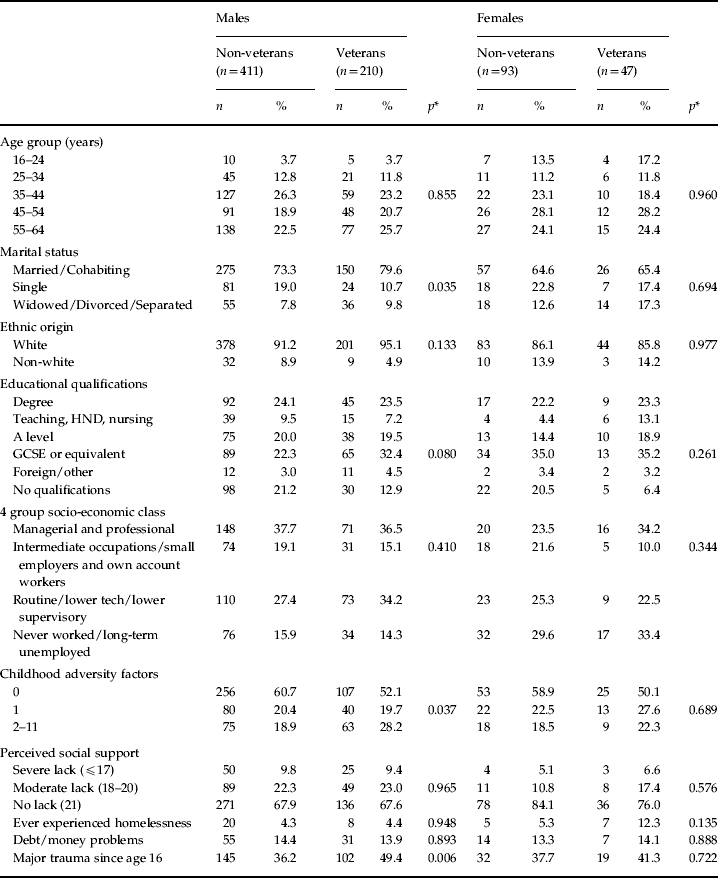
Veterans accounted for 4.7% (257/5480) of the sample, of which 85.2% were male. The median age for male and female post-national service veterans was 49 years [interquartile range (IQR) 40–59] and 46 years (IQR 39–58) respectively. For non-veterans, median age was 47 years (IQR 39–58) and 45 years (IQR 38–56) respectively. Males served for longer on average than females [median 6 years (IQR 2–12) compared with 3 years (IQR 1–5)]. Male veterans were more likely than non-veterans to be married or cohabiting, to report experiencing childhood adversity and to have experienced major trauma since age 16 years (Table 1). Of 102 male veterans who reported experiencing a major trauma since age 16 years, 34% reported that this was related to a military experience. There were no differences between female veterans and non-veterans with regard to any demographic characteristics measured.
Comparison of demographic factors, social support, experience of trauma and childhood adversity between veterans and non-veterans by sex

Weighted percentages to account for survey design; frequencies are unweighted and may not add up due to missing values.
* Pearson's χ2 test with Rao & Scott correction for survey data.
Mental health and behavioural outcomes
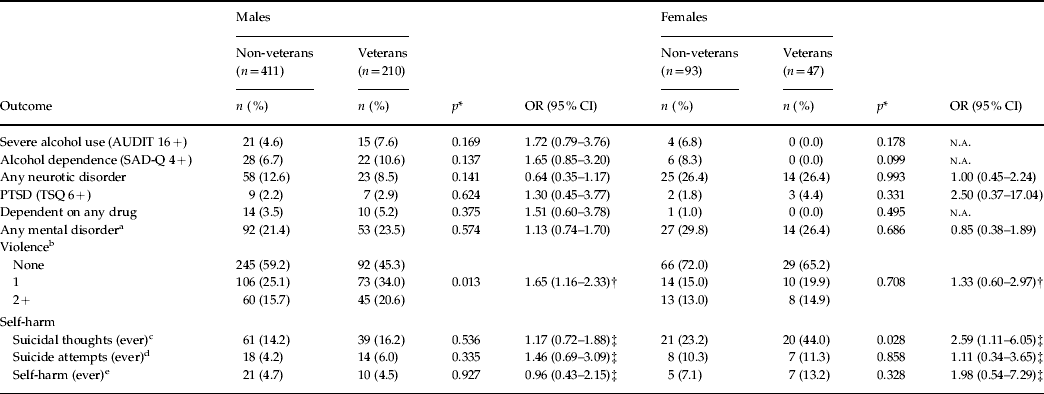
There was no difference in the prevalence of any mental disorders examined between veterans and non-veterans (Table 2) or in self-harm or suicidal behaviours for males according to veteran status. However, male veterans did report more violent behaviours than non-veterans. This association remained significant after adjustment for childhood adversity [OR (ordinal regression) 1.44, 95% CI 1.01–2.06]. Female veterans were more likely to report ever experiencing suicidal thoughts than non-veterans (Table 2).
Comparison of mental health and behavioural outcomes between veterans and non-veterans by sex

OR, Odds ratio; CI, confidence intervals; AUDIT, Alcohol Use Disorders Identification Test; SAD-Q, Severity of Alcohol Dependence Questionnaire; PTSD, post-traumatic stress disorder; TSQ, Trauma Screening Questionnaire.
All percentages are weighted to account for survey design. Frequencies are unweighted but may not add up due to missing values.
a Includes severe alcohol use, alcohol dependence, any neurotic disorder, PTSD or drug dependence.
b Six possible characteristics, for example: ‘Have you ever hit or thrown things at your spouse or partner? Have you been in a physical fight since age 15? Do you often have temper outbursts or get so angry that you lose control?
c Have ever thought of taking their own life.
d Have ever made an attempt to take their life.
e Have ever deliberately harmed themselves in any way but without the intention of killing themselves.
* Pearson's χ2 with second-order Rao & Scott correction for survey data.
† Ordered logistic regression accounting for weighting and clustering, but not stratification.
‡ Logistic regression accounting for weighting and clustering, but not stratification.
No difference in any specific measure of mental health or behavioural outcome was observed between veterans whose last traumatic experience was military-related or not. Length of time since leaving the services was not associated with any of the mental health or behavioural outcomes considered.
Treatment seeking
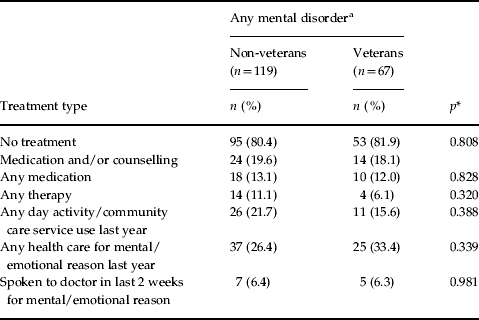
There was no evidence that any measure of treatment seeking differed between veterans and non-veterans (Table 3).
Comparison of treatment use for any mental disorder between all non-veterans and veterans

All percentages are weighted to account for survey design. Frequencies are unweighted but may not add up due to missing values.
a Includes any alcohol dependence, severe alcohol use, drug dependence, PTSD and any neurotic disorder.
* Pearson's χ2 test with Rao & Scott second-order correction for survey data.
Length of service
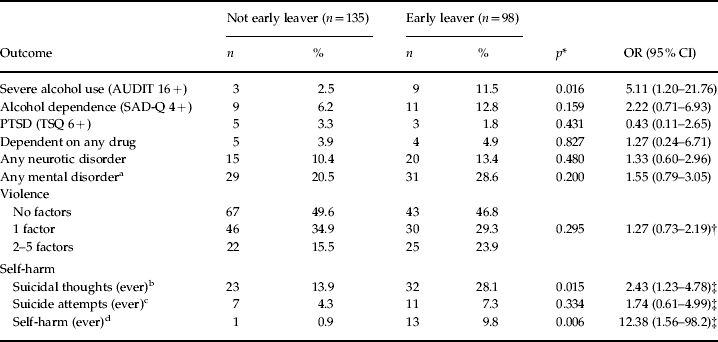
Early leavers were younger than longer serving veterans and they were more likely to be heavy drinkers (Table 4), this association remained after adjustment for age (OR 4.16, 95% CI 1.08–16.00). No differences were found in the number of violent characteristics endorsed but early leavers were more likely to report ever experiencing suicidal thoughts and ever having self-harmed (Table 4). These associations remained after adjusting for age (OR 2.37, 95% CI 1.21–4.66 and OR 12.36, 95% CI 1.61–94.68 respectively).
Comparison of mental health outcomes, violence and self-harm between early service leavers (<4 years) and those who served for ⩾4 years

OR, Odds ratio; CI, confidence intervals; AUDIT, Alcohol Use Disorders Identification Test; SAD-Q, Severity of Alcohol Dependence Questionnaire; PTSD, post-traumatic stress disorder; TSQ, Trauma Screening Questionnaire.
All percentages are weighted to account for survey design, frequencies are unweighted.
a Severe alcohol use, alcohol dependence, any neurotic disorder, PTSD or drug dependence.
b Have ever thought of taking their own life.
c Have ever made an attempt to take their life.
d Have ever deliberately harmed themselves in any way but without the intention of killing themselves.
* Pearson's χ2 with second order Rao & Scott correction for survey data.
† Ordered logistic regression accounting for weighting and clustering, but not stratification.
‡ Logistic regression accounting for weighting and clustering, but not stratification.
There was some evidence to suggest that early service leavers with any neurotic disorder and any mental disorder were less likely to seek help for a mental or emotional reason in the last 2 weeks (p=0.028 and p=0.047 respectively).
Discussion
Main findings
This is the first UK study of veterans' mental health using a population-based comparison group. The results did not support our main hypotheses nor those anticipated from previous research or media assumptions. First, being a veteran was not associated with the health outcomes examined, although male veterans reported more violent behaviours and female veterans reported more suicidal thoughts. Second, no evidence was found to suggest that veterans differed from non-veterans in terms of social support, experiences of homelessness or money problems, but male veterans did endorse more childhood adversity factors than male non-veterans. Third, there was no evidence to support a difference in most aspects of treatment-seeking behaviour between ‘ill’ veterans and ‘ill’ non-veterans. Fourth, leaving early from the services was associated with being a heavy drinker, ever having suicidal thoughts and ever having self-harmed.
Explanations
These data come from a representative probability sample of adults living in England; the response rate of 57% is comparable with other nationally representative studies. Results are generalizable to the community-dwelling population of England as data have been weighted to account for both sampling probability and non-response (McManus et al. Reference McManus, Meltzer, Brugha, Bebbington and Jenkins2009). Data were not available to compare the response rate of veterans to non-veterans. However, recent research shows that non-response rate alone is a weak predictor of non-response bias and that changes in non-response rates do not necessarily alter survey estimates (Groves, Reference Groves2006). Furthermore, a comparable group of non-veterans from the same population could be identified, which has been lacking in previous studies (Orner et al. Reference Orner, Lynch and Seed1992; Fontana & Rosenheck, Reference Fontana and Rosenheck1994). Many veteran studies are based on selected samples and are therefore not representative of all veterans and/or conflicts (Wessely & Jones, Reference Wessely and Jones2004). In contrast, the current study includes a heterogeneous group of veterans whose military role, combat and deployment experiences differ.
The lack of evidence for a difference between the veteran and non-veteran groups may be partly due to the military being a ‘selected’ healthy population, which, in terms of lower mortality, has been found to produce a ‘healthy warrior’ effect in comparison with the general population. This effect has been reported to persist after leaving the services but to gradually wane, such that the mortality rate of veterans eventually meets that of the general population (Seltzer & Jablon, Reference Seltzer and Jablon1974).
Many veteran studies have been conducted in the context of media and public interest in PTSD and ‘Gulf War syndrome’, which may have influenced questionnaire responses. Even true population samples may be vulnerable to framing effects (Di Blasi et al. Reference Di Blasi, Harkness, Ernst, Georgiou and Kleijnen2001) although we did not find evidence of such an effect in our previous study of 1991 Gulf War veterans (Murphy et al. Reference Murphy, Hooper, French, Jones, Rona and Wessely2006). The potential for such information bias is nevertheless reduced in the current study since respondents were not selected on the basis of their military service and questions on military service were embedded within a range of questions covering different subjects.
We did not find that male veterans experience greater levels of mental health problems than male non-veterans, despite reporting more childhood adversity. While it is known that childhood adversity can adversely impact upon subsequent mental health problems (Zaidi & Foy, Reference Zaidi and Foy1994; Iversen et al. Reference Iversen, Fear, Simonoff, Hull, Horn, Greenberg, Hotopf, Rona and Wessely2007), it is possible that military service might confer protective factors that counteract any negative impacts of combat exposure (Aldwin et al. Reference Aldwin, Levenson and Spiro1994).
Comparisons with other research
While we report a low prevalence of PTSD, previous studies have reported considerably higher rates (e.g. O'Brien & Hughes, Reference O'Brien and Hughes1991). Our findings are consistent with a representative study of veterans leaving the services between 1997 and 2001, who were not experiencing adversity in terms of mental illness or unemployment (Iversen et al. Reference Iversen, Nicolaou, Unwin, Greenberg, Dandeker, Ross and Wessely2005 b). The majority of this veteran cohort with mental health problems was not seeking treatment due to feeling able to deal with the problem and/or due to perceived stigma (Iversen et al. Reference Iversen, Dyson, Smith, Greenberg, Walwyn, Unwin, Hull, Hotopf, Dandeker, Ross and Wessely2005 a). Iversen et al. (Reference Iversen, Nicolaou, Unwin, Greenberg, Dandeker, Ross and Wessely2005 b) also reported that early leavers may experience more symptoms of psychiatric distress and, furthermore, Jones et al. (Reference Jones, Fear, Greenberg, Hull and Wessely2009) reported that 74% of soldiers hospitalized with mental health problems had left or were discharged, from the Services prematurely. The finding of significant differences between early service leavers and later leavers in terms of alcohol use, suicidal thoughts and self-harm, despite limited power, suggests that early service leavers warrant further investigation.
Unlike the current study, the majority of literature on the health of veterans has found an association between military service and adverse mental health (e.g. Kulka et al. Reference Kulka, Schlenger, Fairbank, Hough, Jordan, Marmar, Weiss and Grady1990). US-based studies, in particular, report higher rates of mental disorders in veterans; however, many of these have not made true population-based comparisons, have been limited to veterans of a particular conflict or have examined still-serving personnel who have recently returned from a campaign. Vietnam-era studies may have found higher rates of psychopathology, possibly due to the negative public reaction to the campaign. A US veteran study nested within a large epidemiological cohort, which included non-veteran controls and also examined a heterogeneous veteran group in terms of experiences, found few differences in psychiatric morbidity in World War II (WWII), Korean, Vietnam and post-Vietnam era veterans compared with non-veterans in each era, although post traumatic stress was not measured. Non-veterans had higher lifetime rates of affective and anxiety disorders (WWII era) and major depressive and schizophrenic disorders (Vietnam era); although post-Vietnam era veterans (1975–1980/1985) were found to have higher lifetime rates of substance use and antisocial disorders (Norquist et al. Reference Norquist, Hough, Golding and Escobar1990). Another nationally representative study estimated the PTSD prevalence amongst non-wounded US Vietnam War veterans to be 3.5%, rising to 20% in those who reported being wounded (Helzer et al. Reference Helzer, Robins and McEvoy1987). Recently, rates of treatment seeking among serving US veterans of Iraq and Afghanistan were found to be similar to those in the general US population (Schell & Marshall, Reference Schell, Marshall, Tanielian and Jaycox2008).
Limitations
The number of veterans included is small; thus, this study has limited statistical power. Furthermore, the number of personnel who have served in Iraq and Afghanistan is small.
No information about pre-service mental health status, service type, service arm, deployment history, combat exposure or military role was available. In prior studies of veterans, these factors have been identified as being associated with PTSD and other disorders (Fontana & Rosenheck, Reference Fontana and Rosenheck1994; Ikin et al. Reference Ikin, Sim, McKenzie, Horsley, Wilson, Moore, Jelfs, Harrex and Henderson2007). Furthermore, individuals in communal establishments, including nursing homes and psychiatric hospitals, as well as those who are currently homeless, were not included in the original sample. The veteran sample represents the ‘survivors’ and excludes those who may be institutionalized for service-related mental and/or physical problems and may lead to an underestimation of disorder rates.
The TSQ does not include PTSD diagnostic criteria relating to avoidance and numbing; however, it has been validated against the Post-traumatic Stress Symptom Scale – Self-report (Foa et al. Reference Foa, Riggs, Dancu and Rothbaum1993) and the Clinician-Administered PTSD scale diagnostic interview (Brewin et al. Reference Brewin, Rose, Andrews, Green, Tata, McEvedy, Turner and Foa2002) with good sensitivity (86%) and specificity (93%) (Brewin et al. Reference Brewin, Rose, Andrews, Green, Tata, McEvedy, Turner and Foa2002). It has been reported that the prevalence of PTSD is overestimated when based on self-reported questions compared with clinical interviews and thus even the low prevalence of PTSD reported here is likely to be overestimated (Engelhard et al. Reference Engelhard, van den Hout, Weerts, Arntz, Hox and McNally2007). The various subcategories of neurotic disorder could not be delineated due to small numbers. Further, while self-reported measures of alcohol use may underestimate actual use, this is likely to impact reporting in both groups. The AUDIT has been found to have good sensitivity and specificity (Piccinelli et al. Reference Piccinelli, Tessari, Bortolomasi, Piasere, Semenzin, Garzotto and Tansella1997). All measures of violence behaviours have limitations in relation to differential and non-differential measurement error; however, self-reported measures have been shown to capture a greater prevalence of violence than other measures (Lidz et al. Reference Lidz, Mulvey and Gardner1993).
Conclusions
These results do not suggest that the post-national service veteran population in England fares any worse than a comparable population of non-veterans in terms of psychological ill health, marital stability, social disadvantage or treatment-seeking behaviour. The findings do provide some evidence that early service leavers may experience more mental health problems than those who served for longer.
Acknowledgements
All work for this paper was carried out within ACDMH/KCMHR. Both units receive funding from the UK Ministry of Defence. The authors' work was independent of the UK Ministry of Defence, who had no role in the analysis, interpretation or decision to submit this paper. We disclosed the paper to the Ministry of Defence at the point we submitted it for publication. S. Wessely and M. Hotopf are partially funded by the South London and Maudsley NHS Foundation Trust/Institute of Psychiatry National Institute of Health Research Biomedical Research Centre. The APMS was commissioned by the NHS Information Centre for health and social care for the Department of Health.
Declaration of Interest
N. T. Fear, C. Woodhead, M. Hotopf, S. Wessely, R. J. Rona and A. Iversen work for the Academic Centre for Defence Mental Health/King's Centre for Military Health Research at King's College London, which receives funding from the UK Ministry of Defence. S. Wessely is an honorary Civilian Consultant Advisor in Psychiatry to the British Army.