Introduction
Agriculture is the main economic activity in many low-to-moderate income countries (World Bank, 2017; FAOSTAT, 2018) and employs a large number of workers worldwide (UNEP, 2011; ECLAC, 2017; FAOSTAT, 2018). In Brazil, crop and livestock production contributes substantially to economic growth—roughly 23% of the gross domestic product (GDP) as of 2016 (USD 336.9 billion) (MAPA, 2017a; 2017b). However, it has also been associated with high levels of greenhouse gas emissions (GHGs) and environmental degradation (Graziano da Silva, Reference Graziano da Silva2010; Vilela et al., Reference Vilela, Martha, Macedo, Marchão, Guimarães, Pulrolnik and Maciel2011; MAPA, 2017a; 2017b), as well as increasing income inequality in rural areas (Abramovay, Reference Abramovay2000; Graziano da Silva and Campanhola, Reference Graziano da Silva and Campanhola2004; Balsan, Reference Balsan2006). Beef cattle production, in particular, has been associated with very low incomes and high levels of land degradation, abandonment and deforestation (Margulis, Reference Margulis2004; Fearnside, Reference Fearnside2005; Garrett et al., Reference Garrett, Niles, Gil, Dy, Reis and Valentim2017a). In this context, there has been a growing impetus to develop alternative agricultural models that achieve higher productivity and incomes, while reducing environmental impacts, most notably deforestation and GHGs (Nair, Reference Nair1991; Porfirio-Da-Silva, Reference Porfirio-Da-Silva2007; Graziano da Silva, Reference Graziano da Silva2010; Lemaire et al., Reference Lemaire, Franzluebbers, de F Carvalho and Dedieu2014; Reis et al., Reference Reis, Rodrigues, Conceição and Martins2016). Improving the sustainability of agriculture in Brazil is a key component of the country's plan to achieve their emissions reduction targets.
Considering this challenge, two agricultural models that have been encouraged by the Brazilian government, mainly in the Amazon and Cerrado region, are integrated crop−livestock systems (iCL) and integrated crop−livestock−forestry systems (iCLF)Footnote a (Brasil, 2012). These types of production systems aim to improve the sustainability of agriculture production through the integration of various types of agricultural production (i.e. crops, livestock and forestry) in the same area, via intercropping, or rotations, to obtain synergies among agroecosystem components (Nair, Reference Nair1991; Macedo, Reference Macedo2009; Balbino et al., Reference Balbino, Barcellos and Stones2011; Lemaire et al., Reference Lemaire, Franzluebbers, de F Carvalho and Dedieu2014).
Integrated systems represent a strategy to intensify resource uses—labor, land and capital, to increase productivity, while also diversifying production and sparing land for conservation or other uses (Franzluebbers, Reference Franzluebbers2007; Herrero et al., Reference Herrero, Thornton, Notenbaert, Wood, Msangi, Freeman, Bossio, Dixon, Peters, Steeg, Lynam and Rao2010; Lemaire et al., Reference Lemaire, Franzluebbers, de F Carvalho and Dedieu2014; Reis et al., Reference Reis, Rodrigues, Conceição and Martins2016). Production diversification has the additional benefit of reducing market risk, since farmers have opportunities to manage their product portfolio to take advantage of agricultural market price fluctuations (Herrero et al., Reference Herrero, Thornton, Notenbaert, Wood, Msangi, Freeman, Bossio, Dixon, Peters, Steeg, Lynam and Rao2010; Lazzarotto et al., Reference Lazzarotto, dos Santos, de Lima and de Moraes2010).
A key feature of integrated systems, mainly iCL, is that they can be used to recover degraded pastures (Kluthcouski et al., Reference Kluthcouski, Stone and Aidar2003; Macedo, Reference Macedo2009; Vilela et al., Reference Vilela, Martha, Macedo, Marchão, Guimarães, Pulrolnik and Maciel2011; Salton et al., Reference Salton, Mercante, Tomazi, Zanatta, Concenço, Silva and Retore2014) by using residual fertility from the crop rotation to restore soil quality and finance further system improvements (Vilela et al., Reference Vilela, Martha, Macedo, Marchão, Guimarães, Pulrolnik and Maciel2011; Costa et al., Reference Costa, de Almeida, de A Pereira, Kichel and Macedo2012). Prior studies in Brazil, especially in the Cerrado, have also shown that iCL systems can increase production efficiency since they contribute to: (i) improvements in soil quality; (ii) water conservation; (iii) an increase of animal performance; and (iv) a reduction in GHGs per unit of food produced (Kluthcouski et al., Reference Kluthcouski, Stone and Aidar2003; Macedo, Reference Macedo2009; Vilela et al., Reference Vilela, Martha, Macedo, Marchão, Guimarães, Pulrolnik and Maciel2011; Salton et al., Reference Salton, Mercante, Tomazi, Zanatta, Concenço, Silva and Retore2014). What is less understood is how economically viable these productions systems are in the Legal Amazon region of Brazil, particularly in light of their potentially high initial investment costs (Gil et al., Reference Gil, Garrett, Rotz, Daioglou, Valentim, Pires, Costa, Lopes and Reis2018) and (Appendix 1). This lack of generalized information about the economic performance of iCL in the country's largest cattle and crop production region may help explain its low adoption rates, despite fairly high levels of government support (Martha Júnior et al., Reference Martha Júnior, Alves and Contini2011; Vilela et al., Reference Vilela, Martha, Macedo, Marchão, Guimarães, Pulrolnik and Maciel2011; De Oliveira et al., Reference De Oliveira, Freitas, Kluthcouski, Ribeiro, Adriano, Cordeiro, Teixeira, Augusto, Castro, Vilela and Balbino2013; Salton et al., Reference Salton, Mercante, Tomazi, Zanatta, Concenço, Silva and Retore2014; Reis et al., Reference Reis, Rodrigues, Conceição and Martins2016).
The aim of this paper is to conduct a comprehensive economic viability analysis of iCL vs a ‘typical’ (as defined below) continuous crop or livestock farm in the Brazilian Legal Amazon state of Mato Grosso, which is the country's largest producer of soybean and cattle. The evaluation process focuses on assessing the return on investment (ROI) of these systems to inform both producers' decision-making processes as well as bank financial evaluations for funding iCL projects. The integrated system evaluated in this study pertains to soybeans double cropped with corn, followed by pasture and beef cattle grazing, which is the most common integrated system in the Brazilian Amazon and Cerrado (Nair, Reference Nair1991; Macedo, Reference Macedo2009; Balbino et al., Reference Balbino, Barcellos and Stones2011; Lemaire et al., Reference Lemaire, Franzluebbers, de F Carvalho and Dedieu2014). Our analysis relies on experimental data for a period of 7 years: 2005–2012. In addition to conducting a specific assessment of the case of Mato Grosso, the methods used here can inform future efforts to evaluate the economic viability and returns of iCL at broader scales.
Material and methods
Case selection
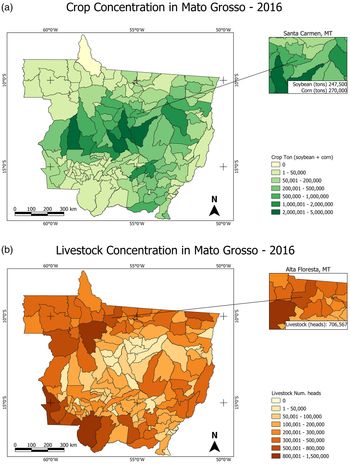
Our analysis focuses on two representative crop and livestock regions in the state of Mato Grosso, Brazil, one of the largest agricultural frontiers in the world (IBGE, 2017; IMEA, 2019; MAPA, 2017a, 2017b). Pastures occupy a majority of the area, followed by soybeans, which are often followed by corn during the course of a single year. Our livestock data were acquired from the municipality of Alta Floresta, in the North region of the state (Fig. 1b), which had the fifth largest cattle herd of the state (706,500 animals) in 2016. Our cropping data were acquired from the municipality of Santa Carmem, in the Mid-North region of the state (Fig. 1a), where about 40% of the soy production occurred in 2016.
(a) Crop concentration in Mato Grosso, 2016. (b) Livestock concentration in Mato Grosso, 2016.

The great concentration of agricultural production in the focal livestock and crop regions makes these cases globally important. Yet, they may not be generalizable to all regions within the state, which contains a great deal of climate, soil and institutional variability. The state spans three ecological biomes: the Amazon, Cerrado and Pantanal. Since colonization of the region did not begin in earnest until 1960, it is still a highly dynamic environment characterized by agricultural systems across a range of farm sizes and technology levels.
Defining a ‘typical’ crop and livestock farm in Mato Grosso
We defined the ‘typical’ crop and livestock systems for the North and Mid-North regions of Mato Grosso for the year 2005Footnote b using farm observations, meetings with local agricultural experts, including farmers, retailers, technicians, consultants, trading managers and data from the Mato Grosso Institute of Agricultural Economics (IMEA). IMEA carries out a comprehensive yearly economic survey focusing on the main agricultural commodities in Mato Grosso: soybean, corn, cotton and beef cattle. These surveys are performed in all Mato Grosso regions using focus group meetings that include farmers and representatives from agricultural organizations and businesses. The purpose of these meetings is to gather up-to-date information about costs, revenue, productivity, investments, farm size, management practices, labor and infrastructure for each commodity across farms in the state.
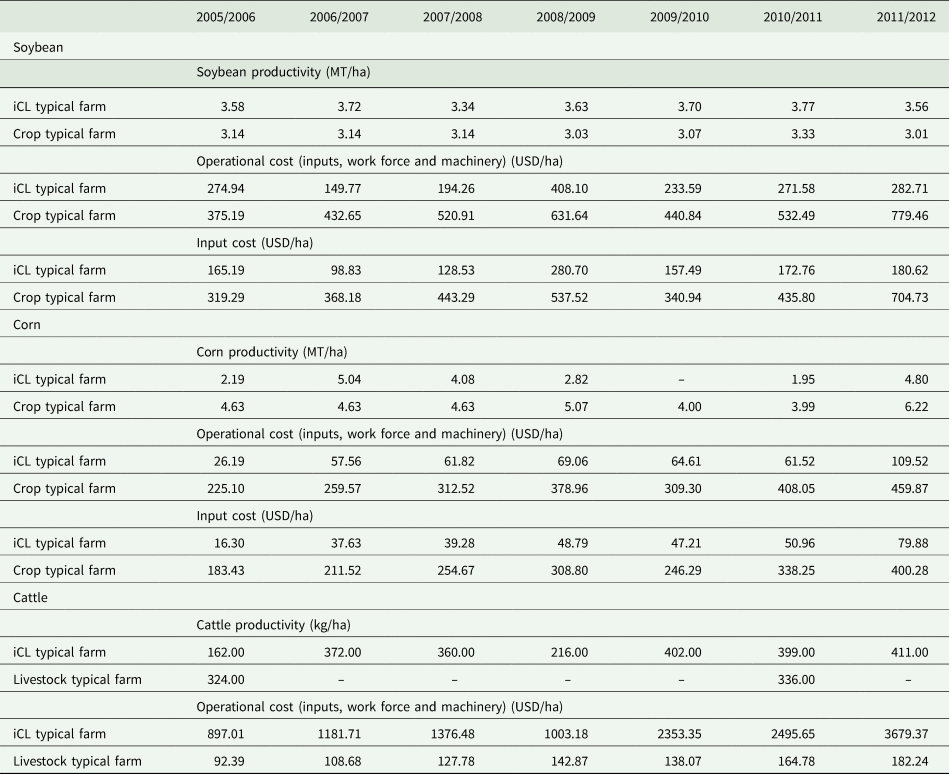
Based on these data we determined that the typical farm size in Mato Grosso is 700 ha of cultivated land area. The typical crop farm is defined by an intensive and specialized production system with two crop seasons per year: soybean (Glycine max) (October–February) and corn (Zea mays) (February–June/July). The initial investment required for the operation of this continuous soybean/corn system was USD 765.63Footnote c ha−1, excluding the land acquisition cost.Footnote d This farm possesses a high level of technology in all production stages with high investment in infrastructure and inputs. As a consequence, it has high soybean productivity levels (av. 3.12 MT ha−1), as well as high production costs (av. USD 530.45 ha−1) (Table 1). Most soybean production in the region is exported through multinational traders. As of 2005, corn area in the state was still limited, but most production is marketed through domestic channels.
Productivity, operating and inputs cost for a typical integrated crop-livestock, continuous crop and continuous livestock farm in Mato Grosso from 2005 to 2012

aMeetings to collect data on the livestock typical farm were accomplished every five years.
biCL typical farm operating cost includes animal acquisition, which is the most important input cost of livestock. In the livestock typical farm, this value is not computed because farmers produce their herds.
In contrast, the typical livestock farm is characterized by traditional cattle ranches with a low level of technology, low productivity and large areas. Farmers do not invest in sophisticated infrastructure, only basic equipment, such as a corral, troughs and fences. Also, farmers do not invest in pasture management. As a consequence, in the dry season, they have difficulties providing adequate nutrition to their herd. The most common cattle breed is Zebu cattle (Bos taurus indicus) and pasture is Urochloa brizantha cv. Marandu. In contrast to soybeans, the cattle are mainly sold for internal markets and this activity is less responsive of international prices and exchange rates. The initial investment required for the operation of a continuous traditional livestock system was USD 173.73 ha−1, excluding the land acquisition cost.
Integrated crop and livestock systems are still somewhat rare in the study region, so it was not possible to use observations and expert knowledge to characterize these systems. Instead, we draw our data from the first iCL experiment established by the Brazilian Agricultural Research Corporation (Embrapa) on a farm called Dona Isabina in the municipality of Santa Carmen in 2005. The farm has 2000 ha cultivated with soybean, corn and rice (Oryza sativa) in rotation and crop sequences. However, the iCL experiment occurred on just 100 ha of the site. The soils in the test site are yellow Oxisols and the topography is flat, with very little slope. The average altitude is 386 m, average annual rainfall of 2064 mm with a dry season from June to September and average temperatures of 27.6°C. To establish pasture rotations and crop sequences, the area of 100 ha was divided into five parcels of 20 ha, bounded by fences. The area in which the experiment was implemented had already been cultivated with soybeans in the summer and pearl millet (Pennisetum glaucum) as a cover crop after the soybean harvest. Scaling this area up to 700 ha (to match the size of typical crop and livestock farms in the region) we calculated an initial investment of USD 863.38 ha−1, excluding land acquisition costs.
Each parcel was cultivated with pastures (Urochloa brizantha cv. Marandu and Urochloa brizantha cv. BRS Piata). The land use of the iCL system followed an annual rotation of crops: soybean or rice in the summer (October–February) and corn or beans (Phaseolus vulgaris) immediately following (February–June). The second crop was intercropped with grass pastures. After the second crop harvest, the cattle were allowed to graze on the pastures that remained, which provided them with additional nutrition during the dry season (June to September) when there is low forage availability.
In the first five years of the experiment the herd was a mixture of male and female Zebu cattle acquired in the region. These animals were sold for slaughter when they reached weight of 480 kg. In the last two years, only males were raised, but still slaughtered when they reached 480 kg. The only supplementation used all year long was mineral salt with an average consumption of 90 g day−1 during the rainy season and 120 g day−1 during the dry season. In the dry season, the cattle also received sorghum silage (Sorghum bicolor), soybean residues, corn and rice produced in the farm processing unit. In all modules, mangers for supplementation and watering were available.
Economic indicators
We used an economic viability analysis approach to compare the economic results of the three agricultural systems (Buarque, Reference Buarque1984; Gitman and Zutter, Reference Gitman and Zutter2014). This method is established in the economic literature as an instrument to evaluate the economic potential of any investment decision (Buarque, Reference Buarque1984; Lapponi, Reference Lapponi2013; Gitman and Zutter, Reference Gitman and Zutter2014). We used data from IMEA to generate typical crop and livestock farm and survey data to generate the iCL farm. Taking into account the lack of available economic performance data for agriculture systems, the use of IMEA and experimental data are the only feasible approaches for establishing the time-series data required to carry out the economic viability analysis presented. The results can be useful for farmers, helping them compare different investment options, as well as for funding agents since they can evaluate different complex agriculture systems using comparable indicators. Since prior studies have identified that a lack of technical information on the economic performance of iCL for both farmers and financers is a key constraint for farmer adoption (Martha Júnior et al., Reference Martha Júnior, Alves and Contini2011; Vilela et al., Reference Vilela, Martha, Macedo, Marchão, Guimarães, Pulrolnik and Maciel2011; De Oliveira et al., Reference De Oliveira, Freitas, Kluthcouski, Ribeiro, Adriano, Cordeiro, Teixeira, Augusto, Castro, Vilela and Balbino2013; Salton et al., Reference Salton, Mercante, Tomazi, Zanatta, Concenço, Silva and Retore2014; Reis et al., Reference Reis, Rodrigues, Conceição and Martins2016; Cortner et al., Reference Cortner, Garrett, Valentim, Ferreira, Niles, Reis and Gil2019), our approach may help enable wider scale adoption of this technology. The financial accounting approach used here, which is based on observed outcomes, is also a useful complement to process models, which predict outcomes based on inputs (e.g. Gil et al., Reference Gil, Garrett, Rotz, Daioglou, Valentim, Pires, Costa, Lopes and Reis2018 for the same region).
We used the following five indicators to assess economic viability and potential economic returns of the iCL system, continuous soy/corn system, and continuous beef cattle system over 7 years (2005–2012): (i) internal rate of return (IRR), (ii) net present value (NPV), (iii) return on investment (ROI), (iv) profitability index (PI) and (v) payback (Gitman and Zutter, Reference Gitman and Zutter2014).Footnote e
Cash flow: To calculate each of these five indicators we first needed to estimate the real cash flow (CF) based on 2005 prices. Following (Lapponi, Reference Lapponi2013):
 $${\rm C}{\rm F}_t = {\rm FC}{\rm O}_t + \Delta I + \Delta {\rm C}{\rm G}_t$$
In which: FCOt = Operating cash flow; ΔI = Net investment in assets; ΔCGt = Net investment in working capital.
Apart from the relationship between costs and revenues, cash flow results take into account interest deductions, taxes and labor charges to demonstrate the cash generation potential of each system.Footnote f As a measure of yearly profitability, we used the net operating profit after income tax (NOPAT).Footnote g It represents the net profit that the system generates to remunerate both the funding entity and the producer (Assaf Neto, Reference Assaf Neto2011; Lapponi, Reference Lapponi2013; Gitman and Zutter, Reference Gitman and Zutter2014). As an inflation indicator, we used the broad consumer price index (IPCA) provided by the Brazilian Institute of Geography and Statistics (IBGE), which is the official inflation index in Brazil.
Investment value: Except for the land value, which was not incorporated into the cash flow, all other infrastructure elements required for production activities were considered as if they had been purchased in the initial year of all production systems, 2005. A market survey was conducted with consultants and equipment retailers to collect prices data in the Mid-North region in 2005, taking into account the infrastructure needed to set up each farm system.
Discount rate: The discount rate defines the present value of future returns (Buarque, Reference Buarque1984; Gitman and Zutter, Reference Gitman and Zutter2014). Choosing a discount rate is one of the most controversial points in economic investment analysis because the choice of incorrect values can lead to suboptimal results and decisions (Buarque, Reference Buarque1984; Lapponi, Reference Lapponi2013). The project economic evaluation literature defines the discount rate as the opportunity cost of investment, which means that it should reflect the expected return value for alternative available investments with similar risk to the activity being analyzed (Buarque, Reference Buarque1984; Lapponi, Reference Lapponi2013; Gitman and Zutter, Reference Gitman and Zutter2014). This approach, although it incorporates correctly the perspective of the discount rate to be used, is limited by the lack of investment alternatives that can serve as a reference (Buarque, Reference Buarque1984).
As a result, the official savings rate is more commonly used in many agricultural investment evaluations, since it represents a low-risk and low return alternative investment option (Buarque, Reference Buarque1984; Gitman and Zutter, Reference Gitman and Zutter2014). In other cases, the economy basic interest rate or long-term interest rates has been used, also indicating low-risk investment alternatives, but with higher returns. An important issue regarding the use of these rates as a reference is no consideration of the investor's profile for defining the interest rate to be used.
Given these drawbacks, our study uses the weighted average cost of capital (WACC), to adjust the variables that make up the investment opportunity cost based on the agent's profile, as well as the level of risk associated with the business being evaluatedFootnote h. The WACC is more appropriate for this evaluation since it considers an agent's decision about which percentage of investment will be funding as well as incorporates market risks of alternative investments (Buarque, Reference Buarque1984; Lapponi, Reference Lapponi2013; Gitman and Zutter, Reference Gitman and Zutter2014). The WACC rate was built taking into account the financial market conditions in Mid-North region in 2005.
Incorporating changing land use and market dynamics
Since our study analyzed the economic viability of the three systems over a 7-year period it was necessary to incorporate changes in land use and markets that were occurring over that period. These dynamics include the growing importance of corn as a second cropFootnote i (resulting in an increase in the on-farm area allocated to integrated crop−livestock systems), changes in the marketing arrangements used by farmers, and a dynamic macroeconomic environment in which real prices for soybean, corn and beef were changing frequently due to growth in demand and exchange rate variations.
Data from IMEA show that corn as a second harvest crop grew by 14.87% per year in the period 2008−2012. To simulate dynamics of land use in the integrated crop−livestock farm, the growth of corn second harvest area in the typical continuous crop farm was used to define the growth of the integrated system areaFootnote j (Kluthcouski et al., Reference Kluthcouski, Stone and Aidar2003; Macedo, Reference Macedo2009; Balbino et al., Reference Balbino, Barcellos and Stones2011; Vilela et al., Reference Vilela, Martha, Macedo, Marchão, Guimarães, Pulrolnik and Maciel2011).
Interviews with farmers and specialized consultants who worked in the North and Mid-North regions in 2005 identified that the most common soybean marketing practice used during that time was to sell their harvest over three periods: (i) 25% of production was sold in advance, from August to October, (ii) 50% of production was sold from November to April, during the harvesting and immediate post-harvest period and (iii) 25% of production was sold from May to July, the period of preparation for another harvest. To adjust the revenue dynamics to the trading practices of that period, the crop sales process was adjusted according to the moment of the soybean harvestFootnote k. Soy sale prices for each period are calculated as the average of the prices observed during the months of soy trading. Similarly, corn sale prices are calculated as the average of the prices observed from September to November, the main months for corn trading.
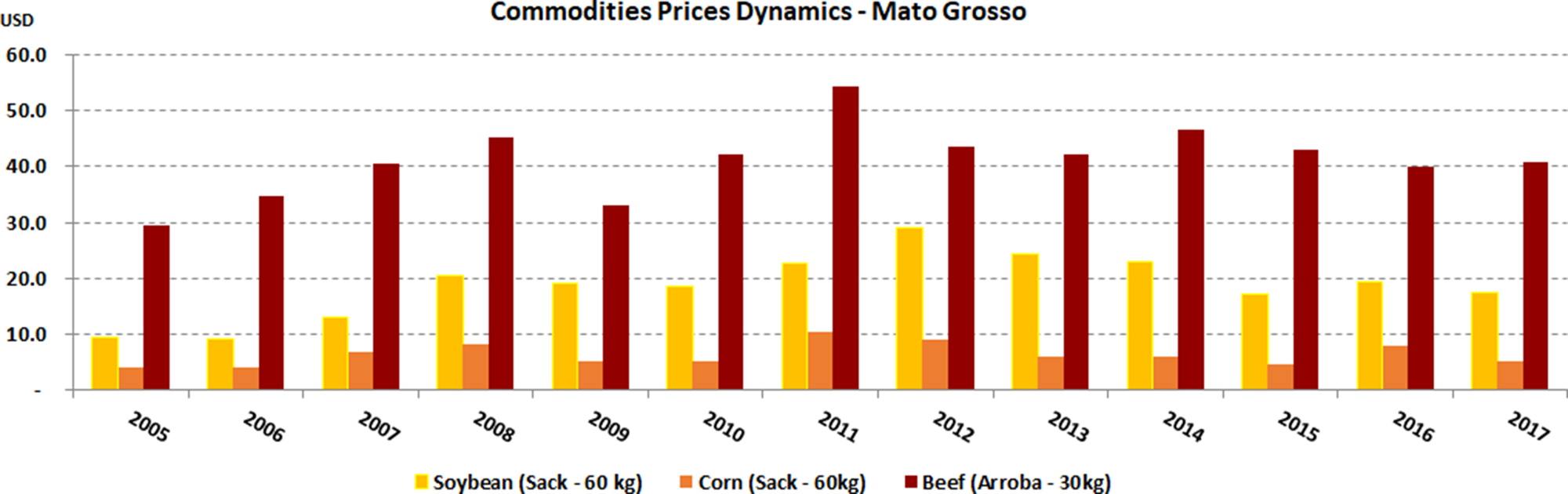
Of particular importance, soybean prices were very low in 2005 and 2006, while production costs remained high (CEPEA, 2007). However, after 2007 the soybean price steadily increased, a trajectory influenced by China's consolidation as the main Brazilian soybean importer (Fig. 2). In 2012, the soybean price in the Mid-North of Mato Grosso—USD 28.94 per sack (60 kg), was three times higher than the value observed in 2005—USD 9.55 per sack; (IMEA, 2016). Nonetheless, in 2009, the financial crisis complicated production and trading. The devaluation of the Brazilian currency during this period (9% in one year), led to increased crop production costs (10% in 2009), largely as a result of fertilizer imports, while soybean prices remained low (IMEA, 2019).
Average commodity prices in Mato Grosso from 200 to 2017.

In contrast, corn prices increased during 2010–2012 as a consequence of financial crisis of 2009, since corn production is oriented toward domestic consumption and is not as influenced by global commodity markets. The same domestic market orientation and price dynamics can be seen in the prices for beef, which achieved a historic high price in 2011, USD 54.40 per “arroba” (30 kg of live weight). However, a considerable portion of Mato Grosso's beef production is exported, 22.1% on average in the last 5 years (MAPA, 2017b), destined mainly for EU, Russia, China and Middle East (MAPA, 2017b; IMEA, 2019).
Results
Productivity
The average cattle productivity in the iCL farm (331.71 kg ha−1) was 5 times higher than the typical livestock farm (63.3 kg ha−1) (IMEA, 2019) due to the availability of higher quality pasture during the dry period of the year. The productivity of soybean in the iCL farm was also on average 16% higher than crop typical farm during the whole study period (Table 1). On the other hand, the input cost of iCL system was 62% lower than the continuous crop farm. Taking into account the high contribution of fertilizers to input costs, this association between higher productivity and lower input cost is likely related to the positive influence of the integrated systems on soil nutrient availability (Carvalho et al., Reference Carvalho, Raucci, Cerri, Bernoux, Feigl, Wruck and Cerri2010; Garrett et al., Reference Garrett, Niles, Gil, Gaudin, Chaplin-Kramer, Assmann, Assmann, Brewer, de Faccio Carvalho, Cortner, Dynes, Garbach, Kebreab, Mueller, Peterson, Reis, Snow and Valentim2017b). Further systematic measurement of soil nutrient availability is needed to confirm this hypothesis. A different result was observed with corn. Since corn had little economic importance at the time that the iCL experiment was started at the Dona Isabina farm and the main objective was to provide agronomic benefits for pasture, low productivity corn seeds were used. Moreover, in 2009 and 2010 there was an intense dry period at the crop germination stage which affected productivity.
Cash flowsFootnote l
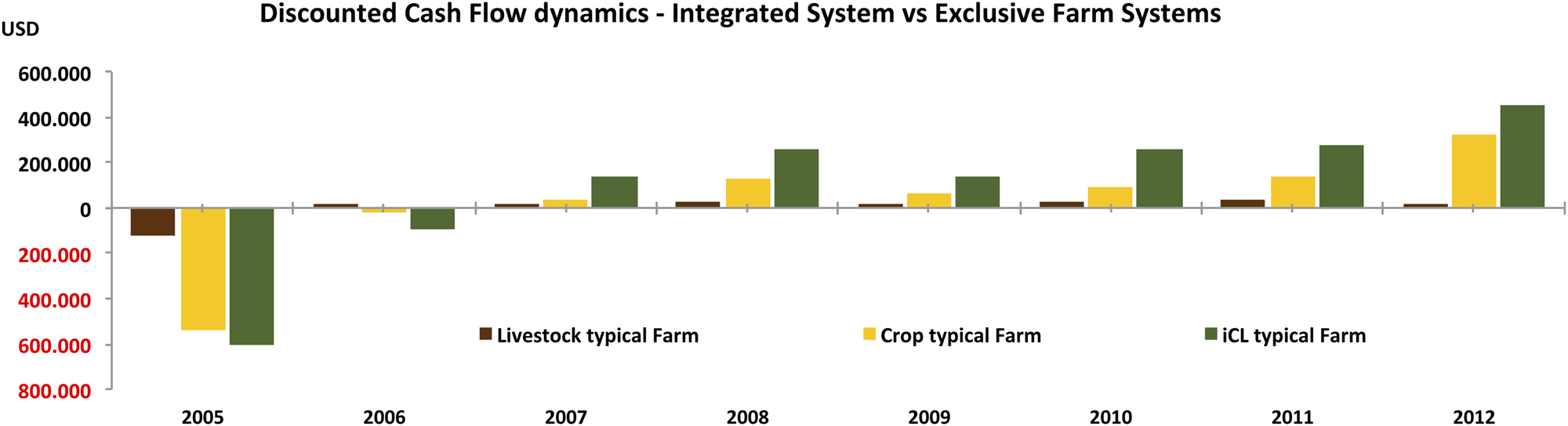
The iCL system had the largest investment costs (negative cash flow in years one and two), but also had the largest positive cash flows throughout the remainder of the study period, achieving a positive result of USD 654.04 ha−1 in 2012 compared to USD 460.85 ha−1 for continuous cropping and UDS 27.59 ha−1 for continuous livestock (Fig. 3). Macroeconomic fluctuations explain most of the changes in cash flows over the study period. In particular, soybean and beef prices increased during the study period (Fig. 2).
Discounted cash flow of a typical integrated crop-livestock, continuous crop and continuous livestock farm in Mato Grosso from 2005 to 2012.

During June to September most continuous livestock farms have to sell off part of their herd, since they do not have conditions to feed them (IMEA, 2016; Valentim, Reference Valentim, Pereira and Pedreira2016; Gil et al., Reference Gil, Garrett, Rotz, Daioglou, Valentim, Pires, Costa, Lopes and Reis2018; Reis et al., Reference Reis, Kamoi, Pedreira, Michetti, Gimenez, Mombach, Silva, Dias-Filho and Andrade2019), which is thought to cause declines in the local cattle price. The higher pasture productivity obtained in the iCL system on the Dona Isabina farm, translated to higher cattle productivity (331.71 kg ha−1 annual average) (Table 1), and enabled this farm to keep their animals during the annual dry season. Indeed, the pasture management strategy implemented at Dona Isabina provided an annual increase of 14% in cattle productivity over the seven years. Moreover, in 2012, the annual cattle productivity was 2.5 times higher than its cattle productivity in 2005 (Table 1). The seasonal dilemma of traditional cattle ranches also enabled the Dona Isabina farm to acquire animals at a low price during the dry season and sell them in periods when prices were high. The seasonal advantage and the high cattle productivity largely explain the better economic results of iCL vs continuous cattle (Fig. 3).
The iCL farm also resulted in higher cash flows than the continuous crop farm (Fig. 3), due to the combination of higher productivity and, on average, 62% lower production costs and 51% lower operating costs (Table 1). The large reduction in production costs can be attributed to lower fertilizer needs due to improved soil fertility from both manure and nitrogen fixing legumes in the pasture.
The economic fragility of traditional livestock is evidenced by the smaller cash flow throughout the study period (on average USD 23,131.62 vs USD 109,164.24 for continuous cropping and USD 204,318.97 for the integrated system).
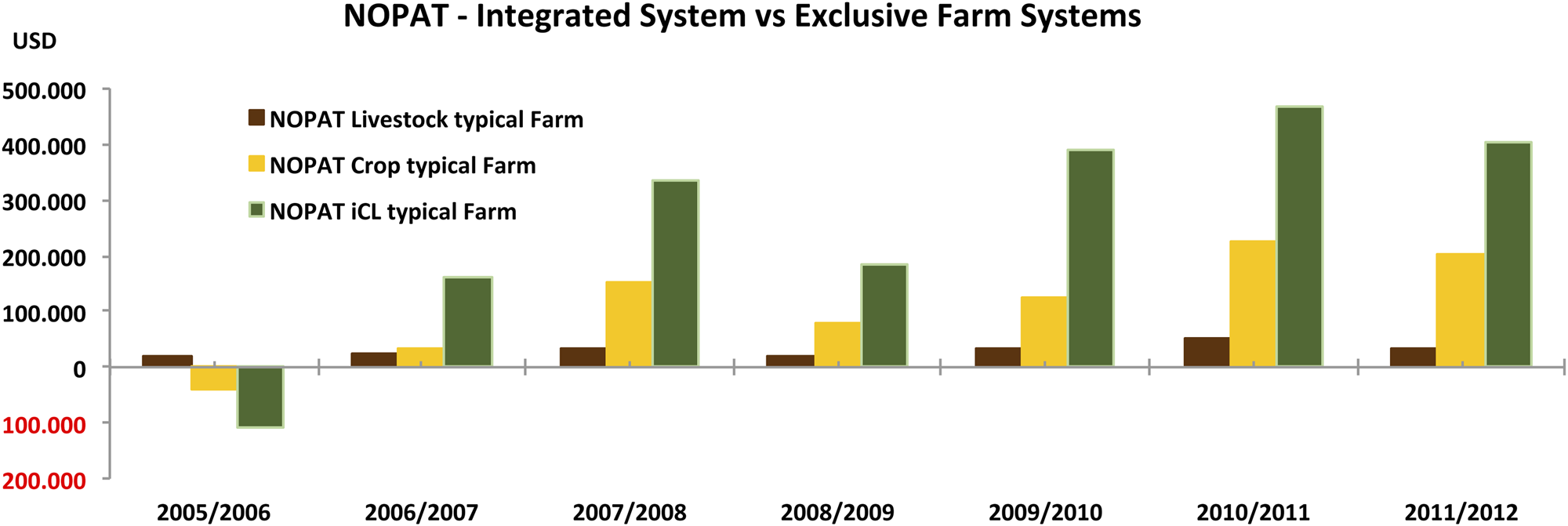
The iCL farm also outperforms the continuous cropping and continuous livestock systems in terms of the NOPAT (Fig. 4). This indicator, which can be interpreted as the annual system capacity to provide economic return after taxes and financial expenses (e.g. interest on debt), indicated that the iCL farm provided a greater money supply than the continuous crop and livestock systems throughout the study period, aside from the initial year.
NOPAT of a typical integrated crop-livestock, continuous crop and continuous livestock farm in Mato Grosso from 2005 to 2012.

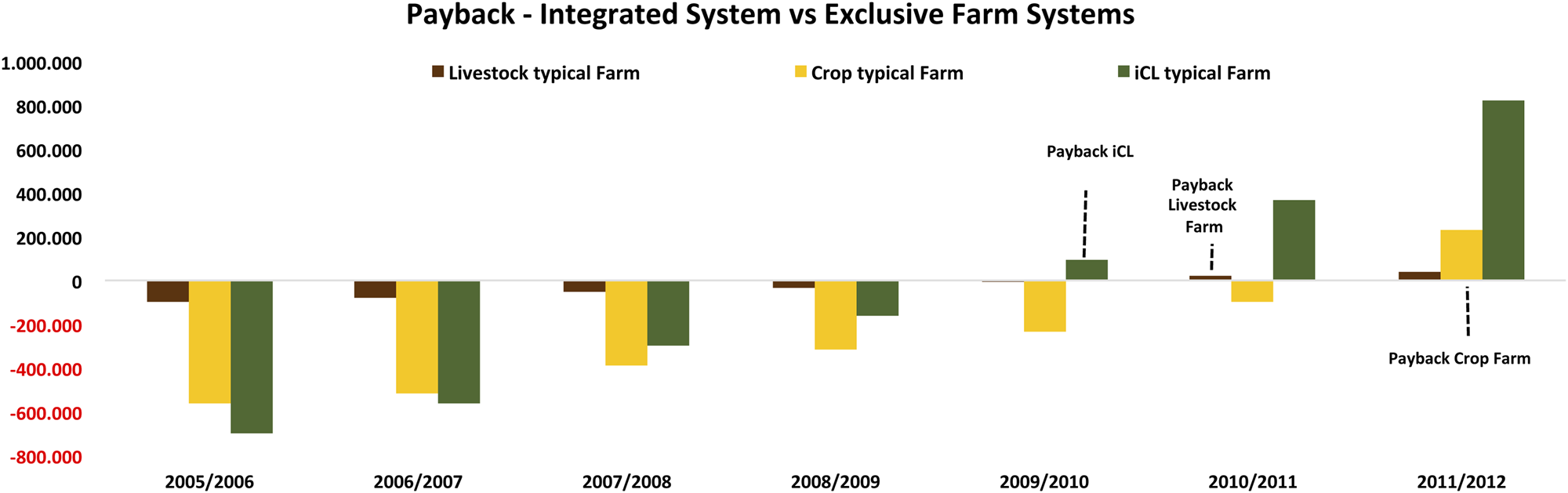
Another economic indicator widely used in the project analysis approach is the recovery period of the investment (the number of years of positive cash flows it takes to repay the initial investment and negative cash flows), known in the literature as the payback period. The iCL farm recovered the investment after 4 years (Fig. 5) while the continuous crop did not recover their investment until year 6. The livestock system recovered the investment after 5 years. In the end of seventh year, the continuous crop and livestock farms had an accumulated cash flow of USD 228,207.46 and USD 40,313.76, respectively. However, the iCL farm had accumulated USD 825,868.81.
Payback of a typical integrated crop-livestock, continuous crop and continuous livestock farm in Mato Grosso from 2005 to 2012.

Economic viability indicators
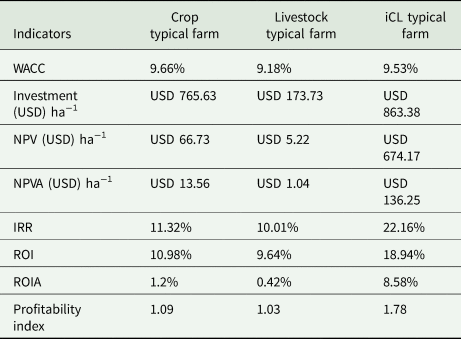
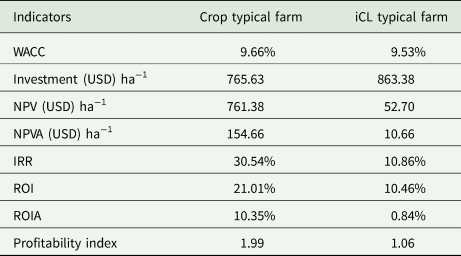
The cash flow of all systems provides useful information to elaborate the set of economic viability indicators displayed in Table 2. Across all indicators (NPV, internal rate of return, payback, profitability index and ROI) the iCL system performs substantially better than the continuous crop and livestock farms. The exception is the higher upfront investment cost per hectare. The livestock farm has the worst performance across all indicators.
Economic viability indicators for a typical integrated crop—livestock, continuous crop and continuous livestock farm in Mato Grosso from 2005 to 2012

Scenario Analysis
Different Interest Rates
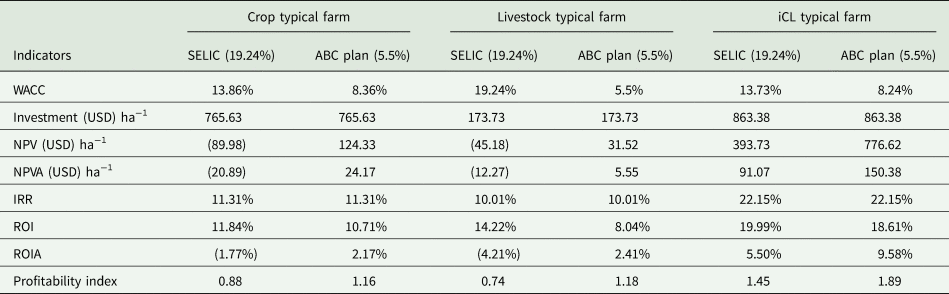
All the results presented above are quite sensitive to the discount rate. Here, we used the Center-West Constitutional Fund rate, 8.75%, to construct the WACC, as well as the entire set of economic viability indicators because in 2005 there was no specific government loan program to encourage iCL in Brazil. However, in 2010, Brazilian Government implemented the low carbon agriculture plan (ABC plan) with incentives and low interest rates for more sustainable agricultural systems, including iCL. The ABC plan offered interest rates of 5.5% in 2010 (Brasil, 2012). However, the performance of iCL relative to the other systems does not change if we use the ABC plan rate or the basic interest rate of Brazilian economy (SELIC) in 2005 (19.24%), a rate used to evaluated investments in stock market (Table 3).
Simulation with different interest rates—economic viability indicators for a typical integrated crop-livestock, continuous crop and continuous livestock farm in Mato Grosso from 2005 to 2012

Different Prices
Between 2005 and 2006, soybean prices were very low in the global market (Fig. 2). Both soybean and corn prices peaked in 2010 and then again in 2016. To capture the effects of these higher prices we used the average soybean and corn prices observed in the Mid-North region between 2013 and 2017. For consistency, the cattle prices were also adjusted to the average prices in the Mid-North region between 2013 and 2017. Moreover, the corn planted area was increased, to match the growth in the average farm-level planted area in the Mid-North in the last 10 years (2007–2017: 46.44%). All other conditions were kept unchanged. As a result of these scenario adjustments the continuous crop system overtook iCL as a better investment (Table 4).
Simulation with different crop prices—economic-financial viability indicators for a typical integrated crop-livestock, continuous crop and continuous livestock farm in Mato Grosso from 2005 to 2012

Discussion
High profitability and greater profit stability of iCL under a range of scenarios offsets its high upfront costs
Despite its low uptake compared to continuous cropping system or traditional extensive ranching, our results indicate that iCL is a substantially better land use investment than continuous crop or livestock systems from a financial perspective under existing crop price scenarios. It both increases the productivity of pasture areas and reduces reliance on external inputs in cropping areas, contributing to higher overall profitability. One reason for the low uptake of iCL is that farmers accurately perceive the system to have high upfront costs and they are uncertain as to how long it will take for the system to pay back this investment (Martha Júnior et al., Reference Martha Júnior, Alves and Contini2011; Costa et al., Reference Costa, de Almeida, de A Pereira, Kichel and Macedo2012; Cortner et al., Reference Cortner, Garrett, Valentim, Ferreira, Niles, Reis and Gil2019). However, our results show that the payback period is only 4 years for the iCL system, less than that of continuous cropping—6 years, or continuous livestock—5 years.
If payback time is considered as an investment risk indicator (Assaf Neto, Reference Assaf Neto2011; Gitman and Zutter, Reference Gitman and Zutter2014), then iCL actually demonstrates lower economic risk than continuous crop or livestock systems (Muniz et al., Reference Muniz, Fiqueiredo, Magnabosco, Wander and Júnior2007; Lazzarotto et al., Reference Lazzarotto, dos Santos, de Lima and de Moraes2010). The iCL system also shows lower variations in profit and NPV under different price and interest rate scenarios. Given the high fluctuations in prices that have occurred in grain commodity prices over the 2000s and their inverse relationship to domestic beef prices, iCL allows farmers the opportunity to buffer their losses when one system suffers due to major price changes. However, the positive returns on continuous cropping are likely a market barrier to the adoption of iCL in regions that are highly suitable for soybean and corn production.
Economic performance of continuous cropping is highly dependent on exchange rates and world prices
Due to its dependence on external markets for both sales and fertilizers, the performance of continuous cropping was strongly influenced by the prevailing exchange rate and international commodity prices, the same main drivers of deforestation in the Amazon (Rodrigues-Filho et al., Reference Rodrigues-Filho, Verburg, Bursztyn, Lindoso, Debortoli and Vilhena2015). When the currency was devalued, Brazilian crops became more competitive in global markets, but, also faced higher production costs (Table 1). In 2008 and 2011, when the exchange rate increased substantially, production costs were particularly high.
Moreover, the high profitability of cropping under current price scenarios may explain why the most common strategy of iCL in this region has been the ‘third harvest’, in which a farmer produces soybean in the first harvest and plants corn intercropped with pasture. Recent research by Embrapa found that 83% of integrated systems in Brazil are iCL and the same pattern can be observed in Mato Grosso (Embrapa; Rede iLPF, 2017). Furthermore, the ‘third harvest’ strategy represents around 50% of iCL in Mato Grosso (Embrapa; Rede iLPF, 2017). As the results show, iCL can reduce external input dependence and improve the economic viability of farming in the region.
Extensive livestock ranching traps farmers in a cycle of low income due to dry season losses
The cash flow restrictions faced by traditional extensive livestock producers make it difficult for ranchers to take advantage of the livestock market. These farmers have few alternatives than selling part of their herd in the dry season, which limits their cash flow and, as a consequence, their capacity to generate revenue. The lack of economic competitiveness of extensive livestock relative to cropping or iCL explains why over the last decade in Mato Grosso many pasture areas have been overtaken by cropland (Macedo et al., Reference Macedo, DeFries, Morton, Stickler, Galford and Shimabukuro2012; Lapola et al., Reference Lapola, Martinelli, Peres, Ometto, Ferreira, Nobre, Aguiar, Bustamante, Cardoso, Costa, Joly, Leite, Moutinho, Sampaio, Strassburg and Vieira2014).
Given the existing low returns of continuous livestock systems, and future potential changes in climate that will further reduce pasture productivity in Mato Grosso (Gil et al., Reference Gil, Garrett, Rotz, Daioglou, Valentim, Pires, Costa, Lopes and Reis2018), it will be even more imperative to help farmers adopt improved pasture management practices, such as iCL to maintain their livelihoods, or else abandon production entirely. iCL would also help reduce the GHGs from livestock (Gil et al., Reference Gil, Garrett, Rotz, Daioglou, Valentim, Pires, Costa, Lopes and Reis2018) and provide new funding opportunities, which have been connected with use and adoption of sustainable practices such as ABC plan.
Low interest loans are key to the viability of establishing all three systems
Using the SELIC interest rate scenario of 19.24%, only iCL was still economically viable. Using the ABC interest rate of 5.5% doubled the NPV of iCL. Continuous cropping showed a huge deficit in the SELIC interest rate scenario, indicating the relationship between technological levels and financial obligations. These results underscore the importance of public policies to provide attractive funding plans with low interest rates to agriculture. However, in recent years, because of economic and political crises, the interest rates provided by the ABC program increased to 8.5% in 2016/2017 and 7.5% in 2017/2018 (MAPA, 2017b).
Conclusion
The challenge of protecting the environment, while generating income and reducing social inequality, requires the identification of agricultural strategies that enable the sustainable intensification of production. Given the growing international concern about the environmental impacts of agricultural activities in the Brazilian Amazon and Cerrado, as well as the importance of Brazilian agriculture in world food systems, the promotion of sustainable agricultural practices in Brazil is of global relevance.
This work, in addition to presenting an alternative to the current model of agriculture, sought to advance understanding of the economic performance of iCL as a sustainable intensification strategy compared to traditional continuous crop and livestock systems. Our results showed that iCL had higher levels of productivity, profitability and ROI and lower payback periods and economic risk than the continuous crop and livestock systems under existing prices and exchange rates over a 7 year period between 2005 and 2012. However, under higher crop prices, continuous cropping provides better economic results than the integrated system.
The case study approach used here is necessary and useful in the absence of a large sample of iCL farms from which to draw data, but does not guarantee that the results are representative of all potential iCL farms in the region. In order to assess how generalizable our results are to northern Mato Grosso and the rest of the Legal Amazon, a wider sample of farms across the region needs to be considered. As iCL continues to be adopted, these types of surveys will become increasingly possible.
Finally, the financial performance of iCL, though potentially important for decisions to adopt or not adopt these systems, are not the only outcomes that are relevant to farmers and policy makers. Systematic measurement of environmental indicators, such as soil fertility, GHGs and water consumption on iCL farms in the study region are needed. Further research should also explore the tradeoffs between economic and environmental outcomes in integrated systems (e.g. Gil et al., Reference Gil, Garrett, Rotz, Daioglou, Valentim, Pires, Costa, Lopes and Reis2018). Since farmers are often motivated by non-monetary objectives and integrated systems entail major changes in management complexity, debt financing and farm aesthetics, better understanding of their cultural appropriateness is needed (Garrett et al., Reference Garrett, Niles, Gil, Gaudin, Chaplin-Kramer, Assmann, Assmann, Brewer, de Faccio Carvalho, Cortner, Dynes, Garbach, Kebreab, Mueller, Peterson, Reis, Snow and Valentim2017b; Cortner et al., Reference Cortner, Garrett, Valentim, Ferreira, Niles, Reis and Gil2019). Given the multifaceted and dynamic reality associated with agriculture, it is vital to assess the social and environmental benefits across a wider range of farms and regions, as well as climate and macroeconomic scenarios. The evaluation of any agricultural system's potential to promote sustainable development must be based on models and assessments that capture the interrelations between different system components—economic, social and environmental—at broader spatial scales beyond the farm (Garrett and Rausch, Reference Garrett and Rausch2016).
Supplementary material
The supplementary material for this article can be found at https://doi.org/10.1017/S1742170519000280.
Acknowledgement
The authors acknowledge Embrapa Agrosilvopastoral, Mato Grosso Institute of Agricultural Economics and the National Rural Learning Service-MT for the support and funding of this research. Moreover, we thank the Work Group of iCLF systems of Embrapa Agrosilvopastoral for fundamental collaboration in development of this economic analysis. We also thank all the colleagues and reviewers who helped with important advices for the text. Special thanks to Aisten Baldan for fundamental help with the reference search and Paula Emilia Pimentel for help with figures. Errors and limitations remaining are the responsibility of the authors.
Appendix 1 Summary Literature Review: Economic analysis of integrated crop and livestock systems in Brazil