1. INTRODUCTION
Does gender and school prestige contribute to the stratification of Japanese lawyers? If so, do changes in the institutional environment, such as the vast increase in the lawyer population and changes brought about by judicial reform, contribute to weakening such stratification, providing more equal opportunities for various groups? Using census dataFootnote 1 collected by the Japanese Bar Association in 2010, in this paper I conduct a secondary analysis, examining the effect of lawyers’ gender and school prestige on the size of the first law firms they decide to join.
2. BACKGROUND
In this section, I will provide an overview of basic information and theories of gender and school stratification. First, I will present a basic picture of the career of Japanese lawyers, judicial reform, and changes brought about by this reform. Second, I will discuss the theories and previous findings on gender stratification both in Japan and overseas. Third, I will discuss the theories as well as the published literature on school stratification in general and among lawyers. Finally, I will discuss why I focus primarily on firm size (especially the size of the first employing firm) as an index of lawyer stratification.
2.1 The Japanese Legal Profession and Education, Judicial Reform, and Changes to Both
The Japanese legal profession and legal education have changed dramatically due to judicial reform introduced in the 1990s and 2000s. This section begins with an overview of the typical career path of Japanese lawyers, followed by a brief overview of the judiciary reforms that changed legal education and the bar examination. This section concludes with a discussion of the changes in the profession that were caused by these reforms.
2.1.1 Careers of Japanese Lawyers
Legal professionals in Japan belong to one of the following three categories: lawyers, judges, or prosecutors. There is a single entrance examination, the National Legal Examination (NLE), for all three professions. Those who wish to become legal professionals must pass the NLE and participate in a training programme at the Legal Training and Research Institute (LTRI), operated by the Supreme Court (see Figure 2). Upon graduation, graduates may choose to become judges, prosecutors, or lawyers; the majority of LTRI graduates become lawyers (Figure 1).Footnote 2 Before judicial reforms, the number of people who passed the NLE was extremely low. From 1974 to 1990, the passing rate of the second stage of the examination was approximately 2% or lower.Footnote 3 As a result, the lawyer to population ratio in Japan was very small. In 1990, for instance, the lawyer to population ratio was 1:7,099 in Japan, 1:339 in the US, 1:811 in the UK, and 1:2,362 in France.Footnote 4 Given the difficulty of the NLE and the paucity of attorneys, in Japan the legal profession has garnered considerable respect.
The number of people who became judges, prosecutors, and attorneys, and the percentage of attorneys who are females, after the completion of training at the LTRI. Source: Japan Federation of Bar Association (2012) Bengoshi Hakusho p.80

Education and Training in the Old and New Systems.
In addition to the overall paucity of lawyers, this resulted in the uneven geographical distribution of attorneys. They have traditionally clustered in big cities, especially in Tokyo, creating a shortage of attorneys in other areas. Of all attorneys, in 2001 47% practised in Tokyo and 14% practised in Osaka.Footnote 5 Of all the areas under the jurisdiction of the district and domestic courts, in 2001, 71 had one or fewer lawyers.Footnote 6 Lawyers travelling from those cities, as well as other law-related professionals—such as tax accountants, patent attorneys, judicial scribers, and administrative scribers—partially made up for the scarcity of lawyers in these peripheral areas.Footnote 7
All Japanese lawyers own or belong to a single office, and they are classified into the following five categories: (i) employed lawyers, (ii) office sharers, (iii) solo practitioners, (iv) solo principals with employed lawyers, and (v) partners.Footnote 8 Lawyers in the second to the fifth categories are called “employer lawyers.” The typical career path for Japanese lawyers is the following: pass the NLE and finish training at the LTRI, join a pre-existing law firm as an employee lawyer and receive on-the-job training, and eventually become an employer lawyer, either through promotion to partner status within the same firm or by founding (or co-founding) a new, independent office.Footnote 9
“Partners” are a “new invention,”Footnote 10 introduced as the size of international law firms have expanded rapidly after 2000, and the opportunity to work as associates and partners for these firms has expanded.Footnote 11 In 2000, Nagashima Ohno & Tsunematsu, as a result of the merger of two firms, became the first international law firm to have more than 100 lawyers.Footnote 12 Because of recent increases in mergers and acquisitions (M & A) and large-scale finance cases—as well as the specialization and internationalization of the field of business law—in the last ten years, large-scale international law firms have expanded.Footnote 13 As of 2012, eight law firms with more than 100 lawyers were operating in Japan. With 465 lawyers, Nishimura Asahi is the largest of these firms, and all except one are located in the Tokyo area.Footnote 14 Fourteen firms have more than 50 lawyers, and 8% of all Japanese lawyers work at these firms.Footnote 15 The percentage of lawyers who work at large firms (more than 50 lawyers) has increased from 4% in 2003 to 8% in 2013.Footnote 16 The percentage of lawyers who belong to mid to large firms (11 or more lawyers) has increased from 13% to 22%.Footnote 17
Over the course of their careers, the majority of lawyers work at a small number of firms (experience 0.7 transfer on average);Footnote 18 they are most likely to work at one firm (no transfer) as an employed lawyer and another as an employer lawyer (including partner).Footnote 19 Because most lawyers work at one firm as an employed lawyer, and because on-the-job training is conducted while they work as an employed lawyer, the type of firms that lawyers join is crucial for their training. The transition from employee to employer status occurs around the age of 40; of employee lawyers, 54.5% of men and 61.4% of women are in their 30s, and only 12.9% of men and 13.0% of women are in their 40s.Footnote 20 Lawyers are likely to transition from a larger firm (a firm with more than two lawyers) to a smaller office (often solo practice).Footnote 21 Moreover, the size of a firm is closely related to the firm’s specialization. For instance, those in solo practice, or small firms, tend to specialize in family law, while those in very large firms tend to specialize in international transactions.Footnote 22
2.1.2 Judiciary Reforms and their Effects
The judicial reforms in Japan consisted of the following two key elements: increasing the NEL pass rate and changing legal education. There were two waves of reforms: (i) the reforms in the 1990s and (ii) the justice system reform movement (late 1990s to 2001) and its implementation (post 2001).Footnote 23 In the first wave of reforms, the number of people who passed the NLE gradually increased from 499 in 1990 to 994 in 2000.Footnote 24 In the second wave of reforms, the number of people who passed increased to 2,133 in 2010.Footnote 25 Thus, during the course of these two waves of reform, the number of people who passed quadrupled. These reforms occurred because of various factors, including changes in the role that law plays in Japanese society, the political environment, and its economic development toward globalization.Footnote 26
In the course of the second wave of reforms, in 2004 the law school system was introduced, and in 2006 the new NLE was introduced (Figure 2). Sixty-eight law schools were established in 2004, followed by six more.Footnote 27 Before the second round of judicial reforms, in Japan law education was mostly carried out at the undergraduate level. In the old system, people did not need a university or law degree, although the majority of lawyers did have a university degree, leaving only 1.6% of lawyers without a university degree in 1980.Footnote 28 However, under the new law school system, two to three years of graduate-level education were required to qualify to apply for the new NLE (Figure 2).Footnote 29
Due to the introduction of the new system and an increase in the number of lawyers, competition among lawyers increased. The average income dropped from 17,010,000 yen in 2000 to 14,710,000 yen in 2010.Footnote 30 Since lawyers no longer enjoy privileged status and have difficulties finding jobs, the number of applicants to law schools dropped from 72,800 in 2004 to 13,924 in 2013.Footnote 31 Law schools are currently having difficulties attracting sufficient numbers of students, and eight law schools have ceased to—or plan to cease to—accept applications.Footnote 32 On the other hand, the scarcity of lawyers in peripheral areas has improved.Footnote 33 In 2000, 71 district/domestic court areas had one or fewer lawyers.Footnote 34 In 2011, however, this figure dropped to two.Footnote 35 To assess the judicial reforms, it is important to examine how they affected stratification (increasing or decreasing disparities) among lawyers and law schools. Thus, this paper focuses on not only the effects of gender and education on the size of a lawyer’s first firm, but also how the effects of gender and education on firm sizes change over environmental changes such as the increase in the lawyer population caused by judicial reforms.
2.2 Gender Stratification
In this section, I will briefly discuss (i) theories of gender stratification, (ii) gender stratification in Japan, and (iii) gender stratification among lawyers.
2.2.1 Theories of Gender Stratification
Theories regarding the sources of gender inequality in wages and status can be divided between those that focus on supply and those that focus on demand. Human capital theory represents the supply approach. Becker attributes gender inequality to how much one invests in education and work experience.Footnote 36 Women tend to invest more time and resources into their homes and less into paid employment, which leads to differences in wages and work status. On the other hand, the demand-side approach (gender stratification theory) views “constraints and inefficiency in work structures and employers” as the primary reasons for gender inequality. Women who are committed to their careers are “penalized” because employers improperly evaluate their work.Footnote 37 Women may also be willing to give up promotions, or are forced to do so, in order to have flexible work hours.Footnote 38
2.2.2 Gender Stratification in Japan
Japan is known as one of the most gender-stratified countries in the advanced world. According to the Global Gender Gap Report, Japan ranked 105th, due in part to its poor representation of women among professionals.Footnote 39 For instance, only a small percentage of female employees advance to administrative positions. Of companies with more than 100 employees, in 2013 only 8.1% of section chiefs and 15.3% of the subsection chiefs were women.Footnote 40
Gender stratification in Japan can be explained by both supply theory (human capital theory) and demand theory (gender stratification theory).Footnote 41 Under Japanese-style business management practices (e.g. lifetime employment), it becomes “rational” for employers to employ more men and invest in more training for men than women. Employers expect less long-term returns on their investment in the case of women, since, on average, Japanese women work only intermittently, due to responsibilities involving childcare. Since educational decisions are made early in life in Japan, parents play a large role in their children’s educational decisions. Being familiar with gender discrimination in the labour market, parents rationally invest more heavily in their sons’ than their daughters’ education, which causes women to be less prepared for the labour market than men.
Thus, for higher education, women are more likely to attend junior colleges than men, as well as major in humanities subjects.Footnote 42
Known for its lifetime employment system, seniority wage system, and long working hours, “Japanese-style business management” structures the labour market and work place. Due to the statistical discrimination that results, this places Japanese working women at a disadvantage.Footnote 43 Companies that plan to hire invest heavily in their employees and expect to receive a long-term return on their investment. Thus, if women are expected to have an intermittent working life due to responsibilities associated with child rearing, companies are less likely to hire women. Since Japanese men work long hours, most of the housework is left to their wives, which makes it difficult for Japanese women to engage in full-time careers.
Working women worldwide bear a double burden at both work and home. However, this situation seems to be even more difficult with Japanese working women. Comparing time allocation for various activities among ten advanced countries shows that, for dual career couples with a child under six, working wives spend more time on household work and childcare than working husbands in all ten countries. Additionally, in all ten countries, working wives work shorter hours than their working husbands.Footnote 44
In Japan, the difference between the genders is more pronounced. Japanese men work the longest hours and spend the least time on housework and childcare among husbands from those ten countries, leaving most of the responsibilities for housework and childcare to their wives.Footnote 45 Japanese working husbands spend the longest hours at work and commuting to and from work, and the least time on housework and childcare.Footnote 46 Thus, to avoid the double burden at home and at work, a considerable number of Japanese women leave the labour force at childbirth. At childbearing age, participation of Japanese women in the labour force declines (from 77.6% at age 25–29 to 67.7% at 35–39).Footnote 47 In 2011, 63.7% of Japanese women left their jobs after marriage and the birth of a first child,Footnote 48 resulting in the “dent” in the “M-shaped curve” of the female labour force participation rate across age groups for Japan.
2.2.3 Gender Stratification in the Legal Profession
The legal profession in other countries is stratified by gender. Women are underrepresented among lawyers in almost all countries.Footnote 49 There are gender differences in terms of specialization. Female lawyers tend to be less specialized than men and tend to specialize in areas dominated by women, such as family law, and work with individual clients from the lower to middle class. They also tend to work in a solo practice or in a small firm.Footnote 50 The difference in pay between male and female lawyers ranges from 10 to 25%.Footnote 51 In England and Canada, male lawyers are more successful in obtaining training at the place of their choice, because men have greater support in social networks and share cultural assets (cultural capital) with male partners at the firm, which can be advantageous in the application process.Footnote 52 The long working hours that law firms require (1,800 to 2,000 billable hours on average in Canada) makes it difficult for female lawyers to raise a family.Footnote 53
Since the pre-war period, in Japan the legal profession has also been stratified by gender. The old lawyer act introduced in 1893 only allowed men to be lawyers—until it was reformed in 1933—and universities did not accept female students until 1913.Footnote 54 Limited access to higher education prevented women from obtaining a legal education. In 1940, the first three women were admitted to the bar.Footnote 55 The Japanese constitution was developed in 1947, and the Fundamental Law of Education and the School Education Law were introduced. Consequently, obstacles were lifted for Japanese women, who were then allowed to attend a university law department. The NLE was introduced in 1949, which opened the door for women to become not only lawyers but also judges and prosecutors.Footnote 56
However, the percentage of female lawyers remains low (Figure 1), and female lawyers have a lower average income than their male counterparts. The percentage of lawyers who were female was 0.1% in 1950, 0.7% in 1960, 2.1% in 1970, 3.7% in 1980, 5.6% in 1990, 8.9% in 2000, 16.2% in 2010, and 17.4% in 2012.Footnote 57 The percentage of female attorneys is growing steadily, especially since the reforms in the 1990s and 2000s.Footnote 58 In 2010, the average income for male lawyers was 11,320,000 yen, and the average income for female lawyers was 8,390,000 yen.Footnote 59
Specializations are different along gender lines.Footnote 60 Except for international business transactions and intellectual property, women are more likely to specialize in areas in which they will address individual clients, while men are more likely to specialize in areas that involve continuous work with company clients, which is more profitable.Footnote 61 Moreover, the specialization of Japanese female lawyers also differs by age.Footnote 62 For instance, older female lawyers are overrepresented in fields such as family law, while younger women are overrepresented in international business transactions, intellectual property, and company law.Footnote 63
The size of law firms and the types of practice in which they engage are related to gender stratification. Older female lawyers in Japan tend to practise family law,Footnote 64 which is more likely to take place in solo practices or small law firms, which entails relatively low income.Footnote 65 On the other hand, the field of intellectual property contains a relatively high proportion of female lawyers in Japan.Footnote 66 Additionally, young female Japanese lawyers appear in relatively high proportions in extremely large firms.Footnote 67 Thus, there seem to be two contrasting tendencies for female Japanese lawyers. In addition, Kaminaga suggest that there used to be open discrimination at the time of hiring, including “low initial salaries, discouragement by interviewers, or priority being given to male candidates,” and “one third of the recruiting firms had advertised posts as for ‘men only’,” although such practice was prohibited in the Equal Opportunity Act in 1999.Footnote 68
Thus, it is important to investigate the effects of gender on lawyer stratification. This hypothesis was made because of gender discrimination; female lawyers in older generations faced more gender discrimination at the time of hiring than younger women, and were unable to work for larger law firms in their first jobs, while female lawyers in the younger generation are free from such discrimination. Thus, by examining the size of the first firms at which lawyers work, this paper investigates whether there were and still are signs of gender discrimination at the time of hiring, and whether such a gender gap has changed (improved) over the years.
2.3 School Stratification
2.3.1 Theories on School Stratification and School Stratification in Japan
In addition to gender, school stratification is another possible source of stratification among Japanese lawyers. The sociology of education has long paid attention to stratification across schools and elucidated the possible effects of this stratification on the future of students. For instance, “tracking” is a concept within the sociology of education. Tracking means that the “school a student attends” can determine the range of possible future career paths.Footnote 69 Graduates from high schools of the highest educational calibre are, for example, more likely to enrol in prestigious universities than graduates from high schools of a lower educational calibre. The rank (or track) of a school affects the educational and career aspirations, and personalities, and determines the future opportunities of those students.Footnote 70 Moreover, according to signalling theory,Footnote 71 attendance at prestigious schools can function as an index for those who have higher abilities, and those who graduate from such institutions have advantages in job seeking. In addition, the alumni network of one’s alma mater can function as a type of social capital, useful in job seeking. In the search for jobs of new college graduates in Japan throughout the 1980s, the network of OGs and OBs functioned as a “node” between job applicants and companies, and provided opportunities for preliminary semi-informal job interviews for job applicants.Footnote 72 Thus, the type of institution one attends can affect (and thus limit) possible job entry paths.
2.3.2 School Stratification in the Legal Profession
A similar tendency is evident among US lawyers. In their analysis of Chicago lawyers, Heinz and Laumann.Footnote 73 show that stratification is determined among lawyers by the prestige of the law schools they attended, with those who graduated from prestigious law schools tending to work for larger law firms. In the US, the American Law School Review publicized the ranking system as early as 1902.Footnote 74 Starting in 1990, the US News and World Report ranked law schools.Footnote 75 Large law firms make hiring decisions based on these rankings, which specifically help those from elite law schools.Footnote 76 Moreover, the types of law school students attend and the size of law firms lawyers join are related to class.Footnote 77 Those who enter elite law schools are more likely to be from privileged backgrounds, while those who attend low-tier law schools are more likely to be from disadvantaged backgrounds.Footnote 78
In Japan, rankings among universities (at the undergraduate level) are also public; hensachi is a detailed index indicating academic competitiveness of the entrance examination for the individual departments of each university. Because law schools are mostly affiliated with universities (at the undergraduate level) and share their undergraduate law faculties, the hensachi of the undergraduate level also reflects the academic competitiveness of affiliated law schools. Moreover, the rankings of each law school—in terms of the percentage of people passing the NLE—are available publicly.Footnote 79 As indices that evidence stratification among universities and law schools are made available, it is possible to observe similar stratification among Japanese lawyers as well, based on school prestige. This paper attempts to illustrate such stratification among Japanese lawyers based on school prestige.
Moreover, if stratification exists among lawyers, it can be affected by institutional changes, especially changes in the supply and demand for lawyers. In their analysis of Chicago lawyers, Heinz and Laumann.Footnote 80 show that the percentage of lawyers from local schools in large law firms increased over a 20-year period (1975 to 1995), attributing this rise to increases in the size of law firms during that period and the increased demand for lawyers. Thus, with regard to the Japanese system, vast changes in the supply of lawyers caused by institutional changes (especially judicial reforms) can be identified as causes for stratification among lawyers.
2.4 Why Do We Care About the Size of Law Firms?
As discussed in previous sections, the size of law firms is closely related to lawyers’ specializations and income, and is therefore an important factor in the stratification of lawyers. In their study on Chicago lawyers, for instance, Heinz and Laumann contend that “the distinction between lawyers who represented large organisations and those who represented individuals or the small businesses owned by individuals” were like “two hemispheres.”Footnote 81 Law firm size is strongly related to lawyers’ income and the types of practices in which they engage. Lawyers in large law firms tend to engage in fields related to business law, which entail higher income, while lawyers who are solo practitioners tend to engage in fields dealing with personal clients that entail lower income.Footnote 82
A similar tendency has been observed among Japanese lawyers. As discussed in previous sections, the average income differs based on specialization, and specialization is related to the size of the firm. In Japan, the average income for lawyers differs, based on specialization as well. Those fields that represent personal clients (such as family law) tend to have a lower average income, while those fields that represent enterprises tend to have higher average income. Extremely large law firms with more than 50 lawyers are particularly likely to deal with international law.Footnote 83 Thus, law firm size is closely related to the types of practice in which lawyers engage, and the levels of income they earn, such that law firm size can be considered a significant factor in lawyer stratification in Japan.
2.5 Why Do We Focus on the Size of a Lawyer’s First Law Firm?
In this paper, the focus will be on the size of lawyers’ first law firms. In the normal job trajectory for Japanese lawyers, after passing the bar, they take legal training at LTRI and then join a law firm as an employed lawyer, to engage in on-the-job training. As discussed in previous sections, the majority of employed lawyers work for only one firm as an employed lawyer. Thus, the size of a lawyer’s first firm determines the type of on-the-job training (OJT) he or she receives, which additionally determines the types of practice and range of work available to that lawyer in the future. Thus, the size of a lawyer’s first firm determines his or her future career opportunities and becomes, therefore, an important indicator of lawyer stratification.
3. Hypothesis
How do gender and education affect stratification among lawyers, and how does their effect change over time? Shavit and BlossfeldFootnote 84 claim that gender disparities tend to decrease over time, whereas disparities across class are harder to change. In Japan, a strong correlation exists between the prestige of the universities students attend and their socioeconomic backgrounds. A disproportionate number of students at Japan’s most competitive academic institutions, such as the University of Tokyo, come from families with the highest average incomes.Footnote 85 Thus, school prestige is strongly correlated with social class. Most likely, such a correlation between school prestige and social class also applies in the case of the education of Japanese lawyers, with the prestige of one’s school reflecting the social class of one’s family.
Thus, it is predicted that structural changes (e.g. the vast increase in the lawyer population due to judicial reforms, and intensified competition among lawyers) lead to a decrease in gender disparity, while they either have no effect on or lead to an increase in socioeconomic disparity by educational background. Thus, the following hypotheses are tested using data regarding Japanese lawyers.
Hypotheses regarding gender:
Hypothesis 1-a: The size of the lawyer’s first firm is related to a lawyer’s gender. Female lawyers tend to start with smaller firms than male lawyers.
Hypothesis 1-b: The effect of gender has decreased over time.
Hypothesis 1-c: The effect of gender has decreased since the introduction of the judicial reforms.
Hypotheses regarding school prestige:
Hypothesis 2-a: The size of a lawyer’s first firm is related to the prestige of a lawyer’s school. Lawyers from prestigious institutions are more likely to join large firms than lawyers from less prestigious institutions.
Hypothesis 2-b: The effect of school prestige has increased over time.
Hypothesis 2-c: The effect of school prestige has increased since the introduction of the judicial reforms.
4. Data and Variables
The data used in this analysis comes from a survey titled “Bengoshi gyomu no keizaiteki kiban ni kansuru jittai chosa (Keizai Kiban Chosa),” which was conducted in 2010 by the Japan Federation of Bar Associations.Footnote 86 This survey, which is conducted every ten years, is the most inclusive and most authoritative survey concerning Japanese lawyers. The data is based on a stratified random sampling of lawyers listed as full members. (Those listed as semi-members as well as those who registered after 2009 were excluded from the analysis.) A questionnaire was sent to 10,000 lawyers (2,000 women and 8,000 men, with women being oversampled). The return rate was 15.7%. Although the return rate seems low, the rate is actually above average for mail surveys of lawyers in Japan.
The dependent variable for analysis is the size of lawyers’ first firms. Independent variables include the gender and educational institutions of respondents. I examine whether gender and school prestige affect the size of lawyers’ first firms, and whether such disparities change (or do not change) over time, especially after the introduction of the judicial reforms.
5. Educational Institutions Included in the Analysis
For the institutional category, the seven individual universities (and affiliated law schools) that had a considerable number of graduates (more than 50) in the data are included in the analysis. Among those seven universities, two universities (A and B) are former imperial universities, one university (C) is a pre-war public university (kanritsu daigaku), and four universities are private (D, E, F, and G). Other universities are categorized for inclusion in the analysis according to the following characteristics: (i) other former imperial universities (besides Universities A and B), (ii) other national universities (besides Universities A, B, and C), (iii) municipal universities (founded by local governments), (iv) private universities (besides Universities D, E, F, and G), and (v) foreign universities. Moreover, because most large law firms are located in Tokyo, universities were also categorized in terms of location: whether they are in the Kanto (Tokyo metropolitan) area.
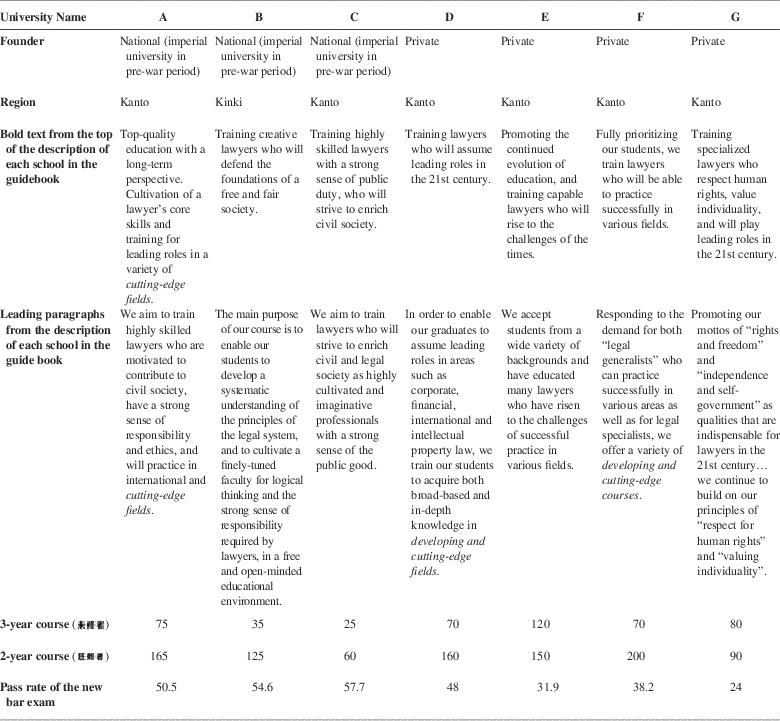
To present the “tracks” for the seven individual universities included in this analysis, descriptions of the schools from the law school guidebook, as well as the percentage of their graduates who pass the bar, are shown in Table 1.Footnote 87
Descriptions of seven individual universities*
*N publisher (2012); Ministry of Justice (2011). The translation is mine.
Table 1 shows that the descriptions for Universities A, D, and F emphasize cutting-edge subjects. Cutting-edge subjects are mostly in the area of corporate law, and therefore these schools better prepare their students to find jobs in large-scale international law firms. Thus, it is expected that graduates from these schools are more likely to work for large firms.
6. Analysis
6.1 The Effect of Gender on First Firm Size
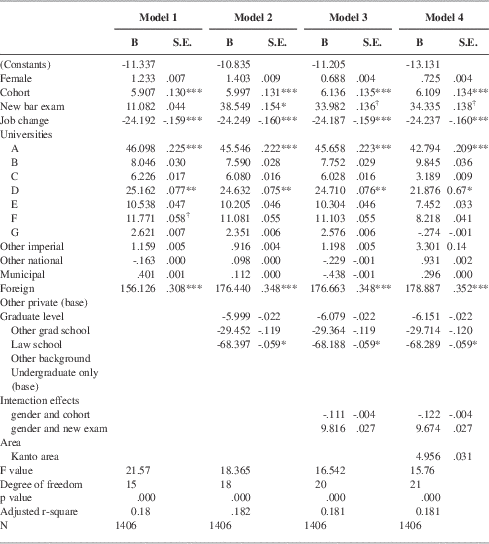
Table 2 shows the result of the ordinary least-squares (OLS) regression analysis of gender on first firm size. In Models 1 to 4, none of the coefficients for the main effect of gender were significant. Thus, hypothesis 1-a (“Gender affects first firm size”) was not supported. Gender was not a significant factor in determining first firm size at the outset.
Results of the analysis (Models 1 to 4)
** p <.001; ** p <.01; * p < .05; † p <.10
6.2 The Effect of Gender on First Firm Size over Time
Next, is there a “change over time in the effect” of gender on first firm size? The results in Table 2 suggest that neither of the interaction effects in Models 3 and 4 were significant. This outcome suggests that changes over time, including the introduction of the reformed system, did not affect (i.e. did not improve or worsen) the equality or inequality between genders, as far as first firm size is concerned.
Thus, at least as far as first firm size is concerned, no significant gender disparity was found, nor were significant changes found over time, including possible changes caused by the introduction of the reformed system. None of the gender-related hypotheses (1-a, 1-b, 1-c) were supported.
The fact that the effect of gender was not significant suggests that the gender gap does not occur at the time of joining the first firm but sometime before or after that period. The percentage of lawyers who are female remains low (Figure 1). This means that the gender gap occurs prior to taking the NLE. Japanese women are more likely to attend junior colleges than men (89% of junior college students are women), and Japanese women traditionally select majors in humanities over the social sciences or natural sciences; among university students, in 2013, 66% of humanities students, 34% of social sciences students, and 12% of engineering students were women.Footnote 88 Thus, Japanese women are less likely to major in law (in Japan law belongs to the social sciences). The gender gap also occurs after the first job. Women are more likely than men to leave firms, citing “family (marriage, childbirth, childcare, and elderly care)” as the main reason.Footnote 89 Female lawyers work fewer hours than male lawyers (males work an average of 2,684.6 hours per year and females work an average of 2,371.1 hours per year).Footnote 90 Moreover, the specializations of lawyers differ by gender (as shown in Section 2.2.3). Thus, constraints and inefficiencies most likely present themselves “before” and “after” joining the first law firm.Footnote 91
6.3 The Effect of Education on First Firm Size
In this section, the effects of education on the size of lawyers’ first firms are examined. In Tables 2 and 3, seven individual universities (Universities A to G) and four categories are contrasted with the base category (“other private universities”), in terms of their effect on first firm size.
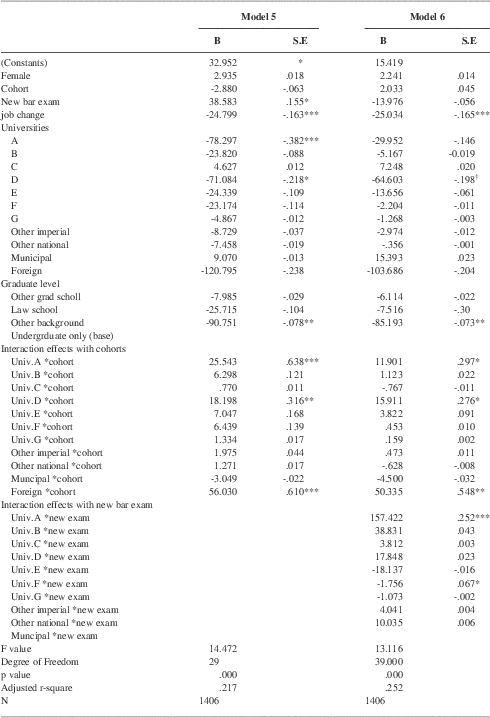
Results of the analysis (Models 5 to 6)
*** p<.001; ** p <.01; * p < .05; †p <.10
NOTE: The interaction effect for foreign universities with the reformed system was excluded from the analysis due to the lack of cases in that category after the introduction of the new system.
Models 1 to 4 suggest that the effects of “University A,” “University D,” and “foreign universities” on first firm size differ significantly from the base category. In Model 1, “University F” is also significantly different from the base category. Thus, compared to the base category “other private universities,” those lawyers who graduated from Universities A, D, and F, and foreign universities tend to join law firms of significantly different sizes. For instance, in Model 1, those who graduated from University A tended to join larger law firms than those who graduated from “other private universities,” with a difference of approximately 46 lawyers. Those who graduated from Universities D and F tended to join larger law firms than those who graduated from universities in the base category (with a difference of approximately 25 and 12 lawyers, respectively). Universities A, D, and F are located in Kanto (the Tokyo metropolitan area) and emphasized their strengths in cutting-edge subjects (sentan kamoku) in their school descriptions from the law school guidebook. These factors may have contributed to their graduates finding jobs at large-scale international law firms. Those who graduated from foreign universities (or foreign law schools) also tended to work for large firms.Footnote 92 Large-scale law firms are international, and it is understandable that those who had studied law in foreign countries would be overrepresented in law firms of this type. In fact, as Rokumoto notes, most international firms send their young associates to study abroad in Western countries as well as to obtain a legal training.Footnote 93 Thus, it is understandable that those who graduate from foreign universities are overrepresented in the population of people working for large-scale, international law firms.
6.4 The Effect of Education on First Firm Size over Time
Has the effect of a lawyer’s alma mater on the size of his or her first firm changed over time? Models 5 and 6 in Table 3 show the results of the analysis addressing this question. Model 5 examines long-term changes in the effect of one’s alma mater across different cohorts of legal apprenticeship. Model 6 examines changes over time surrounding the introduction of the law school system associated with the legal reforms.
In Model 5, which examines long-term effects, the interaction effects for University A, University D, and foreign universities are significantly different from the base category (“other private universities”) in terms of the size of the first firms, and the coefficients are positive. Thus, for every younger cohort (using ten-year cohort groups), the average size of the first firm for University A graduates becomes larger by 26 people than that of graduates from the base category (“other private universities”) every year. For University D graduates, the average size of the first firm becomes larger by 18 people, and for foreign university graduates, 56 people. Thus, the gap between most elite schools and “other” schools widens every year.
In Model 6, which examines changes surrounding the introduction of law schools and the new bar exam system, the interaction effects for Universities A and F are significantly different from the base category (“other private universities”), and the coefficients are positive. After the introduction of the reformed system, graduates of Universities A and F joined firms that are significantly larger (156 lawyers and 56 lawyers on average, respectively) than the base category (“other private universities”).
Thus, the disparity in first firm size between graduates from elite schools and those from other schools has widened over time, in the long term and since the introduction of the reformed system.
7. Discussion
The effect of gender did not significantly affect first firm sizes, while the effects of one’s school were significant. Thus, gender does not initially stratify Japanese lawyers, at least at the time of entry into an attorney’s first firm. Entry into one’s first firm is decided more by merit than gender. This is in agreement with the finding that, among Harvard law-school graduates, women were more successful at obtaining a job in large elite firms than men, although more than half of men became partners within ten years, while only a quarter of women did so.Footnote 94 During the old NLE era, Japanese lawyers belonged to an extremely elite occupation; from 1974 to 1990, approximately 2% or fewer of applicants passed the NLE.Footnote 95 The extreme selectivity of that process may have spared women from encountering discrimination at the time of their entry into the job market, which is similar to the data reported on women from Harvard. Moreover, the fact that law firms do not follow “typical” Japanese-style employment practices (e.g. lifetime employment) and that the majority of employed lawyers leave their firms to become independent, facilitates law firms in hiring women as lawyers.
Thus, with regard to the two approaches that purport to explain gender stratification, supply theory (human capital) and demand theory (gender stratification theory), the former has more explanatory power, at least in terms of the size of first firms. Female lawyers have excellent human capital, are chosen on merit, and do not seem to face outright discrimination at the time of entry into their first firms.
This does not mean, however, that gender stratification among Japanese lawyers does not exist. Differences exist in average incomes and specializations, as was shown in previous sections. These findings suggest that gender differences occur “before” and “after” entry into one’s first firm. As discussed in previous sections, the percentage of women who major in social sciences is lower than men. In 2012, among those who applied for the NLE, only 24.3% were women, and among those who passed the NLE, only 25.9% were women.Footnote 96 Thus, women are less likely to attend a four-year university course than men, are less likely to study law than men, and are less likely to take the NLE than men. Therefore, gender stratification occurs “prior to” entry into one’s first firm.
Moreover, gender stratification also occurs “after” the time of entry into one’s first firm. As was shown in the previous section, women are more likely than men to leave their firms, citing “family” reasons. In addition, in response to the question “Have you ever thought about quitting your job?,” 43.2% of women answered “yes,” while only 27.2% of men answered in the affirmative.Footnote 97 Thus, after women embark on their first job, they seem to encounter severe enough difficulties that they consider leaving their jobs significantly more than men. Women who stated that “demonstrating one’s abilities” is a reason for becoming a lawyer, and those who stated that they experienced “gender discrimination in terms of the job content and distribution of work,” were more likely to have thought about leaving their jobs (odds ratios of 1.401 and 1.813, respectively, which are both significant at 5%).Footnote 98 Thus, the “constraints and inefficiency in work structures and employers,” as described by gender stratification theory, do play a role in generating gender stratification in Japan, “after” entry into one’s first firm.
Future research is required to investigate what occurs “prior to” and “after” entry into one’s first firm, which causes the gender gap among lawyers.
On the other hand, school prestige did affect the size of one’s first firm, and this effect is increasing, but in an unexpected way. The differences were expected to occur across different school types according to prestige and history (e.g. that former imperial universities would do better than the reference category). However, the difference did not occur in terms of school types, and only occurred between a limited number of elite individual institutions (e.g. Universities A, D, and F) versus the rest. University A was the most striking example, where its graduates are overrepresented as new entrants to very large institutions, and this trend has increased. There were even differences between elite former imperial universities A and B. Although school prestige appears to be important, other factors are also involved. A curriculum emphasizing cutting-edge subjects is one such factor affecting the success of a graduate to secure a position at a large elite firm. Thus, human capital seems to play a role in being hired by large firms.
However, there is also evidence that a signalling effect is at work. A partner from one of Japan’s big four law firms said: “Due to the introduction of the new bar exam system, the role of alma mater has increased. Before the judicial reform, a very limited number of people passed the bar. The fact that someone passed the bar could provide assurance of her/his ability. However, as the number of lawyers increases rapidly, passing the bar in itself can no longer ensure the ability of the person. Thus, school prestige became more important at the time of hiring as an index for ability.” This suggests that one’s school can be used as a marker of innate abilities. Further investigation is required to explain the factors involved in this phenomenon.
8. Conclusion
This paper examined the effects of gender and alma mater on the size of Japanese lawyers’ first firms and changes in such effects over time. The results of the analysis showed that gender has no significant effect on the size of one’s first firm. Thus, none of the hypotheses regarding gender were supported.
However, it is too early to determine that gender does not matter in the career tracks of Japanese lawyers. Although no significant gender differences were found in terms of one’s first firm size, there is a significant gender disparity in terms of current overall specializations and incomes for Japanese lawyers, as was discussed in previous sections.
The findings of this paper suggest that gender disparity does not arise mainly at the beginning of one’s career (affecting first firm size) but during stages in the middle of one’s career, during child-rearing years. A considerable percentage of female Japanese lawyers list “family-related reasons” as an explanation for job changes, while few male lawyers do so.Footnote 99 Thus, although young female lawyers in Japan do not start out their careers differently than their male counterparts, their careers change as they approach child-rearing years.
According to Japanese lawyers I interviewed, female lawyers commonly change their specializations and work settings to make their careers more compatible with family life. One female lawyer said she began to specialize in high-interest issues (cresara mondai)Footnote 100 because this field does not require continuous updating in new knowledge and skills, thus allowing her to spend more time caring for her family. Another female lawyer who formerly worked for a large-scale international law firm was loaned out to a public institution after she gave birth to her first child. Moreover, female lawyers who work for large international law firms tend to specialize in “research jobs,” which allow for a more flexible work schedule. Yet, specializing in such research jobs deprives female lawyers of opportunities in dealing with clients directly and in developing the connections and skills required to obtain new clients, experiences that are necessary if they wish to remain in a firm and become partners. Thus, the findings in this paper point to the importance of focusing on mid-career stages to elucidate the mechanisms of gender disparity among Japanese lawyers.
Regarding the effects of one’s alma mater, disparities were found between a limited number of elite schools and the base category in terms of first firm size, and this disparity is increasing over time, both in the long term and since the introduction of the reformed system.
Regarding disparity across schools, I expected that a disparity would be widely observable across different categories of establishment (e.g. former imperial universities, other national universities, municipal universities, and private universities) and across schools with different levels of academic calibre. Yet, the disparity was only observed between a limited number of individual elite schools and the rest of the schools, rather than across categories. For instance, Universities D and E are often considered to have the same overall academic calibre and are often compared. Yet, regarding first law firm size, graduates from University D worked for larger firms significantly more than graduates from universities in the base category, while graduates from University E did not. At those universities, the emphasis on cutting-edge subjects may have helped their graduates to secure positions at large-scale international firms. The most striking finding concerned University A. Its graduates seem to secure the most jobs at the largest firms by far. This tendency is increasing over time, as well as since the introduction of the reformed system.
The introduction of the reformed system appears to be an equalizing process. It has increased the number of law schools throughout Japan and opened the door to a wider range of people with a wider range of backgrounds. However, under this seeming process of equalization, hidden inequalities and disparities among lawyers may be on the rise.