INTRODUCTION
Recent studies have documented the field of minority nonprofits (Cortés Reference Cortés1998; Cortés et al., Reference Cortés, Díaz, Ramos and Campoamor1999; Gleeson and Bloemraad, Reference Gleeson and Bloemraad2010; Hung Reference Hung2007) and the role of nonprofit community-based organizations (CBOs) in immigrant adaptation and mobility processes for low-income communities (Marwell Reference Marwell2007; Ramakrishnan and Bloemraad, Reference Ramakrishnan and Bloemraad2008; Schrover and Vermeulen, Reference Schrover and Vermeulen2005). As local institutions, CBOs provide social support, services, and advocacy related to a number of issues such as health, arts, civil rights, housing, and employment for communities defined by neighborhood or other identifiable boundaries, such as racial or ethnic status (Cordero-Guzmán Reference Cordero-Guzmán2005). Past research has emphasized that CBOs contribute to the social, economic, and political incorporation of immigrant and ethnic minorities by providing spaces where co-ethnics can develop leadership, strong ties, and resources (Bloemraad Reference Bloemraad2006; Chung Reference Chung2007; de Graauw Reference de Graauw, Ramakrishnan and Bloemraad2008; Marwell Reference Marwell2007; Wong Reference Wong2006; Zhou Reference Zhou, Zhou and Gatewood2000; Zhou and Lin, Reference Zhou and Lin2005). However, this work does not examine how CBOs may expand and define community boundaries to share resources, build relations, and work across ethnic and racial lines. In other words, when CBOs widen their boundaries to include multiple groups that cross immigrant, ethnic, and racial lines,Footnote 1 this has important implications for (1) social and economic mobility, as CBOs can distribute resources; (2) intergroup relations, as CBOs can help to build intergroup ties which can break down cultural barriers and lead to greater understanding among diverse groups; and (3) civic society, as CBOs can bring together disadvantaged groups to create a stronger political voice.
Yet, organizational change and the expansion of group boundaries to include others in coalition and collaborative work have proven difficult (Aldrich Reference Aldrich1999; Morris and Staggenborg, Reference Morris, Staggenborg, Snow, Soule and Kriesi2004; Van Dyke and McCammon, Reference Van Dyke and McCammon2010). The reality of scarce resources, perceptions of intergroup competition, and risks associated with organizational change can often work against the expansion of community boundaries (Bobo and Hutchings, Reference Bobo and Hutchings1996; McClain and Tauber, Reference McClain, Tauber and Jones-Correa2001; Minkoff Reference Minkoff1999; Olzak Reference Olzak1992). Despite shared interests related to neighborhood safety, better public schools, or the passage of a local initiative, shifts in resources from one group to another can be viewed as threatening (Jones-Correa Reference Jones-Correa and Jones-Correa2001). Expanding group boundaries can also come with compromises in regards to organizational identity, making it more difficult to retain the support of community and group members (Dalton Reference Dalton1994; Hathaway and Meyer, Reference Hathaway and Meyer1993; Rose Reference Rose2000). Moreover, the unique needs of specific ethnic, immigrant, and racial populations may hinder organizational expansion. Given the multiple barriers CBOs may face, how do these organizations expand group boundaries? How do they serve and incorporate diverse groups in practices and programs and eventually come to assert new community boundaries?
We build upon past research by drawing upon interviews with organizational leaders and documents from Asian American CBOs in the San Francisco Bay Area. We identify the different ways that organizations participate in cross-racial work—the organizational practices, programs, and partnerships to include, serve, or work with people, organizations, or communities representing a different racial background. All of the organizations in our sample engaged in cross-racial work to some extent, but only a handful included other racial groups in new public identities, missions, or goals—what we identify as racial inclusion—and sustained this work over time. Instead, the majority engaged in racial accommodation by simply incorporating other racial groups in individual programs or campaigns while maintaining their focus on Asian Americans.
We argue that while external pressures such as government funding, public policies, and shared interests may encourage cross-racial work, a key element in shaping racial inclusion is how leaders perceive their organization as serving a broader community and how they take action to fulfill this vision. CBO leaders create organizational community boundaries through their interpretation of commonalities among and between groups. While race in the United States constitutes a “bright” boundary and affects the processes by which individuals build collective identities (Alba Reference Alba2005), it is important to recognize that collective groupings can be based on other dimensions such as ethnicity, language, immigrant, or economic status (Jones-Correa Reference Jones-Correa, Espino, Leal and Meier2007).Footnote 2 Our case of Asian American CBOs is useful here because of the different identities and statuses upon which leaders can draw from to build a community and allocate resources. We investigate how CBO leaders view and understand group boundaries, paying attention to whether they view their constituents as immigrants or low-income populations in need of social services, as ethnics in need of a supportive co-ethnic community, or as racial groups in need of advocacy and political empowerment. We find that leaders play an important role in reinventing community boundaries and carrying out work on behalf of expanded group affiliations. Furthermore, as representatives that work on behalf of collective communities, CBO leaders shape the allocation of resources and collective action efforts based on these identified group boundaries.
RELATED LITERATURE
Studies of social movement and interracial coalitions suggest that dynamics at the organizational level influence cooperative relationships among different groups. Along these lines, a number of scholars have noted that shared ideologies and goals enable groups with varied interests to engage in joint planning and form coalitions (Beamish and Luebbers, Reference Beamish and Luebbers2009; Browning et al., Reference Browning, Marshall and Tabb1984; Hathaway and Meyer, Reference Hathaway, Meyer, Rochon and Meyer1997; Lichterman Reference Lichterman1995; Sonenshein Reference Sonenshein1989, Reference Sonenshein1993; Staggenborg Reference Staggenborg1986; Wilson Reference Wilson1973). Research has also demonstrated that multi-issue organizations formed around broad ideological principles are successful at working in collaborations and coalitions with other organizations (Gerhards and Rucht, Reference Gerhards and Rucht1992; Klatch Reference Klatch1999; Van Dyke Reference Van Dyke2003; Whittier Reference Whittier1995). Additionally, challenges or threats can encourage different groups to organize together (Espiritu Reference Espiritu1992; McCammon and Campbell, Reference McCammon and Campbell2002; Okamoto and Ebert, Reference Okamoto and Ebert2010; Saito Reference Saito1998; Van Dyke and Soule, Reference Van Dyke and Soule2002). As groups find themselves under attack by the state, local authorities, or everyday individuals, they may develop collaborative strategies and engage in coalitions across racial lines (Chung Reference Chung2001; Espiritu Reference Espiritu1992; Kim and Lee, Reference Kim and Lee2001; Saito and Park, Reference Saito, Park and Ong2000).
But even if groups share similar goals, ideological orientations, and common enemies, this does not necessarily translate into cooperative efforts or a successful and enduring coalition. Some scholars claim that leadership plays a crucial role in the success of multiracial alliances and other kinds of coalitions because they generate shared interests and identities, create ties between organizations, and build trust (Browning et al., Reference Browning, Marshall and Tabb1984; Eisinger Reference Eisinger1976; Gerhards and Rucht, Reference Gerhards and Rucht1992; Meier and Stewart, Reference Meier and Stewart1991; Roth Reference Roth2003; Sonenshein Reference Sonenshein1989; Staggenborg Reference Staggenborg1988; Van Dyke and McCammon, Reference Van Dyke and McCammon2010). In extensive research on racial politics, Sonenshein (Reference Sonenshein1993) discovered that successful political coalitions forged between Whites and Blacks in Los Angeles were largely due to community leaders with shared philosophies who were able to shape their constituents' group interests beyond racial group loyalties (Diaz-Veizades and Chang, Reference Diaz-Veizades and Chang1996; Regalado Reference Regalado, Yu and Chang1995). Rose (Reference Rose2000) found that leaders served as “bridge builders” between the cultures of middle-class environmental activists and working-class labor activists, and were key in creating the trust necessary for coalition work (Obach Reference Obach2004).
While past research has emphasized the importance of leaders in influencing organizational structures and coalition work, few studies examine how leaders identify the collective group that they serve or represent and how they negotiate boundaries surrounding that collective group. Our work is important because the sharing of community boundaries reflects an ideological commitment, which may help leaders commit to more long-term coalitions even after shared interests fade. Often, the coalitions literature takes group boundaries as given and does not recognize that multiple, layered identities can be drawn upon when defining a community to achieve organizational goals. Boundaries, whether based on ethnicity, immigrant status, or language, separate people into groups, which can generate feelings of similarity and group membership while also resulting in exclusion and inequality (Lamont and Molnar, Reference Lamont and Molnar2002; Sanders Reference Sanders2002).
Past literature has demonstrated that individuals construct and negotiate ethnic and racial boundaries in their everyday lives (Cornell and Hartmann, Reference Cornell and Hartmann2007; Horowitz Reference Horowitz, Glazer and Moynihan1975; Nagel Reference Nagel1994; Waters Reference Waters1999). For example, Kibria (Reference Kibria2002) found that Chinese and Korean second-generation college students crafted their identities based on perceptions of shared experience and history. Some opted for an Asian American panethnic identity that was marked by the experience of being racially labeled and stereotyped as Asian while they were growing up, and by certain orientations and values, such as an emphasis on education, family, and work. Other students readily adopted a panethnic identity that was based on the founding goals of the Asian American movement which involved a shared racial identity united by political interests.
Organizations and group entities also negotiate ethnic and racial boundaries. Immigrant and ethnic groups—often at the behest of community leaders—may organize across ethnic lines to gain access to resources in response to public policies or funding mandates (Espiritu Reference Espiritu1992; Nagel Reference Nagel1994). In particular, ethnic groups have typically expanded their boundaries and organized as a larger panethnic group to create strength in numbers when trying to gain the attention of elites or to compete for funding (Leighley Reference Leighley2001; Okamoto Reference Okamoto2003). Espiritu (Reference Espiritu1992) found that social workers from various Asian ethnic groups coordinated their efforts to compete against other racial groups for access to resources (Nagel Reference Nagel1994; Padilla Reference Padilla1985). Because funders and mainstream institutions viewed distinct ethnic groups as a racial category, this encouraged organizing along panethnic lines (Shiao Reference Shiao1998). Studies have also found that changes in neighborhood demographics can shape whether CBOs incorporate new racial or ethnic groups, given that public funding requires provision of services and programming for the local community regardless of ethnic, immigrant, or racial background (Becker Reference Becker1998). However, this literature neglects a focus on how organizational actors—in our case, CBO leaders—construct group-level affiliations and engage in efforts to expand organizational boundaries, which have important consequences for collective action and resource distribution. Moving beyond the factors shaping the expansion of group boundaries identified by past literature (see Figure 1), we focus on how CBO leaders, as individual actors and representatives of their organizations, construct and expand boundaries when defining their organizational community and carrying out central organizational work.
Broader Conditions Identified by Prior Literature and the Key Role of Leaders in Facilitating Boundary Expansion or Multi-Racial Coalitions
Note: Racial accommodation involves incorporating other racial groups in programs and practices while maintaining a focus on Asian American or Asian-ethnic communities. Racial inclusion involves including other racial groups in expanded missions, goals, and community boundaries.

DATA AND METHODS
To understand the practices of CBOs and how organizational leaders negotiate the inclusion of other racial groups, we draw upon interview and documentary data from Asian American non-profit CBOs in San Francisco and Oakland, California. The San Francisco Bay Area has a long history of Asian American activism which has included building interracial coalitions to combat racial inequality. An organized Asian American movement developed at San Francisco State and UC Berkeley in the late 1960s when Asian American students from different ethnic backgrounds organized together as part of the Third World Liberation Front with African American, Chicano, and Native American students (Liu et al., Reference Liu, Geron and Lai2008; Maeda Reference Maeda2009).Footnote 3 Asian activists embraced the radical ideology of power and self-determination with the aim of serving the people and enacting social change through political means (Geron Reference Geron, Nakanishi and Lai2003; Liu et al., Reference Liu, Geron and Lai2008).
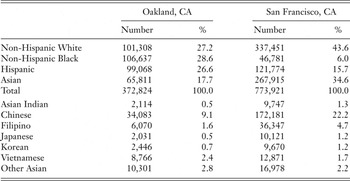
In addition to their histories of progressive politics, the majority-minority cities of San Francisco and Oakland are useful sites for studying interracial cooperation because they are home to a large, diverse Asian American populationFootnote 4 and well-established White, Latino, and African American communities (see Table 1). In 2010, the Asian population represented nearly one-fourth of the population in Oakland and over one-third in San Francisco. Blacks were the smallest racial group in San Francisco at 6%, but represented the largest group in Oakland at 28.6%, and Latinos reached almost one-fifth in both geographic areas. About a third of the San Francisco (35.6%) and Oakland (28.4%) populations were foreign-born (U.S. Census Bureau 2010). While this multi-racial context provides opportunities for organizations to engage in cross-racial work, Asian American organizations do not need to reach out to other racial groups because the Asian American non-profit sector in the San Francisco Bay Area is relatively large and well developed. It is then an empirical question of why and how they do so.
Racial and Ethnic Population of San Francisco, CA and Oakland, CA, 2010

Source: FactFinder, Census 2010.
We selected organizations using snowball sampling methods as part of a larger project on the boundary dynamics of Asian American and Asian-ethnic CBOs in the San Francisco Bay Area. Due to our interest in capturing a diverse set of organizations, we gathered a purposive sampleFootnote 5 of thirty-seven CBOs comprised of ethnic organizations representing Japanese, Chinese, Filipino, Korean, Southeast Asian, and Asian Indian populations as well as pan-Asian organizations that served multiple Asian ethnic groups in our chosen cities. All of the organizations were founded by community members with the mission to serve a specific Asian ethnic group or the larger Asian American community; none of the organizations were originally formed to serve or represent other racial groups such as Whites, Latinos, or African Americans.Footnote 6 These organizations differ from other non-profits and membership-based associations because they typically include cultural components in their mission, services, and programs and frequently represent or serve specific racial/ethnic or disadvantaged populations.
Many of the CBOs in our sample initially started with a core group of volunteers to provide services for the local immigrant or ethnic community, and later evolved into incorporated non-profit organizations with mission statements, full-time staff, organizational space, developed programs and services, and public and private funders. These organizations consisted of cultural, historical, social service, and civil rights organizations typically located in close proximity to group members who sought out their services and programming.
We conducted in-depth, face-to-face, and semi-structured interviews with forty-four existing or previous executive and program directors and presidents, which we identify as organizational “leaders,” as well as one board member, from the thirty-seven CBOs in 2003–2004.Footnote 7 The average number of years leaders worked at each CBO was about ten years. Interviews lasted from one to two hours. We focus on leaders because they can shape how group members perceive their own group interests and the interests of others, and push toward or away from cooperation and the promotion of common cultural, social and political linkages (Kaufmann Reference Kaufmann2003; Regalado Reference Regalado, Yu and Chang1995; Sonenshein Reference Sonenshein and Jones-Correa2001). In addition, their voices and narratives are public representations of the organizations' identities and goals.
Our interview schedule focused on the identity maintenance and practices of organizations, allowing us to gain insights about how leaders negotiated organizational partnerships, changes, and boundaries. Many of our respondents had worked in the CBO nonprofit sector for over twenty years and were able to provide detailed retrospective information about the origins of the organization, shifts in organizational missions and programs, and changes in the Asian American community. One-third of the leaders were first generation and two-thirds were of the 1.5 generation or higher. All were Asian American, except for one who identified as White. Each interview was audiotaped and transcribed for data analysis. We also had opportunities to observe some of the organizations' office spaces, events, and programs, and we took extensive field notes.
Given that we were also interested in understanding whether the organizations developed or maintained racially inclusive practices after our interviews in 2003–2004, we gathered available public documents on the organizations in our sample, including brochures, program fliers, annual reports, press releases, newsletters, and online organizational materials dated from 2000 to 2010. We also searched for news articles and blogs from mainstream and ethnic media sources during the same decade on the programs, campaigns, and activities of the organizations in our sample and of the non-Asian organizations and communities that leaders mentioned as part of their cross-racial work. In the end, we analyzed nearly 300 organizational documents which we used to expand upon the interview data.Footnote 8 These materials allowed us to compare public written mission statements, activities, and goals of the organizations over the course of nearly a decade, and to find out if organizations continued or extended their cross-racial work.Footnote 9
Our analytical strategy included focused coding of the organizational documents and interview transcripts on programs, practices, partnerships, philosophies, and goals using ATLAS.ti software. We sorted the data based on themes, and continued to narrow our thematic codes and summaries until we began to see an organizational typology and narrative that best captured the organizations in our sample. What emerged from the data were the divergent processes through which organizations and their leaders worked across racial boundaries and negotiated cross-racial work as a way to include or accommodate other racial groups in programs, missions, strategies, and community boundaries.
FINDINGS
Leader Roles in Implementing Cross-Racial Work
The organizational leaders in our sample all played prominent roles in managing staff, programs, operations, budgets and funding, and communicating with boards of directors. While each organization in our sample had a board of directors, all but six leaders had a great deal of power and autonomy to influence organizational partnerships, programs, and structures. These leaders oversaw and implemented programs, engaged in fundraising, and made organizational decisions about when the board met and which items went forward to the board for further discussion. Executive Directors (EDs) noted that they played central roles in envisioning the direction of the organization and in carrying out organizational missions and goals. Many also mentioned that the board rarely questioned or interfered with their work, and that they had control over programs and structures and were “the public face of the organization.” As an ED of a Filipino organization noted, “When we're working, particularly outside of the Filipino community, I'm the one doing the liaison work.” Leaders initiated and maintained coalitions as representatives of their organizations and as the decision-makers for organizational programs and structures.
The other six leaders with less power and autonomy took care of daily operations and brought decisions to the board about programs and partnerships. Four of these six leaders were younger and new to the organization while the other two worked in organizations where decisions about programs and partnerships were made by committees. However, even these leaders could weigh in on program and partnership decisions. For the most part, boards of directors tended to meet every other month for “big picture decisions” such as policy stances or major budget issues, while EDs and presidents led the organization's main work to fulfill organizational mission and goals.
Given the influential role of organizational leaders in initiating and implementing organizational work, partnerships, and programs, we focus on how leaders construct and expand boundaries to define their organization's community of focus and carry out central organizational work. We find that CBO leaders play significant roles in shaping community boundaries, resources, and representation. We also discover that how leaders view the shared experiences, culture, and history of Asian Americans—either as distinctive from or similar to other racial groups—has important implications for the ways in which CBOs carry out missions, goals, and work on behalf of these identified communities. All of the leaders mentioned that they worked with or served other racial groups in programs, partnerships, coalitions, or services at one point or another—what we call cross-racial work—because of funding mandates, to generate broader impacts or organizational expansion, or because of shared interests with other organizations or groups. Yet, there were distinct variations in how leaders connected this work to an organizational identity and community boundaries.
Racial Accommodation: Solidifying Ethnic or Racial Boundaries
A majority of leaders viewed cross-racial work as a way to improve organizational funding, impacts, or capacity so that they could more effectively serve Asian communities, rather than as a way to work on behalf of broader group affiliations. For these leaders, the distinct culture and history of an Asian-ethnic or Asian American community solidified group boundaries. Furthermore, these leaders maintained the organization's overall mission and focus on serving or representing the Asian-ethnic or Asian American community, despite working with or incorporating other racial groups in individual programs or campaigns. In the end, this resulted in racial accommodation, when organizations engaged in cross-racial campaigns or provided services and programs across racial lines that were infrequent, short-term, and separate from the organization's overall mission and goals while maintaining a focus on Asian Americans or a specific Asian-ethnic group.
For instance, Carolyn, the director of the Korean Organization (KO) described how their job placement, citizenship, senior, and meal programs serve Korean as well as Russian immigrants and African American low-income residents; they were one of the few organizations to offer these programs in the neighborhood. At one point, a large number of Russian immigrants enrolled in the citizenship classes. She explained that there were “lines outside [the door]” because “we don't shut our doors to non-Korean groups.” However, serving other racial groups did not necessarily translate to including other groups in KO's main mission and community of focus. Instead, Carolyn emphasized how KO's main purpose was to promote the unique language, food, history, art, and other aspects of Korean culture to other groups as a way to “establish an identity” for the Korean community.
As another example, Sean, the director of the Southeast Asian Center (SAC), told us that SAC includes other racial groups in programs and services because of funding requirements. SAC was formed in 1975 to assist the sizeable Southeast Asian newcomer and refugee population in the Bay Area after the Vietnam War. By the end of the 1980s, refugee resettlement from Vietnam, Cambodia, and Laos had diminished. After receiving state funding to expand its programs and services in the 1990s, SAC opened its translation, residency-licensing, and refugee-intake services to Eastern European and African refugees who had settled in SAC service areas across the Bay Area. In 2003, the organization continued to serve non-Southeast Asian refugees, but this work was not an integral component of SAC's main purpose. Instead, Sean viewed this cross-racial work as a means to an end. It allowed SAC to maintain funding so that they could develop new programs related to improving the leadership skills, voter representation, and socioeconomic status of Southeast Asians. Sean reasoned, “We have been here for almost thirty years, with the number of Southeast Asians around two million. [But] in the mainstream politics we are still sadly far behind … We don't have the voice, nobody knows us, we don't have the support.” Despite maintaining programs that served other refugee populations, Sean discussed how a lack of support in the United States provided reasoning for SAC to continue its focus on Southeast Asians.
Other leaders believed that the unique culture or history of Asians helped to signify boundaries, which kept them from including other racial groups in organizational missions, goals, and main communities of focus, even when working with other racial groups in long-term coalitions and partnerships. When we asked Sandy, the ED of Asian American Arts (AAA), about their partnerships and programs with other racial groups, she replied:
It is our mission to serve the APA (Asian Pacific American) community. We have partners with other cultures such as [a Latino arts organization] … [but] we primarily serve the APA community…. [This partnership started] with our purpose of each serving our own community and once in a while then we'd get together … and try to bring awareness to other communities, so we had Latino artists show at our gallery and then we showed at their gallery.
To Sandy, partnering with a Latino organization helped AAA bring awareness about the arts and culture of “our” community, defined as Asian Pacific American, to the Latino community, which represented a “culture” distinct from that of Asian Americans. This distinction provided rationale for why the organization needed to showcase the uniqueness of Asian American culture and art. While this long-standing collaboration with Latino artists started a few decades ago during the Asian American and Civil Rights movements, it was infrequent, and Sandy viewed this work as separate from their overall mission of serving Asian Pacific Americans.
Some leaders of racially accommodating organizations focused on the shared culture and history of Asian Americans, as well as their experience of being racialized as foreigners and model minorities, which created an Asian American community that was distinct from other racial groups. Stephen, the leader of Japanese Americans Creating Action (JACA), described how the organization worked on a number of campaigns and programs with Latinos and African Americans to fight against hate crime and discrimination issues that affected all racial minorities. However, despite this work, Stephen did not place Blacks and Latinos within JACA's community of focus. Instead, he framed political or hate crime campaigns as tied to an “Asian American” identity, while ethnicity was often reserved for talking about specific community needs or issues related to culture, language, or neighborhoods. Stephen used the Vincent Chin case in the 1980s, when two unemployed auto workers in Detroit mistook a Chinese American for a Japanese national, blamed him for the economic downturn in the area, and killed him with a baseball bat, as one example of how racialization impacted Asian Americans despite differences in national origin: “For White America, there was no difference between Chinese, Japanese, Korean.” To him, Asian Americans ultimately experienced unique and separate circumstances compared to Blacks and Latinos, which made it difficult for interracial coalitions and partnerships to endure after a campaign or issue ended:
I don't know if [interracial] partnerships really work quite honestly…. [Foundations will] tell us that we should go work with some Black or Latino organization and do these joint projects, … [but] they have their problems and we have our problems; we want to work on what we want to work on. We know what our issues are and our issues are not Latino or Black issues…. I think the coalition concept works, when you come together on the need that there is and you work together and share together, and when the issue is resolved you go back to whatever it is you're doing.
His emphasis on “our” issues signified a clear boundary between JACA's community of focus—Japanese and Asian Americans—and other racial groups. Despite recognizing that shared interests with other minority groups help to build interracial coalitions, Stephen thought it was necessary for each organization to “go back to whatever it is you're doing” after a multiracial coalition has ended, suggesting that each racial group has its own set of problems and issues that cannot be addressed through cross-racial work.
While funding requirements, common goals, and shared immigrant or refugee status facilitated partnerships or services that incorporated other racial groups, these factors did not produce expanded community boundaries for a majority of leaders. Instead, the racialization or unique culture and history of Asians in the United States provided the justification for strictly working on behalf of Asian Americans. At the same time, racial boundaries often became reified as CBO leaders viewed “our” or “Asian American” issues as different from that of other racial groups. Past literature notes that when others impose a racial category upon different ethnic groups who are distinct in regards to culture, language, and religion, this process of racialization can affect how individuals identify with and unify as a collective group (Espiritu Reference Espiritu1992; Trottier Reference Trottier and Keyes1981); yet, we find that CBO leaders can also reify the racial boundaries of communities that they serve and represent. In this sense, CBO leaders may facilitate accommodation or cooperation with other racial groups through programs, coalitions, or campaigns, but still not view them as in-group members of the community because of the ways that leaders understand the racialization experiences of Asian Americans as unique.
Racial Inclusion: Expanding Community Boundaries
While the above leaders viewed cross-racial work as a way to better serve or represent Asian-ethnic or Asian American communities, leaders from eleven other organizations linked cross-racial efforts with working on behalf of a broader community defined by immigrant, low-income, and/or minority status. As an example, Asians for Environmental Justice (AEJ) formed in 1993 to empower and serve low-income APA communities around issues of environmental and social justice. “Working in multiracial alliances” became a formal part of the organization's main strategies and goals in 2002. Around this time, AEJ leaders realized that they could not carry out the organization's goals of pushing for environmental justice without including other racial/ethnic minorities experiencing similar circumstances of inequality and discrimination. Aligning with other people of color would improve the conditions of all minority communities, including Asian Americans. Jeremy, AEJ's leader articulated this new goal:
We asked ourselves, ‘Can APIs [Asian Pacific Islanders] achieve systemic change by ourselves, as a community?’ The answer is no, and that is why we believe that … only a multi-racial alliance, led by people of color, poor people, women and young people can achieve systemic change goals. We do not organize low-income API so that we can get our piece of the pie. We organize … to contribute to a larger multi-racial movement to better conditions for all [of these] communities.
This leader viewed the organization's main purpose as creating systemic changes on behalf of people of color and other disadvantaged groups, beyond Asian Americans. This is consistent with Emerson's (Reference Emerson2006) study of multiracial congregations, which found that like other organizations, congregations became multiracial because such a process was consistent with their larger goals or missions.
We also find that CBO leaders can play an important role in developing, expanding, or shifting missions and goals. Chinese for Civil Rights (CCR) was founded in the early 1970s to create social change, alter systems of inequality, and advocate on behalf of Chinese Americans. In the 1990s, the organization expanded from a focus on Chinese Americans to serving and acting on behalf of Asian Americans, Blacks, and Latinos through multi-racial campaigns addressing racial inequalities experienced by broader immigrant and minority communities. The executive director during that time played a key role in this shift by working with Latino organizations on behalf of disadvantaged minority students to desegregate public schools in San Francisco. Since large Asian American populations already attended San Francisco's highly-ranked schools, this policy change was not necessarily in the best interest of Chinese and Asian Americans. However, CCR's leader ultimately decided to participate in the campaign because he felt that Latino and African American communities did not have equal opportunities to attend good public schools. Even though CCR came under attack within the Asian American community for similar campaigns that privileged the interests of Latinos and African Americans over Asian Americans, Harold, the current ED, interpreted this work as “a wonderful aspiration towards trying to give people the resources to participate civically” and as part of a process of social change. He supported CCR's move towards representing broader communities: “We tend to be probably more multi-racial than most organizations…. We're not out there to push just for Chinese and Asian Americans; we do it in a larger perspective.”
For these organizational leaders, boundaries did not exist between Asian Americans and other racial/ethnic minorities, such as Blacks and Latinos, but between disadvantaged and advantaged groups—those with more resources, privileges, or power. This ideology was reinforced through interactions with mainstream, historically White organizations. Jessica, the leader of Asian American Health Initiative (AAHI), explained: “I do not feel like I can go to NARAL or National Organization of Women … they have so much power already; it is not worth our effort … they think it's a White women's issue, it's just about abortion access … [and] don't care how women of color have a range of things that inhibit our reproductive rights.” To Jessica, although the organization primarily serves Asian American women, the work that they do is on behalf of women of color who are marginalized and experience different issues related to reproductive rights compared to White women.
Organizations with leaders that viewed people of color or broader communities as part of the organization's main work and purpose engaged in racial inclusion, which involved including racial minorities in expanded missions and goals and long-term, extensive programs or partnerships. One organization completely removed its Asian American focus later on by changing its name to reflect a broader constituency, and a few others changed their leadership and staff to reflect a new community identified by racial minority, immigrant, or low-income status. For instance, Asian Housing Corporation (AHC), originated as a community development nonprofit serving Asian neighborhoods, but later included Latinos and African Americans in their housing and employment programs, as well as their board, staff, mission, and goals. Sue, AHC's director, explained that their federal funding mandated the provision of services for all needy groups, but that she and the board “made a conscious decision from being [an] Asian-focused organization to openly serve other people” in order to fulfill a new mission to “take a more comprehensive approach to neighborhood revitalization.”
Similar to AHC, Laotian Communities (LC) responded to funding and neighborhood pressures by expanding their employment, legal, language, and other service programs to include diverse immigrants and refugees. Additionally, LC developed long-term partnerships with Afghan communities when there was a large influx of Afghan refugees in the 1980s. The success of this long-term partnership enabled LC to serve new populations and become known as an organization that worked on behalf of diverse immigrant and refugee populations with limited English proficiency. Truc, the ED explained, “I think it has just a lot to do with access to resources. We assist people who just by the fact that they speak another language can't access what they have a right to access.” To this ED, the need for language translation was not only a commonality shared by immigrants and refugees, but also a reason to work on behalf of this broader community marginalized because of language barriers. She continued on: “Our goal is to make sure that these communities have access.” The organization later hired diverse staff and volunteers to reflect these new populations and adopted a new mission statement with “diverse refugee, immigrant, limited English, and low-income community members” as LC's community of focus. In 2010, LC's website even included a statement identifying “our community” as “much larger than any one ethnic group,” despite LC's ethnically-focused name.
For these leaders, broader identities related to immigrant, limited English proficiency, people of color, or low-income status took precedence over ethnic or racial boundaries, which helped them to support expanded mission statements and goals. How leaders interpreted issues and commonalities as connecting communities across racial boundaries provided legitimacy for racial inclusion. Inclusive programs and practices were not just temporary responses to meeting organizational or neighborhood needs, but fundamental components of how leaders asserted and defined their work and goals.
Leader and Organizational Characteristics: Shaping Boundary Expansion
While past research has demonstrated that funding opportunities, policy incentives, and survival in a competitive market are key components of incorporating ethnic and racial others in organizational settings, we find that these conditions and incentives may facilitate cross-racial work (see Figure 1), but do not necessarily result in the inclusion of other racial groups as part of an organization's community and identity.Footnote 10 While availability of funding to serve broader racial/ethnic groups and the pressure of organizational survival helped CBOs to open their program doors and services, these organizations needed leadership support to engage in racial inclusion, which often came from the leader's and organization's history, ideology, and prior work with other racial groups.Footnote 11
Asian Americans are both immigrants and racial minorities, coming from diverse national origins with unique language and historical backgrounds, and are also impacted by experiences of discrimination and racialization (Takagi Reference Takagi1998; Tuan Reference Tuan1998; Wong et al., Reference Wong, Ramakrishnan, Lee and Junn2011). Thus, leaders of Asian American CBOs had to negotiate different group boundaries—immigrant, ethnic, and racial—based on their own experiences and backgrounds, which influenced how they connected the goals and missions of their CBOs to Asian ethnics or broader affiliations based on immigrant, minority, or low-income status. As represented in Figure 2, we argue that leaders' interpretations of these group boundaries are key in understanding whether CBOs adopt racially accommodating or inclusive practices.
The Role of Leaders and Their Interpretation of Group Boundaries in Generating Racial Accommodation and Racial Inclusion among CBOs
Note: Racial accommodation involves incorporating other racial groups in programs and practices while maintaining a focus on Asian American or Asian-ethnic communities. Racial inclusion involves including other racial groups in expanded missions, goals, and community boundaries.

The characteristics of leaders themselves provide insights into how leaders were able to broaden community boundaries or reify racial and ethnic boundaries as firmly in place. Our data reveal that nearly all of the leaders from racially inclusive organizations had served on the boards of multi-racial advocacy organizations or coalitions that addressed issues such as poverty, homelessness, or employment rights, which often corresponded with their own organization's mission and goals. These leaders, who were also second or later generation, had also worked in the non-profit CBO sector on social justice and community issues for over ten years, which may have helped to solidify distinct boundaries between those with greater power and advantages and the less advantaged, allowing them to see across racial boundaries and view their work as part of broader social changes. Some had also been active in the Asian American movement and other social justice movements, where working across racial lines was a key part of social change.Footnote 12
In contrast, only a few leaders of racially accommodating organizations served on multi-racial boards or coalitions, and they viewed their involvement as a way to represent Asian Americans, rather than as a way to represent broader communities. Only a handful were active in social movements during the 1970s and beyond, and despite wanting to create broader impacts through working on political and social justice issues, they viewed their work as tied to the Asian American community, rather than other minority and disadvantaged groups affected by these social movements. Leaders of accommodating organizations were also typically of the first generation. Their experiences as newcomer immigrants in the United States may have influenced them to focus on their ethnic group's unique needs and issues or the unique issues of Asian Americans.
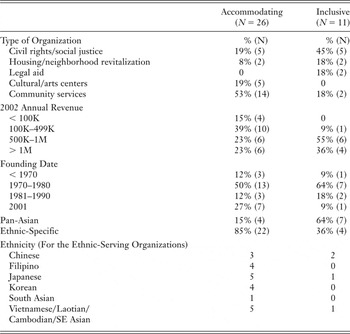
Organizational factors such as organizational type, age, capacity, and reputation also shaped the extent to which CBOs incorporated other racial groups into their programs, practices, and partnerships.Footnote 13Table 2 provides a description of characteristics associated with accommodating and inclusive organizations. In terms of organizational type, almost all of the inclusive CBOs worked on civil rights, social justice, neighborhood revitalization, or legal aid issues shared by other racial minority, immigrant, or marginalized communities, although it is important to note that these CBOs also included community services and development in their programming. The sharing of issues may have helped to facilitate more extensive or frequent instances of cross-racial work and ultimately how leaders viewed other groups as part of their community boundaries.
Characteristics of Accommodating and Inclusive Asian American Organizations (N = 37)

Note: Type of organization is based on mission, goals, and main programming areas. Many of the organizations engaged in programs that fit within multiple categories; therefore, we considered mission and goals as well as programming areas. Community-service organizations provide social service and community development programs, such as for youth or seniors or pertaining to employment, language translation, or immigration and resettlement services.
For CBOs engaged in racial accommodation, racial inclusion may not have been a priority because the costs were often too high. One issue that continually arose for these CBOs was the fact that they had not yet established funding streams or reputations in the field. Leaders of these organizations felt that they needed to effectively serve their own constituencies or members before they could think about expanding to advocate or serve others. That said, not all of the large, well-established organizations achieved racial inclusion. In fact, some of the civil rights organizations had engaged in racial accommodation for decades, and they were among the oldest and most established organizations. Leaders of these organizations did not view common interests or goals with other minority groups as taking priority over their ethnic or panethnic focus. Moreover, a majority of both accommodating and inclusive organizations were formed during or in the recent wake of the Asian American and Civil Rights movements, which could have propelled these organizations to be racially inclusive. Despite these historical beginnings and low costs of racial inclusion (as they likely were for the large, well-established organizations), leaders still needed to play an active role in framing and implementing cross-racial work in a way that is consistent with organizational goals to boards, staff, and members.
Another organizational factor shaping the extent and depth of cross-racial work is whether CBOs originated as serving an ethnic or panethnic community. Sixty-four percent (n = 7) of the eleven inclusive organizations were pan-Asian in name and focus. These organizations were not beholden to a particular ethnic community that they had served for decades, which eased the process of expanding services and programs and including other racial groups into a community of focus. It also may have been easier for pan-Asian organizations to engage in racial inclusion because their leaders already had experience working on behalf of and connecting diverse ethnic and immigrant groups to a common purpose and community. Likewise, 85% (n = 22) of the twenty-six accommodating organizations were ethnic-specific in name and focus (only four were pan-Asian), although a handful of the ethnic-specific organizations focused on broader Asian American issues while maintaining ethnic-specific names, such as JACA.
We also found that racial inclusion can occur even when organizations retain their Asian-ethnic or pan-Asian name. For many leaders of inclusive organizations, working on behalf of Asian Americans and other racial minorities was a way to maintain the original focus of the organization. Past work suggests that identities can be layered, as individuals may choose to situate or identify themselves using multiple group identities depending on the situation (Jones-Correa Reference Jones-Correa, Espino, Leal and Meier2007; Okamoto Reference Okamoto2003; Waters Reference Waters1999). Our findings support this notion in that inclusive CBOs and their leaders identified with multiple communities at one time. However, what is most important is that these leaders privileged broader group affiliations, such as immigrant, racial minority, or low-income status and engaged in more extensive organizational changes, such as name changes or policies not solely in the best interest for Asian Americans. Therefore, we see racial inclusion as existing along a continuum, where organizations involved in racial accommodation may later move towards inclusion, but only if their leaders begin to focus on the needs of broader communities.
Broader Implications of Cross-Racial Work
The differences we find in the depth and extent of cross-racial work are important because CBOs shape resource distribution and political activities among racial and ethnic communities. While racial accommodation simply involves including other racial groups in practices and partnerships, racial inclusion may potentially provide greater economic and political benefits and impacts because it involves the inclusion of multiple racial groups within community boundaries. Leaders of inclusive CBOs talked about material gains for their respective ethnic and racial communities, but also for a broader array of minority groups. They highlighted their participation in legislative and advocacy efforts regarding city and statewide language access policies, redistricting to create racially-balanced precincts, and fights against anti-immigrant ballot initiatives, and how these efforts challenged racial and ethnic inequality. For example, organizations like AHC engaged in neighborhood revitalization efforts for low-income communities, and multi-service centers like LC provided services and programs for language translation, employment, youth leadership, asset development, and family support. These organizations advocated for and developed programs to help low-income and minority populations become self-sufficient and to bring attention to the issues of such communities. All of the inclusive organizations maintained missions and goals with expanded communities several years later, indicating the longevity of racial inclusion.Footnote 14
Leaders who pushed their organizations toward racially inclusive practices did not always make decisions that benefited only Asians. They put their weight behind efforts that improved conditions for all racial minorities, and talked about how they viewed part of the organization's work as facilitating intergroup communication and relations across racial lines. As an example, Harold from CCR explained how the organization entered into a long-term partnership to teach African American and Chinese immigrant parents about their rights and how to be their own advocates within the San Francisco public school system:
So we were trying to get basically Chinese parents and African American parents who were interested in their kids' education on the same page, do the same training with them, and then our whole goal is to start getting them to work together … they literally don't speak the same language. So often we have to be in the room to translate and make sure things are understood.
Here, the organization's efforts were not simply about facilitating intergroup contact within a safe and cooperative setting, but about teaching both groups that they share common interests and can achieve their goals together. And ultimately, when CBOs expanded their missions and goals to include other racial groups, this reflected an organization's commitment to a new population and often shifted some resources and services away from the original CBO constituents. Such a shift had the potential to create problems or tensions, such as dissent from the original community of focus or the risk of losing legitimacy within the community. Like many leaders, Harold of CCR addressed this issue by framing their partnership with African American parents as reflective of their original mission and goals of helping the Chinese community to be more progressive:
One of our major roles here, I don't know if I made this clear, the founders of this organization said the organization is to educate Chinese Americans and make the community more progressive. It isn't just reaching out to African Americans, it's reaching back to Chinese immigrants giving them education on civil rights issues and helping them to understand that they live in a multicultural society…
Because inclusive CBOs often originated with missions and goals related to civil rights or social justice and shared a progressive philosophy of community empowerment, it may have been easier for these leaders to connect this philosophy to cross-racial work and subsequent racial inclusion. Furthermore, these CBOs often had access to resources such as large organizational and staff capacity, funding streams, established programs, and strong reputations in the field to maintain services and programs for their original Asian American community in conjunction with extensive cross-racial work. Although a handful of accommodating organizations also shared these characteristics in terms of capacity and reputation, leaders from accommodating CBOs did not connect a progressive ideology with cross-racial work.
In contrast to racially inclusive CBOs, organizations that engaged in racial accommodation primarily did so to advance the needs and interests of Asian ethnic and panethnic groups. These CBOs held fundraisers, became involved with legislative campaigns, and some even participated in collective action efforts, but the impacts that they articulated related to (1) the importance of maintaining and promoting ethnic cultural traditions such as language and other cultural practices or (2) the need for a place where ethnics could build a community and a sense of belonging. These CBOs were spaces where kids could be dropped off for programs or day care, and where people in the neighborhood could spend the day, meet their friends, and attend classes. As one organizational leader of an ethnic-specific organization explained: “We have funerals here. We have marriages here…. There should be a place in the community for people to rest … to meet their friends.” Many of these leaders viewed cultural and community centers as key for building healthy identities and relationships among their fellow ethnics, including ties between the first and second generations.
While these organizations engaged in cross-racial work and provided the opportunity for people of different racial backgrounds to interact in meetings or campaigns based on shared interests or goals, leaders did not emphasize a shared identity or community with non-Asian groups. These organizations brought some awareness to their members about the cultures and histories of different ethnic and racial groups, but leaders were more focused on how CBOs could help their own ethnic communities. This focus may indeed help to strengthen Asian ethnic and Asian American communities, but does little to directly encourage positive intergroup relations and trust across racial lines, or generate support for racial integration among diverse groups (Pettigrew and Tropp, Reference Pettigrew and Tropp2011).
CONCLUSION
This paper details how leaders of Asian American CBOs are key players in negotiating and highlighting different types of group boundaries, and ultimately in the expansion of organizational boundaries (see Figure 2). While all leaders engaged in cross-racial work—working with or serving diverse racial groups in programs and partnerships, as well as formal political coalitions and campaigns—not all supported the expansion of community boundaries. A majority of leaders discussed cross-racial work as a way to effectively serve and meet the needs of Asian ethnics or Asian Americans—their original constituents or members. This resulted in racial accommodation, where organizations served and represented groups across racial lines but did not include them as part of the organization's main community of focus. In contrast, other leaders identified and constructed a sense of expanded group boundaries for the community that they serve, which facilitated a broader and deeper commitment to immigrants, low-income, and/or racial minorities as a whole. This resulted in racial inclusion, as leaders broadened the definition of their community and included other racial groups in the organization's broad-scale visions and goals. Leaders viewed incorporating other racial minority groups as an important way to create systemic changes and advance the needs of disadvantaged communities as a whole.
While other social factors such as funding pressures and shared interests or issues, as well as organizational factors related to capacity and reputation may have helped leaders to implement cross-racial work, we argue that these factors do not necessarily sustain cross-racial work over time nor do they lead to racial inclusion. As key decision-makers for community-based organizations, leaders play large roles in creating and carrying out organizational missions and goals and, consequently, in shaping community boundaries, resources, and representation. While our study privileges the voices of leaders who are important in determining the direction of organizations, future research should address how members and constituents view other racial groups and document their role in shaping the direction of organizations. The specific case of CBOs provides insights into the processes and mechanisms that encourage community boundary expansion.