Introduction
When nursing home residents are ill or injured, they are typically transferred to the nearest hospital emergency department (ED) for additional care and/or evaluation. These individuals experience complex medical and functional trajectories and cannot be quickly evaluated in the ambulatory “fast track” section of EDs (Schull, Kiss, & Szalai, Reference Schull, Kiss and Szalai2007). Higher rates of ED transfers lead to higher rates of hospital admissions, putting residents at risk for further decline (Gillick, Serrell, & Gillick, Reference Gillick, Serrell and Gillick1982) and greater risk of infection (Quach et al., Reference Quach, McArthur, McGeer, Li, Simor and Dionne2012). Moreover, the situation in a substantial number of cases may be both futile and costly (Allman et al., Reference Allman, Laprade, Noel, Walker, Moorer and Dear1986; Fried, Gillick, & Lipsitz, Reference Fried, Gillick and Lipsitz1997; Gillick et al., Reference Gillick, Serrell and Gillick1982). New evidence suggests that treating nursing home residents in place for some conditions like pneumonia leads to better outcomes (Dosa, Reference Dosa2005).
There is also evidence that the nursing home population is changing over time. Nursing home residents in both Canada and the United States are older (McGregor, Tate, McGrail, Ronald, Broemeling, & Cohen, Reference McGregor, Pare, Wong, Cox and Brasher2010) as well as frailer (American Health Care Association, 2010), and are entering facilities closer to the end of their lives (Frohlich, De Coster, & Dik, Reference Frohlich, De Coster and Dik2006; McGregor, Tate, et al., Reference McGregor, Pare, Wong, Cox and Brasher2010). In short, transferring nursing home residents to hospital EDs may not meet the needs of many residents.
Although nursing home residents constitute a relatively small proportion of ED patients, a better understanding of all potentially avoidable strains on ED resources is both an important public concern (Harnett, Reference Harnett2012; Kramberger, Reference Kramberger2012; Provincial Emergency Services Advisory Panel, 2009) and research interest (Abu-Laban, Reference Abu-Laban2006; Schull, Reference Schull2006; Schull et al., Reference Schull, Kiss and Szalai2007). Moreover, concerns about patient dignity and overcrowding are highly relevant to the nursing home population (Mah, Reference Mah2009).
Research has been limited on facility-level drivers of ED transfers. Facility ownership is one factor found to influence variation in nursing home performance in both Canada (Berta, Laporte, & Valdmanis, Reference Berta, Laporte and Valdmanis2005; Bravo, Charpentier, Dubois, DeWals, & Emond, Reference Bravo, Charpentier, Dubois, DeWals and Emond1998; Doupe et al., Reference Doupe, Brownell, Kozyrskyj, Dik, Burchill and Dahl2006; McGregor, Tate, et al., Reference McGregor, Pare, Wong, Cox and Brasher2010; McGregor et al., Reference McGregor, Tate, McGrail, Ronald, Broemeling and Cohen2006) and the United States (Comondore et al., Reference Comondore, Devereaux, Zhou, Stone, Busse and Ravindran2009; Harrington, Woolhandler, Mullan, Carrillo, & Himmelstein, Reference Harrington, Woolhandler, Mullan, Carrillo and Himmelstein2001; Hillmer, Wodchis, Gill, Anderson, & Rochon, Reference Hillmer, Wodchis, Gill, Anderson and Rochon2005; O’Neill, Harrington, Kitchener, & Saliba, Reference O’Neill, Harrington, Kitchener and Saliba2003). Nursing home facility ownership is also a topic of interest to policy makers as jurisdictions plan for increased capacity to accommodate the aging population. Although substantial U.S. research has documented improved quality delivered by non-profit versus for-profit facilities, there is far less comparative research from other countries. In addition, the United States differs sufficiently from Canada; hence, U.S. research findings may not be generalizable to Canada. Further, and despite U.S. research, health ministries in several Canadian provinces appear to be moving in a direction of increased contracting out of residential care to for-profit facilities (McGregor & Ronald, Reference McGregor and Ronald2011).
Beyond ownership, a number of other facility organizational factors have been found to be associated with variation in hospital utilization and more general measures of performance. These include (a) length of tenure of directors of care (Castle, Reference Castle2001; Castle & Lin, Reference Castle and Lin2010); (b) nursing staff levels (Decker, Reference Decker2008; Horn, Buerhaus, Bergstrom, & Smout, Reference Horn, Buerhaus, Bergstrom and Smout2005); (c) presence of other specialized non-physician clinical staff (Ackermann & Kemle, Reference Ackermann and Kemle1998; Carter & Porell, Reference Carter and Porell2005); (d) physician staffing levels (Intrator, Castle, & Mor, Reference Intrator, Castle and Mor1999; Intrator, Zinn, & Mor, Reference Intrator, Zinn and Mor2004; (e) physician continuity of care (McGregor, Pare, Wong, Cox & Brasher, Reference McGregor, Pare, Wong, Cox and Brasher2010); (f) care team functioning (Barry, Brannon, & Mor, 1999; Rantz et al., 2005); and (g) facility engagement in advance care planning (Molloy et al., Reference Molloy, Guyatt, Russo, Goeree, O’Brien and Bedard2000) and capacity to deliver end-of-life care (Casarett et al., Reference Casarett, Karlawish, Morales, Crowley, Mirsch and Asch2005).
The research study described in this article was aimed at filling the gap in understanding the relationship between facility ownership and ED transfer rates. Our first goal was to examine population ED transfer rates by facility ownership characteristics. Our study question was “How do population ED transfer rates in one large British Columbia (BC) health region (Vancouver Coastal Health) differ by facility ownership (for-profit, non-profit, and publicly owned – defined as owned and/or operated by a hospital/health authority)?” Our second study goal was exploratory. We asked the question: “How are facility organizational characteristics, previously found in the literature to be related to hospital use and/or broader measures of quality, distributed across ownership groups, and which of these characteristics have an association with ED transfer rates?”
Study Setting and Methods
In British Columbia, the vast majority of long-term-care residents receive public funding, with less than five per cent paying privately for their care. However, approximately 60 per cent of these publicly funded beds are located in non-profit facilities (defined as facilities owned and operated by non-profit community and religious organizations) and for-profit facilities (defined as facilities registered as corporations that may or may not be part of a larger corporate chain). The remaining beds are located in publicly owned facilities (defined in this study as facilities owned and/or operated by hospitals or health authorities) (McGregor et al., Reference McGregor, Tate, McGrail, Ronald, Broemeling and Cohen2006).
This study was a retrospective observational cohort study. We extracted secondary administrative data on individuals residing in all 48 publicly funded nursing homes (for-profit, non-profit, and publicly owned) providing care for frail elders between April 1, 2005, and March 31, 2008, in the Vancouver Coastal Health (VCH) region – one of five large health regions in British Columbia. These nursing homes and their residents represent the entire population residing in publicly funded nursing homes in this region.
These data were linked to records of hospital ED transfers over the same time period. ED data are collected by ED unit clerks who enter the data into an electronic data system. Approximately 2–3 clerks enter the data in a given 24-hour period, and since hospital funding is tied to ED visits, each ED transfer is recorded, regardless of mode of arrival or whether a resident is transferred from a facility owned and operated by the same hospital. Although ED transfers were mostly to hospitals within the same region, in facilities located near an adjoining health region, residents were often transferred to hospital EDs in that region. The study population data therefore had to be linked to ED transfer data, not only within the Vancouver Coastal Health region, but also to ED transfer data in the adjoining Fraser Health region.
Data on facility size and ownership were gathered through publicly available lists using the same methods described in previously published work (McGregor et al., Reference McGregor, Tate, McGrail, Ronald, Broemeling and Cohen2006). To address the second study goal, we constructed a similar dataset of nursing home residents and ED transfers over a more restrictive time period (January 1 through December 31, 2008). These data were linked to facility organizational characteristics of the sub-set of facilities that responded to a cross-sectional survey administered to facility directors of care in 2009. Details of the survey have been reported elsewhere (McGregor et al., Reference McGregor, Baumbusch, Abu-Laban, McGrail, Andrusiek and Globerman2011).
Excluded from both populations were a small number of resident-pay, private for-profit facilities (n = 2) whose data are not captured in public administrative health information. We also excluded facilities for those with developmental disabilities (n = 3), hospice facilities (n = 4), facilities for young adults and special populations (n = 5), respite care facilities (n = 2), assisted living facilities (n = 21), and facilities in rural communities (n = 8) due to their very different populations and transfer patterns. Excluded from the second study population were facilities whose organizational characteristics were not available due to survey non-response (n = 12).
ED transfers per 1,000 resident days were derived by dividing the total number of ED transfers by the total resident days over the study time period and multiplying by 1,000. Rates per 1,000 resident days were also converted to rates per 100 resident years. We described the distribution of sex and age, and the patterns of ED transfer rates, stratified by facility ownership (for-profit, non-profit, and publicly owned), over the three-year time period.
The effect of facility ownership on ED transfer rates was estimated by Poisson regression models with random effects adjusted for sex, age, and facility size over the three-year study time period. The three facility types (for-profit, non-profit, and publicly owned) were the main effects, and movement of residents between different facilities with the same ownership type were treated as random blocks. Residents who moved across facility ownership types were excluded (n = 760, 5.8%). Multiple transfers by an individual on the same day were only counted once.
We further examined survey-derived facility organizational characteristics of survey respondent facilities in relation to their distribution across ownership groups and to ED transfer rates. Due to the exploratory nature of the study question, the cross-sectional nature of the data, and the relatively weak ability to adjust for case mix, we opted to restrict our analytic approach to an assessment of the univariate association of each facility characteristic to ED transfer rates, adjusted for resident sex and age. For both parts of the study, standard errors for regression analyses were corrected for over-dispersion where necessary. Ethics approval was obtained from the University of British Columbia Behavioural Research Ethics Board and the relevant ethics review boards within the Vancouver Coastal Health region. All statistical analyses were conducted using the SAS Institute’s SAS version 9.2 software.
Results
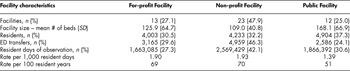
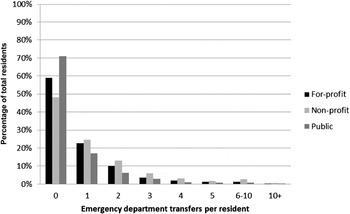
Between April 1, 2005, and March 31, 2008, there were 13,140 residents in 48 facilities meeting the study inclusion criteria, representing over six million resident days. Approximately one third of residents resided in for-profit (30.5%) and non-profit (32.2%) facilities while almost 40 per cent of all individuals resided in publicly owned facilities (see Table 1). The mean age (SD) of the population was 83.1 (SD 10.1) years and one third was male (data not shown). Over the three-year time period, there were a total of 10,710 ED transfers. Crude rates of ED transfers per 100 resident years were 69, 70, and 51 in for-profit, non-profit, and publicly owned facilities respectively (see Table 1). Facility transfer rates ranged from 23 to 95 transfers per 100 resident years, representing a fourfold difference between facilities (data not shown). In publicly owned facilities, 71 per cent of residents had no transfers compared to 59 per cent of residents in for-profit facilities and 48 per cent of residents in non-profit facilities (see Figure 1).
Crude emergency department (ED) transfer rates for residents of nursing homes in Vancouver Coastal Health region, British Columbia, Canada, by facility ownership (for the period April 1, 2005, to March 31, 2008)

ED = emergency department
SD = standard deviation
Histogram of the distribution of emergency department transfers per resident among nursing home residents – for the period April 1, 2005, to March 31, 2008 – in Vancouver Coastal Health region, British Columbia, Canada, by facility ownership

After controlling for sex and age, public ownership was found to be associated with a lower rate of ED transfers compared to for-profit (IRR: 0.65; 95% CI: 0.59, 0.71) and non-profit facilities (IRR: 0.68; 95% CI: 0.62, 0.74) (see Table 2). There was no significant difference in the adjusted rate of ED transfers between for-profit and non-profit facilities (p = .38) (data not shown). Male sex was associated with a higher rate of ED transfers, and no association of age was found. Facility size was not found to be significant in univariate analysis and was therefore not included in the model.
Poisson regression, unadjusted and adjusted incidence rate ratios for the effect of ownership on emergency department (ED) transfer rates, among nursing home residents in Vancouver Coastal Health region, British Columbia, Canada (for the period April 1, 2005, to March 31, 2008)a

CI = confidence interval
IRR = incidence rate ratio
a Excludes residents who moved from one facility ownership type to another during study period; excludes multi-transfers on the same day for the same resident
b Facility size was found to be non-significant and therefore was not included in the final model.
Distribution of Survey-Derived Facility Characteristics across Ownership Groups
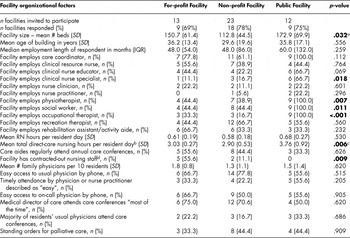
Survey data on other facility characteristics were available on a sub-set of 36 respondent facilities (75%) (see Table 3). Publicly owned facilities were somewhat larger compared to for-profit (difference in mean number of beds: 22) and non-profit facilities (difference in mean number of beds: 60). A significantly greater proportion of publicly owned facilities employed a clinical nurse specialist and other allied health staff (physiotherapist, social worker, and occupational therapist). Publicly owned facilities also had a significantly higher mean number of total direct-care nursing (registered nurse [RN], licensed practical nurse [LPN], and care aide) hours per resident day. A significantly higher proportion of for-profit facilities had contracted out the long-term hiring, management, and remuneration of nursing staff to an outside company (see Table 3).
Distribution of facility organizational factors across ownership groups, for survey respondent nursing homes in Vancouver Coastal Health region, British Columbia, Canada (for the period January 1, 2008, to December 31, 2008)

IQR = interquartile range
RN = registered nurse
SD = standard deviation
a Facility size: for-profit versus non-profit (p = .078), for-profit versus public (p = .483), non-profit versus public (p = .011)
b Total direct-care nursing hours per resident day include registered nursing, licensed practical nursing, and care aide hours per resident day
c Mean total direct-care nursing hours per resident day: for-profit versus non-profit (p = .507), for-profit versus public (p = .036), non-profit versus public (p = .006)
d “Contracted-out” refers to the practice of facilities contracting out the long-term hiring, management, and remuneration of nursing staff to an outside company
Survey-Derived Facility Characteristics and ED Transfer Rates
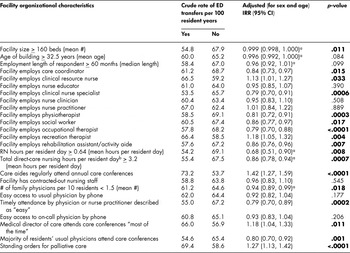
Survey-derived facility characteristics of the 36 respondent facilities were linked to 2,763 transfers and 1.6 million resident days between January 1, 2008, and December 31, 2008 – the year immediately preceding the survey. There was no difference in ED transfer rates between the facilities that responded to the survey compared to those facilities that did not respond. Facility characteristics associated with significantly lower rates of ED transfers in univariate cross-sectional analysis were (a) larger facility size; (b) facility employment of a care coordinator, clinical nurse specialist, a physiotherapist, a social worker, an occupational therapist, or an activity aide; (c) higher mean registered nurse hours per resident day; (d) higher mean total direct-care nursing (RN, LPN, and care aide) hours per resident day; (e) fewer number of physicians per 10 residents; (f) timely attendance by physician or nurse practitioner described as “easy”; and (g) facility reporting a majority of residents’ usual physicians attend annual care conferences (see Table 4).
Crude emergency department (ED) transfer rates, and adjusted incidence rate ratios of facility organizational characteristics and emergency department transfers among nursing home residents in Vancouver Coastal Health region, British Columbia, Canada (for the period January 1, 2008, to December 31, 2008)

CI = confidence interval
IRR = incidence rate ratio
RN = registered nurse
a Continuous variable used for regression model
b Total direct-care nursing hours per resident day include registered nursing, licensed practical nursing, and care aide hours per resident day
Facility characteristics associated with significantly higher rates of ED transfers were (a) facility employment of a clinical resource nurse or recreation therapist; (b) participation of care aides in annual resident care conferences; (c) reported attendance of medical director of care at the residents’ annual care conference “most of the time”; and (d) presence of standing orders in palliative care (see Table 4).
Discussion
Our study found a significantly lower rate of ED transfers among residents of publicly owned facilities (owned and operated by a health authority or part of a hospital) compared to both for-profit and non-profit facilities. The observed effect of public ownership is unlikely due to reporting bias or the presence of “observation units” where residents can be admitted without having to go through the ED in publicly owned facilities. First, we have been reassured by the hospital data systems managers that the cost centres of acute and long-term-care hospital wings are entirely separate and that all ED transfers, regardless of the transfer origin, are recorded. Second, in the region under study, there are no “observation units” available to residents who require acute services, without first going through the hospital ED so that even transfers from the long-term-care wing of the same hospital are admitted to the ED and recorded as such. Furthermore, the association of public ownership with ED transfers seen in our study is generally consistent with the literature demonstrating an association with public ownership (Doupe et al., Reference Doupe, Brownell, Kozyrskyj, Dik, Burchill and Dahl2006; McGregor et al., Reference McGregor, Tate, McGrail, Ronald, Broemeling and Cohen2006; Shapiro & Tate, Reference Shapiro and Tate1995) and lower acute-service utilization.
There is very little published research examining facility ownership characteristics and ED transfers, and none that examines public ownership as a distinct group separate from non-profit ownership. One study on nursing homes in Hong Kong found higher odds of emergency room transfers in for-profit compared to non-profit facilities (Tang et al., Reference Tang, Woo, Hui, Chan, Lee and Sham2010). Both this study and prior U.S. research on the topic focused on for-profit versus non-profit groups and did not examine public ownership separately, presumably due to the absence of a significant publicly owned nursing home sector in these jurisdictions. In many Canadian provinces, however, a substantial proportion of nursing homes are either attached to hospitals, or owned and operated by regional or municipal health agencies. An understanding of differences between the three ownership groups is, therefore, highly relevant.
What underlies the apparent protective association of public ownership and lower ED transfer rates? The staffing differences in publicly owned facilities may be part of the explanation. Our study found that publicly owned facilities had a significantly higher mean number of direct-care nursing hours per resident day compared to the other two groups. This finding was consistent with previous Canadian research on nursing home staffing levels and facility ownership (Berta et al., Reference Berta, Laporte and Valdmanis2005; McGregor, Tate, et al., Reference McGregor, Pare, Wong, Cox and Brasher2010). In our study, the estimated ED transfer rate was 14 per cent lower for each unit increase in total direct-care nursing (IRR: 0.86; 95% CI: 0.78, 0.94). While staffing levels have not been previously studied in relation to ED transfers, prior U.S. research has demonstrated an association between lower hospital admissions and higher registered nurse staffing (Horn et al., Reference Horn, Buerhaus, Bergstrom and Smout2005). Higher direct-care nursing levels in publicly owned facilities may reduce ED transfers through improved facility capacity to detect early disease and/or manage resident acute illness on-site.
Similarly, a disproportionately greater number of publicly owned facilities employ clinical nurse specialists, physiotherapists, and occupational therapists, all of which are associated with lower ED transfer rates and may explain the lower transfer rates observed in publicly owned facilities. Another explanation may be that publicly owned facilities and hospitals have a shared governance and common budget that encourages greater accountability resulting in lower rates of ED transfers.
The bivariate association between larger facility size and a lower rate of transfer is likely confounded by the disproportionate distribution of large facilities across public ownership. This is supported by the fact that facility size was not found to be significantly associated with ED transfers in our first model that included both variables. A number of other factors, not disproportionately present in publicly owned facilities, also appear to be significantly associated with ED transfer rates.
Timely attendance by a physician or nurse practitioner was associated with a lower ED transfer rate. Increased access to physicians has been associated in the literature with both lower (Intrator et al., Reference Intrator, Castle and Mor1999; Young, Barhydt, Broderick, Colello, & Hannan, Reference Young, Barhydt, Broderick, Colello and Hannan2010) and higher rates of hospital admissions (Intrator et al., Reference Intrator, Zinn and Mor2004). Having timely medical assessment of an ill resident may enable an early clinical diagnosis and the initiation of treatment at the facility. Several studies have demonstrated an association between after-hours decline and greater odds of hospitalization for worsening heart failure, presumably due to the absence of medical assessment at these times (Hutt, Ecord, Eilertsen, Frederickson, & Kramer, Reference Hutt, Ecord, Eilertsen, Frederickson and Kramer2002; Hutt, Frederickson, Ecord, & Kramer, Reference Hutt, Frederickson, Ecord and Kramer2003).
Attendance by a resident’s usual physician at the annual care conference was also associated with a lower rate of ED transfers. It is possible that participation of a resident’s usual physician at care conferences promotes more discussion of end-of-life planning between the physician, the resident/family, and other team members as this topic is routinely reviewed at such conferences. Physician familiarity with residents’ wishes has, in some research, been found to be a factor in decisions to transfer dying residents (Bottrell et al., Reference Bottrell, O’Sullivan, Robbins, Mitty and Mezey2001).
A lower physician-to-resident ratio was another variable associated with a lower rate of ED transfer. We hypothesized that a lower physician-to-resident ratio represented a surrogate marker of physician continuity (McGregor et al., Reference McGregor, Baumbusch, Abu-Laban, McGrail, Andrusiek and Globerman2011) such that the more residents cared for by one physician at a given site, the greater the likelihood of that physician regularly visiting the facility. Physician continuity has been associated with a resident/family decision not to be hospitalized (McGregor, Pare, et al., Reference McGregor, Pare, Wong, Cox and Brasher2010) which itself is highly correlated with lower rates of transfer to hospital (McGregor, Pare, et al., Reference McGregor, Pare, Wong, Cox and Brasher2010). We note that our study did not assess physician approach; moreover, Young et al. (Reference Young, Barhydt, Broderick, Colello and Hannan2010) found that facilities in New York State whose physicians attempted to treat patients within the nursing home, and admit to the hospital as a last resort, had significantly lower rates of potentially avoidable hospital admissions.
The participation of medical directors of care in care conferences in our study was associated with a higher rate of ED transfers and contradicted our a priori hypothesis. One possible explanation for this observed association is that the attendance of the medical director at care conferences was a proxy for the residents’ usual physician’s non-attendance, where the latter variable was associated with lower ED transfer rates for the reasons described earlier. The care conference is a scheduled time when family members, and sometimes the resident, meet with all involved disciplines to consider the resident’s health status and review goals of care. It is an opportunity to discuss advance-care planning, including re-visiting whether residents and their families wish transfer to hospital in the event of an acute medical event. This conversation about “degrees of intervention” is most often initiated by the usual physician who has an established relationship with residents and families.
It is more common for the medical director to attend a resident care conference when the usual physician is not present. However, the medical director is an administrator and, unless he/she is also providing primary care to the same resident, is unlikely to have an established relationship with the resident or resident’s family, making regular conversations about a decision to hospitalize less likely to occur. A second possible explanation for a higher rate of ED transfers when medical directors of care participate in care conferences is that medical directors are often asked to decide about hospital transfer when staff members are unable to contact residents’ usual physicians and the “safe” decision, in the absence of the usual physician’s input, is to transfer.
Facility employment of an activity aide was associated with lower ED transfer rates, consistent with our a priori hypothesis. Increased activity-aide-to-resident ratios has been shown in research to be related to improved residents’ expressive language skills, social skills, and cognitive function (Reid & Chappell, Reference Reid and Chappell2003), which in turn relate to positive self-perceived health and a lower risk of mortality (Ramage-Morin, Reference Ramage-Morin2006). We hypothesized that through a similar pathway, more activity aides in a facility might reduce ED visits.
Paradoxically, the presence of a recreation therapist was associated with a higher rate of ED transfer. Recreation therapists are considered to be professional staff and have a higher level of training and compensation compared to activity aides. One possible explanation for this may be a substitution effect whereby other specialized nursing staff, associated with fewer ED visits in our study, are not hired when a facility decides to employ a recreation therapist.
Care aides’ attendance at care conferences and the presence of standing orders in palliative care all appeared to be associated with a greater risk of ED transfers. These findings were also surprising given that we hypothesized these characteristics would have a protective effect. Furthermore, employing specialized nursing expertise did not appear to demonstrate an equally protective effect across job descriptions. Facilities with care coordinators and clinical nurse specialists had lower ED transfer rates, whereas facilities that employed clinical resource nurses had higher rates of ED transfers. Nursing homes, like the rest of the health care system, are complex adaptive institutions, and it is likely that these apparently contradictory associations may be explained by unmeasured factors producing confounding effects.
This study had a number of limitations. First, owing to data limitations we were unable to control for resident case mix beyond sex and age. In British Columbia, all residents must meet common “complex care” criteria in order to qualify for facility admission and accept the “first available bed” while awaiting placement in their preferred facility (British Columbia Ministry of Health, 2011). Facilities must also accept any resident who meets the “complex care” criteria if they have an available bed. There is thus relatively little opportunity for facilities to “risk select” the residents they accept. It is therefore less likely, in our study, that unadjusted differences in case mix between facilities produced spurious associations. Furthermore, publicly owned facilities, by virtue of their affiliation with a hospital, may house more medically complex residents. Failure to adjust for case mix in this instance are therefore likely to bias results towards the null.
A second study limitation is that, as with all observational studies involving secondary health data, there may be unanticipated bias or confounding variables. Third, the cross-sectional analysis was carried out on the sub-set of facilities responding to the survey. While the 75 per cent response rate was relatively high, a disproportionate number of publicly owned and non-profit facilities responded to the survey. Fourth, although the facility survey items were assessed for face validity, they have not undergone more formal validity testing. Furthermore, due to the cross-sectional nature of the data, we were unable to ascertain the causation of the associations we found. It should also be noted that we were unable to measure which transfers were avoidable, and while the underlying assumption for this population was that “less is better”, there are clearly a number of circumstances where transfer to the ED is necessary. Finally, due to the multiple comparisons made in our study, it is possible that some of the observed associations arose from chance. Despite these limitations, ours is one of the few studies to quantify population ED transfer rates by facility ownership group and to our knowledge is the first observational study to explore the possible facility-level organizational factors associated with ED transfers.
Conclusions
A significantly lower rate of ED transfers exists among residents of facilities that are publicly owned (owned and operated by a health authority or part of a hospital) compared to both for-profit and non-profit facilities. Higher total direct-care nursing staff and the presence of allied health staff, disproportionately present in publicly owned facilities, may contribute to this situation. Independent of ownership, a number of other facility organizational characteristics appear to be associated with ED transfers. Further research, to confirm these findings and better understand the mechanisms underlying them, is needed to help determine if efforts to make ED utilization more consistent across various facility types are warranted.