Implications
For studying the impact of disease on nutritional needs of growing pigs, a humane model is needed that is relatively easy to use, predictable and mimics chronic disease. In two experiments, three disease-causing agents were evaluated: repeated injections of turpentine and Escherichia coli lipopolysaccharide (LPS), as well as feeding mycotoxins. Among these agents, repeated injection with increasing amounts of E. coli LPS was considered to be the best model for studying nutrient metabolism during chronic disease in growing pigs.
Introduction
For studying the impact of immune system stimulation (ISS) on nutrient metabolism and productivity of pigs, a model is needed that represents chronic ISS, is equivalent to subclinical or moderate clinical disease and can be used to evaluate the impact of potential (nutritional) interventions to alleviate the impact of ISS on animals. Various animal models of disease have been described in literature; however, most of them induce clinical disease symptoms, severe body weight (BW) loss and only allow short-term observations (Fink and Heard, Reference Fink and Heard1990). For instance, models in which animals are exposed to live pathogens are generally associated with high rates of mortality, extreme BW loss and anorexia, or variable responses (Wichterman et al., Reference Wichterman, Baue and Chaudry1980; Fink and Heard, Reference Fink and Heard1990).
Contrary to using live pathogens, dosages of non-pathogenic immunogens such as Escherichia coli lipopolysaccharide (LPS), inflammatory turpentine (TURP) or mycotoxins (MYCO) are easily controlled and can induce reproducible responses (Fink and Heard, Reference Fink and Heard1990; Deitch, Reference Deitch1998). In addition, limited biosecurity is needed when they are administered to animals. Administration of large single doses of these immunogens can cause severe responses, including high mortality and organ failure (Fink and Heard, Reference Fink and Heard1990). Reducing the dose of these antigens improves survival rates; however, animal recovery often occurs within 48 h after the challenge (Deitch, Reference Deitch1998). Prolonged repeated administration (Van Heugten et al., Reference Van Heugten, Coffey and Spears1996) or continued infusion (Fish and Spitzer, Reference Fish and Spitzer1984) of LPS leads to endotoxin tolerance (Ash and Griffin, Reference Ash and Griffin1989; Deitch, Reference Deitch1998).
The first objective of this study was to directly compare the impact of various non-pathogenic immunogens (LPS, TURP and MYCO) on indicators of ISS in growing pigs. The second objective was to contrast general measures of immune function in LPS-challenged pigs with unchallenged pigs. The overall aim was to establish a humane, chronic ISS model that represents subclinical or mild clinical disease and that can be used to study nutrient metabolism during ISS in growing pigs.
Material and methods
In our study, two experiments (EXPs) were conducted. In EXP I, pigs were exposed to three different non-pathogenic immunogens: LPS, TURP and MYCO. In EXP II, the ISS response of pigs treated with LPS was compared with that of unchallenged pigs. The experimental procedures were reviewed and approved by the University of Guelph, Animal Care Committee.
Experimental design, diets and feeding
In EXP I, nine Yorkshire barrows with initial BW of 24.7 ± 0.40 kg were obtained from the University of Guelph, Arkell Swine Research Center (Arkell, ON, Canada) and housed individually in metabolism crates (Nyachoti et al., Reference Nyachoti, de Lange and McBride1998). After 7 days of adaptation to the environment, pigs were surgically fitted with a jugular catheter (Micro-Renathane, 1.6 mm i.d., 2.41 mm o.d.; Brain Tree Scientific Inc., Braintree, MA, USA) for serial blood sample collection (de Lange et al., Reference De Lange, Sauer and Souffrant1989), and allowed to recover for 10 days before the start of ISS. Three types of non-pathogenic immunogen were tested during a 10-day ISS period: (i) repeated injection of increasing amounts of E. coli LPS (serotype 055:B5, Sigma-aldrich Canada Ltd, Oakville, ON, Canada; cat. no. L2880); (ii) repeated injection of inflammatory TURP; and (iii) feeding grains naturally contaminated with MYCO. Pigs on LPS were injected intramuscularly every 48 h (total of five injections) with increasing amounts of LPS reconstituted in saline. The initial dosage of 60 μg/kg of BW was increased by 12% at each subsequent injection to reduce endotoxin tolerance. The initial dose of LPS was established on the basis of a pilot study in our laboratory in which plasma levels of interleukin-1β (IL-1β) were monitored for 48 h in four pigs. Pigs on TURP were injected subcutaneously (1.0 ml/kg of BW) every 72 h (total of three injections) according to Jahoor et al. (Reference Jahoor, Wykes, Reeds, Henry, del Rosario and Frazer1995) and at different sites along the pig's back and the hindquarters. Pigs on LPS and TURP received the injections at ∼1000 h and ∼2 h after feeding. Pigs on MYCO were given a diet containing 5% naturally contaminated wheat. The diet contained a mixture of (mg/kg diet) deoxynivalenol (5.8), fusaric acid (49.3), zearalenone (0.5) and 15-acetyldeoxynivalenol (0.3), as described previously by Swamy et al. (Reference Swamy, Smith, MacDonald, Karrow, Woodward and Boermans2003). Pigs were randomly assigned to the three treatments. All the pigs received conventional soybean meal and corn-based pig starter diets, formulated to contain 14.5 MJ/kg digestible energy, 9.6 g/kg standardized ileal digestible lysine and sufficient levels of essential nutrients according to National Research Council (NRC; 1998). The MYCO diet also contained 5% MYCO-contaminated wheat. The daily feed allowance was 1.2 kg, supplied in two equal meals at 0800 and 1600 h; feed refusals were removed and weighed just before feeding.
Detailed procedures for EXP II were described previously when the impact of ISS on aspects of nutrient utilization was reported (Rakhshandeh et al. Reference Rakhshandeh, Htoo and de Lange2010). Briefly, 36 barrows (initial BW 21.5 ± 3.5 kg) were housed individually in metabolic crates, and feed-restricted. After 9 days of adaptation to environmental conditions and dietary treatments, pigs were injected intramuscularly every 48 h with either increasing amounts of LPS (n = 24) or sterile saline (n = 12) for 7 days, as described for EXP I.
Observations, sample processing, chemical and statistical analyses
In both the EXP, daily feed intake was monitored 3 days before and during ISS. BW was measured at the start (day 0) and end (day 10 or 7) of ISS and was used to calculate average daily gain (ADG) during ISS. In EXP I, blood samples were collected on a daily basis (∼1400 h) in heparinized tubes and placed on ice until they were processed further. Rectal temperature was measured on a daily basis, immediately after blood sample collection. In EXP II, eye temperature was monitored using the infrared imaging technique as described previously by Montanholi et al. (Reference Montanholi, Odongo, Swanson, Schenkel, McBride and Miller2008), and blood samples were collected using retro-orbital bleeding at day 7. Pigs were then immediately euthanized, a ventral abdominal incision was made, spleen and liver were removed, rinsed with physiological saline, blotted dry and weighed.
Blood plasma was obtained by centrifugation at 2000 × g for 20 min at 4°C. Plasma cortisol levels were determined using a competitive binding radioimmunoassay kit (GammaCoat [125I] Cortisol, DiaSorin Inc., Stillwater, MN, USA; cat. no. CA-1529) according to the manufacturer's protocol with minor modifications. The amount of sample was increased threefold and incubation time was increased (from 45 min at 37°C to overnight at room temperature) to increase the sensitivity of the assay (Marchant-Forde et al., Reference Marchant-Forde, Lay, Pajor, Richert and Schinckel2003). Plasma IL-1β levels were measured using the Quantikine porcine IL-1β immunoassay kit (R&D system Inc., Minneapolis, MN, USA; cat. no. PLB00). In order to quantify red blood cell (RBC) glutathione (GSH) concentrations (Jahoor et al., Reference Jahoor, Wykes, Reeds, Henry, del Rosario and Frazer1995), 2 ml of heparinized blood was centrifuged at 1500 × g for 10 min at 4°C, plasma was removed and 0.5 ml of packed RBC were freeze-thawed several times in liquid nitrogen to lyse the cells. Lysed cells were then de-proteinized using meta-phosphoric acid at a final concentration of 5%. GSH concentrations were quantified in the supernatant using Tietze's enzymatic recycling method (GSH Assay Kit, WPI Inc., Sarasota, FL, USA; cat. no. 062404).
Blood levels of acute-phase proteins and complete blood count (CBC) were determined in the Animal Health Laboratory at the University of Guelph. Serum albumin (Doumas et al., Reference Doumas, Watson and Biggs1971) and haptoglobin (Makimura and Suzuki. Reference Makimura and Suzuki1982) were analyzed using Roche Cobas c501 biochemistry analyzer (Roche Diagnostics, Indianapolis, IN, USA). Plasma fibrinogen was quantified using a KC4 Delta semi-automatic coagulation analyzer (Trinity Biotech, Wickland, Ireland) and a TirinitClot kit (TriniCLOT™ Fibrinogen, Trinity Biotech; cat. no. T1301). CBC was performed using ADIVA 120 Hematology System (Siemens Healthcare Diagnostics Inc., IL, USA).
Daily measurements, such as feed intake, body temperature (BT) and plasma levels of cortisol, IL-1β and GSH data were analyzed statistically as repeated measurements, on the basis of a complete randomized design (MIXED procedure in SAS, version 9.1, SAS institute Inc., Cary, NC, USA) with treatment, time (day) and the treatment by time interaction as fixed effects, and pig within treatment as random effect. In EXP I, the results obtained for each treatment during ISS (n = 3) were compared with those obtained before ISS (n = 9). Owing to the sequential nature of the observations on individual animals, a compound symmetry structure was determined to be the most appropriate fit. In EXP I, BW and BW gain data were analyzed using a complete randomized design (MIXED procedure in SAS) with treatment as fixed effect and pig within treatment as random effect. For EXP II, the same statistical analyses were performed, using a randomized complete block design with treatment and block as fixed effects and pig within treatments as random effect. The Tukey–Kramer test was used to compare treatment effects when the interaction between treatments and time was found to be significant. Differences were considered to be significant at P < 0.05. A tendency toward a significant difference between treatment means was also considered at P ⩽ 0.10.
Results
In EXP I, no differences between the treatment groups were observed for BW, BT, levels of plasma IL-1β and cortisol, RBC GSH and feed intake before ISS (P > 0.05). There were no mortalities in any of the treatment groups. In general, TURP induced severe local inflammation including skin ulcers on the back.
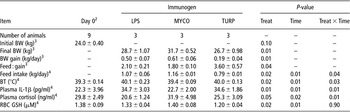
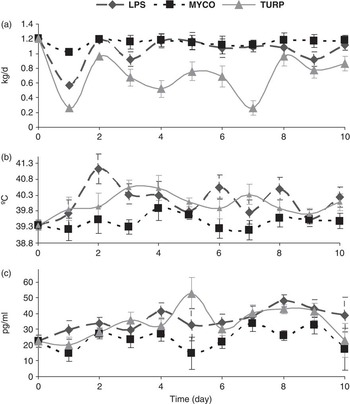
Relative to pre-ISS values, BT and plasma IL-1β concentrations were increased in pigs treated with LPS and TURP (P < 0.02), but not in MYCO-treated pigs (P > 0.10; Table 1), and remained elevated over the duration of study (Figure 1). Plasma cortisol concentrations remained unchanged for MYCO- and TURP-treated pigs, but were reduced for LPS-treated pigs (Table 1; P < 0.01). RBC GSH concentrations were reduced in TURP-treated pigs, but were unchanged in LPS- and MYCO-treated pigs (P < 0.05). No interactive effect of treatments and time on plasma RBC GSH concentrations was observed (Table 1; P > 0.10).
Impact of immunogen type on growth performance and some indices of the innate immune system response in growing barrowsFootnote 1

LPS = lipopolysaccharide; MYCO = mycotoxins; TURP = turpentine; BW = body weight; BT = body temperature; IL-1β = interleukin-1β; RBC GSH = red blood cell Glutathione.
1 Experiment I: nine barrows were fed 1.2 kg/day of a soybean meal and corn-based conventional pig starter diet before and during a 10-day period of immune system stimulation (ISS); ISS was induced during a 10-day period using three non-pathogenic immunogens (Treat): Escherichia coli LPS, MYCO and inflammatory TURP. Data are least square means ± s.e.
2 Pre-ISS (day 0) measurements were not different between the treatment groups (P > 0.10).
3 Initial (day 0) and final (day 10) BW, BW gain and feed conversion ratio (feed : gain) during the 10-day period of ISS.
4 Average daily feed intake, BT, as well as plasma levels of IL-1β, cortisol and RBC GSH, based on daily observations.
Impact of immunogen type on average daily feed intake (a), body temperature (b) and plasma interleukin-1β level (c). Nine barrows were feed-restricted (1.2 kg/day) and treated during a 10-day period with one of three non-pathogenic antigens: Escherichia coli lipopolysaccharide (LPS), mycotoxins (MYCO) and inflammatory turpentine (TURP).

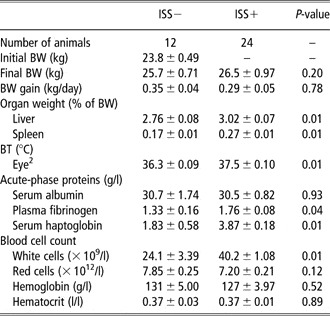
In EXP II, treatment of pigs with LPS increased relative to the weight of spleen and liver (P < 0.01), eye temperature (P < 0.01), plasma fibrinogen (P < 0.04), serum haptoglobin (P < 0.01) and white blood cell count (P < 0.01; Table 2). No effects of ISS were observed on final BW, ADG, serum albumin, RBC count, hemoglobin and hematocrit (P > 0.10; Table 2).
Impact of ISS on relative weight of organs, BT, levels of acute-phase proteins and blood cell countFootnote 1

ISS = immune system stimulation; BW = body weight; BT = body temperature.
1 Experiment II: data are least square means ± s.e. and represent data obtained on day 7 after start of ISS. Pigs were injected (i.m.) every 48 h over a 7-day period with increasing amounts of lipopolysaccharide (ISS+) or sterile saline solution (ISS−).
2 Eye temperatures were measured using the infrared imaging technique. Mean of seven daily values during ISS and based on repeated measurement analysis.
Discussion
The main aim of this study was to establish a humane and chronic model of ISS that represents a subclinical or mild clinical disease and that allows for the evaluation of the impact of ISS on various aspects of nutrient metabolism.
In EXP I, lack of statistical difference for all measured responses between treatment groups before ISS indicated that the pigs on the various treatments were at similar physiological states at the start of the study. In EXP II, it was shown that repeated injection of control animals with saline did not affect the reported measures of immune function, which is consistent with previous observations on growing pigs (Jahoor et al., Reference Jahoor, Wykes, Reeds, Henry, del Rosario and Frazer1995 and Reference Jahoor, Wykes, Reeds, del Rosario and Frazer1999). It was thus concluded that treatment effects observed in EXP I can be attributed to the immunogens per se.
Relationships between growth performance and disease are mediated by proinflammatory cytokines (IL-1β, IL-6 and tumor necrosis factor-α (TNF-α)), which are synthesized and released mainly by mononuclear myeloid cells of the innate immune system upon exposure to pathogens (Buchanan and Johnson, Reference Buchanan and Johnson2007). These cytokines shift the partitioning of nutrients from growth and reproduction toward supporting the immune system (Johnson, Reference Johnson1998; Buchanan and Johnson, Reference Buchanan and Johnson2007). They also orchestrate central nervous system-specific response including fever, sleep, reductions in activity and feed intake, and activation of hypothalamic–pituitary–adrenal (HPA) axis (Johnson, Reference Johnson1998; Karrow, Reference Karrow2006). Among these cytokines, IL-1β is involved in all aspects of the immune response including fever and anorexia. IL-1β can exert its anorectic effect by suppressed feeding behavior, decreased gastric emptying and motility (Johnson, Reference Johnson1998), and increased circulating levels of glucagon, insulin and leptin (Meier and Gressner, Reference Meier and Gressner2004). In this study, we observed a persistent increase in plasma concentration of IL-1β in pigs on LPS and TURP, which was consistent with the observed reductions in feed intake, increased BT and compromised growth performance. BW gain was reduced more severely in pigs on TURP than on LPS, even though plasma levels of IL-1β were similar for pigs on TURP and LPS. The latter indicates that plasma levels of IL-1β explain only partly the observed treatment effects on pig growth performance. Lower feed intake and performance of pigs on TURP relative to LPS-treated pigs can also be attributed partly to higher plasma cortisol levels in these animals (Jahoor et al.,Reference Jahoor, Wykes, Reeds, del Rosario and Frazer1999; Buchanan and Johnson, Reference Buchanan and Johnson2007). Moreover, pain-associated behavior due to skin ulceration may also contribute to decreased feed intake and growth performance of TURP-treated pigs (Zimmermann, Reference Zimmermann2001). In this study, feeding naturally occurring MYCO did not increase the plasma levels of IL-1β, and therefore did not induce fever or provoke substantial reductions in feed intake or growth performance. MYCO have a suppressive effect on the immune system in general and on the activity of mononuclear myeloid cells in particular (Kidd et al., Reference Kidd, Hagler and Qureshi1995; Oswald et al., Reference Oswald, Marin, Bouhet, Pinton, Taranu and Accensi2005). Changes in brain concentration of neurotransmitters seem to be, to a large extent, responsible for reduced feed intake in pigs fed MYCO (Swamy et al., Reference Swamy, Smith, MacDonald, Boermans and Squires2002). This indicates that the impact of MYCO on feed intake is not mediated by proinflammatory cytokines. It can also be speculated that, in this study, feed intake was restricted too severely to identify the impact of MYCO on feed intake. In a previous study by Swamy et al. (Reference Swamy, Smith, MacDonald, Boermans and Squires2002), average daily feed intake (ADFI) of pigs (BW ∼19.0 kg) receiving a very similar MYCO-contaminated diet was reported to be 1.45 kg/day, which was 20% higher than the feed allowance in this study. This, to a large extent, explains the lack of effect of MYCO on ADFI in our study.
Acute disease provokes high plasma levels of the stress hormone cortisol, which appears to be induced by proinflammatory cytokines and particularly IL-1β (Webel et al., Reference Webel, Finck, Baker and Johnson1997). However, during prolonged ISS (e.g. chronic disease) plasma cortisol levels are reduced, apparently to increase the animal's chance of survival (Heim et al., Reference Heim, Ehlert and Hellhammer2000; Fries et al., Reference Fries, Hesse, Hellhammer and Hellhammer2005). In this study, we observed numerical or significant reductions in plasma cortisol levels in TURP- and LPS-treated pigs. Three potential mechanisms for adjustments to the HPA axis, which result in reduced plasma cortisol levels, have been suggested: (i) reduced expression of specific receptors on different levels of axis (e.g. glucocorticoid receptors); (ii) decreased synthesis or depletion of compounds such as corticotrophin-releasing hormone (CRH); adrenocorticotropic hormone and cortisol; or (iii) enhanced negative feedback sensitivity to glucocorticoids (Hellhammer and Wade, Reference Hellhammer and Wade1993). In this study, it is possible that high and persistent levels of IL-1β resulted in prolonged overproduction of cortisol, which consequently saturated the intracellular glucocorticoid receptors, reducing receptor sensitivity (Pariante and Miller, Reference Pariante and Miller2001). The latter mediates feedback inhibition of CRH (De Kloet et al., Reference De Kloet, Vreugdenhil, Oitzl and Joels1998). Certain MYCO (e.g. T-2 toxin) when fed to the pigs at high levels increase plasma cortisol levels, which may be provoked by a severe reduction in feed intake (Rafai and Tuboly, Reference Rafai and Tuboly1982). However, no effect of MYCO on plasma cortisol levels was observed in this study, which is in agreement with the findings of other investigators (Drochner et al., Reference Drochner, Schollenberger, Piepho, Gotz, Lauber, Tafaj, Klobasa, Weiler, Claus and Steffl2004; Leung et al., Reference Leung, Smith, Karrow and Boermans2007).
Intracellular concentrations of GSH represent the balance between rates of synthesis and loss from the cell. Several studies have demonstrated that GSH concentrations are diminished by disease, food deprivation (Hum et al., Reference Hum, Koski and Hoffer1992) or protein and sulfur amino acid deficiency (Grimble et al., Reference Grimble, Jackson, Persaud, Wride, Delers and Engler1992; Jahoor et al., Reference Jahoor, Wykes, Reeds, Henry, del Rosario and Frazer1995). Jahoor et al. (Reference Jahoor, Wykes, Reeds, Henry, del Rosario and Frazer1995) reported that protein-deficient pigs are not able to maintain RBC GSH levels during inflammation, mainly because of the reduced synthesis rate of GSH. In our study, pigs on TURP, because of reduced feed intake, consumed 35% and 30% less protein than pigs on MYCO and LPS, respectively. This may partly explain the lower RBC GSH levels in TURP-treated pigs in our study. Alternatively, it can be speculated that lower levels of RBC GSH in TURP-treated pigs could be due to higher levels of oxidative stress in animals caused by severe local inflammation due to skin ulceration. This can lead to an increase in oxidation of GSH and its export from RBC (Jahoor et al., Reference Jahoor, Wykes, Reeds, Henry, del Rosario and Frazer1995; Breuille and Obled, Reference Breuille and Obled2000).
In EXP II, ISS resulted in altered plasma levels of acute-phase proteins. Proinflammatory cytokines, IL-1, IL-6 and TNF-α, as well as corticosteroids play an essential role in initiating the synthesis of hepatic acute-phase proteins; therefore, the increased plasma haptoglobin and fibrinogen reflect ISS mediated by these molecules (Baumann et al., Reference Baumann, Prowse, Marinkovic, Won and Jahreis1989; Jahoor et al., Reference Jahoor, Wykes, Reeds, Henry, del Rosario and Frazer1995). Moreover, increased eye temperature, an indicator of internal BT, is modulated by the action of proinflammatory cytokines, in particular by IL-1β (Hughes et al., Reference Hughes, Patterson, Thornton, Williams, Lott and Dodge1985; Dinarello, Reference Dinarello2005). Collectively, these results indicated that repeated injection of increasing amounts of LPS successfully stimulated the immune system in growing pigs
Conclusions and implications
Repeated injection of pigs with TURP induced severe responses, including skin ulcerations and substantial reductions in feed intake and BW gains. On the basis of plasma levels of IL-1β, feeding a mixture of naturally occurring MYCO did not provoke ISS. In contrast, repeated injection with increasing amounts of LPS induced a sustained chronic and relatively mild ISS. The latter was confirmed when comparing the general immune function in LPS-treated pigs with unchallenged pigs. Repeated injection with increasing amounts of LPS is therefore considered a suitable model for studying nutrient utilization and evaluating the efficacy of nutritional intervention during chronic–mild clinical ISS, representing chronic subclinical disease or mild clinical disease.
Acknowledgments
The authors thank Drs O. Brian Allen, Margaret Quinton and Aileen Joy Libao for technical assistance.