1. Introduction
The focus of a sentence intuitively indicates the informational importance of the respective word or phrase. In languages like English or German, focus can be marked prosodically (by a pitch accent) or syntactically. Additionally, focus particles can associate with a focused expression and thus provide a further cue that a focused expression is present in an utterance. For example, when a speaker utters the sentence Mary invited JOHN to dinner with intonational focus on John, he or she expresses that Mary invited John in contrast to other persons.
If the focus structure of a sentence successfully reflects the intention of the speaker, it necessarily has consequences for how a sentence is processed and perceived by the listener. It is well known that focused elements are somewhat privileged in language comprehension. For example, Cutler and Fodor (Reference Cutler and Fodor1979) showed that participants devote more attention to processing a focused element (John in the above example) compared to non-focused constituents, as reflected in better phoneme detection (see also Birch & Garnsey, Reference Birch and Garnsey1995, for focus effects on reading). Hence, focus structure guides the listener’s attention in language comprehension. What is more, focus structure seems to alter memory representations of a discourse. A number of studies have shown that focused elements are remembered better than non-focused elements, and are possibly represented with more semantic detail (e.g., Sturt, Sanford, Stewart, & Dawydiak, Reference Sturt, Sanford, Stewart and Dawydiak2004; Sanford, Price, & Sanford, Reference Sanford, Sanford, Molle and Emmott2009; Sanford, Sanford, Molle, & Emmott, Reference Sanford, Price and Sanford2006; Fraundorf, Watson & Benjamin, Reference Fraundorf, Watson and Benjamin2010).
Most previous studies on the role of focus structure in language processing implicitly relied on the assumption that the focused element in an utterance is the most important element (see, for example, Birch & Rayner, Reference Birch and Rayner2010). However, theoretical semantics, in particular Rooth (Reference Rooth1985), proposes that the function of focus is to evoke alternative expressions that can replace the focused expression. So, instead of highlighting prominence per se, alternative semantics defines focus as indicating the presence of alternatives that are relevant for interpretation (see Jacobs, Reference Jacobs1983, Reference Jacobs and Altman1988; Rooth, Reference Rooth1992; and Krifka, 2007, for similar proposals). Focus particles like only are assumed to have an additional function, in that they establish an association between the focused element and its alternatives (Rooth, Reference Rooth1985, Reference Rooth1992).
Alternative semantics is a formal semantic account of focus which does not necessarily make claims about the cognitive processes underlying the comprehension of focus. Yet from this account we can derive the hypothesis that listeners entertain a set of alternatives when processing focal information. The goal of the present study is to investigate the cognitive mechanisms underlying the establishment of alternative sets and the impact of focus particles on this process. In this ‘Introduction’, we will first review previous psycholinguistic studies investigating focus, before turning to the additional influence of focus particles. Then, we introduce the experimental paradigms we used in the current study.
1.1. contrastive pitch accents
Several recent studies have indicated that contrastive alternatives play an important role in on-line language processing (Dahan, Tanenhaus, & Chambers, Reference Dahan, Tanenhaus and Chambers2002; Weber, Braun, & Crocker, Reference Weber, Braun and Crocker2006; Ito & Speer, Reference Ito and Speer2008; Watson, Gunlogson, & Tanenhaus, Reference Watson, Gunlogson and Tanenhaus2008). Here, we discuss two lexical decision studies by Braun and Tagliapietra (Reference Braun and Tagliapietra2010) and Husband and Ferreira (Reference Husband and Ferreira2015) in more detail, which provide the most direct evidence that contrastive pitch accents create a representation of contrastive alternatives and reveal how the set of alternatives is further processed.
In the studies reported in this section, two specific pitch accent types were compared: the H* pitch accent consisting of a high target, and the complex L+H* accent starting with a low target followed by a steep rise in pitch contour of the accented syllable (see Pierrehumbert, Reference Pierrehumbert1980; Silverman, Gembella, Pitrelli, Wightman, Price, & Hirschberg, Reference Silverman, Beckman, Pitrelli, Ostendorf, Wightman and Price1992). Pierrehumbert and Hirschberg (Reference Pierrehumbert, Hirschberg, Coehn, Morgan and Pollack1990) proposed a distinct functional categorization of these two accent types with the H* accent signaling new, non-contrastive information and the L+H* contrastive information.Footnote 1
Braun and Tagliapietra (Reference Braun and Tagliapietra2010) used a cross-modal priming paradigm to investigate whether contrastive pitch accents activate alternatives (building on an earlier study by Norris, Cutler, McQueen, & Butterfield, Reference Norris, Cutler, McQueen and Butterfield2006). Participants were presented with sentences that contained a double contrast (Our neighbors assembled an antenna/trapeze) and had to perform a lexical decision task on a target that appeared after they heard the sentences. The sentence final prime word was spoken either with an H* accent or a contrastive L+H* accent. In Experiment 1a, participants saw target words that were contrastively associated with the critical primes (e.g., prime: antenna, target: DISH) or unrelated to the control primes (e.g., prime: trapeze, target: DISH). The results showed that the L+H* accent facilitated the recognition of the contrastively related targets relative to the unrelated primes (e.g., the contrastively accented noun antenna primed the target DISH). With the non-contrastive intonational contour (H*), in turn, no significant priming effect was observed: the targets were recognized equally fast with contrastive and unrelated primes.
In Experiment 1b, subjects were exposed to the same stimuli but saw non-contrastively associated targets to the critical primes (e.g., prime: antenna and target: TELEVISION). Those target words were associated with the critical primes by general world knowledge but could not replace them; that is, they were not alternatives to the focused elements. The results revealed a slight overall priming effect for non-contrastive targets such that they were recognized faster in the related (non-contrastively associated) than unrelated prime conditions. Crucially, however, no interaction between prosodic conditions and relatedness was found. In summary, Braun and Tagliapietra (Reference Braun and Tagliapietra2010) revealed that contrastive intonational contours specifically lead to the activation of contrastive associates (i.e., alternatives) while non-contrastive prosody did not cause such an effect.
Husband and Ferreira (Reference Husband and Ferreira2015) followed up on Braun and Tagliapietra (Reference Braun and Tagliapietra2010) and investigated how alternative sets evolve over time. They compared the activation of contrastive and non-contrastive associates to a prime word across two stimulus onset asynchronies (SOA). Participants were exposed to auditory stimuli that contained either an H* or an L+H* accent on the prime word (e.g., The museum thrilled the sculptor when they called about his work). At the offset of the prime word sculptor, while the sentence was being played, a visual target appeared on the screen that was either contrastively associated (e.g., PAINTER), non-contrastively associated (STATUE), or unrelated to the prime (REGISTER). In the first experiment, the targets appeared at an SOA of 0 ms. The results showed that contrastive and non-contrastive targets were facilitated compared to unrelated targets in both contexts – with neutral and contrastively accented primes. In the second experiment, the targets were presented at an SOA of 750 ms. It was found that contrastive targets were again facilitated, independent of whether the primes received neutral or contrastive prosody. Non-contrastive targets, however, were only primed in those cases where the primes were pronounced with an H* accent but not with an L+H* accent. Hence, if a prime is contrastively accented only contrastive associates to the prime word continue to be facilitated.
Husband and Ferreira (Reference Husband and Ferreira2015) propose a mechanism of establishing alternative sets involving initial activation of all associates of a focused expression and later selection of the contrastive associates, that is, the proper alternatives. According to their view, non-contrastive words become activated and need to be rejected/suppressed in a later step, either by activation decay or a more active mechanism of suppression. Husband and Ferreira conclude that the resolution of alternative sets in on-line language comprehension requires time, and note that comprehenders might engage in different strategies to establish a set of alternatives depending on how focus is marked (e.g., by focus particles, syntactic means, or prosodically).
In summary, the lexical decision studies by Braun and Tagliapietra (Reference Braun and Tagliapietra2010) and Husband and Ferreira (Reference Husband and Ferreira2015) provide evidence that, after having processed a sentence with a contrastive intonational contour, a noun that can replace the prime word (i.e., an alternative) is more accessible. Therefore, the studies show that contrastive pitch accents create a representation of alternatives to the accented element in on-line language processing, as expected based on the alternative semantic account of focus (Rooth, Reference Rooth1985, Reference Rooth1992). It should be kept in mind that in these experiments the alternatives were not mentioned in the context sentences.
There is also evidence that focus accents influence long-term memory for alternatives that are mentioned in a discourse. Fraundorf et al. (Reference Fraundorf, Watson and Benjamin2010) compared the effect of H* and L+H* accents in discourses that contained a contrast set with two elements (e.g., British and French scientists). The first two experiments presented all items in a row and subsequently tested recognition memory with a two-alternative forced choice task. Experiment 1 and 2 found that the L+H* accent facilitated the recognition of the accented items. In Experiment 3, the authors introduced a truth-value judgment task to investigate the hypothesis that the L+H* accent facilitates encoding of the whole contrast set but not of elements that were not mentioned in the discourses (e.g., a Portuguese scientist). In the recognition phase, which took place one day after participants had been exposed to the stimuli, participants had to indicate whether a statement was true or false. For example, if the critical sentence was The British scientists spotted the monkeys, participants judged whether the statement The French scientists spotted the monkeys (mentioned alternative) was true. The results of Experiment 3 indicated that the L+H* accent increased both the number of hits to correct statements and the number of correct rejections of the mentioned alternative. The rejection of unmentioned alternatives or so-called ‘lures’ (e.g., The Portuguese scientists spotted the monkeys), however, was unaffected.
According to the contrast representation account advocated by Fraundorf et al. (Reference Fraundorf, Watson and Benjamin2010), listeners use contrastive pitch accents to encode the whole alternative set (i.e., the focused element and its alternatives) more richly. The study by Fraundorf et al. provides evidence that information about focus alternatives that were mentioned in a discourse is encoded and stored in a listener’s long-term memory when it was highlighted by a contrastive pitch accent. The results of the study suggest that focus helps to identify the relevant alternatives when a set of alternatives is contextually mentioned.
1.2. focus particles
A set of alternatives is inherent in the semantic definition of certain lexical items referred to as focus particles. For example, in the sentence Mary only invited JOHN to dinner, the function of the particle only is to exclude elements of the alternative set {Peter, Sue, …}, thereby expressing that nobody but John was invited (König, Reference König1991). Traditional analyses divide focus particles into subclasses of exclusives (e.g., only, merely) and additives (e.g., also, even). What is more, the status of these aspects of meaning differs among the subclasses of particles (König, Reference König1991). While exclusives assert the exclusion of alternatives, additives presuppose that the proposition holds for at least one alternative. Accordingly, the particle even in the sentence Mary even invited JOHN to dinner presupposes that somebody else was invited, and adds the assertion that John was invited as well (which is surprising for the speaker).
Focus particles associate with a focused constituent and they must refer to a contextually salient set of alternatives (see also Beaver & Clark, Reference Beaver and Clark2008, who dubbed the term ‘conventional association’). Whereas focus accenting introduces or helps to identify the set of alternatives, the instantiation of a contextually salient set of alternatives is a necessary meaning component of focus particles. Focus particles make an additional statement about the alternatives relative to the focused element, and they affect truth-conditional meaning, which is not the case for intonational focus. There might be two consequences of the semantic properties of focus particles: (i) the alternatives might become even more salient in the case of focus particles compared to bare focus, and (ii) the alternatives might compete with the focused element to a stronger extent.
Several visual world experiments by Kim, Gunlogson, Tanenhaus, and Runner (Reference Kim, Gunlogson, Tanenhaus and Runner2015) investigated how the on-line interpretation of focus particles unfolds over time, and how it interacts with the preceding context (see also Kim, Reference Kim2012, for additional experiments). In Experiment 1, participants were presented with auditory discourses that either contained the particle only or did not (e.g., Mark has some candy and apples. Jane only/_ has some oranges). While listening to the discourses, participants were presented with a visual display containing four items and were asked to click on the item Jane has (second character in the critical sentence). The visual display contained the target item (oranges), a cohort competitor with the same phonological onset (oars), and two unrelated distractor items (pencils and mittens in the given example). What Kim found is that participants were faster at disambiguating the target from the cohort competitor when the discourses contained the particle only compared to no particle. This finding indicates that participants were using the semantic alternative mentioned in the context sentences to predict the upcoming focused element in case they encountered the particle only.
In another experiment, Kim (Reference Kim2012) compared the lexical contributions of the particles only and also in contexts where the focused element was either mentioned in the first sentence or novel (but of the same semantic category). The eye-gaze patterns showed that only and also elicit different expectations concerning the upcoming referents: whereas participants were more likely to fixate a subset member of a semantic category (e.g., apples from the category fruit) in the case of only, they were more likely to fixate the superset of a category (a picture with different kinds of fruit) in the case of also. Kim attributes these findings to the meaning differences between the two groups of particles. Note, that the visual world paradigm by Kim measures the activation or expectedness of the focused element given a set of alternatives, that is, before participants actually know what the focused element is. The effect that the particle only led to a faster detection of the focused element (e.g., in the first experiment) might rely on two possible mechanisms: (i) alternatives became activated to predict the focused element; and/or (ii) alternatives were inhibited in favor of the upcoming focused element.
Finally, a memory experiment by Spalek, Gotzner, and Wartenburger (Reference Spalek, Gotzner and Wartenburger2014) showed that focus particles lead to better memory for the alternative set. The authors investigated the impact of focus particles on long-term memory in a delayed recall paradigm. Participants were exposed to discourses that introduced sets of three elements and specified one of the elements carrying intonational focus in all critical sentences. The manipulation was whether the third critical sentence contained the exclusive particle only, the inclusive scalar particle even, or no particle as a control condition (In the fruit bowl, there are peaches, cherries and bananas. I bet Carsten has eaten cherries and bananas. No, he only/even/_ ate peaches.). After a delay of about four minutes (with nine intervening discourses), participants were required to recall the elements mentioned in the context sentence. The results revealed that both particles, even and only, increased the percentage of correctly recalled alternatives relative to the condition without a particle. Hence, these previous results from our lab suggest that contextually mentioned alternatives are not suppressed if a sentence contains a focus particle, since they are still remembered better later on.Footnote 2
In addition to the effect of the particles, we observed an overall effect of focus such that the element in focus was better remembered than the alternatives. This is consistent with classic findings from the literature (e.g., Sturt et al., Reference Sturt, Sanford, Stewart and Dawydiak2004; Sanford et al., Reference Sanford, Sanford, Molle and Emmott2006; Reference Sanford, Price and Sanford2009), and suggests that the focused element might have a privileged representation among the set of salient alternatives.
Our delayed recall experiments have revealed that focus particles make contextually mentioned alternatives salient in a listener’s long-term memory relative to a condition with bare focus. The on-line studies presented in the previous section indicated that the representation of alternatives unfolds and changes over time (in particular, Husband & Ferreira, Reference Husband and Ferreira2015). To find out how the representation of alternatives emerges in the listener’s mind, it is hence crucial to examine the impact of focus particles on more immediate representations of focus alternatives.
1.3. probe recognition vs. lexical decision tasks
In the current study, we introduce a probe recognition paradigm to investigate the evolving representation of alternatives. The probe recognition task is frequently used to examine the representation of discourse concepts (e.g., McKoon & Ratcliff, Reference McKoon and Ratcliff1980; Glenberg, Meyer, & Lindem, Reference Glenberg, Meyer and Lindem1987; MacDonald & Just, Reference MacDonald and Just1989; Gernsbacher & Jescheniak, Reference Gernsbacher and Jescheniak1995). Several earlier studies indicate that participants’ performance in the probe recognition task not only reflects superficial knowledge of a text (e.g., the features of the text itself, such as the surface syntactic structure), but rather the underlying structure of the events described (Glenberg et al., Reference Glenberg, Meyer and Lindem1987, Gernsbacher & Jescheniak, Reference Gernsbacher and Jescheniak1995). We believe that the probe recognition task is well suited to investigate the evolving representation of alternatives, because it measures how a concept is represented in a listener’s discourse model and thereby reflects what elements listeners consider in the set of alternatives.
Of particular relevance for the current experiment is a previous probe recognition study by Gernsbacher and Jescheniak (Reference Gernsbacher and Jescheniak1995). They investigated the impact of pitch accents on discourse concepts. Participants heard short narratives of the form […] I mean like last Saturday we went to one near campus, ’n she just had to buy an ashtray, ’n y’ know […] and were asked to recognize the visually presented probe ASHTRAY after the last phrase given in the example. When the word ashtray was pitch accented, its activation was higher than when it was pronounced without a pitch accent, reflected in faster probe recognition times.Footnote 3 A further experiment found that introducing a novel unrelated concept with a pitch accent ([…], then she saw a VASE) inhibited the previously mentioned concept ashtray relative to a condition where vase was pronounced neutrally. In an experiment where the word vase as well as ashtray carried an accent (’n she just had to buy an ASHTRAY, […], then she saw a VASE), no inhibition of the previously mentioned concept ashtray was present. To account for this pattern of results, Gernsbacher and Jescheniak propose that pitch accents activate the accented concept, inhibit previously mentioned concepts, and prevent inhibition from novel concepts.
As evident in these previous studies, the probe recognition task requires participants to create a mental model/representation of a given discourse and to compare a particular probe word with this representation of the text. In our study, we will compare the results of a probe recognition task to that of a lexical decision task which has been more frequently used in research on focus alternatives. The lexical decision task taps into listeners’ word-level representations and not necessarily discourse concepts. The crucial difference between the two tasks is that in the case of a lexical decision participants simply access words from the mental lexicon and do not necessarily match it with the previous discourse.
1.4. goals of the current study
The specific goals of the experiments presented here are to investigate the process and the mechanisms underlying the construction of and access to alternative sets instantiated by focus particles. By using two different experimental paradigms, a probe recognition paradigm and a lexical decision paradigm, we investigate how different task demands might affect how participants engage in processing sentences with focus particles. Further, we compare the retrieval of contextually mentioned alternatives to that of unmentioned possible alternatives.
With the probe recognition task (Experiment 1), we examine the competition of (mentioned and unmentioned) alternatives in a situation where participants have to indicate whether a possible alternative had been mentioned or not. In this task, a comparison can be made across the whole set of alternatives, including the focused element. With the lexical decision task (Experiment 2), we tap into the lexical level, measuring whether a particular word was already activated in the listener’s mental lexicon. In particular, we are interested in whether mentioned and unmentioned alternatives become activated. A comparison of the two experiments will allow us to draw conclusions about the mechanisms involved in establishing alternative sets. In particular, we propose that (i) initially a large cohort of semantic competitors is accessed from the mental lexicon, including mentioned and unmentioned alternatives, and that (ii) focus particles lead to stronger competition among members of the alternative set.
2. Experiment 1
In Experiment 1, we use a probe recognition paradigm to investigate how focus particles influence the representation of alternatives, and by which mechanisms alternative sets are established. Participants were exposed to the auditory dialogues taken from Spalek et al. (2014, Exp. 1) that contained either the particle only or even, or no particle (control condition). The stimuli introduced a set of three elements, repeated two alternatives, and mentioned the focused element in the final critical sentence (In the fruit bowl, there are peaches, cherries and bananas. I bet Carsten has eaten cherries and bananas. No, he only/even/_ ate peaches.). A dialogue was followed by a probe word presented visually on the computer screen. The participant’s task was to indicate whether the probe had appeared in the discourse or not, and we measured the time it took subjects (1) to recognize a probe that was part of the introduced alternative set (mentioned alternative: CHERRIES), (2) to correctly reject a probe of the same semantic category that had not been mentioned in the discourse (unmentioned alternative: MELONS), and (3) to reject a noun that had no semantic or associative relation to the focused element and alternative set (unrelated: CLUBS). To summarize, our first probe recognition experiment had a 3 × 3 design with the factors particle condition (only, even, and no particle) and probe type (mentioned, unmentioned, and unrelated).
Concerning the representation of focus alternatives, the account by Gernsbacher and Jescheniak (Reference Gernsbacher and Jescheniak1995) presented above makes two predictions. First, it predicts that focal stress activates the focused word itself (which is not addressed in our study but has been attested by Sturt et al., Reference Sturt, Sanford, Stewart and Dawydiak2004; Norris et al., Reference Norris, Cutler, McQueen and Butterfield2006; Fraundorf et al., Reference Fraundorf, Watson and Benjamin2010; and others). Second, it predicts that the pitch accent on the focused element inhibits the previously mentioned alternatives. We might further derive the hypothesis that focus particles cause a stronger inhibition of the alternatives (compared to bare intonational focus) due to the stronger association with focus. The specific predictions for the three different probe types are summarized below:
1. Concerning the recognition of the mentioned alternatives, there are two alternative hypotheses. First, it is possible that the mentioned alternatives are more accessible in the two conditions with focus particles compared to the control condition with bare focus intonation, considering the results of the priming studies that manipulated focus accenting (Norris et al., Reference Norris, Cutler, McQueen and Butterfield2006; Braun & Tagliapietra, Reference Braun and Tagliapietra2010; Husband & Ferreira, Reference Husband and Ferreira2015). However, these studies employed a manipulation of focus intonation and no set of alternatives was introduced contextually. The account by Gernsbacher and Jescheniak (Reference Gernsbacher and Jescheniak1995) predicts that pitch accents inhibit previously mentioned concepts when several concepts are introduced in a discourse. Therefore, the second hypothesis is that we observe an inhibitory/interference effect, because the accented focused element (and possibly focus particles) might inhibit the previously mentioned alternatives (see also Byram-Washburn, Reference Byram-Washburn2013). Another reason for an interference effect of focus particles might be that these particles establish an association between the focused element and its alternatives, thereby increasing the competition between these elements.Footnote 4
2. In rejecting the unmentioned alternatives, we should observe a processing difficulty since focus particles should lead participants to infer the presence of alternatives. If participants consider those possible alternatives, it should be more difficult for them to reject unmentioned alternatives in the condition with focus particles relative to the condition without.
3. The unrelated probes serve as a control. Accordingly, we do not expect focus particles to exert an influence on the rejection of unrelated items.
2.1. methods
2.1.1. Participants
Forty-four native speakers of German (23 female, mean age 25.6 years, age range 21–31) were recruited from a participant pool at the Institute of Psychology of Humboldt University and paid seven euros in compensation. None of them reported any vision or hearing difficulties. The data of two subjects were excluded from the analysis due to technical problems. The remaining participants were thirty-one women and eleven men with a mean age of 26.2 years. Four participants were left-handed and the remaining participants were all right-handed.
2.1.2. Materials
We created a set of thirty dialogues with a structure as the example in (1). The first sentence, the context sentence, introduced a set of three elements. The second sentence, the continuation sentence, mentioned a person and made an assumption about a particular event. The third sentence, the critical sentence, was spoken by a second speaker who revised the assumption made by the first speaker. The purpose of choosing this particular structure for the dialogues was to make the use of the particle even more felicitous (because it carries a presupposition that the statement is true of other alternatives) and to mention all elements equally often. Further, an item structure was needed that allowed using identical discourses that only differed in the use of the particle in the final sentence. The items used by us fulfill this requirement: the first speaker makes an assumption about two of the elements and is either corrected that the assumption only holds for the third element, or is corrected that the assumption additionally holds for the third element. That is, the item structure allows the use of both inclusive and exclusive particles.
The context and continuation sentences were recorded by a male speaker and three different versions of the critical sentence were recorded by a female speaker, the first author of this paper, who was trained on focus accentuation. Both speakers had a middle German accent close to the standard variety of German, and recording took place in a soundproof room. The critical sentence was recorded in three versions: containing either (a) the exclusive particle nur ‘only’, (b) the inclusive particle sogar ‘even’, or (c) no focus particle as a control condition.
(1) Context sentence (speaker 1):
In der Obstschüssel liegen Pfirsiche, Kirschen und Bananen.
‘In the fruit bowl, there are peaches, cherries, and bananas.’
Continuation sentence (speaker 1):
Ich wette, Carsten hat Kirschen und Bananen gegessen.
‘I bet Carsten has eaten cherries and bananas.’
Critical sentence (speaker 2):
a. Nein, er hat nur Pfirsiche gegessen.
b. Nein, er hat sogar Pfirsiche gegessen.
c. Nein, er hat Pfirsiche gegessen.
‘No, he (a) only / (b) even / (c) _ ate peaches.
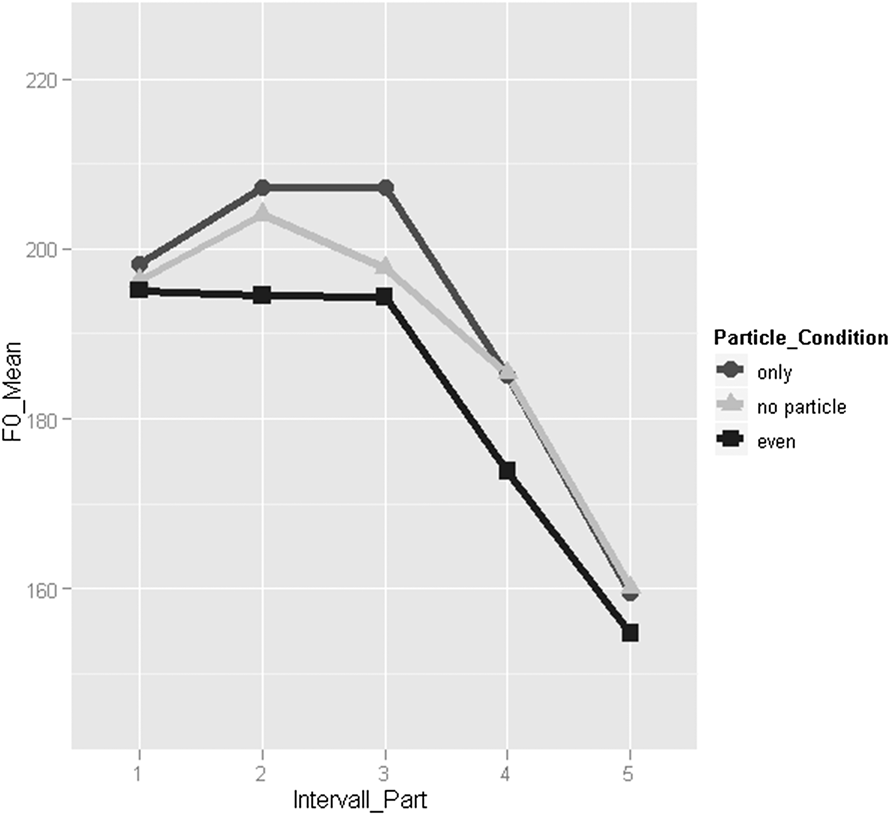
The focused element in the critical sentences carried the same pitch accent type across all experimental conditions, that is an H*L accent (high pitch accent on the stressed syllable). In the conditions with a focus particle, the focus particle carried a pitch accent as well as the focused element, resembling a hat contour. Figure 1 shows the average pitch contour of the focused noun across all experimental items separated by particle condition. The fundamental frequency was measured across five intervals (based on the procedure described in Watson et al., Reference Watson, Gunlogson and Tanenhaus2008; Fraundorf et al., Reference Fraundorf, Watson and Benjamin2010), where the first two intervals roughly correspond to the accented syllable, and the last three intervals to the rest of the word. A statistical analysis of several acoustic parameters is provided in Spalek et al. (Reference Spalek, Gotzner and Wartenburger2014). The analysis showed that the pitch contour of the focused element was similar across conditions, differing only in mean fundamental frequency, but not in duration, intensity, minimum and maximum pitch, nor the relative points of pitch minimum and maximum.
Mean pitch contour of focused element in the critical sentences across particle conditions. The fundamental frequency was averaged at five equidistant interval parts on the entire word.

Each dialogue was paired with a set of three probe words: a mentioned alternative, an unmentioned alternative, and an unrelated probe of comparable frequency and word length. One of the mentioned alternatives (see the continuation sentence) was selected, counterbalancing across items whether it was the first or second one. A complete list of the materials can be found in ‘Appendix A’. Neither the unmentioned alternatives nor the unrelated probes were used for any other item in the experiment.
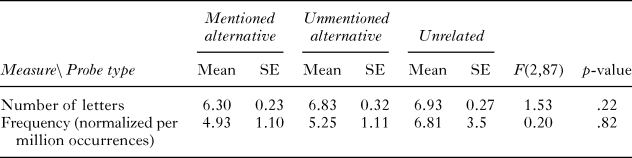
The word length and frequency of all probe nouns were extracted from the dlexDB database (Heister et al., 2011), and statistical analyses (univariate between-item ANOVAs with probe type as factor) were performed to compare the three probe types on word length and frequency. Table B1 in ‘Appendix B’ summarizes the mean values, standard errors, and results from the ANOVAs for the two measures. Word length and frequency of the probes was not significantly different across probe conditions.
The expected answer was yes on one-third and no on two-thirds of the critical trials. A set of twenty filler items was constructed to counterbalance the expected answers from the critical items and to ensure that participants paid attention to the entire discourse. Either verbs (25) or nouns (20) from the continuation sentence or the names of the protagonist (15) served as probe for the filler items. The fillers had the same structure as the experimental items so that participants could not anticipate a certain type of probe based on the structure of an item. Two-thirds of the filler trials required the participants to respond yes and one-third of the trials required them to respond no, thereby equating the overall number of expected yes and no responses.
The factors particle condition and probe type were within-subject. The different particle conditions were presented within-item but the probe type between-items: The fifty items (30 experimental and 20 filler items) were repeated three times, appearing in each of the particle conditions combined with a different probe word. This resulted in a total of 150 trials (90 experimental trials and 60 fillers) per participant, with ten critical items per combination of particle (only, even, no particle) and probe condition (mentioned alternative, unmentioned alternative, unrelated). The stimuli were spread across three experimental blocks separated by a short break. Six experimental lists were created by rotating through the particle conditions and probe types according to a Latin square design. A given list was pseudo-randomized for each subject with the program Mix (van Casteren & Davis, Reference van Casteren and Davis2006). The following constraints were set for randomization: no more than three filler or experimental trials were presented in a row; a given particle condition appeared at most twice in a row. Within one block, an item appeared only once. Additionally, the expected responses (yes or no) were controlled so that a participant was required to give the same response in no more than four consecutive trials.
2.1.3. Apparatus
Participants were seated in a darkened room in front of an Acer TFT monitor (type Asus 1923d) with a resolution of 1280×1024 and a refresh rate of 75 Hz (13.3 ms). Stimulus presentation was controlled by Neurobehavioral Systems’ Presentation software (Version 15.1). Two external buttons were used and participants wore Sennheiser headphones.
2.1.4. Procedure
The experiment started with an instruction displayed on the computer screen. The instruction told the participants that they would be presented with auditory stimuli and that their task was to decide whether a word had appeared in the preceding story or not. They were also instructed to respond as accurately and as quickly as possible and to listen to the exact wording. After the instructions were displayed, subjects performed four practice trials and were allowed to adjust the sound volume.
Each trial began with the onset of a central fixation cross displayed for 700 ms followed by a dialogue that was presented over the headphones. Each of the sound files included 2000 ms of silence after the last critical sentence. With an offset of 50 ms, a probe appeared on the screen and the participants had to indicate by button press whether or not it had appeared in the preceding dialogue. Hence, the delay between presentation and test was 2050 ms. The probe word stayed on the screen until a response was made. If subjects did not respond within 4000 ms, the trial counted as a miss. With an offset of 500 ms the next trial was initiated. After a total of fifty trials, subjects had a short break.
At the end of the experiment, subjects were asked to fill in a form asking for basic demographic information. All subjects were tested individually and an entire session lasted about forty-five minutes.
2.2. results
Trials in which subjects responded incorrectly were excluded from the analysis (1.8%). Table C1 in ‘Appendix C’ shows the average accuracy across conditions. We further excluded reaction time data more than two standard deviations from a participant’s mean in a given combination of particle and probe condition (5.5%). The log-RTs for correct responses were fitted with a series of mixed effects models using the package lme4 in R (Bates & Sarkar, Reference Bates and Sarkar2007). We followed the procedure described in Baayen (2008, pp. 263ff.). We started out with the minimal model, adding further random variables and random slopes. Model comparisons by means of F tests were performed on log-likelihood values to single out the model with the best fit. Only factors that increased the model’s prediction were kept in the final model. Further outliers that were not explained by the model were removed at the stage of model criticism based on the distribution of fitted values and residuals (Baayen, Reference Baayen2008, pp. 279ff.). In particular, eighty-two additional outliers were removed (2.3%). The pvals.fnc function of the package languageR was used to extract p-values based on Monte Carlo Markov sampling.
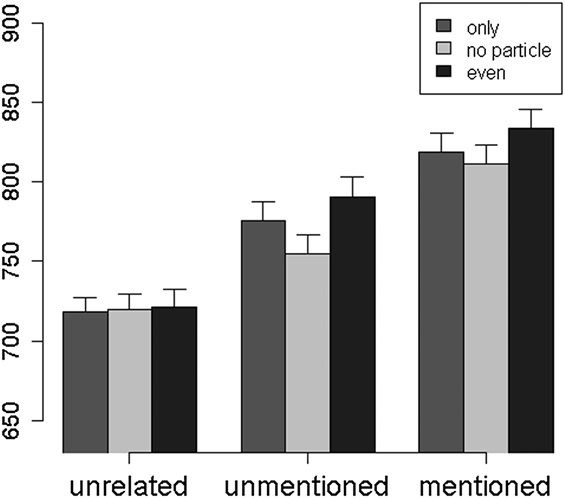
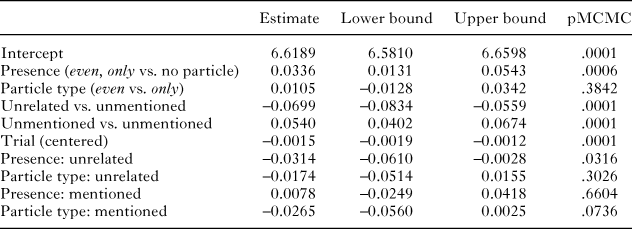
The final model contained the log-RTs, fixed factors for particle condition, probe type, and their interaction, and fixed effects of trial (mean centered), as well as random factors for items, subjects, and random slopes for trial. We used the Helmert coding system for the factor particle: the first contrast named ‘particle presence’ evaluates the presence vs. absence of a particle (only and even vs. no particle) and the second contrast named ‘particle type’ evaluates the difference between even and only. The no particle condition of the unmentioned alternatives was chosen as the baseline (treatment coding) in order to evaluate the difference between unmentioned alternatives and unrelated items as well the mentioned alternatives regarding the effect of the particle conditions. A summary of the overall model is given in Table C2 in ‘Appendix C’. Figure 2 displays the mean RTs of unrelated items, mentioned alternatives, and unmentioned alternatives across particle conditions based on the overall model.
Mean RT across unrelated items, mentioned alternatives, and unmentioned alternatives broken by particle condition (Experiment 1). Error bars represent standard errors (SEM). Means are calculated based on the statistical model presented in Table C2.
2.2.1. Effect of probe type
Concerning the overall comparison of the different probe types, the model revealed two significant main effects: unrelated items were rejected faster than the unmentioned alternatives (β = 0.05, t = –10.16, sd = .006, p < .0001), and the recognition of the mentioned alternatives was slower than the rejection of the unmentioned alternatives (β = –0.07, t = 7.81, sd = .006, p < .0001).
2.2.2. Effect of focus particles
We were specifically interested in the effects of the focus particles even and only. The model showed a significant effect of the presence vs. absence of a particle (presence: β = 0.03, t = 3.21, sd = .01, p < .001). This effect demonstrates that the particles even and only caused interference effects relative to the condition without a particle. There was no significant difference between the two particle types (particle type: p > .38).
2.2.3. Interactions of probe type and focus particle
There was a significant interaction between probe type and the presence of a particle in the unrelated items (presence: unrelated: β = –0.03, t = –2.14, sd = .014, p < .05). This significant interaction reflects that the effect of a focus particle was present for unmentioned and mentioned alternatives but not for unrelated items. There was no interaction between the specific type of particle used and the unrelated items (particle type: unrelated: p > .3). Hence, the two particles even and only again did not differ in the unrelated items.
There was no significant interaction between mentioned and unmentioned alternatives and the presence of a particle, suggesting that similar interference effects of the particles were present for either type of alternative (presence: mentioned: p > .6). That is, the particles only and even interfered with the correct recognition of mentioned alternatives and with the rejection of unmentioned alternatives. However, there was a marginal interaction between the specific type of particle used and the mentioned alternatives (particle type: mentioned: p = .073). This marginal interaction reflects the fact that the effect of only in the mentioned alternatives was slightly, though not significantly, smaller than that of even.
2.3. discussion
Participants were presented with auditory dialogues that mentioned a set of three elements and they had to perform a recognition memory task on a visually presented probe after exposure to the dialogues. We observed significant interference effects of the two particles in the rejection of the unmentioned alternatives: rejections were slower when a particle was present compared to absent, regardless of which particle (even or only) was used. The lack of a significant interaction between unmentioned and mentioned alternatives regarding the overall particle effect indicates that similar interference effects were present in the recognition of mentioned alternatives. However, there was a marginal interaction between the specific type of particle used and the mentioned alternatives, suggesting that the effects of only tended to be smaller than those of even. There was a significant interaction of the overall particle effect (presence vs. absence) and the probe types. This indicates that the interference effect of focus particles was present for mentioned and unmentioned alternatives but not for unrelated items. Overall, the recognition of the mentioned alternatives was slowest, the rejection of the unmentioned alternatives intermediate, and the rejection of the unrelated items fastest. In the following, we will discuss the effects separately for the three different probe types.
2.3.1. Unmentioned alternatives
We found interference effects of focus particles in the rejection of the unmentioned alternatives. These effects provide evidence that listeners consider a set of unmentioned alternatives. We assume that focus particles instantiate a place holderFootnote 5 triggering a search for alternatives from the mental lexicon. According to Rooth (Reference Rooth1992), focus evokes a set of various possible replacements of the focused element, and a subset of this initial set is selected by the context. Therefore it seems plausible that a large cohort of semantic competitors is activated/considered even if the context is restricted to a specific set of elements. It is unlikely that listeners are committed to the unmentioned alternatives, in the sense that they store all possible alternatives. Rather, the interference effects of focus particles arise because the unmentioned alternatives can replace the focused element and hence match the place holder. Note, however, that the task required participants to reject the unmentioned alternatives, therefore the interference effect could be due to stronger competition or a stronger activation of unmentioned alternatives caused by focus particles. In Experiment 2, we use a lexical decision task to test these two alternative hypotheses.
2.3.2. Mentioned alternatives
In the correct recognition of the mentioned alternatives we also found interference effects. That is, the presence of a focus particle decreased a listener’s ability to correctly accept a mentioned alternative. We propose that the interference effect in the mentioned alternatives is due to the competition between the mentioned alternatives and the focused element (and possibly unmentioned alternatives) while constructing the set of alternatives. As we have outlined, there might be two reasons for such a competition. First, Gernsbacher and Jescheniak (Reference Gernsbacher and Jescheniak1995) found that pitch accents inhibit previously mentioned concepts, and our stimuli contained a pitch accent in all conditions. Second, focus particles might cause stronger competition between the focused element and its alternatives due to the fact that focus particles associate with focus. That is, focus particles factor the alternatives into truth-conditional meaning (while bare intonational focus does not have a truth-conditional impact). For example, a sentence like Anna only ate bananas expresses that (i) Anna ate bananas and that (ii) she did not eat pears or melons. In this sense the relation between the focused element and its alternatives is highlighted by a focus particle.
In addition to the effect of focus particles, there is also some evidence for an overall inhibition of the alternatives by pitch accents, as stipulated by Gernsbacher and Jescheniak (Reference Gernsbacher and Jescheniak1995). The recognition of the mentioned alternatives was overall slower than the rejection of the unmentioned alternatives (and unrelated items), even though those alternatives were mentioned twice and should therefore have been highly active (see also Experiment 2). This result points to the fact that, in the probe recognition task, listeners search through the whole set, possibly considering the focused element as well. So, there might be a mechanism that picks out the focused element among the set of alternatives, leading to increased difficulty in accepting the mentioned alternatives (see also Byram-Washburn, Reference Byram-Washburn2013). To bolster this claim, the activation of the alternatives would have to be directly compared to that of the focused element, which was not done here. However, some evidence comes from the main effect of focus in the delayed recall study reported in Spalek et al. (Reference Spalek, Gotzner and Wartenburger2014). The stimuli used in this experiment were the same as in the experiment(s) presented here; therefore, a direct comparison to the delayed recall task is feasible.
In particular, in the current experimental paradigm, focus particles caused interference effects on the recognition of mentioned alternatives rather than facilitatory effects. So, the beneficial effects observed in our delayed recall experiments (Spalek et al., Reference Spalek, Gotzner and Wartenburger2014) were not reflected in decreased reaction times in an immediate recognition memory test. Recognition memory tests are generally easier than recall tests and they impose different task demands (Baddeley, Eysenick, & Anderson, Reference Baddeley, Eysenick and Anderson2009, p. 195). Leaving aside these differences, the probe recognition task used here tapped into the process of establishing alternative sets,Footnote 6 while we investigated the final representation of the focused element and its alternatives in Spalek et al. (Reference Spalek, Gotzner and Wartenburger2014).
The comparison to the delayed recall data suggests that the observed interference effects might not reflect an active dampening (i.e., a suppression) of the mentioned alternatives, since the alternatives are still remembered better later on in the conditions with particles. This finding is most compatible with a competitive inhibition account. We will further discuss this proposal after presenting Experiment 2.
Generally, we are not assuming that no alternatives were activated in the condition without a particle, especially since all conditions bear intonational focus and we do not have a comparison to an unfocused condition. The claim we are making is that there is a relative difference between referencing an alternative set by intonational focus and focus particles. Focal accents evoke a set of alternatives, while focus particles establish an association between the focused element and its alternatives. The fact that we did not find any difference between the conditions with only and even (apart from the marginal interaction in the mentioned alternatives) indicates that what matters is whether or not a particle is present in an utterance. Note that the difference between the conditions with a focus particle compared to the bare condition was mainly driven by the condition with even. However, several studies in our lab did not find any significant differences between exclusive and additive particles (Spalek et al., Reference Spalek, Gotzner and Wartenburger2014; Gotzner, Spalek, & Wartenburger, Reference Gotzner, Spalek, Wartenburger, Knauff, Pauen, Sebanz and Wachsmuth2013; Gotzner & Spalek, in press; as well as another experiment in Gotzner, Reference Gotzner2015), and we note that the interaction observed here was marginal.
2.3.3. Unrelated items
Finally, the null effect in the unrelated control probes (i.e., no RT differences across conditions) indicates that the interference effects were not due to a general processing difficulty associated with the sentences containing particles. For example, one might argue that participants take longer to process the two conditions with particles because they contain an additional word compared to a condition without a particle. Yet this account predicts different rejection times across conditions for all probes. Hence, we can conclude that the effects of the particles are not due to some general processing difficulties of the sentences with focus particles.
2.3.4. Summary
To summarize, Experiment 1 found that the presence of a focus particle in an utterance interfered with the rejection of unmentioned alternatives and the recognition of mentioned alternatives. As a control, the unrelated probes were rejected equally fast across particle conditions. Experiment 1 further indicated that overall the mentioned alternatives were accepted slower than the unmentioned alternatives were rejected, which might be evidence for a general inhibitory mechanism by the focused element in the sense of competitive inhibition.
3. Experiment 2
The goal of Experiment 2 is to further explore the mechanisms by which alternative sets are construed. In the probe recognition task used in Experiment 1, we found that focus particles interfered with the rejection of unmentioned alternatives (and the recognition of mentioned alternatives). As outlined above, the interference effect of focus particles on unmentioned alternatives could reflect either that unmentioned alternatives are more strongly activated or that there is a greater competition among members of the alternative set in the case of focus particles. We could not clearly distinguish these two possibilities since the probe recognition task required participants to reject the unmentioned alternatives. In Experiment 2, we use a lexical decision task in which participants have to indicate whether a word exists or not, requiring a positive response for mentioned alternatives, unmentioned alternatives, and unrelated items. With the lexical decision task, we investigate the nature of the interference effect of focus particles by looking at the relative activation of unmentioned and mentioned alternatives and unrelated items in the presence/absence of a focus particle, and not at their integration into the discourse model.
The lexical decision experiment is similar to a number of cross-modal semantic priming experiments in the literature in which participants listen to a sentence and are then presented with a target word for lexical decision. Semantic similarity between prime and target speeds up reaction times (see Swinney, Onifer, Prather, & Hirshkowitz, Reference Swinney, Onifer, Prather and Hirshkowitz1979, for an early demonstration of the effect), and has been interpreted as evidence that listening to a word activates a cohort of semantically related words (see also Neely, Reference Neely1977). Priming effects in sentence context depend on a number of factors, including the pattern of activation of competitor words (see especially Norris et al., Reference Norris, Cutler, McQueen and Butterfield2006, for an overview). Interestingly, Norris et al. showed that semantic priming only occurs if an utterance contains a focal accent, pointing to the fact that priming is dependent on intonational focus.
If we assume that listeners activate additional unmentioned alternatives to a focused expression (even if the context lists a set of three elements), we should observe a priming effect for unmentioned alternatives relative to unrelated items, in line with previous findings in the priming literature. If focus particles (i) lead to stronger competition among members of the alternative set and (ii) unmentioned alternatives take part in this competition, we should again observe an interference effect of focus particles in Experiment 2.
Since several studies in our lab did not find any significant differences between exclusive and additive particles, we excluded the condition with even in Experiment 2. Another reason to exclude the third condition was that we had to add pseudo-words as visual targets for the lexical decision task, but did not want to extend the duration of the experiment compared to Experiment 1. Experiment 2 hence used a 2 × 3 design containing two particle conditions (only vs. no particle) and three different target types (mentioned alternative, unmentioned alternative, and unrelated target). In line with the priming literature, we refer to the words that participants need to recognize as targets in the lexical decision paradigm (and not as probes as in Experiment 1).
3.1. methods
3.1.1. Participants
Thirty-seven native speakers of German (23 female, 14 male, mean age 25.03 years, age range 18–30) were recruited from a participant pool at the Institute of Psychology of Humboldt University and paid seven euros in compensation. None of them reported any vision or hearing difficulties. Two participants were excluded from further analyses (one participant had already participated in one of our experiments and the other participant only responded to the comprehension questions but not to the target words). The remaining thirty-five participants were fourteen men and twenty-one women with a mean age of 24.94 years. All participants were right-handed.
3.1.2. Materials
The materials were the same as those of Experiment 1, but we only used the condition with the particle only and the control condition without a particle, and we included pseudo-words. We used a 2 × 3 design (particle condition: only vs. no particle; target type: mentioned alternative, unmentioned alternative, unrelated), resulting in six conditions.
There were thirty critical items with an existing German target word. In addition to the experimental items, we used forty-five filler items to counterbalance the ratio between pseudo-words and real words.
The particle conditions were again within-subject and within-item. The target type conditions were within-subject and between-item. The seventy-five items (30 experimental and 45 filler items) were repeated twice, appearing in each of the particle conditions (only vs. no particle) combined with a different target word (mentioned alternative, unmentioned alternative, or unrelated). This resulted in a total of 150 trials per participant with ten critical items per combination of particle and target condition. Thirty comprehension questions were asked at random intervals (every three to eight trials, all of which were filler trials). The comprehension questions were simple yes/no questions asking about the setting or the action the characters performed (e.g., Was Sophie in Frankfurt?).
The stimuli were spread across five experimental blocks separated by a short break. Three experimental lists were created by rotating through the particle conditions and target types according to a Latin square design. The following constraints were set for randomization: no more than three filler or experimental trials were presented in a row; a given particle condition appeared at most three times in a row. The repetitions of an item were separated by at least fifty trials. Additionally, the expected responses (yes or no) were controlled so that a participant was required to give the same response in no more than four consecutive trials.
3.1.3. Apparatus
The apparatus was the same as in Experiment 1.
3.1.4. Procedure
The basic procedure (timing, etc.) was the same as in Experiment 1. Instead of the probe recognition task, participants were told to judge whether a visually presented word was an existing word or not. They were explicitly warned not to perform a probe recognition. We also told them at the start of the experiment that they had to listen carefully to the content of the stories and would be asked comprehension questions. Every thirty trials, subjects had a short break. All subjects were tested individually and an entire session lasted about forty-five minutes.
3.2. results
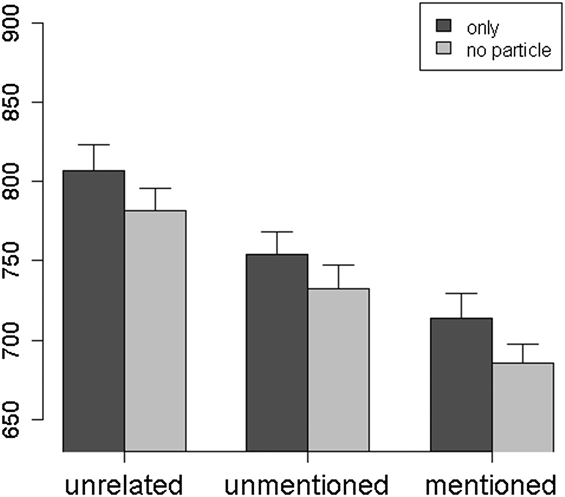
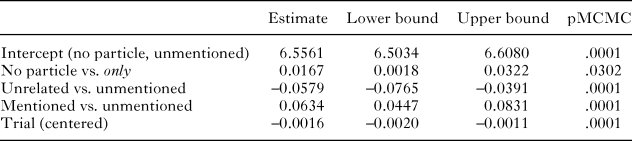
Incorrect responses were excluded from further analysis (2.3%). Table C3 in ‘Appendix C’ shows the accuracy data across conditions. Responses that were more than two standard deviations from a participant’s mean within a given target type and focus condition were discarded (5.7%). Forty-eight additional outliers were removed based on the distribution of fitted values and residuals (2.5%). We employed the same procedure of model fit as described in Experiment 1. Here, the factor particle was treatment coded, because it only had two levels (only vs. no particle). We again chose the unmentioned alternatives as a reference level in order to evaluate the difference between unmentioned alternatives and unrelated items, as well as between unmentioned and mentioned alternatives. Table C4 in ‘Appendix C’ summarizes the model. Figure 3 shows the mean reaction times across unrelated items, unmentioned alternatives, and unmentioned alternatives based on the model.
Mean RT across unrelated items, mentioned alternatives, and unmentioned alternatives (Experiment 2). Error bars represent standard errors (SEM). Means are calculated based on the statistical model presented in Table C4.
The interaction between particle condition and target type was not significant (p = .21 for alternatives and .95 for unrelated items) and did not improve the model fit (χ2(2) = 1.5, p = .43). The interaction was therefore not included in the final model. The final model contained the log-RTs, fixed factors for particle condition and target type; random intercepts for items and subjects as well as random slopes for trial. The model revealed that the unrelated items were recognized slower than the unmentioned alternatives (β = 0.06, t = –6.54, sd = .009, p < .0001), and that the mentioned alternatives were recognized faster than the unmentioned alternatives (β = 0.06, t = 6.04, sd = .009, p < .0001). These two main effects demonstrate (semantic) priming effects of unmentioned alternatives and additional repetition/identity priming of the mentioned alternatives. The model further showed that participants’ reaction times were overall slower in the condition with only compared to no particle (β = 0.02, t = 2.13, sd = .007, p < .05). Hence, there was an overall interference effect of the particle only in this experiment.
3.3. discussion
Experiment 2 employed a lexical decision task and found an interference effect of the particle only compared to the condition without a particle, which was similar across target types. The overall recognition of the different target types showed exactly the reverse pattern of results of the probe recognition task (Experiment 1): the unmentioned alternatives were recognized faster than the unrelated items but slower than the mentioned alternatives. These findings reveal classic semantic priming effects for the unmentioned alternatives and additional repetition/identity priming effects for the mentioned alternatives. These priming effects demonstrate that mentioned as well as unmentioned alternatives become activated, even if the context is limited to a set of three elements. The mentioned alternatives receive the highest amount of activation since they have been mentioned and repeated in the prior context.
The priming effects were present in the condition with only and the condition without a particle. This is not surprising since both conditions contained a prominent intonational focus (see the ‘Discussion’ for Experiment 1). One may wonder whether the observed effects are related to alternative sets at all, or rather reflect general semantic priming, since no differential priming effects for the particle condition and the control condition were observed in Experiment 2. However, as shown by Norris et al. (Reference Norris, Cutler, McQueen and Butterfield2006), the presence of focus seems to be crucial for priming effects to occur. Hence, the general priming effects were likely due to the fact that our sentence material contained an intonational focus in all conditions.
In Experiment 2, participants did not have to indicate that the unmentioned alternatives had not been mentioned, but to simply judge whether they were an existing word. We found an interference effect of the focus particle only relative to bare intonational focus. This indicates that the competition among members of the alternative set is stronger in the case of focus particles.
We did not anticipate that the interference effect of only was equally present in the unrelated items, especially since we did not observe such an effect in Experiment 1. However, such an effect on unrelated items was also present in three prior lexical decision studies (Norris et al., Reference Norris, Cutler, McQueen and Butterfield2006; Byram-Washburn, Reference Byram-Washburn2013, Experiment 1; Husband & Ferreira, Reference Husband and Ferreira2015). We will discuss reasons why the unrelated items behaved differently in Experiments 1 and 2 in the ‘General discussion’.
Considering previous studies on the activation of alternatives by means of contrastive accenting, one might expect to observe facilitatory instead of inhibitory effects when participants are asked to recognize alternatives. Note that the studies by Braun and Tagliapietra (Reference Braun and Tagliapietra2010) and Husband and Ferreira (Reference Husband and Ferreira2015) never introduced a contextual set of alternatives but tested unmentioned alternatives (without any prior mention of alternatives). Note also that we found significant priming effects for mentioned and unmentioned alternatives compared to the (unrelated) control condition, as did these prior lexical decision studies, which demonstrates that the alternatives (mentioned and unmentioned) were activated. Comparing across focus conditions, Braun and Tagliapietra found stronger priming of (unmentioned) alternatives with L+H* accents (in fact no priming of contrastive associates was observed in the condition with H* accent), while Husband and Ferreira observed priming effects of similar magnitude in both focus conditions. In our study, the particle only caused an interference effect relative to the condition without a particle, which is in line with a lexical decision study by Byram-Washburn (Reference Byram-Washburn2013). Such an interference effect was also present in our probe recognition Experiment 1. Therefore, what seems to play a crucial role is whether focus is marked intonationally or additionally by a focus particle. We will continue this discussion in the following sections.
4. General discussion
4.1. comparison between probe recognition and lexical decision
In the probe recognition paradigm employed in Experiment 1, we found that the particles only and even interfered with the rejection of unmentioned alternatives and the correct recognition of mentioned alternatives. Overall, the acceptance of the mentioned alternatives was slowest, the rejection of the unmentioned alternatives was intermediate, and the rejection of unrelated items fastest.
In the lexical decision study, the reverse overall pattern was found: the recognition of the mentioned alternatives was fastest, the unmentioned alternatives were intermediate, and the unrelated items slowest. These effects demonstrate priming effects for unmentioned alternatives relative to unrelated items, and additional repetition/identity priming for the mentioned alternatives. The particle only again caused an interference effect compared to the no-particle condition, this time also for unrelated items.
The probe recognition task required participants to create a mental model/representation of the discourse and to compare a probe word with this representation of the text, while this matching was not necessary for the lexical decision task. In addition, the different tasks tap into different processing levels – the semantic (or conceptual) level and the lexical level, respectively (though we are not claiming that those two levels are completely separate or independent). In the probe recognition task, the unrelated items were more easily rejected than the related probe types (alternatives), because they can be ruled out based on category membership. That is, because the context is not related to the items, participants need not even consider those probes. In a similar vein, Hermann, McLaughlin, & Nelson (Reference Hermann, McLaughlin and Nelson1975) argued that correct recognition of a probe depends on an analysis of multiple dimensions of the stimulus, whereas rejection can occur before all analyses are completed. Similar to the results presented here, the study by these authors also found a semantic category effect in probe rejection such that unrelated items were rejected faster than related items.
As we argued in the discussion of Experiment 1, we assume that focus particles lead a participant to encode a place holder sensitive to elements that can be substituted with the element in focus. In the probe recognition task, the interference effects in the rejection of unmentioned alternatives arise because the unmentioned alternatives match the place holder and participants are required to reject those alternatives. The unrelated items, on the other hand, do not bear any semantic relationship to the context and do not match the place holder. The lexical decision task, in turn, reveals how present or active a specific word is. To be successful at this task, participants do not even need to compare the target word with the previously presented discourse (note, however, that they had to pay attention to the stories, because comprehension questions were asked in some trials). The differential task demands might account for the overall difference observed between the tasks, and possibly for the fact that there was no effect of the particles in the rejection of unrelated probes in Experiment 1. As a consequence, the probe recognition task might be more likely to reveal which elements listeners consider as part of the alternative set, compared to the lexical decision task. Gernsbacher and Jescheniak (Reference Gernsbacher and Jescheniak1995) further argue that probe recognition tasks are a more direct measure of the listener’s discourse representation than corresponding lexical decision tasks.
Taken together, the results suggest that focus particles encourage a listener to entertain a set of mentioned and unmentioned alternatives and to trigger a search through this set. The converging evidence from the two experiments suggests that focus alternatives become activated (even unmentioned ones) and that there is a competition among those elements evident in the interference effects caused by the presence of focus particles.
4.2. encoding–retrieval relationships
In our previous delayed recall experiments (Spalek et al., Reference Spalek, Gotzner and Wartenburger2014), we found that focus particles led to better retrieval of focus alternatives after a delay of about four minutes (with nine intervening discourses). We assumed that this beneficial effect of the particles was due to better encoding of the alternatives. Research on encoding–retrieval relationships suggests that a greater processing effort at an initial encoding stage can lead to beneficiary effects in the long run (see, for example, Elmes & Bjork, Reference Elmes and Bjork1975, for an effect of elaborative rehearsal on retrieval, and Hofmeister, Reference Hofmeister2009, and Drenhaus et al., Reference Drenhaus, Zimmermann and Vasishth2011, for work on focus and encoding–retrieval relationships). A reflection of this is seen in the processing costs associated with focus particles observed in the present experiments, which we interpret as a competition among members of the alternative set.
While the alternative set is being encoded, activation flows to all elements that could be substituted for the focused expression, even unmentioned alternatives (as observed in the two experiments reported here). We surmise that later the unmentioned alternatives decay in activation and the mentioned alternatives become more salient, as evident in our delayed recall experiments (Spalek et al., Reference Spalek, Gotzner and Wartenburger2014). This decay of unmentioned alternatives (and the difference in timing as well as the experimental task) might account for the fact that Fraundorf et al. (Reference Fraundorf, Watson and Benjamin2010) did not observe any differences across focus conditions in the rejection of unmentioned alternatives (lures) in their delayed recognition memory experiment. Note that the test session took place one day later. We assume that, during the encoding stage, a cohort of semantic competitors is accessed from the mental lexicon and that this set is subsequently narrowed down to the relevant members of the alternative set, in our case the mentioned alternatives (see Rooth, Reference Rooth1985, Reference Rooth1992; Katzir, Reference Katzir2007; Fox & Katzir, Reference Fox and Katzir2011; for specific grammatical mechanisms, and see Husband & Ferreira, Reference Husband and Ferreira2015, for a similar argument).
4.3. activation and inhibition
Recent research suggests that generating a set of alternatives in on-line processing might involve both facilitation and inhibition mechanisms (Byram-Washburn, Reference Byram-Washburn2013; Husband & Ferreira, Reference Husband and Ferreira2015).
This assumption is consistent with the current data. We propose that alternative sets are established by initial activation of mentioned and unmentioned alternatives, even when the context is restricted to a set of elements. By competitive inhibition the relevant alternatives become salient. This inhibition does not seem to reflect an active suppression mechanism, since we found priming effects for mentioned alternatives and unmentioned alternatives. Moreover, the mentioned alternatives were remembered better in the conditions with focus particles in delayed recall tasks (Spalek et al., Reference Spalek, Gotzner and Wartenburger2014). The fact that the acceptance of the mentioned alternatives was slowest in the probe recognition paradigm might further indicate that the focused element takes part in this competition, interfering with the acceptance of the salient alternatives (which is in line with previous research showing a privileged representation of focused elements). Overall, we suggest that the observed interference effects are due to competition among the elements in the alternative set, involving the focused element and mentioned as well as unmentioned alternatives. This competition among members of the alternative set is stronger in the case of focus particles because they establish a strong association with focus (Beaver & Clark, Reference Beaver and Clark2008).
According to alternative semantics (e.g., Rooth, Reference Rooth1985, Reference Rooth1992), focus marking by intonational means introduces an additional focus semantic value that evokes expressions that can replace the focused element. Focus particles establish an association with a focused expression and they require a salient set of alternatives by their conventional meaning. In the stimuli we used here, the set of alternatives was signaled by multiple information-structural cues – by focus accenting and by focus association with a particle. Note that we did not vary the presence or absence of focus per se in the present series of experiments, nor did we manipulate the pitch accent type on the focused expression (contrastive or non-contrastive).
Gotzner et al. (Reference Gotzner, Spalek, Wartenburger, Knauff, Pauen, Sebanz and Wachsmuth2013) compared focus particles and contrastive accents directly within a probe recognition paradigm. They found that contrastive accents facilitated the recognition of mentioned alternatives while focus particles caused interference effects. This finding and the findings reported in the current study are consistent with the assumption that intonational focus introduces a set of alternatives or helps identifying the relevant alternatives. Focus particles have an additional function: they establish an association with the focused element and its alternatives, possibly causing the interference effects observed in the current study and in Gotzner et al. (Reference Gotzner, Spalek, Wartenburger, Knauff, Pauen, Sebanz and Wachsmuth2013). That is, we assume that the competition among members of the alternative set is stronger because focus particles highlight the relationship between the focused element and the other members of the alternative set.
Interestingly, we did not find any differences across the different types of focus particles in our experiments. The first experiment compared the exclusive particle only with the scalar particle even, and the two conditions did not differ significantly, which was corroborated in other experiments such as Spalek et al. (Reference Spalek, Gotzner and Wartenburger2014). This lack of difference does not mean that the different particles can be interchanged randomly in an utterance, or that they carry exactly the same meaning. However, the task we used here only required participants to recognize a visually presented probe or target and did not introduce any further manipulations. As far as we can tell, the specific meaning components of the particles did not seem to have played a role in these tasks. Hence, the crucial factor that influences encoding and retrieval of focus alternatives tasks seems to be the conventional association with focus alternatives (Beaver & Clark, Reference Beaver and Clark2008) established by the particles.
Other studies do find a difference between exclusive and additive particles, for example when the representation of the entire proposition is tested. An inferential study with a memory delay by Gotzner and Spalek (Reference Gotzner, Spalek, Degen, Franke and Goodman2014) showed that listeners correctly infer that the alternative is true in the case of also while they negate the alternative with only. This suggests that listeners process and encode discourses differently depending on the type of particle used. At the same time, the representation of the alternatives is enhanced both with only and also, as shown in the memory study by Spalek et al. (Reference Spalek, Gotzner and Wartenburger2014). This shows that alternatives are not ‘mentally switched off’, even when they are not true of the sentence, as in the case of only.
5. Conclusion
To conclude, the two experiments presented here show that focus particles lead participants to activate and compare mentioned alternatives, unmentioned alternatives, and the focused element. The study demonstrates that listeners entertain a set of alternatives upon processing focus particles, and that focus particles interfere with the recognition of alternatives, indicating a stronger competition among elements of the alternative set. The study thereby provides evidence for the psychological reality of the alternative semantic account of focus (particles) developed in Rooth (Reference Rooth1985, Reference Rooth1992) and sheds light on the cognitive mechanisms involved in generating alternatives. In particular, a broad set of possible alternatives is activated and restricted based on competition mechanisms. The study further shows that manipulations of focus structure not only affect the processing of focal information itself but also that of possible alternatives, that is, elements that could have been used in a sentence in place of the focused element. We conclude from this that alternative sets are an important cognitive unit complementing the representation and processing of focal information.
APPENDIX A
Items used in Experiments 1 and 2
APPENDIX B
Word length and frequency of mentioned alternatives, unmentioned alternatives and unrelated items
APPENDIX C
Accuracy across probe/target types and particle conditions

Results of mixed model for probe recognition experiment 1 (n = 3429, log-likelihood = 1160) including estimates, confidence intervals, and p-values based on MCMC sampling
Accuracy across target types and particle conditions (Experiment 2)

Results of mixed model for lexical decision experiment 2 (n = 1888, log-likelihood = 532.8) including estimates, confidence intervals, and p-values based on MCMC sampling