


INTRODUCTION
Third parties often have a stake in the outcome of a civil or interstate war and can affect that outcome by taking sides, i.e., by supporting one side or another. Recent civil-war examples include the Sunni awakening of 2007 when Sunni tribal leaders in Iraq sided with the United States against Al-Qaeda (Biddle, Friedman, and Shapiro Reference Biddle, Friedman and Shapiro2012). Afghan tribal leaders have faced a choice at various times between supporting the government or the Taliban (Berman, Shapiro, Felter Reference Berman, Shapiro and Felter2011; Malkasian Reference Malkasian2013). In March 2011, NATO—principally Britain and France with logistic support from the United States—intervened in Libya in support of the opposition trying to oust Colonel Muammar Gaddafi. Iran and then Russia have sided with President Bashar al-Assad in the Syrian civil war while Turkey, the Gulf States, and others have supported opposing factions. Saudi Arabia is supporting the government in the Yemeni civil war. (See Regan (Reference Regan2000) for a survey of foreign intervention in civil wars.) The history of interstate war is also full of examples of third-party interventions. At least one state intervened in an ongoing war in 27 percent of the wars between 1816 and 2007 (Kyle, Ghosn, and Bayer Reference Joyce, Ghosn and Bayer2013).
What factors affect a third party's decision to take sides? How does intervention affect the duration of the conflict and the chances that one side or the other ultimately prevails? This article studies these questions by adding a third actor to a standard continuous-time war of attrition with two-sided asymmetric information. The third actor has preferences over which of the other two actors wins. It also prefers to be on the winning side if it decides to take sides. Finally, the third party gets a flow payoff for as long as the fighting lasts. This payoff can be negative if fighting entails a net cost, or it can be positive if fighting is profitable. The latter may be the case when ongoing fighting permits the third party to exploit lootable resources, engage in smuggling, or drug trafficking.
This article makes four main contributions. First, it provides a formal framework for analyzing the effects of endogenous intervention on the duration and outcome of the conflict.Footnote 1 Existing formal work on duration generally focuses on two-actor models and is therefore silent on issues related to third-party intervention (e.g., Fearon Reference Fearon2004; Reference Fearon2007; Leventoglu and Slantchev Reference Leventoğlu and Slantchev2007; Powell Reference Powell2012, Reference Powell2013; Krainin Reference Krainin2014a). By contrast, models of intervention or more generally alliance formation center on the effect that taking sides has on the ultimate outcome. These analyses typically lack a time dimension and consequently cannot address the effect that taking sides has on how long the fighting lasts and the related effect that this has on the cost of fighting and the incentive to intervene (e.g., Gent Reference Gent2008; Krainin Reference Krainin2014b; Morrow Reference Morrow1991; Powell Reference Powell1999; Smith Reference Smith1995; Werner Reference Werner2000). As a result of these theoretical limitations, empirical work on the effects of intervention on duration and outcome must rely on testing hypotheses that, while theoretically plausible, cannot be derived from an underlying theoretical framework.Footnote 2 The first contribution of the present analysis is to begin to develop just such a framework.
Second, the analysis identifies equilibrium pressures that tend to make alignment decisions unpredictable whenever the third party's preference for one side over the other is not too large and fighting is costly. These pressures also tend to make coalitions dynamically unstable with the third party joining one side at a given time and then switching with positive probability to the other side at a later time. These results are in keeping with recent work on alliance formation during civil wars that emphasizes the propensity of many groups to change sides during the conflict (Christia Reference Christia2012; Seymour Reference Seymour2014). Christia, for example, describes recent Afghan history “as replete with examples of warring leaders choosing to switch sides” (Reference Christia2012, 3).
More specifically, the analysis highlights a kind of equilibrium “boomerang effect” on alignment decisions in which the expectation that the third party will support a given side makes it less likely that the third party will actually do so. Suppose, for example, that the two main actors, 1 and 2, expect the third party to support 1 at time T. This expectation creates incentives that induce 1 and 2 to take actions that make the third party less likely to support 1. Similarly, the expectation that the third party will support 2 at T leads 1 and 2 to act in ways that make the third party less likely to support 2. The boomerang effect can be swamped by a strong preference for a given side. If, for example, the third party strongly prefers 1 to prevail in the contest against 2, then the third party is sure to support 1. But if the third party's preference for one side over the other is not too large and if fighting is costly for the third party, then the boomerang effect dominates.
Formally, the boomerang effect leads the third party to play a mixed equilibrium strategy in which it joins each side with a positive probability. Mixed equilibria often lack substantive appeal, but the mechanism underlying the boomerang effect is quite intuitive. Suppose again that 1 and 2 expect the third party to support 1 at time T. This support increases 1's chances of prevailing if the war of attrition continues on after T. Anticipating the higher chance of prevailing, 1 is more likely to fight on until T and 2 is less likely. More precisely, some marginal player types of 1 who would have dropped out prior to T are now willing to fight on. Conversely, some marginal types of 2 who would have fought until T drop out before T because they expect their prospects of prevailing to go down when the third party joins 1. The net effect is that there is a large set of relatively less resolute types of 1 that are still active at T only because they believe that the third party will support 1 at that time. If the third party supports 2 instead, these less resolute types of 1 drop out immediately, thereby shortening the subsequent war of attrition. This in turn creates an incentive for the third party to deviate from supporting 1 when fighting is costly and shorter wars are therefore better.Footnote 3 Although described in the context of a war of attrition, this boomerang effect and the mechanism underlying it seem much more general and are likely to be present in any conflict in which uncertainty about how long the other side is willing to fight is a key factor.
The third contribution is to derive several clear comparative-static results which provide formal support for some common claims about conflict. Ross, for example, suggests in his analysis of the resource curse that “resource wealth could lengthen a conflict if it provides funding to the weaker side, helping it equalize the balance of forces” (Reference Ross2006, 282). The more equal the distribution of power in the model, the longer the expected duration of the fighting.
Finally, the formal analysis has implications for empirical efforts to estimate the effects of intervention. These studies often attempt to assess the effect of intervention in support of one side on that side's probability of prevailing by estimating the effects of intervention on the hazard rate of the conflict, i.e., on the probability that that side will prevail in the next instant given that the conflict has not yet ended (e.g., Balch-Lindsay and Enterline Reference Balch-Lindsay and Enterline2000; Balach-Lindsay, Enterline, and Joyce Reference Berman, Shapiro and Felter2008; Gent Reference Gent2008; Regan Reference Regan2002). This approach is based on the presumption that there is a direct link between the probability that a side will prevail and the hazard rate. The present analysis shows that this is not the case. The chances that a faction prevails depend solely on the ratio of its cost of fighting relative to the other side's while the expected duration and hazard rate depend on both the cost ratio and on the sum of the two actors’ costs of fighting. As a result, one cannot infer the effects of intervention on the likelihood that one side will prevail from changes in the hazard rate. In addition to these identification issues, the formal analysis also highlights potential selection effects.
The next section relates the taking-sides model to existing work. The following two sections describe a baseline two-actor, continuous-time war of attrition and then add a third party to this baseline model. The third party chooses between the two alternatives of supporting one side or the other at an exogenously given time T ⩾ 0. Forcing the third party to choose between these two options and not allowing it to decide to stay out by not supporting either side simplifies the analysis and makes it easier to see the key forces at work. Subsequent sections describe the equilibria of the game and the boomerang effect, analyze the comparative statics, and discuss the formal analysis’ implications for empirical efforts to estimate the effects of intervention. The last two sections examine extensions. One extension allows the third party to stay out as well as take sides. The other extension adds a second decision time at which the third party can decide whether to switch sides after having previously taken sides.
RELATED WORK
Wars of attrition provide workhorse models for analyzing many different kinds of conflict. Applications include the study of exit in a declining industry (Fudenberg and Tirole Reference Fudenberg and Tirole1986; Ghemawat and Nalebuff Reference Nalebuff and Riley1985), strikes (Kennan and Wilson Reference Kennan and Wilson1989), economic stabilization (Alesina and Drazan Reference Alesina and Drazen1991; Cassella and Eichengreen Reference Cassella and Eichengreen1996), the provision of public goods (Bliss and Nalebuff Reference Bliss and Nalebuff1984), lobbying and vote buying (Dekel, Jackson, and Wolinsky Reference Dekel, Jackson and Wolinsky2008; Reference Dekel, Jackson and Wolinsky2009), and international bargaining (Fearon Reference Fearon1998).
Adding a third party to a war of attrition seems like a very natural point of departure for studying intervention. But third-party intervention in a war of attrition appears not to have been formally modelled before. The two most relevant studies are Bulow and Klemper (Reference Bulow and Klemperer1999) and Cassella and Eichengreen (Reference Cassella and Eichengreen1996). The former examines two versions of a generalized war of attrition in which p + m players compete for p prizes. In the case of a natural oligopoly of p firms, a firm pays a cost until it exits the market. By contrast, each firm continues to pay a cost for as long as the contest lasts when the firms are competing over setting industry standards since those standards are not set until all of the firms stop fighting. The latter is similar to the present model in that the third party cannot exit the game and its ultimate payoff depends on when the other players quit. A key difference is that the third party's decision affects the distribution of power between the players that are fighting which is not the case in the standards-setting model.
Cassella and Eichengreen (Reference Cassella and Eichengreen1996) study the effect of aid on stabilization. The aid, which arrives at an exogenously specified time, reduces the stakes by narrowing the gap between winning and losing. Whether or not aid accelerates or delays stabilization depends on when it arrives. Early arrival accelerates stabilization whereas late arrival delays it. The fundamental difference between that model and the present analysis is that what happens at the exogenous date is a strategic decision in the model studied here in that the third party decides what to do.
The present analysis is also related to two other areas: formal work on the causes and conduct of war and on alignment, intervention, and duration. As noted above, existing formal work on alignment usually lacks a dimension of time whereas work on duration generally centers on two-actor models. The present analysis begins to bridge this gap.
Nevertheless, two features of the standard war of attrition probably make it a more natural model of civil rather than interstate intervention. The first is the absence of bargaining. Most recent formal work on the causes and conduct of war frames the issue in terms of bargaining and a related inefficiency puzzle (Fearon Reference Fearon1995; Powell Reference Powell2006). Why does bargaining break down in costly conflict which is ex post inefficient? An important argument in the context of civil wars is that negotiated settlements, especially those calling on one of the factions to disarm, often entail very severe commitment problems (Fearon and Laitin Reference Fearon and Laitin2008; Walter Reference Walter2002; Reference Walter2009). As a result, civil-war outcomes often have the winner-take-all quality of wars of attrition.Footnote 4
Second, a state or faction can fight as long as it chooses to pay the cost. Neither can defeat the other. There are no battles which, if lost, result in the elimination of a state or faction. Nor is it possible for one belligerent to fight so long that the other runs out of resources and the ability to continue.Footnote 5
Although the model developed here is likely a better fit for civil war intervention, it still may provide useful insights into intervention into interstate conflict. Models often make strong, simplifying assumptions. They leave some important considerations out in order to focus on others. For example, interstate wars occur in the shadow of third parties that have a stake in the outcome, can intervene, and choose to do so in more than a quarter of the cases (Kyle, Ghosn, and Bayer Reference Joyce, Ghosn and Bayer2013). Yet the canonical models of bargaining and war (e.g., Fearon Reference Fearon1995; Powell Reference Powell1999) set intervention aside in order to focus on bargaining with two-actor bargaining models. The present approach sets bargaining aside and makes other strong assumptions in order to try to get some traction on the problem of intervention.
THE TWO-ACTOR BASELINE WAR OF ATTRITION
This section reviews some general results about wars of attrition which are needed to analyze the equilibria of the taking-sides game. The section then defines a baseline model by imposing four additional assumptions on a standard model. The first guarantees that the baseline model has a unique equilibrium. The second makes it possible to derive explicit, closed-form expressions for the equilibrium strategies. Having a unique, explicit equilibrium in the two-actor model simplifies the analysis when the third actor is introduced. The third and fourth assumptions are more substantively oriented. They ensure that one of the two main actors is stronger than the other. Taking one actor to be stronger than the other helps connect the present analysis to existing work in two ways. Governments are usually stronger than rebel groups, and some analyses rely on this (e.g., Gent Reference Gent2008). Still other work frames alignment decisions in terms of whether a third party balances by joining the weaker side or bandwagons by supporting the stronger side (e.g., Christia Reference Christia2012; Waltz Reference Waltz1979).
In a standard war of attrition, two actors, say 1 and 2, compete for a prize by deciding how long they will fight for it. The longer the fight lasts, the higher each faction's cost. The side that quits first loses. We can think of these actors as states or factions in the present context. More formally, faction 1 pays a marginal cost of c 1 and a total cost of c 1 t if the fight ends at time t. Winning brings a payoff of w 1 while the losing brings zero. If the factions stop at the same time, each wins with probability 1/2.Footnote 6 Taking tj ⩾ 0 to be the time at which j will stop fighting if the game has not already ended by this time and letting tj = ∞ mean that j would fight forever, 1's payoff is
 $$\begin{equation}
U_{1}(t_{1},t_{2})=\left\lbrace \arraycolsep5pt\begin{array}{ll}-c_{1}t_{1} & {\rm if}\,\,\, t_{1}<t_{2} \\
w_{1}/2-c_{1}t_{1} & {\rm if}\,\,\, t_{1}=t_{2} \\
w_{1}-c_{1}t_{1} & {\rm if}\,\,\,\, t_{1}>t_{2} \end{array} \right.
\end{equation}$$
and similarly for U 2(t 1, t 2). It proves convenient to reparametrize the model in terms of the cost ratio ρ0 ≡ c 1/c 2 and the total (marginal) cost k 0 = c 1 + c 2 via c 1 = ρ0 k 0/(1 + ρ0) and c 2 = k 0/(1 + ρ0).
Each faction is unsure of the other's payoff to winning. Specifically, 1 believes 2's payoff w
2 is distributed over
 $(\underline{w}_{2},\infty )$
with
 $\underline{w}_{2}\ge 0$
according to the cumulative distribution G
2(w
2). Similarly, 2 believes that w
1 is distributed over
 $( \underline{w}_{1},\infty )$
with
 $\underline{w}_{1}\ge 0$
according to G
1(w
1).Footnote
7
A strategy for j is a function σ
j
(wj
) that specifies the time at which each type
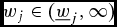 $w_{j}\in (\underline{w}_{j},\infty )$
stops.
The key to determining the equilibrium strategies is that a player type stops when the marginal gain from fighting a bit longer is just offset by the marginal cost. The marginal gain for type w 1 is its payoff to winning, namely w 1, times 2's hazard rate, i.e., the probability that 2 will quit in the next instant given that it has not already quit. The marginal cost is c 1. Equating the marginal gain with the marginal cost for w 1 and w 2 yields two differential equations that the equilibrium strategies σ*1(w 1) and σ*2(w 2) must satisfy. (See the Appendix for the derivation of these strategies.)
The main equilibrium result is that the higher a state's or a faction's payoff to winning, i.e., the larger wj , the longer the faction fights. More formally, σ*1(w 1) and σ*2(w 2) are continuous and strictly increasing at any σ* j (wj ) > 0. There are however infinitely many equilibria, and it is generally impossible to derive explicit closed-form expressions for the equilibrium strategies.Footnote 8
We make two assumptions to simplify the baseline model as much as possible before adding the third party. Assume first that there is an arbitrarily small probability that each faction is nonstrategic and fights forever and, second, that each faction believes the other faction's payoffs are exponentially distributed. The first assumption ensures that the two-actor baseline game has a unique equilibrium; the second makes it possible to derive explicit expressions for the factions’ strategies.Footnote
9
Formally, assume that wj
is distributed exponentially with
 $G_{j}(w_{j})=1-e^{\underline{w}_{j}-w_{j}}$
and that there exists a
 $ \overline{w}_{j}$
such that all
 $w_{j}>\overline{w}_{j}\,$
are nonstrategic types that fight forever.
It follows that the factions’ unique equilibrium stop times when
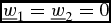 $\underline{ w}_{1}=\underline{w}_{2}=0$
are
 $$\begin{eqnarray}
\sigma _{1}^{\ast }(w_{1}) =\frac{\overline{w}_{1}\overline{w}_{2}}{k_{0}} \left( \frac{w_{1}}{\overline{w}_{1}}\right) ^{1+\rho _{0}},\vspace*{-11pt}\\
\sigma _{2}^{\ast }(w_{2}) =\frac{\overline{w}_{1}\overline{w}_{2}}{k_{0}} \left( \frac{w_{2}}{\overline{w}_{2}}\right) ^{1+1/\rho _{0}}\text{.}
\end{eqnarray}$$
(See Equation (A3) for the more general expressions when
 $\underline{w}_{1}\ge 0$
and
 $\underline{w}_{2}\ge 0$
.)
The types of 1 and 2 that stop at the same time play an important role in the analysis. Solving σ*1(w
1) = σ*2(w
2) from Equations (2) or (A3) shows that w
1 and
 $w_{2}=\overline{w }_{2}\left( w_{1}/\overline{w}_{1}\right) ^{\rho _{0}}$
stop at the same time. The curve θ(ρ0) in Figure 1 traces out these points for
 $0\le w_{1}\le \overline{w}_{1}$
.
Figure 1 also illustrates the equilibrium dynamics. To see how the game unfolds over time, suppose that the pair of lowest-payoff types
 $(\underline{ w}_{1},\underline{w}_{2})$
is below or to the right of θ(ρ0), e.g., at
 $(\underline{w}_{1}^{\prime },\underline{w}_{2}^{\prime })$
. Then the first thing that happens in equilibrium is that all types w
2 between
 $\underline{w}_{2}^{\prime }$
and
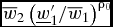 $\overline{w}_{2}\left( \underline{ w}_{1}^{\prime }/\overline{w}_{1}\right) ^{\rho _{0}}$
drop out at t = 0. Graphically, play moves vertically up from
 $(\underline{w}_{1}^{\prime }, \underline{w}_{2}^{\prime })$
to θ(ρ0). Equilibrium play thereafter moves along θ(ρ0) with w
1 and
 $w_{2}= \overline{w}_{2}\left( w_{1}/\overline{w}_{1}\right) ^{\rho _{0}}$
dropping out at the same time until
 $\overline{w}_{1}$
and
 $\overline{w}_{2}$
simultaneously quit. If, by contrast, the lowest-payoff types are above or to the left of θ(ρ0) at, say,
 $(\underline{w}_{1}^{\prime \prime },\underline{w}_{2}^{\prime \prime })$
, then play moves horizontally from
 $(\underline{w}_{1}^{\prime \prime },\underline{w}_{2}^{\prime \prime })$
to θ(ρ0) with types w
1 between
 $\underline{w} _{1}^{\prime \prime }$
and
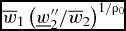 $\overline{w}_{1}\left( \underline{w}_{2}^{\prime \prime }/\overline{w}_{2}\right) ^{1/\rho _{0}}$
dropping out at t = 0. Subsequent play moves along θ(ρ0).
Equilibrium Play in the Baseline Two-actor War of Attrition

Which player types drop out at the start of the game (t = 0) and why they do turns out to be crucial for understanding the equilibria of the three-actor game. A rough intuition begins with the observation that the lowest-payoff type of 2,
 $\underline{w}_{2}$
, is relatively small compared to the lowest-payoff type of 1,
 $\underline{w}_{1}$
, at points below or to the right of θ(ρ0). As a result, low-payoff types of 2 are so pessimistic about their chances of prevailing when
 $(\underline{w}_{1}, \underline{w}_{2})$
is below θ(ρ0) that they drop out immediately. The converse holds when the lowest-payoff types are above θ: the low-payoff types of 1 are so pessimistic about their chances that they quit at t = 0. Finally, if
 $(\underline{w}_{1},\underline{w}_{2})$
is on θ(ρ0), the only types dropping out at t = 0 are
 $ \underline{w}_{1}$
and
 $\underline{w}_{2},$
and the probability that either faction drops out is zero.Footnote
10
It follows that the probability that a faction prevails in a war of attrition depends on the cost ratio but not on the total cost.Footnote
11
For example, the probability that 1 prevails is the probability that it stops after 2, i.e., that σ*1(w
1) > σ*2(w
2). This in turn is the probability (w
1, w
2) lies below θ(ρ0). Since θ(ρ0) depends on ρ0 but not k
0, the probability that 1 wins depends on ρ0 but not on k
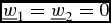
0. Both factions quit sooner when the total cost is higher as is clear from Equation (2) for the case when
 $\underline{w}_{1}=\underline{w}_{2}=0$
or Equation (A3) for the more general case. But a higher total cost does not affect the chances of prevailing as long as the cost ratio remains the same.
As noted above, the government is often stronger than the rebel group and assumed to be so in some work (e.g., Balach-Lindsay, Enterline, and Joyce Reference Balch-Lindsay, Enterline and Joyce2008; Gent Reference Gent2008; Regan Reference Regan2002). Other work frames third-party alignment decisions in both civil and interstate conflict in terms of a tradeoff between balancing or bandwagoning (e.g., Aydin and Regan Reference Regan and Aydin2008; Christia Reference Christia2012; Powell Reference Powell1999; Waltz Reference Waltz1979). A third party “balances power” when it joins, aligns with, or supports the weaker side. It “bandwagons” when it supports the stronger side. A third party faces a tradeoff between balancing and bandwagoning when it prefers the weaker side to win. Bandwagoning maximizes its chances of being on the winning side and obtaining the benefits that come with that. Balancing by contrast maximizes a third party's payoff conditional on being on the winning side.
In light of this work, it is useful to make one faction stronger than the other in the baseline model. Most simply, one faction is stronger than the other when it is more likely to prevail in the war of attrition. To formalize this, let Π j (z 1, z 2, ρ) denote the probability that j prevails in the war of attrition with cost ratio ρ given that at least one faction is strategic and that z 1 and z 2 are the lowest-payoff types still active, i.e., all w 1 ⩽ z 1 and w 2 ⩽ z 2 have already dropped out.Footnote 12 Then j is stronger than i at (z 1, z 2) when Π j (z 1, z 2, ρ0) > Π i (z 1, z 2, ρ0) or equivalently when Π j (z 1, z 2, ρ0) > 1/2.
As time passes and equilibrium play moves along θ, the probability that 1 prevails given that neither side has quit varies. Two assumptions ensure that 1 is always stronger than 2, i.e., everywhere along θ. Assume first that the cost ratio favors 1: c
1 < c
2 or ρ0 < 1. This implies that 1 is stronger than 2 in an otherwise symmetric war of attrition where
 $\underline{w}_{1}=\underline{w}_{2}$
and
 $\overline{w}_{1}= \overline{w}_{2}$
. It implies in the asymmetric case that 1's probability of prevailing decreases as time goes on and play moves along θ. Indeed, the probability that 1 prevails decreases to
 $[1+\overline{w}_{1}/(\rho _{0} \overline{w}_{2})]^{-1}$
in the limit as all strategic types drop out and play approaches
 $(\overline{w}_{1},\overline{w}_{2})$
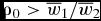
along θ. When this limit is less than 1/2, faction 1 may be stronger than 2 in the early phase of the war of attrition and then become weaker in the latter phase. The assumption that
 $\rho _{0}>\overline{w}_{1}/\overline{w}_{2}$
prevents this by guaranteeing that this limit is larger than 1/2 and therefore that faction 1 remains stronger than 2 throughout the conflict. Lemma 1 summarizes these results (see the Online Appendix for the proof).
Lemma 1 If
 $\overline{w}_{1}/\overline{w}_{2}<\rho _{0}<1$
, then 1 is more powerful than 2 as time passes and play moves along θ: 1's chances of prevailing decline throughout the war of attrition and converge to
 $[1+\overline{w}_{1}/(\rho _{0}\overline{w}_{2})]^{-1}>1/2$
.
Finally, it is important to note how changes in the cost ratio and in the total cost affect the outcome and duration of the conflict as these effects play a major role in determining which side the third party supports. The more the cost ratio favors one side in a war of attrition, the more likely that side is to prevail. To see why, note that as the cost ratio shifts in 1's favor (i.e., as ρ0 = c 1/c 2 declines), θ(ρ0) bows up, the area under it increases, and the probability that 1 prevails goes up. Similarly, the probability that 2 prevails increases as its relative cost of fighting goes down, i.e., Π2 is increasing in ρ0. And, as noted above, θ(ρ0) is independent of k 0, so shifts in the total cost have no effect on either faction's chances of winning as long as the cost ratio remains constant.
Turning to duration, the more symmetric the two factions’ costs, i.e., the closer ρ0 is to one, the longer the fight. The model thus provides formal support for the familiar idea that “making the strength of the two parties more nearly equal” tends to make for longer conflicts (Deutsch Reference Deutsch and Harry1964). This idea, along with the presumption that the government is generally stronger than the opposition, underlies several empirical studies and leads to the hypothesis that intervention on the government's side tends to shorten conflicts whereas intervention on the rebels’ side tends to make them longer.
The total cost also affects the duration. As noted above, a higher cost k 0 induces all types to stop sooner. This makes for shorter fights. Lemma 2 summarizes the results.
Lemma 2 (Baseline Effects of Changes in the Relative and Total Costs of Fighting): The lower a faction's relative cost of fighting, the greater its chances of prevailing (∂Π1/∂ρ < 0 and ∂Π2/∂ρ > 0 when ρ < 1). The more symmetric the cost ratio, i.e., the closer the cost ratio is to 1, the longer the expected duration. Changes in the total cost do not affect either faction's chances of prevailing, but the expected duration is decreasing in the total cost.Footnote 13
A MODEL OF TAKING SIDES
This section describes a game in which a third party, M, has preferences over which side prevails in the war of attrition between 1 and 2 and can affect the outcome by taking sides. More specifically, M can decide at an exogenously specified time T ⩾ 0 to support 1 or 2. Support for j shifts the distribution of power in j's favor and makes j more likely to win. More precisely, M's support for j shifts the cost ratio in j's favor in the continuation game between 1 and 2 that follows M's decision. As will be seen, this continuation game is itself a war of attrition, and Lemma 2 implies that the favorable shift in j's cost ratio increases its chances of prevailing.
To specify the effects of M's taking sides, let c j|n denote j's cost of fighting if M supports n at T. For example, 1's cost of fighting after T is c 1|2 if M aligned with 2 and c 1|1 if M aligned with 1. Take ρ n ≡ c 1|n /c 2|n to be the cost ratio between 1 and 2 if M joins n, and let kn = c 1|n + c 2|n be the total (marginal) cost of fighting for 1 and 2. Then make the following assumption:
Assumption 1
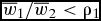
(The effects of Taking Sides): Assume (i) ρ1 < ρ0 < ρ2 and (ii)
 $\overline{w}_{1}/\overline{w}_{2}<\rho _{1}$
and ρ2 < 1.
Part (i) formalizes the idea that M's support for j shifts the cost ratio in j's favor. If M aligns with 1, the cost ratio drops from ρ0 to ρ1 which makes 1 more likely to prevail (Lemma 2). Joining 2 increases the cost ratio from ρ0 to ρ2 and makes 2 more likely to prevail. This is the only part of the assumption needed to characterize the equilibria.
Part (ii) ensures that 1 is stronger than 2 regardless of M's actions. Part (ii) thus excludes the possibility that the third party can shift the distribution of power in 2's favor. Allowing for this would not change the equilibrium analysis but would add many more cases to the comparative-static analysis. Note that no assumption is being made about how M's support affects the total cost of fighting, i.e., whether kj is larger or smaller than k 0.
Faction 1's payoffs in the three-actor game are still given by Equation (1) if the game ends prior to T. To specify its payoff if the game ends at or after T, suppose for example that M joins 1 at T and that the game subsequently ends at t ⩾ T when 2 quits. Then 1's payoff is w 1 − c 1 T − c 1|1(t − T), and 2's is − c 2 T − c 2|1(t − T). More concisely, suppose the game ends at t ⩾ T, the two factions’ stop times are t 1 and t 2, and M supports 1. The 1's payoff if M joins n at T is
 $$\begin{equation}
U_{1|n}(t_{1},t_{2})=\left\lbrace \arraycolsep5pt\begin{array}{ll}-c_{1}T-c_{1|n}(t_{1}-T) & {\rm if}\,\,\, t_{1}<t_{2} \\
w_{1}/2-c_{1}T-c_{1|n}(t_{1}-T) & {\rm if}\,\,\, t_{1}=t_{2} \\
w_{1}-c_{1}T-c_{1|n}(t_{2}-T) & {\rm if}\,\,\, t_{1}>t_{2} \end{array} \right.
\end{equation}$$
with analogous payoffs for 2. As in the baseline war of attrition, each faction is uncertain of the other's payoff to winning and believes it to be exponentially distributed.
Turning to M's payoffs, M gets v 1 if 1 wins and v 2 if 2 prevails. In addition to caring about who wins, M may also prefer to be on the winning side if it takes sides. That is, M's payoff if it aligns with j at T is vj + γ if j subsequently prevails and vi − γ if i ≠ j eventually wins where γ ⩾ 0 is the premium for being on the winning side. Note that if M prefers the weaker side 2 to prevail (v 2 > v 1), then M faces a tradeoff between bandwagoning by joining the stronger faction and balancing by aligning with the weaker side.
That longer conflicts are more costly for the protagonists is inherent in the notion of a war of attrition. Third parties, however, may have very different incentives as Deutsch (Reference Deutsch and Harry1964), Balch-Lindsay and Enterline (Reference Balch-Lindsay and Enterline2000), and Cunningham (Reference Cunningham2010) emphasize. Sometimes the third parties profit from conflict and are better off the longer it lasts. In still other cases, fighting imposes costs on the third party as well as the two protagonists. Formally, let f 0 denote M's flow payoff prior to taking sides, and take fj to be M's net flow payoff after supporting side j. M receives this flow for as long as the conflict lasts. Possible benefits accruing during the fighting include the gains from being able to exploit lootable resources, engage in smuggling or drug trafficking, or the direct side payments from j in return for M's support.Footnote 14 Possible costs include coming under more intense attack from the other faction, being sanctioned by other third parties, the cost of supplying arms or material to j, etc. The key distinction between fj and vj is that the former is contingent on the continuation of the fighting. M gets fj for as long as the conflict lasts. This flow stops when a faction wins at which point M gets a final payoff of v 1 or v 2.
When fj < 0, supporting j comes at a net cost which grows as the contest continues. In these circumstances, M prefers shorter conflicts to longer ones. By contrast, supporting j brings a positive flow of benefits when fj > 0 and M prefers longer fights.Footnote 15 For example, the Central Intelligence Agency's history of the Yugoslav conflict reports that
it was in the interest of the Serb republic that its two enemies, the Croats and the Muslims, continue to fight each other as long as possible. The Bosnia Serbs therefore consciously set out to provide military support for both sides, depending on the military balance in a given sector, ...most often to the side that was in the weaker positions, thus prolonging the fighting and increasing the cost to both sides” (2002, 179–80).
In sum, M's payoff if j prevails at t < T is vj + f 0 t. M's payoff if it supports j at T and j subsequently wins at t ⩾ T is vj + γ + f 0 T + fj (t − T). If the other faction wins at t ⩾ T, M gets vi − γ + f 0 T + fj (t − T).
M has no private information about the factions. Its prior belief is that each faction's payoff to prevailing is distributed according to Gj
(wj
). M also believes that
 $w_{j}>\overline{w}_{j}$
are nonstrategic and fight forever.Footnote
16
THE EQUILIBRIA
This section provides a less technical overview of the perfect Bayesian equilibria (PBEs) of the game. (The formal derivation is in the Appendix.) An equilibrium of the taking-sides model turns out to have a very simple structure composed of three phases. The two factions fight a war of attrition with cost ratio ρ0 and total cost k 0 during the first phase. There follows an interval of pure fighting during which neither side ever quits. These first two phases last until T at which point M decides whether to support 1 or 2. The third phase follows and is again a war of attrition but now with the cost ratio and total cost determined by M 's actions. If for example M supports 1 at T, then 1 and 2 fight a war of attrition with cost ratio ρ1 and total cost k 1 during the last stage of the game.
To describe these phases more precisely, let (z
1, z
2) denote the pair of lowest-payoff types still active at T, i.e., all w
1 < z
1 and w
2 < z
2 will have dropped out during the first two phases before M decides what to do at T. Since M cannot intervene until t, all types that drop out prior to T are effectively playing a war of attrition with each other akin to the baseline war of attrition but with z
1 and z
2 rather than
 $\overline{w}_{1}$
and
 $\overline{w}_{2}$
being the highest-payoff strategic types.Footnote
17
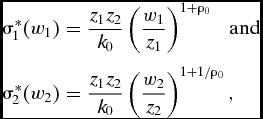
Substituting z
1 and z
2 for
 $ \overline{w}_{1}$
and
 $\overline{w}_{2}$
in Equation (2) gives the stop times for w
1 < z
1 and w
2 < z
2 during this phase:
 $$\begin{eqnarray}
\sigma _{1}^{\ast }(w_{1})&=&\frac{z_{1}z_{2}}{k_{0}}\left( \frac{w_{1}}{z_{1}} \right) ^{1+\rho _{0}}\text{ \ \ and }\nonumber\\
\sigma _{2}^{\ast }(w_{2})&=&\frac{ z_{1}z_{2}}{k_{0}}\left( \frac{w_{2}}{z_{2}}\right) ^{1+1/\rho _{0}},
\end{eqnarray}$$
where we continue to assume
 $\underline{w}_{1}$
and
 $\underline{w}_{2}$
are zero. The first phase lasts until all of the wj
< zj
drop out or until time z
1
z
2/k
0.Footnote
18
The second phase is an interval of pure fighting of length λ ⩾ 0 lasting from T − λ to T during which 1 and 2 never quit, i.e., no types drop out. An interval of pure fighting never occurs in a standard two-actor war of attrition. But it arises naturally in the three-actor game whenever M mixes, i.e., M supports 1 and 2 with positive probabilities.Footnote 19 The length of this interval is a function of z 1 and z 2 and will often be written as λ(z 1, z 2).Footnote 20
The third phase follows M's decision and is a war of attrition with the cost ratio and total cost determined by M's action. If for instance M supports 1, then the continuation game between 1 and 2 following M's decision is a war of attrition with cost ratio ρ1 and total cost k
1. Types z
1 and z
2 are the lowest-payoff types during this phase and play a role analogous to
 $\underline{w}_{1}$
and
 $\underline{w} _{2}$
in the baseline two-actor war of attrition. The factions stop times in this phase are given by the more general expressions for σ*1 and σ*2 in the Appendix for the case in which the lowest-payoff types are not zero (see Equation (A3)).
Characterizing the equilibrium strategies of the taking-sides model thus amounts to finding z 1 and z 2 as well as the probability that M supports 1 at (z 1, z 2) which will be denoted by α1. The pair (z 1, z 2) must satisfy two conditions, an incentive constraint for M and a timing constraint.
The incentive constraint follows from reasoning backwards from the end of the game, i.e., from the war of attrition played during the third phase following M's decision. The dynamics of this stage are illustrated in Figure 2. Recall that payoff types w
1 and
 $w_{2}=\overline{w}_{2}(w_{1}/ \overline{w}_{1})^{\rho _{0}}$
quit at the same time in the baseline two-actor war of attrition when the cost ratio is ρ0. The curves θ(ρ1) and θ(ρ2) depict the pair types (w
1, w
2) that stop at the same time in the two-actor baseline model when the cost ratios are ρ1 and ρ2 respectively. That is,
 $ w_{2}=\overline{w}_{2}(w_{1}/\overline{w}_{1})^{\rho _{j}}$
along θ(ρ
j
).
The Continuation Game when M Takes Sides

To see how the third phase plays out, assume that (z
1, z
2) is between θ(ρ1) and θ(ρ2) as in Figure 2 and that M supports 1 at (z
1, z
2). (Lemma 4 in the Appendix shows that (z
1, z
2) must lie on or between θ(ρ1) and θ(ρ2) in any equilibrium.) Since (z
1, z
2) is below θ(ρ1), the low-payoff types of 2 are so pessimistic about their chances of prevailing when the cost ratio is ρ1 that they drop out as soon as M joins 1. Play moves vertically up from (z
1, z
2) to θ(ρ1) with
 $w_{2}\in [z_{2},\overline{w}(z_{1}/\overline{w} _{1})^{\rho _{1}}]$
quitting immediately after M joins 1. Subsequent play then moves along θ(ρ1).
Suppose instead that M joins 2 at (z 1, z 2) and the cost ratio becomes ρ2. The pair (z 1, z 2) is now above θ(ρ2) and the low-payoff types of 1 are so pessimistic in light of this cost ratio that they drop out immediately after M aligns with 2. Play moves horizontally from (z 1, z 2) to θ(ρ2) at T and then along θ(ρ2) for the rest of the game.
Given that the continuation game following M's decision is a war of attrition, we can determine the factions’ strategies in that war and then use them to calculate M's payoffs to supporting 1 or 2 at (z 1, z 2). Let S 1(z 1, z 2) and S 2(z 1, z 2) respectively denote M's payoffs to supporting 1 or 2 and define Δ12(z 1, z 2) ≡ S 1(z 1, z 2) − S 2(z 1, z 2) to be the difference between these payoffs.Footnote 21 Then M weakly prefers supporting 1 to aligning with 2 at (z 1, z 2) when the payoff to supporting 1 is at least as large as the payoff to supporting 2 or Δ12(z 1, z 2) ⩾ 0. M weakly prefers 2 when Δ12(z 1, z 2) ⩽ 0 and is indifferent between supporting 1 or 2 when Δ12(z 1, z 2) = 0.
M's incentive constraint now follows. Result 1 (stated as Lemma 4 in the Appendix) establishes that (z 1, z 2) must be on or between θ(ρ1) and θ(ρ2). Moreover, M must support 1 for sure when (z 1, z 2) is on θ(ρ1), support 2 for sure when (z 1, z 2) is on θ(ρ2), and support both factions with positive probabilities (0 < α1 < 1) when (z 1, z 2) is between θ(ρ1) and θ(ρ2). In order for these actions to be consistent with equilibrium play, M must at least weakly prefer supporting 1 when (z 1, z 2) is on θ(ρ1), i.e., Δ12(z 1, z 2) ⩾ 0 when (z 1, z 2) is on θ(ρ1). M must also weakly prefer 2 if (z 1, z 2) is on θ(ρ2), and M must be indifferent between 1 and 2 when (z 1, z 2) is between θ(ρ1) and θ(ρ2). Collectively these conditions on Δ12(z 1, z 2) describe M's incentive constraint.
Result 1 (M's incentive constraint): Let (z 1, z 2) denote the weakest types still active at T in a PBE. Then (z 1, z 2) must be on or between θ(ρ1) and θ(ρ2) and
-
i. M must support 1 for sure (α1 = 1) and, necessarily, Δ12(z 1, z 2) ⩾ 0 when (z 1, z 2) is on θ(ρ1);
-
ii. M must support 2 for sure (α1 = 0) and Δ12(z 1, z 2) ⩽ 0 when (z 1, z 2) is on θ(ρ2);
-
iii. M must support 1 and 2 with positive probability (0 < α1 < 1) and Δ12(z 1, z 2) = 0 when (z 1, z 2) is between θ(ρ1) and θ(ρ2).
Result 1 is the key to characterizing the equilibria, and it is worth sketching the argument underlying part (iii). Claims (i) and (ii) follow from very similar arguments.
Proof (sketch): We argue by contradiction. That is, we first assume that M is sure to support 1, i.e., α1 = 1, and then show that this leads to a contraction and hence to the conclusion that α1 must be less than 1.
The first step in reaching a contradiction is to demonstrate that there is an interval (T − λ, T) for a λ > 0 during which 1 never quits, i.e., no player type w 1 quits. We again argue by contradiction by assuming that there is no such interval and then demonstrate that this assumption this leads to a contradiction. More specifically, suppose that there are types w 1 that do quit arbitrarily close to T. This leads to the contradiction that some of these types could profitably deviate from their equilibrium strategy of quitting before T by waiting until T to quit.
Suppose in particular that
 $\widehat{w}_{1}$
's equilibrium strategy is to quit at T − ε where ε > 0 is arbitrarily small. Now compare
 $\widehat{w}_{1}$
's payoff to quitting at T − ε to its payoff to waiting until T to quit. The net payoff to quitting at T − ε is zero: there are no further loses but there is also no chance of securing future gains when the other quits. If by contrast
 $\widehat{w} _{1}$
waits to quit until T, then M by assumption is sure to support 1 and as a result all w
2 between z
2 and θ(ρ1) quit. This implies that
 $\,\widehat{w}_{1}$
's payoff to waiting until T to stop is at least
 $\widehat{w}_{1}\alpha _{1}[e^{\underline{w}_{2}-z_{2}}-e^{ \underline{w}_{2}-\overline{w}_{2}(z_{1}/\overline{w}_{1})^{\rho _{1}}}]-c_{1}\varepsilon$
where α1 = 1 by assumption and the expression in brackets is the prior probability that the w
2 between z
2 and θ(ρ1) drop out.Footnote
22
The expression in brackets is sure to be positive because (z
1, z
2) is between θ(ρ1) and θ(ρ2) and, consequently, the payoff to this deviation is sure to be positive for ε small enough. This contradiction ensures that no w
1 quits in (T − λ, T) for a λ > 0.
Given that no w
1 quits in (T − λ, T) and α1 = 1, the w
2 between z
2 and θ(ρ1) that quit at T have no chance of winning after time T − λ. As a result, they would have done strictly better by quitting at T − λ than they do by fighting on until T. Having a profitable deviation from an equilibrium strategy is a contradiction, and it follows from this contradiction that α1 must be less than one. An analogous argument yields α1 > 0. Putting positive probably on supporting both 1 and 2 implies that M must be indifferent between them and Δ12(z
1, z
2) = 0.
 $\hfill\square$
The pair (z 1, z 2) must also satisfy a timing constraint. The length of the war of attrition during the first phase plus the length of the interval of pure fighting must sum to T. As noted above, the war of attrition between types w 1 < z 1 and w 2 < z 2 ends at time z 1 z 2/k 0. Hence, (z 1, z 2) must satisfy the timing constraint σ*1(z 1) + λ(z 1, z 2) = T or z 1 z 2/k 0 + λ(z 1, z 2) = T. The points that do are illustrated in Figure 3.
The Timing Constraint

At least one pair (z 1, z 2) must satisfy both constraints. To verify this, suppose that Z′ in Figure 3 does not satisfy both constraints. Then M's incentive constraint must fail to hold. This implies that Δ12(Z′) < 0 or, more substantively, that M strictly prefers supporting 2. Suppose further that Z″ does not satisfy both constraints and thus that M's incentive constraint fails to hold here too. This means that Δ12(Z″) > 0. But if Δ12(Z″) > 0 and Δ12(Z′) < 0, then continuity ensures that Δ12(z 1, z 2) must be zero and hence that M's incentive constraint must be satisfied somewhere along the timing constraint between Z′ and Z″.
Proposition 1 (which is formally stated in the Appendix) shows that a unique PBE is associated with each (z 1, z 2) that satisfies the two constraints.Footnote 23 Suppose for example that Z* = (z*1, z 2*) in Figure 3 satisfies both constraints. Then w 1 < z*1 and w 2 < z*2 play a war of attrition with cost ratio ρ0 and total cost k 0. This first phase ends at z*1 z 2*/k 0. There follows an interval of pure fighting lasting until T at which point M supports 1 with probability α1. (See Proposition 1 for the expression for α1.) If M supports j at T, then w 1 > z*1 and w 2 > z*2 fight a war of attrition with cost ratio ρ j and total cost kj during the final phase.
A numerical example helps fix ideas. Suppose that the initial cost ratio is ρ0 = 1/2, decreases to ρ1 = 3/7 if M joins 1, and increases to ρ2 = 9/11 if M joins 2. To keep things simple, the total cost is assumed to remain the same with k
0 = k
1 = k
2 = 1. Taking
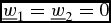 $\underline{w} _{1}=\underline{w}_{2}=0$
,
 $\overline{w}_{1}=5$
, and
 $\overline{w}_{2}=20$
satisfies Assumption 1 with
 $\overline{w}_{1}/\overline{w}_{2}<\rho _{1}<\rho _{0}<\rho _{2}<1$
. M's payoff if 1 prevails is v
1 = −5 and v
2 = 5 if 2 prevails. The payoff to being on the winning side conditional on having taken sides is γ = 1. M's flow payoff prior to taking sides is f
0 = −20 which means fighting is costly and shorter fights are better. The cost is even higher after M takes sides with f
1 = f
2 = −40 . By way of calibrating the model, a marginal cost of 40 means that if M paid this while 1 and 2 fought the two-actor war of attrition, then M's expected cost would be 2.6 or 26 percent of the stakes |v
1 − v
2|. M decides what to do at T = 25. (Figures 1, 2, 3, and 5 are actually plots based on this example.)
In the unique equilibrium, the lowest-payoff types still active at T are z*1 ≈ 1.9 and z*2 ≈ 12.2. Types w 1 ∈ (0, 1.9) and w 2 ∈ (0, 12.2) fight a war of attrition with cost ratio ρ0 = 1/2 during the first phase which ends at z*1 z 2*/k 0 ≈ 21.1. There follows an interval of pure fighting lasting until T = 25 when M joins 1 with probability α1 = 0.7 at T.
THE BOOMERANG EFFECT
The equilibrium strategies exhibit a boomerang effect when the stakes for M are not too large and fighting is costly, i.e., when |v 1 − v 2| is not too large and f 1 and f 2 are negative. The expectation that M is sure to support a given faction leads both factions to take actions that make it less likely that M will actually support that faction when the time comes. The formal effect of these forces is that M typically plays a mixed equilibrium strategy as is the case in the numerical example. The substantive import of the boomerang effect is that alignment patterns will often be unpredictable and coalitions dynamically unstable.Footnote 24 Although identified in the specific context of a war of attrition, the boomerang effect seems likely to be present in any conflict in which there is uncertainty about each side's willingness to fight, more resolute types fight longer than less resolute types, and a third party's support advantages one side.
To develop some intuition for the boomerang effect and the forces inclining M to mix, suppose that both 1 and 2 expect M to join one of the factions, say 1, for sure. M's support for 1 at T will increase that faction's subsequent chances of prevailing. These better prospects will in turn induce some w 1 that would have otherwise dropped out prior to T to fight on until at least T. By contrast, some w 2 that would have fought until T drop out prior to T. The net effect is that there is a large set of types of w 1 that have fought until T only because they expected M to support 1 at T. Realizing that they have been had, these types will immediately drop out if M supports 2 instead, thereby shortening the war of attrition fought in the third phase. The prospect of a shorter war in turn creates an incentive for M to support 2 when fighting is costly, and the larger incentive to support 2 tends to undermine the original expectation that M is sure to support 1. Formally, M's strategy of supporting 1 at T is not sequentially rational: M prefers to deviate by supporting 2 once play gets to T.
Figure 3 illustrates the boomerang effect graphically. The pair (z 1, z 2) must lie on θ(ρ1) if M is expected to support 1 at T (Result 1). If, however, M actually supports 2, then all w 1 between z′1 and the point on θ(ρ2) horizontally across from Z′ instantly drop out. This tends to shorten the war and creates an incentive for M to support 2 when fighting is costly.
To emphasize that it is the way 1 and 2 react to the expectation that M will support a given faction that undermines this expectation, assume that M has to decide what to do at the very start of the game (T = 0 ). Since M effectively moves before 1 and 2, neither faction can react in anticipation of M's action. Absent these anticipatory reactions, M is almost sure to strictly prefer supporting one side or the other. M will virtually never be indifferent and play a mixed strategy.Footnote 25
Equilibrium forces play out differently when the stakes are high or M profits from the fighting (and we are back to the case in which T > 0). When M has a strong preference for one side, it supports that side and does not mix as will be seen below in the discussion of comparative statics. When fighting is profitable, M wants to prolong the conflict rather than shorten it. Now the fact that M's deviating from what it was expected to do tends to shorten the war makes M less rather than more inclined to deviate.
At the risk of pushing this result too hard, it suggests that coalition formation will be more predictable and coalitions will be more stable when fighting is profitable.
WHAT MAKES M MORE LIKELY TO SUPPORT A GIVEN FACTION?
The effects of changes in M's payoffs on the chances that M supports j turn out to be quite straightforward and intuitive. Anything that increases M's payoff to supporting a given faction makes M more likely to support that faction: The higher M's payoff if 1 prevails or the flow payoff it derives from supporting 1, the more likely M is to support 1. The higher M's payoff if 2 prevails or the higher M's flow payoff from supporting 2, the less likely M is to support 1. The effects of changes in the total cost that 1 and 2 pay if M supports a given faction, i.e., the effects of changes in k 1 and k 2, are also straightforward. The higher the total cost of fighting kj , the shorter the war of attrition following M's decision to support j. Thus a higher cost kj (and therefore a shorter third-phase war) makes supporting j more attractive when fighting is costly (fj < 0) and less attractive when fighting is profitable (fj > 0). As a result, an increase in kj makes M is more likely to support j when fighting is costly (fj < 0) and less likely when fighting is profitable (fj > 0). The effects of changes in the payoff to being on the winning side are ambiguous.
These results are stated formally in Proposition 2 in the Online Appendix. The remainder of this section sketches the derivation, and readers less interested in the technical results may omit the rest of this section. The comparative statics follow from three observations. First, θ(ρ1), θ(ρ2), and the timing constraint T = z 1 z 2/k 0 + λ(z 1, z 2, ρ0, k 0) are independent of M's payoffs v 1, v 2, γ, f 0, f 1, and f 2 as well as the total costs k 1 and k 2.Footnote 26 It follows that changes in these parameters have no effect on these curves. Second, Result 1 implies that α1 = 0 at Z″ in Figure 3 where θ(ρ2) and the timing constraint intersect. Result 1 also implies that α1 = 1 at the other end of the timing constraint Z′. More generally, the farther the equilibrium pair (z 1, z 2) is from Z″ along the timing constraint, the higher α1. This means that we can determine the effects of, say, an increase in v 1 on α1 by seeing how (z 1, z 2) moves along the timing constraint.
A qualification is in order before making the third observation. One might hope that the effects of a change in an underlying parameter would have the same directional effect in all of the equilibria when there are multiple equilibria. In a model of war, for example, one might hope that a change in the cost of fighting would make war less likely in all equilibria. Or, the higher the payoff if 1 wins in the present game, the more likely M is to support 1 in all equilibria.
Hope as one might, it is often the case that the direction of the effects of a parametric change vary across equilibria. Typically, a change in x makes y more likely in some equilibria and less likely in others. A less ambitious hope is that a parametric change has the same effect on, say, the probability that M supports 1 in the equilibrium in which M is least likely to support 1 as well as the equilibrium in which M is most likely to support 1. This is the approach take here. (See Ashworth and Bueno de Mesquita (Reference Ashworth and Bueno de Mesquita2006) for a discussion.)
Turning to the third observation, let μ be any parameter, e.g., 1's payoff to winning v 1. Then the probability that M supports 1 in the equilibria in which M is most and least likely to support 1 is increasing in μ if Δ12 is increasing in μ (i.e., if ∂Δ12(z 1, z 2, μ)/∂μ > 0). Conversely, if Δ12 is decreasing in μ, then M is less likely to support 1 (and hence more likely to support 2) in the equilibria in which M is most and least likely to support 1. To see why, consider Figure 4 which shows how Δ12(z 1, z 2, μ) varies as we move along the timing constraint from Z″ where the timing constraint and θ(ρ2) intersect (and α1 = 0 by Result 1) to Z′ where the timing constraint and θ(ρ1) intersect and α1 = 1.Footnote 27 By assumption, there are no pure strategy equilibria in the illustration. That is, M strictly prefers supporting 1 at Z″ (Δ12(Z″) > 0) whereas equilibrium play would require it to support 2 (see Result 1). Analogously, M strictly prefers 2 at Z′ (Δ12(Z′) < 0) whereas equilibrium play would have it support 1.
Δ12 along the Timing Constraint

Rather than supporting either faction for sure, M mixes in the three equilibria depicted in Figure 4. More specifically, the incentive and timing constraints intersect wherever Δ12 = 0 along the timing constraint. According to Proposition 1, a PBE corresponds to each of these intersections. Let
 $\underline{\alpha }_{1}$
and
 $\overline{\alpha }_{1}$
respectively denote the equilibria in which M is least and most likely to support 1. Clearly, an increase in μ to μ′ > μ that induces an upward shift in Δ12 leads to an increase in both
 $ \underline{\alpha }_{1}$
and
 $\overline{\alpha }_{1}$
.
Given that α1 is increasing in a parameter if Δ12 is, it remains to be determined how Δ12 varies with changes in the parameters. Recall that Π j (z 1, z 2, ρ) is the probability that j prevails in the two-actor war of attrition given that zj is the lowest-payoff type still active, the cost ratio is ρ, and given that at least one faction is strategic. Take D(z 1, z 2, ρ, k) to be the expected duration of this conflict. Then algebra and the Appendix show
 $$\begin{eqnarray*}
\Delta _{12}(z_{1},z_{2}) &=&(v_{1}-v_{2})[\Pi _{1}(z_{1},z_{2},\rho _{1})-\Pi _{1}(z_{1},z_{2},\rho _{2})]\\
&&+\,2\gamma [\Pi _{1}(z_{1},z_{2},\rho _{1})-\Pi _{2}(z_{1},z_{2},\rho _{2})] \\
&&+\,f_{1}D(z_{1},z_{2},\rho _{1},k_{1})-f_{2}D(z_{1},z_{2},\rho _{2},k_{2}),
\end{eqnarray*}$$
where we use the fact that Π1(z 1, z 2, ρ1) + Π2(z 1, z 2, ρ1) = Π1(z 1, z 2, ρ2) + Π2(z 1, z 2, ρ2) = 1.
The effects of changes in vj , fj , and the total cost kj for j ∈ {1, 2} are straightforward and unambiguous. The probability that 1 prevails is decreasing in the cost ratio, so Π1(z 1, z 2, ρ1) > Π1(z 1, z 2, ρ2). Δ12 is therefore increasing in v 1 and decreasing in v 2. Thus the higher v 1 and the lower v 2, the more likely M is to support 1. Since durations are always nonnegative, a higher flow payoff to supporting 1 or a lower flow payoff to supporting 2 makes M more to support 1. Because duration is also decreasing in the total cost, a higher k 1 makes M less likely to support 1 when fighting is profitable (f 1 > 0) and more likely when it is costly (f 1 < 0).
The effects of changes in the payoff to being on the winning side are ambiguous and depend on the sign of Π1(z 1, z 2, ρ1) − Π2(z 1, z 2, ρ2). The first term is the probability that 1 wins with M's support or, equivalently, the probability that M will be on the winning side if M supports 1. Analogously, Π2(z 1, z 2, ρ2) is the probability that M will be on the winning side if it supports 2. It follows that an increase in γ makes M more likely to join the side that is more likely to win when it has M's support. In symbols, an increase in γ makes M more likely to join 1 when Π1(z 1, z 2, ρ1) > Π2(z 1, z 2, ρ2) and more likely to join 2 when Π1(z 1, z 2, ρ1) < Π2(z 1, z 2, ρ2).
EMPIRICAL CHALLENGES
The theoretical model developed here and the resulting comparative statics have implications for empirical efforts to assess the effects of intervention. Many studies attempt to evaluate claims about the effects of intervention by estimating a duration model. Gent (Reference Gent2008), for example, uses a competing-risk model to test the hypothesis that third party support for the rebels increases their chances of prevailing. Balch-Lindsay and Enterline (Reference Balch-Lindsay and Enterline2000) and Balach-Lindsay, Enterline, and Joyce (Reference Balch-Lindsay, Enterline and Joyce2008) also use this approach to test their hypotheses about intervention. Regan (Reference Regan2002) estimates a Weibull duration model.
The present analysis shows that using duration models to evaluate the effects of intervention faces at least three formidable challenges. The most basic is that the likelihood that a faction prevails depends on the cost ratio but not on the total cost whereas the expected duration and hazard rate depend on both. Thus trying to infer changes in the likelihood of prevailing (i.e., in the cost ratio) from changes in the duration or hazard rate is problematic. A second challenge is that the hazard rate of equilibrium behavior may be very complicated even in a relatively simple model like this one. This casts doubt on the proportionality assumption of the Cox approach. Finally, there may be significant selection effects.
To illustrate these challenges, suppose we were trying to use a competing-risk proportional hazards model to test the hypothesis that third party support for the “rebel opposition” (i.e., for the weaker faction 2) makes that faction more likely to prevail. For each observation, the (hypothetical) data indicates whether the third party supported 1, supported 2, or stayed out; whether 1 or 2 ultimately prevailed; and the duration of the conflict (see below for the formal the analysis of the game when M has three options). Let Xj = 1 if M supports faction j and Xj = 0 otherwise for j ∈ {1, 2}. M stays out in cases where X 1 = X 2 = 0. Take H 2|k (t) to be 2's hazard rate of victory, i.e., the probability that 2 prevails in the next instant given that the conflict has lasted until t and that M supported k ∈ {0, 1, 2} where supporting “0” means staying out.
The Cox model assumes that the hazard rates of the different possible outcomes are proportional. In symbols, H 2|k (t) = H 2|0(t)e β1 X 1 + β2 X 2 where H 2|0 is the baseline hazard rate, i.e., the chances that 2 prevails if M stayed out. The parameter β j measures the effect on H 2|0 if M supports j. If, for example, M supports 2 in a given observation, then X 1 = 0, X 2 = 1, and the previous equation reduces to H 2|2(t) = H 2|0(t)e β2 . This leaves H 2|2(t)/H 2|0(t) = e β2 . The econometric challenge is to estimate β1 and β2. A positive estimate of β j is generally taken to mean that M's support for j makes j more likely to win.
The model makes it possible to derive the hazard rates and this reveals other challenges. To derive the expression for H 2|2(t)/H 2|0(t), note that the probability that the fighting lasts until at least time t > T is the probability that both factions stop at t or later. The type w 1 that stops at t given that M supported 2 is the inverse w 1 = σ−1 1|2(t), so the probability that 1 has not yet quit at t is 1 − G(σ−1 1|2(t)) = e −σ−1 1|2(t). Similarly, the probability that 2 has not yet quit at t is 1 − G(σ−1 2|2(t)) = e −σ−1 2|2(t), and the probability neither faction has stopped by t is e −σ−1 1|2(t) − σ2|2 −1(t). The chances that 2 prevails in the next instant is the probability that 1 quits in the next instant or d(1 − e −σ−1 1|2(t))/dt. This yields a hazard rate of a rebel victory if M supports 2 of
 $$\begin{eqnarray*}
H_{2|2}(t)&=&\frac{\Pr \lbrace \text{1 quits in the next instant}\rbrace }{\Pr \lbrace \text{ neither faction quits before }t\rbrace }\\
&=&\frac{d(1-e^{-\sigma _{1|2}^{-1}(t)})/dt}{ e^{-\sigma _{1|2}^{-1}(t)-\sigma _{2|2}^{-1}(t)}}=e^{\sigma _{2|2}^{-1}(t)} \frac{d\sigma _{1|2}^{-1}(t)}{dt}\text{.}
\end{eqnarray*}$$
Using the analogous expression for H 2|0(t),
 $$\begin{eqnarray}
\frac{H_{2|2}(t)}{H_{2|0}(t)} &=&\frac{k_{2}}{1+\rho _{2}}\left[ \frac{k_{2} \widehat{t}}{\overline{w}_{1}\overline{w}_{2}}+\left( \frac{z_{1|2}}{ \overline{w}_{1}}\right) ^{1+\rho _{2}}\right] ^{\frac{-\rho _{2}}{1+\rho _{2}}}\nonumber\\
&&\times\, e^{\overline{w}_{2}\left[ \frac{k_{2}\widehat{t}}{\overline{w} _{1}\overline{w}_{2}}+\left( \frac{z_{1|2}}{\overline{w}_{1}}\right) ^{1+\rho _{2}}\right] ^{\frac{\rho _{2}}{1+\rho _{2}}}} \nonumber \\
&&\times\, \left( \frac{1+\rho _{0}}{k_{0}}\right) \left[ \frac{k_{0}\widehat{t }}{\overline{w}_{1}\overline{w}_{2}}+\left( \frac{z_{1|0}}{\overline{w}_{1}} \right) ^{1+\rho _{0}}\right] ^{\frac{\rho _{0}}{1+\rho _{0}}}\nonumber \\
&&\times\, e^{- \overline{w}_{2}\left[ \frac{k_{0}\widehat{t}}{\overline{w}_{1}\overline{w} _{2}}+\left( \frac{z_{1|0}}{\overline{w}_{1}}\right) ^{1+\rho _{0}}\right] ^{ \frac{\rho _{0}}{1+\rho _{0}}}}
\end{eqnarray}$$
where
 $\widehat{t}=t-T$
is the time since intervention and z
1|k
is the lowest payoff type of 1 still active at T given M supported k in equilibrium.
Three observations follow from this expression. First, the proportionality assumption is clearly violated. Indeed, the hazard-rate ratio varies in a complicated way over time. Second, there are likely to be selection effects. Consider an equilibrium in which M supports 2 for sure. Then the pair of lowest-payoff types active at T, (z 1|2, z 2|2), lies at the intersection of the timing constraint and θ(ρ2). Both this pair and the corresponding hazard rate H 2|2 are well defined. But the pair of lowest-payoff types still active at T had M supported 1 or stayed out, that is, (z 1|1, z 2|1) and (z 1|0, z 2|0), are not defined. This in turn implies that the corresponding hazard rates H 2|1 and H 2|0 are not well defined. The numerical example illustrates a similar point. As shown below, M mixes over supporting 1 and 2 and never stays out when the numerical example is extended to allow M to choose not to take sides. Hence (z 1|1, z 2|1) = (z 1|2, z 2|2), and H 2|1 and H 2|2 are well defined and can be calculated. But what would have happened had M stayed out, that is, (z 1|0, z 2|0) and H 2|0, cannot.
Finally, suppose that despite all of these issues one could establish empirically that H 2|2(t)/H 2|0(t) > 1 at all t > T. That is, 2 at any t > T is always more likely to prevail in the next instant if M supported it than if M had stayed out. Could we infer from this that M's support makes 2 more likely to win? Is ρ2/ρ0 > 1 identified?
The answer is no. To establish this, we construct a counterexample in which M's support, by assumption, has no effect on either faction's chances of prevailing. Nevertheless, M's support increases the hazard rate of 2's prevailing, i.e., H
2|2(t)/H
2|0(t) > 1. Formally, suppose M's support has no effect on the cost ratio with
 $\overline{w}_{1}/\overline{w} _{2}<\rho _{0}=\rho _{1}=\rho _{2}<1$
where the inequalities ensure that 1 is always stronger than 2 regardless of what M does (see Assumption 1). Suppose further that M's support for the weaker side 2 (the rebels) increases the total marginal cost of fighting: k
2 > k
0. The Online Appendix shows that H
2|2(t)/H
2|0(t) > 1 at all t > T.
The counterexample illustrates the basic identification problem. The increased cost of fighting following M's decision to support 2 makes it more likely that the fighting will end in the next instant. But both sides are more likely to stop, and there is no change in the factions’ relative chances of prevailing since the cost ratio remains unchanged.
NOT TAKING SIDES
Until now M has had to take sides by supporting either 1 or 2. M could not decide to stay out. This section extends the model by giving M the three options of supporting 1 or 2 or staying out. We show that the equilibrium and comparative statics of the numerical example do not change when the option of staying out is added to the model. The basic reason is that M strictly prefers supporting 1 or 2 to staying out. Hence adding the third option of staying out with its lower payoff has no effect on equilibrium play. More generally, M will typically mix over two options when it has three alternatives as it does in the numerical example and the presence of the third option has no effect. But there may be cases in which M mixes over all three alternatives depending on the parameter values.
The analysis of the three-option game begins with an intermediate step in which M chooses between staying out or supporting 2. The analysis is fundamentally the same if M had the options of staying out or joining 1. Indeed, the main point of the intermediate step is that the equilibrium analysis is essentially the same when M only has two options regardless of what those options are. More importantly, the analysis shows that the equilibrium and comparative statics of the model when M only has two options is often an equilibrium of the model when M has three options.
To specify the model when M can stay out or support 2, assume that the cost ratio, total cost, and flow payoff remain ρ0, k 0 and f 0 if M stays out (where the subscript “0” will be used for the option of staying out). They change to ρ2, k 2, and f 2 if M supports 2. Let α0 be the probability that M stays out. Take (z 1, z 2) to be the lowest-payoff types active at T and S 0(z 1, z 2) to be M's payoff to staying out at (z 1, z 2).
Figure 5 illustrates the geometric similarly of the equilibrium analysis when M can stay out or support 2, or when when M can support 1 or 2. The lowest-payoff types (z
1, z
2) when M can support 0 or 2 must lie on or between θ(ρ0) and θ(ρ2) and satisfy an incentive constraint for M as well as a timing constraint. To specify the latter, note that the first phase of equilibrium play ends when z
1 and z
2 quit at time z
1
z
2/k
0 (assuming
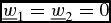 $\underline{w}_{1}= \underline{w}_{2}=0$
). Let λ02(z
1, z
2) be the length of the interval of pure fighting that follows given that the cost ratio will be ρ0 or ρ2 after M decides what to do.Footnote
28
This yields the timing constraint T = z
1
z
2/k
0 + λ02(z
1, z
2, ρ0, ρ2). Let TC
02 denote the set of points satisfying this constrain. The points in TC
02 are shown in Figure 5 as are the points satisfying the timing constraint TC
12 when M could only support 1 or 2.
Taking Sides or Staying Out

M's incentive constraint follows from an analogue of Result 1: If (z 1, z 2) is on the upper edge θ(ρ0), M must stay out (α0 = 1) which in turn requires that M weakly prefer supporting 0, i.e., Δ02(z 1, z 2) ≡ S 0(z 1, z 2) − S 2(z 1, z 2) ⩾ 0. (See the Appendix for the expression for Δ02.) If (z 1, z 2) is on θ(ρ2), M joins 2 for sure and must weakly prefer supporting 2 (Δ02(z 1, z 2) ⩽ 0). Finally if (z 1, z 2) is strictly between θ(ρ0) and θ(ρ2), then M must be indifferent between supporting 0 or 2 so that M can mix in equilibrium (Δ02(z 1, z 2) = 0). Let MIC 02 be the set of points satisfying this incentive constraint.
It is straightforward to show that the analogue of Proposition 1 holds. At least one (z
1, z
2) satisfies TC
02 and MIC
02, and a virtually unique PBE is associated with any (z
1, z
2) satisfying both. Types
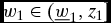 $w_{1}\in (\underline{w}_{1},z_{1}]$
and
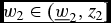 $w_{2}\in (\underline{w} _{2},z_{2}]$
fight a war of attrition until time T − λ02(z
1, z
2, ρ0, k
0) followed by a pure-fighting interval of length λ02. M then decides what to do, and the war of attrition goes on with the cost ratio and total cost determined by M's action.
The comparative-static analysis parallels the argument in the case when M could support support 1 or 2. If Δ02(z 1, z 2) is increasing in a parameter μ, then so are the chances that M will stay out in the equilibria in which M is most and least likely to stay out. It follows that the probability that M stays out are increasing in v 1 and f 0 and decreasing in v 2 and f 2. A higher total k 2 decreases the expected duration of fighting if M supports 2.Footnote 29 This in turn makes M more likely to support 2 when fighting is costly (f 2 < 0) and less likely when it is profitable. The effects of changes in the payoff to being on the winning are however unambiguous in this case. M is less likely to be on the winning side if it supports 2, so an increase in γ makes M more likely to stay out.
Finally, what happens when M has the three options of staying out or supporting 1 or 2? Let TC 12, TC 10, and TC 02 be the timing constraints if M has to choose between supporting 1 or 2, 1 or “0” , or “0” or 2, respectively. Take MICij to be M's incentive constraints when M has to choose between joining i or j.
In the baseline numerical example where M must support 1 or 2, M mixes at the unique (z*1, z 2*) satisfying M's incentive and timing constraints with (z*1, z 2*) ≈ (1.9, 12.2). Moreover, M's payoff to supporting 1 or 2 at (z*1, z 2*) is strictly larger than its payoff to staying out. It follows that the numerical example described above when M can either support 1 or 2 is also an equilibrium when M has three options. The comparative static results for the equilibrium when M can only support 1 or 2 also hold for the equilibrium in which M can support 1 or 2 or stay out.
More generally suppose (z 1, z 2) satisfies the timing and incentive constraints when M's options are restricted to supporting i or j. The equilibrium of the two-option game will be an equilibrium of the three-option game as long as M weakly prefers supporting i or j to supporting the third option, say, n. In symbols, (z 1, z 2) is associated with an equilibrium in the three-actor game as long as min{Si (z 1, z 2), Sj (z 1, z 2)} ⩾ Sn (z 1, z 2). The comparative statics of the equilibrium when M has three options are also the same as when M has two alternatives as long as the previous inequality is strict.
Of course, it may be the case that M always prefers to deviate to the third option n whenever (z 1, z 2) satisfies the incentive and timing constraints with respect to the other two options i and j. When this occurs, M must mix over all three options.
TAKING AND SWITCHING SIDES
What happens when M can take sides at time T′ and revisit the decision at a later time T″? The boomerang effect that tends to induce mixing and make alignment decisions unpredictable when M has one decision time tends to make M's decisions unpredictable at both times. As a result, M often mixes at both T′ and T″ when fighting is costly and the stakes are not too high. An outside observer looking at a set of cases would see instances in which M joins 1 at T′ and subsequently sticks with 1 at T″, M joins 1 at T′ and then switches to 2 at T″, M joins 2 at T′ and sticks with 2 at T″, or M joins 2 at T′ and switches to 1 at T″. In brief, almost anything can happen. This at least qualitatively is in keeping with recent empirical work on alliances in civil wars which finds that side switching is quite common (Christia Reference Christia2012; Seymour Reference Seymour2014).
To specify the extended model, add an additional decision time of T′ = 15 to the baseline numerical example where M could only support 1 or 2 at T″ = 25. In effect, M can now decide whether to support 1 or 2 at T′ and then stick with that faction at T″ or switch sides. The Appendix sketches the derivation of the equilibrium. The key to finding the equilibrium is using the fact that the equilibrium of the one-decision-time model is the equilibrium of the continuation game when M has two decisions.
The equilibrium probability that M joins 1 at T′ in the two-decision-time model is 0.52. Conditional on having joined 1 at T′, the probability that M continues to support 1 at T″ is 0.74. Conditional on supporting 2 at T′, the probability that M switches to supporting 1 is 0.84. The overall probability that M supports a side and then sticks with that side is 0.49. The probability that M switches sides is 0.51.
CONCLUSION
Third party intervention plays an important role in many conflicts. This study analyzes intervention by adding a third party to a standard two-actor war of attrition. The third party cares about the outcome and can influence the outcome by taking sides. The analysis yields four main results. First, it provides a conceptual framework for examining the interdependent effects of endogenous intervention on duration and outcome. Second, the analysis identifies a boomerang effect that tends to make alignment decisions unpredictable and coalitions dynamically unstable when the third-party's stakes are not too large and fighting is costly. These theoretical results resonate with recent empirical work on coalition formation in civil wars (Christia Reference Christia2012; Seymour Reference Seymour2014). Third, the model provides many clear comparative-static results. Finally, the explicit derivation of hazard rates reveals previously unappreciated challenges for empirical efforts to assess the effects of intervention. Many of these efforts assume that intervention in support of a faction makes that faction more likely prevail and that this has a direct effect on the duration and hazard rates of the conflict. This is not the case in the model studied here.
The analysis also points toward two areas for future work. The first is to allow the third party to choose when it intervenes. The same forces that tend to undermine pure-strategy equilibria when the third party intervenes at an exogenously specified time seem likely to be at work when the third party can endogenously choose whether and when to intervene. But this conjecture remains to be established.Footnote 30
The second area for future work is to consider the case of limited resources. In the model studied here, neither side can defeat the other militarily and each side can fight as long as it wants. The present formulation thus abstracts away from the problem of finding the means to fight. As such, the model may be a somewhat better fit for intervention into civil rather than interstate war. Future work might assume that a faction can fight only as long as it has resources and that fighting burns through these resources.
SUPPLEMENTARY MATERIAL
To view supplementary material for this article, please visit https://doi.org/10.1017/S0003055416000782
APPENDIX
Derivation of the equilibrium stop times in the baseline model: Let τ j (t) ≡ σ−1 j (wj ) be the type that stops at t. (Fudenberg and Tirole (Reference Fudenberg and Tirole1986) ensure that this inverse is well defined for t > 0 .) Then 1's payoff to stopping at t is
 $$\begin{equation*}
V_{1}(t)=-c_{1}t[1-G(\tau _{2}(t))]+\int _{0}^{t}(w_{1}-cs)G^{\prime }(\tau _{2}(s))\tau _{2}^{\prime }(s)ds\text{.}
\end{equation*}$$
Setting the derivative equal to zero yields the first-order condition 0 = −c 1 + w 1τ′2(t). Using w 1 = τ1(t) gives c 1 = τ1(t)τ′2(t). Faction 2's analogous first-order condition is c 2 = τ2(t)τ′1. Differentiating the former gives τ′1 = −c 1τ″2/(τ2′)2 and substituting this into the latter yields − τ2τ″2/(τ′2)2 = c 2/c 1. Integrating by parts gives a simple first-order differential equation that can readily be solved to yield τ2(t) = m 2[(c 1 + c 2)t + n 2] c 1/(c 1 + c 2) where m 2 and n 2 are constants of integration. Similar reasoning leads to
 $$\begin{equation}
\tau _{1}(t)=m_{1}\left[ (c_{1}+c_{2})t+n_{1}\right] ^{c_{2}/(c_{1}+c_{2})},
\end{equation}$$
where m 1 and n 1 are constants of integration.
Differentiating the expression for τ2 and substituting this into the first order condition for 1 leads to
 $$\begin{equation*}
1=(m_{2}m_{1})^{\frac{c_{1}+c_{2}}{c_{1}}}\left[ \frac{(c_{1}+c_{2})t+n_{2}}{ (c_{1}+c_{2})t+n_{1}}\right] \text{.}
\end{equation*}$$
An analogous argument for 2 gives
 $$\begin{equation*}
1=(m_{2}m_{1})^{\frac{c_{1}+c_{2}}{c_{2}}}\left[ \frac{(c_{1}+c_{2})t+n_{1}}{ (c_{1}+c_{2})t+n_{2}}\right] \text{.}
\end{equation*}$$
Multiplying these expressions gives 1 = (m 2 m 1) c 1 + c 2 which in turn implies m 2 = 1/m 1 and hence that n 1 = n 2. Using these results to rewrite the expression for τ2 gives
 $$\begin{equation}
\tau _{2}(t)=(1/m_{1})\left[ (c_{1}+c_{2})t+n_{1}\right] ^{c_{1}/(c_{1}+c_{2})}\text{.}
\end{equation}$$
Two boundary conditions pin down m
1 and n
1. The first is that the highest-payoff strategic types
 $\overline{w}_{1}$
and
 $\overline{w}_{2}$
must stop at the same time. Substituting these types into A1 and A2, solving each equation for the expression in brackets, and equating the results leads to an expression that can be solved for m
1 to obtain
 $m_{1}=\overline{w} _{1}^{c_{1}/(c_{1}+c_{2})}\overline{w}_{2}^{c_{2}/(c_{1}+c_{2})}$
.
A second boundary condition is at most an atom of one faction can quit at t = 0. Otherwise a positive measure of types could profitably deviate by waiting an instant longer to quit. Given that τ
j
(t) is strictly increasing for t > 0 (Fudenberg and Tirole Reference Fudenberg and Tirole1986), the fact that at most one faction can quit at t = 0 implies
 $\min \lbrace \lim _{t\rightarrow 0^{+}}\tau _{1}(t)-\underline{w}_{1},\lim _{t\rightarrow 0^{+}}\tau _{2}(t)-\underline{w} _{2}\rbrace =0$
. This leads to
 $$\begin{equation*}
\tau _{1}(t)\hspace*{-1pt}=\hspace*{-1pt}\overline{w}_{1}\left[ \frac{k_{0}t}{\overline{w}_{1}\overline{w }_{2}}+N\right] ^{\frac{1}{1+\rho _{0}}}\hspace*{-2pt}\text{ and }\hspace*{-1pt}\tau _{2}(t)\hspace*{-1pt}=\hspace*{-1pt}\overline{w} _{2}\left[ \frac{k_{0}t}{\overline{w}_{1}\overline{w}_{2}}+N\right] ^{\frac{ \rho _{0}}{1+\rho _{0}}}\text{,}
\end{equation*}$$
where
 $N=\left( \underline{w}_{1}/\overline{w}_{1}\right) ^{1+\rho _{0}}$
when
 $w_{2}\le \overline{w}_{2}\left( w_{1}/\overline{w}_{1}\right) ^{\rho _{0}}$
and
 $N=\left( \underline{w}_{1}/\overline{w}_{1}\right) ^{1+\rho _{0}}$
when
 $w_{2}\ge \overline{w}_{2}\left( w_{1}/\overline{w}_{1}\right) ^{\rho _{0}}$
. Solving for the equilibrium stop times now yields
 $$\begin{eqnarray}
&&\sigma _{1}^{\ast }(w_{1},\underline{w}_{1},\underline{w}_{2},\rho _{0},k_{0},\overline{w}_{1},\overline{w}_{2}) \nonumber\\
&&\quad=\max \left\lbrace 0,\left( \overline{w}_{1}\overline{w}_{2}/k_{0}\right) \left[ \left( w_{1}/\overline{w }_{1}\right) ^{1+\rho _{0}}-N\right] \right\rbrace \nonumber \\
&& \sigma _{2}^{\ast }(w_{2},\underline{w}_{1},\underline{w}_{2},\rho _{0},k_{0},\overline{w}_{1},\overline{w}_{2})\nonumber\\
&&\quad=\max \left\lbrace 0,\left( \overline{w}_{1}\overline{w}_{2}/k_{0}\right) \left[ \left( w_{2}/\overline{w }_{2}\right) ^{1+1/\rho _{0}}-N\right] \right\rbrace.^{31}\hspace*{15pt}
\end{eqnarray}$$
A finesse of the technical issue of unbounded payoffs for
M. M payoffs are always unbounded when there is a positive probability that the fighting will last forever. To deal with this issue, we assume that M believes that it is facing at least one strategic type when play begins. More specifically, assume the game starts at t = −1 with 1 and 2 learning their types. If neither type is strategic (i.e., if
 $w_{1}> \overline{w}_{1}$
and
 $w_{2}>\overline{w}_{2}$
), the game ends with factions 1 and 2 along with M getting a payoff of zero. If at least one type is strategic, play continues to t = 0 where the game described above begins. At the start of this game, a strategic wj
believes that that the other faction's payoff wi
is distributed according to Gi
(wi
) which is wj
's prior belief conditional on (i) at least one type being strategic and (ii) wj
is strategic. By contrast, M believes that the type pair (w
1, w
2) is distributed according to the density
 $G_{1}^{\prime }(w_{1})G_{2}^{\prime }(w_{2})/(1-e^{-\overline{w}_{1}- \overline{w}_{2}})=e^{\underline{w}_{1}+\underline{w}_{2}-w_{1}-w_{2}}/(1-e^{ \underline{w}_{1}+\underline{w}_{2}-\overline{w}_{1}-\overline{w}_{2}})$
over the region in which at least one type is strategic. This density is M 's prior belief conditional on facing at least one strategic type.
It will also be useful to let
 $R(x,y)\equiv e^{\underline{w}_{1}+\underline{w }_{2}-x-y}-e^{\underline{w}_{1}+\underline{w}_{2}-\overline{w}_{1}-\overline{ w}_{2}}$
be the probability that w
1 ⩾ x, w
2 ⩾ y, and that at least one type is strategic.
Characterization of the Perfect Bayesian Equilibria. The characterization of the PBEs is done in three steps. The first is to formally describe the actors’ strategies. The next is to define the lowest payoff type zj still active at T precisely and show that it is a cutoff. The third step is to identify M's incentive constraint. The derivation of the timing constraint follows, and this leads directly to the characterization of the equilibria in Proposition 1.
A strategy for M is simply the probability α j that M aligns with j at T where α1 + α2 = 1. A pure strategy for faction j is a pair of measurable functions {σ j|1(wj ), σ j|2(wj )} where σ j|n (wj ) specifies wj 's stop time if M supports n at T. Stop times must also be nonnegative and satisfy σ j|1(wj ) = σ j|2(wj ) whenever σ j|n (wj ) < T . The later restriction means that wj cannot condition when it quits on M's actions if wj stops before T. Note however that wj can condition its action at time T on what M does at T. If, for example, σ1|1(w′) = t 1 > T, and σ1|2(w′) = T, then w′ stops at t 1 if M supports 1 and w′ quits at T if M aligns with 2. The substantive interpretation of this is that the factions get to see what M does at T before deciding what to do at T even if M is mixing.
Given a pair of strategies for 1 and 2, we can formally define the lowest-payoff type still active at T. Type wj
might stop at different times depending on what M does at T. Nevertheless, wj
is sure to be active until min{σ
j|1(wj
), σ
j|2(wj
)}. This means that wj
is sure to be active until T if min{σ
j|1(wj
), σ
j|2(wj
)} ⩾ T. Define the lowest-payoff type still active at T to be
 $z_{j}\equiv \inf \lbrace w_{j}:\min \lbrace \sigma _{j|1}(w_{j}),\sigma _{j|2}(w_{j})\rbrace \ge T\rbrace$
.
Type zj is a cut point between the types of j stopping before T and those stopping at T or later. The definition of zj implies that all wj < zj stop before T. Lemma 3 shows all wj > zj stop at T or later. It follows that faction j believes at (z 1, z 2) that i's payoffs are distributed according to the truncated distribution Gi (wi )/[1 − Gi (zi )] = 1 − e zi − wi . This along with the specification of the payoffs in Equation (3) mean that the continuation game following M's decision is a simple two-actor war of attrition with the cost ratio and total cost determined by M's action.
Lemma 3 If zj is the lowest-payoff type still active at T and wj > zj , then wj is still active at T.
Proof: Arguing by contradiction, assume w > zj and that w quits at τ < T. We show that w can profitably deviate by mimicking zj 's strategy. Let Uj (x, τ) be x's payoff to following w's strategy of fighting until τ and quitting. We can write Uj (x, τ) = xπτ − ητ where πτ is the probability that j wins with this strategy and ητ is the expected cost of fighting. Similarly, Uj (x, T) = xπ T − η T is x's payoff to following zj 's strategy.
Since zj
cannot profitably deviate from its strategy, Uj
(zj
, T) ⩾ Uj
(zj
, τ) or zj
(π
T
− πτ) ⩾ η
T
− ητ. Nonstrategic types never quit, so there is a positive probability of fighting between τ and T. Hence, η
T
− ητ > 0 which yields π
T
− πτ > 0. It follows that w(π
T
− πτ) > zj
(π
T
− πτ) and Uj
(w, T) > Uj
(w, τ).
 $\hfill\square$
We can now specify M's payoff in the continuation game following its decision at T. Recall that Π j (z 1, z 2, ρ) is the probability that j prevails in the two-actor war of attrition given that zj is the lowest-payoff type of j still active, the cost ratio is ρ, and at least one type is strategic. D(z 1, z 2, ρ, k) is the expected duration of the conflict. It follows that M's payoff to supporting 1 at a (z 1, z 2) which is on or between θ(ρ1) and θ(ρ2) is
 $$\begin{eqnarray*}
S_{1}(z_{1},z_{2}) &=&(v_{1}+\gamma )\Pi _{1}(z_{1},z_{2},\rho _{1})+(v_{2}-\gamma )\Pi _{2}(z_{1},z_{2},\rho _{1})\\
&&+\,f_{1}D(z_{1},z_{2},\rho _{1},k_{1}) \\
&=&(v_{1}+\gamma )\left[ \frac{e^{\underline{w}_{1}-z_{1}}(e^{\underline{w} _{2}-z_{2}}-e^{\underline{w}_{2}-\overline{w}_{2}(z_{1}/\overline{w} _{1})^{\rho _{1}}})}{R(z_{1},z_{2})}\right. \\
&& \left. +\,\int _{\overline{w}_{2}(z_{1}/\overline{w} _{1})^{\rho _{1}}}^{\overline{w}_{2}}\frac{e^{\underline{w}_{1}+\underline{w} _{2}-w_{2}-\overline{w}_{1}(w_{2}/\overline{w}_{2})^{1/\rho _{1}}}}{ R(z_{1},z_{2})}dw_{2}\right] \\
&&+\,\left( v_{2}-\gamma \right) \int _{z_{1}}^{\overline{w}_{1}}\frac{e^{ \underline{w}_{1}+\underline{w}_{2}-w_{1}-\overline{w}_{2}(w_{1}/\overline{w} _{1})^{\rho _{1}}}}{R(z_{1},z_{2})}dw_{1} \\
&&+\,f_{1}\int _{z_{1}}^{\overline{w}_{1}}\left[\vphantom{\frac{e^{\underline{w}_{1}+\underline{w} _{2}-w_{1}-\overline{w}_{2}(w_{1}/\overline{w}_{1})^{\rho _{1}}}}{ R(z_{1},z_{2})}} \sigma _{1}(w_{1},z_{1},z_{2},\rho _{1},k_{1},\overline{w}_{1},\overline{w} _{2})\right.\\
&&\left.\times\,\left( 1+\left( \frac{\rho _{1}\overline{w}_{2}}{\overline{w}_{1}} \right) \left( \frac{w_{1}}{\overline{w}_{1}}\right) ^{\rho _{1}-1}\right) \right. \\
&& \times\, \left. \frac{e^{\underline{w}_{1}+\underline{w} _{2}-w_{1}-\overline{w}_{2}(w_{1}/\overline{w}_{1})^{\rho _{1}}}}{ R(z_{1},z_{2})}\right] dw_{1}\text{.}
\end{eqnarray*}$$
M's payoff to joining 2, S 2(z 1, z 2), is defined analogously.
M's incentive constraint follows from Δ12(z 1, z 2). For notational convenience, let F 12 (for “feasible” ) be the set of points weakly between θ(ρ1) and θ(ρ2). Define intF to be the interior of F 12. Then Lemma 4 or Result 1 as stated in the text holds.
Proof of Lemma 4 (Result 1): Part (iii) is proved in the text. Parts (i) and (ii) follow from similar arguments. We show here that (z
1, z
2) must be in intF
12. Arguing by contradiction, assume (z
1, z
2)∉F
12 with, say,
 $z_{2}<\overline{w}_{2}(z_{1}/ \overline{w}_{1})^{\rho _{2}}$
. Then an atom of types of 2 quit at T regardless of whether M supports 1 or 2. The argument in the proof of 4(iii) then implies that there must be a λ > 0 such that no w
1 quit during the interval (T − λ, T) regardless of what M does.
It follows that any w
2 in a neighborhood [z
2, z
2 + ξ) can profitably deviate by quitting slightly earlier than T. Take ε < λ and ξ sufficiently small that all w
2 ∈ (z
2, z
2 + ξ) quit at T regardless of what M does. Conditional on being at T − ε, w
2 ∈ [z
2, z
2 + ξ) gets zero if it quits at that time. If it fights on until T and then quits, its payoff is − c
2ε. Hence any w
2 ∈ [z
2, z
2 + ξ) does strictly better by quitting at T − ε rather than at T. The definition of z
2 also implies that [z
2, z
2 + ξ) is nonempty, so some types can profitably deviate.
 $\hfill\square$
Let MIC 12 denote the points (x 1 x 2) satisfying M's incentive constraint, i.e., the set of points such that (x 1 x 2) is weakly between θ(ρ1) and θ(ρ2) and (i) Δ12(x 1 x 2) ⩾ 0 if (x 1 x 2) is on θ(ρ1), (ii) Δ12(x 1 x 2) ⩽ 0 if (x 1 x 2) is on θ(ρ2), or (iii) Δ12(x 1 x 2) = 0 if (x 1 x 2) is strictly between θ(ρ1) and θ(ρ2).
The lowest-payoff types still active at T must also satisfy a timing constraint. Suppose (z 1, z 2) is strictly between θ(ρ1) and θ(ρ2). The proof of Lemma 4(iii) shows that there must be an interval of pure fighting just before T during which no types of either faction quit. Let λ be the length of this interval. Then z 1 and z 2 must be indifferent between quitting at T − λ and T + ε for an arbitrarily small ε > 0. (As will be seen in the formal construction of the equilibria, there is a discontinuous jump in the payoff to quitting at T and slightly later. This jump is due to the tie-breaking rule of winning with probability 1/2 in the event of a tie.) To see why this indifference must hold, suppose zj strictly prefers to wait until time T. Then so would some wj slightly less zj , and consequently zj would not be the lowest-payoff type active at T. If zj strictly preferred stopping at T − λ, some wj slightly above zj would also strictly prefer to stop at T − λ. Again, zj would not be the lowest-payoff type active at T.
Type z
1's indifference implies
 $0=z_{1}\alpha _{1}[1-e^{z_{2}-\overline{ w}_{2}(z_{1}/\overline{w}_{1})\rho _{1}}]-c_{1}\lambda$
. In words, when z
1 is deciding what to do at T − λ, its net benefit of quitting is zero. If it fights on until T, its expected gain is the payoff to winning times the probability that M supports 1 weighted by the probability that 2 drops out at T. (If M supports 2, z
1 gets zero.) Type z
1's cost of fighting to T is c
1λ. Indifference requires that the net benefit of quitting at T − λ equal the net benefit of quitting at T. Similarly, z
2's indifference gives
 $ 0=z_{2}(1-\alpha _{1})[1-e^{z_{1}-\overline{w}_{1}(z_{2}/\overline{w} _{2})^{1/\rho _{2}}}]-c_{2}\lambda$
. Solving for α1 and λ yields
 $$\begin{eqnarray}
&&\alpha _{1}(z_{1},z_{2},\rho _{0})\nonumber \\
&&\quad=\frac{\rho _{0}z_{2}(1-e^{z_{1}- \overline{w}_{1}(z_{2}/\overline{w}_{2})^{1/\rho _{2}}})}{\rho _{0}z_{2}(1-e^{z_{1}-\overline{w}_{1}(z_{2}/\overline{w}_{2})^{1/\rho _{2}}})+z_{1}(1-e^{z_{2}-\overline{w}_{2}(z_{1}/\overline{w}_{1})^{\rho _{1}}})}, \nonumber \\
&&\lambda (z_{1},z_{2},\rho _{0},k_{0}) \nonumber \\
&&\quad=\frac{z_{1}z_{2}(1+\rho _{0})(1-e^{z_{2}-\overline{w}_{2}(z_{1}/\overline{w}_{1})^{\rho _{1}}})(1-e^{z_{1}-\overline{w}_{1}(z_{2}/\overline{w}_{2})^{1/\rho _{2}}})}{ k_{0}[\rho _{0}z_{2}(1-e^{z_{1}-\overline{w}_{1}(z_{2}/\overline{w} _{2})^{1/\rho _{2}}})+z_{1}(1-e^{z_{2}-\overline{w}_{2}(z_{1}/\overline{w} _{1})^{\rho _{1}}})]}.\nonumber\\
\end{eqnarray}$$
The timing constraint on (z
1, z
2) now follows. The length of the war of attrition during the first phase plus the length of the pure-fighting interval must sum to T:
 $\sigma _{1}^{\ast }(z_{1},\underline{w}_{1}, \underline{w}_{2},\rho _{0},k_{0},z_{1},z_{2})+\lambda (z_{1},z_{2})=T$
where σ*1 is given by Equation (A3).
Proposition 1 demonstrates that a unique PBE corresponds to each (x
1, x
2) that satisfies M's incentive constraint and the timing constraint. In equilibrium, types
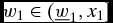 $w_{1}\in (\underline{w}_{1},x_{1}]$
and
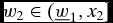 $ w_{2}\in (\underline{w}_{1},x_{2}]$
fight a war of attrition with cost ratio ρ0 and cost k
0 lasting until time T − λ(x
1, x
2). An interval of pure fighting then ensues lasting from T − λ to T. M joins 1 with probability α1 at T. Types
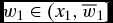 $w_{1}\in (x_{1}, \overline{w}_{1}]$
and
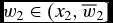 $w_{2}\in (x_{2},\overline{w}_{2}]$
then fight a war of attrition with cost ratio ρ1 and total cost k
1 for the rest of the game. M supports 2 with probability 1 − α1, and
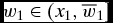 $w_{1}\in (x_{1},\overline{w}_{1}]$
and
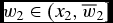 $w_{2}\in (x_{2},\overline{w}_{2}]$
then fight a war of attrition with cost ratio ρ2 and total cost k
2.
Proposition 1 At least one (x 1, x 2) satisfies both M's incentive constraint and the timing constraint, and a unique PBE corresponds to each (x 1, x 2) satisfying these constraints. The equilibrium strategies are given by
 $$\begin{eqnarray*}
&&\sigma _{j|n}^{\ast }(w_{j})\\
&&\quad=\!\left\lbrace\!\!\! \arraycolsep5pt\begin{array}{lll}\sigma _{j}^{\ast}(w_{j},\underline{w}_{1},\underline{w}_{2},\rho _{0},k_{0},x_{1},x_{2}) & \text{if} & w_{j}\in (\underline{w}_{j},x_{j}]\!\! \\
T+\sigma _{j}^{\ast}(w_{j},x_{1},x_{2},\rho _{n},k_{n},\overline{w}_{1},\overline{w} _{2}) & \text{if} & w_{j}\in (x_{j},\overline{w}_{j}]\!\! \end{array}, \right. \\
&&\alpha _{1}(x_{1},x_{2},\rho _{0}) \\
&&\quad=\frac{\rho _{0}x_{2}(1-e^{x_{1}- \overline{w}_{1}(x_{2}/\overline{w}_{2})^{1/\rho _{2}}})}{\rho _{0}x_{2}(1-e^{x_{1}-\overline{w}_{1}(x_{2}/\overline{w}_{2})^{1/\rho _{2}}})+x_{1}(1-e^{x_{2}-\overline{w}_{2}(x_{1}/\overline{w}_{1})^{\rho _{1}}})}
\end{eqnarray*}$$
for j, n = 1, 2 where the stop times
 $\sigma _{j}^{\ast}(w_{j},\underline{w}_{1}, \underline{w}_{2},\rho _{0},k_{0},x_{1},x_{2})$
are given by Equation (A3). Beliefs follow directly from Bayes’ law.
Proof of Proposition 1: It is straightforward to verify that the assessment stated in the proposition is a PBE save for one technicality, namely to show that zj
's strict best response is to stop at T − λ . Suppose (z
1, z
2) is in the interior of F
12 and the interval of pure fighting is λ. The equilibrium of the two-actor war of attrition implies that z
1 prefers stopping at at T − λ to quitting at any earlier time during the first phase. By construction, z
1 is indifferent between stopping at T − λ and T if the probability of winning at T is
 $\alpha _{1}[1-e^{z_{2}-\overline{w}_{2}(z_{1}/ \overline{w}_{1})\rho _{1}}]$
. But z
1 will be stopping at the same time as the atom of types of 2 that quit at T, so z
1's probability of winning is actually
 $\alpha _{1}[1-e^{z_{2}-\overline{w}_{2}(z_{1}/\overline{ w}_{1})\rho _{1}}]/2$
. As a result, z
1 strictly prefers stopping at T − λ to stopping at T. Finally, the equilibrium strategies of the war of attrition in phase three imply that z
1's payoff is decreasing at all t > T since it would be the lowest-payoff type fighting until T. Moreover the limit of z
1's payoff to stopping at t > T as t decreases to T is
 $z_{1}\alpha _{1}[1-e^{z_{2}-\overline{w}_{2}(z_{1}/\overline{w} _{1})\rho _{1}}]-\lambda c_{1}$
which is z
1's payoff to stopping at T − λ. It follows that z
1's strict best response is to stop at T − λ.
As for beliefs, note that even if M plays a pure strategy, say α1 = 1, then j's beliefs about i following the out-of-equilibrium action of M's supporting 2 must be the same as j's beliefs about i following M's support of 1 (see Fudenberg and Tirole (Reference Fudenberg and Tirole1991, 332), though they limit their discussion to games with finitely many types). Thus Bayes’ rule pins down the factions’ beliefs on and off the equilibrium path.
Uniqueness follows from the fact that the continuation games following M's decision are wars of attrition that have a unique equilibrium. Similarly,
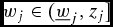 $ w_{j}\in (\underline{w}_{j},z_{j}]$
are effectively playing a war of attrition that has a unique equilibrium.
 $\hfill\square$




Comments
No Comments have been published for this article.