

Introduction
For scholars wishing to understand immigrant minorities’ political behavior, perceived discrimination (PD) appears key (Deaux Reference Deaux2006; Huo, Binning, and Molina Reference Huo, Binning and Molina2010). Mounting evidence indicates that PD is associated with outcomes that include group consciousness (Masuoka Reference Masuoka2006; Sanchez Reference Sanchez2008; Schildkraut Reference Schildkraut2005, Reference Schildkraut2011), empathy (Sirin, Villalobos, and Valentino Reference Sirin, Villalobos and Valentino2016), and political participation (Barreto Reference Barreto2010; Pantoja, Ramirez, and Segura Reference Pantoja, Ramirez and Segura2001; Wong et al. Reference Wong, Ramakrishnan, Lee and Junn2011). Prior research also suggests that PD is robustly associated with immigrant minorities’ partisan identities (PID) (Hajnal and Lee Reference Hajnal and Lee2011; Kuo, Malhotra, and Mo Reference Kuo, Malhotra and Mo2017), which are central predictors of political attitudes and behaviors (Campbell et al. Reference Campbell, Converse, Miller and Stokes1960). As Hajnal and Lee (Reference Hajnal and Lee2011, p. 176) observe, “Latinos who perceive a lot of discrimination are more than twice as likely to identify as Democrats than those who perceive little discrimination (47% vs. 22%).” For Asian Americans, the respective figures are 47% and 31% (Hajnal and Lee Reference Hajnal and Lee2011, p. 177). PD is thus one potential explanation for why both groups have increasingly affiliated with and voted for Democrats in recent years.
If established, a causal link between PD and PID would help to clarify the nature of partisanship among immigrant minorities. Loosely speaking, there are two broad models of ethnic group political incorporation. In one, exemplified by Irish or Italian immigrants, ethnicity gradually wanes as a marker of political attitudes and behavior (Dahl Reference Dahl1961). In the second, often associated with African Americans, continued discrimination generates and reinforces a distinctive political identity that persists for generations (Dawson Reference Dawson1994). If PD directly causes Latinos and Asian Americans to lean Democratic, it would challenge classical conceptions of immigrant political incorporation and partisanship. It would also have important implications for the balance of support for America’s two parties.
Prior research strongly suggests that heightened PD can cause increased affiliation with the Democrats. First, minorities – including those with immigrant origins – construe their environments differently than their majority peers, with this gap arising from the discriminatory interactions that minorities experience with mainstream society (Chong and Kim Reference Chong and Kim2006; Dawson Reference Dawson1994). These perceptions of discrimination are highly mentally accessible, suggesting they can affect how immigrants and their kin judge politics (Masuoka and Junn Reference Masuoka and Junn2013). For example, when PD is heightened, it may cause immigrants and their co-ethnics to develop a stronger attachment to the political party deemed friendlier toward them. Indeed, Kuo, Malhotra, and Mo (Reference Kuo, Malhotra and Mo2017) show experimentally that raising doubts about Asian Americans’ citizenship causes them to shift to the Democrats.
Second, established theorizing suggests that pre-adult experiences can be a key source of political socialization (Sears and Valentino Reference Sears and Valentino1997), in part because the partisanship of US-born parents is likely to structure the political identities of their children. Yet many Latinos and Asian Americans are socialized to a degree outside the USA (Abrajano and Alvarez Reference Abrajano and Alvarez2010; Wong et al. Reference Wong, Ramakrishnan, Lee and Junn2011), making parental socialization a weaker explanation for their partisanship. Accordingly, scholars of immigrant political incorporation instead stress the role of contextual forces in molding immigrants’ PID (Alvarez and Garcia Bedolla Reference Alvarez and Bedolla2003). PD is one such contextual factor, as it often shapes immigrants’ interactions with a host society. Third, anti-immigrant climates have been followed by shifts in Democratic identification among immigrants and their co-ethnics (Dyck, Johnson, and Wasson Reference Dyck, Johnson and Wasson2012; but see Hui and Sears Reference Hui and Sears2018). For example, Pantoja, Ramirez, and Segura (Reference Pantoja, Ramirez and Segura2001) observe that Latinos in California increasingly identified as Democrats in the wake of 1990s ballot measures like Proposition 187, which sought to exclude undocumented immigrants from government services. Jointly, these empirical observations are consistent with models in which PD is causally prior to political variables like partisan identity.
In short, extensive prior research bolsters the hypothesis that PD causes PID among Latinos and Asian Americans, as a heightened sense of discrimination is strongly associated with greater affiliation with the Democratic Party. Yet causal evidence is in short supply. In almost all prior research, PD is not manipulated, which means a PD-PID connection may arise for reasons other than a direct causal relationship (but see Kuo, Malhotra, and Mo Reference Kuo, Malhotra and Mo2017). Thus, additional experimental evidence from varied immigrant minorities, research settings, and operationalizations of PD is critical to isolate any causal effects. Such evidence would also clarify the extent to which elites’ efforts to mobilize Latinos and Asian Americans on the basis of PD are likely to be effective.
Armed with these theoretical expectations, we ran five experiments assessing PD’s impact on PID among Latinos and Asian Americans. Our studies vary in several respects. They took place inside and outside the lab. They occurred prior to and after Donald Trump’s emergence as a national political figure. They manipulated PD via news reports that differed in how explicitly they linked discrimination to politics. The total number of subjects across the experiments was 2,528. Manipulation checks demonstrate that the treatments were always perceived as discriminatory and that they effectively manipulated group-targeted PD in the national sample and some of the lab-based studies. In fact, in our experiments with national samples, the treatments shift both Asian American and Latino respondents’ perceptions of group-targeted discrimination by approximately 20% of the outcome’s standard deviation.Footnote 1
Our treatments focus on group-level PD, making them distinctive from prior work (Kuo, Malhotra, and Mo Reference Kuo, Malhotra and Mo2017). We see good reason to manipulate group-level PD, as researchers commonly find that Latinos and Asian Americans are more likely to perceive discrimination against their groups than against themselves as individuals (Barreto Reference Barreto2010; see also Oskooii Reference Oskooii2016), a finding our national sample results corroborate. In fact, in the national survey reported later, group-targeted discrimination is more strongly correlated with political partisanship than is personally targeted discrimination for both Asian Americans (−0.24 vs. −0.16) and Latinos (−0.25 vs. −0.21). We also expected group-targeted PD to be directly connected to PID, since it may activate cognitive schema about groups that are already integrated with political attitudes (Winter Reference Winter2008). Finally, our studies also gauged partisan attitudes in diverse ways. Yet from many experiments, one empirical result emerges: our manipulations of group-level PD fail to influence partisan identity or more malleable, party-related attitudes.
Experiments with student subjects
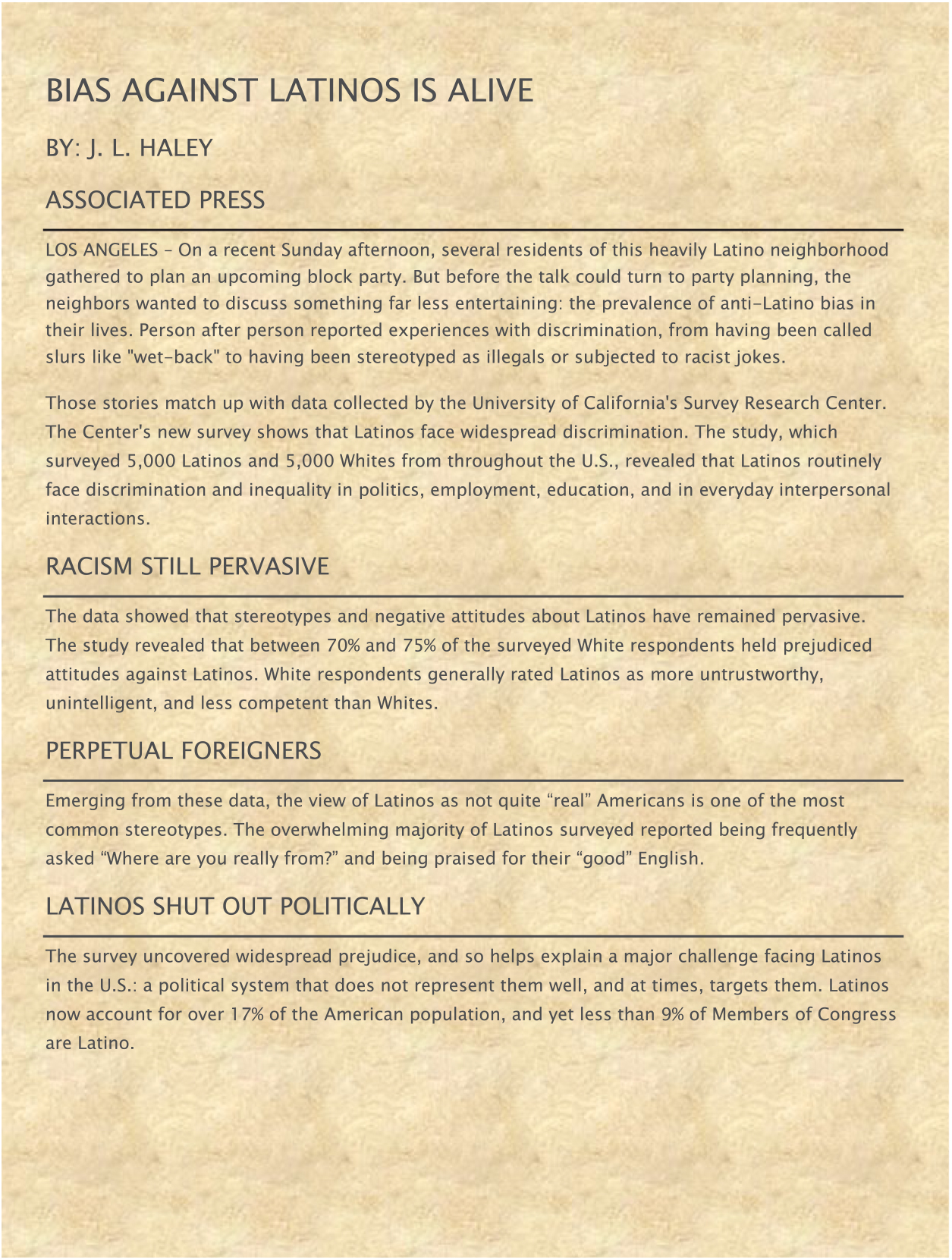
To test the connection between perceiving discrimination against one’s pan-ethnic group and partisan attitudes, we conducted three experiments with Asian American undergraduates at the University of Washington and one experiment with Latino undergraduates at the University of Texas, El Paso.Footnote 2 The experiments were conducted sequentially, to allow for modifications in the experimental protocols. In developing the treatments, we initially sought to prime PD without directly mentioning partisanship or politics. Accordingly, respondents assigned to treatment read a two-page newspaper article titled “Bias Against Asians Is Alive” (Experiments 1 and 2) or “Bias Against Latinos Is Alive” (Experiment 4), with the headline and other content always matching the respondent’s pan-ethnic group. The respective articles described the frequent use of slurs, experiences with various forms of discrimination (e.g. employment), and findings from a national survey reporting high levels of discrimination against the participant’s pan-ethnic group. While Experiment 1 avoided any discussion of discrimination in politics, Experiments 2 and 4 also included a paragraph about how Asian Americans or Latinos are “shut out politically,” although this paragraph included no party-specific content. The control article was always of similar length but described a tortoise nicknamed “Lonesome George” (Kaiser et al. Reference Kaiser, Major and McCoy2004; Major et al. Reference Major, Kaiser, O’Brien and McCoy2007). Appendix A provides the text and images of the treatments, which were formatted to look like newspaper articles. In all four experiments, respondents were also asked to “[p]lease summarize what you just read and describe how it made you feel in two sentences or so” to deepen their engagement with the article and encourage them to process it more fully. This prompt should serve to strengthen the impact of the manipulations.
Experiment 3 tests the influence of a more explicitly political prime. Specifically, it presented respondents with one of two statements made by “a prominent member of Congress.” While the control message was anti-crime, the experimental treatment provided a four-sentence anti-immigration statement. The anti-immigration statement did not single out any specific ethnic groups or provide any party cues.
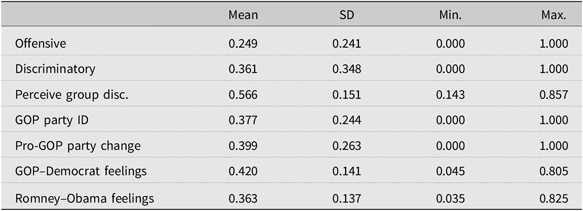
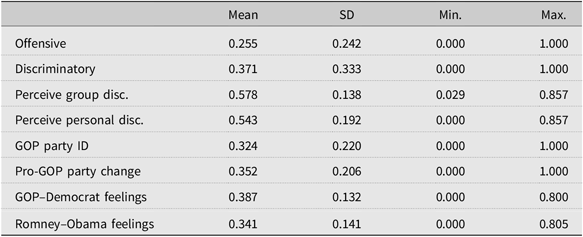
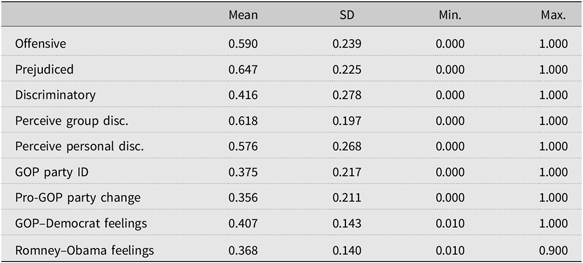
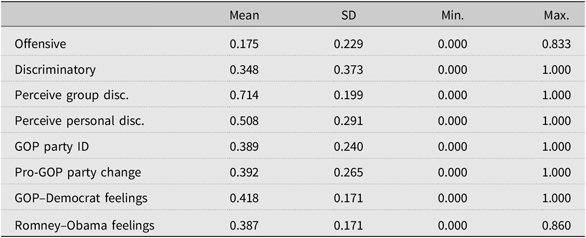
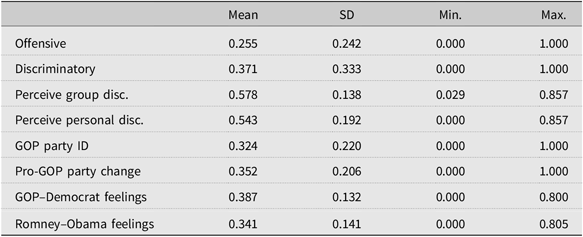
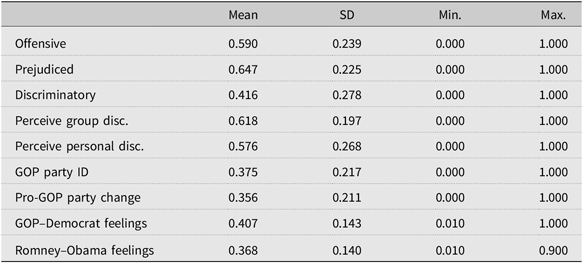
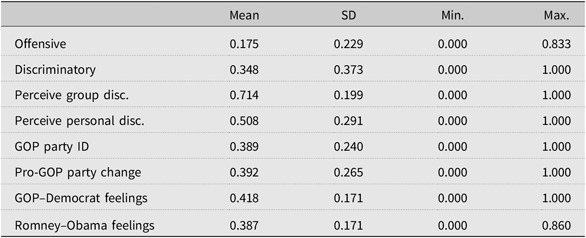
Experiment 1 took place between October and December 2014, while Experiment 4 was administered between July and October 2015.Footnote 3 We removed respondents who were foreign nationals who had come to the USA only upon enrolling in college, leaving us with sample sizes of 181, 247, and 350 Asian American respondents in Experiments 1–3 and 209 Latino respondents in Experiment 4. After reading the assigned text, respondents were asked to report their partisan identity and attitudes toward the political parties using multiple items including: a traditional seven-category measure of partisan identity (“Party ID”); a self-assessment as to whether the respondent has shifted toward the Republicans or Democrats (“Party Change”); and feeling thermometer assessments of the Republicans and Democrats (“GOP–Democrat Feelings”) as well as their 2012 standard-bearers, Governor Mitt Romney and President Barack Obama (“Romney–Obama Feelings”). While partisan identity itself is typically quite stable, these other party-related attitudes are likely to be more responsive to contextual shifts. Appendix B provides the wording for all relevant questions, while Tables C.1–C.4 in Appendix C summarize the outcome measures.Footnote 4 Despite being drawn from college students, it is important to note that our samples are not exclusively strong Democrats. Indeed, all four samples show meaningful variation on all outcome measures, limiting the prospect of ceiling effects on the outcomes.
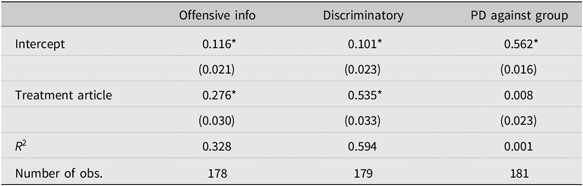
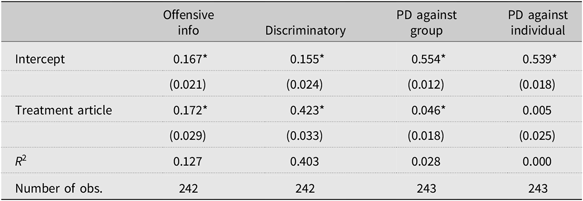
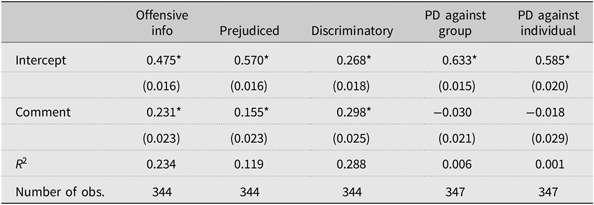
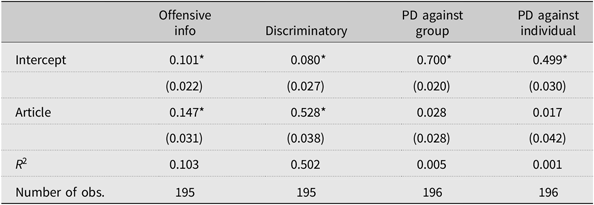
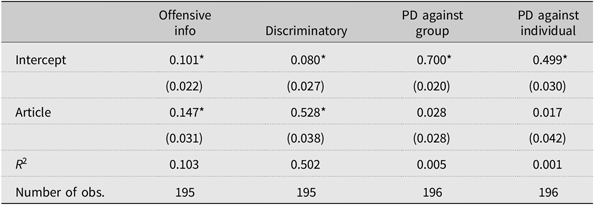
As compared to some specific experiences with discrimination, our manipulations were relatively subtle, with three of the four being delivered through an article about unfamiliar co-ethnic individuals and the fourth through a comment by an unnamed politician. As a result, it is important to assess their effectiveness: did our manipulations actually induce a sense of discrimination among our Asian American and Latino subjects? We embedded manipulation checks near the end of each experiment’s questionnaire; we summarize those variables in Tables C.1–C.4 in Appendix C and report the results in Appendix D. In all four cases, the treatments were more likely to be rated as offensive and discriminatory toward the target pan-ethnic group relative to the controls, always at substantively and statistically significant levels. The treatments also sometimes (but not always) heighten overall perceptions of discrimination against the respondent’s pan-ethnic group. However, they do not shift perceptions of discrimination targeted at the respondent individually. As detailed in footnote 2 above, Asian American and Latino undergraduates are already more likely to perceive higher levels of group-targeted PD than older, less-educated co-ethnics, so it is possible that these manipulation checks are limited to some extent by ceiling effects.
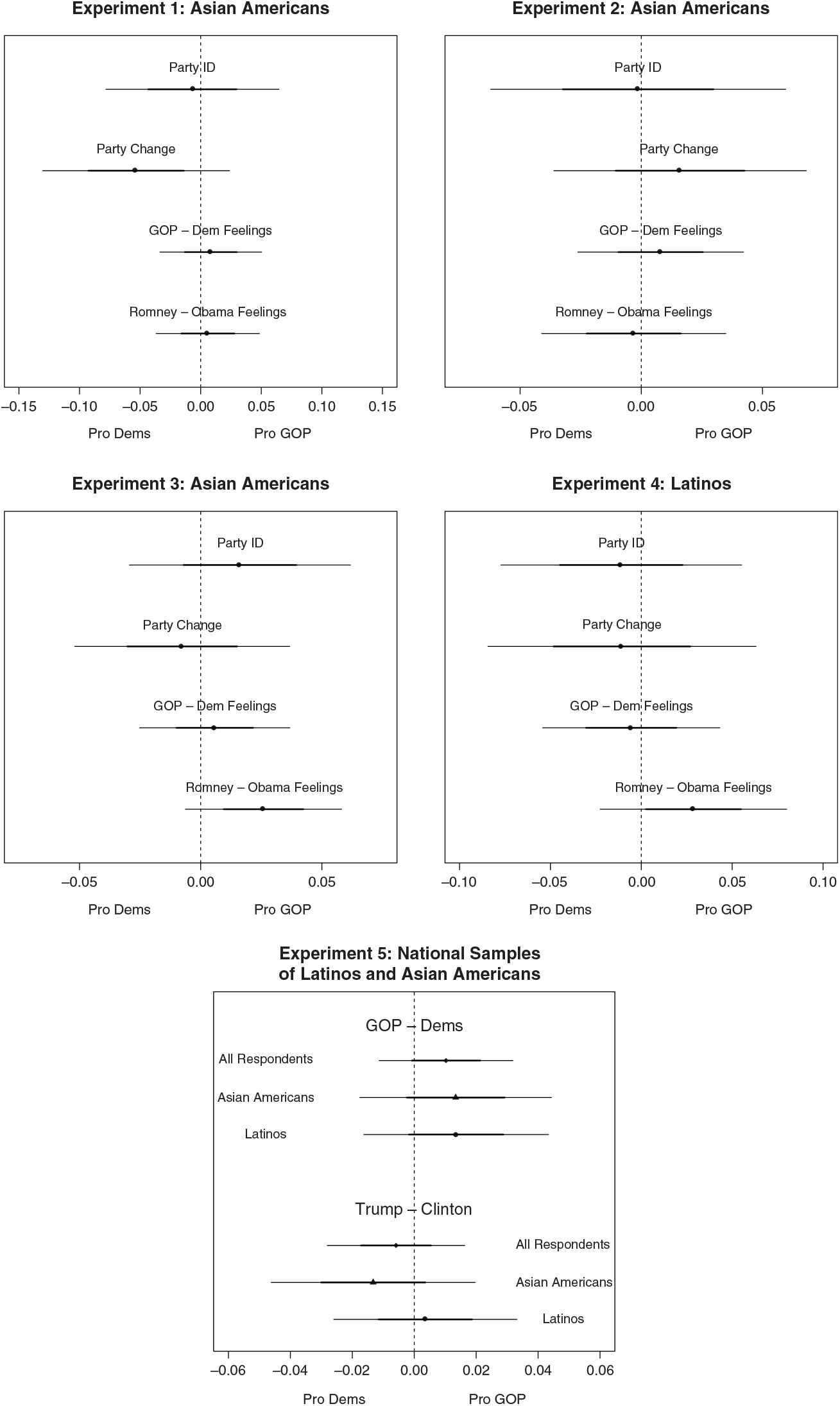
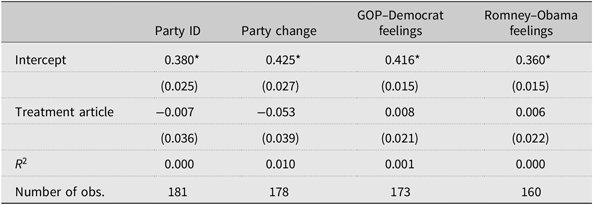
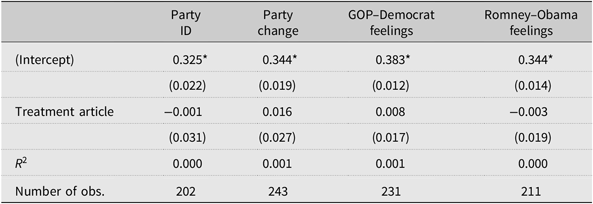
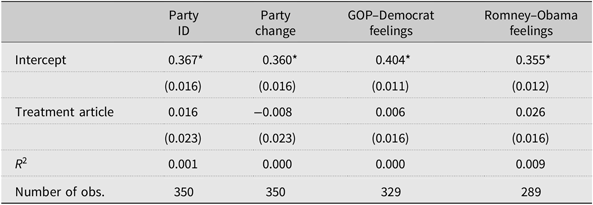
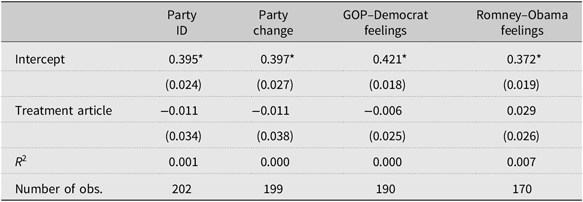
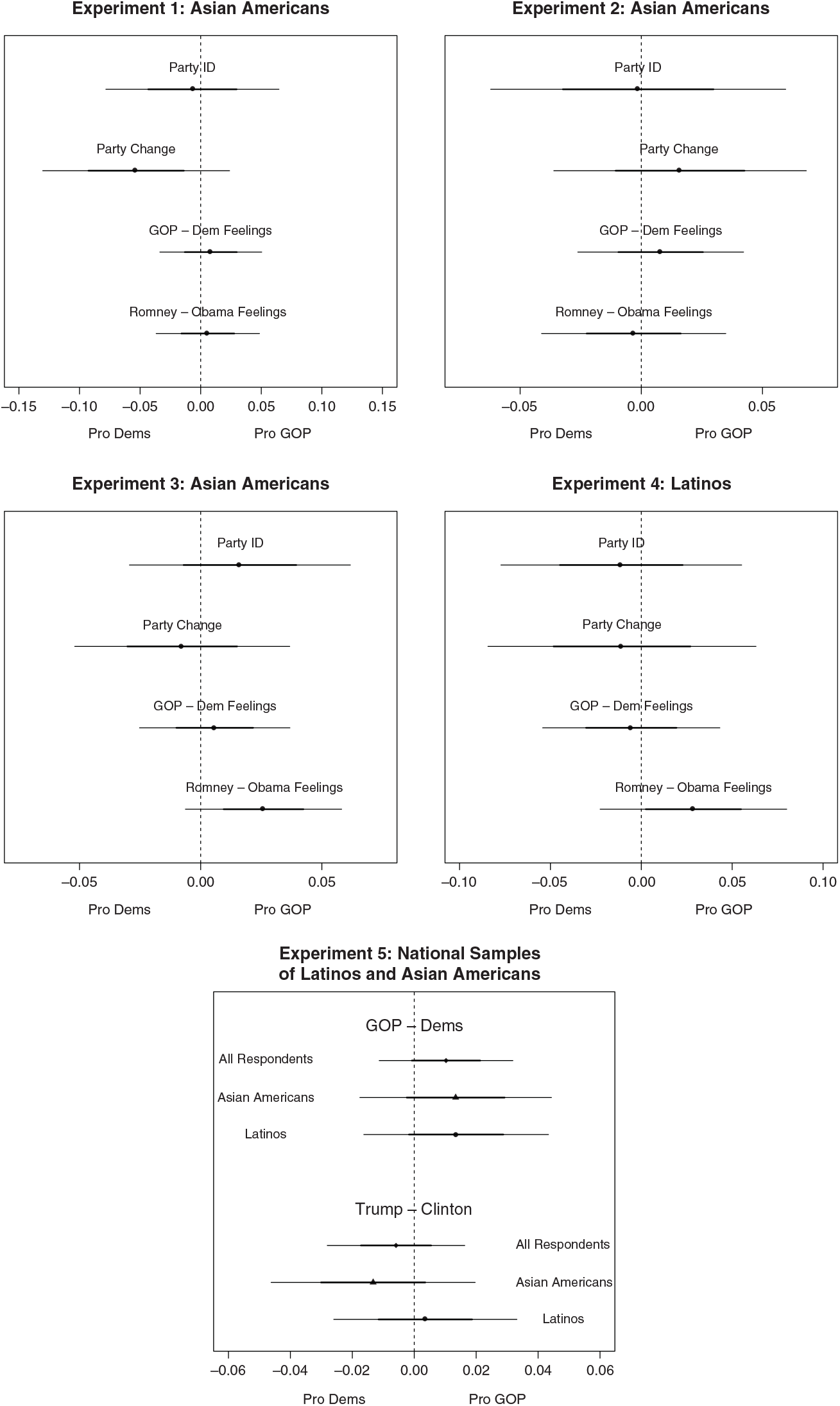
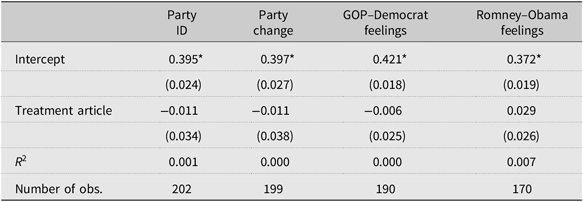
To analyze the experiments’ impacts on partisanship and related attitudes, we fit OLS models of the outcomes of interest for each of the four experiments and illustrate the resulting coefficients and 95% confidence intervals in Figure 1; Appendix E reports the corresponding regression results. As the figure shows, there is no substantively or statistically meaningful effect in any of the four experiments. Being primed to think about discrimination against one’s pan-ethnic group does not have a consistent effect on any of our outcomes.
For each experiment, these figures depict the impact of the treatment text priming group-targeted PD on various party-related outcomes.
Effect sizes and precision
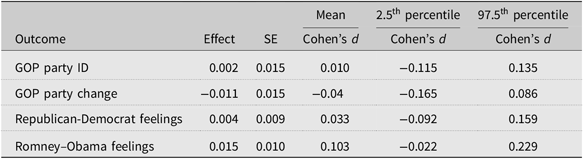
Our lab-based experiments range in size from 181 to 350, so it is valuable to assess how much statistical precision they afford us jointly. In particular, it is instructive to pool our studies to evaluate whether a substantively and statistically meaningful effect emerges across them. To do so, we employed two different tests. First, we aggregated the four lab-based experiments into a single data set and then analyzed the data set with a multilevel model with experiment random effects. Second, we performed a meta-analysis of our four lab-based experiments using the approach outlined in Goh, Hall, and Rosenthal (Reference Goh, Hall and Rosenthal2016). Specifically, we calculated the weighted average of Cohen’s d, which rescales the estimated treatment effect by the outcome’s standard deviation, and report the results alongside the associated 95% confidence intervals in Table 1.Footnote 5 The overall results are quite similar across the two tests and indicate that our null findings are not a function of imprecision. Indeed, these pooled analyses suggest that even the upper bounds on the effect of PD on PID are substantively quite modest.
The Estimated Effects and Standard Errors When the Four Lab Experiments Were Analyzed Jointly Using a Linear Multilevel Model
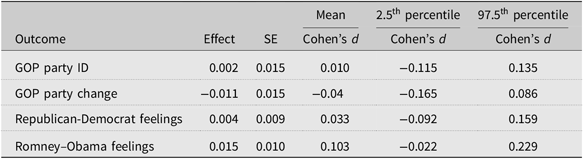
This table presents the mean between-subject Cohen’s d and the associated 95% confidence interval using the meta-analytic approach in Goh et al. (Reference Goh, Hall and Rosenthal2016).
As an example, consider as an outcome the seven-category measure of party identification, with strong Republicans coded as 7. For the multilevel model, we estimate an overall effect of the discrimination-priming treatments of 0.002 (SE = 0.015), meaning that the treatments jointly have an impact that is nearly zero but which leans very slightly pro-Republican. Given the standard error of 0.015, the associated 95% confidence interval spans from an effect of −0.027 in the Democratic direction to 0.031 in the Republican direction. The outcome’s standard deviation is 0.229, meaning that the effect’s 95% confidence interval spans from just 12% of a standard deviation in the Democratic direction to just 14% of a standard deviation in the Republican direction. The results from the meta-analysis are highly similar, as illustrated in Table 1’s first row.Footnote 6
The next outcome of interest is respondents’ self-reported change in their partisan leanings. There, the multilevel model estimates an effect of −0.011 with a standard error of 0.015.Footnote 7 Our experiments also examine the difference between the Republican and Democratic feeling thermometers. For the multilevel model, we estimate an overall effect of the discrimination-priming treatments of 0.004 (SE = 0.009).Footnote 8 Finally, when the outcome is instead the difference in feeling thermometers between Mitt Romney and Barack Obama, the treatment effect is estimated to be 0.015 (SE = 0.010).Footnote 9 In all three cases, even the upper bounds of the 95% confidence intervals reflect substantively small effect sizes.
To be sure, political partisanship is a social identity that is likely to be durable, meaning that it would be surprising if we did find that it responded to a single article or statement (Green, Palmquist, and Schickler Reference Green, Palmquist and Schickler2002; Mason Reference Mason2018). However, overall affect toward the parties – and especially toward their political candidates – is more malleable, so the null findings there are more striking. What’s more, our samples were of college students, a young population whose partisan attitudes may be less crystallized (Sears Reference Sears1986). It is likewise noteworthy that we find no effects of priming perceptions of group-targeted discrimination in either our Latino or Asian American samples, meaning that this result is not specific to one pan-ethnic group.
Experiment with national samples
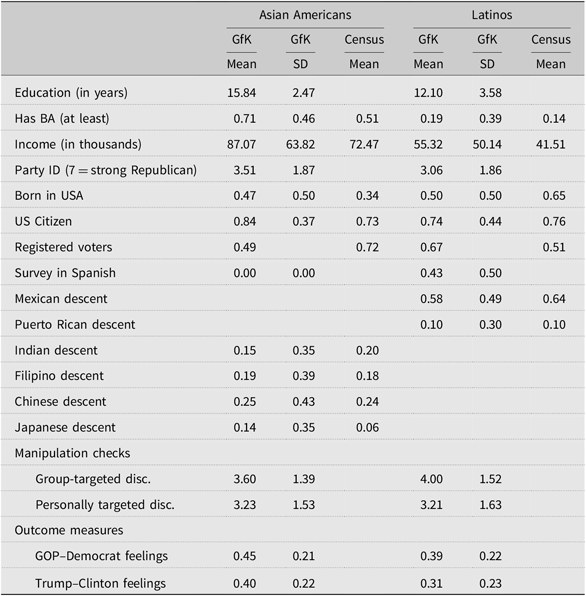
What is the effect of priming perceptions of discrimination against one’s group among Asian American and Latino adults beyond college campuses? Given the limitations of student subjects, and given the particular possibility that pre-treatment effects may have made PD chronically accessible in that population (Druckman and Leeper Reference Druckman and Leeper2012), we repeated our experiment with population-based samples of Asian American and Latino adults via GfK’s Knowledge Panel. This panel employs probabilistic procedures such as random-digit dialing and address-based sampling to build a sample of English and Spanish speakers for online surveys. Respondents were sampled based on their prior responses to questions about their ethnic/racial self-identification as well as questions about Latinos’ preferred language. The survey was fielded between March 23, 2016, and April 11, 2016. In all, the final sample includes 820 Latinos, 352 of whom (43%) took the survey in Spanish. It separately includes 721 Asian American respondents, all of whom took the survey in English. Table C.5 in Appendix C provides descriptive statistics and benchmarks from the 2011–2014 American Community Survey, where available.
In designing the national experiment, we draw on our lab-based experiments to manipulate PD via highly similar articles. For Spanish-language respondents, we translated all materials into Spanish as directly as possible. Our analyses proceeded according to the pre-analysis plan filed with Evidence in Governance and Politics on April 16, 2016.Footnote 10
National experiments: Manipulation checks
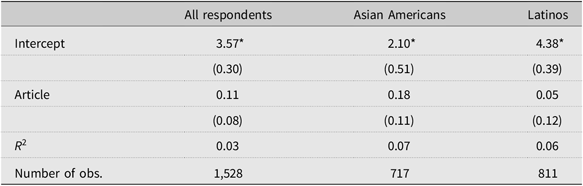
In the lab-based experiments detailed earlier, the manipulations were consistently perceived as being offensive and containing discriminatory content. We conducted similar manipulation checks with the GfK respondents, as detailed in Table 2 as well as in Appendix D. To do so, we assessed the treatment article’s impact on responses to two post-treatment questions about perceptions of PD. To measure group-targeted discrimination, respondents were asked much later in the questionnaire whether they agree or disagree that “my racial/ethnic group is discriminated against.”Footnote 11
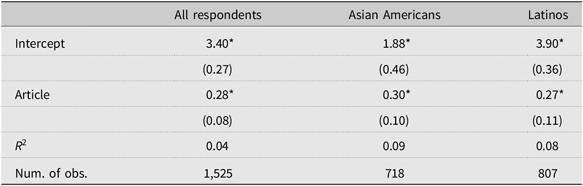
Manipulation Checks, National Samples, Group-Targeted PD
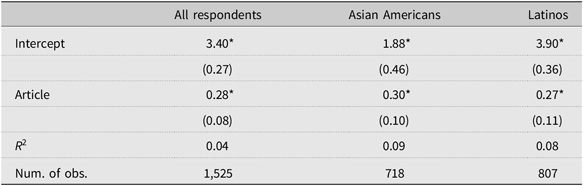
This table presents manipulation checks for the GfK experiments conducted with national samples. The outcome is a scale measuring perceptions of group-level discrimination varying from 1 to 6. These estimates were derived from OLS models with independent variables including respondents’ education, age, gender, national origin group, income, citizenship status, and birthplace in the USA.
* p<0.05.
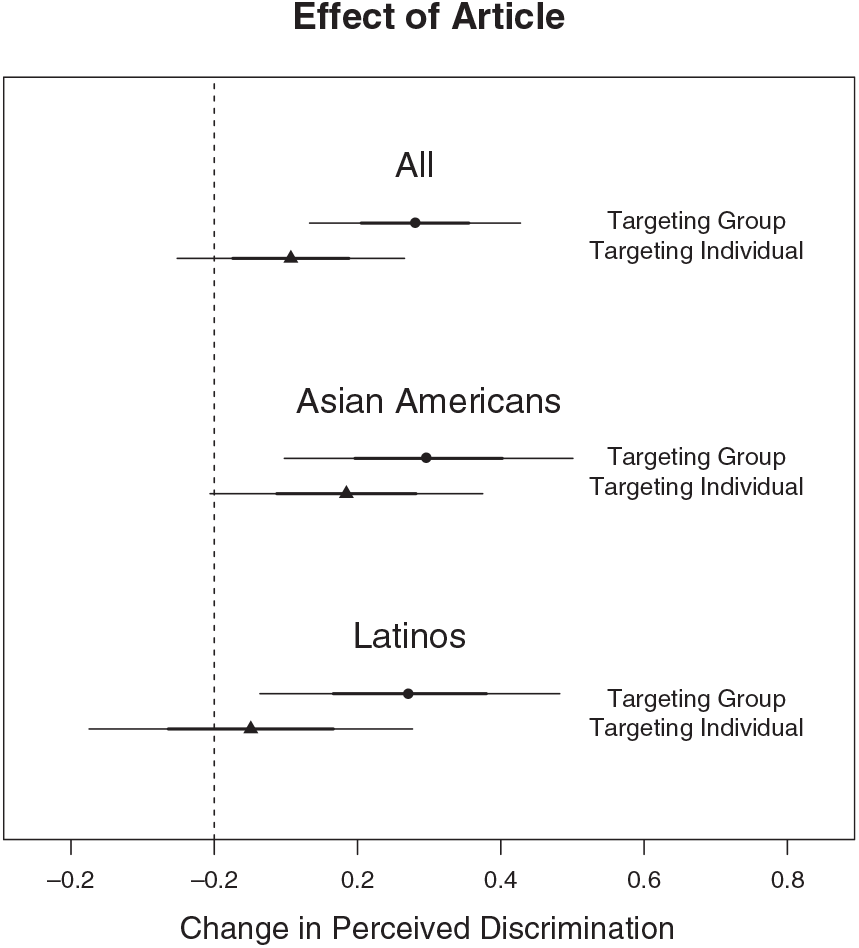
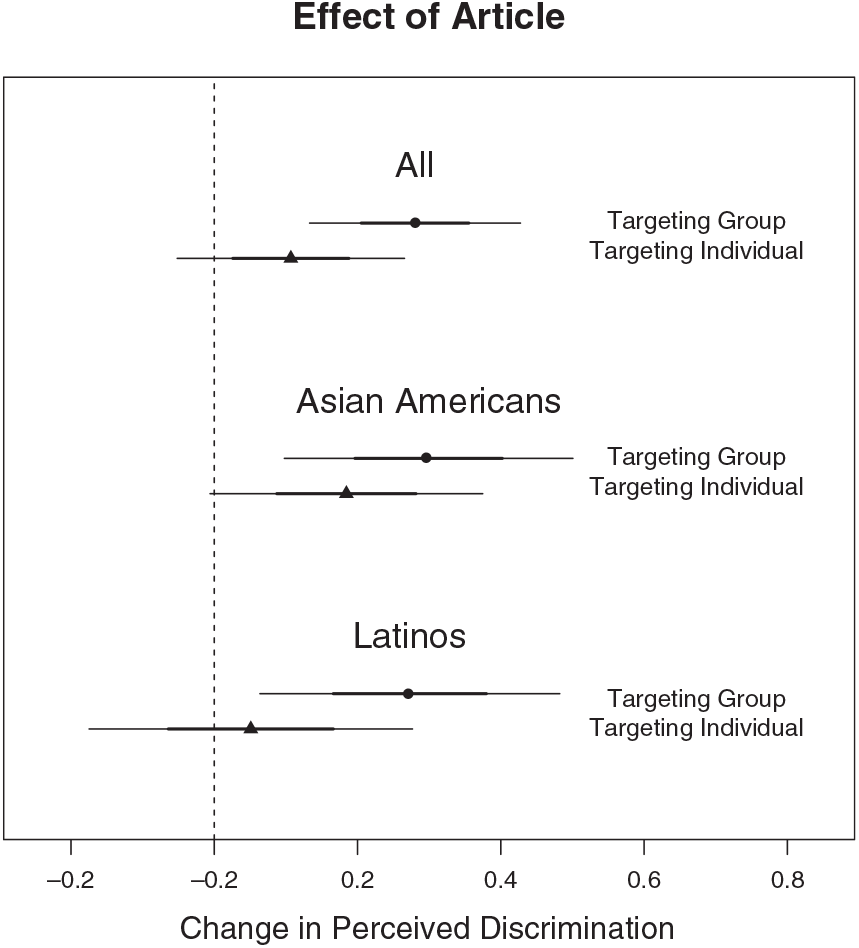
For Asian Americans, Latinos, and the sample overall, reading the article led to a pronounced increase in perceptions of group-targeted discrimination. For Asian Americans, the increase was 0.30 (SE = 0.10), which constitutes 21% of the scale’s standard deviation; for Latinos, the comparable figure was 0.27 (SE = 0.11; 19%). In short, the manipulation was effective in raising respondents’ levels of PD targeted toward their group. The treatment was also narrow in its impact: as Table D.5 and Figure D.1 in Appendix D illustrate, the article did not heighten perceptions of personally targeted discrimination to a statistically or substantively significant degree for Latinos (0.05, SE = 0.12). The effect for Asian Americans was discernible but relatively small (0.18, SE = 0.11).
National experiments: Results
What were the manipulations’ impacts on political attitudes among the national samples? To answer that question, we evaluated the impact of reading the article on feeling thermometers assessing affect toward the two major political parties and their 2016 presidential frontrunners. Immediately after reading the assigned article, all respondents were then asked to assess a variety of figures and groups on a 0–100 feeling thermometer. If heightened PD has a causal impact on assessments of the parties, we might well expect that effect to be evident in changed feeling thermometer ratings.
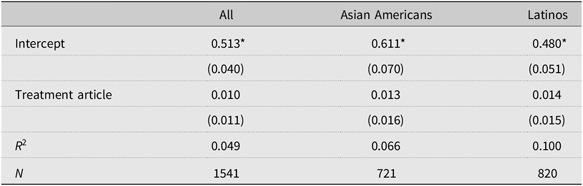
As one outcome, we again considered the difference between the score given to the Democratic Party and that given to the Republican Party. As in the lab-based studies, we rescaled this outcome to vary between 0 and 1; here it has a standard deviation of 0.21. As the top cluster of results in the bottom panel of Figure 1 illustrates, there is no significant effect for Asian Americans (0.013, SE = 0.016) or Latinos (0.014, SE = 0.015); in fact, the point estimates are in the pro-GOP direction. Still, the outcome’s standard deviations – 0.21 and 0.22 for Asian Americans and Latinos, respectively – mean that the 95% confidence intervals exclude any effects larger than 14% of the outcome’s standard deviation for both Asian Americans and Latinos.
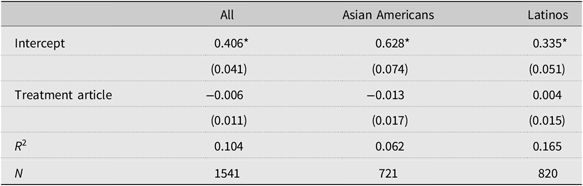
Similarly, the middle cluster of Figure 1 shows no effects on attitudes toward the two parties’ front-running presidential candidates. There, the corresponding estimates are −0.013 (SE = 0.017) for Asian Americans and 0.004 (SE = 0.015) for Latinos.Footnote 12 The article does not shift attitudes toward the parties. Nor does it shift attitudes toward their standard-bearers. In short, the treatments that were unable to shift party-related attitudes among undergraduates are similarly unable to do so among national samples of Asian Americans or Latinos.
Discussion and conclusion
Our experiments indicate that written manipulations heightening the salience of group-targeted discrimination do not shape political partisanship or several related measures of attitudes toward the political parties and their presidential nominees. This finding holds for Asian Americans as well as for Latinos, and for undergraduate samples as well as nationally representative samples. While the sample sizes for specific lab studies vary from 181 to 350 respondents, the experiments jointly are well powered to rule out even moderately sized effects. And although already high levels of group-targeted PD among undergraduates may have limited the impact of the manipulations in select lab-based studies, they cannot explain the overall pattern. Even using a well-powered experiment conducted with a large, nationally representative sample with considerable variation in its partisanship, we find little impact of priming group-level PD.
This collection of results is valuable for multiple reasons. Theoretically, our findings raise fundamental questions about which identity drives the oft-observed association between PD and PID. An implicit assumption in explanations emphasizing PD’s causal role is that it shapes PID because it leads Latinos and Asian Americans to think of themselves as racial/ethnic minorities, a perspective aligning with the work of Dawson (Reference Dawson1994) and others on the crucial impact of group consciousness on minority political behavior (Masuoka Reference Masuoka2006; Sanchez Reference Sanchez2008). However, our inability to shift PID through PD suggests that there may be other pathways connecting pan-ethnic identities with partisanship. Our results also indicate that partisan identities might be sufficiently developed and stable so as to drive PD instead (see also Margolis Reference Margolis2018), a prospect that merits future research. Indeed, if parties cognitively encapsulate other social groups – e.g., class, religion, ethnicity, and race (Green, Palmquist, and Schickler Reference Green, Palmquist and Schickler2002) – then a salient partisan identity could shape one’s construal of information related to these nested groups, including PD.
Given that prior research has found robust associations between partisanship and PD, it is important to discuss these results in the context of prior work. Although most studies finding a PD-PID link employ observational designs, one pioneering study – Kuo, Malhotra, and Mo (Reference Kuo, Malhotra and Mo2017) – shows that heightening PD via an interpersonal encounter can influence party-related attitudes among Asian American college students. Of the various experiments reported here, three of ours likewise sampled Asian American college students, making it valuable to consider the studies’ similarities and differences in detail. With respect to the former, both our experiments and Kuo et al.’s study manipulate aspects of PD. Moreover, both studies assess PD’s impact on partisanship and various party-related attitudes, making the findings less prone to the charge that they are sensitive to the specific outcome measures employed.
The clearest difference between the studies concerns the treatments. Kuo et al. (Reference Kuo, Malhotra and Mo2017) manipulate discrimination toward Asian American individuals, and they do so using a personally targeted intervention. By contrast, the five studies here manipulate discrimination toward Asian Americans and Latinos as groups, and they do so via articles that do not involve direct discrimination against the subject but instead relay others’ reports of discrimination. Focusing on group-level discrimination makes our treatments more impersonal, potentially reducing their immediacy and personal relevance – though also potentially increasing their integration with political attitudes and their relevance in political debates. Furthermore, our treatments’ online transmission, rather than in-person delivery, might make them less affectively charged or psychologically engaging. It’s also important to note that both Asian Americans and Latinos report higher levels of group-targeted PD than personally targeted PD (see Table C.5 in Appendix C as well as Barreto Reference Barreto2010). As a consequence, group-targeted PD may be more chronically accessible and so more difficult to manipulate. In short, there are several plausible explanations for the differences between the results here and those in prior work.
Still, in listing these differences, it becomes clear that the PD-PID link likely depends on particular conditions that are not yet fully grasped. A constructive path forward, then, is to undertake research clarifying the specific types of PD that can influence party-related attitudes and the conditions under which such relationships do or do not appear. Both the personally targeted discrimination studied by Kuo, Malhotra, and Mo (Reference Kuo, Malhotra and Mo2017) and the group-targeted discrimination studied here are abundant in politics, so future research would do well to consider each, operationalized in various ways. Given the prospect that group-targeted PD may be chronically accessible in today’s political environment, it seems especially important to consider dynamic studies with realistic treatments administered over time. Nonetheless, we have presented five well-powered studies varying by setting, participants, outcomes, and treatment operationalization. Our null results suggest that scholars would also do well to consider the reverse pathway – the prospect that partisanship may instead shape group-level perceptions of discrimination. These two pathways may also vary with political socialization, such that PD initially reinforces Democratic partisanship, but Democratic partisanship then comes to heighten subsequent PD.
Author ORCIDs
Daniel J. Hopkins 0000-0002-9085-6050
Appendix A: Manipulations
A1: Treatment Article Text, Experiment 2
Bias against asians is alive by: J. L. Haley Associated Press
Los Angeles – At a recent meeting, the leaders of the Asian Students Association at UCLA gathered to plan the group’s annual film festival. But before the talk could turn to movies, its members wanted to discuss something far less entertaining: the prevalence of anti-Asian bias in students’ lives. Student after student reported experiences with discrimination, from having been called slurs like “chink” to having been stereotyped as nerds, subjected to racist jokes, or ignored by classmates. The discrimination came from friends as well as strangers.
Those stories match up with recent data collected by the University of California’s Survey Research Center. The Center’s new survey shows that Asians and Asian Americans face widespread discrimination in many areas of life. The study, which surveyed 5,000 current ethnic minority and White undergraduates and 5,000 alumni who graduated between 2008 and 2013, revealed that Asians routinely face discrimination and inequality in politics, employment, education, and in everyday interpersonal interactions. In addition, the survey revealed that Whites continue to hold negative attitudes about Asians.
Unfairness in Promotion – The survey demonstrated that Asians are very rarely in top management positions. Even when they possess relevant education and experience for executive positions, Asians continue to serve in junior roles. Very few Asians are directors of White-owned companies, for example. The survey also revealed that despite being disproportionately passed over for promotions and raises, Asians rarely blame those events on discrimination. In turn, this tendency not to report discrimination leads society at large, including Asians, to underestimate the pervasiveness of discrimination toward Asians.
Racism Still Pervasive – The data also showed that stereotypes and negative attitudes about Asians have remained pervasive in recent years. The study revealed that between 70% and 75% of the surveyed White respondents held prejudiced attitudes against Asians. White respondents generally rated Asians as more weak, submissive, untrustworthy, and less social than Whites. Over 70% of the surveyed Whites indicated they would prefer their work supervisor be White rather than Asian.
Perpetual Foreigners – Emerging from these data, the view of Asian Americans as not quite “real” Americans is one of the most common stereotypes. The overwhelming majority of Asian Americans surveyed reported being frequently asked “Where are you really from?” or “How long have you been in the States?” and being praised for their “good” English or lack of accent. What’s more, White Americans tended to agree with statements such as “Asians residing in the US are unwilling to assimilate to the US society” and “Asian Americans stick more to the culture and values of their families’ origins than of the USA.”
Asians Shut Out Politically – The survey uncovered widespread prejudice, and so helps explain another challenge facing Asian Americans in the USA: a political system that doesn’t represent them well. Asian Americans now account for over 4% of the American population, and yet less than 2% of members of Congress are Asian.
Not Expecting This – Finally, 90% of the Asian alumni reported that while in college they did not recognize the extent to which prejudice would cause personal and professional barriers for them. In short, the Survey Research Center demonstrated that Asians face pervasive discrimination on a regular basis and lack opportunities compared to Whites.
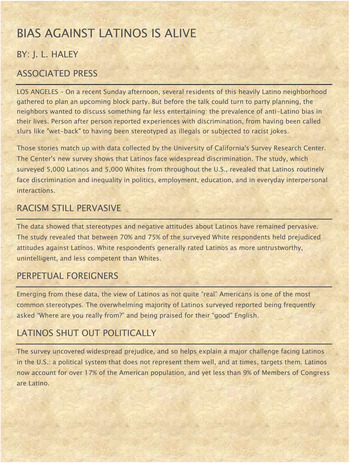
Treatment article on perceived discrimination, national experiment.
Treatment Statement Text, Experiment 3
Before starting the survey, we would like you to read a comment made recently by a politician in our nation’s capital. A prominent member of Congress made the following statement to reporters the other day: “The issue of immigration isn’t just a problem of controlling the border. Even those immigrants who arrive with advanced degrees are threatening this country’s unity and our ability to stay together. Today’s immigrants aren’t focused on learning English, and they stick to themselves – they don’t learn what it means to be American. We need to restrict the number of visas available to skilled foreigners who want to work and live in the US, even if that means families will be separated.”
Control Statement Text, Experiment 3
Before starting the survey, we would like you to read a comment made recently by a politician in our nation’s capital. A prominent member of Congress made the following statement to reporters the other day: “The issue of criminality needs to be addressed by this Congress. Criminals who are granted parole may still harm the general public. We need mandatory prison sentencing for violent crimes, robbery and drug dealing. Courts should have the option of imposing lifetime sentences for repeat offenders.”
Treatment Article Text, Experiment 4
Bias against latinos is alive by: J. L. Haley Associated Press
Los Angeles – At a recent meeting, the leaders of the Latino Students Association at UCLA gathered to plan the group’s annual film festival. But before the talk could turn to movies, its members wanted to discuss something far less entertaining: the prevalence of anti-Latino bias in students’ lives. Student after student reported experiences with discrimination, from having been called slurs like “wet-back” to having been stereotyped as illegal aliens, subjected to racist jokes, or ignored by classmates. The discrimination came from friends as well as strangers.
Those stories match up with recent data collected by the University of California’s Survey Research Center. The Center’s new survey shows that Latinos and Latino Americans face widespread discrimination in many areas of life. The study, which surveyed 5,000 current ethnic minority and White undergraduates and 5,000 alumni who graduated between 2008 and 2013, revealed that Latinos routinely face discrimination and inequality in politics, employment, education, and in everyday interpersonal interactions. In addition, the survey revealed that Whites continue to hold negative attitudes about Latinos.
Unfairness in Promotion – The survey demonstrated that Latinos are very rarely in top management positions. Even when they possess relevant education and experience for executive positions, Latinos continue to serve in junior roles. Very few Latinos are directors of White-owned companies, for example. The survey also revealed that despite being disproportionately passed over for promotions and raises, Latinos rarely blame those events on discrimination. In turn, this tendency not to report discrimination leads society at large, including Latinos, to underestimate the pervasiveness of discrimination toward Latinos.
Racism Still Pervasive – The data also showed that stereotypes and negative attitudes about Latinos have remained pervasive in recent years. The study revealed that between 70% and 75% of the surveyed White respondents held prejudiced attitudes against Latinos. White respondents generally rated Latinos as more lazy, dirty, untrustworthy, and less competent than Whites. Over 70% of the surveyed Whites indicated they would prefer their work supervisor be White rather than Latino.
Perpetual Foreigners – Emerging from these data, the view of Latino Americans as not quite “real” Americans is one of the most common stereotypes. The overwhelming majority of Latino Americans surveyed reported being frequently asked “Where are you really from?” or “How long have you been in the States?”, and being praised for their “good” English or lack of accent. What’s more, White Americans tended to agree with statements such as “Latinos residing in the US are unwilling to assimilate to the US society” and “Latino Americans stick more to the culture and values of their families’ origins than of the US.” The surveyed Latinos worry that harsh immigration policies will target them for simply appearing foreign. Latino respondents report concern about local police being given the authority to question and even detain individuals whom they suspect are in the country illegally.
Latinos Shut Out Politically – The survey uncovered widespread prejudice, and so helps explain a major challenge facing Latino Americans in the USA: a political system that does not represent them well, and at times, targets them. Latino Americans now account for over 17% of the American population, and yet less than 9% of Members of Congress are Latino.
Not Expecting This – Finally, 90% of the Latino alumni reported that while in college they did not recognize the extent to which prejudice would cause personal and professional barriers for them. In short, the Survey Research Center demonstrated that Latinos face pervasive discrimination on a regular basis and lack opportunities compared to Whites.
Appendix B: Question Wording
Items on Undergraduate Survey Experiments
Partisan Identity
Change in views of the parties
Which of the following best describes how your feelings about the US political parties have changed in recent years?
I feel much closer to the Republicans than I used to.
I feel somewhat closer to the Republicans than I used to.
I feel somewhat closer to the Democrats than I used to.
I feel much closer to the Democrats than I used to.
Feeling thermometer measures
For the next set of questions, we’d like to get your feelings toward some groups or individuals in America. You will see a list of groups and people and then you will rate that group or that person on a thermometer that runs from 0° to 100°. Ratings above 50 mean that you feel favorable and warm toward that group or person. Ratings below 50 mean that you feel unfavorable and cool toward that group or person. Ratings right at the 50 degree mark mean you don’t feel particularly warm or cold. You may use any number from 0 to 100 to rate how favorable or unfavorable your feelings are. If you don’t know a group or person, please click on “Don’t know this group/person.”
US president Barack Obama.
Former Massachusetts governor Mitt Romney.
Republicans.
Democrats.
Group-targeted perceived discrimination. Please tell us whether you agree or disagree with the following statements. There are no right or wrong answers for any question.
My racial/ethnic group is discriminated against.
Discrimination against my racial/ethnic group is a big problem today.
Asians/Asian Americans in the USA face a lot of racism.
Discrimination against Asians/Asian Americans is a big problem in the USA today.
Appendix C: Descriptive Statistics
Descriptive Statistics for Manipulation Checks and Outcome Measures, Lab Study 1. University of Washington, n = 181 Asian American Respondents
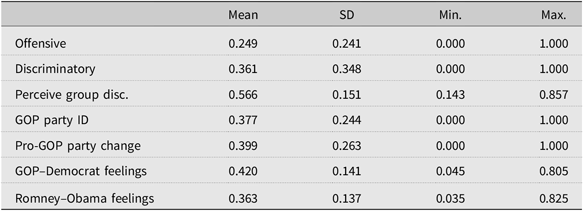
Descriptive Statistics for Manipulation Checks and Outcome Measures, Lab Study 2. University of Washington, n = 247 Asian American Respondents
Descriptive Statistics for Manipulation Checks and Outcome Measures, Lab Study 3. University of Washington, n = 350 Asian American Respondents
Descriptive Statistics for Manipulation Checks and Outcome Measures, Lab Study 4. University of Texas, El Paso, n = 209 Latino Respondents
Descriptive Statistics for the GfK Survey
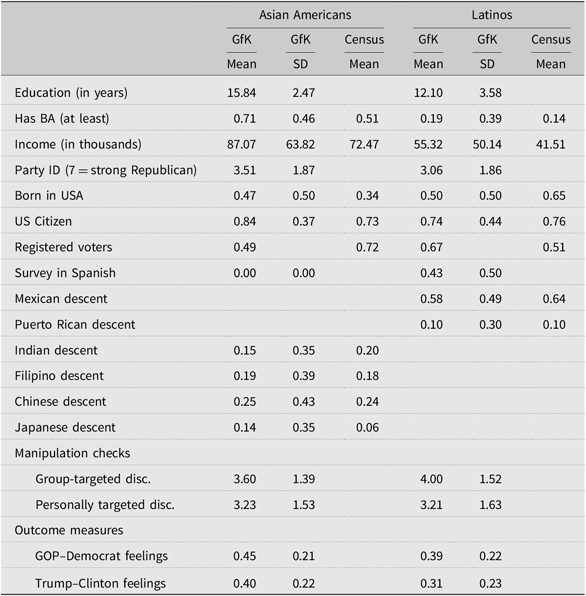
Note. With Asian American respondents (n = 721) on the left and Latino respondents (n = 820) on the right. The Census benchmarks are drawn from the 2011–2014 American Community Survey. For the GfK surveys, “registered voters” reports the share of respondents who were successfully matched to a unique, active record in state voter registration databases.
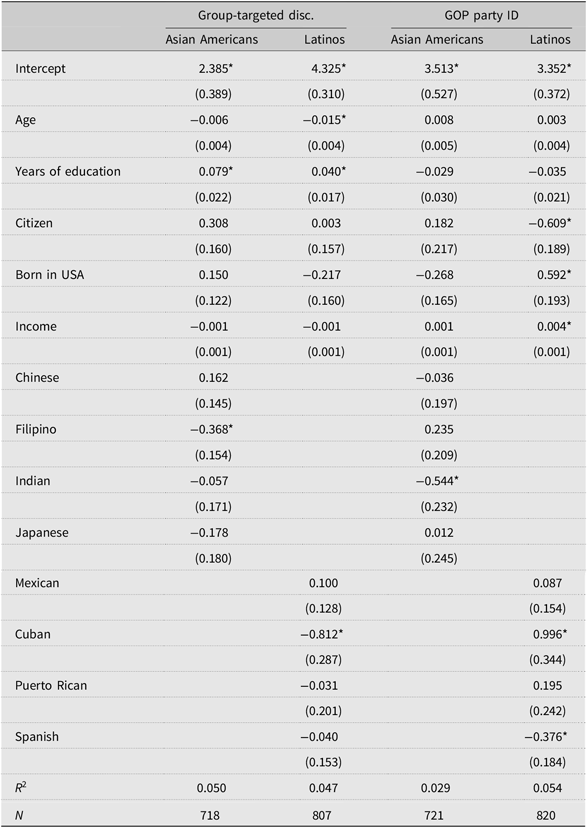
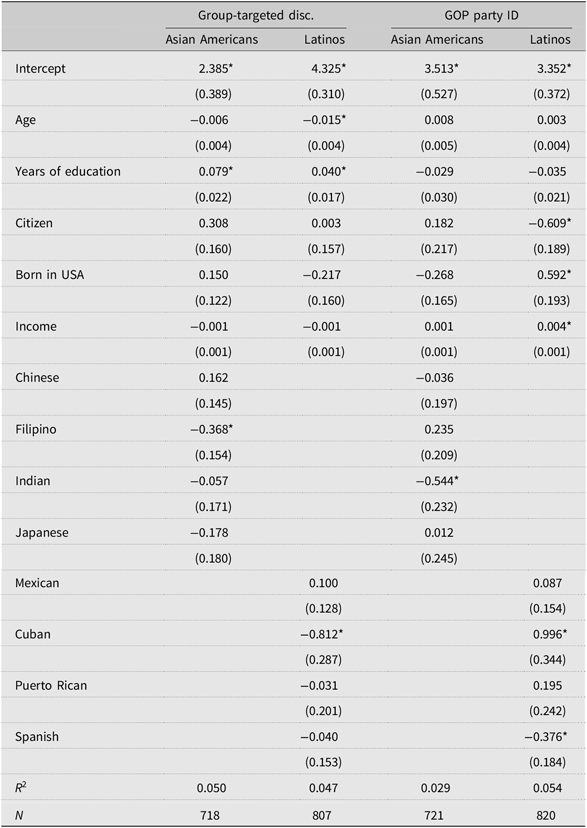
Linear Regression Results Separately for the Asian American and Latino Samples Predicting Group-Targeted Discrimination (Left) and Republican Partisanship (Right)
Appendix D: Manipulation Checks
Manipulation Check from Experiment 1, Asian American Sample
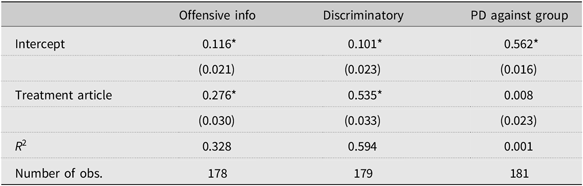
Manipulation Check from Experiment 2, Asian American Sample.
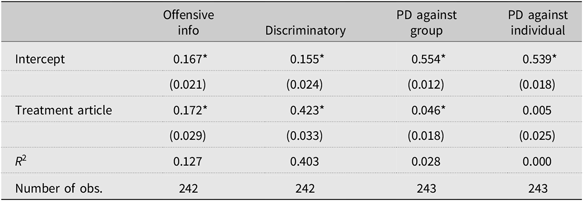
Manipulation Check from Experiment 3, Asian American Sample
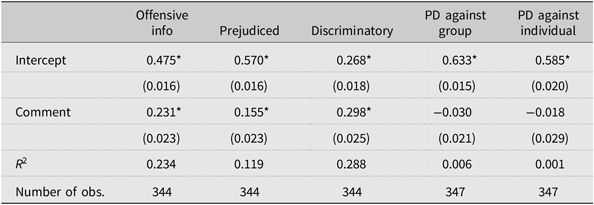
Manipulation Check from Experiment 4, Latino Sample
Manipulation checks, GfK experiment
GfK Experiment: This figure illustrates the effect of reading an article highlighting discrimination on respondents’ perceptions of discrimination against their ethnic/racial group.
Manipulation Checks, National Samples, Perceptions of Personally Targeted Discrimination
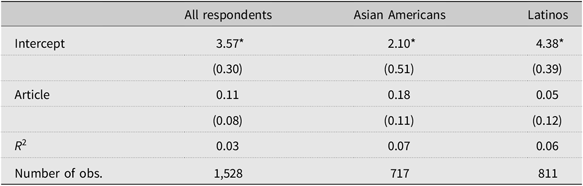
Note. This table presents manipulation checks for the GfK experiments conducted with national samples. The outcome is a 6-category scale measuring perceptions of personal-level discrimination varying from 1 to 6. Several independent variables including respondents’ education, national origin group, income, citizenship status, and birthplace in the USA were included but are suppressed.
Appendix E: Results from Undergraduate Survey Experiments
Regression Results, Experiment 1. Sample: Asian American Undergraduates
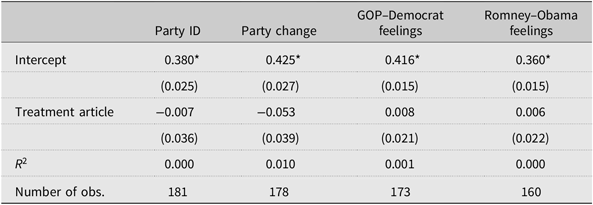
Regression Results, Experiment 2. Sample: Asian American Undergraduates
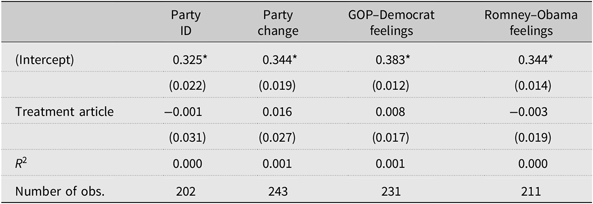
Regression Results, Experiment 3. Sample: Asian American Undergraduates
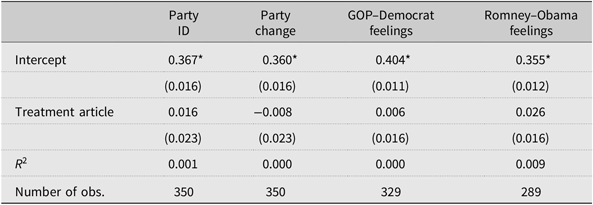
Regression Results, Experiment 4. Sample: Latino Undergraduates
Appendix F: GfK Population-Based Experiments
The Results from the National Survey Experiment when Regressing Assessments of Republicans Minus Democrats on a Series of Independent Variables
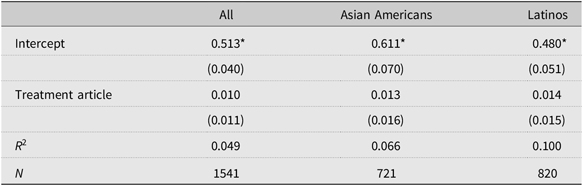
Note. To improve precision, the models condition on various pre-treatment demographics such as income, national origin, citizenship status, birth within the USA, education, and whether the survey was administered in Spanish. These independent variables have little effect on the estimate of interest and so are suppressed.
The Results from the National Survey Experiment when Regressing Assessments of Donald Trump Minus Those of Hillary Clinton on a Series of Independent Variables
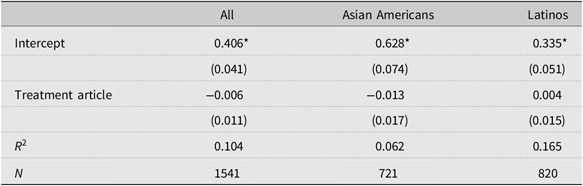
Note. To improve precision, the models condition on various pre-treatment demographics such as income, national origin, citizenship status, birth within the USA, education, and whether the survey was administered in Spanish. These independent variables have little effect on the estimate of interest and so are suppressed.