INTRODUCTION
Cognitive deficits are a core feature of schizophrenia that remain poorly understood and inadequately treated (Kiehl, Smith, Hare, & Liddle, Reference Kiehl, Smith, Hare and Liddle2000; Minzenberg, Laird, Thelen, Carter, & Glahn, Reference Minzenberg, Laird, Thelen, Carter and Glahn2009; Weickert et al., Reference Weickert, Goldberg, Gold, Bigelow, Egan and Weinberger2000). Saccades are rapid eye movements between fixations (Salvucci & Goldberg, Reference Salvucci and Goldberg2000) that can be elicited in different experimental eye movement paradigms to assess motor control and cognition in schizophrenia. The advantages of using saccades to measure cognition is that they are a cost-effective and a non-invasive tool with clearly defined neural pathways (Leigh & Kennard, Reference Leigh and Kennard2004). They are one of the best understood motor responses and the different properties, such as error rate (i.e., percentage of incorrect saccades toward a peripheral target), are easy to measure and are well defined (Hutton, Reference Hutton2008).
The antisaccade task requires individuals to suppress the automatic response of looking at a target and instead look at a mirror (opposite) location (Hallett, Reference Hallett1978). Increased antisaccade error rate has been consistently replicated in schizophrenia patients (Gooding & Basso, Reference Gooding and Basso2008; Mazhari et al., Reference Mazhari, Price, Dragović, Waters, Clissa and Jablensky2011), with error rates as high as 75% in patients, compared to around 20% in the general population (Bittencourt et al., Reference Bittencourt, Velasques, Teixeira, Basile, Salles, Nardi and Ribeiro2013; Gooding & Basso, Reference Gooding and Basso2008). Our recent review concluded that relatives of patients with schizophrenia have intermediate antisaccade error rates between patients and controls (Myles, Rossell, Phillipou, Thomas, & Gurvich, Reference Myles, Rossell, Phillipou, Thomas and Gurvich2017), and twin studies in schizophrenia have reported that the heritability of antisaccade error rates is around 42–57% (Greenwood et al., Reference Greenwood, Braff, Light, Cadenhead, Calkins, Dobie and Gur2007; Malone & Iacono, Reference Malone and Iacono2002). Based on this heritability and consistent findings in the literature, antisaccade error rate is regarded as one of the most promising and robust endophenotypes for schizophrenia (Radant et al., Reference Radant, Millard, Braff, Calkins, Dobie, Freedman and Gur2015; Reilly et al., Reference Reilly, Frankovich, Hill, Gershon, Keefe, Keshavan and Sweeney2013).
It has been suggested that specific deficits (like antisaccade error rate), distinct from generalized deficits, are more useful as an endophenotype for linkage to genetic and molecular markers (Dickinson, Ragland, Gold, & Gur, Reference Dickinson, Ragland, Gold and Gur2008; MacDonald, Carter, Flory, Ferrell, & Manuck, Reference MacDonald, Carter, Flory, Ferrell and Manuck2007). While it has been suggested that antisaccade performance may represent a generalised neuropsychological deficit in schizophrenia (Zanelli et al., Reference Zanelli, MacCabe, Toulopoulou, Walshe, McDonald and Murray2009), numerous studies have found a relationship between antisaccade performance and specific cognitive processes in schizophrenia including a relationship with working memory (Gooding & Tallent, Reference Gooding and Tallent2001; Hutton et al., Reference Hutton, Huddy, Barnes, Robbins, Crawford, Kennard and Joyce2004; Nieman et al., Reference Nieman, Bour, Linszen, Goede, Koelman, Gersons and de Visser2000), attention (Nieman et al., Reference Nieman, Bour, Linszen, Goede, Koelman, Gersons and de Visser2000; Reilly, Harris, Khine, Keshavan, & Sweeney, Reference Reilly, Harris, Khine, Keshavan and Sweeney2008), and executive function processes as measured by the Wisconsin Card Sorting Test and the Stroop task (Karoumi, Ventre-Dominey, & Dalery, Reference Karoumi, Ventre-Dominey and Dalery1998). The key cognitive processes thought to be engaged during successful antisaccade performance in controls are working memory (Mitchell, Macrae, & Gilchrist, Reference Mitchell, Macrae and Gilchrist2002), or inhibition as a consequence of taxing working memory (Roberts, Hager, & Heron, Reference Roberts, Hager and Heron1994).
However, a comprehensive assessment including a broad range of cognitive domains to explore the association between neuropsychological processses and antisaccadic error rate in patients and controls has not been conducted as previous research has limited the number of cognitive domains investigated by narrowing down their focus to domains of interest. To address this gap, the current study will examine the association between antisaccade error and all cognitive domains measured by the MATRICS Consensus Cognitive Battery (MCCB) and the Delis-Kaplan Executive Function System (D-KEFS) Stroop task. This includes attention, working memory, inhibition and executive functioning (all previously associated with antisaccade error rate) along with processing speed, visual and verbal memory, and social cognition. The current study will also explore any associations between psychopathology and antisaccade error rate.
Additionally, these studies exploring the cognitive processes engaged during the antisaccade task in schizophrenia patients have all administered the task using a step condition, which is considered the standard antisaccade task (Gooding & Basso, Reference Gooding and Basso2008). However, the broader antisaccade literature not only examines the step condition, which has no gap between central fixation and peripheral target, but also the gap condition. The gap condition manipulates the duration between the central and peripheral stimulus of the antisaccade task (Myles et al., Reference Myles, Rossell, Phillipou, Thomas and Gurvich2017) and is proposed to increase the sensitivity of the antisaccade task (Gooding & Basso, Reference Gooding and Basso2008). No previous studies have investigated cognitive processes engaged during the gap condition. The inclusion of a gap during the antisaccade task may affect which cognitive processes are engaged, although this needs to be empirically investigated. It would, therefore, be pertinent to explore and compare antisaccade performance in both conditions.
The key aims of the current study were to (i) replicate previous findings of an antisaccade error rate impairment in patients with schizophrenia, (ii) determine the cognitive processes associated with antisaccade error rate performance in patients and controls using a comprehensive neurocognitive assessment and investigating the two groups separately, (iii) determine whether antisaccade error rate during different task conditions (i.e., gap or step condition) is influenced by different neuropsychological processes by investigating significant and unique contributors of the tasks separately for gap and step conditions, and (iv) explore whether there are any associations between psychopathology [as measured by the Positive and Negative Syndrome Scale (PANSS)] and antisaccade error rates.
It was hypothesized (i) that antisaccade error rate would be impaired in patients compared to controls. In keeping with previous research, it was predicted (ii) that antisaccade error rate in both patients and controls would be associated with specific cognitive processes, mainly working memory, attention, and inhibition processes, rather than generalized cognitive deficit. Additionally, as the gap condition increases sensitivity of the task, it was also hypothesized (iii) that these correlations would be more pronounced in the gap condition and there may be additional cognitive processes making significant unique contributions compared to the step condition both for patients and controls. Finally, as antisaccade error rate is a promising endophenotype for schizophrenia and relates to genetically influenced phenotypical characteristics rather than clinical manifestations, we hypothesized (iv) that no correlations would be observed between error rate and PANSS.
METHODS
Participants
Recruitment for the study was through advertisements online and in the community, including the Alfred Hospital and outpatient clinics in Melbourne, Australia. Potential participants were then screened in a telephone interview to ensure they met inclusion criteria. One hundred and ninety-one (54 schizophrenia/schizoaffective outpatients and 137 healthy controls) between 18 and 64 years of age met inclusion criteria. Participants were all fluent English language speakers. Participants were excluded from the study if they had a neurological illness, history of a serious head injury, or current substance abuse or dependence. Controls were also excluded if they had a first-degree biological relative with schizophrenia or schizoaffective disorder and/or met diagnostic criteria for any DSM-IV Axis 1 disorder, as per the Mini-International Neuropsychiatric Interview (M.I.N.I.) screening module (Lecrubier et al., Reference Lecrubier, Sheehan, Weiller, Amorim, Bonora, Sheehan and Dunbar1997).
All patients had a primary Diagnostic and Statistical Manual of Mental Disorders, Fourth Edition (DSM-IV) diagnosis of schizophrenia or schizoaffective disorder. All patients were self-referred community based outpatients with diagnosis confirmed with the M.I.N.I. Patients were not acutely unwell and were on stable antipsychotic medication. A total of 20.4% of patients did not report antipsychotic dosage, and 11% of patients did not clearly report any medication details. Of those who reported medication details, the following breakdown was obtained (for main antipsychotic), clozapine, 19%; quetiapine; 13%; olanzapine, 13%; aripripazole, 13%; risperidone, 7%; paliperidone, 6%; amisulpride,, 4%; asenapine, 4%; ziprasidone, 4%; haloperidol, 2%; trifluoperazine, 2%; zuclopenthixol, 2%. Thirty-three percent of these patients were taking more than one antipsychotic.
A clinical interview was performed with the patients, which included, as noted, the M.I.N.I. to confirm diagnoses. In addition, psychotic symptoms were assessed at time of recruitment using the PANSS (Kay, Fiszbein, & Opfer, Reference Kay, Fiszbein and Opfer1987). The PANSS is a semi-structured interview that assesses positive, negative, general, and total psychopathology symptoms. PANSS scorings were completed by different trained raters based at the Monash Alfred Psychiatry Research Centre. All raters completed internal standardized PANSS training as well as ongoing inter-rater reliability PANSS training sessions. Scores for positive, negative, general, and total symptom severity were calculated for each patient.
The study was performed in accordance with the Declaration of Helsinki (World Medical Association, 2013) and received ethical approval from the Alfred Hospital Human Research Ethics Committee, Melbourne. Each participant provided written informed consent before assessment.
Saccadic Eye Movement Assessment
Antisaccades were tracked using an EyeLink II head-mounted eye tracker (SR Research, Ontario), which records gaze at 500 Hz with an average accuracy of 0.5 degrees. Three cameras were mounted on a padded headband; one for point of gaze and two for binocular eye tracking. Participants were seated with their eye level 966 mm away from the center of a 303 × 378 mm LED monitor with their head resting on a chin rest to stabilize head movement. A nine-point calibration (including horizontal points of ±10º, ±5º, 0º) and a drift correction procedure were conducted before the tasks and re-calibration was completed as necessary.
The target for fixation was a green cross that subtended a 1-degree visual angle, presented on a black background and on a 1024 × 768 resolution. This central target was presented for 1000 or 1500 ms followed by a peripheral target appearing in one of four locations (±5º or ±10º) for 1250, 1500, or 1750 ms in a pseudorandom order. There were 72 trials in total, presented in a pseudorandom order with six blocks of 12 trials with a rest break between each block. The study used two different task parameters; half of the trials had a 200-ms gap between central fixation and peripheral target (known as a gap condition), and the other half of the trials had no gap (known as a step condition). A white circle was presented at the start of each trial to re-center fixation. A single slowed practice trial with feedback was provided to ensure participants understood the task. If the participant was still unclear on the task, the practice trial was repeated. Participants completed the prosaccade task before the antisaccade task to ensure motivation and understanding of task; however, data have not been included as it is not part of the aims and hypotheses of the current study.
Participants were instructed to look at the center of each green cross and were told that the cross would move to either the left or the right of center. They were instructed not to look toward the peripheral cross, but to instead look at the mirror location (at the same distance from center but opposite direction) of the cross. Participants were reminded to look back to the center white re-fixation circle after each trial. Errors, defined as saccades made toward the peripheral target with an amplitude of at least 2 degrees, were analyzed for the gap condition and step condition separately, and a total error rate combining all trials was also included in analyses.
Eye Movement Analysis
Eye tracking was analyzed off-line using Zoomtool (MATLAB®). Separate researchers performed eye movement testing and eye movement analysis. The researcher who conducted eye movement testing (and cognitive testing) was aware of the group status of the participant but the researcher who conducted the eye movement analyses was blind to the participants’ diagnostic group status. Saccades were automatically detected and deemed to have been generated if threshold velocity exceeded 30 degrees per second. Saccades were excluded due to poor fixation, poor calibration, blinking during saccadic movement.
Cognitive Assessment
Premorbid intelligence was assessed using the Wechsler Test of Adult Reading (WTAR) scaled score (Wechsler, Reference Wechsler1997). Cognitive performance was assessed using the Measurement and Treatment Research to Improve Cognition in Schizophrenia Consensus Cognitive Battery (MCCB; Nuechterlein et al., Reference Nuechterlein, Green, Kern, Baade, Barch, Cohen and Gold2008). The MCCB consists of 10 tasks that measures seven cognitive domains: Speed of processing (Brief Assessment of Cognition, Symbol Coding, Category Fluency, and Trail Making Test A), Attention/vigilance (Continuous Performance Test – Identical Pairs [CPT-IP]), Working memory (Wechsler Memory Scale – Third Edition, Spatial Span and Letter Number Span), Verbal learning (Hopkins Verbal Learning Test-Revised), Visual learning (Brief Visuospatial Memory Test-Revised), Reasoning and problem solving (Neuropsychological Assessment Battery, Mazes), and Social cognition (Mayer-Salovey-Caruso Emotional Intelligence Test, Managing emotions).
The D-KEFS Stroop task (Delis, Kaplan, & Kramer, Reference Delis, Kaplan and Kramer2001) was also included to provide an inhibition measure, as this is not assessed in the MCCB and because the antisaccade task relies heavily on the ability to inhibit the natural response to look at the target. The D-KEFS Stroop task involves four levels of task difficulty (Delis et al., Reference Delis, Kaplan and Kramer2001), and for the purposes of the current study, only the inhibition component of the task was included. This requires participants to state the color of the ink instead of reading the color word, and a scaled score was calculated and used in all analyses.
Statistical Analyses
Data analyses were performed using SPSS (version 25). Study variables were assessed for normality and those that were not normally distributed were transformed to normality. Patients’ MCCB raw scores were entered into the MCCB scoring program to produce age and gender T-scores for the seven cognitive domains. T-scores of each domain were included in analyses; the overall composite score T-score was also included as a measure of global neuropsychological performance.
Independent t test comparisons were conducted between patient and control groups for all demographics, neuropsychological and antisaccade measures. As social cognition did not significantly differ between patients and controls, it was not included in further analyses.
Pearson’s correlations were conducted separately for patients and controls to determine which variables had a significant relationship with antisaccade error rate. Pearson’s correlations were also conducted between antisaccade error rate and PANSS symptom severity scores to observe whether associations between saccade and cognitive performances were related to psychopathology severity. Bonferroni corrections were made to account for multiple comparisons.
Standard multiple regressions were conducted separately for patients and controls to determine which of the cognitive variables accounted for antisaccade error rate performance variance. Only neuropsychological measures that were significantly correlated with antisaccade error rate were included in the regressions. While the MCCB overall composite score is derived from the T-scores of each domain, it was still included in the same regression as the neuropsychological T-score variables as multicollinearity assumptions were not violated; VIF was below 5 and tolerance was above 0.2 (Menard, Reference Menard1995).
RESULTS
Demographics
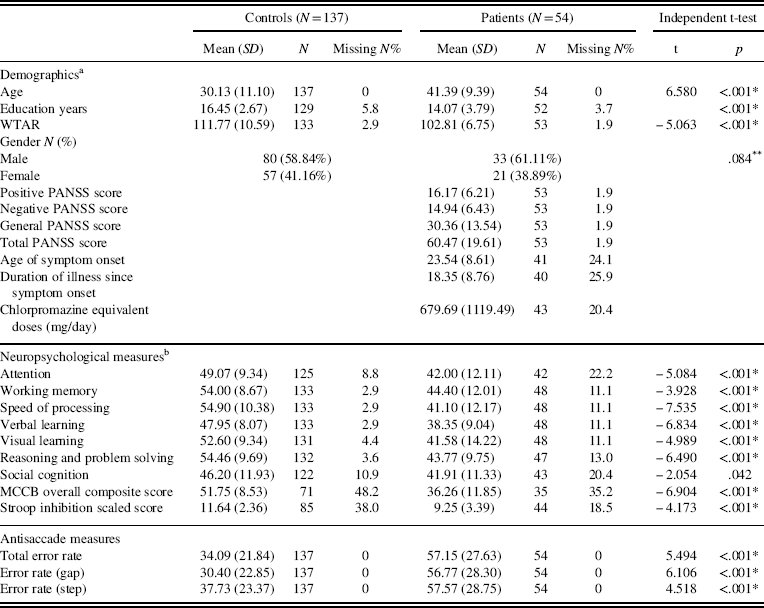
Demographic characteristics of the patient and control groups are described in Table 1. There was a significant difference between groups for all neuropsychological measures except for social cognition and all antisaccade error measures, with patients’ performance significantly impaired relative to controls.
Descriptive statistics for demographics, neuropsychological, and antisaccade measures

a WTAR, Wechsler Test of Adult Reading; PANSS, Positive and Negative Syndrome Scale; CPZ, chlorpromazine.
b MCCB, MATRICS Consensus Cognitive Battery.
* p <.01, considered significant after Bonferroni correction.
** p <.05, considered non-significant trend.
The WTAR estimate of premorbid IQ significantly differed between the two groups; however, it was decided that WTAR would not be included as a covariate. Research has shown that using IQ as a covariate in neuropsychological studies can produce overcorrected, anomalous, and counterintuitive findings about neurocognitive function (Dennis et al., Reference Dennis, Francis, Cirino, Schachar, Barnes and Fletcher2009). In addition, IQ is intimately associated with cognition; therefore, using the WTAR as a covariate could potentially remove too much variability in the measures of cognition (Dennis et al., Reference Dennis, Francis, Cirino, Schachar, Barnes and Fletcher2009; Miller & Chapman, Reference Miller and Chapman2001). The patient group was significantly older than the control group. The intimate relationship between age and cognition has been well studied (Murman, Reference Murman2015); similar to the WTAR, using age as a covariate could remove too much variability in the measures of cognition. Therefore, no additional covariates were entered into any analyses. However, it should be noted that the calculation of MATRICS T-scores through the MCCB Computer Scoring Program corrects for age.
Associations Between Antisaccade Error Rate and Neuropsychological Measures
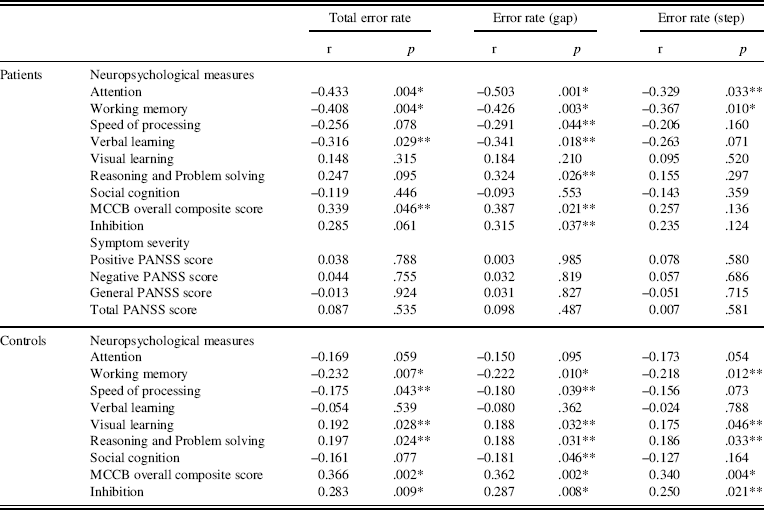
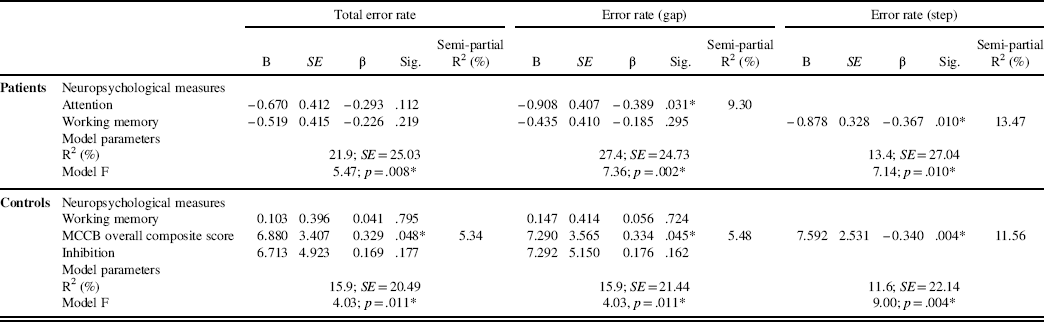
In patients, attention was significantly correlated with total error rate (large effect size) and errors made during the gap condition (large effect size; Table 2). Working memory performance was also significantly correlated with total error rate (medium-large effect size) and errors made during the gap condition (large effect size; Table 2). For total error rate, 21.9% of the total variance was explained by the model, although neither attention nor working memory were significant contributors to this variance (Table 3). For errors made during the gap condition, 27.4% of the total variance in antisaccade error rate was explained, with attention making a significant unique contribution of 9.30% (medium effect size; Table 3). Only working memory was significantly correlated with errors made during the step condition (medium effect size; Table 2), and explained 13.4% of the total variance (medium effect size; Table 3).
Correlations between antisaccade error rate and neuropsychological and symptom severity measures

* p <.01, significant after Bonferroni correction.
** p <.05, considered non-significant trend.
Regression analyses for neuropsychological measures significantly correlated with antisaccade error rate

* p <.05.
In controls, working memory and inhibition performance, as well as the MCCB overall composite score, were significantly correlated with total error rate and errors made during the gap condition (medium effect size; Table 2); 15.9% of the variance in total antisaccade error rate was explained by the model, with overall composite score making a significant unique contribution of 5.34% (small effect size; Table 3). For the gap condition, 15.9% of the total variance in antisaccade error rate was explained by the model (Table 3). Similarly, the overall composite score made a significant unique contribution of 5.48% (small effect size). Only MCCB overall composite score significantly correlated with errors made during the step condition (medium effect size; Table 2), and explained 11.6% of the total variance in antisaccade error rate (medium effect size; Table 3).
Associations Between Antisaccade Error Rate and Symptom Severity Measures
Symptom severity was assessed by the PANSS. Positive, negative and general PANSS sub-scores were not significantly correlated with total error rate (Table 2). Total PANSS score was also not significantly correlated with total error rate. Similarly, none of the PANSS sub-scores or total PANSS score correlated with errors made during the gap or step condition (Table 2).
DISCUSSION
In line with previous schizophrenia studies, the patient group showed significant global cognitive impairment compared to controls. Patients also showed deficits across all cognitive domains analyzed in the current study, consistent with previous observations of significant cognitive deficits in schizophrenia across multiple domains (Keefe & Harvey, Reference Keefe and Harvey2012). Similarly, the current study demonstrated that the patient group had significantly increased antisaccade error rate compared to the control group (Bittencourt et al., Reference Bittencourt, Velasques, Teixeira, Basile, Salles, Nardi and Ribeiro2013; Calkins, Curtis, Iacono, & Grove, Reference Calkins, Curtis, Iacono and Grove2004; Gooding & Basso, Reference Gooding and Basso2008).
There were no significant correlations found between antisaccade error rates and symptom severity, consistent with earlier findings of Hutton et al. (Reference Hutton, Huddy, Barnes, Robbins, Crawford, Kennard and Joyce2004) who did not observe any relationships between antisaccade errors and the Scales for the Assessment of Positive Symptoms (SAPS) and Negative Symptoms (SANS). Antisaccade error rate is a proposed endophenotype and a trait marker, and we would, therefore, expect it to remain constant despite change with symptom severity. The lack of correlations, therefore, supports the use of antisaccade error rate as a relatively stable endophenotype of schizophrenia, not associated with state features. Additionally, this is in agreement with previous studies that have observed good test–retest reliability of antisaccade task performance in schizophrenia patients (Calkins, Iacono, & Curtis, Reference Calkins, Iacono and Curtis2003; Ettinger et al., Reference Ettinger, Kumari, Crawford, Davis, Sharma and Corr2003; Gooding, Mohapatra, & Shea, Reference Gooding, Mohapatra and Shea2004).
Attention and working memory impairment in patients significantly correlated with an increased total antisaccade error rate and increased errors made during the gap condition (with medium to large effect sizes), in line with previous literature (Gooding & Tallent, Reference Gooding and Tallent2001; Hutton et al., Reference Hutton, Huddy, Barnes, Robbins, Crawford, Kennard and Joyce2004; Nieman et al., Reference Nieman, Bour, Linszen, Goede, Koelman, Gersons and de Visser2000). Similarly, working memory significantly correlated with errors made during the step condition (with medium effect size), and a non-significant trend was observed with attention. The regression analyses demonstrated that both working memory and attentional deficits influence antisaccade error rate (with medium effect sizes), as hypothesized.
Working memory was shown to significantly influence antisaccade error rate during the step condition in patients, consistent with previous findings (Gooding & Tallent, Reference Gooding and Tallent2001; Hutton et al., Reference Hutton, Huddy, Barnes, Robbins, Crawford, Kennard and Joyce2004; Nieman et al., Reference Nieman, Bour, Linszen, Goede, Koelman, Gersons and de Visser2000). Working memory dysfunction is considered one of the core cognitive deficits of schizophrenia (Lee & Park, Reference Lee and Park2005; Park & Gooding, Reference Park and Gooding2014) and, through functional MRI studies, has been associated with the dorsolateral prefrontal cortex (DLPFC; Curtis & D’Esposito, Reference Curtis and D’Esposito2003). In addition, cerebral lesions restricted to the DLPFC have resulted in an increased error rate, whereas lesions to other prefrontal areas have been shown to have no effect on antisaccade error rate (Pierrot-Deseilligny, Rivaud, Gaymard, & Agid, Reference Pierrot-Deseilligny, Rivaud, Gaymard and Agid1991). Along with these previous findings, the results of the current study suggest that antisaccade error rate is closely related to working memory and performance on both of these tasks is potentially stems from a common DLPFC dysfunction (Doricchi et al., Reference Doricchi, Perani, Incoccia, Grassi, Cappa, Bettinardi and Fazio1997; Gooding & Basso, Reference Gooding and Basso2008; Sweeney et al., Reference Sweeney, Mintun, Kwee, Wiseman, Brown, Rosenberg and Carl1996).
Antisaccade error rate during the gap condition in the patient group was most significantly influenced by attentional processes, as measured by the CPT-IP. While no previous studies have investigated the cognitive processes engaged in the gap condition, the findings are conceptually consistent. The disappearance of stimuli during the 200-ms gap results in the disengagement of fixation and allows attentional systems to respond quickly to new stimuli (Dorris & Munoz, Reference Dorris and Munoz1995; Mackeben & Nakayama, Reference Mackeben and Nakayama1993). Therefore, it is intuitive that the gap condition would engage more in attentional processes compared to the step condition (where there is no “gap” or opportunity to disengage attention from the central fixation).
Global cognitive performance was not significantly correlated with antisaccade error rate performance in patients regardless of task parameter. This suggests that antisaccade error rate is influenced by specific cognitive processes (i.e., working memory and attention) rather than generalized impairment, consistent with previous findings (Reilly et al., Reference Reilly, Frankovich, Hill, Gershon, Keefe, Keshavan and Sweeney2013).
In controls, poorer working memory, inhibition, and global cognitive performance, as measured by the MCCB overall composite score, were significantly correlated with increased total error rate and increased errors made during the gap condition (with medium effect sizes), and the MCCB overall composite score significantly correlated with errors made during the step condition (with medium effect size). Again, this is consistent with previous research conducted in controls (Mitchell et al., Reference Mitchell, Macrae and Gilchrist2002; Roberts et al., Reference Roberts, Hager and Heron1994).
However, the regression analyses revealed that only global cognitive performance significantly predicted antisaccade error rate for all task parameters (with small to medium effect sizes). This suggests that poorer antisaccade error rate performance in controls is a reflection of poorer global cognitive performance rather than relating to a specific cognitive process as was observed in patients. These findings are also consistent with previous research which observed that antisaccade error rate in patients was associated with diminished response latencies in prosaccade performance under overlap conditions, indicating a selective diminished maintenance of attention, whereas antisaccade error rate in healthy controls was associated with response latency across prosaccade conditions (Reilly et al., Reference Reilly, Harris, Khine, Keshavan and Sweeney2008).
Inhibition performance on the D-KEFS Stroop task did not correlate with antisaccade error rate in patients, but did in controls. While some studies have found an association between antisaccade performance and poorer inhibition (Donohoe et al., Reference Donohoe, Reilly, Clarke, Meredith, Green, Morris and Robertson2006; Levy et al., Reference Levy, Mendell, LaVancher, Brownstein, Krastoshevsky, Teraspulsky and Holzman1998), other studies have failed to find this association (Kumari, Ettinger, Crawford, Zachariah, & Sharma, Reference Kumari, Ettinger, Crawford, Zachariah and Sharma2005; Louchart-de la Chapelle et al., Reference Louchart-de la Chapelle, Nkam, Houy, Belmont, Ménard, Roussignol and Fouldrin2005). A possible explanation is that inhibition may be an “associated by-product” of increased working memory activation (Roberts et al., Reference Roberts, Hager and Heron1994), explaining why working memory performance is more consistently associated with antisaccade error rate compared to inhibition performance. It has also been suggested that increased antisaccade errors may be due to a failure to implement goal-oriented behavior rather than being an inhibitory deficit (Barton, Pandita, Thakkar, Goff, & Manoach, Reference Barton, Pandita, Thakkar, Goff and Manoach2008).
Another pertinent finding was that attention was significantly correlated with antisaccade error rate in patients, but not in controls. Similar to inhibition, a possible explanation for the lack of association in controls may be that the close link between working memory and attention makes it difficult to separate attentional influences on antisaccade performance (Hutton, Reference Hutton2008) and, therefore, the significant correlations with working memory may in part also reflect an association with attentional processes.
There are several limitations to note in the current study. First, there was a moderate sample size for the patient group for the regression analyses. This was addressed by only including neurocognitive variables significantly correlated with eye movement variables in the regressions to increase the power. Second, we were unable to address the use of different antipsychotic medications. However, while antipsychotics appear to have a positive effect on cognitive performance across several domains, research indicates that there is no significant difference between the magnitude of cognitive improvement among different antipsychotics (Davidson et al., Reference Davidson, Galderisi, Weiser, Werbeloff, Fleischhacker, Keefe and Rybakowski2009).
Another potential limitation is that the CPT-IP, which forms the attention domain score, is not a discrete measure of sustained attention, but also captures aspects of working memory. The CPT-IP version is more complex than the original version; the participant has to maintain previous stimulus presentations when matching identical stimuli (Cornblatt, Risch, Faris, Friedman, & Erlenmeyer-Kimling, Reference Cornblatt, Risch, Faris, Friedman and Erlenmeyer-Kimling1988), engaging working memory processes. Thus the exact influence of attention on antisaccades is difficult to ascertain from our measures.
It should also be noted that our mean antisaccade error rates in the entire non-clinical group were higher than the majority of studies, which report an error rate of between 5% and 25% (Reuter & Kathmann, Reference Reuter and Kathmann2004). This may be due to the exclusion of the overlap condition in the current study (McDowell & Clementz, Reference McDowell and Clementz1997), as previous research has shown that using the overlap condition (where the fixation target is still visible when the peripheral target appears) decreases error rate among non-clinical individuals and is often used as an additional condition in saccadic studies (Holahan & O’Driscoll, Reference Holahan and O’Driscoll2005; Klein, Brügner, Foerster, Müller, & Schweickhardt, Reference Klein, Brügner, Foerster, Müller and Schweickhardt2000; Larrison, Ferrante, Briand, & Sereno, Reference Larrison, Ferrante, Briand and Sereno2000).
In summary, the findings of the current study replicated that patients have an increased antisaccade error rate that is unrelated to psychopathology severity as measured by the PANSS. It is also, to our knowledge, the first study to explore the cognitive processes engaged during the gap condition. Consequently, our novel findings make an important contribution to saccadic research by demonstrating that differences in task parameters have an effect on the cognitive processes engaged. The step condition was significantly influenced by working memory while the gap condition appears to rely on broader attentional processes, which should be taken into account in future neurocognitive studies. While global cognitive performance was associated with antisaccade error rate in controls, this was not observed in patients, indicating that, in patients, antisaccade error rate is related to specific neuropsychological processes as opposed to generalized cognitive impairment. Together, the findings demonstrate that antisaccade performance in regards to error rate is a possible schizophrenia endophenotype that is influenced by working memory and attention, depending on the saccadic paradigm used.
ACKNOWLEDGMENTS
This work was funded by a National Health and Medical Research council project grant [National Health and Medical Research Council (NHMRC) APP1060664 awarded to S.R.]. E.H.X.T. was supported by an Australian Postgraduate Award at Monash University. C.G. was supported by a NHMRC Early Career Fellowship (546262). S.R. received funding from Australian Rotary Health/Bipolar Expedition and the Helen McPherson Smith Trust, which partly funded some of the healthy control data in this study. The authors have no conflicts of interest to declare.