INTRODUCTION
Reported thought (Holt Reference Holt1996; Jefferson Reference Jefferson and Lerner2004; Haakana Reference Haakana, Holt and Clift2007), also referred to as inner speech (Tannen Reference Tannen1989; Sams Reference Sams2010), constitutes a phenomenon that is closely related to reported speech, and which in fact has been generally included in this category without having received much specific attention. The term reported speech is employed as a synonym for quotation and is mainly associated with the ‘replaying of the words of another speaker, or the same speaker on a previous occasion, in spoken discourse’ (Holt Reference Holt, D'hondt, Östman and Verschueren2009:190). Recent studies have called attention to the presentation of words or dialogues in ordinary conversation that were never spoken aloud before they were quoted, but which are either explicitly introduced or can be contextually deduced as reporting past thoughts or constructing future/hypothetical locutions (Haakana Reference Haakana, Holt and Clift2007; Sams Reference Sams2010). The category of reported speech has also been expanded in recent years to include the portrayal of words from written discourse, such as when we quote a comment made by a public figure in a newspaper, or the words of the characters in a novel (Holt Reference Holt, D'hondt, Östman and Verschueren2009:190).
This article is generally intended to contribute to the study of these less stereotypical forms of ‘quotations’, by putting the focus on the phenomenon of reporting thoughts in ordinary conversation. Specifically, the aim is to analyse conversational extracts from storytelling sequences in which narrators produce instances of reported thought, so as to examine the way these instances are constructed, positioned and functionally used in the sequence. In all of these instances, speakers choose the direct style, which will be called direct reported thought (DRT), in contrast with indirect reported thought (IRT), according to the style distinction between direct reported speech (DRS), which employs the verb tenses and deictic elements of the original reported situation (Li Reference Li and Coulmas1986), and indirect reported speech (IRS), which ‘adapts the reported utterance to the speech situation of the report’ (Coulmas Reference Coulmas and Coulmas1986:2). The storytelling sequences that provide the instances of DRT are taken from a collection of naturally occurring conversations among speakers of Spanish and/or Galician.
Before moving on to the analysis, in the following section I review previous studies that have considered reported thought. Next, I provide more details on the data collection from which the instances of DRT are taken and focus on the analysis of said instances, considering the storytelling context in which they are produced. The results and conclusions of these analyses are summarised and established in the last section. Generally, I argue that DRT is used by narrators as a device to stage the ways in which they experience the story world in their mind, as discursive processes and reactions around an external event that clash with their expectations or initial perception of the situation.
REPORTED THOUGHT IN PREVIOUS STUDIES
As noted above, reported thought has not received much specific attention, although it is considered in some studies on storytelling and reported speech. For instance, in the analysis of oral narrative structure by Labov & Waletzky (Reference Labov, Waletzky and Helm1967), reported thought is included as an evaluation device, as it serves to insert the narrator's attitude towards the events and to transmit the point of the story. According to the aforementioned authors, evaluation can be more internal or external, depending on the degree to which it is disruptive of the narrative flow. In a list of seven examples of evaluative utterances provided by these authors, four are based on reporting thoughts, both in direct and indirect style (Labov & Waletzky Reference Labov, Waletzky and Helm1967:39). The direct style (DRT) is seen as involving a more internal evaluation than the indirect style (IRT), and the examples of DRT indicate that the use of the introductory formula I said to myself leads to a more internal type of evaluation than the use of I thought. My instances of DRT show that the reporting clauses are mostly based on the use of the verb decir ‘to say’, while the Spanish form pensé ‘I thought’ is the least employed formula.
In analysing conversational narratives, Tannen (Reference Tannen1989) also includes direct reported thought or ‘inner speech’, in her own terms, as a type of ‘constructed dialogue’, that is, as a creation of the speaker that is strategically used to dramatise storytelling and to favour involvement, making the narration more vivid or dynamic (along with other types of constructed dialogue that would correspond to ‘reported speech’). Holt (Reference Holt1996) addresses the formal features and uses of direct reported speech in conversation, but shows an example in which a female speaker introduces direct reported thought in telling a story to stage a ‘process of deliberation’ before deciding to take an action, demonstrating consideration for another character in the reconstructed situation, and also to display her reactions to events in the original context (Reference Holt1996:233–34). While these studies examine reported thought because it emerges in the data, as a subcategory of reported speech or constructed dialogue, Jefferson (Reference Jefferson and Lerner2004) specifically analyses the construction of the format ‘At first I thought’ in telling experiences of extraordinary events, such as shootings, accidents, or hijackings. Drawing on examples taken from newspaper clippings and notes from news broadcasts, Jefferson demonstrates that witnesses of such events tend to produce instances of ‘reported first thoughts’ that turn out to be wrong (in both direct or indirect style, though mostly in the latter), in which they claim an initial awareness or interpretation of the extraordinary event according to a normal or ordinary reality. These first wrong thoughts serve as a ‘normalising device’, that is, as a way of offering an alternative to the extraordinary reality whereby ordinary people ‘can both exhibit their “commitment to the normal”, and provide that, in principle, things like this don't happen’ (Jefferson Reference Jefferson and Lerner2004:155).
Another specific study is that of Haakana (Reference Haakana, Holt and Clift2007), which analyses the construction, design, and uses of direct reported thought in complaint stories produced by Finnish speakers. The narrator-protagonist of these stories reconstructs past events in which someone/multiple people behaved in a reprehensible way, making them feel offended, hurt, or otherwise affected (Günthner Reference Günthner, Hotthoff and Wodak1997a; Acuña, Reference Acuña2002/2003, Reference Acuña2004, Reference Acuña2008, Reference Acuña2009, Reference Acuña2011). Direct reported speech (DRS) or reported dialogues are often used to provide evidence of this bad behaviour, but Haakana demonstrates that DRT can be inserted into them to introduce a ‘silent criticism’ of the reported utterances produced by the antagonists or complainees. This criticism plays an important role in the evaluation and constitution of the complaint story as well as in the speaker's self-presentation, allowing the narrator to ‘show that he or she indeed had a criticism in his or her mind but was sensible enough not to voice it to the co-interactant’ (Reference Haakana, Holt and Clift2007:153). From a formal perspective, this study highlights that DRS and DRT have many similarities and that it can be difficult to tell them apart in many cases, because the speakers do not always employ the verb to think in the reporting clause (e.g. ‘I thought’, ‘he/she thought’), but instead employ other verbs, such as to be, for example, which may be ambiguous, or even no verbs at all.
Sams (Reference Sams2010) analyses instances of inner speech, along with the construction of ‘future dialogues’ in conversations among English speakers. Drawing upon the view of direct quotations as ‘demonstrations’ of a previous speech act, she concludes that the narrator's use of DRT in storytelling sequences generally functions as a demonstration of a mental state or feeling of the speaker in the narrated situation. Other examples show how DRT is provided as a suggestion by the recipients to align with the narrator's stance, to collaborate in the storytelling and to comment on it. In line with Haakana (Reference Haakana, Holt and Clift2007), this study also reports that the speakers tended to use the formula be + like (e.g. ‘I was like’, ‘you're like’) to introduce direct reported thought, and that the way this phenomenon is designed reveals formal similarities in comparison to direct reported speech, such as the use of prosodic cues to convey affect (Besnier Reference Besnier1990; Clark & Gerrig Reference Clark and Gerrig1990; Holt Reference Holt1996, Reference Holt2000; Günthner Reference Günthner, Hotthoff and Wodak1997a,Reference Günthner, Niemeier and Dirvenb).
Thus, reported thought has been generally considered by previous studies in relation to storytelling as an evaluation device as well as a dramatisation and an involvement strategy in the case of DRT, which has been approached to a greater extent than the indirect style (IRT). In this way, DRT has been functionally compared to direct reported speech (DRS), serving as a demonstration of a previous state of mind and mood instead of a previous locution. The research has also stressed common elements in the ways both phenomena are constructed and designed, resulting in difficulties when it comes to telling them apart in some cases, as the speakers rarely employ the verb to think to introduce DRT and can even omit the use of any verb in this kind of reporting. Some studies, however, have noted more specific functions of both direct and indirect reported thought, noting the activities they can perform, as a narrator's device to depict a ‘silent criticism’ of a previously reported speech, a ‘process of deliberation’ to decide on the next action to take and a first wrong idea on what is happening in the situation. At the same time, attention has been paid to the important role of reported thought in the speaker's self-presentation, as it can display consideration for others or a ‘commitment to the normal’ as an ordinary person.
In a similar vein, the present article aims to identify the most specific functions of reported thought as well as to explore the ways in which it emerges and is constructed in ordinary conversations. The focus is on instances of direct reported thought (DRT) that, as in the case of previous studies, were found in storytelling sequences, reinforcing the evidence that this interactional context is favourable for the emergence of the aforementioned phenomenon. This data analysis is developed in the following section.
DATA ANALYSIS
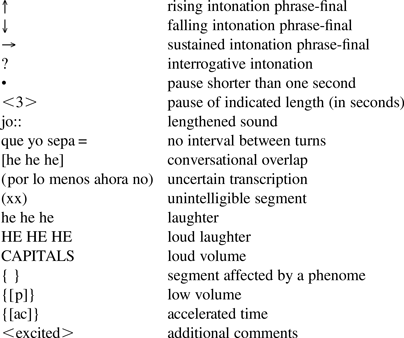
The analysis in this section relies on extracts from storytelling sequences that were taken from my collection of naturally occurring interactions among friends and relatives, neighbours, workmates, or classmates. This conversational data was obtained through observant participation in communicative settings such as the home, the street, the bus, the workplace, the pub, or a residence hall, and in different Galician populations (Spain), thus meaning that the interactants are mostly speakers of Spanish and/or the Galician language. Some of the interactions are part of the Corpus of Galician/Spanish Bilingual Speech of the University of Vigo (Corpus de Fala Bilingüe Galego/Castelán, abbreviated as CoFaBil; see Rodríguez & Casares Reference Rodríguez and Casares2003), while others are the result of my own fieldwork (Acuña Reference Acuña2009, Reference Acuña2011, Reference Acuña2017). The data transcription is based on a system of conventions adapted from Álvarez Cáccamo (Reference Álvarez Cáccamo1990), which organises spoken discourse into intonation units (see the Appendix for transcription conventions). The real names of the participants, as well as those of third parties who are mentioned or talked about in some cases, are always replaced by pseudonyms. The analysed extracts have been selected because they include instances of direct reported thought in contexts of storytelling.
I start with data from a conversation that took place in student housing among three female undergraduate students in their twenties—Laura, Olga, and Vanesa. The participants gossip about another female undergraduate student, Cristina, who was Laura's flatmate in the residence hall for some time but had to enter a psychiatric hospital. Laura shares information about this incident and the mental problems that Cristina had, highlighting that she used to tell many lies (see also Acuña Reference Acuña2014). Extract (1) collects the core part of a sequence in which Laura tells a story about one of Cristina's aforementioned lies. In the previous turns, Laura reported that this girl had said that her father suffered with heart problems and was dying as a result. The story focuses on an incident that happened some days later, when Cristina's father came to the residence hall to take Cristina's clothes home and Laura talked to him. The arrows after the line numbers in the transcriptions highlight the segments in which the speaker produces DRT.
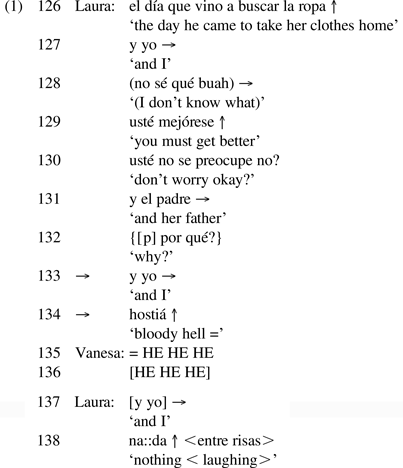
The narrator begins by reporting a dialogue between Laura and Cristina's father the day he came to take his daughter's clothes (lines 126–38). In this dialogue, Laura expresses her desire for his health to improve and recommends he not worry so much (lines 127–30), but then Cristina's father asks ‘why’ (lines 131–32), indicating that he does not understand the reason for these comments about his health. This reported dialogue is not introduced by verbs of saying, since the speaker only indicates the subject pronoun in the reporting clauses (lines 127, 131), as also occurs in lines 133–34, where Laura re-enacts her surprise in view of the father's question, by means of an exclamation, hostiá ↑ ‘bloody hell’ (line 134). This exclamation has been marked as an instance of DRT because it can be interpreted as a portrayal of an immediate mental reaction of the protagonist in view of the father's question, insofar as this evidenced Cristina's lie about his health. It seems unlikely that Laura responded to Cristina's father in this way, since it would be rude, and there is more reporting in lines 137–38, just after Vanesa's laughter (lines 135–36), where the narrator re-enacts an elusive response to the father's previous question, na::da ↑ ‘nothing’ (see lines 137–38). This latter reporting is also introduced without the use of any verb (line 137), but it can only be considered as replaying what Laura answered to Cristina's father in the dialogue, trying to change the subject. In this way, the foregoing exclamation of surprise (lines 133–34) is more interpretable as depicting a first reaction to the father's question that was not voiced in the original context and thus as an instance of DRT.
This instance of DRT has important similarities with those analysed by Haakana (Reference Haakana, Holt and Clift2007) in complaint stories, as it is also inserted in a segment of DRS to depict a silent response or reaction to the interlocutor's utterances in the reported dialogue. The difference is that, while in complaint stories this silent response is a criticism of something said by the complainee, which serves to legitimise the speaker's complaint, in this case the silent response communicates a ‘change-of-state’ (Heritage Reference Heritage, Atkinson and Heritage1984) in the speaker's knowledge and information, that is, her astonishment in discovering that Cristina had lied, as her father had no health problem. This replaying of a ‘silent shock’ is useful for the narrator to highlight the striking nature of the events by including the way she experienced them in her mind, as well as to make the narration funny: note Vanesa's laughter just after the reported exclamation (lines 135–36). By contrast, it also serves to construct a positive self-image of the narrator, in including something not said in the situation (Haakana Reference Haakana, Holt and Clift2007:153). The fact that Laura does not voice this shocked reaction in discovering Cristina's lie and that she does not reveal this invention to the father, but tries to change the subject, portrays her as a sensitive and discreet person, who does not want to cause more worries for this character.
There is a second instance of DRT in this story, which is produced following some turns that were omitted from the transcription because they cannot be understood. This final part of the storytelling is shown in (2).
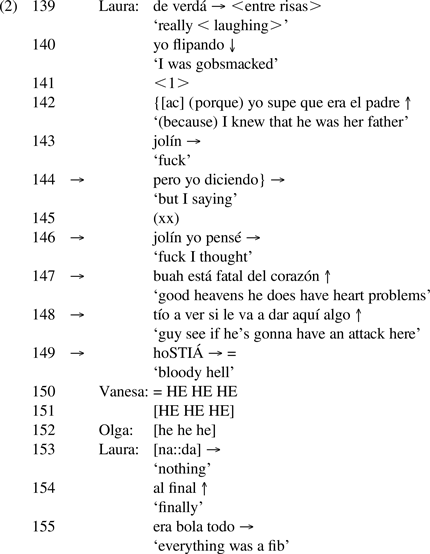
After staging a shocked reaction by means of DRT in reconstructing the dialogue with Cristina's father, here Laura underlines this experience by making a state formulation: yo flipando ‘I was gobsmacked’ (see lines 139–40). Following a pause (line 141), she produces more DRT (lines 144–49), which is unambiguously introduced by using the past simple form of the verb pensar ‘to think’ (line 146). However, note that this is a self-repair of a previous use of the progressive form yo diciendo ‘I saying’ (line 144), in which the auxiliary verb estar ‘to be’ is elided. This self-repair indicates that the speaker is aware of a possible ambiguity and then strives to make it clear what she is going to report. In this final part of the story, DRT is used to depict the narrator's initial state of mind in the situation portrayed, before the reported dialogue with Cristina's father, thus involving a flashback in the storytelling. These thoughts portray the protagonist worrying about the possibility that this man could suffer a heart attack right there (lines 146–49). The use of the exclamation hoSTIÁ → ‘bloody hell’ (line 149) functions here to intensify such a state of alert, causing the audience's laughter (lines 150–52).
Thus, this second instance of DRT serves to highlight the narrator's initial perception of the situation as problematic or delicate, staging how she worried about the dangers of Cristina's father's supposed health problems. It is chronologically ordered before the conversation held with this character but positioned after the reporting of that dialogue (DRS) in the storytelling sequence, to criticise Cristina's behaviour, as her lie caused an unnecessary alarmed situation. Despite this critical point, however, note that DRT functions again as a device to make the narration funny, causing the audience's laughter (lines 150–52). In concluding the story, the narrator's use of nada ‘nothing’ (line 153) explicitly marks this instance of DRT as a first wrong thought (Jefferson Reference Jefferson and Lerner2004), which is next explained with al final ‘finally’ (line 154) and era bola todo ‘everything was a fib’ (line 155).
The following extracts have been taken from another conversation that took place in a sandwich bar, also between three women in their twenties—Eva, Cris, and Mar. In this case, the communicative activity is mainly based on the telling of stories of a highly intimate nature, as they revolve around relationships with men (see also Acuña Reference Acuña2017). The role of the narrator is taken by Eva in most cases, who shares her experiences with a boy with whom she has started an intimate friendship. One of these stories is focused on something surprising that happened on the last day she was talking with him, before leaving on vacation. In (3), Eva is explaining that she wanted to express some affection towards him in this situation (the scene setting had been noted in previous turns, although not shown in this extract), but thought that this could be inappropriate.
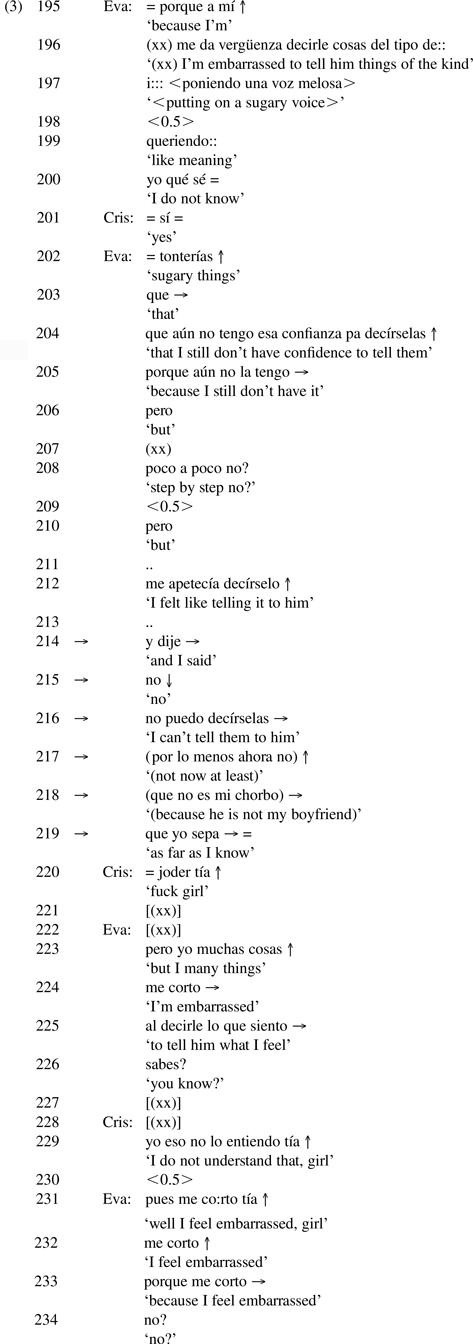
In this extract, Eva claims that she generally feels embarrassed to display affection to her male friend in an overly romantic or sensitive way (lines 195–200, 202–208), putting on a sugary voice (line 197) and using the expression tonterías ‘sugary things’ (line 202). She also opines that affective displays of this kind are not appropriate now in her friendship with the boy, since there is not enough confidence for it, and the relationship should strengthen ‘step by step’ (line 208). Following the micropause in line 209, Eva states that she wished to say something affectionate to the boy in her last meeting with him (lines 210–12) and then, after another micropause (line 213), provides a report of her thoughts in direct style (lines 214–19), refusing to say certain things to her friend (probably the ‘sugary things’ to which she referred before, in lines 202–205), ‘because he is not my boyfriend’ (line 218), ‘as far as I know’ (line 219). The reporting clause in this case (line 214) is not based on the verb pensar ‘to think’, but on decir ‘to say’, which is closely associated with reported speech. However, it can be argued that this is another example of DRT that is contextualised in the story world, as the speaker uses third person pronouns to refer to the boy, in a situational context where they are the only characters (lines 216, 218). In this way, it follows that Eva does not voice these words to him, but is staging a dialogue with herself, in her mind.
In this way, the aforementioned use of DRT demonstrates the process of deliberation (Holt Reference Holt1996:233–34) that Eva has with herself with respect to the possibilities of expressing affection to her friend, and thus her perception of the situation as delicate and worthy of a reflection. In line with her previous comments, in which she expresses her negative view of this issue because of a lack of confidence, the inclusion of this DRT serves to communicate these concerns in a more specific and vivid way, as a staging of the inner conflict that she was experiencing in situ, just in the moments before the remarkable event (Eggins & Slade Reference Eggins and Slade1997) of the story, which is given in extract (4). Moreover, this demonstration of an inner deliberation before taking an action in the scene serves to both display intimacy and to construct a positive self-presentation of the narrator at the same time, portraying her as a reasonable and cautious person, who reflected on how to manage the situation in a proper way, and who thought before speaking.
Finally, as noted in previous extracts, the construction of DRT in this story also causes the recipient's reaction, leading here to a brief discussion between Eva and Cris, who disagrees with her friend's way of thinking, in favour of the repression of feelings (lines 220–21, 228–29); in contrast, Eva reiterates that she feels embarrassed in this respect (lines 222–26, 231–34), in line with her initial claims in the extract. It seems relevant that Cris does not express this disagreement in those initial moments, but just after the display of DRT, which suggests that this device is more effective or impressive for the audience, functioning similarly to DRS as an invitation to offer assessment (Holt Reference Holt1996, Reference Holt2000) or a certain response from the recipient. Thus, while DRS implies giving ‘direct access’ to a past locution (Holt Reference Holt1996), DRT seems to do the same but in respect to the speaker's mind in the reported situation.
Extract (4) is taken from the immediate following turns of the sequence above, in which there is no other instance of DRT, but shows that the storytelling revolves around an event that clashes in some way with the initial way of thinking of the narrator-protagonist in the setting, as highlighted in extracts (1) and (2). Here, Eva produces DRS, reporting in a direct style what she finally said to her friend.
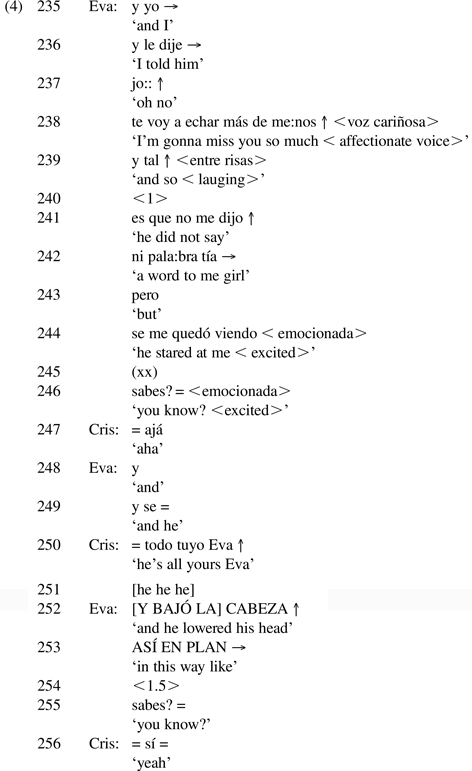
In this extract, Eva employs DRS to depict how she finally expressed grief about it being the last day she was going to be with her friend (lines 235–39). Note that she makes a self-repair in introducing this dialogue, as first she employs a reporting clause without the use of any verb (line 235) and next constructs the reporting clause in a different way: y le dije → ‘I told him’ (line 236). This self-repair helps the narrator to make it clear that, unlike her previous use of DRT in (3), she is now to report what she said to her interlocutor in the situation. After this segment of direct reported speech and a pause (line 240), she then describes her friend's reaction to her expression of affection, stressing that he did not say anything but just stared at her (lines 241–46) and lowered his head (lines 252–55). In delivering the above-mentioned description, Eva makes an implicit evaluation of this reaction as something surprisingly positive for her, generally using a tone of voice that communicates excitement, heightening volume at some points (lines 252–53) and twice employing the formula sabes? ‘you know’ (line 246, 255) to check the recipients’ understanding. Cris confirms this understanding and positively evaluates the boy's reaction as a sign that he liked Eva and her affectionate words (lines 247, 250–51, 256).
Thus, the point of this story is that Eva's friend demonstrated a positive reaction to her affective comments, invalidating her initial worries that expressions of this kind could not be appropriate, as was highlighted by means of the construction of DRT in (3). From the very beginning in this storytelling, the narrator explicitly claims to feel embarrassment regarding the expression of affect to her friend and argues her general view that this is a delicate matter. But her subsequent use of DRT involves a demonstration of her way of reasoning that is better integrated into the storytelling as a mental process that was produced in the reported situation and is really effective for the audience's involvement and participation, providing direct access to the narrator's inner experience in the story world.
The use of DRT in this storytelling sequence has certain similarities with those seen in the previous one. On the one hand, it is again related to DRS, while in this case it is not inserted to introduce a silent response or reaction to something said by the interlocutor, but is instead positioned before the segment of DRS to stage an inner deliberation on the part of the protagonist regarding what she should or should not say in the dialogue situation. On the other hand, this deliberation also serves to highlight an initial perception of the situation that turns out to be wrong or exaggerated after the use of DRS, when the boy's positive reaction is produced and described with excitement, emphasising a change-of-state in the speaker's previous knowledge, information, orientation, or awareness (Heritage Reference Heritage, Atkinson and Heritage1984:299). In this way, DRT in the aforementioned sequence is also constructed as a first wrong thought that serves to enhance the surprising positive resolution of a situation that the protagonist considered delicate and faced with caution and some concern.
The following extracts are taken from another sequence of the same conversation, in which Eva recalls what happened one day at home, when she had to study for an exam the next day. Prior to the telling of her story, she had explained that when she had exams at university, she and her friend spent less time together, as he wanted to let her study.
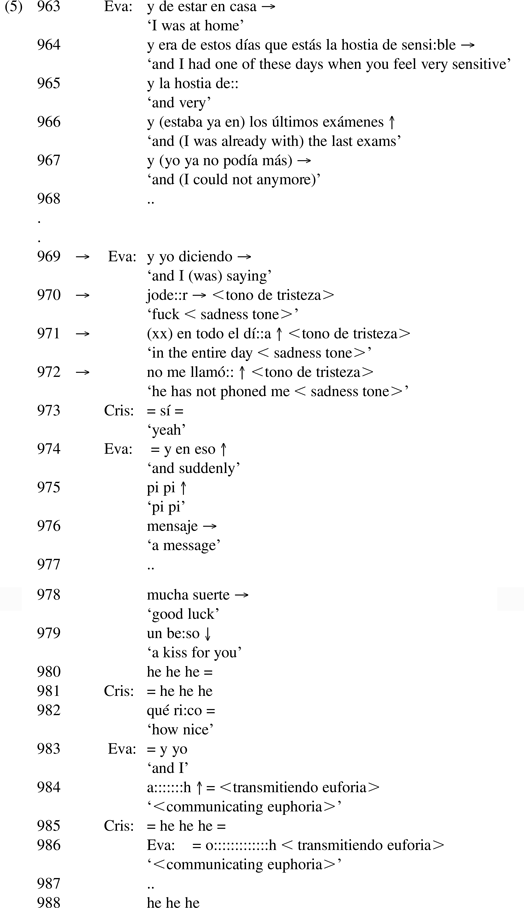
In this extract, Eva outlines a scene one day at home, when she was ‘very sensitive’ and exhausted because of worrying about finishing the exam period (lines 963–67). The following turns were omitted because they include the telling of a secondary story that is not of interest here. Going back to the main story, in line 969, Eva constructs a reporting clause based on the progressive form y yo diciendo ‘and I (was) saying’, eliding the auxiliary verb estar ‘to be’, following which she directly reports how she lamented that her male friend had not phoned her once in the entire day (lines 970–72). In this report, the speaker displays an affectionate stance by means of an emotive interjection and prosodic cues such as elongated vowels, which convey a sad tone: jode::r → ‘fuck’ (line 970), en todo el dí::a ↑ ‘in the entire day’ (line 971), no me llamó:: ↑ ‘he has not phoned me’ (line 972). Despite the use of the verb diciendo (‘saying’, line 969) in the reporting clause, it seems reasonable to think that this is not direct reported speech (DRS), but a depiction of the mental process that the narrator-protagonist was experiencing that day, which is in concordance with her foregoing state formulation that she was ‘very sensitive’ (lines 963–64). The utterances are not part of the replaying of a past interaction and the narrator does not mention any other person she was talking with through the story, so the situation seems to be that she was alone and feeling very disappointed because her friend had not phoned her. As in the previous instances, this use of DRT provokes the recipients’ reaction, which expresses understanding (line 973).
Immediately following this report, the use of the narrative formula y en eso ‘suddenly’ (line 974) announces an event that clashes with Eva's negative thoughts: she receives a text message on her mobile phone from her friend, wishing her luck (for the exam she would have the next day) and sending a kiss (lines 975–79). The replaying of this message provides an example of direct reported speech (DRS) that portrays a written discourse (Holt Reference Holt, D'hondt, Östman and Verschueren2009:190). Eva's laughter communicates her reaction of joy (line 980), and Cris also reacts by laughing and praising the boy's action (lines 981–82). Finally, Eva makes vocalisations that convey an affective stance of great joy or euphoria (lines 983–84, 986), again causing Cris to laugh (line 985). These ‘response cries’ (Goffman Reference Goffman1981) are preceded by a short reporting clause in which the narrator-protagonist only employs y yo ‘and I’ (line 983) to contextualise them in the story world, as her reaction to the boy's message in the narrated situation. The question remains as to whether it should be interpreted that this reaction constitutes DRS or DRT, as it is not possible to deduce if Eva intends to communicate that she screamed in such ways after reading the message despite supposedly being alone, or if this a way of portraying a radical change in her state of mind and mood because of the boy's message. As there is an absolute ambiguity, this reported reaction has not been marked as DRT.
It is clear, however, that this is another story about a surprising event for the narrator-protagonist, which clashes with her foregoing thoughts in the reconstructed situation. Extract (6), which shows the immediately following turns of the aforementioned sequence, underlines this use of DRT, as now Eva insists on the significance of her story by reporting again her reaction and first thoughts, although in a different way.
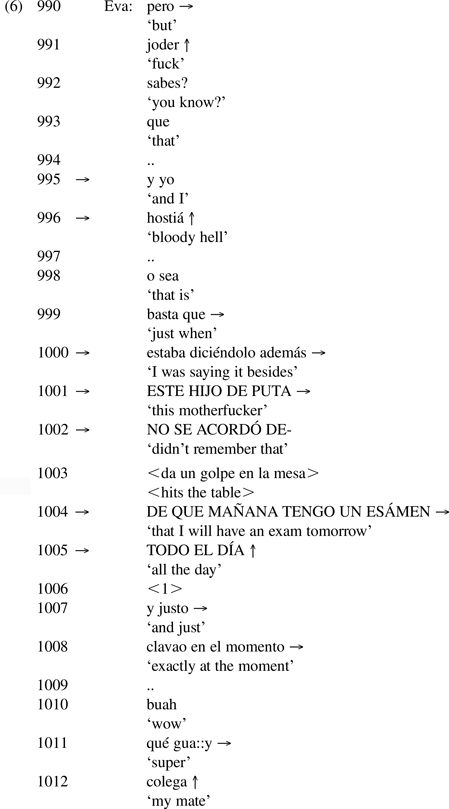
Following some false-starts (lines 990–94), Eva employs another reporting clause only based on a subject pronoun (line 995), to again depict her surprised reaction because of her friend's message, by using the exclamation hostiá ↑ ‘bloody hell’ (line 996). This exclamation has been marked as DRT because it is almost identical to the first instance that was shown in (1) (lines 133–34), and it seems more credible as an immediate mental reaction to the friend's message than the hyperbolical response cries conveying euphoria in extract (5). Thus, I think that this exclamation can be interpretable as another brief instance of DRT that is intended to depict a ‘silent shock’ of the protagonist, while the level of ambiguity in this case is higher than in the previous similar instance in (1). After a micropause (line 997), Eva introduces a reformulation marker, o sea ‘that is’ (line 998), makes another false start (line 999) and produces a second reporting clause, using the progressive form of the verb decir ‘to say’, followed by the adverb además ‘besides’ as an argumentative reinforcement, estaba diciéndolo además → ‘I was saying it besides’ (line 1000).
This reporting clause and the following utterances in lines 1001–1005 have also been marked as an instance of DRT, in which the narrator intends to again portray her initial state of mind and mood in the situation, thus producing a retelling, but in a different way in comparison to the use of this device in extract (5), in which the narrator shaped DRT as a process of lamentation that her friend had not phoned her for the entire day. In this case, however, Eva uses DRT to stage a process of blaming or accusation, insulting this character (line 1001) and concluding that he had forgotten the exam she would have the next day (lines 1002–1005). After a pause (line 1006), the narrator implicitly refers to the surprising event in the story, that is, to the receipt of a message from her friend, to emphasise that it happened immediately after these negative thoughts about the boy: justo ‘just’ (line 1007), clavao ‘exactly’ (line 1008), en el momento ‘at the moment’ (line 1008). The sequence concludes with more expressions of happiness from Eva (lines 1010–1012), which here are not explicitly contextualised in the narrated situation, to insist for the last time on the point of her story: the great positive surprise and joy she experienced with her friend, just when she was thinking badly about him.
In sum, the extracts from this sequence include once more a replaying of the first wrong thoughts because of the occurrence of something later that contradicts or invalidates that initial way of considering the situation. In the case of this sequence, moreover, it has been shown how the narrator-protagonist produces two versions of these initial thoughts to emphasise the significance of an event that meant great surprise and joy for her, just because it evidenced that she was wrong in her previous thoughts. This use of DRT is positioned according to the chronological order: it is first constructed just before a segment of DRS that portrays a written discourse and provides the surprising external event, and then is produced for the second time to emphasise the moment said mental process was produced, just before that event. By contrast, there is some evidence that DRT is also employed here as a device to depict the shocked reaction of the protagonist after reconstructing the event that clashes with her initial way of thinking, though with a higher level of ambiguity than in extract (1).
The use of DRT to stage the reaction of the protagonist to a surprising or unexpected event is clear in extract (7) below. It is taken from another conversation that took place at home among a mother and her two daughters. The mother, Isa, is telling a complaint story regarding the misbehaviour of an old female friend because this woman greets her when they meet in some places, but pretends to not have seen her when they cross in other places.
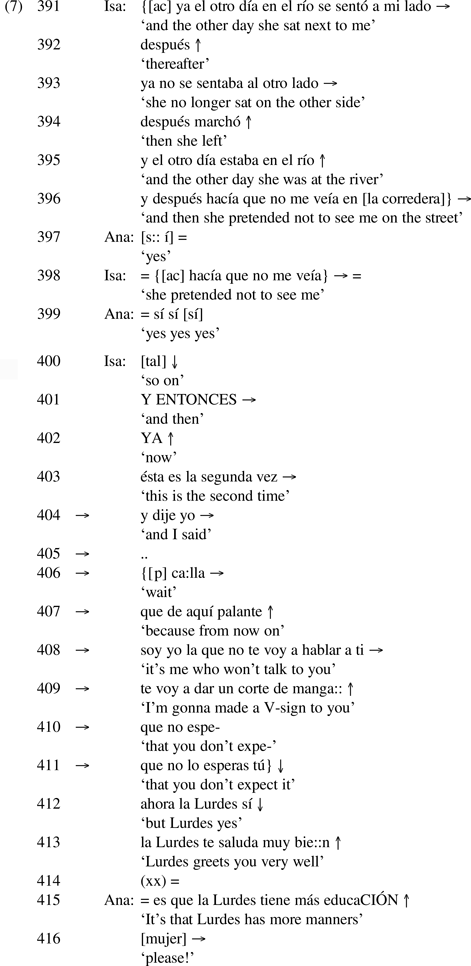
The first turns collected by this extract show the core part of the complaint story, in which Isa is highlighting the surprising or unexpected actions of the antagonist, her old female friend: this woman usually sits next to her in places such as a river beach, but pretends to not have seen her later when they cross on the street (lines 391–96, 398). In talking about these actions, the narrator displays a negative affectionate stance by employing an accelerated tempo and repeating the utterance that refers to the antagonist's misbehaviour during the parade, where she avoids meeting her (lines 396, 398). Immediately following these utterances, Ana communicates understanding and a high level of involvement in the storytelling by using sí ‘yes’ with vowel elongation, s:: í (line 397) and then with reiteration of sí sí [sí] (line 399).
The final part of the storytelling is based on the narrator's use of DRT to stage her mental reaction to this inappropriate and surprising behaviour of the woman (400–411). This DRT is preceded by utterances that announce a conclusion or consequence in relation to the reported behaviour (lines 400–402) and stress that it has been demonstrated twice by the antagonist (lines 403). Isa then constructs a reporting clause based on the verb decir ‘to say’ (line 404) and elaborates a discourse that is directly addressed to this woman (lines 406–11), claiming an intention not to talk to her again and displaying indignation by using the idiomatic expression dar un corte de manga ‘to make the V-sign’ (line 409). This discourse portrays the mental indignant reaction of the narrator-protagonist in view of the antagonist's behaviour. Despite the use of the verb decir ‘to say’ in the reporting clause (line 404), it is contextually deducible that Isa does not construct it as something she said to the woman who avoided meeting her, but as a mental process of reproaching her behaviour and planning her own revenge as a consequence, which she experienced in the situation of the story world. Interestingly, note that the narrator employs a piano voice in staging this mental reaction (406–11), which seems to serve as a contextualisation cue that such discourse was not voiced but produced in the narrator's mind.
This complaint story provides an instance of the construction of DRT that is slightly different to those analysed by Haakana (Reference Haakana, Holt and Clift2007) in narratives of this kind, as it does not introduce a silent criticism against the complainee, in a reported dialogue with him/her, but instead a reaction of the narrator-protagonist reproaching the misbehaviour and planning her own next actions as a consequence. Unlike other instances, the construction of DRT is not linked here to a reported dialogue or DRS, but to a foregoing reconstruction of actions that are socially seen as inappropriate. Moreover, there are no reported first thoughts in this case, probably because the misbehaviour involves a breaking of social rules that has both inappropriate and unexpected results. Thus, the narrator does not need to insert any element providing the reason why the behaviour was surprising and indignant for her, because this can be deduced from those shared social rules. As in other instances, however, the aforementioned complaint story also revolves around a surprising event, which in this case causes an indignant reaction that is staged as a mental discursive process reproaching and planning the subsequent actions against the complainee.
SUMMARY AND CONCLUSIONS
From a formal viewpoint, the analysis in this article has confirmed the similarities between direct reported speech (DRS) and direct reported thought (DRT) noted by previous studies, in that both keep the deictic elements of the original context and can be designed to convey affect (Sams Reference Sams2010). This similar design and the fact that DRT tends not to be introduced by means of the verb to think, as could be expected, can make it difficult to distinguish it from DRS in some cases. In Spanish, the language in which the stories here analysed were produced, the verb pensar ‘to think’ was only used in one case (see line 146 in extract (2)). In the other cases, the reporting clause that introduces DRT is based on the verb decir ‘to say’ or elides the use of any verb, as happens with DRS (see also Acuña Reference Acuña2009, Reference Acuña2011). The possible ambiguities that emerge as a result can often be resolved by considering the discursive and reported context, as has been done through the analysis, while in some cases they can remain.
Haakana (Reference Haakana, Holt and Clift2007) has argued that the ambiguity between DRS and DRT can be intentional in the telling of complaint stories, because this ambivalence makes it possible ‘to give or imply a picture of the situation in which the speaker possibly resisted the antagonist by criticising him or her’ (Reference Haakana, Holt and Clift2007:175). Although this may occur in some cases, my contention is that the use of verbs of saying or the elision of verbs in introducing DRT could be more generally related to the latter's general function as a device to stage the thoughts and states of mind or feelings of the narrator-protagonist as discursive actions, processes, and reactions that are also part of the events of the story world, despite the fact that they were not voiced, but mentally produced, in contrast with DRS. More specifically, it is possible that speakers tend to construct DRT not just as an evaluative element to assert their attitude towards events, but as another important event itself, which is based on the discourse that was produced in their mind as external events were happening. From this perspective, the use of verbs of saying in both DRS and DRT would have to do with the fact that both are understood as reporting dialogues, whether voiced or ‘just’ mental, with oneself. This argument is reinforced if we consider the existence of the introductory formula decir para mí ‘to say to myself’ that I have found in another instance of DRT from my corpus (not analysed here) and that is also included by Labov & Waletzky (Reference Labov, Waletzky and Helm1967) in their list of evaluative utterances in narratives. This formula suggests a vision of thoughts as a process of ‘talking’ to oneself, implying that this is mental and not voiced, because talking aloud with oneself is, socially speaking, considered problematic and a sign of psychological disorders. The omission of the element para mí ‘to myself’ or even of the verb decir ‘to say’ and any other, as we have seen in several instances, in which the narrators use the formula y yo ‘and I’ to introduce both DRS and DRT, can be explained as a device to maximise the level of narrative dynamism by quickly turning to focus on the reconstruction of actions.
Thus, one of my conclusions is that the construction of DRT in conversational storytelling shares certain general functions with DRS in that it contributes to dynamising the narrative process and enhancing involvement (Tannen Reference Tannen1989) by keeping a focus on actions and also embedding evaluations of the story (Labov & Waletzky Reference Labov, Waletzky and Helm1967), thus making it possible to display the narrator's perspectives. The difference with respect to DRS lies, in my view, in the more specific functions. As a staging of mental discursive processes, the inclusion of DRT creates a ‘multi-layered picture’ of the narrated situation (Haakana Reference Haakana, Holt and Clift2007), which is based not only on the reconstruction of external events but also on what happened in the narrator's mind before, during, or after the facts just produced. In this way, narrators provide ‘direct access’ (Holt Reference Holt1996) to the way they internally experience and feel about the events of the story world, displaying intimacy, constructing their self-image, and trying in this way to enlist the audience's affiliation and empathy. As the instances analysed have shown, DRT tends to impact on the audience, provoking a recipient's response or a reaction of some kind (such as laughter and signals of understanding or disagreement). In addition, it has also been demonstrated that DRT can show ‘granular detailing’ (Schegloff Reference Schegloff2000), as most of the instances comprise quite extensive units that indicate the importance given by narrators to the reconstruction of these internal events. The examples included in (5) and (6) have even highlighted the construction of a ‘retelling’ in replaying the thoughts of the narrator-protagonist.
The importance of providing this multi-layered picture of the narrated situation seems to be related to the kind of story that is being told, that is, DRT could be characteristic of certain types of stories. As mentioned earlier, Haakana (Reference Haakana, Holt and Clift2007) demonstrates that it can be produced in complaint stories to introduce a silent criticism of the antagonist in a reported dialogue, which serves to constitute the complaint about this character. Sams (Reference Sams2010) analyses similar examples of complaint stories, along with others that are produced by recipients to contribute to the storytelling. The stories analysed in this article have shown that DRT is employed, on the one hand, to stage an initial perception of the narrated situation that later turns out to be wrong, exaggerated, or inadequate, that is, a first wrong thought (Jefferson Reference Jefferson and Lerner2004) and, on the other, to depict a shocked and/or indignant reaction of the protagonist during or after an external event. Some stories have shown both uses of DRT, while others have shown only one, and most of the external events include DRS. More specifically, we have seen that the first wrong thought is shaped in a range of ways, as a process of worrying, deliberating, lamenting, and blaming or accusing someone in the situation, before the external event, while the reactions are constructed as an exclamation of surprise or astonishment and a process of reproaching and planning a future revenge action. Apart from the fact that all of the stories include some instance of DRT, they share two other important features: they are produced in the first person, and so the narrator is also the protagonist, and they revolve around a positive or negative surprising event—something that clashes either with the initial way of thinking that is portrayed or just with social norms, as is the case with the complaint story in (7).
In this way, the construction of DRT in conversational storytelling can be generally considered as a powerful device for narrators to emphasise the shocking nature of the events they experienced in a certain situation and to illuminate why and how they were moved by them, positively or negatively. For these reasons, it can be hypothesised that this phenomenon would be especially characteristic of stories narrated in the first person, with a high personal nature and strong emotional components, such as complaint stories and the surprising anecdotes considered here. Further research could confirm this hypothesis and continue to explore the specific functions of DRT in other interactional environments, both narrative and nonnarrative, as well as the construction of the indirect style (IRS) and the differences in comparison to DRT.
APPENDIX: TRANSCRIPTION CONVENTIONS