Central line–associated bloodstream infections (CLABSIs) increase risk of prolonged hospitalization, morbidity, and death, and result in substantial financial and nonfinancial costs to health systems and society.Reference Calfee 1 – Reference Scott 3 CLABSI rates can be significantly reduced by implementing a “bundle” of 5 clinical practices: full-barrier precautions, chlorhexidine antiseptic and sterile dressing, optimal vein selection, improved hand hygiene, and prompt removal of unnecessary central line catheters.Reference Mermel 2 , Reference Pronovost, Needham and Berenholtz 4 , Reference Southworth, Henman, Kinder and Sell 5 This bundle, combined with dedicated line insertion and maintenance teams, checklists to ensure practice consistency, and practitioner education, has led hospital intensive care units (ICUs) to see significant and sustained CLABSI rate reductions.Reference Lipitz-Snyderman, Needham and Colantuoni 6 – Reference Weeks, Goeschel, Cosgrove, Romig and Berenholtz 9
Given strong evidence supporting the effectiveness of these programs, the Joint Commission and the Department of Health and Human Services set the goal of “zero CLABSIs” as a policy tool to mobilize hospital stakeholders, resulting in a proliferation of coordinated state and local quality improvement initiatives and widespread implementation of CLABSI reduction programs.Reference Weeks, Goeschel, Cosgrove, Romig and Berenholtz 9 – Reference Srinivasan, Wise and Bell 13 These efforts contributed to an estimated 58% CLABSI rate decrease in US ICUs between 2001 and 2009.Reference Srinivasan, Wise and Bell 13 However, while some hospitals have virtually eliminated CLABSIs in their ICUs, others continue to struggle to attain and/or sustain near-zero rates.Reference Lipitz-Snyderman, Needham and Colantuoni 6
Organizational differences in achieving successful reductions are evident within one of the largest and most successful initiatives: the Comprehensive Unit-based Safety Program (CUSP)—a formal model for translating CLABSI reduction evidence into practice—developed at Johns Hopkins University and disseminated by the Agency for Healthcare Research and Quality (AHRQ).Reference Pronovost, Needham and Berenholtz 4 , Reference Pronovost, Goeschel and Colantuoni 7 By 2013 there was a decrease of 41% in the overall rate of CLABSI infections among hospitals implementing this program. 14 Additionally, 68% of units reported zero CLABSIs for at least one quarter, up from 30% at baseline. Although these statistics demonstrate program efficacy and the feasibility of achieving “zero,” variability across participating ICUs was evident, and not all hospitals achieved or maintained zero infections, possibly owing to inconsistency in protocol implementation within and across hospitals.
Evaluations of CLABSI prevention programs proposed organizational factors—leadership and management practices—as potential explanations for program success, including the CUSP final report and a post hoc analysis of the Michigan Keystone project by Dixon-Woods et al. 14 , Reference Dixon-Woods, Bosk, Aveling, Goeschel and Pronovost 15 However, as Dixon-Woods et al state, “we did not try to describe the contextual factors that might have modified the effectiveness of the program in different settings.”Reference Dixon-Woods, Bosk, Aveling, Goeschel and Pronovost 15 To help fill this gap in the literature, we conducted an extensive qualitative exploratory study of 8 sites that participated in the first wave of AHRQ’s CUSP program and compared management strategies present at higher- vs lower-performing hospitals. We propose a “management bundle” to incorporate identified best practice strategies and provide corresponding implementation suggestions.
METHODS
Site Selection
Site selection was a multi-step process. First, we reviewed baseline and post intervention hospital-level CLABSI outcome data for the first 2 cohorts of the AHRQ’s CUSP CLABSI prevention initiative. Although nearly all of the participating hospitals showed notable improvements after the intervention, some hospitals had virtually eliminated CLABSIs and maintained those results for 6 months or longer. We classified these hospitals as higher performers, and we designated as lower performers the hospitals that demonstrated less consistent results—for example, variation between units or occasional sharp upticks in their infection rate trends. Next, we paired higher- and lower-performing hospitals according to key organizational characteristics (ie, size, number, and size of ICUs, teaching status, and geography). We then presented short lists of potential sites to CUSP project staff to obtain their perspective about the sites as comparators and as candidates for extensive study. We worked through CUSP staff at the national and state levels to invite sites to participate in our study; all sites we approached agreed to participate. Because one site originally identified as lower-performing had substantially improved by the time of our analysis, we reclassified this site as higher-performing. Therefore our final, purposive sample included five higher-performing and three lower-performing hospitals.
Study Sites
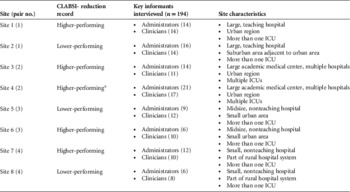
The 8 study sites ranged in size from 300-bed single hospitals to 1,000-plus-bed health systems and included community hospitals, teaching hospitals, academic medical centers, and health systems. The sites were located throughout the East Coast and Midwest and there were no differences by type between pairs of higher- and lower-performing hospitals (Table 1).
Case Study Sites and Key Informants Interviewed

NOTE. CLABSI, central line–associated bloodstream infection; ICU, intensive care unit.
a Site 4 was selected initially as “lower-performing” based on CLABSI data and input from the project liaison. However, because this site had made a successful turnaround since the Comprehensive Unit-based Safety Program concluded, we categorized this hospital as “higher-performing” for the purposes of our study.
Data Collection
During 2-day visits between June 2011 and October 2012 to each of the 8 hospitals, 3 research team members conducted a total of 194 in-person interviews lasting 30 to 60 minutes each. Interviewees included administrative leaders, clinical leaders, professional staff, and frontline physicians and nurses. We interviewed a similar mix of key informants at each site, using 2 versions (ie, clinical and nonclinical) of a semi-structured interview guide. Questions were about organizational change related to healthcare-associated infection initiatives as well as facilitators and barriers to that change. To ensure consistency and accuracy of our data, interviews were audio-recorded with participant consent and then transcribed verbatim.
Analysis
We used a constant comparative analytic approach involving both inductive and deductive methodsReference Glaser and Strauss 16 to analyze 1,236 pages of interview transcripts and determine what distinguished higher- and lower-performing sites. First, a coding team overseen by the lead investigator identified broad themes on the basis of the interview guide and developed a preliminary coding dictionary. Data were then classified into categories of findings following the methods described by Constas.Reference Constas 17 The team next developed code lists and a coding frame. A doctoral student who had been involved in the research from its inception coded the transcripts, working closely with the principal investigator to ensure consistency and accuracy. We used the Atlas.ti, version 6.0, qualitative data analysis software to support our analysis. 18
RESULTS
Strategies for Prevention of Healthcare-Associated Infection Evident at Higher-Performing Hospitals
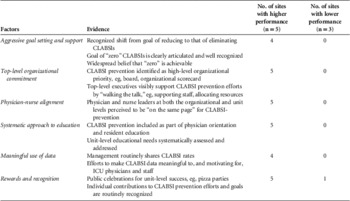
We identified 6 management strategies that distinguished higher- from lower-performing hospitals. These factors are briefly described below and summarized in Table 2. Unless otherwise noted, we considered strategies in higher-performing hospitals to be distinctive when there was evidence the strategy was in place in at least 4 of the higher-performing hospitals and in no more than 1 lower-performing hospital.
Factors Differentiating Higher- and Lower-Performing Hospitals

NOTE. CLABSI, central line–associated bloodstream infection; ICU, intensive care unit.
1 . Aggressive goal setting and commitment to “zero” CLABSIs. All of the hospitals in our study stated a goal of eliminating CLABSIs, referring frequently to their desire to “get to zero.” However, at higher-performing sites this goal was more explicitly stated, widely embraced, and aggressively pursued. In contrast, staff at lower-performing hospitals regarded “getting to zero” as aspirational, with many interviewees suggesting they did not actually believe it was “realistic” to completely eliminate CLABSIs.
Notably, many of the interviewees at the higher-performing hospitals indicated that they had also started out thinking that CLABSIs were an unavoidable “cost of doing business,” but now believed these infections could be eliminated. This shift was attributed to mounting evidence from other organizations and care units that had successfully eliminated CLABSIs. One interviewee described this cognitive shift from the physicians’ perspective.
“I think our doctors, like doctors around the country, have finally bought in to the fact that you can get to zero. I think they didn’t agree with that [previously], and we would hear ‘our patients are sicker.’ But as the data has shown around the country, it is possible to get to zero.”
—infection preventionist
Many ICU clinicians and staff identified this aggressive goal as a clear motivator for consistently focusing on CLABSI reduction, continually pushing themselves to go longer and longer between infections. In contrast, interviewees from lower-performing hospitals were satisfied with continual decreases in rates and/or adequate performance relative to benchmark institutions. This acceptance of lower standards was reflected by one executive who noted, “I understand that we will never be at zero; I am impressed that we are low as we are.”
2. Top-level commitment. One of the hallmarks of higher-performing organizations was visible top-level leadership commitment to CLABSI prevention as an organizational goal. In all of these hospitals, CLABSI prevention had been adopted as a board-level initiative and/or a priority for the overall organizational performance “scorecard.” One interviewee, for example, said that success “starts with the CEO,” and requires “100% commitment” from top leaders. Others noted the importance of having leaders who “walked the talk” by providing resources and/or other support to CLABSI prevention. Within the lower-performing sites, CLABSI prevention appeared to be more a unit-based effort than an organization-wide initiative, with few interviewees even mentioning a role for top leaders.
3. Physician-nurse alignment. Higher-performing hospitals also showed strong alignment and collaboration between physician and nurse leaders at all organizational levels. Informants indicated that having cross-disciplinary leaders who were “on the same page” about CLABSI goals and approach was an important success factor. In some of the hospitals, alignment occurred through formal organizational structure—for example, a shared nurse/physician leadership model; in others, it was simply reflected in positive relationships and effective communication. The pair of quotes below, from the chief medical and chief nursing officers at one higher-performing hospital, illustrate the importance of physician-nurse collaboration from both perspectives.
“Leadership is important, [as is] the ability of leaders to work together and be candid with each other. It’s a hard job… and my relationship with [the chief nursing officer] and the entire nursing team is good…. It is a pleasure to work with that group.”
—chief medical officer
“We do not draw a clear line in the sand with me on the nursing side and [the chief medical officer] on the physician side. I probably spend as much time with physician issues, and she probably spends as much time with nursing care. At the end of the day, it’s really a patient care issue. We are not afraid to be in each other’s peer group.”
—chief nursing officer
Among the lower-performing sites, interviewees did not mention positive physician-nurse relations as a component of CLABSI prevention efforts.
4. Systematic approach to education. Education in the higher-performing hospitals was described as systematic, comprehensive, and repetitive. Whereas all hospitals had education programs for clinicians, only the high-performers indicated CLABSI prevention topics were included as part of physician orientation and resident education, as well as being reintroduced through in-service programs and communications when protocol changes occurred or reminders were needed. Higher-performing hospitals also systematically assessed and addressed unit-level educational needs, ensuring that new hires were properly oriented and gaps in practice were addressed.
5. Meaningful use of data. One of the most noteworthy characteristics of the higher-performing hospitals was that nearly everyone involved in CLABSI prevention clearly knew the CLABSI rates and trends on their units. Leaders recognized that sharing data in multiple venues—at staff meetings, via emails, and by posting in break rooms and other common spaces—was important to fostering a shared sense of responsibility among frontline clinicians and staff. One unit manager summarized these efforts: “We usually do four or five different modes of information sharing. We’ll do emails. There’s a Friday communication from our manager. There’s a communication that I’ll do weekly. We have an educator newsletter that goes out.”
As a result of these efforts, frontline clinicians and staff at the higher-performing hospitals were well aware of their current CLABSI rates, understood the reports, and enjoyed seeing improvement in the data. Management and staff-level interviewees talked about both a “sense of pride” that they felt when they saw their rates improve and, in contrast, disappointment when infections occurred. Although some of the lower-performing hospitals had posted and/or shared data, staff often did not know about the data and/or did not understand the data or its relevance to their clinical work.
6. Rewards and recognition. In addition to more systematically sharing CLABSI data, higher-performing hospitals more regularly provided recognition when goals and milestones were met. Unit-level leaders in particular made a point of publicizing and celebrating their units’ major CLABSI-prevention accomplishments. These celebrations ranged from simple recognition at staff meetings, to posters and newsletters lauding the accomplishment, to larger celebrations, such as a management-sponsored pizza party when the unit hit a major milestone (eg, a CLABSI-free year). Many frontline staff indicated these celebrations made them feel that management understood and appreciated how hard they had worked to make the practice changes that led to improved outcomes.
Beyond group celebrations, leaders also actively recognized specific individuals for their contributions to the unit’s success. Overall, this recognition both motivated and encouraged continued commitment among staff. The lower-performing hospitals, in contrast, tended to place less emphasis on recognizing success. When they did so, the activities were less visible and meaningful to staff and, as interviewees in one hospital indicated, the staff still felt underappreciated by management in general.
DISCUSSION
In contrasting higher- and lower- performing hospitals on the basis of success with CLABSI prevention, several management practices stood out, including commitment to zero, leadership support, physician-nurse alignment, systematic education, meaningful use of data, and rewards and recognition. Many of the factors distinguishing these higher-performing hospitals are similar to those shown to be important elements of other evidence-based quality improvement effortsReference Kaplan, Brady and Dritz 19 – Reference Poon, Blumenthal, Jaggi, Honour, Bates and Kaushal 21 and patient safety interventions.Reference Taylor, Dy and Foy 22 In fact, a few months after the conclusion of study data collection in 2012, the Johns Hopkins CUSP program published a CUSP implementation framework that includes several elements of the management practices we identified in our study, specifically top-level support, multidisciplinary teams, education, and the use of data. 23
However, many of the CUSP framework elements presented by Johns Hopkins did not emerge in our study as strategies important to success, and others had a different focus. For example, the CUSP framework listed education as an element, described as the need to “train staff in the science of safety.” Our findings revealed that successful education focused more specifically on CLABSI prevention topics and clinical techniques such as implementing infection prevention practices rather than general education about patient safety. Most importantly, our finding that goal definition distinguished higher-performing hospitals is new. We found that aiming for general improvement seemed far less motivating than aiming for an absolute standard of zero CLABSIs. This apparent association mirrors anecdotal reports in the literature.Reference Kuehn 24 However, ours is the first study to formally explore and highlight this aspect of CLABSI program success and to identify management strategies supporting the zero infections goal specifically, as well as program success generally.
Our findings suggest an important fourth and final step in CLABSI program implementation and evaluation.Reference Dixon-Woods, Bosk, Aveling, Goeschel and Pronovost 15 The first 2 steps were to (1) identify a clinical bundle capable of eliminating CLABSIs and (2) develop a set of clinical practice interventions to implement the bundle.Reference Pronovost, Needham and Berenholtz 4 The third step was to spread the CUSP program nationwide to demonstrate the program efficacy and the ability to achieve “zero.” 14 The persistent variability in success rates across hospitals after this third step highlighted the need for a fourth step—identifying organizational and management factors that are critical to successful implementation of the CUSP program. In 2012 CUSP took this step by publishing the CUSP framework discussed above. Our study expands this work by comparing practice variation between higher- and lower-performing hospitals and expands the evidence base for this fourth step.
Management Bundle for CLABSI Prevention Interventions
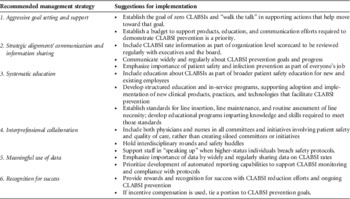
Based on the 6 management strategies we identified as common to high-performing hospitals, we developed a bundle of management strategies and corresponding suggestions for implementation of these management practices. We present these strategies in Table 3 in the order they would be introduced during a CLABSI prevention program.
Management “Bundle” for CLABSI Prevention Interventions

NOTE. CLABSI, central line–associated bloodstream infection.
Although our management bundle is based on evidence for use of these specific management practices as mentioned by interviewees at the higher-performing organizations, we do not suggest that this set of strategies should be implemented broadly in its current form. We instead propose this list of best practices as a guide to future studies. The appropriate next steps are to explore the presence of elements of this bundle in larger-scale studies and compare the bundle elements with those of the published CUSP framework to determine the relative weights of the different strategies, edit this bundle accordingly, and then experiment with implementing a revised CLABSI CUSP framework that includes both a clinical practice bundle and a management practice bundle. As the first step in this process, the results of our study have important implications for policy and practice within hospitals and their ICUs because they highlight the importance of specific managerial practices in support of the typical clinical bundle. Without attention to these management practices, significant variation in CLABSI rates may persist, even within defined programs for prevention of healthcare-associated infection.
Limitations
Several study limitations are important to note. One relates to the small number of hospitals involved. The substantial resources required to conduct systematic qualitative studies pose a significant barrier to conducting larger-scale studies. Future work can include the development of surveys based on this research to explore and validate our findings in larger samples, including assessing whether implementation of our proposed best practices is associated in quantitative models with greater reductions in CLABSI rates. An additional limitation concerns external generalizability. All of the hospitals in this sample participated in the CUSP project; a study using a broader sample of hospitals might find additional or stronger differences in management and organizational factors associated with higher performance. A third limitation is that despite the strength of the qualitative evidence presented, causation may run in a different direction—for example, as CLABSI rates decline, group beliefs and behaviors may also change. If this were the case, retrospective accounts of how the teams reduced CLABSIs might mention practices that were more a product of success in reducing CLABSIs than contributors to their success.
CONCLUSIONS
Results of this research suggest that some of the between-hospital variability in success when implementing a defined CLABSI prevention program may relate to specific management practices focused on “getting to zero” infections. Hospitals currently vary widely with respect to the strategies they use to support implementation and use of clinical CLABSI prevention bundles. If the management bundle proposed in this study is verified through larger-scale work, it may benefit the field to expand the concept of clinical practice bundles to include a management practice bundle as well.
Acknowledgments
We are grateful to the hospitals and individuals who participated in this study.
Financial support. AHRQ (contract #HHSA290200600022).
Potential conflicts of interest. All authors report no conflicts of interest relevant to this article.
Disclaimer. The views expressed in this paper are solely those of the authors and do not represent any US government agency or any institutions with which the authors are affiliated. AHRQ solicited the research through a competitive task order awarded under its pre-competed ACTION II contract. To ensure fulfillment of the terms of the task order, the Agency’s representative reviewed deliverables from the study describing study design, conduct; collection, management, analysis, and interpretation of the data; and the resulting manuscript. However, this review allowed the research team autonomy to exercise its scientific judgment in all of the above project phases. Conduct of this research was reviewed and approved by the institutional review board of the Ohio State University.