

Introduction
Rice, Oryza sativa L. (Poaceae), is a staple food for about half of the world's population and about three-quarters of a billion of the world's poorest people depend on it (Heong and Hardy, Reference Heong, Hardy, Heong and Hardy2009). Lowland rice accounts for more than 75% of the world's annual supply, but it is affected by biotic and abiotic threats. Globally, India leads in rice production area with 44.3 million ha, but productivity is only 75% of the world's average of 4.02 t/ha (Anonymous, 2009). Rice, the major crop of the state of Punjab, is cultivated over an area of 2.80 million ha with an annual production of 11.23 million tons (Anonymous, 2011a). Insect pests, diseases and weeds are major factors limiting rice productivity. More than 100 species of insects are known to be pests of this crop, of which 20 are of major economic significance (Pathak and Dhaliwal, Reference Pathak and Dhaliwal1981). In general, yield loss in rice crops due to insect pests has been estimated to be about 25% (Dhaliwal et al., Reference Dhaliwal, Jindal and Dhawan2010) to 30–40% (Heinrichs et al., Reference Heinrichs, Saxena and Chelliah1979).
It is essentially a crop growing in warm, humid environments conducive to the survival and proliferation of the yellow stemborer (YSB) Scirpophaga incertulas (Walker), the leaffolder (LF) Cnaphalocrocis medinalis (Guenée) and the whitebacked planthopper (WBPH) Sogatella furcifera (Horvath) (Ye et al., Reference Ye, Yao, Shu, Cheng, Hu, Xia, Gao and Altosaar2003; Savary et al., Reference Savary, Castilla, Elazegui and Teng2005). The LF is a destructive and widespread pest throughout the rice-growing regions in South and Southeast Asia. Depending on crop age at the time of infestation, the damage caused by the LF ranges between 18.3 and 58.4% (Ramasamy and Jatileksono, Reference Ramasamy, Jatileksono, Evanson, Herdt and Hossain1996). The damage is positively related to the percentage of damaged leaves (Bautista et al., Reference Bautista, Heinrichs and Rejesus1984). The YSB is the dominant species in India, and it causes maximum damage at the tillering and flowering stages (Nair, Reference Nair1975). It can cause 18–40% damage to rice crops (Senapati et al., Reference Senapati, Samalo and Patnaik1990; Anonymous, 2006). For every unit increase in whitehead damage, a l–3% yield loss may be expected (Pathak and Khan, Reference Pathak and Khan1994; Dale, Reference Dale and Heinrichs1994; Muralidharan and Pasalu, Reference Muralidharan and Pasalu2006). Similarly, Rubia and Penning de Vries (Reference Rubia and Penning de Vries1990) observed an almost proportional yield reduction due to simulated whitehead damage. The WBPH is an important phloem sap-sucking pest of rice. A severe attack of WBPH causes ‘hopper burn’ (Horgan, Reference Horgan, Heong and Hardy2009). It has become a serious threat to rice cultivation in most of the rice-growing countries including India, causing 8–80% yield losses under variable conditions of insect abundance, varieties, crop age, agronomic practices and insecticide usage (Kushwaha and Chand, Reference Kushwaha and Chand1988; Ramaraju et al., Reference Ramaraju, Babu and Venugopal1996; Heong and Hardy, Reference Heong, Hardy, Heong and Hardy2009).
Water and labour are the two major factors required for a good rice harvest, and both these factors are becoming more costly and less accessible day by day in Asia (Naklang et al., Reference Naklang, Fukai and Nathabut1996; Greenland, Reference Greenland1997; Vorosmarty et al., Reference Vorosmarty, Green, Salisbury and Lammers2000). Although rice cultivation by transplantation is generally considered the superior method, direct sowing has been successful in some parts of the world (Adair et al., Reference Adair, Beachell, Jodon, Davis and Jones1992; Weerakoon et al., Reference Weerakoon, Mutunayake, Bandara, Rao, Bhandari and Ladha2011), as it saves both labour and water. Direct seeding reduces the labour required for the cultivation of transplanted rice crops by half. In recent years, Indian Punjab farmers have also started adopting alternative crop establishment methods, e.g. bed transplantation and flat puddled transplantation for resource conservation (Anonymous, 2011a). However, there is a lack of information on the effects of different rice crop establishment methods on insect pest damage and grain yield. Therefore, the present study was carried out to determine the effects of different crop establishment methods on insect-induced injury with the objective of developing more effective integrated pest management (IPM) strategies.
Materials and methods
Crop
This study was carried out during two wet cropping seasons at the Rice Research Area, Punjab Agricultural University, Ludhiana, India, situated at 30°54' North and 75°48' East. The seeds of ‘PR 118’ variety were sown at a rate of 20 kg seed/ha on 20 and 24 May in 2005 and 2006, respectively, to raise the nursery for conventional, bed and furrow transplanting methods of crop establishment. This rice variety is resistant to some of the pathotypes of the bacterial leaf blight pathogen prevalent in Punjab. Transplanting and direct seeding were carried out on 22 and 25 June in 2005 and 2006, respectively, in plots of size 5 × 5 m. The experiment was carried out in a randomized block design with five replications. Individual plots were separated by water channels.
Field preparation
Conventional transplanting
The transplantation of seedlings at a rate of two seedlings/hill was carried out in well-puddled plots by maintaining a row–row and plant–plant spacing of 20 × 15 cm to ensure that there were 33 seedlings/m2. Water was kept standing in the plots for 2 weeks after transplantation. Later, irrigation was applied after the infiltration of the standing water into the soil (Anonymous, 2011a).
Bed transplanting and furrow transplanting
Beds (67.50 cm wide) and furrows (30 cm wide) were prepared in the plots by using a wheat bed planter without puddling. The beds and furrows were irrigated and immediately transplanted (two seedlings/hill) by maintaining a plant-to-plant distance of 9 cm to ensure that there were 33 seedlings/m2. In the first fortnight, irrigation water was applied to just pass over the beds and in furrows once in 24 h. Thereafter, irrigation was applied only at 2-day intervals after the infiltration of the standing water into the soil. In this way, 25% of the total applied irrigation water can be saved without affecting the grain yield.
Puddled direct seeding
In the puddled direct seeding (PDS) method, 50 kg/ha of seeds were water-soaked for 24 h. After decantation, the seeds were placed as a thin layer in between two wet gunny bags for up to 2 days for germination. The pre-germinated seeds were then broadcast seeded manually in the already puddled treatment plots. Light irrigation was applied when the seedlings grew to a height of 3–4 cm and after the infiltration of water into the soil. This method eliminates transplantation shock and farmers can also save water and labour.
In all the treatments, a fertilizer at rates of 125 kg/ha N, 30 kg/ha P2O5 and 30 kg/ha K2O was applied (Anonymous, 2011a). One-third of nitrogen and all of the phosphorous and potassium were applied before the last puddling/field preparation. The remaining nitrogen was broadcast into two split applications: one 3 weeks after the transplantation and the other 3 weeks later. For controlling pre-emergence weeds, a spray of Anilofos 30 EC at a rate of 1250 ml/ha was applied after the weeds had been hand-pulled once (Anonymous, 2011a). No insecticide was applied.
Insect pest damage assessment
The leaves were considered damaged if at least one-third of their area was showing the symptoms of C. medinalis damage. The larvae fold the leaves and scrape the green tissues within, causing scorching and leaf drying. The number of damaged leaves and the total number of leaves per hill were recorded from five hills selected randomly per replication, and the percentage of damage was calculated. After hatching, the larvae of S. incertulas descend towards the base and crawl between the leaf sheath and stem and feed on the green tissues of the leaf sheath. The caterpillars then bore into the stem to produce deadhearts (DHs) and whiteheads, both of which were recorded along with the number of total tillers and panicle-bearing tillers. The percentage of DHs and whiteheads was calculated based on five hills selected randomly per replication. The S. furcifera population build-up was determined from five hills selected at random per replication. The hills were slightly tilted and tapped two to three times at the base. Planthoppers seen floating on the water or that had fallen to the ground were counted. Observations were recorded at 10-day intervals, starting 40 days after transplanting (DAT) or days after direct seeding (DAS).
Grain yield
Grain yield on a plot basis was recorded after harvesting/threshing the crop manually, and it is expressed as q/ha.
Statistical analysis
The incidence of damage caused by the stemborer and LF and population counts of WBPH were statistically analysed using the SPSS v. 14.0 (SPSS Institute, 2006) package involving the general linear model of two-way ANOVA with interaction. The error variances were heterogeneous, so a pooled analysis weighted least square was used, with the weights being the reciprocal of the root mean square error. The differences in treatment means were compared using Tukey's test.
Results and Discussion
LF C. medinalis infestation
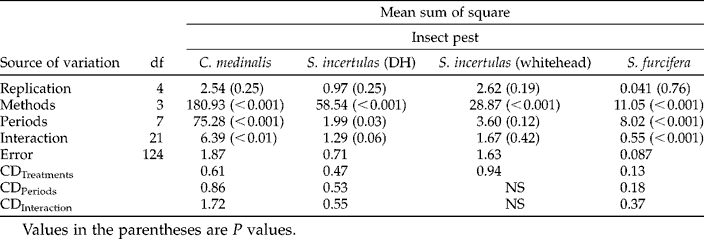
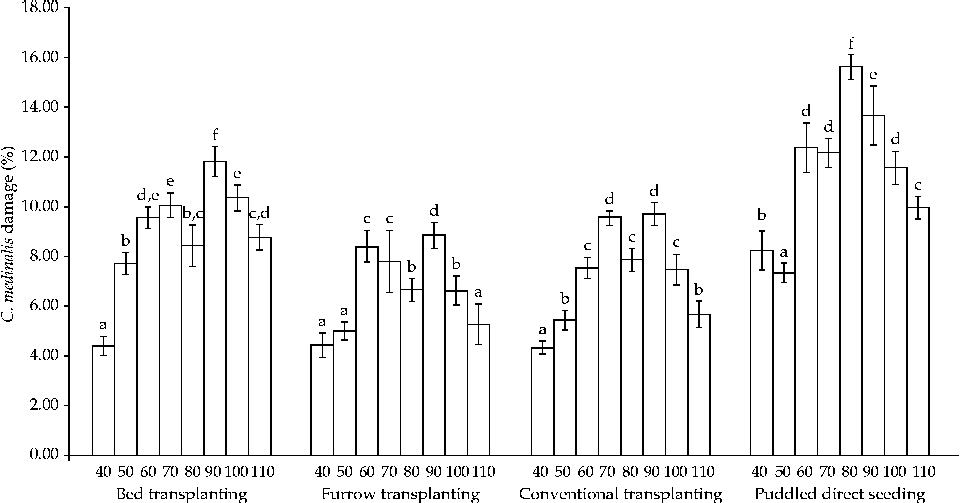
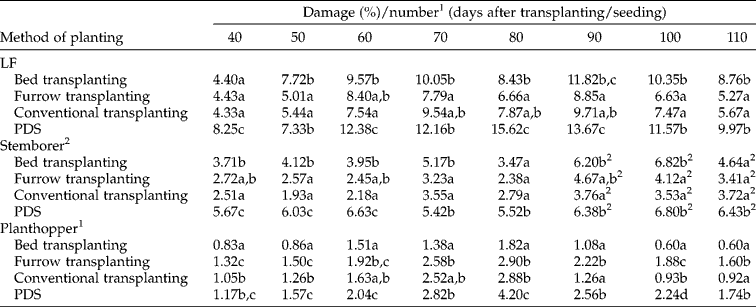
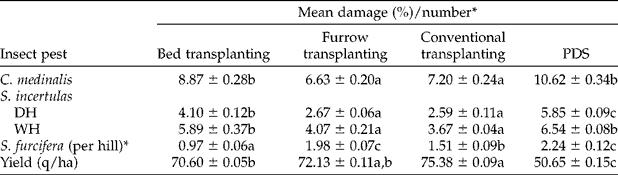
The mean incidence of leaf damage over the years varied significantly among the different crop establishment methods (F 3,124= 96.67; P< 0.001) and across the observation days (F 7,124= 40.22; P< 0.001). The interaction between crop establishment methods and observation days was significant (F 21,124= 3.4; P< 0.01) (Table 1; Fig. 1). Across the different observation days, the number of damaged leaves was significantly higher in the furrow-transplanted (8.85%), bed-transplanted (11.82%) and conventionally transplanted (9.71%) crop at 90 DAT, while high damage was observed earlier at 80 DAS in the puddled direct-seeded crop (15.62%) (Fig. 1, Table 2). Broadly, leaf damage was significantly higher in the case of puddled direct seeded crop (7.33–15.62%) than in the crop grown using the other crop establishment methods, while it was generally lower in the furrow-transplanted (4.43–8.85%) and conventionally transplanted (4.33–9.71%) crop (Table 2, Fig. 1). For the mean of observation days and years, leaf damage was significantly lower in the furrow-transplanted (6.63%) and conventionally transplanted (7.20%) crop than in the bed-transplanted (8.87%) and puddled direct seeded (10.62%) crop (Table 3). These findings were corroborated by the findings of the study of Weerakoon et al. (Reference Weerakoon, Mutunayake, Bandara, Rao, Bhandari and Ladha2011), who reported that LF infestation was 58 and 54%, respectively, in direct-seeded rice crops in Sri Lanka during two cropping seasons.
ANOVA indicating the source of variation, degrees of freedom (df), mean sum of squares and probability level for insect pest damage/number

DH, deadheart.
Values in the parentheses are P values.
Overall effects of different rice crop establishment methods on the incidence of Cnaphalocrocis medinalis (mean ± SE). Bars having the same letters are non-significantly different at P= 0.05.
Overall effect of different methods of crop establishment on the incidence of leaffolder (LF), stemborer and planthopper on rice w.r.t. observation days
PDS, puddled direct seeding; data having same letters are non-significantly different at P= 0.05.
1 Population of planthoppers recorded in different crop establishment methods over different days.
2 Whitehead percentage; planthopper population.
Overall effects of different rice crop establishment methods on the incidence of insect pests and yield
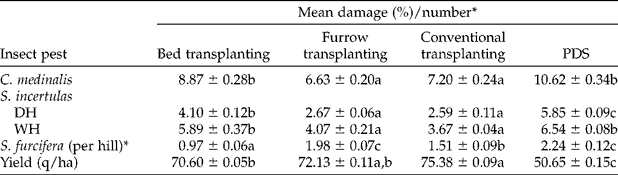
PDS, puddled direct seeding; DH, deadheart; WH, whitehead.
* S. furcifera population; data having same letters are non-significantly different at P= 0.05.
Agronomic practices play an important role in crop health, insect pest infestation and crop productivity. The higher damage caused by the LF in the puddled direct-seeded crops in the present study was due to the clumpy growth of plants leading to the intermingling of leaves, which provides favourable conditions for the folding of leaves and easy leaf-to-leaf movement of the larvae. Previous studies have also reported higher LF damage in the direct-seeded rice crop than in the conventionally transplanted rice crop (Savary et al., Reference Savary, Castilla, Elazegui and Teng2005; Anonymous, 2011b). Among the other crop establishment methods, as in the case of the system of rice intensification, higher damage was recorded in the direct-seeded plots than in the conventional transplanting rice plots (Ravi et al., Reference Ravi, Rajendran, Raju, Murlidharan, Chandrasekaran and Balasubramanian2006; Mahajan and Sarao, Reference Mahajan and Sarao2009).
A significant interaction was observed between the crop establishment methods and DAT/DAS when the effect of DAT/DAS on the incidence of LF damage was examined using a non-linear regression analysis. The incidence of damage followed a quadratic pattern with DAT/DAS, where a quadratic equation explained 69–85% of the variability across the different methods (Fig. 1). The contribution of the cubic component to the quadratic equation was very small and non-significant.
Stemborer S. incertulas (DH) infestation
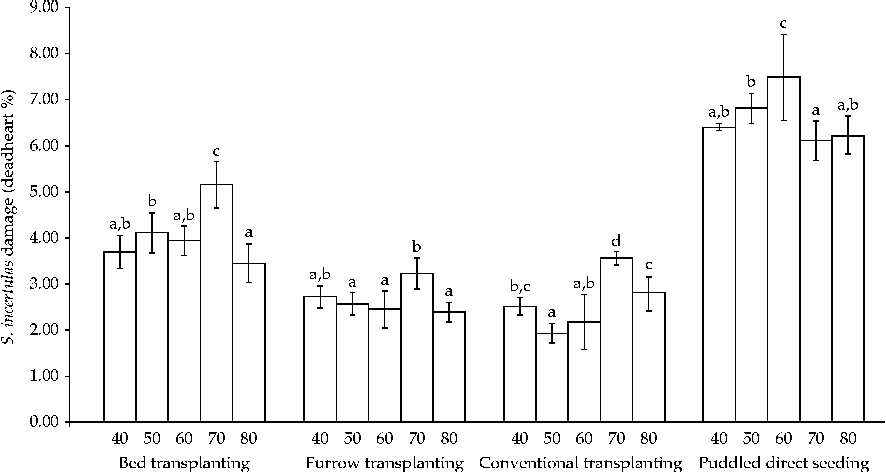
The incidence of DH damage varied significantly among the different crop establishment methods (F 3,76= 82.66; P< 0.001) and across the observation days (F 4,76= 2.81; P= 0.03). The interaction between crop establishment methods and observation days was significant (F 12,76= 1.83; P= 0.06) (Table 1, Fig. 2). Among the different crop establishment methods and across the observation days, DH damage was significantly higher in the furrow-transplanted (3.23%), bed-transplanted (5.17%) and conventionally transplanted (3.55%) crop at 70 DAT, while a high rate of damage was observed earlier at 60 DAS in the puddled direct-seeded crop (6.63%) (Fig. 2). It was significantly higher in the puddled direct-seeded crop (5.42–6.63%) than in the crop grown using the other crop establishment methods on all the observation days except 70 DAS, while it was generally lower in the furrow-transplanted and conventionally transplanted crop across the observation days (Table 2). The mean of observation dates and years for DH damage was significantly lower in the furrow-transplanted (2.67%) and conventionally transplanted (2.59%) crop than in the bed-transplanted crop. Highest DH damage (5.85%) was observed in the puddled direct-seeded crop (Table 3). These findings were in line with those of the study of Oyediran and Heinrichs (Reference Oyediran and Heinrichs2001), who reported high stemborer damage in direct-seeded rice crops. Savary et al. (Reference Savary, Castilla, Elazegui and Teng2005) also recorded high stemborer damage in poor water-managed rice crops. Similarly, Weerakoon et al. (Reference Weerakoon, Mutunayake, Bandara, Rao, Bhandari and Ladha2011) reported that stemborer infestation was 24 and 20%, respectively, in direct-seeded rice crops in Sri Lanka during two cropping seasons.
Overall effects of different rice crop establishment methods on the incidence of Scirpophaga incertulas (DH) (mean ± SE). Bars having the same letters are non-significantly different at P= 0.05.
In PDS plots, plants were in close proximity, which assists in the movement of larvae from one plant to another, causing severe damage. In the bed transplanting method, plant height is among the several morphological factors positively correlated with the number of eggs laid by females and it leads to high damage (Pathak et al., Reference Pathak, Andres, Galacgac and Raros1971; Sarao and Mahal, Reference Sarao and Mahal2012). The close planting of rice seedlings has also been validated to increase stemborer damage (Sharma et al., Reference Sharma, Gill and Dhaliwal1995; Sarao and Mahal, Reference Sarao and Mahal2006).
Stemborer S. incertulas (whitehead) infestation
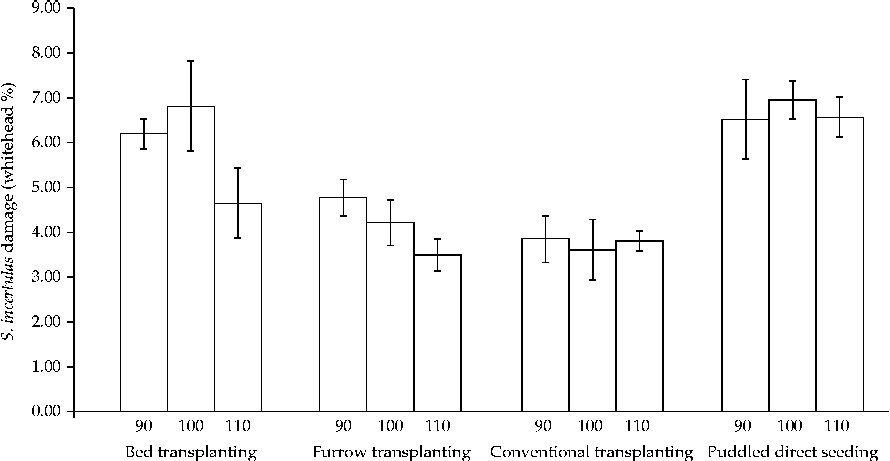
The incidence of whitehead damage varied significantly among the different crop establishment methods (F 3,44= 17.69; P< 0.001). However, whitehead damage across the observation days (F 2,44= 2.21; P= 0.12) and the interaction between crop establishment methods and observation days (F 6,44= 1.02; P= 0.42) were non-significant (Table 1, Fig. 3). Over the years, whitehead damage was significantly higher in the puddled direct-seeded rice crop from 90 to 110 days after seeding (6.38–6.80%), whereas it was lowest in the conventionally transplanted crops (3.53–3.76%) (Table 2). The mean incidence of whitehead damage over the years and observation dates was significantly higher in the puddled direct seeded and bed-transplanted crop, whereas it was lowest in the furrow-transplanted and conventionally transplanted rice crop (Table 3).
Overall effects of different rice crop establishment methods on the incidence of Scirpophaga incertulas (whitehead) (mean ± SE).
As an interaction was observed between the crop establishment methods and DAT/DAS, the effect of DAT/DAS on the incidence of SB damage was examined using a non-linear regression analysis. The incidence of damage followed a quadratic pattern with DAT/DAS, where the quadratic equation explained 36–66% of the variability across the different methods (Fig. 2).
WBPH S. furcifera population
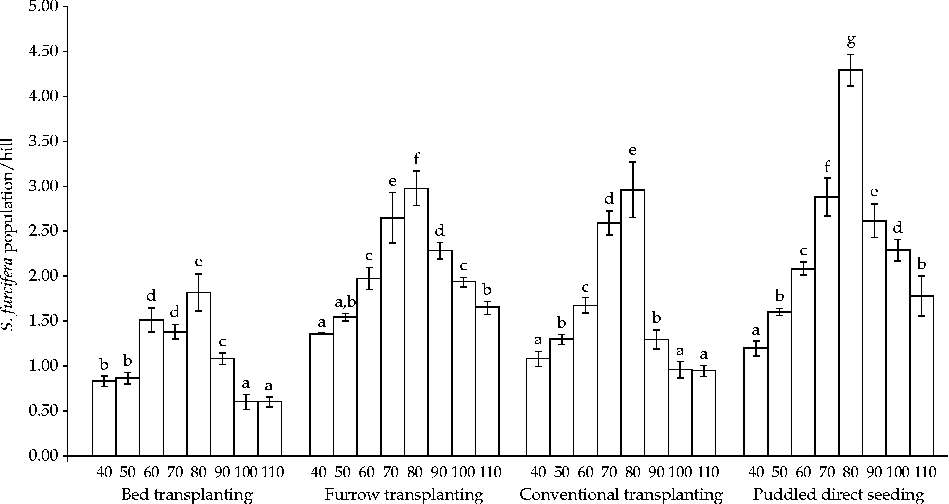
The mean population build-up of S. furcifera over the years differed significantly among the different crop establishment methods (F 3,124= 126.80; P< 0.001) and across the observation days (F 7,124= 92.0; P< 0.001). The interaction between crop establishment methods and observation days was significant (F 21,124= 6.32; P< 0.01) (Table 1; Fig. 4). The population build-up was significantly higher for all the crop establishment methods at 80 DAT/DAS (Table 2). Planthopper population build-up was significantly higher in the furrow-transplanted (1.32–2.90 hoppers/hill) and puddled direct-seeded (1.17–4.20 hoppers/hill) crop (Table 2). Similarly, the mean planthopper population build-up over the years and observation dates was significantly higher in the puddled direct seeded and furrow-transplanted crop, whereas it was lowest in the bed-transplanted rice crop (Table 3).
Overall effects of different rice crop establishment methods on the Sogatella furcifera population (mean ± SE). Bars having the same letters are non-significantly different at P= 0.05.
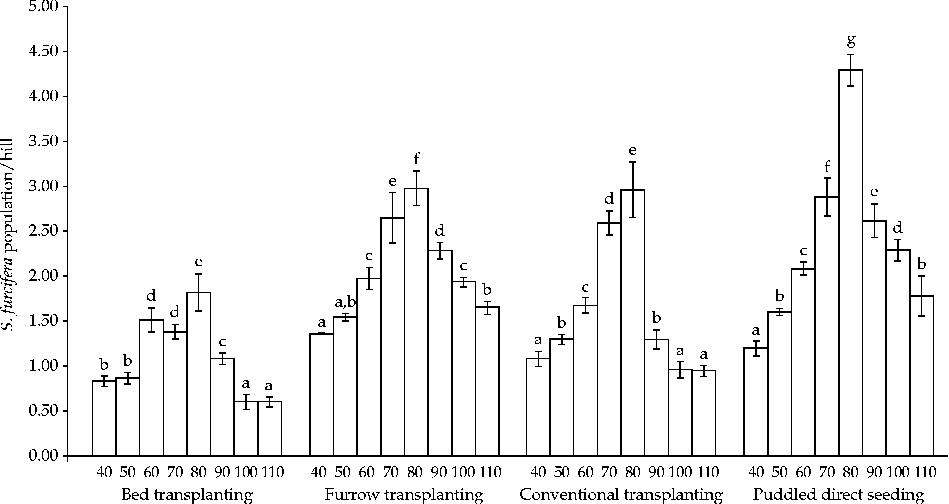
PDS results in closer plant establishment, which may have helped to change the microclimate conducive for the multiplication and build-up of hoppers. Similarly in furrow transplanting, conditions remain more humid, which is favourable for a higher population build-up. These findings were supported by the findings of the study of Savary et al. (Reference Savary, Castilla, Elazegui and Teng2005), who also reported a higher planthopper population build-up in direct-seeded rice crop. Similarly, Weerakoon et al. (Reference Weerakoon, Mutunayake, Bandara, Rao, Bhandari and Ladha2011) also reported that brown planthopper population build-up was 23 and 31, respectively, in direct-seeded rice crop in Sri Lanka during two cropping seasons. A closer planting system has also been reported to favour an increased population build-up of rice insect pests (Sain et al., Reference Sain, Bentur and Kalode2001; Sarao and Mahal, Reference Sarao and Mahal2006).
A significant interaction was observed between the crop establishment methods and DAT/DAS and the effect of DAT/DAS on the WBPH population as examined using a non-linear regression analysis. The WBPH population followed a quadratic pattern with DAT/DAS, where the quadratic equation explained 61–80% of the variability across the different methods (Fig. 4). The contribution of the cubic component to the quadratic equation was very small and non-significant.
Yield
The paddy yield differed significantly among the different crop establishment methods (Table 3). It was significantly higher (F 3,12= 74.57; P< 0.001) in the conventionally transplanted, furrow-transplanted and bed-transplanted crop, while it was lowest in the puddled direct seeded crop (Table 3). The LF and stemborer damage appeared earlier and at a high intensity in the puddled direct-seeded rice crops, which may have caused yield loss. Oyediran and Heinrichs (Reference Oyediran and Heinrichs2001) also recorded a higher yield in transplanted rice crops than in the direct-seeded rice crops.
Conclusion
The present study thus provides an overview of complex interlinked processes and suggests that the PDS crop establishment method results in higher damage and population build-up by C. medinalis, S. incertulas and S. furcifera. This crop establishment method also needs further refinement for precision agriculture, as the broadcasting of seeds leads to the clumpy growth of plants in the field. Therefore, agronomists should devise and evaluate an appropriate crop establishment method that significantly reduces insect pest damage and increases crop yield. Dry direct seeding or aerobic rice cultivation is one step towards this type of crop establishment method, which can be incorporated into IPM strategies for sustainable rice cultivation.
Acknowledgements
The authors thank the Senior Rice Breeder, Rice Section, Department of Plant Breeding and Genetics, and Head, Department of Plant Breeding and Genetics, for providing facilities for the smooth conduct of the experiments.