We draw on a growing interdisciplinary literature on the use of heuristics to argue that individual citizens condition their use of political heuristics on the context in which they participate in politics (Gigerenzer, Hertwig and Pachur Reference Gigerenzer and Gassmaier2011). Further, and perhaps more controversially, we argue that they “choose” heuristics (likely subconsciously) that are, in a specific sense explained below, rational.
After developing our general argument, we apply it to the question of how Americans infer the voting behavior of their US senators. This question has been the subject of several recent studies, which have established that most Americans use a simple partisanship heuristic to infer how their senators voted on important bills before Congress (Ansolabehere and Jones Reference Ansolabehere and Jones2010; Dancey and Sheagley Reference Dancey and Sheagley2013). Our theory, however, leads us to push beyond these findings and to hypothesize that the use of this partisanship heuristic will be conditioned by the political context in which citizens form their beliefs. Specifically, we argue that individuals will condition their use of the partisanship heuristic on the extent to which the senator in question is a party loyalist or a “maverick”—with individuals in less loyalist contexts using the partisanship heuristic less often than those in more loyalist contexts.
In the next section, we flesh out the general argument that motivates this hypothesis, pointing out that our approach differs from the usual focus of the American-centered literature on heuristics in that our principle concern is explaining contextual-level variation in heuristic use, rather than individual-level; although, our theory also bears implications for individual-level variation, which we also investigate. Because our focus is unusual and our definition is taken from an emerging interdisciplinary literature on heuristics, rather than the political science literature directly, we take special care to place our study in the context of the extant political science literature on heuristics and discuss the informational requirements our model places on citizens in detail. Next, we investigate how individuals can come to understand (even if subconsciously) the relevant features of the political context upon which they condition their use of the partisanship heuristic and discuss the role of political sophistication in this process. Finally, we present an empirical test of the argument using individual data from the 2006 Cooperative Congressional Election Study and contextual data capturing each senator’s historical record of party loyalty in legislative voting. Building on the study by Ansolabehere and Jones (Reference Ansolabehere and Jones2010), we construct an empirical model that accounts for the confounding influences of voter preferences and true information to isolate behaviors consistent with heuristic use. To preview, we find very strong support for our hypothesis that context conditions the use of the partisanship heuristic. Further, our analysis reveals several other intriguing phenomena, including the way that voters treat freshman senators (for whom there is no record of legislative voting on which to condition their heuristic application) and how political interest heightens sensitivity to political context, causing high interest voters (relative to their lower interest counterparts) to apply the partisanship heuristic more often for loyal senators and less often for disloyal senators. We conclude by briefly discussing the normative implications of our research and summarizing the relevant takeaways for political scientists.
Models of Information Processing, Heuristics, and “Ecological Rationality”
Students of mass political behavior are increasingly taking an “information processing” approach to the study of political attitudes, beliefs, expectations, and behaviors (Lodge, McGraw and Stroh Reference Lodge and Hamill1989; Zaller Reference Zaller1992; Kuklinski and Hurley Reference Kuklinski and Hurley1994; Lupia Reference Lupia1994; Lupia and McCubbins Reference Lupia and McCubbins1998). In this paradigm, the main concern is understanding how an individual selects from and processes the stream of political messages he or she receives in order to form beliefs and make decisions. Much of this work has argued that this processing “throws away” much of the political information individuals encounter—instead mixing a small amount of carefully selected information with simple rules of thumb that map this information to complex political cognitions (like attitudes, beliefs, and expectations). Borrowing from Gigerenzer and Gassmaier (2011) and Gigerenzer, Hertwig and Pachur (Reference Gigerenzer and Gassmaier2011), we take the combination of these kinds of simple informational inputs and the corresponding rules that map them to a given complex cognition to define a heuristic.Footnote 1
Defined in this way, it would not be too much of a stretch to characterize much of the “information processing” literature as an attempt to both identify the heuristics (the relevant informational inputs and applicable cognitive rules) that individuals use to produce various complex cognitions and behaviors, and to understand how these heuristics allow individuals to produce more or less “rational” cognitions (Lupia and McCubbins Reference Lupia and McCubbins1998) or create persistent biases in them (Zaller Reference Zaller1992).
Examples of this agenda in political behavior research focused on the American case (by far the most studied case in the literature) include Nicholson’s (Reference Nicholson2012) study of the polarizing effects of in/out-group dynamics, Lau and Redlawsk’s (Reference Lau and Redlawsk1997, Reference Lau and Redlawsk2001) research on correct voting and information search, and Lodge and Hamill’s (Reference Lodge, McGraw and Stroh1986) classic work on partisan bias in information absorption and recall. Dancey and Sheagley’s (Reference Dancey and Sheagley2013) recent article on voters’ beliefs about the legislative behavior of their senators is an exemplar of the heuristic approach to information processing. Their study argues (and finds) that the average American forms her beliefs about the legislative voting of her senators by applying the partisanship heuristic, which mixes two informational inputs—a senator’s party affiliation and his party’s positions on legislation—with a simple rule: “senators vote with their party.” Our goal in this paper is to build on these results and others (e.g., Ansolabehere and Jones Reference Ansolabehere and Jones2010; Carson et al. Reference Carson, Koger, Lebo and Young2010) by shifting the focus from the question of whether voters use a partisanship heuristic to the questions of when or under what conditions they use it and how its usage varies contextually.
Our answers to these questions draw on (and we hope ultimately contribute to) an emerging literature in political behavior pointing to the critical role that political and institutional context plays in determining the kinds of political heuristics voters in those contexts use (Fortunato and Stevenson Reference Fortunato and Stevenson2013, Reference Fortunato and Stevenson2016; Duch, Przepiorka and Stevenson Reference Duch, Przepiorka and Stevenson2014). This literature draws, in turn, on a broader multidisciplinary effort to develop theoretical tools (including conceptual language and measurement strategies) for identifying the specific differences in context that condition heuristic use (Goldstein and Gigerenzer Reference Goldstein and Gigerenzer2002; Smith Reference Smith2003; Gigerenzer, Hertwig and Pachur Reference Gigerenzer and Gassmaier2011).
This general literature suggests that a heuristic will be used when it is “ecologically rational” in the context in which it is to be applied. That is, when it is less costly than alternative information processing strategies (including the costs of collecting relevant informational inputs and the cognitive costs of processing these inputs) and produces—on average—sufficiently accurate inferences, given the costs. Specifically, an ecologically rational heuristic should either be more accurate—again, on average—than other alternative information processing strategies that have similar (or lesser) costs, or, if less accurate than an alternative strategy, be sufficiently less costly that it is still “rational” to use it overall.Footnote 2 To put it more simply, ecologically rational heuristics are those that are cheap, simple, and accurate in a given context. Consequently, when these features of a heuristic differ across contexts, we should expect its use to differ accordingly. Our focus here will be on the empirical regularities (in this case, the legislative voting patterns of senators) that make a heuristic more or less accurate in a given context. Note this is distinct from previous work examining how context conditions the relative value of informational inputs (e.g., Huckfeldt Reference Huckfeldt2007) or how individual differences condition heuristic choice quality (e.g., Lau and Redlawsk Reference Lau and Redlawsk2001), though we see our contribution as complimentary to this work.
We can illustrate the concept of the ecological rationality of a heuristic with a simple example. Several scholars (e.g., Goldstein and Gigerenzer Reference Goldstein and Gigerenzer2002; Pohl Reference Pohl2006) have studied how individuals use a simple recognition heuristic to discriminate between a pair of items on a given criterion—for example, to report which of a given pair of cities is the largest. The recognition heuristic applied to this question takes a single piece of information—whether the individual recognizes the name of one city but not the other, recognizes both cities, or recognizes neither—and mixes it with the simple rule: “if I recognize one city but not the other, the one I recognize is likely to be larger, otherwise I don’t know.” When this heuristic discriminates between cities (i.e., the subject recognizes one city but not the other) subjects consistently choose the recognized city as the largest.
Why do they do this? Goldstein and Gigerenzer (Reference Goldstein and Gigerenzer2002) argue that they do so because it is almost always (i.e., in all contexts) ecologically rational for individuals to use the recognition heuristic in this task. Specifically, the informational inputs the heuristic requires are essentially costless, the rule is simple to apply, and the inferences generated by the heuristic are very likely to be right for most people. That is, the contexts in which most individuals come to recognize city names or not (the media environment, social interactions, educational experiences, etc.) all tend to produce a strong positive correlation between recognition and city size and, somehow, individuals “know” this correlation and instinctively rely on it to answer the question.
Consider now a similar task in which the recognition heuristic is not ecologically rational in most contexts. Suppose that rather than choosing which of two cities is the largest, one is asked which of the cities is closer to Edinburgh? Pohl (Reference Pohl2006) asked just this type of question to a group of subjects and almost none of them used the recognition heuristic to answer it. Why? Because even though applying such a heuristic is certainly as cheap and simple as in the previous example, it is not nearly as accurate. And, importantly, Pohl’s subjects intuitively understood this (as, no doubt, most readers will).Footnote 3 There are few contexts (if any) in which city name recognition will have a high correlation with the distance of the city from Edinburgh, therefore most individuals will not reach for the recognition heuristic when faced with this task.
The logic of this simple example serves in more complex scenarios as well. In a recent paper (Fortunato and Stevenson Reference Fortunato and Stevenson2016), we present evidence suggesting that the different heuristics voters might use to generate expectations about which governing coalitions are likely to form (in parliamentary democracies) differ in their cost, simplicity, and accuracy (i.e., their ecological rationality) across countries and that the use of these different heuristics corresponds to this variation. For example, in countries in which there is a strong correlation between a party’s ideological distance from the prime ministerial party and their chance of getting into a cabinet, voters use an ideological compatibility heuristic to form expectations about who will join a given PM in cabinet. In countries where this correlation is weaker, use of the heuristic is diminished.
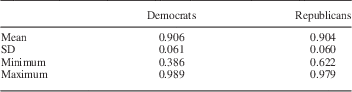
Examining use of the partisanship heuristic to infer legislative voting in the US Congress is a nearly ideal first application of ecological rationality to political science because it isolates a single moving parameter: accuracy. As we argue below, we expect little systematic difference across contexts in the cost or simplicity of this heuristic; however, we have good reason to believe that its accuracy varies substantially across contexts. Specifically, while there is a great deal of party-line voting in the 105th through the 109th Senates (the period leading up to the administration of the survey with which we test our arguments), there is significant variation across senators—ranging from a high of 99 percent loyalty (John Kerry in the 108th Senate) to a low of 39 percent (Zell Miller in the 108th Senate). More generally, the party loyalty of individual senators in a given session tends to vary from nearly perfect to about 65 percent (keep in mind that 50 percent means the senator splits her votes between Democratic and Republican coalitions perfectly and her party label is therefore uninformative). Table 1 describes loyalty in senate voting over this period by party in a bit more detail.
Description of Senator Loyalty by Party for the 105th–109th Congresses

Thus, the main hypothesis we propose to test in the paper is that voters with senators who have historically voted with their party at lower rates (i.e., “mavericks”) will apply the partisanship heuristic less often than those who have senators who are party loyalists. More formally:
Ecological Rationality Hypothesis: Voters with less reliably partisan senators will use the partisanship heuristic less often than voters with more reliably partisan senators.
Before assessing this hypothesis, we consider a few theoretical issues. First, we discuss the information inputs required to apply the partisanship heuristic and whether it is reasonable to assume that voters possess them. Second, we consider how individual differences in political interest and sophistication should interact with context to condition the use of the partisanship heuristic.
The Informational Inputs of the Partisanship Heuristic
The partisanship heuristic requires voters to have two pieces of information: the party affiliation of their senator and the party’s position on the issue in question. Information on the first of these is widely available and our survey evidence suggests that it is also widely known. In the roughly 52,000 respondent–senator pairings in our final data, the respondent identified the party of the senator correctly about 82 percent of the time. That said, this information is not costless and, in accordance with the idea of ecological rationality, if its cost were to vary by state or by senator that would be a potential source of contextual variation in the use of the partisanship heuristic. However, there is little evidence of this kind of variation in our data and the prima facie case that it would be harder to obtain information about one’s senator in one state or the other strikes us as weak.
The second piece of information that is necessary to apply the partisanship heuristic is an understanding of what position the parties have taken on the legislative vote in question. Few scholars, including us, would credit the idea that most voters have detailed information about the parties’ positions and votes on specific bills (or even direct knowledge that the bills were considered). However, it is also clear that most voters understand the parties’ general ideological positions and that (perhaps as a consequence) many have accurate perceptions of party positions on at least a few important and salient issues. To take one example, in an April 2012 survey, the Pew Research Center found that 71 percent of respondents knew the Republicans were the more conservative party. Further, about two-thirds believed, correctly, that Democrats are more supportive of gay rights, raising income taxes, and providing a “path to citizenship” for illegal immigrants (Pew 2012, 2). The survey included seven issue questions in total and a brief analysis showed that, controlling for a respondent’s age, gender, and education, the probability of correctly identifying the parties’ relative positions on these issues increased by about 30 percent if one understood the relative positions of the parties on the more general liberal–conservative dimension.Footnote 4 These findings (and many others like them) imply that, while most voters may lack direct knowledge of party positions on specific bills, many can use their general understanding of the left-right or liberal–conservative dimension to infer the positions of parties on salient issues.
This gives us some confidence in the assumption that many of the 2006 Cooperative Congressional Election Survey (CCES) respondents know (or can infer) the parties’ positions on the kinds of salient issues they were asked about in that survey.Footnote 5 That said, the close empirical connection between knowledge of the parties’ relative positions on the general left-right ideological dimension and their relative positions on specific, salient, issues suggests that we can maximize the applicability of our assumption by limiting our sample to respondents who correctly place the Democrats to the left (more liberal) of the Republicans when asked to evaluate party ideologies (clearly a prerequisite to using general ideologies to correctly infer party positions on specific policies). Likewise, since our first informational criterion for applying the partisanship heuristic is knowing the partisanship of the senator in question, we can also exclude respondents who did not have this information. In the end, we proceed with a sample of respondents that seem to possess both of the informational prerequisites to apply the partisanship heuristic and note that the conclusions we draw from the analyses below pertain only to those that possess the requisite informational inputs.Footnote 6
How Do Voters Come to Know Senators’ Historical Party Loyalty?
We do not believe that most voters consciously collect information about the partisan loyalty of their senators. Rather, we argue (consistent with almost all work on the ecological rationality of heuristics) that this contextual information (which is necessary to discriminate between contexts in which the partisanship heuristic will be more or less ecologically rational) gets transmitted through social institutions (the media, schools, etc.) and interpersonal interactions. In the case of senatorial voting behavior, it is likely that the media plays the most important role in building this kind of background knowledge (i.e., a voter’s sense of whether their senator is a loyalist or maverick)—a notion consistent with the tone of other recent work that finds fairly extraordinary connections between legislative behaviors and voters (e.g., work showing that variation in congressional voting patterns is closely reflected in the attitudes and behaviors of the electorate—see Levendusky Reference Levendusky2009; Ansolabehere and Jones Reference Ansolabehere and Jones2010; Carson et al. Reference Carson, Koger, Lebo and Young2010). Importantly, we in no way claim that voters directly absorb the record of roll call votes, whether through the media or in some other way, but instead argue that voters come to a general sense of their senators’ partisan loyalty based on a media narrative that is a reflection, but not a carbon copy, of their real legislative behaviors.
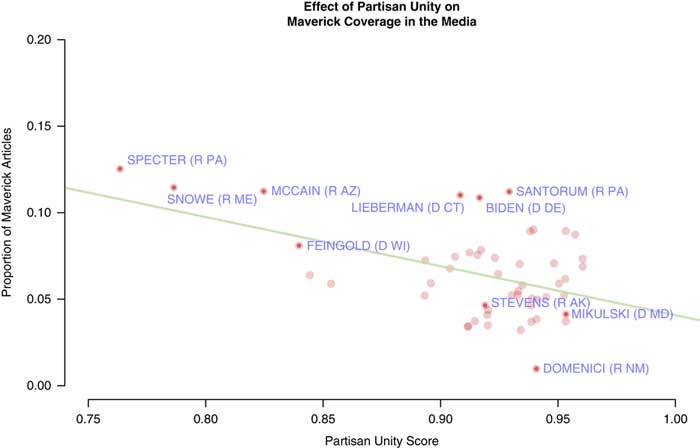
This media mechanism for connecting relatively opaque legislative behaviors to voters has struck most researchers (including those cited above) as so obvious as to require no empirical justification. It is possible, however, to examine the plausibility of the assumption that qualitative information about senatorial voting behavior is made available to voters in media messages. Specifically, we can examine whether the language used in news stories about loyalist senators differs systematically from the language used for maverick senators. Thus, while we do not attempt a sophisticated media analysis here (since our purpose is only to illustrate the plausibility of our assumptions), we do create a simple estimate of media-transmitted historical party (dis)loyalty for the senators that served in each of the five terms leading up to the 2006 CCES. This identifies almost all stories in US newspapers and television news broadcasts about each senator in this period (1997–2006) and calculates the proportion of these news articles mentioning the senator that also included language relevant to party disloyalty.Footnote 7
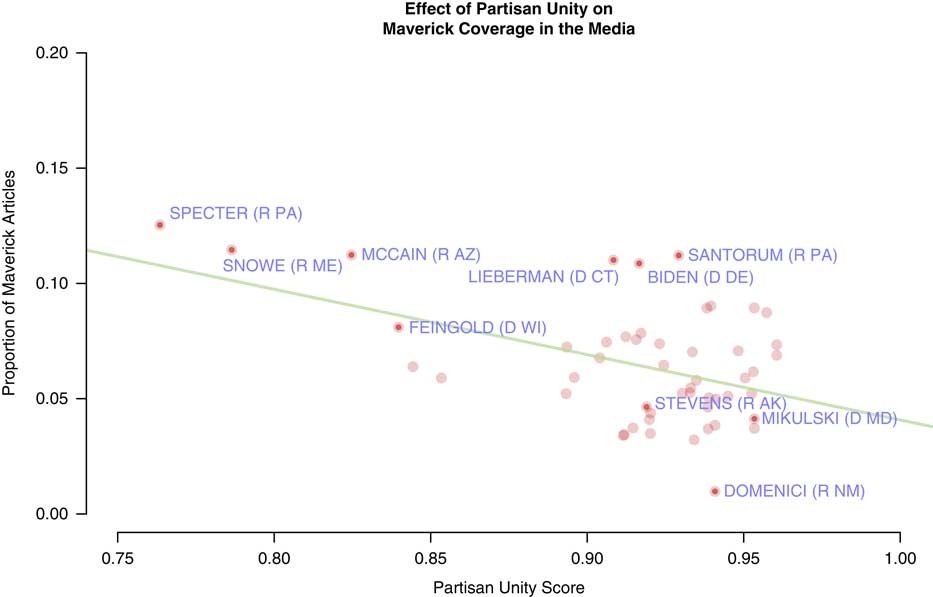
We compared this measure with the senators’ historical party unity score over the same period. The latter measure is simply the number of votes on which the senator voted with the majority of their party over the total number of votes the senator cast for the 105th–109th Senates. The raw data are plotted in Figure 1. The plot shows that our measure of the media message about a senator’s partisan disloyalty has a significant negative correlation with his or her unity score over the period. Further, the specific senators identified in the extremes of the graph are those we would expect to see. For example, a much greater proportion of the stories about Senators McCain, Snowe, and Specter contain language indicating partisan disloyalty than for Senators Stevens and Mikulski. Though there are, indeed, a few notable outliers (Senator Lieberman, for example), the relationship between real voting behavior and the media narrative on party loyalty is quite robust.Footnote 8 This evidence, though not meant to be definitive, certainly points to the plausibility that information about the party loyalty of different senators is available to voters via the media, at least in terms of a general characterization of the extent to which senators tend to be party loyalists or mavericks.
The relationship between media coverage of senators’ partisan disloyalty and their observed record of party unity.
Finally, we conclude this section with another question about the information environment in which voters might come to know the partisan loyalty of their senators: what do they do when their senator has no voting history? The data we analyze in the empirical sections below include a number of freshman senators. It is reasonable to ask whether voters use a partisanship heuristic, simply guess, or do something else in these cases. Usefully, our data will let us answer this question definitely, but, in our view a theory based on the ecologically rational use of heuristics would have to conclude that voters in such contexts will use a partisanship heuristic. The reason is simply that across all contexts (i.e., across states and senators) the average senator is a party loyalist and so voters’ default long-term correlation between partisanship and legislative voting behavior—in the absence of the kind of countervailing information about “maverickiness” detailed above—should, in our view, be high, thus inducing an ecologically rational use of the partisan heuristic for freshman senators.
Political Sophistication and the Partisanship Heuristic
If media coverage is the mechanism through which individuals come to have information about the long-term correlation between partisanship and legislative behavior in their particular political contexts, as the results in the last section suggest, then it is a simple (and well documented; Zaller Reference Zaller1992) step between that and the hypothesis that more politically interested, sophisticated, or aware individuals will be more likely (consciously or otherwise) to correctly evaluate the ecological rationality of the partisan heuristic (as applied to legislative voting) in their particular context. Thus, in our view the role of political sophistication and/or interest in our theoretical story is not to simply increase or decrease the use of the partisan heuristic generally, but rather to enhance the extent to which such individuals use the partisanship heuristic in contexts where it is appropriate to do so.
This hypothesis is very much in spirit of Sniderman, Brody and Tetlock (Reference Sniderman, Brody and Tetlock1991) and Lau and Redlawsk (Reference Lau and Redlawsk1997) who argued that some political knowledge and motivation is required to use heuristics effectively. Likewise, it complements Lau and Redlawsk’s (Reference Lau and Redlawsk2001) later finding that using a heuristic increases the probability of a correct vote for political sophisticates but may decrease it for the less politically sophisticated. In both cases, the claim is that politically interested and sophisticated individuals are able to use heuristics to enhance the quality of their political choices; for us, by using them in contexts where they are more likely to lead to accurate or otherwise satisfying choices; and, for Lau and Redlawsk, by increasing the chances of a “correct” vote.Footnote 9 Finally, this hypothesis, while not contradicting Dancey and Sheagley’s (Reference Dancey and Sheagley2013) findings, does add considerable nuance to their empirical predictions.
Data and Model Construction
In this section, we present the data and construct the empirical models used to test our main hypothesis as well as to explore related questions like how voters assess the likely voting behavior of freshman senators and how variation in general political interest over respondents impacts our findings. We use data from the 2006 CCES. Among other things, this survey asked respondents how each of the senators from their state voted on seven bills that had recently come up for a vote in the Senate: a ban on “partial birth abortion,” government funding of stem cell research, the withdrawal of American troops from Iraq, a path to legal citizenship for illegal immigrants, an increase to the minimum wage, an extension for the capital gains tax cut, and a free trade agreement between the United States and several Central American countries. The survey also asked voters how they would have voted on the issues themselves, as well as their perceptions of the general ideological positions of the parties, their own ideological positions and party affiliations, a battery of political knowledge and interest questions, and other standard demographics. Recent articles using these data by Ansolabehere and Jones (Reference Ansolabehere and Jones2010) and Dancey and Sheagley (Reference Dancey and Sheagley2013) provide a detailed discussion of the survey as well as much of the relevant descriptive data, so we do not repeat that information here.Footnote 10
These data are complicated—consisting of individual choices of one of three alternative responses (a perceived “yea” vote, “nay” vote, or a “don’t know”) to questions about two different senators and seven different issues—and so the models that we ultimately need for a careful test of our hypothesis are correspondingly complex. Before describing those various complexities, however, we discuss our model in more simple terms.
Ignore for a moment the question of context and ask simply how we could use these data to establish that individuals are using a partisanship heuristic. One strategy relies on the idea that if respondents are using the partisanship heuristic, they should (1) report that their senator will vote the party line on all issues and (2) this report should be unresponsive to the senator’s actual vote. Thus, we can conceptualize a test for the use of the partisanship heuristic as a regression of (1) an indicator for the senator’s party’s position on an issue (call this variable party position) and (2) an indicator of the senator’s actual vote on the issue (call this variable true vote) on a dependent variable indicating whether the respondent thought her senator voted for the bill or not. If most voters were using the heuristic on most issues, the coefficient on party position should be large and the coefficient on true vote should be 0. If the latter coefficient is non-zero and positive (i.e., a senator casting a vote for the bill leads respondents to be more likely to report the senator voted for it), we may conclude that there are individuals in the sample who are not using the partisanship heuristic but rather direct knowledge of senatorial votes or, at least, some process that implies or reflects direct knowledge.Footnote 11 The larger this coefficient is relative to that on party position, the more important is this effect relative to the partisanship heuristic (and vis-à-versa). Finally, if both coefficients are 0, we can conclude that most voters are simply guessing.
Given this setup, we can now see how to add a test for our contextual hypothesis to the model. We can simply add each senator’s historical party unity score to the model interacted with party position and true vote. If our hypothesis is correct, the interaction with party position will have a large positive coefficient (i.e., more historical party-line voting leads to a greater chance that the respondent will report that her senator has voted the party line).
One important wrinkle in this setup is that respondents were allowed three possible responses to the questions about senatorial votes: “yea”, “nay”, or “don’t know.” Consequently, we need a statistical model that is appropriate for modeling unordered, discrete choices. In what follows we use mixed logit models. In our case, these models require that we include two constructed variables for each conceptual variable (see Train Reference Train2009). This proliferation of right-hand-side variables complicates presentation and interpretation of the results. However, the essential character of the proposed inference is the same despite these complications: we want to know the effect of party position and how this changes across contexts. In the actual model specification (reported in the section A2 of the online appendix) these effects are captured with appropriate sets of dummy variables and interactions, making interpretation of the coefficients quite complex. Thus, in the text we report substantive effects that combine all these coefficients appropriately and compare those instead.
The main variables of interest in the empirical model are historical party unity, party position, true vote, and (most importantly) their interactions. However, there are also two other important substantive variables that we will examine in the empirical work that follows—the respondent’s level of political interest and whether a given senator has any voting record with which respondents’ might condition their perceptions of his or her legislative behavior. Our theoretical story suggests that in contexts defined by loyalist senators, almost all voters would do well to use a partisanship heuristic rather than direct knowledge of votes. However, it is likely the politically interested have some direct knowledge of their senator’s legislative behavior simply as a side-effect of consuming a great deal of political news. Thus, it is important that we allow the relative use of the partisanship heuristic to vary over respondents with different levels of political interest. We can do this simply by interacting our true vote and party position (as well as with the interaction of these variables with historical party unity) with a measure of the respondent’s political interest.
In addition, our theoretical story about the impact of context depends on the idea that there is some historical record of a senator’s behavior that defines the relevant contextual cue for applying (or not) the partisanship heuristic. This condition is clearly not met for freshman senators and so we include an interaction between true vote and party position with an indicator for whether the senator in question is a freshman.Footnote 12 Given that the average senator is a party loyalist, our expectation is that voters will assume freshman are as well. Of course, it is possible that they do not make this assumption and instead report “don’t know” responses in this case. Thankfully, our empirical design can easily discriminate between these possibilities.
Finally, other factors (both measured and unmeasured) may confound our inferences about the relationships of interest. Thus, we attempt to measure possible confounders as well as model the unmeasured variation in the data by exploiting the hierarchical nature of our data to specify and estimate a series of error components (random intercepts). Below we take up these tasks in turn.
Policy and Partisan Projection
The first set of control variables concern the possibility that respondents may project their own views about an issue onto their senators (Wilson and Gronke 2000; Ansolabehere and Jones Reference Ansolabehere and Jones2010). Thankfully, the CCES included questions asking respondents how they would have voted on each of our seven issues. Thus, we can include a set of dummy variables in the empirical models indicating whether the respondent preferred a “yea” vote, a “nay” vote, or had no preference. In addition, we can interact these variables with indicators of the respondent’s partisanship (specifically whether he or she identifies with the same party as the senator in question, called co-partisans) to allow for the possibility that respondents’ projections may be stronger if they are projecting onto a co-partisan. This also allows for the possibility that respondents may project the position they dislike onto senators from the opposing party.
The second set of controls is the interaction of co-partisans and the senators’ true votes. These are included to account for the potential that respondents may have differing levels of real information about the behaviors of senators given their partisanship. For example, senators may receive more scrutiny from opposing partisan constituents. Alternatively, constituents may have greater levels of direct information on the behavior co-partisan senators. One way or the other, it is important to account for these possibilities.
The final set of policy and partisan controls is meant to control for out-group effects on behavioral expectations. It is possible that respondents whose senator is from the opposing party are more likely to believe their senator votes the party line (Nicholson Reference Nicholson2012). The intuition here is that out-group behaviors are more likely to be oversimplified and that the natural bias of constituents is to assume that all opposing party legislators are essentially “party clones.” Thus, we include an interaction of party position and co-partisans.
Characteristics of Respondents
Earlier research using this same data includes several individual-level factors for which we also account. Specifically, Dancey and Sheagley (Reference Dancey and Sheagley2013) found significant differences in levels of political information across socio-economic groups as well as significant differences in the willingness to give “don’t know” responses across gender. To prevent these differences from influencing the estimates of our variables of interest, we include the same demographic controls used by Dancey and Sheagley: gender, race (white or otherwise), income, and education.
Controlling for Unmeasured Variables by Leveraging the Hierarchical Data Structure
The rows of our data fall into in a variety of natural groupings. These include rows that refer to the same senator, rows that refer to the same issues, and rows that refer to the same respondent. The danger of data like these is that rows falling into the same group (say, that are by the same respondent) will be correlated with one another due to unmeasured variables at that group level (say, a personality trait that causes a respondent to be more likely to say “don’t know” in response to all questions). If unaccounted for, such correlation will corrupt our estimates of effects and uncertainty (Steenbergen and Jones Reference Steenbergen and Jones2002). At the same time, the opportunity of this structure is that we can exploit the natural groupings in the data to both evaluate how problematic correlation within each grouping is and use error-components models to account for any worrisome correlations.
The detailed hierarchical structure of the data is discussed in the section A2 of the online appendix and illustrated in Table A2.1. That discussion pinpoints nine possible groupings of the data that could theoretically cause rows to be correlated in various ways. Given current technology, no feasible empirical model could simultaneously account for all nine groupings explicitly. Thus, it is important to identify those groups that are most likely to be problematic.
One way to identify these problematic groupings is to examine how the standard errors of our estimates change when we estimate the model with error clustered on different groupings. This technique for identifying problematic groupings has often been used by applied researchers somewhat informally (e.g., Fortunato and Stevenson Reference Fortunato and Stevenson2013) and has recently been put on more formal econometric footing (King and Roberts Reference King and Roberts2015). The idea is to focus on modeling those levels in the data that appear to have the most impact on our standard error estimates.Footnote 13 The section A3 in the appendix provides this analysis and suggests that the most important groupings to account for are issues and senators.
Given this, we model issue effects explicitly with a set of dummy variables (fixed effects). Further, we include random effects at the level of individual responses (i.e., a senator–issue–respondent grouping). This is the lowest level at which we could model such effects and argue that it effectively subsumes other higher level effects.Footnote 14 In our view, this combination of fixed and random effects is the best specification that is estimable; however, we also estimated a wide variety of alternatives as reported in the section on robustness below. As it turns out, none of our substantive conclusions depend on the specific way we handle modeling the impact of unmeasured factors.Footnote 15 Indeed, as we show in the section A4 of the online appendix, we get the same substantive conclusions from a simple multinomial model with no random or fixed effects and only the covariates necessary to test the hypotheses (e.g., no demographics or other controls). The robustness of the results to these drastic differences in model specification reassures us that the relationships we have found are strongly “in the data” and not due to our modeling decisions.
Empirical Results
Evidence of Ecological Rationality
Our ecological rationality hypothesis is simply that voters with more reliably partisan senators will use the partisanship heuristic more often than voters with less reliably partisan senators. To measure the extent to which the partisanship heuristic is being used (in any particular context), we need to estimate the predicted probability (ceteris paribus) that when a respondent is asked her senator’s vote on a roll call, she answers “yea” when the party position is “yea” and subtract this from the predicted probability that she answers “yea” when the party position is “nay.” This difference is how a respondent’s predicted beliefs about her senator’s vote change when the party position changes and so captures the extent to which the partisanship heuristic is consequential.Footnote 16 Given this, we can test our ecological hypothesis simply by calculating this difference for each level of historical party unity and observing whether the difference is larger for higher levels of party unity, as we hypothesize it should be.
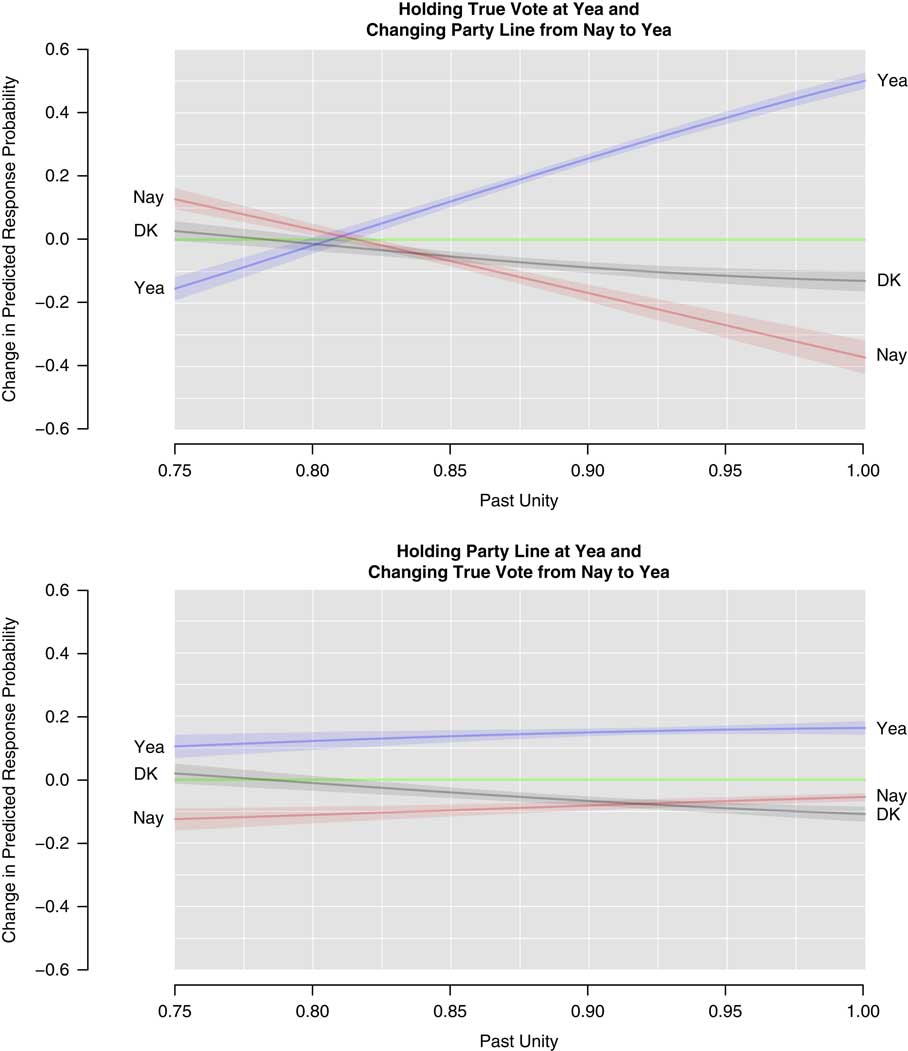
In the top panel of Figure 2, we calculate these differences for a representative respondent using the coefficients reported in Table A2.3 (in the appendix). The evidence in this panel strongly supports our hypothesis. In contexts with strong party loyalists (e.g., Mitch McConnell with party unity of 0.96) a respondent’s probability of reporting that her senator voted for a bill increases by a dramatic 0.50 when the party position changes from “nay” to “yea.” In contrast, respondents in contexts with a senator like John McCain (0.82 party unity) do not alter their probability of reporting “yea” when the party position changes from “nay” to “yea.”
The conditioning effect of past unity on voter inferences.
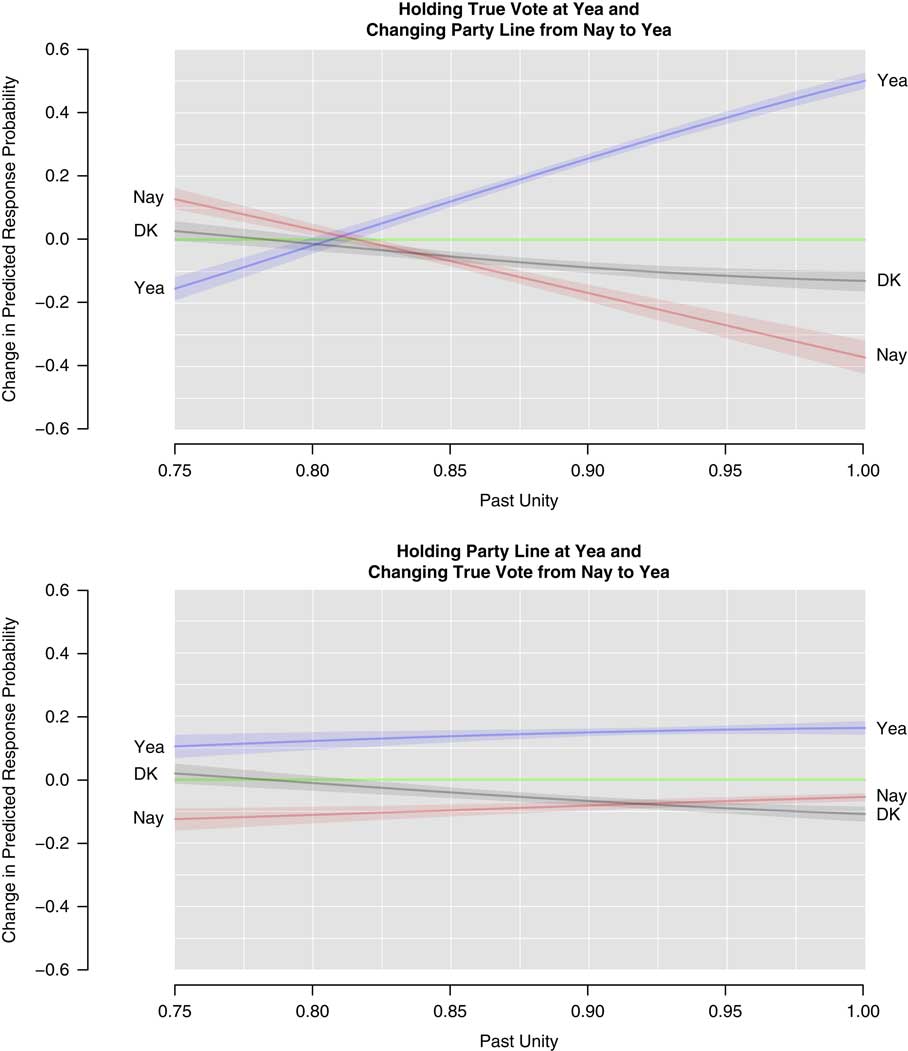
Interestingly, our estimates suggest that respondents in contexts with maverick senators with the lowest levels of party unity may actually apply a sort of anti-partisanship heuristic in which, absent other information, they assume that their senator votes against his party. For example, the model predicts that Arlen Specter’s (unity score of about 0.76) constituents actually decrease their probability of reporting the senator voted for a bill (by about 0.15) when the party position changes from “nay” to “yea.” Of course, this is an instance in which voters’ responsiveness to the information has gone too far, making them more likely, on average, to make an incorrect inference than a voter that simply assumes each senator votes with their party every time. Such contexts, however, are outliers.
The second panel in Figure 2 is calculated in the same way as the upper panel, but is the difference between cases in which the party position is constant and the senator’s true vote changes. To the extent that the respondent’s predicted beliefs change in this situation, this change represents forces that cannot be attributed to a partisanship heuristic (e.g., direct knowledge of legislative votes). The lower panel shows that the change in the typical respondent’s probability of reporting “yea” when their senator’s vote changes from “nay” to “yea” is about 0.12 and it is effectively independent of party unity context. It is reassuring that we find a contextual effect where we predicted it and not where we did not. Taken together, these results offer strong support for our hypothesis that voters apply partisanship heuristic in response to their context.
Finally, unrelated to our hypothesis, but nonetheless quite interesting, Figure 2 shows that the probability of respondents giving a “don’t know” response monotonically decreases with their senator’s party unity, and these effects are statistically and substantively robust. This suggests that citizens may feel more knowledgeable about their senators’ voting behaviors, and therefore more empowered to draw an inference about a particular vote, when those voting behaviors are more consistently partisan. This finding compliments previous work on “don’t know” propensity (e.g., Luskin and Bullock Reference Luskin and Bullock2011) and cue clarity (e.g., Levendusky Reference Levendusky2009), but is, to our knowledge, the first empirical connection between context and a citizen’s willingness to draw an inference.
The Role of Political Interest
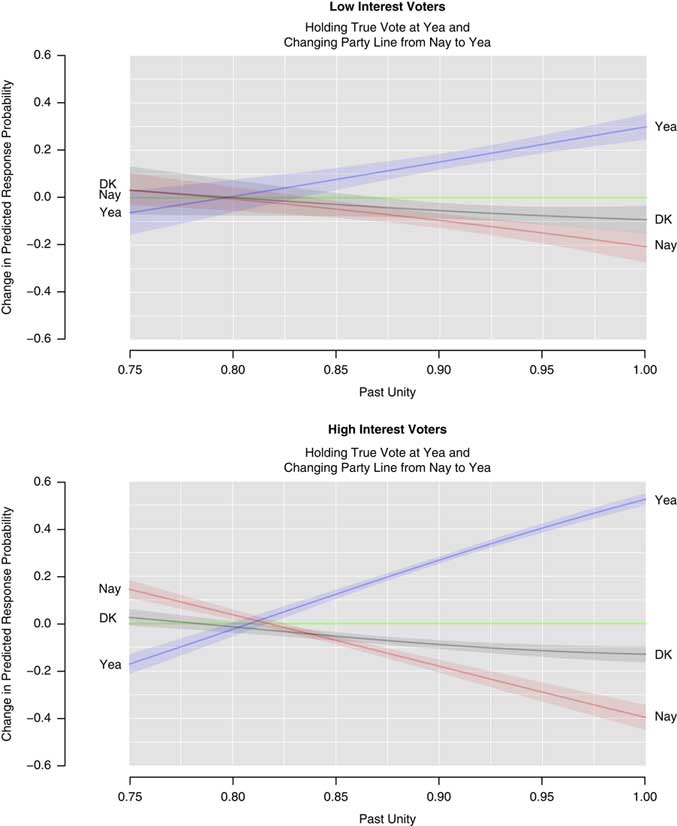
Having recovered robust support for our main hypothesis, we now turn our attention to the role of political interest. Our first question is simply whether the results of the test of our main hypothesis change when we consider individuals with different levels of political interest. Figure 3 gives the answer by calculating the impact of the party line for low and high interest respondent inferences. Recall that the evidence for our ecological hypothesis in the top panel of Figure 2 came from the positive slope on the “yea” line over contexts (and the negative slope on the “nay” line). Thus, it is apparent from Figure 3 that this contextual effect (as indicated by the relevant slopes) is stronger among the highly politically interested than the less politically interested, since the steepness of the slopes differ. Among those with low interest, the difference in the change in probability of answering “yea” in response to a change in party position from “nay” to “yea” is only about 40 percent over the whole range of party unity, while it is over 70 percent in the high interest case. This suggests that individuals with higher levels of interest in politics are better attuned to their political environment.
Comparing ecological rationality across high and low interest voters.

This finding adds some subtlety to previous research suggesting that more interested voters are always more likely to apply the partisanship heuristic (Dancey and Sheagley Reference Dancey and Sheagley2013)—with the implication that they do so even when it leads them to make more mistakes than the less politically interested. Our results suggest that more politically interested voters apply the heuristic more often than less politically interested voters when it is likely to be accurate and less often when it is not.
In addition, a close look at the results for contexts in which senators are mavericks, suggests that the politically interested are more likely to use an anti-partisanship heuristic (i.e., increasing their probability of saying “nay” and decreasing their probability of saying “yea” in response to a party position change from “nay” to “yea”) than are low interest individuals. This is clear given that only on the high interest panel is the “nay” line significantly different from 0 (at about 15 percent) on the far left side of the graph; for low interest respondents, this estimate is only about 4 percent and is not different from 0.
While the figures we have shown so far, which feature changes in probabilities plotted against party unity, are the most direct way of testing our main hypotheses, we can explore the impact of interest a bit more if we also examine our estimates of how the levels of the various probabilities change with political interest.
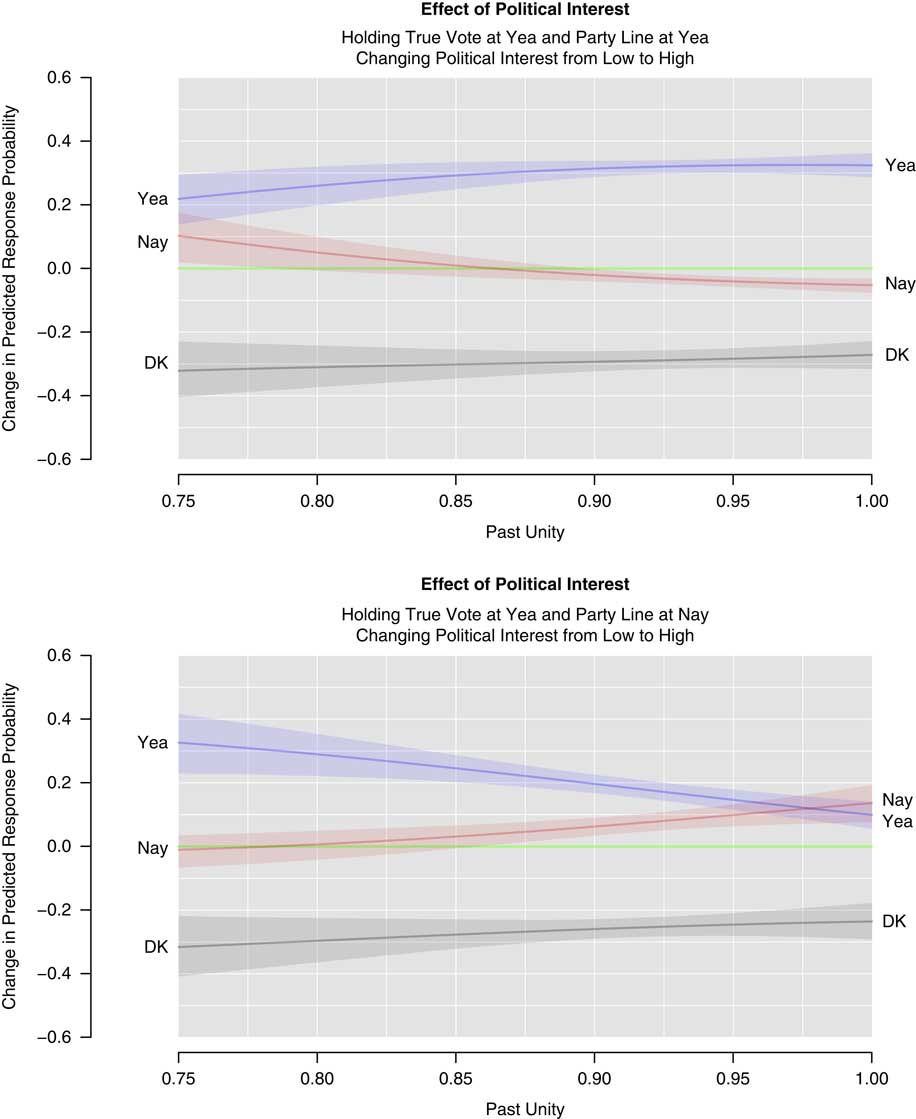
These estimates are presented in Figure 4, where we present the change in the predicted probability of a representative respondent (the same one used in the figures above) reporting “yea,” “nay,” or “don’t know” resulting from a change in their political interest from low to high, for different vote scenarios. In the top panel, both the senator’s true vote and the party line are “yea” votes. In the bottom panel, the true vote remains a “yea,” but the party line is a “nay.” Thus, in each panel, the correct response for the voter is “yea,” but the party line is at odds with this correct response in the lower panel.
Comparing the impact of political interest for concordant and discordant situations.
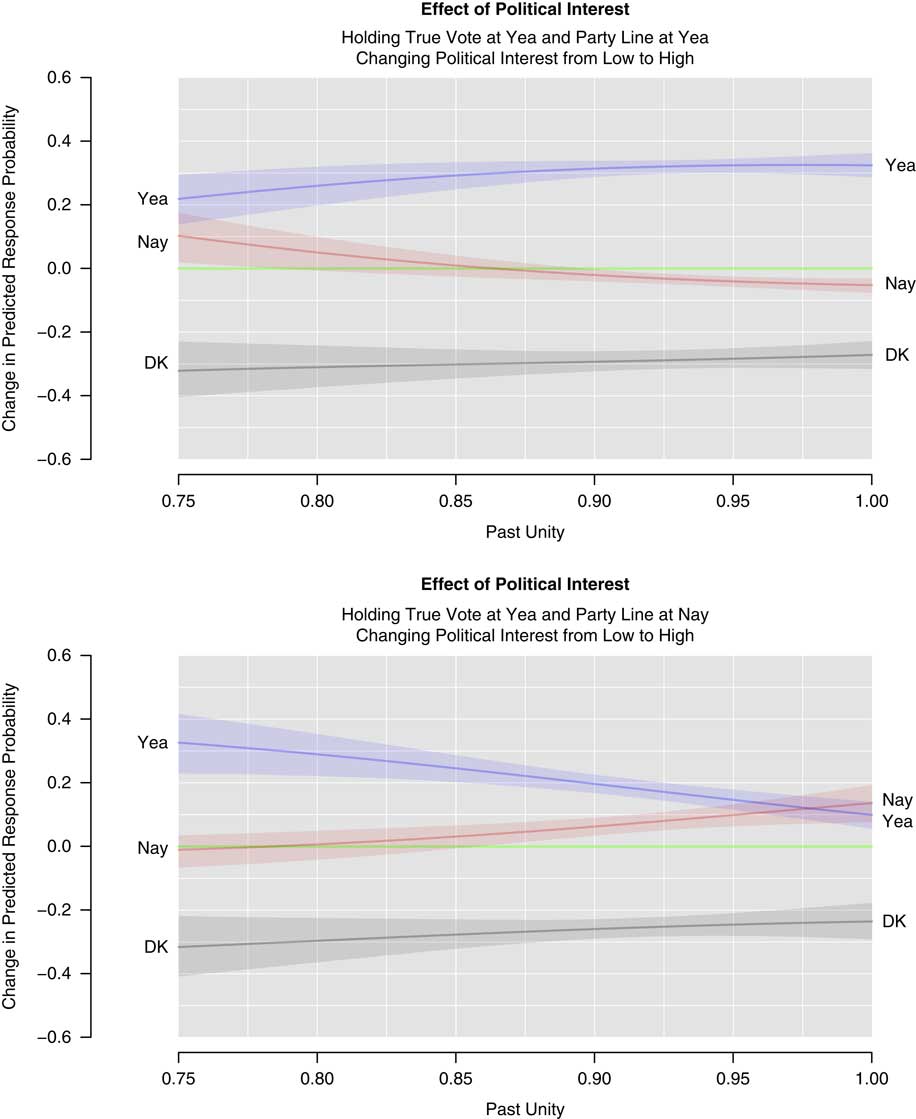
The relationships in Figure 4 are quite striking. First, in every case, the probability of a “don’t know” answer declines with the increase in political interest. Second, the probability of answering correctly, “yea” in both cases, is always greater with the interest increase, but changes in response to the loyalty context—the increase grows monotonically when the true vote and party line agree, but shrinks when the true vote and party line are at odds. Finally, in the case of loyal senators, higher interest voters are more likely to draw an incorrect inference by using the heuristic when the true vote and party line disagree (far right of lower panel), and, in the case of disloyal senators, higher interest voters are more likely to draw an incorrect inference by not using the heuristic when the true vote and party line agree (far left of upper panel). This adds nuance to Dancey and Sheagley’s (Reference Dancey and Sheagley2013) conclusion that high interest voters are more likely to be led astray by heuristics when senators defect from their party. Our examination of the data suggests that high interest voters are more likely to answer incorrectly when loyal senators defect from the party line or when disloyal senators hold the party line, but are also more likely to answer correctly in all contexts.
It is important to keep in mind that these results are derived from analyses of respondents possessing the informational inputs necessary to properly apply the partisanship heuristic. In the appendix, we present the results of an analysis of all respondents, without considering whether or not they possess the necessary information. In this more permissive sample, the positive effect of political interest on heuristic application is inflated and suggests that more interested respondents are always more likely to apply the partisanship heuristic in all contexts, whether it is accurate or not, just as Dancey and Sheagley (Reference Dancey and Sheagley2013) conclude. The reason for this difference, of course, is that political interest is a powerful predictor of whether or not a respondent possesses the necessary informational inputs to properly apply the partisanship heuristic. By choosing to include all respondents, rather than just those who possess the requisite information, political interest will capture variation in a respondent’s ability to properly apply the heuristic, as well as their propensity to apply in a particular context. Consider what this means substantively. There are several respondents who lack the informational inputs to properly apply the partisanship heuristic and may either apply it improperly (e.g., one may have a Democratic senator, but mistakenly believe that senator is a Republican and therefore infer that they took the Republican position on the roll call in question) or not at all, perhaps guessing at random instead. In situations where the heuristic is accurate (over 90 percent of the time during this period), these respondents will draw incorrect inferences more often than their counterparts who possess the informational inputs. Accordingly, in situations where the heuristic is not accurate (<10 percent of the time) they will appear to draw correct inferences more often. But this is merely an artifact of their systematic misuse of the heuristic or their random guesses -- when exceptions to strong empirical regularities manifest, those who guess at random appear better informed than those who truly understand the process in question. Because this type of respondent is clustered in the lower interest categories, we may be tempted to draw conclusions about political interest and heuristic use because the design has conflated the application of the heuristic with the ability to apply the heuristic. We believe that this conflation may be appropriate in some circumstances, however, the focus of our manuscript is explicitly on contextual variation in the application of the partisanship heuristic, thus, we believe that the restricted sample is appropriate and have focused our discussion accordingly.
Freshman Senators
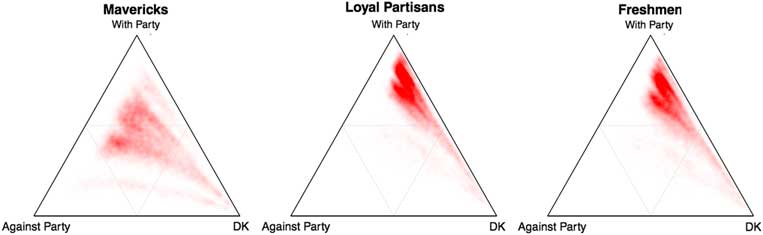
The last relationship we investigate is treatment of freshman senators. Recall from our discussion above that freshman have no established record of party unity (at least in the senate) and thus provide an opportunity to assess the default expectations of voters. When inferring the votes of freshmen, do voters assume they are party loyalists, assume that they are mavericks, guess at random, or decline to respond? We assess this relationship by generating a series of predicted probabilities, where all variables are left at their true, observed values, except freshman status and past unity which, we manipulate. We plot these probabilities in a series of simplexes in Figure 5.
Comparing voter treatment of maverick, loyal partisan, and freshmen senators.
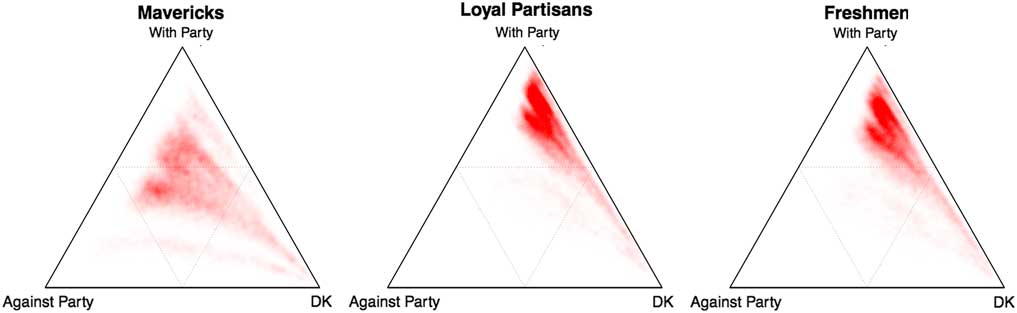
Figure 5 distinguishes between mavericks (unity of 0.75), loyal partisans (0.95), and freshmen. The figure shows that freshmen senators are treated virtually identically to loyal partisans. Indeed, the distribution of predicted probabilities are scarcely differentiable between the two, but stand in stark contrast the distribution of predicted probabilities for maverick senators. This is strong evidence that voters consider freshmen to be nothing more than “party clones” until they establish a voting record (and so condition the informational environment of their constituents) that says otherwise.
Conclusion
This paper takes seriously the idea that voters are sensitive to political contexts in which they operate and (perhaps subconsciously) employ heuristics appropriate to those contexts. Drawing on a growing multidisciplinary literature on the ecological rationality of heuristics, we hypothesized that constituents of senators who are loyal partisans would instinctively employ the partisanship heuristic to infer their senators’ behavior while constituents of mavericks would (again, instinctively) avoid doing so. Our empirical results are quite consistent with this hypothesis. Further, our analysis provides several new insights into the processes shaping voters’ beliefs about their representatives’ behaviors. First, we find that high interest voters apply the partisanship heuristic more often than low interest voters in contexts where it is most likely to be accurate and less often in contexts where it is less likely to be accurate, adding important nuance to previous results. Second, we find that, in the absence of countervailing information, voters assume, quite sensibly, that senators are party loyalists. Specifically, freshman senators are treated no differently than senior senators with an established record of party loyalty. Taken together, these results paint a picture of a reasonable voter, who relies on heuristics, and is remarkably attuned to the contexts in which those heuristics are employed.
We hope that this manuscript can contribute beyond the theory and results of the hypothesis testing, by motivating others to investigate how political contexts shape cognitive processes and information gathering. Further, we hope that behavioral scholars will engage more directly in the informational inputs required of their behavioral models as well as the plausibility of assumed information flows, as we discussed in our sample selection and short investigation of the relationship between legislative voting and media coverage. Finally, we believe that this research has normative implications as well. While previous research has documented use of the partisanship heuristic, few have highlighted just how accurate it is in the abstract. If voters simply inferred that senators voted the party line on every vote, they would be correct over 90 percent of the time. Our research shows that citizens are not only using this powerful tool often, but that they are using it discriminately—demonstrating that they are more attune to their political surroundings than many have suspected previously.
Acknowledgement
We would like to thank participants at the University of California, Riverside’s American Politics Workshop and Ben Bishin, Steve Nicholson, and Jessica Trounstine for helpful feedback as well as the editorial team and two anonymous reviewers. All errors our own. Fortunato would also like to thank the Hellman Fellows Fund for their generous support.