Introduction
Worldwide, the number of people with dementia is currently estimated to be over 35 million, a figure expected to rise due to an aging population (Wimo and Prince, Reference Wimo and Prince2010). This increase will place a significant burden on healthcare services. In the UK, two-thirds of people with dementia live in private residences and are supported by informal care provided by friends and family. This informal care contributes £12.4 billion (55%) of the estimated £23 billion annual cost of dementia to the economy (Luengo-Fernandez et al., Reference Luengo-Fernandez, Leal and Gray2010). Estimates of the global cost of informal care are as high as US$251 billion (Wimo and Prince, Reference Wimo and Prince2010). As the informal care sector is such a substantial resource, it is essential that when reviewing dementia care, whether as interventions delivered by the National Health Service (NHS) or social services, or as fiscal measures, one also considers the benefits and adverse effects on the caregiver. From an NHS perspective, this agrees with the National Institute for Health and Clinical Excellence (NICE) “reference case” which states: “an additional QALY (quality adjusted life year) should receive the same weight regardless of any other characteristics of the people receiving the health benefit.” The reference case explicitly states that “the perspective on outcomes should be all direct health effects, whether for patients or, when relevant, other people (principally carers)” (NICE, 2008). NICE has also produced specific care guidelines for caregivers of people with dementia (NICE, 2007).
There are many papers detailing pharmacological and non-pharmacological interventions to support people with dementia, but fewer deal with economic evaluations of interventions to support their informal caregivers. Often outcomes for informal caregivers are secondary measures of studies targeted primarily at the person with dementia. This paper reviews evidence on health-related outcomes for caregivers from interventions targeted at people with dementia and their caregivers, as well as interventions targeted solely at caregivers.
Methods
Studies were considered for inclusion if an informal caregiver was looking after a person with dementia in a community setting. The caregivers could be any age, gender, nationality or ethnicity and both pharmacological and non-pharmacological interventions were included. Studies had to include cost data and a health related outcome measure for the caregiver.
Electronic database searches were conducted on Biosis, Medline, PsycINFO, Science Direct, Cochrane Library, NHS Economic Evaluation Database, BMJ, the Department of Health and Rowntree Foundation. Titles, keywords, and text were searched for the terms (“Dementia” or “Alzheimer's Disease”) and (“Caregiver*” or “care*”) and “Costs and Cost Analysis”. The last search was conducted on 18 January 2011.
Study eligibility was based on initial screening of title and abstract. Articles passing the initial screening were retrieved for further inspection. The type of study, country of study, study design, number of participants recruited and completing the study, study length, caregiver outcomes measured, cost results and outcome results were extracted.
Study quality was assessed using the Drummond ten-item checklist for robust economic evaluations (Drummond et al., Reference Drummond, Sculpher, Torrance, O'Brien and Stoddart2005). Differences in quality were highlighted to avoid studies with weaker methodology being given the same weight as studies of higher quality.
It was anticipated that studies would be diverse in both setting/type of intervention and participants; therefore meta-analysis would be unsuitable and a narrative approach to data synthesis was planned. The principal summary measure for the effectiveness of an intervention was the difference in means of the caregiver outcome measures between intervention and control groups at the end of the intervention.
Results
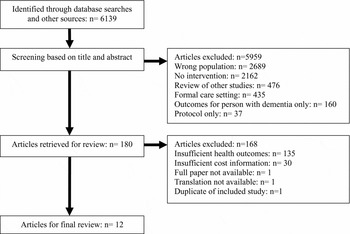
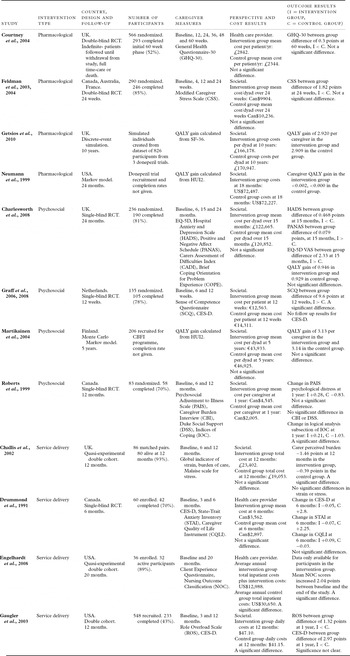
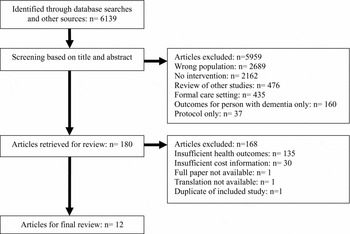
After duplicates were removed from search results, 6139 studies were identified, of which 5959 were excluded during the initial screening of title and abstract (Figure 1). The main reasons for exclusion were reporting survey rather than intervention data and the population being too broad, e.g. interventions with caregivers as participants within a general population, but data not being extractable. Of 180 articles retrieved for further inspection, 135 were excluded because health-related outcomes were not included, 30 were excluded due to insufficient costing information, one article was not available through library loans or contact with the author, and a translation in English was not available for one article. Two papers contained results of the same study, the BECCA befriending scheme (Charlesworth et al., Reference Charlesworth, Shepstone, Wilson, Thalanany, Mugford and Poland2008; Wilson et al., Reference Wilson2009). To avoid repeated presentation of the same results, the cost-utility paper (Wilson et al., Reference Wilson2009) was excluded from the review and will not be discussed further; however, the results will be covered in the discussion on the main paper (Charlesworth et al., Reference Charlesworth, Shepstone, Wilson, Thalanany, Mugford and Poland2008). The 12 articles retrieved for full review are presented in Table 1.
Flow of articles retrieved through electronic searches.
Characteristics of studies included in the review
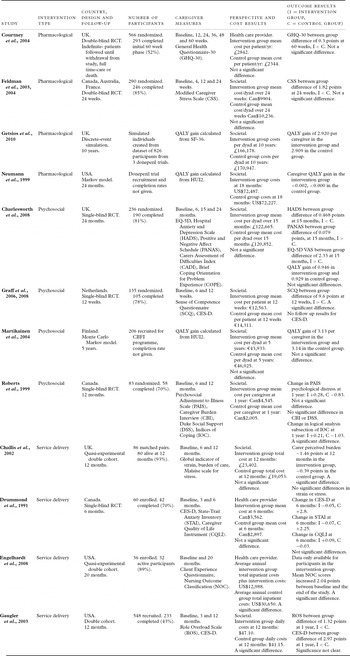
GHQ = General Health Questionnaire; QALY = Quality Adjusted Life Year; CSS = Caregiver Stress Scale; HADS = Hospital Anxiety and Depression Scale; PANAS = Positive and Negative Affect Schedule; CADI = Carers Assessment of Difficulties Index; CBFI = cognitive-behavioral family intervention; COPE = Coping Orientation for Problem Experience; PAIS = Psychosocial Adjustment to Illness Scale; CBI = Caregiver Burden Interview; DSS = Duke Social Support; IOC = Indices of Coping; STAI = State-Trait Anxiety Inventory; CQLI = Caregiver Quality of Life Instrument; CES-D = Center for Epidemiologic Studies depression scale; NOC = Nursing Outcome Classification; ROS = Role Overload Scale.
Pharmacological interventions
Courtney et al. (Reference Courtney2004) described a double-blind randomized controlled trial (RCT) of donepezil compared to placebo for people with dementia. Donepezil is an acetylcholinesterase inhibitor which impedes the breakdown of acetylcholine neurotransmitters. It is believed to have a beneficial effect on memory and the ability to carry out daily activities, but its effect on behavioral problems associated with dementia is currently ambiguous. In the study, 566 people with dementia were randomized to either 5mg/day of donepezil or a placebo. At 12 weeks, participants were re-randomized to receive donepezil 5mg/day, 10mg/day or placebo. Treatment continued until participants withdrew from the study, were institutionalized or died. Well-being of the caregiver was measured with the General Health Questionnaire-30 (GHQ-30) at baseline, 12, 24, 36, 48 and 60 weeks. The GHQ-30 is a self-completed questionnaire used to assess anxiety, social functioning and depression. A higher score indicates increased severity of symptoms. At 60 weeks, GHQ-30 scores of caregivers in the intervention group were 0.3 points lower than the control group; however, this was not a significant difference (95% CI −0.3 to 0.9, p = 0.3). Service use was measured with the dementia-specific caregiver activities scale and UK national average unit costs for the price year 2000. Annual cost per patient was £2,842 in the donepezil group and £2,344 in the placebo group, a non-significant difference (p = 0.16). The authors stated that a “societal perspective” was taken, yet the costs of medication, institutionalization and informal care were excluded, and so a “healthcare provider perspective” is more accurate.
Results of a 24-week trial of 5–10 mg of donepezil daily compared to a placebo were presented by Feldman et al. (Reference Feldman2004). The study was multi-center with 290 dyads randomized across sites in Canada, Australia and France. Informal caregiving time was costed at the Canadian minimum wage. Health service use was recorded by the Canadian Utilization of Services Tracking questionnaire with analysis from a societal perspective, only including service use that was considered to be Alzheimer's disease (AD) related. Service costs were calculated in 1998 Canadian dollars using Canadian unit costs for all countries. The mean cost per dyad at 24 weeks was Can$9,904 for the intervention group and Can$10,236 for the control group, a non-significant difference. Effectiveness results were presented in a separate paper (Feldman et al., Reference Feldman2003). The main outcome measure for caregivers was a modified version of the Caregiver Stress Scale (CSS) recorded at baseline, 4, 12, and 24 weeks. Higher scores on the CSS reflect increased stress levels. At 24 weeks there was no significant difference in overall CSS scores between groups but a significant difference was observed on cognitive status (p< 0.001). Caregivers in the control group perceived a greater cognitive decline in the persons with dementia than their counterparts in the intervention group.
The cost-effectiveness of donepezil for people with dementia was modeled by Getsios and colleagues (Reference Getsios, Blume, Ishak and Maclaine2010) using discrete-event simulation. Individuals were simulated using data from 826 participants across three efficacy trials of donepezil. Data on long-term behavioral and functional effects associated with dementia were taken from seven donepezil trials. Costs were taken from UK national data sources and included daily donepezil costs, twice yearly physician visits, and direct and indirect care costs; hence a societal perspective was used. Caregiver health utility data were modeled over ten years using SF-36 scores from the donepezil trials. To make the simulated individuals typical of people in the UK with AD, sex and age weighting from a national dementia report were applied. For people with dementia starting treatment in the mild-moderate stage the costs at ten years were £166,178, while costs for those in the control group were £170,947. QALY gains for caregivers in the intervention group were 2.920, while for the control group QALY gains were 2.909, a net difference of 0.012 after ten years.
Neumann et al. (Reference Neumann1999) assessed the cost-effectiveness of donepezil compared to usual care using a Markov model. Transition probabilities between stages of dementia and participant settings were calculated from a longitudinal study of 1,145 people with dementia in the USA. Effectiveness of donepezil was taken from a 24-week RCT investigating 5mg and 10mg daily doses on people with mild or moderate AD. A societal perspective was used for analysis. Costs of care were taken from a 1993 study of 180 people with AD and their caregivers living in California. Quality of life (QoL) weights were obtained from the HUI2 (Health Utility Index) data of a companion study of 528 caregivers of people with AD. QALY gains for caregivers were not presented; however, sensitivity analysis showed an incremental cost-effectiveness ratio (ICER) of US$8,700 and US$72,000 when the weights for caregivers and people with dementia were combined. It was then possible to calculate that the QALY differences between intervention and control group was less than 0.002 for caregivers of people with mild AD and less than 0.001 for caregivers of people with moderate AD.
Psychosocial interventions
In the Health Technology Assessment conducted by Charlesworth et al. (Reference Charlesworth, Shepstone, Wilson, Thalanany, Mugford and Poland2008), 236 caregivers were randomized to receive either contact with a Befriender Facilitator (BF) or usual care. The hypothesis was that if a person feels more able to cope with their caring role, their service use may become lower. The BF would arrange a match between caregiver and befriender volunteer with the expectation that there would be weekly home visits by the befriender for at least six months. Take-up was 48% and the retention rate after 24 months was 81% with similar dropout rates between groups. The primary reason for withdrawal was caregiver health. Data were collected at baseline, 6, 15 and 24 months. Caregiver measures included the EQ-5D, Hospital Anxiety and Depression Scale (HADS), Positive and Negative Affect Schedule (PANAS), Carers Assessment of Difficulties Index (CADI) and Brief Coping Orientation for Problem Experience (COPE). Resource use data were collected through an interview covering areas of the Client Service Receipt Inventory (CSRI), the Caregiver Time Questionnaire, the Caregiver Activity Schedule and the Resource Utilization in Dementia Questionnaire. Unit costs were derived from national estimates. Costs for caregiver time were calculated using the gross average wage. Base-case analysis was on costs and effects at 15 months. Mean QALY gains per caregiver were calculated using EQ-5D data and were 0.946 for the intervention group and 0.929 for the control group at 15 months, a non-significant difference (p = 0.315). Differences in HADS and PANAS scores were also non-significant (p = 0.342 and p = 0.94 respectively). Mean costs per caregiver at 15 months were £122,665 for the intervention group and £120,852 for the control group. The highest proportion of cost was informal caregiver time at approximately 85% of total costs. The ICER was calculated as £105,954. Sensitivity analysis implied a 42.2% probability of the ICER being below the NICE threshold of £30,000. A societal perspective was used for base-case analysis; when the perspective was shifted the mean ICER was £117,039 for the combined health service and public sector, £77,236 for households and £521 for the voluntary sector.
The cost-effectiveness of an in-home/telephone tailored occupational therapy program compared to usual care was discussed by Graff et al. (Reference Graff2008). The hypothesis was that if caregivers felt better equipped in their caregiving role it may lead to a delay in institutionalization of people with dementia, thus reducing societal costs. Criteria for the caregiver were not as strict as for other studies; to be eligible the caregiver only needed to provide care at least once a week and not have a severe illness. The criteria for people with dementia were being in the mild to moderate stage of dementia, free from severe behavioral and psychological symptoms; not diagnosed with severe depression or co-morbid illness and at least three months into a course of a cholinesterase inhibitor or memantine. A total of 135 dyads were randomized. The intervention spanned five weeks and consisted of four one-hour sessions of problem-defining and goal-setting for the dyads, followed by six sessions of practical advice on problem-solving, coping strategies and effective supervision. Outcome measures were collected at baseline, 6 and 12 weeks. The Sense of Competence Questionnaire (SCQ) was the primary outcome measure, a higher score indicating a higher feeling of competence. Clinical effectiveness results were presented in a separate paper (Graff et al., Reference Graff, Vernooij-Dassen, Thijssen, Dekker, Hoefnagels and Rikkert2006). The Center for Epidemiologic Studies depression scale (CES-D) was applied at baseline but no follow-up data were available. At 12 weeks, adjusted SQC scores were 9.6 points higher for the intervention group compared to the control group, a significant difference (95% CI 4.7 to 14.5, p < 0.0001). Costs were calculated using outpatient tariffs to cover staff delivery of the occupational therapy sessions and staff hourly wages for additional time such as administering interviews and analyzing the data. Health service unit costs were taken from Dutch guidelines on economic health care from 2004. Informal caregiving hours were valued using the unit cost of a middle-aged cleaning person applied to the hours of absence from employment attributed to caregiving or illness. A societal perspective was used; the mean cost per patient at 12 weeks was €1,748 lower (95% CI – €4,244 to €748) in the intervention group than the control group (€12,563 vs. €14,311).
The long term cost-effectiveness of a cognitive-behavioral family intervention (CBFI), as compared to usual care in Finland, was modeled by Martikainen and colleagues (Reference Martikainen, Valtonen and Pirttila2004). The CBFI was aimed at both the person with dementia and their caregiver. People with dementia received physical and recreational training, while caregivers received educational support and counseling. A Monte Carlo Markov model was derived from Neumann et al. (Reference Neumann1999), as discussed previously. Transition probabilities were also taken from Neumann et al. (Reference Neumann1999); the transition from moderate to mild stage was excluded as it was deemed implausible. The effect of the CBFI program on delay to nursing home admission was taken from a study of 206 participants receiving the intervention over 3.5 years and followed up for 8 years. QoL measures were not included in the CBFI effectiveness study so were derived from a separate study of the QoL weights attached to each stage of dementia under the assumption that caregivers’ QoL was directly related to the progression of dementia in the person they cared for. Usual care practice was not standardized across Finland so was based on the main services provided by two regional health centers. A societal perspective was adopted; service and medication costs were taken from national estimates, intervention costs were local. Costs were discounted by 5% annually. The Bayesian approach was taken to calculate distributions for the parameters used. A second-order Monte Carlo simulation was used to calculate the distribution of mean costs and effects from the resulting model. The mean cost per dyad in the intervention group was €43,933 and €46,925 in the control group, a non-significant difference. As the cost of the intervention was lower than standard care the CBFI program is potentially cost-saving. A cost-effectiveness acceptability curve was constructed and showed that there was a probability of 0.9 that the CBFI program was cost-effective for all values of willingness to pay up to €100,000 per QALY gained. Caregivers in the intervention group gained 3.13 QALYs over five years compared to the 3.14 QALYs of caregivers in the control group; however, this was not a significant difference.
Roberts et al. (Reference Roberts1999) evaluated the effect of up to ten one-to-one problem-solving therapy sessions for caregivers of persons with dementia compared to usual care. The counseling sessions were nurse-led and conducted in-home or by telephone. A set of 83 caregivers were randomized, with 38 receiving the counseling and 45 assigned to the control group. The primary outcome was the Psychosocial Adjustment to Illness Scale (PAIS), with caregivers also completing the Caregiver Burden Interview (CBI), Duke Social Support (DSS) and Indices of Coping (IOC) measures at baseline, 6 months and 1 year. A significant difference between groups was found on the logical analysis subsection of the IOC (intervention group change +0.21, control group change −1.03, p = 0.04). No significant differences were recorded by the other measures. Comprehensive costs were collected and classified by caregiver direct and indirect expenses, cash transfers and health and social service use for the persons with dementia. The mean direct and indirect cost for intervention caregivers at one year was Can$4,545, while the mean cost for the control caregivers was Can$2,005.
Service delivery interventions
Studies were classed as service delivery if the intervention involved a change in the management or delivery of existing services, either for the person with dementia or their caregiver.
Challis and colleagues (Reference Challis, Abendorff, Brown, Chesterman and Hughes2002) matched dyads on functioning, behavioral symptoms and caregiver stress level. Of the 86 dyads, 43 received case management. A case manager, based in a community mental health team for the elderly, regularly updated care plans for dyads in the case management arm. Dyads were selected for case management on the basis of identified unmet service needs and a significant risk of institutionalization being present. Caregiver outcomes were assessed at uptake, 6 and 12 months, and included an indicator of strain, the Malaise scale for stress and a measure of the burden of care. At 12 months the only significant difference between groups was in the lower perceived burden felt by caregivers in the intervention group (95% CI −3.37 to −0.33, p < 0.05). Due to the design of the study there were no “drop-outs” as such, but six individuals had died at the 12-month point. A societal perspective was used for analysis. Mean annual costs of care services per patient (including long-term, hospital and social services) were £23,402 for the intervention group and £19,053 for the control group, a non-significant difference.
Caregivers of persons with moderate to severe dementia were block randomized to a Caregiver Support Program (CSP) or standard care in Drummond et al. (Reference Drummond, Mohide, Tew, Streiner, Pringle and Gilbert1991). The intervention consisted of a 4-hour block of weekly in-home respite care, along with additional respite on request and regular home visits by nurses to educate about caregiving and neglected health problems. Caregivers were also told about a monthly support group in the area. Standard care for the control group was focused on the persons with dementia rather than the caregiver. Sixty caregivers were randomized and 42 (70%) completed the study. The health outcomes collected were CES-D, State-Trait Anxiety Inventory (STAI) and the Caregiver Quality of Life Instrument (CQLI). At six months the caregivers in the intervention group had a small improvement in CQLI while the control group had a decrease in CQLI, the difference between groups was not significant. Cost data were reported in Canadian dollars for the year 1988, and included health service use such as nursing, respite and physician visits. The mean cost per caregiver in the intervention group was Can$3,562 over the six-month period while the mean cost in the control group was Can$2,897, a non-significant difference. The authors calculated an incremental cost per QALY of Can$20,036.
A pilot program investigating the impact of a care coordination and support strategic partnership (CCSP) between a home healthcare agency and a telephone support service provided by nurses was presented by Engelhardt et al. (Reference Engelhardt, Kisiel, Nicholson, Mulichak, DeMatteis and Tobin2008). Thirty-six people with AD and their caregivers were recruited, with 32 actively participating. A further 113 people with AD who did not receive the CCSP program were identified through medical records, but no further details were given of how the controls were matched to the participants of the CCSP program. Dyads in the CCSP program were followed for 20 months. Clinical effectiveness was determined using the Nursing Outcome Classification (NOC) system, where aspects such as knowledge are rated on a scale of one to five with five being the best state possible. At baseline, the mean NOC score for caregivers in the intervention group was 2.14. This increased to 4.18 at 20 months, a significant difference (p < 0.001). NOC scores were not available for the matched cohort. Program delivery costs were calculated by multiplying the length of telephone support time by the average clinician wage plus overhead costs. Home visits were costed at US$95.61 per visit; no explanation was given as to where this figure came from. Informal caregiver time was not recorded; hence a healthcare provider perspective was adopted. Mean annual cost of inpatient hospital stays plus intervention per participant was US$364 in the intervention group and US$271 in the control group.
Gaugler et al. (Reference Gaugler, Zarit, Townsend, Stephens and Greene2003) discussed the effect of adult day care services. Caregivers receiving subsidized adult day care services in New Jersey were compared to a control group who did not use adult day care services in Ohio, an area chosen because of its similar sociodemographic mix. Caregivers completed the Role Overload Scale and CES-D at baseline, three months and one year. A total of 548 caregivers were selected for the study but because caregivers selected for analysis in the control group could not have used adult day care services, the number eligible at one year had dropped to 233. The number of hours that caregivers reported receiving formal services and spent on informal caregiving tasks was multiplied by the US Department of Labor figure for average household payments for home healthcare services. A societal perspective was used for analysis. Loss of employment hours were costed using hourly wage estimates from the Bureau of Labor Statistics. At 12 months the average daily costs for the intervention and control group were US$47.10 and US$41.15 respectively, a significant difference (p < 0.05). Role overload was 19.96 in the intervention group and 21.28 in the control group; a lower score indicated a lower level of overload. CES-D scores were 12.77 in the intervention group and 15.74 in the control group, a lower score indicating a lower level of depression. Significance of the clinical results was not presented clearly in the paper.
Study quality
The Drummond et al. (Reference Drummond, Sculpher, Torrance, O'Brien and Stoddart2005) ten-item check-list was applied to included studies and results are summarized below. For further details see Table S1, published as supplementary material online attached to the electronic version of this paper at http://www.journals.cambridge.org/ipg.
The majority of papers clearly stated a research question or objective. The alternatives under evaluation were discussed, albeit briefly in papers which modeled effectiveness data from other trials, or where companion papers gave fuller descriptions of the intervention (Neumann et al., Reference Neumann1999; Feldman et al., Reference Feldman2003, Reference Feldman2004; Gaugler et al., Reference Gaugler, Zarit, Townsend, Stephens and Greene2003; Getsios et al., Reference Getsios, Blume, Ishak and Maclaine2010). The rationale behind study design was clearly stated and effectiveness was established for all studies apart from that by Engelhardt et al. (Reference Engelhardt, Kisiel, Nicholson, Mulichak, DeMatteis and Tobin2008), where effectiveness data were only collected for the intervention group due to the control being a matched historical cohort. This meant that it was not possible to determine how effective the intervention was compared to usual care.
The range of costs collected in each study varied, with studies including health service use, social service use, informal caregiving time or a mixture of all three. Unit cost sources were stated on the whole, but several studies did not report the price year (Roberts et al., Reference Roberts1999; Challis et al., Reference Challis, Abendorff, Brown, Chesterman and Hughes2002; Courtney et al., Reference Courtney2004; Graff et al., Reference Graff, Vernooij-Dassen, Thijssen, Dekker, Hoefnagels and Rikkert2006; Engelhardt et al., Reference Engelhardt, Kisiel, Nicholson, Mulichak, DeMatteis and Tobin2008). Of the studies where follow-up extended beyond 12 months, discounting of costs and benefits was conducted where appropriate, apart from the study by Courtney et al. (Reference Courtney2004) where annual costs were calculated by multiplying each 12-week phase up to a year rather than using costs collected over a longer time period. Half of the studies performed an incremental analysis of costs and consequences (Drummond et al., 1999; Neumann et al., Reference Neumann1999; Gaugler et al., Reference Gaugler, Zarit, Townsend, Stephens and Greene2003; Martikainen et al., Reference Martikainen, Valtonen and Pirttila2004; Charlesworth et al., Reference Charlesworth, Shepstone, Wilson, Thalanany, Mugford and Poland2008; Getsios et al., Reference Getsios, Blume, Ishak and Maclaine2010). No form of sensitivity analysis was mentioned in five of the studies (Drummond et al., 1999; Roberts et al., Reference Roberts1999; Challis et al., Reference Challis, Abendorff, Brown, Chesterman and Hughes2002; Gaugler et al., Reference Gaugler, Zarit, Townsend, Stephens and Greene2003; Engelhardt et al., Reference Engelhardt, Kisiel, Nicholson, Mulichak, DeMatteis and Tobin2008).
Discussion
Effectiveness findings
The initial database search retrieved articles on a variety of intervention types and no clear trend in research focus or health economic methodology was observed. Four pharmacological, four psychosocial, and four service delivery interventions were included. Of the trials included for full review, four recorded significant differences in outcome measures for caregivers as the result of an intervention: lower perceived burden (Challis et al., Reference Challis, Abendorff, Brown, Chesterman and Hughes2002), higher sense of competence (Graff et al., Reference Graff, Vernooij-Dassen, Thijssen, Dekker, Hoefnagels and Rikkert2006), improved coping skills (Roberts et al., Reference Roberts1999) and increased nursing knowledge (Engelhardt et al., Reference Engelhardt, Kisiel, Nicholson, Mulichak, DeMatteis and Tobin2008).
Despite a lack of statistically significant results for caregivers in the pharmacological studies, there were significant effects for the people with dementia participating in the trials. Indeed, NICE guidelines recommend donepezil for the maintenance of function and cognitive status for people with moderate stage AD (NICE, 2009). Feldman et al. (Reference Feldman2003) found that participants randomized to donepezil declined only 0.74 points on the Disability Assessment for Dementia scale compared to an 8.98 point decline for the control group at 24 weeks. Courtney et al. (Reference Courtney2004) found that people with dementia randomized to donepezil scored 0.8 points higher on the Mini-Mental State Examination, an instrument used to measure cognition, than the control group over a two-year period. It is possible that caregivers experienced benefits not recorded by the outcome measures selected for the trials; it would therefore be rash to state that pharmacological interventions have no benefits for caregivers when there is a lack of evidence overall.
The psychosocial interventions had mixed results for caregivers. This is supported by a meta-analysis (Broadaty et al., Reference Brodaty, Green and Koschera2003), where a weighted average effect size of 0.32 was found for the main outcome measures of 30 studies into psychosocial interventions for caregivers of people with dementia (an effect size of 0.2 is considered statistically significant but weak, 0.5 is moderate and 0.8 is strong). NICE guidelines recommend that psychosocial interventions such as cognitive behavioral therapy should be available to caregivers who are experiencing psychological distress (NICE, 2007). The wide geographical area in Charlesworth et al. (Reference Charlesworth, Shepstone, Wilson, Thalanany, Mugford and Poland2008) may have biased the trial costs through increased travel costs, with the likelihood being that if the befriending scheme had been set up in an urban area the costs would be lower.
Although Engelhardt and colleagues (Reference Engelhardt, Kisiel, Nicholson, Mulichak, DeMatteis and Tobin2008) found a significant increase in caregivers’ knowledge between baseline and the end of the service delivery intervention, the methodological quality of the study was weak. With no results available for the control group, it is difficult to quantify how much of the change was attributable to the intervention and how much was coincidental. Evidence on the effectiveness of service delivery interventions is of potential interest to health and social care providers and policy-makers. With mounting pressure on health and social care budgets, the reorganization of existing service delivery may be a more affordable and efficient short-term option than offering additional psychosocial interventions with high set-up costs.
Initial database searches returned many modeling papers, but most dealt only with the effects on the persons with dementia and did not contain data for the caregiver. Models are useful for extrapolating costs and effects beyond the time period for which clinical evidence is available, as evidenced by Getsios et al. (Reference Getsios, Blume, Ishak and Maclaine2010), where costs and QALY gains were extrapolated over ten years. A long time period for follow-up is generally preferable so that the residual effects of an intervention can be measured and valued. But as Getsios et al. (Reference Getsios, Blume, Ishak and Maclaine2010) only recorded a small difference over ten years, it leads to questions about whether the instrument used to measure caregiver utility, in this case the SF-36, was appropriate. While models can aid policy-makers in allocation decisions when clinical data are not currently available, the quality of evidence produced by a model is dependent on the quality of the data populating the model. This means that while models are undeniably useful, clinical trials are still required in order to produce a portfolio of evidence to use for modeling.
A range of different measures was used. Most used generic instruments such as EQ-5D; however, some studies included group specific instruments such as the Caregiver Stress Scale. NICE guidance on technology appraisals state that a standardized and generic instrument such as EQ-5D is preferred (NICE, 2008). While the EQ-5D is good at detecting changes in physical health, it is not designed to detect changes in mental well-being beyond one question on anxiety/depression. In research involving caregivers, it is typically mental well-being that is expected to improve; it is therefore important to use an instrument capable of detecting these changes. One solution is to include a generic preference-based measure alongside a group-specific measure; however, there is a need to consider the burden of asking caregivers to complete extra questionnaires.
The heterogeneity of caregivers within the subgroup of dementia caregivers needs to be considered; the needs of a spouse caregiver may differ from those of a child caregiver and what is effective for one subtype of caregiver may not translate to another. Evidence on the effectiveness of combined psychosocial and pharmacological interventions is also sparse with further work in the area required. As well as addressing the issue of collecting relevant cost data, methodological quality also needs to be improved through larger sample sizes. Future research would benefit from a longer follow-up period, something that is often restricted by lack of funding.
Cost findings
Three studies found significant differences in costs between intervention and control groups (Roberts et al., Reference Roberts1999; Gaugler et al., Reference Gaugler, Zarit, Townsend, Stephens and Greene2003; Engelhardt et al., Reference Engelhardt, Kisiel, Nicholson, Mulichak, DeMatteis and Tobin2008). Gaugler and colleagues (Reference Gaugler, Zarit, Townsend, Stephens and Greene2003) found the average daily cost for the control group to be $41.15, compared to $47.10 for the intervention group. Roberts et al. (Reference Roberts1999) found no significant difference between health and social care costs between groups when the costs of the relative with dementia were included, although there was a significant difference for caregiver costs only (intervention group costs Can$4,545, control group costs Can$2,005). Conversely, Engelhardt et al. (Reference Engelhardt, Kisiel, Nicholson, Mulichak, DeMatteis and Tobin2008) found significantly higher costs in the control group, mainly resulting from higher inpatient stays (control group costs were $30,650 compared to $12,988 for the intervention group at 20 months). However, the methodological quality of this pilot study was weak. The remaining studies did not have significant differences in cost outcomes and the balance between intervention and control group costs varied. Four studies found non-significant lower costs in the control group at the end of the trial (Feldman et al., Reference Feldman2004; Martikainen et al., Reference Martikainen, Valtonen and Pirttila2004; Graff et al., Reference Graff2008; Getsios et al., Reference Getsios, Blume, Ishak and Maclaine2010). It is interesting to consider whether funding bodies would support an intervention if it was deemed to be cost-saving but there was no significant benefit to the participants involved. Similarly, would funding be forthcoming if an intervention only benefitted the caregiver but had no effect on the person with dementia?
Implications for funding
The need to support caregivers has been historically recognized. However, in the UK the release of the National Carers Strategy (NCS) in 1999 was the start of real policy planning for carers. The most recent update of this document was 2010 (Department of Health, 2010). Key messages from the NCS include the need for caregivers to stay mentally and physically well, and to not suffer financial hardship due to their role. During the financial year 2010/11 the government pledged to make £1 million available to condition-specific voluntary organizations that help support carers. On top of this, £400 million is to be given over four years to the NHS to fund respite breaks for carers. The figures may look large on the surface, but this financial support is to be divided between carers of all types, and dementia funds to date have never reached the level of other illnesses. The level of UK funding for dementia research is estimated to be approximately £50 million annually, considerably less than funding for cancer research (£590 million) or heart disease (£169 million). The proportion of funding for research does not reflect the cost of the illness to social and healthcare services – £10 billion annually for dementia, £4.5 billion for cancer and £2.3 billion for heart disease (Luengo-Fernandez et al., Reference Luengo-Fernandez, Leal and Gray2010). If research funding for dementia were to increase in line with its national burden, there would be a boost to research in this field. Informal care accounts for £12 billion (55%) of the annual UK cost of dementia (Luengo-Fernandez et al., Reference Luengo-Fernandez, Leal and Gray2010). Although this could be partially funded through increased taxes, such fiscal measures are rarely popular. Private funding of care is another option, but with an estimated annual cost per dementia patient of over £27,000 (Luengo-Fernandez et al., Reference Luengo-Fernandez, Leal and Gray2010) this would not be universally affordable and the government would still need to cover costs for patients who could not afford the bill.
While health economists provide evidence on the costs and benefits of competing treatments, it is ultimately policy-makers, such as the government, who decide which interventions get funded. NICE has set a threshold for cost-effectiveness at £20,000–£30,000 per QALY gained for an intervention to be deemed an effective use of NHS resources (NICE, 2008). As discussed above, NICE prefers instruments such as EQ-5D to be used for QALY calculation purposes; hence cost-effectiveness decisions will be biased towards interventions that improve physical health. While few would argue that physical health is the only aspect of well-being worth targeting, there is an argument that interventions solely aimed at improving general well-being are not the main duty of the NHS and should be funded by other means. Treatments that cost more than the £30,000 per QALY threshold can still be funded if public reaction to the original decision is unfavorable. An example of a funding decision being overturned is that of the breast cancer drug Herceptin (Barrett et al., Reference Barrett, Roques, Small and Smith2006). One of the key concepts in health economics is opportunity cost, i.e. the true cost of funding a treatment is the value of benefits foregone by not using the resources in their best alternative use. For each NICE guidance overturned, resources need to be diverted from elsewhere to fund the treatment.
Once an intervention has been deemed cost-effective and policy-makers have decided to implement it beyond the trial period, redistribution of resources towards the intervention is required. This is more complicated in the case of caregivers of people with dementia as interventions may fall across the divide between health and social care. Consequently, there is the issue of which sector should bear the set-up and running costs. The need for greater integration between different sectors in the provision of support for caregivers is clear.
Limitations of the review
The main limitation of this systematic review was a lack of evidence of the cost-effectiveness of interventions to support informal caregivers of people with dementia residing in the community. However, a number of trials for both the person with dementia and their caregiver are underway and therefore a larger evidence base will be available in the future (Joling et al., Reference Joling2008; Woods et al., Reference Woods2009). Evidence came from a range of countries and there is a question as to how transferrable the findings are, given the heterogeneous nature of health and social care provision across different countries.
Conflict of interest
None.
Description of authors’ roles
All authors contributed to the study design. C. Jones collected the data and wrote the initial draft of the paper. R.T. Edwards and B. Hounsome critically revised the paper.
Acknowledgments
This review was funded by a Bangor University 125th Anniversary Research Studentship PhD. The authors wish to thank Professor Bob Woods, Pat Linck and Joshua Pink for comments on earlier drafts.