


Introduction
Parthenogenesis is common in invasive insect pests (Hoffmann et al., Reference Hoffmann, Weeks, Nash, Mangano and Umina2008). Aphids are probably one of the best studied insect pests where parthenogenetic reproduction has a key role in the invasiveness. Indeed, the genetic diversity and structuring of aphid populations are mostly determined by: (i) the lifecycle strategy of aphid genotypes (from Cyclical Parthenogenesis [CP] to Obligate Parthenogenesis [OP]); and (ii) clonal selection (Simon et al., Reference Simon, Baumann, Sunnucks, Hebert, Pierre, Le Gallic and Dedryver1999, Reference Simon, Rispe and Sunnucks2002; Llewellyn et al., Reference Llewellyn, Loxdale, Harrington, Clark and Sunnucks2004). Clonal selection of sexual or asexual genotypes (clones), and its consequences on the spatial and temporal distribution of populations, depends on biotic (e.g. host-plants) and/or abiotic (e.g. climate, geographic barriers) agents that interact with distinct life-history traits (e.g. dispersal ability, intrinsic rate of increase) affecting the performance of aphids (Figueroa et al., Reference Figueroa, Simon, Le Gallic, Prunier-Leterme, Briones, Dedryver and Niemeyer2004; Loxdale et al., Reference Loxdale, Massonnet and Weisser2010).
Certainly, the success of invasive aphid species seems to depend on the clonal structure of populations and the temporal persistence and spatial dominance of a few genotypes (Zepeda-Paulo et al., Reference Zepeda-Paulo, Simon, Ramirez, Fuentes-Contreras, Margaritopoulos, Wilson and Figueroa2010; Harrison & Mondor, Reference Harrison and Mondor2011; Chen et al., Reference Chen, Chiu and Kuo2013; Caron et al., Reference Caron, Ede and Sunnucks2014 but see Forneck et al., Reference Forneck, Anhalt, Mammerler and Griesser2015). These genotypes, the so-called ‘superclones’ (Vorburger et al., Reference Vorburger, Lancaster and Sunnucks2003), are thought to be general-purpose genotypes (Lynch, Reference Lynch1984) characterized by carrying groups of coadapted genes that are not broken up by sexual recombination (Sunnucks et al., Reference Sunnucks, Chisholm, Turak and Hales1998). This genetic architecture should increase the chances of certain genotypes to occupy and multiply in a broad range of niches, thus explaining their broad ecological tolerance resulting from clonal selection in highly homogenous environments (e.g. intensive crop farming). However, the mechanisms underpinning the ecological success of these genotypes are poorly understood.
The English grain aphid Sitobion avenae (Fabricius) (Hemiptera: Aphididae) is one of the major pests of cereals worldwide. While populations in UK, north of France and Romania (the source range) are predominated by CP genotypes and typically featured by a high genetic diversity (Sunnucks et al., Reference Sunnucks, De Barro, Lushai, MacLean and Hales1997; Dedryver et al., Reference Dedryver, Hulle, Le Gallic, Caillaud and Simon2001; Llewellyn et al., Reference Llewellyn, Loxdale, Harrington, Brookes, Clark and Sunnucks2003; Papura et al., Reference Papura, Simon, Halkett, Delmotte, Le Gallic and Dedryver2003), populations in Australia, Chile and China (the introduced range) are predominated by a dissimilar number of OP genotypes depending on the region (Wilson et al., Reference Wilson, Sunnucks and Hales1999; Figueroa et al., Reference Figueroa, Simon, Le Gallic, Prunier-Leterme, Briones, Dedryver and Niemeyer2005; Xin et al., Reference Xin, Shang, Desneux and Gao2014). Interestingly, host plant and geographic differentiation favored by local clonal selection have been reported in UK, France and China, respectively, while almost no differentiation due to migrations have been found in Romania, Australia and Chile. Hence, the genetic diversity and clonal structure of S. avenae populations are the results of distinct regions and climates.
In Chile, populations of the grain aphid are characterized by a high heterozygosity, a weak host-plant differentiation and a few widely distributed and time-persistent asexual clones found across agroclimatic regions (~1000 km) and years (1996–2000), respectively, which represented nearly 90% of the total genotypes detected (Figueroa et al., Reference Figueroa, Simon, Le Gallic, Prunier-Leterme, Briones, Dedryver and Niemeyer2005). Notably, one of these predominant genotypes (Sa2) was found in similar frequencies on all cereals (oat and wheat) and pastures (cocksfoot grass, wild oat, mouse barley and common velvetgrass) sampled, across the entire range of cereal distribution in Chile, and in France, the putative source population (Figueroa et al., Reference Figueroa, Simon, Le Gallic, Prunier-Leterme, Briones, Dedryver and Niemeyer2005). In addition, this Sa2 genotype shows a lower variation in its reproductive performance on different defended hosts (cereals may contain benzoxazinoid 2,4-dihydroxy-7-methoxy-1,4-benzoxazin-3-one; hereafter Hx), a flatter energetic cost for non-induced detoxification enzymes, and an increased body mass toward hosts with high Hx levels compared to other less-frequent genotypes (Figueroa et al., Reference Figueroa, Simon, Le Gallic, Prunier-Leterme, Briones, Dedryver and Niemeyer2004; Castañeda et al., Reference Castañeda, Figueroa, Fuentes-Contreras, Niemeyer and Nespolo2010a , Reference Castañeda, Figueroa and Nespolo b ). Overall, these constitute evidences for denoting Sa2 genotype as a ‘superclone’. However, behavioral differences among S. avenae genotypes have not been studied yet. As a consequence of its distribution pattern among hosts, it is expected that a ‘superclone’ should possess similar abilities to use either high or low chemically defended host plants, while a non-superclone genotype might be subjected to a trade-off, then showing differential performances on plants with variable levels of chemical defenses. Hence, in a situation of host change, as frequently occurs during the earlier stages of invasion to a new host, it is expected that the superclone's behavior is not affected by the host change, behaving similarly (e.g. similar time to access to the phloem among host after host change) on plants with variable defenses (flat norm of reaction), whereas the non-superclone genotype does.
In this study, the performance and probing behavior of two genotypes of the aphid S. avenae, one characterized previously as ‘superclone’ (Sa2) and other rare genotype (Sa46) (Castañeda et al., Reference Castañeda, Figueroa, Fuentes-Contreras, Niemeyer and Nespolo2010a ), were studied when facing wheat cultivars with different levels of Hx, a plant chemical defense against aphids. Main wheat cultivars that dominates wheat plantations differ in the amount of the benzoxazinoid 2,4-dihydroxy-7-methoxy-1,4-benzoxazin-3-one (hereafter Hx), with several evidences showing that these compounds affect aphid performance and behavior (Niemeyer, Reference Niemeyer2009). These compounds are present in the plant naturally as glucosides, which are hydrolyzed to the respective aglucones upon damage tissue to give origin to biologically active aglucones that are natural plant defense, prominently in young plant tissues of wheat (Niemeyer, Reference Niemeyer2009).
Thus, we first assessed that the genotypes selected effectively differ in their reproductive performances (a fitness proxy) across hosts, and subsequently evaluate their probing behavior after host changes to differently defended host plants. We discuss the utility of assessing the performance and host-use of different S. avenae genotypes in the laboratory for developing models of aphid outbreaks to predict clonal dynamics and aggressiveness of certain genotypes in the field.
Materials and methods
Insects
The aphids used were collected during the Austral spring–summer of 2005, as described in Castañeda et al. (Reference Castañeda, Figueroa, Fuentes-Contreras, Niemeyer and Nespolo2010a ). Aphid lineages have been kept separately for many generations on barley seedlings (Hordeum vulgare cv. Acuario; no chemical defenses against aphids) caged within plastic cylinders covered with a fine textile mesh in plastic pots filled with organic compost. We have maintained several clonal lineages of the species growing in the laboratory since 2006 under conditions that ensure its parthenogenetic reproduction (20°C and 16L:8D photoperiod), and these lineages are periodically genotyped at seven microsatellite loci (Sm10, Sm17, S3.R, S5.L, S4Σ, S19 and S24) to verify their identity (Figueroa et al., Reference Figueroa, Simon, Le Gallic, Prunier-Leterme, Briones, Dedryver and Niemeyer2005). Each new experimental clonal lineage was obtained from the offspring of a single individual taken from the original lineage. Based on its host range (i.e. number of pasture species and cereal cultivars on they were found), its ability to reproduce on plants with high levels of the Hx, its geographic distribution and time-persistence (see Figueroa et al., Reference Figueroa, Simon, Le Gallic, Prunier-Leterme, Briones, Dedryver and Niemeyer2005; Castañeda et al., Reference Castañeda, Figueroa, Fuentes-Contreras, Niemeyer and Nespolo2010a ), two genotypes of the grain aphid were chosen. The Sa2 genotype has been described as one of the most common and time-persistent genotypes in S. avenae aphid populations in Chile and France, with a broad host range in Chile that includes wheat cultivars with high levels of Hx (Figueroa et al., Reference Figueroa, Simon, Le Gallic, Prunier-Leterme, Briones, Dedryver and Niemeyer2005). Here the Sa2 genotype is defined as the superclone genotype. Contrastingly, the Sa46 genotype has been found only on Gramineae with no or very low levels of Hx and is thereafter defined as the non-superclone genotype. The performance of these two genotypes was assessed on seedlings of wheat cultivars differing in their levels of Hx to confirm differences in their diet breadth; subsequently, the probing behavior was studied on these two wheat cultivars.
Plants
Most cereals produce secondary metabolites including Hx, which are known to have antixenotic and antibiotic effects on aphids (Niemeyer, Reference Niemeyer2009). Different wheat cultivars are known to vary mostly in their Hx concentrations and in their effects on aphid biology (Figueroa et al., Reference Figueroa, Simon, Le Gallic, Prunier-Leterme, Briones, Dedryver and Niemeyer2004, Reference Figueroa, Simon, Le Gallic, Prunier-Leterme, Briones, Dedryver and Niemeyer2005; Castañeda et al., Reference Castañeda, Figueroa, Fuentes-Contreras, Niemeyer and Nespolo2009, Reference Castañeda, Figueroa, Fuentes-Contreras, Niemeyer and Nespolo2010a , Reference Castañeda, Figueroa and Nespolo b ). In this study, Triticum aestivum cv. Huayún (0.26 ± 0. 08 mM kg−1 Hx fresh weight) and Triticum turgidum ssp. durum cv. Llareta (12.85 ± 1.46 mM kg−1 Hx fresh weight) (hereafter low- and high-Hx hosts, respectively) were used due to their contrasting levels of chemical defenses against aphids. Morphologically, T. turgidum ssp. durum is taller than T. aestivum and also with larger culms, but are similar in internodes size and leaf blades size (Clayton et al., Reference Clayton, Vorontsova, Harman and Williamson2012). In our study, these cultivars were used in the same phonological stage. Determinations of Hx concentrations were conducted in each wheat cultivar using the procedure of Nicol et al. (Reference Nicol, Copaja, Wratten and Niemeyer 1992 ), and kindly provided by Hermann Niemeyer (personal communication). Wheat cultivars are products of the wheat-breeding program (Programa Nacional de Trigo) of the Instituto Nacional de Investigaciones Agrarias (INIA) and were kindly provided by Ivan Matus (INIA-Quilamapu, Chillán, Chile). All plants were grown at 20°C and 60% RH under a photoperiod of 16L:8D. For performance and Electropenetration Graphs (EPG) records (see below), 7-day-old wheat seedlings were used.
Aphid performance
Parthenogenetic colonies of both selected aphid genotypes were reared for several generations on barley, a cereal lacking Hx (Niemeyer, Reference Niemeyer2009). Adults from these colonies were transferred to potted seedlings of two wheat cultivars with different amounts of Hx, as described above. Aphids of both genotypes were maintained on barley as controls. To synchronize aphid age, enclosed groups of 2–5 adult aphids from barley rearing, were allowed to reproduce for 24 h on both wheat cultivar, after which the adults were removed from the plant and only two new nymphs were left. These nymphs started the population and the total number of aphids on each experimental plant of each treatment, including nymphs and adults (i.e. the offspring of the two initial nymphs) was recorded. The population growth rate was calculated as [ln (N f ) – ln (N i )/(t f –t i )], as described by Zehnder & Hunter (Reference Zehnder and Hunter2009). Twenty replicates were performed for each aphid genotype–host combination.
Monitoring of probing behavior
To evaluate the probing behavior of each selected S. avenae genotype, the effect of host-change (i.e. when confronting a new host) was assessed by performing a 2 × 2 × 2 experimental design, with ‘host-change’, ‘genotype’ and ‘test host’ as factors. Because parthenogenetic aphids reproduce by telescoping of generations, the actual feeding behavior of each focal individual aphid can be affected by the environmental conditions experienced during the two previous parthenogenetic generations. Hence, all host-changes were performed after aphids completed at least three generations on a given host (i.e. high- and low-Hx wheat cultivars and barley). Therefore, behavioral comparisons included eight groups of treated aphids taking directly from its original rearing plant: (1) individuals of the non-superclone probing on low-Hx host after reared on no-Hx host, (2) individuals of the non-superclone probing on low-Hx host after reared on low-Hx host (control of treatment 1), (3) individuals of the non-superclone probing on high-Hx host after reared on no-Hx host, (4) individuals of the non-superclone probing on high-Hx after reared on high-Hx host (control of treatment 3), (5) individuals of the superclone probing on low-Hx host after reared on no-Hx host, (6) individuals of the superclone probing on low-Hx host after reared on low-Hx host (control of treatment 5), (7) individuals of the superclone probing on high-Hx host after reared on no-Hx host and (8) individuals of the superclone probing on high-Hx after reared on high-Hx host (control of treatment 7). Changes from high- to low-Hx hosts and vice versa were not included because we wanted to assess the effect of host-change from non-defended to chemically defended hosts, either with high or low levels of Hx, rather than among hosts with different levels of Hx. Each treatment included 20 replicates.
The EPG technique is regularly used to study the probing behavior of hemipteran insects (Tjallingii, Reference Tjallingii, Campbell and Raymond1990). The assays were conducted on wingless parthenogenetic females whose bodies are individually fitted with a thin gold electrode, while a second copper electrode is inserted into the soil of the potted plant. Both electrodes were then connected to a DC electrical circuit to monitor stylet incursions inside the plant tissues (Tjallingii, Reference Tjallingii, Campbell and Raymond1990). When the aphid's stylet penetrates the plant tissues, the electrical circuit is closed. After amplification, all signals were expressed in voltage changes and monitored for 2 h using PROBE 3.4 software (F. Tjallingii, Laboratory of Entomology, Wageningen University, Netherland). The EPG data obtained from each record were manually analyzed with the same software. Each waveform pattern was associated with a specific stylet activity, e.g. non-probing (NP), stylet pathway phase (C), potential drop related to cell punctures (pd), xylem ingestion (G), difficulties during stylet penetration (F), salivation into sieve elements (E1) and phloem ingestion (E2) (Tjallingii & Esch, Reference Tjallingii and Esch1993). Waveform E1 and E2 conform to the so-called E phase. The files listing the waveforms marked by PROBE 3.4 were further analyzed with Excel Workbook EPG data macro software (Sarria et al., Reference Sarria, Cid, Garzo and Fereres2009), which automatically calculates several EPG variables frequently used to characterize the probing behavior in aphids. Sets of variables for probing behavior were separated into categories related to pre-phloemantic, phloemantic and all tissue factors.
Statistical analysis
Performance data (population growth rate) were analyzed using Levene's test for homogeneity of variances and normality. Then, a two-way analysis of variance (ANOVA) was conducted to determine the effect of host plant (low- and high-Hx) and genotype (superclone and non-superclone) using STATISTICA 7.0 software for Windows (StatSoft, 2004). Probing behavior data were analyzed with Levene's test for homogeneity of variances and normality in the R package (R-Core T Development Team, 2012). Each EPG variable was analyzed with a three-way ANOVA to determine the effect of host-change (HC), aphid genotype (G), tested host plant (TH) and their interactions, using a permutational ANOVA implemented in PERMANOVA 1.6 (Anderson, Reference Anderson2001), including Bonferroni correction for all a posteriori comparisons.
Results
Aphid performance
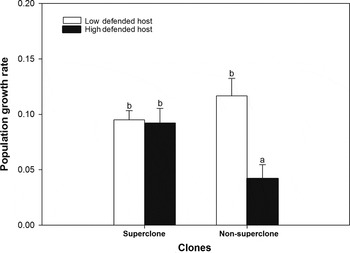
Aphid performances did not vary significantly among genotypes but did vary among hosts within genotypes (fig. 1). While the non-superclone genotype performed significantly better on the low-Hx wheat cultivar (F = 24.57, P < 0.001), the superclone genotype showed no differences among wheat cultivars (F = 0.32, P = 0.5815); however, the performance of the non-superclone genotype was significantly lower than the superclone genotype on the high-Hx wheat cultivar (F = 9.99, P < 0.01; fig. 1).
Population growth rates for the superclone and non-superclone genotypes on wheat cultivars with different concentrations of plant defense chemicals. Different letters within sets of bars indicate that the differences between values are significant at P < 0.05 determined using a two-way ANOVA followed by Tukey's multiple comparisons test.

Effect of host change in the probing behavior of superclone and non-superclone
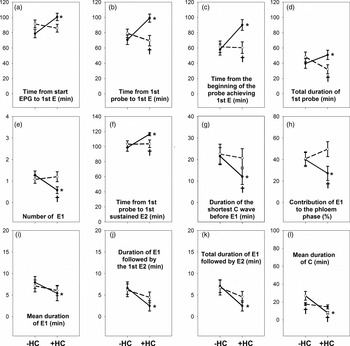
Regarding probing behavior, from the 70 different EPG variables only a few variables showed significant interactions between factors. A correlation matrix was then generated to test the collinearity among variables, after which the variable most related with phloem access was selected. Pre-phloematic stylet behaviors showing host-change × aphid genotype interactions (HC × G) included the time from the start of the EPG to the first E (fig. 2a), the time from the first probe to the first E (fig. 2b), the time from the beginning of the probe to the first E (fig. 2c), the total duration of the first probe (fig. 2d) and the duration of the shortest C wave before E1 (fig. 2g). In all of these cases, the non-superclone genotype displayed more quickly than the superclone genotype after host-changes for all the above pre-phloematic behaviors on both wheat cultivars. Regarding phloematic behaviors, the number of E1 waveforms showed a significant HC × G interaction, such that the superclone genotype displayed fewer E1 waveforms after host-change (fig. 2e). In addition, the time from the first probe to the first sustained E2 (fig. 2f) also showed a significant HC × G interaction such that the non-superclone genotype accessed phloem tissues more quickly after host-changes. Among the behaviors exhibited by aphids inside the sieve elements, the contribution of E1 to the phloem phase (%) (fig. 2h), the mean duration of E1 (fig. 2i), the duration of E1 followed by the first E2 (fig. 2j) and the total duration of E1 followed by E2 (fig. 2k), were not significantly affected by host-changes in the non-superclone genotype, whereas the superclone genotype showed a significant reduction in the duration of all these variables after host-changes. Nevertheless, the contribution of E1 to the phloem phase (%) tended to be larger in the non-superclone (fig. 2h). Regarding behaviors performed either after or before accessing the sieve elements (all-tissue factors), the mean duration of C periods decreased significantly after host-changes, but only in the superclone genotype (fig. 2l).
Changes in various EPG parameters (mean ± SE) displayed by the superclone (solid line) and the non-superclone (dashed line) genotypes after host-change (+HC) and no host-change (−HC). Asterisks (*) to the right of the mean value indicate significant differences (P < 0.05 for pairwise a posteriori comparisons following PERMANOVA tests) within a genotype between host-change treatments. Daggers (†) below mean values indicate significant differences (P < 0.05, Tukey's multiple comparison test) between genotypes within host-change treatments (40 individuals per treatment).

Combined effect of host-change and host-plant in the probing behavior of superclone and non-superclone
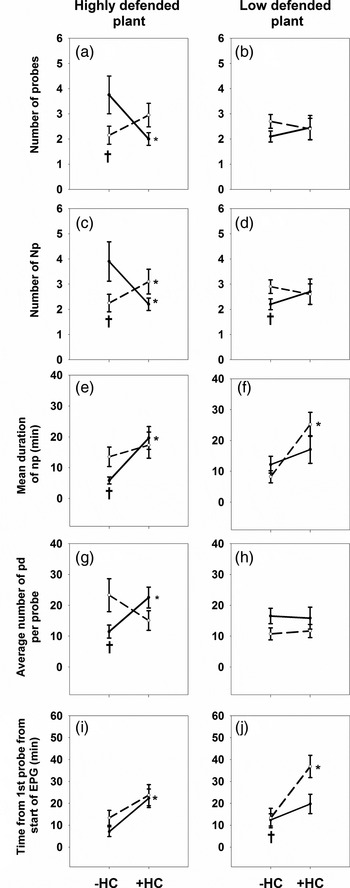
Remarkably, aphid genotypes showed different feeding behaviors on the test hosts depending whether host-changes occurred, as reflected by a significant HC × G × TH triple interaction. For instance, the number of probes and the number of non-probing periods both decreased in the superclone upon transfer to plants with high Hx (fig 3a, c), but did not change upon transfer to plants with low Hx (fig 3b, d). No such changes were observed in the non-superclone under similar conditions.
Changes in various EPG parameters (mean ± SE) displayed by non-superclone (dashed line) and superclone (solid line) resulting after treatments of host-change (+HC) and no host-change (−HC) to either highly defended or less-defended host plants. Asterisks (*) to the right of the mean value indicate significant differences (P < 0.05 for pairwise a posteriori comparisons following PERMANOVA test) within genotype between host-change treatments. Daggers (†) below mean values indicate significant differences (P < 0.05 for pairwise a posteriori comparisons following PERMANOVA tests) between genotypes within host-change treatments (20 individuals per treatment).

The mean duration of non-probe periods significantly increased in the superclone after transfer to plants with high Hx (fig. 3e), whereas non-probe periods increased in the non-superclone only after transfer to plants with low Hx (fig. 3f). The average number of cell punctures (pds) per probe increased significantly in the superclone after transfer to plants with high Hx (fig. 3g), whereas transfer to plants with low Hx did not elicit changes in this variable for either genotype (fig. 3h). Finally, the time from the start of EPG to the first probe (fig 3i, j) was longer after host-change in both genotypes. However, these differences were observed in interactions between plants with high Hx and superclone individuals (fig. 3i) and between plants with low Hx and non-superclone individuals (fig. 3j).
Discussion
This study revealed that the reproductive performance and probing behavior of a superclone and a non-superclone genotype of the English grain aphid S. avenae are distinct when confronting wheat seedlings with different levels of a certain chemical defense. Firstly, as expected, the superclone showed a flat reaction norm in reproductive performance on these wheat cultivars. This is consistent with the pattern of occurrence of these genotypes in the field on cereals with different Hx concentrations (Figueroa et al., Reference Figueroa, Simon, Le Gallic, Prunier-Leterme, Briones, Dedryver and Niemeyer2005), but differ from previous studies comparing the performance in the laboratory (Figueroa et al., Reference Figueroa, Simon, Le Gallic, Prunier-Leterme, Briones, Dedryver and Niemeyer2004; Castañeda et al., Reference Castañeda, Figueroa, Fuentes-Contreras, Niemeyer and Nespolo2009). Surprisingly, in relation to the probing behavior, the superclone showed a slower access to the phloem after host change than the non-superclone. The later result suggests that the non-superclone behaved as specialist achieving a quicker access to the phloem. The higher efficiency exhibited by the non-superclone was observed through a significantly shorter time exploring pre-phloem tissues than the superclone and access to the phloem more rapidly. Similar faster access to the phloem has been found in specialist individuals of the aphid Uroleucon ambrosiae that access to the phloem tissues faster than generalist conspecifics on plants of Ambrosia trifida (Bernays & Funk, Reference Bernays and Funk1999). Likewise, a more rapid access to the first long probe, which is a proxy of access to phloem tissues, was also found by Vargas et al. (Reference Vargas, Troncoso, Tapia, Olivares-Donoso and Niemeyer2005), who studied the probing behavior in individuals of the specialized tobacco-race of the aphid Myzus persicae compared with generalist individuals. Thus, the non-superclone studied herein behaved as a specialist aphid, whereas the superclone does as a generalist. Hence, following a situation of host change, as occurs during the earlier stages of invasion to a new area (host) or host range expansion, the superclone's behavior is not affected by host change, behaving similarly (e.g. similar time to access to the phloem among host after host change) on plants with variable defenses (flat norm of reaction), whereas the non-superclone genotype does. It is worth mentioning that the non-superclone exhibited an efficient probing behavior that was independent of the plant chemistry. This result is also consistent with other studies on aphids showing that the relatively higher efficiency of specialists after a host change is independent of the host plant (Vargas et al., Reference Vargas, Troncoso, Tapia, Olivares-Donoso and Niemeyer2005), although this efficiency could be altered by a short period of experience on the alternative host (Tapia et al., Reference Tapia, Silva, Ballesteros, Figueroa, Niemeyer and Ramírez2015).
Castañeda et al. (Reference Castañeda, Figueroa and Nespolo2010b ) also studied the genotypes of S. avenae used herein, showing that they do not vary in their capacity to detoxify defense chemicals in host plants (Castañeda et al., Reference Castañeda, Figueroa and Nespolo2010b ). This observation could be explained in part by our results regarding the differences in probing behavior. A faster access to sieve elements in non-superclone individuals may reduce the time they are exposed to Hx in the mesophyll tissue (Hofman & Hofmanová, Reference Hofman and Hofmanová1971). In addition, learning abilities of aphids allows them to improve handling over plant metabolites (Ramírez et al., Reference Ramírez, Caballero and Niemeyer1999; Ramírez & Niemeyer, Reference Ramírez and Niemeyer2000; Prado & Tjallingii, Reference Prado and Tjallingii1999) or volatile compounds (Webster et al., Reference Webster, Qvarfordt, Olsson and Glinwood2013). Other studies have evoked rearing histories on test plants to explain differences in reproductive performance between different genotypes. Indeed, in a study of the performance of the generalist aphid M. persicae s.s. and its tobacco-specialized subspecies M. persicae nicotianae, Olivares-Donoso et al. (Reference Olivares-Donoso, Troncoso, Tapia, Aguilera-Olivares and Niemeyer2007) found a weakening of transgenerational maternal effects in the generalist genotype but not in the specialized genotype when both taxa were subjected to ‘optimal’ and ‘suboptimal’ hosts. These findings suggest that specialist, as the non-superclone, may exhibit rigid behaviors after host-change. In contrast, the same study showed that generalist aphids were able to progressively improve their performance after being transferred to the optimal host, displaying higher flexibility.
It is worth mentioning that host use in the field the non-superclone used in this study is no limited to low-Hx plants (Figueroa et al., Reference Figueroa, Simon, Le Gallic, Prunier-Leterme, Briones, Dedryver and Niemeyer2005). Indeed, wheat plants used were all more or less a suitable host for this genotype, which suggest that temporary establishment on a plant without Hx (rearing plant: barley) did not affect its subsequently probing response on wheat plants with different chemical defense levels (low-Hx and high-Hx). It should be kept in mind that the wheat species used in this study might not only differ in Hx content; although our previous studies suggest that other ecologically relevant characteristics are similar (e.g. sowing time, rate of development, orientation relative to aphid sources or exposure to wind) (Figueroa et al., Reference Figueroa, Loayza-Muro and Niemeyer2002, Reference Figueroa, Simon, Le Gallic, Prunier-Leterme, Briones, Dedryver and Niemeyer2004, Reference Figueroa, Simon, Le Gallic, Prunier-Leterme, Briones, Dedryver and Niemeyer2005; Castañeda et al., Reference Castañeda, Figueroa, Fuentes-Contreras, Niemeyer and Nespolo2009, Reference Castañeda, Figueroa, Fuentes-Contreras, Niemeyer and Nespolo2010a , Reference Castañeda, Figueroa and Nespolo b ).
The differences in probing behavior exhibited by the superclone and non-superclone genotypes of S. avenae described in this study could be also interpreted as ‘flexible’ and ‘rigid’, respectively. Such differences are evidenced when aphids were transferred from non-defended (barley; no Hx) to highly defended (wheat cv. Llareta; high-Hx) plants. For instance, the superclone showed indications of lower activity when transferred to plants with high-Hx (e.g. lower number of probes, higher number of non-probes periods and longer time to the first probe from start of EPG; fig. 3a, e, g, i), but not when transferred to plants with low-Hx (fig. 3a, d, f, h, j). Conversely, the non-superclone exhibited weak signs of host rejection, the number of non-probes increasing only when transferred to plants with low-Hx (fig. 3d) and increasing both the mean duration of non-penetration (fig. 3f) and the time from the first probe to the start of EPG (fig. 3j) when transferred to plants with high-Hx.
Other studies have reported that the host range influences the reproductive flexibility of aphids; specialized variants usually display more rigid phenotypes (Via, Reference Via1991; Caballero et al., Reference Caballero, Ramírez and Niemeyer2001), although phenotypic plasticity can alter these rigid patterns (De Barro et al., Reference De Barro, Sherratt, David and Maclean1995; Douglas, Reference Douglas1997; Gorur et al., Reference Gorur, Lomonaco and Mackenzie2005; Liu et al., Reference Liu, Zhai and Zhang2008). Few behavioral studies have addressed phenotypic plasticity of probing behavior in specialized or non-superclone genotypes (Ramírez & Niemeyer, Reference Ramírez and Niemeyer2000; Gorur et al., Reference Gorur, Lomonaco and Mackenzie2007).
The case of S. avenae in Chile, with an obligate parthenogenetic reproduction, shows a clear geographical dominance of some clones over others. Our findings show the probing behavior could be considered as a differential trait between a superclone and a non-superclone whose responses could be linked to genotype's capacity to confront certain chemical properties of the plant. Interestingly, is common to find invader species with low genetic variability in its populations, considering the clonality as a mechanism by which invaders with low genetic diversity succeed (Caron et al., Reference Caron, Ede and Sunnucks2014). Accordingly, studies related to physiological flexibility and fitness of insect pest, whose population is conformed mainly by superclone individuals, are key for integrated pest control. The knowledge of probing behavior of this aphid species could be considered a tool that give information about how the aphid faces chemical barriers in the plant and how these probing responses could be linked to activation of signaling pathways and immunity. Giving rise to study of aphid–plant interaction at the molecular levels and finally to the development of the new generation of biopesticides. However, further studies are needed to decipher the association between behavioral repertories and how this modulates the relative success of dominant genotypes.
Disclosure
The authors have no conflicts of interest to disclose.
Acknowledgements
We thank Lucia Briones for providing the S. avenae genotypes and Dr Iván Matus (INIA-Quilamapu) for providing the wheat cultivars, and HN for providing the Hx-content analyses. J.B.-S. thanks the Universidad de Talca for a doctoral grant. This work was partially funded by PBCT-CONICYT Anillo ACT-38 and by ICM grant NC120027.