How do states convince citizens to pay tax? Rather than focusing on enforcement, most accounts emphasize voluntary or ‘quasi-voluntary’ compliance as an essential element of successful tax regimes.Footnote 1 In these settings, individuals evade taxes far less commonly than would be expected if decisions were driven by fear of state sanctioning, and they express an intrinsic motivation to pay tax.Footnote 2 This intrinsic motivation, which scholars term ‘tax morale’, is often framed as citizen obligation or civic duty. Where tax morale is weak, the cost of enforcing tax compliance is much higher; widespread evasion and organized popular resistance to taxation are more likely to occur.Footnote 3 Norms favoring voluntary compliance are therefore important, but there remains limited understanding of how these norms come into being. The bulk of the literature on state building and taxation presumes that social contracts emerge slowly out of multiple rounds of conditional exchange between states and citizens.Footnote 4 From this perspective, it is repeated rounds of bargaining – not the expansion of enforcement – that produces quasi-voluntary compliance. But how do pro-compliance norms become general across a population? Does the provision of public goods simply produce a quid pro quo exchange with taxpayers, or can it result in deeper and less contingent norms of citizen obligation fairly quickly? And are there features of social context that either facilitate or impede this process?
In explaining how conditional compliance becomes normative commitment, the emphasis has long been on fiscal exchange, which is the relationship between receipt of public goods and increased willingness to pay tax. But the broader context surrounding exchange is important. Research has shown that higher levels of institutional trust, involvement in participatory decision making and national identity all strengthen societal norms against tax evasion.Footnote 5 In this article, we broaden this attention to context to include the social landscape surrounding individuals. We argue that two factors give definite predictions about individuals’ attitudes toward taxation: experience of state services provision (public goods) and the availability of community-provided substitutes for state services (club goods). Thus our theoretical starting point is the standard exchange-driven narrative of social contract emergence: individuals more readily adopt pro-compliance norms when they have a reasonable expectation that the state will deliver services in exchange for taxes.Footnote 6 More novel is this article’s argument that tax morale is affected by the existence of substitutes for state services. Where communities are able to effectively engage in ‘self-help’ provision of club goods, individuals with access to these community-provided goods are less likely to adopt norms favoring tax compliance, as they are less likely to turn to the state to provide security, contract enforcement or other basic services. These two arguments might be seen as consistent with capturing both supply and demand dimensions of state-society bargaining. Where either the state supply of services or the societal demand for such services is weak, we would be less likely to find norms that support voluntary compliance with state tax demands.
To test our hypotheses, we use new public opinion data from urban Nigeria to investigate why individuals adopt attitudes about taxation that we view as consistent with higher levels of tax morale. Ordered logit and multi-level estimations provide empirical support for our posited drivers of individual tax morale. First, individuals who report the receipt of public goods and those who are more satisfied with the government’s use of tax revenue are more likely to express support for an unconditioned citizen obligation to pay tax. Secondly, we test our innovative and more controversial intuition regarding the effect of club goods using several proxies, and we account for possible reverse causality. Overall, we find support for the notion that greater access to community-provided or club goods has a depressive effect on tax morale. Individuals who view group relations in their communities as harmonious, which would presumably make collective action easier and more effective, express lower degrees of tax morale. Similarly, individuals with access to club goods, such as those who participate in savings clubs or rely on vigilante groups for security, express lower degrees of tax morale. It is not involvement with these groups in particular that produces a weaker orientation toward the state; instead, we argue that reported reliance on these groups serves as an indicator of a local landscape that favors self-help collective action by communities or groups of individuals.
Do norms of citizen obligation to pay tax translate into actual tax compliance? The literature commonly assumes that individual tax morale generates actual tax compliance, but empirical support for this relationship is sparse.Footnote 7 Our data allow us to explore the effects of pro-compliance norms, state services delivery and the availability of club goods on individual tax payment. Bivariate logit models show that unconditioned belief in a citizen obligation to pay tax has a significant, positive effect on actual tax payment, and this norm mediates the effect of public goods provision on tax payment. In other words, the delivery of state services does not independently produce tax compliance; instead, receipt of public goods generates higher degrees of tax morale, which in turn boosts the likelihood that an individual will pay tax.
Our article makes several contributions to the literature. First, we suggest a new avenue of inquiry for scholars interested in attitudes toward taxation and state authority. The literature on state-society relations has often relied on a binary opposition between clientelistic and programmatic linkage, which are commonly seen as rivals.Footnote 8 In an attempt to move beyond the debate over these two forms of linkage, this article focuses on a contextual factor that is often neglected in the literature: the presence of community-level goods that sometimes serve as substitutes for state services. Non-state provision of needed services is particularly important where state penetration is historically very weak, as is the case across the developing world and, certainly, in urban Nigeria. Because we find that individuals with access to club goods are less likely to adopt pro-compliance norms, our findings suggest reasons to be skeptical that social capital necessarily improves government performance, as Putnam and others suggest.Footnote 9 In Putnam’s Italy, rotating credit associations and other trust-based community institutions provide information to government institutions and make them more efficient. These same types of institutions, however, when faced with a weak or predatory state, may serve as effective bulwarks against state penetration.
Secondly, our findings expand the evidentiary base for the fiscal exchange hypothesis to a region of the world for which evidence remains sparse. This article increases our confidence that government delivery boosts tax morale across a range of environments, including those in which distrust of state institutions and a past history of predatory state rule might be expected to undermine the strength of this mechanism. Thirdly, our tax payment findings suggest that public goods provision does not generate compliance on its own, as a purely exchange-based account of tax contracts would suggest. Instead, state services provision generates higher levels of tax morale, which in turn makes individuals more likely to pay tax. This is presumably good news for states, as we would expect a normative pathway to compliance to be more durable than one based on simple assessments of government performance.
In the next section, we discuss how the literature currently addresses the emergence of tax regimes and the place of individual attitudes in that literature. The third section explores the analytical distinction between public, private and club goods, from which we derive our working hypotheses. The fourth section describes the data, measures and research design, and it explains why urban Nigeria is a good context in which to examine the question of tax norm emergence. Finally, we discuss the results and conclude.
STATE FORMATION, TAXATION AND INDIVIDUAL ATTITUDES
In studies of the formation of modern Western European states, the development of tax collection capacity proceeds in tandem with the increasing societal penetration of states. The literature stresses the importance of iterated bargaining between states and societal actors.Footnote 10 The outcome of this bargaining is the establishment of a mutually beneficial social contract, in which citizens defer to the authority of the state, pay taxes and receive public goods. Studies of tax regimes in other settings have often adopted this framework, focusing on the evolution of consensual relations between tax-seeking states and tax-paying dominant classes.Footnote 11 At base, much of the historical institutionalist literature posits a simple exchange: individuals agree to pay taxes, and states agree to provide public goods and, possibly, to include citizens in state decision making.
One problem with this approach is its applicability to contexts where states are not reliant on tax revenues. For instance, in Sub-Saharan Africa, few governments are dependent on direct taxation to finance their budgets, and negotiation around taxation has not been central to state-society relations. In order to explain weak state accountability, scholars have tended to emphasize macro-structural factors, such as ethnic diversity, group inequality or the availability of alternative revenue sources.Footnote 12 For instance, the resource curse literature suggests that state-society bargaining does not occur if states rely on natural resource rents rather than tax revenues. In these contexts, states have few incentives to deliver social services or develop ties of accountability with their populations.Footnote 13 Structural features at the national level, such as resource profiles, affect states’ motivations to invest in direct taxation, but state capacity to collect tax can be powerfully influenced by pre-existing social institutions. Particularly in the early stages of state building, these institutions mediate the effects of state strategies, possibly leading to significant geographic variation in state capacity within a single-state territory.Footnote 14 For instance, according to Boone, where pre-existing local authority structures are centralized and have their own revenue sources, a state must build stronger bureaucratic capacity and deliver more public goods than it must in areas where it does not face these kinds of rivals. Drawing on this central insight, we investigate the effects of meso-level organizations – that is, the social institutions that coordinate club goods provision – on individual tax morale.
The article argues that neither exchange nor coercion is sufficient to explain tax regime emergence. We depart from the mainstream political science literature in stressing the importance of individual attitudes. Tax morale scholars have established that attitudes play a primary role in boosting compliance with taxation, but these scholars are largely reliant on evidence from the developed world, where compliance and state capacity are already high. Like the literature discussed above, the tax morale literature has relied heavily on exchange mechanisms to explain the emergence of norms favoring voluntary compliance.Footnote 15 It has also established the effect of the broader political context on tax norms. For instance, Alm et al. show that longitudinal changes in levels of trust in the Russian state partly explain shifts in tax morale.Footnote 16 Both Torgler and Feld and Frey find that political participation in decision making improves both tax morale and tax authorities’ treatment of citizens.Footnote 17 In a rare study of tax compliance in Sub-Saharan Africa, Fjeldstad and Semboja find that an individual’s perception of the societal prevalence of evasion exerts at least as strong an effect as the perceived likelihood of prosecution.Footnote 18 To this point, scholars have neglected the effect of localized social capital on tax attitudes, though effective community provision of services would conceivably diminish the value attached by individuals to state supply of goods. Thus our article fills an important gap by examining how public goods delivery and local community context affect tax morale where state capacity is weak and tax evasion is prevalent.
INDIVIDUAL ATTITUDES TOWARD TAXATION
To develop hypotheses about individual tax morale, we consider research on risk pooling, public goods investment and clientelism in the developing world. These distinct literatures suggest the importance of three different kinds of goods that individuals may receive from their environments: public, club and private goods. In deriving testable hypotheses, we focus on the first two types of goods (club and public), since the literature on what we term private goods does not generate clear expectations regarding effects on our dependent variable, as we will discuss.
Public Goods
Our starting hypothesis is the straightforward fiscal exchange thesis that underlies much of the work on taxation.Footnote 19 According to this mechanism, individuals who directly benefit from public goods are more likely to pay taxes and to support the state’s right to tax. It may be that these individuals grasp the link between tax contributions and continued government spending on public goods. Alternatively, receipt of public goods may create greater trust in government institutions and greater belief in the procedural fairness of government decisions, both of which scholars have found to be positively associated with tax moraleFootnote 20 and payment.Footnote 21
Hypothesis 1: Individuals with positive evaluations of public goods delivery are more likely to support the state’s right to tax.
The logic of fiscal exchange is straightforward, but there are some potential complications. Evaluations of government performance can be affected by individuals’ political allegiances. Research has shown that those who support the sitting government express more positive evaluations of government performance, and their evaluations are less likely to be affected by evidence of corruption or mismanagement.Footnote 22
Club Goods
Our second mechanism focuses on the link between tax morale and internal community attributes, specifically the availability of group-delimited or club goods. In Nigeria and other low-capacity states, public goods are provided at suboptimal levels, and communities and individuals often engage in ‘self-help’ provision of such goods. These efforts range from the forging of somewhat amorphous trade and trust networks to the collective provision of schools and roads to the creation of concrete non-state agents of order, such as ethnic militias and vigilante groups. Access to these goods is almost always limited to those who contribute to their creation and maintenance.
The literature on risk pooling in the developing world, reaching back to James Scott, suggests that individuals are often embedded in networks based on norms of reciprocity and more tangible enforcement mechanisms.Footnote 23 Co-ethnicity is a strong basis for the creation and maintenance of these kinds of networks,Footnote 24 as are religious co-affiliation and other kinds of social ties.Footnote 25 These networks serve as a valuable protection against income shocks for the poor in both urban and rural settings, but they can be powerful resources for organizing and policing collective action as well. Why are club goods provided in some communities to a greater extent than in others? It is easier to enforce participation and contributions to community goods where there exist community cohesion and norms of reciprocity.Footnote 26 Where communities are instead sharply divided, individuals may shy away from investing in community goods from which rivals cannot be excluded.Footnote 27 Stated differently, individuals are less likely to construct networks of exchange where information is poor, as we might presume it to be in communities characterized by diversity, conflict or distrust.Footnote 28
Given the above, there are two mechanisms through which club or community-provided goods might shape tax morale. First, effective club goods provision may crowd out demand for state-provided services. Communities that provide insurance and savings to their members need not look to the state to provide a social safety net, while vigilante and community policing would make citizens less reliant on state police. Secondly, negative experiences with the state and positive experiences with investment in club goods can reinforce one another. Where public officials prioritize ‘primordial publics’ over the civic realm, as scholars suggest is the case in Nigeria, state corruption and predation become commonplace.Footnote 29 This would in turn reinforce individuals’ decisions to invest in alternative authority structures, such as ethnic groups, market associations or even militias. Our second hypothesis flows from the posited inverse relationship between a community’s success at club goods provision and its residents’ willingness to invest in the state.
Hypothesis 2: Individuals are less likely to support the state’s right to tax if they live in communities that effectively engage in the ‘self-help’ provision of club goods.
Private Goods
In electoral regimes, core or electorally crucial constituencies are often granted greater access to state services and state spending.Footnote 30 Though this is true in much of the world, targeted redistribution of state resources is even more central to politics in Africa. There, differential public investment is often provided along ethnic lines, and the effects of favoritism toward ruling coalition members can be seen in the distribution of roads, education and health, and electrification.Footnote 31 Clientelism is a winning strategy for politicians, and voters often expect – and even demand – targeted redistribution over the more general delivery of public goods.Footnote 32 Thus for many African voters and politicians, politics involves the transformation of public finances into private goods. Membership in ethnic or partisan winning coalitions is often treated as an important determinant of individuals’ access to resources, voting preferences and political participation.
Can we link membership in winning coalitions to attitudes toward taxation? Would likely ‘winners’ in the game of clientelistic redistribution be more likely to support a citizen obligation to pay taxes? There are reasons this is problematic. Clientelistic redistribution can explain some group-level differences in government services, but these effects are rarely uniform across types of services, even within a single country.Footnote 33 Further, as Wantchekon points out, even where clientelistic benefits exist, they rarely extend to all individuals within a coalition.Footnote 34 Looking at taxation explicitly, there is a great deal of ambiguity about the effect of membership in ruling coalitions. On the one hand, members of ruling coalitions might be more likely to support an expansion of the state and tax revenue, as they are likely to benefit from heavier state coffers. But these same individuals might think twice if the tax burden falls disproportionately on their shoulders, as Kasara suggests it does.Footnote 35 She finds that African states more heavily tax their core constituencies – in this case, presidents’ co-ethnics – because they have greater extractive capacity when dealing with these groups. Greater tax burdens, however, need not be inconsistent with a willingness to pay. In his study of tax policy in South Africa and Brazil, Lieberman shows that individuals willingly pay taxes where they see state policy as benefiting a group to which they belong, even if they themselves will not be beneficiaries.Footnote 36
Clientelism’s effect on tax morale therefore seems indeterminate. The beneficiaries of clientelistic redistribution may wish others to pay taxes, as expanded tax revenue would benefit them, but they may reject obligation when it comes to their own payment. Where they exist, higher levels of tax payment among ruling coalition members may reflect either greater enforcement capacity, as Kasara suggests, or voluntary compliance, as Lieberman suggests. More broadly, clientelistic linkage has an ambiguous effect on individuals’ attitudes toward state authority and citizen obligation. On the one hand, clientelistic linkage can be a basis for state legitimacy and trust in state institutions,Footnote 37 which is often found to increase tax morale. On the other hand, clientelistic linkage may undermine civic attitudes and reinforce the notion of governance as conditional exchange between particular governments and particular constituencies.Footnote 38 This runs counter to the idea of non-conditioned citizen obligation to pay tax, which is the focus of this article. Though the empirical sections below examine this dimension more carefully, we do not view ruling coalition membership as a convincing explanatory variable due to the inconsistency of its hypothesized effects.
DATA AND EMPIRICAL DESIGN
We use data from an independent academic survey on taxation and political attitudes conducted in eleven Nigerian cities in December 2010 (N=2,750), more details of which can be found on the authors’ websites. City-representative samples were selected using a stratified, clustered sampling procedure; individual informants were selected using a random-walk protocol from GIS-selected starting points. To ensure adequate female respondent representation, especially in the Muslim north, gender parity was imposed. Cities were drawn from each of the three zones into which Nigeria is often divided, and they vary in terms of demographics, politics and riot proneness. There are three northern cities (Bauchi, Kano, Sokoto), three middle belt cities (Jos, Kaduna, Lafia), and five cities in southeastern and southwestern Nigeria (Ibadan, Lagos, Aba, Enugu and Onitsha).
Nigeria is a valuable context in which to examine the development of tax morale. The federal and state governments’ dependence on oil revenues has generated a classic resource curse dynamic, in which both government accountability and tax collection infrastructure are low.Footnote 39 The oil boom of the late 1970s generated an increasingly corrupt and predatory state in Nigeria, and successive authoritarian governments did not invest in the rule of law or services delivery. State neglect fostered a large informal economy and a do-it-yourself attitude toward infrastructure and contract enforcement on the part of communities and individuals. In some cities, informal vigilante groups have often been the most visible agents of order; in others, communal riots over indigeneity and religious differences are common. Despite the return to multiparty elections in 1999, distrust of state institutions remains widespread.Footnote 40 This is an environment in which tax morale would be expected to be low.
Though state penetration is weak across Nigeria, the federal system allows for a degree of variation in taxation and services across states. In terms of formal taxing powers, the federal government retains control over the taxes that are least costly to collect, such as customs and excise. State governments are formally empowered to collect personal income tax and other levies, and some states collect council rates and taxes on behalf of local governments.Footnote 41 Overall, the tax collection infrastructure at both the federal and state levels is weak in Nigeria, even by African standards. Many state governments depend on federal oil transfers, and they consequently underinvest in tax collection capacity. Over the past decade, however, some Nigerian states have undertaken reforms aimed at increasing internally generated revenue and creating a bureaucratic presence in their urban centers. Since the bulk of public goods are provided at the state and local levels, this creates interesting variation in both tax collection and services across the cities sampled. For instance, in a surprising test of the durability of the resource curse, federal transfers to Lagos State were suspended in 2003 due to a bureaucratic dispute, and the state government responded by stating that it would fund itself via tax revenues. The state government increased its tax revenue more than tenfold between 2003 and 2007. Dramatic improvements in revenue collection coincided with a visible expansion of social services, even in slums. Thus in areas where states have started this process of reform and delivery, we would expect higher levels of tax morale, even if the overall national context remains deleterious.
Tax Morale
Our measure of tax morale captures individuals’ attitudes toward a citizen obligation to pay tax. Individuals are asked to grade their agreement with the following alternative statements: ‘citizens should always pay their taxes, even if they disagree with the government’ (Statement A) or ‘citizens should only pay taxes if they believe in the government’ (Statement B). Individuals can respond by strongly agreeing with A, agreeing with A, agreeing with B or strongly agreeing with B. They can also choose to agree with neither statement (4.4 per cent of the sample). Based on this question we create a single scale ranging from 1 to 4, with larger numbers showing more agreement with the notion of an unconditioned citizen obligation to pay tax (Statement A).
Is this a valid measure of an individual’s intrinsic motivation to pay tax? The tax morale literature uses a range of questions to capture the same concept. Many of these questions ask respondents to express the strength of their agreement with a single normative statement, or they ask respondents to rate the justifiability of tax evasion on particular grounds. Importantly, there is no objective measure of tax morale. All existing measures imperfectly capture the concept of intrinsic motivation to pay tax, but our measure is both consistent with other authors’ use and also avoids some potential pitfalls. For instance, one widely used measure of tax morale is a World Values Survey (WVS) question that asks respondents to rate the justifiability of ‘cheating on taxes’.Footnote 42 This question style, very common in the literature, runs the risk of normative priming and may also be unsuitable in low-enforcement settings. In these settings, tax evasion rarely requires active ‘cheating’ so much as it does avoidance, and a cheating-based question may produce an implausibly high level of tax morale. For instance, according to the WVS, a high percentage of Nigerians (63.3 per cent) say that cheating on taxes is never justified (with a further 14.7 per cent responding with a 2 out of 10, with 10 being ‘always justifiable’). This is a higher level of tax morale than in most Latin American countries and even exceeds levels in high-income industrialized countries.Footnote 43 The WVS significantly over-reports levels of tax morale in Nigeria given known societal attitudes toward taxation and actual evasion behavior, which is well over 50 per cent of the population. In order to avoid this, we follow the practice of other scholars in using a question that probes the acceptability of particular grounds for non-payment (here, a citizen’s disagreement or non-belief in the government).
One concern with our choice of dependent variable may be the extent to which it taps into the overall support for the sitting government versus a deeper long-term orientation toward the state. As we explained earlier, the literature on clientelism and targeted redistribution does not suggest a single mechanism linking taxation and ruling coalition membership. But it is worthwhile to examine the correlation between tax morale and these measures. We examine several measures of individual support for or membership in ruling coalitions: (1) stated co-partisanship with the sitting president or expressed intention to vote for him in the then-upcoming 2011 elections; (2) shared partisanship with the sitting state governor; (3) shared ethnicity with the state governor and the president;Footnote 44 and (4) expressed trust in one’s own governor or the president. Univariate correlations between our dependent variable and these measures are very low (under 0.1). Low correlations increase our confidence that tax morale, as measured here, taps into a deeper orientation toward state authority that is independent of support for or expected benefit from any particular administration.
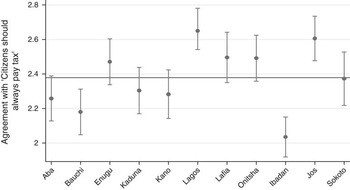
In the analysis below, we retain the full four-point scale of responses, ranging from ‘strongly agree with Statement B’ (value 1) to ‘strongly agree with Statement A’ (value 4). Roughly 42 per cent of the sample agrees with Statement A to some extent. Patterns of responses, however, vary across cities. Figure 1 shows city-level means for the variable, with bars representing 95 per cent confidence intervals around the means. The solid line represents the global sample mean. Differences in means are significant across several cities, and particular cities (Lagos, Ibadan, Bauchi, Jos) serve as interesting outliers. This variation does not seem to be associated with the effectiveness of the tax collection apparatus, the capacity of which is low across Nigeria. There also seems to be little correlation between a state’s level of budgetary tax dependence and either pro-tax attitudes or tax compliance. For instance, both Lagos and Oyo States rely on internally generated tax revenue to fund state budgets to a greater extent than other states; however, they lie on opposite ends of the spectrum in terms of both tax morale and residents’ reporting of tax payment. Among states with intermediate levels of tax dependence, there is similar variation. If budgetary dependence on taxation is correlated with state investment in tax collection, differences in tax morale and payment do not seem to be driven by differences in state collection capacity.
Unconditioned support for citizen obligation to pay tax across Nigerian cities

Nor is variation directly due to differences in state government performance. Lagosians have higher tax morale than their counterparts in other cities, which is unsurprising given the expansion of services. Other outliers are more difficult to explain. Jos, for instance, is the most riot prone of the cities surveyed. During our survey, deadly conflict broke out in a village near Jos and residents feared that riots would erupt within the city. Ibadan, on the other hand, is a fairly homogenous city, with Yorubas composing 88 per cent of the population, and it has never experienced ethnic or religious riots. As Figure 1 shows, these two cities are strong outliers with regard to attitudes toward taxation. The battle-scarred residents of Jos express much stronger approval of citizens’ unconditioned obligation to pay tax, while the residents of Ibadan have much lower mean tax morale. Jos and Ibadan suggest that conflict and trust may work as suggested above: less conflictual communities may be able to solve collective action problems and engage in ‘self-help’ provision of club goods without the assistance of the state, while those who cannot are more likely to look to the state as a potential solution.
Independent Variables
For our fiscal exchange hypothesis, we use two measures of tax-related government performance. The first of these indicators is expressed satisfaction with how the current state administration has spent tax revenue. Approximately 38 per cent of our sample reported that they were very or somewhat satisfied with the way their state governments had used tax revenue. This question directly prompts state government use of tax revenue, but this does not undermine its fitness as a measure of satisfaction with overall public goods delivery or tax revenue use. For most Nigerians, taxes and services relate to local and state governments. There is a strong association between state governors and elected local officials, as the former typically serve as political ‘godfathers’ within their territories. Further, as noted above, state governments are often involved in collecting local government levies and provide most large public goods. Our second indicator of public goods delivery is an additive measure of concrete public goods provision. Respondents are asked about seven different public goods that may have been built in their communities by the current government (hospitals, schools, police posts, water infrastructure, etc.). Using these responses, an index of public goods provision was constructed with a maximum of seven and a minimum of zero public goods provided. About 73 per cent of the sample reported the construction or provision of at least one new public good by the sitting government; 23 per cent of the sample reported the provision of four or more public goods.
To test our second hypothesis, we use several proxies for the ability of an individual’s community to provide club goods to its own members. The first is an individual’s perceived level of conflict within her own community, since we assume that conflictual communities are less effective at club goods provision. Individuals are asked to characterize the relationship between ethnic and religious groups in their city. Responses are on a five-point scale ranging from ‘very hostile’ (coded 1) to ‘very cordial’ (coded 5). We also code respondents’ answers to the question of how often ethnic and religious conflict in their community had resulted in the loss of life or destruction of property. There is a high rate of refusal for this question (1,000 observations lost), but the correlation between the perception of community relations and an individual’s estimate of rioting is high (0.56) for the remaining observations.
Both of these remain imperfect measures of club goods provision, and we include more direct measures of individual access to community goods. Thus a third measure is a dummy variable that takes a value of 1 if the individual relies on informal savings clubs to safeguard the bulk of their savings. States are rarely expected to provide banking services to their citizens, but we see the use of savings clubs as a rough proxy for community-level social capital. In poor countries, individuals weather risks on their own without a state-provided security net, and savings clubs are one community solution to this problem. About 8 per cent of our sample reports using savings clubs, though that constitutes 22 per cent of those who actively save money. Another direct proxy for club goods availability is reported reliance on non-state security forces. In Nigeria, as elsewhere in the developing world, communities often rely on vigilante groups and informal militia for protection.Footnote 45 We therefore include a measure of individuals’ reliance on non-state actors for security provision: the variable takes a value of 1 for individuals who report that they would find vigilante groups most helpful in solving a theft. About 7 per cent of our sample reports that they would find vigilante groups most helpful (before police, for instance). We expect weaker tax morale from individuals living in harmonious communities, those who invest their savings with members of their social networks and those who see vigilante groups as potentially effective security enforcers.
Besides our key variables, we use standard controls, including a respondent’s age, gender, education, ethnicity, religion, religiosity, the respondent’s status as indigenous to state of residence, a measure of food deprivation and household asset ownership. Occupation was recoded to produce usable ‘class-like’ categories, such as informal sector employment, unskilled formal sector employment and white-collar professional status. We also include variables that capture different aspects of an individual’s interaction with the state: a measure of an individual’s interest in politics (a four-point range from ‘not at all interested’ to ‘very interested’); a measure of whether individuals reported meeting with a government official or representative in the prior year, ranging from never (1) to often (4); and a binary measure of whether respondents reported paying a bribe to or being asked for a bribe by a government official in the prior year.
Due to the ordinal nature of our dependent variable, the statistical analysis relies on ordered logistic models.Footnote 46 City fixed effects are included to control for unobservable city-level characteristics, but the results are similar when they are excluded. As a robustness check, we also incorporate city-level factors via multi-level estimation techniques that explore nested data.Footnote 47 This latter approach recognizes the hierarchical structure of that data, correcting potentially underestimated standard errors of regression coefficients. Overall, our results are robust across a variety of model specifications.
RESULTS
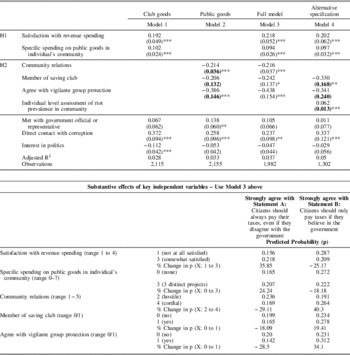
In discussing the statistical estimations, we first assess the direction of effects and statistical significance. We then compare the substantive effects of the variables identified as statistically significant and explore robustness. Table 1 shows the results from ordered logit estimations, testing our hypotheses separately and then combining the key independent variables in a full model (Model 3). Model 4 uses the alternative operationalization of community conflict. The dependent variable is individual tax morale (higher values indicate greater agreement with the statement ‘citizens should always pay their taxes, even if they disagree with the government’).
Ordered Logit Model of Individual-Level Determinants of Attitudes Toward Taxation

Note: robust standard errors in parentheses; ***p<0.01, **p<0.05, *p≤0.10. Models include city fixed effects and all control variables. The dependent variable takes higher values for higher tax morale (unconditioned support for a citizen obligation to pay tax). Bold text indicates it is jointly statistically significant in an F test.
Several findings stand out. There is solid support for fiscal exchange. Both variables operationalizing our public goods hypothesis have strong, significant effects on tax morale. Increased satisfaction with the use of tax revenue and the receipt of concrete public works (hospitals, roads, etc.) increases the likelihood that individuals express unconditioned support for a citizen obligation to pay tax. Both indicators are statistically significant in Model 1 and in the full model (Model 3). Secondly, we find robust support for the depressive effect of club goods supply on individual tax morale. All of the measures used to capture community-level social capital receive support from the estimations. Individuals who see communal relations in their local area as cordial or very cordial are more likely to condition their support for a citizen’s obligation to pay tax. The negative effect of harmonious community relations on tax morale is robust in both Model 2 and in the full model. As an additional check on this measure, in Model 4 we use an individual’s aggregated report of ethnic and religious clashes in her community. Individuals who report rioting in their communities are more likely to express higher levels of tax morale. Being a member of a savings club also has a negative effect on tax morale, as posited. The variable is just shy of the conventional 10 per cent confidence level in Model 2 (p=0.118) but is statistically significant in Model 3 and in a joint F test of all variables operationalizing Hypothesis 2. Respondents who express a willingness to turn to vigilante groups in the event of a theft are also more likely to condition a citizen’s obligation to pay tax (negative and statistically significant coefficients in Models 2 and 3).Footnote 48 Overall, there is strong support for the idea that individual access to club goods reduces tax morale.
Other measures of individual contact with the state also have statistically significant effects on tax morale. Having paid or been solicited for a bribe is found to be strongly and positively associated with tax morale, as is being a victim of state-directed evictions (reported in Table 2). This corroborates the idea that any contact with the state – even if that contact is predatory – might increase an individual’s orientation toward the state as a locus for claims making.Footnote 49 Far less robust is the effect of meeting with state representatives, which is signed in the expected direction (meeting with a representative increases tax morale) but is not consistently statistically significant across models.
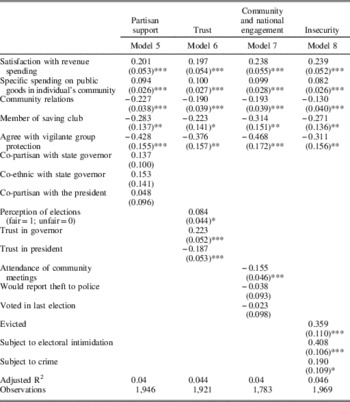
Ordered Logit Model of Individual-Level Determinants of Attitudes Toward Taxation: Robustness Checks

Note: robust standard errors in parentheses; ***p < 0.01, **p < 0.05, *p ≤ 0.10. All control variables are included in the estimations. The dependent variable takes higher values for higher tax morale.
Many demographic controls do not have an effect on tax attitudes. Education, age, socioeconomic status, religion and religiosity do not achieve statistical significance, though female respondents do have higher tax morale. Hausa ethnic identity is also positively associated with tax morale, which may be due to a pre-colonial history of stronger, more centralized states in the areas of Northern Nigeria where Hausa reside or to different governance patterns during colonialism. Apart from this, other ethnic effects are not significant. Igbo identity is negatively associated with social contract attitudes, but it is not statistically significant, suggesting that being part of the president’s ethnic coalition has no effect on tax morale.
With logit models, the size of effects cannot be directly inferred from model coefficients. Table 1 therefore includes predicted probabilities and average marginal effects for statistically significant variables. The probabilities and effects are computed for meaningful values of each of the variables, keeping the remaining covariates at their observed values and then averaging across respondents. The variables that test our core theoretical hypotheses have sizeable marginal effects. More satisfaction with the use of tax revenue (a move from 1 to 3) and recent public goods projects in a community (a move from 0 to 3) increase the likelihood of expressions of tax morale by 36 and 24 per cent, respectively. Residents of harmonious communities are about 29 per cent less likely to agree with an unconditioned citizen obligation to pay tax. Being a member of a savings club and supporting vigilante group protection reduce the expression of tax morale by 18 and 28.5 per cent, respectively.
Our main findings are robust to a battery of additional empirical specifications. As a first step, we include several variables that code for individual membership in the ruling coalition, which allows us to test whether potential access to clientelistic benefits shapes tax morale. These code whether the respondent was: a co-partisan of the president or expressed an intention to vote for him in the then-upcoming 2011 elections; a co-partisan of the sitting governor in her state; or a co-ethnic of the state governor. Co-ethnicity with the president is already included in Igbo ethnicity as a control, since Igbos are typically presumed to be the beneficiaries of Goodluck Jonathan’s administration. We also add alternative evaluations of confidence in government (perception of the fairness of elections, trust in the governor and trust in the president) and other measures of social and political engagement (attendance of community meetings, likelihood of reporting theft to the police and reported voting in the last election). Finally, we include variables that capture personal security: perception of the prevalence of electoral intimidation, direct experience of crime in the last year and direct experience with state-sponsored clearance of illegal structures.
Most importantly, Table 2 shows that our key variables retain statistical significance after adding additional variables to our preferred Model 3. In addition, membership in winning coalitions does not affect individual attitudes toward taxation (Model 5). Some of the additional measures of attitudes toward the state attain statistical significance (Model 6). Perception of the fairness of elections increases support for an unconditioned citizen obligation to pay tax. The trust variables also achieve statistical significance, but the effect of trust is not uniform. Trust in the governor increases tax morale, while trust in the president reduces it. In Model 7, reported attendance of community meetings, which might indicate involvement in neighborhood civic life, reduces tax morale. Since individuals who participate in neighborhood civic life presumably have greater access to networks or institutions that provide club goods, this result supports our club goods hypothesis. In Model 8, two measures of personal insecurity – perceptions of the prevalence of electoral intimidation and direct experience with state clearances – have significant, positive effects on support for citizen tax obligation. As with contact with bribery, these measures might be seen as a proxy for enforcement, or they may reinforce the notion that any contact with the state increases an individual’s familiarity with and orientation toward the state.
One concern with our findings on the fiscal exchange mechanism may be that political allegiances affect how individuals respond to government performance. However, similar to our theoretical discussion of the potential direct effects of clientelistic coalition membership, we believe that partisanship and co-ethnicity could possibly mediate the public goods–morale relationship in different directions. Those who share a partisan or ethnic identity with office holders may react more positively to received services than non-group members, such that the effect of the fiscal exchange mechanism is magnified. On the other hand, co-ethnics and co-partisans may view the receipt of services as mere clientelistic spoils, which then has an ambiguous effect on tax morale. As suggested above, clientelistic linkage may foster a view of state–citizen relations as contingent or conditional, making individuals more likely to agree with the statement that views tax compliance as only contingently necessary. We test these conditional hypotheses by adding interaction terms to Model 5. We find no significant interaction effect between the number of public goods in a community and indicators of either co-partisanship or co-ethnicity. This suggests that our findings regarding fiscal exchange are not mediated by partisanship or ethnicity. This is important because it shows that government services delivery can promote tax morale – and, possibly, a deeper orientation toward the state – across ethnic and partisan lines, even in divided societies.
As a further robustness check, we run multi-level ordered logit regressions (Online Appendix Table A2). In these models, we include the individual-level variables from Model 3 and city- and state-level variables. Two relevant measures at the state level are available: the percentage of the state budget funded from internally generated tax revenue (as opposed to transfers from the federal government)Footnote 50 and statewide personal victimization rates.Footnote 51 State budget reliance on internally generated revenue can serve as a proxy for varying levels of tax enforcement across states, while crime victimization may capture the difference in safety and security across states. We also include city-level aggregations of individual-level survey responses, including trust attitudes vis-à-vis the governor and the president, co-partisanship with the governor/president and co-ethnicity with the state governor. The intuition here is that living in an environment characterized by lower levels of trust may independently affect individual attitudes. Similarly, an individual’s attitudes may be affected by the partisan or ethnic character of her city, regardless of her own identity. We find little evidence of effects above and beyond individual-level effects. Only living in a city with a large proportion of co-partisans of the president independently increases the likelihood of expressions of higher tax morale. At the same time, our hypotheses regarding public and club goods continue to find robust support in these multi-level estimations.
Despite the robustness of our findings so far, there remains some concern about a recursive relationship between our dependent variable and some of the variables we use to operationalize our club goods hypothesis. In other words, individuals with low tax morale may be more likely to seek out and invest in community-level substitutes for the state. Though we acknowledge this theoretical possibility, we believe it does not affect the substance of our inferences for several reasons. First, the causal direction from tax morale to club goods seems less compelling in a context like urban Nigeria. Forms of community self-help predate government presence in the informal slum communities where the bulk of urban Nigerians live; indeed, state governments have even attempted to piggyback atop and expand their reach via pre-existing associations and vigilante groups.Footnote 52 In the rest of Africa, the pattern is similar: burial societies, rotating credit associations and other informal institutions were already established in the colonial period.
Secondly, our results are robust when we rerun our models with community-level proxies that are less vulnerable to this endogeneity concern. For instance, it is implausible that a respondent’s orientation toward tax obligation would substantially affect his count of the number of riots that had occurred in his town. As we noted earlier, this less qualitative measure of community conflict is highly statistically significant in Model 4 (Table 1). Finally, to further bolster our confidence in the findings, we employ a filtering technique described in Frey and TorglerFootnote 53 to estimate and correct the potential bias in some of our proxies for the supply of community-provided or club goods. For instance, assume that those who express belief in an unconditioned citizen obligation to pay tax always have a favorable orientation toward the state. These state-favoring individuals may then see their communities as less harmonious, may be less likely to turn to vigilante groups for help with a crime or may be less likely to participate in savings circles.
To deal with this potential bias, we calculate a bias correction by computing two city-level averages: (1) the average value of all residents’ responses for each of our main club goods proxies (quality of community relations, reliance on vigilantes and participation in savings clubs) and (2) the average value of responses for those individuals with the highest levels of tax morale (a response of 4 or ‘strongly believe’ that citizens should always pay tax). If there is a positive difference between the city average of all respondents and the city average of high-morale respondents, then we add this city-specific bias correction value to the assessments of all high-morale individuals in that city. By following the same method for all three of our proxies, we bring the response values of high-morale individuals closer to the average responses of those who live in the same city. When our preferred model is rerun with these bias-corrected measures, both the qualitative assessment of community relations and the reliance on vigilante groups remain statistically significant (Online Appendix Table A3). This fairly conservative estimation method roughly halves the coefficients on these two variables, but our marginal effects remain large, increasing our confidence in a causal relationship between the supply of community goods and tax morale.
ATTITUDES AND BEHAVIOR: WHO PAYS TAXES?
We turn now to the important question of whether higher tax morale has concrete effects on actual tax compliance. Our data allows the construction of a behavioral measure that is not susceptible to the problems of self-reported tax payment. Direct questioning regarding individuals’ own tax payment will generate some degree of over-reporting, given the incentives to conceal tax evasion. It may also generate respondent hostility toward enumerators, which could corrupt other responses as well. We therefore pursued an indirect means of ascertaining individual tax payment.
In the course of several questions about taxation and awareness of reforms, each respondent was asked if she currently paid more taxes and levies than she had three years previously. To this question, 44 per cent of respondents volunteered that they did not pay taxes. We use this unprompted response to construct a binary measure of tax payment. Those who reported that their taxes increased or decreased were presumed to have paid taxes, while those who volunteered non-payment were coded as non-payers. Our findings are robust to an alternative coding of this variable. Because the answer ‘No, I do not pay more taxes and levies than three years ago’ can also be construed as ‘no I do not pay taxes, but I also did not pay in the past’, we also code our variable as a 1 only if the respondent volunteered that he/she pays more now than in the past (Model 11). This variable codes 69 per cent of respondents as not paying taxes.
Are our rates of tax evasion plausible in the Nigerian context? State governments do not calculate or publicly release estimates of tax evasion rates. In our own discussions with state and federal government officials, there has been a general acknowledgement that the size of the tax base and the overall level of evasion in Nigeria are simply unknown. Lagos State has, however, started a process of tax auditing, and their estimates are instructive. Despite better tax enforcement than elsewhere in Nigeria, less than 35 per cent of Lagosians paid taxes in 2011.Footnote 54 Nor should this be seen as primarily a problem of the informal economy. Recently, Nigeria’s minister for economy and finance estimated that 75 per cent of officially registered firms do not pay federal corporate taxes.Footnote 55 Given these numbers, our self-reported measures seem plausible.
We can only view volunteered reporting of non-payment as evidence of evasion if the respondent is liable for tax. In Nigeria, income tax rates are set federally, and all workers – regardless of whether they are employed in the formal or informal sector – are assessed personal income tax liability starting at 5 per cent of their income per year.Footnote 56 Those with annual incomes below 30,000 naira (UK £258) are not required to file or pay taxes. This is a very high bar for exemption, far less than a pound a day, since income earners typically support several dependents. Though the majority of Nigerians are poor, very few workers would be eligible for formal exemption. Further, even those exempted from income tax are still likely to be required to pay a property tax known as tenement rate. Legislation on tenement rates varies from state to state, but individual exemptions are not granted based on income, property value, or whether the inhabitant is a tenant or owner.Footnote 57 The vast majority of our respondents would be legally required to pay both personal income tax and tenement rate.
In order to further explore the reliability of our non-payment measure, we run additional tests that assume some subset of non-evading non-payers among our respondents. Individuals may, for instance, earn less than 30,000 naira and live in a low-income area with habitations exempt from tenement rate. These individuals would not owe tax. We use our indicators on individual income, food deprivation and assets to create tax payment variables that do not consider extremely poor respondents as liable for tax. We consider as non-evaders individuals who have high levels of food deprivation (highest two or three levels of the variable), possess few assets (lowest two or three levels of the variable) and report earning less than 5,000 naira (£19) per month. Importantly, all the findings reported below on determinants on tax payment remain robust to using such alternative measures of tax payment (Online Appendix Table A4). It is also important to highlight that, overall, neither wealth nor employment in the formal economy is a statistically significant predictor of tax payment.
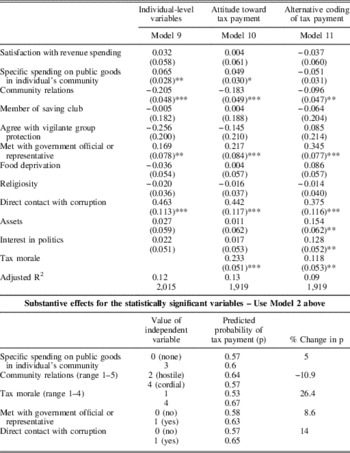
So who pays tax? Findings in Table 3 are derived from logistic models with city fixed effects, but the results hold when city fixed effects are excluded or when we use the same number of observations across Models 9–11. Our key finding, reported in Models 10 and 11, is that attitudes toward taxation have a significant effect on tax payment. Those who express higher levels of tax morale are more likely to pay tax. The variable has an important substantive effect too. A change from strongly supporting Statement B (‘citizens should only pay taxes if they believe in the government’) to strongly supporting Statement A (‘citizens should always pay their taxes, even if they disagree with the government’) increases the predicted probability of tax payment by 26.4 per cent. Since satisfaction with revenue spending and public goods receipt do not directly boost tax payment, services provision seems to produce tax compliance through its effect on individual attitudes. In other words, public goods receipt produces higher degrees of tax morale, which in turn is associated with tax payment. This finding underlines the importance of examining shifts in social norms alongside more concrete improvements in state delivery of services and state enforcement capacity.
Logit Model of Individual-Level Determinants of Tax Payment

Note: robust standard errors in parentheses; ***p<0.01, **p<0.05, *p≤0.10. Models include city fixed effects and all control variables. The dependent variable takes a value of 1 if individual pays taxes and 0 otherwise.
Of the other factors that achieve significance in our earlier model of tax morale, only one has consistent and robust independent effects on actual tax payment. In all specifications, those who report harmonious community relations are significantly less likely to pay tax. We posit that this is due to the substitution effect hypothesized above to explain attitudes: residents of areas with effective community provision of club goods are less likely to pay taxes, as they simply need the state less than those who do not have access to effective community goods provision. Neither savings club membership nor vigilante group reliance, however, is statistically significant. Measures of public goods provision also perform weakly in explaining actual tax payment. Concrete public goods provision has a positive effect on tax payment but is not significant across all models. In Model 11, which uses our alternative measure of tax payment, it is insignificant and signed in an unexpected direction. But other forms of direct contact with the state have strong, positive effects on tax payment. Direct contact with official corruption is significantly and positively associated with tax payment, as it is for tax morale. Another measure of contact with the state – meeting with a government official – is also significantly and positively associated with tax payment. The results for bribery and meetings with officials may be consistent with either of the mechanisms posited above. That is, state contact may be increasing individuals’ orientation to the state and individual tax payment, or bribe solicitation and meeting with government representatives may serve as proxies for state enforcement capacity.
CONCLUSION
Our findings have several implications for those who are interested in the development of state capacity and accountability in weak states in the developing world. Most simply, we show that tax morale exists even in contexts like Nigeria, where resource curse and predatory state dynamics are presumed to stunt the adoption of norms favoring state authority and voluntary compliance with state demands. Belief in an unconditioned citizen obligation to pay tax is not general: only about 40 per cent of our urban sample expresses a degree of agreement with this view, and these attitudes are likely to be more rare in rural contexts. Secondly, our findings lend further evidentiary support to established findings on fiscal exchange. Individuals in urban Nigeria are more likely to support a citizen obligation to pay tax if they have received concrete benefits from the state and view the state’s use of tax revenue favorably. Support from Sub-Saharan Africa for this mechanism is particularly important, as the existing literature relies heavily on evidence from the developed world. Finally, a more complicated story is suggested by our findings about the effect of social context on tax morale. We find that individuals with access to club goods are less likely to express belief in an unconditioned citizen obligation to pay tax. On the other hand, those who live in conflict-prone areas, where effective club goods provision is less likely, express higher degrees of tax morale, even if they lack past positive experience of state delivery. These findings suggest that conflict and ethnic diversity – factors often statistically associated with weaker public goods provisionFootnote 58 – may exist alongside popular support for ideas of citizen obligation to the state.
We suggest two directions for future research on the creation of state authority and effective taxation. First, both scholars and policy makers have recently – and rightly – focused on public goods delivery as a route to tax revenues and accountability. There has been a concomitant downplaying of the role of coercion in state building. But we show that state contact need not be benevolent in order to change individual orientations toward the state. Urban Nigerians who have been solicited for bribes – and those who have suffered due to state authorities’ destruction of illegal structures – have higher tax morale than those who lack these negative experiences of state contact. This is controversial evidence that warrants more research, but it is also direct evidence of the link Tilly poses between state extortion and societal acceptance of state authority. Secondly, future work would profit from greater attention to pre-existing institutions that serve, to some degree, as state rivals. Communities often construct substitutes for state services provision in the absence of the state. These substitutes can serve as impediments to a greater reliance on and responsibility to the state. Overall, we suggest that the emergence of tax morale – or norms supporting the quasi-voluntary compliance long presumed to be instrumental in the construction of state authority – is a reciprocal process of extending state services while prompting citizens to lessen their reliance on community-provided goods.