Introduction
Balanced structural chromosome rearrangements are common in human. Approximately 1/500 to 1/1000 of live births carry a balanced translocation (Jacobs et al., Reference Jacobs, Melville, Ratcliffe, Keay and Syme1974). Although the carriers of both Robertsonian and reciprocal translocations are phenotypically normal, the reproductive risk of balanced carriers varies depending on the chromosomes involved, the breakpoint positions, the segregation patterns and the sex of the translocation carrier (Ford & Clegg, Reference Ford and Clegg1969; Faraut et al., Reference Faraut, Mermet, Demongeot and Cohen2000). However, they generally have a lower chance to produce normal or balanced gametes due to abnormal segregation of chromosomes at meiosis leading to repeated spontaneous abortions and infertility (Scriven et al., Reference Scriven, Handyside and Ogilvie1998; Simopoulou et al., Reference Simopoulou, Harper, Fragouli, Mantzouratou, Speyer, Serhal, Ranieri, Doshi, Henderson, Rodeck and Delhanty2003).
There has been a long debate on whether the chromosomes involved in rearrangement affect the segregation of the structurally normal chromosomes. This incidence is known as interchromosomal effect (ICE) (Estop et al., Reference Estop, Cieply, Munne, Surti, Wakim and Feingold2000; Munne et al., Reference Munne, Escudero, Fischer, Chen, Hill, Stelling and Estop2005; Alfarawati et al., Reference Alfarawati, Fragouli, Colls and Wells2012). Several studies have investigated the occurrence of ICE in embryos derived from patients undergoing preimplantation genetic diagnosis (PGD) for translocations (Gianaroli et al., Reference Gianaroli, Magli, Ferraretti, Munne, Balicchia, Escudero and Crippa2002; Munne et al., Reference Munne, Escudero, Fischer, Chen, Hill, Stelling and Estop2005; Vozdova et al., Reference Vozdova, Oracova, Musilova, Kasikova, Prinosilova, Gaillyova and Rubes2011; Alfarawati et al., Reference Alfarawati, Fragouli, Colls and Wells2012). Although some studies strongly suggest that ICE exists in preimplantation embryos, some show that it is negligible or not even present (Estop et al., Reference Estop, Cieply, Munne, Surti, Wakim and Feingold2000; Gianaroli et al., Reference Gianaroli, Magli, Ferraretti, Munne, Balicchia, Escudero and Crippa2002; Munne et al., Reference Munne, Escudero, Fischer, Chen, Hill, Stelling and Estop2005; Alfarawati et al., Reference Alfarawati, Fragouli, Colls and Wells2012). This study aimed to analyse the occurrence of ICE in human preimplantation embryos derived from both Robertsonian and reciprocal translocation carriers focusing on ones with chromosome 10 rearrangements who were undergoing PGD and investigate whether aneuploidy screening will be beneficial to increase the pregnancy rates.
Materials and methods
Patient information
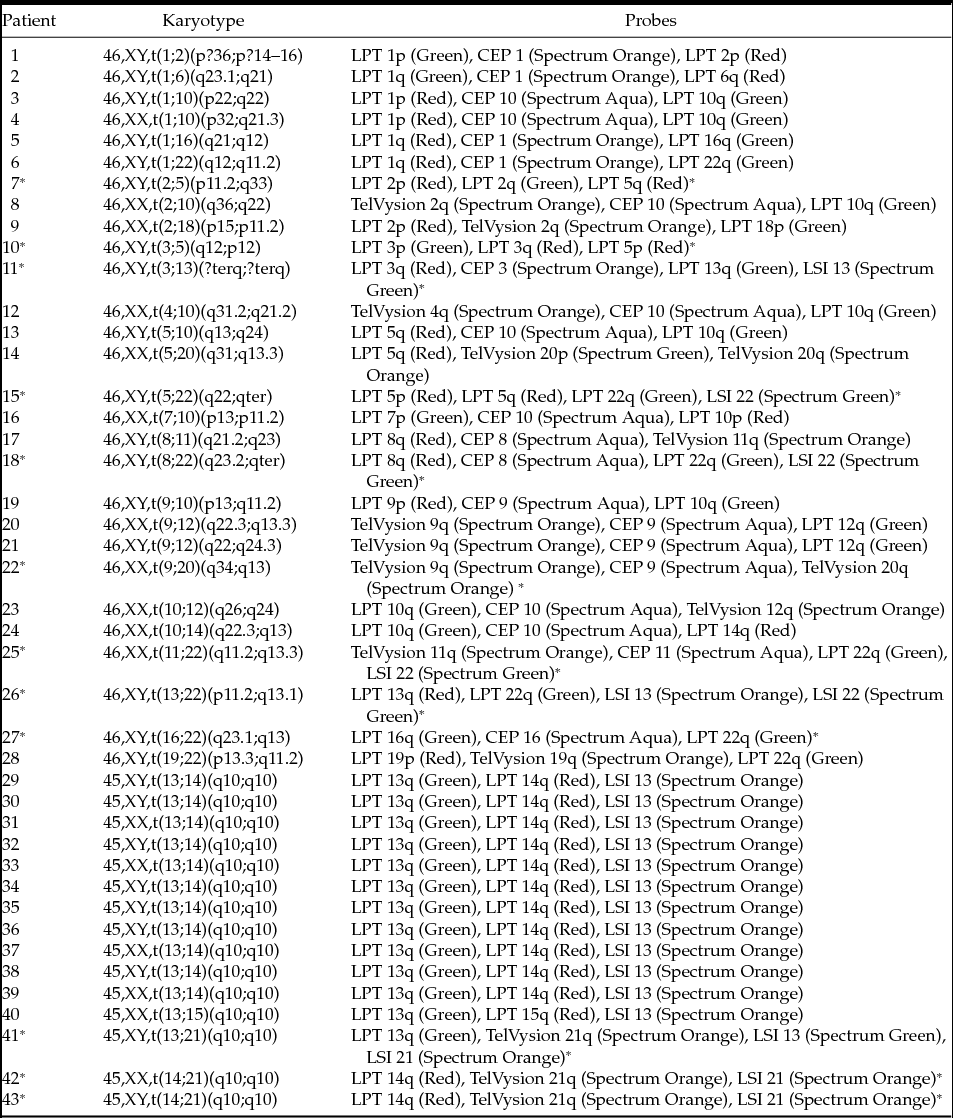
Overall, 15 patients underwent 17 cycles of PGD for Robertsonian and 28 couples underwent 35 cycles of PGD for reciprocal translocations from August 2010 to June 2013 at the Bahceci Assisted Reproductive Technology Centre. Of these reciprocal carriers, nine with chromosome 10 rearrangements underwent 12 PGD cycles. The karyotypes of all the carriers were reported by the clinical cytogeneticists. Multicolour fluorescence in situ hybridisation (FISH) was optimised using the patients' lymphocytes prior to each PGD cycle. A combination of two sub-telomeric probes and one centromeric or three sub-telomeric probes was used for each PGD case (Table 1).
List of patient information. Patient ID with the karyotype and the list of probes used in PGD analyses are listed. All the probes are from Cytocell (UK) and Abbott Molecular Inc (USA)

Controlled ovarian stimulation and embryo culture
The controlled ovarian stimulation process has been described previously (Ulug et al., Reference Ulug, Turan, Tosun, Erden and Bahceci2007). Briefly, human chorionic gonadotrophin (hCG) injection (5000 IU) (Ovidrelle; Merck Serono, UK) was administered to induce ovulation when at least two follicles reached 18 mm in diameter. Follicles were aspirated transvaginally 35–36 h after hCG injection under ultrasound guidance. Retrieved oocytes were cultured for 2 h before hyaluronidase treatment. Patients’ semen samples were processed using discontinuous colloidal silica gel gradient (PureSperm; Nidacon, Sweden). The sperm pellet was washed twice with sperm washing medium and only meiosis II (MII) stage oocytes underwent the intracytoplasmic sperm injection (ICSI) procedure. Injected oocytes were cultured in Single Step Medium (SSM) supplemented with 10% synthetic serum (Irvine Scientific, Irvine, CA, USA) in a 5% CO2 and 5% O2 in air incubator (INB-203C, IKS International, The Netherlands). Fertilisation check was performed 14–18 h post ICSI.
Preimplantation genetic diagnosis: biopsy, spreading and fluorescence in situ hybridisation
Only good quality embryos obtained from Robertsonian and reciprocal translocation carriers with a minimum of six cells and less than 50% fragmentation on day 3 of embryo development were biopsied. Culture medium was replenished post biopsy. Single blastomere was biopsied from each embryo using a laser (Octax™, MTG, Germany).
In total, 499 embryos from Robertsonian and reciprocal translocation carriers were biopsied. Of these, 175 embryos were biopsied from Robertsonian carriers from whom 135 were derived from young women (maternal age <36) and 40 from women with advanced maternal age (maternal age of ≥36). In total, 324 were obtained from couples undergoing PGD for reciprocal translocations. One hundred and eighty six of these embryos were derived from women <36 years old and 138 from women with advanced maternal age (≥36). A further 1339 cleavage stage embryos with no structural chromosomal abnormalities of which 606 were derived from 62 patients with maternal age of <36 and 733 embryos from 88 patients with advanced maternal age of ≥36 were biopsied in the control group. The control group involved patients who were undergoing in vitro fertilization (IVF) treatment at the same clinic during the same time interval and using the same diagnostic FISH test. The patients in the control group were undergoing aneuploidy screening (PGS) as part of a routine IVF cycle in order to reduce the risk of miscarriage and any syndromes, i.e. Down's syndrome, due to spontaneously arising aneuploidy. The embryos in the control group were obtained from patients with female factor problems; such as endometriosis, polycystic ovarian syndrome and tubal problems; male factor problems, such as azoospermia, and patients experiencing implantation failures and miscarriages.
Biopsied blastomeres were fixed on poly-l-lysine coated slides (Thermo Scientific, Germany) using a spreading solution (0.01 N HCl/0.1% Tween 20). The blastomeres were digested in pepsin solution (0.01% pepsin in 0.01 N HCl) at 37°C for 15 min, fixed in 1% formaldehyde at 4°C for 10 min and dehydrated in ethanol series.
PGD for translocation was performed using multicolour FISH (Table 1). The samples were co-denatured with the probes at 73°C for 5 min and hybridised over-night at 37°C. The slides were washed as described by the manufacturer in 0.4× standard sodium citrate (SSC)/0.3% Tween 20 for 5 min at 73°C and 2× SSC/0.1% Tween 20 for 1 min at room temperature. The nuclei were counterstained with 5 μl of 150 ng/ml 4,6-diamidino-2-phenylindole (DAPI, Medimiks, Turkey). All nuclei were evaluated by two experts using Olympus fluorescence microscope.
Nine chromosome aneuploidy screening (PGS; chromosomes 13, 15, 16, 17, 18, 21, 22, X and Y) was performed by two rounds of multicolour FISH (Vysis MultiVysion PB and Vysis MultiVysion 4CC, Abbott Molecular Inc., USA) by co-denaturation at 73°C for 5 min and hybridisation for 4 h at 37°C. The slides were washed as explained previously. The occurrence of ICE was analysed in the embryos obtained from translocation carriers. The chromosomes involved in the translocation were excluded from the aneuploidy analysis and only the structurally normal chromosomes were involved in the ICE analysis. Similarly, the chromosomes involved in the rearrangement were excluded from the aneuploidy analysis in the control group.
The balanced and diploid blastocysts were transferred into the uterus of the patient on day 5 of embryo development.
Statistical analysis
GraphPad prism v6 software was used to perform all the statistical analyses. Fisher's exact test was performed to analyse if there was a statistical difference in the aneuploidy rate among embryos obtained from translocation carriers and non-carriers.
Results
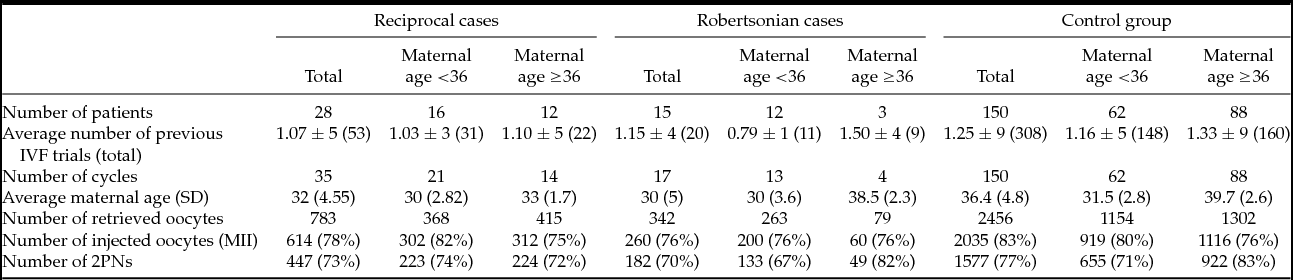
In total, 342 oocytes were retrieved from Robertsonian translocation carriers and 260 (76%) were microinjected. One hundred and eighty two of these injected oocytes (70%) were fertilised normally. Seven hundred and eighty three oocytes were retrieved from reciprocal translocation carriers and 614 (78%) of these were microinjected. Of these injected oocytes 447 (73%) were fertilised normally.
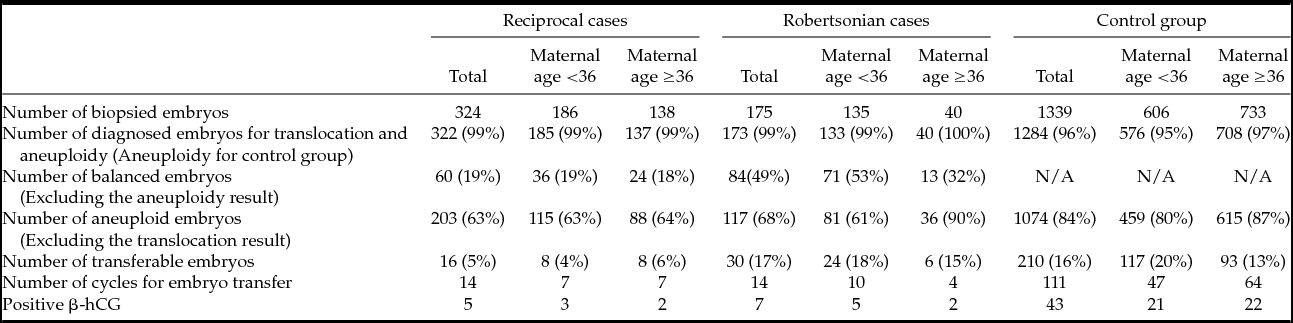
Overall, 99% (495/499) of the cleavage stage embryos derived from 15 Robertsonian and 28 reciprocal translocation carriers from 52 PGD cycles were analysed successfully (Table 2). The embryos obtained from age-matched patients with normal karyotypes and undergoing preimplantation genetic screening (PGS) were analysed for the rate of aneuploidy. In total, 1284 cleavage stage embryos were successfully analysed in the control group (Table 2).
Summary of cycle information for reciprocal and Robertsonian translocation carriers and the control group. The embryology details including the previous IVF trials, total number of cycles performed for PGD, average maternal age, number of oocytes retrieved, the number of meiosis II (MII) stage oocytes and number of embryos are shown

Forty nine per cent (84/173) of the embryos derived from Robertsonian carriers were balanced. There was no difference in the meiotic segregation in the embryos derived from female and male Robertsonian carriers in such the rate of obtaining balanced embryos was similar in both genders. Overall 68% (117/173) of the embryos derived from Robertsonian carriers were aneuploid (Table 2). Sixty one per cent of the embryos (81/133) were derived from patients with maternal age of <36 years and 90% (36/40) from patients with advanced maternal age (≥36). The overall aneuploidy rate in the embryos obtained from the patients with no rearrangements (control group) was 85% (1074/1284). Eighty per cent (459/576) of the embryos derived from patients with maternal age of <36 were shown to be aneuploid and 87% (615/708) of the embryos from women with advanced maternal age were aneuploid. Although a higher aneuploidy rate was observed in the embryos obtained from Robertsonian carriers with advanced maternal age compared with the control group, there was no significant difference (P > 0.05). Therefore, no ICE was detected in the embryos obtained from Robertsonian carriers.
Nineteen per cent (60/322) of the embryos derived from reciprocal translocation carriers were shown to be balanced. When the overall aneuploidy status of the embryos was analysed, it was shown that 63% (203/322) of the embryos were aneuploid. Of these aneuploid embryos, 56% (155/203) were obtained from patients with maternal age of <36 years of age (Table 3). Similar to the embryos obtained from Robertsonian translocation carriers, there was no apparent ICE detected in the embryos of reciprocal translocation carriers (P > 0.05).
Summary of PGD and cycle outcome. Cycle informations for reciprocal and Robertsonian translocation carriers are listed. Numbers of biopsied embryos, balanced or normal and euploid embryos, and positive β-hCG are listed

The number of patients undergoing PGD for reciprocal translocations with chromosome 10 rearrangements was higher compared with the other chromosomes. Therefore, we further analysed the ICE in the embryos obtained from patients with chromosome 10 rearrangements. More than half of the embryos (58/106, 55%) obtained from patients with chromosome 10 rearrangements were aneuploid. However, there was no significant increase in the aneuploidy rate between these embryos obtained and the control group. Interestingly, the number of aneuploid embryos obtained from male carriers with chromosome 10 rearrangements (70%) was significantly more compared with the female carriers (47%, P < 0.05).
Discussion
The objective of this study was to identify if ICE is present in embryos obtained from Robertsonian and reciprocal translocation carriers. Evaluation of such an effect would provide crucial information on the decision of the PGD protocol to be used, the prediction of PGD outcome and preparation for appropriate counseling.
In our study, we investigated the occurrence of ICE by comparing the degree of aneuploidy detected in Robertsonian and reciprocal translocation carriers with age-matched patients with normal karyotypes and undergoing PGS. The majority of the patients in the control group did not have an indication for an increased risk of aneuploidy in the embryos. However, 19% of these patients in the control group were experiencing repeated miscarriages that may lead to increased incidence of aneuploidy in the embryos. Although the ideal control group would be fertile couples undergoing PGD for single gene disorders and with no infertility problem, it is difficult to congregate this patient group. These patients with no known increased risk of aneuploidy in the embryos preferred not to undergo PGS as it presents extra costs for the patients. In this study, the analysis was further focused on the embryos obtained from translocation carriers involving chromosome 10 rearrangements due to a high number of patients with this rearrangement (32%, 9/28).
To date there has been a long debate on whether ICE exists or not. Previously published studies mainly analysed ICE in sperm and embryos. Although some studies showed that ICE exists in the sperm of reciprocal translocation carriers (Anton et al., Reference Anton, Vidal and Blanco2008; Vozdova et al., Reference Vozdova, Oracova, Musilova, Kasikova, Prinosilova, Gaillyova and Rubes2011) and Robertsonian translocation carriers (Anton et al., Reference Anton, Blanco and Vidal2010, Reference Anton, Vidal and Blanco2011; Alfarawati et al., Reference Alfarawati, Fragouli, Colls and Wells2011; Fiorentino et al., Reference Fiorentino, Spizzichino, Bono, Biricik, Kokkali, Rienzi, Ubaldi, Iammarrone, Gordon and Pantos2011; Treff et al., Reference Treff, Tao, Schillings, Bergh, Scott and Levy2011; Rogenhofer et al., Reference Rogenhofer, Durl, Ochsenkuhn, Neusser, Aichinger, Thaler and Muller2012; Kovaleva, Reference Kovaleva2013; Piomboni et al., Reference Piomboni, Stendardi and Gambera2014), others proposed that ICE is not present or it can be neglected since it is to a small extend (Martin, Reference Martin1988; Syme & Martin, Reference Syme and Martin1992; Van Hummelen et al., Reference Van Hummelen, Manchester, Lowe and Wyrobek1997; Blanco et al., Reference Blanco, Egozcue, Clusellas and Vidal1998; Munne et al., Reference Munne, Escudero, Fischer, Chen, Hill, Stelling and Estop2005). Kovaleva (Reference Kovaleva2013) reported that although an increased incidence of trisomy 21 is present in balanced reciprocal translocation and inversion carriers, this may not be evidence of ICE (Kovaleva, Reference Kovaleva2013). A similar argument persists in human preimplantation embryos where some studies suggested that ICE exists in cleavage stage human embryos derived from reciprocal translocation carriers (Vozdova et al., Reference Vozdova, Oracova, Musilova, Kasikova, Prinosilova, Gaillyova and Rubes2011), whereas others presented opposite findings (Gianaroli et al., Reference Gianaroli, Magli, Ferraretti, Munne, Balicchia, Escudero and Crippa2002; Alfarawati et al., Reference Alfarawati, Fragouli, Colls and Wells2012). Collective data from previous studies showed that the incidence of ICE depends on the breakpoints and the regions of the translocated chromosomes (Estop et al., Reference Estop, Cieply, Munne, Surti, Wakim and Feingold2000; Alfarawati et al., Reference Alfarawati, Fragouli, Colls and Wells2012). Studies also suggested that meiotic divisions might cause ICE in embryos such that the positioning and pairing of the rearranged chromosomes with the structurally normal homologues chromosome may be disturbed and alter the segregation (Lejeune, Reference Lejeune1963; Guichaoua et al., Reference Guichaoua, Quack, Speed, Noel, Chandley and Luciani1990; Anton et al., Reference Anton, Vidal and Blanco2008, Reference Anton, Blanco and Vidal2010).
In this study, PGD outcome of both Robertsonian and reciprocal translocation carriers and the aneuploidy of structurally normal chromosomes were assessed in cleavage stage embryos using FISH. One of the main disadvantages of this study is the use of FISH as this analysis limits the number of chromosomes analysed. In this study, FISH is used to screen nine chromosomes that are known to cause miscarriages, implantation failures or genetic syndromes, i.e. trisomy 21. However, analysis of many probes by FISH requires more rounds of FISH probing and with each round the accuracy for the new set of probes is lowered. In our study, we did not face any accuracy problems and hybridisation failures in the following FISH rounds except for two embryos. In these cases, we had requested a second biopsy and reported the results using the new cells. Although FISH analysis of the blastomeres limits the aneuploidy screening to fewer chromosomes, it still provides a valid result for the chromosomes analysed. Moreover, recent studies also support the use of FISH in aneuploidy screening to increase the pregnancy rates in patients with advanced maternal age (Rubio et al., Reference Rubio, Bellver, Rodrigo, Bosch, Mercader, Vidal, De Los Santos, Giles, Labarta, Domingo, Crespo, Remohi, Pellicer and Simon2013).
With the advancing technologies 24 chromosome screening by array comparative genomic hybridization (aCGH) has been applied in both reciprocal and Robertsonian translocations, however aCGH has not replaced the use of FISH in PGD completely (Scriven et al., Reference Scriven, Flinter, Khalaf, Lashwood and Mackie Ogilvie2013; Van Echten-Arends et al., Reference Van Echten-Arends, Coonen, Reuters, Suijkerbuijk, Dul, Land and Van Ravenswaaij-Arts2013). One of the main reasons of this is that depending on the breakpoints involved in the rearrangement, the detection sensitivity of the translocated segments by aCGH varies. In this study, one of the translocated segments for almost half of the patients (46%) could not be detected by aCGH even with higher resolution microarrays due to the positions of the breakpoints. Therefore, in order to avoid any misdiagnosis and birth of an offspring with unbalanced chromosome complement, FISH was used in the analysis. In the clinical applications, the use of FISH has an added advantage over aCGH due to the high costs for the patients. As FISH is more cost effective, in most of the newly developing countries, it remains to be the preferred technique in PGD for translocations.
Our study showed that ICE was not detected in embryos from Robertsonian translocation carriers. However, previous studies suggested that ICE was present at cleavage stage embryos obtained from Robertsonian carriers. They also pointed out that the presence of ICE can be altered depending on the positions of the breakpoints. Therefore it may not be surprising that different studies show slight differences in the presence of ICE (Alfarawati et al., Reference Alfarawati, Fragouli, Colls and Wells2012). The aneuploidy rate in the embryos obtained from women with advanced maternal age was higher in both Robertsonian carriers and the control group. These high rates of aneuploidy in embryos were not surprising as it is well known that there is an increased rate of aneuploidy in the patients with advanced maternal age.
Overall, the aneuploidy of the structurally normal chromosomes was high for the embryos obtained from reciprocal translocation carriers; however there was no apparent ICE in the embryos (75%, P > 0.05). Our results were supported by previously published studies screening 24 chromosomes for aneuploidy using aCGH where they also reported that there was no apparent ICE in embryos from reciprocal translocation carriers (Alfarawati et al., Reference Alfarawati, Fragouli, Colls and Wells2012). Interestingly, in this study, the majority of the aneuploid embryos was obtained from male reciprocal carriers (73%). A recently published study suggested that more than half of the men with chromosomal rearrangement produce gametes with increased rate of aneuploidy (55%) in the structurally normal chromosomes (Anton et al., Reference Anton, Vidal and Blanco2011).
In our study, 32% (9/28) of the patients with reciprocal translocations had a rearrangement involving chromosome 10. Therefore, although ICE was analysed among all the reciprocal carriers with different rearrangements, the main analysis was performed for the patients with chromosome 10 rearrangements. Nine reciprocal translocation carriers with chromosome 10 rearrangements underwent 12 cycles of PGD. Half of the embryos obtained from these carriers had aneuploidy. Although there was a high rate of aneuploidy in both younger and advanced maternal age patients, these were not significantly higher compared with the control group (P > 0.05). It was observed that the male carriers with chromosome 10 rearrangements produced more aneuploid embryos (70%) compared with the female carriers (47%). Two independent case reports showed that the gametes produced by the male carriers of reciprocal translocations involving chromosome 10 have an increased risk of aneuploidy in the structurally normal chromosomes suggesting an ICE (Van Hummelen et al., Reference Van Hummelen, Manchester, Lowe and Wyrobek1997; Baccetti et al., Reference Baccetti, Bruni, Collodel, Gambera, Moretti, Marzella and Piomboni2003).
In conclusion, this study showed that there was no ICE present in embryos derived from both reciprocal and Robertsonian translocation carriers regardless of the maternal age. However as the rate of aneuploidy is high (>60%), it might be beneficial for patients to undergo aneuploidy screening as well as PGD for translocations to reduce the risk of transferring an aneuploid embryo and lowering the risk of miscarriage and birth of a child with congenital abnormalities.