Introduction
In the past decade, Arctic sea ice extent gained extraordinary attention as a harbinger of global climate change. Research institutions began posting on their web sites daily maps and images of the North Polar ice pack (for example http://nsidc.org; http://arctic.atmos.uiuc.edu; http://ocean.dmi.dk; http://arctic-roos.org/). The International Arctic Research Centre, in cooperation with Japan's Aerospace Exploration Agency, now even provides an up-to-date sea ice extent in km2 (http://www.ijis.iarc.uaf.edu). But interest in the ebb and flow of Arctic sea ice cover is nothing new. Throughout the eighteenth and nineteenth centuries, geographers and oceanographers contemplated the existence of an open polar sea. During the early twentieth century, meteorologists and glaciologists watched as a warm spell melted vast stretches of the ice pack. In the mid twentieth century, geoengineers entertained purposefully thawing North Polar ice. And, by the late twentieth century, climatologists began linking dramatic sea ice loss to anthropogenic climate change.
This article traces the history of thinking about Arctic Ocean sea ice extent. I show that scientists have repeatedly envisaged an ice-free Arctic Ocean by examining three such lines of thinking: (1) the belief in one; (2) the potential for one; and (3) the threat of one. I propose that the persistence of this ice-free Arctic Ocean narrative has helped fuel scepticism of human-forced environmental change in the Arctic.
Ron Doel, Spencer Weart, Michael Robinson, Charles Emmerson, and James Fleming have all discussed scientific thinking about Arctic sea ice extent (Doel Reference Doel2002; Weart Reference Weart2003; Robinson Reference Robinson, Benson and Rozwadowski2007; Emmerson Reference Emmerson2010; Fleming Reference Fleming2010; Sörlin and Lajus Reference Sörlin, Lajus, Christensen, Nilsson and Wormbs2013). Whereas each has looked primarily at specific moments and cases, I aim to string together centuries of systematic thinking and to demonstrate that direct observations of Arctic nature have combined with cultural forces external to it, to produce an imagined, ice-free North Polar landscape (Bravo and Sörlin Reference Bravo and Sörlin2002). Sea ice itself, particularly the position of the ice edge, played a vital role in how scientists perceived the Arctic environment. Even so, sea ice dynamics alone do not explain the emergence and perpetuation of an ice-free Arctic Ocean narrative. Economics, power relations, geostrategic concerns, and social movements generated interest in sea ice extent and, in turn, motivated visions of icelessness. Therefore, while the narrative of an ice-free Arctic Ocean found grounding in material observations of the far northern environment, it also very much reflects Euroamerican ambitions, priorities, and fears.
‘Ice-free’ has meant different things to different people at different times. Believers in an open polar sea reckoned that sea ice clung to landmasses and congealed in sheltered bays but did not stretch across the Arctic basin. For most twentieth century scientists, an iceless Arctic remained a remote possibility, the result of a long transition from frozen to slushy to open water. Today, climatologists identify the threat as seasonal, even should sea ice disappear completely during summer, it will re-form in winter. On the one hand, these three characterisations of ‘ice-free’, belief, potential, and threat, evolved in step with sea ice monitoring techniques. Over time, inference gave way to coordinated observation which gave way to satellite imagery. On the other hand, perceptions of ‘ice-free’ changed along with views of the natural world and the human place in it. From the 1700s into the 1800s, the belief in an ice-free Arctic Ocean grew out of the broader pursuit of the geographical unknown. By the early 1900s, with the open polar sea theory finally disproved, the principle of uniformitarianism and its assumption of consistent, gradual change supported the idea that an iceless Arctic Ocean might emerge at some point in the future. In the mid-1900s, recognition of the geophysical scope of human technology reinforced this distant potential. By the close of the century, the knowledge that human actions have altered fragile Earth systems made an iceless polar sea a far more immediate threat.
While scientists have found consensus regarding the immediacy of this threat, many members of the public remain unconvinced. Several scholars have argued that such scepticism of anthropogenic global warming owes to a small group of prolific, coordinated, and well-financed mouthpieces who managed to manufacture doubt that did not and does not exist in the scientific community (for example Oreskes and Conway Reference Oreskes and Conway2010: 169–215; Dunlap and McCright Reference Dunlap, McCright, Dryzek, Norgaard and Schlosberg2011: 144–160; Weart Reference Weart2011). I do not wish to challenge this important and compelling conclusion. I do, however, wonder to what degree we can pin all doubt on the operation of a ‘climate change denial machine’. I propose, then, the existence of a more benign form of public climate change scepticism based less in the purposeful spread of misinformation by a well-organised apparatus and more on decontextualised, often myopic, readings of past (and some present) scientific observations of, debates over, and uncertainties regarding sea ice extent.
One final note: I do not mean to suggest that visions of icelessness existed exclusively. For example, scientists sometimes anticipated the opposite: sea ice building, advancing southward, and enveloping civilisation (Weart Reference Weart2003: 66–89). I have tried to acknowledge dissenting opinions wherever appropriate. Nevertheless, I have chosen to focus my attention on the ice-free Arctic Ocean narrative both for its longevity as well as for its relevance to the on-going climate change discussion.
Belief: the open polar sea
Prior to the 1500s, western Europeans defined their northern periphery through notions of boundlessness. During this period, the Arctic reaches were imagined more often than they were encountered directly. For example, around 1072 Adam of Bremen speculated that ‘you will find no human habitation, nothing but ocean, terrible to look upon and limitless, encircling the whole world’ (Adam of Bremen Reference Tschan2002: 215). Cartographers fired these fantasies by sketching an open Arctic Ocean as a counterbalance to a hypothesised, though still undiscovered, southern continent.
During the sixteenth and seventeenth centuries, commercial and imperial agendas compelled unprecedented numbers of western Europeans northward. Not only did whalers begin hunting in Arctic waters but expeditions financed by merchants attempted to access the lucrative Oriental spice trade by navigating either the northwest or northeast passage. The search for these supposed seaways continued intermittently for more than three centuries. It often ended in tragedy.
The failure to find a water route through the Arctic Ocean to the East Indies perplexed scientists. Seeking explanation, English hydrographer Joseph Moxon theorised that polar ice formed only near landmasses. Moxon held that if mariners sailed at higher latitudes, they would surely evade the thick ice that congregated around the Arctic's continental fringe (Moxon Reference Moxon1674). Swiss mathematician Samuel Engel promoted a similar strategy. Ice could only form in fresh water, he thought. Hence, while ice tended to concentrate where rivers expelled along the coastline, seawater beyond coastal areas must remain unfrozen (Engel Reference Engel1765). He figured that if vessels could only break through these frozen margins, an iceless ocean extended across the top of the world.
The belief in an open polar sea swelled during the nineteenth century as the Arctic emerged from the Little Ice Age. Reports from the region returned evidence of substantial sea ice retreat. For instance, in 1817 Joseph Banks citing observations made by whaling captain, scientist and polar explorer William Scoresby, the younger, explained to the British Admiralty that ‘a considerable change of climate, inexplicable at present to us, must have taken place in the Circumpolar Regions, by which the severity of the cold that has for centuries past enclosed the seas in the high northern latitudes in an impenetrable barrier of ice has been, during the last two years, greatly abated’ (Bodenmann and others 2011: 581). Around the same time, many Russian sailors described extensive polynyas, vast stretches of open water, around the Bering Strait and the northern coast of Eurasia. In 1821, Ferdinand von Wrangell wrote that a ‘wide, immeasurable ocean spread before our gaze, a fearful and magnificent, but to us a melancholy, spectacle’ (Wright Reference Wright1953: 347).
One of the most vocal supporters of the open polar sea was United States Navy medical officer Elisha Kent Kane. Kane led two parties north in search of the British Franklin Expedition, lost in 1845 attempting to navigate the northwest passage. Kane relied on his belief in an ice-free Arctic Ocean to approximate the drift and location of the missing men. Although Kane failed to find Franklin and company, his team returned from the Arctic in 1855 confident in the existence of an open polar sea. ‘Beyond that cape’, crewman William Morton noted from the northwest coast of Greenland overlooking Smith Sound, ‘stretching as far as the eye, assisted by the telescope, could reach, was the iceless open sea! The unfrozen ocean that had been supposed to surround the pole was. . .before me; its waves, surging from the farthest north, were breaking at my feet. . .[and] not a speck of ice was to be seen’ (Morton Reference Morton1857: 18–19). Five years later, in 1860, another of Kane's crew, physician Isaac Israel Hayes, returned to the Arctic and confirmed that ‘at no point within the Arctic Circle has there been found an ice-belt extending, either in winter or in summer, more than from fifty to a hundred miles from land’ (Hayes Reference Hayes1867: 361).
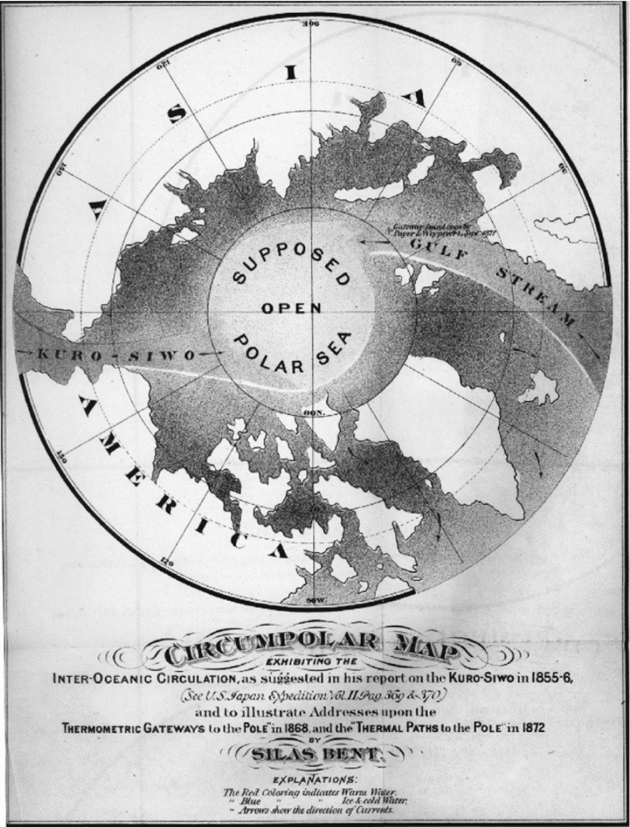
The belief in an ice-free Arctic Ocean found particular momentum in the nationalistic impulse to survey, chart, and map the last of the world's blank spaces (Bravo and Sörlin Reference Bravo and Sörlin2002). If correct, the idea promised passage to one of the era's grandest geographic ‘firsts’, the North Pole. August Petermann raised support for two German Arctic expeditions on the belief in an open polar sea and the hope that the endeavours would aid in resolving German unification (Luedtke Reference Luedtke2008). Likewise, when the United States Congress sent Charles Francis Hall north in 1871 to help knot together a nation fractured by the Civil War, it did so, in part, on the advice of open polar sea proponent and United States Naval oceanographer Silas Bent (Robinson Reference Robinson2006) (Fig. 1).
A map drawn by Silas Bent in 1872 showing the Gulf Stream and Kuro–Siaw currents penetrating the ice margin, opening into an open polar sea (Credit: NOAA Photo Library).

Still, believers in such a sea were more than optimists dreaming of profitable trade routes or nationalists looking for an easy approach to the pole. The hypothesis gained support from many in the scientific establishment, including Louis Agassiz, Alexander Dallas Bache, Franz Boas, James Dana, Roderick Murchison, and the aforementioned August Petermann (Van Campen Reference Van Campen1876; Wright Reference Wright1953; Robinson Reference Robinson, Benson and Rozwadowski2007). These learned men guessed that the concept held the key to understanding global atmospheric and hydrospheric operations. For example, American oceanographer Matthew Fontaine Maury asserted that two currents are at work in the Arctic, one sweeping warm, tropical waters north, the other sending cold, polar waters south. This exchange kept vast stretches of the Arctic Ocean free of ice. He also reckoned such circulation explained temperature regulation in the world's oceans even though the tropics received more solar energy, waters there did not heat up indefinitely because of the influx of colder Arctic waters (Maury Reference Maury1855). Many other rationales emerged: the polar sea, like the Great Lakes, was too large to freeze over; constant strong storms and winds prevented pack ice from forming in the Arctic; the centrifugal force of Earth's rotation pulled sea ice away from the North Pole; and solar radiation and geothermal activity heated polar waters (Anon. 1855; Wheildon Reference Wheildon1860; Wheildon Reference Wheildon1874).
By the late nineteenth century, however, mounting evidence to the contrary forced scientists to abandon the notion. Not only had Swedish, Norwegian, German, American, Austro-Hungarian, French, Dutch, British, and Russian Arctic expeditions been turned back by impenetrable ice, none had gathered any oceanographic, meteorological, or physical proof of open water lying beyond it (Markham Reference Markham1871). These negative discoveries vindicated the theory's many critics, among them Charles Daly, C.A. Schott, Fridtjof Nansen, and Clements Markham. Thus, although the early modern search for an Arctic shortcut as well as nineteenth century prophecies of an open polar sea had nourished the belief in an ice-free Arctic Ocean, that belief proved feckless.
Potential: Arctic warming and cold war geostrategy
In 1885, the Danish Meteorological Institute (DMI) began collecting information from sailors and shore-based observers on summer drift ice in the Davis Strait. For years mercurial ice conditions had frustrated sea travel along Greenland's west coast, and the DMI hoped that by tracking seasonal sea ice extent it could better predict the probability of passage through those waters. The project met with so much success that in 1894 it expanded to include the entire Atlantic sector of the Arctic Ocean, from Greenland to Novaya Zemlya. To accommodate the enlarged scope, DMI mapmakers collated observations made by ‘explorers, whalers, and other navigators of the polar seas’ as well as extrapolated ice cover for regions where no observations existed. The DMI published these yearly sea ice summaries in Danish and English (Thomsen Reference Thomsen1948: 140–141; Anon. 1902a: 57–58).
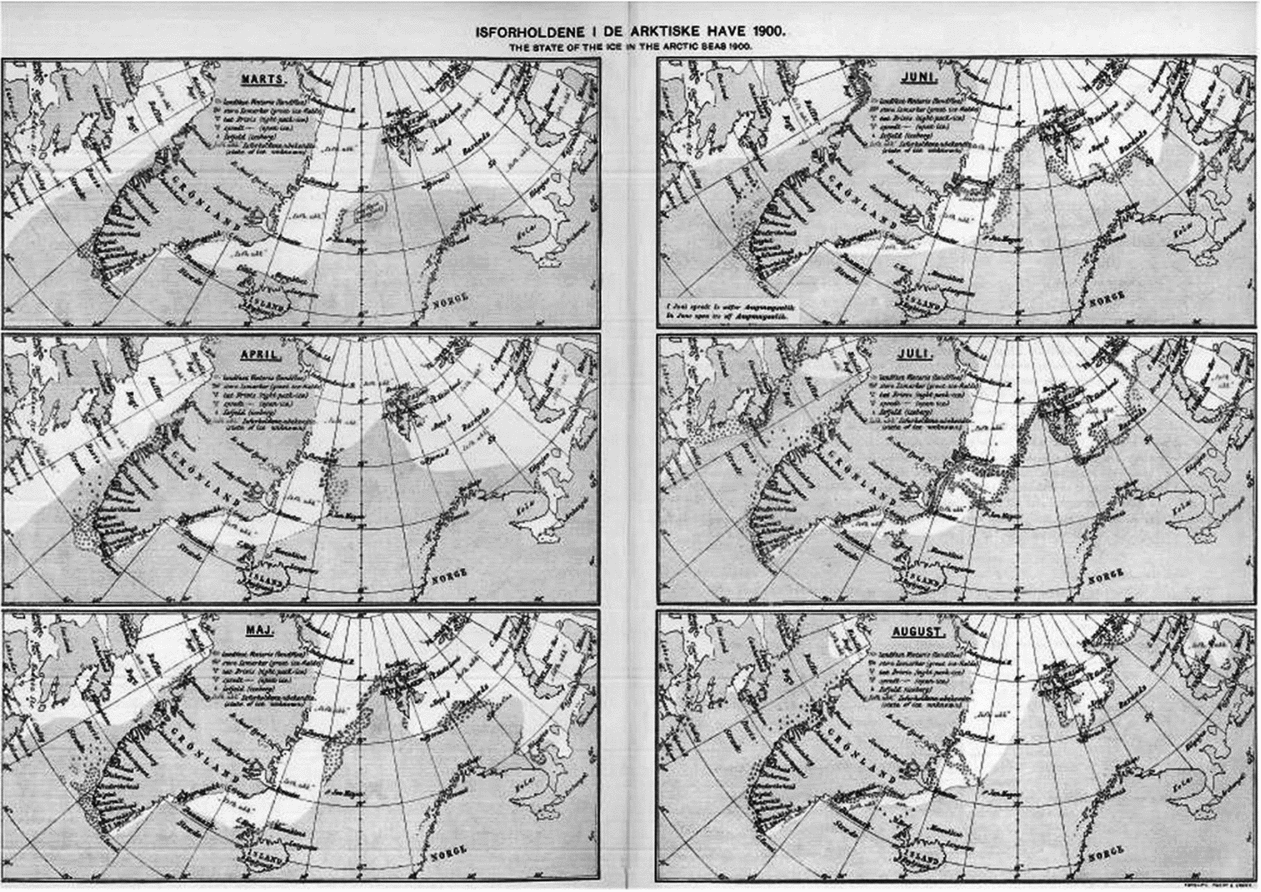
By 1899, ‘knowing as far as possible the annual distribution, character, and quality of drift ice of polar origin’ had become so valuable to ‘war-vessels and merchantmen’ that delegates to the Seventh International Geographical Congress in Berlin pressed national organisations to contribute to DMI efforts (Thomsen Reference Thomsen1948: 140). To smooth the process, the Congress systemised the collection of sea ice observations by distributing schematic forms and an instruction manual, and appointed the DMI as international overseer. One year later, in 1900, the DMI assembled the first issue of an annual series titled ‘The state of the ice in the Arctic Sea’, which ran to 1956, interrupted only by WWII. The report documented ice conditions around the whole of the Arctic Ocean from April to September, based on observations made by coastal residents, scientific expeditions, and sailors from around the Arctic basin (Fig. 2). Although the DMI remained the epicentre of Arctic sea ice surveying into the mid-twentieth century, other organisations pursued similar work, including the Norwegian Polar Institute, the British Admiralty, the International Ice Patrol, the Icelandic Meteorological Office, and agencies in Canada, Germany, Finland, and the Soviet Union (Smith Reference Smith1932).
Example of the DMI's annual publication on ice in the Arctic seas (DMI 1901).
Sea ice charts served, foremost, as practical navigational aids. Trade writers reading the DMI's annual digest, for example, translated ice conditions as ‘favourable’ or ‘unfavourable’, ‘normal’ or ‘severe’; they described Arctic seas as ‘approachable’ or ‘inaccessible’, ‘available’ or ‘difficult to penetrate’; and they referenced Arctic navigation as ‘easy’ or ‘arduous’, ‘hindered’ or ‘impossible’ (Anon. 1902b: 157–158, 1903: 218, 1904: 355–356, 1905: 34, 1912: 145, 1916: 310, 1924: 223). By the 1920s, these charts began showing significantly diminished sea ice extents. ‘Ice was much scarcer than usual’ in 1920 (Anon. 1921: 243). In 1925, ‘the most notable feature of the year was the unusually small amount of ice observed in practically all the Arctic seas that were visited’ (Anon. 1926: 168). ‘In European Arctic waters there was extraordinarily little ice’ in 1930 (Anon. 1931: 202). The retreat of the ice edge proved a great boon for Arctic industries. By the 1920s, drift ice seldom blocked fishing off the coasts of Iceland (Zubov Reference Zubov1963). During the early 1930s, ordinary steamships could circumnavigate Novaya Zemlya and Franz Josef Land without encountering pack ice, and the northeast passage often remained open (The New York Times 5 December 1932). And, by 1938, the length of the coal shipping season around Svalbard had nearly doubled, from ninety-five days in the 1910s to 175 days (Shokal’skii Reference Shokal'skii1936).
Scientists connected melting Arctic sea ice to North Hemispheric warming. In 1930, Bernt Johannes Birkeland used records available from the previous two decades to show that temperatures on Spitsbergen had indeed risen (Birkeland Reference Birkeland1930). In 1932, Charles F. Brooks outlined the important interrelationship between the world's oceans and the atmosphere. ‘Every change in wind direction or velocity, in air temperature, in absolute humidity, in cloudiness, every shower, disturbs the water surface or changes its temperature or salinity to some degree’, remarked Brooks. ‘And, conversely, every change in roughness, temperature or salinity of the ocean surface affects the atmosphere’ (Brooks Reference Brooks1932: 457). Referencing Birkeland's temperature data and using Brooks’ logic, Richard Scherhag reasoned that altered Atlantic currents had warmed polar waters, strengthening atmospheric circulation, raising temperatures, and forcing changes in Arctic sea ice conditions. Diminished Arctic Ocean sea ice cover, he suggested, both illustrated and enhanced the warming trend (Scherhag Reference Scherhag1939).
To be sure, rising temperatures in the Northern Hemisphere during the 1920s and 1930s never precipitated anything close to a total loss of Arctic sea ice. Nor did experts portray it as such. Charts drawn by the DMI show that, while the ice pack did on several occasions shrink beyond 81°N around Svalbard, Franz Joseph Land, and Severnaya Zemlya, it never fell back farther than roughly 83°N, and it remained considerably larger in the Beaufort and Bering Sea regions (for example DMI 1931; DMI 1937). The retreat did, however, indicate to many the potential for dramatic change. For example, in 1938 Charles Ernest Pelham Brooks made clear the gravity of the situation. ‘In recent years’, stated Brooks, ‘attention is being directed more and more towards a problem which may possibly prove of great significance in human affairs, the rise of temperatures in the northern hemisphere, and especially in the Arctic regions’ (Brooks Reference Brooks1938: 29–32). By 1944, so many researchers, including Hans W:Son Ahlmann, Oscar V. Johansson, and Jules Shokal’skii, had contemplated the warming phenomenon that English climatologist Gordon Manley reviewed their work in the G.J. Symons Memorial Lecture delivered to the Royal Meteorological Society. Manley urged his audience ‘to bear in mind the tremendous variety of engrossing problems awaiting us after the war, and particularly the possible developments in the discussion of climatic change’ (Manley Reference Manley1944: 217).
If early twentieth century warming had opened the potential for a future, ice-free Arctic Ocean, by mid-century, that potential bore new geostrategic relevance thanks to the emerging cold war. In 1958, the United States Office of Naval Research supported a scientific symposium on Arctic sea ice cover. International attendees lectured on sea ice reporting and predicting techniques as well as the mechanics and physics of Arctic ice (NRC 1958). By 1960, nuclear-powered submarines ‘prowl[ed] safe from detection beneath the pack’, measuring its thickness and testing the viability of launching missiles from amidst it (The New York Times 19 October 1958). In 1963, the United States Navy's Oceanographic Office translated Soviet oceanographer Nikolai Zubov's 1943 scientific treatise on Arctic ice. Zubov had acknowledged Arctic warming as ‘a most interesting phenomenon’, recognising that ‘ice in the sea is of particular interest to the Soviet Union’ (Zubov Reference Zubov1963: 470, 478).
At the same time, state-supported geoengineers in the United States and the Soviet Union promoted the deliberate creation of an ice-free Arctic Ocean. Most notably, melting North Polar ice would hinder covert missile manoeuvring, but it also promised to open more direct transportation routes and, depending on one's intentions, either moderate Arctic weather or make it more uncomfortable. One popular scheme proposed sprinkling coal dust over Arctic sea ice, lowering its albedo and inducing melt. Writing in Fortune magazine in 1955, John von Neumann notified the public of the plausibility of such climatological warfare: ‘Microscopic layers of coloured matter spread on an icy surface, or in the atmosphere above one could inhibit the reflection-radiation process, melt the ice, and change the local climate’ (Neumann Reference Neumann and Sarnoff1956: 41). In 1957, Soviet scientist Petr M. Borisov championed constructing a dam across the Bering Strait. The structure would allow for the removal of cold Arctic seawater, generating an influx of warmer water from the North Atlantic, reducing the freshwater surface layer in the Arctic Ocean, in turn melting sea ice and preventing its recovery (Borisov Reference Borisov1969). Some contemplated hydrotechnical installations that would redirect massive amounts of warm Atlantic water towards the Arctic Ocean; others suggested setting off a series of nuclear bombs in order to manufacture an ice cloud over the Arctic that would allow solar radiation in but block its dissipation back into space (Fleming Reference Fleming2010).
Of course, many scientists feared the ramifications of fabricating an ice-free Arctic Ocean. In 1956, American geophysicists Maurice Ewing and William L. Donn posited that ‘when the Arctic Ocean is ice-covered, surface temperatures in the Atlantic increase and continental glaciers decline; when the Arctic is open, surface temperatures in the Atlantic decrease, and continental glaciers develop’ (Ewing and Donn Reference Ewing and Donn1956: 1062). The pair concluded that the transition to an ice-free Arctic Ocean might force a new ice age. American meteorologist Harry Wexler agreed with Ewing and Donn's bottom line, noting, ‘the disappearance of the Arctic ice pack would not necessarily be a blessing to mankind’ (Wexler Reference Wexler1958: 1063). Other climatologists anticipated radical changes in atmospheric conditions that might cause precipitation to increase in India, the Middle East, and China and decrease over North America, Eurasia, and northern Africa (Clark Reference Clark1982).
In addition to their hesitation over intentionally modifying Arctic sea ice extent, most experts envisaged an ice-free Arctic Ocean as decidedly distant. ‘To lay down a black layer 0.1 millimetre thick over the Arctic ice pack and adjacent snow fields (from latitude 65°N to the North Pole), an area equal to 24 · 106 square kilometres, would take 1.5 billion tons of carbon’, explained Wexler (Wexler Reference Wexler1958: 1060). He drove home the logistical difficulty by enumerating the flights that would be required, detailing the problems of wind erosion and snow cover, and explaining the extraordinary time constraints of the measure. Robert A. McCormick calculated that, if ever pursued, Borisov's Bering Strait project would take upwards of 100 years to melt the entire Arctic ice pack (Wexler Reference Wexler1958).
While some researchers criticised geoengineering designs as impractical, others framed all ice-free Arctic Ocean scenarios as hypothetical (for example Donn and Shaw Reference Donn and Shaw1966, Reference Donn and Shaw1967). Asked in 1969 by the United States Navy to respond to predictions of an ice-free Arctic Ocean, Norbert Untersteiner replied simply, ‘the evidence for swift and dramatic thinning of the pack is unreliable’ (The New York Times 20 February 1969). Even Ewing and Donn figured the change to ice-free conditions would require an increase in winter ocean surface temperature of more than 35°C, pushing their onset of a new ice age at least several centuries into the future (Ewing and Donn Reference Ewing and Donn1956). Therefore, while early twentieth century Arctic warming opened the potential for an ice-free Arctic Ocean and cold war climate modification schemes sustained that potential through the mid twentieth century, ice cover remained in the Arctic Ocean.
Threat: global climate change
In 1968, the Soviet Union launched Cosmos 243. Although just one of sixty-four satellites the Soviet Union sent up that year, Cosmos 243 was the first ever passive microwave imaging satellite (Zaytzev Reference Zaytzev, Potts and Tauber1972). Four years later, the United States launched its own, the Electrically Scanning Microwave Radiometer (ESMR), aboard Nimbus 5. Cosmos 243 and Nimbus 5 illustrate the intensification of geophysical investigation during the cold war (Zwally and Gloersen Reference Zwally and Gloersen1977). Preceded by the erection of drift stations, submarine measurements, and aerial observation, radiometric surveillance of sea ice was a by-product of cold war technological investment and innovation. As sea ice became increasingly linked to national economic and security concerns, states placed proirity on these real-time monitoring systems.
The passive microwave sensors aboard Cosmos 243 and Nimbus 5 detected radiation emitted from or reflected by a surface on earth. By converting the relative radiative power to a brightness factor, researchers differentiated between open water and sea ice. Because the emitted microwave radiation penetrated cloud cover, and the instruments operated through the cold, dark polar winter, they offered scientists the first unimpaired and uninterrupted look at Arctic sea ice extent. In 1978, the National Aeronautics and Space Administration (NASA) replaced the ESMR with the more powerful and dynamic Scanning Multichannel Microwave Radiometer orbiting aboard Nimbus 7. In 1987 the Defence Meteorological Satellite Program launched satellites carrying imaging systems known as Special Sensor Microwave/Imagers. And in 2002, NASA sent up an Advanced Microwave Scanning Radiometer aboard Aqua (Drobot and Anderson Reference Drobot and Anderson2000).
The data sent back from these orbiting radiometers revealed much. First, that sea ice typically spanned 15 million km2 in winter; by the end of the summer melt season just less than 7 million km2 remained (Kinnard and others 2011). More importantly, it showed a clear downward trend in Arctic sea ice. Many in the scientific community began linking this decline to human-forced global warming. In 1991, Per Gloersen and William J. Campbell noticed ‘significant decreases in ice extent and open-water areas within the ice cover in the Arctic’. The pair suggested that the −2.1% trend in Arctic sea ice extent between 1978 and 1987 ‘may be a signal of climate change’ (Gloersen and Campbell Reference Gloersen and Campbell1991: 33–36; Gloersen and others 1993: 150). Four years later, researchers Ola M. Johannessen, Martin Miles, and Elnar Bjørgo found that from 1987 to 1994 ‘the rate of decrease. . .ha[d] accelerated’ to a decadal trend of −4.3%. The team noted that the hastening retreat ‘could provide an early indication of greenhouse warming’ (Johannessen and others 1995: 126). Konstantin Y. Vinnikov argued in 1999 that the magnitude of shrinking was ‘much larger than would be expected from natural climate variations’, concluding that ‘the observed decrease in N[orthern] H[emipshere] sea ice extent is related to anthropogenic global warming’ (Vinnikov and others 1999: 1934–1937). The Arctic Climate Impact Assessment, compiled under the direction of Robert Corell and released by the Arctic Council and International Arctic Science Committee, reported in 2004 that rapid sea ice decline had been ‘due, at least in part, to anthropogenic intensification of the global greenhouse effect’ (Huntington and Weller Reference Huntington and Weller2004: 3).
Around this same time, researchers also began plugging satellite data on Arctic sea ice into climate models. Developed in the mid-1950s and functionally available since the 1970s, modelling enabled scientists to simulate earth system interactions under different scenarios in order to develop projections of future conditions (Edwards Reference Edwards2011). Although plagued by uncertainties, such as the lack of long-term satellite data on the North Polar ice and the extreme complexity of dynamical sea ice processes, and highly variable, climate models revealed the threat of a seasonally ice-free Arctic Ocean (for example Walsh and others 2005). In 1992, models suggested that, should greenhouse gases double, sea ice cover would be reduced by half (Boer and others 1992). In 1995, the Intergovernmental Panel on Climate Change (IPCC) projected with medium confidence ‘a large change in the extent and thickness of sea ice’, concluding that by 2050 ‘there is likely to be substantially less sea ice in the Arctic Ocean’ (Fitzharris 1995: 243). In 1999, models quantified the loss, showing that by 2050 sea ice extent could be upwards of twenty per cent smaller (Vinnikov and others 1999). By the early 2000s, some researchers projected that ‘perennial ice in the Arctic will disappear by the end of this century’, while others proposed ice-free summers as early as 2050 (Smedsrud and Furevik Reference Smedsrud and Furevik2000: 7; Falkingham and others 2002).
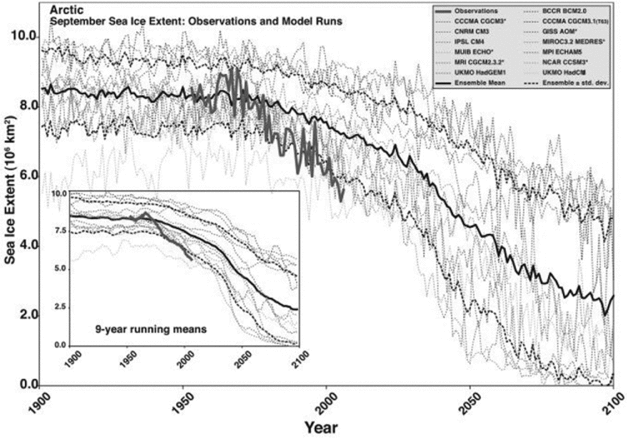
The observed disintegration of sea ice from 2002 to 2006 outpaced predictions of a seasonally ice-free Arctic Ocean (Fig. 3). A report published in May 2007 by researchers at the National Snow and Ice Data Centre made clear the disparity between computer simulations and actual loss. ‘Current summer minima,’ lamented the authors, ‘are approximately thirty years ahead of the ensemble mean model forecast’ (Stroeve and others 2007: L09501). Even with this knowledge in hand, when sea ice shrank to a then record-low 4.28 million km2 in September 2007, the news ‘astounded’ and ‘unnerved’ many members of the scientific community (Daily Mirror (London) 22 September 2007; The New York Times 2 October 2007; Stroeve and others 2008; Comiso and others 2008).
September Arctic sea ice extent from observations (thick red line) against thirteen IPCC AR4 climate models as well as a multi–model ensemble mean (solid black line) and standard deviation (dotted black line) (Stroeve and others 2007: L09501).
The drastically accelerated negative trajectory energised a host of revised projections. Some scientists supposed ice-free summers by 2037; others estimated around 2030; and a few even fancied between 2010 and 2015 (Wang and Overland Reference Wang and Overland2009; Emmerson Reference Emmerson2010; Times Colonist (Victoria) 16 November 2007). Hence, by the mid-2000s, climate models had demonstrated that an ice-free Arctic ocean could be realised ‘within our lifetimes and certainly within our children's lifetimes’ (Scientific American 21 September 2007).
Modelled ice loss motivated extensive research into the threat posed to natural systems. As a result, polar bears became one of the most emotive images of Arctic Ocean sea ice decline. The megafauna reside on the ice-covered waters over the biologically fecund continental shelf, hunting their prey from ice perches, traveling over ice corridors, and even building dens on floating ice. Because changes in sea ice extent and stability threatens to radically alter the feeding, migratory, and reproductive habits of the bears, some scientists suppose ‘it is unlikely that polar bears will survive as a species if the sea ice disappears completely, as has been predicted by some’ (Derocher and others 2004: 163).
Sea ice loss also threatens to alter Earth's physical systems. For instance, as sea ice retreats, the dark, open waters left behind absorb the near twenty-four hours of sunlight during the polar summer. As sea ice begins to re-form in the winter, the heat energy trapped in the sea is released into the atmosphere, weakening the jet stream. A slower jet stream causes North Hemispheric weather systems ‘to be more persistent, which may lead to an increased probability of extreme weather events that result from prolonged conditions, such as drought, flooding, cold spells, and heat waves’ (Francis and Vavrus Reference Francis and Vavrus2012: L06801). Recent examples of the global atmospheric response to Arctic sea ice loss include the unusually snowy winter of 2009–2010 in Europe, the Russian heat wave of 2010, the record-breaking rains across the northeast United States in 2011, and the drought that struck the western and southern United States in 2012.
Yet, at the same time that the threat of an ice-free Arctic Ocean vaulted to the forefront of discussion on human-caused global warming, the actual persistence of a year-round, if substantially diminished, ice pack forced scientists to adjust their projections. In 2007, Wieslaw Maslowksi said before a meeting of the American Geophysical Union that the removal of summer sea ice could occur by 2013. Just four years later, he pegged the summer of 2016 instead (BBC News 12 December 2007; BBC News 7 April 2011). In similar fashion, Jay Zwally charged in late 2007 that ‘at this rate, the Arctic Ocean could be nearly ice-free at the end of summer by 2012’ (National Geographic News 12 December 2007). One month later, Zwally preferred the summer of 2013 (Voice of America 9 January 2008). Hence, while late twentieth century satellite imagery and turn-of-the twenty first century climate modelling exposed the threat of an ice-free Arctic Ocean, that threat has remained unrealised.
Scepticism: the legacy of the ice-free Arctic Ocean narrative
So far, I have traced the trajectory of the ice-free Arctic Ocean narrative; I want, now, to turn to its legacy. Numerous scholars contend that climate change scepticism derives from a few prestigious, non-specialist scientists. Their work has shown how this small group of men attacked the scientific research of others, misrepresented that scientific data, and hid the inconsistencies of their own scientific work in order to stall state regulation of human activity thereby protecting both industry interests as well as their own ideological convictions (Oreskes and Conway Reference Oreskes and Conway2010; Dunlap and McCright Reference Dunlap, McCright, Dryzek, Norgaard and Schlosberg2011; Weart Reference Weart2011). The argument is largely convincing.
That said, not all sceptics share these affiliations or motivations; nor are they all as beholden to special political and economic interests as this portrayal implies (for example Greenfyre 2008; Brin Reference Brin2010). Rather, there exists a more latent form of public climate change scepticism that, perhaps empowered by this well-coordinated, well-funded campaign of denial, operates apart from it. Such sceptical persons do not outright dismiss the possibility that humans have forced climate change. They do, however, question the science using evidence and logic, however meagre or flawed. While I will draw on Internet sources to substantiate my claim, it can be assumed that only a minority of sceptics maintain a web presence.
I propose that the ice-free Arctic Ocean narrative grounds two sceptical positions toward human-forced climate change. First, recurring visions of an iceless polar sea prompt sceptics to infer that sea ice extent fluctuates cyclically. Leveraging many of the same historical observations, charts, and data presented here, they conclude that the ice pack has naturally expanded then contracted over time, and that we are presently experiencing nothing out of the ordinary for a dynamic natural system (Condon Reference Condon2009; Penhallurick Reference Penhallurick2012; Brown Reference Brown2013). ‘Changes are cyclical’, writes Brian Maher, ‘the point being, the late twentieth century warming was in no way a singular event worthy of mass hysterics’ (Maher Reference Maher2010).
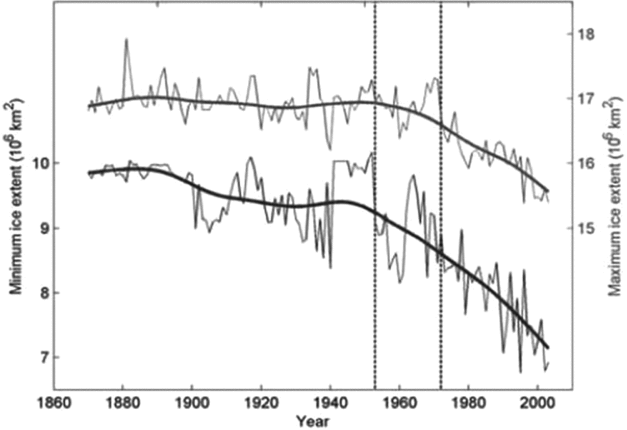
This way of thinking, however, usually relies on isolating specific moments in the ice-free Arctic Ocean narrative. Take, for instance, an article oft-quoted by sceptics written in 1922 by American consul to Norway George Nicolas Ifft (for example Maher Reference Maher2010). ‘The Arctic seems to be warming up’, Ifft began, ‘so little ice has never before been noted’ (Ifft Reference Ifft1922: 589). Ifft's comments, without doubt, align with the knowledge that ice cover has fluctuated across different timescales. Yet, the sea ice extent noted by Ifft, 81°, 29’N, in no way compares to the modern-day situation. A 2008 study led by Christophe Kinnard that reconstructed sea ice minima since 1870 using historical observations and satellite imagery suggested that around the time Ifft was writing, sea ice probably spanned over 9 million km2; in 2012, sea ice shrivelled to 3.41 million km2 (Kinnard and others 2008: L02507; Fetterer and others 2009) (Fig. 4).
Total maximum (green) and minimum (blue) ice extent time series for the period 1870–2003 (Kinnard and others 2008: L02507).
Such decontextualisation of individual episodes exaggerates incidents of historic sea ice loss and gain, thereby flattening the long-term downtrend. Instead of seeing a ‘reduction in Arctic ice cover [that] started in the late 19th century, consistent with the rapidly warming climate, and became very pronounced over the last three decades’, sceptics fashion a sort of pulse line with regular deviations from an otherwise constant standard (Polyak and others 2010: 1757). This enables them to read natural variability whereas a majority of scientists now acknowledge that ‘Many observed changes in. . .sea ice extent. . . over the 20th century are distinct from internal variability and consistent with the expected response to anthropogenic forcing’ (Hegerl and others 2007: 666).
A second strand of scepticism owes to the fact that an ice-free Arctic Ocean has been envisaged over the past three centuries but has never materialised during this time. It gains momentum as predictions of iceless summers pass unfulfilled (for example Coffman Reference Coffman2009; South Reference South2010?). At the same time, the yearly return of ice cover lends credence to popular portrayals and perceptions of the far north as an, above all, frozen wilderness (for example National Geographic 2010; Berlowitz and others 2012). As Andrew C. Revkin asserted in 2011, ‘I’m not worried about the resilience of Arctic ecosystems and not worried about the system tipping into an irreversibly slushy state on time scales relevant to today's policy debates’ (Revkin Reference Revkin2011). Put simply: the narrative of an ice-free Arctic Ocean has built to the recognition that sea ice covers the top of the world. The growing reality that anthropogenic global warming might lead to catastrophic melting in the near future has been slow in reversing it.
Conclusion
This article has studied the narrative of an ice-free Arctic Ocean for two reasons. First, to show that the current interest in sea ice extent is not new; and second, to propose past experience as a possible origin of public scepticism regarding the severity and reality of human-induced environmental change in the far north. Judging by its longevity and current robustness, I do not doubt that this narrative will continue well into the future. Nor do I doubt that it will, at some point, transition from the threat of an ice-free Arctic Ocean to the actuality of one.
Acknowledgements
For commenting on drafts, I thank Alex Boynton, David Braaten, Nick Cunigan, Greg Cushman, Joane Nagel, Ed Russell, and Jared Taber. I am especially grateful to Josh Nygren, Brian Rumsey, and Adam Sundberg for their advice and constant encouragement. I also want to thank the three anonymous readers for Polar Record whose suggestions very much improved the article.