





1. Introduction
We work over an algebraically closed field k of characteristic
$0$
 .
Given an algebraic variety, the Quot-schemes parameterize flat families of quotient sheaves with fixed numerical characteristics, for instance, Hilbert polynomial on that variety. Hilbert and Quot schemes owe their construction to Grothendieck in [Reference Grothendieck11], and later they got further developed following results of Mumford, Altman, and Kleiman. Here is a short review.
Let X be a reduced connected projective scheme over k, equipped with a very ample line bundle
$\mathcal {O}_{X}(1)$
 , and let
$P\in \mathbb Q[t]$
 be a numerical polynomial with rational coefficients. As the family of semi-stable coherent sheaves on X with Hilbert polynomial P is bounded (e.g., [Reference Huybrechts and Lehn14, Theorem 3.3.7, p. 78]), there is
$m\in \mathbb {N}$
 , such that any such sheaf
$\mathcal {F}$
 is m-regular [Reference Kleiman17, Theorem 1.13, p. 623]. From m-regularity of
$\mathcal {F,}$
 it follows that for all
$i\geq 0$
 , the sheaf
$\mathcal {F}(i+m)$
 is globally generated and

is surjective [Reference Mumford26, p. 100]. In particular, we can find any such
$\mathcal {F}$
 among quotients of
$\mathcal {O}_{X}^{\oplus n}(-m)$
 , where
$n:= P(m)$
 . So we need to consider the Quot-scheme
$ {\mathrm {Quot}}(\mathcal {O}_{X}^{\oplus n}(-m), P)$
 [Reference Grothendieck11, théorème 3.2, p. 260]. The kernels of the quotients
$\mathcal {O}_{X}^{\oplus n}(-m)\twoheadrightarrow \mathcal {F}$
 do not have to be globally generated, however, the family of all these kernels is bounded [Reference Grothendieck11, proposition 1.2, p. 252], and hence
$m'$
 -regular for some
$m'\in \mathbb {N}$
 . Therefore, there is
$p\in \mathbb {N}$
 such that for all
$l\geq p$
 ,
$\mathcal {O}_{X}^{\oplus n}(-m)$
 is l-regular as well as any
$\mathcal {F}$
 as above, and the kernel of
$\mathcal {O}_{X}^{\oplus n}(-m)\twoheadrightarrow \mathcal {F}$
 . Then surjectivity of maps as in (1.1) gives us for each
$l\geq p$
 a realization of
$ {\mathrm {Quot}}(\mathcal {O}_{X}^{\oplus n}(-m), P)$
 as a closed subscheme

where
$N_{l}:= nP_{\mathcal {O}_{X}}(l-m)$
 and
$ {\mathrm {Gr}}(N_{l}-P(l), N_{l})$
 is the Grassmannian of
$N_{l}-P(l)$
 -dimensional subspaces in an
$N_{l}$
 -dimensional space [Reference Grothendieck11, lemmes 3.3 and 3.7].
The action of
$ {\mathrm {GL}}_{n}(k)$
 on
$\mathcal {O}_{X}^{\oplus n}$
 induces an action of
$ {\mathrm {GL}}_{n}(k)$
 on

where each
$n\times n$
 matrix becomes a matrix of
$P_{\mathcal {O}_{X}}(l-m)\times P_{\mathcal {O}_{X}}(l-m)$
 scalar matrices (of matrices entries).Footnote
1
Thus, we have a rightFootnote
2
action of
$ {\mathrm {GL}}_{n}(k)$
 on
$ {\mathrm {Gr}}(N_{l}-P(l), N_{l})$
 . The Plücker embedding

comes with a
$ {\mathrm {GL}}_{n}(k)$
 -linearization of the very ample line bundle, that is induced from the canonical
$ {\mathrm {GL}}_{N_{l}}(k)$
 -linearization. As
$ {\mathrm {Quot}}(\mathcal {O}_{X}^{\oplus n}(-m), P)\subseteq {\mathrm {Gr}}(N_{l}-P(l), N_{l})$
 is
$ {\mathrm {GL}}_{n}(k)$
 -invariant, the induced very ample line bundle on
$ {\mathrm {Quot}}(\mathcal {O}_{X}^{\oplus n}(-m), P)$
 is
$ {\mathrm {GL}}_{n}(k)$
 -linearized (e.g., [Reference Huybrechts and Lehn14, p. 101]). This linearized ample line bundle allows one to describe the moduli space of (semi) stable coherent sheaves, as the GIT quotient of a locus of “(semi) stable” quotient sheaves cut out in the Quot-scheme. The moduli space of coherent sheaves became an instrumental tool to study many fundamental problems in modern algebraic geometry. In the 1990s, Le Potier studied the moduli space of coherent systems [Reference Le Potier21]. These parameterize further, the information of pairs
$(V,\mathcal {F})$
 composed of coherent sheaf
$\mathcal {F}$
 with fixed numerical characteristics, together with a subspace V of its space of global sections, that is, morphisms

equipped with a suitable notion of stability condition associated with
$(V, \mathcal {F})$
 .
The current article aims at studying a particular instance of coherent systems, known as stable pairs, with support over a fixed algebraic variety and explores the connections between the birational geometry of the underlying variety and the associated moduli space of stable pairs.
Definition 1.1. Let Z be an algebraic variety. In this article, a sheaf stable pair
$\mathcal {E},s$
 on Z consists of a torsion-free coherent sheaf
$\mathcal {E}$
 and a morphism

of sheaves (of
$\mathcal {O}_{Z}$
 -modules) such that

where
$r= {\mathrm {rank}}(\mathcal {E})$
 .
This is also a special case of “quotient husks” in [Reference Kollár18]. For simplicity, we will usually drop “sheaf” and just refer to
$\mathcal {E},s$
 as a stable pair [Reference Lin23], [Reference Pandharipande and Thomas28], [Reference Sheshmani30].
We say that two stable pairs
$\mathcal {E},s$
 and
$\mathcal {G},t$
 are equivalent if there is a commutative diagram

The equivalence class of
$\mathcal {E},s$
 is denoted by
$[\mathcal {E},s]$
 .
However, the above stable pairs should not be confused with stable pairs studied in birational geometry. In fact, we relate the above stable pairs with stable minimal models in birational geometry [Reference Birkar5]. It is this connection that inspired this work.
Much of this article is devoted to understanding the moduli spaces
$M_Z(r,n)$
 of stable pairs classes
$[\mathcal {E},s]$
 on a smooth curve
$Z,$
 where
$\mathcal {E}$
 is of rank r (mostly
$r=2$
 ) and
$\deg \mathcal {E}=n$
 . Here,
$\deg \mathcal {E}$
 is defined in terms of
$ {\mathrm {coker}}(s)$
 . This case already exhibits a rich geometry. To such
$[\mathcal {E},s],$
 one can associate
$X=\mathbb {P}(\mathcal {E})\to Z$
 together with divisors
$D_1,\ldots ,D_r,A$
 . The structure

is a stable minimal model over the generic point of Z but often not over the whole Z. But a birational procedure produces a stable minimal model

It turns out that the moduli space of the initial stable pairs
$[\mathcal {E},s]$
 parameterizes the procedure of going from
$(X,D_1+\cdots +D_r),A$
 to
$(X',D_1'+\cdots +D_r'),A'$
 .
This (birational) geometric picture provides a crucial tool to study the above moduli spaces. Specifically, the associated birational models encode how the divisors
$D_i$
 intersect, degenerate, and influence the global geometry. This viewpoint allows us to interpret features of the moduli space—such as its fibers, stratification, and singularities—as reflections of concrete birational phenomena, including blowups, contractions, and degenerations of linear systems. In this way, our approach forges a connection between moduli theory and the minimal model program, offering a geometric framework for analyzing the behavior of stable pairs. Moreover, this perspective suggests a broader strategy that may generalize to higher-dimensional bases or more intricate moduli problems.
We can now state the first result of this article for stable sheaves on curves.
Theorem 1.2. Let Z be a smooth projective curve and n be a non-negative integer. Then
-
(1) $M_Z(r,n)$
 is a smooth projective variety.
-
(2) Consider the natural morphism $M_Z(r,n)\xrightarrow {\pi } {\mathrm {Hilb}}_Z^n$
sending
$[\mathcal {E},s]$
to the divisor of
$ {\mathrm {coker}}(s)$
. The fiber of
$\pi $
over
$\sum _{1}^{\ell }n_{j}q_{j}$
is isomorphic to $$\begin{align*}F_1 \times \dots \times F_{\ell}, \end{align*}$$
where $F_{j}$
depends only on r and
$n_{j}$
(so it is independent of Z and the choice of
$\sum _{1}^{\ell }n_{j}q_{j}$
). -
(3) $F_{j}$
in (2) is a normal variety of dimension
$n_j(r-1)$
with Cartier canonical divisor.




It is not hard to see that, by dualization, the moduli space
$M_Z(r,n)$
 is isomorphic to the Quot-schemes of zero-dimensional quotients of a trivial vector bundle over the curve (cf. Lemma 3.17). There is a large literature on the geometry of these Quot-schemes from various perspectives (see [Reference Bagnarol, Fantechi and Perroni2], [Reference Bifet, Ghione and Letizia4], [Reference Biswas, Gangopadhyay and Sebastian7], [Reference Gangopadhyay and Sebastian10], [Reference Ito15], [Reference Jow16], [Reference Oprea and Pandharipande27], [Reference Ricolfi29], [Reference Strømme31]). A central aspect of this work is the establishment of a concrete and conceptual bridge between moduli theory of sheaf stable pairs and birational geometry. This viewpoint allows for reinterpretation of classical constructions and the formulation of new results, demonstrating that the moduli spaces of sheaf stable pairs can be described in terms of explicit geometric transformations.
We have a more precise description of
$M_Z(2,n)$
 and the fibers of
$\pi $
 in low degrees
$n\leq 3$
 .
Theorem 1.3. Let Z be a smooth projective curve. Then
$M_Z(2,1)$
 is isomorphic to
$Z\times \mathbb {P}^1$
 .
Theorem 1.4. Let Z be a smooth projective curve. Then the fiber of

over a point
$\sum _{1}^{\ell }n_{j}q_{j}$
 is isomorphic to

Moreover,
$M_{\mathbb {P}^1}(2,2)$
 is isomorphic to the blowup of the Grassmannian
$ {\mathrm {Gr}}(2,4)$
 along a conic not contained in a plane in
$ {\mathrm {Gr}}(2,4)$
 .
Theorem 1.5. Let Z be a smooth projective curve. Then the fiber of

over a point
$\sum _{1}^{\ell }n_{j}q_{j}$
 is isomorphic to

where
$F_3$
 is a
$\mathbb {Q}$
 -factorial Fano
$3$
 -fold of Picard number one with canonical singularities along a copy of
$\mathbb {P}^1$
 . Moreover,
$F_3$
 is birational to
$\mathbb {P}^3$
 .
We will give an explicit construction of
$F_3$
 from
$\mathbb {P}^3$
 .
The present article is only the beginning of a long-term project on sheaf stable pairs and birational geometry. There are various directions to explore. We outline some of these:
-
• study $M_Z(2,n)$
over
$Z=\mathbb {P}^1$
for degrees
$n\geq 4$
; -
• study $M_Z(r,n)$
over
$Z=\mathbb {P}^1$
for higher ranks
$r\geq 3$
; -
• study $M_Z(r,n)$
over curves Z of genus
$g(Z)\geq 1$
; -
• study $M_Z( {\mathrm {ch}})$
over higher-dimensional bases Z with fixed Chern character
$ {\mathrm {ch}}$
; -
• use techniques of enumerative geometry to get results in birational geometry.


Each direction exhibits its own challenges. Overall, the above program will enrich both birational geometry and enumerative geometry. We believe that deeper connections between the two fields become more apparent when one studies the above moduli spaces over higher-dimensional bases. In this article, we mainly apply birational geometry to understand these moduli spaces over curves. But in the higher-dimensional case, one might be able to go in the opposite direction as well and relate invariants in the two fields.
Finally, for completeness of this discussion, we say a few words about our investigation of
$M_Z(2,2)$
 over a smooth curve Z. Hope this helps to see how birational geometry comes into the picture. Assume
$[\mathcal {E},s]\in M_Z(2,2)$
 . As stated above, we can associate a model

and from this, we can get a stable minimal model

There are two main cases to consider: one is when the cokernel divisor is reduced and the other is when the cokernel divisor is non-reduced.
Assume first that
$\mathcal {E},s$
 has reduced cokernel divisor
$Q=q_1+q_2$
 . The two divisors
$D_1,D_2$
 intersect at two distinct points, one over each
$q_i$
 . To go from X to
$X'$
 , it is enough to blowup these points and then blow down two curves over the
$q_i$
 . Already from this picture, one can guess that the classes
$\mathcal {E},s$
 with fixed
$q_1,q_2$
 are parameterized by
$\mathbb {P}^1\times \mathbb {P}^1$
 .
Now assume the cokernel divisor is non-reduced, say
$Q=2q$
 . This is the more complicated case. In this case,
$D_1\cdot D_2=2$
 and the intersection points are over q. There are three subcases to be considered.
Case I: The fiber F over q is a component of both
$D_1,D_2$
 . In this case,
$X=X'$
 and
$D_{i}'$
 is the horizontal part of
$D_{i}$
 (similarly for A).
Case II: F is not a component of
$D_1,D_2,A$
 . Then
$D_1$
 and
$D_2$
 are tangent to each other at some point over q. Then the stable minimal model is obtained as in the following picture:

Case III: F is a component of one of
$D_1,D_2,A$
 . Say F is a component of
$D_1$
 . Then
$D_2,A$
 are tangent, and the stable minimal model is obtained by a similar but slightly different process. One then considers the case when F is a component of
$D_2$
 (resp. A), etc.
The above arguments make it clear that the fibers of
$M_Z(2,2)\to {\mathrm {Hilb}}_Z^2$
 are independent of the genus of Z, that is, the fiber only depends on whether the cokernel divisor is reduced or not (and the same arguments apply even if Z is not projective). In fact, it is enough to work in a formal neighborhood of the cokernel divisor. From this, one can reduce the calculation of the fibers to a local problem.
To make the story short, in the non-reduced cokernel case, one is reduced to classifying all quotients

where L is a
$k[t]/\langle t^2 \rangle $
 -module of length
$2$
 . Such L is either
$k\oplus k$
 or
$k[t]/\langle t^2\rangle $
 . Some careful calculations show that such quotients are parameterized by a singular quadric in
$\mathbb {P}^3$
 .
But to investigate fibers in the degree
$3$
 case, we need to borrow more sophisticated tools from birational geometry.
2. Preliminaries
We work over an algebraically closed field k of characteristic zero. All varieties and schemes are defined over k unless stated otherwise. Varieties are assumed to be irreducible.
2.1. Contractions
By a contraction, we mean a projective morphism
$f\colon X\to Y$
 of schemes such that
$f_{*}\mathcal {O}_{X}=\mathcal {O}_{Y}$
 In particular, f is surjective and has connected fibers.
We say that a birational map
$f\colon X\dashrightarrow Y$
 contracts a divisor
$D\subset X$
 if f is defined at the generic point of D and
$f(D)\subset Y$
 has codimension at least
$2$
 . The map f is called a birational contraction if
$f^{-1}$
 does not contract any divisor.
2.2. Pairs and singularities
Let X be a pure-dimensional scheme of finite type over k and let M be a
$\mathbb {Q}$
 -divisor on X. We denote the coefficient of a prime divisor D in M by
$\mu _DM$
 .
A pair
$(X,B)$
 consists of a normal quasi-projective variety X and a
$\mathbb {Q}$
 -divisor
$B\geq 0$
 such that
$K_X+B$
 is
$\mathbb {Q}$
 -Cartier. We call B the boundary divisor.
Let
$\phi \colon W\to X$
 be a log resolution of a pair
$(X,B)$
 . Let
$K_W+B_W$
 be the pullback of
$K_X+B$
 . The log discrepancy of a prime divisor D on W with respect to
$(X,B)$
 is defined as

A non-klt place of
$(X,B)$
 is a prime divisor D over X, that is, on birational models of X, such that
$a(D,X,B)\leq 0$
 , and a non-klt center is the image of such a D on X. We say that
$(X,B)$
 is lc (resp. klt) if
$a(D,X,B)$
 is
$\geq 0$
 (resp.
$>0$
 ) for every D. This means that every coefficient of
$B_W$
 is
$\leq 1$
 (resp.
$<1$
 ).
A pair
$(X,B)$
 is dlt if the coefficients of B are
$\leq 1$
 and there exists a log resolution
$\phi \colon W\to X$
 such that if we write
$\phi ^*(K_X+B)=K_W+B_W$
 , then the coefficients of every
$\phi $
 -exceptional component in
$B_W$
 is
$<1$
 .
A log smooth pair is a pair
$(X,B),$
 where X is smooth and
$ {\mathrm {Supp}} B$
 has simple normal crossing singularities.
2.3. Types of models
Let
$(X,B)$
 be an lc pair.
Let
$X\to Z$
 be a contraction to a normal variety and assume that
$K_X+B$
 is big over Z. We say that the log canonical model of
$(X,B)$
 over Z exists if there is a birational contraction
$\varphi \colon X\dashrightarrow Y,$
 where
-
• Y is normal and projective over Z;
-
• $K_Y+B_Y:= \varphi _*(K_X+B)$
is ample over Z; -
• $\alpha ^*(K_X+B)\geq \beta ^*(K_Y+B_Y)$
for any common resolution


We call
$(Y,B_Y)$
 the log canonical model of
$(X,B)$
 over Z.
A dlt model of an lc pair
$(X,B)$
 is a pair
$(X',B')$
 with a projective birational morphism
$\psi \colon X'\to X$
 such that
-
• $(X',B')$
is dlt; -
• every exceptional prime divisor of $\psi $
appears in
$B'$
with coefficients one; -
• $K_{X'}+B'=\psi ^{*}(K_X+B)$
.


We say that a pair
$(Y,B_Y)$
 is a log minimal model of an lc pair
$(X,B)$
 if there exists a birational contraction
$\phi \colon X\dashrightarrow Y$
 such that
-
• $(Y,B_Y)$
is
$\mathbb {Q}$
-factorial dlt; -
• $K_Y+B_Y$
is nef; -
• $\phi $
is
$K_X+B$
-negative, that is, for any prime divisor D on X which is exceptional over Y, we have
$a(D,X,B)<a(D,Y,B_Y)$
.


A log minimal model
$(Y,B_Y)$
 is good if
$K_Y+B_Y$
 is semi-ample.
2.4. Stratification
Let X be a scheme. A stratification of X consists of a set of finitely many locally closed subschemes
$X_{1}, \dots , X_{n}$
 of X, called strata, pairwise disjoint and such that
$X=\bigcup _1^n X_i$
 , that is, such that we have a surjective morphism
$\coprod _1^n X_i\to X$
 .
3. Higher rank sheaf stable pairs
3.1. Stability
Let X be a projective variety of dimension d, and let
$\mathcal {O}_{X}(1)$
 be a very ample invertible sheaf on X. Denote by
$P_{\mathcal {F}}$
 the Hilbert polynomial of a coherent sheaf
$\mathcal {F}$
 on X.
Definition 3.1 [Reference Sheshmani30, Definition 2.6].
Let
$q(m)$
 be given by a polynomial with rational coefficients such that its leading coefficient is positive. A pair
$\mathcal {O}_{X}^r\xrightarrow {\phi }\mathcal {F}$
 , where
$\mathcal {F}$
 is a pure sheaf, is
$\tau '$
 -stable (resp.
$\tau '$
 -semi-stable) with respect to (stability parameter)
$q(m)$
 if
-
1. for all proper non-zero subsheaves $\mathcal {G}\subseteq \mathcal {F}$
for which
$\phi $
does not factor through
$\mathcal {G,}$
we have $$\begin{align*}\frac{P_{\mathcal{G}}}{{\mathrm{rk}}(\mathcal{G})} < \frac{P_{\mathcal{F}}+q(m)}{{\mathrm{rk}}(\mathcal{F})}, \quad \text{resp.}\ (\leq); \end{align*}$$
-
2. for all proper subsheaves $\mathcal {G}\subseteq \mathcal {F}$
for which
$\phi $
factors through $$\begin{align*}\frac{P_{\mathcal{G}}+q(m)}{{\mathrm{rk}}(\mathcal{G})}<\frac{P_{\mathcal{F}}+q(m)}{{\mathrm{rk}}(\mathcal{F})}, \quad \text{resp.\ } (\leq). \end{align*}$$


We consider the stability condition when
$q(m)\to \infty $
 .
Definition 3.2. Fix
$q(m)$
 to be given as a polynomial of degree at least
$d+1$
 with rational coefficients such that its leading coefficient is positive. A pair
$\mathcal {O}_X^r\xrightarrow {\phi }\mathcal {F}$
 is called to be
$\tau '$
 -limit-stable (resp.
$\tau '$
 -limit-semi-stable) if it is stable (resp. semi-stable) in the sense of Definition 3.1 with respect to this fixed choice of
$q(m)$
 .
Lemma 3.3 [Reference Sheshmani30, Lemma 2.7].
Fix
$q(m)$
 to be given as a polynomial of at least degree
$d+1$
 with rational coefficients such that its leading coefficient is positive. Then stability and semi-stability coincide. A pair
$\mathcal {O}_X^r\xrightarrow {\phi }\mathcal {F}$
 is
$\tau '$
 -limit-stable if and only if
$ {\mathrm {coker}}(\phi )$
 is a sheaf with at most
$d-1$
 -dimensional support, that is,
$ {\mathrm {coker}}(\phi )$
 is a torsion sheaf.
Proof. The exact sequence

induces a short exact sequence

Hence, we obtain a commutative diagram

Now we assume that
$\mathcal {O}_{X}^{r}\to \mathcal {F}$
 is
$\tau '$
 -limit-stable:

By rearrangement, we get

Note that the right-hand side of (3.1) is a polynomial in m of degree at most d. However, by the choice of
$q(m)$
 , it is a polynomial of degree at least
$d+1$
 with positive leading coefficients. Hence, as
$m\to \infty $
 , the only way for the inequality (3.1) to hold is
$ {\mathrm {rk}}( {\mathrm {Im}}(\phi ))= {\mathrm {rk}}(\mathcal {F})$
 and therefore
$\mathcal {Q}$
 has rank zero.
For the other direction, we assume that
$\mathcal {Q}$
 is a torsion sheaf, but
$\mathcal {O}_X^r\to \mathcal {F}$
 is not
$\tau '$
 -limit-stable. Then there exists a saturated subsheaf
$\mathcal {G}$
 satisfying the destabilizing condition:

noting that
$ {\mathrm {Im}}(\phi )\not \subseteq \mathcal {G}$
 . Since
$\mathcal {F}$
 is pure, one has
$ {\mathrm {rk}}(\mathcal {G})>0$
 . But the degree of
$q(m)$
 is chosen to be sufficiently large, a contradiction.
Now we study automorphisms of stable pairs.
Lemma 3.4 [Reference Sheshmani30, Lemma 3.6].
Given a
$\tau '$
 -limit-stable pair
$\mathcal {O}_{X}^{r}\xrightarrow {\phi }\mathcal {F}$
 and a commutative diagram

The map
$\rho $
 is given by
$ {\mathrm {id}}_{\mathcal {F}}$
 .
Proof. The diagram (3.2) induces

By commutativity of (3.2),
$\rho \circ \phi =\phi \circ {\mathrm {id}}=\phi $
 then
$\rho ( {\mathrm {Im}}(\phi ))= {\mathrm {Im}}(\phi )$
 . Hence,
$\rho ( {\mathrm {Im}}(\phi ))\subseteq {\mathrm {Im}}(\phi )$
 . It follows that
$\rho \mid _{ {\mathrm {Im}}(\phi )}= {\mathrm {id}}_{ {\mathrm {Im}}(\phi )}$
 . Indeed, if
$s\in {\mathrm {Im}}(\phi )(U)$
 where
$U\subseteq X$
 is affine open with
$\widetilde {s}\in \mathcal {O}_{X}^{r}(U)$
 satisfying
$\phi (\widetilde {s})=s,$
 then

Now apply
$ {\mathrm {Hom}}(-,\mathcal {F})$
 to the short exact sequence

where
$\mathcal {Q}$
 is the corresponding cokernel. We obtain

Since
$\mathcal {O}_{X}^{r}\to \mathcal {F}$
 is
$\tau '$
 -limit-stable,
$\mathcal {Q}$
 is a torsion sheaf. Hence, by purity of
$\mathcal {F}$
 ,
$ {\mathrm {Hom}}(\mathcal {Q},\mathcal {F})=0$
 . We obtain an injection

Now
$\rho |_{ {\mathrm {Im}}(\phi )}= {\mathrm {id}}_{ {\mathrm {Im}}(\phi )}=( {\mathrm {id}}_{\mathcal {F}})|_{ {\mathrm {Im}}(\phi )}$
 , so
$\rho = {\mathrm {id}}_{\mathcal {F}}$
 .
3.2. Sheaf stable pairs
In this section, we establish some general results regarding sheaf stable pairs on varieties. Inspired by Lemma 3.3, we propose the following definition of such pairs.
Definition 3.5. Assume Z is a variety. A sheaf stable pair is of the form
$\mathcal {E},s$
 where

To give a morphism,
$\mathcal {O}_{Z}^r\xrightarrow {s}\mathcal {E}$
 is the same as giving r sections

where
$s_{i}$
 corresponds to the morphism from the ith summand of
$\mathcal {O}_{Z}^r$
 to
$\mathcal {E}$
 determined by s. We will then sometimes use the notation
$\mathcal {E},s_{1},\dots ,s_{r}$
 instead of
$\mathcal {E},s$
 .
We also often denote
$\mathcal {Q}:= {\mathrm {coker}}(s)$
 . So we get an exact sequence

Lemma 3.6. Assume
$\mathcal {E},s$
 is a stable pair. Then the morphism
$\mathcal {O}_{Z}^r\xrightarrow {s}\mathcal {E}$
 is injective.
Proof. Since
$\dim {\mathrm {Supp}} {\mathrm {coker}}(s)<\dim Z$
 , s is generically an isomorphism, so
$\ker (s)$
 is torsion, hence zero. So we get a short exact sequence

Lemma 3.7. Assume
$\mathcal {E},s$
 is a stable pair on a normal variety Z. Then
$ {\mathrm {Supp}}\ {\mathrm {coker}}(s)$
 is empty or of pure codimension one.
Proof. Let
$\mathcal {Q}= {\mathrm {coker}}(s)$
 . If
$\mathcal {Q}=0$
 , then
$ {\mathrm {Supp}}\ \mathcal {Q}=\emptyset $
 .
Suppose
$\mathcal {Q}\neq 0$
 . Assume
$ {\mathrm {Supp}}\ \mathcal {Q}$
 is not of pure codimension one. Then after shrinking, we can assume
$0<\dim {\mathrm {Supp}}\ \mathcal {Q}\leq \dim Z-2$
 . Now we have a diagram

where
$^{\vee \vee }$
 denotes double dual. All the maps are isomorphisms on
$U=Z\setminus {\mathrm {Supp}}\ \mathcal {Q}$
 . But
$\mathcal {E}^{\vee \vee }$
 is reflexive [Reference Hartshorne13, Corollary 1.2] and Z is normal, hence
$\mathcal {E}^{\vee \vee }$
 is determined by
$\mathcal {E}^{\vee \vee }|_U\simeq \mathcal {O}_{Z}^r|_U$
 [Reference Hartshorne13, Proposition 1.6], so
$\mathcal {O}_{Z}^r\to \mathcal {E}^{\vee \vee }$
 is an isomorphism. On the other hand,
$\mathcal {E}$
 is torsion-free by assumption, so the natural morphism
$\mathcal {E}\to \mathcal {E}^{\vee \vee }$
 is injective. Therefore,

are isomorphisms, contradicting the assumption
$\mathcal {Q}\neq 0$
 .
Lemma 3.8. Assume
$\mathcal {E},s$
 is a stable pair on a variety Z. Assume
$\mathcal {E}$
 is locally free, and

the associated projection and line bundle. Then the base locus
$ {\mathrm {Bs}}(\mathcal {O}_{X}(1))$
 is vertical over Z. More precisely,

Proof. Pulling back
$\mathcal {O}_{Z}^r \xrightarrow {s} \mathcal {E}$
 to
$X,$
 we get

where the second morphism is a natural surjective morphism [Reference Hartshorne12, Chapter II, Proposition 7.11]. Since
$\mathcal {O}_{Z}^r \xrightarrow {s} \mathcal {E}$
 is surjective on

the induced morphism
$\mathcal {O}_{X}^r \longrightarrow \mathcal {O}_{X}(1)$
 is surjective on
$f^{-1}U$
 . So
$\mathcal {O}_{X}(1)$
 is generated by global sections on
$f^{-1}U$
 , hence
$ {\mathrm {Bs}}(\mathcal {O}_{X}(1))\subseteq X\setminus f^{-1}U$
 .
Corollary 3.9. Assume
$\mathcal {E},s$
 is a stable pair on a smooth projective curve Z, then the associated
$\mathcal {O}_{X}(1)$
 is nef (i.e.,
$\mathcal {E}$
 is nef).
Proof. Recall that an invertible sheaf
$\mathcal {L}$
 on a projective scheme Y is nef if
$\deg \mathcal {L}|_C\geq 0$
 for every curve
$C\subseteq Y$
 .
In our case,

so by Lemma 3.8,

Thus, if
$C\subseteq X$
 is a curve with
$\deg \mathcal {O}_{X}(1)|_C<0$
 , then
$C\subseteq {\mathrm {Bs}}(\mathcal {O}_{X}(1)) \subseteq \text {union of fibers of } f$
 . But
$\mathcal {O}_{X}(1)$
 is ample over Z, so there is no such C. This shows that
$\mathcal {O}_{X}(1)$
 is nef.
Example 3.10. If Z is a smooth projective curve and
$\mathcal {E}=\mathcal {O}_{Z}(n_1)\oplus \dots \oplus \mathcal {O}_{Z}(n_r),s$
 is stable, then
$n_{i}\geq 0$
 for every i.
If not, say,
$n_1<0$
 , then
$\mathcal {O}_{X}(1)|_S$
 is anti-ample, where
$S\hookrightarrow X$
 is the section determined by
$\mathcal {O}_{Z}(n_1)$
 . But then
$\mathcal {O}_{X}(1)$
 is not nef, a contradiction (see also [Reference Lazarsfeld20, Proposition 6.1.2]).
In particular, any stable pair on
$\mathbb {P}^1$
 is of the form above.
Example 3.11. In general,
$\mathcal {O}_{X}(1)$
 may not be base point free. Indeed, assume

The identity morphism
$\mathcal {O}_{Z}\to \mathcal {O}_{Z}$
 and the morphism
$\mathcal {O}_{Z}\to \mathcal {O}_{Z}(p)$
 corresponding to any non-zero section determine a stable pair
$\mathcal {E},s$
 with
$ {\mathrm {coker}}(s)$
 supported at p. Now
$X=\mathbb {P}_Z(\mathcal {E})$
 is a ruled surface over Z. Consider the section
$S\subseteq X$
 given by the surjection
$\mathcal {E}\to \mathcal {O}_{Z}(p)$
 [Reference Hartshorne12, Chapter V, Proposition 2.6]. Then
$\mathcal {O}_{X}(1)|_S$
 is isomorphic to
$\mathcal {O}_{Z}(p)$
 which is not base point free, hence
$\mathcal {O}_{X}(1)$
 is not base point free.
Remark 3.12. Assume
$\mathcal {E},s$
 is a stable pair on a variety Z. Then the morphism
$\mathcal {O}_{Z}^r\xrightarrow {s}\mathcal {E}$
 determines a rational map

Indeed, the summands
$\mathcal {O}_{Z}$
 of
$\mathcal {O}_{Z}^r$
 determine sections
$s_{1},\dots ,s_{r}$
 of
$\mathcal {E}$
 which generate
$\mathcal {E}$
 outside
$ {\mathrm {Supp}} {\mathrm {coker}}(s)$
 . We can view
$s_{1}, \dots , s_{r}$
 as sections of
$\mathcal {O}_{X}(1)$
 generating it outside

Therefore, they determine a rational map as in the diagram above which is a morphism outside
$f^{-1} {\mathrm {Supp}} \ {\mathrm {coker}}(s)$
 .
Alternatively, the morphism
$\mathcal {O}_{Z}^r\to \mathcal {E}$
 is an isomorphism outside
$ {\mathrm {Supp}} \ {\mathrm {coker}}(s)$
 hence determines the rational map above.
Definition 3.13. Assume Z is a variety,
$\mathcal {E},s$
 and
$\mathcal {G},t$
 stable pairs. We say that the pairs are equivalent if there is a commutative diagram

where the vertical arrows are isomorphisms and the left one is the identity. The equivalence class of
$\mathcal {E},s$
 is denoted by
$[\mathcal {E},s]$
 .
If
$s_{1},\dots ,s_{r}\in H^{0}(Z,\mathcal {E})$
 and
$t_{1},\dots ,t_{r}\in H^{0}(Z,\mathcal {G})$
 are the sections of
$\mathcal {E},\mathcal {G}$
 determined by
$s,t$
 , then the above is equivalent to saying that there exists an isomorphism
$\mathcal {E}\to \mathcal {G}$
 sending
$s_{i}$
 to
$t_{i}$
 for every i.
Lemma 3.14. Assume Z is a variety,
$\mathcal {E},s$
 and
$\mathcal {G},t$
 are stable pairs. Assume that there is a commutative diagram

where the vertical arrows are isomorphisms and the left one is given by a matrix

for some
$\lambda \in k\setminus \{0\}$
 . Then

Proof. If
$s_{1},\dots ,s_{r}\in H^{0}(Z,\mathcal {E})$
 and
$t_{1},\dots ,t_{r}\in H^{0}(Z,\mathcal {G})$
 are the sections of
$\mathcal {E},\mathcal {G}$
 determined by
$s,t,$
 respectively, then the above is equivalent to saying that there exists
$\lambda \in k\setminus \{0\}$
 and an isomorphism
$\mathcal {E}\to \mathcal {G}$
 sending
$s_{i}$
 to
$\lambda t_{i}$
 , for each i.
Consider the morphism
$\mathcal {G}\to \mathcal {G}$
 which sends a section u on an open set to
$\frac {1}{\lambda }u$
 . This is an isomorphism and composing it with
$\mathcal {E}\to \mathcal {G}$
 gives an isomorphism
$\mathcal {E}\to \mathcal {G}$
 sending
$s_{i}$
 to
$t_{i}$
 . Thus,
$[\mathcal {E},s]=[\mathcal {G},t]$
 .
Lemma 3.15. Assume Z is a variety. Then to give a class
$[\mathcal {E},s]$
 of rank r with
$\mathcal {E}$
 reflexive is equivalent to giving a reflexive
$\mathcal {K}$
 and an inclusion

with cokernel of rank zero.
Proof. Given
$\mathcal {E},s$
 , dualizing

we get

with
$ {\mathrm {rank}}(\mathcal {O}_{Z}^r/\mathcal {E}^{\vee })=0$
 . Moreover, if
$[\mathcal {E},s]=[\mathcal {G},t]$
 , then we have a diagram

with
$\mathcal {E}\to \mathcal {G}$
 an isomorphism, and dualizing, we get

which means that the two inclusions are the same, that is, their images coincide.
Conversely, given
$\mathcal {K}\hookrightarrow \mathcal {O}_{Z}^r$
 , dualizing, we get the class of a stable pair
$\mathcal {O}_{Z}^r\xrightarrow {s}\mathcal {K}^{\vee }$
 .
Definition 3.16. For a smooth projective variety Z,
$M_Z( {\mathrm {ch}})$
 denotes the moduli space of stable pair classes
$[\mathcal {E},s]$
 with Chern character
$ {\mathrm {ch}}$
 on Z. This is a projective scheme (see [Reference Le Potier22], [Reference Sheshmani30, Theorem 3.7], and Lemma 3.4). When Z is a smooth projective curve, we simply write it as
$M_Z(r,n),$
 where r is the rank and n is the degree of
$\mathcal {E}$
 . In this case, the morphism

sends
$[\mathcal {E},s]$
 to the divisor determined by
$ {\mathrm {coker}}(s)$
 (Quot-to-Chow morphism).
Lemma 3.17. Assume Z is a smooth projective curve. Then
$M_Z(r,n)$
 is isomorphic to the Quot-scheme
$ {\mathrm {Quot}}(\mathcal {O}_{Z}^r,n)$
 parameterizing quotients of
$\mathcal {O}_Z^r$
 with rank
$0$
 and degree n [Reference Huybrechts and Lehn14, §2.2], hence smooth.
Proof. Let S be a Noetherian base scheme. Let
$(\mathcal {E}_S, s_S)$
 be a family of stable pairs over S, parameterized by S. By definition, this corresponds to a family of inclusions over
$Z \times S$
 :

where
$\mathcal {E}_S$
 is a vector bundle on
$Z \times S$
 that is flat over S. Define the coherent sheaf
$\mathcal {Q}_S$
 by the exact sequence

Since
$\mathcal {O}_{Z \times S}^r$
 is flat over S and
$\mathcal {E}_S^\vee $
 is a vector bundle, hence locally free and flat over S, the quotient
$\mathcal {Q}_S$
 is flat over S. Thus, the quotient

defines an S-valued point of the Quot-scheme
$\mathrm{Quot}(\mathcal {O}_Z^r, n)$
 .
Conversely, let

be an S-valued point of the Quot-scheme. This determines a short exact sequence on
$Z \times S$
 :

Since
$\mathcal {Q}_S$
 is flat over S and
$\mathcal {O}_{Z \times S}^r$
 is free, the kernel
$\mathcal {K}_S$
 is flat over S. Because Z is a smooth curve,
$\mathcal {K}_S$
 is torsion-free relative to Z. As
$\mathcal {Q}_S$
 has relative rank
$0$
 , the sheaf
$\mathcal {K}_S$
 has relative rank r. On a smooth curve, any torsion-free sheaf is locally free; therefore,
$\mathcal {K}_S$
 is a family of vector bundles.
We define the family of pairs by setting
$\mathcal {E}_S := \mathcal {K}_S^\vee $
 . This recovers the class
$[\mathcal {E}_S, s_S]$
 , viewed equivalently as the inclusion
$\mathcal {K}_S \hookrightarrow \mathcal {O}_{Z}^r$
 .
These constructions are functorial in S and inverse to each other. It follows that
$M_Z(r,n)\cong {\mathrm {Quot}}(\mathcal {O}_{Z}^r,n)$
 .
For smoothness of
$ {\mathrm {Quot}}(\mathcal {O}_{Z}^r,n)$
 , see [Reference Huybrechts and Lehn14, Proposition 2.2.8], noting that for any short exact sequence,

with
$\mathcal {Q}$
 being rank zero, one has
$ {\mathrm {Ext}}^1(\mathcal {K},\mathcal {Q})\simeq H^{1}(Z,\mathcal {K}^{\vee }\otimes \mathcal {Q})=0$
 by the Grothendieck vanishing.
Lemma 3.18. Assume Z is a smooth projective curve. Assume that for some
$r,n$
 , the fiber of

over some point h is of dimension
$n(r-1)$
 and smooth in codimension one. Then this fiber is an irreducible normal variety.
Proof. First, note that
$ {\mathrm {Hilb}}_Z^n$
 is just the nth symmetric product of Z, hence it is smooth of dimension n (for
$Z=\mathbb {P}^1$
 ,
$ {\mathrm {Hilb}}_Z^n\simeq \mathbb {P}^n$
 ). Pick general ample divisors
$H_{1}, \dots , H_{n}$
 through h. Then
$H_{i}$
 are smooth intersecting transversally at h.
Since
$\dim {\mathrm {Quot}}(\mathcal {O}_{Z}^r,n)=nr$
 , general fibers of
$\pi $
 are of dimension
$n(r-1)$
 (in fact, general fibers of
$\pi $
 are
$(\mathbb {P}^{r-1})^n$
 ). By upper semi-continuity of fiber dimension, every fiber of
$\pi $
 over some neighborhood of h is of dimension
$n(r-1)$
 . Thus, we can see that

is a locally complete intersection and hence Cohen–Macaulay [Reference Hartshorne12, Chapter II, Proposition 8.23]. And it is smooth in codimension one by assumption. Therefore, it is normal by Serre criterion [Reference Hartshorne12, Chapter II, Proposition 8.23]. Here, we are using smoothness of
$M_Z(r,n)$
 (see Lemma 3.17). Then the fiber is irreducible as
$\pi $
 has connected fibers.
4. Models associated with a sheaf stable pair
Definition 4.1. Assume
$[\mathcal {E},s]$
 is a stable pair of rank r on a variety Z, with
$\mathcal {E}$
 locally free. Let
$s_{1}, \dots , s_{r}$
 be the sections of
$\mathcal {E}$
 determined by s. We introduce the notation

Here, we view
$s_{i}$
 as sections of
$\mathcal {O}_{X}(1)$
 via the morphism (3.3), so
$D_{i}$
 is the divisor of this section (similarly for
$s_1+\dots +s_r$
 ). We call

the model associated with
$[\mathcal {E},s]$
 .
Now assume
$\mathcal {G},t$
 is another stable pair on Z with
$\mathcal {G}$
 locally free. Let

be its associated model. We say that the above two associated models are isomorphic if there is an isomorphism over Z

mapping
$\mathcal {O}_{X}(1)$
 to
$\mathcal {O}_{Y}(1)$
 and mapping
$D_{i}$
 to
$E_{i}$
 and A to C.
Lemma 4.2. Assume
$\mathcal {E},s$
 and
$\mathcal {G},t$
 are stable pairs on a normal variety Z, with
$\mathcal {E},\mathcal {G}$
 locally free. Then
$[\mathcal {E},s]=[\mathcal {G},t]$
 if and only if the associated models of
$\mathcal {E},s$
 and
$\mathcal {G},t$
 are isomorphic.
Proof. Assume
$[\mathcal {E},s]=[\mathcal {G},t]$
 . Then there exists an isomorphism
$\mathcal {E}\to \mathcal {G}$
 sending the corresponding sections
$s_{1}, \dots , s_{r}$
 to
$t_{1}, \dots , t_{r}$
 . This induces an isomorphism

mapping
$\mathcal {O}_{\mathbb {P}(\mathcal {G})}(1)$
 to
$\mathcal {O}_{\mathbb {P}(\mathcal {E})}(1)$
 and mapping the divisor of
$t_{i}$
 to the divisor of
$s_{i}$
 . It also maps the divisor of
$t_1+\dots +t_r$
 to the divisor of
$s_1+\dots +s_r$
 .
Conversely, assume the associated models are isomorphic. So we have an isomorphism as in (4.1) mapping
$\mathcal {O}_{\mathbb {P}(\mathcal {G})}(1)$
 onto
$\mathcal {O}_{\mathbb {P}(\mathcal {E})}(1)$
 and mapping the divisor of
$t_{i}$
 to the divisor of
$s_{i}$
 and divisor of
$t_1+\dots +t_r$
 to divisor of
$s_1+\dots +s_r$
 . This gives an isomorphism
$\mathcal {E}\to \mathcal {G}$
 . However, divisor of a section does not determine the section, it determines it only up to scaling [Reference Hartshorne12, Chapter II, Proposition 7.7] (as
$\mathbb {P}(\mathcal {E})$
 and
$\mathbb {P}(\mathcal {G})$
 are normal), that is, there exist
$\lambda _{i}, \lambda \in k\setminus \{0\}$
 such that
$s_{i}$
 is mapped to
$\lambda _{i}t_{i}$
 and
$s_1+\dots +s_r$
 is mapped to
$\lambda (t_1+\dots +t_r)$
 . But then

However, the sections
$t_1, \dots , t_r$
 are linearly independent over k as
$\mathcal {G},t$
 is a stable pair so
$\mathcal {O}_{Z}^r\xrightarrow {t}\mathcal {G}$
 is injective. Therefore,
$\lambda _{i}=\lambda $
 and
$s_{i}$
 is mapped to
$\lambda t_{i}$
 for all i. This shows
$[\mathcal {E},s]=[\mathcal {G},t]$
 by Lemma 3.14.
Next, we discuss connection with the theory of stable minimal models.
Definition 4.3. Assume Z is a variety. In this article, an (lc) stable minimal model over Z is of the form

where

For more details, see [Reference Birkar5]. The last condition means that A does not pass through any non-klt center of
$(X,B)$
 . Note however that the above definition is in the relative situation while the setting in [Reference Birkar5] is global. Also one should not confuse the above notation with the one in [Reference Birkar5]; in the setting above, Z is a fixed base and
$K_X+B$
 is semi-ample over Z defining a contraction
$X\longrightarrow S/Z$
 ; we have suppressed S in the notation because in this article we usually deal with the situation where
$S=Z$
 .
Example 4.4. Assume
$Z= {\mathrm {Spec}} k$
 is a point, and
$\mathcal {E},s$
 is stable of rank r. Then
$\mathcal {E}$
 is a k-vector space of dimension r. And
$\mathcal {O}_{Z}^r\xrightarrow {s}\mathcal {E}$
 is an isomorphism. Let

be the associated model. Put
$B=\sum D_{i}$
 .
We want to argue that
$(X,B), A$
 is a stable minimal model. Identifying
$\mathcal {E}$
 with
$k^r$
 via
$\mathcal {O}_{Z}^r\xrightarrow {s}\mathcal {E}$
 , we can assume

Then
$D_{1}, \dots , D_{r}$
 are the standard coordinate hyperplanes, hence
$(X,B)$
 is lc (this is the standard toric structure on
$\mathbb {P}^{r-1}$
 ). To show
$(X,B),A$
 is a stable minimal model, it is enough to show
$s_1+\dots +s_r$
 does not identically vanish on
$\bigcap _{i\in I}D_{i}$
 for any subset
$I\subseteq \{1,\dots ,r\}$
 . Assume not. Then extending I, we can assume
${{\lvert }I{\rvert }}=r-1$
 in which case
$\bigcap _{i \in I} D_{i}$
 is one point. We may assume
$I=\{1,\dots ,r-1\}$
 . Then
$s_1+\dots +s_r$
 vanishes on
$\bigcap _{i \in I} D_{i}=(0:\dots :0:1)$
 which is not the case, a contradiction.
Remark 4.5. Given a stable pair
$\mathcal {E},s$
 on a variety Z with
$\mathcal {E}$
 locally free, we can define a model
$(X,B), A \to Z$
 as in the previous example. The example shows that this model is a stable minimal model over some open subset of Z. But we will see that it is often not a stable minimal model over the whole Z even when Z is a smooth curve and
$r=2$
 . It is however possible to modify the above model birationally and get a stable minimal model over the whole Z. This is our next aim.
Construction 4.6. Assume Z is a normal variety and
$\mathcal {E},s$
 is a stable pair on Z. We will associate a stable minimal model
$(X',B'),A'\xrightarrow {f'}Z$
 . Let
$Q= {\mathrm {Supp}} {\mathrm {coker}}(s)$
 , and
$U=Z\setminus Q$
 . Since
$\mathcal {O}_{Z}^r\xrightarrow {s}\mathcal {E}$
 is an isomorphism on U,
$\mathcal {E}$
 is locally free on U. So by Definition 4.1, we have an associated model

over U. If F is the fiber over any closed point
$z\in U$
 ,

is a stable minimal model, by Example 4.4. Letting
$B^U=\sum D_{i}^U$
 , we see that
$(X^U,B^U),A^U$
 is a stable minimal model over the smooth locus of U. But it may not be a stable minimal model over the whole Z (or even U).
Let X be a compactification of
$X^U$
 over Z. Denote
$X\to Z$
 by f. Take a log resolution
$X"\xrightarrow {\varphi }X$
 . We can take this resolution so that it is an isomorphism over the smooth locus of U and so that letting

the pair
$(X",B"+A")$
 is log smooth.
Run an MMP on
$K_{X"}+B"$
 over Z. Since
$(X^U,B^U),A^U\to U$
 is a stable minimal model over the smooth locus of U, and since
$\varphi $
 is an isomorphism over this locus, the MMP does not modify
$X"$
 over this locus.
Assume the MMP terminates with a good minimal model
$X"'$
 . Then
$K_{X"'}+B"'$
 is semi-ample over Z defining a contraction
$X"'\to T\to Z$
 . The MMP is also an MMP on
$K_{X"}+B"+uA"$
 for any
$0<u\ll 1$
 . Now run another MMP on
$K_{X"'}+B"'+uA"'$
 over T. Assume this terminates with a good minimal model
$X'$
 over T. Then
$A'$
 is semi-ample over T defining a birational contraction, since
$A'$
 is big over Z and hence big over T. Replacing
$X'$
 with the base of this contraction, we get

which is a stable minimal model, noting that
$A'$
 does not pass through any non-klt center of
$(X',B')$
 . Over the smooth locus of U,
$X\dashrightarrow X'$
 and
$X"\dashrightarrow X'$
 are isomorphisms.
Proposition 4.7. Let Z be a smooth variety and
$\mathcal {E},s$
 a stable pair of rank r with
$\mathcal {E}$
 locally free and Q the divisor of
$ {\mathrm {coker}}(s)$
 being simple normal crossing. Then the associated stable minimal model

exists and it depends only on
$Z,r$
 and
$ {\mathrm {Supp}} \ Q$
 .
Proof. Consider the identity morphism
$\mathcal {O}_{Z}^r\to \mathcal {O}_{Z}^r$
 and the associated model

as in Definition 4.1. Let
$B'=\sum D_{i}'+f^{\prime *} {\mathrm {Supp}} \ Q$
 . Let

be the associated model of
$\mathcal {E},s$
 as in Definition 4.1. Set
$B= {\mathrm {Supp}}(\sum D_{i}+f^{-1}Q)$
 .
By Remark 3.12, there is a rational map

induced by the sections
$s_{1}, \dots , s_{r}$
 determined by s.
Let
$t_{1}, \dots , t_{r}$
 be the sections of
$\mathcal {O}_{Z}^r$
 determined by the summand
$\mathcal {O}_{Z}$
 . The morphism

maps
$t_{i}$
 to
$s_{i}$
 . Viewing
$t_{i}$
 as sections of
$\mathcal {O}_{X'}(1)$
 and
$s_{i}$
 as sections of
$\mathcal {O}_{X}(1)$
 , the above rational map
$\alpha $
 pulls back
$t_{i}$
 to
$s_{i}$
 . This shows
$D_{i}=\alpha ^{-1}_{*}D_{i}'$
 ,
$A=\alpha ^{-1}_{*}A'$
 . Moreover,
$\alpha $
 is an isomorphism over
$U,$
 where
$U=Z\setminus {\mathrm {Supp}} Q$
 .
Let
$X"\xrightarrow {\varphi }X$
 be a log resolution of
$(X,B+A)$
 so that it is an isomorphism over U. Let

and let
$A"$
 be the horizontal part of
$A^{\sim }$
 . We can assume that
$X"\xrightarrow {\psi }X'$
 is a morphism.
Then
$\psi _{*}B"=B'$
 . In fact,
$B"= {\mathrm {Supp}}(B^{\prime \sim }+ {\mathrm {Exc}}(\psi ))$
 . Thus, we can run an MMP on
$K_{X"}+B"$
 over
$X'$
 ending with a dlt model of
$(X',B')$
 , say
$(Y,B_Y)$
 . Moreover, since
$A'$
 does not contain any non-klt center of
$(X',B')$
 , the pullback of
$A'$
 to Y, say
$A_Y$
 , is the birational transform of
$A'$
 . Therefore,
$(X',B'+uA')$
 is the lc model of both
$(Y,B_Y+uA_Y)$
 and
$(X",B"+uA")$
 for any
$0<u\ll 1$
 . So
$(X',B'),A'\to Z$
 is the stable minimal model associated with
$\mathcal {E},s$
 .
Remark 4.8. Under the assumption of Construction 4.6, assume there exists an effective Cartier divisor L on Z with
$ {\mathrm {Supp}} L=Q$
 and U is smooth. For example, this holds when Z is smooth. Then one can show that we can run MMPs as in Construction 4.6 terminating with good minimal models as required.
In fact, let
$(Z",L")$
 be a log resolution of
$(Z,L)$
 (here we assume that both L and
$L"$
 are reduced), and
$X=Z"\times \mathbb {P}^{r-1}$
 . Then
$f\colon X\to Z$
 is a compactification of
$X^U$
 over Z. Let
$B"= {\mathrm {Supp}}(\overline {B^U}+f^{*}L")$
 and
$A"=\overline {A^U}$
 . Then
$(X"=X,B")$
 is a log resolution of X. Note that
$K_{X"}+B"\sim f^{*}(K_{Z"}+L")$
 . Any MMP on
$K_{X"}+B"$
 over Z is induced form an MMP on
$K_{Z"}+L"$
 over Z.
Lemma 4.9. Let
$\mathcal {E},s$
 be a stable pair of rank
$2$
 on a smooth projective curve Z. Let

be the model of
$\mathcal {E},s$
 as in Definition 4.1. Then
$D_1\cdot D_2=\deg \mathcal {E}$
 .
Proof. We have a formula

Let
$T_1$
 be the horizontal part of
$D_1$
 . We can write
$D_1=T_1+P,$
 where
$P\geq 0$
 is vertical. Then

where g is the genus of Z. Moreover,

where we use the fact
$(K_X+2T_1)\equiv 0 /Z$
 . Therefore,
$D_1\cdot D_2=\deg \mathcal {E}$
 .
5. Stable pairs on curves with fixed cokernel divisor
In this section, we study stable pairs on a curve with cokernel given by a fixed divisor on the curve. This is motivated by the construction of stable minimal models explained in the previous section.
Given a stable pair
$\mathcal {E},s$
 on a smooth curve, assume
$Q=\sum _{1}^{\ell }n_{j}q_{j}$
 is the divisor determined by
$ {\mathrm {coker}}(s)$
 . Going from the associated model

to the stable minimal model

resolves the singularities of sections
$s_{1}, \dots , s_{r}$
 determined by s, and untwists
$\mathcal {E}$
 to turn it into
$\mathcal {O}_{Z}^r$
 . This procedure makes modifications only over the points
$q_{j}$
 and in an independent way over different
$q_{j}$
 . This leads to the following statement which will be proved in a more direct fashion.
Theorem 5.1. Let Z be a smooth curve and
$Q=\sum _{1}^{\ell }n_{j}q_{j}$
 an effective divisor. Let

Then
$M_{Q}$
 and
$M_{j}$
 carry natural projective scheme structures and

We will make some preparations before giving the proof. We will apply the theorem to understand the fibers of

when Z is a smooth projective curve. In fact, this connection already appears in the proof of the theorem.
Proof of Theorem 5.1.
First, we reduce to the case when Z is projective. Let
$\overline {Z}$
 be the compactification of Z. Let
$V=Z$
 and
$W=\overline {Z}\setminus {\mathrm {Supp}} \ Q$
 . Given any stable pair
$\mathcal {E},s$
 on Z with cokernel divisor Q, considering

and the diagram

where
$\alpha $
 is determined by the other three arrows (which are all isomorphisms), and by gluing, we can extend
$\mathcal {E},s$
 to
$\overline {Z}$
 preserving the cokernel divisor. Note that
$\alpha $
 is simply the inverse of
$s|_{V\cap W}$
 . Similar remarks apply to stable pairs with cokernel divisor
$n_{j}q_{j}$
 . Thus, from now on, we assume that Z is projective. Then we can identify

so we get projective scheme structures on
$M_Q$
 and
$M_j$
 .
Next, we will define a map on k-rational points

Pick
$[\mathcal {E},s]\in M_Q$
 . Let
$V=Z\setminus \{q_{2}, \dots , q_{\ell }\}$
 and
$W=Z\setminus \{q_1\}$
 . Then the morphisms

glue together via

where
$\beta $
 is determined by other arrows. This gives a stable pair
$\mathcal {E}^1,s^1$
 with cokernel divisor
$n_1q_1$
 . A similar construction produces
$\mathcal {E}^j,s^j$
 with cokernel divisor
$n_{j}q_{j}$
 .
Assume
$[\mathcal {E},s]=[\mathcal {G},t]\in M_Q$
 . Then there is a commutative diagram

Let again
$V=Z\setminus \{q_{2}, \dots , q_{\ell }\}$
 and
$W=Z\setminus \{q_1\}$
 , and consider

Restricting to
$V\cap W,$
 we get a commutative diagram

where
$\mathcal {E}|_{V\cap W}\to \mathcal {O}_{V\cap W}^r$
 and
$\mathcal {G}|_{V\cap W}\to \mathcal {O}_{V\cap W}^r$
 are inverses of
$s|_{V\cap W}$
 and
$t|_{V\cap W}$
 . Here, we are making use of the fact that
$V\cap W=Z\setminus {\mathrm {Supp}} Q$
 , so
$s|_{V\cap W}$
 and
$t|_{V\cap W}$
 are both isomorphisms. Therefore, the diagrams in (5.1) glue together giving a commutative diagram

showing
$[\mathcal {E}^1,s^1]=[\mathcal {G}^1,t^1]$
 . The same holds for every j. Thus, we have a well-defined map

We claim that this map is bijective. Pick
$[\mathcal {E}_j,s_j]\in M_j$
 . Inductively, we can assume that there exists a unique stable pair
$\widetilde {\mathcal {E}},\widetilde {s}$
 on Z such that

Using the notation
$V,W$
 from above, the two morphisms

restricted to
$V\cap W$
 give a diagram

where the lower isomorphism is determined by the other three isomorphisms. So the above two morphisms glue to give a morphism
$\mathcal {O}_{Z}^r\xrightarrow {s}\mathcal {E}$
 . From the construction, we see that
$\mathcal {E}^j,s^j=\mathcal {E}_j,s_j$
 for all j.
One can also show that the class
$[\mathcal {E},s]$
 is also uniquely determined by the classes
$[\mathcal {E}_j,s_j]$
 . We leave this to the reader.
It remains to show that
$M_Q\to M_1\times \dots \times M_{\ell }$
 is a morphism of schemes. Note that
$M_Q$
 and
$M_j$
 are (fine) moduli spaces with universal families
$\mathcal {M}_j\to M_j$
 giving
$\prod \mathcal {M}_j\to \prod M_j$
 . The latter is a family for moduli functor of
$M_Q$
 , hence there is a moduli map
$\prod M_j\to M_Q$
 . One may check that this coincides with inverse of
$M_Q\to \prod M_j$
 constructed above.
Remark 5.2. Assume Z is a smooth curve, and
$Q=nq\geq 0$
 a divisor supported at one point q. We outline an algebraic method to calculate

We can compactify Z hence assume it is projective. Then, by Lemma 3.17, it is enough to parameterizes quotients

with
$\mathcal {L}$
 of rank zero whose first Chern class is Q [Reference Fulton9, Example 15.2.16(b)]. Two such quotients are considered the same if their kernels coincide.
Since
$\mathcal {L}$
 is supported at q, the quotient is determined by the induced quotient

where
$\mathcal {O}_{q}$
 is the local ring of Z at q; this is because
$\mathcal {L}_q=H^0(Z,\mathcal {L})$
 and giving a surjection
$\mathcal {O}_{Z}^r\to \mathcal {L}$
 (resp.
$\mathcal {O}_{q}^r\to \mathcal {L}_q$
 ) is the same as giving r sections of
$\mathcal {L}$
 generating
$\mathcal {L}$
 (resp. r elements of
$\mathcal {L}_q$
 generating
$\mathcal {L}_q$
 ).
Now
$\mathcal {O}_{q}$
 is a PID, so
$\mathcal {L}_q$
 is an
$\mathcal {O}_{q}$
 -module of the form

where
$d\leq r$
 and

If t is a local parameter at q, then
$I_j=\langle t^{\ell _j}\rangle $
 for some
$\ell _{j}\leq n$
 , hence

So
$M_Q$
 parameterizes quotients

In turn this corresponds to quotients

In particular, this shows that
$M_Q$
 depends only on n and thus to calculate
$M_Q$
 we could assume
$Z=\mathbb {P}^1$
 .
Remark 5.3. This is a continuation of Remark 5.2. If
$n=1$
 , the quotients of (5.2) are of the form

which in turn implies
$M_q\simeq \mathbb {P}^{r-1}$
 .
In the following, we assume
$r,n\geq 2$
 . There are
$p_r(n)\geq 2$
 possibilities for
$L=\oplus k[t]/\langle t^{\ell _j}\rangle $
 satisfies (5.2), where
$p_r(n)$
 is the number of partitions of n into r non-negative parts.
(1) First, we take
$L=k[t]/\langle t^n\rangle $
 . A quotient as in (5.2) is determined by

such that
$a_{i,0}\neq 0$
 for at least one i. Note that
$e_i$
 is invertible in L if and only if
$a_{i,0}\neq 0$
 .
The quotients with
$e_i$
 invertible are parameterized by
$\mathbb {A}^{n(r-1)}$
 via

whose entries are the coefficients of
$e_i^{-1}e_j$
 in L for
$1\leq j\leq r$
 . All of these glue together to form a smooth open subset
$S_1$
 of
$M_Q$
 of dimension
$n(r-1)$
 .
(2) Next, we take
$L=k[t]/\langle t^{n-1}\rangle \oplus k$
 . Then a quotient as in (5.2) is determined

such that

The quotients with

invertible are parameterized by
$\mathbb {A}^{n(r-1)-2}$
 via

All of these glue together to form smooth locally closed subset
$S_2$
 of
$M_Q$
 of dimension
$n(r-1)-2$
 .
We conclude that
$M_Q$
 has a stratification with locally closed smooth subsets
$\{S_i\}_1^{p_r(n)}$
 , where
$\dim S_1=n(r-1)$
 and
$\dim S_j\leq n(r-1)-2$
 for
$1\leq i\leq p_r(n)$
 and
$1<j\leq p_r(n)$
 . In particular,
$M_Q$
 is of dimension
$n(r-1)$
 and smooth in codimension one. Therefore,
$M_Q$
 is normal by Lemma 3.18.
Proof of Theorem 1.2.
(1) follows from Lemma 3.17. (2) is an immediate consequence of Theorem 5.1 and Remark 5.2.
For (3), as in Remark 5.2,
$F_{j}$
 depends only on
$n_{j}$
 and hence we may take
$Z=\mathbb {P}^1$
 . If
$n_j=1$
 , then
$F_j\simeq \mathbb {P}^{r-1}$
 and everything is clear. So we assume
$n_j\geq 2$
 and then the normality of
$F_{j}$
 follows from Remark 5.3. Note that every fiber of
$\pi $
 has dimension equal
$n(r-1)$
 . So
$\pi $
 is flat [Reference Eisenbud8, Theorem 18.16], and then
$K_{F_j}$
 is Cartier since
$K_X$
 is Cartier [Reference Matsumura24, Theorem 23.4].
6. Stable pairs of rank two over curves
In this section, we continue our study from the previous section but for rank two case with irreducible cokernel support.
Theorem 6.1. Assume Z is a smooth curve,
$Q=nq$
 with
$n\geq 0$
 and q a point. Then

has a natural stratification by locally closed subsets

where

is an open subset.
Proof. As in the proof of Theorem 5.1, we can compactify Z hence assume it is projective. If
$Q=0$
 , then
$\mathcal {O}_{Z}^2\xrightarrow {s}\mathcal {E}$
 is an isomorphism, so there exists only one equivalent class
$[\mathcal {E},s]$
 . In this case,
$M_Q$
 is one point corresponding to
$m=0=n$
 . So we assume
$Q\neq 0$
 .
Let
$X, D_1,D_2, A \to Z$
 be the model associated with
$\mathcal {E},s$
 . Since
$\mathcal {E},s$
 is stable,
$D_1,D_2,A$
 have no common horizontal component over Z. But they may have common components mapping to q.
Let
$X_0=X$
 ,
$D_{i,0}=D_{i}$
 . Also let
$R_0$
 be the largest divisor such that
$R_0\leq D_{i,0}$
 for
$i=1,2$
 . Let
$M_{i,0}=D_{i}-R_0$
 . If
$s_{i}$
 is the section corresponding to
$D_{i,0}$
 , then
$R_0$
 is the fixed part of the linear system generated by
$s_1,s_2$
 .
Now
$M_{1,0}$
 and
$M_{2,0}$
 have no common component and
$M_{i,0}=D_{i}$
 over
$Z\setminus \{q\}$
 . Moreover, since
$D_{1,0}\sim D_{2,0}$
 ,
$M_{1,0}\sim M_{2,0}$
 . Assume
$M_{1,0}\cap M_{2,0}=\emptyset $
 . In this case,
$R_0=\frac {n}{2}F$
 , where F is the fiber of
$X\to Z$
 over q. Indeed, this follows from Lemma 4.9 and

and
$M_{1,0}\cdot F=1$
 . Moreover, since
$M_{1,0}\sim M_{2,0}$
 and
$M_{1,0}\cap M_{2,0}=\emptyset $
 , the linear system
${{\lvert }M_{1,0}{\rvert }}={{\lvert }M_{2,0}{\rvert }}$
 gives an isomorphism
$X\simeq Z\times \mathbb {P}^1$
 and
$\mathcal {E}\otimes \mathcal {O}_{Z}(-\frac {n}{2})\simeq \mathcal {O}_{Z}^2$
 . Thus, the case
$M_{1,0}\cap M_{2,0}=\emptyset $
 corresponds to
$m=0$
 ,
$2\ell =n$
 and there is only one class
$[\mathcal {E},s]$
 with this property, and this gives
$G_0= {\mathrm {pt}}$
 when n is even. This case cannot happen when n is odd.
Assume that
$M_{1,0}\cap M_{2,0}\neq \emptyset $
 . Note that at least one of
$M_{1,0}$
 and
$M_{2,0}$
 is purely horizontal, that is, have no vertical component. So
$M_{1,0}\cap F$
 or
$M_{2,0}\cap F$
 is one point (with multiplicity one). Moreover,
$M_{1,0},M_{2,0}$
 cannot intersect outside F. This implies that
$M_{1,0}\cap M_{2,0}$
 is one point (but maybe with multiplicity
$>1$
 ). And if
$M_{i,0}$
 is purely horizontal, then
$M_{i,0}\cap F = M_{1,0}\cap M_{2,0}$
 (as sets).
Let
$X_1\xrightarrow {\varphi _1}X_0$
 be the blowup of the intersection point
$M_{1,0}\cap M_{2,0}$
 , say
$r_0$
 , and
$E_1$
 the exceptional divisor. Let

where
$R_1$
 is the largest divisor with
$R_1\leq \varphi _1^{*}M_{i,0}$
 ,
$i=1,2$
 . By the previous paragraph,
$F\not \subseteq M_{i,0}$
 for some i and
$M_{i,0}\cdot F=1$
 , so
$M_{i,0}$
 is smooth at
$r_0$
 for this i, so
$R_1=E_1$
 and

Also
$M_{i,1}$
 is purely horizontal for some i, intersecting each fiber of
$X_1\to Z$
 at one point transversally. So
$M_{1,1}\cap M_{2,1}$
 is empty or consists of one point only (maybe with multiplicity
$>1$
 ).
If
$M_{1,1}\cap M_{2,1}=\emptyset $
 , we stop. If not, we blowup
$M_{1,1}\cap M_{2,1}$
 and repeat the above. This gives a sequence

such that
$X_{j+1}\to X_{j}$
 blows up a point on
$E_{j}= {\mathrm {Exc}}(\varphi _{j})$
 not belonging to any other component of the fiber of
$X_{j}\to Z$
 over q, and such that
$M_{1,m}\cap M_{2,m}=\emptyset $
 . So the fiber of
$X_m\to Z$
 over q is a reduced chain of
$\mathbb {P}^1$
 :

with self-intersections
$-1,-2,\dots ,-2,-1$
 , respectively. Also
$E_m\not \subseteq M_{i,m}$
 for
$i=1,2$
 , and
$M_{i,m}$
 is purely horizontal for some i, hence this
$M_{i,m}$
 intersects
$E_m$
 but no other
$E_{i}$
 or F.
Now we can run an MMP on
$X_m$
 over Z. First, we contract F, then
$E_1,\dots $
 , then
$E_{m-1}$
 . We arrive at a surface
$X'$
 such that
$E_m$
 is the fiber of
$X'\to Z$
 over q. Since one of
$M_{i,m}$
 does not intersect any of the curves contracted by the MMP,
$M_{1,m}$
 and
$M_{2,m}$
 remain disjoint in the process. Therefore,

Assume
$R_0=\ell F$
 . Then, by Lemma 4.9,

where we use the facts

Also we can see from the construction of sequence (6.1) that
$m=M_{1,0}\cdot M_{2,0}$
 . Thus,
$n=m+2\ell $
 . If
$s_1,s_2$
 are the sections determined by s, then we get sections
$t_1,t_2$
 of
$\mathcal {E}\otimes \mathcal {O}_{Z}(-\ell q)$
 whose zero divisors on X are
$M_{1,0}$
 and
$M_{2,0}$
 . In fact,

gives a stable pair
$\mathcal {E}\otimes \mathcal {O}_{Z}(-\ell q),t$
 with cokernel divisor
$mq$
 .
Conversely, from any stable pair
$\mathcal {G},t$
 with cokernel divisor
$mq,$
 we get a stable pair
$\mathcal {E},s$
 with cokernel divisor
$Q=nq$
 as above. This identifies

with the open subset

where
$M_1,M_2$
 are the divisors determined by t. Note that the case
$m=n$
 ,
$\ell =0$
 gives an open subset
$G_n\subseteq M_Q$
 .
Remark 6.2. We use notation in the proof above. Let
$D_{i}'$
 be the birational transform of
$M_{i,0}$
 , and
$A'$
 birational transform of
$A_0=A-R_0$
 . Also let
$F'$
 be the fiber of
$X'\to Z$
 over q. We will see below that

is nothing but the stable minimal model associated with
$\mathcal {E},s$
 .
It is clear from the construction above that we can recover

from

by reversing
$X_m\to X'$
 and then reversing
$X_m\to X$
 .
In fact,
$G_m$
 is parameterizing all such precesses. This amounts to choosing and blowing up a point on
$F'$
 , then blowup a point on the exceptional curve not belonging to the birational transform of
$F'$
 , and so on.
We argue that
$M_{1,0},M_{2,0},A_0$
 are the pullbacks of
$D_1',D_2',A'$
 under the birational map

One way to see this is to note that
$X\dashrightarrow X'\simeq Z\times \mathbb {P}^1$
 is the map defined by the sections
$t_1,t_2$
 of
$\mathcal {E}\otimes \mathcal {O}_{Z}(-\ell q)$
 corresponding to
$M_{1,0},M_{2,0}$
 .
Here is another argument. If
$M_{i,0}$
 is purely horizontal, then

where
$\psi $
 denotes
$X_m\to X'$
 , hence the same holds for both
$i=1,2$
 noting that
$\psi _{*}M_{i,m}=D_{i}'$
 . This shows that
$M_{i,0}$
 is the pullback of
$D_{i}'$
 .
On the other hand, let
$A_m\geq 0$
 be the divisor on
$X_m$
 such that
$A_m\sim M_{i,m}$
 for
$i=1,2$
 and such that pushdown of
$A_m$
 to X is
$A_0$
 . Then
$E_m\not \subseteq A_m$
 and
$A'$
 is the pushdown of
$A_m$
 . Thus,
$D_1'\sim D_2'\sim A'$
 , so if
$\overline {A}$
 is the pullback of
$A'$
 to X, then

so
$\overline {A}=A_0$
 .
Remark 6.3. We explain how the construction in the proof of Theorem 6.1 relates to stable minimal models. We use notation introduced in the proof.
By construction,
$(X_m,B_m)$
 is log smooth where

and where
$\sim $
 denotes birational transform and
$\varphi $
 denotes
$X_m\to X$
 . Also recall
$A_m\sim M_{i,m}$
 . Let
$B_j,A_j$
 be the pushdowns of
$B_m,A_m$
 to
$X_{j}$
 via
$X_{m}\to X_{j}$
 . We claim that

is lc but

is not lc for any
$0<u\ll 1,$
 where
$A_{j}^h$
 denotes the horizontal part of
$A_{j}$
 . The pushdown of
$B_m$
 to
$X'$
 is
$B'=D_1'+D_2'+F'$
 , and the pushdown of
$A_{m}^h$
 is
$A'$
 . Moreover,
$D_1',D_2',A'$
 are disjoint, and
$(X',B'+uA')$
 is lc. Since
$X_m\to X'$
 is a sequence of blowups,
$(X_m,B_m+uA_m^h)$
 is lc.
Now assume both
$M_{1,m}$
 and
$M_{2,m}$
 are purely horizontal. Then
$M_{1,j}$
 and
$M_{2,j}$
 intersect at some point on the fiber of
$X_{j}\to Z$
 over q, so
$(X_{j},B_{j})$
 is not lc. Then we can assume that one of
$M_{1,m}$
 and
$M_{2,m}$
 is purely horizontal but the other is not. The same holds for
$M_{1,j}$
 and
$M_{2,j}$
 . This implies that
$A_0$
 is also purely horizontal hence
$A_{j}$
 is purely horizontal, so
$A_{j}^h=A_{j}$
 .
Then again
$M_{1,j}$
 and
$M_{2,j}$
 intersect at some point and
$A_{j}$
 also passes through this point. Thus,

is not lc. This proves the claim.
Moreover,
$A'$
 does not contain any non-klt center of
$(X',B')$
 , so

is a stable minimal model.
Since
$B_m$
 equals
$B^{\prime \sim }$
 plus the exceptional divisor of
$X_m\to X'$
 , running MMPs as in Construction 4.6 ends with
$(X',B')$
 , so the above is the stable minimal model of
$\mathcal {E},s$
 .
In summary, each
$X_{j+1}\to X_{j}$
 is the blowup of a point where

fails to be lc. When we arrive at
$X_m$
 ,

is lc, and using MMP, we modify it to get a stable minimal model. So the whole process is dictated by transforming
$(X_0,B_0+uA_0^h)$
 into a stable minimal model.
6.4. The variety of invariant subspaces. Here is another point of view from embeddings.
Lemma 6.5. Let Z be a smooth projective curve, and let
$\alpha \colon \mathcal {K}\hookrightarrow \mathcal {O}_Z^2$
 be a subsheaf of co-length n. Suppose that
$\wedge ^2\alpha $
 given by a section
$s\in H^0(Z,\mathcal {O}_Z(n))$
 . Then there is a diagram

Proof. Let
$\mathcal {E}=\mathcal {K}^{\vee }$
 . Note that
$\mathcal {E}\simeq \mathcal {K}\otimes \mathcal {O}_Z(n)$
 . The adjoint
$\alpha ^{\vee }\colon \mathcal {O}_Z^2\longrightarrow \mathcal {E}$
 , which is defined via the adjunct matrix of
$\alpha $
 , can be twisted by
$\mathcal {O}_Z(-n)$
 . The fact that composition is
$s\oplus s$
 is essentially Cramer’s rule.
Therefore,
$\mathcal {K}$
 is uniquely determined by a subsheaf of the Artinian sheaf

of length n, and

while
$ {\mathrm {length}}(\mathcal {A}_s)=2n$
 . Suppose that s vanishes at points
$q_{1}, \dots , q_{r}$
 with multiplicities
$n_{1}, \dots , n_{\ell }$
 , then
$s=s_1\dots s_{\ell }$
 , where
$s_j$
 vanishes exactly at
$q_j$
 with multiplicity
$n_j$
 .
Denote by
$ {\mathrm {Quot}}(s)$
 the space of subsheaves
$\mathcal {K}$
 that correspond to a fixed
$s\in H^0(Z,\mathcal {O}_Z(n))$
 . Then we have the factorization property

So it suffices to assume s vanishes at a single point q with multiplicity n. In other words,
$s=t^n$
 , where
$t\in H^0(\mathcal {O}(1))$
 vanishes at q. Then
$ {\mathrm {Quot}}(t^n)$
 is the variety of n-dimensional subspaces
$V\subseteq (k[t]/\langle t^n\rangle )^{\oplus 2}$
 satisfying
$t\cdot V\subseteq V$
 .
Write

with
$\dim W=2$
 . Then V is a module over
$k[t]$
 and by classification of modules over PID,

There are at most two terms since the null space
$\mathrm{Null}(V\xrightarrow {t\cdot } V)\hookrightarrow t^{n-1}W$
 and
$\dim W=2$
 .
Lemma 6.6. For fixed
$m=0,1,\dots ,{{\lfloor }\frac {n}{2}{\rfloor }}=: b$
 ,

and
$v\in t^mW\oplus t^{m+1}W\oplus \dots \oplus t^{n-1}W$
 has a non-zero projection
$v\pmod {t^{m+1}}\in t^mW$
 .
Note that we only care about the components
$v_m+v_{m+1}+\dots +v_{n-m-1}$
 of v in
$t^mW\oplus t^{m+1}W\oplus \dots \oplus t^{n-m-1}W$
 . Since we only consider V as a subspace of
$(k[t]/\langle t^n\rangle )^{\oplus 2}$
 , the component
$v_m$
 is well-defined only as a point in
$\mathbb {P}(t^mW)=\mathbb {P}^1$
 . Other components
$v_{m+1}+\dots +v_{n-m-1}$
 are determined up to an action of the multiplication group
$1+kt+\dots +kt^{n-2m-1}\simeq \mathbb {A}^{n-2m-1}$
 . So
$\dim {\mathrm {Quot}}(t^n)=n$
 and there is a stratification

according to the value of
$m=0,1,\dots ,b$
 and each stratum
$ {\mathrm {Quot}}(t^{n},m)$
 is an
$\mathbb {A}^{n-2m-1}$
 -bundle over
$\mathbb {P}^1$
 , except that for
$n=2b$
 and
$m=b,$
 one has
$V=t^bW\oplus \dots \oplus t^{2b-1}W$
 . So the stratum
$ {\mathrm {Quot}}(t^{2b},b)$
 is a single point.
For example, in the special case
$n=3,$
 one has
$b=1$
 and
$m=0,1$
 . The three-dimensional space
$ {\mathrm {Quot}}(t^3)\simeq {\mathrm {Quot}}(t^3,0)\cup {\mathrm {Quot}}(t^3,1)$
 . Since
$ {\mathrm {Quot}}(t^3,0)$
 is an
$\mathbb {A}^2$
 -bundle over
$\mathbb {P}^1$
 and
$ {\mathrm {Quot}}(t^3,1)$
 is isomorphic to
$\mathbb {P}^1$
 , the dimension of stratum drops by
$2$
 .
7. Degree one stable pairs on curves
In this and following sections, we give an in depth analysis of the moduli spaces
$M_Z(2,n)$
 and the fiber of

for rank two stable pairs on curves and of degree
$n\leq 3$
 .
Example 7.1 (Degree one).
Assume Z is a smooth projective curve and assume
$\mathcal {E},s$
 is a stable pair of rank
$2$
 and degree
$1$
 . Let

be the associated model. By Lemma 4.9,
$D_1\cdot D_2=1$
 , so
$D_1\cap D_2\subseteq $
 one fiber of f, and divisor
$Q= {\mathrm {coker}}(s)$
 is one point q. Let F be the fiber over q.
Case 1:
$D_1,D_2,A$
 have no vertical components. Then the associated stable minimal model is obtained as in this picture:

Here,
$X'\simeq Z\times \mathbb {P}^1$
 and
$D_1',D_2',A'$
 are fibers on the projection
$X'\to \mathbb {P}^1$
 .
Case 2:
$D_1$
 or
$D_2$
 has a vertical component. Since
$D_1\cdot D_2=1$
 and since
$D_1,D_2$
 have no common horizontal component, only one of
$D_1,D_2$
 can have a vertical component, say
$D_1$
 . For similar reason, A cannot have a vertical component. Then the associated stable minimal model is obtained as in this picture:

Again
$X'\simeq Z\times \mathbb {P}^1$
 and
$D_1',D_2',A'$
 are fibers of the projection
$X'\to \mathbb {P}^1$
 .
Case 3: A has a vertical component. In this case,
$D_1,D_2$
 cannot have a vertical component. Then the associated stable minimal model is obtained as in this picture:

Again
$X'\simeq Z\times \mathbb {P}^1$
 and
$D_1',D_2',A'$
 are fibers of the projection
$X'\to \mathbb {P}^1$
 .
In summary, the class
$[\mathcal {E},s]$
 is determined by the model
$X,D_1,D_2,A\to Z$
 which is in turn determined by the fixed model
$X',D_1',D_2',A'\to Z$
 and the point p on the fiber
$F'$
 . Therefore, the fiber of

over each point q is
$\mathbb {P}^1$
 and
$M_Z(2,1)\simeq Z\times \mathbb {P}^1$
 .
This also completes the proof of Theorem 1.3.
Example 7.2 (Degree one on
$\mathbb {P}^1$
).

Assume
$Z=\mathbb {P}^1$
 . Then, for any
$[\mathcal {E},s]\in M_Z(2,1)$
 ,
$\mathcal {E}\simeq \mathcal {O}_{Z}\oplus \mathcal {O}_{Z}(1)$
 as
$\mathcal {E}$
 is nef (Corollary 3.9). Moreover, by Lemma 3.15,
$M_Z(2,1)\simeq {\mathrm {Quot}}(\mathcal {O}_{Z}^2,1)$
 , more precisely,
$M_Z(2,1)$
 is parameterizing embeddings

Tensoring with
$\mathcal {O}_{Z}{(1)},$
 we get

Since both sheaves are generated by global sections, the above inclusion can be recovered from

Thus, we get an embedding into a Grassmannian:

Since
$M_Z(2,1)$
 has a
$\mathbb {P}^1$
 -fibration onto Z, which is of Picard number two,
$M_Z(2,1)$
 is a hypersurface in
$\mathbb {P}^3$
 of degree
$2$
 . Therefore,

This is of course consistent with Example 7.1 where giving a class
$[\mathcal {E},s]\in M_Z(2,1)$
 is the same as a picking point
$q\in Z=\mathbb {P}^1$
 and then picking a point p on the fiber
$F'=\mathbb {P}^1$
 of
$X'\to Z$
 .
Remark 7.3. Here is another point of view.
Assume
$Z=\mathbb {P}^1$
 . Let
$\mathcal {G}_1=\mathcal {O}_Z^{r-1}$
 ,
$\mathcal {G}_2=\mathcal {O}_Z(n),$
 and
$\mathcal {E}:= \mathcal {G}_1\oplus \mathcal {G}_2$
 . We consider the moduli space
$\mathcal {M}$
 of maps
$\mathcal {O}_Z^r\xrightarrow {s}\mathcal {E}$
 with the condition that its cokernel has zero-dimensional support and the following equivalence holds:

This
$\mathcal {M}$
 can be viewed as a subvariety of the Quot-scheme
$ {\mathrm {Quot}}(\mathcal {O}_{Z}^r,n)$
 , while the latter is smooth of dimension
$nr$
 .
Such a map
$s\colon \mathcal {O}_Z^r\to \mathcal {E}$
 is given by

where
$\alpha _{i}\in H^0(\mathcal {G}_2)=: H$
 and
$\beta _{i}\in H^0(\mathcal {G}_1)$
 such that its determinant is a non-zero vector in H. In particular, those
$\beta _i$
 ’s determine an
$(r-1)$
 -dimensional subspace in
$V:= H^0(\mathcal {O}_Z^r)$
 , denoted by
$\beta _M$
 . Then there is a morphism

Note that

acts on
$\overline {\mathcal {M}}$
 by matrix multiplication

where
$\gamma _1\in k^*$
 ,
$\gamma _2\in {\mathrm {GL}}(r-1),$
 and
$\varphi \in {\mathrm {Hom}}(\mathcal {O}_Z^{r-1},\mathcal {O}_Z(n))$
 . It is not hard to see that
$\det M$
 is invariant up to scaling of
$\gamma _1\cdot \det \gamma _2$
 under the action of
$ {\mathrm {Aut}}(\mathcal {E})$
 , while
$\beta _M$
 is invariant as a linear subspace of V. Hence, there is an induced morphism
$\pi \colon \mathcal {M}=\overline {\mathcal {M}}/ {\mathrm {Aut}}(\mathcal {E})\to \mathbb {P}(H)\times \mathbb {P}(V)$
 . The injectivity and surjectivity can be derived from the definition. The surjectivity of
$\pi $
 is clear. Assume that
$\pi (M)=\pi (M')$
 for some
$M,M'\in \overline {\mathcal {M}}$
 with

After multiplying by matrices from
$ {\mathrm {Aut}}(\mathcal {E}),$
 we may assume that both
$(\beta _2,\beta _3,\dots ,\beta _r)$
 and
$(\beta _2',\beta _3',\dots ,\beta _r')$
 are the identity matrix
$I_{r-1}$
 , and
$\det M=\det M'$
 . Then
$\beta _1=\beta _1'$
 and we may take
$\gamma _1=1$
 and
$\gamma _2=I_{r-1}$
 . It is not hard to calculate that
$\det M=\alpha _1-\sum _{j=1}^{r-1}\beta _{1j}\alpha _{j+1}$
 . Now we define
$\varphi =(\varphi _1,\varphi _2,\dots ,\varphi _{r-1})\in {\mathrm {Hom}}(\mathcal {O}_{Z}^{r-1},\mathcal {O}_{Z}(n))$
 by letting
$\varphi _j=\alpha _{j+1}'-\alpha _{j+1}$
 . Then

and hence
$\pi $
 is injective. Since
$\mathcal {M}$
 is connected and
$\mathbb {P}(H)\times \mathbb {P}(V)$
 is smooth, the bijective morphism
$\pi $
 is an isomorphism.
In the case
$n=1$
 , any quotient of
$\mathcal {O}_Z^r$
 of degree
$1$
 has kernel
$\mathcal {O}_Z^{r-1}\oplus \mathcal {O}_Z(-1)$
 . Those quotients are corresponding to stable pairs
$\mathcal {O}_Z^r\to \mathcal {O}_Z^{r-1}\oplus \mathcal {O}_Z(1)$
 . In particular, we obtain
$ {\mathrm {Quot}}(\mathcal {O}_{Z}^r,1)\simeq \mathbb {P}^{r-1}\times \mathbb {P}^1$
 .
Example 7.4 (Reduced cokernel divisor).
Assume Z is a smooth projective curve,
$\mathcal {E},s$
 a stable pair with associated model

such that the cokernel divisor Q is reduced, say
$Q=q_1+\dots +q_n$
 . Assume
$F_{1}, \dots , F_{n}$
 are the fibers passing through the points in
$D_1\cap D_2$
 , that is, fibers over the
$q_{i}$
 . Then the stable minimal model
$(X',B'=D_1'+D_2'),A'\to Z$
 is obtained by blowing up
$D_1\cap D_2$
 followed by blowing down
$F^{\sim }_{1}, \dots , F^{\sim }_{n}$
 . This picture illustrates the case
$n=4$
 when
$D_1,D_2,A$
 have no vertical component.

The stable minimal model
$(X',B'),A'\to Z$
 satisfies

and this is equipped with the marked points
$p_{i}\in F_{i}'$
 . When
$D_1,D_2,A$
 have no vertical component, we have

The marked stable minimal model

determines the equivalence class
$[\mathcal {E},s]$
 . Moreover, starting with n distinct points
$q_{1}, \dots , q_{n}\in Z$
 and considering a marked stable minimal model as above, the same process produces an equivalence class
$[\mathcal {E},s]$
 . In other words, all such marked stable minimal models are parameterized by

where
$ {\mathrm {Hilb}}_{Z,g}\subseteq {\mathrm {Hilb}}_Z^n$
 is the locus corresponding to reduced divisors (all coefficients equal
$1$
 ) on Z of degree n.
The classes
$[\mathcal {E},s]$
 with the properties above form an open subset of
$M_Z(2,n)$
 . Thus,
$M_Z(2,n)$
 is birational to the product above.
Note also that
$p_{i}\in D_1'$
 if and only if
$D_1$
 has a vertical component over
$q_{i}$
 . A similar remark applies to
$D_2'$
 and
$A'$
 .
8. Degree two stable pairs on curves
Example 8.1 (Degree two on
$\mathbb {P}^1$
, geometric treatment).

Assume
$Z=\mathbb {P}^1$
 and
$[\mathcal {E},s]\in M_Z(2,2)$
 . Then
$\mathcal {E}=\mathcal {O}_{Z}(1)\oplus \mathcal {O}_{Z}(1)$
 or
$\mathcal {E}=\mathcal {O}_{Z}\oplus \mathcal {O}_{Z}(2)$
 as
$\mathcal {E}$
 is nef.
(1) Assume
$\mathcal {E},s$
 has reduced cokernel divisor
$Q=q_1+q_2$
 as in Example 7.4. Let

be the associated model and

be the associated marked stable minima model. We claim that

Proof.
$(\Longrightarrow )$
 There exists a
$(-2)$
 -curve
$S\subseteq X$
 corresponding to the summand
$\mathcal {O}_{Z}$
 of
$\mathcal {E}$
 , that is, corresponding to the surjection
$\mathcal {E}\twoheadrightarrow \mathcal {O}_{Z}$
 . Let
$F_1,F_2$
 be the fiber of
$X\to Z$
 over the points
$q_1,q_2$
 , respectively. There is a section
$u\in H^0(\mathcal {E})\simeq H^0(\mathcal {O}_{X}(1))$
 whose divisor is
$S+F_1+F_2$
 . None of
$D_1,D_2$
 can pass through
$S\cap F_1$
 or
$S\cap F_2$
 otherwise
$2=\deg \mathcal {E}=D_{i}\cdot (S+F_1+F_2)>2$
 , a contradiction. So if
$S'\subseteq X'$
 is the birational transform of S, then
$S^{\prime 2}=0$
 and
$p_1,p_2\in S'$
 . But we can check
$S'\sim D_i'$
 , so
$S'\cap D_i'=\emptyset $
 , hence
$S'$
 is a fiber of the second projection
$X'=Z\times \mathbb {P}^1\to \mathbb {P}^1$
 .
$(\Longleftarrow )$
 Let
$S'$
 be the fiber containing
$p_1,p_2$
 . Then we can check that
$S^2=-2,$
 where
$S\subseteq X$
 is the birational transform of
$S'$
 . So this is possible only if
$\mathcal {E}=\mathcal {O}_{Z}\oplus \mathcal {O}_{Z}(2)$
 .
The claim shows that the points
$[\mathcal {E},s]\in M_Z(2,2)$
 with
$\mathcal {E}=\mathcal {O}_{Z}\oplus \mathcal {O}_{Z}(2)$
 and cokernel divisor
$q_1+q_2$
 are parameterized by a copy of
$\mathbb {P}^1$
 .
(2) Now assume
$ {\mathrm {coker}}(s)$
 divisor is non-reduced, say
$Q=2q$
 .
Case I: The fiber F over q is a component of both
$D_1,D_2$
 . Then
$X=X'$
 and
$D_{i}'$
 is the horizontal part of
$D_{i}$
 (similarly for A).
Case II: F is not a component of
$D_1,D_2,A$
 . Then
$D_1$
 and
$D_2$
 are tangent to each other at some point: indeed if A intersects
$D_1$
 at any point, then it also intersects
$D_2$
 at the same point because A is the divisor of
$s_1+s_2$
 . Then the stable minimal model is obtained as follows:

Case III: F is a component of one of
$D_1,D_2,A$
 . (Now if F is a component of two of
$D_1,D_2,A$
 , then we are done in Case I). Say F is a component of
$D_1$
 . Then
$D_2,A$
 are tangent. Then the stable minimal model is obtained as follows:

If F is a component of
$D_2$
 (resp. A), then the picture is similar with
$p=D_2'\cap F'$
 (resp.
$p'=A'\cap F'$
 ).
(3) We consider the fiber of
$M_Z(2,2)\to {\mathrm {Hilb}}_Z^2$
 . The fibers over points corresponding to reduced divisors are
$\mathbb {P}^1\times \mathbb {P}^1$
 by Example 7.4. The fiber over a point corresponding to
$2q$
 is

which has a stratification as in Theorem 6.1,

Here,
$G_0$
 is one point corresponding to the case when the fiber F over q is a component of both
$D_1$
 and
$D_2$
 . On the other hand,
$G_2$
 parameterizing the case when
$D_1,D_2$
 have no common component. By the proof of Theorem 6.1,
$G_2$
 admits a morphism

whose fibers are
$\mathbb {A}^1$
 . This is seen from the process of going from X to
$X'$
 .
Example 8.2 (Degree two on
$\mathbb {P}^1$
, algebraic treatment).

(1) Then
$M_Z(2,2)\simeq {\mathrm {Quot}}(\mathcal {O}_{Z}^2,2)$
 and the latter parameterizing embeddings

where either

Tensoring with
$\mathcal {O}_{Z}(1)$
 ,

In the first case,
$\mathcal {K}$
 can be recovered from

but not in the second case. In any case, the later inclusion gives a birational morphism

and
$ {\mathrm {Gr}}(2,4)\subseteq \mathbb {P}^5$
 is a quadric hypersurface. So we get a diagram

Think of points in
$ {\mathrm {Gr}}(2,4)$
 as (projective) lines in
$\mathbb {P}(V\otimes S^1),$
 where
$V=H^0(\mathcal {O}^{\oplus 2})$
 and
$S^{\ell }=H^0(\mathbb {P}^1,\mathcal {O}(\ell ))$
 . There are three types of lines in
$\mathbb {P}(V\otimes S^1)$
 :
-
(i) $\mathbb {P}(v\otimes S^1)$
that generates
$v\otimes S^{\ell }\subseteq V\otimes S^{\ell }$
of codimension
$\ell +1$
. -
(ii) $\mathbb {P}(V\otimes f(x,y))$
for some linear function
$f\neq 0$
. By change of coordinates, we may assume
$f(x,y) =x$
. In
$V\otimes S^{\ell }$
, it generates (a subspace isomorphic to)
$V\otimes S^{\ell -1}$
which has codimension
$2$
, where its complement space is generated by
$V\otimes y^{\ell }$
. -
(iii) Line intersects Segre quadric in two points. We may assume that it is represented by the subspace spanned by $v_1\otimes x$
and
$v_2\otimes y$
(as
$2\times 2$
matrices). In
$V\otimes S^{\ell }$
, it generates a subspace spanned by
$v_1\otimes x g(x,y)$
and
$v_2\otimes x g(x,y)$
, which also has codimension
$2$
, where its complement space is spanned by
$v_1\otimes y^{\ell }$
and
$v_2\otimes x^{\ell }$
.


Now the non-injective case is (i), that is, when
$H^0(\mathcal {K}(1))=\langle v\rangle \times S^1\hookrightarrow \Gamma (V\otimes S^1)\simeq V\otimes S^1$
 . This happens when
$H^0(\mathcal {K}|_{k\langle v\rangle })\subseteq H^0(V\otimes \mathcal {O}_Z)=V$
 . That is,
$\mathcal {K}=\mathcal {O}_Z\oplus \mathcal {O}_Z(-2)$
 . The point in
$ {\mathrm {Gr}}(2,4)$
 has no information about the embeddings
$\mathcal {O}_Z(-2)\hookrightarrow \mathcal {O}_Z^2$
 and that can be added in after tensoring
$\mathcal {K}\hookrightarrow \mathcal {O}_Z^2$
 by
$\mathcal {O}_Z(2)$
 and taking global sections. That will be a subspace

where
$\langle w\rangle $
 is the image of
$H^0(\mathcal {O}_Z(-2)\otimes \mathcal {O}_Z(2))$
 . Note that
$\langle w\rangle $
 is a well-defined line in
$(V/\langle v\rangle )\otimes S^2$
 , that is, a point of
$\mathbb {P}^2\simeq \mathbb {P}(S^2)$
 . So the special points of
$ {\mathrm {Quot}}(\mathcal {O}_{Z}^2,2)$
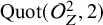 form a
$\mathbb {P}(S^2)$
 -bundle over
$\mathbb {P}(V)$
 . Indeed, it is isomorphic to
$\mathbb {P}^2\times \mathbb {P}^1$
 (see the calculation below and also Remark 7.3). So the birational morphism g is blowup of a copy of
$\mathbb {P}^1=\mathbb {P}(V)$
 [Reference Andreatta and Wiśniewski1, Corollary 4.11]. Thus, the diagram (8.2) is the resolution of indeterminacies of the lower rational map. It is possible to write down this map explicitly in coordinate.
To compute the normal bundle of
$\mathbb {P}(V)\simeq \mathbb {P}^1\hookrightarrow G:= {\mathrm {Gr}}(2,V\otimes S^1)$
 explicitly, use the Plüker map

and
$\wedge ^2(V\otimes S^1)=(\wedge ^2V\otimes S^2)\oplus ( {\mathrm {Sym}}^2V\otimes \wedge ^2 S^1)$
 . On the one hand, the Plüker coordinates of
$\mathbb {P}(V)\subseteq G$
 are
$[0:x_1^2:x_1x_2:x_1x_2:x_2^2:0]$
 , which is not contained in any plane in G, where
$x_0,x_1$
 are the homogeneous coordinates of
$\mathbb {P}(V)$
 . On the other hand, a subspace
$W\subseteq V\otimes S^1$
 has form
$v\otimes S^1$
 if and only if the projection from
$\wedge ^2 W$
 to the first factor
$\wedge ^2 V\otimes S^2$
 is zero. The space
$\wedge ^2 w$
 for
$[w]\in G\subseteq \mathbb {P}^5$
 is the fiber of determinant of the universal subbundle which is
$\mathcal {O}_{\mathbb {P}^5}(-1)|_G=: \mathcal {O}_{G}(-1)$
 . So
$\mathbb {P}(V)\subseteq G$
 is the zero locus of a canonical bundle homomorphism

Alternatively, it is the zero locus for a section of
$\mathcal {O}_G(1)\otimes \wedge ^2V\otimes S^2$
 and the normal bundle is isomorphic to

which is
$\mathcal {O}_{\mathbb {P}(V)}(2)^{\oplus 3}$
 , noting that
$\mathbb {P}(V)$
 is a conic in
$\mathbb {P}^5$
 .
Since g is a blowup, the canonical divisor of
$M_Z(2,2)$
 is linearly equivalent to
$g^*K_G-2E\sim 4g^*H|_G-2E$
 , where E is the g-exceptional divisor and
$H\subseteq \mathbb {P}^5$
 is a hyperplane. Let
$\ell \subseteq G$
 be a line that intersects
$\mathbb {P}(V)$
 at a point q (with multiplicity one). By the blowup formula [Reference Fulton9, Theorem 6.7],
$g^*[\ell ]=[\widetilde {\ell }]+[L]$
 in the Chow group
$A_1(M_Z(2,2))$
 , where
$\widetilde {\ell }$
 is the proper transform of
$\ell $
 and
$L\subseteq \mathbb {P}^2\subseteq M_Z(2,2)$
 is a line in the fiber of g over q. Since
${\overline {\text {NE}}}(M_Z(2,2))$
 is generated by the classes of
$\widetilde {\ell }$
 and L, Kleiman’s criterion implies that
$4g^{*}H|_G-2E$
 is ample and hence
$M_Z(2,2)$
 is Fano (see also [Reference Mukai25, Theorem 7]).
(2) We calculate the fibers of
$\pi $
 . We need to parameterize quotients

with
$\mathcal {L}$
 of rank zero whose divisor if of degree
$2$
 .
First, consider the case when
$\mathcal {L}$
 is supported at distinct points
$q_1,q_2$
 . By Theorem 5.1 and Remark 5.2, such quotients are parameterized by
$\mathbb {P}^1\times \mathbb {P}^1$
 . This agrees with the geometric picture above.
Now consider fiber over
$2q$
 , that is, when
$\mathcal {L}$
 is supported at one point q. By Remark 5.2, it is enough to parameterize quotients

where L is a
$k[t]/\langle t^2 \rangle $
 -module of length
$2$
 . Such L is either
$k\oplus k$
 or
$k[t]/\langle t^2\rangle $
 .
First, consider
$L=k[t]/\langle t^2\rangle $
 . A quotient is determined by the choice of

such that either
$a_1\neq 0$
 or
$a_2\neq 0$
 . Then kernel of the quotient is

If
$a_1\neq 0$
 , then e is invertible in
$k[t]/\langle t^2\rangle $
 , so if
$(f,g)$
 is in the kernel, then

so

If
$a_2\neq 0$
 , we can see

So in any case, the kernel is
$\langle (-h,e)\rangle $
 , that is, the submodule generated by
$(-h,e)$
 .
When e is invertible

where

is uniquely determined. Thus, such kernels are parameterized by the points of
$\mathbb {A}^1\times \mathbb {A}^1$
 with coordinates
$m_1,m_2$
 . Similarly, when h is invertible, the corresponding kernel is
$\langle (1,-h^{-1}e)\rangle $
 , where

Such kernels are parameterized by
$\mathbb {A}^1\times \mathbb {A}^1$
 with coordinates
$l_1,l_2$
 .
When both
$e,h$
 are invertible,

so

This means that the two
$\mathbb {A}^1\times \mathbb {A}^1$
 are glued along
$\mathbb {A}^1\setminus \{0\}\times \mathbb {A}^1$
 by the isomorphism

The union of the two copies
$\mathbb {A}^1\times \mathbb {A}^1$
 under the above isomorphism is a variety mapping to
$\mathbb {P}^1$
 and with fibers
$\mathbb {A}^1$
 . This corresponds to the morphism
$G_2\to \mathbb {P}^1$
 determined in the geometric discussion above.
Consider

where we consider the coordinates
$x,y,z,u$
 on
$\mathbb {P}^3$
 . The points with
$x\neq 0$
 are

which are parameterized
$\mathbb {A}^1\times \mathbb {A}^1$
 with coordinates
$y,u$
 . And the points with
$z\neq 0$
 are

which are parameterized
$\mathbb {A}^1\times \mathbb {A}^1$
 with coordinates
$-y,u$
 . The intersection of the two sets of points is the set of points with
$x\neq 0$
 ,
$z\neq 0$
 , and
$y\neq 0$
 , which consists of points

corresponding to an isomorphism from
$\mathbb {A}^1\setminus \{0\}\times \mathbb {A}^1$
 given by

with respect to the coordinates above. So
$V(xz+y^2)$
 consists of the union of two copies of
$\mathbb {A}^1\times \mathbb {A}^1$
 glued by the above isomorphism together with the singular point
$(0:0:0:1)$
 .
Now consider all the quotients

with
$L=k\oplus k$
 . Such a quotient is given by sending
$(1,0),(0,1)$
 to
$(a_1,b_1),(a_2,b_2)\in k^2$
 such that

The quotient send t to zero, so it factors through a surjection
$k\oplus k\to L$
 which should be an isomorphism. So the kernel is
$\langle t\rangle \oplus \langle t\rangle $
 and this is unique.
Finally, by Lemma 3.18, all the quotients for
$L=k[t]/\langle t^2\rangle $
 and
$L=k\oplus k$
 are parameterized by a normal surface. And the above discussion shows that this normal surface is isomorphic to
$V(xz+y^2)$
 when we remove one point from each side. But since both are normal surfaces, they are isomorphic.
This completes the proof of Theorem 1.4.
9. Degree three stable pairs on curves
9.1. Algebraic treatment
Assume
$Z=\mathbb {P}^1$
 . We consider sheaf stable pairs
$\mathcal {O}_Z^2\to \mathcal {E}$
 of rank
$2$
 and degree
$3$
 . Since
$\mathcal {E}$
 is nef, either
$\mathcal {E}\simeq \mathcal {O}_Z(1)\oplus \mathcal {O}_Z(2)$
 , or
$\mathcal {E}\simeq \mathcal {O}_Z\oplus \mathcal {O}_Z(3)$
 .
We first focus on the former, which is the generic case. Let
$\mathcal {M}$
 be the moduli space of stable pairs with
$\mathcal {E}=\mathcal {O}_Z(1)\oplus \mathcal {O}_Z(2)$
 .
Denote
$V:= H^0(\mathcal {O}_Z(1)\oplus \mathcal {O}_Z(1))$
 ,
$H:= H^0(\det \mathcal {E})\simeq H^0(\mathcal {O}_{\mathbb {P}^1}(3))$
 , which are both vector spaces of dimension
$4$
 . We claim that there is an injective morphism
$\mathcal {M}\to \mathbb {P}(H)\times \mathbb {P}(V)$
 .
As in Remark 7.3, a stable map
$s\colon \mathcal {O}_Z^2\to \mathcal {E}=\mathcal {O}_Z(1)\oplus \mathcal {O}_Z(2)$
 is given by

where
$\alpha _{i}\in H^0(\mathcal {O}_{\mathbb {P}^1}(2))$
 and
$\beta _{i}\in H^0(\mathcal {O}_{\mathbb {P}^1}(1))$
 such that its determinant is a non-zero vector in
$H=H^0(\det \mathcal {E})$
 . Note that

acts on
$\overline {\mathcal {M}}$
 by matrix multiplication

where
$\gamma _i\in k^*$
 and
$\varphi \in {\mathrm {Hom}}(\mathcal {O}_Z(1),\mathcal {O}_Z(2))$
 . We still see that the determinant
$\det M=\alpha _1\beta _2-\alpha _2\beta _1$
 is invariant up to scaling of
$\gamma _1\gamma _2$
 . View
$[\beta _1:\beta _2]$
 as an element of
$V\simeq \mathbb {A}^4$
 , which is invariant up to scaling of
$\gamma _2$
 . So there is an induced morphism

Assume that
$\pi (M)=\pi (M')$
 for some
$M,M'\in \overline {\mathcal {M}}$
 with

After multiplying by matrices from
$ {\mathrm {Aut}}(\mathcal {E}),$
 we may assume that
$[\beta _1:\beta _2]=[\beta _1':\beta _2']$
 and
$\det M=\det M'$
 . Then we may take
$\gamma _1=\gamma _2=1$
 . In the case when
$\beta _1$
 and
$\beta _2$
 are proportional, let
$\varphi \in {\mathrm {Hom}}(\mathcal {O}_Z(1),\mathcal {O}_Z(2))$
 be any homomorphism satisfying
$\varphi \beta _1=\alpha _1'-\alpha _1$
 ; in the case when
$\beta _1$
 and
$\beta _2$
 are not proportional, let
$\varphi =0$
 be given by
$\varphi \beta _j=\alpha _j'-\alpha _j$
 for
$j=1,2$
 . Then

and hence
$\pi $
 is injective.
Now we turn to the general setting. Note that
$M_Z(2,3)\simeq {\mathrm {Quot}}(\mathcal {O}_{Z}^2,3)$
 and the latter parameterizing embeddings

where either
$\mathcal {K}=\mathcal {O}_Z(-1)\oplus \mathcal {O}_Z(-2)$
 or
$\mathcal {K}=\mathcal {O}_Z\oplus \mathcal {O}_Z(-3)$
 . In both cases,

is a three-dimensional subspace in six-dimensional vector space, where
$V=H^0(\mathcal {O}_Z\oplus \mathcal {O}_Z)$
 and
$S^{\ell }=H^0(\mathcal {O}_Z(\ell ))$
 . But
$\mathcal {K}$
 is globally generated only in the first (generic) case.
Assume that
$\oplus _{\ell \geq 0}S^{\ell }\simeq k[x,y]$
 as graded modules. For a three-dimensional subspace
$W\hookrightarrow V\otimes S^2$
 , there is a linear map

The image is expected to be
$H^0(\mathcal {K}(3))$
 and hence of codimension
$3$
 in the eight-dimensional vector space
$V\otimes S^3$
 . On the Grassmannian
$G= {\mathrm {Gr}}(3,6)$
 , we have a universal subbundle
$\mathcal {S}\hookrightarrow \mathcal {O}_{G}\otimes V\otimes S^2$
 of rank
$3$
 , with a morphism
$\sigma \colon \mathcal {S}\oplus \mathcal {S}\to \mathcal {O}_{G}\otimes V\otimes S^3$
 for which we like the image of
$\sigma $
 to have rank
$5$
 . By general theory in [Reference Fulton9, Chapter 14], the expected codimension of the degeneracy locus

in G is
$3$
 . By [Reference Bănică3, §4.1], the degeneracy locus
$D_5(\sigma )$
 has singularities along
$D_4(\sigma )$
 . This corresponds to the case when
$\mathcal {K}=\mathcal {O}_Z\oplus \mathcal {O}_Z(-3)$
 . In this case,
$H^0(\mathcal {K}(2))=v\otimes S^2$
 for some vector
$v\in V$
 , which spans
$H^0(\mathcal {K})\hookrightarrow H^0(\mathcal {O}_Z\otimes V)$
 . The image of
$W\oplus W\to V\otimes S^3$
 for
$W=v\otimes S^2$
 is
$v\otimes S^3$
 which has dimension
$4$
 . To get all of five-dimensional
$H^0(\mathcal {K}(3))\hookrightarrow H^0(V\otimes \mathcal {O}(3))=V\otimes S^3$
 , we need to specify an additional line in

This line is
$H^0(\mathcal {O}_Z(-3)\otimes \mathcal {O}_Z(3))\hookrightarrow H^0(\mathcal {K}(3))$
 , so if
$ {\mathrm {Quot}}(\mathcal {O}_{Z}^2,3)= {\mathrm {Quot}}_{1,2}\cup {\mathrm {Quot}}_{0,3}$
 , then the map
$\pi \colon {\mathrm {Quot}}(\mathcal {O}_{Z}^2,3)\to G$
 is injective on
$ {\mathrm {Quot}}_{1,2}$
 and collapses
$ {\mathrm {Quot}}_{0,3}\simeq \mathbb {P}^2\times \mathbb {P}^1$
 onto
$\mathbb {P}^1=\mathbb {P}(V)$
 which is the singular locus of
$\pi ( {\mathrm {Quot}}(\mathcal {O}_{Z}^2,3))\subseteq {\mathrm {Gr}}(3,6)$
 .
If we consider
$W\subseteq V\otimes S^2$
 and want
$\dim xW+yW=5$
 for
$xW+yW\subseteq V\otimes S^3$
 , then this means that there exist
$w_1,w_2\in W$
 such that
$w_1x=w_2y$
 . As
$W\subseteq V\otimes S^2$
 , there exists
$v\in V\otimes S^1$
 such that
$w_1=vy$
 and
$w_2=vx$
 . This
$v\in V\otimes S^1$
 is unique up to rescaling since
$\dim xW \cap yW=1$
 (as subspaces in
$V\otimes S^3$
 ). Hence, on an open subset of
$ {\mathrm {Quot}}(\mathcal {O}_{Z}^2,3)$
 , we take
$v\in V\otimes S^1$
 then construct
$\langle vx,vy\rangle $
 in
$V\otimes S^2$
 , which are always independent vectors, and complete this to a three-dimensional subspace W by choosing a line

This is an open subset in a
$\mathbb {P}^3$
 -bundle over
$\mathbb {P}^3$
 : although each
$\langle v\rangle $
 ,
$\langle w\rangle $
 corresponds a point of
$\mathbb {P}^3$
 , occasionally we will end up with
$\dim xW\cap yW\geq 2$
 in
$V\otimes S^3$
 .
Suppose
$\dim xW\cap yW\geq 2$
 . Then there exist
$v_1,v_2\in V\otimes S^1$
 such that
$v_1x,v_1y,v_2x,v_2y\in W$
 . But W is three-dimensional, so
$ {\mathrm {Span}} \langle v_1x,v_1y\rangle \cap {\mathrm {Span}} \langle v_2x,v_2y\rangle \neq 0$
 . This means that there exists
$u\in V$
 such that
$uS^2 \subseteq W$
 and thus
$uS^2=W$
 . Such subspaces W are parameterized by locus
$\langle u\rangle \in \mathbb {P}(V)=\mathbb {P}^1$
 and their
$\pi $
 -preimage in
$ {\mathrm {Quot}}(\mathcal {O}_{Z}^2,3)$
 is isomorphic to
$\mathbb {P}^2\times \mathbb {P}^1$
 . Since
$\pi ^{-1}(\mathbb {P}(V))$
 is not a divisor on
$ {\mathrm {Quot}}(\mathcal {O}_{Z}^2,3)$
 , this
$\mathbb {P}(V)=\mathbb {P}^1\subseteq G= {\mathrm {Gr}}(3,6)$
 is singular in the
$\pi $
 -image of
$ {\mathrm {Quot}}(\mathcal {O}_{Z}^2,3)$
 .
9.2. Description of the fiber of Hilbert–Chow morphism via equations
Let
$Z=\mathbb {P}^1$
 . Denote by F be the fiber of
$\pi \colon M_Z(2,3)\to {\mathrm {Hilb}}_Z^3$
 over
$3q$
 for some closed point
$q\in Z$
 . We may assume that q is the origin.
Let t be the local coordinate of the origin in
$\mathbb {A}^1\subseteq \mathbb {P}^1$
 . Then all possible embeddings
$\mathcal {K}\hookrightarrow \mathcal {O}_Z^2$
 with
$\det \mathcal {K}^{\vee }=\mathcal {O}_Z(3q)$
 are in bijective correspondence with three-dimensional subspaces in

which are t-invariant (see Section 6.4). There are two types of such submodules
$N\subseteq M$
 with
$\dim N=3$
 :
-
1. $N=k[t]/\langle t^3\rangle $
as a
$k[t]$
module. This is an open subset of F (of dimension
$3$
) corresponds to the case when N projects onto a line in
$M/tM$
. -
2. $N\simeq k[t]/\langle t^2\rangle \oplus k[t]/\langle t\rangle $
corresponds to the case when
$t^2M\subsetneq N\subsetneq M$
. This is the singular set, isomorphic to
$\mathbb {P}^1$
, which is the set of lines in
$tM/t^2M$
.


Local equations can be written in local coordinates on the Grassmannian
$ {\mathrm {Gr}}(3,M)$
 . If
$W\subseteq M$
 is a three-dimensional subspace and one chooses a splitting
$M\simeq W\oplus M/W$
 , then these subspaces in the neighborhood of W correspond to graphs of linear maps
$W\to M/W$
 . For example, W itself corresponds to zero map.
Write
$M= {\mathrm {Span}}(u,ut,ut^2,v,vt,vt^2)$
 and choose
$W= {\mathrm {Span}}(ut,ut^2,vt^2)$
 . This corresponds to Case (2) above and they are all isomorphic. Then
$M/W\simeq {\mathrm {Span}}(u,v,vt)$
 . If we order the basis as
$(ut,ut^2,vt^2,u,v,vt)$
 , then subspaces near W are spanned by rows of

where the right half of the matrix, that is,

is the linear map
$W\to M/W$
 . By assumption, this subspace is t-invariant. Denote the jth row by
$R_j$
 ,
$1\leq j\leq 3$
 . Since
$t(ut+au+bv+cvt)=ut^2+aut+bvt+cvt^2$
 , we have
$tR_1=(a,1,c,0,0,b)$
 and hence
$tR_1=aR_1+R_2+cR_3$
 . This gives equations

Repeat this process, we have the full set of equations on nine variables:

In Equation (9.3), we have
$g(a+i)=0$
 . If
$g=0,$
 then Equation (9.4) gives
$hi=0$
 and from Equation (9.5), we obtain
$h=i^2$
 . So both
$h,i$
 are also zero. Remaining equations then give:

From Equations (9.6) and (9.7), we have
$a=d=0$
 . Then
$e=0$
 ,
$b=f,$
 and c is a free variable. This gives

which is two-dimensional.
If
$g\neq 0$
 in Equation (9.3), then
$i=-a$
 from Equation (9.3),
$b=f$
 from Equation (9.2), and
$h=-d$
 from Equations (9.1) and (9.5). So we are left with variables
$a,b,c,d,e,g$
 and equations

Note that
$d,e$
 can be eliminated from the first two equations while the last one gives

in
$\mathbb {A}^4$
 with coordinates
$a,b,c,g$
 . Finally, collect together

which gives matrix

with relation
$a^3+agc=bg$
 . In particular, we can take
$a=g=d=0$
 and that recovers Equation (9.8) which we considered above.
Therefore, locally around a single point, the equation of F can be written as
$a^3=g(b-ac)$
 in
$a,b,c,g$
 coordinates which is a
$cA_2$
 -singularity. In particular, F has canonical singularities.
The calculation above can be generalized to higher dimension.
Proposition 9.1. Let
$Q_n$
 be the variety of n-dimensional submodules in
$M_n=(k[t]/\langle t^n\rangle )^{\oplus 2}$
 .
-
1. $\dim Q_n=n$
; -
2. the singular locus $Q_n^{ {\mathrm {Sing}}}\simeq Q_{n-2}$
when
$n\geq 2$
; -
3. the smooth locus $Q_n^{\circ }:= Q_n\setminus Q_n^{ {\mathrm {Sing}}}$
is an
$\mathbb {A}^{n-1}$
-bundle over
$\mathbb {P}^1$
; -
4. if $x\in Q_{n-2}^{\circ }\subseteq Q_{n-2}\subseteq Q_n$
, then in some local coordinates around x,
$Q_n$
is isomorphic to
$\mathbb {A}^{n-2}\times (\text {singular surface } xy=z^n)$
, which is a higher-dimensional
$cA_{n-1}$
-singularity.


Now we can give a proof of Theorem 1.5.
Proof of Theorem 1.5.
By Theorem 5.1 and Remark 5.2, we can assume
$Z=\mathbb {P}^1$
 . And then by Theorem 1.4, it is enough to consider the fiber F of
$\pi $
 over
$3q$
 .
As in the previous section, it is enough to parameterize all quotients

where L is a
$k[t]/\langle t^3\rangle $
 -module with length
$3$
 . The only possibilities for L are

It is enough to consider the case

as this is the generic case by Remark 5.3. This corresponds to the case when the divisors of
$s_1,s_2$
 have no common component, that is,
$3=n=m$
 as in Theorem 6.1. Each quotient is determined by

and then the kernel of the quotient is the submodule
$\langle (-h,e)\rangle $
 .
The quotients with e invertible are parameterized by
$\mathbb {A}^3$
 via

Similarly, the quotients with h invertible are parameterized by
$\mathbb {A}^3$
 via

When both
$e,h$
 are invertible, we have

inducing a birational map

which is an isomorphism on points with non-zero first coordinates.
The above birational map induces a birational map

where we identify U with points with
$m_4\neq 0$
 and V with
$l_4\neq 0$
 .
Define the hyperplanes

By construction,
$\varphi $
 gives an isomorphism

and one has
$\varphi ^2= {\mathrm {id}}$
 . Also we can see that

and no other divisors are contracted. Pick the canonical divisor
$K_Y$
 such that

We want to compute

in terms of
$K_X$
 and
$A_{i}$
 . First, note that

where
$G\subseteq X$
 is given by
$m_2^2-m_1m_3=0$
 . Moreover,

where
$K_X$
 is determined as a Weil divisor by
$K_Y,\varphi $
 , and
$a,b\in \mathbb {Z}$
 . So

Since
$\deg G=2$
 and
$\deg K_X=-4$
 ,

hence

On the other hand,
$(Y,\sum _1^4 H_{i})$
 has lc singularities, so

Thus, one of
$a+6$
 and
$b+3$
 is zero and the other is one.
We claim that
$a+6=0$
 . Assume not. Then

is lc. But then

is lc [Reference Kollár and Mori19, Theorem 5.50], which is not the case, so we have
$a+6=0$
 and
$b+3=1$
 as claimed (note that
$G|_{A_1}$
 is a double line). Summarizing, we have

Since the constructions are symmetric for
$X,Y$
 , we also have

for some appropriate choices of
$K_X,K_Y$
 , where P is a hypersurface of degree two. Let
$p\colon W'\to X$
 and
$q\colon W'\to $
 be a common resolution of X and Y. Then we have

Therefore, the log discrepancy
$a(A_1,Y,\frac {1}{2}H_1+H_2+H_3+\frac {1}{2}H_4+\frac {1}{2}P)=\frac {1}{2}$
 and hence we can extract
$A_1$
 from Y by an extremal birational contraction
$\rho \colon W\to Y,$
 where W is of Fano type [Reference Birkar and Zhang6, Lemma 4.6]. Then, by (9.2), we have
$a(A_1,Y,\sum _1^4 H_i)=1$
 and thus

where
$\sim $
 denotes birational transform. Moreover,

Claim 9.2. The cone of effective divisors of W is generated by
$H_4^{\sim }$
 and
$A_1^{\sim }$
 .
Proof of Claim 9.2.
Pick a Weil divisor
$D\geq 0$
 on W. We can write

for some
$\alpha \in \mathbb {Z}$
 . Letting
$\beta =\deg \rho _{*}D$
 and noting
$\rho _{*}D\sim \beta H_4$
 , we get

Then the left-hand side of

is pseudo-effective on X which shows

Thus,
$3\beta -\alpha \geq 0$
 implying the claim. Note that if
$\beta =0$
 , then
$D=-\alpha A_1^{\sim }$
 with
$-\alpha \geq 0$
 .
Claim 9.3. The Iitaka dimension
$\kappa (W,H_4^{\sim })=0$
 .
Proof of Claim 9.3.
Assume not. Then
$H_4^{\sim }$
 is movable and there exist
$e\in \mathbb {N}$
 and
$M\geq 0$
 such that
$e H_4^{\sim }\sim M,$
 where
$H_4^{\sim }\not \subseteq {\mathrm {Supp}} M$
 . Then, from

we get

So

Moreover,
$e=\deg \rho _{*}M$
 , so
$\rho _{*}M$
 is a hypersurface defined by a polynomial
$\Pi $
 of degree e. Thus,
$\varphi ^{*}(\rho _{*}M)$
 is given by the polynomial

of degree
$3e$
 . But then
$R=0$
 and
$\varphi ^{*}(\rho _{*}M)=3e A_1$
 .
Since
$H_1,H_4$
 are the only exceptional divisors of
$\varphi ^{-1}$
 and since
$H_4\not \subseteq {\mathrm {Supp}}\rho _{*}M$
 , we have
$\rho _{*}M=e H_1$
 . Thus,
$\varphi ^{*}\rho _{*}M=2e A_1 + e A_4$
 , a contradiction. So we have proved the claim.
Now run the
$H_4^{\sim }$
 -MMP and let T be the resulting model. We can run this MMP as W is of Fano type. Since W is
$\mathbb {Q}$
 -factorial of Picard number two [Reference Birkar and Zhang6, Lemma 4.6], T is
$\mathbb {Q}$
 -factorial of Picard number one as
$H_4^{\sim }$
 is contracted, given
$\kappa (H_4^{\sim })=0$
 . In particular, T is a (klt) Fano variety.
By construction, W contains big open subsets of both U and V, that is, open subset with complement of codimension
$\geq 2$
 :
-
• for $U,$
we use the fact that
$U\dashrightarrow W$
contracts no divisor; recall that
$U\setminus A_1\xrightarrow {\sim }V\setminus H_1$
and
$A_1^{\sim }\subseteq W$
; -
• for $V,$
it is clear as
$W\to Y$
is a birational morphism.


In fact, the complement in W of the union of the two big open sets contains only one prime divisor,
$H_4^{\sim }$
 . Now
$W\dashrightarrow T$
 is an isomorphism outside
$H_4^{\sim }$
 and
$H_4^{\sim }$
 does not intersect the mentioned big open sets. Thus, T also contains big open subsets of U and V. Moreover, the complement in T of the union of two big open sets is of codimension
$\geq 2$
 .
Therefore, T is isomorphic to the fiber
$F_3$
 of
$\pi $
 because both
$T,F_3$
 are normal varieties with isomorphic open subsets with codimension
$\geq 2$
 complements. Now since
$F_3$
 has klt singularities and
$K_{F_3}$
 is Cartier by Theorem 1.2(3), it has canonical singularities, along a copy of
$\mathbb {P}^1$
 as in Section 9.1.
Acknowledgements
The third author would like to thank Vladimir Baranovsky for helpful discussions. The authors would also like to thank the referees for the very careful reading and suggestions to improve the article.
Funding statement
The first author is supported by a grant from Tsinghua University and a grant of the National Program of Overseas High-Level Talent. The second author is supported by the Shuimu Tsinghua Scholar Program and the China Postdoctoral Science Foundation (2023TQ0172). A.S. would like to acknowledge grants from the Beijing Institute of Mathematical Sciences and Applications (BIMSA), the Beijing NSF BJNSF-IS24005, and the China National Science Foundation (NSFC) NSFC-RFIS Program W2432008. He would like to thank the NSF AiFi Institute for Artificial Intelligence and Fundamental Interactions at Massachusetts Institute of Technology (MIT) which is funded by the U.S. NSF grant under Cooperative Agreement PHY-2019786. He would also like to thank China’s National Program of Overseas High-Level Talent for generous support.


 Open access

