Introduction
Combat increases risk for psychopathology (Thomas et al. Reference Thomas, Wilk, Riviere, Mcgurk, Castro and Hoge2010), and although efficacious treatments for post-traumatic stress disorder (PTSD) exist (Bradley et al. Reference Bradley, Greene, Russ, Dutra and Westen2005; Steenkamp & Litz, Reference Steenkamp and Litz2013), less progress has been made in PTSD prevention. Most available prevention strategies target individuals during the aftermath of trauma (Feldner et al. Reference Feldner, Monson and Friedman2007; Agorastos et al. Reference Agorastos, Marmar and Otte2011; Forneris et al. Reference Forneris, Gartlehner, Brownley, Gaynes, Sonis, Coker-Schwimmer, Jonas, Greenblatt, Wilkins, Woodell and Lohr2013; Kliem & Kroger, Reference Kliem and Kroger2013), and the data from the few studies intervening before a traumatic event has occurred suggest the need for novel evidence-based approaches (Skeffington et al. Reference Skeffington, Rees and Kane2013). To date, no such randomized controlled trial (RCT) has been conducted (Feldner et al. Reference Feldner, Monson and Friedman2007; Skeffington et al. Reference Skeffington, Rees and Kane2013).
Attention bias modification training (ABMT), a computer-based protocol tested in RCTs (Linetzky et al. Reference Linetzky, Pergamin-Hight, Pine and Bar-Haim2015; MacLeod & Clarke, Reference MacLeod and Clarke2015), is thought to mitigate anxiety by targeting disruptions in a threat-monitoring system responsible for prioritizing potential threats in the environment (LeDoux, Reference Ledoux2000; Monk et al. Reference Monk, Telzer, Mogg, Bradley, Mai, Louro, Chen, McClure-Tone, Ernst and Pine2008; Browning et al. Reference Browning, Holmes, Murphy, Goodwin and Harmer2010). Most work links threat-related attention vigilance to anxiety. Therefore, ABMT is typically designed to shift attention away from threat. For example, in such protocols, response targets appear more frequently at the screen locations of neutral than threat stimuli (see Method), and thus gradually rectify biased attention toward threat. However, recent research on PTSD has focused on the opposite attentional profile, threat avoidance, and on heightened fluctuations between threat vigilance and threat avoidance. Specifically, soldiers displaying threat avoidance immediately before and after combat deployment exhibit increased risk for PTSD (Beevers et al. Reference Beevers, Lee, Wells, Ellis and Telch2011; Wald et al. Reference Wald, Degnan, Gorodetsky, Charney, Fox, Fruchter, Goldman, Lubin, Pine and Bar-Haim2013; Sipos et al. Reference Sipos, Bar-HAIM, Abend, Adler and Bliese2014). In addition, elevated attention bias variability (ABV), the tendency of attention to fluctuate between threat vigilance and threat avoidance, has been detected in patients with PTSD (Iacoviello et al. Reference Iacoviello, Wu, Abend, Murrough, Feder, Fruchter, Levinstein, Wald, Bailey, Pine, Neumeister, Bar-Haim and Charney2014; Naim et al. Reference Naim, Abend, Wald, Eldar, Levi, Fruchter, Ginat, Halpern, Sipos and Adler2015).
Here we tested the hypothesis that using ABMT to induce vigilance towards minor threats before combat deployment reduces the risk for PTSD following combat. We expected ABMT towards threat to minimize risk associated with threat avoidance, as demonstrated in prior research (Wald et al. Reference Wald, Degnan, Gorodetsky, Charney, Fox, Fruchter, Goldman, Lubin, Pine and Bar-Haim2013). Training towards threat could facilitate protective forms of threat processing during combat by countering maladaptive threat-avoidance patterns. We tested two dose levels of ABMT toward threat (four and eight sessions), with the hope of gaining preliminary information on dose–response. In addition, because elevated ABV has been detected in PTSD (Iacoviello et al. Reference Iacoviello, Wu, Abend, Murrough, Feder, Fruchter, Levinstein, Wald, Bailey, Pine, Neumeister, Bar-Haim and Charney2014; Naim et al. Reference Naim, Abend, Wald, Eldar, Levi, Fruchter, Ginat, Halpern, Sipos and Adler2015), and a reduction in this variability has been linked to a reduction in PTSD symptoms using attention control training (ACT; Badura-Brack et al. Reference Badura-Brack, Naim, Ryan, Levy, Abend, Khanna, McDermott, Pine and Bar-Haim2015), we also tested the efficacy of ACT. ACT uses the same format as ABMT but presents equal amounts of targets in the locations of threat and neutral attention stimuli, presumably inducing more balanced threat-related attention. Thus, these three active conditions were contrasted with a no-training control condition testing relative preventative efficacy in soldiers exposed to high-intensity combat.
Method
Study overview
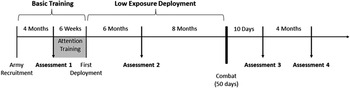
The study was approved by the Tel Aviv University Institutional Review Board and the Israel Defense Force (IDF) Ethics Committee. Study procedures were explained and a written informed consent was obtained (see Fig. 1 for study timeline). We obtained self-reported information on symptoms of PTSD, depression and combat experiences at baseline during basic training (assessment 1), at a 6 months follow-up (assessment 2), 10 days following 50 days of high-intensity combat (assessment 3) and 4 months after combat had ended (assessment 4). Assessment 4 also included a structured clinical interview. The self-reported instruments throughout and the interviews at the last assessment point were administered by independent evaluators unaware of study-group assignments.
Study timeline and data collection points. Assessment 1 = baseline during basic training; assessment 2 = following 6 months of low-intensity combat exposure; assessment 3 = 10 days following 50 days of high-intensity combat deployment; assessment 4 = 4 months following 50 days of high-intensity combat deployment.

Participants
Participants were 719 male soldiers, aged 18–27 years, constituting the entire maneuver component of an infantry brigade. All soldiers were determined to be physically and mentally healthy prior to military recruitment as required for service in first-tier infantry units. Soldiers were excluded for self-reported reading difficulties or dyslexia.
Study design
The study was a selective prevention trial, with randomized blinded treatment assignment, research-assistant-delivered training, and blinded clinician independent-evaluator end-point-outcome assessment. We compared high-dose ABMT toward threat (eight sessions), low-dose ABMT toward threat (four sessions) and low-dose ACT (four sessions) with a no-training control. Randomization used a web-based application (Urbaniak & Plous, Reference Urbaniak and Plous2013). Soldiers within each platoon were randomized individually into one of the four conditions, thus affording control over the participants’ military and combat experience, leadership and geographical locations across intervention groups.
Threat-related attention bias
Threat-related attention bias was measured using the dot-probe task (online Supplementary Fig. S1). As in Wald et al. (Reference Wald, Degnan, Gorodetsky, Charney, Fox, Fruchter, Goldman, Lubin, Pine and Bar-Haim2013), each trial began with a central fixation display (500 ms), on which participants were requested to focus. The fixation was followed by a word pair (1000 ms). The word pairs consisted of one threatening word and one neutral word (e.g. dead–data, grave–field, ambush–pillow, casualties–amenities), written in white on a black background, font Ariel size 14. The words appeared one above the other equidistant from the screen's center, at a distance of 3 cm from one another. The word pair was then replaced by a target probe (one or two red dots) that appeared in either of the two locations vacated by the words. Probes appeared with equal probability at the location of the neutral and threat words. Participants were required to identify the probe type as fast as possible without compromising accuracy. Upon response the screen cleared and a new trial began. Threat bias was calculated as the difference between average reaction time (RT) to targets at neutral-word locations and targets at threat-word locations. Positive bias scores reflect faster mean RT to targets appearing at threat locations. Negative bias scores reflect the opposite pattern. The task consisted of 152 trials presented on 15.4″ (39.1 cm) screen laptops.
Interventions
ABMT (Linetzky et al. Reference Linetzky, Pergamin-Hight, Pine and Bar-Haim2015; MacLeod & Clarke, Reference MacLeod and Clarke2015) relied on the same dot-probe task described above but was designed to shift participants’ attention toward threat (i.e. targets always appeared at the threat word location). Training involved either four (low-dose) or eight (high-dose) 10-min training sessions delivered over the course of 6 weeks.
ACT involved four sessions, 10 min each, delivered over the course of 6 weeks. Each session consisted of the same 152 dot-probe trials as described for the ABMT condition. However, this condition did not shift the direction of attention but rather balanced attention deployment between neutral and threat words (Badura-Brack et al. Reference Badura-Brack, Naim, Ryan, Levy, Abend, Khanna, McDermott, Pine and Bar-Haim2015) since probes appeared with equal probability at neutral and threat locations.
Finally, soldiers in the no-training control group attended eight check-ins yoked to the times of other groups’ training. They entered the room where training took place, asked for their names and were informed that they will not be training today.
Measures
The primary outcome was a PTSD diagnosis defined by an independent evaluator using the Clinician-Administered PTSD Scale (CAPS; Blake et al. Reference Blake, Weathers, Nagy, Kaloupek, Gusman, Charney and Keane1995), and a total score ⩾40. For scale psychometrics, see Weathers et al. (Reference Weathers, Ruscio and Keane1999). Interviews were conducted over the telephone by nine graduate-level clinical psychology students, blind to group assignment, trained and supervised to 85% reliability criterion with a senior clinician.
Secondary outcomes were self-reported PTSD and depression symptoms. PTSD symptoms were evaluated with the 17-item National Center for PTSD Checklist of the Department of Veterans Affairs (PCL-M; Blanchard et al. Reference Blanchard, Jones-Alexander, Buckley and Forneris1996). Symptoms were related to stressful events during deployment. For scale psychometrics, see Blanchard et al. (Reference Blanchard, Jones-Alexander, Buckley and Forneris1996). Cronbach's α's in the current sample were 0.90, 0.91, 0.91 and 0.89 for the four assessment points, respectively. Symptoms of depression were measured with the nine-item Patient Health Questionnaire (PHQ-9; Kroenke et al. Reference Kroenke, Spitzer and Williams2001). For psychometrics, see Kroenke et al. (Reference Kroenke, Spitzer and Williams2001). Cronbach's α's in the current sample were 0.81, 0.85, 0.86 and 0.85 for the four assessment points, respectively. Combat exposure was measured using an adapted version of the Combat Experiences Scale (Hoge et al. Reference Hoge, Castro, Messer, McGurk, Cotting and Koffman2004; Wald et al. Reference Wald, Degnan, Gorodetsky, Charney, Fox, Fruchter, Goldman, Lubin, Pine and Bar-Haim2013).
Analysis
Universally applied prevention programs tend to have small effect sizes. This reality is in part due to the fact that most participants are low risk (as defined by the low prevalence rates), and therefore not affected by the intervention. Consequently, our analytic strategy was to ascertain that detected effects, even if small, are indeed robust and not merely spurious, arising in only one specific type of analysis. To that end, we estimated a series of models in an attempt to determine whether the findings would be robust and consistent across a variety of analytic techniques [e.g. generalized estimating equations (GEEs) with data imputation; repeated-measures analysis of variance (ANOVA) for participants with complete datasets].
The primary outcome – PTSD prevalence at 4 months post-combat – was assessed using two-tailed χ2 contrasts. Odds ratios (ORs) and number needed to treat (NNT) were calculated.
Two complementary analyses were conducted: (a) repeated-measures ANOVAs were used for participants with complete data. PCL and PHQ-9 scores served as dependent variables. Training group served as a between-subjects factor and time as the repeated within-subject factor. Self-reported combat experiences were entered as covariates; and (b) because most soldiers were highly resilient, reflected in relatively low PCL scores over time, we explored change over time using a dichotomous variable of PCL score ⩾40 (reflecting severe symptoms). Applying an intention-to-treat approach with last observation carried forward (LOCF), two-tailed χ2 contrasts between training groups were calculated. The same analysis was also modeled for participants with full data, as well as using GEEs relying on the entire sample of randomized participants including subjects with missing data (see below for more detailed description).
Training effects on symptoms over time were tested in random-effects time-series models using GEEs (Zeger et al. Reference Zeger, Liang and Albert1988). This approach addresses missing data by computing estimated marginal means relying on the entire sample of randomized participants including subjects with missing data. The GEE models for the two symptom scales (PTSD, depression) examined two-way interactions for time (assessments 1, 2, 3, 4) and training group (high-dose ABMT, low-dose ABMT, ACT, no-training control), specifying an unstructured correlation matrix to model the correlations between participant-specific intercepts and change slopes. Group × time interactions were tested reflecting an intention-to-treat analytic approach.
Ethical standards
All procedures contributing to this work comply with the ethical standards of the relevant national and institutional committees on human experimentation and with the Helsinki Declaration of 1975, as revised in 2008. Y.B.-H. and I.W. had full access to all the data in the study and take responsibility for the integrity of the data and the accuracy of the data analysis.
Results
Participants
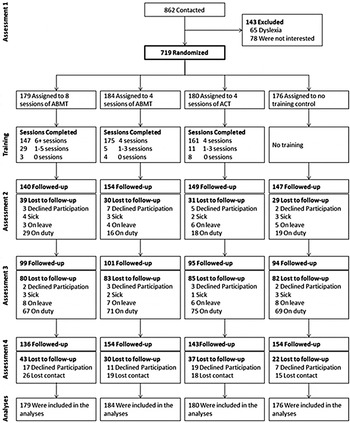
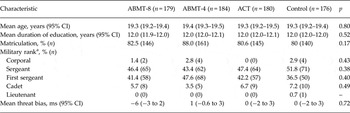
Fig. 2 depicts participant flow through the study. From 862 male soldiers constituting the maneuver component of the infantry brigade, 719 met inclusion criteria, agreed to participate, and underwent randomization. Of these, 179 participants were allocated to eight sessions of ABMT, 184 to four sessions of ABMT, 180 to four sessions of ACT, and 176 to the no-training control condition. Groups were well-matched on all variables (Table 1). Mean age was 19.3 (s.d. = 0.8, range = 18–27) years, with mean education duration of 12.0 (s.d = 0.3) years. A total of 719 (100%) completed the baseline assessment (assessment 1); 590 (82.1%) completed the 6 months follow-up assessment (assessment 2); 387 (54%) completed the assessment 10 days after 50 days of high-intensity combat (assessment 3) – lower participation rate in this assessment was due to difficulties in tracking the soldiers so shortly after combat; and 585 (81%) completed the assessment at 4 months post-combat (assessment 4).
CONSORT (Consolidated Standards of Reporting Trials) diagram. Enrollment, randomization and follow-up of the study subjects. ABMT, Attention bias modification training; ACT, attention control training. Assessment 1 = baseline during basic training; assessment 2 = following 6 months of low-intensity combat exposure; assessment 3 = 10 days following 50 days of high-intensity combat deployment; assessment 4 = 4 months following 50 days of high-intensity combat deployment.

Baseline characteristics by training groups

ABMT, Attention bias modification training; ACT, attention control training; CI, confidence interval.
a Military rank relates to assessment 4, at 4 months post-intense combat.
Age, education, dot-probe performance and baseline self-reported depression and PTSD were not associated with loss to follow-up (independent-sample t tests, completers v. non-completers, within each training group at assessment points 2–4, all p's > 0.05). Attrition did not differ between the groups at all assessment points (χ2 tests at assessment points 2–4, all p's > 0.10; online Supplementary Table S2).
Adherence to treatment
Participants in the eight-session ABMT, four-session ABMT and ACT groups attended an average of 6.74 (s.d. = 1.94), 3.88 (s.d. = 0.62) and 3.72 (s.d. = 0.92) sessions, respectively, with mean accuracy greater than 90% in all groups, reflecting good treatment adherence.
Combat experiences
The 14 months between the end of training and high-intensity combat deployment presented a low-intensity exposure (1.3, s.d.= 1.6, range = 0–12 combat events) with no between-group differences (p > 0.70). Soldiers’ military mission during this period was border patrol, which was mostly non-eventful. The 50 days of acute combat were associated with high-intensity combat exposure (7.9, s.d. = 3.8, range = 0–18 combat events), with no differences among groups (p > 0.12; online Supplementary Table S1 for prevalence and types of combat experiences by group).
Efficacy measures
Primary measures
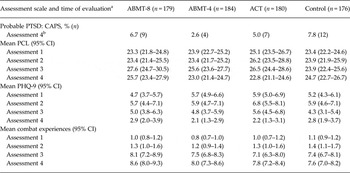
Between-group comparison of CAPS-PTSD diagnosis revealed a significantly lower PTSD rate in the low-dose ABMT group (2.6%) as compared with the no-training control group (7.8%, χ2 = 4.11) [p < 0.05, OR 3.21, 95% confidence interval (CI) 1.01–9.22], but not relative to the high-dose ABMT (6.7%) or ACT (5%) groups, neither of which differed from the no-treatment group. The absolute risk reduction from no treatment to low-dose ABMT was 5.2%, with NNT = 19.2, suggesting that on average, 19.2 soldiers would have to receive this training instead of the current no-treatment practice for one additional soldier to not develop PTSD following combat.
Secondary measures
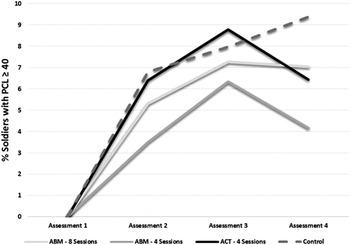
To help ensure that the findings of the primary outcome remain robust across alternative model specifications we examined progression over time of self-reported PCL values ⩾40. Fig. 3 displays percentages of participants with PCL scores ⩾40 by assessment time and training condition applying an intention-to-treat approach with LOCF. During baseline (assessment 1), none of the soldiers had a PCL score ⩾40. Following a 6-month low-intensity deployment (assessment 2), 5.1, 3.8, 6.1 and 6.8% of the soldiers had a PCL score ⩾40 in the eight-session ABMT, four-session ABMT, ACT and no-training control groups, respectively, with no significant between-group differences. At 10 days following intense combat (assessment 3), 7.8, 6.5, 8.9 and 7.4% of the soldiers had a PCL score ⩾40 in the eight-session ABMT, four-session ABMT, ACT and no-training control groups, respectively, with no significant between-group differences. At the 4-month follow-up (assessment 4), soldiers in the four-session ABMT group (4.3%) had significantly lower incidence of PCL scores ⩾40 than the no-training control group (9.8%, χ2 = 4.10) (p < 0.05, OR 2.40, 95% CI 1.01–5.71), but not than the eight-session ABMT (7.3%) or ACT (6.7%) groups, neither of which differed from the no-treatment group (as above, 9.8%).
Percentage of soldiers with Post-Traumatic Stress Disorder Checklist (PCL) scores ⩾40 during the four assessment points of the study. PCL scores ⩾40 reflect considerable symptom severity. Data on the percentage of soldiers with PCL ⩾40 refer to intention-to-treat analysis with last observation carried forward. ABMT, Attention bias modification training; ACT, attention control training. Assessment 1 = baseline during basic training; assessment 2 = following 6 months of low-intensity combat exposure; assessment 3 = 10 days following 50 days of high-intensity combat deployment; assessment 4 = 4 months following 50 days of high-intensity combat deployment.

In recognition of the potential pitfalls of the LOCF method we repeated the above analyses using data from participants who had complete data for all assessment points. The same results emerged, with no group differences over time except for a difference between soldiers in the four-session ABMT group and soldiers in the no-training control group at 4 months post-combat (χ2 = 5.04) (p = 0.025, OR 3.46, 95% CI 1.10–10.85). Finally, applying a GEE model to analyse the PCL ⩾40 data yielded a significant group × time interaction effect (Wald χ2 12 = 100.67, p < 0.0001), with the groups not differing on any of the time points except for a significant difference between the four-session ABMT group and the control group at 4 months post-combat (p = 0.03, 95% CI −0.11 to −0.06), again indicating the same results obtained with our original analysis.
Progression of self-reported PTSD symptoms (PCL total scores) over the study's four assessment points was analysed using GEEs (Table 2 for mean and 95% CIs). Significant effects of time (Wald χ2 = 14.04, p < 0.003) and group × time interaction (Wald χ2 = 41.26, p < 0.0001) were found. Follow-up analysis indicates that the no-training control group showed a non-significant linear increase in PTSD symptoms over time, with no quadratic component. In contrast, the three attention training groups all showed significant quadratic trends (p's = 0.006, 0.02 and 0.001, for the eight-session ABMT, four-session ABMT and the ACT groups, respectively). In these groups an increase in PTSD symptoms 10 days after combat was followed by a sharp decrease in symptoms at the 4-month follow-up, particularly in the four-session ABMT and ACT groups. The same results pattern was obtained for participants with full datasets analysed with repeated-measures ANOVA: main effect of time (F = 11.86, p < 0.0001), group × time interaction (F = 2.49, p < 0.008; online Supplementary Fig. S2).
Efficacy measures by training groups in the different assessment points for the intention-to-treat population

ABMT, Attention bias modification training; ACT, attention control training; CAPS, Clinician Administrated PTSD Scale; PCL, PTSD Checklist (self-reported PTSD symptoms); CI, confidence interval; PHQ-9, Patient Health Questionnaire-9 (self-reported depression).
a All analyses were performed on data from the intention-to-treat population taken from the generalized estimating equations analyses.
b Assessment 1 = baseline during basic training; assessment 2 = following 6 months of low-intensity combat exposure; assessment 3 = 10 days following 50 days of high-intensity combat deployment; assessment 4 = 4 months following 50 days of high-intensity combat deployment.
Depression symptoms increased from baseline (assessment 1) to the low-intensity combat (assessment 2), and then decreased 10 days following high-intensity combat (assessment 3), and decreased further 4 months post-combat (assessment 4), revealing significant quadratic trends in all the groups (p's = 0.0001; online Supplementary Fig. S3). Finally, no relationships were found between baseline dot-probe performance (accuracy, RT, threat-related attention bias) and post-deployment symptoms) all p's > 0.10).
Discussion
Relative to no intervention, four 10-min ABMT sessions significantly reduced risk for combat-related PTSD. ABMT trained soldiers to attend towards threat in an attempt to enhance cognitive processing of potentially traumatic events. Such an enhancement was expected to transiently elevate stress following combat but reduce later risk for PTSD (Wald et al. Reference Wald, Degnan, Gorodetsky, Charney, Fox, Fruchter, Goldman, Lubin, Pine and Bar-Haim2013). Indeed, this pattern did arise (Beevers et al. Reference Beevers, Lee, Wells, Ellis and Telch2011; Wald et al. Reference Wald, Degnan, Gorodetsky, Charney, Fox, Fruchter, Goldman, Lubin, Pine and Bar-Haim2013). The current results support the idea that attending toward threat may be adaptive in circumstances where vigilance to threat is needed and paramount to survival (LeDoux, Reference Ledoux2000). In extreme situations, such as combat, even minor threat cues might signal genuine danger (Wald et al. Reference Wald, Bitton, Levi, Zusmanovich, Fruchter, Ginat, Charney, Pine and Bar-Haim2016). Under such circumstances, it may become adaptive to be highly attentive to threat cues. This approach is different from that typically applied in ABMT for anxiety disorders, in which attention is typically trained away from threats under safe circumstances. It should be noted, however, that the mean severity of self-reported symptoms in the current sample was low, with approximately half of the participants reporting negligible symptoms, and the effect sizes, as expected in such studies, were small.
In general, universally applied PTSD prevention programs tend to have small effect sizes (Adler et al. Reference Adler, Bliese, McGurk, Hoge and Castro2009). Relative to clinical trials of treatment-seeking populations, universally applied interventions are less likely to produce ‘clinically significant’ main effects. This is thought to be because many participants face low risk and have minimal opportunity to benefit or demonstrate an effect. While not ‘clinically significant’ in standards applied to treatment studies, small, statistically significant effects in studies such as ours can still be important from a public health perspective. The patterns observed in our data suggest the presence of a small but potentially important effect. Specifically, only the two groups trained to attend toward threat showed a clear, transient elevation in self-reported symptoms immediately following combat; no such change occurred in the ACT and control groups. This transient elevation may reflect enhanced ultimately beneficial processing of combat-related threat. Importantly, this elevation is followed by reduction in symptoms at 4 months. That is, deeper initial threat processing may induce symptoms in the short run that presage fewer symptoms later on. Importantly, because a small change in the number of soldiers showing PTSD following combat in one intervention group or another might affect the overall results in universally applied prevention, our approach was to establish that the small effects we obtained are, indeed, robust and not merely spurious, arising in only one specific type of analysis. Thus, in addition to the main GEE analysis concerning PTSD diagnosis we also estimated additional models in an attempt to determine whether the findings would be robust across a variety of analytic techniques. The observed consistency across a variety of analytic techniques (repeated-measures ANOVA of completers, GEE, % participants with PCL ⩾40) helps convey that the findings are reliable.
The dose of ABMT also appeared to affect both short- and long-term outcome. Specifically, eight relative to four sessions of ABMT produced greater transient elevation in symptoms 10 days following combat. Of note, both groups also showed decreases in symptoms at the 4-month follow-up assessment, but the significant PTSD prevention effect was found only for the lower-dose group, with the eight-session intervention having no effects relative to the no-intervention condition. This result was unexpected, as we hypothesized a simple dose–response pattern. Nevertheless, if replicated, the data could suggest a therapeutic window for ABMT dose as a PTSD prevention protocol, potentially related to the degree of rise in symptoms immediately post-combat. Specifically, if optimal functionality of the attentional threat-monitoring system reflects a delicate balance between neurocognitive response and environmental demands (Naim et al. Reference Naim, Abend, Wald, Eldar, Levi, Fruchter, Ginat, Halpern, Sipos and Adler2015), it may be the case that over-driving the system toward threat vigilance might miss the beneficial effects associated with such intervention. This further would suggest that eight sessions of ABMT potentially represent the higher bound, as this was not beneficial but also did not increase risk beyond the no-treatment control group. Currently, four sessions appear to be most optimal but future research on ABMT dose is certainly needed.
Although ACT did not yield a significant preventative effect relative to the no-training control group (5.0% v. 7.8%), a steep reduction in PTSD symptoms from 10 days post-intense combat to 4 months post-combat follow-up was observed in this group. Preliminary evidence from RCTs indicated that ACT is efficacious in the treatment of combat-related PTSD (Kuckertz et al. Reference Kuckertz, Amir, Boffa, Warren, Rindt, Norman, Ram, Ziajko, Webb-Murphy and McLay2014; Badura-Brack et al. Reference Badura-Brack, Naim, Ryan, Levy, Abend, Khanna, McDermott, Pine and Bar-Haim2015). Additional research is needed to understand the potential role of ACT in PTSD prevention.
Both conventional military training and the ABMT approach used here are designed to enhance attention to combat-related cues. However, there is a fundamental difference between conventional military training, which is typically achieved through verbal instruction and modeling of behavior during simulation drills, and the ABMT approach that targets a specific and more basic threat-monitoring mechanism. More research is needed to elucidate how these two distinct approaches might converge or interact in affecting soldiers’ response to combat. Previous data collected in the context of military training and combat deployment indicate that: (a) threat-related attentional suppression, measured by the same computerized task applied here, is associated with elevated post-traumatic symptoms (Wald et al. Reference Wald, Lubin, Holoshitz, Muller, Fruchter, Pine, Charney and Bar-Haim2011, Reference Wald, Degnan, Gorodetsky, Charney, Fox, Fruchter, Goldman, Lubin, Pine and Bar-Haim2013; Sipos et al. Reference Sipos, Bar-HAIM, Abend, Adler and Bliese2014); (b) threat-monitoring patterns and related neural circuits are amenable to modification with the use of computerized tasks similar to the one applied in the current study (Browning et al. Reference Browning, Holmes, Murphy, Goodwin and Harmer2010; Eldar & Bar-Haim, Reference Eldar and Bar-Haim2010; Britton et al. Reference Britton, Suway, Clementi, Fox, Pine and Bar-Haim2015); and most importantly, (c) it is highly probable that the neurocognitive target in both the conventional military training and our ABMT relies on the same neural architecture (Pine et al. Reference Pine, Helfinstein, Bar-Haim, Nelson and Fox2009). ABMT may induce enhanced threat vigilance in a more direct and focused manner that perhaps augments the more generic effect of conventional military training. Indeed, while all the soldiers in the current sample received the same military training, group differences in PTSD emerged in relation to differential computerized training.
Finally, no group differences were found in depression symptoms over time, and all groups showed significant and consistent fluctuations. To put such changes into context, more research on mood fluctuations across the deployment cycle is needed.
Limitations
The current results should be viewed in light of potential limitations. First, many combat-deployed soldiers do not develop PTSD within 4 months post-combat. Hence, longer-term follow-up studies are needed. Second, randomization of participants within platoons may have led to some contamination in that participants could discuss their training experience with each other. Previous research indicates that participants typically cannot infer the training contingency or identify the training condition they had received (MacLeod & Grafton, Reference MacLeod, Grafton and Gross2014). However, the participants in the no-training control group could have eventually figured out that they did not train. This concern may be alleviated to an extent considering that the primary outcome (probable PTSD post-combat) was collected long after the training had ended. In any event, in the trade-off between tight control over participants’ military experience, experienced leadership and geo-operational location on the one hand, and possible contamination due to individual randomization within platoons, on the other hand, we selected to randomize soldiers within platoons. Third, our assessment protocol had limitations. Adding measurement of threat-related attention bias at outcome points could further elucidate the mechanism underlying therapeutic effects. Similarly, collecting information on pre-existing trauma would be desirable in future studies given its predictive value for PTSD vulnerability. Fourth, our study did not include females because the infantry maneuver components in the studied brigade were restricted to males. However, there are mixed-gender units that could potentially engage in combat. Therefore, generalization of the current findings for such units would require further research. Finally, the drop-out rates were quite high, reflecting the difficulty of studying actively deployed soldiers. Using intention-to-treat modeling and data imputation, and the fact that there were no differences between ‘completers’ and those who were lost to follow-up on measures tested at previous time points, should alleviate this concern to an extent.
Conclusions
The current findings have implications for possible prevention of PTSD symptoms in populations at high risk of being exposed to potentially traumatic events (e.g. soldiers, first responders). This RCT of selective prevention of PTSD supports a minimal risk intervention with a clear potential for scalability in selected high-risk populations. Given the large population at elevated risk, the low dissemination costs of ABMT, the relatively low risk it imposes, and an NNT of 19.2, it appears that research into larger-scale application and mechanism elucidation is warranted. The data also suggest that the effects of ABMT can last up to 14 months following initial training, perhaps via consolidation of learning adaptive attention patterns (Abend et al. Reference Abend, Pine, Fox and Bar-Haim2014). More research on the effectiveness and underlying preventative mechanism of ABMT for PTSD is needed.
Supplementary material
The supplementary material for this article can be found at http://dx.doi.org/10.1017/S0033291716000945
Acknowledgements
The study was supported by US Army Medical Research and Materiel Command (USAMRMC), Award W81XWH-13-1-0003, and by the Iranian American Jewish Federation of New York.
Declaration of Interest
None.