Introduction
Vestibular schwannomas are considered to be the most frequent intracranial benign tumour. These tumours will frequently present bilaterally in their hereditary form and unilaterally as part of a sporadic mechanism.Reference Stangerup and Caye-Thomasen1 Currently, the aetiology of sporadic vestibular schwannomas remains largely unknown, although certain studies have found associations with extrinsic factors, including ionising radiation,Reference Yonehara, Brenner, Kishikawa, Inskip, Preston and Ron2 cigarette smoking,Reference Benson, Green, Pirie and Beral3–Reference Palmisano, Schwartzbaum, Prochazka, Pettersson, Bergenheim and Florentzson5 radio frequency waves,Reference Hardell, Carlberg and Hansson Mild6 noise exposure,Reference Chen, Fan, Zheng, Cao and Wang7–Reference Fisher, Pettersson, Palmisano, Schwartzbaum, Edwards and Mathiesen11 and allergic disease.Reference Chen, Fan, Zheng, Cao and Wang7
Studies attempting to ascertain socioeconomic risk factors for acoustic neuroma are scarce. However, the literature has characterised a positive association between education and acoustic neuromas.Reference Schuz, Steding-Jessen, Hansen, Stangerup, Caye-Thomasen and Johansen12–Reference Carlson, Marston, Glasgow, Habermann, Sweeney and Link14 Specifically, the tumour is found more commonly among those with four years or more of college education. In the same manner, the risk for acoustic neuromas is positively associated with self-reported household income.Reference Schuz, Steding-Jessen, Hansen, Stangerup, Caye-Thomasen and Johansen12,Reference Inskip, Tarone, Hatch, Wilcosky, Fine and Black13 Racial considerations have also been found to play a role, with African-American, Hispanic and Asian populations being more likely to present with larger tumours than their Caucasian counterparts in the USA.Reference Carlson, Marston, Glasgow, Habermann, Sweeney and Link14 This may suggest that access to healthcare might be hindered in selected communities, thereby delaying tumour diagnosis.
Recent investigations have demonstrated the geographic variability of vestibular schwannomas in West Scotland, with areas of unusually high or low period prevalence of vestibular schwannomas.Reference Caulley, Sawada, Hinther, Ko, Crowther and Kontorinis15 Socio-economic risk factors may contribute to geographic variation in this disease within Scotland but socioeconomic inequalities in vestibular schwannomas have yet to be described in the UK.
This study sought to investigate the relationship between socio-economic circumstances and the geographic distribution of vestibular schwannomas in the West of Scotland from 2000 to 2015. The primary objective was to establish the frequency of vestibular schwannomas across their associated Scottish Index of Multiple Deprivation. The secondary objective of this study was to analyse the raw prevalence of vestibular schwannoma cases at the council area of geography in Scotland to determine any statistically significant relationship between vestibular schwannoma prevalence at the council level, individual census variables and aggregates of those individual census variables. We hypothesised that the frequency of vestibular schwannoma cases across their associated Scottish Index of Multiple Deprivation ranks are random (that is, no excess cases of vestibular schwannoma within high or low ranks of the Scottish Index of Multiple Deprivation).
Materials and methods
This study was a geographic analysis of the relationship between period prevalence of cases of vestibular schwannoma and socioeconomic indicators using geographic information system (‘GIS’) technology. Because this study served audit purposes, ethical approval or patient consent was not required. The methods used in this study have been described in detail in previous work.Reference Caulley, Sawada, Hinther, Ko, Crowther and Kontorinis15
Data source
The demographic and clinical data were accrued from the National Health Services (NHS) of West Scotland and the vestibular schwannoma database. Subjects included all individuals diagnosed with vestibular schwannoma through the NHS of West Scotland as documented on the West of Scotland Skull Base Multidisciplinary Meeting database. The West of Scotland region, defined as Ayrshire and Arran, Dumfries and Galloway, Forth Valley, Greater Glasgow and Clyde, and Lanarkshire, comprises approximately half of the total Scottish Population at 3.6 million people.16
Surveillance data of vestibular schwannomas were collected from 2000 to 2015. Diagnosis of vestibular schwannoma was determined based on diagnostic imaging, particularly magnetic resonance imaging (MRI) of the internal auditory meatus with intravenous gadolinium administration. In very few cases where MRI was contraindicated, computed tomography of the brain with intravenous contrast was utilised. Patients diagnosed with neurofibromatosis type 2 were excluded from our cohort because there is a known causal genetic background.
Scottish Index of Multiple Deprivation ranking
As individual-level socioeconomic indicators were not available for each case of vestibular schwannoma, an area-level proxy indicator, the Scottish Index of Multiple Deprivation, was used based on the postcode of each case at diagnosis. The Scottish Index of Multiple Deprivation ranks range from the lowest value of 1 to the highest value of 6976. The Scottish Index of Multiple Deprivation is based on a weighted sum of scores from seven domains: income, employment, crime, education, health, housing, and access to amenities and services. This analysis used data from the latest Scottish Index of Multiple Deprivation from 2016. Cases were classified based on population-weighted quintiles of Scottish Index of Multiple Deprivation score, with one representing the least deprived and five representing the most deprived sectors of the population.
Geographic analysis
The geographic analysis used to establish the geographic variability of vestibular schwannomas in West Scotland has been reported elsewhere.Reference Caulley, Sawada, Hinther, Ko, Crowther and Kontorinis15 Mapping and data preparation were conducted with ArcGIS desktop 10.4.1 (Redlands, Environmental Systems Research Institute, USA). The period prevalence was calculated as the number of vestibular schwannoma cases over the 15-year period, divided by the population for each aggregated spatial unit (district and zone).Reference Streiner and Norman17 All period prevalence measures were carried out assuming a national Scottish population of 3.6 million (3.16 million within the 10 zones) in 2011 based on the latest census data available (referring to the examined population of West Scotland).
For each vestibular schwannoma case, the corresponding Scottish Index of Multiple Deprivation rank out of 6976 ranks was extracted by postcode to determine the variation in observed frequency of rank across vestibular schwannoma cases. To reduce type I error and to account for possible non-normality because of the small sample size, 95 per cent confidence intervals (CIs) and p-values were calculated with the use of bias-corrected bootstrapping from 999 random resamples of Scottish Index of Multiple Deprivation ranks (1 to 6976) for each case of vestibular schwannoma.
In order to explore the strength of relationship between census variables (independent) and vestibular schwannoma prevalence (dependent) at the level of geographic distribution by council area, a set of variables that are commonly used in analysis of health determinants were selected. These variables were taken from the NHS 2011 census ‘bulk data files’ and included groups under: ethnicity (white, African, Asian, mixed and other); county of birth (England, Ireland, Wales, Northern Ireland, Scotland, other European Union member countries or other European Union accession countries, or other countries from April 2001 to March 2011); housing tenure (owned outright, owned with a mortgage or loan, shared ownership, rented from council local authority, other social rental agreement, private rental, other rental agreement, or living rent free); households by deprivation dimensions (ranging from no deprivation to deprivation in four dimensions); highest level of qualification (ranging from level one (low) to level six (high)); and median and rank sum of Scottish Index of Multiple Deprivation values by council area. The census variables were analysed for significance at an individual and grouped level. We used a 0.7 cut-off as per standard convention for considering an independent variable in model building.
A bootstrap analysis of the pairwise correlation values was performed to assess the significance of the relationship between the census variables and vestibular schwannoma prevalence because of the small sample size. Statistical significance and CIs for each pairwise observed correlation of a census variable with vestibular schwannoma prevalence was compared to the distribution of 10 000 bootstrapped correlation coefficients. This process allowed for both the creation of bootstrapped CIs and the production of two-sided pseudo p-values for each of the observed coefficients. For each pairwise comparison of vestibular schwannoma prevalence and a census variable, the two variables were re-sampled with replacement (free sampling) and a correlation coefficient was produced. That process was repeated 10 000 times and each time the correlation value was recorded. The pseudo p-value was adjusted for multiple testing using the false detection rate.
Results
Frequency of vestibular schwannoma cases
Geographic data were available for 512 individuals diagnosed with vestibular schwannomas from 2000 to 2015. Of these individuals, 511 met the study inclusion criteria, due to missing data in 1 case. There was no significant variation in the frequency of Scottish Index of Multiple Deprivation ranks across vestibular schwannoma cases. That is to say, the frequency of vestibular schwannoma cases across Scottish Index of Multiple Deprivation quintiles was random with no more highly ranked than lowly ranked or middle ranked cases within the Scottish Index of Multiple Deprivation. The histogram of frequency of vestibular schwannomas by Scottish Index of Multiple Deprivation exhibited variation in the number of vestibular schwannoma cases within a given range of ranked values (see Figure 1 in the supplementary material, available on The Journal of Laryngology & Otology website).
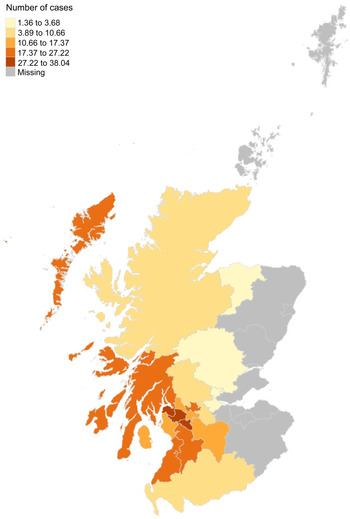
Prevalence of vestibular schwannoma by council area. The number of cases refers to the prevalence of vestibular schwannoma at the examined time period.

From bootstrapping random samples, a set of empirical cumulative distribution functions were produced. This set of empirical cumulative distribution functions produced a typical envelope of what would be expected for an empirical cumulative distribution function that was due to chance (e.g., if vestibular schwannoma cases were randomly distributed amongst the Scottish Index of Multiple Deprivation ranks). The observed empirical cumulative distribution functions were plotted and superimposed on this simulated envelope (see Figure 2 in the supplementary material, available on The Journal of Laryngology & Otology website).
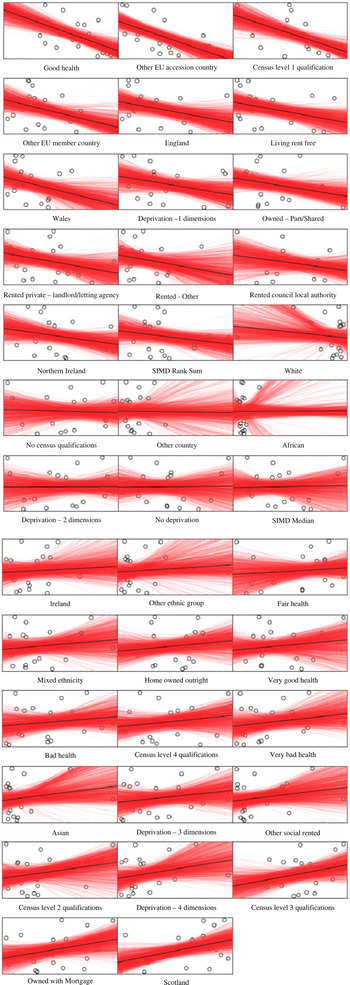
Bootstrapped regression between vestibular schwannoma prevalence and census variables in Scotland. EU = European Union; SIMD = Scottish Index of Multiple Deprivation Continued.

We found that the empirical cumulative distribution function of Scottish Index of Multiple Deprivation ranks for vestibular schwannoma cases does not exceed the simulated envelope. Thus, the cases of vestibular schwannoma were randomly distributed amongst the Scottish Index of Multiple Deprivation ranks in Scotland.
Prevalence by council area and impact of examined factors
We analysed the dependence of vestibular schwannoma rates by council area. At this level of geography, there were enough cases in each of the large spatial regions to support stability in raw prevalence of vestibular schwannoma as a dependent variable. Vestibular schwannoma counts by data zone are presented in Table 1 in the supplementary material, available on The Journal of Laryngology & Otology website. Prevalence of vestibular schwannomas by council areas are depicted in Figure 1. Glasgow City represented the highest prevalence of vestibular schwannomas (see Table 2 in the supplementary material, available on The Journal of Laryngology & Otology website).
Correlations between consensus variables and vestibular schwannoma prevalence by council area level of geography are presented in Table 1. Prevalence of vestibular schwannomas was lowest in council areas where there were higher rates of self-reported good health (–0.64, 95 per cent CI: –0.93 to –0.38; p = 0.002), if country of birth was a European Union accession country (–0.63, 95 per cent CI: –0.84 to –0.43; p = 0.002) and for those with level 1 qualifications (–0.56, 95 per cent CI: –0.88 to –0.26; p = 0.01). However, no variants met our threshold criteria (± 0.7) and so we did not attempt any multiple regression analyses. Additionally, the linearity of correlations was inconsistent across analysed variables. For instance, although good health was associated with a lower prevalence of vestibular schwannomas, very good health was not (0.15, 95 per cent CI: –0.31 to 0.67; p = 0.36). People originating from European Union member countries as of March 2001 by council area demonstrated a weak negative correlation with vestibular schwannomas that demonstrated a trend towards significance (–0.43, 95 per cent CI: –0.74 to –0.10; p = 0.06). After adjusting for multiple testing, only good health (p = 0.048) and people originating from European Union accession countries (p = 0.048) remained significant. Raw correlations between aggregated census variables by council area level of geography did not show any significant relationship with vestibular schwannoma prevalence (Table 2).
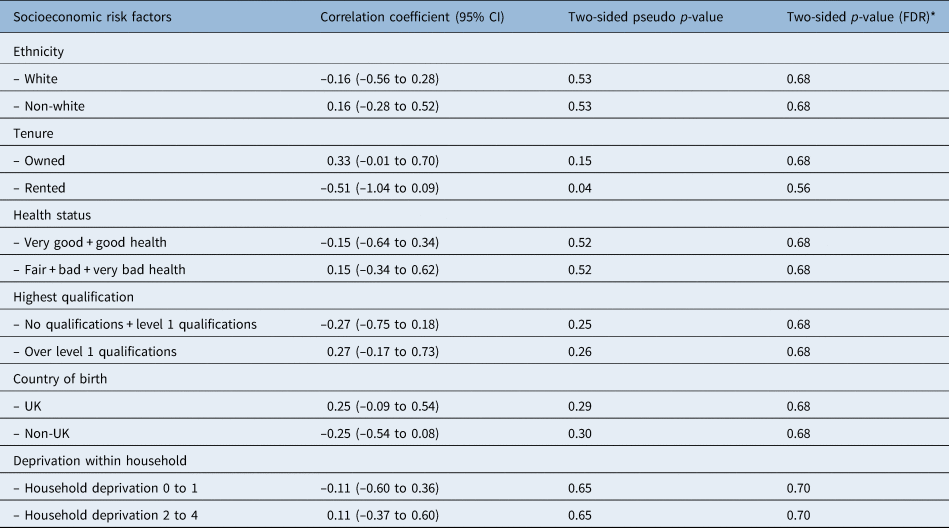
Correlations between census variables and vestibular schwannoma prevalence at the council area level of geography

* False detection rate (FDR) corrections for multiple testing on the pseudo p-values. CI = confidence interval; EU = European Union
Raw correlations between aggregate census variables and vestibular schwannoma prevalence at the council area level of geography

* False detection rate (FDR) corrections for multiple testing on the pseudo p-values. CI = confidence interval; EU = European Union
To further visualise the strength of the trends given by the correlation coefficients, linear trend lines were created and bootstrapped to assess the tightness of the trend (Figure 2).
Good health and European Union accession country origin showed tighter bootstrapped trend lines compared to other census variables confirming the robustness of this finding despite their marginal significance.
Discussion
A recent geographical analysis of the period prevalence of vestibular schwannomas in West Scotland identified postcode districts in Greater Glasgow and Clyde, southern parts of the Western Isles, Ayrshire and Arran which exhibited unusually low period prevalence of vestibular schwannomas. Similarly, unusually high period prevalence of vestibular schwannomas were found in Tayside, Forth Valley and Dumfries and Galloway.Reference Caulley, Sawada, Hinther, Ko, Crowther and Kontorinis15 Potential genetic or environmental risk factors may contribute to geographic variation in this disease within Scotland but evidence in this domain is lacking. Our study represents the first analysis of the association between socioeconomic variables and the geographic distribution of vestibular schwannomas in West Scotland.
Our analysis demonstrated a negative correlation between prevalence of vestibular schwannomas and individuals with good health as measured by the census. Of note, there did not appear to be a significant trend between progressive health status and geographic distribution of vestibular schwannomas in West Scotland. In particular, very good health, fair health, bad health and very bad health by council area level of geography were not significantly correlated with prevalence of vestibular schwannoma. Moreover, our results show that vestibular schwannoma cases are randomly distributed among Scottish Index of Multiple Deprivation ranks, suggesting homogeneity of the NHS cover across areas of different Scottish Index of Multiple Deprivation (different degree of deprivation). That is, patients with symptoms that could indicate the presence of a vestibular schwannoma seem to have access to healthcare and necessary imaging regardless of the level of deprivation within their council area.
At the council area level, patients originating from a European Union accession country were correlated with a significantly lower prevalence of vestibular schwannoma. The related variable (that is, European Union member countries as of March 2001) demonstrated a trend towards significance but did not meet the threshold for significance under multiple testing. The underlying cause of this trend remains unclear. European Union accession country origin could be indicative of a healthy-immigrant effect, a phenomenon noted in several western countries where the newest immigrants tend to be more healthy.Reference Markides and Rote18 In this setting, it may suggest that a higher proportion of immigrants is associated with a lower prevalence of vestibular schwannoma. This trend could be indicative of lower access to health in high immigrant areas and thus lower diagnostic rates of vestibular schwannoma. Alternatively, the age structure of this population may contribute to the prevalence of vestibular schwannomas. A recent analysis by Eurostat, a Directorate-General of the European Commission showed that migrants to the European Union are on average considerably younger (29 years) than the mean population age for all European Union countries (43 years).19 Specifically, 61.1 per cent of European Union migrants residing in Scotland are under the age of 35, compared to only 41.5 per cent for non-migrant populations.20 As such, the prevalence of vestibular schwannomas in the immigrant population may be lower as a result of the younger age distribution because large epidemiological studies have shown that mean age of diagnosis is over 50 years.Reference Gal, Shinn and Huang21,Reference Harun, Agrawal, Tan, Niparko and Francis22
• The aetiology of sporadic vestibular schwannomas remains largely unknown
• There is considerable geographic variability of vestibular schwannomas in West Scotland, with areas of unusually high and low period prevalence of vestibular schwannomas
• Socioeconomic risk factors may influence geographic variation in vestibular schwannomas, including country of origin and level of education
• Patients originating from a European Union accession country were correlated with a significantly lower prevalence of vestibular schwannomas
• This trend could be indicative of lower access to healthcare in high immigrant areas and thus lower diagnostic rates of vestibular schwannomas
Underdiagnosis or prolonged diagnostic intervals for vestibular schwannomas is an issue beyond just new immigrants. It has been shown that the incidence of larger vestibular schwannomas has increased, which might be explained by the fact that some tumours are asymptomatic until later stages, therefore eluding early diagnosis.Reference Moffat, Jones, Mahendran, Humphriss and Baguley23 However, this issue may be more pronounced for immigrants where a lack of access to healthcare or health insurance coverage can further exacerbate diagnostic delays.Reference Olshan, Srinivasan, Landrum and Sataloff24 This can have downstream effects as well because individuals who do not have health insurance coverage are less likely to receive treatment for vestibular schwannomas when compared to their counterparts.Reference Leon, Trifiletti, Waddle, Vallow, Ko and May25 Further studies are needed to understand the patient recognition and diagnostic intervals in the immigrant population in the UK.
Study limitations
This study was derived from one tertiary centre that is responsible for the skull base service in West Scotland, ensuring a standardised diagnostic algorithm in patient selection and documentation. However, uncovering spatial determinants of vestibular schwannomas is more difficult because such databases only contain the location of vestibular schwannoma cases at the time of diagnosis. Although patients may not have always lived at the location reported, this is probably a shared limitation for all geographical areas examined and not dependent on socioeconomic status.
Scottish census geography contains a number of geographic levels or scales (sizes of geographic regions). While the postcode contains the smallest geography, census data is reported at the output area level and aggregated to coarser levels such as the data zone, postcode district and council area. Scottish Index of Multiple Deprivation values only vary between data zones because that is the region in which the Scottish Index of Multiple Deprivation is calculated. There can be multiple postcodes within a data zone and, if that is the case, all vestibular schwannoma cases associated with postcodes in the same data zone will be assigned the same Scottish Index of Multiple Deprivation rank. Thus, we were only able to calculate variation between data zones in Scottish Index of Multiple Deprivation rank and scores. It is possible that variation in period prevalence at smaller spatial scales could lead to different areas exhibiting an association between Scottish Index of Multiple Deprivation scores.Reference Matisziw, Grubesic and Wei26,Reference Grubesic27 Furthermore, analysing the geographic distribution of vestibular schwannomas in West Scotland is challenging because most postcode districts have low numbers of cases and low populations which make period prevalence estimates somewhat unstable and spatial aggregation necessary for rate stabilisation.
Although our study provides a snapshot of a dynamic condition, it enhances understanding of spatial trends in vestibular schwannomas and helps rectify the knowledge deficit regarding the association between period prevalence of vestibular schwannomas and socioeconomic variability in Scotland. The findings should be interpreted with caution given the limitations of the study analysis tools.
Conclusion
Understanding the aetiopathogenesis of vestibular schwannomas remains a challenging issue. In this study, geographical variation of vestibular schwannomas was not associated with socioeconomic indicators of health status. These findings indicate that regarding diagnostics, this population has largely demonstrated equal access to, use and benefit of healthcare resources across West Scotland. Trends towards lower prevalence of vestibular schwannomas in regions that demonstrate higher immigrant populations from European Union accession countries were identified. However, this may reflect the age distribution of this sub-population. Further study will be required to determine the precise role of extrinsic factors in the geographic distribution of vestibular schwannomas.
Supplementary material
The supplementary material for this article can be found at https://doi.org/10.1017/S0022215120002182.
Competing interests
None declared