
1. Introduction
Thermohaline staircases are water column characteristics commonly observed in both the high-latitude and low-latitude oceans. These structures are characterized by a multiplicity of vertically well-mixed homogeneous layers in both temperature and salinity separated by sharp interfaces characterized by high vertical gradients in both of these water column properties. Since the first observations of such structures were described in the 1960s (e.g. Tait & Howe Reference Tait and Howe1968; Neal, Neshyba & Denner Reference Neal, Neshyba and Denner1969), the search for an understanding of the reason for their existence has been a significant preoccupation of both oceanographic and fundamental fluid mechanics research.
The current state of understanding of these curious structures in the turbulent mixing environment of the oceans is distinctly different in the low-latitude and high-latitude regions. At low and middle latitudes, staircases are observed on the interface separating warm salty water at shallow depths from relatively colder and fresher water below, which favours the doubly diffusive salt-fingering instability. These low-latitude staircase structures appear to be well explained by the so-called gamma ( $\gamma$) instability (Radko Reference Radko2003). The
 $\gamma$ instability theory was initially derived on the basis of a mean-field model and later supported by a multiscale analysis that eliminated the influence of an ultraviolet catastrophe that otherwise existed in the theory (Radko Reference Radko2019a). Further elaborations of the theory on the basis of numerical simulations of turbulent mixing processes (e.g. Stellmach et al. Reference Stellmach, Traxler, Garaud, Brummell and Radko2011; Traxler et al. Reference Traxler, Stellmach, Garaud, Radko and Brummell2011; Ma & Peltier Reference Ma and Peltier2021a,Reference Ma and Peltierb) followed. The theory successfully predicts the upper limit of the density ratio
 $R^c_\rho =1.8$ below which the staircases are most likely to form, a result that explained the distribution of density ratio of the observed staircases in the tropical region (Radko Reference Radko2013).
Despite the success of this explanation of the salt-fingering staircase formation process, there has not been an equivalently successful explanation provided for the formation of staircases in the high-latitude oceans. In these regions, in which sea ice cover is at least annually present, the stratification of the water column has cold fresh water overlying relatively warm salty water, a circumstance that is referred to as being in the ‘diffusive convection’ regime. The  $\gamma$ instability is unable to provide an explanation of the staircases that form in the diffusive convection regime (e.g. Timmermans et al. Reference Timmermans, Toole, Krishfield and Winsor2008; Shibley et al. Reference Shibley, Timmermans, Carpenter and Toole2017), due to the fact that the observed density ratio
 $R_\rho =S_z/\varTheta _z$ (in other literature,
 $R_\rho$ is referred to as the inverse density ratio – see Radko (Reference Radko2013)) lies in the range
 $2< R_\rho <7$ (Timmermans et al. Reference Timmermans, Toole, Krishfield and Winsor2008) which is much higher than that in which the linear stability of diffusive-convection operates, which is
 $1< R_\rho <1.14$. The challenge posed by the lack of an explanation for high-latitude ocean staircase formation has led to an increasing number of attempts to provide an answer. Somewhat plausible suggestions have included the idea that so-called thermohaline intrusion-induced staircases, as proposed by Merryfield (Reference Merryfield2000) and Bebieva & Timmermans (Reference Bebieva and Timmermans2017), may be playing a role. More recently, there has been the proposal that thermohaline shear instability (Radko Reference Radko2016; Brown & Radko Reference Brown and Radko2019; Radko Reference Radko2019b) could be involved. In the present paper, we will describe an apparently original mechanism for layer formation that is especially well matched to the conditions in the high-latitude Arctic Ocean. This mechanism depends upon the validity of a data-based parametrization for the turbulent diapycnal diffusivities of heat and salt.
Similar recourse to reliance upon a parametrization of turbulent mixing for the understanding of the appearance of strong gradients in stratified turbulent flow is that of Taylor & Zhou (Reference Taylor and Zhou2017, hereafter TZ). Their work is, however, distinct from that herein, as it is directed to the understanding of turbulent stratified shear flows of a fluid in which density is determined by a single scalar field and uses the turbulence parametrization of Salehipour et al. (Reference Salehipour, Peltier, Whalen and MacKinnon2016). Our interest in this paper is in the formation of thermohaline staircases in a fluid stratified in both temperature and salinity.
The remainder of this paper is arranged as follows. In § 2.1, we describe the parametrization of diapycnal diffusivities proposed by Bouffard & Boegman (Reference Bouffard and Boegman2013) and discuss our implementation of it. An analysis of the layering instability that this parametrization supports is presented in § 2.2. A nonlinear simulation of the evolution of this initially linear instability which leads to staircase formation is presented in § 3. In § 4 we discuss the consistency of our stability criterion with the most recent oceanographic observations. A summary of our conclusions is offered in § 5.
2. A theory for staircase formation in the diffusive convection regime
The theory we have developed for the understanding of staircase formation in the high-latitude oceans is dependent upon a data-based parametrization for the diapycnal diffusivities of the heat and salt, fluid components that are characterized by dramatically different Prandtl (Schmidt) numbers, and for which turbulent diffusivity depends only upon the buoyancy Reynolds number defined as  $Re_b = \varepsilon /(\nu N^2)$, where
 $N^2 = -(g/\rho _0) \partial \rho /\partial z$ is the buoyancy frequency,
 $\varepsilon$ is the viscous dissipation and
 $\nu$ is the molecular viscosity. This assumption is motivated by the turbulently quiescent nature of the Arctic Ocean compared to the low- and mid-latitude ocean.
2.1. A parametrization of turbulent diapycnal diffusivities
Calibration of an accurate parametrization for mixing in a stratified turbulent flow has always been recognized as a fundamental problem in theoretical fluid dynamics (see the recent reviews of Peltier & Caulfield (Reference Peltier and Caulfield2003), Gregg et al. (Reference Gregg, D'Asaro, Riley and Kunze2018) and Caulfield (Reference Caulfield2021)). Owing to the accumulating data from numerical simulations, laboratory experiments and field measurements, new parametrizations underpinned by improved physical understanding have emerged in recent decades (see e.g. Shih et al. Reference Shih, Koseff, Ivey and Ferziger2005; Bouffard & Boegman Reference Bouffard and Boegman2013; Salehipour et al. Reference Salehipour, Peltier, Whalen and MacKinnon2016). These revised parametrizations are possible replacements for that of Osborn (Reference Osborn1980), which was based upon an analysis of the turbulent kinetic energy equation and which suggested that the mixing efficiency should be fixed to a value near 0.2.
Among these different schemes for the parametrization of turbulent diffusivity, that of Bouffard & Boegman (Reference Bouffard and Boegman2013) will be of particular interest in the present context. It is apparently unique in that it stresses the importance of the Prandtl and Schmidt numbers as well as a measure of turbulence intensity by the buoyancy Reynolds number. It contains no explicit dependence upon shear as in that of Salehipour et al. (Reference Salehipour, Peltier, Whalen and MacKinnon2016).
Specifically, the Bouffard & Boegman (Reference Bouffard and Boegman2013) parametrization for diapycnal diffusivity is based upon the following functional fits to the datasets employed to constrain it. For the salinity and temperature contributions to the diapycnal diffusivities  $K_\rho$ as a function of
 $Re_b$ and
 $Pr$, distinctly different fits are provided. The data on which these functional fits were based include those from both laboratory experiments (e.g. Jackson & Rehmann Reference Jackson and Rehmann2003; Rehmann & Koseff Reference Rehmann and Koseff2004) and numerical simulations (e.g. Shih et al. Reference Shih, Koseff, Ivey and Ferziger2005; Smyth, Nash & Moum Reference Smyth, Nash and Moum2005). Their parametrization is as follows:
 $$\begin{gather} K^{BB}_\rho(Re_b, Pr)=\kappa, \quad \text{for} \ Re_b<10^{{2}/{3}}Pr^{-{1}/{2}}, \end{gather}$$
 $$\begin{gather}K^{BB}_\rho(Re_b, Pr)=\frac{0.1}{Pr^{{1}/{4}}}\nu Re_b^{{3}/{2}}, \quad \text{for} \ 10^{{2}/{3}}Pr^{-{1}/{2}}< Re_b<(3 \ln \sqrt {Pr})^2, \end{gather}$$
 $$\begin{gather}K^{BB}_\rho(Re_b, Pr)= 0.2 \nu Re_b, \quad \text{for} \ (3 \ln \sqrt {Pr})^2< Re_b<100, \end{gather}$$
 $$\begin{gather}K^{BB}_\rho(Re_b, Pr)= 2 \nu Re_b^{{1}/{2}}, \quad \text{for} \ Re_b>100. \end{gather}$$
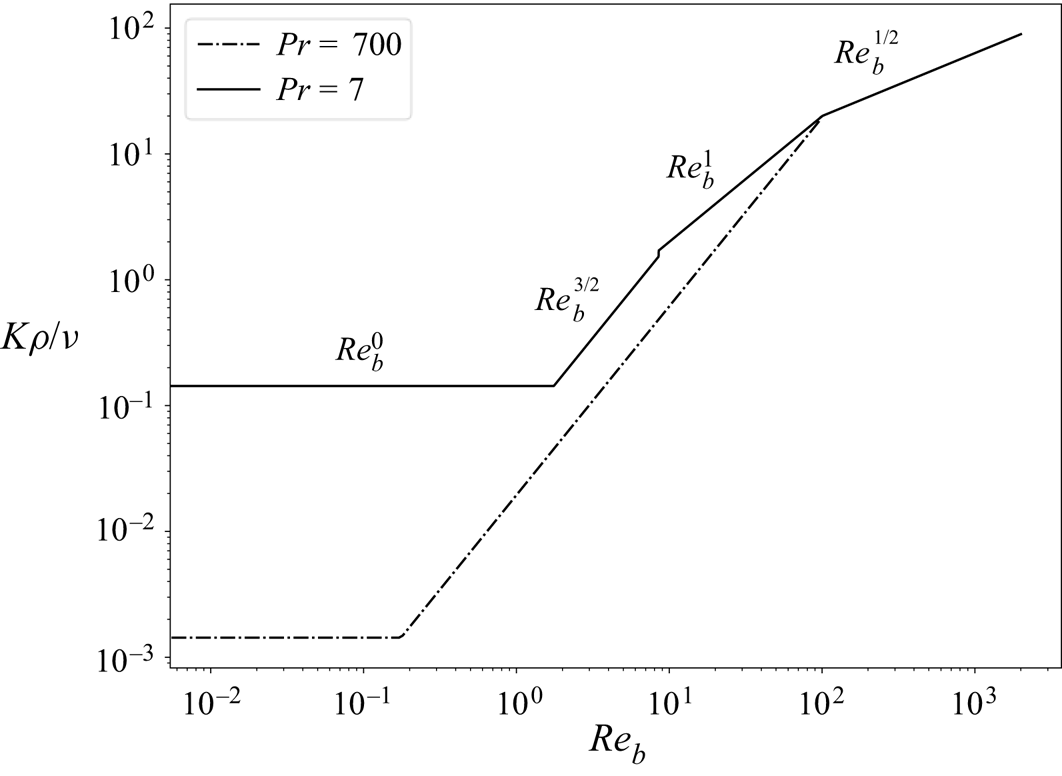
The regions of different dependence upon  $Re_b$ from (2.1a) to (2.1d) are described as the ‘molecular-diffusion-driven regime’, the ‘buoyancy-controlled regime’, ‘the transitional regime’ and, at highest buoyancy Reynolds number, the ‘energetic regime’. In figure 1 we have plotted the dependence of
 $K_\rho$ as a function of
 $Re_b$ for the Prandtl number for temperature,
 $Pr=7$, and the Prandtl number (or Schmidt number) for salinity,
 $Pr=700$. It is clear on the basis of figure 1 that the difference in
 $Pr$ is associated with significantly different dependences of diapycnal diffusivities as a function of
 $Re_b$ when the buoyancy Reynolds number is moderate (
 $Re_b<100$). In this range, the low diffusivity renders the salinity much more difficult to mix than temperature. There exists a slight discontinuity between the buoyancy-controlled regime and the transitional regime in (2.1) at
 $Pr=7$ but it does not have any significant effect in our following analysis. It is also important to note that the transitional regime as described by the Osborn (Reference Osborn1980) relationship, assumed as basis for the parametrization, does not exist in the parametrization for
 $Pr=700$.
Prediction of  $K_s(Re_b)$ and
 $K_\theta (Re_b)$ based the parametrization of Bouffard & Boegman (Reference Bouffard and Boegman2013).

2.2. A linear stability criterion for the staircase onset
Given the parametrization of diapycnal diffusivity for both heat and salt, we are in a position to analyse their implications for the stability of a water column that is stratified in both temperature and salinity. We will perform this assessment in the context of the similar mean-field model as that recently employed to investigate layer formation in the salt-fingering regime (Ma & Peltier Reference Ma and Peltier2021a, hereafter MP). The governing mean-field equations for the large-scale temperature field  $\varTheta (z)$ and salinity field
 $S(z)$ are as follows:
 $$\begin{gather} \frac{\partial \varTheta }{\partial t}={-}\frac{\partial}{\partial z} F_\varTheta= \frac{\partial}{\partial z} \left( K_\varTheta(Re_b) \frac{\partial \varTheta}{\partial z}\right), \end{gather}$$
 $$\begin{gather}\frac{\partial S }{\partial t}={-}\frac{\partial}{\partial z} F_S= \frac{\partial}{\partial z} \left(K_S(Re_b) \frac{\partial S}{\partial z}\right). \end{gather}$$
Equations (2.2) are coupled because both diffusivities are dependent on  $Re_b=\varepsilon /(\nu N^2)$. This control parameter of the model will be perturbed by instability growth through its dependence on
 $N^2$, which will be modified by the variations in
 $\varTheta$ and
 $S$. In our model,
 $\varTheta$ and
 $S$ are defined in density units so that the equation of state can be written as
 $\rho =\rho _0+S-\varTheta$.
In the above equations, we have assumed that  $K_\varTheta$ and
 $K_S$ are independent of the gradient Richardson number
 $Ri_g$. The reasonableness of this assumption is based upon the fact that the Richardson number is usually large in the Arctic and therefore its effect on the turbulent level is relatively minor compared with the low- to mid-latitude ocean. We will furthermore assume
 $K_\varTheta$ and
 $K_S$ to be independent of the density ratio
 $R_\rho$. In work that will be published elsewhere, we will demonstrate this independence explicitly using direct numerical simulations of Kelvin–Helmholtz billows in the diffusive-convection environment.
It is also important to understand that a multicomponent fluid may still behave, insofar as the characteristics of its turbulence are concerned, as if it were a single-component fluid. The condition under which this is possible is that the turbulent diffusivities of the two components are the same. In this case the advection–diffusion equations for the two species combine into a single such equation for density. As shown by Smyth et al. (Reference Smyth, Nash and Moum2005) and Shih et al. (Reference Shih, Koseff, Ivey and Ferziger2005) as well as our figure 1, this occurs if and only if the intensity of the turbulence is sufficiently high as measured by the buoyancy Reynolds number to be higher than 100. It is therefore clear on this basis alone that a theory based upon a layer formation criterion for a single-component fluid should not apply to the formation of Arctic staircases since the experimental measurements in field experiments (e.g. Chanona, Waterman & Gratton Reference Chanona, Waterman and Gratton2018; Dosser et al. Reference Dosser, Chanona, Waterman, Shibley and Timmermans2021) have established that the buoyancy Reynolds numbers in the Arctic Ocean are usually smaller than 100, with the exception of some hot spots near the continental shelf.
In order to investigate the conditions that might support the existence of a layering mode of instability, we assume furthermore that the background stratification is characterized by uniform gradients and the one-dimensional fields can be decomposed into a combination of background fields  $\bar {\varTheta } =-\varTheta _{z0}z$ and
 $\bar {S}= -S_{z0}z$ and weak perturbations
 $\varTheta '$ and
 $S'$ as
 $$\begin{gather} \varTheta(z)=\bar{\varTheta}(z)+\varTheta'(z), \end{gather}$$
 $$\begin{gather}S(z)=\bar{S}(z)+S'(z). \end{gather}$$
Assuming an initial state characterized by a constant viscous dissipation  $\varepsilon _0$, the buoyancy Reynolds number
 $Re_b$ will be perturbed from its background value
 $\overline {Re}_b$ by the amount
 $Re_b'$, which is given by
 \begin{equation} Re_b'=\frac{\partial Re_b}{\partial \rho_z}\frac{\partial \rho'}{\partial z}=\frac{\rho_0}{\nu g} \frac{\varepsilon_0}{ \left(\dfrac{\partial \bar{\rho}}{\partial z}\right)^2} \frac{\partial \rho' }{\partial z} ={-} \overline{Re}_b \frac{\dfrac{\partial S' }{\partial z} -\dfrac{\partial \varTheta' }{\partial z}}{\dfrac{\partial\bar{\rho}} {\partial z}}, \end{equation}
which follows by employing a Taylor expansion to determine the perturbation to the squared buoyancy frequency that appears in the definition of the buoyancy Reynolds number. We then expand  $K_\varTheta$ and
 $K_S$ in (2.2) in
 $Re_b$ keeping only the first-order terms to obtain
 $$\begin{gather} \frac{\partial \varTheta'}{\partial t}=\left.-\frac{\partial K_\theta} {\partial Re_b} \right|_{\overline{Re}_b} \overline{Re}_b \frac{1}{R_\rho-1} \left(\frac{\partial^2 S'}{\partial z^2} - \frac{\partial^2 \varTheta'}{\partial z^2}\right)+K_\theta |_{\overline{Re}_b} \frac{\partial^2 \varTheta'}{\partial z^2}, \end{gather}$$
 $$\begin{gather}\frac{\partial S'}{\partial t}=\left.-\frac{\partial K_s}{\partial Re_b} \right|_{\overline{Re}_b} \overline{Re}_b \frac{R_\rho}{R_\rho-1} \left(\frac{\partial^2 S'}{\partial z^2} - \frac{\partial^2 \varTheta'}{\partial z^2}\right) +K_s |_{\overline{Re}_b} \frac{\partial^2 S'}{\partial z^2}. \end{gather}$$
In order to analyse the stability of this linear system, we expand the perturbation terms in normal modes as  $(\varTheta ', S')=(\hat {\varTheta },\hat {S})\exp (\lambda t)\exp (\textrm {i} k z)$. Upon substitution into (2.5), the system is reduced to an eigenvalue problem for a
 $2 \times 2$ matrix whose eigenvalues
 $\lambda$ are roots of the quadratic equation
 \begin{align} &\lambda^2+k^2\left(K_\theta+K_s+\frac{\partial K_s}{\partial Re_b} Re_b \frac{R_\rho}{R_\rho-1}- \frac{\partial K_\theta}{\partial Re_b} Re_b \frac{1}{R_\rho-1}\right)\lambda \nonumber\\ &\quad+\,k^4\left(K_\theta K_s+\frac{\partial K_\theta}{\partial Re_b} K_s Re_b \frac{1}{R_\rho-1} - \frac{\partial K_s}{\partial Re_b} K_\theta Re_b \frac{R_\rho}{R_\rho -1}\right) =0. \end{align}
A sufficient condition for an eigenvalue  $\lambda$ with positive real part is that the third term in (2.6) be negative definite, namely,
 \begin{equation} K_\theta K_s+\frac{\partial K_\theta}{\partial Re_b} K_s Re_b \frac{1}{R_\rho-1} - \frac{\partial K_s}{\partial Re_b} K_\theta Re_b \frac{R_\rho}{R_\rho -1}<0. \end{equation}
By further writing the diapycnal diffusivity in the form of flux coefficient as in  $K_\theta =\nu \varGamma _\theta Re_b$ and
 $K_s=\nu \varGamma _s Re_b$, the above condition for instability is further simplified to
 \begin{equation} \frac{\partial \varGamma_s}{\partial Re_b}\frac{1}{\varGamma_s} >\frac{\partial \varGamma_\theta}{\partial Re_b} \frac{1}{\varGamma_\theta} \frac{1}{R_\rho}. \end{equation}
By assuming that  $K_S$ and
 $K_\theta$ have different power-law dependences on
 $Re_b$ as
 $K_S\sim Re_b^{\beta _s}$ and
 $K_\varTheta \sim Re_b^{\beta _\theta }$, the criterion of (2.8) will become
 \begin{equation} \beta_s-1>\frac{\beta_\theta-1}{R_\rho}. \end{equation}
By comparing (2.9) with the power-law dependences of Bouffard & Boegman (Reference Bouffard and Boegman2013) shown in (2.1), we will immediately arrive at the conclusion that the system will be unstable as long as the value of  $Re_b$ remains in the buoyancy-controlled regime of salinity, namely,
 \begin{equation} 0.18< Re_b<97. \end{equation}
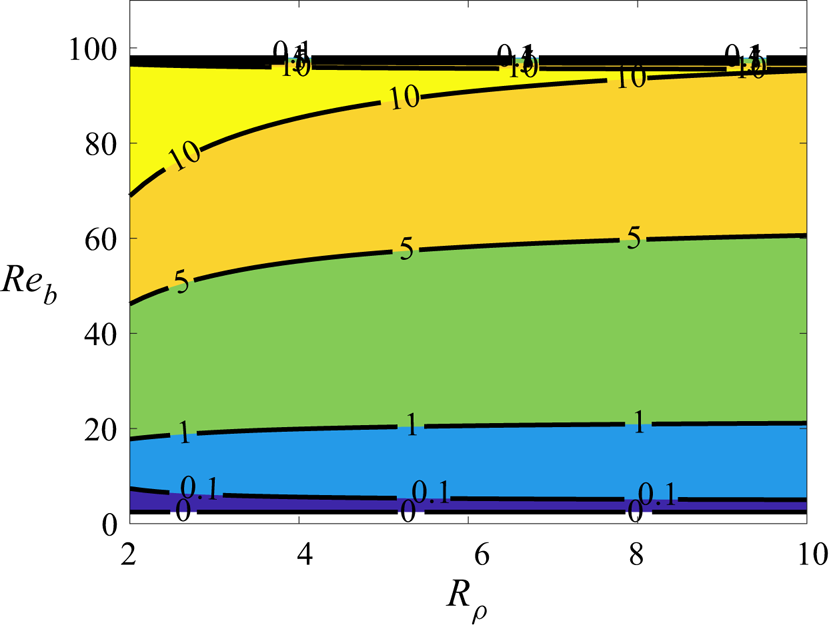
Although the instability criterion does not depend explicitly upon  $R_\rho$, the non-dimensional growth rate (evaluated by numerically solving the quadratic equation for the linear instability) is dependent on both
 $Re_b$ and
 $R_\rho$, as shown in figure 2. The growth rate is mainly controlled by
 $Re_b$ and reaches its maximum value at
 $Re_b$ sufficiently close to but smaller than the upper stability boundary at
 $Re_b=97$.
Filled contour plot of growth rate (real part of the non-dimensional eigenvalue  $\lambda /(k^2 \nu )$) as a function of
 $Re_b$ and
 $R_\rho$ evaluated by solving the quadratic equation (2.6) with the implementation of Bouffard & Boegman 's (Reference Bouffard and Boegman2013) parametrization in (2.1).

The physical interpretation of our linear stability analysis can be understood by taking the limit  $R_\rho \to \infty$ in the above formulae. In this limit, the contribution from the temperature field vanishes and the salinity is equivalent to density, reducing (2.5) to the form
 \begin{align} \frac{\partial \rho'}{\partial t}&=\left.\left(\left.-\frac{\partial K_\rho}{\partial Re_b} \right|_{\overline{Re}_b} \overline{Re}_b +K_\rho\right)\right|_{\overline{Re}_b} \frac{\partial^2 \rho'}{\partial z^2} \nonumber\\ &\equiv K_\rho^{eff}\frac{\partial^2 \rho'}{\partial z^2}. \end{align}
In the above limiting form, our instability criterion is equivalent to the condition that the diffusion coefficient is  $K_\rho ^{eff}<0$, initially proposed in Phillips (Reference Phillips1972) and extended in the recent work of TZ. The condition that the diffusion coefficient in this diffusion equation is negative is just, as expected, the result for a fluid in which density is determined by only a single diffusing species. When the possible influence of shear on the condition for the formation of layers is eliminated from equation (2.14) of TZ, the same result is obtained. However, TZ's criterion is not applicable to the formation of Arctic staircases, as
 $R_\rho$ is everywhere finite, and the typical value is 2–7 (Timmermans et al. Reference Timmermans, Toole, Krishfield and Winsor2008). Therefore, our more general analysis based on a two-component system described in (2.5) has to be applied in the Arctic Ocean.
Our criterion (2.10) basically states two important things concerning the staircase formation process in the polar ocean. First, whether or not a staircase forms does not depend on the density ratio  $R_\rho$, as it does in the salt-fingering staircase formation process. This is consistent with the analysis of a large dataset documenting staircase measurements in the Canada Basin of the Arctic Ocean in Shibley et al. (Reference Shibley, Timmermans, Carpenter and Toole2017), where the presence of staircases is observed for a wide range of values of
 $R_\rho$ measured to range from 2 to 9 (demonstrated in figures 5d and 7a of Shibley et al. Reference Shibley, Timmermans, Carpenter and Toole2017). This is distinctly different from the salt-fingering staircases, where no staircases have been found in places where the salt-fingering density ratio is larger than 2 (Radko Reference Radko2013). Second, the criterion (2.10) implies that the staircases only form in the range of intermediate turbulence strength as determined by the buoyancy Reynolds number. This is also consistent with the field measurements, from which accumulating evidence has established that strong turbulence may prevent staircases from forming at all (Shaw & Stanton Reference Shaw and Stanton2014; Guthrie, Fer & Morison Reference Guthrie, Fer and Morison2017; Shibley & Timmermans Reference Shibley and Timmermans2019). We will return to a detailed discussion of these measurements in § 4.
3. A nonlinear mean-field model simulation of staircase formation
The linear stability analysis discussed in the last section demonstrates that a background stratification characterized by constant gradients of temperature and salinity will be unstable to small-amplitude perturbations once the criterion (2.10) is satisfied. However, it remains an issue as to whether the system will evolve into a layered state in the nonlinear stage of its evolution. To this end, we perform a mean-field model simulation by integrating the following field equations in time:
 $$\begin{gather} \frac{\partial \varTheta }{\partial t}= \frac{\partial}{\partial z} \left( K_\varTheta(Re_b) \frac{\partial \varTheta}{\partial z}\right) -K_4 \frac{\partial^4 \varTheta}{\partial z^4 }, \end{gather}$$
 $$\begin{gather}\frac{\partial S }{\partial t}=\frac{\partial}{\partial z} \left(K_S(Re_b) \frac{\partial S}{\partial z}\right)- K_4 \frac{\partial^4 S}{\partial z^4 }. \end{gather}$$
In the above we continue to assume that  $K_\theta$ and
 $K_S$ are parametrized based on (2.1). A hyperdiffusivity
 $K_4$ is also introduced to damp high vertical wavenumbers of the growing disturbance, a remedy for the ultraviolet catastrophe that would otherwise exist in the model (this approach has been previously employed for the same purpose in the initial analysis of the
 $\gamma$ instability (Radko Reference Radko2003, Reference Radko2005; MP). Although the determination of
 $K_4$ should be based on a multiscale analysis as in Radko (Reference Radko2019a), for present purposes we will simply fix the hyperdiffusivity so as to produce a fastest-growing vertical wavelength
 $\lambda _c=0.4~\textrm {m}$, so that the modelled interfacial thickness (which equals half the fastest-growing wavelength (see discussion in MP) matches the interface thickness of approximately 0.2 m inferred from the temperature stratification (see Padman & Dillon Reference Padman and Dillon1987; Radko Reference Radko2013) in the Canada Basin. A possible physical scale in determining the length scale for the interface thickness is the Ozmidov scale
 $L_O=\sqrt {\epsilon /N^3}$, which separates the buoyancy subrange from the inertial subrange, considering that the buoyancy Reynolds number can be written in the form of
 $Re_b=(L_O/L_K)^{4/3}$ (where
 $L_K=(\nu ^3/\epsilon )^{1/4}$ is the Kolmogorov scale), so that the minimum scale for our
 $Re_b$-based model to be effective is
 $L_O$. In fact, utilizing typical buoyancy frequency
 $N \sim 10^{-2}~\textrm {s}^{-1}$ in the Arctic and a mediate
 $Re_b=40$ within our instability range, we arrive at an Ozmidov scale
 $L_O \approx 0.07~\textrm {m}$, which is close to the estimated interface thicknesses. However, whether
 $L_O$ is actually determining the interface thicknesses will require further detailed analysis to confirm, but it appears to us to be a highly plausible conjecture.
The initial background conditions for the integration of (3.1) are chosen to be characterized by negative constant gradients  $\varTheta _{z0}$ and
 $S_{z0}$ for temperature and salinity fields separately. The values of
 $S_{z0}$,
 $\varTheta _{z0}$ and the constant viscous dissipation
 $\varepsilon _0$ are chosen so that the initial density ratio
 $R_{\rho 0}={S_{z0}}/{\varTheta _{z0}}=4$ and the initial buoyancy Reynolds number
 $Re_{b0}=40$. We have furthermore added white noise of magnitude
 $(0.005\Delta \varTheta, 0.005\Delta S)$ to the initial field variables to provide the seed required for growth of the fastest-growing mode of linear instability. Our one-dimensional domain for the purpose of this integration has a height that extends from
 $-6~\textrm {m} < L < 6~\textrm {m}$, which is sufficient to contain 30 fastest-growing wavelengths. Periodic boundary conditions are applied top and bottom. Equations (3.1) are integrated in time using a straightforward finite-difference method, the same as we have previously employed (MP) in our mean-field model for the salt-fingering case.
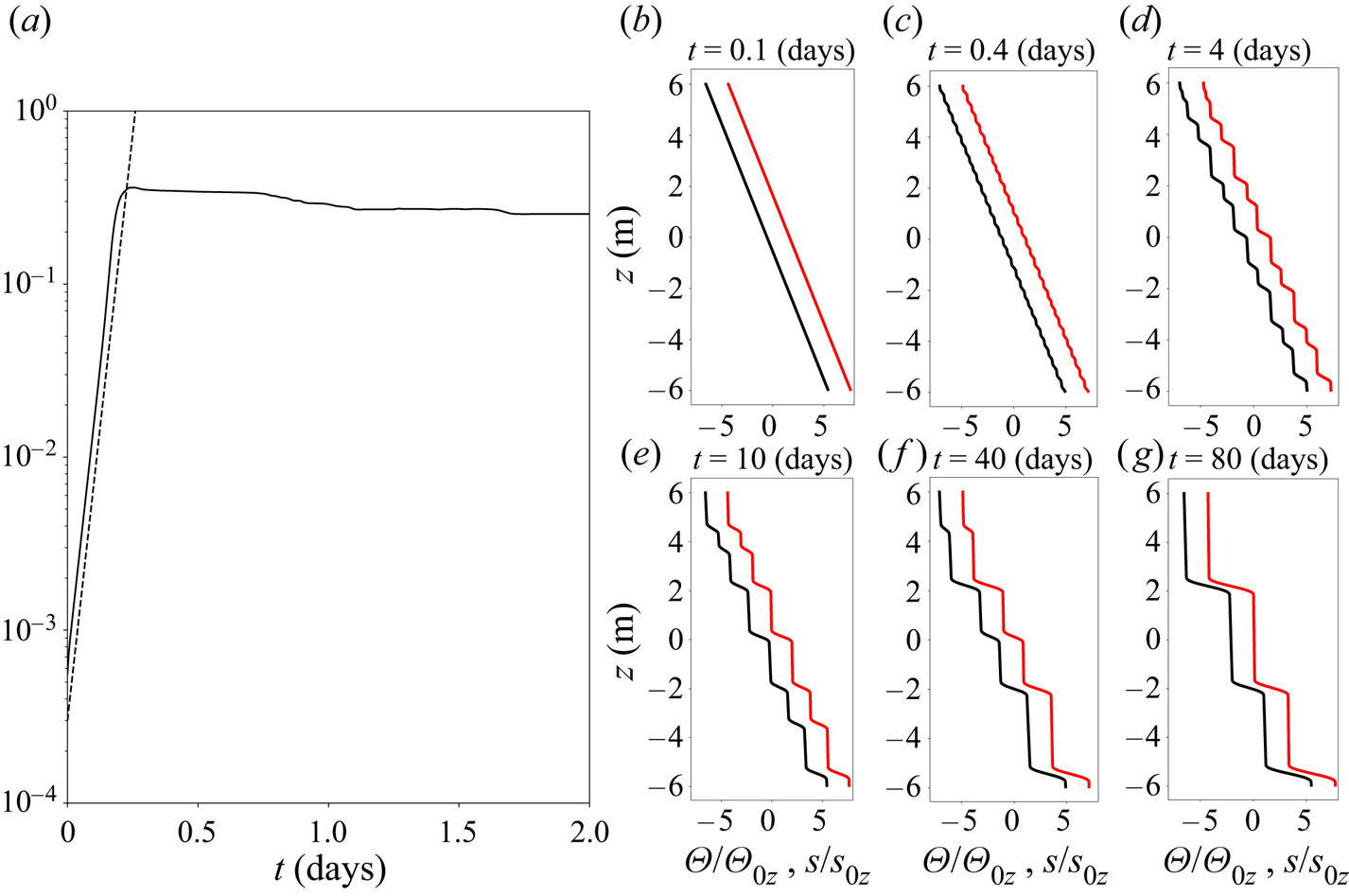
In figure 3(a), the growth of the fastest-growing mode in the nonlinear model is compared with the prediction of linear stability theory. The close match between the growth rates demonstrates the effectiveness of our linear stability analysis. After the saturation of the fastest-growing mode, the staircase structure appears as in figure 3(c), in which well-mixed layers are separated by high-gradient interfaces for both the temperature and salinity fields. Both these initially formed step sizes and the interface thickness are equal to half the fastest-growing wavelength of our system, which is determined by the value of  $K_4$ implemented in the model. These staircase structures then experience a series of merging events following the B-merger mechanism (proposed in Radko Reference Radko2007) in a similar way as occurs in the salt-fingering case (see Radko Reference Radko2005; MP). Adjacent layers continue to merge until the step sizes reach a value near 4 m (as shown in figure 3g), a value that is comparable to the observed staircases in the Arctic. No further merging events occur in this simulation, either because the system has reached a stable state, or because further merging events would occur on a much longer time scale than represented by the integration. In any case, our parametrized model simulation does show that the staircase structure forms spontaneously. This establishes the effectiveness of our criterion for layer formation in the diffusive convection regime.
4. A data-based evaluation of the criterion for layer formation
As discussed in § 2, our theory predicts a criterion for diffusive-convection layer formation that requires diffusivity for salinity to increase sufficiently rapidly with  $Re_b$. This criterion is satisfied when
 $Re_b$ lies in the region of intermediate turbulence strength in which
 $0.18 < Re_b < 91$, which is often referred to as the ‘left flank’ of the curve of mixing efficiency as a function of buoyancy Reynolds number. In this section, we will compare the predictions of this criterion to the available Arctic Ocean observations.
4.1. Spatial variability of staircases
The most abundant oceanographic measurements in the Arctic are provided using high-resolution Ice-Tethered Profilers (ITPs; Krishfield et al. Reference Krishfield, Toole, Proshutinsky and Timmermans2008; Toole et al. Reference Toole, Krishfield, Timmermans and Proshutinsky2011) that have been employed to sample over the entire central Eurasian and Canada Basins. The recent work of Shibley et al. (Reference Shibley, Timmermans, Carpenter and Toole2017) provided detailed analysis of the ITP measurements over the years 2004–2013 to document the spatial variability of the presence of staircases in the entire Arctic region. As shown in their figure 7(a) most of the staircases are observed in the Canada Basin (staircases are present in 80 % of profiles) and they are generally not observed in the Eurasian Basin (staircases are present in 24 % of profiles) (Shibley et al. Reference Shibley, Timmermans, Carpenter and Toole2017).
We turn next to a discussion of the observations of mixing as reported in the most recent work of Dosser et al. (Reference Dosser, Chanona, Waterman, Shibley and Timmermans2021), which uses the fine-scale parametrization of Polzin, Toole & Schmitt (Reference Polzin, Toole and Schmitt1995) to estimate the dissipation rate by analysing the ITP data that sampled the central Arctic Ocean over the years 2002–2019. They compiled and evaluated the distribution of buoyancy Reynolds number  $Re_b$ for the Canadian Basin in summer, which is shown in their figure 4(a). Although the turbulence in the Arctic Ocean is an inherently patchy and intermittent process, as shown in the log-normal distribution of
 $\varepsilon$ in their figure 7(a), the sampled
 $Re_b$ lies almost entirely within the range of our criterion
 $0.18< Re_b<97$. Thus the layering mode is expected to keep growing in time although
 $Re_b$ may continue to vary, until the staircase forms in the Canada Basin. For the Eurasian Basin, however, Dosser et al. (Reference Dosser, Chanona, Waterman, Shibley and Timmermans2021) have shown that, while the geometric mean values of
 $\varepsilon$ are almost identical to those in the Canada Basin and Eurasian Basin, monthly averaged
 $N^2$ is approximately three times smaller in the latter (see figure S2 of the supporting information of Dosser et al. (Reference Dosser, Chanona, Waterman, Shibley and Timmermans2021)), resulting in a buoyancy Reynolds number whose mean value is three times larger than the values in the Canada Basin. This means that a larger portion of the tail of the log-normal distribution of
 $Re_b$ will be high enough to be stable to our criterion, in which case the staircase formation process would be inoperative with
 $Re_b>97$. This qualitatively explains why most of the staircases are found in the Canada Basin.
4.2. Temporal variability of staircases
The best example of the temporal variability of diffusive-convection staircases is provided by the recent discussion of Guthrie et al. (Reference Guthrie, Fer and Morison2017). These authors found that the Amundsen Basin (of the Eurasian Basin) of the Arctic Ocean was characterized by well-defined staircase structures in 2013 but they were largely absent in the following year of 2014 (also absent in the previous measurements in 2007 and 2008). Through their analysis, they found that the years in which staircases are absence are characterized by consistently higher mixing activity compared with the year 2013 (approximately an order of magnitude higher), although the density ratios  $R_\rho$ are almost the same for these years.
This is an entirely expected result based upon the theory advocated herein. The turbulence level in the Eurasian Basin is too high to allow the staircase-forming instability to develop. Our mechanism requires a sufficiently quiescent level of turbulence for the staircase-forming high-Prandtl-number mechanism to function.
5. Summary and discussion
We have described a theoretical model based on a parametrization of stratified turbulent diapycnal diffusivities by Bouffard & Boegman (Reference Bouffard and Boegman2013). Based upon the implementation of this buoyancy Reynolds number and Prandtl-number-dependent diffusivities for both heat and salt, we have shown that this parametrization supports a new mode of layering instability that appears to explain the thermohaline staircase formation process that operates in the high-latitude oceans. This mechanism requires a salinity-dominated stratification as well as a low-energy turbulence environment for the instability to develop. Since the diffusive-convection stratification mostly exists in the Arctic region (see the discussion of the global dataset of thermohaline staircases of Van Der Boog et al. (Reference Van Der Boog, Koetsier, Dijkstra, Pietrzak and Katsman2021), for example), our theory cannot be directly migrated to apply to determine the staircase formation process in the low- and mid-latitude oceans in which temperature usually dominates the stratification in the thermocline, and turbulence levels are usually much higher than in the Arctic Ocean. In the low- and mid-latitude oceans, the staircases develop in the salt-fingering environment, and the turbulence so produced may form thermohaline staircases via the  $\gamma$ instability theory of Radko (Reference Radko2003).
A somewhat counter-intuitive aspect of the theory for high-latitude staircase formation presented herein is that our layering instability does not rely explicitly upon double diffusion as has been widely believed to be necessary (see the reviews of Schmitt (Reference Schmitt1994) and Kelley et al. (Reference Kelley, Fernando, Gargett, Tanny and Özsoy2003), for example). Although the unstably stratified temperature gradient only plays a secondary role to influence the overall instability in our theory, we want to stress that this does not mean that the thermohaline staircase can form without the unstably stratified temperature gradient. In fact, the theoretical analysis of the diffusive interface structure in Linden & Shirtcliffe (Reference Linden and Shirtcliffe1978) demonstrates that a stable diffusive interface cannot exist for  $R_\rho >\tau ^{-1/2}\approx 10$ (where
 $\tau =\kappa _s/\kappa _\theta \approx 0.01$ is the ratio of molecular diffusivities for salinity and temperature). This suggests that, even though the layering instability may develop with no temperature component through our proposed mechanism, the diffusive interfaces may only be stabilized when the background unstably stratified temperature gradient is sufficiently strong. In future work, we will explore the condition under which a stable double-diffusive interface (e.g. Linden & Shirtcliffe Reference Linden and Shirtcliffe1978; Carpenter, Sommer & Wüest Reference Carpenter, Sommer and Wüest2012) will be reached in the fully equilibrated stage of our mean-field model of staircase development.
In order to more accurately represent physical reality, several improvements are warranted to the mean-field model-based analyses discussed herein. First, the time and spatial variability of viscous dissipation  $\varepsilon$ may be added to the model. In the current mean-field model we set
 $\varepsilon$ to be a constant for simplicity. While this assumption may be reasonable in the initial development of instability from the constant-gradient configuration, it is possible that differences in
 $\varepsilon$ could become important at interfaces and homogeneous layers once the layering structure has formed. In the future work we will seek to include a parametrization of
 $\varepsilon$ that depends upon local stratification
 $N^2$ in the model. Meanwhile, we will also try to consider the time variability of
 $\varepsilon$ that is consistent with the log-normal distribution from the field measurements. Second, a properly calibrated fastest-growing wavelength should be explored to provide a more reliable estimate of the staircase step size and the time scale of staircase formation. In other words, we need to deal more fully with the ultraviolet catastrophe contained in our current model. A successful example of how this may be accomplished is found in the work of Radko (Reference Radko2019a). Through these further analyses, we will seek to develop a relationship between the layer thickness and important physical quantities, such as the Ozmidov scale.
(a) Evolution of the fastest-growing mode for temperature normalized by  $\varTheta _{z0}$. The dashed black line shows the growth rate of the fastest-growing mode
 $\lambda =32.1~\textrm {day}^{-1}$ predicted from the linear stability analysis. (b–g) The temperature profile (black) and salinity profile (red), normalized by
 $\varTheta _{z0}$ and
 $S_{z0}$ separately (so that they have the same amplitude span across the domain), as functions of depth at six simulation times. The initial layering structure shows at
 $t=0.4$ day and experiences continuous merging of neighbouring interfaces.

Acknowledgements
The authors thank the three anonymous referees for helping us to improve the article.
Funding
Financial support under the NSERC Discovery Grant A9627 is gratefully acknowledged.
Declaration of interests
The authors report no conflict of interest.