Introduction
There has been considerable debate on the growth of the import trade in manufactured goods from China to sub-Saharan Africa and its impact on African economies. Ancharaz (Reference Ancharaz2009) has argued that changing preferences in Africa rather than China’s rise are responsible for this phenomenon, but the question of structure versus agency—whether China’s rise is the cause or the instrument of change−is not material to the outcome. The balance of opinion is unambiguous that the trade has massively undermined manufacturing within sub-Saharan Africa. Ajakaiye and Kaplinsky (Reference Ajakaiye and Kaplinky2009), for example, have shown how the import of furniture and leather goods from China to South Africa has undermined local manufacture. Giovannetti and Sanfilipo (Reference Giovannetti and Sanfilippo2009) conclude that the flooding of African markets with Chinese-manufactured goods has undermined African exports. And Villoria (Reference Romero and Tejada2009) argues that, although Chinese imports of primary commodities from Africa have grown rapidly, there has been no significant growth in agricultural exports from Africa. The balance of trade between Africa and China is distributed highly unevenly, and out of the fifty-three African countries for which trade data are reported, only thirteen have a trade surplus with China, while the remaining forty countries run a trade deficit (Haugen Reference Haugen2011:162). The picture that emerges suggests that the loss of manufacturing jobs and agricultural profitability that began with structural adjustment programs in the late 1970s has now been compounded as African investment moves away from productive sectors toward a trade dominated by imports (Subramanian & Mathuijs Reference Ng and Tuan2007; Ademola et al. Reference Ademola, Bankole and Adwuyi2009).
Traditionally centers for trade, the streets of African cities are dominated by formal and informal trade, now mainly in imported manufactured goods. Scholarly work suggests that within African cities the markets are flooded with goods and traders, that profit margins have narrowed (Lyons & Brown Reference Kaplinsky and Morris2010), and that the initial opportunities offered by the import trade for poverty reduction within Africa have diminished considerably, reducing importing to a subsistence occupation for many. The continuous narrowing of profit margins in this competitive economy has driven more African traders to import on their own account, bypassing established local and Chinese importers. Many travel to intermediate destinations such as the United Arab Emirates (UAE), but increasing numbers travel to China, in particular, Guangzhou (Lyons et al. Reference Li, Ma and Xue2008).
A striking feature of the retail trade in consumer goods is how much of it is informal. A 2005 survey of Tanzania’s economy (ILD 2005a, 2005b, 2005c) concluded that 91 percent of businesses were informal in one way or another. The retail sector is certainly dominated by informality, from the spatial informality of street vendors to the range of informal practices by which goods reach the market. The aim of this article is to understand the barriers and opportunities for the poor of sub-Sarahan Africa to participate in the import trade in manufactured goods from China to Africa, and how, and at what cost, this participation is achieved.
Network Value Chains
Global value-chain (GVC) analysis is now widely accepted in development debates as helpful in explaining why the poor face barriers in trade. This question is particularly salient as the debates move away from the more orthodox focus on the links between trade and economic growth to look at its potential for poverty reduction, and from the focus on locality, which forms the basis of cluster theory. The strengths of value-chain analysis are that it considers the key role played by intermediaries in linking production to consumption, and also that the passage of goods along a path is often more coordinated than classical theory recognizes (Mitchell et al. Reference Lyons, Brown. and Zhigang2009).
Thus, since it was adopted in development debates less than fifteen years ago, value-chain analysis has become a useful critical perspective on international trade. A commonly accepted definition suggests that
the value chain describes the full range of activities required to bring a product or service from conception, through the different phases of production (involving a combination of physical transformation and the input of various producer services), delivery to final consumers and final disposal after use. (Mitchell et al. Reference Lyons, Brown. and Zhigang2009:iii)
Value chains are governed by power relations, and a widely used distinction contrasts “buyer-driven” and “producer-driven” value chains. Research on the former concentrates on the power of large buyers such as Walmart to control commodity chains. In contrast, “producer-driven” commodity chains are driven by large producers, who exert influence “upstream” with raw material and component suppliers, and “downstream” through their links with distribution and retailing. Research on both emphasizes the importance of volume in profitability but suggests that technological innovation is less important in buyer-driven chains (Gereffi Reference Gereffi1999; Gereffi et al. Reference Gereffi, Humphrey and Sturgeon2005; Mitchell et al. Reference Lyons, Brown. and Zhigang2009).
In sub-Sarahan Africa, analysis of value chains in developing countries has focused on the links between industrial or agricultural producers and marketing networks. Dominated by very large distributors, these chains are largely buyer driven, imposing expectations of quality, lead times, volumes, and prices on producers. Governments have failed to design effective policies for wider integration in the value chains (Gibbon & Ponte Reference Gibbon and Ponte2005:200,202), and the power disparities in these chains mean that small producers are unable to shape expectations to their own advantage. Unless supported by development agents, small producers are marginalized in these chains and only large, capital-rich producers are able to establish negotiating positions with both buyers and governments that influence the requirements from suppliers to their advantage (Mitchell & Ashley Reference Mathews, Ribeiro and Alba Vega2009; Mitchell et al. Reference Lyons, Brown. and Zhigang2009).
However, while the concepts of “buyer-driven” and “producer-driven” value chains may account for the movement of large volumes of goods, they fail to capture a situation in which production, intermediation, and consumption are dominated by large numbers of small players, none of whom individually controls the chain. Some recent work provides a more nuanced classification of value chains and their power relations, focusing particularly on the products in the chain. For example, the terms “hierarchy” and “quasi-hierarchy” are now used to emphasize the role of buyers in chains that are either wholly owned or largely controlled by one party; and chains in which buyers and sellers do not collaborate on the product are said to be characterized by “arm’s length” relations. For our purposes, the more recently developed concept of a “network” of suppliers and buyers with similar levels of power collaborating in the definition of products is very useful (Romero & Tejada Reference Mitchell and Ashley2011; Frederick & Cassill Reference Frederick and Cassill2009; Gereffi & Memedovic Reference Gereffi and Memedovic2003; Humphrey & Schmitz Reference Humphrey and Schmitz2002).
This article argues that the value chain for the import of manufactured goods into sub-Saharan Africa, particularly low-value manufactured goods, represents an example of a “network” value chain, and consequently offers the small entrepreneur with relatively little financial or political capital opportunities for entry into the chain and for influence on product definition and operation. Focusing attention on imports from Guangzhou, China, the article examines the functioning of network value chains and the opportunities for the African poor to integrate into value chains and become upwardly mobile in the process. In so doing, it attempts to fill a gap in the value-chain literature, which mostly has focused on the links between industrial and agricultural producers and marketing networks, with limited exploration of the opportunities for the poor—now increasingly urban—to integrate into value chains as intermediaries or distributors. In addition to analyses that draw on migration studies or the sustainable livelihoods framework for the study of small operators (e.g., Lyons & Brown Reference Kaplinsky and Morris2010), this article shows how the GVC concept can also be used for ethnographic analysis to provide a useful framework for the study of livelihood strategies.
This article, then, explores the value chain for consumer goods between Guangzhou and sub-Saharan Africa, focusing mainly on manufactured goods such as garments and textiles. It aims to understand: (1) the individuals involved and their ethnographic characteristics and operational strategies; (2) how the activities of these individuals create the value chain and are shaped by it; and (3) how the chain and its actors incorporate the informal retail sector in sub-Saharan Africa into this strand of global capital.
Guangzhou
Within China, Guangzhou (Canton) is a key hub for the export of manufactured consumer goods. An international port for more than two hundred years, Guangzhou is the capital of Guangdong Province, which has been at the forefront of China’s marketization. It attracts investment from Hong Kong and foreign companies, particularly in electronics, garments, and textiles (Ng & Tuan Reference Mitchell, Keane and Coles2003), and its relatively small-scale manufacturing companies are quick to respond to new opportunities.
Boosted by the Canton Trade Fair, Guangzhou’s GDP rose from RMB 100 billion to RMB 500 billion during 1994–2005, outstripping average Chinese urban growth. During 1995–2005 service industries (including commerce) rose to almost 60 percent of GDP (Hu & Kaplan Reference Hu and Kaplan2001). The city’s official population increased dramatically from five to twelve million during 1978–2010, though research in other Chinese cities (Wu Reference Subramanian and Matthuijs2001) suggests that undocumented internal migration may considerably increase the published figure. The number of foreigners, generally business visitors, is also growing. Of these, some 20 percent are African, rising from six thousand in 2000 to twenty thousand in 2005, an annual increase of 33.3 percent—far higher than other groups (Li et al. 2010).
Guangzhou’s African visitors are clustered. This reflects both the increasing social stratification and segregation of growing Chinese cities (Hu & Kaplan Reference Hu and Kaplan2001) and the social exclusion of Africans within Chinese society, notably in the housing market (Li et al. 2009). While foreign elites cluster near Zhujiang New Town (the city’s new central business district), Ersha Island’s high-end villa estate, and the new high-rise suburb of Panyu (Li et al. 2009), Africans congregate in poorer areas, which are conveniently located for transport to the port and manufacturing centers and provide cheap accommodation in apartment blocks, hostels, and hotels. They are particularly evident around Xiaobei Road, where the high-rise Tian Xiu Building towers over Dengfeng, a crowded urban village, and Sanyuanli near the Guangzhou train station, known locally as “Chocolate City” or “Africa Town” with its busy wholesale markets. Together, these two sites compose a ring around the main train station of the city, making the whole region along Huanshi Road the focus of African diasporas in Guangzhou (Li et al. 2009).
A very wide range of goods is processed or manufactured for export in Guangzhou and the surrounding province of Guangdong. Figure 1, which compares the growth of imports to the city with exports, demonstrates the increasing importance of manufacturing to the city’s economy. Figure 2 summarizes trends in some key export sectors from the city. The list is by no means complete—heavy and light machinery, construction materials, sanitary fittings, mobile phones, and other items are highly visible in the markets of Guangzhou but not shown in the data. However, the export data summarized here are particularly interesting because they suggest that relatively low-cost items such as textiles, garments, footwear, and personal accessories represent a larger financial value than goods in several higher-value sectors such as motorcycles or electronics.
Import and Export Volumes from Guangzhou 1999–2007 (U.S.$100,000)
Source: Guangzhou Municipality, import and export statistics, figures extracted by the authors

Value of Exports from Guangzhou by Sector 1999–2007 (U.S.$100,000)
Source: Guangzhou Municipality, import and export statistics, figures extracted by the authors
Methods
Drawing on the conceptualization of trade between Guangzhou and sub-Sarahan Africa as a value chain, the methodology identified key nodes and links in the chain, and the institutional and policy environments and economic trends that affect different parts of the chain. This illuminated the strategies of individual traders at specific positions in the chain, their constraints and opportunities, their strategic choices, and the opportunity for mobility at each point, providing a picture of the trade and of trader strategy.
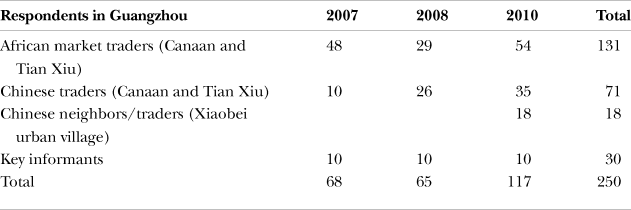
The research first identified key locations in Guangzhou for this trade. Between January and May 2006, following a survey of local newspapers such as the Guangzhou Daily, eighty pilot questionnaires were distributed to African traders by two teams of research assistants with the aim of establishing the key locations for African business and housing. Of these, forty-three questionnaires were collected at Xiaobei, a location known by almost all interviewees, and the rest in other locations in the city. From March 2007 to May 2010 a series of more detailed questionnaires were carried out in these two key trading areas, centered on the Tian Xiu Building on Xiaobei Lu and on Canaan, the major market in Sanyuanli (see table 1).
Interview Summary
In March 2007 the authors carried out a study among African traders in both areas: forty-eight Africans were interviewed in the Tian Xiu Building in Xiaobei using detailed questionnaires including open and closed questions. The interviews, carried out in French or English, aimed to identify life trajectories, migration trajectories, and business type, scope, and history, and to understand social capital links. Also interviewed were ten Chinese traders and agents. The latter were interviewed using a simple interview schedule to determine their background, links with Africans, and experiences.
In November 2008 the authors carried out a smaller number of in-depth interviews with twenty-nine African traders in both areas. The interviews used a shorter questionnaire focusing on the business profile and personal, work, and migration history, and also exploring qualitative issues raised by interviews in the previous year. In addition, twenty-six detailed interviews in Mandarin or Cantonese were carried out with Chinese wholesalers working with the African trade covering business trends, the role of African customers in the business, and relations between Chinese and African businesspeople. Finally, ten key-informant interviews were carried out with market managers, municipal and provincial officials, and African community leaders. Interviews were carried out in English, French, Mandarin, or Cantonese as appropriate.
Finally, in May 2010 the authors conducted further in-depth interviews with fifty-four African traders in the Tian Xiu Building and Canaan, in French or English as appropriate; with thirty-five Chinese traders in these areas in Cantonese; and in Xiaobei with eighteen Chinese traders who live and work locally, interacting with African traders “after hours” providing food, drink, and entertainment. Ten key-informant interviews with African leaders and Chinese officials were also conducted by the authors.
The sampling for these three surveys was not carried out on the basis of nationality or language group. Instead, the researchers approached every fourth or fifth trader passing through the main entrance lobby of Tian Xiu Building, and every fourth African buyer or shop proprietor encountered on a transect walk of Canaan. A similar strategy was adopted for the selection of Chinese traders, with a random selection of every fourth or fifth Chinese-run shop in the two areas. Despite the random sampling technique, a large spread of nationalities is represented, as well as traders of both sexes (see table 1) and at different stages of their careers as merchants and as participants in the China–Africa trade.
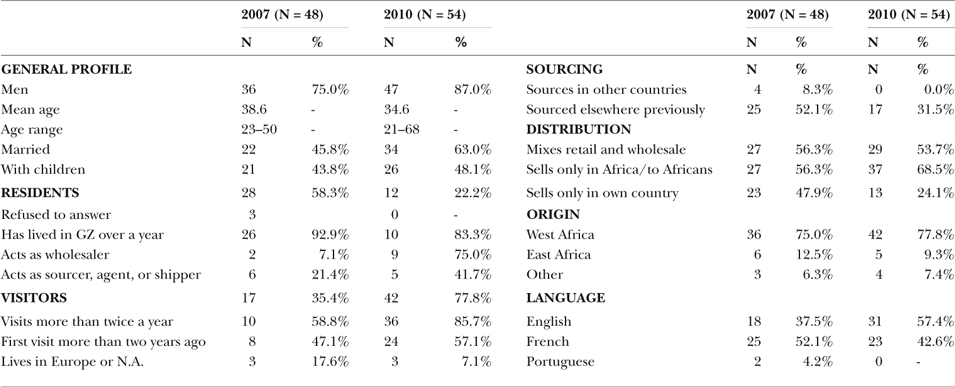
Some key characteristics of the respondents are summarized in table 2. The “General Profile” suggests, first, that the percentage of men, already high in 2007, had risen by 2010. The lower percentage of women reflects not only the fact that men travel more, but also that they travel for longer periods of time. Women generally reported restricting their visits to the bare minimum and choosing not to remain in Guangzhou speculatively, instead returning home to their domestic responsibilities as soon as possible. In the later interviews the mean age of respondents had dropped slightly but remained around the mid-thirties, and the percentage of married traders and traders with children rose slightly.
Key Attributes of African Traders in Canaan and Tian Xiu, 2007 and 2010
Second, the percentage of traders who stay permanently in Guangzhou (“residents”) fell dramatically during the period, from 58.3 percent (28) in 2007 to 22.6 percent (12) in 2010. Interviews in both 2008 and 2010 suggested that this was due to visa restrictions and tougher policing. Interviews in 2008 were undertaken just after the Beijing Olympics when visa restrictions remained in place, and in 2010 just before the 2010 Asian Games were held in Guangzhou. In reality, the restrictions have never fully been relaxed, and the effect has been a cumulative increase in the difficulty of obtaining residency permits and growing restrictions on their renewal and duration. The Guangdong provincial government statistics department estimated in 2007 that there were thirty thousand Africans in Guangzhou on any one night, and that the figure had dropped to fifteen thousand by 2010 (interviews with provincial officials, 2010). The perception that there has been a major drop in numbers was supported in an interview with leaders of the Ghanaian community. At the same time, the frequency with which nonresidents (“visitors”) come to Guangzhou has increased over the period, and the volume of trade has grown. A crude estimate of the number of African import–export intermediaries—based on average lengths of stay and frequency of visits, and allowing for the dispersal to less heavily policed cities in the province and for some undercounting of total overnight figures by the authorities—would probably come to some eighty thousand African traders in total, but the figures cannot be treated as definitive.
Among both “visitors” and “residents,” West African nationals are somewhat more common. This probably reflects the fact that many East African traders travel to Dubai instead. Although the price of Chinese goods is somewhat higher there than in China, the journey is far less expensive than the journey to China and presents fewer bureaucratic hurdles.
Finally, it must emphasized that nearly all the respondents were individual traders or worked for small family businesses, and ranged in terms of prosperity from very poor to fairly wealthy individuals. These interviews do not cover the activities of major companies and very few traders have limited liability companies; sampling in that domain will have to be undertaken elsewhere. This study focuses on the lives, business activities, and strategies of small-scale, independent actors.
Findings
The value chain by which goods reach Africa’s markets can be broadly conceptualized in a number of stages, including manufacture (often in Guangdong Province), wholesale export and shipping from Guangzhou (sometimes via warehouses and wholesalers in the UAE), wholesale and retail distribution in African ports and other points of entry, and further wholesale and retail activities in African countries and regions some distance from major entry ports and airports.
This complex chain has multiple nodes and links at every stage (see Kaplinsky & Morris (2003). African “residents” in Guangzhou take on a mix of activities, including exporting goods to their own wholesale or retail businesses, exporting goods to contacts elsewhere, and providing agency, shipping, and introductory services for visiting African businesspeople. The second group of respondents, “visitors,” live in any one of some thirty African cities—for example, Lomé—and come to Guangzhou periodically to source goods for their businesses. In a small number of cases, respondents were actually African émigrés to the U.S. or Europe who maintain an import business in Africa as well as sourcing goods to be distributed in the U.S. or E.U., where they live or have relatives who can act as distributors. These traders also carry out their sourcing in a wide range of ways, buying directly from factories or from market wholesalers in Guangzhou; purchasing on their own account, or for traders at home who have placed orders with them prior to departure—thus defraying the costs of travel; and using Guangzhou as a main source of goods in a certain price and quality range, while sourcing elsewhere in Guangdong, elsewhere in China, or abroad, particularly in the UAE, for higher-quality higher-priced goods.
The full array of regulatory measures controlling and influencing actors in the chain is vast. The influence of the regulations is profound, however, particularly the restriction on visas. Haugen (2012:69) writes of Nigerians in Guangzhou as “trapped in a second state of immobility” by the scant opportunities for visa renewal once their short-term visas run out. This is a business impediment as well as a source of personal distress for migrants who engage in trade and trade-related services. The situation can be described as a “second state of immobility”: the migrants have succeeded in the difficult project of emigration, but find themselves spatially trapped in their destination country. Each country jurisdiction imposes its own constraints on personal mobility and the flow of goods and capital, making the specialized knowledge and skills of actors an important asset in entering the chain and maintaining a position on it.
The Trading Environment
In addition to the regulatory frameworks, the trade is very vulnerable to external conditions. These include changing production costs, currency fluctuations and restrictions, rising shipping costs, and downward pressures on demand.Footnote 1 Major events such as international sports tournaments have stimulated more repressive policing of visas and have been associated with higher hotel costs, which have combined to reduce orders.
Significant difficulties for all traders also arise from pressures on input prices. Input costs have risen in the garment industry, for example—labor, materials, energy—and general inflation has taken its toll, raising factory prices. This puts particular strain on African traders who have to contend not only with rising shipping costs, like all importers, but also with the rising costs of double currency exchange, as local currencies are often not directly convertible into Chinese RMB but first have to be changed into U.S. dollars. At the same time, purchasing power in sub-Saharan African markets is not rising and competition is driving down local retail prices (Lyons & Brown Reference Kaplinsky and Morris2010). Caught between rising factory-gate costs and stagnant retail prices, African traders in Guangzhou have been forced to reduce the quality of goods they handle. In 2010 this strategy was cited universally by respondents in the garment sector, although not by all respondents in other sectors.
Traders cite the wide range of goods and the relatively low prices as reasons to trade in China. However, they must defend themselves against losses from faulty or substandard goods. Thus Ahmed, a computer importer from West Africa (interview, Tian Xiu, 2008), said, “quality control, you have to be very careful, but I have an advantage because I am engineer and I know all the tests”; while Muhamad from Dakar said of an order of underwear, “You have to be careful. I ordered a thousand pieces. When I came to check them the top pieces were as I had ordered them, but underneath most of the order had been changed for a different textile” (interview, Tian Xiu, 2010). The general perception among African traders is that the Chinese do not take responsibility for faulty goods or changed orders and that they are rarely willing to return a deposit in such a situation. Quality control, cited by all respondents, is a key reason for the prolonged stays undertaken by “visitors,” who invest as much time in waiting for delivery and checking over the contents as in buying. Interestingly, there has been no change in this aspect of trader experience over the years−it emerged as a major concern in all three surveys.
Entry to the Chain
The particular individuals who are able to occupy a position on this chain, and the various ways in which access is negotiated, were among the most interesting findings in this study. First, high-cost products such as generators or computers require a large capital investment per unit. Entry to trade in these sectors therefore requires access to significant capital sums from the outset and is largely restricted to richer traders. Second, dealing in such products requires technical expertise and, therefore, education. In contrast, the garment sector is accessible to people with relatively limited capital and less technical education who are prepared to start small—with low-end goods in small quantities—but who aspire to trade in larger quantities and eventually to trade higher-end goods. The striking features of this sector are therefore the opportunities for upward mobility and the immense variety of players, entry levels, and personal trajectories leading to, and through, the value chain. To exemplify this, we present the stories of several traders (all names have been changed).
Some people enter the value chain having started with very little. Mamadou (interview, Tian Xiu, 2010) from Bamako, Mali, now age sixty-eight, left school at sixteen with only six or seven years of education and then spent twenty-five years failing to establish himself profitably in any occupation. Eventually accepting the fact that there were no jobs and no money in Mali, he
just ran, just ran. In 1984 I joined a group walking across the Sahara, with no passport or papers, and got into Libya after a few weeks. I worked there for two years in construction and then Algeria, saving some money. With this I returned to Mali and got a visa for Germany, where I spent nine months working as a fruit picker. Work wasn’t very good but I learned a lot. I heard that Thailand was a good place to visit for trade and that there was a lot of work in Israel. I returned to Côte d’Ivoire, I immediately got a visa for Israel and spent nine years doing everything, anything: construction by day, bakery and office cleaning by night. However, I started to get problems with my back so could not work so easily, and it was not possible to get into trade in Israel because the Israelis have taken the trade sector. From Israel I went directly to Thailand [1993], discovered it was a good source of wax cloth, and began to make regular visits to import it to Bamako, selling out of my father’s house. It was then some years before I was able to buy a shop in the Marché Rose [Bamako’s central market]. My brother-in-law was by then selling Chinese textiles in his own shop and invited me to Guangzhou to help him. I’m saving to buy a farm at home when I retire.
Mamadou thus spent twelve years building up the capital to go into trade, taking casual work all over the world and learning to speak six languages. Returning to Mali, he then spent a further thirteen years importing goods from Thailand, before establishing himself on the China–Mali value chain as a wholesaler in Guangzhou in 2004 at the age of sixty-two.
For others beginning in relative poverty the process of sufficient capital accumulation can occur within the trade itself, a development that can involve a series of bold moves. Mardea from Cameroon (interview, Canaan, 2007) is the first of her husband’s four wives. Her husband earns very little and among them the four wives have had to raise and support twenty-five children. Mardea had started buying imported clothes for sale in Cameroon in 1986, more than twenty years before we interviewed her. As the children grew, allowing her short absences from home, she started traveling to Nigeria, then to Togo, where she found cheaper sources, then to Dubai and later to Bangkok. In the previous five years she had traveled only to Guangzhou, shopping for herself and her co-wives two weeks out of every eight and also acting as agent to four friends.
Another entry strategy for the poor, common among young men, is to arrive in Guangzhou with very little money, look for “bargains,” and ship home small quantities of goods with more formal “visitors.” As Tourré from Mali explained, “We Africans, we start with nothing, not like you people who come with enough money for two weeks’ living. We have to start earning immediately (interview, Tian Xiu, 2008).” He is now one of the few Africans renting a shop in the Tian Xiu Building. And as Armand from DRC explained, “You need private money, but if you start small-small you can make a profit” (interview, Tian Xiu, 2010). Once profits accumulate, they can be reinvested in larger volumes and higher-value goods, and eventually traders can run their businesses on a more formal footing, first by sharing shipping containers with others and eventually ordering full containers for themselves. While attempting to “grow” the business, young traders use the local knowledge they gain to offer their services as “agents” to newer traders. Through home or family contacts, or through meeting people at the Tian Xiu Building or at hotels frequented by African arrivals, or even by loitering at the railway station or airport, they introduce themselves to newcomers, offering introductions to factories, secretarial services, shippers, and so on—as well as to hotels, restaurants, markets, and mosques or churches.
According to our samples the proportion of young traders has dropped dramatically over time. In 2007, 46 percent of the sample was aged thirty or under, whereas the proportions in 2008 and 2010 were 28 percent and 33 percent respectively. It is impossible to generalize from such small samples, and the repressive visa regime makes such traders nervous and reluctant to speak. Nevertheless, the change is striking and should be considered as a subject for further research. The present visa regime militates against speculative stays and especially against the overstaying of one’s visa, and, as we see below, conditions even in the garment sector have become increasingly tough. One problem faced by the trading community is that its members are highly visible to local security guards.
Those who enter trade with capital or from a position of privilege may move relatively quickly into trading in more capital-intensive products. Florence from Burundi (interview, Tian Xiu, 2010) was born in Cairo in 1973, where her father was in the diplomatic service. As a young adult she worked in southern Sudan as a refugee officer and left to study computing in Perpignan, France, where she eventually worked for a high-tech company until her marriage. She was introduced to the Guangzhou trading scene by her husband, a member of the Senegalese military who did a two-year training course there from 2006 to 2008. She began trading during visits to him, importing high-end bathroom fixtures to Burundi.
Others are able to use their capital to set up a diversified distribution chain from the outset, capturing more than one market. Thus Kaorane (interview, Tian Xiu, 2008), a Senegalese man who was well connected through a compatriot network to outlets in France, Germany, and Italy, has been a “resident” in a series of countries. “I traded for years in Thailand,” he said, “but then that went down; I moved to Hong Kong but that became expensive. Anyway, all the manufacturing is here, so I have now moved to Guangzhou and opened a company here.” Several traders came from a background in transport. Eddie had worked as a customs clearing agent in Togo, Régis from Congo Kinshasa ran a motorcycle courier service in DRC, and Yann ran a truck transport business in DRC.
Finally, some start with capital, increase it through trade at home, and only then move into the international market. Sunny from Port-Harcourt is a good example of a young man from a prosperous merchant family who pursued an education and ran a retail business before embarking on the life of an exporter in Guangzhou:
In 1993 to 1995 I started selling shoes and bags in Lomé. European bags and shoes (second hand). I saved enough money to go to university. From 1995 to 1999 I went to Imo State University and studied government and public administration. Even at university I was selling to my classmates. From 1995 to 2005 I continued selling when I finished. . . . Then I decided I was ready for China. (Interview, Canaan, 2007)
The picture that emerges is of a value chain encompassing business people from all walks of life dealing, for the most part, in relatively low-value goods that enable entry into the market through a very diverse range of strategies. Before we turn to an examination of their operating strategies, it is important to understand the environment in which they operate.
Positioning Strategies
Having found a position in the value chain, any entrepreneur asks, first, how he or she can maintain and strengthen it.
The value chain is associated with enormous variety in terms of the scale of business. For example, there is great variety in the quantities shipped and the methods of shipment. Some traders export several containers several times a year, with stock valued at U.S.$100,000 per container. Others ship by the bale, five to ten bales a few times a year, usually sharing a container (groupage). Some take the first two hundred kilograms with them as air freight, selling the rest when it arrives by sea. Some package the goods themselves and deal with the export paperwork. Others rely on agents for this work, particularly if they do not speak or read Chinese.
Diversification strategies spread the risk and are therefore key to maintaining turnover and profitability and minimizing losses. One strategy is to operate at multiple positions in the value chain. Many respondents act as both wholesalers and retailers and have deliberately set out to make their distribution networks as diverse as possible, generally building on social capital, particularly family, village, or ethnic networks.
The diversification of distribution networks can also lead to product diversification. For example, Moussa, a twenty-eight-year old Alayen from Dakar who was interviewed in 2007, first visited Guangzhou in 2002, and when interviewed was visiting four to six times a year. He was staying for five to seven weeks each time to source his goods and oversee delivery and shipping. He sent ladies’ garments by container (groupage) to his uncle who operates a shop in the central Touba Sandaga market in Dakar both as a wholesale outlet to stalls and hawkers selling in Sandaga and other Dakar markets such as Marché HLM and as a retail outlet. At the same time, Moussa bought and supervised the quality and shipping of bedroom furniture and bedroom suites to uncles who own furniture shops in Spain (Barcelona), and Italy (Florence).
Issa, a forty-five-year old from Burkina Faso interviewed in 2007, who is also a “visitor,” comes to Guangzhou four to six times a year for two weeks each time. He imports goods from China to Ouagadougou, where he has a shop, as well as to the U.S., where a brother is living. At each visit he fills two small containers, sourcing directly from Guangzhou Shenzhen or Beijing. In the Ouagadougou shop the goods are sold to local retailers, to retailers from across the border, and to retailers from the provinces who come into Ouagadougou to buy their stock.
Mamadou (the sixty-eight-year-old man from Bamako discussed above) and his brother-in-law provide fabrics on a wholesale basis to African “visitors” from their shop in the Tian Xiu Building. They also have a shop in Bamako (and are hoping to open another), which they supply directly by sending five to ten bales at a time as needed. Having been among the first merchants to rent a shop in the Tian Xiu Building, they also have a very good position in the mall, just on the main entrance lobby. They take advantage of this by offering a wide range of services to passersby, from selling cola nuts to engaging in informal currency exchange. This second strategy broadens their income base but leaves them vulnerable to drops in clientele. Mamadou’s assessment was that business dropped by 30 percent during the 2008 Beijing Olympics and had only partially recovered by 2010.
Another way of broadening and diversifying the customer base is the rare strategy of diversifying between import and petty manufacturing. Emmanuel from Port Harcourt in Nigeria said that he has
been in business a long time. I have a factory that manufactures sports clothes, but started coming here to buy about ten years ago. I come frequently and stay about thirty days each time so that I can order goods from factory. We cannot compete on quality with the Chinese because we do not have industrial sewing machines. So I sell the imports—they are my “A” grade stock—and manufacture imitations in my workshop. The quality [of the goods from my own workshop] is less, so they are my “B” grade stock and poorer people buy them. (Interview, Canaan, 2007)
A final strategy is the reduction in the quality of goods. The trade takes place in an environment of economic trends that have driven up factory prices and of shocks that affect a raft of associated costs. At the same time, purchasing power in sub-Saharan Africa has not risen commensurately. A strategy identified by many in 2010 was to reduce the quality of orders. For those who are not marketing to the elites, a strategy for maintaining trade volume has been to order goods made from poorer-grade materials and constructed with lower-quality workmanship.
Once entrepreneurs have positioned themselves in this way on the value chain, the key question they face is how to access or create opportunities for upward mobility. In general, actors in a value chain can improve their profitability by increasing efficiency, by moving into higher-value product lines, by changing position on the chain, or by a combination of these activities (Humphrey & Schmitz Reference Humphrey and Schmitz2002). All these strategies were evidenced by the respondents in this study, although three strategies appeared to be key: (1) moving closer to the value chain’s source and cutting out links in the supply chain, (2) varying the services provided or goods sold, and (3) upgrading to higher-end goods and/or larger volumes of goods. However, the variations and combinations of these strategies were as varied as the traders’ histories.
Abu Bakr (interview, Canaan, 2008) had shortened his supply chain and upgraded his goods, moving into higher-end merchandise and importing it directly from China. He began his commercial life by traveling between Niamey, Niger, and Côte d’Ivoire and buying from importers of second-hand shoes, which he sold in the street. Having accumulated some profits, he established a retail tire shop and began buying second-hand tires from Lomé, Togo, and later from Germany. He now bypasses Lomé importers by traveling to Guangzhou himself three times a year for three weeks at a time, making shipments of four to five containers to his shop in Niamey.
No one’s position on the chain is secure, because of constant competition. The key threat is being cut out. François, age twenty-eight, came to Guangzhou in 2007 to open an extension to his parents’ business in Guinea Conakry, which supplies generators for the postconflict reconstruction of businesses, utilities, and services. He is also studying business at a French university’s Guangzhou campus. Now nearing the end of the course, he has submitted a dissertation proposal on the stabilization of businesses that suffer from the threat of being cut out of the chain by both suppliers and clients.
The customers are trying to bypass you by contacting suppliers direct. They search on the Internet, visit Guangzhou, etc. Only the ones who fear the risk of trading in an unknown language, etc., don’t try this. . . . [At the same time,] suppliers try to bypass you. For example, on a number of occasions I have gone to Conakry to release customers’ goods from the port and found the suppliers’ card in the crates. So the suppliers are trying to bypass the trader to get direct links with the customers. . . . The quantities I send are now drastically reduced because we have lost so many customers. Now I send only to relatives. (Interview, Tian Xiu, 2008)
Operating Strategies and Informality
The value chain for small-scale manufactured goods negotiates multiple interfaces between formal and informal economic activity.
Access to Guangzhou, first, is by way of visas. From the early 1990s, when the China–Africa trade first began to expand, until 2005, these were relatively easy to obtain. However, access to permanent-resident visas has become increasingly difficult and the visa terms are more and more restrictive. This has forced traders to develop a range of coping strategies. People who have overstayed their visa now risk indefinite imprisonment until they can raise the funds to pay a substantial fine and purchase a ticket home. There are diverse informal strategies for renewing visas without leaving China in person, but many people—it is impossible to estimate the numbers with any precision—simply go underground, either leaving Guangzhou for outlying towns that are less heavily policed or making themselves as invisible as possible to the authorities in Guangzhou while attempting to continue trading. There have been some violent incidents, however. According to Jamie from Nigeria,
You ask for more now but they will only give you a visa for 30 days. . . . I was here when there was the trouble last year. The police were going after a young man who jumped from upstairs in the Canaan building. He was injured and instead of taking him to hospital they took him straight to the police station. So Nigerians went the next day to the police station to demonstrate. (Interview, Canaan, 2010)
The export goods are also subject to Chinese regulations. At least some of the volume of trade is handled and documented formally, even though in Africa the import regulations are routinely flouted and formal duties are evaded. Africans increasingly say that there is no possibility of negotiation or compromise with the Chinese authorities, although there are numerous strategies for evading them. One strategy is for a trader to take a large proportion of goods as excess baggage when returning home by air, thereby escaping scrutiny, at least in some airports. “I take 150 kg by air to Cotonou [in Benin] as it is contraband,” said Uche, a trader from, Benin (interview, Tian Xiu, 2010). Particularly in Nigeria, where there are many restrictions on the import of garments, traders have evolved a range of strategies for bypassing the regulations which, beyond a small quota, prohibit the import of manufactured clothing. “All these things we buy here, in our country [are] contraband,” said Sunny from Nigeria. Benny, also from Nigeria, said, “Clothes made in China are contraband in Nigeria, so you take them to Cotonou, where there are agents who take them in a truck. It costs about Naira 150 per piece” [about RMB6 or U.S.$1.00]. There are also methods for avoiding customs checks. About contraband goods imported for sale in Nigeria, Sunny said,
[We ship] through Lomé [Togo]. From Lomé the goods go by sea to Port Harcourt. If they go into Lagos, they have to come by road from there. There are a lot of customs checkpoints on the road. It’s very hard. Every time there is a new customs man employed, he makes some confiscations to show that he is working. There is always a transfer, so even if you have a relationship with a customs officer, he may be moved on. The Nigerian government is not stable−they can work up something overnight which can affect you. In doing business you need to be very diplomatic. (Interview, Canaan, 2010)
Finally, the whole chain of business distribution within Africa, from importers and wholesale to retail distribution, remains largely informal in terms of use of public space (fixed and mobile street vending), business registration, financial services accessed, and many other spheres. The garment and textiles value chain from Guangzhou to Africa is thus both linked directly to the informal sector and able to survive on the basis of specialized informal practices.
Cultural Factors
The mutual and deeply held suspicions that exist between African traders and their suppliers, and between African traders and state regulatory authorities, find expression in the press, on the Internet, on the street, and in people’s conversations. According to many observers, cultural adaptation is a key to success in negotiations and in managing one’s position in the chain and in Guangzhou generally. Han (Reference Han2013), Bodomo (Reference Bodomo2012), and Lyons et al. (Reference Li, Ma and Xue2008) have identified the importance of language skills in interactions between traders and their Chinese hosts. Some traders develop a facility with English, or employ a family member with professional training and good English to work in their factory outlet, although Francophone traders remain linguistically excluded. A small number of African traders have learned sufficient Mandarin or Cantonese to facilitate their work, although this seems to be more common among Anglophone than among Francophone traders. In 2008, for example, only two of the eleven French speakers whom we interviewed had learned some Chinese, as against five of the eighteen English speakers.
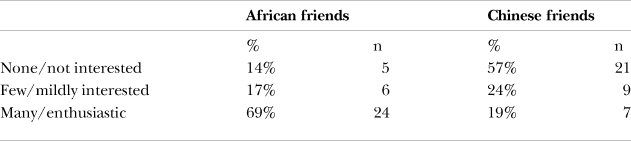
Han (Reference Han2013) notes that alternative models of adaptation can be adopted in the absence of linguistic facility. Some traders have married Chinese nationals, establishing a local family and sometimes opening joint businesses with Chinese businesspeople, building on their different connections and opportunities (see also Lyons et al. 2012; Haugen Reference Haugen2012). Most traders belong to close-knit social groups, often organized around a long-term “resident,” meeting daily in particular cafés and providing each other with social support. Nigerians, the largest African diaspora in Guangzhou, have formed more than one group, some based around the Catholic cathedral, others around football teams. There are also strong ethnic links; the Igbo, for example, have a particularly staunch mutual support group (Haugen Reference Haugen2012). As table 3 shows, establishing friendships with fellow Africans in Guangzhou is overwhelmingly considered more important than making friends with Chinese associates, and the African friendships often transcend national differences.
Trader Attitudes to Friendships in Guangzhou, 2007
In general, the long-term impact of these various adaptations—in particular, whether they can change the fundamental suspicion with which China regards these small operators from Africa—is a subject of debate. Some observers (e.g., Bertoncelo & Bredeloup 2009) see the mutual distrust between Chinese and Africans as too deep to change fundamentally. Bodomo (Reference Bodomo2010) sees the mixed community of Africa Town as providing a bridgehead for Chinese–African rapprochement, although he also argues (Bodomo Reference Bodomo2012) that in China the state distrust of informal globalization in general and Africans in particular is so strong that only an exercise of political will would be able to change Chinese perceptions.
Discussion and Conclusions
This article studies the African traders in Guangzhou who supply low-end manufactured products from the Chinese manufacturing clusters of Guangdong through the export hub of Guangzhou to the ports and airports of East and West Africa and from there across the continent, directly linking Africa’s largely informal retail distribution system to manufacturers in Guangdong.
Han (Reference Han2013), who has studied cultural change among Africans and Chinese involved in the trade in Guangzhou, writes: “Africa Town is associated with the form of globalization that . . . most people of the world today experience. It is ‘globalization from below,’ or the transnational flow of goods and people initiated by individuals and families and involving a relatively small amount of capital and informal transactions,” complementing the “globalization from above” initiated by states and corporations and involving large budgets (2013:84) (see also Mathews et al. Reference Lyons, Brown and Zhigang2012).
This article conceptualizes the linked paths along which goods travel as a global value chain, showing the chain to be similar to a “network” value chain—where the outcomes result from a myriad of interactions among relatively small players, none of whom has the power to determine the products or dictate the processes in the chain. It shows that one reason for this structure is the relatively low unit-cost of goods, which has made it possible for a diverse group of people to operate in the sector. Although some are upwardly mobile, none has achieved dominance in the market. Whereas Gibbon and Ponte (Reference Gibbon and Ponte2005) demonstrate that in the African buyer-dominated chains small African providers have largely been excluded because of standards of quality and timing set by powerful buyers (such as commercial farmers with government support), the intermediaries who are the subject of our study are forced to negotiate quality and timing with each supplier and for every order, creating both constraints and opportunities in the way they run their businesses. On that basis, and in the context of this chain, their success defies the difficulties experienced by small-scale African business people trying to participate in global trade.
Because the unit-cost of manufactured goods such as textiles and garments is relatively low, and the cost of travel has also remained relatively low for some time, this chain has drawn in intermediaries who are small-scale, independent traders, some very poor. The exogenous and endogenous challenges they face depend on a wide range of factors. Access to capital and information may govern the size of orders and dependability of suppliers, and the freedom of movement and cultural constraints at home—for example, constraints on women—may govern how long they can stay in Guangzhou. These constraints and opportunities inform the position selected by intermediaries on the chain, which in turn dictates their potential for mobility along the chain.
African vendors follow many strategies as they seek to defend or improve their position and reduce the insecure context in which they operate: changes in business practices, changes in their way of life, changes in expectations, changes in public behavior. This discussion suggests that traders also seek to overcome the root causes of insecurity, although they are limited by national, linguistic, and other barriers. Given the importance of GVC analysis in individual and group outcomes, we would therefore propose expanding its scope as a conceptual framework to embrace cultural factors affecting personal (or business) strategy and behavior.
The study shows that participation in this value chain is fraught with external challenges, requiring constant vigilance and the employment of the survival strategies identified in the value-chain literature, but that serious threats also come from excessive competition within the chain, particularly the lack of dependability of upstream and downstream links. Despite being composed of intermediaries of limited means and whose orders are relatively small, this export–import process can be considered as a network value chain and understood in those terms.
The study also shows two important trends. First, the survey suggests that short buying visits for a few weeks several times a year has increased. At the same time, increasing competition and rising factory and regulatory costs have driven down profits, both over the relatively short-term duration of this study (three years) and, as reported by respondents, over the longer term. Nevertheless, the volume of goods traded through the chain and its total financial value have continued to grow. These trends testify to the resilience, determination, and skill of those intermediaries who continue to trade.
The adoption of value-chain analysis in development studies is relatively recent and has focused on the economic impact of value chains. To date, two areas in particular have captured scholarly attention. The first is the question of whether participation in a value chain has a significant effect in terms of poverty reduction. In the case of the Guangzhou–African value chain in textiles and garments studied in this article, the answer must be “no.” Given the widespread conclusion in the literature that the trade as a whole undermines manufacturing, this trade is clearly counterdevelopmental in an African context. Labor-intensive manufacturing for local consumption and export would clearly create more—and more stable—jobs. In terms of direct effects, even the estimated eighty thousand people who earn money and support families by working as intermediaries in the Guangzhou chain represent only a tiny percentage of the sub-Saharan African population, now close to 1 billion.
The second focus in the literature has to do with the potential for growers, processors, or manufacturers in developing countries to find links to markets through entering a value chain as suppliers. This case study has described a population of intermediaries who have become adept at navigating their way through the maze of challenges facing value-chain operators. Further research would be useful to determine whether lessons can be transferred from the relative successes of small African businesspeople in import-oriented value chains to opportunities for engagement in the export of produce or commodities from Africa.
This network-type value chain in garments and textiles between China and Africa is essentially a grassroots phenomenon that creates a global platform with petty capital. Its growth has been fueled by the entrepreneurial courage and skills of the traders, as well as their skills in international trade, and it deserves to be regarded by policymakers and agencies as a resource and a model. A key issue arises for future research. In attempting to do justice to the complicated decisions facing intermediaries on the chain as individuals, and the constraints and opportunities they face, this article has not done justice to the role of different national cultures, religious institutions, and other subgroups in providing moral and instrumental support to individual members. A future analysis of these factors will enable a richer understanding of the fields framing this value chain, providing a cultural dimension in addition to the institutional, regulatory, and spatial dimensions identified and analyzed here.
Acknowledgments
This article was partially funded by the National Natural Science Foundation of China and the Fundamental Research Funds for the Central Universities.