Introduction
In recent years, the importance of participatory research has increased and methods employing community researchers have become more commonplace (cf. Clough et al., Reference Clough, Leamy, Miller and Bright2004, Reference Clough, Green, Hawkes, Raymond and Bright2006; Leamy and Clough, Reference Leamy and Clough2006; Braithwaite et al., Reference Braithwaite, Cockwill, O'Neill and Rebane2007; Fudge et al., Reference Fudge, Wolfe and McKevitt2007; Clark and Glynn, Reference Clark and Glynn2008). Engaging members of different communities to research issues within their own communities can bring new dimensions and perspectives to research questions and can bring insider knowledge about social life within communities rarely reached by ‘outside’ researchers (Griffith, Reference Griffith1998). Unlike traditional approaches to research in which researchers generate research themes and interpret findings, the community research approach aims to empower community members to shape and have some ownership of the research agenda. Whilst the method has been employed by both academics and practitioners in fields such as health and social care, housing, psychology and community development, there is a dearth of knowledge and a lack of documented accounts relating to the approach. In addition, discussions of the method rarely move beyond practical considerations.
This paper documents learning from a community research project aimed at empowering Refugee Community Organisation (RCO) leaders, in the city of Birmingham, UK. The overall aim of this 12-month funded project was to build the capacity of RCOs to identify and collect robust and reliable evidence that would improve stakeholders understanding of their role and aid progress towards policy change. The main mechanism used to collect evidence was a team of 16 paid community researchers from a range of refugee backgrounds. This paper will consider the rationale for adopting a community research approach and explore the meaning of community research for those taking part. A number of methodological challenges, including the impact on the quality of data, interpretation of research findings and the production of knowledge, will also be discussed alongside practical concerns.
What is community research?
Community research, involves training community members to carry out research within their own communities, often but not always, for the benefit of those communities. The approach has seen growing recognition in recent years as both academics and practitioners have begun to realise that those traditionally viewed as research objects possess skills, knowledge and expertise that can enable them to make valuable contributions to research projects. The approach has also started to tally well with the requirement of numerous research funders, in particular those keen to make a move from research aimed at influencing policy to undertaking action research as a means of community development. This change in attitudes has occurred alongside the introduction of policy guidance advocating the need for a greater level of community engagement. A number of policy and funding directives such as Local Agenda 21, Best Value, New Deal for Communities, Single Regeneration Budget (SRB), Neighbourhood Renewal Funding (NRF), Planning for Real, to name but a few, have marked a notable shift towards the need for community consultation and involvement.
Community research involves collaboration between professional social researchers, funding agencies and the group or organisation being researched. The community research approach has it roots in participatory appraisal and action research (cf. Hope and Timmel, Reference Hope and Timmel1984; Carr and Kemmis, Reference Carr and Kemmis1986; Fals-Borda and Rahman, Reference Fals-Borda and Rahman1991; Tolley and Bentley, Reference Tolley, Bentley, de Koning and Martin1996; Stringer, Reference Stringer2007), which cannot be defined by a single approach, but rather an approach that can cross cut a number of methods with the overall intention being to ‘enable participants to develop their own understanding of and control of the process and phenomena being investigated’ (Gonsalves, Reference Gonsalves2005). Research located within the participatory paradigm challenges traditional positivist notions of research, whereby research is considered the exclusive domain of ‘objective’ scientists (Denzin and Lincoln, Reference Denzin and Lincoln1998; Silverman, Reference Silverman2005). Participatory research can be located alongside other interpretative approaches such as action research and some feminist methodologies, which have arisen through concerns about the politics of research and questions about control and power, especially between the researcher and the researched (Alcoff and Potter, Reference Alcoff and Potter1993). These concerns have led to a increased collaborations between various stakeholders and the involvement of community members in various aspects of the research process from identifying research priorities, collecting and interpreting data and disseminating research findings (cf. Barnes et al., Reference Barnes, Davies and Tew2000; Kemshall and Littlechild, Reference Kemshall and Littlechild2000; Gonsalves, Reference Gonsalves2005).
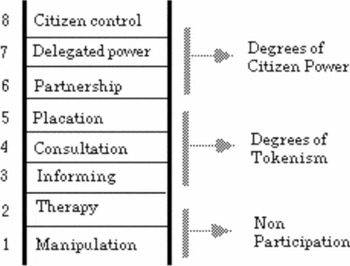
The training of community members to be active members of research teams is often attributed to an underlying intention to ‘empower’ members of a community, by delegating power and control, in order for them to create knowledge that can be mobilised to bring about policy and neighbourhood change. Empowerment is however a much-debated concept, with many different definitions and contexts (Lyons et al., Reference Lyons, Smuts and Stephens2001; Morrow and Malin, Reference Morrow and Malin2004; Fazil et al., Reference Fazil, Wallace, Singh, Ali and Bywaters2004). There is considerable overlap between the concepts of community participation and community empowerment (Laverack, Reference Laverack2001) and indeed varying degrees of participation and empowerment that can be adopted, as illustrated in Arnstein's (Reference Arnstein1969) ladder of participation (see Figure 1).
Ladder of participation (Arnstein, Reference Arnstein1969).

At the highest level the purpose of empowering and building the research capacity of a community is to develop their independence so they are better placed to improve the quality of their own lives. Professional external agents are used to help them acquire some control over the way their community is researched, develop their own knowledge base and, in so doing, equip themselves with the power to manage their own affairs and effect change (Eversole and Routh, Reference Eversole and Routh2005). This however raises questions about the nature of power and the intended outcome of using community researchers, such as who should be a community researcher? To what extent do community researchers have power over others to bring about change? Is the power dynamic within communities always impacted positively? To what extent are community researchers used as a means to cut costs or give the impression of community involvement by funders or project managers wishing to keep up with current political rhetoric?
A significant proportion of the literature on community research fails to acknowledge the complexities of power dynamics and comprises mainly of descriptive account of specific projects, often aimed at the identification and evaluation of ‘hard to reach’ service users and service provision (Byre, 2001; Hall et al., Reference Hall, Rae and Jarvis2002; Elliott et al., Reference Elliott, Watson and Harries2002; Eversole and Routh, Reference Eversole and Routh2005). As Elliott et al. (Reference Elliott, Watson and Harries2002) highlight, peer researchers are often part of communities that can be a lot less accessible to traditional researchers. This privileged access to ‘hard-to-reach’ groups is one of the main impetuses for the use of peer research methods, as it offers a doorway for ‘traditional researchers’ into the lives of people that may be outside of mainstream service provision (cf. Griffith, Reference Griffith1998; McCabe and Ford, Reference McCabe and Ford2001). The community peer research approach has attracted interest from those looking for new ways of accessing excluded groups, which avoid commonly used routes of access via traditional gatekeepers. Other common themes running through the literature focus on practical and capacity building issues such as training, skills development, the need for structured and frequent support to maintain enthusiasm and commitment, sourcing and recruiting peer researchers (Kuebler and Hausser, Reference Kuebler and Hausser1997; Byrne, Reference Byrne2001; Elliott et al., Reference Elliott, Watson and Harries2002) as well as the time and resource implications associated with community research (Hall et al., Reference Hall, Rae and Jarvis2002).
Methodological challenges
The issues of validity and reliability within the community research process have received relatively limited attention. One of the key points raised in relation to validity is the influence of peer researchers on the research (Hall et al., Reference Hall, Rae and Jarvis2002; Kuebler and Hausser, Reference Kuebler and Hausser1997). As is the case with all social research, there is a danger that people may vary their accounts and reinterpret their experiences in different ways depending on who they are being interviewed by, the nature of the relationship and rapport established between the researcher and the researched and the research setting, amongst other influencing factors such as gender, age, ethnicity etc., all of which can impact on the research process (Alcoff and Potter, Reference Alcoff and Potter1993; Maynard and Purvis, Reference Maynard and Purvis1994; Denzin and Lincoln, Reference Denzin and Lincoln1998). It should be noted that the use of either professional or community researchers does not automatically guarantee quality in the research process. It has however been argued that interviews conducted by peer researchers are more likely to lead to ‘dumming down’ or ‘drumming up’ scenarios, whereby important details about the lives of respondent can be lost or distorted through an unwillingness to express their views, or on the flip side, a desire to impress or portray themselves in a certain light to their peers. Drawing on a community research project with substance and alcohol mis-users, Elliot et al. (Reference Elliott, Watson and Harries2002) suggest that details about issues such as depression, violent or suicidal feelings may have been lost through the community research process. They go on to argue that, despite the difference in data that may be collected by different researchers, it ‘does not mean that one account is less valid than any other’ (2002: 177). As the access to certain groups ultimately depends on the use of peer researchers, all of the data collected, minus certain details or not, adds to the knowledge base about these groups. Indeed, it should also be recognised that one of the benefits of peer research can be the willingness of some groups to express their views more openly and honestly to people they can identify with, either because of common shared backgrounds or experiences. This can result in the generation of much richer insights and data about certain topics and communities (cf. Phillimore et al., Reference Phillimore, Ergun, Goodson and Hennessy2007; Goodson et al., Reference Goodson2008; Goodson and Phillimore, Reference Goodson and Phillimore2008).
Sampling is a further area that can bring the validity of peer research into question. Recruiting respondents from personal networks of friends and associates is undoubtedly less challenging and time consuming than meeting specific sampling targets and can be particularly problematic for projects that require a representative sample as the constraints of personal networks can be limited to certain geographical and social milieus (Hall et al., Reference Hall, Rae and Jarvis2002). Careful consideration of sampling, both in terms of the recruitment of peer researchers and the training and support provided in relation to sampling strategies and practice, is particularly important. Kuebler and Hausser (Reference Kuebler and Hausser1997) do however stress that peer research can generate an understanding of a ‘hidden’ population that researchers may not previously have had access to. Sampling bias can make the generation of representative data much more challenging. As with validity, the reliability of peer research is often directly linked to the quality of the peer researcher's work and the level of commitment offered by those recruited. There are certain measures that can be implemented in order to safeguard research reliability, for example, Kuebler and Hausser explain how they implemented ‘intra-questionnaire safeguards’: ‘as a check as to whether the interview had been conducted or not, priviledged access interviewers (PAIs) were asked that respondents fill in by themselves at least the last page of the interview form . . . This not only guaranteed a maximum anonymity for the interviewee . . . but enabled us to control for different handwriting on the interview forms returned to the research institute’ (1997: 328).
Community research ethics
The ethics of peer research is one area that has attracted growing attention in the literature. The issue of exploitation is often at the centre of debates about the way in which community researchers are involved in research programmes. It is acknowledged that there is a fine line between empowering and building the capacity of researchers on the one hand, and exploiting their skills, expertise and labour on another (Elliot et al., Reference Elliott, Watson and Harries2002). An appropriate level of remuneration for the time and services provided is considered essential in creating a reciprocal, non-exploitative relationship between peer researchers, project leads, other agencies and stakeholders. Our review of the literature however demonstrates considerable variation in the form of payment received by community researchers, which for example ranged from small one-off fees paid for participating in the research, a nominal fee payable per interview to a formal ‘wage’ payment for the duration of the research project (Kuebler and Hausser, Reference Kuebler and Hausser1997; Byrne, Reference Byrne2001; Elliott et al., Reference Elliott, Watson and Harries2002; Hall et al., Reference Hall, Rae and Jarvis2002). In these cases, payment acted as an incentive for researchers to become involved in the project and helped increase their longevity by keeping peer researchers motivated and involved. Payment also added a sense of value and professionalism to their work.
Using community research to research refugees’ lives in Birmingham
Birmingham has gained a reputation as one of Britain's foremost multi-cultural cities. Whilst Birmingham has provided a home to those who seek sanctuary or new opportunities and the city today sees its multi-cultural identity as one of its defining characteristics, new communities in the city have had to face a range of difficulties when striving to make a place for themselves. Research in the city has revealed that new communities face a range of obstacles to their successful integration in the city, including the resentment of local people, high levels of homelessness, extreme levels of unemployment (over 60%) and under-employment, difficulties accessing education, poor quality ESOL provision and difficulties accessing appropriate healthcare (Bloch, Reference Bloch2002; Phillimore et al., Reference Phillimore, Goodson, Beebeejaun and Ferraria2004; Goodson et al., Reference Goodson, Phillimore, Black, Jones, Lutz, Tice and Williams2005).
Research undertaken in Birmingham recommended to policymakers that the role of Refugee Community Organisations (RCOs) in service provision be elevated. In addition, the evidence base relating to migrants needed to be improved in order to demonstrate the extent of the challenges faced, and new opportunities offered, by new communities in the city, and to begin to develop policies to address those challenges. Despite the overwhelming need for different approaches to evidence collection, there have been few moves towards change. In particular, the role of RCOs as both a source of evidence and expertise about new communities had been under-utilised. This project, created through the joint working of a university department, a local community organisation, a refugee community network and a number of their members, was seen as a way of overcoming these difficulties and enhancing the role of RCOs. The project sought to build the capacity of RCOs to use existing and new evidence to promote changes in policy and service provision. Through this approach, the project sought to improve stakeholder understanding of the value and contribution of RCOs in supporting settlement and cohesion, and work towards reviews of policy in several critical areas identified by community researchers themselves. These areas were the delivery of ESOL, young people's access to education, employment of skilled refugees and mental health services.
Capacity building methodology
The starting point for the project was working with the different refugee communities to identify challenges to refugee integration, the types of data that might be collected to evidence problems faced and an appropriate recruitment process to select community leaders to take part in the project. Once trainee researchers had been selected, they received accredited training in research and the principles of community organising. In this paper, we focus upon the qualitative research training, which formed the main body of the work.
Qualitative research training
The main thrust of the project comprised of three modules in qualitative research designed to bring academic-type social research skills to a range of different communities who were experiencing language and literacy challenges. Alongside the general principles of social research, teaching covered a range of issues including the purpose of interviewing, ethics, subjectivity and researcher bias, listening and inquiring, questioning, probing, question and topic guide design, body language, identifying respondents, setting up interviews and collecting data. During this module, trainees identified the issues they felt their organisations and stakeholders needed to know in order to help understand the experiences of refugees and asylum seekers. Having identified thematic areas, further group working helped turn issues into questions and to develop interview topic guides. Through repeated, observed, mock interview and self-reflection sessions, community researchers honed their interview techniques.
During the second module, students were allocated a personal mentor and were required to undertake a series of face-to-face interviews.Footnote 1 With support from their mentor, and clear guidelines of sampling targets, researchers were required to follow a step-by-step process, which took them from the point of identifying respondents, setting up, undertaking and recording interviews to completing data analysis forms, self-reflection forms and receiving detailed feedback from their mentor on each completed interview and then repeating the process incorporating the feedback received. The final qualitative module taught students how to analyse and write up their data in a systematic fashion. With mentor and tutor support, researchers learned how to develop codes, theme data and create a data analysis framework, which they used to help them prepare an accredited report of their findings.
The review of the literature pointed to a range of challenges associated with the community research approach, some of which were practical, others methodological and/or ethical. The next section explores peer researchers’ reflections on the project, the learning achieved by the research team and the challenges faced in managing the process.
Community researcher perspectives: evaluation of the project
The project comprised of a two-part evaluation. The first was aimed at assessing, at the early stage of the project, what community researchers hoped to gain. The second took place at the end of the programme and explored problems and achievements. First stage evaluations demonstrated that community researchers hoped to gain a range of learning from their involvement in the project, which included increasing their knowledge of the communities they serve and improving their understanding of research skills and ability to analyse and use information, to softer outcomes such as improving their confidence levels, communication and life skills. The accredited nature of the programme was a major incentive for community researchers’ participation in the programme, especially given that many of the participants were professional people who had fled their countries of origin without any evidence of their past qualifications, skills or experience. Gaining a qualification and improving their chances of securing paid employment in the UK was perhaps the greatest motivating factor to get involved in the training.
Second stage evaluation findings demonstrated that all expectations had been met with the exception, for two trainees, of locating sustainable paid employment. The impact that the training had on confidence and communication skills was one of the most commonly identified outcomes of the project, which in some cases led to the greater gains they had hoped for, such as securing paid work and further training. There were a number of unanticipated outcomes identified, which included the ability to analyse qualitative data, write reports, how to work under pressure and deal with deadlines. The qualitative methods training was considered a particularly useful element of the training that enabled team members to acquire new skills that were transferable to a range of different situations. Some individuals for example were able to use their interviewing skills and improved knowledge of their community in their existing roles as refugee advisors or volunteers, or found their understanding of research design useful in helping to develop independent research projects. Others felt it had also helped them to improve their performance when they themselves were interviewed for jobs.
Power and empowerment
The collaborative way in which the proposal and particularly the research themes were developed meant that the community researchers had a direct role in shaping the overall project, the original focus of which had been decided entirely by the communities involved in the research. Involving community researchers in every aspect of research from deciding topics, questions, research tools, sampling, analysis frameworks and recommendations also gave them ownership over the research process. The level of community researcher involvement and their early intervention was seen as one of the successes of the project and an important factor that empowered and motivated community researchers and their organisations to take part. This approach ensured that the evidence collected in this project was truly embedded in the concerns of the RCOs and the communities they served.
Evaluations demonstrated that improved self-esteem and research skills, alongside the added status associated with working with an academic institution, and the respect this earned within their own communities and organisations, undoubtedly gave community researchers a feeling of added power and confidence to access their communities. This ‘privileged’ access and the rapport that community researchers were able to establish with their respondents enabled them to reduce the traditional power relations that often exist between researcher and the researched, and, as expressed by Elliott et al. (Reference Elliott, Watson and Harries2002), ‘opened the door’ to being able to understand how the lives, experiences and stories of respondents related to the key theoretical strands of our project. This was particularly the case with research questions relating to mental health where, for example, community researchers were able to uncover the experiences of African women who had experienced sexual violence. Many respondents would not seek support because of the shame they felt and their lack of confidence in their GP's capacity to understand them. Given researchers’ knowledge of their communities and the trust they held as community leaders, they were able to ask questions about sensitive issues in a culturally appropriate way that simply would not have been possible for outside academic researchers.
Whilst the benefit of being able to access the stories and voices of ‘hard-to-reach’ communities is frequently acknowledged, it is important for us to consider the type of power dynamics that may arise during any research project. One common misconception within the community research literature is that community members are better placed to conduct research with members of the same community. Our experience has demonstrated that it is not always essential for a researcher to have a close identity with the research subject. Indeed, many skilled professional researchers, not closely affiliated with the research community, are able to get inside and build relationships with individuals in order to report on the experiences of people different to themselves. To always assume the need for an identity match between researcher and researched is a somewhat naïve analysis of how power bases and relationships are played out at different levels across different communities. Factors such as gender, tribe or cast affiliation were important factors that determined how researchers were viewed and how they behaved in certain research situations, which, in turn, affected the type of relationships formed with different respondents during their field work. Furthermore, some interviewees questioned the usefulness of research undertaken by members of their own community because they viewed their community as powerless and thought any data collected by refugees would be considered worthless by ‘the establishment’. Others were concerned about being open and honest about their lives to members of their own community because they did not want them to possess personal knowledge that might potentially empower researchers whilst dis-empowering the individual interviewee. This raised questions about confidentiality and trust and the extent to which community researchers could, or were perceived to be able to, record and relay stories they had collected in an entirely confidential manner. The ambiguity of power relations clearly calls for a comprehensive understanding of the politics of different communities and careful consideration of the complex nature of community relationships and how researchers can be best matched with target samples.
Subjectivity, validity and reliability
The complexities of power dynamics led to further concerns around researcher bias. Given that community researchers selected research themes based on concerns of their own communities, this raised questions about the level of objectivity that could be relied upon. The development of a common topic guide formed an integral part of the community research training, which in turn helped overcome some of the problems associated with the comparability of questioning, as it ensured community researchers covered the same topics. The topic guide was however developed with community researchers in English and could not account for the way in which individual researchers may have interpreted and translated questions when interviewing in their own community languages. Our experience demonstrated that the close monitoring of the quality of data collection, even with a personal mentor in place, can be extremely difficult when working with a large team of researchers who are out in the field and conducting research across a range of different communities.
The issue of subjectivity is one of concern in all social research, especially when associated with qualitative methods (Denzin and Lincoln, Reference Denzin and Lincoln1998). Whilst, there is much debate about the nature of objectivity and some have questioned the ability of any researcher to be entirely objective (cf. Phillimore and Goodson, Reference Phillimore and Goodson2004), others stress the importance of being able to identify, and account for, one's own subjectivities through a process of self-reflection (Nolin, Reference Nolin2006). In order to introduce the importance of reflexivity, community researchers were given a significant amount of training in issues of researcher bias and subjectivity. Teaching reflexivity and documenting research experiences through the use of self-reflection forms were methods used to help researchers identify their own biases. The way in which any researcher interprets someone else's reality will be affected by their own ontological and epistemological beliefs (Phillimore and Goodson, Reference Phillimore and Goodson2004). Our experiences demonstrated that the subjectivities and ‘positionings’ of community researchers are likely to be different from that of an ‘outsider’, which raises important questions about the way we see and interpret our own reality and that of members of our own community compared to ‘new’ realities and experiences. Familiarity with the research setting was found to be one aspect that impacted on the level of information that was taken for granted, the extent to which issues were probed for depth and clarity of meaning and the type of information each researcher decided to record.
The influence that culture had on conversation patterns and norms was a further issue that raised concerns about subjectivity. Whilst we observed that some community researchers were unable to move away from cultural formalities they associated with interviewing and often over punctuated interviews with platitudes, which impeded the natural flow of conversation and potentially restricted the depth and richness of data generated, others embraced the opportunity to give a voice to members of their community, and worked on building rapport and trust to enable respondents to tell their stories. However, in cross language research the concept of story telling, or indeed the collection of any qualitative data that aspires to tell the story of their respondents using their own words, raises an additional set of questions, such as: What impact does translation have on the validity of findings? How are questions asked and/or changed through translation? How are probes and follow up lines of questioning dealt with?
The project had insufficient budget to translate and transcribe all of the community researchers interviews, which meant that certain safeguards needed to be introduced to help capture as much data as possible. Each community researcher was provided with a data analysis table that served as a tool for researchers to write everything that was said in relation to a particular issue. Again, this approach was not without its challenges. The quality of the subsequent data gained depended considerably on the commitment, time and ability of each researcher; issues that are discussed in more detail in the following section on capacity. The use of data tables to record and present data inevitably led to a great deal of summative data that had essentially already been filtered by the community researchers. In order to collect richer, more in-depth, data we used the initial round of interviews to identify issues that required further exploration and then prepared detailed topic guides for community researchers to undertake a number of in-depth case studies that were recorded and then transcribed in full.
Capacity
The trainees who took part in this project possessed a range of different skills and aptitudes, which was problematic on some levels for both tutors and some trainees. Although a person specification was used to help with recruitment, the community researchers were nominated by their RCOs, rather than interviewed. This approach to recruitment was partly to ensure inclusivity, but also to expedite the process so the 12-month project deadline could be met. In practice, the ability of community researchers to undertake work independently, to make links between key themes and to probe and follow up issues during interviews, was related to a range of different factors, including educational backgrounds, literacy levels, language ability and interpersonal skills. Perhaps the most useful aspect of the teaching was the personal mentoring system, which helped to overcome some of these difficulties given that trainees required varying levels of one-to-one work to bring them to the point where they could undertake successful interviews. The mentors provided a wide range of advice and guidance, most related to the training, assessments, reporting and fieldwork, but also other support around immigration issues, employment and benefits. This holistic support was necessary to help people to continue to focus on their studies and research.
Community researchers’ capacity to bring about change was a further challenge faced. Community researchers reported that participation in the project had raised expectations amongst their research respondents, many of whom were unaware of the slow nature of policy change and questioned community researchers directly about policy progress. Community researchers however were often equally frustrated with the slow pace of lobbying. Many expected instant results and became disillusioned because they felt meetings were often about ‘just talking’. Whilst they had undertaken training in policy formation, much of their frustration stemmed from a lack of understanding of institutional cultures and governance in the UK. Others were nervous about following up on unfulfilled pledges, and saw failure to deliver as a sign of the lack of policymakers’ willingness to engage with them as RCO leaders. These difficulties aside, many were willing to engage and learn more about the principles of policy research. Being backed by a creditable funder and an academic institution was thought to have given the project, and as a result community researchers, kudos and enabled them access to decision makers that would not have occurred through acting alone. In addition, the possession of ‘hard’ evidence, which they had collected through new learning in social research and interviewing, was seen as a powerful tool that community researchers and their organisations could use in lobbying and fund raising efforts. Two years after the data were collected, it is still used by policymakers to shape services. Two working groups have been set up, one around mental health and the other around ESOL, with the direct objectives of tackling the issues raised in the community research.
Conclusions
This community research project with its focus on partnership hailed a new way of working for the three organisations involved. Linking together established, respected organisations, with lesser-known but critically important community focused organisations, provided an excellent model for raising the profile of those organisations and giving a voice to their communities. The training gave the community researchers opportunities to meet, and work with, leaders from other organisations. They have shared knowledge and experience, learned from each other and since have undertaken some joint working outside of the project.
Much has been achieved through the project, but it represents only the beginning of a process which in order to continue requires some resolution to ongoing capacity issues. The profile of the refugee network and the work of RCOs in the city has been raised both through the evidence collected and disseminated. The majority of community researchers also have personal success stories to tell. The efficacy of ESOL is now being questioned sub-regionally and refugee mental health is now very much on the agenda in Birmingham and the across the region. This is testimony to the role of the community researchers in undertaking research that gave an insiders perspective to complex or sensitive issues such as language learning and mental health. The outcomes of this project provide a strong argument for the increased work with community researchers to uncover the reality of the lived experience in a way that is not possible through conventional academic research.
This paper has demonstrated that there are a whole range of issues that need to be addressed when using a community research approach. Whilst the approach may allow privileged access to ‘hard-to-reach’ communities and a new perspective on research questions, there are methodological and ethical considerations that need to be addressed before commencing research. These include how researchers are recruited and identified and how we assess their suitability to question appropriately and deal with data in an ethical manner. They also extend to consideration about data collection, recording, translation and presentation, which all prompts questions about the overall reliability and validity of research data and how the community research process can best be managed and how quality can be controlled generally. At the very least, these issues force us to problematise the nature of community research and to question the overall impact on research, for example: Are we studying what we think we are studying? Are the measures we use consistent? These are important considerations that need to be taken into account when developing community research methodologies and research tools in order to safeguard research rigour.
It was never the intention of this paper to underplay the skills, expertise or wealth of knowledge that professional researchers can offer, but rather to appreciate that community researchers offer something very different to professional researchers and that working with community researchers requires compromises in certain areas. Data collected will offer a different perspective to that collected by outside researchers. It may offer unique insights or could be superficial. What is clear is that community research is not an easy option and if it is to be undertaken effectively, then it requires good-quality training and continuing support for trainees. There is a range of ethical considerations, including the impact that becoming a researcher will have upon the interviewee and their community and exit strategies once projects are completed.
Despite the challenges and constraints faced by organisations using a community research approach, there is evidence to show that it can help organisations and their research teams access the previously unreachable, and ask questions in new ways. It can also provide rich and valuable data that generates new interest in the policy arena and has the potential to help change the lives of both the researchers and the communities in which they reside.
Acknowledgements
The authors would like to thank the Joseph Rowntree Foundation for funding the project on which this research is based.