

Introduction
Increases in the demand for protein products coupled with an on-going concern over the impact of livestock production on the environment have once again highlighted the importance of nitrogen (N) efficiency in agricultural production systems. For individual dairy farms, the efficiency of N use (ENU) is low with only 0.2 of all N inputs being exported from the farm as utilisable product (Van Vuuren, Reference Van Vuuren2011). This inefficiency at farm level creates large surpluses of N in the agricultural production system, which in turn can be lost to the environment as ammonia (NH3), nitrous oxide (N2O) and nitrate (NO3 −). Because these N losses contribute to environmental deterioration, dairy farmers operating within the EU must adhere to environmental legislation governing greenhouse gas emissions (EU Climate and Energy Package, EU, 2008) to which N2O is a contributor; trans-boundary gasses (Gothenburg Agreement, S.I.10, 2004) to which NH3 is a contributor; and maintenance of water quality (Good Agricultural Practice for the Protection of Waters, S.I.610, 2010) governing NO3 − losses. At the individual cow level, N efficiency is also a cause for concern with 0.7 to 0.8 of N ingested being excreted in the urine and faeces (Broderick, Reference Broderick2006). Excreted principally as urea N in the urine, this volatile form of N not only contributes to environmental depletion but also creates a metabolic demand for energy and has been reported to have deleterious effects on reproduction in the dairy cow (Tamminga, Reference Tamminga2006). Therefore, it is imperative that strategies are explored which improve N efficiency in the dairy cow, not only from an environmental perspective but also from a herd health perspective.
In Ireland, dairy farming is characterised by a predominantly spring calving dairy herd with grazed pasture forming the principal component in the diet (Dillon et al., Reference Dillon, Crosse, Stakelum and Flynn1995). Therefore, a significant portion of N losses occur as N2O and NO3 while the animal is outdoors (Casey and Holden, Reference Casey and Holden2005). However, there are also large portions of N lost as NH3 associated with the storage and land spreading of animal excreta (Hyde et al., Reference Hyde, Carton, O'Toole and Misselbrook2003). Therefore, it is important to investigate strategies that reduce the potential for N loss from both indoor and pasture fed dairy cows of which dietary manipulation of N efficiency offers great potential. During the housing period, the use of alternate forages to grass silage (Burke et al., Reference Burke, Murphy, O'Donovan, O'Mara, Kavanagh and Mulligan2007), manipulation of dietary energy and CP content (Broderick, Reference Broderick2003) and the amino acid composition (Broderick et al., Reference Broderick, Stevenson, Patton, Lobos and Olmos Colmenero2008) have been evaluated as a means of improving N efficiency in the lactating dairy cow. However, dietary manipulation of N efficiency in the pasture fed dairy cow is much more difficult due to the large contribution of pasture to overall N intake. To this end, supplementary concentrate strategies offer potential for manipulation of N efficiency in such systems.
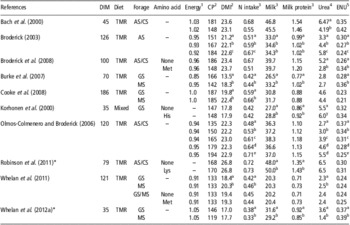
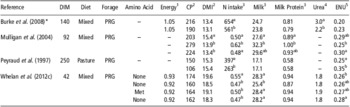
The paper that follows will review recent N balance experiments conducted at University College Dublin, as well as reports in literature on studies aimed at improving N efficiency in the lactating dairy cow. For the convenience of the reader, the results of these experiments have been summarised in Table 1 (total mixed ration type diets) and Table 2 (pasture-based diets).
Nitrogen efficiency levels for lactating dairy cows offered various total mixed ration type dietary treatments

DIM = days in milk; TMR = total mixed ration; Mixed = forage based ration plus supplementary concentrates; AS = predominantly alfalfa silage; GS = predominantly grass silage; MS = predominantly maize silage; PRG = predominantly Lolium perenne-based pasture; DMI = dry matter intake; ENU = efficiency of N use.
abc/xyDifferent superscripts within each column of each reference differ significantly (abc P < 0.05, xyz P > 0.05 but <0.10).
1Energy is expressed in units of energy for milk production (UFL kg/DM), where one UFL is equal to the NEL content of 1 kg of rolled barley (870 g kg/DM, 7.1128 MJ NEL). Energy value is calculated where mixed diets are offered.
2CP (g kg/DM, CP value is calculated where mixed diets are offered), DMI (kg/day).
3Milk, milk protein and N intake are expressed in kg/day.
4Urea is expressed in mmol/l, references with an asterisk are blood urea N, all others are milk urea N.
5ENU calculated where data was not reported.
Nitrogen efficiency levels for lactating dairy cows offered various pasture based dietary treatments

DIM = days in milk; mixed = pasture-based diet with supplementary concentrates; PRG = predominantly Lolium perenne based pasture; DM = dry matter; DMI = dry matter intake; ENU = efficiency of N use.
abcDifferent superscripts within each column of each reference differ significantly.
1Energy is expressed in units of energy for milk production (UFL kg/DM), where one UFL is equal to the NEL content of 1 kg of rolled barley (870 g kg/DM, 7.1128 MJ NEL). Energy value is calculated where mixed diets are offered.
2CP (g kg/DM, CP value is calculated where mixed diets are offered), DMI (kg/day).
3Milk, milk protein and N intake are expressed in kg/day.
4Urea is expressed in mmol/l, references with an asterisk are blood urea N, all others are milk urea N.
5ENU calculated where data was not reported.
Forage source and efficiency of N utilisation
The use of grass silage and maize silage is common during the housing period throughout northern Europe (Rath and Peel, Reference Rath and Peel2005). The climatic conditions in Ireland are well suited to the production of grass silage. However, the chemical composition of grass silage can vary considerably depending on N application rates, maturity at harvest and weather conditions (McDonald et al., Reference McDonald, Edwards, Greenhalgh and Morgan2002). For example, CP contents of grass silage in literature ranged from 100 g kg/dry matter (DM) (Bernard et al., Reference Bernard, West and Trammell2002) to 190 g kg/DM (Cooke et al., Reference Cooke, Bernard and West2008), consistent with the range of CP for 3200 grass silage samples analysed for dairy farms in Ireland (Kavanagh (Reference Kavanagh2011), personal communication). This variation in the chemical composition of grass silage can result in an inconsistent dry matter intake (DMI), poor milk production and consequently, a poor ENU by the lactating dairy cow (Burke et al., Reference Burke, Murphy, O'Donovan, O'Mara, Kavanagh and Mulligan2007). Maize silage by contrast, has a lower CP and contains starch as a digestible energy source which will improve the ratio of fermentable organic matter to N in the rumen. Burke et al. (Reference Burke, Murphy, O'Donovan, O'Mara, Kavanagh and Mulligan2007) demonstrated that replacing a portion (0.67) of grass silage with maize silage, increased DMI (+4.8 kg/day, P < 0.05), milk yield (+6.7 kg/day, P < 0.05) and the ENU for milk production from 0.28 to 0.36 (P < 0.05), therefore reducing N excretion. By contrast, a more recent experiment at University College Dublin (Whelan et al., Reference Whelan, Mulligan, Flynn, McCarney and Pierce2011) reported no improvement in milk production (20.3 kg/day, P > 0.10) or ENU (0.23, P > 0.10), despite small improvements in DMI (+1.9 kg/day, P < 0.01) where maize silage replaced grass silage in the forage DM, consistent with the study of Cooke et al. (Reference Cooke, Bernard and West2009). However, the dairy cows used in Whelan et al. (Reference Whelan, Mulligan, Flynn, McCarney and Pierce2011) and Cooke et al. (Reference Cooke, Bernard and West2009) were 121 and 186 days in milk (DIM) respectively, whereas the animals used in Burke et al. (Reference Burke, Murphy, O'Donovan, O'Mara, Kavanagh and Mulligan2007) were 70 DIM. The combination of fewer DIM and a greater difference in DM and energy intake likely contributed to the production responses observed in Burke et al. (Reference Burke, Murphy, O'Donovan, O'Mara, Kavanagh and Mulligan2007) where maize silage replaced grass silage, highlighting the importance of formulating a diet to suit the stage of lactation. The nutritional quality of the grass silage and maize silage offered to the dairy cow is also important in the maintenance of milk production. O'Mara et al. (Reference O'Mara, Fitzgerald, Murphy and Rath1998) examined the effects of replacing portions of grass silage (0.77 dry matter digestibility (DMD)) with maize silage (0.67 DMD), reporting that when maize silage completely replaced grass silage in the ration, dietary DMD reduced (0.76 v. 0.72, P < 0.05) with no improvement in milk production (21.4 v. 22.7 kg/day, P > 0.05). Therefore, when devising nutritional strategies that improve the ENU, factors such as stage of lactation and forage quality are of up most importance.
In pasture-based dairy production systems, supplementary forages can be used to reduce the demand for grazed grass and this may also impact on the N balance in the lactating dairy cow. For example, Burke et al. (Reference Burke, O'Donovan, Murphy, O'Mara and Mulligan2008) reported no effect of offering maize silage to pasture-fed dairy cows on N efficiency. However, where dairy cows offered pasture were supplemented with high moisture ear maize silage, a greater portion of ingested N was partitioned towards the faeces (0.30 v. 0.27, P < 0.05) and milk (0.21 v. 0.16, P < 0.05) compared with un-supplemented animals (Van Vuuren et al., Reference Van Vuuren, Van Der Koelen, Valk and De Visser1993). Because faecal N is less mobile in the soil system, strategies that increase faecal N at the expense of urinary N reduce the potential for N loss as NO3 − and N2O (Pakrou and Dillon, Reference Pakrou and Dillon1995; Selbie et al., Reference Selbie, Lanigan, Di, Moir, Cameron, Khalil and Richards2010).
Reducing dietary CP
There is a stronger relationship between dietary CP or N intake and N excretion in the urine (R 2 = 0.74) than either faecal N (R 2 = 0.21) or milk N (R 2 = 0.30; Mulligan et al., Reference Mulligan, Dillon, Callan, Rath and O'Mara2004). Therefore, strategies that reduce dietary CP are generally associated with an improvement in ENU. However, in many feeding situations, dairy farmers continue to offer high CP diets to the lactating dairy cow despite much research reporting little or no benefit of this feeding strategy to milk yield, or milk protein yield (Leonardi et al., Reference Leonardi, Stevenson and Armentano2003; Mulligan et al., Reference Mulligan, Dillon, Callan, Rath and O'Mara2004; Olmos-Colmenero and Broderick, Reference Olmos-Colmenero and Broderick2006).
Recent studies at University College Dublin demonstrated that mid-lactation dairy cows offered diets containing 133 g CP kg/DM could produce 20 kg/day milk and 1.64 kg/day milk solids with an N efficiency of 0.24 (Whelan et al., Reference Whelan, Mulligan, Flynn, McCarney and Pierce2011). Similarly, early lactation dairy cows offered diets containing 146 and 119 g CP kg/DM produced 32 and 29 kg/day milk and 2.23 and 2.04 kg/day milk solids for high and low CP diets, respectively (Whelan et al., Reference Whelan, Pierce, McCarney, Flynn and Mulligan2012c). Furthermore, the ENU in these animals was 0.38 reflecting the low N intake and possibly a degree of body tissue mobilisation that may have occurred. In studies conducted at the University of Wisconsin, Olmos-Colmenero and Broderick (Reference Olmos-Colmenero and Broderick2006) observed a linear increase in urinary N excretion from 0.11 to 0.26 kg N/day (P < 0.01) and reduction in N efficiency from 0.37 to 0.25 (P < 0.01) as CP increased from 135 to 194 g kg/DM. However, they observed no improvement (P > 0.10) in milk N output beyond 165 g CP kg/DM concluding that a CP of 165 g CP /DM was sufficient for animals producing 37.1 kg milk/day. Similarly, for early lactation dairy cows (42 DIM), Bach et al. (Reference Bach, Huntington, Calsamiglia and Stern2000) saw no effect of increasing dietary CP from 150 to 180 g CP kg/DM on milk yield or milk protein yield suggesting improved N efficiency and reduced N excretion where lower CP diets are offered.
In an Irish context, manipulation of N balance in the pasture-fed dairy cow is important as grazed grass is the predominate forage in the dairy cows diet. However, such manipulation is more difficult unless a concentrate supplement is offered, or the application of fertiliser N to the pasture is altered. Mulligan et al. (Reference Mulligan, Dillon, Callan, Rath and O'Mara2004) observed a reduction in urinary N excretion (0.31 v. 0.19 kg/day, P < 0.01) when the supplementary concentrate CP was reduced (242 v. 94 g CP kg/DM). Similarly, Burke et al. (Reference Burke, O'Donovan, Murphy, O'Mara and Mulligan2008) reduced urinary N excretion (0.40 v. 0.32 kg/day, P < 005) where supplementary CP was reduced (194 v. 69 g CP kg/CM). However, both studies were conducted on mid-lactation dairy cows and may not accurately reflect the early lactation period when DMI is likely to be poorer and the response of milk production to increase dietary CP higher (NRC, 2001). To this end, Whelan et al. (Reference Whelan, Pierce, McCarney, Flynn and Mulligan2012c) examined the effects of supplementary concentrate CP on N efficiency in early lactation dairy cows (42 DIM). In that study, milk production (28.3 v. 25.4 kg/day, P < 0.05) and urinary N excretion (0.26 v. 0.19 kg/day, P < 0.01) were reduced where concentrate CP was reduced (190 v. 150 g CP kg/DM). N intake was lower (0.55 v. 0.47 kg/day for high and low CP, respectively, P < 0.01), N efficiency was not improved in this study due to lower milk N output where the low CP concentrate was offered. By contrast, replacing rolled barley with ground corn in the low CP concentrate improved milk yield and milk N output to levels comparable with the high CP supplement, therefore improving N efficiency (Whelan et al., Reference Whelan, Pierce, McCarney, Flynn and Mulligan2012c). Furthermore, concentrations of β-hydroxy butyric acid (0.71 v. 0.59 mmol/l, P < 0.05) and blood urea N (5.49 v. 4.21 mmol/l, P < 0.05) were lower in animals offered the low CP v. the high CP concentrates, indicating an improved metabolic status in the low CP groups (Whelan et al., Reference Whelan, Pierce, Flynn and Mulligan2012b). When considered together, these studies demonstrate that reductions in N excretion and improvements in the ENU are possible in the pasture-fed dairy cow. However, for improvements in ENU to occur, the maintenance of milk production is important, particularly in early lactation. To this end, replacing rolled barley with ground corn in the low CP concentrate will give milk yields comparable to animals offered higher CP concentrate.
Reducing the CP content of grazed grass through reducing N fertiliser application is also likely to affect N efficiency in the dairy cow. Peyraud et al. (Reference Peyraud, Astigarraga and Faverdin1997) compared swards of pasture fertilised at 0 and 80 kg N/ha after initial harvest. In that experiment, pasture CP (150 v. 100 g CP kg/DM) and N intake (0.37 v. 0.26 kg/day, P < 0.05) was higher for high N swards. However, the quantity of microbial N entering the small intestine (0.37 kg/day) and milk N (0.09 kg/day) were unaffected, therefore reducing urine N excretion (0.16 v. 0.07 kg/day, P < 0.01). Van Vuuren et al. (Reference Van Vuuren, Krol-Kramer, Van der Lee and Corbijn1992) also examined fertiliser application rates demonstrating that reducing N application from 500 to 275 kg N/ha per year reduced pasture CP (212 v. 174 g CP kg/DM) and rumen NH3 N concentrations (15 v. 10 mmol/l, P < 0.01). However, duodenal amino acid flow and amino acid composition were unaffected, indicating improved N efficiency with low N application.
Overall, the results of these experiments question the current feeding practice of offering diets in excess of 160 g CP kg/DM to lactating dairy cows. Correct formulation to ensure a balance of N and energy in the rumen will help optimise amino acid flow to the small intestine and more accurately meet the requirements of the dairy cow. This in turn will allow for a reduction in dietary CP and urinary N excretion, while maintaining milk production.
Amino acids and N balance
In comparison with the non-ruminant animal, predicting the supply of amino acids to the small intestine of ruminants is far more difficult due to the digestive processes of the reticulorumen (Lapierre et al., Reference Lapierre, Pacheco, Berthiaume, Ouellet, Schwab, Dubreuil, Holtrop and Lobley2006). However, the use of dose response curves to infusions of individual amino acids has helped identify amino acids, which may be limiting to milk production, of which lysine (Lys) and methionine (Met) are first limiting (NRC, 2001). In addition, histidine (His) has been suggested a potential limiting amino acid in dairy cows offered grass and barley-based diets (Varvikko et al., Reference Varvikko, Vanhatalo, Jalava and Huhtanen1999; Korhonen et al., Reference Korhonen, Vanhatalo, Varvikko and Huhtanen2000). Improving amino acid supply through feeding crystalline amino acids is not possible due to the rumen degradation of orally administered amino acids (Volden et al., Reference Volden, Velle, Harstad, Aulie and Sjaastad1998). However, the use of rumen-protected forms of amino acids can improve the post-rumen supply of amino acids; for example, the isopropyl ester of a methionine hydroxyl analogue (HMBi) gives a good degree of rumen protection (Noftsger et al., Reference Noftsger, St-Pierre and Sylvester2005; Breves et al., Reference Breves, Schröder, Heimbeck and Patton2009) and is suited to concentrate pellet formation (Graulet et al., Reference Graulet, Richard and Robert2005; Rulquin et al., Reference Rulquin, Graulet, Delaby and Robert2006).
In several feeding situations, the supply of additional Met has been shown to improve yields of milk and milk protein (Noftsger and St-Pierre, Reference Noftsger and St-Pierre2003; Broderick et al., Reference Broderick, Stevenson, Patton, Lobos and Olmos Colmenero2008; Phipps et al., Reference Phipps, Reynolds, Givens, Jones, Geraert, Devillard and Bennett2008) and improve ENU (Robinson, Reference Robinson2010) relative to un-supplemented diets. Broderick et al. (Reference Broderick, Stevenson, Patton, Lobos and Olmos Colmenero2008) demonstrated that milk N output could be maintained when reducing CP from 186 to 148 g kg/DM by adding 15 g/day of rumen-protected Met, reducing urinary N output by 0.11 kg/day. This result is important because it allows producers to maintain milk N output and reduce N excretion where N supply to high yielding dairy cows is reduced. However, results reported in Leonardi et al. (Reference Leonardi, Stevenson and Armentano2003) and Whelan et al. (Reference Whelan, Mulligan, Flynn, McCarney and Pierce2011) show that N excretion is not manipulated by Met supplementation, indicating the variability in production responses to Met supplementation depending on milk yield potential, dietary ingredients and the contribution of microbial CP to intestinal amino acid supply (Varvikko et al., Reference Varvikko, Vanhatalo, Jalava and Huhtanen1999; Robinson, Reference Robinson2010).
Until recently, the use of Lys in commercial dairy rations has been somewhat limited by the lack of a suitable technology for rumen resistance that is capable of withstanding feed mixing processes (Swanepoel et al., Reference Swanepoel, Robinson and Erasmus2010). The addition of a Lys supplement to MS and maize grain-based diets, improved milk yield (48 v. 50 kg/day) and protein yield (1.35 v. 1.43 kg/day) in one study (Robinson et al., Reference Robinson, Swanepoel, Shinzato and Juchem2011). However, in an earlier study by Swanepoel et al. (Reference Swanepoel, Robinson and Erasmus2010), milk production (54 kg/day) was not improved by supplementary Lys, suggesting that the Lys requirements of the animal were closely met by supply from the basal diet and that production was not limited by available Lys.
For cows fed on grass silage and barley-based supplements, it is reported that neither Met nor Lys are first limiting for milk protein yield (Varvikko et al., Reference Varvikko, Vanhatalo, Jalava and Huhtanen1999) presumably due to the high contribution of microbial CP to intestinal amino acid flow in these diets and the balance of Met and Lys in microbial CP (NRC, 2001). In duodenal infusion studies, Korhonen et al. (Reference Korhonen, Vanhatalo, Varvikko and Huhtanen2000) suggested that His may be the first limiting amino acid for milk production in diets based on grass silage and barley. In that study, infusion of His from 0 to 6 g/day linearly increased milk protein yield from 0.86 to 0.92 kg/day (P < 0.01). However, the production response to increased His was small and it is unlikely that ENU improved as milk urea concentration increased (5.5 to 1.6 mmol/l; P > 0.05 but <0.10) with His infusion in that study (Korhonen et al., Reference Korhonen, Vanhatalo, Varvikko and Huhtanen2000).
There is a scarcity of data in literature reporting amino acids supplementation to dairy cows offered grazed pasture. Early studies by Peyraud et al. (Reference Peyraud, Astigarraga and Faverdin1997) indicated that the amino acid profile reaching the duodenum in pasture-fed dairy cows contained 76 and 18 g/kg of Lys and Met, respectively, suggesting that Met could potentially limit milk yield. Where early lactation dairy cows (25 DIM) were offered pasture plus supplements rich in Met and Lys (fish meal) milk protein yield (0.90 v. 0.81 kg/day, P < 0.01) improved relative to diets with a poor supply of these amino acids (sunflower meal; Schroeder and Gagliostro, Reference Schroeder and Gagliostro2000). Similarly, Whelan et al. (Reference Whelan, Pierce, McCarney, Flynn and Mulligan2012c) reported improved milk production (28.4 v. 25.4 kg/day, P < 0.05) where low CP concentrates (140 g CP kg/DM) were supplemented with a Met source. However, there was also a numeric increase in N intake (+0.03 kg DM/day) in the Met-supplemented cows resulting in only small improvements (+0.01) in the ENU compared with the non-supplemented group. Indeed, none of the studies reported in this paper showed an improvement in the ENU for milk production where AA were offered, despite many (Noftsger and St-Pierre, Reference Noftsger and St-Pierre2003; Broderick et al., Reference Broderick, Stevenson, Patton, Lobos and Olmos Colmenero2008; Phipps et al., Reference Phipps, Reynolds, Givens, Jones, Geraert, Devillard and Bennett2008) reporting some improvement in milk yield. This demonstrates the variability of responses to dietary amino acid supplementation in lactating dairy cow and perhaps the adaptability of the mammary gland in coping with changes in the concentration of amino acids supplied to it.
Conclusions
Dietary manipulation of N efficiency is possible for lactating dairy cow offered both pasture and preserved forage-based diets. Furthermore, these strategies do not necessarily reduce the performance and may in fact improve the metabolic status of the dairy cow. However, further work is required in this area to determine the lifetime effects of such nutritional strategies, both from a herd health and environmental impact prospective.
Further information
The Dairy Solutions Symposium is a biennial event that covers a wide variety of themes and topics of relevance and importance to the dairy industry. The aim is to provide high level, up-to-date information and research to dairy professionals, technologists and scientists. In 2012, the theme addressed the biggest challenge facing all those involved in dairy production: optimising production efficiency while lowering environmental impact. For more information, please visit www.dairycowsolutions.com or contact dairycowsolutions@alltech.com.