Malnutrition is common in infants after the Stage I Norwood operation.Reference Kelleher, Laussen, Teixeira-Pinto and Duggan1 Neonates with hypoplastic left heart syndrome or complex single ventricle who face staged surgical reconstruction experience significant growth failure.Reference Vogt, Manhliot and VanArsdell2–Reference Anderson, Beekman and Border5 When weight gain is impaired after cardiac surgery, the risk of a poor long-term outcome increases.Reference Eskedal, Hagemo and Seem6 Inadequate nutrition and feeding difficulties strongly influence the outcome of surgical treatment, increasing post-operative morbidity and length of hospitalisation.Reference Anderson, Beekman and Border5, Reference Boctor, Pillo-Blocka and McCrindle7, Reference Einerson and Arthur8 Feeding difficulties are common in infants after the Norwood operation and may be associated with the increased incidence of swallowing dysfunction, vocal cord paralysis, and gastro-oesophageal reflux noted in this population of infants.Reference Davis, Davis and Cotman4, Reference Wernovsky, Ghanayem and Ohye9–Reference Srinivasan, Sachdeva and Robert11
Multiple feeding strategies ranging from predominantly oral feeding to gastrostomy tube feeding are utilised in these infants to maximise caloric intake and weight gain, as well as to promote optimal surgical outcomes. In clinical practice, nutritional feeding strategies often vary from one clinician to another. Difficulties in achieving adequate oral intake may result in home nasogastric feedings to provide or supplement dietary intake or in the placement of surgical gastrostomy tubes. Little is known about the relationship between feeding practices and patient outcomes including post-operative growth. The aim of this study was to compare feeding strategies currently utilised in infants discharged following Stage I Norwood operation and the relationship to weight gain outcomes at Stage II palliation.
Methods
Patient population
The patient population consisted of infants from nine institutions who survived to discharge after Stage I Norwood. The study was approved by the Institutional Review Board at each institution, and informed consent was obtained from all participants. Infants greater than 30 days of age at Stage I palliation, less than 37 weeks of gestation, and infants with genetic syndromes or other non-cardiac conditions associated with growth failure or alterations in feeding strategy were excluded.
Procedures and measures
Medical records were reviewed to retrieve demographic, surgical, and nutritional/feeding data for all patients who met inclusion criteria. Patient-related variables included sex; age/date at surgery; weight at birth and at surgery; operative procedure performed, including modifications; significant post-operative complications; and date and weight at discharge. Nutritional/feeding data included feeding method, caloric concentration, and volume/24 hours at the time of hospital discharge. Any feeding problems – oral motor dysfunction, swallowing dysfunction, gastro-oesophageal reflux, etc. – identified before discharge and gastrointestinal/prokinetic medications prescribed were also noted. Data regarding interstage mortality and reason for and duration of re-hospitalisations during the interstage period were also collected.
Data regarding interstage weights and feeding regimens – oral feeding breast/bottle only, nasogastric tube or gastrostomy tube feeding only, or a combination of oral and tube feeding – were collected prospectively at 2-week intervals following Stage I discharge from parent logs and physician visits, with the final measure at admission for Stage II palliation. Parents recorded the infant's weight and the route and amount of each feeding for a 24-hour period and noted any changes in formula including caloric concentration or feeding problems such as vomiting. Many parents were discharged with infant scales and oxygen saturation monitors as part of a home surveillance programme. If a home scale was not available, weights were obtained at a clinic, physician's office, or by a visiting nurse. The location of the scale was noted on the weight and feeding logs. Logs were returned by mail in postage-paid/pre-addressed envelopes or at clinic visits when appropriate.
Statistical analyses
Descriptive statistics were generated for demographic and clinical variables, and are reported as means and standard deviations for continuous variables or medians with interquartile range if the data were heavily skewed. Categorical variables were reported as frequencies and proportions. Infants were classified into three feeding groups based on their feeding regimens at discharge from Stage I surgery: oral only, tube only, and oral with tube supplementation (oral/tube). For continuous variables, analysis of variance or non-parametric Kruskal–Wallis tests were used, where appropriate, to compare infants by feeding group. For categorical variables, Chi-square test or Fisher's exact test was used depending upon the nature of the data.
The change in weight from Stage I discharge to Stage II surgery was compared among feeding regimens using regression-based analysis of variance. To measure the change in weight, two outcomes were used: average daily interstage weight gain and change in weight-for-age z-score. Average daily interstage weight gain was defined as the difference between the weight at Stage II palliation and the weight at discharge from Stage I Norwood procedure, divided by the interstage duration. Change in weight-for-age z-score was defined as the weight-for-age z-score at Stage II minus the weight-for-age z-score at Stage I discharge. Weight-for-age z-scores were derived using the World Health Organization reference standards. The relationship between change in weight and clinical outcomes was assessed using simple linear regression models.
A linear mixed effects model was then used to study changes in infants’ weight over time. To account for the non-linear trend in infants’ weight over time, both linear and quadratic terms for the time variable – age in months – were included in the model. To investigate differences among feeding regimens and their effects on the rate of interstage weight gain, the interactions between the time variable – both linear and quadratic terms – and feeding regimen were incorporated into the model. Hospital length of stay was included in the mixed model as an index of the illness severity. The criterion for statistical significance was set at a p-value less than 0.05 level. All data were analysed using SAS 9.2 (SAS Institute Inc., Cary, North Carolina, United States of America).
Results
A cohort of 158 infants from nine institutions who survived to discharge after Stage I Norwood was enrolled in the study. There were four interstage deaths and three exclusions, including two infants with less than 1 week between Stage I discharge and Stage II admission and one who was later noted to have a syndrome associated with growth failure. A total of 151 infants were included in the analysis, including 97 (64%) male infants. The mean age at Stage I Norwood was 6.2 days plus or minus 4.3 and the mean weight was 3.2 kilograms plus or minus 0.5. The primary diagnosis was hypoplastic left heart syndrome in 127 (84%). Stage I source of pulmonary blood flow was a right ventricle to pulmonary artery conduit in 86 (57%), and 65 (43%) had a modified Blalock–Taussig shunt. The mean oxygen saturation at discharge was 84%. Stage I hospital length of stay ranged from 7 to 112 days, with a median of 24 days. The mean weight at Stage I discharge was 3.5 kilograms plus or minus 0.6. The mean weight-for-age z-score at discharge was −1.88, ranging from −4.78 to 0.79.
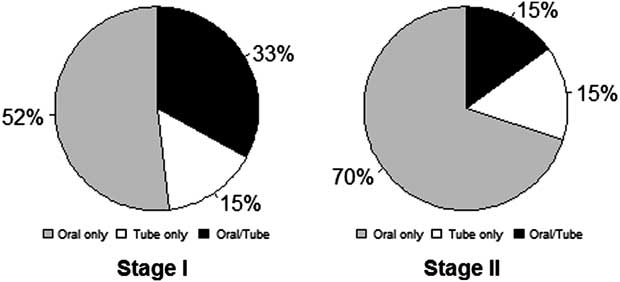
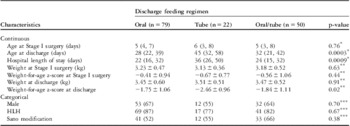
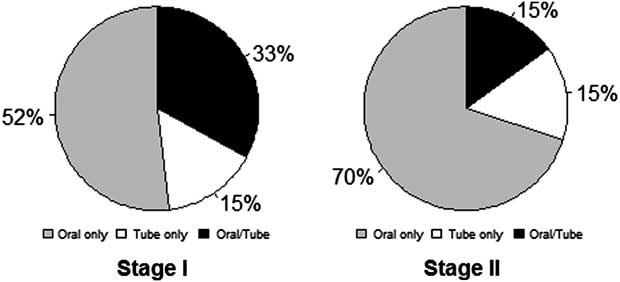
As shown in Figure 1, the feeding regimen at discharge from Stage I Norwood was oral only in 79 (52%) infants including four breastfed infants; tube only in 22 infants (15%), including 13 by gastrostomy and nine by nasogastric tube; and oral with tube supplementation in 50 (33%) infants. The mean, median, and mode caloric concentration of feedings at Stage I discharge – excluding breastfed infants – was 25.3, 26, and 27 calories/ounce, respectively. Daily caloric intake at discharge averaged 120 kilocalories per kilogram. There was no significant difference in discharge formula concentration (p = 0.26) or kilocalories per kilogram body weight per day (p = 0.27) among the feeding groups. Demographic and clinical characteristics by discharge feeding regimens are shown in Table 1. There were no significant differences between the feeding groups at Stage I surgery related to age, weight, weight-for-age z-score, or shunt type. Tube-only-fed infants had a significantly longer Stage I median length of stay (36 days) in comparison with oral-only (22 days) and oral/tube-fed infants (24 days), p < 0.001, but Stage I discharge weight did not significantly differ among the groups (p = 0.91). Tube-only-fed infants were significantly older at Stage I discharge (p = 0.0003) and had a significantly lower mean weight-for-age z-score at discharge, p = 0.02. Tube-only-fed infants also had a significantly higher incidence of reported oral motor dysfunction (p < 0.0001), swallowing dysfunction (p < 0.0001), and gastro-oesophageal reflux (p < 0.001) than oral-only-fed infants and a significantly higher incidence of oral motor dysfunction (p < 0.001) and swallowing dysfunction (p < 0.001) than infants fed orally with tube supplementation. There were no significant differences among the feeding groups related to the incidence of neurologic, renal, or pulmonary complications; use of extracorporeal membrane oxygenation; or duration of inotropes greater than 1 week during Stage I hospitalisation. However, infections were reported more frequently in the group of infants fed by tube only (45%) compared with 16% in infants with oral/tube feeding and 34% in infants with oral-only feeding, p = 0.02.
Title – Distribution of infants by feeding regimen at Stage I discharge and Stage II surgery. Caption – Proportion of infants feeding by oral only, tube only or oral with tube supplementation regimens.
Demographic and clinical characteristics at Stage I by discharge feeding regimen.

SD = standard deviation; IQR=interquartile range; HLH=hypoplastic left heart
Continuous variables are reported as mean ± SD or median (IQR) if data are heavily skewed
Categorical variables are reported as frequency (percentage)
*Kruskal–Wallis rank-sum test
**One-way ANOVA
***Chi-square test with Yates’ correction
****Fisher's exact test
During the interstage period, average daily caloric intake did not differ significantly between the feeding groups, 114.81 plus or minus 23.54 kilocalories per kilogram in infants fed orally only, 107.51 plus or minus 16.23 kilocalories per kilogram in infants fed only by tube, 113.10 plus or minus 16.54 kilocalories per kilogram in infants fed orally with tube supplementation. Approximately 80% (121) of infants were re-hospitalised during the interstage period. The median days of hospitalisation during the interstage period was 3 days, ranging from 0 to 127 days, with no significant differences between feeding groups (p = 0.44). Approximately 20% of hospitalisations were feeding/gastrointestinal related, and one-third with concomitant oxygen desaturation.
In 53 infants, the feeding regimen changed between Stage I discharge and Stage II surgery. The feeding regimen at Stage II (Fig. 1) was oral in 106 (70%) including three who continued breastfeeding, nasogastric or gastrostomy tube only in 23 (15%) infants, and oral with tube supplementation in 22 (15%) infants. In 38 of the 50 infants initially discharged on oral with tube supplementation, 29 were feeding exclusively orally and nine were feeding exclusively by tube at admission for Stage II surgery, with the remaining 12 continuing to receive tube supplementation of oral feeding. For all analyses, however, as previously noted, the infants were classified on the basis of their feeding regimens at discharge from Stage I surgery.
The median age of infants at Stage II surgery was 141 days (interquartile range 114–171 days), with tube-only-fed infants being significantly older at Stage II (median 162 days) than infants with exclusively oral feeding (median 133 days) or infants with oral plus tube supplementation (median 149 days) at Stage I discharge, p = 0.004. As shown in Table 2, there were no significant differences among feeding groups in weight or weight-for-age z-scores at Stage II surgery.
Characteristics at Stage II admission by discharge feeding regimen.

IQR = interquartile range; SD=standard deviation
Continuous variables are reported as mean ± SD or median (IQR) if data are heavily skewed
*Kruskal–Wallis rank-sum test
**One-way ANOVA
Interstage change in weight was compared between feeding groups using regression-based analysis of variance (Table 3). There were significant differences in average daily interstage weight gain among the three feeding groups, oral only 25.0 plus or minus 7.7 grams per day, oral with tube supplementation 21.4 plus or minus 6.7 grams per day, tube only 22.3 plus or minus 6.5 grams per day (p = 0.019). Tube-only-fed infants had a greater change in weight-for-age z-score from Stage I discharge to Stage II surgery, p = 0.007, as shown in Table 3.
Change in weight from Stage I discharge to Stage II admission.

p-values are reported from ANOVA analysis
The average daily interstage weight gain was not significantly associated with Stage I age (p = 0.63), shunt type (p = 0.61), weight at Stage I discharge (p = 0.30), Stage I hospital length of stay (p = 0.28), or number of days hospitalised during the interstage period (p = 0.26). There was a significant correlation between average daily interstage weight gain and birth weight (r = 0.19, p = 0.02). Similarly, change in weight-for-age z-score was not significantly associated with Stage I age (p = 0.09), shunt type (p = 0.19), weight at Stage I discharge (p = 0.24), or number of days hospitalised during the interstage period (p = 0.13), and was not significantly correlated with birth weight (p = 0.10). Interstage change in weight-for-age z-score, however, was significantly correlated with Stage I hospital length of stay (r = 0.24, p = 0.003).
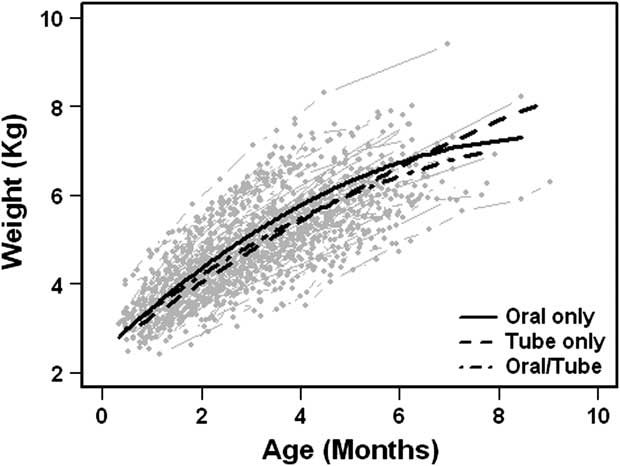
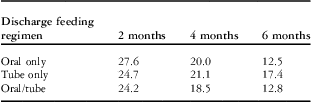
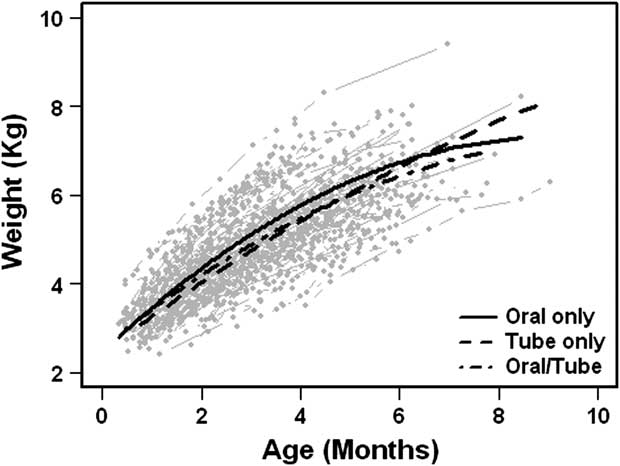
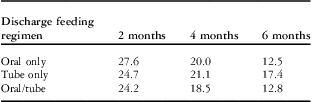
To examine changes in the rate of weight gain over time, a linear mixed effects model was fitted to account for the correlation between repeated measurement within a subject and the variation between subjects. The overall rate of weight gain was 16–32 grams per day for study infants, similar to infant norms. However, the rate of weight gain declined over time and varied among feeding groups as shown in Figure 2. The generated growth curves showed an earlier decline in weight gain velocity for oral-only- and oral/tube-fed infants (less than 15 grams per day at 5.36 months) in comparison with tube-only-fed infants (less than 15 grams per day at 8.64 months). Table 4 also shows the different rates of weight gain at 2 months, 4 months, and 6 months of age for the three feeding groups. Infants in the oral-only group had the greatest decline in the rate of weight gain from 27.6 grams per day at 2 months of age to 12.5 grams per day at 6 months of age. At 6 months of age, tube-only-fed infants had the greatest rate of weight gain at 17.4 grams per day.
Title – Weight change over time. Caption – The regression equation for oral-only-fed infant is weight (kg) = 2.75 + 1.06 age −0.057 age2 −0.012 HLS; the regression equation for tube-only-fed infants is weight (kg) = 2.75 + 0.83 age −0.022 age2 −0.012 HLS; the regression equation for oral/tube-fed infants is weight (kg) = 2.86 + 0.90 age −0.042 age2 −0.012 HLS. The curves imposed upon the individual's weight data are fitted growth curves for different feeding regimens after adjusting for the effect of hospital length of stay at the median of 24 days; HLS=hospital length of stay.
Rate of weight gain (grams per day) at different ages by discharge feeding regimen.
Discussion
Significant growth failure has been reported in infants with single ventricle or hypoplastic left heart syndrome undergoing staged reconstruction,Reference Kelleher, Laussen, Teixeira-Pinto and Duggan1–Reference Atz, Jenkins and Brook3 prompting the use of alternative feeding strategies to promote more aggressive nutritional therapy when oral intake is poor. In this study, nearly half of all infants were discharged with either nasogastric tube feedings as a supplement to oral feeding or exclusive tube feeding generally via gastrostomy or nasogastric tube. This is consistent with the consensus study by Wernovsky et al,Reference Wernovsky, Ghanayem and Ohye9 reporting 39% of institutions discharging patients with a nasogastric tube and 18% having a gastrostomy tube placed surgically when oral intake was poor during Stage I hospitalisation. Our study was the first multi-centre prospective study to evaluate the impact of feeding strategy on interstage weight gain outcomes. We found that whereas infants fed orally had significantly greater average daily interstage weight gain (25 grams per day), infants discharged with supplemental tube feeding and tube feeding alone achieved an average daily weight gain of 21 grams per day and 22 grams per day, respectively, comparable to infant norms. Medoff-Cooper et al,Reference Medoff-Cooper, Irving and Marino12 found that the change in weight-for-age z-score between surgery and discharge was significantly better (less negative) in infants exclusively on oral feedings than in neonates who required tube support; however, weight-for-age z-score decreased in all groups, irrespective of the mode of feeding. In our study and in contrast to the findings of Srinivasan et al,Reference Srinivasan, Jaquiss and Morrow13 as shown in Table 3, we did not observe a decline in weight-for-age z-score during the interstage period. Kelleher et al,Reference Kelleher, Laussen, Teixeira-Pinto and Duggan1 identified aggressive nutritional therapy as a positive correlate of improved nutritional status during Stage I hospitalisation. It is likely that the frequent monitoring of weight by parents and healthcare providers during the interstage period in study infants prompted interventions that promoted weight gain including adjustments in formula caloric concentration or volume of feeding in tube-fed infants. The majority of participating institutions discharged infants on a home surveillance protocol, which included daily monitoring of feeding and weight gain.
Our findings show that many infants were not able to sustain adequate weight gain beyond 5 months of age, especially infants fed orally with or without tube supplementation at discharge. The greater average daily weight gain observed in infants fed exclusively orally may partly reflect their younger age at Stage II, before the observed decline. Tube-only-fed infants had a later Stage II with a slower decline in the rate of weight gain, allowing them to achieve a Stage II weight and weight-for-age z-score similar to the other feeding groups, but at an older age. Ghanayem et al,Reference Ghanayem, Hoffman and Mussatto14, Reference Ghanayem, Tweddell, Hoffman, Mussatto and Jaquiss15 have also reported a significant decline and flattening in growth velocity after 4 months of age, suggesting this reflects the limited durability of the first stage of palliation. The authors propose that the decline in somatic growth supports the concept of moving the elective performance of the second stage of surgery to a younger age. Furthermore, their data suggest that frequent monitoring of oxygen saturation and weight gain was useful in selecting patients at increased risk of interstage death.Reference Ghanayem, Hoffman and Mussatto14 Interstage mortality in infants in our study was only 2.6%, significantly lower than the mortality reported for infants without such monitoring reported at between 10% and 15%.Reference Srinivasan, Sachdeva and Robert11, Reference Ghanayem, Hoffman and Mussatto14, Reference Simsic, Bradley, Stroud and Atz16, Reference Hehir, Dominguez and Ballweg17 Among the four infants who died, two within 5 days of discharge, three were tube feeding only and one was feeding orally.
Other potential correlates of weight gain in infants with single ventricle following Norwood operation were evaluated. It has been hypothesised that utilisation of a right ventricle to pulmonary artery conduit instead of a modified Blalock–Taussig shunt might improve perfusion to the gastrointestinal tract, decreasing the risk for failure to thrive due to feeding problems;Reference Kelleher, Laussen, Teixeira-Pinto and Duggan1 however, we observed no difference in weight gain related to shunt type. Better weight gain in infants with right ventricular to pulmonary conduits than in the modified Blalock–Taussig shunt group (20.6 grams per day versus 16.5 grams per day) was reported by Lai et al;Reference Lai, Laussen and Cua18 however, infants in the latter group were significantly older at bidirectional Glenn (median age 5.8 months versus 4.5 months) resulting in no difference in weight at Stage II, perhaps reflecting decreased rate of weight gain with advancing age, consistent with our findings. In contrast to Kelleher et al,Reference Kelleher, Laussen, Teixeira-Pinto and Duggan1 who found that infants with more frequent interstage readmissions had a lower weight-for-age z score at Stage II, we found no significant correlation between average daily interstage weight gain or change in weight-for-age z-score and the number of days hospitalised during the interstage period. Although longer Stage I hospital length of stay was not predictive of average daily interstage weight gain in our study, infants discharged on exclusively nasogastric or gastrostomy tube feedings had a longer Stage I length of stay, a lower weight-for-age z-score at discharge, and a higher incidence of post-operative infections during their hospitalisation. Wernovsky et al,Reference Wernovsky, Ghanayem and Ohye9 also found that wound infection and a positive blood culture were variables associated with a longer Norwood hospital length of stay. As noted by Steltzer et al,Reference Steltzer, Rudd and Pick19 the immune system is adversely affected by undernutrition. Inadequate oral caloric intake may have contributed to increased infections in these infants, which further increased their already elevated baseline energy expenditure, compromised their weight gain, and contributed to the need for home tube feedings. Finally, Anderson et al,Reference Anderson, Beekman and Eghtesady20 reported that z-scores for weight at bidirectional Glenn were lower in infants with lower weight-for-age z-scores at neonatal discharge. They suggest that more intensive nutritional interventions could change this outcome and improve growth in this population, as we believe infants in our study population experienced. Investigators from the Pediatric Heart Network Infant Single Ventricle trial found that administration of enalapril to infants with single-ventricle physiology in the first year of life did not improve somatic growth, ventricular function, or heart failure severity; however, superior cavopulmonary connection surgery resulted in significant ventricular remodelling and catch-up growth.Reference Hsu, Zak and Mahoney21 Most recently, based on a multivariable model, they reported that a greater increase in weight-for-age z-score at 14 months of age in these infants with single ventricle was associated with greater daily caloric intake and younger age at cavopulmonary conncection.Reference Williams, Zak and Ravishankar22
The major strengths of our study are the large multi-centre sample and the prospective interstage data collection. Some might contend that the better average daily interstage weight gain in infants who were able to be discharged feeding orally without tube supplementation reflects their general state of better health, with tube feedings being necessary in sicker babies having higher metabolic needs, consistent with their longer hospital length of stay and greater decline in weight-for-age z-score during hospitalisation. However, there is increasing evidence suggesting that nutritional support, a modifiable factor to promote weight gain, may play an important role in improving outcomes.Reference Kelleher, Laussen, Teixeira-Pinto and Duggan1, Reference Anderson, Beekman and Border5, Reference Williams, Zak and Ravishankar22, Reference Pilo-Blocka, Adatia, Sharieff, McCrindle and Zlotkin23 Suboptimal nutritional support during Stage I hospitalisation may leave some infants nutritionally disadvantaged during the interstage period. Tube feeding in our infants who had a more prolonged hospital stay may have facilitated their “catch-up” in weight-for-age z-score following discharge. We are unable to ascertain the reason for prolonged hospitalisation, as data regarding the hospital course of the study infants during their Stage I hospitalisation is limited with respect to variables such as in-hospital nutritional management, pre-operative intubation, post-operative length of mechanical ventilation, and the nature of infections and other post-operative complications. Another potential study limitation is the well-known considerable variation in clinical practice between and/or within centres.Reference Wernovsky, Ghanayem and Ohye9 In addition, as infants in this study were not assigned to a specific feeding regimen, some infants did change feeding regimen during the interstage period. However, regression analysis of weight change over time based on the 98 infants who did not change their feeding method gave similar results to the selected models based on 151 patients. Finally, we have speculated that the good weight gain achieved by infants in this study, independent of feeding method, reflects the close monitoring associated with the study (Hawthorne effect) and the nutritional interventions initiated in response to the monitoring. Study coordinators reported changes in the caloric concentration or volume of feedings in response to study monitoring, but nutritional management varied among clinicians and was not sufficiently documented to allow analysis.
Conclusions
Following Stage I Norwood, infants discharged on oral feeding had better average daily weight gain than infants with tube-assisted enteral feeding. However, the use of nasogastric or gastrostomy feeding routes is common in these infants to provide optimal nutritional support in infants unable to achieve adequate oral intake. The overall weight gain after discharge was within the normal limits in all feeding groups. Increased provider/parent nutritional monitoring may have promoted weight gain in study infants, supporting the utility of surveillance to optimise weight gain outcomes. The rate of weight gain, however, decreased over time, especially in infants fed orally. As weight gain was not sustained with advancing age, it should be considered in timing of Stage II interventions. Future prospective multi-centre studies are needed to examine the relationship between nutritional interventions and clinical outcomes, including cognitive and neurodevelopmental outcomes in children with complex congenital heart disease.
Acknowledgement
We thank the local (Cincinnati) Pediatric Heart Research Association for their donation of funds to support the purchase of infant scales and supplies used in the study and for our home surveillance programme.