





Eating disorders affect at least 1.4 million people in the UK. 1 The most studied are anorexia nervosa, which presents as severe weight loss (body mass index [BMI] < 18.5 kg/m2) caused by restriction or excessive exercise with a perception of fatness despite low weight; 2 bulimia nervosa, which involves binge eating followed by compensatory behaviours such as self-induced vomiting; and binge-eating disorder, which presents as binge eating without compensation. 2 Treatment outcomes for eating disorders are poor, Reference Broadbent and Schmidt3–Reference Linardon6 but interventions are most successful when delivered at first onset. Reference Solmi, Radua, Olivola, Croce, Soardo and Salazar de Pablo7 Thus, early intervention is important. Reference Bould, Newbegin, Stewart, Stein and Fazel8
Age at onset of eating disorders and treatment in the UK
Early identification should target the transition from adolescence into emerging adulthood, as this is when eating disorders typically begin. A meta-analysis (k = 192) summarised retrospectively reported median age at symptom onset: Reference Solmi, Radua, Olivola, Croce, Soardo and Salazar de Pablo7 anorexia nervosa was 16 years, bulimia nervosa was 18 years, and binge-eating disorder was 20 years. Reference Hudson, Hiripi, Pope and Kessler9–Reference Taylor, Caldwell, Baser, Faison and Jackson11 No UK samples were included, which we address with our study. In the UK, authorities require treatment to be delivered in age-appropriate settings, Reference Winston12 and patients turning 18 years old move to adult services. This transition lacks structure and is complicated by changes in treatment, social environment, and family structure. Reference Winston12 A 2019 National Health Service (NHS) England Guidance called for a seamless transition pathway. 13 Moreover, eating disorder symptoms differ by onset; compared with adolescent onset (13–20 years), children (<13 years) report less binge eating, purging, or excessive exercise for weight loss, Reference Peebles, Wilson and Lock14,Reference Walker, Watson, Leach, McCormack, Tobias and Hamilton15 and lose weight at a faster pace. Reference Peebles, Wilson and Lock14 Adolescent onset of anorexia nervosa shows lower death rates and better long-term outcomes than later onset, Reference Steinhausen16 whereas onset in childhood shows worse outcomes. Reference Herpertz-Dahlmann and Dahmen17,Reference Grilo and Udo18
Genetics of eating disorders and their age at onset
Genetic risk may contribute to differences in age at onset, as eating disorder symptoms are heritable. Twin-based heritability estimates range from 0 to 66% for anorexia nervosa-specific symptoms, 43–72% for bulimia nervosa-specific symptoms, and 41% for binge eating in the absence of compensatory behaviours (a core symptom specific to binge-eating disorder; see Supplementary Table 1 including references). Evidence shows that early onset may reflect greater genetic susceptibility. Reference Hilker, Helenius, Fagerlund, Skytthe, Christensen and Werge19–Reference Kalman, Olde Loohuis, Vreeker, McQuillin, Stahl and Ruderfer24 For example, higher polygenic scores (PGSs) for schizophrenia, major depressive disorder, and autism spectrum disorder were significantly associated with a younger age at onset of bipolar disorder. Reference Kalman, Olde Loohuis, Vreeker, McQuillin, Stahl and Ruderfer24 The lack of an association between the bipolar disorder PGS and bipolar disorder age at onset may be attributable to a lack of predictive power resulting from a less well-powered discovery genome-wide association study (GWAS). The Brainstorm Consortium reported a modest negative correlation between average age at onset and heritability across 22 brain disorders, including anorexia nervosa. Reference Anttila, Bulik-Sullivan, Finucane, Walters and Bras25 For instance, Tourette’s syndrome showed 20% heritability with an average onset of 7 years, and major depressive disorder showed 13% heritability with an average onset of 32 years. Reference Anttila, Bulik-Sullivan, Finucane, Walters and Bras25 However, there were a number of outliers: schizophrenia showed a single-nucleotide polymorphism (SNP)-based heritability of 26% with an average age at disorder onset of 21 years. Adult-onset attention-deficit hyperactivity disorder (ADHD) is associated with a lower ADHD PGS than childhood onset, suggesting distinct subtypes, with the former being more environmentally influenced, less consistent or milder. Reference LaBianca, Brikell, Helenius, Loughnan, Mefford and Palmer26 Sex-specific genetics may also play a role in onset: early-onset schizophrenia in females may reflect greater genetic susceptibility, whereas males may accumulate more environmental risks. Reference Hilker, Helenius, Fagerlund, Skytthe, Christensen and Werge19 Such findings emphasise how genetic risk interacts with early environment and sex at birth.
Genome-wide complex trait analysis using genomic-relatedness-based restricted maximum-likelihood (GCTA-GREML) of the age at diagnosis of anorexia nervosa showed a SNP-based heritability of 1%, with 21% for early onset (diagnosis <13 years, assuming a lifetime prevalence of 0.3%) and 15% for typical onset (>13 years, assuming a lifetime prevalence of 4%) (Supplementary Table 1), suggesting that earlier onset may be partially driven by genetics. Reference Watson, Thornton, Yilmaz, Baker, Coleman and Adan27 Early onset showed a negative genetic correlation with age at menarche, and Mendelian randomisation suggested a causal role of younger age at menarche in early-onset anorexia nervosa. Reference Watson, Thornton, Yilmaz, Baker, Coleman and Adan27 These findings indicate distinct subphenotypes influenced by puberty timing. An age-at-menarche PGS also correlated negatively with binge-eating disorder Reference Abdulkadir, Herle, Loos, Breen and Bulik28 and positively with adolescent persistent thinness, Reference Abdulkadir, Herle, Palmos, Loos and Breen29 suggesting broader relevance for eating disorders and weight phenotypes beyond anorexia nervosa.
Aims
As of 2026, the genetics of eating disorder symptoms and their clinical course, including onset and severity, have been minimally investigated. Therefore, we performed a two-fold investigation: (a) phenotypic analysis exploring the age at onset of low weight and behavioural symptoms, including binge eating, self-induced vomiting, diuretic and laxative use, fasting, and excessive exercise, in a large UK sample; and (b) a genetic analysis to assess the SNP-based heritability and cross-trait polygenic risk score association of (i) behavioural eating disorder symptoms and low weight and (ii) their age at onset, and (iii) cognitive symptoms and (iv) their severity.
Method
Sample
Participants were from the National Institute for Health and Care Research (NIHR) BioResource (n = 70 442) who participated in the Genetic Links to Anxiety and Depression (GLAD) Study Reference Davies, Kalsi, Armour, Jones, McIntosh and Smith30 (n = 46 802), the Eating Disorders Genetics Initiative Reference Monssen, Davies, Kakar, Bristow, Curzons and Davies31 (EDGI UK; n = 6393) or other physical health and general population cohorts (n = 17 247) whose participants took part in the COVID-19 Psychiatry and Neurological Genetics (COPING) study (Supplementary Table 2). The COPING study provided complementary data for GLAD Study and EDGI UK participants in their sign-up survey. Reference Davies, Hübel, Herle, Kakar, Mundy and Peel32
We excluded 45 469 participants missing sex (measured via self-reported assigned sex at birth; n = 1826), age (n = 1474) or eating disorder symptoms (n = 41 321). The ED100K was optional in the GLAD Study, which explains the high missingness. We excluded 1322 participants with inflammatory bowel disease (IBD) or inflammatory bowel syndrome (IBS) at random, to match the general population’s illness prevalence of 1.2% and between 10 and 20%, respectively. 33 We checked prevalence in cases and controls separately; 11.5% of cases had IBS, which we matched in the control sample. Oversampling for these conditions could confound the analyses by introducing symptom and genetic effects related to IBD/IBS, making it harder to identify associations specific to eating disorders. A total of 24 973 individuals reported at least one eating disorder symptom, and 16 846 had age at onset data. We excluded 337 participants with genetically inferred non-European ancestry via principal components analysis. We removed genetic variants with minor allele frequency <1%, that were missing in >5% of participants, or that deviated from Hardy–Weinberg equilibrium (p < 10−10). We excluded participants with >5% missing variants, with undetermined genetic sex or with high mean identity-by-descent to other participants (n = 409), leaving 15 559 individuals with both phenotypes and genetic data. For the PGS analysis, we removed UK Biobank participants (n = 1132) to avoid sample overlap with discovery GWASs conducted within the UK Biobank.
Ethical approval
The authors assert that all procedures contributing to this work comply with the ethical standards of the relevant national and institutional committees on human experimentation and with the Helsinki Declaration of 1975, as revised in 2013. The London – Fulham Research Ethics Committee approved the GLAD Study on 21 August 2018 (reference: 18/LO/1218) and EDGI UK study on 29 July 2019 (reference: 19/LO/1254). The NIHR BioResource is approved as a Research Tissue Bank by the East of England – Cambridge Central Committee (reference: 17/EE/0025). The COPING study is approved by the South West – Central Bristol Research Ethics Committee on 27.04.2020 (reference: 20/SW/0078). All participants provided informed consent.
Measures
Behavioural eating disorder symptoms and low weight
Participants reported binge eating, low weight, self-induced vomiting, laxative use, diuretic use, fasting and excessive exercise via the ED100K (Supplementary Table 3). Reference Thornton, Munn-Chernoff, Baker, Juréus, Parker and Henders34 This questionnaire was included in the sign-up survey in the EDGI UK and COPING study and was optional in the GLAD Study. We identified participants who reported a lifetime symptom and as a comparison, participants who endorsed not having experienced that symptom and who were not recruited on the basis of having a psychiatric condition (i.e. were not participants of the GLAD Study or EDGI UK).
Participants endorsing a symptom could report the age at onset (Supplementary Table 3): for example, ‘Roughly how old were you when you began having regular episodes of binge eating?’. For binge eating, participants must endorse loss of control (13 excluded). We removed implausible responses younger than 3 and older than 118 years (257 excluded) and ages that exceeded the participant’s current age (58 excluded).
Cognitive symptoms
Participants reported the severity of five cognitive symptoms on Likert scales: (a) self-worth being dependent on body shape or weight when at low weight and (b) when binge eating, (c) fear of weight gain at low weight, (d) feeling fat at low weight and (e) feeling that body parts are larger than they are at low weight (Supplementary Table 3). We generated binary (symptom present or absent) and continuous (severity scores) variables for all symptoms except ‘feeling that body parts are larger’, which we retained as a three-point scale (‘not at all’, ‘somewhat’, ‘very much’). For the remaining continuous variables, we excluded participants who endorsed absence of the symptom, creating severity scales ranging from four to six points (depending on the symptom), which reflect the range in those with the symptom.
Analysis
This paper has been preprinted. Reference Davies, ter Kuile, Lee, Wang, Mundy and Ahmad35 We used R version 4.1.2 (R Foundation for Statistical Computing, Vienna, Austria; https://hero.epa.gov/hero/index.cfm/reference/details/reference_id/7469942).
Retest-reliability of retrospective self-reported age at onset
A small subsample of participants completed the ED100K twice: first, optionally in the GLAD Study and second, mandatorily in the COPING study (n = 239–1805 participants, depending on symptom). We assessed participants’ reliability of their retrospective reports by calculating the difference between both answers. For our analyses, we used participants’ most recent responses.
Phenotypic analysis
Age at onset
We described combined and sex-stratified age at onset. We calculated percentages in onset categories by sex: (a) childhood, ≤12 years; (b) adolescence, 13–17 years; (c) emerging adulthood, Reference Potterton, Richards, Allen and Schmidt36 18–25 years and (d) adulthood, ≥26 years. We additionally explored the role of sex and gender by regressing behavioural symptoms and low weight and their age at onset on sex (male/female) and gender (man/woman/transgender/non-binary).
Genetic analysis
SNP-based heritability
Using GCTA-GREML, Reference Yang, Lee, Goddard and Visscher37 we estimated SNP-based heritabilities in females only (insufficient male cases, n maximum = 665). Population prevalences for liability-scale estimation of behavioural symptoms and low weight were estimated from the part of the sample not ascertained for a psychiatric condition. We used our sample’s prevalence estimates for the cognitive symptoms, as they are likely to best reflect the population prevalence given that they exist only in cases (e.g. feeling fat at low weight). We estimated SNP-based h 2 for quantitative and binary age at onset, split into adult (≥18 years) and child/adolescent onset (<18 years). Quantitative traits were right-skewed and thus square-root transformed to approximate normality (Supplementary Fig. 1). We assessed cognitive symptom severity with linear models, assuming an underlying latent normal distribution.
Analyses were adjusted for genotyping batches and ten genetic principal components. Because age is correlated with differences in reporting onset between the GLAD and COPING studies (r = 0.14–0.28), we controlled for age in an additional analysis of onset.
Cross-trait polygenic associations
We created psychiatric, anthropometric, social, behavioural, somatic, and personality PGSs (for discovery GWASs, see Supplementary Table 4) by using SBayesRC. Reference Zeng, Zheng, Liu, Sidorenko, Yengo and Turley38 Using linear and logistic (binary and ordinal) regressions, we used these PGSs as exposure variables and explored their associations with the following outcomes: (a) behavioural symptoms and low weight and (b) their age at onset, and (c) cognitive symptoms and (d) their severity in both females and males (where sample size allowed). PGSs were standardised. We used the same adjustment variables as above. We corrected for multiple testing by using a false discovery rate with a threshold of 0.01.
Results
Sample descriptives
Participants had an average age of 45 years (s.d. = 18), were majority female (73.5%), most self-reported their race as White (96.2%) and 18% had a Master’s degree or above (for full details, see Supplementary Table 5).
Test–retest reliability of retrospective self-reported age at onset
Binge eating showed the largest discrepancies in reported age at onset between first and second reporting in the GLAD and COPING studies, with 12.0% of the differences exceeding 10 years compared with 3.1–8.5% for the other eating disorder symptoms (Supplementary Table 6; Supplementary Fig. 2). The mean and median differences ranged from 2 to 4.4 years and 1 to 2 years, respectively. However, the correlations between both assessment time points ranged from 0.69 to 0.85 for all symptoms, indicating acceptable test–retest reliability (Supplementary Table 6).
Phenotypic analysis
Age at onset
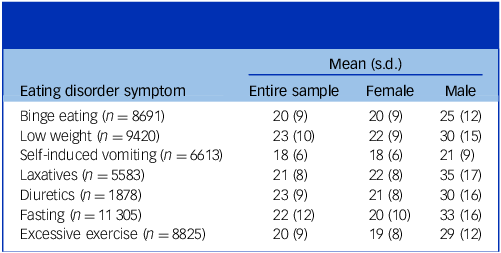
Self-induced vomiting had the youngest mean onset at 18 years in females (Table 1; Supplementary Table 7; Fig. 1(a)). Fasting and laxative use in males had the oldest mean onset at 33 and 35 years, respectively. Males consistently showed an older mean age at onset than females across all symptoms; for example, the mean age at onset of binge eating was 20 years in females but 25 years in males. To assess the influence of reporting bias on our outcome distributions, we excluded participants whose discrepancy between two reported ages of symptom onset exceeded 5 years, showing minimal difference in the outcome distributions (Supplementary Table 8).
(a) Sex-stratified age at onset of behavioural eating disorder symptoms and low weight; (b) sex-stratified age at onset split into four categories: childhood, adolescence, emerging adulthood and adulthood.

Mean age at onset of each phenotype in the entire sample, split by sex

Table 1 Long description
A table comparing the mean age at onset of various eating disorder symptoms across the entire sample, females, and males. The table has 7 rows and 4 columns. Column headers are Eating disorder symptom, Entire sample, Female, and Male. Row labels include Binge eating, Low weight, Self-induced vomiting, Laxatives, Diuretics, Fasting, and Excessive exercise. Each row provides the mean age at onset and standard deviation for each symptom. For example, Binge eating has a mean age of 20 years with a standard deviation of 9 for the entire sample, 20 years with a standard deviation of 9 for females, and 25 years with a standard deviation of 12 for males. The table shows that males consistently have an older mean age at onset than females across all symptoms.
Females more frequently reported adolescent onset (35–53%) than males (12–34%), whereas males more frequently reported adult onset (25–71%) than females (9–32%) (Fig. 1(b); Supplementary Table 9). Further, more females than males reported onset in childhood of excessive exercise (16 v. 2%) and fasting (16 v. 4%).
Compared with men, all other gender groups (non-binary, transgender and women) reported significantly earlier ages at onset, with differences ranging from approximately 4 to 18 years (Supplementary Table 10). For symptom presence, the sample included sufficient numbers of women and men without the symptoms to estimate odds ratios; women had significantly greater odds of all symptoms than men (odds ratios between 6.71 and 23.16). Compared with being male, being female was also associated with significantly greater odds of all symptoms (odds ratios ranging from 6.7 to 22.05; Supplementary Table 10) and with younger age at onset (ranging from 4 to 12 years younger).
Genetic analysis
SNP-based heritability
We detected significant SNP-based heritability for all behavioural symptoms and low weight (Fig. 2; Supplementary Table 11; Supplementary Table 12 shows a range of liability-scale estimations). Diuretic use had the highest heritability estimate (0.78 [s.e. = 0.10]), whereas fasting was the least heritable (0.31 [s.e. = 0.08]).
Genome-wide complex trait analysis using genomic-relatedness-based restricted maximum-likelihood and twin heritability estimates in females of lifetime presence of binge eating, low weight, self-induced vomiting, diuretics, laxatives, excessive exercise, and fasting. References for twin heritability estimates are in Supplementary Table 1. Covariates included ten principal components and genotyping batches. Prevalence of lifetime symptoms for liability-scale conversion is calculated from the National BioResource sample (i.e. participants not recruited on the basis of having a psychiatric condition). p-values are adjusted via false discovery rate. GCTA, genome-wide complex trait analysis.

Neither the continuous nor the binary age-at-onset phenotypes showed a significant heritable component after correcting for multiple testing (Supplementary Fig. 3; Supplementary Table 11) or adjusting for age (Supplementary Table 13). GCTA-GREML power calculations Reference Visscher, Hemani, Vinkhuyzen, Chen, Lee and Wray39 indicated that our smallest sample (n diuretic use = 979) translated to 9% power to detect a heritability of 0.20 and 80% power to detect a heritability of 0.90. Our largest sample (n fasting = 5668) had 95% power to detect a heritability >0.20, suggesting that the maximum heritability of this symptom’s continuous age-at-onset phenotype is <0.20. With this phenotype, we had 15% power to detect a heritability of 0.05, as was found for depression by Harder et al. Reference Harder, Nguyen, Pasman, Mosing, Hägg and Lu21
We did not identify heritable components for cognitive symptoms or their severity at the current sample size (Supplementary Fig. 3; Supplementary Table 11). Power calculations indicated that our largest sample sizes (n symptom = 4849 and n severity = 4273) were 100% powered to detect a heritability of 0.50 and 0.30, respectively, placing an upper limit on the likely heritabilities of these phenotypes.
Cross-trait polygenic associations
We observed multiple consistent significant associations across the behavioural symptoms and low weight in females (Fig. 3; Supplementary Table 14) and males (Supplementary Fig. 4; Supplementary Table 15). For example, the ADHD PGS was associated with greater odds of all symptoms in females (odds ratios of 1.12–1.36, qs< 0.001) and with binge eating and excessive exercise in males (binge eating: odds ratio 1.35, 95% CI 1.17–1.56, q = 0.001; excessive exercise: odds ratio 1.19, 95% CI 1.07–1.32, q = 0.01). Other PGSs showed diverging associations. For example, for each standard deviation increase in the childhood obesity PGS in females, the odds of reporting low weight were lower by 0.15 (95% CI 0.8–0.91, q < 0.001), but 0.14 higher for reporting binge eating (95% CI 1.05–1.24, q = 0.003), and showed no significant associations with any other symptom.
Anthropometric, psychiatric, social, behavioural, somatic, and personality polygenic risk score associations with lifetime behavioural eating disorder symptoms and low weight in females. ADHD, attention-deficit hyperactivity disorder; BMI, body mass index; OCD, obsessive–compulsive disorder; PTSD, post-traumatic stress disorder.

Fig. 3 Long description
The image contains a series of forest plots showing the odds ratios of various conditions and behaviors associated with different eating disorder symptoms. Each plot represents a different condition or behavior, with the horizontal axis indicating the odds ratio ranging from 0.6 to 1.6. The vertical axis lists the conditions and behaviors, including ADHD, age at menarche, alcohol dependence, alcohol use, anorexia nervosa, anxiety, autism spectrum disorder, bipolar disorder, BMI, cannabis use, childhood obesity, educational attainment, household income, insomnia, major depressive disorder, neuroticism, OCD, panic disorder, PTSD, risk-taking behavior, schizophrenia, smoking (heavy), smoking (lifetime), social deprivation (Townsend), tiredness, and type 2 diabetes. Each plot includes data points for different eating disorder symptoms: binge eating, self-induced vomiting, diuretics, excessive exercise, low weight, laxatives, and fasting. The data points are color-coded to represent these symptoms, with black lines indicating non-significant results. The plots show the relationship between each condition or behavior and the various eating disorder symptoms, highlighting significant associations and trends.
Three PGSs were negatively associated with age at onset in females (Supplementary Table 16) and none in males (Supplementary Table 17). In females, higher childhood obesity PGS was associated with a younger onset of binge eating (β = −0.58, 95% CI −0.83 to −0.32, q = 0.002), with each standard deviation increase in the PGS corresponding to, on average, an earlier onset of approximately 7 months. Similarly, each standard deviation increase in higher educational attainment PGS was associated with an earlier onset of low weight of approximately 6 months (β = −0.54, 95% CI −0.81 to −0.27, q = 0.007), whereas each standard deviation increase in schizophrenia PGS was associated with an earlier onset of fasting of approximately 7 months (β = −0.53, 95% CI −0.81 to −0.26, q = 0.007).
We identified some significant PGS associations with cognitive symptoms and their severity in females (Supplementary Tables 18 and 19) and none in males (Supplementary Tables 20 and 21). In females, being afraid of weight gain was associated with anorexia nervosa PGS (odds ratio 1.18, 95% CI 1.09–1.28, q = 0.001), BMI PGS (odds ratio 1.25, 95% CI 1.15–1.36, q < 0.001) and childhood obesity PGS (odds ratio 1.25, 95% CI 1.16–1.35, q < 0.001). Feeling fat at low weight was also associated with BMI PGS (odds ratio 1.26, 95% CI 1.18–1.36), q < 0.001) and childhood obesity PGS (odds ratio 1.18, 95% CI 1.10–1.26, q < 0.001). Further, severity of feeling fat at low weight was positively associated with ADHD PGS (odds ratio 1.12, 95% CI 1.05–1.20, q = 0.006) and BMI PGS (odds ratio 1.18, 95% CI 1.10–1.26, q < 0.001).
BMI PGS was also associated with greater severity of self-worth being dependent on body shape/weight at low weight (odds ratio 1.16, 95% CI 1.09–1.23, q < 0.001) and feeling one’s body is larger than it is at low weight (odds ratio 1.12, 95% CI 1.06–1.20, q = 0.004). Childhood obesity PGS was also associated with the severity of feeling one’s body is larger than it is at low weight (odds ratio 1.14, 95% CI 1.07–1.21, q = 0.001). Educational attainment PGS was associated with lower severity of self-worth being dependent on body shape/weight at low weight (odds ratio 0.88, 95% CI 0.83–0.94, q = 0.001) and when binge eating (odds ratio 0.89, 95% CI 0.84–0.94, q = 0.002). Finally, for each standard deviation increase in lifetime smoking PGS, the odds of being in a group that reported greater severity of self-worth being contingent on body weight/shape at low weight versus all groups reporting less severity combined was 0.13 odds higher, assuming proportional odds across thresholds (odds ratio 1.13, 95% CI 1.06–1.20, q = 0.002).
Discussion
Phenotypic analysis: age at onset
We extended international research by examining ages at onset for specific eating disorder symptoms in a UK sample. Median onset was 17 years for both fasting and excessive exercise, 16–20 years for purging behaviours (vomiting, laxatives, diuretics), 18 years for binge eating and 20 years for low weight. Our UK findings align with international estimates that eating disorders typically emerge between adolescence and early adulthood. Reference Solmi, Radua, Olivola, Croce, Soardo and Salazar de Pablo7 Despite this existing research, there is a stereotype that eating disorders are primarily adolescent conditions. Our findings challenge this by showing onset is equally common in adulthood.
Our findings suggest that limited funding in adult services may disproportionately disadvantage males with eating disorders. Across all symptoms, a higher proportion of males than females reported adult onset (>18 years): binge eating (71 v. 55%), low weight (81 v. 57%), vomiting (57 v. 34%), laxatives (75 v. 48%), diuretics (81 v. 53%), excessive exercise (80 v. 40%) and fasting (82 v. 42%). Male eating disorders remain underrecognised, underresearched and shaped by female-centric diagnostic models, Reference Downs and Mycock40 making inadequate adult service investment especially disadvantageous for men. These patterns may reflect genuine sex differences in onset, driven by pubertal timing, hormonal changes Reference Klump, Culbert, Slane, Burt, Sisk and Nigg41 or differential social and environmental risks. Alternatively, they may result from stereotypes framing eating disorders as female conditions, Reference Murray, Nagata, Griffiths, Calzo, Brown and Mitchison42 leading men to delay recognising symptoms and thus reporting later onset. Reference Räisänen and Hunt43 Further research using longitudinal prospective research is needed to clarify these mechanisms.
We demonstrate the need for parity between child/adolescent and adult services in the UK. Historically, adult services have experienced greater constraints on funding and resources, with 55% of child/adolescent services reporting the discharge of patients at age 18 years for not meeting the criteria for adult services. Reference Winston, Child, Jackson and Paul44 Stricter thresholds reflect limited resources. In 2014, the Children and Young Person’s community eating disorders services in England were allocated an additional £30 million (now around £53 million) per year. Reference Eisler, Simic, Fonagy and Bryant-Waugh45 Adult services saw no equivalent increase until the 2019 NHS Long Term Plan, 46 which outlined investment in adult community eating disorder services to improve the continuity of care. 47 Beyond different therapeutic approaches, transitions are hindered by poor communication, unclear guidelines, and disruption of established therapeutic relationships at a critical developmental stage. Reference Winston, Paul and Juanola-Borrat48–Reference McClelland, Simic, Schmidt, Koskina and Stewart50 Our results support not only sustaining but expanding this investment.
Genetic analysis: SNP-based heritability
We found that although each lifetime symptom has a significant genetic component (0.31–0.78), their age at onset appears less genetically influenced. Our null findings may reflect limited sample size; Harder et al reported a 5.6% heritability for depression age at onset in 76 365 participants. Reference Harder, Nguyen, Pasman, Mosing, Hägg and Lu21 Nonetheless, Ferentinos et al found 17% heritability in 3468 participants via structured interviews. Interview-based phenotyping may yield more reliable data than surveys. Reference Everett, Crochiere, Dallal, Martin, Manasse and Forman51,Reference House, Lister, Seidler, Li, Ong and McMaster52 Further, other quantitative phenotypes have demonstrated low heritability estimates, such as subjective well-being (h 2 = 0.062, s.e. = 0.005), cigarettes per day (h 2 = 0.057, s.e. = 0.013) and extraversion (h 2 = 0.049, s.e. = 0.008). Reference Anttila, Bulik-Sullivan, Finucane, Walters and Bras25 GCTA-GREML heritability estimates are sensitive to measurement error, Reference Krishna Kumar, Feldman, Rehkopf and Tuljapurkar53 which may be greater in quantitative than binary phenotypes. For example, recalling the exact age that symptoms began (i.e. a quantitative measure) is less reliable than before or after 30 years of age (i.e. a binary measure). Nonetheless, even binary onset phenotypes showed non-significant heritability. Watson et al reported 1% heritability for age at diagnosis in anorexia nervosa, with 9335 participants and mixed phenotyping methods, including clinical interviews. Reference Watson, Thornton, Yilmaz, Baker, Coleman and Adan27 Thus, our null results may reflect both smaller sample size and measurement error.
We found no molecular genetic evidence for heritability of cognitive symptoms or their severity (e.g. fear of weight gain, self-worth contingent on body shape/weight), despite twin studies reporting moderate estimates (e.g. 23% for feeling fat at low weight). Reference Mazzeo, Mitchell, Bulik, Reichborn-Kjennerud, Kendler and Neale54 As with age at onset, smaller genetic contributions may exist but remain undetectable in our sample. Larger meta-analyses are needed to clarify whether polygenic influences on these symptoms can be reliably identified.
Within the diathesis–stress framework, genetic and environmental factors interact to shape disease liability; Reference Rende and Plomin55 our paper suggests that whilst eating disorder symptoms are heritable, common genetic variation may contribute little to onset timing or cognitive severity. Instead, environmental factors – such as early trauma, Reference Brewerton, Gavidia, Suro and Perlman56 cultural pressure around thinness, urbanisation, industrialisation, Reference Pike and Dunne57 consumerism and changing gender roles Reference Nasser58 – along with non-common genetic factors, may better explain individual differences in these traits.
Genetic analysis: cross-trait polygenic associations
In females, we observed that a higher BMI and childhood obesity PGS were linked to lower odds of low weight. This supports prior findings that low-BMI PGS – combined with anorexia nervosa PGS – strongly shape BMI trajectories. Reference Abdulkadir, Hübel, Herle, Loos, Breen and Bulik59 We also provide the first evidence that greater childhood obesity genetic load is associated with earlier binge eating onset (approximately 7 months) in females. Higher BMI PGS was positively associated with all behavioural symptoms in females and most in males, and many cognitive symptoms and their severity in females, consistent with prior associations between anthropometric PGSs and eating disorder symptoms such as body dissatisfaction and fasting. Reference Abdulkadir, Hübel, Herle, Loos, Breen and Bulik60
The type 2 diabetes PGS was positively associated with diuretic use, but not low weight, in females, despite type 2 diabetes having a negative genetic correlation with anorexia nervosa (r g = −0.22). Reference Watson, Yilmaz, Thornton, Hübel, Coleman and Gaspar61 Likewise, the obsessive−compulsive disorder PGS was unrelated to low weight, despite the known genetic overlap between obsessive−compulsive disorder and anorexia nervosa Reference Yilmaz, Halvorsen, Bryois, Yu, Thornton and Zerwas62 and body dysmorphic concerns, Reference Monzani, Rijsdijk, Iervolino, Anson, Cherkas and Mataix-Cols63 suggesting that metabolic and psychiatric traits may differentially influence low weight and psychiatric symptoms of anorexia nervosa.
PGSs for ADHD, major depressive disorder, and post-traumatic stress disorder in females showed positive associations across all behavioural symptoms and low weight, supporting shared psychiatric genetic risk. Reference Grotzinger64 Many studies indicate a positive genetic correlation between body weight and ADHD (e.g. Demontis et al Reference Demontis, Walters, Athanasiadis, Walters, Therrien and Nielsen65 ); although our finding of a positive association with binge eating supports this, our finding of a positive association with low weight does not. Nonetheless, we replicate links between earlier menarche and binge eating, Reference Abdulkadir, Herle, Loos, Breen and Bulik28 and report, to our knowledge, novel associations between age-at-menarche PGS with fasting and excessive exercise. Mechanisms remain unclear: menarche and disordered eating are negatively genetically correlated (r g = −0.18), Reference Baker, Thornton, Bulik, Kendler and Lichtenstein66 pubertal fat gain may heighten body dissatisfaction Reference Stice67 and oestrogen may moderate genetic effects on binge eating during puberty. Reference Klump, Fowler, Mayhall, Sisk, Culbert and Burt68
In females, the educational attainment PGS was linked to lower odds of laxative use and earlier onset of low weight, but not low weight itself. This latter finding contrasts with prior positive genetic correlations between years of schooling and both early-onset (r g = 0.15) and typical-onset (r g = 0.24) anorexia nervosa. Reference Watson, Thornton, Yilmaz, Baker, Coleman and Adan27 Emerging evidence suggests the non-cognitive genetic component of education (e.g. curiosity, self-control) may drive this link. Reference Demange, Malanchini, Mallard, Biroli, Cox and Grotzinger69 Our results highlight the value of symptom-level analyses for disentangling genetic pathways to eating disorder risk.
Limitations
Our findings must be considered in light of multiple limitations. First, age at onset was measured by retrospective self-report, which is unreliable; Reference Thornton, Munn-Chernoff, Baker, Juréus, Parker and Henders34,Reference Cannell, Schwarz, Bruce and Kessler70 in our data, 12% of binge eating age at onset reports differed by ≥10 years. Question wording also varied. For example, that low weight showed the oldest onset – contrary to other studies Reference Solmi, Radua, Olivola, Croce, Soardo and Salazar de Pablo7 – may reflect its measurement as an outcome of other symptoms such as restrictive eating and weight loss behaviours. Compensatory behaviours’ first onset were recorded while binge eating was defined as clinically relevant onset (‘regular episodes of binge eating’). Although self-report enables efficient large-scale data collection, careful question design is important (see Kessler et al Reference Kessler, Wittchen, Abelson, Mcgonagle, Schwarz and Kendler71 ). Second, COPING study data were collected throughout the COVID-19 pandemic, when environmental homogeneity may have inflated heritability. Third, our sample is largely White, female and highly educated, with genetic analyses limited to genetically inferred European ancestry; such selection can bias genotype–phenotype associations. Reference Schoeler, Speed, Porcu, Pirastu, Pingault and Kutalik72 Ongoing recruitment efforts in the GLAD Study and EDGI UK aim to increase diversity, particularly among males and other genetic ancestries. Fourth, differences in the power of discovery GWASs may make direct comparison between PGSs difficult and have contributed to some results not reaching statistical significance, e.g. the association between the anorexia nervosa PGS and low weight.
Future directions
Our work raises questions for future research. The establishment of twin-based heritability estimates for the age at onset of eating disorder symptoms would contextualise our SNP-based heritability estimates. Reference Watson, Thornton, Yilmaz, Baker, Coleman and Adan27 Although incorporating age at onset can boost GWAS power, this relies on onset being heritable; Reference Harder, Nguyen, Pasman, Mosing, Hägg and Lu21 larger samples and more precise phenotyping are needed to test the extent to which the age at which eating disorder symptoms start is heritable, and therefore the value of pursuing its addition to GWASs.
To conclude, we show that eating disorders arise in adulthood as frequently as in childhood or adolescence, challenging the stereotype of primarily adolescent onset and carrying important clinical implications. The observed sex differences in age at onset may reflect true biological variation or reporting bias and require further study. Although individual eating disorder symptoms are heritable, the timing of their onset and cognitive features appear only minimally influenced by common genetic variation.
Supplementary material
The supplementary material is available online at https://doi.org/10.1192/bjp.2026.10763
Data availability
The data in this study are available via application to the relevant study.
Acknowledgements
We would like to acknowledge all GLAD, EDGI UK and COPING study participants for their time in taking part in our studies.
Author contributions
H.L.D., M.H., G.B. and C.H. formulated the research question and designed the study. All authors were involved in data collection and cleaning. H.L.D. and C.H. carried out the analyses for the study, with assistance from A.R.t.K. and R.W. H.L.D. wrote the article with help from C.H. and critical review from all authors. All authors gave final approval of the version to be published and agree to be accountable for all aspects of the work in ensuring that questions related to the accuracy or integrity of any part of the work are appropriately investigated and resolved.
Funding
H.L.D. acknowledges PhD funding from the Economic Social Research Council. C.H. acknowledges funding by Lundbeckfonden (grant number R276-2018-4581) and Novo Nordisk (grant number NNF23OC0085941). G.B. acknowledges funding from the National Institute for Health and Care Research (NIHR) BioResource (grant/award numbers RG85445 and RG94028) and NIHR Maudsley Biomedical Research Centre (grant/award number IS-BRC-1215-20018).
Declaration of interest
None.



 Open access


eLetters
No eLetters have been published for this article.