The murders of two papal officials c.774 are recorded at length in two of the eighth-century papal biographies in the Liber pontificalis, a history of the popes written by papal officials in the early Middle Ages.Footnote 1 The entire history, in the form of serial biography, was written in stages from the sixth century onwards, and covers nearly nine hundred years, from St Peter to Pope Stephen V.Footnote 2 Little reference is made at any point in the text to any interaction between ecclesiastical and secular authorities in judicial contexts, other than those which concern heresy or the martyrdom of the earliest popes. It is all the more striking, therefore, that the case of the murders of Christopher (the primicerius or head of the papal administration) and his son Sergius (the sacellarius [paymaster] and subsequently the secundicerius) is accorded such a disproportionate amount of space in the narrative. Of the forty-four chapters comprising the political narrative in the Life of Hadrian, thirteen are taken up with the murders and their consequences. This case and the manner in which it was dealt with by the pope raise many important questions about ecclesiastical jurisdiction, modes of punishment and knowledge of the law more generally in the early Middle Ages that are highly pertinent to the various case studies presented in this volume.
This article, therefore, first addresses the immediate implications of this case in the context of other references to law-making and decree-giving by the pope embedded in the historical narrative of the Liber pontificalis. I shall then discuss the wider legal or procedural knowledge implied by these references to law. Thereafter my second case study, of the Synod of Rome in 769, exposes the meagre and often ambiguous sources on the basis of which assumptions about legal resources in the early Middle Ages have been formulated, and the general categories within which most scholars have been working hitherto. The synod's context and conclusions raise further questions about the complex and still insufficiently understood development of canon law in the early Middle Ages, its relation to papal authority, the status and function of early medieval manuscript compilations of secular and canon law, and the authority and applicability of the texts they contain. Consideration of the legal issues and legal consequences underlying relations between secular and religious authorities in the context of the early medieval popes also exposes more general questions about the church and the law. These concern not only the engagement of secular and religious authorities with the law and what that law actually comprised (Roman law, canon law, national laws and state and royal edicts) but the very formation of such bodies of law and how and why these became recognized as law and became enforceable. There is also the problem of definition. What are the processes by which opinion and conciliar decision became perceived as ‘law’? How early can a ‘code of canon law’ be defined, and what light does the transmission and reception of ‘canon law’ throw on such questions?
The Murder of Christopher and Sergius
The background to my first case study is as follows. The two murdered officials, Christopher and Sergius, had served Pope Stephen III (768–72). Indeed, according to the Liber pontificalis, Stephen owed them his very position as pope in faction-ridden Rome.Footnote 3 The biography of Stephen (Life 96) related that Christopher and Sergius had brought about the violent deposition of Stephen's predecessor, Constantine II, after the latter had been in office for thirteen months; the mutilation by blinding and death of Constantine, his three brothers and other leaders of the Roman faction supporting him; and the election of Stephen in Constantine's place in August 768. The Liber pontificalis reports a bewildering succession of supporters changing sides, allegations of involvement on the part of the ‘perfidious Lombards’, and the emergence of a new and powerful rival to Christopher and Sergius in the person of the papal cubicularius or chamberlain, Paul Afiarta. Paul Afiarta effected the downfall of his rivals Christopher and Sergius,Footnote 4 who were arrested and imprisoned and their eyes gouged out. Christopher died of his injuries. Sergius was left to languish in a cell in the Lateran, and died under mysterious circumstances. It was subsequently established, as we shall see, that he had been murdered.
The story is taken up in the first part of the Life of Stephen's successor, Pope Hadrian I. Although Hadrian was pope from 772 to 795, the first part of his Life (chapters 1–44), is thought to have been composed in the mid-770s, probably by the same person who provided the Lives of Hadrian's immediate predecessors, Paul I and Stephen III. In other words, this contemporary author was not only responsible for the entire sequence of narratives relating to Christopher and Sergius; he was also their colleague.Footnote 5
The Liber pontificalis reports the events in a far from objective manner, but nevertheless presents the narrative as a process of enquiry. In reproducing this long section of the Life of Hadrian, I have interspersed exact quotations with summaries of the lengthier passages.Footnote 6 It starts with the claim that Paul Afiarta was culpable for the death of Sergius:
[§9] It so happened that while Paul [Afiarta] was away … it became obvious to everyone how he had brought about the death of the secundicerius Sergius, blind and in his prison cell.
The passage continues to explain that at this stage the pope was still loyal to Paul, and sent a message in secrecy to Leo, archbishop of Ravenna, for Leo to detain Paul Afiarta in Ravenna or Rimini. Paul was therefore imprisoned in Rimini. In the meantime, in Rome:
[§10] [T]he blessed pontiff began a detailed inquest [cepit curiose … inquirere] into the secundicerius’s death. He called all the gaolers together and carefully questioned them on how Sergius had been removed from his cell.
It is at this point that the narrative gives a full report of everything said and done, with the gaolers’ response as follows:
It was in the first hour of the night that the chamberlain Calventzulus came with the priest Lunisso and the tribune Leonatus, inhabitants of the city of Anagni, and he took Sergius away; this was while the lord pope Stephen was alive, eight days before he departed this life [i.e. 16 January 772]; and he handed him over to those Campanians.
The obvious person to summon into the papal presence to answer questions is the chamberlain Calventzulus, and the Liber pontificalis continues:
This chamberlain [Calventzulus] was immediately brought into their midst and interrogated as to who had ordered him to remove Sergius from the cell and hand him over to these Campanians. He replied that his orders ‘had been given him by the chamberlain Paul, surnamed Afiarta, by Gregory the regionary defensor, by the duke John, lord Pope Stephen's brother, and by the chamberlain Calvulus, in the presence of the Campanians themselves’.
The next stage of the enquiry was to send for these Campanians, Lunisso and Leonatus:
[§11] The holy prelate sent his envoys into Campania to Anagni, and had Lunisso and Leonatus brought to Rome. Taken tightly bound into the apostolic presence, they admitted that their orders to remove and kill Sergius had come from the chamberlain Paul, Gregory the regionary defensor, John the lord Pope Stephen's brother, and Calvulus, also a chamberlain and Paul's wicked accomplice.
Not satisfied with these confessions and allegations, the pope added a practical investigation into the scene of the crime:
The holy pontiff immediately sent his most trustworthy ministers with these Campanians to point out the place where they had killed and buried Sergius. They made their way as far as the Merulana, to the painted arch alongside the road leading to the church of God's holy mother ad praesepe [i.e. Santa Maria Maggiore].Footnote 7 Close to this arch here, they opened one of the tombs and displayed Sergius's body lying in it, with a rope tightened around his throat and his entire body bruised and injured; there was no doubt that he had been throttled and buried in the earth while half alive.
The narrative now moves to a resolution of the enquiry in describing the reactions of the Roman authorities who had been part of the enquiry and of the people who also offered an opinion about the necessity for punishment:
[§12] When all the church's chief men and judges of the militia saw this, they and the whole people went with one accord to the Lateran patriarchate and, prostrate before the apostolic feet, they earnestly begged the bountiful pontiff to order vengeance and punishment [emendatio] for such an unheard-of crime, in that they had presumed cruelly to murder a blind man already much tortured, for which there was no recorded precedent. They stated that if the guilt of such a disgraceful act were not atoned for [si talis flagitii reatus non expiaretur], his unholy presumption and rashness would mushroom in this city of Rome, and perverse men would take courage from it and try to perpetrate even worse things.
The narrative now reverts to the papal response to these demands:
[§13] Then the holy prelate acceding to the prayers of the judges and the whole Roman people ordered the chamberlain Calvulus and the aforesaid Campanians to be handed over to the city prefect for trial before the whole people of Rome, as is done with murderers. They were taken to the public prison of the Elephantum,Footnote 8 and tried there before the whole people. The Campanians made the same confession in this trial as they had done before, but Calvulus's heart was hardened and he confessed the whole truth only with reluctance: it was by a cruel death that he gave up the ghost in that prison. In order to cut off the huge and intolerable guilt [tantis intolerabilibus flagitii reatibus] of the disgraceful act, these Campanians were sent into exile to Constantinople.
This was not the end of the matter. First of all, the narrative implies that the dishonourable treatment of Christopher and Sergius required some reparation, and reports:
[§14] After this the blessed pope ordered the bodies of Christopher and his son Sergius to be removed and he had them honourably buried in St Peter's.
There remained Paul Afiarta's role in the affair to deal with, and this brought the archbishop of Ravenna, where Paul was in custody, into the story.
As for the record of the trial [gestam vero examinationis … direxit], Hadrian sent it to Ravenna for Paul to have a complete and orderly digest of it [ut omnia per ordinem redigerentur]. Leo, archbishop of Ravenna, took the record [gesta] and without apostolic warrant immediately handed over Paul to the consularis of Ravenna. He was tried before the whole people of Ravenna and the record [acta] was read out to him and so he showed his guilt of the whole crime and confessed he had perpetrated the evil deed. That was how Paul was tried. But neither the archbishop nor any Ravennans informed the holy pontiff of this though he heard it through others.
Pope Hadrian's reactions are then spelt out. So far the narrative has delivered death or exile as punishments for the perpetrators, and the trial of Paul at this stage was not what Hadrian had anticipated. He had his own ideas about what might be appropriate, but so did the archbishop of Ravenna:
[§15] Meanwhile as the distinguished pastor and outstanding pontiff wanted to save Paul's soul and prevent its eternal loss, he had a request drawn up to send to the emperors Constantine and Leo, dealing with the blind Sergius's unholy death and asking their imperial mercy for Paul, that as punishment [ut pro emendatione] Paul should be taken and held in exile and prison in the districts of Greece. His thrice-blessedness sent the same request to Archbishop Leo, for him to send Paul into exile to Constantinople whether by the Venetiae or another route.
Leo replied that this was ‘thoroughly inexpedient’ because Maurice, son of the duke of Venice, had been captured by King Desiderius and Maurice wanted to secure his son's release by exchanging Paul for him. The narrator adds a sharp comment:
See what an opportunity the archbishop of Ravenna cunningly grasped to snuff out Paul! And so he sent the request back to the apostolic see.
[§16] The pope then instructed his sacellarius Gregory … to warn archbishop Leo firmly, to make sure Paul was kept safe, and on his return from Pavia to bring him to Rome. …
[But as soon as he had gone] the archbishop summoned the consularis of Ravenna and ordered him to have Paul killed.Footnote 9
Hadrian's reaction was two-fold:
[§17] When Gregory the sacellarius returned from Pavia and found Paul dead … he greatly rebuked the archbishop – why had he presumed so to deal with Paul contrary to the apostolic injunction?
When the archbishop apologized to the pope, Hadrian wrote back:
[M]y intention was to save his soul and I had decided on the penance he would have to undergo [nam certe ego animam eius cupiens salvare, paenitentiam eum summitti decreveram]; that was why I sent my sacellarius to bring him here to Rome.
This remarkable case is given striking prominence in the Life of Hadrian overall. The crimes committed by Paul Afiarta and his accomplices included the mutilation by blinding, a distinctively cruel act that recurs a number of times in eighth-century papal and Byzantine sources, as well as in ninth-century Frankish narratives. It is usually either in relation to martyrdom or as an abuse of power by a tyrannical ruler.Footnote 10 Modern scholars have argued for a transformation in the significance of blinding in the political contexts of eighth- and ninth-century Byzantium and Francia. They have suggested that such a violent act was a manifestation of legitimate power of the prince ‘in majesty’ defending his person and reign, in which blinding was a commutation of a death penalty; consequently it is represented as mercifulness on the part of the ruler. Yet these Roman cases, so very different from any notion of royal or imperial compassion, have been largely overlooked, except for a recent discussion by Jeffrey Berland. Berland argues that the Liber pontificalis contrived to avoid making the pope specifically responsible for the blinding of so many men by representing public mutilations as if they were private acts of revenge; the perpetrators were ‘Romans’ or members of particular factions in the context of disputes such as that involving Christopher and Sergius.Footnote 11 It is certainly in keeping with this interpretation that Hadrian's conduct of a formal judicial process is then depicted in the narrative as reasserting papal power and Lateran disapproval of the murders associated with his predecessor as bishop of Rome.
In investigating the murders of Christopher and Sergius, the pope dealt with leading officials of the papal administration but also with lay supporters within Rome. The forensic investigation, the interrogation of the accused, the identification of the burial place of the unfortunate Sergius and his exhumation, are all directly instigated by the pope in consultation with iudices and the church's chief men, with vociferous encouragement from the Roman people. This reference to popular participation may of course be a rhetorical device, but popular assent was also one of the expectations of legitimate proceedings. The written reports and description of the judicial process, culminating in the exile or death of the four perpetrators brought to trial, are presented as immediate procedures.
Such speedy expedition had been normal in late Roman judicial practice, in which a short period in prison before trial was part of the criminal process, with a prompt implementation of penalties thereafter.Footnote 12 There had also been a range of possible corporal punishments, but lengthy punitive confinement in a prison was more common for lower ranks in society.Footnote 13 From the fourth century onwards, some crimes hitherto punished with exile carried the death penalty. Although the late Roman state had recognized the role of bishops as judges and punitive authorities, there is no suggestion in the Life of Hadrian that an ecclesiastical court would actually try the accused, as distinct from identifying the accused. As we have seen, having ascertained who the perpetrators were, it was the city prefect who took over in a public trial ‘as was customary for murders’ (ut more homicidantium).Footnote 14 The narrative offers no precise detail, but the death in prison of Calvulus, who had refused to confess his crime, may indicate that he was summarily executed. The forensic investigation by Hadrian and the subsequent brief incarceration of the three culprits, Calvulus, Lunisso and Leonatus, in the prison Elefantum before trial, and the speedy outcome, therefore, could all be part of a process that had changed little since Late Antiquity.
Yet the matter cannot be left there. First of all, the representation of Hadrian as morally superior and punctilious in procedure, in comparison with his predecessor Stephen, who had so unequivocally been associated with the murders of the two papal officials, and with the cavalier action of archbishop Leo of Ravenna, however much Leo may have been following the law as he understood it, highlights the strong interpretative agenda underlying all the biographies of the popes in the Liber pontificalis, not just that of Hadrian. The biographies up to Life 97 of Hadrian I (772–95), moreover, were widely circulated in Carolingian Francia and in Britain as well as elsewhere in Italy. The Liber pontificalis is part of a cluster of authoritative histories written in the later eighth and the ninth centuries that together created a very strong imaginary framework within which ‘old law’ associated with Roman authority, real or not, might be understood in a new context. For this reason the Liber pontificalis may have played a role well beyond Rome in determining perceptions of the pope and of papal authority. Whether that authority embraced a role in law-making or promoting the law of the church, and whether the Liber pontificalis exerted any influence in shaping perceptions of the role of the pope in relation to the ‘canon law’, are further questions that need to be addressed, although we shall see that this is not entirely straightforward; I can only make some preliminary observations here.Footnote 15
The Law of the Church in Early Medieval Rome
Although I have suggested that there may have been considerable continuity between late antique and eighth-century legal practice, much remains uncertain about the possible expectations of either a secular or an ecclesiastical judicial process in eighth-century Rome.Footnote 16 It is difficult to establish precisely either the legal status or the precedents for Hadrian's action. The lack of any contemporary legal texts of Roman origin or provenance for the eighth century also makes it impossible to determine which laws or set of regulations about procedure and allocation of jurisdiction may have guided the actions of the pope or the city prefect in the centuries immediately following the deposition of the last Roman emperor in the West in 476. As we noted at the beginning, whatever else that event precipitated, it changed the status of Roman law in the West, and created a new context and set of political and social configurations in which the law might be acknowledged or practised.
Let us consider procedure and the precedents in Roman law first of all. By the late fourth century, there was a considerable amount of procedural overlap between the ecclesiastical and public spheres; from Constantine's conversion onwards, Roman law had included material relating to the church. Imperial statements were widely circulated in the Theodosian Code issued in 438, and Book 16 of the code was devoted to ecclesiastical matters.Footnote 17
Heresy, for example, became a public crime in the 380s;Footnote 18 state officials, therefore, could try those charged with heresy. Conversely, both Hillner and Wiesheu have noted the evidence relating to a bishop's potential role in criminal proceedings, other than those involving charges of heresy, from Merovingian Gaul in Gregory of Tours’ Lives of Martin and Germanus, and the imposition of penance as a punishment. This suggests that ecclesiastical penance, in Gaul at least, could override public punishment and that bishops also tried cases involving public crimes, especially sexual misconduct or violence against or by clerics.Footnote 19 In Frankish Gaul, Visigothic Spain and Italy, and perhaps elsewhere, imperial Roman law remained available in the Theodosian Code long after the deposition of the last emperor in the West and the emergence of the various kingdoms of western Europe.
Manuscripts of the code survive from Frankish Gaul from the sixth century onwards, for example, in a variety of forms: in its full form; in the early sixth-century abridgement, together with the interpretations of the late Roman iurisconsults Gaius, Hermogenianus and Paul, created by the lawyers working for King Alaric of the Visigoths and known as the Breviary of Alaric; in the apparently private compilation from the sixth century known as the Lex Romana Burgundionum; in a probably Frankish version of the breviary with most of the Theodosian Code's Book 16 on ecclesiastical matters appended; and in a number of other abridgements of the breviary, including the Lex Romana Curiensis made at the end of the eighth century and the Epitome Aegidii.Footnote 20 Even in the ninth century, recourse to ‘Roman law’ in the Carolingian world is most usually to one of these forms of the Theodosian Code, though it is almost invariably clauses from Book 16 that are cited.
Modern discussions of legal developments in relation to the church usually invoke the sixth-century Code and Novellae of the Byzantine Emperor Justinian as well. Although Justinian in the mid-sixth century had allowed bishops to conduct criminal trials as long as they collaborated with public (a preferable term to ‘secular’) judges regarding the imposition of penalties, it cannot be assumed that Justinian's precepts were directly relevant to eighth-century practice in the city of Rome, even if there were some knowledge of his code in early medieval Italy.Footnote 21 With the partial reconquest of Italy by Justinian's generals in the middle of the sixth century, one might have expected Justinian's Code, Digest and Institutes to have been circulated. There is so little evidence for this that it is one reason to doubt the extent and durability of Byzantine control in Italy in the sixth or early seventh centuries. The earliest extant manuscripts of the second edition (534) of Justinian's Code are a possibly Italian fragment from the sixth century now in Cologne, Historisches Archiv, Best 7050B(130), and Verona, Biblioteca Capitolare LXII (60). Each was palimpsested in Italy in the seventh and eighth centuries respectively, with new texts written on top of them. The top script of the Cologne fragment is a Latin glossary and that of the Verona palimpsest is the Concordia canonum of Cresconius, a ‘systematic’ canon law collection, arranged by topic rather than chronologically.Footnote 22 Short extracts from Justinian's Code, mostly from Book 1, all of which concerns church matters, were also incorporated into a number of ninth-century Frankish and Italian compilations of legal material.Footnote 23 In addition, half a dozen verbatim quotations by Pope Gregory I (590–604) from the code (Books 1, 7 and 9) in Letter 13.49 were recycled in various contexts during the ninth century by Hincmar of Rheims, among others.Footnote 24 Further, some key elements of the prescriptions in Justinian's Novellae in its original Greek were incorporated into the Latin abridgement known as the Epitome Juliani, which is attested in Italy in fragments from the eighth century and in full copies from north of the Alps in the ninth century.Footnote 25 This in its turn was abridged.Footnote 26 One possible general justification for the understanding of what was ‘customary’ in Rome by the eighth century might be a statement attributed to the Emperor Constantine in 333 and surviving in the informal compilation of Roman imperial laws from the fourth and fifth centuries known as the Sirmondian Constitutions. This allows for judicial decisions by a bishop to be upheld, while enforcement was the responsibility of the prefect.Footnote 27 In the absence of specific procedural regulations or any details concerning the respective punishments for clerical or secular culprits or their crimes, it may be that older Roman law still provided the framework, if not the particular prescriptions, within which justice was administered. Thus Roman law could have continued to provide at least judicial and procedural guidance and the basis for a demarcation of roles (to put it no more strongly), for Pope Hadrian in the 770s.
The earliest manuscript in which the Sirmondian Constitutions survive offers a possible context for the way such a framework might have been constructed. It was produced as part of the intense conciliar and canonical activity in the archdioceses of Lyon and Vienne in the later sixth and seventh centuries, and it is generally accepted that the Sirmondian Constitutions themselves also date from this period.Footnote 28 It was, in Mark Vessey's words, ‘a time and milieu in which special efforts were being made to coordinate Roman law with the law of the church and to produce, or at least to invoke, the textual warrant for both’.Footnote 29 That there may well have been similar developments in Italy, and even in Rome itself, remains to be established.Footnote 30
Only particular cases can shed any light on how legal problems were resolved in early medieval Rome and what legal resources may have been available. Thus the procedure described in Life 97 of the Liber pontificalis may well indicate that some ambiguities persisted, both about jurisdiction within Rome between the bishop and the city prefect and regarding what counted as an ‘ecclesiastical’ matter, given that both Christopher and Sergius were papal officials. There might have been sufficient flexibility, or else uncertainty, in the procedure to be followed, for a particular practice to have been overridden, in the narrative at least, by the people of Rome begging the pope ‘to order vengeance and punishment’ (ut vindictam atque emendationem fieri praecepisset),Footnote 31 precipitating Hadrian to take charge of the initial phase of the process.
The use of the word emendatio, however, relates to the subsequent penalty for the offenders, not the initial procedure. It appears to signal a shift away from an earlier Roman legal understanding of swift retributive punishment, especially in relation to capital crimes, to a wish to reform an offender by punitive imprisonment or other means. By the sixth century, as Julia Hillner has demonstrated, in both Justinian's Novellae and in various cases that appear in the letters of Pope Gregory I, exile and monastic confinement had become a relatively frequent alternative form of punishment for specific crimes, such as heresy, sexual misdemeanours by ecclesiastics or violence perpetrated against clerics.Footnote 32 By the eighth century, the rehabilitation of the criminal is an oft-voiced concern, and far more in keeping with the role of penance, remorse and an educative period of banishment, if not permanent exile to a far-away monastery.Footnote 33 Emendatio, usually to be translated as ‘correction’ or ‘reform’,Footnote 34 linked with the penalty of ‘exile’ that was invoked for the Campanians Lunisso and Leonatus as well as potentially for Paul Afiarta, could be therefore understood as reformative as well as punitive. Although exile had been a common enough fate within Roman law, in which the two principal aspects were relegatio and delegatio, the latter including a loss of property, there is no specific indication that these legal measures extended in law texts to capital crimes such as murder. We can only surmise that the way of thinking about criminals as sinners and a wish to save their souls was something with which papal thinking was imbued from the time of Pelagius I (556–61) and Gregory I onwards.Footnote 35 These two popes had dealt with a number of cases of the crimes mentioned in the Theodosian or Justinianic codes: religious dissent, violence against clerics and sexual misbehaviour. The extrapolation of such thinking to Hadrian's concern with the salvation of Paul Afiarta's soul is thus a curious extension of a Roman idea in order to punish a secular crime. It suggests that the two ideas of ‘reform’ of an offender, firstly by punishment and secondly by penance, were entwined in notions of justice in eighth-century Rome.Footnote 36
When it came to the punishment of the ultimate instigator, Paul Afiarta, the pope had a clear conception of his role which echoes the notion implicit in the use of emendatio put into the mouths of the Roman people by the narrator of the Life of Hadrian. The text explains that Hadrian wished to save the souls of the murderers as well as that of Paul, the chief instigator of the crime. The pope's talk is thus of penance and penitential exile in monastic confinement. In the event, of course, matters were taken out of Hadrian's hands by Leo, archbishop of Ravenna, who appears to have had a different view of the matter: in Leo's custody, Paul was charged before the public civil authority and executed. Ultimately the Liber pontificalis portrays a direct clash between perceptions of how punishment should be delivered, rather than a clash of authority in conducting the trial. Yet even these different perceptions accord with the possibilities of legal judgments, not least if a bishop were presiding over the case. The only jurisdictional element articulated was Hadrian's fury that Leo as archbishop of Ravenna had disobeyed the pope's orders. Elsewhere in the Liber pontificalis, the concern with papal legislative activity in an ecclesiastical context is a recurring element of the narrative.
The Knowledge and Development of Canon Law
Let us turn now to the second case study, also recorded in the Liber pontificalis, for the light it might shed on the knowledge and development of canon law, and on papal authority more generally.
The decisions taken at the Synod of Rome in April 769 appear to be a dramatic instance of the politics of legitimation in action.Footnote 37 The synod was convened by Pope Stephen III some months after his election in order to justify the deposition of his immediate predecessor Constantine II (767–8). At the end of the four days of the synod, Leontius the scriniarius mounted the ambo inside the basilica and announced the synod's conclusions. Then from the same ambo three bishops, Gregory of Silva Candida, Eustratius of Albano and Theodosius of Tivoli, threatened anathema for anyone transgressing the synod's decisions.Footnote 38 As a statement of the authority behind the new rules for papal election and the decisions formulated, this could not be clearer.
The records of the entire proceedings of the synod survive in the narrative summary incorporated into the Life 96 of Stephen III in the Liber pontificalis. A portion of the Acta for the first day is also extant in a ninth-century Verona manuscript, but only extracts from the synodal record of the third day and the new rules for papal election then agreed survive in a number of canonical collections in the tenth and eleventh centuries, such as those of Rather of Verona, Anselm of Lucca and Deusdedit.Footnote 39 In these tenth- and eleventh-century instances, the synod is referred to as providing a precedent for deposition of a bishop and action in relation to any ordinations carried out by the man deposed.
Since I have explored the case of Pope Constantine II elsewhere, neither the horrible violence meted out to him, members of his family and his loyal episcopal colleagues by Pope Stephen's faction, the question of the legal justification for Stephen's actions, nor even the subsequent record of the synod's new rules are, despite the theme of this volume, my concern here.Footnote 40 Instead, I wish to explore the wider context and implications of this synod and its personnel for our understanding of the church and the law in the early Middle Ages. The possible role of the Liber pontificalis in bolstering the imaginative and historical understanding of papal and synodal authority is one element of this. The fundamental questions of the wider legal or procedural knowledge and development of both canon law and papal authority, within which the new rules for papal elections were formulated and recorded, also need to be considered.
Thirteen of the bishops assembled in Rome for the synod had been summoned from Francia. Stephen had sent his legate Sergius to Francia with an invitation to Charlemagne and Carloman, the new rulers of the Frankish realm, asking them to send
… some bishops, who were skilled, learned in all the divine scriptures and the teachings of the holy canons, and thoroughly expert [ut aliquantos episcopos gnaros et in omnibus divinis Scripturis atque sanctorum canonum institutionibus eruditos], to hold a council in this city of Rome to deal with that unholy presumption of novel error and rashness which Constantine the intruder into the holy see had dared to perpetrate.Footnote 41
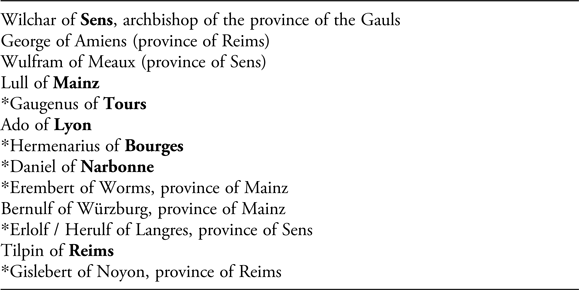
Pope Stephen subsequently received from ‘the Christian kings of the regions of the Franks twelve bishops, approved men, who were very learned in the divine scriptures and the caerimonia of the holy canons’ (Dirigentes scilicet ipsi christianissimi reges XII episcopos ex eisdem Francorum regionibus, nimis divinis Scripturis et sanctorum canonum cirimoniis doctos ac probatissimos viros).Footnote 42 The list of the Frankish bishops (primarily metropolitans) who were sent in answer to this summons is extant in only one manuscript, a mid-ninth-century copy of the Liber pontificalis written at Auxerre and now in Leiden, Universiteitsbibliotheek, VLQ 41.Footnote 43
The Frankish bishops from Liber pontificalis, Life 96.16 in Leiden VLQ 41 (Auxerre, s.IXmed).

These Frankish bishops include one Anglo-Saxon and one Italian, and a few who had assumed office during Pippin III's reign, but half of them (marked with asterisks) had apparently been newly appointed in late 768 or 769.Footnote 44 Despite their newness in post, the text implies that the Frankish bishops, in contrast to the Italians, were chosen for their expertise in both the content of the law and the orchestration of a synod. The obvious question is what that knowledge might have comprised in the seventh decade of the eighth century. Why should the pope have sent to Francia for learned bishops?
Such a papal appeal to the Franks for experts in divine Scripture and holy canons might seem extraordinary or even unwarranted, but it actually reflects the predominance of Frankish Gaul in terms of the surviving evidence for the creative compilation of legal material. Even to refer to ‘legal material’ in this general way, of course, begs the question of definition and requires an explanation, not only of what the formulation ‘legal material’ might cover for the early Middle Ages, but also of the role of the church in the assembly of such material. The remainder of this article, therefore, moves to a consideration of the wider questions raised by Hadrian's murder enquiry and the synod of 769.
Canon Law Compilations in the Early Middle Ages
Law in the early Middle Ages is a notoriously and fearsomely complex topic, and the legal culture and legal practice of the post-Roman polities of early medieval Europe, including the British Isles, are very diverse. Arguments have been particularly lively in relation to how we can identify law in action in relation to the surviving evidence. Modern historians currently think in terms of the broad categories of Roman law, the barbarian leges or law codes (from Ireland, Anglo-Saxon England, Frankish Gaul, Spain, Lombard Italy, Burgundy, Bavaria, Alemannia and Saxony), royal edicts, especially of the Frankish rulers, ecclesiastical or ‘canon’ law and biblical law. There has also been a wealth of scholarship devoted to every aspect of law since at least the sixteenth century, and even now a number of web-based projects are attempting to map these categories, such as the Projet Volterra on Roman law and various data-collecting and editing projects relating to Carolingian canon law, capitularies, formulae and the vast mid-ninth-century compilations attributed to ‘Benedictus Levita’ and ‘Pseudo-Isidore’ of material from church councils and papal letters that is notorious for containing so much that is judged to be forgery.Footnote 45 Generally these projects, perhaps partly due to their having had to make a case for funding, are somewhat inclined to reinvent the same wheel, and take too little notice of a great deal of anglophone, francophone, Italian and Spanish exposition and interpretation. What these database projects have in common is their focus on the extant early medieval manuscripts of all these texts, and an enormous amount of meticulous comparative documentation and record has been achieved over the past century and a half. There are only occasional attempts to look across project boundaries.
Why might this be a problem? Essentially the manuscript compilers of ‘law’ in the early Middle Ages appear to have had different objectives and criteria from those that modern scholars suppose, and modern scholars, whether unwittingly or on principle, are too much influenced by eighteenth- and nineteenth-century conceptions of legal systems and too little inclined to view these texts as resources, as elaborate historical reference material, or as an arsenal of material such as comparable precedents or solutions to be invoked in arguments and decision-making, or as all of these. All the new legal text project leaders are building on earlier assemblies in print of information about texts and manuscripts, not least the classic volumes by Friedrich Maassen on canon law, Wasserschleben and Schmitz, Raymund Kottje and his students on penitentials, Hubert Mordek on Frankish capitularies, and the bibliographical guides and commentaries provided by Lotte Kéry, Detlev Jasper, Horst Fuhrmann and Linda Fowler-Magerl.Footnote 46
These general categories and decisions taken long since about classification create a false impression of clearly distinct demarcation, obscure the variety within each broad category and duck the problems of definition and function of any kind of law in the new political configurations of the post-Roman world. Even deciding what can be counted as ‘secular’ and what as ‘ecclesiastical’ is not straightforward. As we have seen, Roman emperors and barbarian kings from the fourth century onwards contributed many rulings concerning the church and religion in their own legislation as well as in their statements as presidents of, or attenders at, the assemblies of clerics now known as church councils or synods.
The texts generally referred to as canon law also comprise an enormous variety of conciliar material from the first four ecumenical councils, as well as from other councils such as those of Ancyra, Gangra, Neocaesarea, Antioch and Carthage, and the provisions relating to the clergy known as the ‘Apostolic canons’, originally in Greek but translated into Latin in the sixth century by Dionysius Exiguus, to which Dionysius added a number of papal letters. This major Italian collection is called the Dionysiana, and achieved wide circulation north of the Alps from the late eighth century onwards in the augmented form known as the Dionysio-Hadriana.Footnote 47 Dionysius's Latin texts of the ecumenical councils were also incorporated into many manuscript collections by independent compilers who added selections in various permutations from the synods and church councils of North Africa, Visigothic Spain, Frankish Gaul, papal Rome and Lombard Italy between the fifth and eighth centuries, and variable choices from extant papal letters, generally termed decretals, of which the earliest appears to be that of Pope Siricius (384–99).Footnote 48
Some compilers kept the texts in chronological order. Others rearranged all the canons they chose by topic into what are known as the ‘systematic’ collections. All these collections are usually lumped together as canon law collections and given names according to their predominant content, the first editors, the origin of the manuscripts, the current library location or (when known) the compiler: so the Collectio Hispana, Hibernensis, Quesnelliana, Dacheriana, Sanblasiana, Corbeiensis, Remensis, Vaticana, Parisensis, Dionysiana and so on.Footnote 49
This is what I think of as the ‘Maassen legacy’. Pursuit of particular conciliar canons and particular configurations thereof has been a preoccupation of all those walking in Maassen's footsteps. Maassen was utterly committed to the fifth- and sixth-century origins of most of the collections he registered, and all manuscripts were described as witnesses to these hypothetical early collections. The latest text in any collection was taken to be the terminus ad quem rather than the compilation being related to the date of the manuscript. Any collection actually containing any texts later than the supposed original core collections was relegated to the status of an excrescence, sullying the late antique collection, rather than as indicating a later compiler assembling a variety of material for a particular place and purpose in a later context. Others besides myself have begun to see individual manuscripts as pieces of evidence in their own right, rather than merely as a means to trace a chain of copying of a particular group of canons. Of course, an extraordinary amount has been achieved in tracing the transmission of early church councils and papal decretals. More recently, the discussion of conciliar canons and collections was given a tremendous boost and extra rigour and vigour by the late Klaus Zechiel-Eckes, whose work on the pseudo-Isidorean decretals moved on from identification of late antique canonical collections to open up the possibility of active engagement with the content of these canons in contemporary debate in the eighth and ninth centuries. Even so, the emphasis of all the pseudo-Isidorean research remains the identification and dating of sources, and classification of it as genuine or false.
As indicated earlier, the status of any of these texts as ‘law’, on what their authority rested and how they might have been used are all problematic, as many recent studies have begun to observe. Rob Meens has commented, for example, that it is not ‘easy to distinguish a canon law collection from neighbouring genres such as florilegia, penitentials or episcopal statutes’.Footnote 50 Rachel Stone has pointed out that early medievalists have long been accustomed to think of the secular laws or leges as the resource on which negotiation and settlement might be based, as distinct from a ‘fixed body of rules systematically applied’.Footnote 51
This seems to me to be eminently applicable to ecclesiastical law as well. In the intentions of the compilers, from those assembling the early African councils or Pope Hormisdas's commission to Dionysius Exiguus in the early sixth century onwards, there was no doubt a wish to provide a new system of rules and decisions particularly relating to the church or pertinent for church affairs (a more neutral phrase than ‘ecclesiastical’ or ‘canon law’), and the structural models of Roman and imperial law and what Caroline Humfress has referred to as its ‘substantive principles’ played a role in this.Footnote 52 This is most obviously visible in the layout of the early medieval codices, with such details as rubrics and headings, tables of contents, numbering of clauses, and details of origin and date of sets of conciliar and papal decisions very similar to that of the compilations of Roman law and the leges.
Nevertheless, for an early medievalist, verdicts such as that of Helmholz as recently as 2015, reflecting, alas, all too current a misconception, that a ‘true system of canon law … only [came] into existence in the twelfth century’ are distinctly unhelpful.Footnote 53 Such a verdict elides the difference between the compilation of records of decisions and the decisions themselves, ignores how blurred supposed boundaries between ‘law’ and authoritative texts might have been, fails to consider how ‘old’ secular or ecclesiastical law with Roman authority (real or not) might have been received and understood in new contexts, and gives insufficient attention to the indications of contemporary attitudes reflected in the manuscript evidence. As far as the category of ‘canon law’ is concerned, moreover, the implications of the inclusion of the papal letters in compilations of conciliar canons need to be considered rather than simply taken on board as self-evidently appropriate and unproblematic additions.
Many Frankish and north Italian codices from the later eighth and the ninth centuries combine Roman law and leges with teaching materials about legal practice and definitions of law and justice, legal formulae and Frankish capitularies. Similarly, collections of canons from church councils appear in codices with papal letters, sermons, prayers, commentaries on the creed and historical narratives. In addition to canons from councils and papal letters, compilers often incorporated summaries and presentations of law relating to the church promulgated, or purporting to be promulgated, by Roman secular authorities.
One such text is the so-called summa de ordine ecclesiastico from the Berlin manuscript referred to earlier (Staatsbibliothek, Phillipps 1735). Of fifty-two promised capitula in the list of contents, it contains §§1–30 and a few words of §31. Its most recent editors suggest that it may have been produced in Frankish Gaul during the seventh or eighth centuries. In due course it provided one of the sources for the mid-ninth-century collection of ‘Benedictus Levita’, often associated with the corpus of canon law material known collectively as the Pseudo-Isidorean Decretals. Many other centres in the early Carolingian realm were actively compiling legal collections of all kinds.
Although it makes excellent sense to map the hard evidence of the surviving manuscripts, the form in which the evidence has survived has by its very complexity created a major problem of method. This is true of all the manifestations of law in the early Middle Ages. The general categories within which most scholars have been working mask the questions about the complicated and still insufficiently understood status and function of the manuscript compilations themselves, and the authority and applicability of the texts they contain. In what respect might these texts have legal status and authority? Why and by whom were they compiled? What criteria governed the selection of the material they contain? How were these books used, and by whom? Many manuscripts from the early Middle Ages, and especially from the later eighth and ninth centuries, contain what might be called legal chrestomathies, that is, they appear to be carefully designed compilations containing many different types of rules, regulations and decisions relating to political, social and religious behaviour, often together with what could be labelled supporting documents and information. Two final examples can serve briefly to illustrate the sheer variety of contents and the creativity of the compilers:
The first example is from Rhaetia, now in St Gallen, Stiftsbibliothek, csg 722, compiled c.800. It contains a compilation of late antique Roman law known as the Lex romana curiensis and dated to the late eighth century, together with a selection of clauses on ecclesiastical matters from the Epitome Juliani, and the episcopal statutes of Bishop Remedius of Chur (800–20) which concern both Christian observance and secular criminal topics.Footnote 54
The second manuscript example is Paris, BN, lat 2123. Its contents are as follows:
1r–v: First Council of Ephesus §§1–4 with the declaration on original sin.
2r–5v: Lateran Council (649).
6r–17r: Incipit dogma id est doctrina uel definitio de fide (Gennadius of Marseilles, De ecclesiasticis dogmatibus).
17r–24v: commentaries on the Creed (Keefe nos 58, 254, 309, 386), often added to Pope Leo I's Ep. 165 as testimonia de fide.Footnote 55
24v–29r: Leo, Ep. 165, and texts on the doctrine of the Incarnation attributed by the scribe to Hilary of Poitiers, Ambrose of Milan, John of Constantinople and others.
29v–51r: the Cononian Epitome of the Liber pontificalis.
52v–54v: Polemius Silvius, Laterculus (nomina provinciarum), with Notitia galliarum.
54v–64r: the Canones Gregorii version of the Iudicia Theodori.
64v–104v: the Decreta maiorum (= Collectio canonum Herovalliana), including the decree De libris recipiendis et non recipiendis usually attributed to Gelasius (fols 73v–76r).
105r: Council of Carthage (418) §1 on original sin.
105v–153v: Collectio Flaviniacensis (a legal formulae collection).
153v–156v: Isidore of Seville, Etymologiae 16.25–6 (on weights and measures) and 2.10 (definitions of lex, constitutio, edictum and mos).
As can be seen, the diversity of this manuscript's contents includes particular statements about doctrine. The legal material includes the very distinctive ‘canon law’ collection known as the Herovalliana, which starts with a statement about the catholic faith and the Creed, defines the canon of Scripture and the biblical apocrypha, and then inserts the decree De libris recipiendis et non recipiendis usually (but erroneously) attributed to Gelasius (fols 73v–76r).Footnote 56 It is significant that the dominant theme of the abbreviated version of the Liber pontificalis in this codex emerges, because of the clauses selected, as the legislative activity of the popes referred to earlier. The codex effectively provides the historical and specifically Roman and Western framework, within which the statements from the Eastern church councils as well as the definitions of the bishops’ diverse responsibilities, and texts to assist a bishop in the discharge of these responsibilities, are to be understood.
Both these codices, like many other examples that could have been cited, appear to be independent products of late Merovingian and Carolingian ecclesiastical preoccupations and the Frankish reception of earlier Christian historical, doctrinal and legal texts. Not only is the number of compilations of early medieval ‘canon law’ credited to particular dioceses in Frankish Gaul far greater than for Italy, but Frankish manuscripts form the greater majority of the surviving early medieval corpus of manuscripts and fragments containing the texts designated as ‘canon law’ by modern scholars.Footnote 57
The appeal for learned bishops from Francia by Stephen III in 769, therefore, accords with the clear association of many of these manuscripts with particular Frankish bishops, though some of those who can be identified occupied their sees slightly later than Stephen's request. I have already alluded to the extraordinary compilations of both canon and Roman law in Frankish Gaul. Bishops have been associated with much of this activity. Cuthbert Turner, for example, identified activity in Arles as crucial for the dissemination of ‘canon law’, that is, conciliar decrees and papal ‘decretals’ in Gaul in the sixth century.Footnote 58 Mordek's work on the compilation known as the Vetus Gallica (c.600) established that a later redaction at Autun can be associated with Bishop Leodegar (663–80).Footnote 59 Other compilations from the Frankish kingdoms in the later Merovingian and early Carolingian period are also associated with particular bishops. Thus the compilation known as Collectio Frisingensis (Munich, Bayerische Staatsbibliothek, Clm 6434) was produced at Freising during the incumbency of Bishop Arbeo (764–8). Two other canon law compilations (Vienna, Österreichische Nationalbibliothek, Cod. 418, and Munich, Bayerische Staatsbibliothek, Clm 5508) are associated with Bishop Arn of Salzburg. Bishop Rachio of Strasbourg commissioned a copy of the canon law collection known as the Collectio Hispana in 788.Footnote 60
Conclusion
This article began with a lurid murder enquiry conducted by the then reigning pope from the eighth century, and the questions it raised about procedure, punishment and legal resources in early medieval Rome. It has ended with the evidence for the compilation and commissioning of collections of legal provisions, comprising imperial, papal and conciliar decisions from Late Antiquity and the early Middle Ages on a great variety of topics, all of which had the potential to form both a body of law and a portfolio of principles and guidance. I have indicated that the role, or perceived role, of the pope, in consolidating the authority of such a portfolio needs rigorous examination. These assemblages of royal, imperial, papal and conciliar material nevertheless served as an essential resource in relation to both legal practice and conceptions of justice for secular authorities as well as for the church in the early Middle Ages.Footnote 61 How fundamental and versatile this remarkable range of resources and variety of manuscript compilations proved to be is evident in many of the case studies considered in this volume, all of which explore the legal issues and legal consequences underlying relations between secular and religious authorities throughout Christian history.