Recently researchers have suggested that syntactic priming may facilitate the production of wh-questions with obligatory auxiliary verbs, particularly when second language (L2) learners are prompted to produce those questions with a wide variety of lexical items (McDonough & Kim, Reference McDonough and Kim2009; McDonough & Mackey, Reference McDonough and Mackey2008). With the adoption of a usage-based approach to the acquisition of constructions (e.g., Bybee, Reference Bybee, Robinson and Ellis2008; Goldberg & Casenhiser, Reference Goldberg, Casenhiser, Robinson and Ellis2008; Lieven & Tomasello, Reference Lieven, Tomasello, Robinson and Ellis2008), they have assumed that form and meaning are linked, and that constructions are acquired through an item-based process driven by the structural patterns associated with lexical verbs. Constructions are acquired by the formation of an inventory of lexically based frames followed by generalization through analogy to derive more complex constructions (Goldberg, Reference Goldberg2006; Rowland, Reference Rowland2007; Tomasello, Reference Tomasello2003). Lexically based frames consist of a group of fixed elements (referred to as the pivot) and variable slots that are filled with different lexical items. For the wh-question construction, the pivot is typically the combination of a specific wh-word plus auxiliary verb, whereas the variable slots are the subject and lexical verb. For example, a learner may produce multiple questions with [what is] as the pivot but may fill in the variable slots with different subjects and lexical verbs, such as what is the teacher doing? and what is the farmer eating?
Frequency plays an important role in helping learners to detect the lexical frames, and to eventually extend those frames to develop more abstract representations (Bybee, Reference Bybee1995, Reference Bybee, Robinson and Ellis2008; Childers & Tomasello, Reference Childers and Tomasello2001; Ellis, Reference Ellis2002, Reference Ellis, Doughty and Long2005; Robinson & Ellis, Reference Robinson, Ellis, Robinson and Ellis2008). In the initial stage of the acquisition of a construction, frequency in the form of repeated exposure to numerous occurrences of a single exemplar of a construction (i.e., high-token frequency) facilitates detection of a lexical frame, and this encourages subsequent recognition and production. For the acquisition of questions in L2 English, for example, repeated exposure to wh-questions such as what do you do? what do you like? and what do you eat? may help beginning learners detect the lexical frame [what do you] + [lexical verb]. In later stages when more abstract representations are forming, frequency in the form of exposure to the same construction with a variety of lexical items (i.e., high-type frequency) encourages the extension of a lexically based or low-scope pattern. Through exposure to more diverse wh-questions—such as where are your friends going? why did she take your book? and when will we get the tests back?—learners may expand their initial lexical frame of [what do you] + [lexical verb] to a more abstract construction consisting of [wh-word + subject + auxiliary verb + lexical verb] that allows a wide variety of lexical items to fill each slot.
TYPE FREQUENCY AND SYNTACTIC PRIMING
Although usage-based approaches to acquisition have focused largely on the importance of input frequency in the development of abstract representations, frequency in language production may also contribute to acquisition. Because linguistic information is largely shared, any experience that involves the comprehension or production of language may influence the associations among constructions (Branigan, Pickering, Liversedge, Stewart, & Urbach, Reference Branigan, Pickering, Liversedge, Stewart and Urbach1995; Chang, Dell, & Bock, Reference Chang, Dell and Bock2006; Pickering & Garrod, Reference Pickering and Garrod2004). Syntactic priming research, for example, has shown that either hearing or producing an initial sentence facilitates production of a new utterance with the same structure, which suggests that both comprehension and production can influence subsequent language use (Bock, Dell, Chang, & Onishi, Reference Bock, Dell, Chang and Onishi2007; Huttenlocher, Vasilyeva, & Shimpi, Reference Huttenlocher, Vasilyeva and Shimpi2004; McDonough, Reference McDonough2006; Savage, Lieven, Theakston, & Tomasello, Reference Tomasello2003). In particular, language production tasks that push learners (Swain, Reference Swain1993) to stretch their linguistic resources—such as the extension of a lexically specific frame to new lexical items—may help learners develop more abstract representations. Syntactic priming activities may be one such task, as they model target constructions with diverse lexical items and push learners to produce those constructions with a wider range of lexical items than they might typically use.
Syntactic priming is a form of repetition priming in which prior exposure to a structure facilitates subsequent use of that structure, as opposed to an alternative structure that could also be used to express the same meaning. For example, if a speaker produces a passive construction during a conversation (e.g., our usual seats were taken), then later in that same conversation she or her interlocutors may produce additional utterances with the passive (e.g., the game was called off, the book sale was extended), even though other structures—such as active constructions—are available (e.g., the officials called off the game or the library extended the book sale). One explanation for syntactic priming, the residual activation account, states that the comprehension or production of the first utterance activates lexical and syntactic information, after which residual activation of the syntactic information remains and facilitates subsequent production of an utterance with the same structure (Cleland & Pickering, Reference Cleland and Pickering2003; Pickering & Branigan, Reference Pickering and Branigan1998). An alternate explanation, the implicit learning account, is that comprehension or production of the first utterance promotes the association of meaning with a particular form, and that this implicit learning (i.e., learning how to express message content using a particular structure) leads to subsequent use (Bock & Griffin, Reference Bock and Griffin2000; Chang et al., Reference Chang, Dell and Bock2006). Some researchers have suggested that both explanations may be correct, in that each one can account for specific characteristics of syntactic priming. The lexical activation account explains why repetition of open-class lexical items in the initial and subsequent utterances, which is referred to as the lexical boost, facilitates syntactic priming in the short term, whereas the implicit learning account explains why the effect of priming on speakers’ subsequent production can be long lasting (Hartsuiker, Bernolet, Schoonbaert, Speybroeck, & Vanderelst, Reference Hartsuiker, Bernolet, Schoonbaert, Speybroeck and Vanderelst2008).
Syntactic priming activities model a target structure, referred to as the prime, and then elicit production of a new utterance by use of a prompt, which is usually either a lexical verb or noun, or both. Syntactic priming occurs when the speaker generates a new utterance that has the same structure as the prime, even though other structures could have been used. Although the structures typically tested in syntactic priming research have equally acceptable alternatives, such as alternation between a noun phrase (NP) and clausal complements (the athlete admitted his problem vs. the athlete admitted he had a problem), L2 speech production research has also tested alternation between targetlike and interlanguage constructions, specifically wh-questions in which obligatory auxiliary verbs are either supplied (what are they talking about?) or omitted (what they talking about?). In this context, the syntactic priming activities are designed to encourage production of targetlike wh-questions as opposed to interlanguage alternatives.
The example in (1) illustrates a syntactic priming activity designed to elicit targetlike wh-questions that was used in the current study. During the activity, an information exchange task in which the researcher and learner took turns asking each other questions about some pictures, the researcher modeled the target wh-construction—a wh-question with an obligatory auxiliary verb—by asking the learner the prime question who do they see in the tree? After the learner looked at his pictures and answered the question (three birds), he then generated a question to ask the researcher using the words provided in the prompt (Joy/teach). He produced a wh-question that matched the target wh-construction previously modeled in the prime.
(1) Researcher: who do they see in the tree? (prime question)
Learner: three small bird
Researcher: oh okay, this one right?
Learner: yeah who did Joy teach? (prompt = Joy/teach)
Researcher: a boy and his sister.
Because the instructions only stated that the words in the prompts should be used to ask questions, the learners could generate a variety of question types depending on their communicative intent and language abilities. For example, learners could have used the prompt Joy/teach to ask interlanguage wh-questions with missing or inaccurate auxiliary verbs (such as what Joy teach the kids? how Joy teach them? and what is Joy teach?), yes/no questions (does Joy teach?), or other wh-question types (who teaches Joy?). The goal of the priming activities is to elicit the target wh-construction as opposed to these alternatives.
The use of syntactic priming activities to encourage the subsequent production of wh-questions has been explored in a series of studies that involve Thai university students of English as a foreign language (EFL; McDonough & Chaikitmongkol, Reference McDonough and Chaikitmongkol2010; McDonough & Kim, Reference McDonough and Kim2009; McDonough & Mackey, Reference McDonough and Mackey2008). McDonough and Mackey (Reference McDonough and Mackey2008) compared the posttest production of learners who carried out syntactic priming activities with trained interlocutors (more advanced Thai EFL speakers) to the subsequent production of learners who completed oral tests only. They found that learners who produced the target wh-questions with a variety of lexical verbs and question words (why, when, where, etc.) during the priming activities subsequently produced more target wh-questions. A classroom-based follow-up study (McDonough & Chaikitmongkol, Reference McDonough and Chaikitmongkol2010) similarly reported that learners who carried out syntactic priming activities with their peers in a classroom context showed greater subsequent production of target wh-questions than learners in the control group who followed the regular curriculum.
The occurrence of syntactic priming can be affected by the lexical items provided in the primes and prompts. For example, the lexical boost, which is repetition of an open-class lexical item in the primes and prompts, has been shown to facilitate syntactic priming in a variety of experimental tasks, including scripted interaction studies with first language (L1) and L2 speakers (Branigan, Pickering, & Cleland, Reference Branigan, Pickering and Cleland2000; Cleland & Pickering, Reference Cleland and Pickering2003; Kim & McDonough, Reference Kim and McDonough2008; Schoonbaert, Hartsuiker, & Pickering, Reference Schoonbaert, Hartsuiker and Pickering2007). Furthermore, the type frequency of the lexical verbs presented in prime constructions can impact the occurrence of syntactic priming. To illustrate, L1 researchers have shown that English L1 children subsequently produce passive constructions only if they were exposed to passive primes with different lexical verbs (Savage, Lieven, Theakston, & Tomasello, Reference Savage, Lieven, Theakston and Tomasello2006). McDonough and Mackey (Reference McDonough and Mackey2008) found that type frequency involving lexical verbs in the wh-questions—generated by learners from prompts—was associated with their subsequent production.
To investigate the possible impact of type frequency on learners’ subsequent production, McDonough and Kim (Reference McDonough and Kim2009) compared the effectiveness of syntactic priming materials that manipulated the type frequency of lexical verbs provided in primes and prompts. They hypothesized that high-type frequency in the researcher’s primes and the prompts used to elicit learner production would positively impact EFL learners’ production of wh-questions with auxiliary verbs. The researcher’s primes were complete wh-questions with auxiliary verbs that either contained 36 unique lexical verbs and 6 question words (high-prime-type frequency) or had 6 unique lexical verbs and 4 question words (low-prime-type frequency). The prompts were similarly manipulated by using either 36 unique lexical verbs (high-prompt-type frequency) or 6 lexical verbs (low-prompt-type frequency) to elicit wh-questions from the learners. Thai EFL learners (n = 83) carried out an oral pretest, two sets of syntactic priming activities, and an immediate oral posttest over a 2-week period. The findings indicated that there was no main effect for prime-type frequency, but there was a significant main effect for prompt-type frequency. Learners who received high-type-frequency prompts subsequently produced more accurate wh-questions with greater lexical variety than learners who received low-type-frequency prompts.
As the authors acknowledged, one limitation of the study was the absence of a delayed posttest, which could have provided insight into the longer-term impact of syntactic priming materials with different kinds of type frequency. If syntactic priming is a type of implicit learning, then it should have lasting effects on learners’ production. Its longer term impact has been tested in L1 speech production research by inserting filler sentences or time lags between the primes and the participant’s responses during a single experiment (e.g., Bock & Griffin, Reference Bock and Griffin2000; Hartsuiker et al., Reference Hartsuiker, Bernolet, Schoonbaert, Speybroeck and Vanderelst2008; Hartsuiker & Kolk, Reference Hartsuiker and Kolk1998). In contrast, L1 and L2 acquisition researchers have tested the impact of syntactic priming on learners’ subsequent production over longer time periods, which ranged from 1 day (Shin & Christianson, Reference Shin and Christianson2011) to 3 weeks (McDonough & Mackey, Reference McDonough and Mackey2008) and up to 4 or 5 weeks (McDonough & Chaikitmongkol, Reference McDonough and Chaikitmongkol2010; Savage et al., Reference Savage, Lieven, Theakston and Tomasello2006). However, these studies did not isolate or measure the impact of syntactic priming using materials with different prime- and prompt-type frequencies. To determine whether the benefits of prompt-type frequency reported by McDonough and Kim (Reference McDonough and Kim2009) persist over time, the current replication study therefore includes a delayed posttest administered 2 weeks following the immediate posttest.
AUDITORY PATTERN DETECTION AND SYNTACTIC PRIMING
Besides the addition of a delayed posttest, this replication study also investigated another issue raised by McDonough and Kim (Reference McDonough and Kim2009) as a possible explanation for the findings that (a) not all learners who received high-type-frequency prompts subsequently produced more accurate wh-questions, and that (b) some learners who received low-type-frequency prompts also showed higher accuracy on the posttest. They speculated that the impact of prompt-type frequency on learners’ subsequent production may be mediated by their cognitive abilities, such as their ability to recognize patterns and to generalize through analogy. In other words, learners with the capacity to recognize patterns may be more able to detect and produce the construction targeted in priming materials than learners with lower auditory discrimination abilities. Auditory discrimination may be one of several cognitive abilities—including phonological memory, working memory, attentional control, or grammatical sensitivity—that may interact in ways that impact learners’ ability to benefit from syntactic priming activities. Unlike cognitive abilities that implicate explicit metalinguistic knowledge (e.g., the ability to identify words in sentences with similar grammatical roles), auditory pattern detection may be one of the “more basic, non-metalinguistic abilities” (Robinson & Ellis, Reference Robinson, Ellis, Robinson and Ellis2008, p. 508) that plays a role in category identification and formation. Thus phonological and working memory measure learners’ ability to store (or store and process) the output produced by perceptual processing, whereas auditory pattern detection involves their ability to encode perceptual information.
The impact of pattern detection during auditory processing on language performance has been explored within a variety of disciplines. For example, reading researchers have shown that adults and children with reading disorders are typically less accurate at recognizing nonspeech stimuli that differ in terms of tone or duration pattern than their normal reading peers (Cestnick & Jerger, Reference Cestnick and Jerger2000; Heath, Hogben, & Clark, Reference Heath, Hogben and Clark1999; Walker, Givens, Cranford, Holbert, & Walker, Reference Walker, Givens, Cranford, Holbert and Walker2006; Walker, Shinn, Cranford, Givens, & Holbert, Reference Walker, Shinn, Cranford, Givens and Holbert2002). Studies have also shown that children with grammar-specific language impairment have difficulty discriminating between auditory stimuli that consist of tones and speech stimuli (Rosen, Adlard, & van der Lely, Reference Rosen, Adlard and van der Lely2009; van der Lely, Rosen, & Adlard, Reference van der Lely, Rosen and Adlard2004). Researchers have also demonstrated that auditory pattern-discrimination scores correlate with the spelling scores of child L2 learners of English (Seeff-Gabriel, Reference Seeff-Gabriel2003; Wang & Geva, Reference Wang and Geva2003) and are related to L2 learners’ perception of phonemes (Díaz, Baus, Escera, Costa, & Sebastián-Gallés, 2008; Winkler et al., Reference Winkler, Kujala, Tiitinen, Sivonen, Alku and Lehtokoski1999).
Much of this research has used the oddball paradigm in which participants identify an auditory stimulus that deviates from an established pattern, which is referred to as the standard. The oddball or deviant stimulus has a different pitch, duration, or pattern than the established standard, and the listeners’ accuracy in detecting the deviant stimulus is calculated. For example, the standard stimulus might consist of 500, 1,000, and 1,500 Hz frequency components, whereas the deviant stimulus could represent a 10% increase, or 550, 1,100, and 1,650 Hz, respectively. However, auditory processing tasks with linguistic content (e.g., words, syllables, or vowels) may capture differences between more and less skilled language users more effectively than tasks that use nonspeech stimuli—for example, tone, duration, and pattern (Díaz et al., 2008; Fiez et al., Reference Fiez, Raichle, Miezin, Petersen, Talla and Katz1995; van der Lely et al., Reference van der Lely, Rosen and Adlard2004). These studies suggest that tasks that provide speech stimuli may be more useful in capturing variation in learners’ ability to detect patterns in auditory input than nonspeech stimuli involving tones.
In the case of syntactic priming, the standard pattern is represented through the primes, which are presented through the researcher’s materials. The pattern is based on the presence and order of constituents in the prime constructions, as opposed to a pattern of tones with specific pitch or frequency features, or a pattern based on individual sounds. For the wh-question construction targeted in the current study, the relevant pattern is the occurrence of a wh-question word, auxiliary verb, subject, and lexical verb—in that order. Although this underlying pattern remains constant across all of the researcher’s primes, different lexical items can fill each slot in the construction. As a result, a learner with the capacity to recognize patterns may be better able to detect the underlying construction even when the primes have different lexical items (high-type frequency). In contrast, a learner with lower pattern-detection abilities may not detect the underlying construction because the primes’ lexical diversity obscures their underlying structural similarity.
Learners’ pattern-detection abilities may also influence their ability to generate target constructions from the prompts. Learners who can detect patterns may be better able to generate utterances that conform to a single pattern but have different lexical items; that is, they may perceive the underlying similarity of their utterances and simply insert different lexical items into slots in that construction. Learners with lower discrimination abilities, however, may regard each utterance as unique and may be more able to produce the target construction only when prompted with the same lexical items repeatedly (i.e., low-type frequency). In sum, learners’ ability to detect wh-question patterns and to use those frames to generate their own questions may be influenced by both their auditory pattern-discrimination abilities and the prompt-type frequency provided in the priming materials.
PURPOSE OF THE STUDY
This replication study aims to confirm and extend McDonough and Kim’s (Reference McDonough and Kim2009) finding that prompt-type frequency facilitated subsequent production and also tests their suggestion that pattern recognition may impact learners’ ability to benefit from syntactic priming activities.
The study was guided by one principal research question:
1. Do type frequency and auditory pattern detection influence Thai EFL learners’ subsequent production of wh-questions?
On the basis of McDonough and Kim (Reference McDonough and Kim2009), it is predicted that learners who receive high-type-frequency prompts will subsequently produce more accurate wh-questions than learners who receive low-type-frequency prompts. Pushing learners to produce wh-questions with diverse lexical items creates greater opportunities for them to extend lexically specific wh-question frames than the repeated production of a wh-question with the same lexical items. Because interactive syntactic priming activities present structural patterns through aural input and elicit oral production, it is predicted that learners with high pattern-detection abilities will subsequently produce more wh-questions than learners with low pattern-detection abilities.
METHOD
Participants
The participants comprised 43 Thai EFL learners (women, n = 31; men, n = 12) at a large public university in northern Thailand. They had a mean age of 18.6 years (SD = 0.5) and had studied English previously for a mean of 13.6 years (SD = 1.7). They represented bachelor degree programs in a variety of disciplines, specifically art and media technology (n = 20), business administration and economics (n = 11), science and engineering (n = 11), and law (n = 4). They were enrolled in two sections of an integrated-skills EFL course—taught by the second researcher—that was required for their degree programs. The goal of the course was to develop the learners’ ability to use English for oral and written communication in academic and social contexts and was organized into three thematic units (i.e., travel, alternative medicine, and advertising) that emphasized skill development along with cognitive and metacognitive learning strategies. At the time of data collection, the learners were studying the second thematic unit in the course, alternative medicine. In terms of comparability with McDonough and Kim (Reference McDonough and Kim2009), these learners were enrolled in the same course, followed the same syllabus, and data collection began at the same point in the semester. No changes in the course curriculum had been made between data-collection periods, which were separated by approximately 1 year.
Design
The current study employed a pretest-delayed posttest design to explore the impact of prompt-type frequency and auditory pattern discrimination on Thai EFL learners’ subsequent production of wh-questions. The first variable, prompt-type frequency, was operationalized following McDonough and Kim (Reference McDonough and Kim2009) as the number of unique lexical verbs provided in the prompts used to elicit production of wh-questions. Learners were randomly assigned to either the high-type-frequency group, which was prompted with 36 unique lexical verbs, or the low-type-frequency group, which was prompted with 6 unique lexical verbs. The second variable, auditory pattern discrimination, was operationalized as accuracy in determining whether sound sequences were identical or different. Learners were assigned to groups representing high and low auditory pattern discrimination on the basis of their test performance.
The dependent variable, the learners’ production of wh-questions, was operationalized narrowly as accurate wh-questions in contexts that required auxiliary verbs. Their production of wh-questions with auxiliary verbs was measured in terms of (a) the proportion of correct questions to total obligatory contexts, (b) the occurrence of wh-question frames, and (c) the number of frame-based wh-questions. A wh-question frame was defined as a correct [wh-word] + [aux] + [s] + [v] sequence produced repeatedly in which at least two elements were fixed.Footnote 1 The fixed element, or pivot, was typically the combination of [wh-word + aux], but pivots consisting of fixed combinations of [aux + s] were also considered.
Materials
Oral Tests. The materials used for the oral tests and the syntactic priming activities were the same as those used in previous priming studies carried out in this Thai EFL context (McDonough & Kim, Reference McDonough and Kim2009; McDonough & Mackey, Reference McDonough and Mackey2008) and consisted of communicative activities that generated contexts for a variety of questions. The oral tests included story-completion tasks, picture-difference tasks, guessing games, and interview topics but did not target any particular lexical items or involve tightly controlled turn-taking patterns. The oral test activities provided neither question primes for the researcher nor prompts for the learners to use when asking questions. The pretest and immediate posttest were identical to those used in the previous studies, whereas the delayed posttest consisted of new activities of the same type—for example, a third story-completion task was created using a new set of pictures and a different story line.
Syntactic Priming Activities. The syntactic priming activities were the same as those used in previous studies (McDonough & Kim, Reference McDonough and Kim2009; McDonough & Mackey, Reference McDonough and Mackey2008) and consisted of picture question-answer tasks and picture-difference tasks that were designed to elicit wh-questions with auxiliary verbs. Both priming activities involved the exchange of information on the basis of pictures. The goal of the picture question-answer task was to provide information about pictures in an array, whereas the goal of the picture-difference task was to identify all the differences in the two versions of the pictures, which displayed beach and camping scenes. For both tasks, the researcher’s materials provided primes in the form of complete wh-questions with required auxiliary verbs (e.g., where is the teacher writing the report?). Because McDonough and Kim (Reference McDonough and Kim2009) reported no main effect or interaction effects involving prime-type frequency, the prime questions were not manipulated. Instead, all learners received the same primes (referred to as high-prime-type-frequency primes in the original study), which were wh-questions that contained 36 unique lexical verbs and 6 question words (i.e., what, why, where, when, how, and who). The learners’ materials provided prompts in the form of nouns and lexical verbs only (e.g., Mary/open). The high-prompt-type-frequency materials provided 36 prompts with 36 unique lexical verbs, whereas the low-prompt-type-frequency materials provided 36 prompts with only 6 unique lexical verbs. To avoid the lexical boost, neither the nouns nor the verbs in the learners’ prompts were the same as the verbs in the researcher’s primes. The lexical verbs used in the primes and prompts were checked for occurrence on the General Service List (West, 1953; adapted by Baumann & Culligan, 1995) to increase the likelihood that the learners would be familiar with their meaning.
Auditory Pattern-Discrimination Task. The auditory pattern-discrimination task was created by a team of researchers to assess the learners’ ability to detect patterns in aural input. In this task, learners heard pairs of sound sequences and decided whether the two sequences were the same or different. To avoid the influence of vocabulary, content, or phonological knowledge in the L1, in any L2 likely to be known by the learners on basis of the foreign language courses offered at the university (e.g., English, French, German, or Japanese), or in the heritage languages often reported by Thai students (e.g., Chinese and Hindi), the sound sequences were created using Korean sounds that represented a mixture of consonant (C) and vowel (V) syllables—that is, CV, CVC, VC, and V. The sounds were organized into sequences containing four, five, six, seven, and eight syllables, with six unique sequences in each syllable set (for a total of 30 items).
After the 30 items were created, they were digitally recorded by a female native Korean speaker. Fifteen same items were created by repeating a sound sequence separated by a 1,000 ms pause, such as the 6-syllable sequence a gab ji a na suh . . . a gab ji a na suh. For the 15 different items, the second sound sequence contained one syllable that had a different V or VC combination than the initial sequence, such as the vowel sound in the fourth syllable of the 5-syllable sequence sang hi num chi nun . . . sang hi num cha nun. To reduce the salience of different sounds and to encourage learners to listen to the complete sequence, the different V or VC combination never occurred on the first or the last syllable in the sequence. The number of same and different items was balanced across syllable sets. The order of items was randomized, and there was a 3,000 ms pause between items. The task was administered to the learners in a group setting using the audio equipment in the regularly scheduled classroom. On hearing each item, they indicated whether the two sequences were identical by circling same or different on an answer sheet. The learners were given an item with different sequences as practice prior to the task itself.
The task was pilot tested with 71 native speakers of English who were all students at a regional southwestern university in the United States. Their mean score was 23.69 (SD = 2.16), and Cronbach’s alpha was extremely low (.16). Item analysis indicated that items involving 4-syllable sequences and 8-syllable sequences had low and high item difficulty, respectively, and had low discrimination values, thus they were removed from the test. The revised test, which consisted of 18 items of 5-, 6-, and 7-syllable sequences, was then piloted with 60 Thai EFL learners at the same university as the participants. Their mean score was 15.12 (SD = 2.29) and Cronbach’s alpha was .63. It was decided that the revised version of the test would be used. Any items, however, that were not useful for discriminating between high and low scorers—on the basis of the item-total correlations—were removed before dividing the participants into performance groups.
Procedure
The data collection occurred over a 4-week period beginning in the middle of a 15-week semester. The learners scheduled three individual sessions with the first researcher that were held in the first, second, and fourth weeks. During the initial session, they completed the pretest and the first set of syntactic priming activities, all of which took from 20–25 min to complete. One week later, they completed the second set of syntactic priming materials and the immediate posttest, which also took approximately 20–25 min. The process in the first 2 weeks of data collection was identical to the procedure followed in McDonough and Kim (Reference McDonough and Kim2009). The additional research activities added to the current replication study occurred in the third and fourth week. During week 3, the learners completed the auditory pattern-discrimination task—lasting 20 min—during their regularly scheduled English classes. Finally, in week 4, the learners met the first researcher to carry out the delayed posttest activities, which took from 10–15 min to complete. All of the interaction between the researcher and the learners was digitally recorded using mp3 recorders.
Analysis
The audio recordings were transcribed by the researchers. The learners’ questions were first classified in terms of contexts for wh-questions with required auxiliary verbs (such as what is the boy holding?) Nonobligatory contexts included wh-questions with the copula (where is the house?) and wh-questions that do not require auxiliary verbs (who did it?). Next, the accuracy of the learners’ wh-questions in required contexts was determined on the basis of (a) the semantic appropriateness and position of the wh-question word, (b) the tense-aspect-number features of the auxiliary and main verb, and (c) presence and location of the auxiliary verb. Errors that involved features unrelated to question formation were not considered—that is, errors such as the incorrect use of plurals or articles with direct objects (e.g., why does she like bear?). Finally, a proportion score was obtained by dividing the number of accurate questions by total contexts.
Because learners with higher auditory pattern-detection abilities may be better able to detect structural patterns, the learners’ use of wh-question frames was also analyzed. Any accurate [wh-word] + [aux] + [s] + [v] sequence that occurred at least twice with the same lexical items in the pivot (i.e., a fixed combination of either [wh-word + aux] or [aux + s]) was considered a wh-question frame. The number of unique wh-question frames was totaled, and the number of accurate wh-questions generated using a wh-question frame was summed.
For the auditory pattern-discrimination task, each item was scored as correct (1 point) or incorrect (0 points) on the basis of whether the learners correctly identified whether the sound sequences were identical, and total points were summed. The second researcher coded a subset of the oral data (20%) for required contexts, accuracy, and question frames. Interrater reliability was obtained through Pearson correlation coefficients, which were .98 for contexts, .99 for accuracy, and .92 for wh-question frames. Alpha was set at .05.
RESULTS
Preliminary Analyses
Prior to addressing the research question, the learners’ pretest performance was first checked to ensure that there were no preexisting differences between the prompt-type-frequency groups. Learners in both groups produced a similar number of contexts for wh-questions with required auxiliary verbs during the pretests, with a mean of 3.91 contexts for the high-prompt-type-frequency group (SD = 1.68) and 3.25 contexts for the low-prompt-type-frequency group (SD = 2.07). Learners in the low-prompt-type-frequency group had a slightly higher proportion of accurate wh-questions to total contexts (.32) than the high-prompt-type-frequency group (.20), but the difference was not significant, t (41) = 1.34, p = .19. Next, the syntactic priming data were checked to ensure that the materials were implemented as intended with the high- and low-prompt-type-frequency groups producing comparable contexts for wh-questions but differing in the type frequency of their lexical verbs. Learners in the high-prompt-type-frequency group produced a mean of 26.57 contexts (SD = 2.29) with a mean of 25.48 unique lexical verbs (SD = 2.61). Learners in the low-prompt-type-frequency group produced a similar number of contexts (M = 25.90, SD = 2.36), but their wh-questions targeted a mean of only 6.60 unique lexical verbs (SD = 0.88). Thus, these preliminary analyses suggest that there were no preexisting differences between the prompt-type-frequency groups and that the syntactic priming materials successfully elicited wh-questions that differed in terms of the type frequency of their lexical verbs.
Finally, the auditory pattern-discrimination test was analyzed to remove items with low discrimination values and to determine the test’s resulting internal consistency. Item-total correlations were used to identify four items with zero or negative discrimination values, which were then removed. The learners’ mean score for the remaining 14 items was 11.35 (SD = 2.35) and Cronbach’s alpha was .70. The scores were then correlated with the learners’ production of target wh-questions during the syntactic priming activities to confirm the predicted relationship between the learners’ auditory pattern-detection skills and their performance during the syntactic priming activities. Due to the nonnormal distribution of both variables, a Spearman-rank correlation test was used, and a significant, positive relationship (rho = .454, p < .002) was indicated. Finally, to create a binary independent variable, the mean score was used to divide learners into high or low auditory pattern-discrimination groups. Learners who scored above the mean (n = 21) were classified as high scorers (M = 12.95, SD = 0.72), and learners who scored below the mean (n = 22) were classified as low scorers (M = 9.67, SD = 2.29).
Prompt-Type Frequency, Auditory Pattern Discrimination, and Subsequent Production
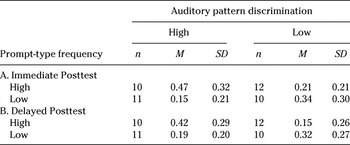
The research question asked whether prompt-type frequency and auditory pattern-discrimination abilities impact Thai EFL learners’ subsequent production of wh-questions. Factorial 2 × 2 ANOVAs with prompt-type frequency (high or low) and auditory pattern discrimination (high or low) as between-groups variables were separately carried out for the immediate and delayed posttests. As shown in Table 1, part A, the high-type-frequency-high auditory pattern-discrimination group had the highest proportion of accurate wh-questions on the immediate posttest, followed by low-type-frequency-low auditory pattern-discrimination group. The ANOVA indicated that there was no main effect for type frequency, F (1, 39) = 0.229, p = .642, or auditory pattern discrimination, F (1, 39) = 1.503, p = .228. However, there was a significant interaction effect, F (1, 39) = 7.504, p < .009, partial η2 = .161.
Proportion scores by group

Because the interaction effect involved greater accuracy within the matching conditions (high-high and low-low), an independent-samples t test was used to compare the mean scores for the matching conditions with the nonmatching conditions (low-type-frequency-high pattern discrimination and high-type-frequency-low pattern discrimination). The independent-samples t test (equal variance not assumed) indicated that learners in the matching conditions had significantly higher proportion scores than learners in the nonmatching conditions, t (1, 29.88) = 2.646, p < .013, d = .87.
The same pattern was found for the delayed posttest. Learners in the high-type-frequency-high auditory pattern-discrimination group produced the highest proportion of accurate wh-questions, followed by the low-type-frequency-low auditory pattern-discrimination group, as shown in Table 1, part B.
The ANOVA indicated that there was no main effect for prompt-type frequency, F (1, 39) = 0.728, p = .220, or for auditory pattern discrimination, F (1, 39) = 0.143, p = .707. There was, however, a significant interaction effect of type frequency × auditory pattern detection, F (1, 39) = 6.432, p < .015, partial η2 = .142. An independent-samples t test (equal variance assumed) indicated that learners in the matching conditions (high-high and low-low) had significantly higher proportion scores than learners in the nonmatching conditions (high-low and low-high), t (1, 41) = 2.633, p < .012, d = .79.
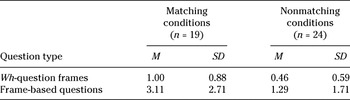
To further explore the interaction between prompt-type frequency and pattern detection, the learners’ use of wh-question frames and production of accurate wh-questions generated using those frames were analyzed. The occurrence and use of frames were summed across both posttests combined because the same wh-question frame could occur on both tests. The number of learners who used the same question frames for both posttests was the same in the matching and nonmatching groups (n = 2). As shown in Table 2, learners in the matching conditions on average produced more wh-question frames and generated more accurate questions using those frames than learners in the nonmatching conditions.
Wh-question frames by group

Mann-Whitney tests—nonparametric independent-samples t tests appropriate when the assumption of normality has not been met—indicated that learners in the matching conditions produced significantly more wh-question frames, Z = 2.14, p < .032, d = .72, and frame-based questions, Z = 2.37, p < .018, d = .80, than learners in the nonmatching conditions.
DISCUSSION
To summarize the findings, this replication study confirmed the positive, immediate impact of prompt-type frequency on Thai EFL learners’ production of wh-questions, as previously reported in McDonough and Kim (Reference McDonough and Kim2009). However, the original study found a main effect for high-prompt-type frequency, whereas the current study reported an interaction effect. Although high-prompt-type frequency was beneficial for learners with higher auditory pattern-discrimination scores, low-prompt-type frequency was beneficial for learners with lower auditory pattern discrimination scores. In terms of the longer-term impact of syntactic priming activities, the delayed posttest findings revealed the same interaction effect, which was also evident in the learners’ production of wh-question frames and the use of those frames to generate accurate wh-questions. Taken together, the findings suggest that, either alone or in combination with learner characteristics, prompt-type frequency influences learners’ subsequent production of wh-questions, both immediately and following a 2-week delay.
These findings provide further evidence that learner characteristics can impact their ability to benefit from the implicit learning opportunities provided during interaction. Previous implicit feedback research has shown that learners with lower anxiety (Sheen, Reference Sheen2008); higher literacy levels (Bigelow, Delmas, Hansen, & Tarone, Reference Bigelow, Delmas, Hansen and Tarone2006); higher working memory capacity (Mackey, Philp, Egi, Fujii, & Tatsumi, Reference Mackey, Philp, Egi, Fujii, Tatsumi and Robinson2002); and higher phonological memory, attentional control, and analytic skills (Trofimovich, Ammar, & Gatbonton, Reference Trofimovich, Ammar, Gatbonton and Mackey2007) may derive greater benefit from interaction that provides recasts. The current study suggests that auditory pattern detection may be another characteristic that can impact the degree to which learners benefit from interaction with syntactic priming.
The interaction effect between auditory pattern detection and prompt-type frequency suggests that experimental interventions, which complement learners’ aptitude profiles, may be particularly effective. In other words, treatment activities that model and elicit constructions with lexical diversity may be beneficial for learners who have greater abilities to detect underlying structural patterns in aural input. Treatment activities that provide and elicit a construction with a more limited set of lexical items, however, may be more effective for learners who are less able to detect such patterns. Previous aptitude research has explored the correlations between learners’ aptitude and language achievement following a specific type of intervention, such as explicit and implicit interventions (DeGraaf, Reference DeGraaf1997); implicit, explicit, and rule-search interventions (Robinson, Reference Robinson1997); communicative language teaching (Ranta, Reference Ranta and Robinson2002); and deductive, inductive, and structured input instruction (Erlam, Reference Erlam2005), whereas the current study assigned learners to high-low auditory pattern-detection groups post hoc. Future research might adopt an a priori design to test the effectiveness of aptitude-intervention pairings on learners’ subsequent performance.
The relatively limited number of L2 studies that have compared complementary and noncomplementary aptitude-intervention pairings may be related to the difficulty in differentiating among the aptitude components that could be relevant in a specific learning environment as well as the challenges involved in developing and validating more specific aptitude measures (Dörnyei, Reference Dörnyei2005; Robinson, Reference Robinson and Robinson2002; Skehan, Reference Skehan and Robinson2002). Aptitude-intervention studies have typically relied on global aptitude tests such as the Modern Language Aptitude Test, the Pimsleur Language Aptitude Battery, or the Defense Language Aptitude Battery. Scores on these measures are then correlated with learning measures such as listening comprehension tests, vocabulary and grammar tests, or proficiency tests (for a recent example, see Sparks, Patton, Ganschow, & Humbach, Reference Sparks, Patton, Ganschow and Humbach2009). These types of aptitude tests may need to be supplemented by more specific tests that measure a particular aptitude complex with more precise measures particularly important for learning tasks that do not draw on explicit analytical abilities (Robinson, Reference Robinson2005). The auditory pattern-detection test used here may be a positive, initial step toward this goal, but its relatively low reliability suggests that further innovations are needed.
Additional challenges concern the need to devise tasks that can identify clusters of learner characteristics that may interact with specific environmental factors or temporal conditions (Dörnyei, Reference Dörnyei2005, Reference Dörnyei2009). For example, the ability to detect patterns during auditory processing is a cognitive skill that may interact with phonological memory—that is, an individual’s ability to retain phonological material temporarily for short periods (about 2,000 ms). To judge whether sound sequences follow the same pattern, learners must be able to maintain the first sound sequence in memory. Recent phonological memory research has used a serial nonword recognition task in which learners listen to sets of nonwords and determine whether the sounds appeared in the same order or a different order (Gathercole, Pickering, Hall, & Peaker, Reference Gathercole, Pickering, Hall and Peaker2001; O’Brien, Segalowitz, Collentine, & Freed, Reference O’Brien, Segalowitz, Collentine and Freed2006; O’Brien, Segalowitz, Freed, & Collentine, Reference O’Brien, Segalowitz, Freed and Collentine2007; Trofimovich et al., Reference Trofimovich, Ammar, Gatbonton and Mackey2007). The nonwords targeted in the recognition task, and in nonword repetition tasks also used to assess phonological memory, are typically created to conform to L2 phonological patterns, although some nonword repetition tasks have been designed using a language unfamiliar to the participants, such as Arabic (French, 2004; Mizera, 2006; both as cited in Hummel, Reference Hummel and Fabbro2002, Reference Hummel2009).
Similar to the auditory pattern-detection task used in the current study, the serial nonword recognition task does not require production, and it assesses the ability to differentiate between sound sequences. However, the serial nonword recognition task only manipulates the order of nonwords and is designed to identify the upper limits of phonological memory. The auditory pattern-detection test used here, in contrast, involved differences in vowel and consonant sounds and presented shorter sequences to reduce the involvement of phonological memory. As previously mentioned, the original version of the auditory pattern-detection test included sound sequences that consisted of eight syllables, which were subsequently removed because of their low discrimination values. Although the shorter sequences effectively differentiated between learners with higher and lower pattern-discrimination scorers, the longer sequences did not.
Tests that can capture differences in learners’ auditory pattern discrimination and phonological memory are needed to determine whether these learner characteristics, either alone or in combination, impact learners’ ability to benefit from interactive syntactic priming activities. Future research that creates and validates measures of auditory pattern discrimination, which minimizes the role of phonological memory, is needed. In particular, tests with shorter sound sequences can be used, as in the current study, and learners can be asked to determine if those sequences are identical or different. However, the nature of the differences targeted in the sequences should vary in ways that reflect meaningful characteristics of speech stimuli (e.g., word order, syllable structure, intonation, stress, vowel, and consonant differences) to determine if some patterns are perceptually more salient than others. Once more precise measures of auditory pattern detection are available, it will be interesting to explore whether learners with high auditory pattern-discrimination abilities benefit from syntactic priming activities, regardless of their phonological memory capacity.
Although the current study has found that the interaction between auditory pattern detection and type frequency in syntactic priming materials impacts learners’ subsequent production of wh-questions, future studies are needed before more generalizable conclusions are justified. Studies that examine the applicability of syntactic priming and the engagement of general cognitive learning mechanisms—such as pattern detection and category formation—to L2 learning environments would be particularly insightful. Usage-based approaches to the acquisition of constructions are typically situated within L1 acquisition research, in which implicit learning mechanisms may be more relevant than in instructed L2 acquisition contexts. In some L2 learning environments, such as the one described in this study, learners receive years of instruction that contains metalinguistic explanations of grammatical features. This raises interesting questions about their ability to make use of the implicit learning opportunities created during communicative tasks. Investigating learners in more diverse learning environments, who represent varying proficiency levels, is also important in light of reports that phonological memory may play a larger role in early L2 development rather than more advanced stages (Hummel, Reference Hummel2009; O’Brien et al., Reference O’Brien, Segalowitz, Collentine and Freed2006).
Previous studies in this learning environment have shown that very few learners, who carry out interactive activities that were not manipulated to create learning opportunities (through interactional feedback or syntactic priming), benefit from those interactions (McDonough, Reference McDonough2005, Reference McDonough and Mackey2007; McDonough & Chaikitmongkol, Reference McDonough and Chaikitmongkol2010; McDonough & Mackey, Reference McDonough and Mackey2006, Reference McDonough and Mackey2008). In these studies, learners assigned to control or comparison groups rarely demonstrated improved production of target constructions. Nevertheless, additional studies with control groups may provide further evidence that syntactic priming tasks engage learning mechanisms in ways that general fluency-building or language-practice activities do not. Although the inclusion of a delayed posttest was important to explore the nonimmediate impact of syntactic priming on learners’ production of wh-questions, more longitudinal research is still needed. In particular, longitudinal research that measures multiple, specific cognitive factors would shed light on whether particular aptitude complexes can result in the same learning outcomes over time.
As a replication study, the current study purposefully tested the same construction targeted in the original study, but future priming research would benefit from the inclusion of more diverse linguistic structures. If pattern detection plays a role in whether learners benefit from syntactic priming activities, then it would be useful to test structures that differ in terms of the linguistic features that are relevant for the underlying pattern. In wh-questions, the presence and location of the auxiliary verb and the agreement features among the subject, auxiliary verb, and lexical verb are crucial for the production of accurate questions. However, other structural patterns may involve features such as intonation, word order, and syllable lengthening, which may be more or less difficult to detect. We hope that future research that addresses the potentially interacting role of various learner factors—cognitive, affective, and motivational—and their intersection with environmental conditions may shed further light on the contribution of syntactic priming to L2 development.