1. Introduction
Third language (L3) acquisition has gained increasing attention in linguistic research, acknowledging that the possibilities for transfer at the L3 initial state differ from second language (L2) acquisition (SLA) (see De Angelis, Reference De Angelis2007; Rothman, Cabrelli Amaro & de Bot, Reference Rothman, Cabrelli Amaro, de Bot, Herschensohn and Young-Scholten2013). At the onset of L2 acquisition, only one linguistic system is available for transfer, leading researchers to focus on what, if anything, is transferred into the L2. With two linguistic systems available at the onset of L3 acquisition, transfer becomes increasingly dynamic. One goal of L3 studies is to determine the source of transfer at the L3 initial stages, and to explain how and why such transfer occurs (Flynn, Foley & Vinnitskaya, Reference Flynn, Foley and Vinnitskaya2004; Rothman, Reference Rothman2010, Reference Rothman2011, Reference Rothman, Baauw, Dirjkoningen and Pinto2013).
In this study we focus on three principal models for linguistic transfer at the L3 initial stages (see Section 2) and use our data to test their predictions. Our experiment was conducted with three groups of L3 learners:
-
Group A: L1English/L2Spanish/L3Brazilian Portuguese
-
Group B: L1Spanish/L2English/L3Brazilian Portuguese
-
Group C: Heritage Spanish/English/L3 Brazilian Portuguese
By testing mirror-image groups of successive English/Spanish bilinguals (Groups A and B) we are able to differentiate between the predictions made by each of the three models (see Falk & Bardel, Reference Falk and Bardel2010; Rothman, Reference Rothman2010). By including a group of heritage Spanish speakers (Group C), we are able to test Iverson's (Reference Iverson, Pires and Rothman2009) claim that comparing simultaneous and successive bilinguals in the context of multilingual acquisition provides an opportunity to inform the debate of whether new linguistic features or properties not instantiated in the L1 can be acquired in adulthood.
In the next two sections, we summarize the three models of transfer in L3 along with two relevant generative L3 studies. In Section 4, we present the linguistic phenomenon under investigation. In Section 5, we present the current study, beginning with our research questions and hypotheses, followed by the methodology, results, a discussion of implications for generative multilingual acquisition and heritage language research, and finally, a brief conclusion.
2. L3 transfer models
The treatment of L3 acquisition as a phenomenon distinct from L2 acquisition allows for, if not necessitates, the proposal of new models dealing with the initial state, path of acquisition, and ultimate attainment of L3 learners. Below we present three current models of the initial stages of multilingual acquisition that address the issue of transfer into the L3.
2.1 The Cumulative-Enhancement Model
The Cumulative-Enhancement Model (CEM) (Berkes & Flynn, Reference Berkes, Flynn, Cabrelli Amaro, Flynn and Rothman2012; Flynn et al., Reference Flynn, Foley and Vinnitskaya2004) is based on the idea that multilingual acquisition is inherently non-redundant, and predicts that previously acquired linguistic knowledge will only transfer when it is facilitative to the L3 and subsequent language (Ln) acquisition process. Transfer may occur from any previously acquired linguistic system, but, crucially, only if it results in target-like production and comprehension in the L3/Ln. According to the CEM, overarching typological/structural similarities between the L3 and the L1 or L2 grammars do not play an inhibitory role in the transfer process.
Evidence for the CEM comes from Flynn et al.'s (Reference Flynn, Foley and Vinnitskaya2004) study of head directionality in relative clauses by L1 Kazakh/L2 Russian learners of L3 English. In the study, L3 learners transfer head-directionality from L2 Russian at the initial stages of L3 acquisition, thus converging on the proper L3 structure. Transfer from Kazakh would be non-facilitative, since Kazakh is left branching and English is right branching. These results, while consistent with the CEM's predictions, are also consistent with the predictions of the L2 Status Factor (discussed below). On the basis of these data alone, we cannot differentiate between the predictions of these two L3 transfer models.
Although the CEM makes testable predictions, it raises several questions about the nature of transfer as it is conceptualized here. First, to ensure that only facilitative transfer takes place, the CEM would have to predict that linguistic transfer happens on a structure-by-structure basis, perhaps uneconomically (in the sense of Rothman, Reference Rothman, Baauw, Dirjkoningen and Pinto2013). This conceptualization of (L3) transfer is fundamentally different from both competing L3 models and the predominant models of SLA (e.g., Schwartz & Sprouse, Reference Schwartz and Sprouse1996; Vainnika & Young-Scholten, Reference Vainnika and Young-Scholten1996), all of which predict transfer of a complete linguistic system. Furthermore, what appears to be “facilitative transfer” into the L3 may simply be acquisition: the work done by the parser in determining whether a given linguistic property is appropriate for transfer into the L3 seems to presuppose that a representation for that property already exists in the L3 grammar (to ensure compatibility), and transfer from the L1 or L2 would then be superfluous.
2.2 L2 Status Factor
The L2 Status Factor (L2SF) (Bardel & Falk, Reference Bardel and Falk2007; Falk & Bardel, Reference Falk and Bardel2011) predicts that the L2 serves as the source of transfer at the initial stages of multilingual acquisition. This transfer may be facilitative or non-facilitative, depending on whether the linguistic structures of interest are shared (i.e. representationally similar) between the L2 and the L3. The authors, citing recent neurolinguistic claims (Paradis, Reference Paradis2004; Ullman, Reference Ullman2001, Reference Ullman and Sanz2005), propose that the L2 has a special status as the source of default transfer due to differences in storage between the L1, which is stored in procedural memory, and the L2, which is stored in declarative memory. If this is true, it follows that the L2 would be more accessible than the L1 as a source of transfer during the initial stages of L3/Ln acquisition.
Evidence for the L2SF comes from Bardel and Falk (Reference Bardel and Falk2007) and Falk and Bardel (Reference Falk and Bardel2011). In the 2007 study, the authors tested verbal negation in two groups of bilingual learners learning L3 Dutch and L3 Swedish, both V2 languages (languages in which the finite verb obligatorily occupies the second position of the matrix clause). One group consisted of learners whose L2 was a V2 language, while the other group consisted of learners whose L1 was a V2 language. The group with a V2 language as an L2 performed significantly better with post-verbal negation, suggesting that the syntactic structure of negation was transferred from the L2 and not the L1.
In their 2011 study, the authors tested the acquisition of object pronouns in L3 German with mirror-image groups of adult French–English bilinguals. Results showed transfer primarily from the L2 in both bilingual groups, resulting in facilitative transfer for one group and non-facilitative transfer for the other. This supports the authors’ claim that the L2 is the primary source of transfer, regardless of whether such transfer is facilitative. While these results support the L2SF, it is unclear how this model accounts for L1 transfer in L3 acquisition, which has been observed (e.g., Hermas, Reference Hermas2010; Lozano, Reference Lozano, Mardsen, Pourcel and Whong-Barr2002).
2.3 Typological Primacy Model
The Typological Primacy Model (Rothman Reference Rothman2010, Reference Rothman2011, Reference Rothman, Baauw, Dirjkoningen and Pinto2013) predicts that transfer is determined by the structural similarity between the L3 and the L1 or L2. It is argued that transfer is not partial or selective (in the CEM sense), but rather, similar to L2 acquisition (Schwartz & Sprouse, Reference Schwartz and Sprouse1996),Footnote 1 is holistic. Specifically, the TPM proposes that the linguistic parser, after sufficient input early in L3 acquisition, selects a linguistic system to transfer based on four dimensions of the input, in order of decreasing influence: (i) the lexicon, (ii) phonological/phonotactic cues, (iii) functional morphology (and its semantic import) and (iv) syntactic structure. In the case of Spanish–English bilinguals learning Brazilian Portuguise (BP) as an L3, the many similarities between the Spanish and BP lexicons trigger the transfer of Spanish, and the other cues do not need to be considered (Rothman, Reference Rothman, Baauw, Dirjkoningen and Pinto2013; published November 13, 2013 – this issue).
There are several studies showing evidence for the TPM, many of which address the acquisition of L3 Brazilian Portuguese (BP) (e.g., Montrul, Dias & Santos, Reference Montrul, Dias and Santos2011; Rothman Reference Rothman2010, Reference Rothman2011; Rothman & Cabrelli Amaro, Reference Rothman and Cabrelli Amaro2010). Rothman (Reference Rothman2010), for example, examined word order in L3 BP in mirror-image groups of Spanish–English bilinguals. The results show that both groups transfer word-order preferences from Spanish, despite the fact that Spanish results in non-facilitative transfer and English would have resulted in facilitative transfer. Rothman argues that Spanish transfer occurs in both groups due to its structural and typological similarity to L3 BP.
2.4 Summary of L3 transfer models
Each model that we have discussed here makes unique predictions for transfer at the initial stages of L3 acquisition. The CEM predicts that transfer comes from either the L1 or the L2, but will always be facilitative. The L2SF predicts that transfer comes exclusively from the L2, but, unlike the CEM, such transfer can be facilitative or non-facilitative. Finally, the TPM predicts that transfer is based on psychotypological/structural similarity, and thus comes from either the L1 or the L2 and can be facilitative or non-facilitative.
While each model makes explicit predictions for the initial stages of the L3, testing learners at the initial state has practical challenges. Completion of a test in the L3 requires, at the minimum, some knowledge of the lexical items used in the experimental task. However, if we take seriously the notion that cross-linguistic differences are specified in the lexicon, any lexical learning could result in linguistic development. These models do not preclude linguistic development, and make implicit predictions for what artifacts might be seen during the acquisition process. These predictions are similar to the explicit ones made for the initial stages: for mirror-image groups of the same language pairings learning an L3 property instantiated in either the L1 or L2, the CEM predicts that no development will be necessary (as transfer is only facilitative), the L2SF predicts developmental asymmetries between groups, and the TPM predicts no asymmetries, but leaves room for the possibility of development stemming from non-facilitative transfer. These differences in the developmental predictions of the three L3 models will prove critical in the interpretation of our results.
3. Other relevant L3 studies
3.1 Montrul, Dias and Santos (Reference Montrul, Dias and Santos2011)
Montrul et al. (Reference Montrul, Dias and Santos2011) tested two groups of successive Spanish–English bilinguals at the initial stages of L3 acquisition of BP to examine the three transfer models above. Participants completed both an oral production task and an acceptability judgment task. We discuss only the first task here, as it is the results of this task that provide insight related to the current study.
In the oral production task, participants listened to the story of Little Red Riding Hood in BP and then retold the story using picture cues. The goal of the task was to compare their object expression to a BP control group. Object expression was selected as a point of comparison for the three transfer models because these languages differ in this domain, particularly with respect to Differential Object Marking (DOM), null object licensing, clitic doubling, and clitic placement. These differences make it possible for non-facilitative transfer from Spanish to BP to take place and contrastively test the predictions made by the TPM and the CEM. Participants in both bilingual groups produced DOM and clitic doubling, suggesting transfer from Spanish. Only the TPM, which predicts that the most structurally/typologically similar language will serve as the source of transfer into the L3, accounts for this non-facilitative transfer.
3.2 Iverson (Reference Iverson, Pires and Rothman2009)
Iverson (Reference Iverson, Pires and Rothman2009) aimed to use L3 acquisition as a testing ground for evaluating the predictions of Full Access (e.g., Schwartz & Sprouse, Reference Schwartz and Sprouse1996) and Representational Deficit (e.g., Hawkins & Hattori, Reference Hawkins and Hattori2006; Tsimpli & Dimitrakopoulou Reference Tsimpli and Dimitrakopoulou2007) approaches to adult SLA, claiming that the availability of a property/feature for transfer into an L3 is contingent upon its acquisition in the L1 or L2. Showing transfer of a property into an L3 which could only be transferred from an L2 learned in adulthood can be taken as evidence of the possibility of acquisition. This claim can be corroborated by comparable behavior in the L3 of simultaneous and successive bilinguals of the same language pairing.
Iverson tested two groups of Spanish–English bilinguals acquiring L3 BP: (i) heritage bilinguals, who began acquiring Spanish before puberty and (ii) successive bilinguals, who did not begin acquiring Spanish until after puberty. Both groups were studying abroad in Brazil at the time of the study. Each group completed two experimental tasks which gauged their knowledge of gender features and noun-drop. Spanish, like BP, has noun-drop – as a reflex of having grammatical gender – while English does not. If participants in the successive bilingual group were to show knowledge of noun-drop in L3 BP, that knowledge could only be transferred from their Spanish grammar.
On both tasks, the two experimental groups performed like the BP natives, providing evidence that the acquisition of formal features, in this case, gender features, is not subject to a maturational critical period.
4. Differential Object Marking
Following the study by Montrul et al. (Reference Montrul, Dias and Santos2011), this study examines the potential transfer of DOM into L3 BP. Here we present an overview of the distribution of DOM in Spanish, along with considerations related to its potential interpretation in BP.
4.1 What is Differential Object Marking?
DOM is the name given to the use of an overt morphological (case) marking which distinguishes certain objects from others. Importantly, DOM exists in Spanish, but not in English or BP. In Spanish, certain direct objects are preceded by the preposition a, whereas in English and BP there is no overt accusative case marker. The use of DOM, therefore, is illustrative when considering transfer at a Spanish/English/Portuguese interface.
4.2 Differential Object Marking in Spanish
The distribution of DOM in Spanish has been discussed frequently across linguistic paradigms, with many factors proposed as deterministic in its use.Footnote 2 As Rodriguez-Mondoñedo (Reference Rodríguez-Mondoñedo2007), writes, however, “there are at least two dimensions that everybody has to contemplate in one way or another: specificity and animacy” (p. 89), and these two are the most commonly discussed (see e.g., Aissen, Reference Aissen2003; Leonetti, Reference Leonetti2004; Torrego, Reference Torrego1998; Zagona, Reference Zagona2002). Of these, animacy has been called the “dominant trigger for DOM” (Leonetti, Reference Leonetti2004, p. 75).
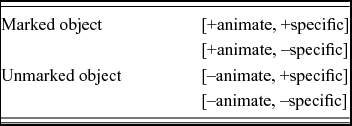
In the present study, the use of DOM is tested across four object types, based on the most commonly referenced paradigm for DOM in Spanish, in which [+animate, +specific] objects are obligatorily marked and all other object types ([+animate, –specific], [–animate, +specific], [–animate, –specific] are not obligatorily marked (see Table 1).
Differential Object Marking in Spanish (Rodríguez Mondoñedo, Reference Rodríguez-Mondoñedo2007).

Objects which are [+animate, +specific] are obligatorily marked with an a preceding the direct object, as in (1)–(2):
-
(1)

-
(2)


As demonstrated, specificity can be indicated in different ways. In (1), María, a proper name, is [+animate, +specific]. A specific referent is typically also implied when the object is used with a definite article, such as la niña “the girl”.
However, in (2), we see that in certain cases the object can be considered [+specific] even with an indefinite article (una secretaria “a secretary”, rather than la secretaria “the secretary”). In these cases, DOM can be used to differentiate between two distinct meanings, which, as Leonetti writes, “indicates that the presence of ‘a’ tends to be associated with specific readings” (p. 75). He also notes that this distinction is somewhat asymmetrical, in that the specific reading is only available in the presence of DOM, while the non-specific reading is available either in the presence or absence of DOM. In (2a) then, when DOM is used, una secretaria “a secretary” refers to a specific or non-specific secretary, while in (2b), lack of DOM indicates a non-specific secretary. This is not uncontroversial, as others (e.g., Guijarro-Fuentes & Marinis, Reference Guijarro-Fuentes and Marinis2007) claim that the use of DOM entails specificity.
Inanimate objects are unmarked, regardless of specificity, as in (3)–(4).Footnote 3
-
(3)
-
(4)


Like Rodriguez-Mondoñedo (Reference Rodríguez-Mondoñedo2007), we acknowledge certain limitations of the paradigm represented above (Table 1). This analysis is not uncommon in the literature (see e.g., Rodriguez-Mondoñedo, Reference Rodríguez-Mondoñedo2007; von Heusinger & Kaiser, Reference von Heusinger, Kaiser and von Heusinger2003; Zagona, Reference Zagona2002) and serves to clearly distinguish the [+animate, +specific] category from other object types, which is useful given the purpose of the present study. However, we would like to highlight the fact that DOM is possible, although not obligatory, in the case of [+animate, –specific] objects (see e.g., Aissen, Reference Aissen2003; Leonetti, Reference Leonetti2004; Torrego, Reference Torrego1998).
Leonetti (Reference Leonetti2004) suggests that there is no systematic correlation between the object marker and specificity of the object, despite the fact that the presence of DOM has a tendency to be associated with specific readings. Examples like (5) and (6) show DOM in cases of non-specific indefinites. In (5), DOM obligatorily precedes indefinite, non-specific pronouns alguien “someone” and nadie “anyone”. In (6), DOM is used with the non-specific bare plurals trabajadores “workers” and candidatos “candidates”. In the case of bare plurals, though, DOM is optional. As the examples show, the sentences are grammatical with or without DOM preceding the object.
-
(5)
-
(6)


Leonetti argues that the use of DOM in these cases is not due to any [+specific] feature, but rather is based on a [+human] feature which ‘overrides all other factors in the DOM system in Spanish’ (Leonetti, Reference Leonetti2004, p. 85). Among [+animate] objects, he suggests that optionality of DOM occurs only with non-pronominal DPs (as in (6)) and with a small group of verbs.
Following Torrego (Reference Torrego1998) and Zagona (Reference Zagona2002), Guijarro-Fuentes and Marinis (Reference Guijarro-Fuentes and Marinis2007) suggest that DOM is restricted to verbs with an agentive or causal subject. This is illustrated in (7), where in (a), the object is obligatorily marked because the subject el paciente “the patient” is agentive, whereas in (b) the object is obligatorily unmarked because the subject la situación “situation” is not agentive.
-
(7)

Guijarro-Fuentes and Marinis (Reference Guijarro-Fuentes and Marinis2007) also suggest that DOM is obligatory when the object is understood as affected (physically, psychologically, or in terms of location), as in (8). In (8a), the object un delincuente “a criminal” is considered unaffected and thus DOM is optional. In (8b), however, the object el delincuente “the criminal” is considered to be affected physically, and thus DOM is used obligatorily.
-
(8)

Finally, Guijarro-Fuentes and Marinis (Reference Guijarro-Fuentes and Marinis2007) claim that the use of DOM is restricted by the aspectual class of the predicate, as shown in (9) and (10). They claim that telic verbs require obligatory use of DOM, as in (9), whereas non-telic verbs require obligatory use of DOM only in the case of a [+animate] subject, as in (10).
-
(9)
-
(10)


As detailed above, DOM in Spanish involves many factors. Nonetheless, there is consistency in certain sub-contexts: DOM is obligatorily used with [+animate, +specific] objects, and is overwhelmingly prohibited with [–animate] objects. The methodology for the current study is based on the distributional paradigm presented in Table 1, in which objects are divided into four types based on animacy and specificity only. While these are the main variables examined in this study, we do take into consideration the other factors presented here. We elaborate on this in Section 5.3 below.
4.3 Prior studies of acquisition of DOM in Spanish
The acquisition of DOM has been shown to be problematic for both L2 learners (Bowles & Montrul, Reference Bowles, Montrul, Bruhn de Garavito and Valenzuela2008; Guijarro-Fuentes, Reference Guijarro-Fuentes2012; Guijarro-Fuentes & Marinis, Reference Guijarro-Fuentes and Marinis2007, Reference Guijarro-Fuentes, Marinis and Collentine2009) and heritage bilinguals (Montrul, Reference Montrul2004; Montrul & Bowles, Reference Montrul and Bowles2009).Footnote 4 Guijarro-Fuentes and Marinis (Reference Guijarro-Fuentes and Marinis2007) tested L2 learners’ ability to distinguish between grammatical and ungrammatical usage of DOM across six conditions manipulated for both the structure and the semantics of the predicate. Relevant for the present study are the first three conditions, testing the following object types: [+animate, +specific], [–animate, +specific], [–animate, –specific] and [+animate, –specific].
The L2 learners performed at chance across all conditions in a contextualized acceptability judgment task. While advanced L2 learners performed at chance with [+animate, +specific] objects and [+animate, –specific] objects, they did show sensitivity to animacy, performing well above chance on sentences with [–animate] objects. The authors attribute this result to the relative simplicity of this condition or perhaps explicit instruction (see Bowles & Montrul, Reference Bowles, Montrul, Bruhn de Garavito and Valenzuela2008), as the second language learners only need to learn the animacy restriction on DOM to perform accurately. In general, the results of the study show that DOM proves difficult for native English speakers to acquire in L2 Spanish.
Like L2 learners of Spanish, heritage bilinguals also display divergence from native Spanish speakers with respect to DOM. Rodríguez-Mondoñedo (Reference Rodríguez-Mondoñedo2008) has shown that monolingual Spanish-speaking children acquire DOM with 98% accuracy as early as 2;9 (i.e. at two years and nine months of age). It is possible that heritage bilinguals acquire DOM in early childhood and later suffer attrition which results in variable usage of this property. Alternatively, heritage bilinguals may not converge on monolingual norms of DOM because they are exposed to qualitatively different input.Footnote 5
Montrul and Bowles (Reference Montrul and Bowles2009) show that even advanced heritage bilinguals diverge from monolingual native speakers with respect to their usage and acceptance of DOM in Spanish. In an acceptability judgment task, 16 of 30 advanced proficiency heritage bilinguals and 20 of 23 intermediate proficiency heritage bilinguals accepted sentences with a [+animate, +specific] direct object without DOM, diverging significantly from the monolingual controls. In a second acceptability judgment task given to different participants, the authors found that 24 of 30 advanced heritage bilinguals and 27 of 28 intermediate heritage bilinguals accepted ungrammatical sentences with DOM. Interestingly for the present study, all groups of heritage bilinguals in the second experiment accepted DOM with [–animate] objects, which the authors attribute to differences in input, language change (Company, Reference Company, Bernabé, Berenguer, Cantarero and de Torres2002) or perhaps the complexity of DOM itself.
5. The present study
5.1 Research questions and hypotheses
The present study aims to examine what morphosyntactic transfer effects obtain in the L3 acquisition of BP by successive and heritage bilinguals of Spanish and English. We adopt the three research questions (RQs) and hypotheses as set out below.
-
RQ1. Which of the three proposed models best predicts and explains the results of all three groups tested?
We predict evidence of transfer from Spanish in all three bilingual groups, based on the prior work of multiple authors, particularly those working with BP (Montrul et al., Reference Montrul, Dias and Santos2011; Rothman Reference Rothman2010, Reference Rothman2011), which would be consistent with the predictions of the TPM and inconsistent with predictions of both the CEM and the L2SF.
-
RQ2. Following from Iverson (Reference Iverson, Pires and Rothman2009), is there evidence based on these data to support complete acquisition of a new linguistic property (DOM) in the L2 in adulthood?
Our prediction of transfer from Spanish (see RQ1), irrespective of its L1/L2 status, has implications not only for L3 acquisition but also, indirectly, for L2 acquisition. As Iverson (Reference Iverson, Pires and Rothman2009) explains, in order to transfer any linguistic property (such as DOM), the learner must have a mental representation of this property, meaning it has been acquired. We predict evidence of transfer from Spanish in all groups, including the non-native Spanish bilinguals. Such transfer implies that the L2 Spanish group has acquired DOM in their L2 and supports the Full Transfer/Full Access Model for SLA (Schwartz & Sprouse, Reference Schwartz and Sprouse1996).
-
RQ3. What do the results of the heritage speakers, specifically in terms of Spanish transfer, tell us about the syntactic representation of Differential Object Marking in their Spanish grammar?
As we outline in our predictions for RQ2, we believe evidence of transfer from Spanish in this experiment is an indication of an underlying mental representation of the Spanish syntax in the speakers tested. We predict that the transfer observed in the heritage bilinguals may look different than the transfer of the other two groups due to evidence that DOM is represented differently in the Spanish of heritage speakers (Montrul & Bowles, Reference Montrul and Bowles2009). Divergent results from the heritage bilinguals, while indicating transfer from Spanish, may indicate transfer of a system in which DOM is applied in a different distributional pattern.Footnote 6
5.2 Participants
There were 43 participants in the study, all Spanish–English bilinguals in their first semester of studying BP as an L3.Footnote 7 Participants were recruited from Accelerated BP courses at a number of large public and private universities across the United States.
The first two groups of L3 participants tested were successive bilinguals of the same language pairing.Footnote 8 The L1 English group (n = 14) consisted of native English speakers (mean age 21.5 years, range 19–24) who began acquiring Spanish as an L2 at age 12 or later. The L1 Spanish group (n = 9) consisted of native Spanish speakers (mean age 24.33 years, range 19–34) who began acquiring English as an L2 at age 9 or later.Footnote 9 In addition to the “mirror-image” groups, a third bilingual group was also tested. The heritage Spanish group (n = 20) consisted of US residents (mean age 20.9 years, range 19–24) exposed to Spanish from birth and English before the age of 7 years. There were also control groups for each of the three languages: Spanish (n = 26), English (n = 24) and Brazilian Portuguese (n = 15).
5.3 Grammaticality judgment task
Participants completed a grammaticality judgment task (GJT) via surveygizmo.com, rating 120 BP sentences on a scale of 1 (ungrammatical) to 4 (grammatical). Sentences were presented in audio and written formFootnote 10 simultaneously, one sentence at a time. Participants were unable to revise previously rated sentences.
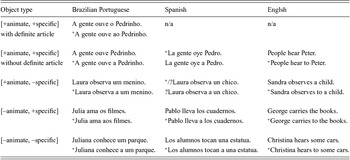
There were 64 target sentences, 16 DOM-related fillers and 40 unrelated fillers. Each of the 64 target sentences consisted of a DP subject followed by a transitive verbFootnote 11 and a direct object of one of four types: (i) [+animate, +specific] (ii) [–animate, +specific] (iii) [–animate, –specific] and (iv) [+animate, –specific]. For each object type, half of the sentences did not include the differential object marker a – which is ungrammatical in Spanish for [+animate, +specific] objects, but grammatical for other object types in Spanish and across the board in BP – and half included a – which is ungrammatical in BP and only obligatory for [+animate, +specific] objects in Spanish. Since BP allows for the optional use of the definite article before proper nouns, which could possibly interpreted as DOM by L3 learners, it was important to include related filler sentences (n = 16) that contained a definite article used with [+animate, + specific].Footnote 12 Half of these exhibited DOM, while half did not. Table 2 contains examples of sentences in GJT in all three languages.
Sample sentences from grammaticality judgment task by object type.

The goal of this study was to investigate two major variables – animacy and specificity. Additional factors that play a role in the use of DOM in Spanish were controlled for in the task. In the [+animate, +specific] condition, all objects were singular, male, proper nouns (i.e. personal names). In the [+animate, –specific] condition, all of the objects were singular (eliminating the possibility of bare plurals), masculine, human nouns, preceded by the indefinite article.
Immediately following the Portuguese task, participants completed Spanish and English versions of the task. Participants who scored outside the native control range for either the Spanish or the English task were excluded from the study. Participants were also excluded from the study if they had knowledge of another language other than English or Spanish, or more than one semester of BP exposure (recall footnote 9)
5.4 Results
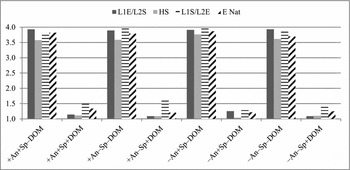
First we summarize the results from the English and Spanish tasks. For each language, a mixed ANOVA was run using the ratings of the grammaticality judgment task with a between-subjects variable of Group, and within-subjects variables of Animacy, Specificity, and DOM. The results from the English version of the task can be seen in Figure 1.
Mean ratings of English version of grammaticality judgment task.

There were significant main effects for both Group (F(1,63) = 5.35, p = .002) and DOM (F(1,63) = 1743, p < .001); however, no interactions containing Group were significant. While each group may have differed in absolute ratings, they all exhibited similar patterns in accepting [–DOM] sentences and rejecting [+DOM] sentences in English. The same analysis was run on the Spanish version of the tests. The results from the Spanish version of the task can be seen in Figure 2.
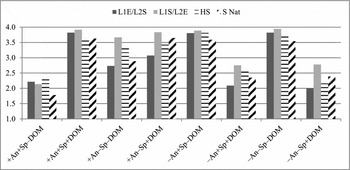
Mean ratings of Spanish version of grammaticality judgment tasktask.

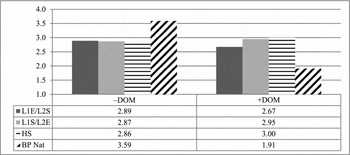
There was a significant interaction of Animacy, Specificity and DOM (F(1,65) = 76.16, p < .001), as DOM is obligatory for only [+animate, +specific] objects. However, there was no significant interaction of these variables with Group, indicating that the groups did not exhibit different patterns of judgments. Additionally, the interaction of DOM and Group was significant (F(2,65) = 4.03, p = .011). This is perhaps a reflection of the groups’ tendency to not reject [+animate, –specific] objects, with or without DOM. Coupling the results of the tasks in English and Spanish shows that all L3 groups have knowledge of whether or not DOM is possible in English and Spanish. In English, they know that it is simply ungrammatical. In Spanish, they show consistent acceptance of unmarked [–animate] objects, but crucially reject unmarked [+animate, +specific] objects.
Now we return to the results on the BP version of the task. The ANOVA returned a significant interaction of all variables (F(3,54) = 3.13, p = .03). This result was further investigated with Bonferroni post-hoc tests for each item type. Below we detail the results for items which require DOM in Spanish, followed by items for which DOM would not be required in Spanish.
First, we consider the results for constructions with [+animate, +specific] direct objects (see Figure 3), which are the primary test case for transfer. Results show a clear difference in the intuitions of the BP controls as compared to all three experimental groups. The BP controls, as expected, accept [–DOM] sentences almost at ceiling, while the experimental groups perform just above chance, giving the grammatical sentences significantly lower rankings than the natives (p < .012 for all comparisons). The L3 groups and BP natives also differ on the [+DOM] sentences. DOM does not exist in BP, and so, not surprisingly, the BP controls uniformly reject [+DOM] sentences for [+animate, +specific] objects. Each of the L3 groups, however, rates these [+DOM] sentences significantly higher than the natives (p < .038 for all comparisons).
Mean ratings of [+animate, +specific] objects.

We highlight the fact that the native controls are the only group to make a clear and significant distinction between the [–DOM] and [+DOM] constructions (p < .001). All three groups of Spanish/English bilinguals effectively do not make a distinction between the [–DOM] and [+DOM] sentences in this category (p > .374 for all comparisons). With Bley-Vroman's (Reference Bley-Vroman1983) suggestions in mind to use grammatical counter-balance distinction trends as a comparison to avoid the comparative fallacy, we highlight that the trends across the groups are not at all in the same direction, but truly different. We take this to indicate that the underlying grammars of the Spanish bilingual groups on the one hand and the BP natives on the other are truly distinct at this point in development. Crucially, the Spanish bilingual groups accept DOM, which is ungrammatical in BP and cannot be transferred from English.
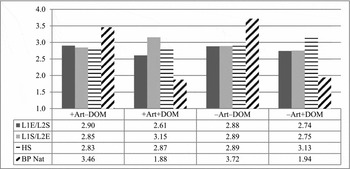
As mentioned previously, the definite article is used variably with proper nouns, which Spanish speakers of BP may interpret as DOM. To rule out this possibility, a subset of the fillers contained definite articles with proper (human) names, with and without DOM (see Figure 4, which displays this data combined with the data displayed in Figure 3).
Mean ratings of [+animate, +specific] objects with [±article, ±DOM].

For the data in Figure 4, there was no interaction of the variables of (the presence of an) Article, DOM and Group (F(3,54) = 1.015, p = .383), no interaction of Article and Group (F(3,54) = 1.373, p = .261), and no significant main effect for Article (F(1,54) = 0.673, p = .416). We take this to signify that the use of the definite article with all groups was truly optional. Furthermore, there was an interaction between DOM and Group (F(3,54) = 13.151, p < .001). Post-hoc tests showed that only the BP group made significant distinctions based on presence of DOM (p < .001), while the L3 groups did not. The L3 groups failed to reject items that contained a definite article, as well as those with both an article and DOM. This suggests that (i) the definite article was not interpreted as DOM, and (ii) these learners also optionally allow the use of definite articles with names. The use of definite articles with proper names is not found in the Spanish dialects of these L3 learners,Footnote 13 and may be a result of some development of their BP grammar.
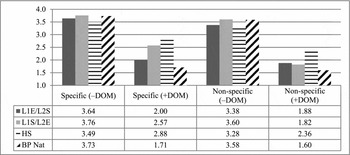
Next, we consider the results for the remaining three object types. As explained in Section 4.2 above, evidence in the literature claims that DOM is never used in Spanish with [–animate] objects (regardless of specificity). Therefore, we expect the three experimental groups to pattern consistently with the native controls in our two inanimate object categories ([–animate, +specific] and [–animate, –specific]). As shown in Figure 5, these predictions are confirmed by the data in the case of [–DOM] constructions with [–animate, +specific] objects; both the control and the bilingual groups accept these sentences, with no significant differences between the ratings of each group (p > .267 for all comparisons).
Mean ratings of [–animate, ±specific] objects.

However, in the case of [+DOM] sentences with the same object type [–animate, +specific], there is some divergence across the bilingual groups. The L1 English speakers appear to have the most native-like intuitions, clearly rejecting the [+DOM] constructions with ratings comparable to the native group (p = .99). However, both the L1 Spanish speakers and the heritage bilinguals give these [+DOM] constructions significantly higher ratings than the natives (p < .004). Importantly though, when comparing the [+DOM] and [–DOM] constructions for [–animate, +specific] objects, it is clear that all of the groups make a clear distinction between the two, significantly preferring the [–DOM] sentences to the [+DOM] sentences (p < .038 for all comparisons). However, the divergence among the experimental groups here is noteworthy and unexpected.
Similarly, for [–animate, –specific] direct objects (see Figure 5), we should expect the BP controls and all L3 groups to accept [–DOM] sentences and reject [+DOM] sentences. As predicted, the BP controls and the L3 groups do not assign significantly different ratings to the [–DOM] constructions (p > .47 for all comparisons). Looking at the [+DOM] constructions, the L1 English and L1 Spanish groups do not differ significantly from the BP controls (p > .418); however, there is some divergence in the heritage bilinguals as compared to the BP control (p = .028). As with [–animate, +specific] objects, all groups distinguish significantly between [–DOM] and [+DOM] items (p < .001), despite the divergence of the heritage bilinguals in the case of [+DOM] constructions.
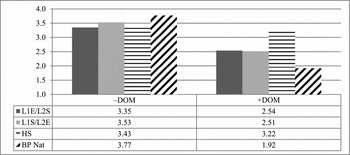
The fourth object type is [+animate, –specific] objects. Unlike the [–animate] objects, this object type provides us with a chance of seeing divergence between the L3 groups and the BP controls, at least for the [+DOM] sentences. We expected to see convergence between the L3 groups and the BP controls for the [–DOM] sentences since DOM is not obligatory before [+animate, –specific] objects. The results are given in Figure 6.
Mean ratings of [+animate, –specific] objects.

The results show that the BP controls and the three L3 groups accept these sentences, as expected, with no significant differences between the groups (p > .09 for all comparisons). However, if we look at the [+DOM] sentences for [+animate, –specific] items, we may see divergence between the L3 groups and the controls, since, in Spanish, it is claimed to be possible for DOM to precede nonspecific direct objects. Given that the BP controls do not have this possible context in which DOM is licit before this object type, they should have considerably lower ratings for these [+DOM] sentences. This result is borne out clearly in the data (see Figure 6). All three L3 groups show significantly higher acceptance of these [+DOM] sentences than the BP group (p < .037 for all comparisons). Despite this divergence from the control group for this sub-condition, both the L1 English and the L1 Spanish groups do make a distinction based on presence of DOM, rating [+animate, –specific] objects without DOM higher than those with DOM, consistent with the BP control (p < .005 for all groups). The heritage group does not make this distinction (p = .378). This is not entirely unexpected, as DOM with [+animate, –specific] objects is possible in Spanish. Furthermore, on the Spanish version of the task, both the L1 Spanish group and the heritage group tended to accept sentences with [+animate, –specific] objects, regardless of the presence of DOM. The similarity of the heritage group's performance in Spanish and BP for this condition is a clear indication of transfer. In contrast, the L1 Spanish group performed in a more BP-like manner on the BP task, which could be a result of linguistic development following transfer. The L1 Spanish group's more rapid convergence on the BP norm (as compared to the heritage group) could be a result of increased metalinguistic awareness that stems from formal language instruction (Missler, Reference Missler, Dentler, Hufeisen and Lindemann2000; Thomas, Reference Thomas1988); while both these groups are bilingual, the L1 Spanish group learned one of their languages (English) in a classroom setting. If increased metalinguistic awareness acts as a catalyst for acquisition, then the asymmetry in development of the heritage and L1 Spanish groups is not unsurprising.
6. Discussion
Several observations can be made from the data. All L3 groups rejected DOM in English. In Spanish, DOM is treated correctly for [+animate, +specific] objects and all [–animate] objects by all L3 groups, while distinctions were less clear for [+animate, –specific] objects. In BP, the native control group rejected all cases of DOM, but the L3 groups’ performances were not always in line with native patterns. The L3 groups made distinct judgments based on the presence or absence of DOM for all [–animate] objects in BP, but did not do so for [+animate, +specific] objects in BP, failing to reject these items regardless of presence or absence of DOM. Furthermore, in all these conditions, all L3 groups exhibited similar patterns of behavior. There was divergence between the L3 groups for [+animate, –specific] objects: the L1 Spanish and L1 English group, like the BP group, correctly distinguished between presence and lack of DOM for [+animate, –specific] objects, while the heritage bilinguals did not. Additionally, the L3 groups (and the BP group) allowed for the optional use of definite articles with personal names, something not found in English or their dialects of Spanish. In light of these results, we return to our principal research question: which, if any, of the L3 transfer models best explains and predicts the transfer patterns of the three groups of Spanish–English bilinguals learning L3 BP?
The CEM (Flynn et al., Reference Flynn, Foley and Vinnitskaya2004) predicts that transfer should never be non-facilitative. Hence, the CEM predicts that none of the three bilingual groups should transfer from Spanish since, with respect to DOM, such transfer would result in non-target production and comprehension in the L3. Given that all three groups show robust, non-facilitative transfer from Spanish, the predictions of the CEM are not supported.
The L2SF (Bardel & Falk, Reference Bardel and Falk2007; Falk & Bardel, Reference Falk and Bardel2011) predicts that the L2 will be transferred at the initial stages of L3 acquisition. This prediction is confirmed by the results of the L2 Spanish group, which show clear transfer from Spanish. However, the L1 Spanish group showed similar transfer from Spanish, an outcome unanticipated by the L2SF. According to Bardel and Falk, this L1 transfer should be blocked by these speakers’ L2 English system. Since the L2SF makes predictions only for successive bilinguals acquiring an L3, the results of the heritage speakers are not considered.
The TPM (Rothman Reference Rothman2010, Reference Rothman2011, Reference Rothman, Baauw, Dirjkoningen and Pinto2013) predicts that all three bilingual groups will transfer the most structurally/typologically similar language (here, Spanish) at the initial stages of L3 acquisition. All three bilingual groups, as predicted by the TPM, show evidence of transfer of Spanish which, for certain direct object types, resulted in divergence from the BP controls.Footnote 14 We argue that the TPM best accounts for these data.
It should be noted that while these learners of L3 BP accept instances of DOM, they do not strongly reject the lack of DOM with [+animate, +specific] objects, which is ungrammatical in Spanish. This may seem in contention with models that predict transfer of Spanish-like DOM, but it is not, as none of these models denies the acquisition of target-like structures. The observation that the L3 groups allowed use of the definite article with personal names, a phenomenon not found in their L1 or L2, may be evidence of linguistic development. Additionally for the property in question here, it is feasible that learners of BP know that lack of DOM is grammatical without knowing that DOM is actually ungrammatical in BP. This has been referred to as a preemption problem (Trahey & White, Reference Trahey and White1993), in which options from previously acquired grammars continue to be entertained even after acquisition of a target form in the new (here, L3) grammar (for preemption problems with respect to Spanish/BP, see e.g., Iverson & Rothman Reference Iverson, Rothman, Danis, Mesh and Sung2011; Rothman & Iverson, Reference Rothman and Iverson2013). What is crucial here is that these learners show evidence of DOM in L3 BP, which is not transferrable from English and is not part of the BP input. L1 or L2 Spanish is the only possible source of transfer of DOM.
Alternatively, as suggested by an anonymous reviewer, it is possible that this evidence does not represent transfer from Spanish; rather, learners are simply demonstrating a general over-acceptance of a novel structure (i.e. DOM) in the non-native language, a finding which has been reported in L2 acquisition research (Schulz, Reference Schulz2006; Slavkov, Reference Slavkov, Slabakova, Rothman, Kempchinsky and Gavruseva2008). In order to completely rule out this possibility, it would be necessary to test a fourth group: L3 learners whose first two languages lacked DOM. If these learners did not show increased acceptance of DOM in the L3 BP, it would strengthen the conclusions of the present study, namely that the L3 learners’ acceptance of DOM in BP is the consequence of linguistic transfer from Spanish, the most typologically similar language. If, on the other hand, these L3 learners showed a similarly increased acceptance of DOM in L3 BP, it would indicate that, at least in some cases, what seems to be transfer of a structure from a previously acquired language may actually be indeterminate over-acceptance of that structure in the non-native language.
Without this fourth ([–DOM]) L3 experimental group, we cannot entirely rule out the possibility that the participants are arbitrarily over-accepting DOM in the L3. Nonetheless, we reiterate that the findings of the present study are most consistent with an account which predicts transfer from Spanish. If participants were not transferring DOM from Spanish, they would not be expected to show differential acceptance of DOM in BP based on the animacy of the direct object. However, participants’ acceptance of DOM was conditioned by this critical factor. Recall, for example, that participants in all three L3 groups rated [–DOM] sentences significantly higher than [+DOM] sentences with [–animate] direct objects, suggesting that their acceptance of DOM in BP is not arbitrary at all. Instead, their acceptance of DOM in BP appears to be governed by the animacy of the direct object.
Finally, if the L3 groups in the present study were transferring from Spanish, we would also expect to find subtle differences in their acceptance of DOM in BP based on the nature of their Spanish DOM systems. The heritage bilinguals, regardless of whether or not DOM was present, rated Spanish sentences with [+animate, –specific] direct objects equally. Not surprisingly, this group (and, crucially, not the other two L3 groups) showed the exact same pattern of acceptance in L3 BP. This consistency of DOM acceptance across languages is most easily accounted for by positing the transfer of Spanish into the L3.
Our second research question addressed the implications of these results for SLA, based on the ideas and evidence in Iverson (Reference Iverson, Pires and Rothman2009). Whether or not adults have access to the same acquisition mechanisms (i.e. Universal Grammar) as children is a long-standing debate in SLA research. Those who claim that language acquisition in adulthood is a fundamentally different process (e.g., Clahsen & Muysken Reference Clahsen and Muysken1986, Reference Clahsen and Muysken1989; Bley-Vroman Reference Bley-Vroman, Gass and Schachter1989, Reference Bley-Vroman1990; Clahsen & Hong Reference Clahsen and Hong1995; Franceschina Reference Franceschina2001, Reference Franceschina2005; Hawkins Reference Hawkins, Dekydtspotter, Sprouse and Liljestrand2005; Hawkins & Hattori Reference Hawkins and Hattori2006; Tsimpli & Dimitrakopoulou Reference Tsimpli and Dimitrakopoulou2007) account for apparent successes by appealing to non-linguistic learning and problem-solving strategies. So, while the L1 English/L2 Spanish group showed apparent knowledge of DOM on the Spanish version of the task, this may not constitute evidence of true linguistic acquisition for all sides of the debate.
In light of this, Iverson (Reference Iverson, Pires and Rothman2009) acknowledged that examining the initial stages of L3 acquisition may provide insight with respect to acquisition possibilities in L2 acquisition in adulthood, as only what has been successfully acquired in the L2 is available for transfer into the L3. Furthermore, he claims that when testing the L3 of learners who acquired their L2 in adulthood, comparison to heritage speakers can be appropriate and fruitful. Approaches to adult language acquisition claiming lack of access to Universal Grammar make different predictions for these groups, denying the possibility of linguistic transfer of an L2 acquired in adulthood.
In this study, both the L1 English group and the heritage group showed evidence of transfer of DOM into L3 Portuguese. As it is uncontroversial that the heritage bilinguals, who acquired Spanish as a first language, have an underlying linguistic representation of DOM, it can be assumed that the L1 English/L2 Spanish group was able to acquire, in adulthood, the relevant features necessary for acquiring DOM in Spanish. If the acquisition of new properties in adulthood implies continued access to UG, this evidence supports the notion that these learners were not subject to a maturationally-conditioned critical period for language learning. This contributes to similar results of other studies demonstrating the transfer of an L2 acquired in adulthood into the L3 (e.g., Cabrelli-Amaro, Iverson & Judy, Reference Cabrelli Amaro, Iverson, Judy, Pires and Rothman2009; Falk & Bardel, Reference Falk and Bardel2011; García Mayo & Villareal Olaizola, Reference García Mayo and Villareal Olaizola2011: Jaensch, Reference Jaensch2011; Montrul et al., Reference Montrul, Dias and Santos2011; Rothman, Reference Rothman2011), including poverty-of-the-stimulus properties (Guijarro-Fuentes, Iverson, Judy & Rothman, Reference Guijarro-Fuentes, Iverson, Judy and Rothman2008).
Finally, our third research question addressed the results of the heritage bilinguals and what these data can tell us about the syntax of DOM in heritage Spanish. The results of the grammaticality judgment task confirm our predictions that while transfer of Spanish is evident in the heritage bilinguals, the results are slightly divergent from those of the other two experimental groups. The heritage group patterns similarly to the other L3 groups in all but one condition: animate, nonspecific objects. In this condition, the heritage group made no distinction in their ratings whether DOM was used or not, a behavior which they also exhibited in the Spanish version of the task. Although speculative, it is possible that these speakers are losing sensitivity to the [±specific] feature involved in DOM in Spanish, shifting towards a use of DOM based on animacy only. Such a change would be consistent with prior findings of insensitivity to semantic features (perhaps specificity) in unrelated structures, such as subjunctive use in relative clauses (e.g., Montrul, Reference Montrul2009) and dislocated structures (e.g., Zapata, Sánchez & Toribio, Reference Zapata, Sánchez and Toribio2005). While this group of heritage speakers does diverge from participants who were raised as monolingual speakers of Spanish, they do not exhibit the same shortcomings reported in other studies, in which heritage speakers accept the use of DOM in ungrammatical contexts as well as the lack of DOM where it would traditionally be considered obligatory (e.g., Montrul & Bowles, Reference Montrul and Bowles2009). However, it should be noted that heritage speakers may perform less well on written tasks (compared to both monolinguals and L2 learners) than oral production tasks (Montrul, Foote & Perpiñán, Reference Montrul, Foote and Perpiñán2008), and that native-like accuracy of DOM use is not undocumented (Montrul & Sánchez-Walker, Reference Montrul and Sánchez-Walker2013).
These data contribute to mounting evidence that although heritage grammars are native grammars, they differ from both native monolingual and adult L2 grammars (see e.g., Montrul & Sánchez-Walker, Reference Montrul and Sánchez-Walker2013). The divergence in linguistic competence among heritage speakers has been commonly attributed to incomplete acquisition and/or language attrition of the heritage language (Montrul, Reference Montrul2008). Pires and Rothman (Reference Pires and Rothman2009) have suggested that divergence is instead the result of exposure to qualitatively different input (when compared to monolinguals) and/or lack of formal education. This input may not be sufficient to trigger acquisition of specific properties and/or it may provide input to properties that are represented differently in the heritage grammar (Pires & Rothman, Reference Pires and Rothman2009). The nature of this divergence is an important and controversial question, but we do not attempt to answer it here.
7. Conclusion
The results of this study, which display evidence of transfer of DOM from Spanish into BP at the L3 initial stages, are consistent with the predictions of the TPM, as (of the two previously acquired languages) Spanish is the language more structurally similar to BP. These results are not consistent with the predictions of the CEM or the L2SF, as evidence of transfer from Spanish was evident across all experimental groups, in spite of its lack of facilitation of acquisition of the target language, and regardless of the order of acquisition of the first two languages. Further, the results of the successive (L1 Spanish and L2 Spanish groups) vs. simultaneous bilinguals (heritage group) are consistent with those of Iverson (Reference Iverson, Pires and Rothman2009) and provide evidence against the existence of a maturational critical period for the acquisition of morphosyntax. At the same time, the results of the heritage bilinguals differ from the successive bilinguals, providing unique evidence related to the heritage grammar of this particular syntactic property.