The phenomenon of violence between juvenile groups or youth gangs is multi-faceted, and is hard to grasp primarily for two interrelated reasons: it has been hard to agree on an operational definition for it; and it is difficult to estimate the magnitude of the problem in contemporary societies. Gang violence, intergroup violence, and other concepts have been deployed in defining this cross-cultural phenomenon. Legal approaches and sociocultural traditions are unique to every country, affecting how the phenomenon is defined and characterized around the world. The World Health Organization (WHO) defines physical violence as:
The intentional use of physical force or power, threatened or actual, against oneself, another person, or against a group or community, that either results in or has a high likelihood of resulting in injury, death, psychological harm, maldevelopment or deprivation (Krug, Dahlberg, Mercy, Zwi, & Lozano, Reference Krug, Dahlberg, Mercy, Zwi and Lozano2002, p. 5).
Meanwhile, the United Kingdom Home Office (Pearce & Pitts, Reference Pearce and Pitts2011, p. 12) posits that “gangs” have the following features:
Young people (who) spend time in groups of three or more. The group spends a lot of time in public places. The group has existed for 3 months or more. The group has engaged in delinquency or criminal behavior together in the last 12 months. The group has at least one structural feature (a name, an area, or a leader).
In the Spanish case, youth gang is defined in Directive 23, from December 7, 2005, released by the Secretary for State Security. It posits the following requirements for a group to be considered a gang: members are young people 12 to 32 years old, have structures that hold them together and provide for internal discipline, they carry out acts of violence, and they cause social unrest (Igual, Reference Igual, Lázaro and Molinero2009). Combining various criteria, the Eurogang Footnote 1 network proposes that the concept of “gang” be defined as follows: “any durable, street-oriented youth group whose involvement in illegal activity is part of its group identity” (Weerman et al., Reference Weerman, Maxson, Esbensen, Aldridge, Medina and van Gemert2009, p. 20). However, Klein and Maxson (Reference Klein and Maxson2006) claim that gangs should not only be considered from the perspective of crime, as it would be overly reductionist to say their objective is crime, overlooking other possible motives (revenge, upholding honor, demanding respect, etc.) and socialization settings. The examples above suggest the existing definitions of violence are largely too generic. That is why some authors (Moser, Reference Moser2004) recommend describing the type of violence being examined. Other definitions have included illegal activities besides physical violence, making it a challenge to design interventions to prevent or treat this problem specifically. In the present case, any description of violence must take into account the fact that at least in Spain, and in Europe at large, many apparently individual acts of violence are in fact inspired by group norms and habits (Martín, Martínez, & Rosa, Reference Martín, Martínez and Rosa2009; Scandroglio, López, & San José, Reference Scandroglio, López and San José2008). In conducting this study, we identified groups of interest involved in identity violence, which is defined as physical aggression carried out by a person or persons who, because they belong to a particular group, intentionally attempt to physically harm one or more persons identified as members of a rival or other group. It is distinguished mainly: (a) as distinct from ingroup violence against unruly ingroup members who show inadequate commitment to the group; and (b) for including indiscriminate acts of violence (no regard for who or how many people) against members of a rival group, therefore prioritizing group identity.
Egley and Howell (Reference Egley and Howell2012) summarize the growth of gang violence in the United States, which increased during the last decade before stabilizing. Likewise, the European Economic and Social Committee (2009) report found a similar trend in Europe. However, the qualitative differences between street gangs on either side of the Atlantic are considerable, in the severity and frequency of the violence they perpetrate, their connections to other illegal behaviors, and how affiliations develop (Klein, Weerman, & Thornberry, Reference Klein, Weerman and Thornberry2006).
In Spain, it has been confirmed that some groups commit violent acts with extremist ideology behind them, which despite their low stake in delinquency rates, are of special societal concern (Ministerio de Justicia, 2011). Data from the Delinquency Analysis Department of the Technical Unit of the Judicial Police Force (Pozo, Gallego, Vicente, & Pérez, Reference Pozo, Gallego, Vicente, Pérez, Brutto and Minesso2013) illustrate in greater depth the street gang situation in Spain: between 2010 and 2011, a total of 3,928 members of this type of group were identified. Of those, 610 were right-wing extremists, 1,813 left-wing extremists, 1,467 Latin American gang members, and 38 belonged to different types of groups. Moreover, the number of juveniles that state security forces arrested belonging to violent groups rose between 2010 and 2011 in the case of right-wing (from 17 to 78) and left-wing (from 20 to 52) extremist groups, but fewer Latin American youths were arrested (from 371 to 302). Meanwhile, the Spanish Finance Ministry’s annual reports (2004–2011) indicate gangs have a greater presence in Madrid and Barcelona, but the phenomenon is starting to be seen in smaller cities as well. The most active groups were the Latin Kings, Dominicans Don’t Play, the Trinitarios, and the Ñetas. In Madrid specifically, the reports detected only the Latin King presence in 2006 and 2007, and scarcely at that. In 2008, in addition to the Latin Kings, activity from the Trinitarios was identified, and both groups’ activity was more frequent than in the previous year; and Domincans Don’t Play became the most active group. In 2009, those three Latin American groups were equally present, the Trinitarios being the most violent. Over the course of 2010, the groups’ activity declined, and in 2011, that pattern of low activity stabilized. Nevertheless, the last Ministry of Finance report (Ministerio de Justicia, 2013, p. 418) indicates that “although the so-called ‘Latino gangs’ did not reach the last decade’s average level in committing major crimes, certain events (in Madrid and Barcelona) may suggest an uptick in their activity.”
In terms of composition, some studies have reported that these juvenile groups are ethnically homogenous (Bullock & Tilley, Reference Bullock and Tilley2002), while others have said they are heterogeneous (Gatti, Tremblay, Vitaro, & McDuff, Reference Gatti, Tremblay, Vitaro and McDuff2005). Esbensen and Carson (Reference Esbensen and Carson2012), in a five-year longitudinal study conducted in seven U.S. cities, did not find that immigrants were more likely to join a gang. Decker, van Gemert, and Pyrooz (Reference Decker, van Gemert and Pyrooz2009) pointed out similarities and differences between the U.S. and Europe in the connection between gang membership and immigration. In both territories, gangs have no single ethnic or cultural origin, but they differ greatly in the frequency and intensity of their crimes (more frequent and serious in the USA). They also identified factors that affect immigrant youth and are associated with the formation of gangs: poverty, racism, multiple marginality, the capitalist system, anomie, housing scarcity, and the formation of ghettos.
According to numerous qualitative studies, immigration is tied to criminal behavior only when the host societies or communities have issues of social disorganization (Sampson, Raudenbush, & Earls, 1998), anomie (Messner & Rosenfeld, Reference Messner and Rosenfeld2007), prejudice and hostility (Hagedorn, Reference Hagedorn2008), or their members had previous family or educational problems. Vigil (Reference Vigil1988) proposed the “multiple marginality” thesis according to which some groups of immigrant youth at-risk for social exclusion (poor, maladapted at school, insufficient parental support, and racism in their communities) tend to unite or form gangs. Mohammed (Reference Mohammed2011) declared a similar sentiment with regard to French gangs. Zdun (Reference Zdun2011) gathered empirical support for this proposal through qualitative analysis of development in violent youths and delinquents in the former Soviet Union who emigrated to Germany. Some stopped participating in violent activity if the host society provided positive sources of social support (from institutions and friends above all). Others continued their antisocial behavior if they had repeated negative experiences, joining up with other violent youths.
More recently, Barrett, Kuperminc, and Lewis (Reference Barrett, Kuperminc and Lewis2013) conducted a quantitative and qualitative study of adolescents residing in Atlanta (USA), and found a relationship between “acculturative stress” Footnote 2 (which includes socioeconomic disadvantage and prejudice) and gang membership. However, noticeable differences between U.S.-born Latinos and first-generation immigrants led them to propose that the two groups follow different paths to gang membership.
In Spain, Sobral, Gómez-Fraguela, Luengo, Romero, and Villar (Reference Sobral, Gómez-Fraguela, Luengo, Romero and Villar2010) found a connection between the acculturation strategy of “separation” (characterized by a positive perception of one’s culture of origin and rejection of the host culture) and antisocial behaviors in a sample of 750 adolescents (11 to 17 years old) from Latin America, all educated in Madrid and Galicia. Martín et al. (Reference Martín, Martínez and Rosa2009), on the other hand, found socialization (normalization) gaps in the school and family institutions of free Latino and Spanish youths affiliated with Madrid street gangs. Taking an anthropological perspective, Feixa and Canelles (Reference Feixa and Canelles2006) summed up the features of Latin American immigration and its relation to gang membership as follows: most Latin American youths do not belong to youth associations; most are not violent; Latino youth associations are not criminal organizations, though their members may be involved in illegal activity. Furthermore, these organizations have ceased to be entirely Latin American or entirely male, and do not control territories although they may assigned to them.
The present study’s objective was to gain an understanding of the relationship between migration experience and violent group behavior in young gang members, originally from Latin America and carrying out custodial sentences in Community of Madrid Justice Enforcement Centers (CEMEJ). More operatively, it aimed to describe elements of commonality and difference in research participants’ interpretations relating to different socialization settings and the migration experience. We explore the influence of both: migration experience and socialization settings in Spain in cases of affiliation with a violent group or involvement in violent group behavior.
Method and Materials
Participants
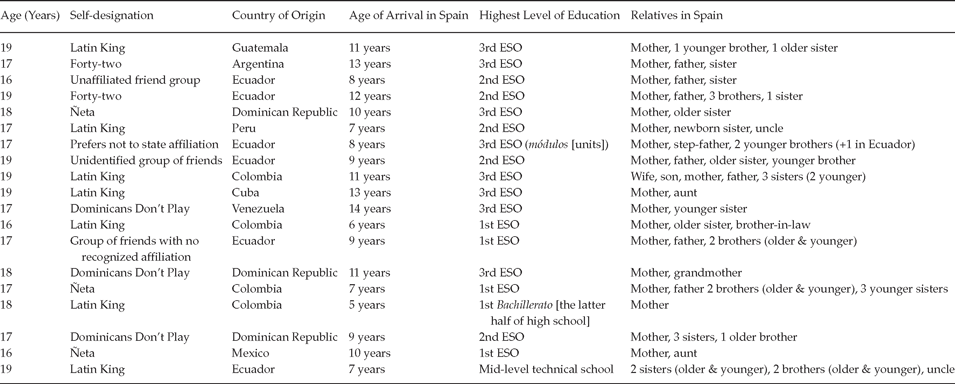
Nineteen men born in Latin American countries, aged 16 to 19 years old, participated in this study. All were residents of the Autonomous Community of Madrid who at the time of the study: (a) were carrying out fixed custodial sentences in the Community of Madrid CEMEJ system; (b) their sentence was primarily from having assaulted one or more rival gang members; (c) belonged to various violent groups; and (d) signed an informed consent document, along with their legal guardians. Their main features are displayed in Table 1.
Main Characteristics of the Violent Youths Interviewed, Madrid 2012

Note: ESO = Educación Secundaria Obligatoria [compulsory secondary school].
Instruments
Semi-structured in-depth interviews were conducted using a guide with 62 questions in two areas: (1) Perceived emigration experience: country of origin, reasons for emigration, appraisal of emigration, relationship to country of origin; and (2) Perceived involvement in different socialization settings: neighborhood of residence, school, family, significant other, peer group. Their personal experiences (before and after arriving in Spain) were addressed, as well as attitudes (past and prospective) toward the socialization setting and its relation to juvenile group violence.
Procedure
An interview guide was created using a two-stage procedure. In the first, the guide was compiled based on past research results and suggestions from CEMEJ professionals (2 directors, 3 psychologists, and 6 educators). Second, to test its appropriateness for the target population, a pilot study was conducted by interviewing five free youths from Latin America (aged 17 to 19 years old) who had in the last year assaulted three or more rival gang members. Once the final instrument was complete, we proceeded to recruit youths in the Community of Madrid CEMEJ system through staff with the Juvenile Offender Reeducation and Reinsertion Agency (ARRMI from the acronym in Spanish) Footnote 3 and six individuals in charge of Centers (two directors and four program coordinators). The directors were given two protocols: an information form for psychologists, educators, and participating guardians with the research goals and characteristics; and an informed consent protocol for the juvenile offenders, their parents, or their legal guardians, agreeing to participate in the study and granting permission to record their statements. After confirming that the youths and their legal guardians agreed to participate, researchers conducted the interviews in CEMEJ rooms where they could ensure absolute confidentiality. The interview guide piloted before was administered with two modifications: interviewers adapted questions to respondents’ characteristics and language, and freely inquired into their responses to gain interpretive richness and depth. The interviews were conducted between January 14 and June 31, 2011. Digital recordings of the interviews were transcribed word for word.
Analysis of Results
Qualitative data analysis was based in the Grounded Theory (Strauss & Corbin, Reference Strauss and Corbin2002) method of constant comparison through open coding of intracategorical contents (referring to different variables and areas of study); the unit for comparative analysis was the paragraph. This happened in six phases:
-
1. First listening and transcribing the interview word for word.
-
2. Open coding the transcribed texts following the original interview structure to create the first coding structure, then identifying new indicators, subjects, or dimensions for analysis. Response contents were inductively categorized into six previously determined frames: migration experience, and the various socialization settings (family, school, ingroup violence, significant other, and neighborhood).
-
3. Axial coding was then used to classify those six categories or indices along three basic dimensions: (a) perceived migration experience; (b) the socio-affective dimension comprised of socialization settings (community or neighborhood, school, family, peer group, and significant other); and (c) the functional-procedural dimension, which had two factors or sub-dimensions: functional, which included six indices or subjects (features or composition of the setting, the respondent’s relationship to it, his appraisal or attitudes about it, expectations about each setting upon leaving the Center, and the setting’s relationship to group violence); and temporal, that is, how those indices develop over time for each environment.
-
4. Content analysis was applied through the constant comparison method, using Gibbs’s (Reference Gibbs2012) systematic comparison technique. In each category first identified during the structural phase, a process of comparing – one by one – respondents’ textual statements was developed to identify similarities and differences in content. Each comparison resulted in hypothesis generation or reformulation, each hypothesis being the researcher’s inferences about respondents’ perception of a subject or process. In any comparison from which different contents (perceptions) were inferred, meaning they were not considered in the hypothesis above, the hypothesis had to be reformulated. Hypotheses ultimately determined to be research results met two conditions: (a) empirical support from all respondents’ texts; (b) there was no statement in any interview transcript to refute it, wholly or partially. Since each hypothesis included several interpretations of a specific subject, a system to sort those interpretations was needed. This analysis technique of systematic comparison was applied to carry out descriptive or intracategorical analysis to capture respondents’ perceptions of a given subject or category. Furthermore, it was applied to exploratory or intercategorical analysis to examine relationships between two or more categories or subjects of study, either synchronously (without taking into account order of events) or diachronically (assuming a temporal sequence of events).
-
5. Final analysis, or saturation. Given the intentional, voluntary nature of the sample, saturation criteria were not established a priori. Hypotheses were formulated and then modified by systematically comparing all the participants’ statements, on all indices and subjects studied.
-
6. Quality controls were in place, using the Delphi technique. Our Delphi panel consisted of five people on the research team – experts on group violence – who did not take part in the analysis.
-
Each of those five experts was given structured tables of results in four rows: (1) Proposed hypotheses; (2) Textual statements from every respondent to all questions pertaining to each hypothesis; (3) A 7-point semantic differential scale to convey level of agreement with each hypothesis, based on how well it captures the statements in the row above; these experts did not take part in earlier research phases (coding and analysis); and (4) Space to record any discrepancies between a given hypothesis and the associated statements from respondents, and the reformulated hypothesis they propose to better fit the statements provided. The panel’s evaluations and suggestions were recorded, reformulating hypotheses to be newly analyzed until the following quality criterion was met: at least four of the five experts gave the hypothesis a score of six or seven points.
Qualitative content analysis was conducted with support from the computerized qualitative analysis program NUD.IST (Non-numerical Unstructured Data Indexing Searching & Theorizing), version 6.0.
Results
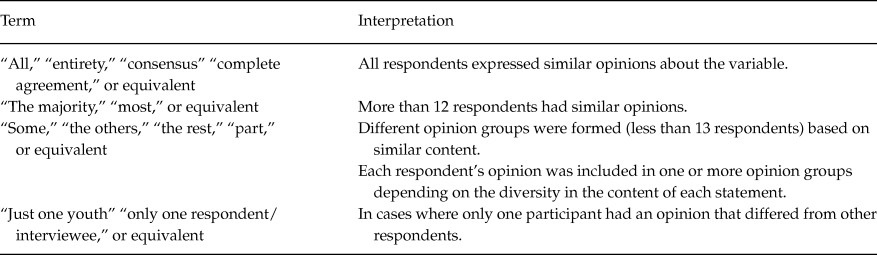
The results are presented in keeping with the structure of our analysis: (1) Perceived migration project; and (2) Perceived integration in Spain in five main socialization settings (neighborhood of residence, school, family, significant other, and peer group), whose functions and development over time were analyzed. Though no quantity is assigned to each opinion, we propose specific terms to capture participants’ convergence or divergence on each subject (Table 2).
Main Terms Used to Present Results and Classify the Content of Respondents’ Statements

To formulate hypotheses, five logical connective operators were applied to the conditions, features, and content of each hypothesis: (1) Negation when a particular condition or feature is negated (e.g., “the youths do not belong to families with a democratic supervision style”); (2) Joint denial when multiple conditions or features are negated (e.g., “their families cannot and do not know how to control their leisure activities”); (3) Conjunction when two conditions must both be true (e.g., “the families are distinctly affectionate and permissive”); (4) Disjunction when one of the conditions is met, or both are (e.g., “the families are described as inconsistent or permissive”); and (5) Exclusive Disjunction when one of the conditions is true and the other false (e.g., “the families are one of two types: inconsistent or permissive”).
Perception of Migration Experience
All the youths reported leaving their countries of origin during childhood or early adolescence (between 8 and 14 years old). None were consulted about the decision to emigrate, and some were against it. Their migration experience was generally appraised in one of three ways: (a) one subset felt “indifferent” about it. They had no choice in the matter, it happened suddenly, or they never reflected on the need to emigrate or the benefit of emigration; (b) a second subset felt that emigration had positive outcomes for the family, specifically cited one or more of the following: access to a job with better working conditions, security, or pay; enabling the mother to flee a domestic violence situation; or giving respondents more security than in their countries of origin, where they were affected by delinquency, marginalization, or gang conflict. These positive outcomes remained current for some, but for others, the financial crisis had reduced those initial benefits; and (c) the third subset of juveniles negatively appraised their migration experience for three reasons: violent street conflict; trouble adapting at school or academically achieving; and workplace exploitation of relatives.
All the youths reported difficulties integrating into Madrid society for one of these three reasons: (a) preexisting anxiety or feelings of doubt about emigration; (b) the loss of emotional reference points in their countries of origin; and (c) little relationship or bad relations with relatives living in Spain after emigration. These problems had two fundamental consequences: negative expectations about his future in Spain, or close relatives’ future there (some of whom were interviewed); and a strong, emerging need for support or help in Spain to combat loneliness or lack of friends in this new country.
All respondents had positive memories of their countries of origin, sometimes in addition to negative ones. No one interviewed had only negative memories, but some expressed only positive ones. Their positive memories involved family members and/or friends they left behind, and customs or typical rites of passage for their peers or communities. They also recounted negative memories: violence and lack of safety on the streets of the city where they lived, and bad relations with certain relatives (parents, step-parents, aunts, uncles, or grandparents).
Perception of Integration in Different Socialization Settings
Neighborhood
Respondents perceived their neighborhoods of residence as a function of geographical borders or daily social relations. There they carried out most or all of their activities as children and adolescents. Their neighbors were predominantly immigrant or native Spanish populations with low socioeconomic status. Neighborhood composition was mostly appraised as bad for one of three reasons: similar conditions as in their countries of origin; competition between immigrant and Spanish groups; discrimination and intergroup conflict.
In all cases, respondents’ first issues with integration occurred in late childhood or early adolescence. In most interviews, two interconnected types of conflict were discussed: discrimination or xenophobia, and loneliness. To cope, respondents sought support from other children or adolescents with similar experiences, or from relatives (from their mothers or older siblings). The youths sought out extra-familial company based on the following criteria: their new companions’ national origin, skin color, or socioeconomic status.
In all cases, it was in their neighborhoods that respondents first had contact with juveniles or young people belonging to violent groups, whether friends or foes. Older siblings, friends, or acquaintances from school or nearby buildings had previously belonged to these groups; none of the youths joined a violent group without first knowing a member. Their reasons for joining can be divided into two types: (a) proactive: the group would facilitate positive relationships (friendship or camaraderie); and (b) reactive: it would increase their sense of safety after past threats or attacks, and would alleviate a lack of family support and sense of loneliness.
Once affiliated with a violent group, the juveniles perceived their neighborhoods as more under control and less threatening. In most cases, this process favored a sense of territory: groups had places or areas they considered their own (parks, bars, clubs, local garages, storage lots, or old abandoned factories). Territoriality entails that the presence of invaders in those places is not really accepted, but is often tolerated as long as the person is not identified as a member of a rival group (in every case) or some other group (in just one case). The seriousness of invasion was influenced by one or more of the following conditions: (a) men produce more negative, intense reactions than women; (b) more numerous invaders cause greater alarm; (c) the presence of weapons or dangerous objects in the vicinity increases alarm; and (d) the danger of an invasion is based on intuitive estimation of how powerful the rival group is.
Territory invasion tended to provoke one of three types of response: immediate aggression, immediate flight, or a ritual exchange of threats and verbal aggression often ending in aggression. Aggression is more common than flight. Two conditions make flight likely: a very numerous group or a very powerful group (capable of harsh reprisals). These conditions may or may not be related; ergo sometimes an invading group that is small in number, but powerful, can cause flight.
School setting
Regarding primary school, some respondents said they completed it in their countries of origin, while others completed some of it there. Their general appraisal of secondary school in their countries of origin was in every case more positive than in Spain for one or more of three reasons: their teachers were able to generate greater respect; they found it easier to make friends or keep them; they did not experience racism and/or xenophobia. Everyone interviewed believed that primary school in Spain requires greater effort (sometimes viewed positively, sometimes negatively).
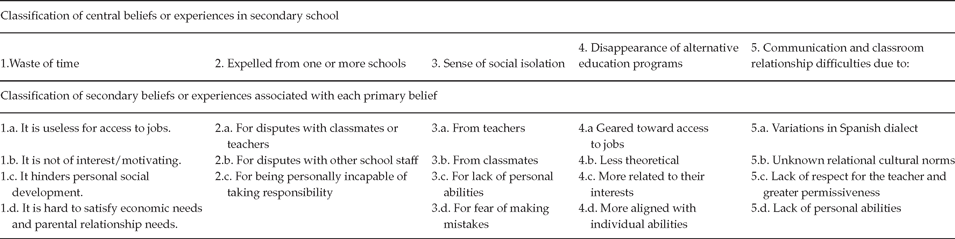
As for secondary school, most respondents dropped out before finishing compulsory secondary education. Everyone interviewed had a negative view of the secondary-school experience, an attitude in every case connected to perceived boredom throughout. In addition, they expressed a set of beliefs and experiences, the structure of which appears in Table 3. Central beliefs or experiences are displayed in the first two rows, and associated beliefs or experiences that clarify or justify that content appear in subsequent rows.
Classification of Content Related to Secondary School Experience

Perceived significant other relations
Everyone interviewed reported having had affective relationships with one or more girls. Most stated that they had had sexual relations with penetration, and the majority reported having had one or more girlfriends. Most of these girls lived in the respondent’s neighborhood, while the rest lived in nearby neighborhoods, or recently immigrated.
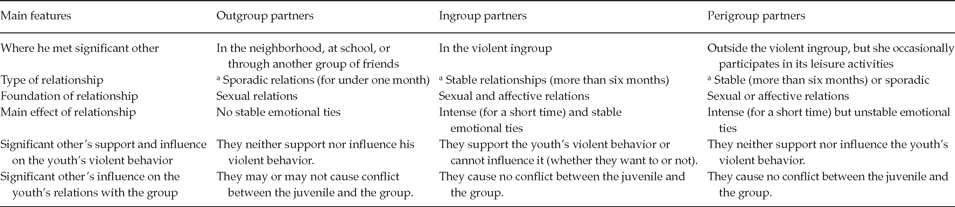
The connection between a youth’s significant other and his violent ingroup was an important aspect. We classified affective partners based on their relation to the group: outgroup, ingroup, and perigroup. Some interviewees had had various types of significant others, others only ingroup. Table 4 presents the characteristics and particulars of each class of significant other.
Types and Main Characteristics of the Significant Others of Youths Interviewed

Notes: aRelationships were sorted into types based on youths’ interpretations of stability or instability in their affective relationships. All interviewees who reported “sporadic” relationships estimated their duration at less than a month. All “stable” relationships reported had lasted at least three months.
Perception of family
No interviewee reported having a compound family. They had one or two parents, and in most cases other relatives (siblings, aunts/uncles, grandparents, or cousins), friends, or others with whom they merely share housing. Female-headed families were predominant across all cases.
All the young people interviewed had some portion of their families still living in their countries of origin. That separation was appraised as negative, but with important qualifications. They all felt nostalgic for a family member who did not immigrate, but some intensely rejected other family members (father, step-father, step-mother, cousins, or grandfather) for one of more of four reasons: abandonment, neglect, physical and verbal abuse directed at the interviewee, his mother, brothers, or sisters, or sexual abuse of the interviewee or a sibling.
All but one interviewee positively appraised their families. The most highly appreciated person was the mother, except in one case where it was the father. Conflict with parents or guardians was neither perceived as intense nor serious, and had three main sources: (a) Noncompliance with family rules: coming home late, neglecting obligations to personal hygiene and assistance with the housework, and verbally aggressive response in disputes with family members; (b) Problems at school: low achievement, expulsion or school sanction, and drop out; and (c) Problems stemming from the discovery of the youth’s antinormative activities.
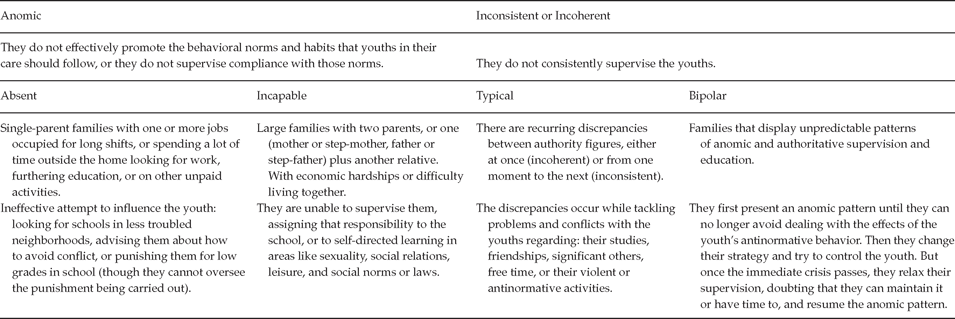
Analysis of family relations revealed two basic patterns of parental supervision: anomic (subdivided into absent or inept), and inconsistent or incoherent (typical or bipolar pattern). Table 5 details which features respondents had in common and where they differed.
Parental Supervision Trends in Families of Juvenile Offenders

One or more of the following conditions could restore some of the waning family influence over the juvenile and his illegal activities: (a) the juvenile fears or confirms that the group’s activities could have a direct, negative impact on his family (especially his mother); (b) when events coincide that heighten the youth’s perceived vulnerability, family is the ultimate refuge; and (c) when the family (especially the mother) comes into explicit, direct, lasting conflict with the activities of the violent group to which the juvenile belongs.
Perception of the violent ingroup
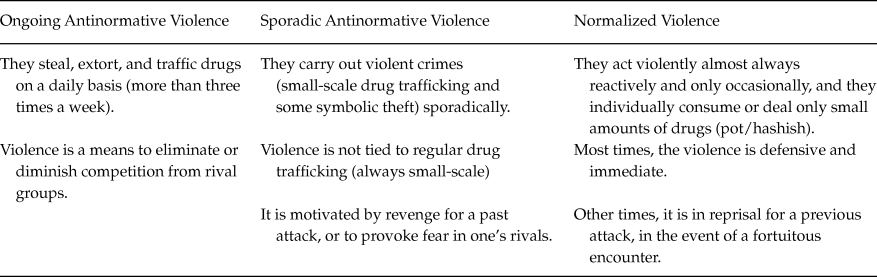
The size of these violent ingroups ranged from 12 to 100 members. In all but one case, their composition was diverse: Latin American immigrants and youths from at least one of these other backgrounds: other Latin American, Eastern European, or African countries; or Spanish. The groups were comprised of men (in every case, this was most common) as well as women. In terms of the frequency and extent of illegal or antinormative activities carried out within the group framework, the juveniles identified various types of groups (see Table 6).
Typology of Groups as a Function of Violence, Its Justification, and their Antinormative Activities

We also observed differences in how central or important the group was in participants’ social relationship networks. From that standpoint, three main types emerged among these youths: (a) the first maintains important relationships only or primarily with the violent ingroup to serve one of the following objectives: economic resources for themselves, company or friendship, and defense against possible enemies; (b) the second maintains important relationships with various social groups, the violent group being the one that provides defense against rival groups, while their self-esteem and economic resources come jointly from other spheres (family and significant other); and (c) the third maintains relationships with various social groups, and their emotional relationships and economic resources are tied entirely or primarily to other people or groups (family, friends, significant other), while the violent group provides defense against their enemies.
Everyone interviewed reported receiving information about the rules governing their groups. Most said the provenance of the rules is in the traditions of similar groups in the Latin American countries from which the group’s founders came. The content of these internal rules is articulated in different combinations of the following five principles: (a) pride in belonging to the group; (b) the need to obey the hierarchy and especially the group leaders, although one interviewee denied that any inequality exists in his organization; (c) unconditional solidarity and reciprocity toward members of the group; (d) respect for family and an obligation to defend it at any price; and (e) before joining the group, must demonstrate one’s determination to belong to it by willingly participating in an initiation rite.
The decision to join these groups was related to one or more of seven motives: (a) to defend one’s personal safety against rival groups or Spanish society at large; (b) to build self-esteem and personal recognition; (c) to gain economic resources; (d) to uphold cultural traditions; (e) to stay connected to friends who already joined the group; (f) fear of loneliness; and (g) to gain the strength needed to exact revenge for past aggression.
Respondents were in complete agreement that not everyone can belong to a violent group. One or more characteristics define those who join: national or Latin American origin, shared interests or values, bravery or ability to defend oneself against aggression, and past friendship or similarity of personal needs (economic or defensive). People who fail to meet one of those conditions are systematically rejected, but the criteria may be relaxed if the aspiring joiner is presented by a member of the group (this generates trust, so not all conditions may be necessary).
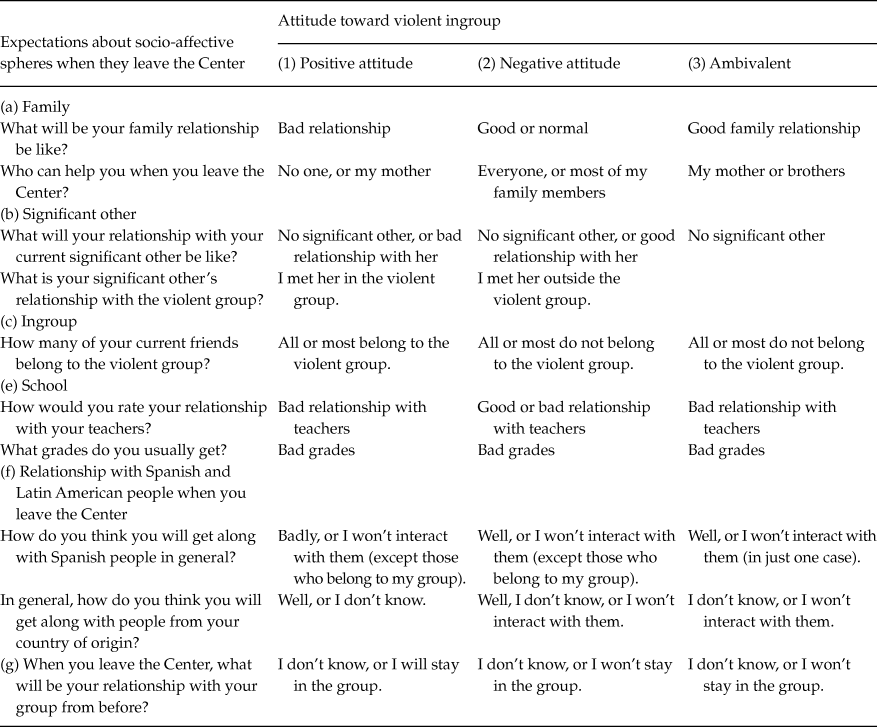
At the time they were interviewed, the youths’ perceptions of their development within the group was mixed: (a) some positively appraised their reference group (“positive attitude group”); (b) others negatively appraised the group they committed the crime with for one or two of three reasons: they have not contacted him since the arrest, no one remains in the group from his close circle of friends, or its vulnerability has been revealed – that is – it has failed in its objective to protect its members (“negative attitude group”); (c) some youths had no clear opinion, considered the group unimportant, or had good relationships with some of its members and bad relationships with others (“ambivalent group”). Table 7 shows each subgroup’s expectations about their relations with family, significant other, the violent ingroup, other friends, and work or school upon leaving CEMEJ, and the social support each one will provide.
Relationship Between Attitudes Toward Ingroup Violence, and Expectations about Socio-affective Spheres When They Leave the Center

A series of conditions each, or together, made a youth more likely to consider leaving the violent group: (a) developing a stable emotional relationship with a significant other who does not belong to the group, and opposes his criminal activities or the ingroup itself; (b) believing that people who matter more to him might be affected by the group’s activities; (c) a direct conflict suddenly occurring with his family or significant other related to his belonging to the group, or its illegal activities; (d) believing he can obtain economic resources through satisfying normative work; (e) one or more people from his close circle of friends distancing themselves from the ingroup, or leaving it entirely; and (f) heightened individual or group vulnerability due to negative encounters with the police, having been assaulted with serious consequences, or a close friend having been assaulted with serious consequences.
Discussion
This phenomenon can be analyzed as a manifestation of identity-based violence, aggression that is motivated, collectively justified, and normatively supported by the group. According to Social Identity Theory (Tajfel, Reference Tajfel1974), violent group behavior can be considered the result of two group identities overlapping in space and time, each of them represented by one or more people. Authors in Europe (Feixa & Canelles, Reference Feixa and Canelles2006) and the United States (Hagedorn, Reference Hagedorn2008) have emphasized this identity factor.
It can be said that these juvenile offenders were in the midst of a systematic crisis as a result of their migration experience, a crisis characterized by ineffective parental supervision, academic failure, school drop-out, and experiences of xenophobia and racism – all akin to the acculturative stress apparently affecting Latin American immigrants in the United States, as described by Barrett et al. (Reference Barrett, Kuperminc and Lewis2013). These problems have led then to actively seek out alternative forms of social support centered on participation in criminal or antinormative groups. The groups help reduce threats from rival groups, generate respect for the individual, his family members, and his friends, and provide economic resources that are scarce in their families. This theoretical interpretation is consistent with Vigil’s (Reference Vigil1988) theory of multiple marginality, and Hagendorn’s (2008) argument that prejudice and hostility have an influence on the formation of gangs. We propose, therefore, that group violence and violent group membership is not an outcome of immigration, neither in general nor selectively. Moreover, according to van Gamert, Paternson, and Lien (Reference van Gamert, Peterson and Lien2008), when immigrants are marginalized geographically, socially, and economically, it puts risk factors in place that facilitate the appearance of street gangs.
This is not primarily the result of structural or explicit marginalization (the youths had access to educational and social services), but rather the inability of basic social agents to meet these young people’s needs: because their families cannot; and at school, rigid educational and assessment standards have a tremendous influence. Those factors perhaps make certain ethnic or non-ethnic groups (Martín et al., Reference Martín, Martínez and Rosa2009) more vulnerable to multiple marginality (Vigil, Reference Vigil1988).
From a normative perspective, we observed two related interpretive trends: failure to internalize socially accepted norms due to family or school influence, and normative acceptance or internalization of the violent ingroup. Furthermore, in the family, scarce parental supervision over juveniles’ free time and social relations, and none at school, perhaps made the group the only sphere where they could build positive individual and collective self-esteem. This was even more likely if the youth found a sexual or affective partner within the violent ingroup. Similar results were found in past research: McDaniel (Reference Mc Daniel2012) in the family sphere, Thornberry, Krohn, Lizotte, and Smith (Reference Thornberry, Krohn, Lizotte and Smith2003) at school, and Martín et al. (Reference Martín, Martínez and Rosa2009) in the three agents of influence cited (family, significant other, and school).
The association between antisocial behavior and weak parental supervision (anomic or inconsistent in this study) was likewise reported in previous studies (McDaniel, Reference Mc Daniel2012). In addition, these data lead us to postulate about the effects of eventual normative conflict with different socialization settings. If these youths were able to avoid conflict with their families, significant others, and groups of friends, then they were able to uphold contradictory behaviors and norms (illegal or violent in the ingroup, unacceptable to the family). It seems this was most often the case. If specific conflicts arise with the family, significant other, or other source of instrumental and affective social support – and that conflict persists – the juvenile offender would experience strong dissonance with their antinormative actions and group membership. This hypothesis is similar to what Wood and Alleyne (Reference Wood, Alleyne, Wood and Gannon2012) proposed in their theory review study, or what Melde and Esbensen (Reference Melde, Esbensen, Esbensen and Maxson2012) found in their empirical study. Additional empirical support for this interpretation lies in the finding that these juvenile offenders continued to have a positive attitude toward the ingroup despite their penal situation, and a mixed view (stated or unstated) of staying in it: they expressed positive expectations about the ingroup, and negative or dubious expectations about opportunities to find effective social support in the other socialization settings available to them.
The features of the groups these interviewees purportedly belong to are particular to European gangs, according to comparative studies conducted by Klein et al. (Reference Klein, Weerman and Thornberry2006), and Decker et al. (Reference Decker, van Gemert and Pyrooz2009) in immigrant youths. For the most part, they did not take part in professional or long-term illegal activities or violence. These youths reported belonging to heterogenous gangs made up of people with different nationalities, residing in neighborhoods with Spanish and immigrant populations, from families in the more disadvantaged sectors of society (Winfree et al., Reference Winfree, Weitekamp, Kerner, Weerman, Medina, Aldridge and Mujanovic2007).
From an applied perspective, we hypothesize that as Sperber (Reference Sperber2013) argued, immigrant-inclusive policies should be a central priority for social action. We also recommend that these policies rely on local cooperation, and focus on family and school. In light of these results, we propose that unifying educational programs must be maintained, with immigrant as well as Spanish youths participating, to foment networks of belonging that avoid residence-based groupings that are exclusionary on the basis of national origin, skin color, or other identity markers (ghettos) also associated with violence in Europe (Urteaga, Reference Urteaga2011).
Education programs for adolescent juvenile offenders from Latin America (in formal or informal contexts) should prioritize social and workplace insertion as a core element. They should also be culturally adapted, contextualized, active, and affectively positive. The beneficiary would develop inspiring expectations of belonging to a professional group, and of successful or at least satisfactory learning (the individual would contribute to defining this concept). Furthermore, this education would have a short- and long-term impact on the family’s economic situation. This objective is more likely to be achieved if the education program includes empowerment techniques: cooperative learning groups, Participatory Action Research, and self-persuasion induction techniques.
Regarding the family setting, it is very probable that as Shute (Reference Shute2013) expounds, the influence of family for these young people was undervalued and should be incorporated into rehabilitative and preventative action programs. As this study demonstrated, in almost every case analyzed, family was highly valued throughout (especially the mother), and was being protected by the violent groups’ rules. When conflicts arise or a youth’s family expresses the impact this behavior has on them, their children experience strong cognitive dissonance toward their affiliation and activities. Finally, from a sociopolitical perspective, reconciling professional and family life would help increase parental supervision.
We may conclude that, in general, one of the main objectives of preventative (secondary or tertiary) interventions should be promoting a positive alternative social identity, in two ways: by altering the influence of socialization settings (job access, reconfiguring the family relationship, alternative social support groups); or by making these groups social associations or movements. Opting for one or the other type of intervention will mostly depend, according to Feixa, Scandroglio, López, and Ferrándiz (Reference Feixa, Scandroglio, López and Ferrándiz2011), on institutional support, in which control and community reinsertion objectives have come to be politically and ideologically predominant.
The present results have several limitations. The first has to do with the sample we used, intentional and therefore not representative of the phenomenon studied. Nonetheless, gathering a representative sample is highly unlikely when the behavior of interest and underlying group context are antinormative or socially undesirable. Thus, the present study should be interpreted as one approach to violent group behavior, and to some of its main, most influential factors that do not saturate the interpretive nor experiential universe, but negate the hypotheses of some earlier studies in the United States and Europe, a methodology that has little precedent in Spain.
Regarding the probability of lying or bias in participants’ responses, while those are always possibilities, we believe they were reduced through several measures. First, information was captured in a formalized way by people specially trained to administer the informed consent forms. The voluntary, anonymous nature of participation was emphasized to the juveniles and their guardians, along with the right to withdraw at any time. Second, before conducting the interview, participants were reminded of those guarantees to make sure they understood. Participants were then asked to freely verbally accept. Finally, rigorous criteria were applied in conducting the qualitative analysis. A Delphi panel was employed, comprised of 5 members of the research team not involved in the analysis so as to avoid interpretive bias.
Finally, all the participants were men. The violent group behavior that was the focus of this analysis is much more common in men on the whole; and they are much more likely to return to judicial custody in the centers where they carried out prior sentences. Nevertheless, it would be very interesting to analyze violent group behavior in women, and the roles women play in these groups or street gangs. Widening the scope in that way would be quite consistent with the logic of saturation in qualitative analysis, which attempts to compare and contrast theory generated first in unconventional individuals or people with unusual features.
This study was funded by the Diagrama Foundation for Psychosocial Intervention, part of the “Madrid Joven Integra [Madrid Youths Unite]” program, which is part of the “Programa Operativo Lucha contra la Discriminación [Fight Discrimination Operations Program]” (European Social Fund, objective 3, Comunidad de Madrid), with collaboration from the Agencia para la Reeducación y Reinserción del Menor Infractor (ARRMI) [Juvenile Offender Reeducation and Reinsertion Agency] for the Comunidad de Madrid. It was additionally funded by the Ministerio de Ciencia e Innovación under the National Science Research, Development, and Innovation Plan (Ref. PSI2008–05221/PSIC).
The authors want to thank the Research, Programs, and Education arm of the ARRMI for its collaboration; the coordinators of the Youth in Social Conflict and Juvenile Justice Center Coordination (CEMEJ from the acronym in Spanish) divisions for the Comunidad de Madrid; and CEMEJ directors and staff. Finally, we want to recognize all the youths who participated in this study for the openness and sincerity they displayed in interviews.