Introduction
In Benin, vegetable production is part of the national poverty alleviation strategy (Hounkpodoté and Tossou, Reference Hounkpodoté and Tossou2001) and the agricultural diversification plan (Anonymous, 2006). The activity is economically important and intensive in urban and periurban (UPU) areas, where the subsector provides informal employment opportunities (Zossou, Reference Zossou2004). In UPU areas, vegetable crops are grown year-round, mainly in small plots of 0.05 ha in various intercropping and rotation schemes. In 2000, it was estimated that 52.518 tons of vegetables were produced on 22,000 ha in southern Benin alone (Méhoba, Reference Méhoba2000).
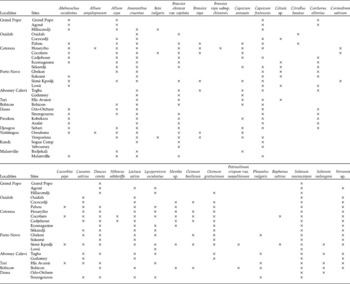
Increasing food demand by a growing urban population combined with scarcity of land contributes to the intensification of UPU vegetable production. Intensification aggravates pest infestation, which is one of the major vegetable production constraints (Beniest, Reference Beniest1987; d'Arondel de Hayes and Traoré, Reference d'Arondel de Hayes and Traoré1990; Bordat and Goudegnon, Reference Bordat and Goudegnon1991). In this study, vegetables are defined as the crops listed in Table 1.
List of vegetables grown at the different sites surveyed in Benin

Among vegetable pests, aphids (Hemiptera: Aphididae) are recognized worldwide as economically important (Remaudière and Autrique, Reference Remaudière, Autrique, Remaudière, Autrique, Eastop, Starý, Aymonin, Kafurera and Dedonder1985). Most aphid species are polyphagous feeding on a wide range of plants, while a few species are host-specific and restricted to one or a few plant genera or species (Blackman and Eastop, Reference Blackman and Eastop2000). Aphids cause poor plant health by sucking sap from the plants and transmitting pathogenic viruses leading to weakening and wilting of plants, leaf curl and decolourization, and sooty mould formation due to honeydew excretion on plant surfaces.
More than 220 aphid species have been collected in sub-Saharan Africa alone (Autrique and Ntahimpera, Reference Autrique and Ntahimpera1994). Of these species, 40% are endemic to Africa, whereas approximately 45% of the exotic species have cosmopolitan or sub-cosmopolitan distribution. In tropical regions, most aphid species show all year-round anholocyclic behaviour (reproduction only by parthenogenesis) on their hosts (Autrique and Ntahimpera, Reference Autrique and Ntahimpera1994).
In most cases, producers' coping strategies against aphid infestations in Benin and many other West African countries is frequent and uninformed use of synthetic pesticides, which remains largely unsustainable and ineffective with actual or potential negative impact on people's health and the environment (Atcha-Ahowé et al., Reference Atcha-Ahowé, James, Godonou, Boulga, Agbotse, Kone, Kogo, Salawu, Glitho, Clarendon and Youdeowei2009; Rosendahl et al., Reference Rosendahl, Laabs, Atcha-Ahove, James and Amelung2009; Lund et al., Reference Lund, Sæthre, Nyborg, Coulibaly and Rahman2010). While a recent vegetable pest list for Benin includes aphids among the key biotic constraints to vegetable production in the country (James et al., Reference James, Atcha-Ahowé, Godonou, Baimey, Goergen, Sikirou and Toko2010), a detailed inventory of aphid species and associated biodiversity is lacking.
This study was undertaken to increase the knowledge of aphids and their natural enemies and contribute information for use in the development of sustainable vegetable pest management strategies in the region.
Materials and methods
Survey sites
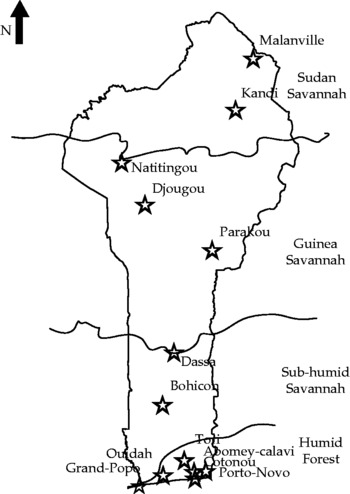
Benin is located between 6o15 and 12o25 latitude north and 0o45 and 4o00 longitude east. The country has four agroecological zones defined on the basis of temperature and rainfall pattern: Sudan savannah, Guinea savannah, sub-humid savannah and humid forest zone (Fig. 1). A baseline survey to assess aphid species and their natural enemies on vegetables and weeds was carried out from August 2007 to July 2009 at 30 sites distributed in 13 localities of Benin (Fig. 1). During the 2-year study, UPU sites with a year-round production pattern were surveyed at least six times evenly distributed throughout the year, whereas sites with a seasonal vegetable production pattern were visited four times (end of rainy season until end of dry season).
Survey localities for aphid communities in vegetable agroecologies of Benin

Survey method
During each visit to each site, three vegetable plots belonging to different farmers were selected, and from each plot, three vegetable beds for each vegetable species cultivated by the farmer were randomly selected for inspection. On each of the three beds, ten crop plants were randomly selected (making a total of 90 plants per crop per site per visit) and carefully examined for the presence of aphid infestations and natural enemies. Samples of leaves, fruits or stems with aphid colonies were collected from infested crops. Weeds in close proximity to the vegetables were also examined in the same way as the vegetables. A handheld lens was used in the examination process. Aphid host plants (crops and weeds) were collected and placed separately in labelled paper bags for subsequent identification, and in this survey, maize (Zea mays L. rugosa Bonaf.) was regarded as a weed. All samples were carried in cool boxes for sorting in the laboratory. Root-feeding aphids were not included in the study.
Post-field handling and identification
Alate and apterous adult aphids were removed from the samples and preserved in 70% alcohol in glass vials and stored at room temperature. Samples of the preserved specimens were mounted on microscope slides as per Blackman and Eastop (Reference Blackman and Eastop2000). A selected set of slides were sent to the Natural History Museum (NHM) in London for identification. Samples of immature aphid colonies were placed in plastic rearing boxes (9.5 × 4.5 × 5 cm or 15 × 9.5 × 5 cm) with moistened tissue paper in the bottom. These specimens were observed daily for mummification and signs of disease. Aphid mummies collected from the plant parts in the field and in the laboratory were incubated individually in 10 ml plastic tubes until adult parasitoids emerged. Primary parasitoids as well as hyperparasitoids were preserved in 70% alcohol in small 2–5 ml glass vials and stored at room temperature. Adult predators encountered were placed in individual plastic rearing boxes (as described above). Larvae of predators were reared to the adult stage in small plastic tubes in the laboratory at room temperature for identification. Selected samples of parasitoids, hyperparasitoids and predators were sent to the NHM for identification. In all cases, the specimens identified by the NHM served as the reference collection for subsequent identification of the remaining samples.
Dead aphids that showed symptoms of pathogen infection were removed from the samples and observed under a stereo microscope. Spores and hyphae of pathogens that caused infection in aphids were mounted on slides for pathogen identification.
Results
Aphid fauna on vegetables
A total of 29 vegetable species within 12 plant families were inspected and collected (Table 1) at 30 vegetable production sites in Benin (Fig. 1). The highest diversity of vegetables per site occurred in the UPU areas of Southern Benin. Of the 29 species, 12 including African garden eggplant (Solanum macrocarpon L.) (Solanaceae), amaranth (Amaranthus cruentus L.) (Amaranthaceae), hot pepper (Capsicum frutescens L.) (Solanaceae), lettuce (Lactuca sativa L.) (Asteraceae) and white cabbage (Brassica oleracea L. var. capitata f. alba) (Brassicaceae) were frequently observed across the vegetable production sites (Table 1).
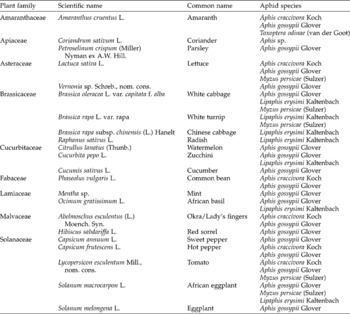
Of the 29 vegetable species, 22 were infested with aphids (Table 2). The family Solanaceae contained the highest number of vegetables grown and infested with aphids; five vegetable species were recorded in this family and three of them were associated with more than one aphid species. Aphids were always absent from beetroot (Beta vulgaris subsp. vulgaris L.) (Chenopodiaceae), Celosia sp. L. (Amaranthaceae), onion (Allium cepa L.) (Amaryllidaceae), leek (Allium ampeloprasum L.) (Amaryllidaceae), nalta jute (Corchorus olitorius L.) (Tiliaceae), carrot (Daucus carota L.) (Apiaceae) and basil (Ocimum basilicum L.) (Lamiaceae). These seven vegetables were found, respectively, in 3, 4, 9, 2, 7, 11 and 4 of the 13 localities surveyed (Table 1).
Vegetables infested by aphids recorded in urban and peri-urban agroecosystems in Benin

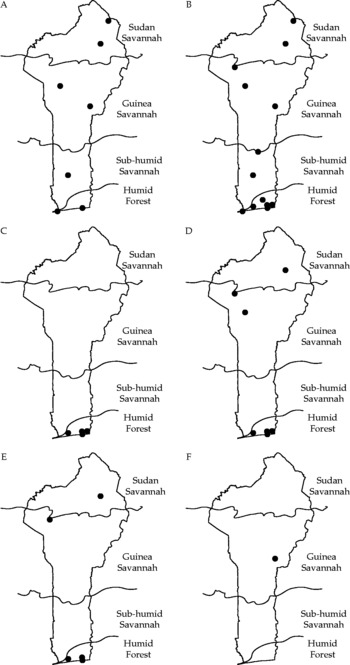
The six aphid species, i.e. Aphis craccivora Koch, Aphis gossypii Glover, Aphis spiraecola Patch, Lipaphis erysimi (Kalt.), Myzus persicae (Sulzer) and Toxoptera odinae (Van der Goot), were collected from the vegetables. Their distribution is shown in Fig. 2.
Distribution maps of (A) Aphis craccivora, (B) Aphis gossypii, (C) Aphis spiraecola, (D) Lipaphis erysimi, (E) Myzus persicae and (F) Toxoptera odinae in vegetable agroecosystems in Benin

Aphis craccivora was recorded at seven localities and on amaranth, common bean (Phaseolus vulgaris L.) (Fabaceae), hot pepper, lettuce, okra (Abelmoschus esculentus (L.) Moench. Syn. (Malvaceae) and tomato (Lycopersicon esculentum Mill., nom. cons.) (Solanaceae) in all agroecological zones (Fig. 2A, Table 2).
Aphis gossypii was the dominating aphid species and recorded from all 13 localities (Fig. 2B). Of the 12 plant families inspected, eight families, i.e. Amaranthaceae, Apiaceae, Asteraceae, Cucurbitaceae, Fabaceae, Lamiaceae, Malvaceae and Solanaceae, had vegetable species infested with A. gossypii. Aphis gossypii was recorded from 17 vegetable species including African garden eggplant, amaranth, cucumber (Cucumis sativus L.) (Cucurbitaceae), hot pepper, okra and Vernonia sp. Schreb., nom. cons. (Asteraceae) (Table 2), which are the most commonly grown vegetables in Benin.
Aphis spiraecola was recorded on white cabbage in the humid forest zone (Fig. 2C). Lipaphis erysimi occurred at seven localities in three agroecological zones. It was not recorded from the sub-humid savannah (Fig. 2D). The species was found on the Brassicaceae – Chinese cabbage (Brassica rapa subsp. chinensis (L.) Hanelt), white cabbage (B. oleracea L. var. capitata f. alba), white turnip (B. rapa L. var. rapa) and radish (Raphanus sativus L.). Lipaphis erysimi was also recorded on African basil (Ocimum gratissimum L.) (Lamiaceae), African eggplant (S. macrocarpon L.) (Solanaceae), cucumber and zucchini (Cucurbita pepo L.) (Cucurbitaceae) (Table 2).
Myzus persicae was less prevalent and recorded at five localities in three agroecological zones (Fig. 2E) on African garden eggplant, tomato, lettuce, white cabbage and white turnip within the families Solanaceae, Asteraceae and Brassicaceae.
Toxoptera odinae was recorded on Amaranthus sp. at one location in the Guinea savannah zone (Fig. 2F).
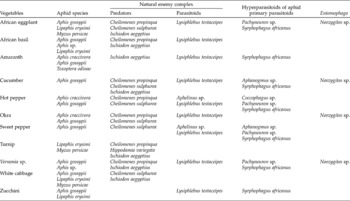
We recorded seven natural enemies of aphids (Table 3). These included four predators, Ischiodon aegyptius (Wiedemann) (Diptera: Syrphidae), Cheilomenes propinqua (Mulsant) (Coleoptera: Coccinellidae), Cheilomenes sulphurea (Olivier) (Coleoptera: Coccinellidae), Hippodamia variegata (Goeze) (Coleoptera: Coccinellidae); two primary parasitoids Aphelinus sp. near ficusae Prinsloo & Neser (Hymenoptera: Aphelinidae) and Lysiphlebus testaceipes (Cresson) (Hymenoptera: Braconidae: Aphidiinae), and one entomopathogen Neozygites sp. (Entomophthorales: Neozygitaceae).
Aphid fauna on vegetables in Benin

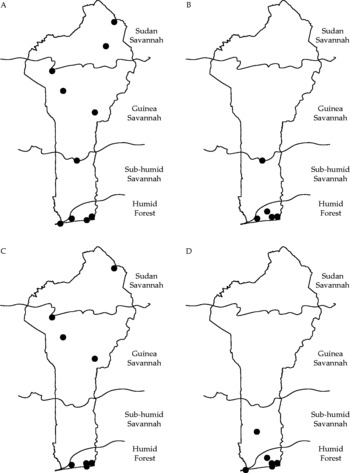
The three most widely distributed aphid predators were the ladybirds C. propinqua and C. sulphurea, and the hoverfly I. aegyptius. Cheilomenes propinqua was distributed in all agroecological zones and recorded at ten localities (Fig. 3A), whereas C. sulphurea was only recorded in the sub-humid savannah and the humid forest zone at five localities (Fig. 3B). Ischiodon aegyptius was recorded from three agroecological zones (not recorded in the sub-humid savannah) (Fig. 3C) and frequently associated with L. erysimi (Table 3).
Distribution maps of the aphid predators (A) Cheilomenes propinqua, (B) Cheilomenes sulphurea and (C) Ischiodon aegyptius, and (D) the entomopathogenic fungi Neozygites sp. in vegetable agroecosystems in Benin

The entomopathogenic fungi Neozygites sp. was found infesting aphids in two of the four agroecological zones in Benin, the sub-humid savannah and the humid forest zones (Fig. 3D). Neozygites sp. was recorded on aphids in cucumber, okra, aubergine, African eggplant and Vernonia sp., and was frequently associated with A. gossypii on Vernonia sp. and African eggplant (Table 3).
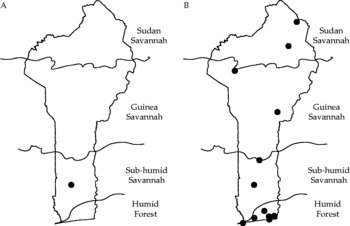
The primary parasitoid of aphids Aphelinus sp. was only recorded at one out of the 30 production sites (Fig. 4A). It was recorded at the same site (Bohicon) on three different sampling dates in 2007 and 2008 on hot pepper or sweet pepper (Capsicum annuum L.) but in very limited numbers. Lysiphlebus testaceipes, an endoparasitoid of aphids, was with very few exceptions the only primary parasitoid on aphids across the vegetable production sites surveyed (Fig. 4B). A common host of L. testaceipes was A. gossypii (Table 3).
Distribution maps of the aphid primary parasitoids (A) Aphelinus sp. and (B) Lysiphlebus testaceipes in vegetable agroecosystems in Benin

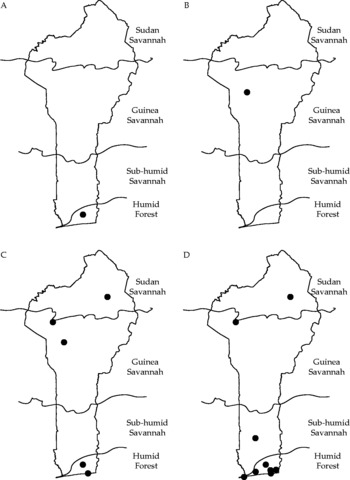
The five species of hyperparasitoids, Syrphophagus africanus (Gahan) (Hymenoptera: Encyrtidae), Pachyneuron sp. near muscarum (Linnaeus) (Hymenoptera: Pteromalidae), Aphanogmus sp. near trasides Polaszek (Hymenoptera: Ceraphronidae) and Coccophagus sp. near graminis Annecke & Insley (Hymenoptera: Aphelinidae) (Table 3), and one unidentified species, were collected from parasitized aphids in the vegetable fields. The hyperparasitoid Aphanogmus sp. was rarely encountered during the survey and only recorded from two localities in the humid forest zone (Fig. 5A). The species was recorded on sweet pepper (C. annuum L.) (Solanaceae) and cucumber (Table 3). The Coccophagus sp. recorded in the study was one single male (Fig. 5B) on hot pepper (Table 3). Pachyneuron sp. (near muscarum) was recorded from five localities in three agroecological zones (not recorded in the sub-humid savannah) (Fig. 5C). The species was recorded on sweet pepper, hot pepper, Vernonia sp. and African garden eggplant (Table 3). The most abundant hyperparasitoid was S. africanus. The species is known as a hyperparasitoid of aphids and psyllids via encyrtid or eulophid primary parasitoids (J. Noyes, NHM, personal communication). The species was distributed in all agroecological zones and recorded at nine localities (Fig. 5D). Syrphophagus africanus was recorded on sweet pepper, hot pepper, Vernonia sp., African garden eggplant, amaranth, cucumber and zucchini (Table 3).
Distribution maps of the hyperparasitoids of aphid primary parasitoids (A) Aphanogmus sp., (B) Coccophagus sp., (C) Pachyneuron sp. and (D) Syrphophagus africanus in vegetable agroecosystems in Benin

In addition, one specimen of the (usually) gregarious, cosmopolitan parasitoid of larvae of predatory Coccinellidae (Coleoptera), Homalotylus eytelweini Ratzeburg (Hymenoptera: Encyrtidae), was recorded at Hla Avamé (humid forest zone). One specimen of the parasitoid Anacharoides suspensus Quinlan (Hymenoptera: Figitidae: Aspicerinae), of which the species of this genus are larval–pupal endoparasitoids of aphidophagous Syrphidae, was recorded at Pahou in the humid forest zone.
Aphid fauna on weeds
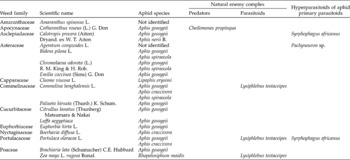
Of the 22 weed species inspected, 17 were aphid host plants (Table 4). The most common weeds associated with aphids across localities were Catharanthus roseus G. Don, Boerhavia diffusa L., Chromolaena odorata (L.) King & Robinson, Commelina benghalensis L. and Portulaca oleracea L. A. gossypii were observed on weed species belonging to 12 plant families including Apocynaceae, Asclepiadaceae, Asteraceae, Commelinaceae, Cucurbitaceae, Nyctaginaceae, Portulacaceae and Poaceae. While A. gossypii was highly polyphagous, A. spiraecola was observed feeding on Bidens pilosa, C. benghalensis and C. odorata (Table 4). Aphis craccivora infested B. diffusa, C. benghalensis and P. oleracea. Aphis nerii B. was recorded on Calotropis procera (Aiton) Dryand. ex W. T. Aiton in the humid forest zone, and L. erysimi was found on Cleome viscosa L. at one location in the humid forest zone. Rhopalosiphum maidis (Fitch) infested maize germinating in the vegetable fields. The two aphid species A. nerii and R. maidis were not recorded from vegetables, whereas M. persicae and T. odinae were not recorded on weeds. Aphids were always absent from the five weeds Commelina diffusa Burman (Commelinaceae), Cyperus sp. (Cyperaceae), Fleurya aestuans (L.) Gaudich (Fabaceae), Melanthera scandens (Schumach. & Thonn.) Roberty (Malvaceae) and Trianthema portulacastrum L. (Tiliaceae). The common aphid predator recorded widely from weeds was C. propinqua, along with the parasitoid L. testaceipes, and the hyperparasitoids S. africanus and Pachyneuron sp. (Table 4).
Aphid fauna on weeds in vegetable agroecosystems in Benin

Discussion
In the vegetable production system of Benin, a wide range of exotic and indigenous vegetables is cultivated in diverse intercropping and rotation schemes. However, faunistic studies focusing on several arthropod pests of vegetables, including aphid species, are rare in the region. The new knowledge on aphid species and their natural enemies gathered in this study is the basic information needed to develop an integrated pest management (IPM) strategy against aphids in vegetable agroecosystems in Benin as well as in a larger part of West Africa.
Aphis gossypii was the most polyphagous and widely distributed aphid species recorded in the study. This is the first record of A. spiraecola from West Africa (J. Martin and V. Eastop, personal communication). The aphid species reported in this study are known as potential virus vectors (Blackman and Eastop, Reference Blackman and Eastop2000). Viral symptoms were not recorded in the study, but during field visits symptoms were observed on several crops.
The number of aphid species recorded in this study (six) was relatively low compared with, for example, similar studies in Sri Lanka (Wijerathna and Edirisinghe, Reference Wijerathna and Edirisinghe1997) and Reunion (Vayssières et al., Reference Vayssières, Delvare, Maldès and Aberlenc2001), where 18 and 25 species, respectively, were recorded infesting vegetables. The low number in this study could partly be explained by the fact that the number of vegetable species recorded in Benin (29) was lower compared with the number recorded in Sri Lanka (51). The number of plant families grown as vegetables in Benin was also lower (12) compared with that in Sri Lanka (18), while eight plant families were surveyed in Reunion. Similarly, the number of predators recorded in this study was lower compared with the studies from Sri Lanka and Reunion. The number of primary parasitoids on aphids recorded was the same in Benin as in Sri Lanka (two), while five species were recorded in Reunion. The Sri Lankan study did not report on hyperparasitoids or parasitoids of coccinellids or syrphids (Wijerathna and Edirisinghe, Reference Wijerathna and Edirisinghe1997). The study from Reunion reported one species of Pachyneuron sp. from Aphididae, and they also recorded S. africanus; however, the latter was not linked to aphids, any other pest or their primary parasitoids (Vayssières et al., Reference Vayssières, Delvare, Maldès and Aberlenc2001).
Based on the sampling methodology used, we believe the risk of undersampling aphid species to be relatively small. Aphids typically feed externally on the plant and are easy to spot (Müller et al., Reference Müller, Adriaanse, Belshaw and Godfray1999). Since root-feeding aphids were not included in the study, this contributes to minimize the risk of sampling bias.
Assessing the risk of sampling errors in the natural enemy community (parasitoids, predators, entomopathogens) is more difficult. Some species of parasitoids may cause their host to wander after parasitism and mummify away from the aphid colony or the aphid food plant (Müller et al., Reference Müller, Völkl and Godfray1997). This might cause underestimation of parasitism and lead to biased evaluations of community structures when one parasitoid species causes its host to move further than another. Although the methodology used in this study included thorough sampling of a number of vegetables and weeds in and around the vegetable plots during each field visit, we cannot exclude the possibility that rare parasitoid species could have escaped our observation.
Adult predators are fast and will quickly move away from any disturbance in the field. In this study, we only focused on identifying the most common and the key predators encountered in the field. It is, therefore, likely that predator species within the orders Anthocoridae, Miridae, Cecidomyiidae, Hemerobiidae and Chrysopidae were missed.
In this study, parasitized aphids were mainly collected from the field as mummies or occasionally prior to mummification. Therefore, we are confident that we recorded all secondary parasitoid species attacking the primary parasitoid prior to mummification. Rare secondary parasitoids attacking the primary parasitoid after mummification has occurred might have been missed if the mummies were collected before being attacked, but their presence in the vegetable system cannot be ruled out, as was also reported by Müller et al. (Reference Müller, Adriaanse, Belshaw and Godfray1999).
The hoverfly I. aegyptius that has aphidophagous larvae is widespread in Africa, including the offshore islands of Madagascar, the Seychelles, the Canary Islands and Madeira. It is also found in parts of the Middle East and eastern Mediterranean. In tropical Africa, this is one of the commonest aphid predator species among the Syrphidae (N. Wyatt, personal communication).
The predators Hippodamia and Cheilomenes species are usually aphid predators (R. Booth, personal communication). Cheilomenes propinqua was listed by Catling (Reference Catling1970) as a coccinellid feeding on the brown citrus aphid in South Africa. The predator C. sulphurea was identified as one of the key natural enemies of A. craccivora in Uganda (Davies, Reference Davies1972). The species was imported from Angola to France to test for its efficacy on Aphis fabae Scopoli (Hodek et al., Reference Hodek, Chakrabarti and Rejmanek1984).
The primary aphid parasitoid L. testaceipes is a native Nearctic species that is distributed throughout USA, in Mexico and in Canada. The species also extends far into Neotropical America. This is the first record of L. testaceipes from Benin and West Africa. While many aphidiines have rather narrow host ranges, L. testaceipes has been reared from many genera of aphids on many host plants and has thus been exported around the world for use in biological control (G. Broad, personal communication). The species has been accidentally spread or introduced as a biocontrol agent to many regions of the world, but its history of spread or introduction to Benin is still unknown (Sæthre et al., Reference Sæthre, Hofsvang, Godonou and Tepa Yotto2010). Lysiphlebus testaceipes is known to parasitize seven (A. craccivora, A. gossypii, A. nerii, A. spiraecola, L. erysimi, M. persicae and R. maidis) of the eight aphid species recorded on vegetables and weeds in Benin (Mackauer and Starý, Reference Mackauer, Starý, Delucchi and Remaudière1967). Lysiphlebus testaceipes was introduced to Kenya in 1911 for biological control of Schizaphis graminum (Rondani) (Starý et al., Reference Starý, Remaudière, Autrique, Remaudière, Autrique, Eastop, Starý, Aymonin, Kafurera and Dedonder1985; Greathead, Reference Greathead, Neuenschwander, Borgemeister and Langewald2003), and it has long been established in South Africa (Starý et al., Reference Starý, Remaudière, Autrique, Remaudière, Autrique, Eastop, Starý, Aymonin, Kafurera and Dedonder1985). The species was also introduced to Burundi in 1985 to control A. fabae (Autrique et al., Reference Autrique, Starý and Ntahimpera1989). The parasitoid was recorded from A. gossypii in Tunisia in 1999 (Ben Halima-Kamel, Reference Ben Halima-Kamel2010) and also reported from Morocco (Starý et al., Reference Starý, Lyon and Leclant1988) and Algeria (Laamari et al., Reference Laamari, Naima, Halima, Sihem and Starý2009). The second primary parasitoid recorded, Aphelinus sp. near ficusae, may be new to science (A. Polaszek, personal communication).
The hyperparasitoid S. africanus (Gahan) is widely distributed in Africa, and the species is known from St Helena, Reunion, East and southern Africa (M.-G. Sæthre, unpublished observation). This is the first record of the species from Benin and West Africa. The specimens of Pachyneuron sp. near muscarum recorded in this survey may represent an undescribed species (J. Noyes, personal communication). Pachyneuron muscarum has been recorded as a hyperparasitoid of scale insects, aphids and psyllids and is a common widely distributed species in Europe and the Middle East. Aphanogmus sp. nr. trasides belong to a genus whose members, particularly in the subgroup to which this species belongs, are commonly hyperparasitoids, attacking braconid or other primary parasitoids (A. Polaszek, personal communication). This species may also be undescribed.
The males of Coccophagus sp. near graminis recorded in this survey are related to, but clearly different from, C. graminis, a South African species (A. Polaszek, personal communication). Coccophagus males are usually hyperparasitoids on females of their own or other species. Because they are heterotrophic parasitoids, it is quite likely that males could successfully develop in previously parasitized aphids, although the usual hosts (and the obligate hosts of the female Coccophagus) are soft scale insects (Coccidae).
Based on the material in the NHM collection, it was observed that the parasitoid A. suspensus is found in several West African countries: Nigeria, Senegal and possibly also Rhodesia (D. Notton, personal communication). There appear to be no previous host records for A. suspensus. However, the species of this genus are larval–pupal endoparasitoids of aphidophagous Syrphidae and are sometimes encountered on crop plants. While they may be regarded as pests because they kill useful hoverflies, on the basis of the material in the collection in this study, they do not appear to be particularly common, and so their overall impact may be minor.
The parasitoid H. eytelweini is a frequently reared, usually gregarious, cosmopolitan parasitoid of larvae of predatory Coccinellidae (Coleoptera) (J. Noyes, personal communication). There has been some taxonomic confusion over the identity of this species since it has been misidentified frequently as Homalotylus flaminius (Dalman). The ranges of both species overlap, although true flaminius has yet to be found in the New World. It is likely that most records of flaminius in the literature, especially from India and the Middle East, are actually misidentifications of eytelweini (J. Noyes, personal communication).
Commelina benghalensis, C. odorata, P. oleracea, C. roseus and B. diffusa were identified as common weeds observed within and in the vicinity of vegetable plots regularly infested with aphids. These plants served as refuges both for aphids and their natural enemies. The identification of weeds that were associated with aphids is an important outcome of this study, which together with the complex of natural enemies can be utilized in the development of an IPM strategy against aphids.
The results reported in this study provide an overview of the aphid species, and their key natural enemies occurring in vegetable agroecosystems of Benin. It is unlikely that common species were missed through sampling error. However, rare species may have been overlooked. This study provides no quantitative data on the species sampled. The study has, however, identified several links between primary and secondary parasitoids and their aphid hosts, as well as between predators and their aphid prey.
Although the aphids identified in this study are cosmopolitan species with well-known distributions and host ranges, knowledge of their distribution and host range among vegetable agroecologies in Benin and West Africa will help to shape pest management strategies in areas where similar studies have not been undertaken previously. The study also provides information on the distribution of natural enemies of the aphid fauna in Benin, an important tool to be used in combination with other IPM control measures for aphid management in vegetables.
Acknowledgements
The authors are grateful for the excellent assistance provided by the technicians François Onikpo, Pio Osséni, Franck Mensah and Toril Sagen Eklo. The authors also thank the vegetable growers in Benin who allowed us to visit their fields. This study was funded by the Norwegian Research Council through the FRIMUF-programme and CGIAR-stipend.