Introduction
Findings linking military deployment to deficient attention, learning and memory suggest that combat stress harms cognitive function (Vasterling et al. Reference Vasterling, Proctor, Amoroso, Kane, Gackstetter, Ryan and Friedman2006a, Reference Vasterling, Proctor, Amoroso, Kane, Heeren and Whiteb). These effects have been attributed to altered neurochemical responding (Habib et al. Reference Habib, Gold and Chrousos2001; Morilak et al. Reference Morilak, Barrera, Echevarria, Garcia, Hernandez, Ma and Petre2005), which is known to influence many information-processing functions in times of stress (McEwen & Sapolsky, Reference McEwen and Sapolsky1995; Sauro et al. Reference Sauro, Jorgensen and Pedlow2003; Marx et al. Reference Marx, Brailey, Proctor, MacDonald, Graefe, Amoroso, Heeren and Vasterling2009).
Most prior reports on this stress–cognitive relationship focus on perturbed processing of neutral information. By contrast, the present study examines the relationship between stress and attention to threat cues. Threat-related attention biases are implicated in the etiology and maintenance of anxiety disorders, including post-traumatic stress disorder (PTSD) (Bar-Haim et al. Reference Bar-Haim, Lamy, Pergamin, Bakermans-Kranenburg and van IJzendoorn2007). Although most studies find attention biases towards threat in the anxiety disorders, laboratory-based research finds that acute stress can also lead anxious individuals to shift their attention away from threats (Mathews & Sebastian, Reference Mathews and Sebastian1993; Amir et al. Reference Amir, McNally, Riemann, Burns, Lorenz and Mullen1996; Mansell et al. Reference Mansell, Clark, Ehlers and Chen1999; Garner et al. Reference Garner, Mogg and Bradley2006; Helfinstein et al. Reference Helfinstein, White, Bar-Haim and Fox2008). Similar findings occur in combat veterans with PTSD (Constans et al. Reference Constans, McCloskey, Vasterling, Brailey and Mathews2004), and also in civilians exposed to life-threatening danger (Bar-Haim et al. Reference Bar-Haim, Holoshitz, Eldar, Frenkel, Muller, Charney, Pine, Fox and Wald2010). However, these latter findings in veterans and civilians exposed to danger manifest in cross-sectional data; no longitudinal study has examined associations between attention bias and psychological symptoms both before and after acute stress exposures.
Findings on attention threat avoidance are of particular interest because symptoms in acutely traumatized individuals involve prominent behavioral avoidance (DSM-IV-TR; APA, 2000). Moreover, such symptoms of avoidance predict later risk for PTSD (Solomon & Mikulincer, Reference Solomon and Mikulincer1992; Marmar et al. Reference Marmar, Weiss, Schlenger, Fairbank, Jordan, Kulka and Hough1994; Shalev et al. Reference Shalev, Peri, Canetti and Schreiber1996; Bremner & Brett, Reference Bremner and Brett1997; Harvey & Bryant, Reference Harvey and Bryant1998, Reference Harvey and Bryant2002; Brewin et al. Reference Brewin, Andrews, Rose and Kirk1999; Briere et al. Reference Briere, Scott and Weathers2005; Lensvelt-Mulders et al. Reference Lensvelt-Mulders, van der Hart, van Ochten, van Son, Steele and Breeman2008). Although these longitudinal associations emerge for symptom reports, they may relate to prior reports of attention avoidance in traumatized individuals. If attention avoidance could clearly be demonstrated in longitudinal research on acute trauma, this might provide key insights on novel risk classification and intervention procedures.
The present study capitalized on a rare opportunity afforded by access to first-tier soldiers undergoing stress exposure as part of simulated combat. In these individuals, we examined threat-related attention bias and stress-related symptoms at baseline and again immediately following a combat simulation exercise. We compared data in these individuals to data in similarly assessed comparison soldiers, not exposed to the stressful simulation. Based on Bar-Haim et al. (Reference Bar-Haim, Holoshitz, Eldar, Frenkel, Muller, Charney, Pine, Fox and Wald2010), we expected no group differences at time 1 but stress-related differences at time 2, both in attention–threat avoidance and in post-traumatic symptoms; we also expected to see an inverse correlation between degree of threat bias and post-traumatic symptoms in the stress-exposed group.
Method
Participants
Two groups of first-tier male paratroopers were recruited from a single Israeli Defense Force (IDF) company, consisting of six platoons. The two study groups were formed using random assignment, which determined the timing of combat simulation exercises and associated assessments of attention and PTSD symptoms. Because of research staff availability and IDF restrictions on scheduling, only one platoon could be studied during combat simulation. As a result, a single platoon (n=18, mean age=18.47 years, s.d.=0.80) was assigned randomly to the combat simulation condition whereas the other five platoons (n=113, mean age=18.66 years, s.d.=0.99) were assigned to the control condition.
For both groups, data were collected at the same two time points. Time 1 data for both groups were collected in basic training, during a week in which no military combat training occurred. Time 2 data were collected 23 weeks later, during advanced combat training. At time 2, the soldiers in the combat simulation group were tested immediately following a strenuous 36-h period of combat simulation activities. For the soldiers in the control group, time 2 data were collected at the same time. However, soldiers in the control group were studied at rest, when they were preparing to participate in the same drill experienced by the combat simulation group, scheduled to occur in the following few days. Time 2 data were collected from all soldiers on the training grounds.
To avoid coercion, written informed consent was obtained individually from each participant in a one-to-one setting. Given the sensitivity of conducting research within the context of military training, the research staff worked closely with the IDF to ensure that research participants could feel fully empowered to decline participation. Separate informed consent was obtained at times 1 and 2. In each instance, a civilian researcher obtained consent, after explaining the study procedures and emphasizing the voluntary nature of participation. Soldiers who declined participation (~6% of the sample) were excused from data collection but otherwise participated in identical activities as the study participants. The fact that participation was not uniform suggests that effective procedures were implemented that enabled reluctant soldiers to refuse. The study was approved by the Tel Aviv University Institutional Review Board, the Ethics Committee of the IDF Medical Corps, and the High Ethics Committee of the Israeli Ministry of Health.
Threat-bias assessment: the dot-probe task
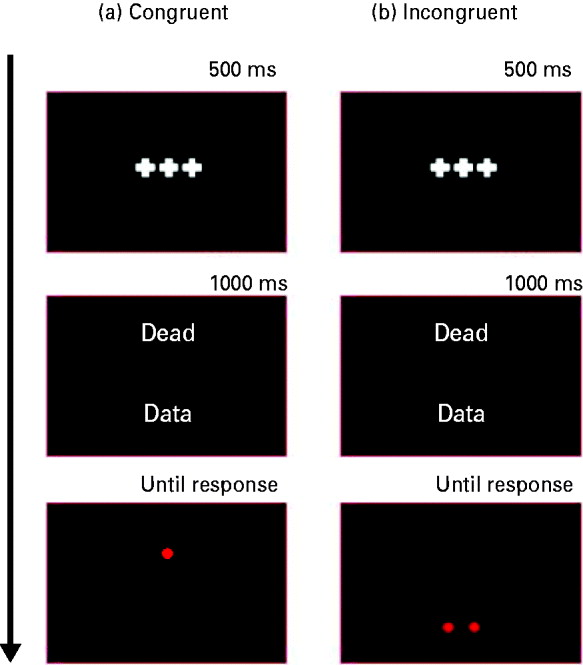
Threat-attention bias was evaluated using a Hebrew-adapted version of the classic word-based dot-probe task (MacLeod et al. Reference MacLeod, Mathews and Tata1986, Reference MacLeod, Rutherford, Campbell, Ebsworthy and Holker2002). Fig. 1 presents the sequence of events in a dot-probe task trial. The task consisted of 152 trials in which threat–neutral word pairs were presented in a randomized order. Each trial began with a centrally presented fixation display ‘+++’ (500 ms), followed immediately by a vertically aligned word pair written in 1-cm-high white block text (1000 ms). One word appeared directly above, while the other appeared directly below, the location vacated by the preceding fixation signal. A distance of 3 cm separated the two words. The word stimuli consisted of 38 threat–neutral word pairs. Within each pair, word length and frequency of usage were matched. Ratings of emotional valence by 18 independent judges were used to evaluate the valence of the words used in the study. These ratings confirmed that the threat words were rated as negative and that the neutral words were rated as neutral. The word pair was then replaced by a target probe that appeared in either of the two locations vacated by the words. The probe type was either a pair of red dots or a single red dot, and this was determined randomly on each trial. Participants were required to identify which of the two probe types appeared by pressing the corresponding key as quickly as possible without compromising accuracy. The participant's response cleared the screen, and the next trial began 500 ms later. Response latencies to the probe provide a ‘snapshot’ of attention, with faster responses to probes occurring at the attended location, relative to the unattended location. Threat bias was calculated as the difference between average response time to targets at neutral-word locations and targets at threat-word locations. Attention bias towards threat manifests as a faster response to probes that replace threat-related, relative to neutral, stimuli. The opposite pattern occurs in avoidance of threat stimuli (Bar-Haim et al. Reference Bar-Haim, Lamy, Pergamin, Bakermans-Kranenburg and van IJzendoorn2007).
Sequence of events in a dot-probe trial: (a) a threat-congruent trial; (b) a threat-incongruent trial.

Assessment of post-traumatic symptoms and traumatic history
PTSD symptoms were evaluated with the 17-item National Center for PTSD Checklist of the Department of Veterans Affairs (PCL; Weathers et al. Reference Weathers, Litz, Herman, Huska and Keane1993; Blanchard et al. Reference Blanchard, Jones-Alexander, Buckley and Forneris1996). Symptoms were related to any stressful experience (in the wording of the ‘specific stressor’ version of the checklist). Scores ranged from 17 to 85, with higher scores reflecting more symptoms of PTSD.
Trauma history was assessed using an eight-item self-report questionnaire developed specifically for this study. The questionnaire assessed the presence or absence of prior exposure to a terrorist attack, motor vehicle accident, rocket/shell fire, or various types of assault. Each item was scored yes/no, and a mean traumatic-history score was computed by summing these scores to each item.
Procedure
As noted earlier, data were collected at two time points. At time 2, the soldiers of the combat simulation platoon (n=18) were tested immediately following a strenuous 36-h period. This period involved stressful combat simulation activities including: total sleep deprivation, long-distance marching while carrying heavy loads, live-ammunition exposure, and restricted food intake. Data from soldiers in the five control platoons (n=113) were collected at the same time, prior to participation in the drill. Procedures were the same at both time points. The dot-probe task was first administered on a 17-inch-screen laptop computer; the PCL inventory was then completed. Upon completion of these tasks, participants were briefed and thanked.
Data analysis
Our main hypothesis was that both attention bias scores and psychiatric symptoms would show different changes over time in the two groups, as reflected in group×time interactions. Specifically, to test whether attention bias to threat is suppressed under stress (combat simulation) and whether the stress induced by combat simulation results in increased post-traumatic symptoms, attention bias scores and PCL scores were submitted respectively to two separate 2×2 ANOVAs. In both analyses, simulation status (combat simulation, control) served as a between-groups factor and time (time 1, time 2) served as a within-subject repeated measure. Follow-up within- and between-group contrasts were computed to decompose significant interactions. Cohen's d effect sizes are also reported. Finally, to determine whether threat bias suppression was correlated with PCL scores at time 2 and PCL change scores from time 1 to time 2, separate Pearson correlations were computed for each group.
Results
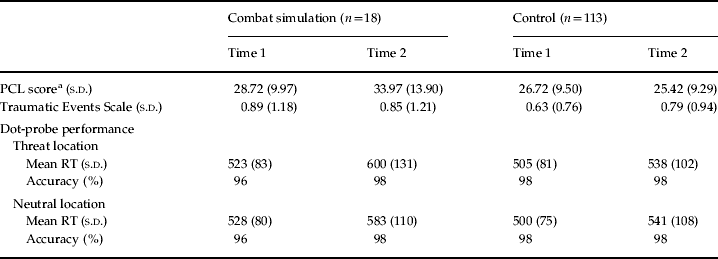
Table 1 provides information on participants' PCL scores, trauma history, and mean reaction times (RTs), standard deviations (s.d.s), and accuracy rates on the dot-probe attention task by group and data collection time point. The two groups did not differ in age, PCL scores and dot-probe performance (mean RT, accuracy and threat bias) at time 1 (all p's >0.10) and on trauma history scores at both times 1 and 2 (p's >0.20).
PCL scores, trauma history scores, and mean RTs (in ms), s.d.s, and accuracy rates on the dot-probe attention task by group and data collection time point

PCL, Post-Traumatic Stress Disorder Checklist; RT, reaction time; s.d., standard deviation.
a Two participants from the control group did not provide PCL data at time 1 and four participants from the control group did not provide PCL data at time 2.
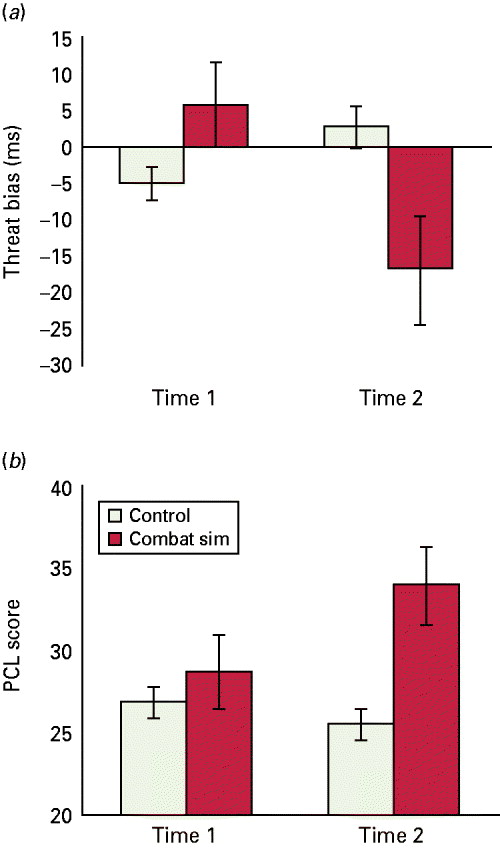
We first tested our primary hypothesis that attentional bias to threat is suppressed under stress (combat simulation). Trials with incorrect responses and trials with response times ±2 s.d. of the participant's mean for a particular condition were excluded (<2% of all trials). In accord with predictions, a significant time×simulation status interaction was found [F(1, 129)=9.32, p<0.005], indicating suppression of threat bias in soldiers exposed to combat simulation [t(17)=2.26, p<0.05, Cohen's d=1.09]. Of note, the control group showed a time-related increase in threat vigilance [t(112)=2.16, p<0.05, Cohen's d=0.41]. Finally, threat bias at time 2 was significantly lower in the combat simulation group relative to the control group [t(129)=2.47, p<0.05, Cohen's d=0.43] (Fig. 2a).
(a) Means and standard error bars of threat bias (ms) by combat simulation status. Positive values represent attention bias towards threat. Negative values represent threat avoidance. (b) Means and standard error bars of post-traumatic symptoms (PCL score) by combat simulation status.

The ANOVA concerning the effects of stress on post-traumatic symptoms (PCL scores) also revealed a significant time×simulation status interaction [F(1, 124)=7.61, p<0.01], with a non-significant trend of elevation in participants exposed to combat simulation [t(17)=1.79, p=0.09, Cohen's d=0.86], and no change in the control group [t(107)=1.59, p>0.10, Cohen's d=0.30]. A between-groups contrast for time 2 data revealed significantly higher post-traumatic symptoms in the combat simulation group relative to controls [t(125)=3.35, p<0.001, Cohen's d=0.60] (Fig. 2b).
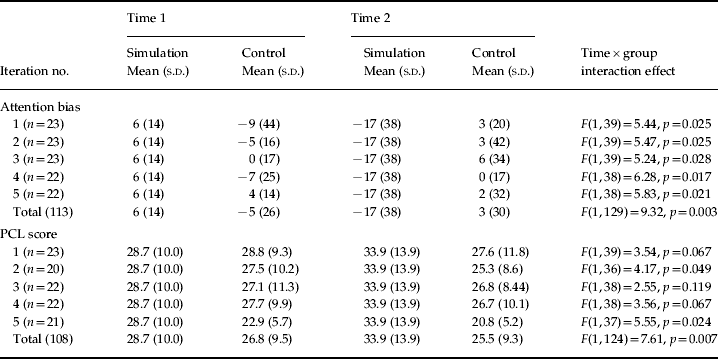
Although expected results emerged from this primary analysis, this analysis could be influenced by imbalances in the experimental group, which was drawn from one platoon, and the control group, which was drawn from five platoons. For example, observed findings in this primary analysis could reflect unique military experiences in one or another of the five control platoons or could be influenced by the disproportionately larger size of the control group. As a result, in secondary analyses, we computed five sets of ANOVAs. These contrasted the experimental combat simulation platoon separately with each of the five control platoons. Dependent variables comprised attention bias and PCL scores. These results are summarized in Table 2. The findings show that, despite some loss of statistical power, the results in the full sample reflect a general trend across each of the five contrasts between the experimental and five separate control platoons.
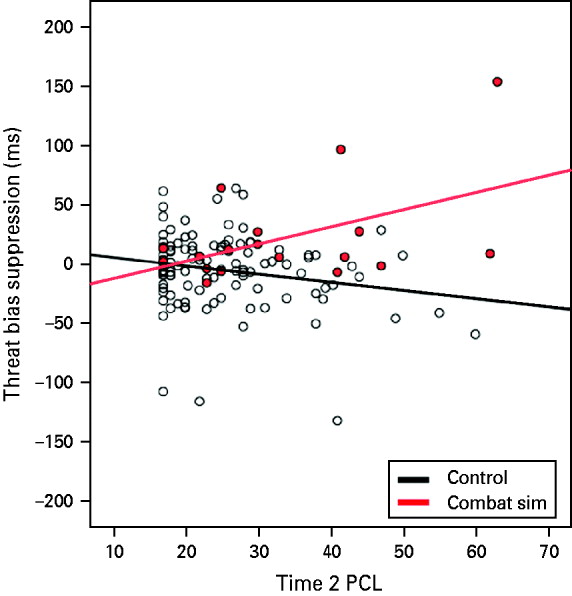
Scatterplots of threat bias suppression (i.e. threat bias in time 1 minus threat bias in time 2: high values indicate greater threat avoidance) by post-traumatic symptoms (PCL score) following military training (grey, combat simulation group; black, control group).

Mean attention bias scores (in ms), and PCL scores for each platoon at the two data collection time points. F and p values for the time×group interaction effects are also reported. Numbers for the combat simulation group are constant (n=18)

PCL, Post-Traumatic Stress Disorder Checklist.
Correlations within each group (Fig. 3) revealed that, among participants in the combat simulation group, stronger suppression of threat-related bias from pre- to post-combat simulation was associated with a higher incidence of self-reported post-traumatic symptoms on the PCL at time 2 (r=−0.48, p<0.05), and with a greater increase in PCL symptoms from time 1 to time 2 (r=−0.46, p=0.053). A non-significant trend in the opposite direction was found in the control group (r=−0.17 and 0.11, p=0.08 and 0.28), for both analyses respectively. Fisher's r-to-Z analysis showed a significant difference between the two correlation coefficients, Z=3.68 and −2.20, for the comparison with PCL scores at time 2 and PCL change scores from time 1 to time 2 respectively (both p's <0.05).
Discussion
The results from the current study suggest that acute stress causes attention to shift away from threat cues. This attention shift could either reflect active avoidance of minor threats or preoccupation with more potent threats that may distract from attention to the threat-connoting words. In any event, stress also influences the relationship between attention and symptoms, such that acutely stressed individuals displaying attention biases away from threat manifest particularly high levels of symptoms. As with data on the clinical and behavioral responses to trauma (Harvey & Bryant, Reference Harvey and Bryant2002; McNally, Reference McNally2003), the current neuropsychological data suggest that attention avoidance of trauma cues comes at a cost.
Although the current findings are generally consistent with Bar-Haim et al. (Reference Bar-Haim, Holoshitz, Eldar, Frenkel, Muller, Charney, Pine, Fox and Wald2010), they also extend these prior data in an important manner. Specifically, Bar-Haim et al. (Reference Bar-Haim, Holoshitz, Eldar, Frenkel, Muller, Charney, Pine, Fox and Wald2010) along with all prior work in this area assessed trauma, attention and stress-related symptoms at one point in time. With this cross-sectional design, previously observed, attention–symptom associations could be attributed to influences of pre-stress attention biases on stress-related symptoms; this would reflect the occurrence of pre-stress attention avoidance, manifesting even before trauma exposure, in those individuals most likely to develop symptoms.
The current study examined changes in attention bias following acute stress. With this design, the current study shows that the relationship between symptoms and attention only arises following stress; individuals manifesting attention avoidance during trauma displayed no attention bias prior to acute stress. Such findings carry important implications for risk assessment and prevention. Namely, these longitudinal data suggest that insights on risk are more likely to derive from measures of attention avoidance acquired in the context of acute stress, as opposed to under no-stress conditions. Similarly, in terms of prevention, other data suggest that some forms of computer-based attention retraining could eventually be used to counteract the effects of stress on anxiety (Hakamata et al. Reference Hakamata, Lissek, Bar-Haim, Britton, Fox, Leibenluft, Ernst and Pine2010). As with risk prediction, the current data suggest the importance of basing such interventions in the context of acute stress exposure, because different patterns of attention bias manifest before and after stress exposure.
Previous studies on extreme military training and combat exposure find signs of stress-related deterioration in cognitive function (Lieberman et al. Reference Lieberman, Tharion, Shukitt-Hale, Speckman and Tulley2002, Reference Lieberman, Bathalon, Falco, Kramer, Morgan and Niro2005, Reference Lieberman, Castellani and Young2009; Vasterling et al. Reference Vasterling, Proctor, Amoroso, Kane, Heeren and White2006b), and also an association between dissociative symptoms and serum levels of stress-related neurochemical markers (Morgan et al. Reference Morgan, Wang, Southwick, Rasmusson, Hazlett, Hauger and Charney2000, Reference Morgan, Southwick, Hazlett, Rasmusson, Hoyt, Zimolo and Charney2004, Reference Morgan, Rasmusson, Pietrzak, Coric and Southwick2009; Charney, Reference Charney2004). The present findings reveal yet another way in which stress may impact cognitive function in soldiers, through influences on early selective attention processes, which, in turn, may contribute to avoidance and dissociation, features characteristic of acute stress disorder and PTSD.
Research on association among stress, attention and post-traumatic symptoms can extend considerable neuroscience research. This includes work on underlying neural circuitry (Monk et al. Reference Monk, Nelson, McClure, Mogg, Bradley, Leibenluft, Blair, Chen, Charney, Ernst and Pine2006, Reference Monk, Telzer, Mogg, Bradley, Mai, Louro, Chen, McClure-Tone, Ernst and Pine2008), its functional chronometry (Pourtois et al. Reference Pourtois, Grandjean, Sander and Vuilleumier2004; Eldar & Bar-Haim, Reference Bar-Haim2010), and its emerging genetic underpinnings (Fox et al. Reference Fox, Ridgewell and Ashwin2009; Perez-Edgar et al. Reference Perez-Edgar, Bar-Haim, McDermott, Gorodetsky, Hodgkinson, Goldman, Ernst, Pine and Fox2010). Efforts to generate new treatments may benefit from a mutually reinforcing dialogue organized around a cognitive-neuroscience framework (Pine et al. Reference Pine, Helfinstein, Bar-Haim, Nelson and Fox2009). For instance, as noted above, novel computer-based methods provide a means for altering threat-related attention bias that could provide therapeutic benefits (Bar-Haim, Reference Bar-Haim2010; Hakamata et al. Reference Hakamata, Lissek, Bar-Haim, Britton, Fox, Leibenluft, Ernst and Pine2010). Randomized control trials indicate that attention-bias modification treatments, based on the dot-probe task, produce significant symptom reductions in anxiety patients (Amir et al. Reference Amir, Beard, Burns and Bomyea2009a, Reference Amir, Beard, Taylor, Klumpp, Elias, Burns and Chenb; Schmidt et al. Reference Schmidt, Richey, Buckner and Timpano2009). As such, these treatments could be applied to individuals exposed to acute stress, perhaps to train those individuals who show consistent attention bias away from threat to systematically re-engage attention towards such mild threats.
It is worth noting that the typical threat-related attentional pattern of patients diagnosed with PTSD is that of enhanced vigilance, a bias towards threat, rather than the pattern of threat avoidance, as occurs in the current study (Bar-Haim et al. Reference Bar-Haim, Lamy, Pergamin, Bakermans-Kranenburg and van IJzendoorn2007). However, prior findings of enhanced threat vigilance in PTSD come from studies in clinical populations where trauma was experienced many months in the past. Moreover, these populations are tested under conditions far less stressful than in the current study. By contrast, threat avoidance manifests in research on non-clinical populations, studied while exposed to stress. Thus, future longitudinal work is needed to evaluate the nature of relationships among stress exposure, attention to threat, and psychiatric symptoms over time. Such work can clarify whether acute, stress-related threat avoidance, at one point in time, might predict threat vigilance and PTSD at later points in time.
The results of the present study should also be interpreted in light of some limitations. First, although PCL scores at time 2 were significantly higher in the combat simulation than the control group, symptom increases were no more than moderate, both from a statistical and an effect-size perspective, falling well below clinical cut-offs. This might relate to the unusual, stress-resilient nature of study participants or the nature of the stress, which, although fairly severe, was only simulated. Thus, the reported PCL symptoms may reflect more general stress symptoms rather than post-traumatic symptoms proper and may not be directly relevant to clinical expressions of PTSD, following actual trauma. Second, given the small number of subjects, particularly in the combat simulation group, the findings should be considered preliminary. Third, several unmeasured factors, such as intellectual functioning or social support, could have influenced these findings, although our use of random assignment makes this unlikely. Fourth, it was not feasible, because of the busy schedules of these soldiers, to conduct closely spaced baseline and post-stress testing sessions. Doing so could minimize the possible occurrence of between-groups differences in daily experience. This possibility is also minimized by our use of random assignment, in IDF soldiers who were also recruited together as part of the same company and exposed to similar experiences during the first 6 months of their military service. As such, all study participants completed the same training schedule. Fifth, the nature of the stressor in the present study is complex. It involves sleep deprivation, live-ammunition drills, extreme physical demands from prolonged hiking, and food restriction, which create complex changes in the individual. Therefore, it is difficult to disentangle the precise aspect of stress that is most disruptive to attention. Moreover, although this stressor generates an experience that is similar to combat, no simulation can ever fully recreate the experiences of the battlefield. Sixth, no data exist on the lasting effects of acute stress on threat-related attention patterns and PTSD symptoms. Future work is therefore needed that includes a longer-term follow-up assessment of both threat bias and symptoms long after the stress. Finally, the current study was based in an unusual sample, soldiers undergoing military stress exposure, who may exhibit atypical responses to stress. Such a design is a necessary compromise when trying to identify other, more typical samples so that they might be studied in depth both prior to and after exposure to extreme stress. Because of the unpredictable nature of extreme, traumatic stress, it is almost impossible to identify such samples. Although it is important to extend the current findings through research in other samples, the similarities between the current findings and findings in other civilian samples (e.g. Bar-Haim et al. Reference Bar-Haim, Holoshitz, Eldar, Frenkel, Muller, Charney, Pine, Fox and Wald2010) suggest that the results may generalize to non-military settings.
In conclusion, traumatized individuals, particularly when they develop stress-related symptoms, shift their attention away from threat. This suggests that the attention response to trauma comes at a psychological cost. Much like some forms of overt, behavioral avoidance, this form of attention avoidance may also represent a natural, potentially maladaptive acute response to severe stress. Given that behavioral avoidance predicts poor outcome following stress exposure, more research, using both naturalistic and experimental designs, is needed on the evolving relationship between attention and symptomatic responses to stress.
Acknowledgments
Funding for this project was provided by the Leo and Julia Forchheimer Foundation in collaboration with the Mount Sinai School of Medicine, and partially supported by the Israeli Science Foundation (grant no. 964/08) to Y.B.-H.
Declaration of Interest
None.