INTRODUCTION
The cell cycle is a repeated process of growth in which one cell grows and divides into two daughter cells. During radiation treatment of cancer patients, we have no idea during which phase of the cell cycle we are irradiating. The radiation sensitivity changes with the ageing of cells from mitotic to S phase. The cell cycle is important because radiations readily kill the cells in the mitotic phase.
In this paper, a new approach is applied to correlate different phases of the HeLa cell S-3 with mean lethal ionising radiation dose (Do) along with nuclear magnetic resonance (NMR) water-proton spin-lattice relaxation time (T1). This information can be used to pin-point the mitotic phase of the cells in vivo in order to apply ionising radiation treatment at that particular time.
MATERIALS AND METHODS
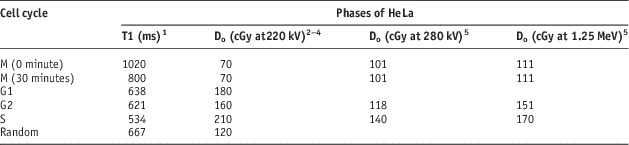
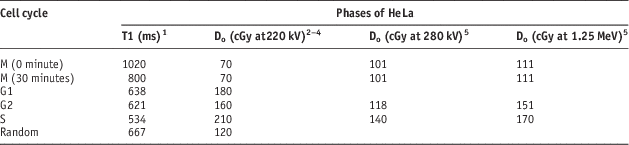
The data for the NMR water-proton spin-lattice relaxation time (T1) in HeLa cells in different phases of the cell cycle are abstracted from Beall et al.Reference Beall, Hazlewood and Rao1 Terasima and TolmachReference Terasima and Tolmach2–Reference Terasima and Tolmach4 measured the mean lethal ionising radiation dose (Do) at 220 kV in different phases of the HeLa cell cycles. However, Terasima and TolmachReference Terasima and Tolmach2–Reference Terasima and Tolmach4 did not measure the mean lethal radiation dose in S phase. As T1 is measured in the S phase, using the regression analysis and graph plotting it is found that the Do is about 210 cGy in the S phase. Additional data of mean lethal ionising radiation dose (Do) in M, G2 and S phase of HeLa cells at 280 kV and 1·25 MeV (cobalt-60) are obtained from Sapozink.Reference Sapozink5 The abstracted data are shown in Table 1.
NMR spin-lattice relaxation time along with mean lethal dose in different phases of HeLa cells and at different energies
RESULTS
Analysis of T1 and Do was assessed in M, G1, G2 and S phases of the HeLa cell cycle at 220 kV, yielding a correlation of 0·80 (Figure 1). At 280 kV and 1·25 MeV, the correlations were 0·77 and 0·82, respectively (Figures 2 and 3).
Correlation between nuclear magnetic resonance (NMR) spin-lattice relaxation time (T1) and mean lethal radiation dose (Do) in different phases of HeLa cells at 220 kV.

Correlation between nuclear magnetic resonance (NMR) spin-lattice relaxation time (T1) and mean lethal radiation dose (Do) in different phases of HeLa Cells at 280 kV.
Correlation between nuclear magnetic resonance (NMR) spin-lattice relaxation time (T1) and mean lethal radiation dose (Do) in different phases of HeLa Cells at 1·25 MeV.
DISCUSSION
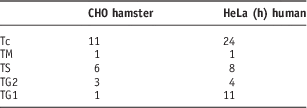
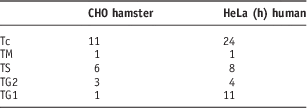
It is interesting to note that the mitotic phase in the cell cycle lasts from 0·5 to 1 hour. Therefore, in the 24-hour cell cycle of HeLa cells, the window of opportunity to initiate radiation treatment in the mitotic phase is very limited. From Table 2, G1 and S phase durations last for 11 and 8 hours, respectively. Therefore, the chances of hitting G1 and S phases are much higher compared with the mitotic phase.
Cell cycle phase times in different phases of Chinese hamster ovary (CHO) cells and HeLa cells
From Figures 1–3, it is interesting to note that the T1 value decreases from M phase (1020 ms) to S phase (534 ms). However, the Do value increases from M phase to S phase, irrespective of the radiation energy used. The variation in T1 is because of an increase in oxygen content in different phases of the cell cycle. It has been shown that the S phase has more oxygen compared with M phase.Reference Akber6 The 50% decrease in T1 value from M phase to S phase cannot be accounted for the mere condensation of chromosomes.Reference Beall, Hazlewood and Rao1
It is interesting to note, in Figure 1, that as the cell ages, T1 decreases and the mean lethal ionising radiation dose increases. The T1 measurements in the mitotic phase at 0 and 30 minutes interval reveal an interesting feature. It appears that radiation sensitivity decreases as cell cycle progresses or as a function of time. Even in the M phase, which lasts for only 1 hour out of the 24 hours of a complete HeLa cell cycle, the radio sensitivity is not constant. The decrease in T1 value from 0 to 30 minute clearly indicates that mitotic cell sensitivity decreases as a function of time. Another interesting aspect is that the random measurement of the sample having cells in different phases yield a T1 value of 667 msReference Beall, Hazlewood and Rao1 and Do value of 120 cGy.Reference Terasima and Tolmach3 It appears that if the sample contains more cells in S phase, the Do value will increase and the T1 value will decrease. This aspect has clinical ramifications. In a clinical setting, we have no clue what percentage of the cells are in the mitotic phase or in the S phase. The question is how we can apply this approach to clinical settings. There are three approaches. First, the biopsy taken from the patient should be measured for T1 value as a function of time. The shortest relaxation time will provide the information that most of the cells are in the S phase, and using the doubling time prepare for the radiation initiation when most cells are about to enter in the mitotic phase. Second, note the longest T1 value, which indicates that the cells are in the mitotic phase and the commencement of irradiation would be helpful. Third, measure the T1 value in different phases of the cell cycle. Using the random population of cells, one can estimate when the cells will be in the mitotic phase. For example, in Figure 1, it clearly shows that if we delay the T1 measurement, the cell migration would be more in the resistive phases of the cell cycle. It is appropriate that an equation needs to be developed to pin-point at what time cells will be in the mitotic phase. This simple approach will enhance the rate of cancer cure. Furthermore, the dissimilarities between normal tissue cell cycle and tumour tissue cell cycle will provide uncomplicated loco-regional tumour control that often results in complications.