INTRODUCTION
Many cephalopods have been maintained under laboratory conditions by researchers interested in studying aspects of their physiology (e.g. Wells & Wells, Reference Wells and Wells1995), behaviour (e.g. Porteiro et al., Reference Porteiro, Martins and Hanlon1990) but also as models in biochemical research (e.g. Villegas, Reference Villegas1969; Lee et al., Reference Lee, Turk, Yang and Hanlon1994; Ikeda et al., Reference Ikeda, Sakurazawa, Sakurai and Matsumoto2003). As a result, considerable effort has been made to improve the maintenance, rearing and culture of cephalopods for the scientific community (e.g. Choe, Reference Choe1966; Boletzky, Reference Boletzky1974; Boletzky & Hanlon, Reference Boletzky and Hanlon1983; Hanlon & Hixon, Reference Hanlon, Hixon and Berg1983; Hanlon & Forsythe, Reference Hanlon and Forsythe1985; Forsythe et al., Reference Forsythe, Hanlon, DeRusha and Boucaud-Camou1991; Hanlon et al., Reference Hanlon, Turk and Lee1991; Lee et al., Reference Lee, Turk, Yang and Hanlon1994) and more recently for human consumption (Nabhitabata, Reference Nabhitabhata1995; Iglesias et al., Reference Iglesias, Sanchez, Otero and Moxica2000; Chapela et al., Reference Chapela, González, Dawe, Rocha and Guerra2006; García García & Valverde, Reference García García and Valverde2006; Rodriguez et al., Reference Rodriguez, Carrasco, Arronte and Rodriguez2006). Cuttlefish and octopuses have caused few problems for researchers interested in their biology (Moltschaniwskyj et al., Reference Moltschaniwskyj, Staudinger, van Gelderen, Villanueva, Warnke, Hall, Lipinski, Marian, Nishiguchi, Sakai, Shulman, Sinclair and Sinn2007) and are the most attractive groups for commercial scale culture (e.g. Forsythe et al., Reference Forsythe, Hanlon, DeRusha and Boucaud-Camou1991; Vaz-Pires et al., Reference Vaz-Pires, Seixas and Barbosa2004). In contrast, squid (Teuthidae) are much more difficult to maintain in captivity (e.g. Hulet et al., Reference Hulet, Villoch, Hixon and Hanlon1979; Hanlon, Reference Hanlon, Gilbert, Adelman and Arnold1990). The difficulties in culturing many squid species are principally related to their holonektonic life cycle characterized by a planktonic paralarval stage and intense swimming activity of the adults (Hanlon, Reference Hanlon, Gilbert, Adelman and Arnold1990). High mortality rates during culture trials have been primarily caused by rough capture techniques and inadequate tank design both leading to skin damage and infection (LaRoe, Reference LaRoe1971; Hulet et al., Reference Hulet, Villoch, Hixon and Hanlon1979; Hanlon et al., Reference Hanlon, Hixon and Hulet1983, Reference Hanlon, Turk and Lee1991; Hanlon, Reference Hanlon, Gilbert, Adelman and Arnold1990). The Indo-Pacific loliginid squid; Septioteuthis lessoniana appears to be the sole candidate for large-scale culture (Nabhitabhata, Reference Nabhitabhata1995; Walsh et al., Reference Walsh, Turk, Forsythe and Lee2002).
The Azorean population of Loligo forbesi (Steenstrup, 1856) contains the largest loliginid squid known even when compared with conspecifics of the European shelf (Boyle & Pierce, Reference Boyle and Pierce1994). Male squid can reach a dorsal mantle length (DML) close to 1 m, with a weight exceeding 8 kg (Martins, Reference Martins1982). These large coastal squid support an artisanal fishery around the Azorean Archipelago, concentrated principally from November–February (Martins, Reference Martins1982; Porteiro, Reference Porteiro1994; Porteiro & Martins, Reference Porteiro and Martins1994). Despite its commercial interest and ecological importance (Piatkowski et al., Reference Piatkowski, Pierce and da Cunha2001; Velasco et al., Reference Velasco, Olaso and Sanchez2001), not much is known about the biology of L. forbesi in the Azores. Hanlon et al. (Reference Hanlon, Yang, Turk, Lee and Hixon1989) were the first to rear Azorean L. forbesi from egg to sub-adults in a closed seawater system with reasonable growth rates (Forsythe & Hanlon, Reference Forsythe and Hanlon1989), albeit not past 100 days post-hatching due to high mortality rates. Porteiro et al. (Reference Porteiro, Martins and Hanlon1990) maintained adult squid (27–77 cm DML) for behavioural observations but suffered high mortality.
Up to now, efforts for keeping these squid in the laboratory have not been repeated anywhere in the world. In this paper, we report our attempt to improve the transport, handling and culture techniques for adult Azorean L. forbesi based on the methodology used previously in the Azores (Porteiro et al., Reference Porteiro, Martins and Hanlon1990; Gonçalves et al., Reference Gonçalves, Porteiro, Cardigos and Martins1995; Pierce et al., Reference Pierce, Key, Boyle, Siegert, Goncalves, Porteiro and Martins1999; Pham et al., Reference Pham, Carreira, Porteiro, Gonçalves, Cardigos and Martins2009). Descriptions of some of our techniques have been previously briefly reported by Pierce et al. (Reference Pierce, Key, Boyle, Siegert, Goncalves, Porteiro and Martins1999).
MATERIALS AND METHODS
Adult L. forbesi were captured, transported and maintained in the laboratory for three culture trials performed between October 1994 and April 1995. Each of the trials are subsequently referred to as EX94, EX95(1) and EX95(2). These cannot be regarded as distinct experiments since squid were constantly added into the tanks according to the mortality levels.
Collection and transport
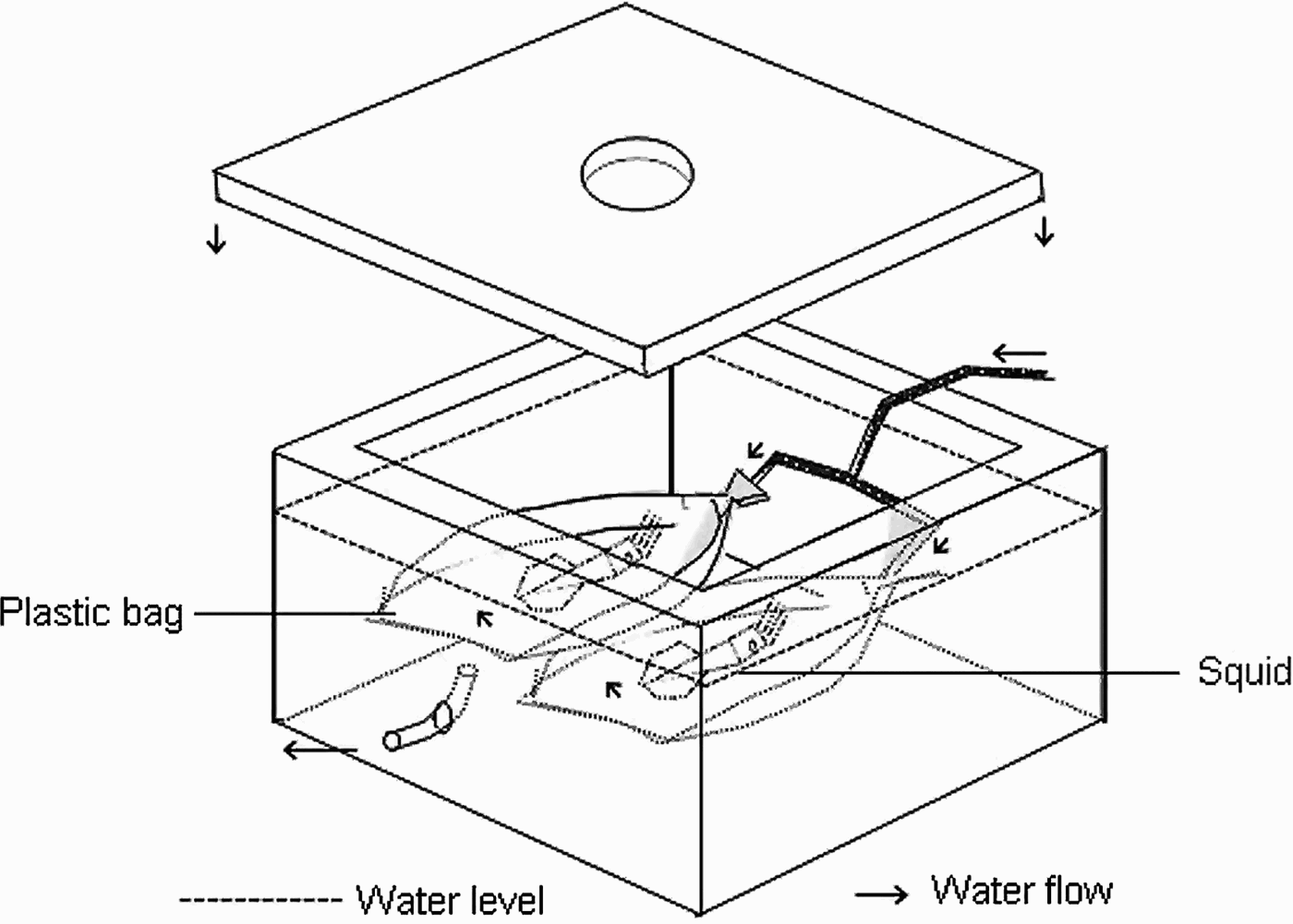
Squid were caught with traditional squid jigs used by Azorean fishermen, previously described by Martins (Reference Martins1982) and Porteiro (Reference Porteiro1994). Each squid was placed separately in a black plastic bag (50 l capacity) filled with seawater and gently introduced horizontally into a 500 l box previously filled with seawater (Figure 1). To restrict vigorous movements that may stress the animal, bags were tied up. A tube with running seawater, connected to a pump, was inserted in the bag aperture. At other the end, the bag was perforated for outflow of seawater. This design ensured a continuous replacement of the water, thus evacuating any ink that may have been squirted. On arrival to the harbour, the plastic bags were rapidly transferred into small boxes (e.g. 40/50 l) and after transportation to the laboratory and handling (see below) were lowered directly into the culture tanks for acclimatization to the captive condition for a period varying between 60 and 90 minutes.
Transport boxes design for holding individual Loligo forbesi after being caught by jigging.

Handling, growth and tagging
Squid were handled immediately after acclimatization and prior to release in the culture tanks. Lifting squid out of water should be performed very delicately since the gladius can easily be damaged (Boletzky & Hanlon, Reference Boletzky and Hanlon1983; Hanlon, Reference Hanlon, Gilbert, Adelman and Arnold1990). To obtain wet body weight (BW) measurements, the squid was placed in a box, water was drained out of the mantle cavity (to be discounted) and the box weighed on a digital scale (Mettler®PM1616, 0.1 g accuracy). Subsequently, dorsal mantle length (DML) and sex determinations were taken with the squid submerged in the tank, near a water outlet. Length and BW measurements were also recorded after death and the instantaneous coefficient of growth, G (Forsythe & Van Heukelem, Reference Forsythe, Van Heukelem and Boyle1987) computed using the equation:

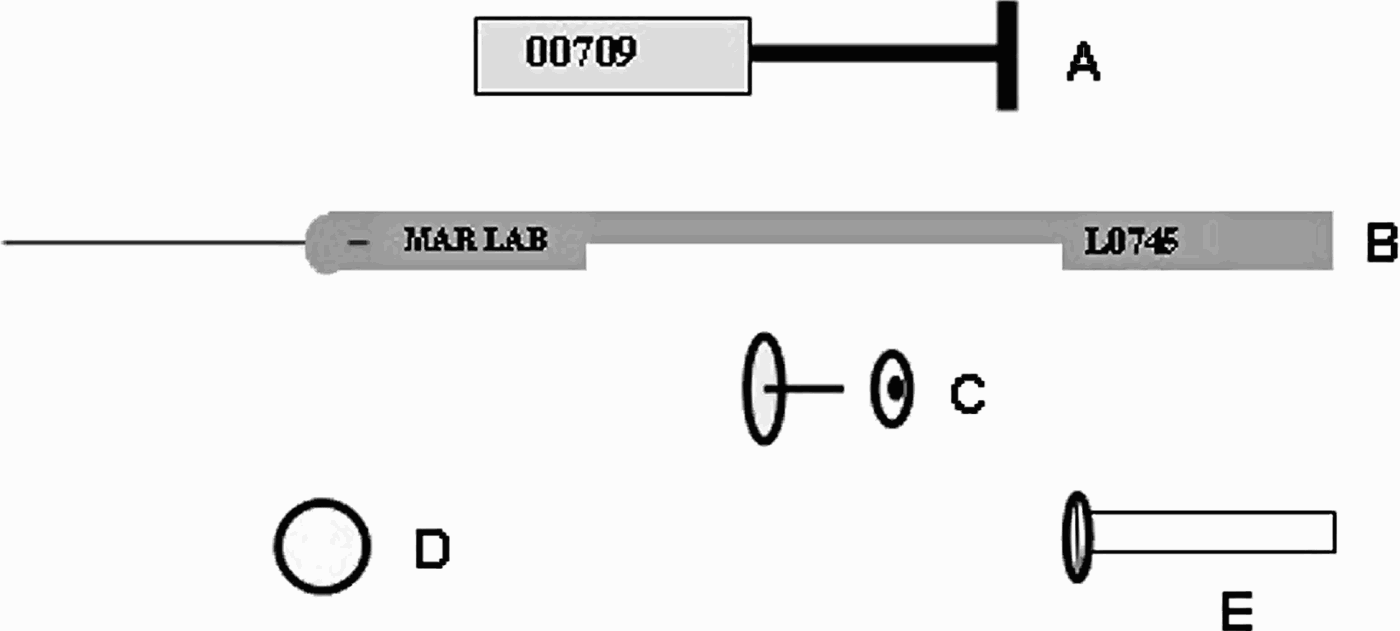
The potential of five different tags were evaluated (Figure 2): 3 plastic tags (commercial anchor-tag, soft plastic band, pin tag (inserted through the latero-anterior mantle or fin muscle)); small plastic circles glued on the mantle (with isocyanate glue); and finally marks burned with a heated metal stick on the dorsal part of the mantle.
Tags for marking individual squid, Loligo forbesi in captivity. (A) Anchor tag (25 mm); (B) soft plastic band tag (95 mm long and 3 mm high); (C) pin tag (5 mm); (D) glued circles of white sheet plastic (5 mm); (E) metallic rod (7.5 mm) used for burning marks.

Considering the extraordinary sensitivity of the squid eye and their natural occurrence in a dim light environment, these manipulations were performed under weak illumination. Cold anaesthesia (following the method of Sakurai et al. (Reference Sakurai, Ikeda, Shimizu, Shimazaki, Okutani, O'Dor and Kubodera1993)) was applied successfully on a few occasions but was eventually abandoned as it required more handling time and proved unnecessary.
Recirculating seawater system design
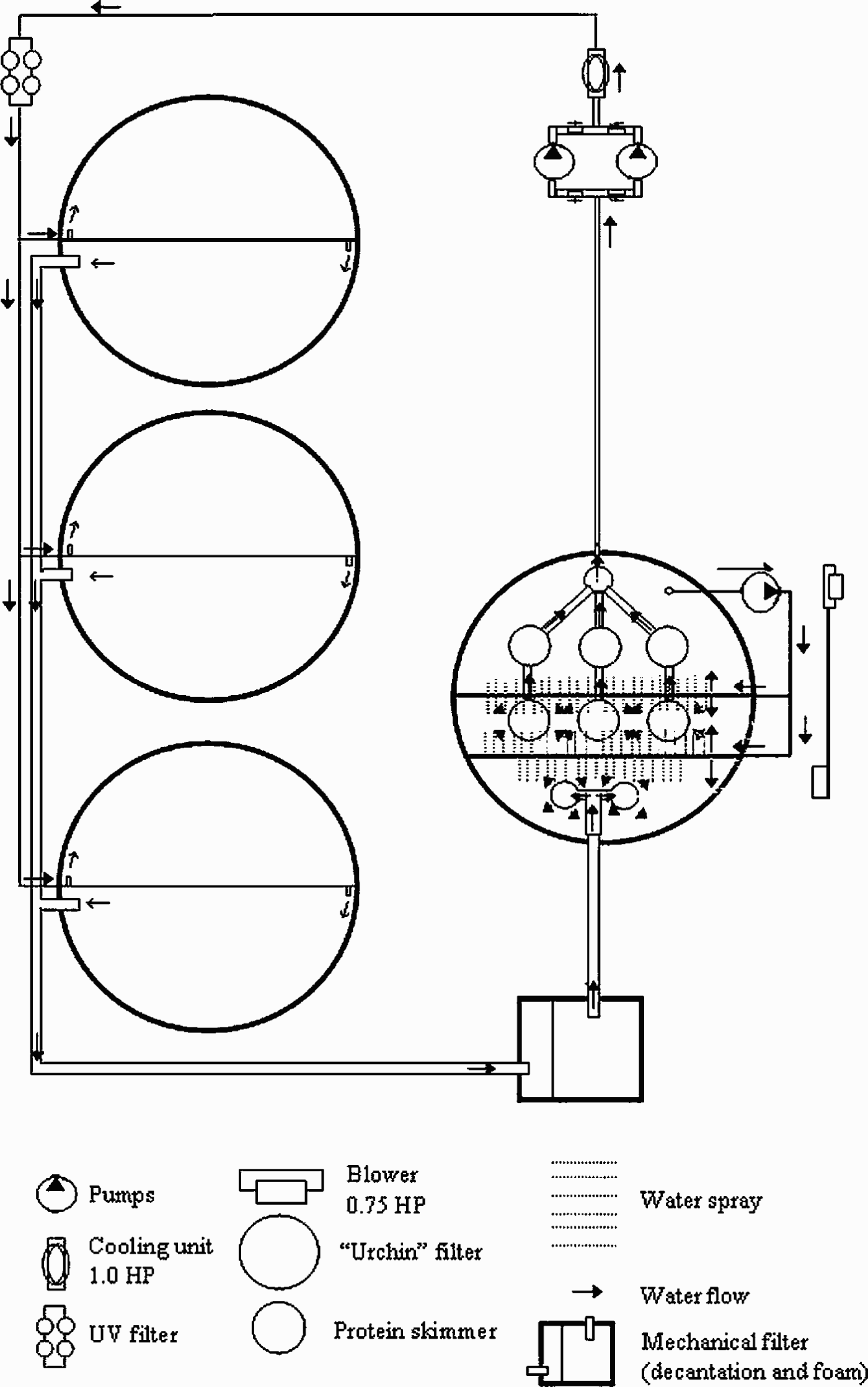
Three circular tanks were used for maintaining the squid (Figure 3). Each consisted of a circular swimming pool, with a total seawater capacity of 8000 l (3.6 m and 90 cm high). The tanks were supported by rigid (metallic) framework and PVC liner. Another identical tank was used as a filtration unit (Figure 3). Water circulation was carried out by electrical centrifuge water pumps. Two pumps (1.5 HP—~18 m3h−1) were used alternatively (working one week each). The water flowed at a rate of 6.9 m3 h−1 which allowed a complete renewal of the seawater in the system every 4.6 hours (daily turnover of 5.2 times). Another small pump (1 HP—~15 m3h−1) was installed in the biological filtration tank to increase circulation and optimize the filtration process. The water treatment comprised mechanical filtration, followed by foam fractionation and biological filtration (Figure 3). A 5–7 cm thick mixture of coastal gravel and crushed bivalve shells along with PVC tubes filled with plastic ‘urchins’ served as the filter bed in the biological filter. The water then passed through a cooling unit (1.0 HP) to keep the temperature below 20°C. Before entering the tanks, the water was disinfected by a UV (50 W) unit. Aeration was provided by an electrical air blower (turbine—0.75 w) in the filtration system and by water fall (cascade) in the tanks.
Closed seawater system used for maintenance of Loligo forbesi during three culture trials.

Liners and illumination
To avoid violent collisions with tank walls, the liners were painted with regular vertical dark stripes (10 cm wide and spaced 10 cm). Similarly, the tank bottoms were covered with a 4 cm dark gravel layer. To prevent squid striking against tank walls at night, a permanent weak and indirect illumination over the tanks was provided. Considering that these squid were caught at great depth (~200 m), direct illumination was strictly avoided. Tanks were covered with a black plastic lid. Diffuse natural light was maintained from 9:00 to 18:00 h (period in which culture room doors were open) and fluorescent light (40 w) on beams 3 m above the covered tanks, provided light the rest of the time.
Routine control of water quality
The system was filled with natural seawater pumped from Porto Pim bay (Horta). Throughout the experiments, temperature, salinity and dissolved oxygen were measured daily. The seawater was occasionally supplemented with freshwater (~200 l) to adjust salinity levels. Nitrogen levels (ammonia, nitrite and nitrate) and pH were monitored weekly with a portable spectrophotometer (Palintest 7000 ® Photometer). Whenever the pH dropped below 7.8, it was adjusted through addition of sodium bicarbonate to the seawater. When nitrate levels reached the recommended values part of the water was replaced (~1/4–1/3). All the water quality parameters mentioned were determined simultaneously in all tanks to ensure similar conditions for all squid.
Feeding
Diet composition and feeding time varied between each trial. In EX94, squid were fed daily (generally at 18.00) mainly with freshly dead Trachurus picturatus. However, some Pagellus bogaraveo, Trachynotus ovatus, Scomber japonicus and Lepidopus caudatus were occasionally provided. In EX95(1) and EX95(2), freshly defrosted fish (Trachurus picturatus, Pagellus bogaraveo and Scomber colias) were given to the squid twice a day, at 0900 h and 1800 h. Fish were provided whole although on some occasions were cut into slices. Each fish was weighed and measured before being introduced into the tanks. Food items were supplied one by one, thus allowing identification of the squid grabbing them. Afterwards, the parts of fish rejected by each squid were removed from the tank, weighed, labelled and deep frozen. All the various parts of the rejected fish were recorded independently. The daily feeding rates (DFR) were calculated as the average of food consumed per day (F) in relation to their body weight using the equation:

RESULTS
Collection and transport
A total of 89 squid were caught and maintained in the laboratory. They ranged from a BW of 162 to 1583 grams, corresponding to a DML of 174 to 445 mm, respectively.
Survival during transport from fishing site to the laboratory was 100%. The 500 l boxes were ideal for supporting several plastic bags and absorbing any impacts during travel. The squids did not harm themselves on the box walls, strongly decreasing stress and dermal injuries. In addition, plastic bags simplified land transport as they could easily be disposed into small boxes (e.g. 40/50 l) to be lifted by hand and lowered directly into the culture tanks for acclimatization. Strong water current in the bags was important to keep good levels of oxygen and to clean out any ink that might have been squirted.
Handling and tagging
Our methodology for obtaining weight measurements was fast and efficient. Sex determination, morphometric measurements and tagging were easily done at the water surface so the squid could be released as fast as possible. This method proved to be quick, lasting between 30 and 45 seconds altogether. Weak illumination further reduced stress when the squids were handled. It was also important for these manipulations to occur immediately after transport and prior to release in the culture tanks since catching the squids again at a later time was an unnecessary stressful operation.
Of the tags used, pin tags and burning marks were the most appropriate. The other models were either injurious (anchor-tag) or were lost after a few days (band tag and glued tags). Even burning marks proved not to be appropriate for long term recognition as they tended to disappear (skin regeneration) within 2 weeks. The pin tags were more efficient as they were neither lost nor did they cause dramatic injuries.
Survival
On average, survival time was low. Overall, 56% of the squid survived more than ten days, whilst 15% managed to exceed 20 days. In EX95(1) a small female of 162 grams survived up to 44 days in our system. Mean survival time along with associated maximum and minimum values, are presented for all experiments (Table 1). Mean survival was highest in EX95(1) followed by EX95(2) and EX94. Small squid survived better than larger ones (>1000 g). When size dispersion was high and females were present, the largest males displayed aggressive behaviour towards the smallest (i.e. fin beating, forward rush, etc.; Porteiro et al., Reference Porteiro, Martins and Hanlon1990; Pham et al., Reference Pham, Carreira, Porteiro, Gonçalves, Cardigos and Martins2009) but no direct lethal attacks were recorded. Nevertheless, such events increased stress levels and inking. During two of the trials, reproductive behaviour (including pair formation and egg deposition) occurred (see Pham et al., Reference Pham, Carreira, Porteiro, Gonçalves, Cardigos and Martins2009).
Total number of squid, mean body weight (BW), stocking density, survival time, mean daily feeding rate (DFR) and mean instantaneous coefficient of growth (G) of Loligo forbesi maintained during three culture trials in a closed seawater system.

Growth
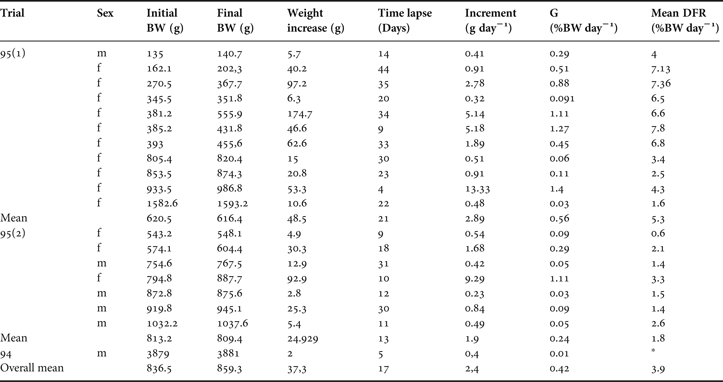
Table 1 displays the mean instantaneous coefficient of growth for all three trials. Despite the fact that some individuals showed a positive increase in BW, mean G was negative. Growth data for the squid that displayed positive growth is presented in Table 2. Growing squid ranged between 135 and 1583 grams with a corresponding DML of 174–445 mm, respectively. The instantaneous coefficient of growth varied between 0.009 and 1.4% increase in body weight day−1 with an overall mean of 0.42% BW day−1 (Table 2).
Sex, initial and final body weight, weight increase, survival time, growth increment, instantaneous coefficient of growth (G) and mean daily feeding rate (DFR) of positive-grown Loligo forbesi during three culture trials in a closed seawater system.

Water quality
Typically, NH3, NO2, NO3 and pH could not be adequately maintained below recommended levels (0.1 mg l−1 NH3, 0.1 mg l−1 NO2, 50 mg l−1 NO3 and pH between 7.7 and 8.2 (Boletzky & Hanlon, Reference Boletzky and Hanlon1983)). High concentrations of N-ammonia (up to 0.79 mg l−1 (Table 3)) were recorded. Such values could be explained by the frequent biomass re-load after periods without animals (filter is obliged to re-prime). In addition, when inking occurred, the level of N-ammonia increased during the next few days and it took 3–5 days to recover. In all three trials, the salinity varied between 33‰ and 41‰ with an average of 38‰ in EX94, 36‰ in EX95(1) and 35‰ in EX95(2) (Table 3). Seawater temperature was difficult to maintain constant. On some occasions it was impossible to effectively stop the temperature from increasing, suggesting that our cooling unit was sub-dimensioned. The average temperature in EX94 was 16°C (maximum: 24°c), 17.9°C (maximum: 20.6°c) in EX95(1) and 14.6°C (maximum: 15.7°C) in EX95(2) (Table 2).
Water quality parameters during three culture trials of Loligo forbesi, maintained in a closed seawater system (minimum and maximum values recorded).

Feeding
Most of our squid (89%) did not starve and showed interest in the food provided. Frozen fish was accepted even when furnished in slices. Daily feeding rates varied between 0 and 7.8% BW day−1 (Table 1). Feeding did not follow any consistent pattern. Squid were eating meals for a few days then starved for a while, then fed again, etc. Death typically followed three to five days of starvation.
DISCUSSION
Squid have always been a challenging group to study because of the difficulty in maintaining them under captive conditions. The large size and pelagic life style of L. forbesi (O'Dor et al., Reference O'Dor, Hoar, Webber, Carey, Tanaka, Martins and Porteiro1994) makes it particularly challenging when compared to smaller coastal species for which maintenance techniques are better managed (e.g. Sepioteuthis lessoniana (Walsh et al., Reference Walsh, Turk, Forsythe and Lee2002; Ikeda et al., Reference Ikeda, Sakurazawa, Sakurai and Matsumoto2003), Loligo pealei (Maxwell et al., Reference Maxwell, Macy, Odate and Hanlon1998) or Loligolunculla brevis (Stowasser et al., Reference Stowasser, Pierce, Moffat, Collins and Forsythe2006)). Nevertheless, our results suggest that with further efforts, maintaining large active squid such as Loligo forbesi might be feasible.
Delicate capture is crucial for successful long term maintenance of any cephalopod (Boletzky & Hanlon, Reference Boletzky and Hanlon1983; Hanlon, Reference Hanlon, Gilbert, Adelman and Arnold1990). Squid have a very delicate epidermis, easily damaged when entering in contact with rasping surfaces such as nets. Such injuries eventually lead to bacterial infection of the unprotected tissue and can be lethal (Hulet et al., Reference Hulet, Villoch, Hixon and Hanlon1979). For this reason, squid jigging has always been referred to as one of the most efficient atraumatic capture methods since it avoids skin and fin damages, typical of trawl-caught squid (Boletzky & Hanlon, Reference Boletzky and Hanlon1983). The minor wounds typically inflicted by the jig to the arms and tentacles do not pose any problem as they heal very rapidly (Hulet et al., Reference Hulet, Villoch, Hixon and Hanlon1979). Other atraumatic methods of capture include dipnets, encircling with a lampara net or purse seine (Hanlon et al., Reference Hanlon, Hixon and Hulet1983), pound nets (Chabala et al., Reference Chabala, Morellow, Busath, Danko, Smith-Maxwell and Begenisich1986) or trap nets (O'Dor et al., Reference O'Dor, Durward and Balch1977).
Shipboard transport is a careful operation that must take into account the degree of stress the squid can tolerate by providing optimal carrying conditions (Ikeda et al., Reference Ikeda, Ueta, Sakurazawa, Sakurai and Matsumoto2004). In our previous trials (Porteiro et al., Reference Porteiro, Martins and Hanlon1990), squid were transported in small insulated boxes with periodic water changes. This was later substituted by larger PVC boxes (~500 l) with continuous flow of seawater. In such system, squid were transported alone or in groups of up to 10 individuals per box. Despite short transportation time (between 15 and 45 minutes), high mortality primarily occurred due to skin damage, stress and asphyxia when inking, the latter being most problematic as reported by Chabala et al. (Reference Chabala, Morellow, Busath, Danko, Smith-Maxwell and Begenisich1986). The issue was resolved by placing individuals into separated plastic bags with continuous flow of fresh seawater. This was highly efficient since contact with the plastic bags did not lead to skin damage and isolation strongly decreased stress levels. Furthermore, water quality did not deteriorate and oxygen levels remained high. With this system, squid were captured and transported to the laboratory with no inflicted injuries.
Of the 5 types of tags tested, pin tags were the more adequate as they were less harmful, cheap, persisted for a long time and were fast to apply. The tattoo mark method used by O'Dor et al. (Reference O'Dor, Durward and Balch1977) was efficient but slower to administer as it required anaesthesia. Despite significant advances in tagging technology (e.g. Anderson & Babcock, Reference Anderson and Babcock1999; O'Dor, Reference O'Dor2002), pin tags are cheap and efficient for recognizing individual squid in captivity. Nevertheless, recent developments of cheap methods for tagging marine invertebrates have been made. For example, the ‘visible implant elastomer’, a plastic material, available in various colours injected subcutaneously has proven to work perfectly with octopuses (Pham & Isidro, in press) and loliginid squid (Zeeh & Wood, Reference Zeeh and Wood2009).
Despite our ability to capture and transport squid to the laboratory in good conditions, it was difficult to keep them alive for a long time (survival time between 1 and 44 days). Sub-adult squid (i.e. <1000 g) typically survived longer than larger squid. Upon death, larger squid presented severe skin damages, especially on the fins and posterior mantle tip due to intense contact with tank walls. This problem has been well documented by other researchers (e.g. Hanlon et al., Reference Hanlon, Hixon and Hulet1978, Reference Hanlon, Yang, Turk, Lee and Hixon1989; Hulet et al., Reference Hulet, Villoch, Hixon and Hanlon1979; Hanlon & Hixon, Reference Hanlon, Hixon and Berg1983; Yang et al., Reference Yang, Hixon, Turk, Krejci, Parsons, Bradford and Hanlon1984; Hanlon, Reference Hanlon, Gilbert, Adelman and Arnold1990; Sakurai et al., Reference Sakurai, Ikeda, Shimizu, Shimazaki, Okutani, O'Dor and Kubodera1993) and seems to persist even in larger tanks (15 m) (O'Dor et al., Reference O'Dor, Durward and Balch1977). Hanging some kind of flexible and soft material (e.g. cotton net with small mesh) on the tank walls, to act as a bumper, could help reduce skin and fin damages. For example, Flores et al. (Reference Flores, Igarashi, Mikami and Kobayashi1976) used polyethylene sheet for this purpose and Lipinski (Reference Lipinski1985) also used a bumper protection. Permanent weak illumination over the tanks at night has been suggested to help avoiding night collisions (Neill, Reference Neill1971; Flores et al., Reference Flores, Igarashi, Mikami and Kobayashi1976; Yang et al., Reference Yang, Hanlon, Lee and Turk1989; Hanlon et al., Reference Hanlon, Yang, Turk, Lee and Hixon1989) but in our case was not sufficient to prevent skin abrasion.
Short survival time can also be attributed to our inability to keep adequate water quality. Good water quality is a basic requirement for successful culture of cephalopods (see reviews by Boletzky & Hanlon, Reference Boletzky and Hanlon1983; Hanlon, Reference Hanlon and Boyle1987, Reference Hanlon, Gilbert, Adelman and Arnold1990). It is well known that cephalopods cannot tolerate low salinity, low dissolved oxygen, pH below 7.6 and high levels of toxic ammonia (NH3), nitrite (NO2), and nitrate (NO3). High peaks of ammonia (up to 0.79 mg l−1) were detected when tanks were re-loaded with squids and even though death was not immediate, such levels have certainly affected the animals. In addition, temperature could not appropriately be maintained constant, often too high (up to 24°C) considering these squid are found down to 440 m where temperatures are as low as 12°C (O'Dor et al., Reference O'Dor, Hoar, Webber, Carey, Tanaka, Martins and Porteiro1994).
Our improvements in squid transportation and handling proved to be appropriate for this species and can be successfully adopted for other large pelagic species. However, maintenance techniques require fine-tuning. Meticulous control of water quality parameters by increasing the performance of the biological filer and cooling unit is essential for long term maintenance. Furthermore, it is important to utilize tanks which are adapted to the size of the squid, ensuring enough swimming space. Nevertheless, it is worth noting that reproductive activity occurred with resulting egg masses laid inside the tanks (Pham et al., Reference Pham, Carreira, Porteiro, Gonçalves, Cardigos and Martins2009).
To summarize, fast mortality seems to be caused by a combination of small swimming space, unstable water temperature, high ammonia and aggressive agonistic interactions. The addition of shock absorbing material coupled with more stable water temperature, good water quality and different stocking regimes (e.g. male only and female only) that will limit agonistic interactions will certainly increase survival and should be the base for future work.
ACKNOWLEDGEMENTS
This work was funded by the European Commission within the frame of EC research programme in the Agriculture and Fisheries sector (EUROSQUID I—Stock Dynamics, Interactions and Recruitment in the North East Atlantic Squid Fisheries (AIR1, CT92-0573) and EUROSQUID II—Fishery Potential of North Eastern Atlantic Squid Stocks (FAR-MA 1 146)). We also thank the Directorate of Fisheries of the Regional Secretariat of Agriculture and Fisheries of the Azores Government who gave us permission to use their installations at Porto Pim beach (Horta) and supported its running costs. Thanks are also due to Professor Peter Boyle, John Forsythe and Professor Y. Sakurai who gave us suggestions in order to implement this system. A special thanks is addressed to Ruth Higgins for help correcting the English and to Paulo Martins who conducted a great part of the routine jobs for this project.