INTRODUCTION
Mortality is relatively rare for older children and adolescents in the United States. Less than 20,000 of those aged 5 to 19 years old die annually compared to 2.3 million adults (Xu et al., Reference Wolfe, Grier, Klar, Levin, Ellenbogen, Salem-Schatz, Emanuel and Weeks2010). Death caused by illness comprises a small percentage of all mortality in childhood and adolescence. Life-limiting illness in those populations remains significant for several reasons: (1) there are increasing numbers of children and adolescents with “chronic complex conditions” severe enough to require specialty and tertiary pediatric care (Feudtner et al., Reference Drake, Frost and Collins2000), (2) seriously ill children and adolescents use healthcare resources intensely, and (3) the site of care and even the place of death for the seriously ill child or adolescent are shifting to the family home (Feudtner et al., Reference Feudtner, Christakis and Connell2007) mandating that parent support be addressed. Self-efficacy, the conviction that one can perform behaviors that will achieve and sustain desired outcomes (Bandura, Reference Bandura1977, Reference Bandura1982, Reference Bandura1997), may be crucial for parent caregivers of their seriously ill offspring. A review of 47 studies across diverse community samples showed that general parent self-efficacy is associated with child and adolescent behavior outcomes as well as with parental competence, depression, role satisfaction, and caregiver strain (Jones & Prinz, Reference Jalmsell, Kriecbergs, Onelov, Steineck and Henter2005). Personal self-efficacy has been related to improved symptom and pain management for adults with chronic illness and protection of mental health for their caregivers, and has been shown to vary in caregivers by patient functional abilities (Keefe & France, Reference Keefe, Ahles, Porter, Sutton, McBride, Pope, McKinstry, Furstenberg, Dalton and Baucom1999; Hudson, Reference Hoekstra-Weebers, Jaspers, Kamps and Klip2003; Keefe et al., Reference Jones and Prinz2003; Rucker-Whitaker et al., Reference Robinson2007; van der Meer et al., Reference Szyfelbein, Osgood and Carr2007; Su et al., Reference Sloper2009).
Limited exploration suggests that similar relationships may exist for parent self-efficacy in caring for a child with a chronic illness. Urban mothers of 365 chronically ill children 5 to 9 years old demonstrated lower perceived maternal self-efficacy and greater distress at times when children had more functional limitations (Silver et al., Reference Rucker-Whitaker, Basu, Kravitz, Bushnell and deLeon1995). For 26 mothers and 20 fathers of children diagnosed with autism, self-efficacy mediated the effect of child behavioral problems on maternal anxiety and depression and moderated the effect on paternal anxiety (Hastings & Brown Reference Feudtner, Feinstein, Satchell, Zhao and Kang2002). Perceived caregiving mastery predicted psychological health among parents of children with cerebral palsy (Raina et al., Reference Porter, Keefe, Garst, McBride and Baucom2005). Adolescents’ disease-specific self-efficacy, younger age, and higher income predicted concordance in pain ratings by 53 adolescents with sickle cell disease and their parents (Barakat et al., 2008). Parent self-efficacy, coping, and children's disease severity significantly predicted the likelihood that management of disease would be appropriately shared by 129 parents and their children with diverse chronic conditions (Kieckhefer et al., Reference Keefe and France2009). In a randomized controlled trial of a support intervention, greater perceived self-efficacy at baseline predicted measurable increases in parents’ ability to improve their disabled children's psychosocial functioning and reduce their depressed mood (Barlow et al., Reference Barakat, Simon, Schwartz and Radcliffe2008). Considered together, these studies suggest that self-efficacy may enhance parental and child well-being and improve care management for children with chronic illnesses.
The number of studies focusing on distress and depression in parents caring for critically ill children is increasing. A PubMed search from 1971 through 2010 (key words: parent, distress, stress, anxiety, depression, and intensive care or critical illness) yielded 652 citations, with as many in the past 10 years as in the previous 20 years. Studies have historically focused on parents’ psychological responses to neonatal and pediatric intensive care admissions (McGettigan et al., 1994; McGrath, 2001; Doherty et al., 2002), with more recent interest shown in measuring stress associated with technological interventions in the course of chronic life-threatening illnesses (Bonner et al., 2006; Packman et al., 2010), and at time of childhood death (Lineberger et al., 2009). Persistent distress characterizes long-term care as shown in two studies of Dutch and United States parents of children followed for 12 to 18 months following a cancer diagnosis (Hoekstra-Weebers et al., Reference Hays, Valentine, Haynes, Geyer, Villareale, McKinstry, Varni and Churchill1999; Sloper, Reference Silver, Bauman and Ireys2000). Burden of care has been conceptualized and examined specifically as caregiver strain in family caregivers for ill adults but this concept has not been extensively applied to parents caring for children and adolescents with life-threatening illness. The relationships among self-efficacy, mood states, and caregiver strain, moreover, have not been examined for parents of seriously ill children and adolescents.
The aims of this secondary analysis are to (1) describe the levels of self-efficacy in a sample of parents of seriously ill children and adolescents who participated in a study of parent–child symptom concordance; (2) determine the relationships between parent self-efficacy, caregiver strain, and parental mood; and (3) identify predictors of greater self-efficacy We hypothesized self-efficacy would be inversely related to caregiver strain and negative mood states and directly associated with positive mood states. In the absence of relevant literature, a priori hypotheses were not made for predictors of parent self-efficacy, which we tested in several exploratory models.
METHODS
Study Used for Secondary Analysis
This secondary analysis is drawn from data initially collected for a multi-site, multi-method, cross-sectional study, “Understanding Communication about Symptoms in Children with Serious Illness” (L.Z., Principal Investigator), the aim of which was to describe parent–child symptom concordance during advanced illness. Quantitative data from five selected questionnaires related to our constructs of interest were analyzed from all 50 parent–child dyads enrolled in the initial study.
Participants
Fifty seriously ill children, adolescents, and young adults between the ages of 7 and 21 years had been recruited with one parent each from all subspecialty divisions at Mattel Children's Hospital at University of California Los Angeles, Children's Hospital Los Angeles, Trinity KidsCare Pediatric Hospice, and New York-Presbyterian Morgan Stanley Children's Hospital in New York City. To be included in the study, the patient was living with a life-limiting condition and had < 20% chance of survival beyond 3 years, and the parent was in a primary caregiving role for their child. Exclusion criteria were: living in a place other than their parents’ home or one of the recruiting institutions; absence of a primary caregiver; or having a primary caregiver unable to speak English with sufficient fluency to participate in an interview about communication, and to fill out self-report questionnaires.
Procedures
Approval to conduct the study was obtained from the Institutional Review Boards (IRB) for human subject protection at University of California Los Angeles, Children's Hospital of Los Angeles, Trinity Kids Care Hospice, and at Columbia University Medical Center. After referral by the patient's primary attending physician, written informed parent consent and child consent or assent were obtained by a member of the research team. Self-report questionnaire data were then collected by an advanced practice nurse, medical student, psychologist, or physician, all trained in protection of human subjects’ rights and with professional experience providing services to vulnerable families. Participating children and parents filled out these surveys separately in the respective subspecialty clinic, inpatient hospital room, or at home following recruitment in clinical sites. Each site was overseen by its principal investigator.
Measures
Chronic Pain Self-Efficacy Scale
The Chronic Pain Self-Efficacy Scale (CPSS) (Anderson et al., Reference Anderson, Dowds, Pelletz, Edwards and Peeters-Asdourian1995) assesses belief in one's ability to manage pain, cope with related symptoms, and perform various daily living tasks that could be affected by pain. For the initial symptom concordance study a caregiver version was adapted to the parent perspective (Bursch et al., Reference Barlow, Powell, Gilchrist and Fotiadou1999) similar to the adaptation made in a previous study for adult caregivers of family members (Keefe et al., Reference Jones and Prinz2003). Under the larger, more general construct of personal self-efficacy, this questionnaire taps a specific type of efficacy in the domain of parenting. Twenty-two items in question format ask the parent to assess his/her level of certainty in performing tasks related to three subscale categories: that he/she can help their child manage pain (PSE), perform daily functions (FSE), and cope with symptoms related to pain (CSE). Parents rate ability for each item on a 10-point Likert scale ranging from very uncertain (10) to very certain (100). Subscale items are averaged to generate subscale scores, and all subscale scores are averaged for a total score. When used with adults caring for adult family members high internal consistency (a = 0.95) has been reported (Keefe et al., Reference Jones and Prinz2003).
Caregiver Strain Index
The Caregiver Strain Index (CSI) (Robinson, Reference Ravilly and Robinson1983) identifies various stressors present in the life of caregivers since they began taking care of the patient. It consists of 13 items, each of which is a sentence describing a difficulty associated with caring for a seriously ill person, such as loss of sleep, emotional adjustments, or changes in plans. Each item is endorsed yes or no resulting in total scores ranging from 0 to 13. A strict cutoff point is not established, but the instrument developer reports that positive endorsement of seven or more items indicates greater levels of strain. There is space to provide a comment if desired following each item. Prior studies have confirmed CSI validity and reliability with adult caregivers of adult family members (Robinson, Reference Ravilly and Robinson1983; Miaskowski et al., Reference Melnyk, Alpert-Gillis, Hensel, Cabble-Beiling and Rubenstein1997 a and Reference Miaskowski, Kragness, Dibble and Wallhagenb).
Profile of Mood States
The Profile of Mood States (POMS) (McNair et al., Reference McNair and Heuchert1971, Reference McNair, Lorr and Droppleman1992; McNair & Heuchert, Reference Litt, Shafer and Napolitano2005) is a well-established self-report questionnaire consisting of a list of feelings that are rated by how much each feeling was experienced in the past week. The original long version lists 65 feelings that comprise six factors measuring tension, depression, anger, fatigue, confusion, and vigor. Agreement for occurrence of each feeling is provided on a five-point ordinal scale ranging from 0 (not at all) to 4 (extremely) with two items reverse scored. Total mood disturbance score is calculated by subtracting the vigor factor score from the sum of the five negative mood factor scores. Construct, predictive, and concurrent validity have been widely reported. Kuder-Richardson internal reliability coefficients have been consistently reported at or near 0.90 for the six factors with two recent normative studies reporting coefficients ranging from 0.84 to 0.95 (McNair & Heuchert, Reference Litt, Shafer and Napolitano2005). POMS developers have established four normative samples: 1000 psychiatric outpatients and 856 college students reported in the first two manuals (McNair et al., Reference McNair and Heuchert1971, Reference McNair, Lorr and Droppleman1992), and 170 elders and 400 adults, each group stratified for age, gender, and race according to the 1990 United States census (McNair & Heuchert, Reference Litt, Shafer and Napolitano2005).
Symptom Rating Scale
Symptom Rating Scale (SRS) (Szyfelbein et al., Reference Su, Lu, Chen and Wang1985) is a vertical analogue measure drawn like a large thermometer and used to rate 14 symptoms. Children and parents rated symptom intensity from 0 (none) to 10 (as bad as it can be) and associated unpleasantness from 0 (doesn’t bother me) to 10 (bothers a whole lot). For the regression analysis, to measure parent perceptions that their child was in pain, a dichotomous (yes/no) variable was derived from the parent report of the intensity score for the SRS pain symptom item.
Statistical Analyses
Prior to conducting the initial study, power for detecting symptom concordance was estimated at 80% for the target sample of 50 parent–child pairs based on published correlations of parent and child symptom reports ranging from 0.35 to 0.40 (Barakat et al., 2008). For the relationships of primary interest in this secondary analysis, the sample of 50 yielded post-hoc power >83% for correlations between self-efficacy and strain (r = −0.44) and between strain and mood disturbance (r = 0.41), and post-hoc power at 70% for correlations between self-efficacy and mood disturbance (r = −0.35).
Sample demographics are described. Means, standard deviations, and ranges are calculated for parent self-efficacy, caregiver strain, and parent mood variables. Means are compared with POMS normative values and with other published samples using CPSS and CSI scores, for which norms are not available. Because the instruments used to measure these three key secondary analysis variables have not been widely applied to samples of parents caring for seriously ill children and adolescents, we provide additional Cronbach a reliabilities and construct validity based on our sample.
For inferential statistics two-tailed p values are set at 0.05 for this exploratory study. Bivariate correlations for interval level relationships, χ2 for categorical differences, t-tests or analyses of variance for mean differences, and linear regression analyses, are calculated to test the a priori and exploratory hypotheses. Both parametric Pearson and more conservative Spearman ρ statistics were calculated and compared for all correlations. Although r values were slightly smaller for the latter as would be expected, as significance did not vary beyond the set p value, only the more familiar Pearson parametric statistic is reported. Because of the sample size no more than four variables were entered into any one regression model.
RESULTS
Participant Characteristics
Patients ranged from 7 years to 21 years (mean age 14.2, SD 4.0; median 13 years). Medical diagnoses were categorized primarily as oncologic (50%) and cardiac (40%). Fifty-two percent of the patients were female. More than half of the parents self-reported race/ethnicity as Caucasian (60%, n = 30), one-quarter were Hispanic/Latino (26%, n = 13), and only three families reported African-American and two Asian/Pacific Islander backgrounds. Three patients and 18 parents were born outside the United States. All understood written and spoken English. Six percent of mothers and 18% of fathers had not completed high school, but most parents had a high school or some college education (62% mothers, 50% fathers), and one-third had completed college or graduate programs (32% mothers, 28% fathers). Family income ranged widely from < $10,000 to >$150,000 annually; the median category chosen represented income between $60,000 and $79,999. Twenty mothers (40%) and five fathers (12%) were not employed. Of these, two fathers and one mother were retired. Six mothers had stopped working temporarily in order to spend more time with their sick child. The majority of parents were married (n = 35, 70%), 16% were divorced, and10% were single. Eighty-eight percent of primary caregivers participating in the study were mothers.
Descriptive Analyses of Key Variables for Secondary Analysis
Parent Self-Efficacy
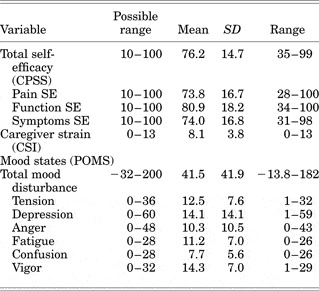
The mean score for total self-efficacy was 76.2 (SD 14.7). Mean subscale scores were: for self-efficacy in managing pain (PSE), 73.8 (SD 16.7); for functional ability (FSE), 80.9 (SD 18.2); and for coping with pain-related symptoms (CSE), 74.0 (SD 16.8) (Table 1). In the absence of normative data, the magnitude of the scores can be appreciated against the possible range of means from 10 to 100, putting all scores for this sample in the top quintile for the scale. Scores were skewed positively and the modal score was 89.4. Cronbach a for this sample was 0.93.
Means, standard deviations, and ranges for parent self-efficacy, caregiver strain, and mood state variables (N = 50)

Note: For mood state variables, higher scores indicate higher levels of each mood, including vigor, which is the only positive mood subscale. Because total mood disturbance is the sum of negative affect factors minus the vigor score, the range includes negative numbers.
Parent Caregiver Strain
The mean total caregiver strain score for parents in our sample was 8.1 (SD 3.8) (Table 1). Scores ran the full possible range from 0 to 13. The score distribution was clearly skewed toward greater strain with 46% (n = 23) of parents positively endorsing 10 or more items, and 68% (n = 34) positively endorsing between 7 and 13 items. Nine sources of strain were endorsed by more than half the parent respondents: emotional adjustments (82%), changes in personal plans (78%), family adjustments and other demands on time (each 68%), feeling completely overwhelmed (66%), work adjustments (64%), disturbed sleep (62%), financial strain (60%), and feeling confined (56%). Scale Cronbach a for this sample was 0.86.
Optional comments provided on the CSI provided a narrative dimension for interpretation for the overall high scores. Parents reinforced how disturbed sleep was a major factor creating strain through increased vigilant wakefulness and frequent sleep interruptions. They also offered specific examples to support their endorsement of demands on time, family relationships, and changes in employment status as sources of strain. Although 40% endorsed inconvenience as a contributor to strain, some parents’ comments indicated they rejected the implication that inconvenience was a burden, expressing instead resignation to the caregiving tasks as well as devotion and commitment to their child in spite of any inconveniences. Typical comments added to this item were: “I’d be sad if I were not here with her;” “I love my child;” “That's what I do;” “It's a dichotomy: (my child is) an incredible source of inspiration.”
Parent Mood States and Disturbance
POMS scores demonstrated parents’ perception of their mood states at mid-range for vigor and at the lower end of the ranges for the five negative mood factors measured: tension, depression, anger, fatigue, and confusion (Table 1). One sample t-test against the POMS normative adult sample (McNair & Heuchert, Reference Litt, Shafer and Napolitano2005) indicate that the parent sample in this study had scores significantly higher than the norm on tension (t = 4.4, p < 0.001), depression (t = 3.0, p = 0.004), fatigue (t = 3.3, p = 0.002), and confusion (t = 2.5, p = 0.004), and significantly lower for vigor (t = −5.0, p < 0.001). Total mood disturbance was significantly greater than for the normative adult sample (t = 4.0, p < 0.001). Among the negative affect factors, parent perceived fatigue was not significantly different (t = −0.79, p = 0.44), that is it was comparable to, that reported by the POMS normative sample of psychiatric outpatients (McNair & Heuchert, Reference Litt, Shafer and Napolitano2005). Cronbach a for mood factors in this sample ranged from 0.80 to 0.96.
Effect of Demographic, Clinical Strain, and Moods Variables on Self-Efficacy
Self-Efficacy, and Parent and Child Demographics
Parent total pain management self-efficacy scores on the CPSS and its subscales for pain (PSE), related functioning (FSE), and coping with symptom management (CSE) were analyzed by parent and child demographics and selected clinical variables. Comparisons were made by Pearson correlations of self-efficacy scores with parent ages and number of siblings, which had been collected as interval data; and by t-tests or analyses of variances for mean differences among genders, ethnic groups, household income groups, parent education groups, and diagnoses, all of which were collected as categorical data. Only child age was significantly associated with parent self-efficacy, parent scores rising with younger child age. There was a moderate significant inverse relationship between child age and parent total self-efficacy (r = −0.33, p = 0.02) and a stronger inverse relationship between child age and both CSE (r = −0.35, p = 0.01) and PSE (r = −0.40, p = 0.005), whereas the relationship to FSE was not significant (r = −0.12, p = 0.42). Bivariate correlations were not significant among total self-efficacy scores and parent age, or number of siblings. There were no significant mean differences on parent total or subscale self-efficacy scores across child gender, ethnic group, household income, mother and father education, or diagnostic group (non-significant t and F statistics not shown).
Self-Efficacy and Caregiver Strain
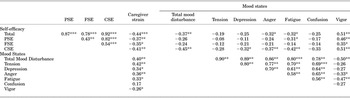
CSI scores were inversely and significantly correlated with caregiver self-efficacy total score (r = −0.44, p = 0.001) and all self-efficacy subscale scores: PSE (r = −0.37, p = 0.009), FSE (r = −0.35, p = 0.013), and CSE (r = – 0.41, p = 0.003) (Table 2). When parent self-efficacy level was dichotomized by median score, parents with self-efficacy at or above the median for this sample had significantly lower CSI scores (t = −3.4, p = 0.001).
Correlations between self-efficacy, caregiver strain, total mood disturbance, and positive and negative mood states

*p ≤ 0.05
**p ≤ 0.01
***p ≤ 0.001
Self-Efficacy and Parent Mood States
Relationships between total self-efficacy and parent mood states were inverse and statistically significant for total mood disturbance, anger, and fatigue but were not significantly associated for tension, depression, or confusion. A positive relationship existed between self-efficacy and vigor. Relationships between mood states and the self-efficacy subscale for coping with symptoms followed this pattern with a higher probability, including a moderate inverse relationship with parent total mood disturbance, anger and fatigue, a milder inverse relationship with depression, and a moderate positive relationship with vigor (Table 2).
When parent self-efficacy level was dichotomized by median score, parents with self-efficacy at or above the median for this sample self-reported significantly more vigor on the POMS (t = 4.4, p < 0.001), and significantly less total mood disturbance (t = 3.0, p = 0.001). Depression (t = −2.4, p = 0.016), anger (t = −2.9, p = 0.005), fatigue (t = −2.5, p = 0.016), tension (t = −2.4, p = 0.021), and confusion (t = −2.1, p = 0.044) levels were all significantly lower for parents with higher self-efficacy.
Predictors of Parent Self-Efficacy
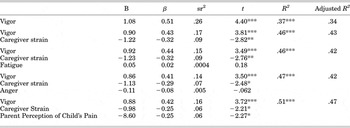
Linear regression analysis was done selecting predictor variables that had significant bivariate correlations with self-efficacy. Various combinations of the several eligible variables were tried limiting each model to three or four variables to be consistent with the constraints of sample size. Child age was the only demographic significantly associated with self-efficacy and was included in all models. Caregiver strain and vigor were consistently significant in all models, independently predicting up to 10% and 17% of the variance respectively in total self-efficacy. Caregiver strain, parent vigor, and parent perception of their child's pain at the time of data collection accounted for more than half (51%) of the variance for total parent self-efficacy to help their seriously ill children manage pain and related symptoms (Table 3). In this model, parent perceiving the child to be in pain at the time of data collection was associated with an almost nine point decrease in self-efficacy. Endorsement of each additional caregiver strain item was associated with an approximately one point decrease in self-efficacy. Conversely, an almost one point increase in vigor corresponded with an almost one point increase in self-efficacy.
Linear regression models predicting total caregiver self-efficacy

Child age controlled for in each model.
*p ≤ 0.05
**p ≤ 0.01
***p ≤ 0.001
Instrument Reliability and Validity for This Sample
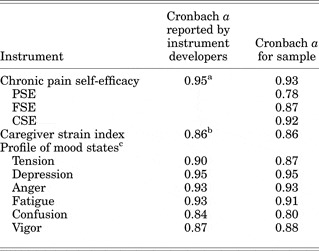
Self-efficacy, caregiver strain, and mood state instruments used in this secondary analysis were chosen for the initial symptom concordance study and had previously been used with family members caring for adult patients. As we used these instruments to collect data from parents (mostly mothers) caring for seriously ill older children and adolescents, we tested the reliability and validity for this new sample. As noted above, Cronbach a statistics substantiated internal consistency reliability at acceptable-to-high levels for all total and subscale scores on the CPSS (0.78–0.93) and POMS (0.87–0.96), and for the CSI total score (0.86). They were quite similar to alphas previously reported for these instruments (Table 4). Construct validity was provided by correlations among the measured variables that were logically and conceptually consistent, including inverse relationships of self-efficacy and vigor with caregiver strain, and positive relationships between negative moods and caregiver strain, and with vigor and self-efficacy. Hypotheses were supported, providing additional evidence of construct validity for the nature of self-efficacy, mood states, and caregiver strain represented by these variables in the hypotheses.
Instrument internal consistency by Cronbach a in study sample compared with developer's reports

aKeefe et al., Reference Jones and Prinz2003.
bRobinson, Reference Ravilly and Robinson1983.
cMcNair & Heuchert, 2003.
DISCUSSION
To our knowledge, this is the first study of parent self-efficacy for pain management with seriously ill school-age children and adolescents. Parents expressed a range in self-efficacy scores but they were surprisingly high on average. Caregiver strain was markedly high and attributed to emotions, sleep disruption, changes in employment status, and demands on time and finances. Although inconvenience was endorsed quantitatively on the Caregiver Strain Index in some instances, it was acknowledged qualitatively as an inevitable and accepted component of parent caregiving rather than a perceived source of strain. Parents of children with serious disease were beset by more negative moods and experienced less vigor than adults in a normative sample, and levels of fatigue were similar to those reported by psychiatric outpatients. Yet vigor rather than negative affects predicted self-efficacy. Self-efficacy was inversely correlated with caregiver strain and with the negative mood states of anger and fatigue, and positively correlated with vigor. With the exception of younger child age, self-efficacy was not associated with demographics. Younger child age, less caregiver strain, and more parent vigor predicted parent self-efficacy.
Findings from this study converge with the body of knowledge concerning the critical role self-efficacy has in managing serious illness and provide new information on pain management self-efficacy of parents caring for children and adolescents who are critically ill. Consistent with previous literature on adult patients, self-efficacy was a measurable and varied trait and higher levels were associated with less caregiver strain and mood disturbance and more positive affect.
Of interest are comparisons that can be made with two studies of family members caring for adults with cancer in which the same variables were of concern and measured with similar instruments (Keefe et al., Reference Jones and Prinz2003; Porter et al., Reference Platt, Brambilla, Rosse, Milner, Castro, Steinberg and Klug2007). In the first systematic assessment of family caregiver self-efficacy for pain management at end of life, Keefe et al. (Reference Jones and Prinz2003) reported a wide range of self-efficacy using the CPSS, inverse relationships with CSI scores, and inverse relationships with negative mood and direct relationships with positive mood, both measured by the brief POMS. In a similar study of informal caregivers for patients with early-stage lung cancer, caregivers again had a wide range but on average low level of pain management self-efficacy, and it was inversely related to caregiver strain and mood disturbance, and directly related to positive mood (Porter et al., Reference Platt, Brambilla, Rosse, Milner, Castro, Steinberg and Klug2007).
In addition to similarities in outcomes, findings of our study also highlight unique aspects of self-efficacy for parent caregivers of seriously ill children and adolescents. Self-efficacy scores for this sample had a positive skew, high mean and mode, and subscale scores in their top quintiles. Scores can be contrasted with two published studies in which the CPSS mean scores were lower by 11 points for patients and 18 points for caregivers. Patients with temperomandibular pain reported an average self-efficacy score of 64.7 (SD 18.0) for momentary pain measured four times over 7 days (Litt et al., Reference Kieckhefer, Trahms, Churchill and Simpson2004). Caregivers of adult family members with advanced cancer diagnoses scored 57.5 (SD 21.5) on the CPSS (Keefe et al., Reference Jones and Prinz2003).
The notably high caregiver strain in our sample may be inevitable for a uniquely intimate relationship in a time of loss. If it is not realistic to eliminate strain during these last phases of illness, what may be a critical first step for providers is to acknowledge its enormity and unique context, and then to consider with parents which sources of strain might be amenable to manipulation. As self-efficacy may be protective against perception of strain, perhaps parents need help to resolve doubts and achieve certainty that they are fulfilling the parenting role during each stage of caring for a child with life threatening illness.
The role of mood states for parent caregivers and its relationship to self-efficacy also provides insights for assisting these parents. Greater total self-efficacy for pain management, and in particular greater self-efficacy for coping with pain-related symptoms, were both associated with less anger and fatigue reported by parents. The magnitude of negative affects reinforced the weight of caregiver strain. It is notable that the level of fatigue was comparable to a normative sample of outpatient adults with psychiatric diagnoses, which suggests the exhaustion was comparable to the drain imposed by a mental illness. Not all elevated mood states were relevant to self-efficacy. Only anger and fatigue were mildly inversely correlated and none of the negative affects or the total mood disturbance score predicted self-efficacy. Sources of anger can be identified and may be amenable to counseling to buffer negative effects during both last stages of illness and during bereavement. Appropriate respite interventions may help address fatigue. Vigor, the single positive affect, although significantly lower than the norm value, was positively correlated with self-efficacy and was the only mood state predictive of self-efficacy. According to the POMS, vigor is defined as being lively, active, energetic, cheerful, alert, full of pep, and carefree. It is difficult to envision how parents caring for their seriously ill child could be characterized by these traits, and in fact they endorsed low frequencies for each, with only “active and alert” reported at either moderate or high levels by more than half (54%). Nevertheless, those who did endorse feelings encompassing vigor also had higher self-efficacy which, in turn, was associated with less mood disturbance and caregiver strain.
Self-efficacy, caregiver strain, and negative and positive mood states all showed variability in measurement, consistent with earlier studies. Within a clinical encounter, these variables need to be assessed in relation to the unique presentation of each child and family so that interventions are appropriately tailored and implemented without stereotyping. Overall, our data suggest parent self-efficacy with regards to managing their child's pain is a strength and a protective factor against parental distress and diminished well-being. Supportive interventions may best be targeted to those parents with lower caregiving self-efficacy as well as offered to all parents when death approaches and during bereavement, times when the accumulation of strain and negative affects, and lower vigor, could make them particularly vulnerable to doubts about their parenting. Pediatric palliative care programs have been shown to improve family satisfaction with care for children and adolescents who have advanced illness (Hays et al., Reference Hastings and & Brown2006). Neither of the medical centers used for recruitment in this study had formal pediatric advanced care programs at the time of the study, but as such programs are developed they can be expected to provide the needed structure and resources to enhance parent self-efficacy.
Future research should include expanding understanding of self-efficacy and its correlates and testing of interventions to enhance self-efficacy. Greater understanding of self-efficacy specific to pain management is particularly relevant because of the prevalence and concerns around pain as serious illnesses progress (Platt et al., Reference Miaskowski, Zimmer, Barrett, Dibble and Wallhagen1994; Ravilly & Robinson, Reference Raina, O'Donnell, Rosenbaum, Brehaut, Walter, Russell, Swinton, Zhu and Wood1996; Wolfe et al., Reference van der Meer, van Stel, Detmar, Otten, Sterk and Sont2000; Drake et al., Reference Bursch, Schwankovsky, Gilbert and Zieger2003; Jalmsell et al., Reference Hudson2006). Measuring self-efficacy and related variables is a continuing research challenge. There has been blurring across concepts of self-efficacy, self-esteem, optimism, and coping, and use of varied instruments to make these concepts measurable, which makes it difficult to compare study findings and to build a cohesive knowledge base (Jones & Prinz, Reference Jalmsell, Kriecbergs, Onelov, Steineck and Henter2005).
In our study, vigor was also revealed as an important factor relevant to self-efficacy. It is not known how the parents who reported greater vigor achieved it. It is conceivable that parents of seriously ill children and adolescents could be supported to derive vigor from nutrition, friendships, alternative modalities, spirituality, or other ways yet to be identified. All merit study.
The few self-efficacy intervention studies reported have used information, education, and support for family caregivers of adult patients. Adaptations of such interventions to parents of seriously ill children and adolescents in hospitals must consider that these parents prioritize staying in proximity to their child, tend to have considerable knowledge of their child's condition, and while continuing to need information, also have pressing needs for support in affective, family, and social realms. In pediatric intensive care settings, Melnyk et al. (Reference Melnyk, Alpert-Gillis, Feinstein, Crean, Johnson, Fairbanks, Small, Rubenstein, Slota and Corbo-Richert1997, Reference McNair, Lorr and Droppleman2004) have developed and performed trials of coping interventions that begin early in hospitalization and continue after transfer to general units. It is conceivable that this type of intervention could incorporate a self-efficacy focus and that it could be offered across settings over the long term of a serious illness trajectory. Self-efficacy is a promising focal point for interventions that will affect a single concern such as pain, but also influence a wide range of patient and caregiver outcomes (Jones & Prinz, Reference Jalmsell, Kriecbergs, Onelov, Steineck and Henter2005; Porter et al., Reference Platt, Brambilla, Rosse, Milner, Castro, Steinberg and Klug2007). This imposes the need for contextual studies to better understand the interactions between self-efficacy and related parent, child, and environmental variables.
This study is limited by a cross-sectional design, which cannot identify causal links. Data were constrained to that collected for the primary study. Variables selected for the secondary analysis were measured with instruments previously used with family caregivers of ill adults. There are no measures of pre-illness general parent self-efficacy or child self-efficacy, no measures of child pain management self-efficacy, and no longitudinal data to show changes over the illness trajectory. The convenience sample was comprised of parents willing to consent to the study which provides a possible selection bias in which participating parents may have been among the more self-efficacious. All data are based on self-report and limited to one parent. Predominance of mothers made it impossible to compare statistical differences between mothers and fathers. Relationships of self-efficacy to quality of life, patient adjustment, or patient/caregiver dyadic self-efficacy reported previously for adult patients could not be replicated within the limits of this secondary analysis (Keefe et al., Reference Jones and Prinz2003; Porter et al., Reference Platt, Brambilla, Rosse, Milner, Castro, Steinberg and Klug2007).
Because end of life related to childhood and adolescent morbidity is relatively rare in the United States, the study sample was accrued from multiple sites and two geographic regions. There was heterogeneity in ages and family demographics but primarily Caucasian and Latino ethnicities were represented. Recruitment was limited to participants with fluency in English. Two major diagnostic categories for serious illness and several rarer ones were included. There was no intent to achieve random selection from the population of older children and adolescents with life-threatening illnesses. Nevertheless, to the extent that there is diversity in this sample there is the opportunity for generalizability of findings.
In summary, this secondary analysis is the first exploration of self-efficacy in parents of children and adolescents nearing the end of life. Findings are convergent with studies of self-efficacy in family caregivers for adult patients and for children and adolescents with diverse chronic illnesses, and show the protective role of self-efficacy in caregiver well being. Development of interventions to enhance self-efficacy should be pursued to provide an important addition to effective treatment and integrated palliative care for families of children and adolescents with life-limiting conditions.
ACKNOWLEDGMENTS
We thank the families who participated in this study; the Glaser Pediatric Network, which funded the initial study (L.K. Zeltzer, P.I.) from which this secondary analysis is performed; the Arnold P. Gold Foundation for Humanism in Medicine for its support of Dr. Erlich's Summer Research Fellowship; and the New York–Presbyterian Hospital and Alpha Zeta Chapter Sigma Theta Tau International (STTI) which funded, in part, the presentation of a subset of these data by Dr. Byrne at the 18th International Research Congress of Sigma Theta Tau International Honor Society in Vienna, Austria on July 12, 2007.