. . . if we waited long enough, if we could observe planetary dynamics at geological time scales, the rocks and mountains which define the most stable and durable traits of our reality would dissolve into the great underground lava flows of which they are but temporary hardenings
DeLanda (Reference DeLanda1995, 8).
Introduction
The last two decades of archaeological debate attest to the emergence of a diverse set of theoretical reorientations to archaeological materials. These are currently at work under a number of headings, including ‘object agency’ (Gosden Reference Gosden2005; Reference Gosden, Ferris, Harrison and Wilcox2014), ‘materiality’ (Miller Reference Miller2005; Van Dyke Reference Van Dyke and van Dyke2015a; Reference Van Dyke2015b), ‘entanglement’ theory (Hodder Reference Hodder2012), ‘symmetrical archaeologies’ (Webmoor and Witmore Reference Webmoor and Witmore2008; Olsen and Witmore Reference Olsen and Witmore2015; Witmore Reference Witmore2007) ‘New Materialisms’ (Fowler and Harris Reference Fowler and Harris2015; Harris Reference Harris2014a; Reference Harris, Whittle and Bickle2014b; Witmore Reference Witmore2014), and, most recently, ‘object-oriented ontologies’ (Edgeworth Reference Edgeworth2016; Olsen and Witmore Reference Olsen and Witmore2015; see Harris and Cipolla Reference Harris and Cipolla2017 for an overview). What these diverse approaches share is a new regard for things, objects and materials. Many also share an appreciation for the rapports that things have with one another and with humans (Watts Reference Watts2013). At times, some or all of these approaches are discussed in terms of ‘post-humanism’. This general term encompasses multiple approaches that challenge anthropocentrism and urge archaeologists to give non-humans ‘their due’ when it comes to interpreting agency and historical processes. Coinciding with these new approaches is a growing set of critiques from various orientationsFootnote 1 (e.g. Barrett Reference Barrett2014; Bauer and Kosiba Reference Bauer and Kosiba2016; Fowles Reference Fowles2016; Sørensen Reference Sørensen2013; Reference Sørensen2016; Van Dyke Reference Van Dyke and van Dyke2015a). Critics raise important concerns explored below. Unfortunately, some thinkers tend to homogenize post-humanism by forcing very different ideas and frameworks together and typifying them as the same general approach working under a series of different guises.Footnote 2
In this essay, I engage both endorsements and critiques of post-humanism, parsing the literature in terms of the archaeology of colonialism and the archaeology of Indigenous history. I discuss these new directions in theory in regard to recent heritage struggles concerning New England's stone landscapes (Cipolla and Quinn Reference Cipolla and Quinn2016, 123–24; Ives Reference Ives2013; Reference Ives2015a; Reference Ives2015b; McLoughlin Reference McLoughlin2017). When considered in terms of competing heritage narratives, only one of which can be true, these debates have the potential to become volatile. This is because each position in these debates artificially cleaves apart complicated and plural colonial landscapes and histories (see Hayes's (Reference Hayes2011) ‘occulting’), several positions overlook or even ignore the long-term Indigenous histories that shaped colonial landscapes (Cipolla Reference Cipolla2017a; Oland, Hart and Frank Reference Oland, Hart and Frank2012; Schmidt and Mrozowski Reference Schmidt and Mrozowski2013), and some participants in these debates even disregard contemporary Indigenous presence and knowledge. I argue that we gain a more nuanced perspective on these debates and struggles when considering stone landscapes in terms of the vibrant matter and energy flows referenced in the epigraph from philosopher Manuel DeLanda. As embodied in the quotation, his work demonstrates the dynamism of substances such as stone that are often conceptualized by Western archaeologists as stable and inanimate. This notion reflexively points to the limitations of human perception and speaks to the relational assemblages or meshworks that are so central to the work of DeLanda and other New Materialist thinkers, often drawing heavily upon the work of Deleuze and Guattari (Reference Deleuze, Guattari and Massumi1987).Footnote 3 In terms of the stone landscapes under consideration, these perspectives offer a more neutral ground for discussion and collaboration where hard and fast distinctions of culture/nature and living/non-living are not assumed. Here, the earth and stones, along with flows of energy that enliven both (all independent of human agency and understanding), offer a more ‘symmetrical’ or flat starting point of analysis; as I argue later in this paper, this approach matches up in interesting ways with elements of pragmatism.
Parsing post-humanism
By now most archaeologists know that post-humanism involves various attempts to move beyond and challenge the views on agency, causality and history that began to emerge in the 1990s and continue to flourish today (Olsen Reference Olsen2012). As indicated by the name, the central agenda of this critique is to undercut the anthropocentrism at the core of modern Western understandings of these phenomena. Central thinkers in this movement like Latour, who reminded us that we have never been modern (Reference Latour1993) more than two decades ago, target the dichotomous ways of thinking and being that characterize Western modernity. As the critique goes, distinctions of nature/culture or human/non-human are rigorously monitored and maintained within this modernist ideology (a process that Latour labels ‘purification’), drawing attention away from or glossing over the ways in which such categories are entangled with one another and are continuous. The ideology of purification thus denies the hybrid, mixed and messy nature of the world.
Within archaeology and anthropology, hints of this movement show through in arguments for object agency (Gosden Reference Gosden2005) and materiality (Miller Reference Miller2005), but these approaches tend to maintain firm foci on humans in the past and, in turn, unintentionally guard, defend and reify the modernist dichotomies just mentioned. In critiques and reactions to these maintained dichotomies, new approaches such as symmetrical archaeology (e.g. Olsen Reference Olsen2010; Webmoor and Witmore Reference Webmoor and Witmore2008; Witmore Reference Witmore2007) and New Materialisms (Harris Reference Harris2014a; Reference Harris, Whittle and Bickle2014b; Fowler and Harris Reference Fowler and Harris2015; Witmore Reference Witmore2014) were incorporated into archaeological theory.
In general, I see post-humanism as a valuable addition to the archaeology of colonialism, a field of study that most recently came to align itself with post-colonial theory (Cipolla and Hayes Reference Cipolla and Hayes2015; Ferris, Harrison and Wilcox Reference Ferris, Harrison and Wilcox2014). Like postcolonialism, post-humanism critiques the limitations of modernist, Western perspectives on the world. Although it is beyond the scope of this paper, more work is needed in order to unpack the differences between postcolonial calls to decolonize (Atalay Reference Atalay2006a; Reference Atalay2006b; Reference Atalay2012; Smith Reference Smith1999) and post-human critiques of Western purifying perspectives (Webmoor and Witmore Reference Webmoor and Witmore2008). Both certainly embrace anti-essentialism, but they do so in very different ways. Postcolonialism is mostly concerned with decolonizing ‘othered’ subaltern peoples (Liebmann and Rizvi Reference Liebmann and Rizvi2008; Lydon and Rizvi Reference Lydon and Rizvi2010), whereas post-humanism sometimes argues against the ‘othering’ of the non-human world (Olsen Reference Olsen2003). However, post-humanism is useful here in that it poses new questions about assumptions that lay unexplored in the postcolonial critique, such as the underlying belief that most of the differences between peoples involved in colonialism is a matter of cultural difference laminated over a universalized human status (Blaser Reference Blaser2014). Here, difference might be reduced to identity politics and power negotiations in contexts of inequality and exploitation. Within this framework, differences are not dealt with sufficiently (Alberti Reference Alberti2016; Alberti et al. Reference Alberti, Fowles, Holbraad, Marshall and Witmore2011) and the non-human world is often essentialized as background noise to what ‘really’ happened in the colonial past (between peoples or between Culture A and Culture B). Here too, post-humanism offers valuable perspectives on the potential vibrancy of matter and the complicated assemblages of relationships through which these colonial power differences emerged.
Despite these potentially positive dimensions of post-humanism, scholars studying colonial or Indigenous pasts – undoubtedly attuned to the political contexts in which they work (e.g. Cipolla Reference Cipolla2013a; Reference Cipolla2013b; Mrozowski et al. Reference Mrozowski, Herbster, Brown and Priddy2009) – might be reluctant to engage with these new ideas due to recent criticism. For instance, Ruth van Dyke's (Reference Van Dyke2015b) edited volume, Practicing materiality, charts an explicitly anthropocentric course and evokes a sharp critique of post-humanism in regard to its purported lack of engagement with politics and political action. Van Dyke (Reference Van Dyke and van Dyke2015a) critiques symmetrical archaeologists along with all who champion a ‘flat’ ontology. She argues that these approaches consider things and animals as ‘equal players’ to humans in ‘decisions, abilities, and beliefs’ (Van Dyke Reference Van Dyke and van Dyke2015a, 18). In contrast, symmetrical archaeologists have noted in many instances that symmetry does not conflate humans and non-humans. According to Olsen and Witmore (Reference Olsen and Witmore2015, 188), it was ‘never about confusing farmers with shovels or sailors with navigational aids’. They insist that symmetry is not a glossing over of the differences between entities but rather an acknowledgement that differences between entities are much more complicated than assumed dualisms allow. In fact, according to Olsen and Witmore (ibid.), these actual (rather than projected) differences are ‘constitutive for the world, including for human existence’.
Although Van Dyke draws largely upon the respective works of Jane Bennett and Bruno Latour in this section of her critique, she associates these themes with most post-human approaches, including thinkers associated with actor-network theory, symmetrical archaeology and New Materialisms. She outlines two main critiques. First, post-humanism shifts attention away from social inequality and resists issues of social justice. Second, through a series of complicated philosophical manoeuvres, these post-human approaches circumnavigate issues of intentionality in the past (see also Pollock Reference Pollock2016; Ribeiro Reference Ribeiro2016). Altogether, according to Van Dyke, these approaches avoid any serious engagement with ethics and politics.
Regarding Van Dyke's critique, I agree that there are several lines of thought currently classified as post-human that steer clear of important opportunities to engage in political commentary and critique. For instance, Witmore recently referenced a study of an abandoned herring factory in Iceland (Pétursdóttir Reference Pétursdóttir2012), noting that discussing and using such a site as a ‘means to an end’ to explore the limits of capitalism or the consequences of industrialization would be problematic (Witmore Reference Witmore2014, 216–17). Such a project, according to Witmore, would remain anthropocentric, dualistic in its modes of thought, and perhaps defy allegiance to the symmetrical or flat ontology that he so strongly endorses. This is where I see an important distinction within the diverse body of thought associated with the label ‘post-humanism’. Witmore's stance on the herring factory seems to contrast with other post-human approaches such as those of Bennett, Barad or DeLanda, each discussed further below. I see the thing we call ‘capitalism’ as part of the factory mentioned by Witmore and I cannot help but wonder if such an archaeological assemblage might shed new light on the complicated admixtures and relationships there. Such a place offers insights into how a heterogeneous mixture of humans, non-humans and hybrids acted together. By critically reflecting on capitalism or industrialization through the herring factory assemblage, could we gain new understandings and appreciations for our current condition? This seems like a missed opportunity to use our engagements with the past to help us try and guide our future, a future that, admittedly, we have only a small share of control over. Like many writings in symmetrical archaeology, I think Witmore overstates his point in this instance. If not, then this approach will only further bifurcate intellectual knowledge and ‘real’-world problems, as Ingold (Reference Ingold2014, 231) alluded to in his blistering response to Witmore's article, in which he noted a similar binary between ‘vainglorious academics’ and the real world that they purport to study. In any case, I believe that this example begins to lay bare different understandings of how the flat ontology works and what constitutes a betrayal of said ontology, a point I return to in the final section of this essay.
As someone who is committed to the postcolonial project, who works with Indigenous communities in North America, and who spends a great deal of time working on issues of colonialism, past and present, I generally sympathize with critiques such as those of Van Dyke. In fact, I recently questioned the pragmatic impacts and outcomes of the post-human (intellectual) hunt for dualisms (Cipolla Reference Cipolla and Cipolla2017b; Harris and Cipolla Reference Harris and Cipolla2017, Chapter 11) along with certain thinkers’ troubling comparison of subaltern people with ‘subaltern’ things (Olsen Reference Olsen2003; Reference Olsen2010). Unlike Van Dyke and the critics of symmetrical archaeology discussed recently by Olsen and Witmore (Reference Olsen and Witmore2015), I do not find any inherent fault with a flat ontology for archaeological research. As indicated above, I do not read in such calls (Witmore Reference Witmore2007) a commitment to keeping all entities ‘equal players’ throughout the analysis, but instead a commitment to approach research with no a priori assumptions about the limitations and strengths of various entities in the past, human or otherwise. After all, Witmore (Reference Witmore2007, 547, emphasis in original) reminded us in his manifesto for symmetrical archaeology that ‘symmetry does not imply some simplistic notion of equivalence between humans and non-humans’. I do, however, find likening actual colonized peoples’ experiences to the experience of non-living things being intellectually ‘colonized’ by modern sensibilities to be highly problematic (e.g. Olsen Reference Olsen2003; for a critique, see Fowles Reference Fowles2016). According to Olsen and Witmore (Reference Olsen and Witmore2015, 193), in such cases, ‘observers gain humility sufficient to recognize things as subaltern others’, but, in my reading, overlook the practical implications of their enlightened perspective when it comes to those colonized and formerly colonized communities with which many archaeologists work. We can stand back and appreciate the material properties of a water cannon, but I would argue that the analysis (and our responsibilities) must shift when said cannon is drawn into an assemblage like those reported on in late 2016 with the Dakota Pipe Line Access water protectors. Moreover, I assert that metaphors such as ‘subaltern things’ will only serve to drive the wedge further between academics and Indigenous communities, digging the moat deeper that separates the ivory tower from the rest of the world (Cipolla Reference Cipolla and Cipolla2017b). Having noted these pragmatic reservations regarding a post-human neglect of the political and pragmatic in favour of intellectual isolationism, I do question whether, by grouping all post-human approaches together, archaeologists who are critical of these ideas are dismissing too much. I follow this thread in relation to the respective works of Jane Bennett and Karen Barad, two scholars whose works recognize the vibrancy of the non-human world.
Political scientist Jane Bennett is known best among archaeologists for her 2010 book Vibrant matter. A political ecology of things. Archaeologists are particularly interested in Bennett's discussion of a North American blackout as an example of human–non-human relational agency (e.g. Bauer and Kosiba Reference Bauer and Kosiba2016; Fowler and Harris Reference Fowler and Harris2015). A cursory reading of her work seems to confirm critics’ concerns, outlined above. For instance, when discussing who or what to blame for the blackout, Bennett (Reference Bennett2010, 36) notes that ‘the locus of political responsibility is a human–nonhuman assemblage’. A closer read, however, suggests that there is more to Bennett's project. She asks, ‘must a distributive, composite notion of agency thereby abandon the attempt to hold individuals responsible for their actions or hold officials accountable to the public?’ (ibid., 37). She is quick to emphasize that a vibrant materialist approach precludes placing full blame on individuals. Though she distributes the blame for the blackout among a network of human, non-human and hybrid ‘actants’, she does not overlook the importance of identifying sources of harm. In fact, she highlights corporate greed as one of the important areas to assess as we move forward. As with my above concerns over Witmore's framing of Pétursdóttir's (Reference Pétursdóttir2012) herring factory study, here we are reminded that we can use Bennett's insightful writing to critically assess our place in various assemblages and use this information to make informed decisions as we plan for the future. It is true that Bennett rejects the possibility of identifying one single human source of fault, but she provides a view that can make differences in the future for humans (again, who are never in complete control).
Physicist Karen Barad (Reference Barad2003; Reference Barad2007) also looks to assemblages of humans and non-humans when explaining history, intentionality and agency. Barad (Reference Barad2007, 23) does not associate these phenomena with individuals, but instead with intersections of humans and non-humans. According to her theory of agential realism (ibid., 218), ‘agency cannot be designated as an attribute of subjects or objects, which are themselves constituted through various practices’. Yet Barad aligns herself with social activism (Dolphijn and Van der Tuin Reference Dolphijn, van der Tuin, Dolphijn and van der Tuin2012, 59). For her, ethics is ‘about taking account of the entangled materializations of which we are part, including new configurations, new subjectivities, new possibilities’ (ibid., 69). In contrast to some other approaches grouped under the general mantle of ‘post-humanism’, Barad's model embraces social and political issues (Barad Reference Barad2007, 24–25) and acknowledges the important role of power (see ibid., Chapter 6) as an emergent quality of assemblages. For instance, she critiques Butler's (Reference Butler1993) work for a general neglect of the material dimensions of gender interpellation (Barad Reference Barad2007, 194); Barad's analysis of the material qualities of ultrasonography – focusing on the piezoelectric crystal that is central to this process – reveals insights on political issues related to reproductive rights. She demonstrates how the piezoelectric crystal performs in the ultrasound and helps to produce an image of the foetal body. Altogether, this assemblage encourages us to focus on the foetus exclusively; this facilitates and is in part conditioned by political discourse that emphasizes the ‘autonomy and subjectivity of the fetus’ (Barad Reference Barad2007, 212) while objectifying the pregnant woman. In my reading, the post-human project iterated in Barad's work is about looking forward as humans, entangled in complex assemblages and using these new understandings to change the world for the better (in whatever ways humans can):
Learning how to intra-act responsibly within and as part of the world means understanding that we are not the only active beings – though this is never justification for deflecting that responsibility onto other entities. The acknowledgement of ‘nonhuman agency’ does not lessen human accountability; on the contrary, it means that accountability requires that much more attentiveness to existing power asymmetries (Barad Reference Barad2007, 218–19).
It is in the writings of politically engaged post-human thinkers such as Barad and, to a lesser extent, Bennett that I find important contrasts – both between them and thinkers such as Olsen and Witmore and between my views of post-humanism and blanket critiques of these directions in theory.
Barad and Bennett each take influence from Deleuze and Guattari's (Reference Deleuze, Guattari and Massumi1987) notion of assemblage. Assemblage theory (DeLanda Reference DeLanda2006, Reference DeLanda2016) is often associated with the term ‘New Materialism’, which comes from the work of philosophers Manuel DeLanda and Rosi Braidotti. Compared with their cousin ‘materialism’, New Materialist approaches embrace a flat ontology that attempts to reduce or avoid anthropocentrism; such approaches often begin their analysis at the level of substances, recognizing their various properties (and vibrancies). For instance, DeLanda – also heavily influenced by the writings of Deleuze and Guattari – attacked anthropocentrism and dichotomous modes of thought, arguing for critical comparisons between seemingly disparate entities. For example, he drew parallels between hurricanes and steam motors and between the formation of geological and social strata. He sought to compare and contrast these entities, but not in a metaphorical sense because he found real physical similarities between the entities he compared (DeLanda Reference DeLanda1995, 3). For DeLanda, these seemingly disparate processes operate on flows of energy (or vibrant matter), albeit at very different rates and scales. It is from these vantage points that I seek to revisit and reassess the contested stone heritage of New England. Before considering the vibrancies of stone and earth in such contexts, however, it is first necessary to establish the background context for these discussions and debates.
Contested stone heritage in New England
Before I built a wall I'd ask to know,
What I was walling in or walling out,
And to whom I was like to give offense.
Robert Frost, ‘Mending wall’ (Reference Frost and Lathem1969, 34)
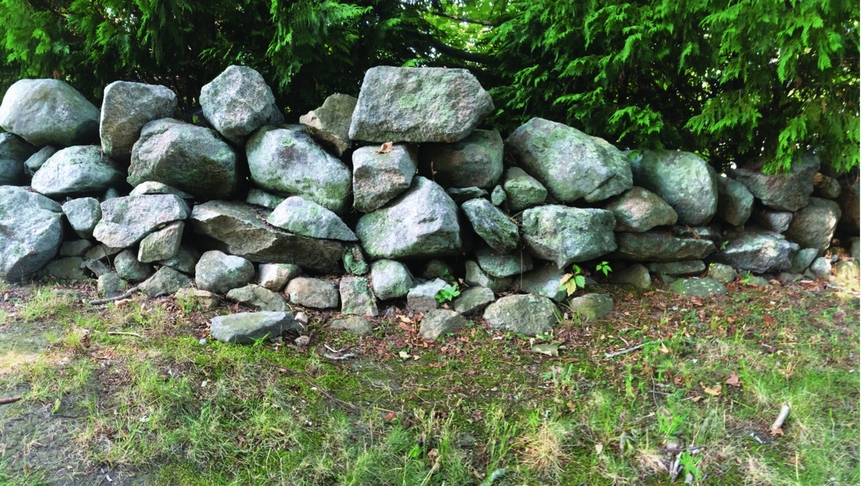
The many dry-laid stone features scattered through the woodlands of New England include walls (figure 1), small structures often interpreted as the remains of colonial root cellars, and piles of varying shapes and sizes. For the purposes of this essay, I focus specifically on discourse and debate concerning the piles (Cipolla Reference Cipolla2013a, 85–86; Reference Cipolla2016; Cipolla and Quinn Reference Cipolla and Quinn2016, 123–24; McLoughlin Reference McLoughlin2017), but some thinkers have extended the arguments reviewed below to include certain walls and structures. Labelled ‘memory piles’, ‘field clearing’, ‘taverns’ or ‘sacrifice rocks’ (Crosby Reference Crosby, Leone and Potter1988; Butler Reference Butler1946; Ives Reference Ives2013; Reference Ives2015a; Reference Ives2015b; Simmons Reference Simmons1986, 254–55; Speck Reference Speck1945; Weslager Reference Weslager1947) depending on when and, of course, whom one asks, the piles in question embody the binary and absolutist nature of many colonial heritage struggles and debates. When defining and discussing such features, both archaeologists and non-archaeologists alike tend to fall into a well-worn set of dualistic modes of thinking. I review these general arguments before considering how a New Materialist-inspired approach might improve our perspective. Within these debates, the features in question are ceremonial and otherworldly or practical and utilitarian, alive and ancestral or inanimate and fundamentally non-human, prehistoric or historic, and – most important for the purposes of this essay – part of Indigenous or white heritage. Such features are rarely considered in terms of the diverse and entangled nature of colonial history in New England (Cipolla Reference Cipolla2016; Cipolla and Quinn Reference Cipolla and Quinn2016; Ives Reference Ives2013; Reference Ives2015a; Reference Ives2015b).
Stone wall in New London, Connecticut. Photograph by the author.

Outside observers such as Frank Speck (Reference Speck1945), Eva Butler (Reference Butler1946), and William Simmons (Reference Simmons1986) noted that Indigenous peoples of the Northeast remembered people and events by constructing stone and brush piles. Typically situated close to a path, stone piles seem to have ‘captured’ memory, or at least preserved it, by coaxing newcomers and passers-by to inquire about them with local Indigenous people (Cipolla Reference Cipolla2016). However, Indigenous reluctance to discuss these practices with white observers is also clearly documented from the eighteenth century to the present (Butler Reference Butler1946; Stiles Reference Stiles1916).
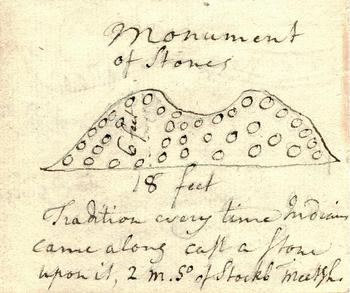
In the 1760s, Ezra Stiles (Reference Stiles1916, 160) sought an explanation for stone piling (figure 2), presumably asking both local whites and Natives. He reported the following:
the Inds. continue the Custom to this day, tho’ they are a little ashamed the English should see them, & accordingly when walking with an Eng. they have made a path a quarter Mile's Distance to avoid it . . . The Indians being asked the reason of their Custom & Practice, say they know nothing about it, only that their Fathers & their Grandfathers & Great Grandfathers did so, and charged all their Children to do so; and yet if they did not cast a Stone or piece of Wood on that Stone as often as they passed by it, they would not prosper, & particularly should not be lucky in hunting deer.
Stiles's (n.d., 104) sketch of a stone heap near Stockbridge, Massachusetts. The note reads, ‘Monument of Stones. Tradition every time Indians come along cast a stone upon it, 2 M[iles] S[outh] of Stockbridge’.

Writing nearly 200 years later, Frank Speck (Reference Speck1945) and Eva Butler (Reference Butler1946) provided complementary interpretations to those of Stiles (see also Kendall Reference Kendall1809, 49–52). Speck collected oral histories, studied ethnohistories, observed this practice, and even contributed to a heap in Massachusetts (Speck Reference Speck1945, 21). One year after Speck's article, Eva Butler (Reference Butler1946) provided an invaluable synthesis of ethnohistoric observations on stone and brush piling from the eighteenth and nineteenth centuries. On the final page of the article she discussed the interpretive difficulties associated with stone piles, noting that ‘there is evidence also that people who were not Indians but who were interested in perpetuating the old customs of the Indians, have periodically attempted to revive it’ (Butler Reference Butler1946, 9, emphasis added). In this respect, non-Natives appropriated and essentialized this practice (Ives Reference Ives2015b), sometimes wrongfully perpetuating the assumption that local Indigenous groups had forgotten or simply disappeared.
Further complicating these narratives is the fact that, as indicated in Frost's poem above, stacking stone was not always a memory-making or spiritual practice in New England. One need only thumb through a sample of professional archaeological reports from the area to see how these features are nearly all interpreted as white-made, colonial, farm-clearing piles. Stiles, Speck and Butler made little note of this parallel set of practices, but this comes as no surprise when considering anthropology's fascination with radical difference in the late 19th and early 20th centuries. Timothy Ives (Reference Ives2013) provides an impressive synthesis of archival materials on this topic, especially farming literature from the 18th through to the 20th centuries, confirming some of the public and archaeological interpretations just mentioned. For instance, Joshua Hempstead (Reference Hempstead1901), a white resident of New London, Connecticut, recorded making numerous stone piles during the 18th century for the purposes of field clearing and boundary marking. Here is where we first encounter the vibrancy of the earth and stones. Annual freezing and thawing cycles in the area regularly break up bedrock and push new ‘crops’ of fieldstones into its plough zones each year. Farmers like Hempstead knew that, in order to farm the land, they had to regularly remove these ‘new’ stones. They often placed them on the edges of their arable land. By referencing farming manuals, Ives (Reference Ives2013) provides a compelling argument for the ubiquity of this practice on local farms of the 18th and early 19th centuries. He provides several examples of handbooks that explicitly discussed how to farm in New England's rocky soils. He shows that stone piles located along the perimeter of properties often transformed into the stone walls that Robert Frost found so intriguing.
Ives (Reference Ives2013, 48–52) also documents an important period of abandonment for many farms in the later 19th century. A number of white farmers in the area chose to leave their farms due to competition from western farms, the Homestead Act of 1862, the California Gold Rush, the Civil War, and/or new employment opportunities in local industries. Several decades later, a new population of European immigrants reclaimed these former farmlands. Although the ubiquitous stone features associated with these farms had been forgotten at this time, they were quickly rediscovered as their new owners cleared the land once again. According to Ives, freshly imported Old World understandings of stone features and cairns combined with contemporaneous Native American cultural revitalization movements of the early 20th century to create new memories of these features.
Recently, archaeologists, Native Americans and members of the general public have increased their attention on these features. This is particularly evident in cultural resource management archaeology (Ives Reference Ives2013; Reference Ives2015a). It seems that many archaeologists, usually marginally aware of the ethnohistoric records reviewed above, find comfort in the practical, perhaps safer, interpretation of all such features as related to white farming practices of the 18th and 19th centuries. This interpretation is also undoubtedly much more satisfactory to the land developers who often pay these firms for their expertise. By labelling such features as utilitarian rather than ceremonial, they are engaging in what Latour would call purification. This type of bifurcation does not necessarily match with local Indigenous knowledge. It does, however, clear the way for new developments that will impact such features, often destroying them. In the very recent past, this standard interpretation of stone piles eased its way into a near state of doxa for the archaeological community. This narrative reduces New England's stone landscapes to the recent past and to utilitarian purposes (clearing the way for farming). Here, Indigenous claims and views are disregarded in favour of ‘detached’ archaeological science. Here Indigenous oral tradition, history and contemporary belief are irrelevant to such features.
Indigenous communities recently broke this doxa, critiquing archaeological classifications of ‘white-made agrarian features’ by drawing attention to contemporary Indigenous knowledge, oral tradition, oral history and the ethnohistorical literature introduced above. Seen in recent actions taken by United South and Eastern Tribes, Inc. (hereafter USET), a non-profit organization which includes 26 federally recognized tribes, Indigenous communities reject this interpretation, arguing that the white agrarian features that archaeologists often find are actually Indigenous-made ceremonial stone piles, some of which are ancient in origin (USET 2003; 2007; 2014). A resolution from 2007 (USET 2007, 037, emphasis added) eloquently summarizes USET's perspective:
whether these stone structures are massive or small structures, slacked, stone rows or effigies, these prayers in stone are often mistaken by archaeologists and State Historic Preservation Officers as efforts of farmers clearing stones for agricultural or wall building purposes.
In a recent co-authored article (Cipolla and Quinn Reference Cipolla and Quinn2016, 123), my colleague James Quinn, the Mohegan tribal historical preservation officer, noted that the Mohegan Tribal Historic Preservation Office ‘believes that the prayers and ceremony imbued in these features on the landscape are still active and remain so until destroyed, making them vital sites that connect Mohegan people to their ancestors and to the land’.
Without disregarding the validity of these Indigenous perspectives, which are documented in the various forms mentioned above and in oral histories and traditions, I still wonder about the ubiquity of such practices. We must consider Indigenous rejections of absolutist archaeological interpretations not only in terms of Indigenous knowledge and history, but also in terms of the colonial politics (including strategic essentialism), heritage struggles and non-inclusive forms of archaeological practice that inform them. Indigenous critiques of archaeological interpretations tend to dialogically reverse the narrative presented above. From these perspectives, the features in question range in antiquity from ancient to the more recent past and they are Indigenous ceremonial features. From this perspective, archaeological knowledge is disregarded as incorrect. Great value is placed on Indigenous forms of knowledge and contemporary Indigenous sensibilities.
Still, a third ‘interest’ group is composed of non-Indigenous romantics who tend to side with Indigenous views (Ives Reference Ives2015b). Many recent blogs and websites created by members of the general public interpret these stone landscapes as nearly entirely ancient and ceremonial, harking back to the ways in which many possible farming features were reimagined in the late 19th and early 20th centuries (Ives Reference Ives2013; Reference Ives2015b). Here again, archaeological interpretations are typically framed as incorrect. Underlying this third stance, however, is a sometimes staunch disregard for contemporary Indigenous people, assuming that ‘traditional’ knowledge and practice require saving by interested members of the white middle class.
All of these views overlook or at least downplay the dynamism of the earth and various human groups’ mutual condition of living in the same landscape subject to the same flows of energy. In all cases, the relationships between these different types of entity are left underexplored or even completely overlooked or disregarded. All of these arguments focus on unique cultural perspectives on past human practices, declaring who is right and who is wrong in their claims about the past. Consistent across all three generalized standpoints is a need to classify how people acted upon stones in the past, placing implicit value on reconstructing the human intent and cultural conventions that structured past human practices. Here, I advocate a critical approach that considers the realities of the colonial Northeast and the diversity through which these features and narratives derived. Based on the accounts reviewed above, it is clear that stone features seen in the landscapes of contemporary New England tie to both Indigenous and white heritage, oftentimes a plural heritage rather than discrete, racially or ethnically bounded histories (see e.g. Carter Reference Carter1997). Moreover, there is a certain level of unity in the various human uses of stone currently argued over and opposed. This is because, whether agricultural, ceremonial or both, all of these practices begin with earth flows and lively stones that entrap humans in various forms of labour and cultural convention. That is to say that the earth and its stones have a vibrancy to them that exists regardless of what humans know, believe or do.
Earth flows and lively stones
Something there is that doesn't love a wall,
That sends the frozen-ground-swell under it,
And spills the upper boulders in the sun;
And makes gaps even two can pass abreast.
Robert Frost, ‘Mending wall’ (Reference Frost and Lathem1969, 33)
The processes noted above by Frost seem to resemble the energy flows and vibrancy of matter endorsed by New Materialist thinkers. As Deleuze and Guattari (Reference Deleuze, Guattari and Massumi1987, 40) put it, the earth is a ‘body without organs’ that is ‘permeated by unformed, unstable matters, by flows in all directions, by free intensities or nomadic singularities, by mad or transitory particles’. I argue that if we keep these flows and material dynamisms in our focus, if we start our analyses there, we can begin to uncover common ground between various stakeholder arguments and interests, perhaps reducing the heritage struggles outlined above. Frost was explicit in his recognition of the abilities of non-human entities such as the earth and its stones to entrap humans in cycles of maintenance (à la Hodder's entanglement, Reference Hodder2012). Kendall's remarks on his nineteenth-century observations of stone piling in Massachusetts highlighted a similar form of material entrapment for Indigenous people: ‘they expect blessings from the observance of the practice [stone piling], and evils from neglect’ (Kendall Reference Kendall1809, 49). If we move beyond the cultural conventions and look to the earth and to the stones themselves, to their vibrancy, can we overcome some of the challenges outlined above? Flattening our starting point to correct for notions of human exceptionalism gives the earth back its vibrancy and its dynamism. These qualities certainly preceded and partially evoked the human conventions currently fought over. Agrarian stone piling and Native ceremonial stone piling are reframed as two different responses to the earth's changes (growing stones). In one case, the response has to do with growing food; moving stones to make way for human productivity. In the other, the response has to do with maintaining a connection between people and their land, allowing the material outcomes of past human practices (prayer) to remain undisturbed.
This perspective requires me to push my thinking on this problem a bit deeper, both geologically and temporally, than most parties currently engaged in these debates and struggles. I start by recognizing the properties (Ingold Reference Ingold2007) rather than the materiality of the earth and stones of New England. In doing so, I acknowledge that stone and earth take on different properties in different settings (as part of different sets of relations), as did Ingold (Reference Ingold2007) with his insightful discussion of a wet stone and its dynamism (see also Jones and Alberti Reference Jones, Alberti, Alberti, Jones and Pollard2013). The changing qualities and dynamisms in question – what Bennett called thing powers – operate regardless of human understanding and recognition. In this sense, the problem with stone landscapes that we currently see in New England heritage is an ancient assemblage that ties back to a time before humans. The depth of this time frame relates directly to the qualities of the stone itself, its ability to outlive humans, and the specific set of relations that allow it to impinge upon and shape their world. We must remember that the stones that make up the currently contested features were formed deep beneath the surface of the earth long ago in relation to other minerals, heat and water. It was these relations that also pushed stones toward the earth's surface, broke off fragments of various sizes, and nudged them slowly into the human world of which they are now a contested part. In this sense, it is the earth and its stones that call humans into their service, forcing cobbles into their realm, and initiating a complex set of assemblages that link directly to our current situation.
From this perspective, it is not the now-opposed cultural conventions that brought these assemblages into being, but a much older and gradual set of forces beyond human control. It is from the meeting of two important entities in these assemblages – stones and people – that all of our current debates descend. It is in that meeting that categories of human/non-human or nature/culture became further entangled. We tacitly recognize this reality through references to ‘Mother Earth’, a name used by many Indigenous people of New England, who also tend to refer to stones as ‘grandmothers’ or ‘grandfathers’ (Cipolla Reference Cipolla2016). In perspectives such as these, the divide between human and non-human is anything but absolute (Deloria Reference Deloria2003, 79–81).
In recognizing the earth's relation to them as maternal, local Indigenous groups maintain a partially distinct ontology from European and Euro-American farmers who encountered stones in similar ways. As exemplified in USET's comments and actions as well as in other Indigenous insights on these features, for Indigenous people of New England, piling stones on the landscape was at least sometimes a means of place-based prayer (Deloria Reference Deloria2003). This involves gathering stones ‘born out of’ or ‘grown’ by Mother Earth and subsequently forced into the world of people and reassembling them (perhaps in likenesses to the mother rocks whence they came, putting back together on top of the earth's surface fragmented pieces of what was once whole beneath).Footnote 4 Here the distinctions between nature and culture recede in importance (McLoughlin Reference McLoughlin2017). For example, ‘cultural’ piles of stone often sit atop large ‘natural’ outcrops that protrude from the earth (Ives Reference Ives2015a). As a whole, this general type of assemblage challenges the duality of nature and culture (Ingold Reference Ingold2000). Here also we begin to scrutinize the distinction between ‘archaeological’ stone piles and ‘geological’ stone piles. From the ceremonial standpoint laid out by USET, some being (human ancestor, Mother Earth) placed the stones as they are observed on the landscape today. As discussed above, these are important connection points between the people and the land, but most observers did not witness the original construction event(s). Disturbing the piles severs these ties. Here also we see the hard and fast distinctions policed in the current heritage debates (white heritage/Indigenous heritage; ceremony/work) begin to recede.
European colonists and settlers brought with them their own knowledge of the earth and stones. For the purposes of this essay, I do not elaborate on European perspectives on nature, stone and the earth, other than to point to the fact that – broadly speaking – for them, nature and culture as well as time and temporality were different than in Indigenous perspectives on these topics (Deloria Reference Deloria2003). Terra nullius colonialism (see Gosden 2004; Cipolla Reference Cipolla2013b) conceived of the relationship between culture and nature as hierarchical. Humans transformed nature through culture. According to this framework, if some humans were not transforming nature in a productive way, other humans had the right to take over and maximize the environment's output (Cipolla Reference Cipolla2013b). Yet as New England's colonial and settler farmers bounded the land and began to dig in, spades, ploughs and shovels frequently encountered the hard truth of New England soils, its ability to ‘grow’ stones. This encounter was not unlike earlier interactions with the earth and its stones in the area, but a different assemblage unfolded. Here farmers sought to maximize the yield of their lands, so they piled freshly ‘born’ stones at the edges of their property or on top of immovable stone outcrops on their lands. Each year the piles grew, sometimes forming walls. Piles on such farms resemble ceremonial piles, a central point of tension in today's heritage struggles (Cipolla Reference Cipolla2016).
From this New Materialist-inspired perspective, the grounds on which various absolutist claims about stone heritage in New England sit are not as opposed as the debates imply. In fact, each speaks to a basic condition of life in New England: living on the earth's surface is a deeply entangled status and whether Indigenous, colonist or settler, earth flows are key components of our assemblages (cf. Harris and Robb's Reference Harris and Robb2013 discussion of multiple ontologies and the basic conditions of having a body). The continuity between these perspectives that I argue for here is not meant to flatten ontological differences between stakeholder groups (see note 4), but rather to argue that along with important differences, there are important continuities. These points raise questions about differential treatment of various sorts of stone heritage in New England. Why are archaeologists and heritage professionals so quick to bulldoze stone heritage that they deem fully agrarian and Euro-American (Ives Reference Ives2015b)?Footnote 5 Since all Euro-American farms overlie Indigenous landscapes and since colonial farms often employed a variety of different ‘types’ of labourer, including indentured servants, Native workers and enslaved or free Africans, such absolutist claims about Euro-American heritage are difficult to support. I return to this point below in my discussion of plurality and archaeology, but for now we must ask, why is the archaeology of farming in New England treated as disposable and subject to developer needs and interests? Here we encounter the old modernist dualisms between the sacred and the secular (Fowles Reference Fowles2013), the mundane and the exotic, similarity and difference. In other cases, development is allowed to impact the land when such features are classified as colonial versus ancient. The colonial past is expendable compared to ancient Native landscapes. Within this valuation is a hidden assumption about authenticity. Prehistoric heritage is framed as authentic while colonial survivance stories (Vizenor Reference Vizenor2008) are deemed inauthentic and far less valuable. Both of these dualisms are the product of modernist European sensibilities that must be decolonized in order to make an archaeology for all.
Final thoughts: pragmatism and vibrant matter
An archaeology for all, or at least for more, is by default a plural archaeology that is anti-essentialist to the core. The value I place on plurality and anti-essentialism could be framed within the broader political project of ‘decolonizing’ archaeology. Although, when taken as a whole, post-humanism has received a fair share of critique for its purported lack of political engagement, the framework I present in this paper certainly does not preclude a political and pragmatic stance. Although I approached the problem using a flat ontology that was open to the vibrancy of non-organic matter, I did so while prioritizing what pragmatist philosopher Richard Rorty referred to as ‘the problems of men’ (Rorty Reference Rorty1982, 53). In my reading, there are several post-human thinkers in archaeology who would find a major contradiction in my application of the term ‘flat ontology’. For instance, Witmore, in his alignment with object-oriented ontology, wants to treat archaeological materials as more than ‘mere vehicles to something else’ (Witmore Reference Witmore2014, 203);Footnote 6 he thus assumes a flat ontology that approaches archaeological materials with no or few expectations, particularly those expectations that often cleave along binaries (e.g. human versus non-human) (see also Olsen and Witmore Reference Olsen and Witmore2015, 192). I agree that the archaeological materials that present themselves to us in our work are much more than representations of past human activity; this I have tried to show with my reconceptualization of the stone heritage conflicts at the core of this article. However, these things that archaeological materials reveal to us and the things we write about them can be used for anthropocentric ends without wholly betraying the flat or symmetrical starting point of our analyses. For me, there is no truly flat ontology in archaeology because we are all drawn to our work from our own interests and needs no matter how flat or symmetrical we claim our ontologies to be. All archaeological inquiries – from deeply anthropocentric structural archaeologies to recent symmetrical and object-oriented approaches – prioritize human interests and problems to some degree. The difference lies in the nature of the problems prioritized. Wrestling with philosophical conundrums, earning tenure or mitigating heritage disputes are all forms of addressing human problems and needs; these are the forces that ultimately animate these archaeological inquiries and the publications cited throughout this and all other archaeological works.
These points raise further questions about the relationship between pragmatism and various forms of post-humanism, both of which align closely with different forms of philosophical realism. Certainly pragmatism and post-humanism are not the same, but there are some interesting parallels, particularly when considering material vibrancy and assemblage theory. Pragmatists shrug off the importance of getting assertions about the world ‘out there’ right in order to ask about the practical implications of making certain assertions about the world (Rorty Reference Rorty1982, 163). This means that pragmatists concentrate on how their assertions might shape the world. As Rorty (ibid., 166) eloquently put it, ‘In the end, the pragmatists tell us, what matters is our loyalty to other human beings clinging together against the dark, not our hope of getting things right’. Some thinkers classified as ‘post-humanists’ might decry this pragmatic starting point. However, I argued above that certain post-human orientations, such as those of Barad, Bennett and DeLanda, include pragmatic elements. Each of these thinkers provides applications of assemblage theory that served or could serve pragmatic ends. Like most post-humanists, these thinkers find major fault with Western modernity, typically associated with human exceptionalism and dualistic modes of thinking and being. In this sense they adopt the flat ontology to better understand real difference rather than assumed differences projected via dualistic ontologies. This is one way to move beyond the limitations of Western modernity, possibly in hopes of a better world in the future.
A closer consideration of pragmatism and its philosophical origins offers additional parallels (see Salinas Reference Salinas2014). For instance, pragmatist philosopher Charles Sanders Peirce's notion of synechism (Peirce Reference Peirce1892; Reference Peirce1998) shares similarities with assemblage theory. Synechism asserts that ‘everything is continuous with everything else; there are no atomistic elements of reality fundamentally discontinuous from each other’ (Pihlström Reference Pihlström, de Waal and Skowroński2012, 246). As a comparison, Barad (Reference Barad2007, 216) argued, ‘Reality is an ongoing dynamic of intra-activity’. The synechist seeks ‘continuities where discontinuities are thought to be permanent and . . . semiotic relations where only dyadic relations are thought to exist’ (Esposito Reference Esposito, Queiro and Gudwin2007).Footnote 7 Peirce's approach sought to overcome dualisms between individual/collective, science/religion, physical/mental and living/non-living (Esposito Reference Esposito, Queiro and Gudwin2007; Peirce Reference Peirce1892; Pihlström Reference Pihlström, de Waal and Skowroński2012, 248). In recognizing these continuities in the world and asserting that these continuities continue to grow and become more complicated through time and through Peirce's version of semiosis, he also recognized that our assertions impact the world, including other humans. Here, like the post-humanists mentioned above, Peirce begins with a meta-ontological perspective – everything is continuous and the continuities are constantly growing (akin to assemblages). It is because of this ‘synechistic condition’ that we find ourselves in that we have responsibilities to judge the impact that our actions might have on other parts of the ‘assemblage’, particularly other humans.
In the end, what difference does it make that I framed stone landscape struggles in terms of lively stones instead of opposed cultural conventions and beliefs? I argue that a new regard for material vibrancy helps us emphasize the continuities between different stakeholder arguments and different ‘ethnified’ histories. There is a shared human relation with earth flows and lively stones just as there is a shared element in all colonial histories (e.g. across categories of colonizer and colonized). In a world that is increasingly overcome with absolutist and essentialist understandings of identity and history, this seems a valuable lesson to emphasize. With these shared qualities come opportunities to unify and protect certain features and landscapes, whether framed as white colonial, Indigenous ceremonial or both. However, there are still important differences. The above argument should not be read as a claim that stone landscapes ‘belong’ to all people in the same manner but rather to point out that these landscapes have ‘lived’ through complicated Indigenous and plural colonial stories, stories that chronicle Indigenous ontologies, exploitation, human rights violations and survivance (Vizenor Reference Vizenor2008). In summary, it seems that these landscapes and the various arguments surrounding them certainly have something to teach us about moving forward together.
Acknowledgements
This paper has benefited from the knowledge and feedback of many colleagues and friends. I thank Doug Harris, Kat Hayes, Douglas Hunter, Alexandra Martin, Jay Levy, Kevin McBride, Stephen Mrozowski, Robert Preucel, James Quinn, Stephen Silliman and Elaine Thomas for continuing to discuss and debate stone landscapes with me over the years. I am similarly grateful to the Joukowsky Institute for Archaeology at Brown University for inviting me in February of 2016 to discuss a version of this paper in the form of a research seminar; the attendees were enthusiastic and provided many useful comments. Thanks are also due to Oliver Harris, Timothy Ives and two anonymous peer reviewers, each of whom offered helpful feedback on initial drafts. Funding for this research was provided by a European Commission Marie Curie Fellowship (grant number 333909).