On Sunday, September 13, 1868, the news that the bodies of a man and a woman had been discovered at Cold Spring—a popular riverside resort northwest of Indianapolis—“electrified” the city. Those who surveyed the remains, including the Marion County coroner and a crowd of over one hundred spectators, confronted a gruesome sight. The Civil War, only recently concluded, provided observers with a frame of reference; a reporter for the Indianapolis Sentinel described “a picture of grisly horror seldom seen except upon the battle field.” A good part of the man's face had been blown off, apparently by the shotgun that lay a few feet away. Flies buzzed around his body, spiders and black beetles crawled about his wound. Witnesses—even those who had grown accustomed to the numerous “grisly horrors” that befell the soldiers who fought what has been called the nation's first modern war—found the second discovery, the smoldering body of a “small, delicate woman,” even more disturbing. She had been badly burned from the chest down, so badly that her intestines were exposed, the flesh on her thighs burned away, and the bones partially reduced to powder. (“BURNED TO A CRISP,” the Indianapolis Journal would tastefully put it.)Footnote 2
A member of the crowd that gathered on the sandbar on the west bank of the White River identified the pair as Jacob Young and his wife, Nancy, “highly respectable residents of Indianapolis.” The local press quickly heaped praise on the deceased. The Republican Journal described Young as “an honest, industrious, thrifty citizen, respected among business men for his uprightness, and honored among his neighbors for his exemplary social qualities.” The Democratic Sentinel called him a “sober, industrious, shrewd, and responsible business man.” Witnesses initially supposed that they had stumbled upon a tragic instance of murder-suicide, a case of a jealous, enraged, or otherwise unhappy husband who killed his wife and then himself. Testimony before a hastily convened coroner's jury cast doubt on that theory. More convincingly, the position of Jacob Young's body relative to the shotgun argued against suicide. So, too, did the discovery that Nancy Young had been shot with a different weapon—a pistol—and dealt a blow to the head with a blunt instrument. The jury quickly concluded that both husband and wife had been victims of foul play.Footnote 3
An additional revelation only further inflamed a public reeling from the news that two “harmless and respected people” had been murdered. Police investigators discovered a key piece of evidence, miraculously preserved given the general pandemonium that prevailed at the crime scene—a footprint that did not match the shoes of the victims, “the print of a neat little lady's gaiter in the yielding soil.” “A woman in such a crime,” lamented the Journal. “Who could she be?”Footnote 4
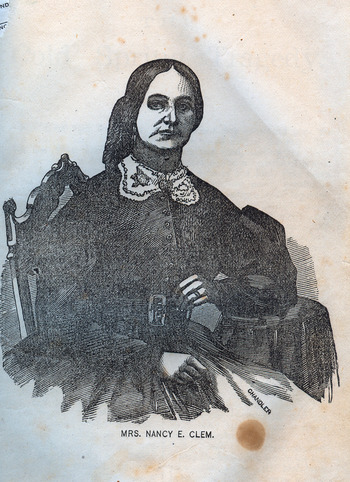
The only extant image of Nancy Clem appeared in The Cold Spring Tragedy (Indianapolis, 1869), a pamphlet published by the Indianapolis Journal after Clem's second trial. In the wake of her first conviction for murder, the pamphlet's anonymous author described a woman with a “dangerous expression” on her face, a “sinister turn of her eye,” and a “resolute set of her jaws.” Courtesy of Herman B Wells Library, Indiana University.

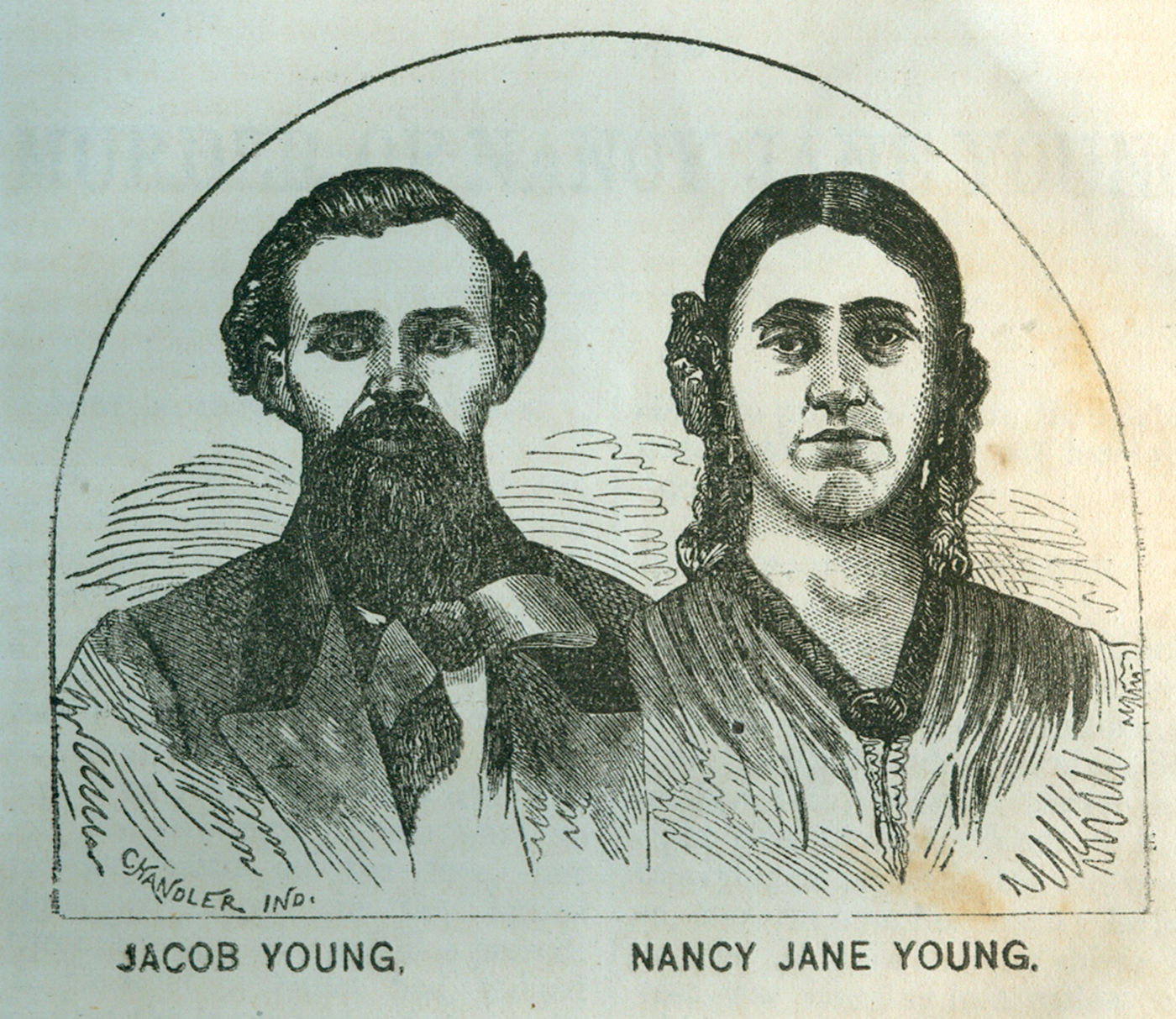
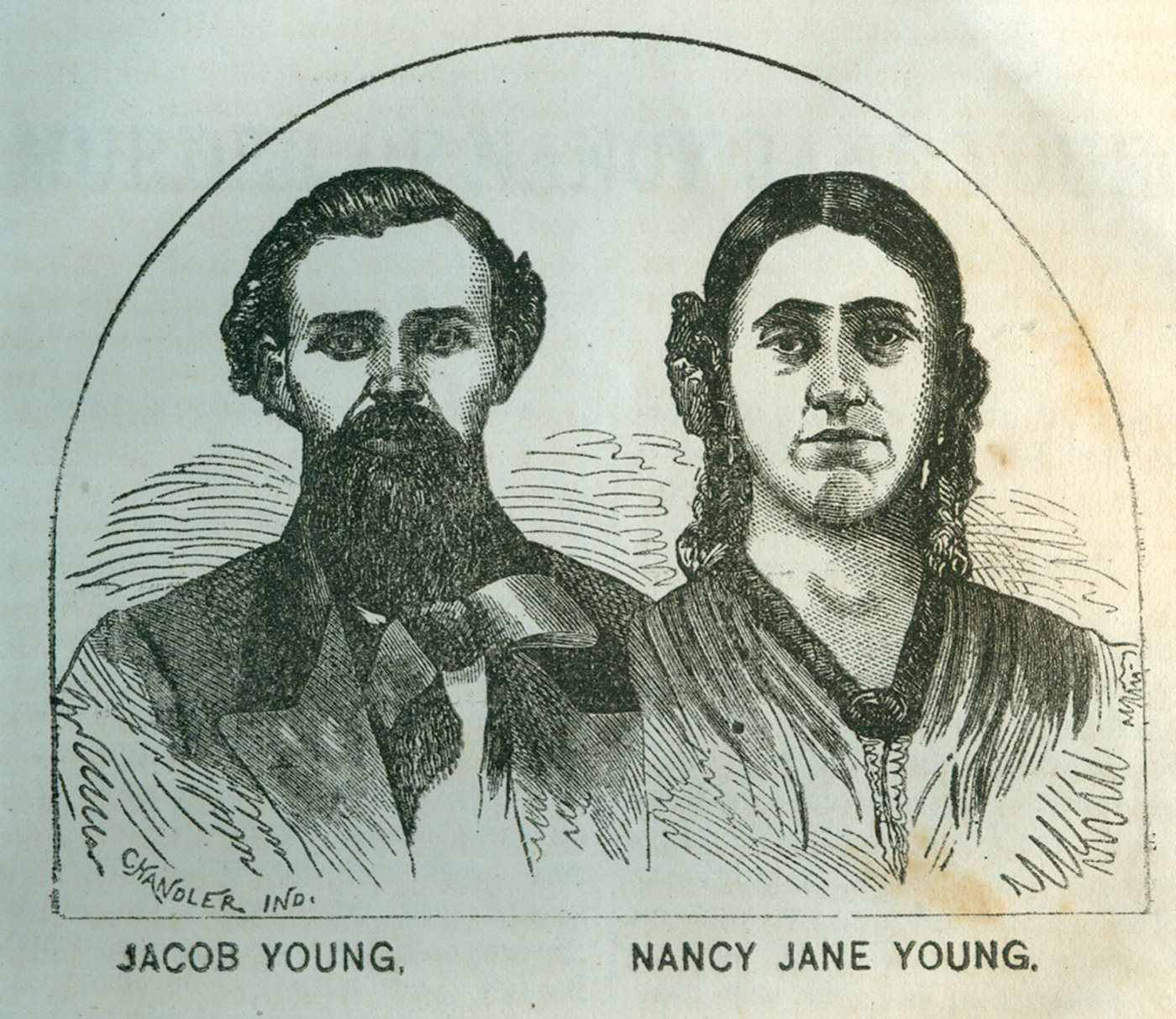
A portrait of Jacob and Nancy Jane Young, probably based on a photograph, published in The Cold Spring Tragedy (Indianapolis, 1869). Slow to embrace the sensationalism that characterized the East Coast penny press, Indianapolis newspapers did not publish images of the crime scene. Nancy Jane Young's reputation as a “pure [C]hristian woman” (Journal, Dec. 2, 1868) probably discouraged lurid visual depictions of her disfigured corpse. Courtesy of Herman B Wells Library, Indiana University.
The woman who allegedly fired the shot that killed Nancy Young was Nancy E. Clem, the thirty-something wife of a “flourishing” grocer.Footnote 5 As the Journal's outburst suggests, Clem's sex does much to explain the attention the case attracted. In the late 1860s and 1870s, she was arguably the nation's most famous murderess—as famous in her day as Lizzie Borden would later become, and no wonder. What became known as the “Cold Spring Tragedy” is a story of crime and punishment, political corruption and legal maneuvers, partisan and regional identities, legitimate and illegitimate business, conflicting opinions regarding the uses and abuses of circumstantial evidence, and competing understandings of the political economy of marriage. However, it is also a story of striving and temporarily succeeding, both in a shadowy economic universe defined by the dubious promise of easy money and in the equally amorphous world of an emerging celebrity culture.Footnote 6 Indeed, Clem was one of the first women to embody a new Gilded Age social type: the genteel murderess—a status made possible, to be sure, by heavy doses of journalistic creativity, but also by shifting constructions of class, gender, and criminal behavior. Her case marks a historical moment in which local and regional notions of respectability gave way to—and sometimes clashed with—broader national definitions of gentility. In the end, Clem's genteel notoriety proved short-lived, in part because she simply did not fit the social categories contemporary commentators constructed for her, in part because the categories themselves had changed. Perhaps we might see her case—to adapt the historian Martha Hodes's phrasing—as illustrating the “mercurial nature and abiding power” of class.Footnote 7
Had it not been for the potent allure and abiding power of money, tragedy might have been averted. Clem's story and the stories of her alleged victims, first and foremost, tell us something about the financial schemes, large and small, that characterized the period that Mark Twain and Charles Dudley Warner famously dubbed the Gilded Age and the creative if not necessarily legitimate, strategies ambitious women and men employed to get ahead. A tubercular former carpenter and agricultural implements salesman who had been rejected when he tried to enlist in the Union Army, Jacob Young abandoned his job as drayman for a hardware store for the more lucrative pursuit of “street broker.” Sometime during the summer of 1867, he and his longtime friend, William J. Abrams, went into business together, engaging in a series of mysterious and evidently profitable transactions. By early 1868 Nancy Clem had also become one of Young's partners in a business that relied on a system of interchangeable loans taken out at high rates of interest. The scheme ranged widely. Those involved included hardware dealer Robert Dorsey, Young's former employer; William Duzan, Clem's family physician; Arthur L. Wright, the Marion County treasurer; S. K. Fletcher, a banker and son of one of Indianapolis's first families; and even Ann Hottle, Clem's dressmaker, who invested her life savings of $925. Rumors abounded that the venture included some of the city's most prominent businessmen, and indeed it did. With real and personal property valued at over $50,000, Wright was the genuine article; so, too was Fletcher, worth almost three times as much. Still, some of the unnamed bigwigs who supposedly participated probably were figments of the schemers' imaginations, intended to entice potential investors. As Dr. Duzan would later testify, Clem “represented herself as being engaged in business transactions with a body of responsible gentlemen, by which she made large profits.”Footnote 8
Contemporary commentators never quite understood what this business aimed to accomplish, nor would the surviving participants tell. Possibly, as some observers hinted, it involved counterfeiting. The recent adoption of a uniform national currency renders this scenario unlikely. No longer could bogus notes, supposedly issued by distant state banks, be passed off as legal tender; although Indianapolis had only recently been the site of a major counterfeiting operation, creating realistic facsimiles of government-issued greenbacks required skills and equipment that none of the partners possessed.Footnote 9 Newspaper reports sometimes described the Clem-Young-Abrams relationship as a “ring,” an expression that in the years after the Civil War often connoted political corruption. Indianapolis had its share of corrupt officials, and indeed accusations of misconduct would dog both prosecution and defense in the trials to come. However, apart from the participation of the county treasurer (who seems not to have abused his official position), Clem, Young, and Abrams's business was “political” only in the broader sense that prominent people were rumored to be involved.Footnote 10
Faced with the task of explaining the Cold Spring affair, most contemporary observers opted for a vaguer label: “confidence game,” a catch-all term that described any number of ways that naïve and greedy people might be separated from their money. “Games” were nothing new; both antebellum and postbellum urban newspapers in Indianapolis and elsewhere were rife with reports of swindles confidence men and women perpetrated on trusting individuals. The typical scam involved a transaction between strangers, the typical perpetrator a city slicker who preyed on a credulous “countryman.” In January 1868, for example, an “old gentleman” from Springfield, Ohio, waiting for a train at Indianapolis's Union Depot met a man who desperately needed money to pay a freight bill. The “sharper” promised a U.S. government bond as collateral, but vanished before producing it, leaving his victim $150 poorer.Footnote 11
Clem, Young, and Abrams played a somewhat less typical game. Rather than rely on the credulity of strangers, they borrowed from people who knew and trusted them. Dr. Duzan had known Clem since she was a child; Ann Hottle was her dressmaker, an occupation that placed her on terms of intimacy with her clients. Robert Dorsey was Jacob Young's friend and former boss. To be sure, the three principals took care to conceal their relationships to each other, a circumstance made possible in part by Indianapolis's explosive growth during the Civil War years. By the late 1860s, when its population reached nearly fifty thousand (up from eighteen thousand at the beginning of the decade), Indianapolis was on its way to becoming a city of strangers. Hence Dr. Duzan dealt with Nancy Clem but did not know Abrams; he was acquainted with Young only as a patient who had visited his office some years earlier. Robert Dorsey did business with Young and knew Abrams but had never met Mrs. Clem. Wright knew Young, but not Abrams and Clem.Footnote 12 Such assertions, extracted from reluctant witnesses, should be taken with a grain of salt; in the aftermath of Young's murder, many people were eager to distance themselves from the dead man and his associates. Nevertheless, they ring true precisely because they describe an entirely plausible arrangement, one that allowed Clem, Young, and Abrams to hide the fact that each was playing with the same pot of money—most of it Dorsey's and Duzan's. Even as they insisted on secrecy—a strategy that no doubt only enhanced their scheme's allure—the brokers assured wary clients that they were dealing with people they knew. Clem “represented the persons she was dealing with to be honorable men of my acquaintance, but would not name them,” Duzan explained. In short, Clem, Young, and Abrams depended on longstanding personal ties rather than far-flung regional or national networks. At a time when both legitimate and illegitimate business was becoming increasingly centralized, the Clem-Young-Abrams “ring,” during the short time it lasted, remained a neighborhood affair.Footnote 13 Indeed, it is entirely possible that the social, psychological, and economic dislocations of the Civil War rendered a venture rooted in face-to-face relations all the more appealing. At a time of dramatic change, Clem, Young, and Abrams offered their clients a reassuring localism.Footnote 14
Most likely, the trio carried out what would later become known as a Ponzi scheme, named for Carlo Ponzi, an early twentieth-century Italian immigrant who bilked hundreds of gullible investors out of millions of dollars. The basic scenario, one more recently employed by Bernard Madoff and Kenneth I. Starr, involved persuading people to lend money in exchange for spectacularly high rates of interest. Sometimes perpetrators returned the promised interest but not their clients' principal; in this case the supposed “interest”—unbeknownst to the lender—consisted of a portion of his principal. Sometimes they paid back both principal and interest to initial investors, a ploy intended to establish their credibility and to persuade others—who would not be so fortunate—to join the game. In this rendition, they used newer players' investments to repay their original sponsors. Dr. Duzan, for example, realized a handsome profit in only four months, more than $9,000 (well over $100,000 in today's currency). Ann Hottle, on the other hand, lost everything. Still, it is entirely possible that Duzan's fortunes also were in danger, for sometimes schemers borrowed successively higher amounts from the same investor, absconding with his or her money when their profits reached what they judged to be the maximum he or she was willing to lend. Duzan's outlays increased rapidly during the brief period that elapsed between early April and late July. He lent Clem first $500, then $2,000, then $8,000, then $15,000, then $20,000. Had he been able to give her the $22,000 she asked for in September, he might never have seen his money again.Footnote 15 Or, as one observer noted, he might have been taken for a buggy ride from which he would never return.Footnote 16
Smooth talkers all, Young, Abrams, and Clem were well suited to their newfound profession. Young, a former salesman, possessed, as the Journal had noted, “exemplary social qualities.” Abrams was “affable” in manner, with a “modulation of … voice in conversation” that bespoke “the cultivation so well adapted to sharp trading.” Clem was pretty, vivacious—and persuasive. Prosecutors would later describe her as “a woman of brain and of power,” a woman capable of “twirl[ing]” men “around her fingers like ribbons.”Footnote 17
The short-lived business flourished not only due to collective force of personality, but also as a result of the era's general mania for speculation combined with a largely unregulated economy. Indeed, the financial mystery that would come to enthrall residents of Indianapolis and elsewhere had its origins in more innocuous transactions. In an era when banks—especially the unregulated “private” establishments recent federal legislation ignored—could be less than solidly reliable, friends, relatives, and neighbors routinely lent money to each other and just as routinely charged interest. Silas Pollard, a prosperous farmer, testified that he “had business transactions with Abrams from the time of his going into the army until his return.” Evidence suggests that long before she began doing business with Jacob Young, Clem regularly turned small profits by loaning out money left to her by her first husband, who had died in 1857.Footnote 18 Even street brokering—borrowing and lending money without the burden of keeping a bricks-and-mortar establishment—was not illegal. Existing evidence does not tell us whether or not Jacob Young purchased the $100 license the state of Indiana required; odds are he did not. Apart from this probable lapse, Young was theoretically a law-abiding citizen—until he began cheating investors out of their money.Footnote 19
Moreover, Indianapolis, like other cities, was teeming with various get-rich-quick schemes, intrigues that probably made Clem's, Young's, and Abrams's propositions all the more persuasive, their assurances all that much more plausible. Clem's neighbor, Levi Pierson, a bricklayer, was “in a kind of policy business.” “It is a lottery,” he explained. “I am banking; there is a man attending to it for me; in case they ‘hit it,’ I pay the ‘hits’ off.” Reverend T. A. Goodwin, who had previously “sold some notes” for Young, identified himself, not as a man of the cloth, but as a “real estate agent and broker.” Dressmaker Ann Hottle complained that before she lent her money to Clem, she “was only getting eight per cent”—a rate of interest she received, not from a bank, but from her brother-in-law. Dissatisfied with his investment strategy, she turned her money over to a Dr. Carter but then quickly transferred her assets to Clem, who promised returns of “ten, fifteen or twenty per cent.”Footnote 20 Clem, Young, and Abrams were not the only street brokers in town. Had not two people died, their business would have attracted little publicity.
At any rate, it proved profitable, at least on paper. Young bought a horse and buggy and a house furnished with the accouterments of Victorian domesticity. At the very moment of his death, he had been collecting fresh water clams shells for his wife, who was fond of using them to fashion “parlor ornaments.” Abrams, a carpenter (he and Young had apprenticed together) who worked only “occasionally” made a similar series of purchases—a house and a fast horse and top buggy—the nineteenth-century equivalent of a sports car. Clem, too, was either making or borrowing substantial sums, handling far more money than most women could expect to garner from the legitimate economy. Her consumer choices were less flamboyant, perhaps because she feared arousing the suspicions of Frank Clem, her unsuspecting second husband, but they also were in keeping with gendered expectations. Some of her newfound wealth financed her son's short-lived education at Earlham College, some, home improvements; paper hangers were busily engaged on the day of the murders. Some may have paid the wages of the “colored girl” she hired shortly before the Youngs met their untimely demise. Hiring her was a decision she probably came to regret.Footnote 21
No one will ever determine what happened on that Saturday afternoon—and why. Whether, as prosecutors alleged, Young threatened to reveal Clem's business dealings to Frank when she refused to pay the $22,000 she reportedly owed him or whether the murderers simply knew that he carried a large sum with him on the day that he drove to Cold Spring is unclear.Footnote 22 Whether, as prosecutors would imply, Clem had planned all along to dupe Young is similarly uncertain. Terms such as “confidence game,” “Cassie Chadwick system” (one local historian's subsequent description of the venture), and “Ponzi scheme” denote a degree of intentionality that may—or may not—have been present from the start. We do not know whether Clem, Young, and Abrams deliberately formed a “conspiracy” with the goal of fleecing friends and acquaintances, whether legitimate transactions gradually devolved into fraudulent practices, or whether any of the three principal players intended to cheat each other. What we do know is that on the afternoon of September 12, 1868, Jacob Young left for Cold Spring with approximately $20,000. When his body was discovered the next day, the county coroner found “but ten dollars and a few odd cents” in his pockets. The settlement of his estate revealed that Young was not the rich man he was reputed to be; he died $40,000 in debt. The biggest living loser, Robert Dorsey, to whom Young had lately been paying only “interest,” was out $10,500. “He is reaping the bitter fruits of those who make haste to get rich,” prosecuting attorney John T. Dye solemnly proclaimed.Footnote 23
After a few false starts, police investigators identified three suspects. A pawnshop proprietor recognized Abrams as the man who purchased the shotgun that lay beside Jacob Young's body. Silas Hartman, Nancy Clem's ne'er-do-well younger brother, had rented a buggy and sorrel mare named “Pet” shortly after noon on September 12; a horse shod with distinctive “interfering shoes,” very much like Pet's, had left behind tracks at the scene of the crime. As for the print of “the neat little lady's gaiter,” prosecutors claimed, it was made by someone wearing a no. 3 shoe, the same size that Clem wore. Jane Sizemore, Clem's “colored girl,” told the coroner's jury that her employer had recently purchased new gaiters and quite suddenly discarded them. Lacking eyewitnesses, prosecuting attorneys constructed a plausible, though never decisively proven, scenario: a frequent passenger in their carriage, Clem rode with Jacob and Nancy Young to Cold Spring, with Hartman, unbeknownst to the Youngs, following closely behind.Footnote 24 Concealed in the bushes that lined the riverbank, Hartman killed Jacob Young with the weapon Abrams procured. Seconds later Clem shot Nancy Jane Young with a pistol that was never found, striking her with a rock or the pistol itself when the bullet did not instantly kill her. Reporters and prosecutors offered varied explanations for the condition of Nancy Young's body. Some accounts had Clem and Hartman pausing to set the corpse on fire in order to disguise its identity; others suggested that the powder from the pistol ignited the victim's crinoline petticoat.Footnote 25
All three suspects faced charges of first-degree murder. Abrams was convicted and sentenced to life in prison, later receiving a gubernatorial pardon. Hartman killed himself in his jail cell before he could be tried, shortly after issuing a confession that implicated himself and Abrams but exonerated his sister. Clem's arrest in October 1868 marked the beginning of an extraordinary legal odyssey. Her first and third trials resulted in hung juries, her second and fourth in convictions and life sentences (“No jury in Indiana will ever hang a woman,” the Journal noted), each of which she successfully appealed to the Indiana Supreme Court, which ordered new trials. Finally, in 1874, in the face of considerable outrage, Marion County commissioners refused to pay the expenses of a fifth trial, forcing prosecutors to enter a plea of nolle prosequi.Footnote 26
Clem undertook another sort of journey during her nearly six years of incarceration, as contemporaries struggled to understand a woman who defied common understandings of gender and crime. Women most often made the news when they became victims of violent crime, not when they acted as perpetrators.Footnote 27 Murderesses—relatively rare and predictably members of the demimonde—typically appeared in nineteenth-century popular culture as sexual predators who lured unsuspecting men to their untimely deaths or as women who committed typically female transgressions, killing unwanted infants, sexual rivals, tyrannical husbands, or faithless lovers. Women who killed typically used poison, resorting only rarely to firearms. The man Clem allegedly murdered was not her husband or lover but her erstwhile business partner. Most important, as newspapers repeatedly noted, Clem was “respectable”—a middling housewife married to a respectable man. She was not, in other words, a “woman of the town.” By all accounts lead defense attorney John Hanna told the truth when he claimed that “nothing … could be produced against her virtue.” Clem's failure to conform to standard narratives presented a considerable challenge—to prosecution, defense, and the numerous journalists who undertook the task of explaining her to their readers.Footnote 28
Lawyers on both sides nevertheless tried to exploit familiar linkages between illicit sexuality and violent crime. Prosecuting attorney and future president Benjamin Harrison, who arguably made his name prosecuting his neighbor (he lived at 299 North Alabama Street, she at 266), hinted at sexual liaisons between Clem and Jacob Young. His colleague William Pinkney Fishback alluded to Clem's “nocturnal visits” to Young's house. These insinuations made for a logical story in light of prevailing cultural conventions, but it was a story that would not hold water. Despite prosecuting attorneys' attempts to suggest the contrary, Clem's and Young's relationship had remained entirely a business affair. Nancy Jane Young and Clem's sister-in-law, Rebecca Hartman, were present when their transactions took place. Prosecutors also cast subtle aspersions on Clem's past behavior. “You know,” lead prosecutor John Dye explained, “she kept boarders and did their washing for them,” implying that Clem's services amounted to more than laundry. Again, these intimations had little basis in fact. Rather, they reflect prosecutors' attempts to convince jurors that Clem was the kind of woman who could commit murder. By and large these particular efforts failed. If “virtue” is defined as sexual propriety, Hanna was right: “Nothing could be produced against … [Nancy Clem's] virtue.”Footnote 29
If prosecutors tried to transform Clem into a believable murderess by sullying her reputation, defense attorneys reasoned from much the same premise: a woman such as their client could not have committed murder. Therefore they tried to find one who could. They hired detectives to locate a prostitute who wore no. 3 shoes, attempting without success to convince potential witnesses that the “frail sister”—not Clem—was the woman they had seen riding in the Youngs' carriage on the day of the murder. Indeed, when the opportunity arose, Clem's lawyers revived this previously failed strategy, simply because it made such good cultural sense. During her third trial in 1871, they produced a new (and it turned out, utterly unreliable) witness, who claimed to have seen “a well known woman of the town”—a woman who bore a remarkable resemblance to Clem—”in the vicinity of Cold Spring … walking along the road from the direction of the scene of the murder.”Footnote 30
When familiar narratives failed—as they did in Clem's case—lawyers explored new cultural territory. Prosecutors' signal contribution was a novel strategy that linked “self-reliance” to gender deviance. The defendant, in their telling, was a “faithless wife” because she engaged in business without the knowledge or consent of her husband; at times prosecuting attorneys came close to implying that Clem's economic independence, not murder, was her crime. “Self-reliant and God-defiant,” Dye termed her. In condemning Clem's “self-reliance,” Dye and his colleagues championed the ideology that historians have come to call the doctrine of separate spheres: respectable women belonged in the home, not in the marketplace. However, this was a conception of gender relations that many Indianapolitans—even as late as the 1860s—would have found unfamiliar. If female street brokers were rare, no one had to look very far to find evidence of women's active involvement in the city's economy. In fact they needed to look no further than William J. Abrams's conspicuous consumption of firearms on the morning of the murder. Abrams—or someone who looked very much like him—encountered at least two businesswomen as he shopped for a shotgun. Rebecca Marot's secondhand furniture store had no guns for sale. The Exchange Store did, but Josephine Stevens, the twelve-year-old daughter of the proprietor, asked a higher price for a rusty double-barreled shotgun than the man was willing to pay. That he purchased the infamous weapon (newspapers would subsequently refer to it as “that gun”) from a man—a clerk at Solomon Brothers pawnshop—was the result of a serendipitous combination of availability and price, not the absence of women from the urban marketplace.Footnote 31
Indeed, prosecutors' suggestive recounting of Clem's previous economic history and denunciation of her self-reliance unwittingly laid the groundwork for a passionate defense of “the men and women who work.” “If you want virtue, industry and solid worth, go among the women who work. Go to the women who stand before the wash tub,” Hanna thundered. He condemned the “fashionable … slander” against working women. “During her widowhood,” he noted, Clem had been “thrown upon her own resources. She took boarders, did her own work, sewed for those she boarded, and proved herself a self-reliant woman. Nothing whatever could be produced against her virtue.” Hanna painted attorneys for the state as elitists who disdained manual labor (men, he implied, who would rather hire servants than suffer their wives to do “their own work”) and harbored little sympathy for women “thrown upon their own resources.”Footnote 32 As for Clem's economic activities since her second marriage, he invoked older traditions that viewed women's participation in family economies as both expected and essential. He acknowledged that she had been “foolish” to conceal her dealings from her husband, but otherwise approved her diligence and savvy. Far from condemning Clem's self-reliance, he praised her “great business tact.” Clem's industry and economy, Hanna's colleague William Wallace Leathers explained, rendered her a “faithful wife” and “model woman.”Footnote 33
Courtroom rhetoric thus offered two contrasting visions of gender, economy, and the expected duties of “faithful wives.” One, articulated by the prosecution, was urban, and for its time and place modern. The other, represented by the defense, reflected the necessities and sensibilities of a rural society.Footnote 34 In a case where the evidence was mostly circumstantial, arguments regarding the respectability of “working women” carried a good deal of weight—especially given that farmers from outlying townships, nearly all of them married to women who “did their own work,” dominated successive juries. In fact they were almost persuasive; Clem's first trial, nearly ended with her acquittal (a single juror held out for a guilty verdict). Bolstered by new, even though still circumstantial, evidence, prosecutors subsequently secured a conviction, albeit one that Clem's attorneys successfully appealed. However, arguments that nearly swayed Clem's first jury had little impact outside the courtroom. If newspapers can be believed, public opinion was decidedly against her; indeed, some intimated that the threat of violence and a potential lynching had pushed jurors toward a guilty verdict in 1869. Even after her release in the wake of the nolle prosequi plea, most Indianapolitans remained convinced of her guilt.Footnote 35
Clem's trials by media paralleled, but also deviated from, her trials by jury. To be sure, most of what we know about her case comes from newspapers, which published testimony and lawyers' arguments. Nevertheless, journalists and even ordinary citizens who wrote letters to the editor offered additional commentary as they struggled to understand the woman who would become nationally known as “the notorious Mrs. Clem.” Their remarks largely ignored evidentiary details. Equally significant and in sharp contrast to courtroom rhetoric, journalistic commentary removed Clem from her economic context, rarely referencing the transactions that had allegedly culminated in murder. Rather, it sought to make sense of Clem herself, a woman who—despite prosecutors' strenuous attempts—failed to conform to standard expectations concerning female criminals. Clem allegedly had murdered a business associate, not a lover nor a husband. She neither looked nor acted the part. Reporting on the opening day of Clem's first trial, the Indianapolis Journal noted that the defendant possessed “a pleasant and intelligent countenance” and conducted herself with “lady-like deportment.” In the late 1860s, moreover, “the defendant showed no emotion” was a freshly minted cliché; nineteenth-century Americans expected appearance and demeanor to reveal guilt. Even so, as the Journal explained, Clem's “bearing … [was] such as to baffle all the usual tests of guilt.” The Sentinel largely agreed: “While betraying some little agitation, her manner was calm and self-possessed, and during the whole day she sat quietly in her chair, looking on at the proceedings apparently with as much interest and as coolly, as any spectator.” Only when it decided to capitalize on Clem's notoriety by compiling a pamphlet shortly after her second trial—one of two that resulted in a conviction—did the Journal discover new visual evidence, discerning a hitherto unperceived “dangerous expression” on Clem's face, a “sinister turn of her eye,” and a “resolute set of her jaws.”Footnote 36
As a local historian put it, prosecutors ultimately failed in “their efforts to convict the woman and keep her convicted.” As Clem's trials multiplied, her fame grew. So, too, did her perceived refinement. The Nancy Clem who emerged in the public prints during the early 1870s was unquestionably a lady—a depiction foreshadowed by the decision of the Southern Prison's warden to have the cell she was to occupy wallpapered and carpeted when he learned of her impending arrival.Footnote 37 Prosecution and defense presumably continued to argue over the respectability of “working women” and competing definitions of marital fidelity. Later transcripts have not survived, and newspapers did not print attorneys' opening and closing arguments for her third and fourth trials. However, the Clem casual readers encountered was not a working woman, even though prison regulations required her to labor. In a twist that must have filled prosecuting attorneys with dismay, they read about a prisoner who hewed much more closely to their own definition of virtuous womanhood than to the disreputable villainess they had tried to create. Influenced by a series of high-profile cases featuring refined criminals, commentators presented a Clem who was not only eminently respectable, but positively genteel. They created what many nineteenth-century Americans would hitherto have termed an oxymoron: a genteel murderess.
For some, gentility connoted innocence. State Prison Life, by One Who Has Been There, penned by former convict J. H. Banka, featured Clem prominently in a chapter titled “Life-Time Women”—and commented approvingly on her deportment. Banka reported that she “associated very little with the inmates of her department,” most of whom were incarcerated for prostitution, and “was usually alone in her cell, or sitting apart from the rest, busily engaged with her work. Sometimes we would see her sitting for hours under a little shade-tree in the yard of the department, plying her needle, the tears all the while dropping from her great soft eyes.” Although Banka's account reads as if Clem “busily engaged” in fancy parlor needlework, “plying her needle” was her required prison job; she stitched a more prosaic product: pants to be worn by male prisoners. Whether Clem worked her legendary influence on Banka or whether he reflexively resorted to sentimentality when confronted with a female prisoner who failed to fit his preconceptions is unclear. “Sometimes she would come up to the library, and passing into the chapel, stand at the barred windows and gaze out upon the world with a blank despair, or such a longing look as was painful to witness. We have seen her stand at the library window that overlooks the yard, when the prisoners were marching in long lines to their meals, and weep like a child. ‘Poor fellows,’ she would say, ‘how many wives and mothers, and children are waiting for you!’” Lest his readers miss the point, Banka took care to make it: “This did not look to us like the actions, nor did her plaintive words sound like the language of a murderer.”Footnote 38
Few commentators seconded Banka's faith in Clem's innocence. Still, even those who believed her guilty took their cues from his sentimental account, collectively creating a portrait of a genteel murderess who exemplified “quiet and resigned submission” and “lady-like deportment.” The longer Clem remained in the public eye, the more genteel she became in the eyes of her beholders—even among those utterly convinced of her guilt. Successive newspaper accounts depicted a model prisoner who kept her cell “neat and clean by her own hands,” “cheerfully” performed her assigned duties, and knelt in prayer before “her little iron bedstead every night and morning.” The Chicago Inter Ocean described the person it termed “the notorious Mrs. Clem” as “very much a lady in her appearance, dressing neatly and with great taste.”Footnote 39 Even Clem's legal nemesis, Benjamin Harrison, got in on the act. In a story that may well be apocryphal, the man who had once publicly condemned her for her “terrible power,” “fatal power,” and “mastery over strong men” softened his approach by her fourth trial, referring to her only as the “unfortunate defendant.” Asked by an opposing attorney why “he had been so easy in his remarks,” he reportedly replied, “No matter what she may have done, she is still a woman and I won't abuse her.” Of course, Harrison meant that Clem had become (either in his eyes or more likely in the eyes of a public he feared antagonizing) a certain kind of woman, a genteel and entirely reputable, if by no means innocent, “lady” who did not deserve “abuse.”Footnote 40
How could an apparent murderess be a lady? One answer is that by the early 1870s gentlemen could be murderers. Fearing a nationwide tolerance of violent crime, a Sentinel reader placed Clem's successive legal appeals in the context of various newsworthy acquittals. “Stokes may shoot Jim Fisk, McFarland may murder Richardson, Mrs. Clem may butcher husband and wife, Mary Harris may shoot a recreant lover, … Daniel Sickles may murder the paramour of his wife, Cole may shoot Hiscock down.” In this telling, Clem joined a pantheon of celebrity murderers, including Edward Stokes, who gunned down his financial and romantic rival, financier Jim Fisk; Daniel Sickles, George Cole, and Daniel McFarland, each of whom murdered his wife's lover, and Mary Harris, who shot and killed her erstwhile fiancé. Although evidence of guilt was unequivocal, each escaped punishment. Stokes received a four-year sentence for manslaughter. Sickles, Cole, and McFarland were acquitted by juries who believed that husbands had a customary if not legal right to protect their honor. Harris became the first defendant to be acquitted on the grounds of temporary insanity.Footnote 41
By the late nineteenth century, associations between class and criminal behavior had loosened; the era's most famous murderers were not clerks, manual laborers, or people with previous criminal histories, but men of relative wealth and standing. Stokes was a wealthy speculator and scion of a distinguished family, Sickles a congressman, Cole a doctor and Civil War hero. Although he was much better educated, McFarland, a failed land speculator and teacher of elocution who falsely represented himself as a distinguished attorney, bore the closest resemblance to the protagonists in the Cold Spring saga. Then, the nation's most notable defendant—accused, to be sure, of adultery, not murder—was the renowned clergyman Henry Ward Beecher. Taken together, these cases suggested that it had become possible to conceive of respectable people committing serious crimes, even murder—even if it might not be possible to imagine convicting them. In short, genteel murderers, as opposed to defendants who derived their gentility from perceptions of innocence, had become recognizable cultural types.Footnote 42 Their very existence provided contemporaries with another means of classifying Clem—ladylike, but guilty.
Nevertheless she fit awkwardly into this cast of characters. Accounts that likened her to the perpetrators of sensational crimes committed by genteel criminals inadvertently underscored her uniqueness, for her alleged “butchering of husband and wife” was no crime of passion in either the unintentional or (despite prosecutors' arguments) sexual sense of the term. If the conventional wisdom linking class and crime had been shaken, associations between sexuality and murder had not. Whereas supporters of Sickles, Cole, and McFarland argued that husbands' rights (or—in Harris's case—a lover's callous betrayal) justified their actions, no one offered any justification for Clem's alleged crime. Her inclusion among criminal members of the relative elite was notable in another respect, for it exemplified a strange form of upward social mobility. That Harris, the child of Irish Catholic immigrants, could also be depicted as ladylike suggests that women were especially likely candidates for these sorts of makeovers. Still, Harris was a woman wronged. Her gentility stemmed from her status as the victim of a heartless lover and an “irritable” reproductive system. No one who believed Clem guilty depicted her as a victim. More to the point, Clem, unlike Sickles, Cole, McFarland, and Harris, had not been acquitted—nor would she ever be.Footnote 43 Had her fifth trial not been blocked by tight-fisted local officials, she might well have spent the rest of her life in prison.
Just as the Cold Spring tragedy had its origins in real material circumstances, there was a real Nancy Clem. She bore only a passing resemblance to the genteel murderess the media created.Footnote 44 Like her alleged victims, she hailed from Pike Township, a farming area just northwest of Indianapolis, though by the time of the murder, she had resided in the city for nearly twenty years. Whereas Jacob Young and Nancy Young (née Case) occupied the margins of rural society, Clem came from sturdier stock. Her father, John Hartman, was a middling yeoman and solid citizen who had moved his large and growing family from North Carolina in 1830, when Nancy was five years old. The Hartmans were by no means the richest family in Pike, but they enjoyed modest if not spectacular success. Hartman died before he could accumulate the means to “settle” all his six sons on nearby farmland of their own, but he managed to provide dowries to each of his three daughters, including the future Nancy Clem.Footnote 45
Even as she moved from countryside to city, from rural drudgery to relative urban refinement, Clem remained the daughter of a father who signed his will with a mark. The Journal's trial pamphlet claimed that she, too, was “utterly without education, not even able to write her name.” Later accounts, more in keeping with her newly genteel image, frequently described her as an avid reader of books and especially newspapers. Prison records claimed that she “reads and writes.” What that meant is anyone's guess. As Abraham Lincoln's example famously attests—“education defective” he wrote in his 1858 autobiography—early nineteenth-century Indiana offered its citizens only rudimentary public education; and rural Hoosiers did not place much value on educating girls. The most accurate answer may be that Clem could read, a conclusion that suggests that she was not “utterly without education,” but not write—or at least not very well. “Defendant can not write,” the Cincinnati Gazette noted during her first trial. Perhaps one reporter came closest to the truth when he explained that Clem was “not a person of culture, her early education having evidently been neglected.”Footnote 46
Additional, albeit fragmentary, evidence confirms that Clem was “not a person of culture.” Although observers such as Banka recorded her statements in flowery prose, the only verbatim testimony that survives, taken in a later deposition, reveals a different idiom. Here Clem uttered folksy expressions such as “like rats in a barn” and “pretty damned comfortable”—spoken no doubt in the upcountry accent that rendered “Indianapolis” into “Nopolis,” an inflection that immediately identified one as a Butternut (a midwesterner of southern origins). Indianapolis's New England elite considered such people to be “white trash” and condemned the “relics of barbarism”—belief in witchcraft, adherence to superstitions, and use of folk remedies—Butternuts brought with them. However, in 1849 when Clem and her first husband, a plasterer named William Patton, moved to what was still in many respects a raw frontier city, these sorts of disparagements represented wishful thinking; Clem's claims to “respectable” social status stood on solid footing, precisely because society and sociability in antebellum and even immediate postbellum Indianapolis remained remarkably fluid.Footnote 47
Residence, both geographic and temporal, rendered the future Nancy Clem far from “barbaric.” As early as the 1840s, Indianapolis already had its share of slums, most of them south of Washington Street, boasting colorful names such as Irish Hill, Vinegar Hill, Vinegar Slip, and Dumptown (a shantytown whose residents constructed shelters “out of old boards, scraps of tin and what not” that more prosperous citizens discarded).Footnote 48 The city's small African American population, clustered in the northwestern section of the city, proved the exception to the south of Washington rule. However, the Patton home, located in the northeastern quadrant of the old city, stood firmly in respectable but remarkably cosmopolitan territory. In moving to North Alabama Street, the emigrants from Pike Township joined a heterogeneous, if entirely white, neighborhood that included New Englanders, New Yorkers, southerners, Ohioans, Germans, Irishmen and women, and—increasingly—native Hoosiers. Tradespeople rubbed elbows with professionals; a carpenter, a cooper, a teacher, a minister, and a lawyer all lived within close proximity to the Pattons. In 1861 Benjamin Harrison, an up-and-coming attorney, future president, and Clem's future legal nemesis, would take up residence in a one-and-a-half-story “cottage” just a few houses down and across the street; a livery stable, the very establishment from which Silas Hartman hired the infamous mare shod with interfering shoes, stood immediately behind the Harrisons' rented house. In a mobile society that routinely valorized “old settlers,” long-standing residence counted for a good deal; thus, even Harrison's social identity was open to question, for he was a relative newcomer. Clem's defense told jurors they should trust the testimony of her older brother Mathew Hartman because “he has resided in this city for seventeen years.”Footnote 49
In one sense the Alabama Street neighborhood reflected a moment of transition between what historians call an “old middle class” made up of master mechanics and a “new” one that consisted primarily of white-collar clerks and professionals. Still, it is important not to overestimate the pace of social change or assume that contemporaries hewed to the same definitions that historians would construct a century later. Who deserved the adjectives “middle-class” and “respectable” and even the definition of “class” itself was up for grabs during much of the nineteenth century. The language that attorney John Hanna employed when he termed his client a member of the “working classes” suggests both the malleability of social categories and their utility. Moreover, as trial rhetoric suggested, class, especially for women, was very much a matter of sexual virtue. Neither a transient nor a prostitute, Clem was respectable by the standards of her time and place. The legal, ethical, and cultural problem with which various observers grappled was that a respectable woman had been accused of murder.Footnote 50
However, this was a different definition of respectability than the one on which journalists would increasingly rely; or to put it another way, there was a difference between respectability as this was understood in the antebellum and immediate postbellum years and Gilded Age gentility. The distinction, slippery though it may be, tells us much about the remaking of the middle class in the late nineteenth century. It was part and parcel of what the historian Karen Halttunen has famously described as “transition from the sentimental culture of early Victorianism to the theatrical culture of high Victorianism.” Gentility, as journalistic depictions of Clem suggested, emphasized appearance and outward behavior over inner character. Gentility required stylish, but tasteful dress; it necessitated a bearing and an accent that identified one, not as a provincial bumpkin, but as a member of a nation of refined people. For women, genteel status was largely incompatible with visible labor.Footnote 51
Of course accounts that transformed a poorly educated confidence woman into a genteel murderess are testimony to the limited interpretative frameworks nineteenth-century commentators had at their disposal. What to think of a woman who allegedly murdered, not a husband or lover, but a business associate? A woman who allegedly killed with a pistol rather than poison, the usual female weapon? In their efforts to pin her down, to prove her innocence or guilt, attorneys and journalists lurched from one available cultural script to another. Thus it is tempting to conclude that the potentially guilty, if socially rehabilitated, Nancy Clem who appeared in print was merely a figment of journalistic imagination. However, she also reflected Clem's own sense of the status to which she believed she was entitled—and something of her own social aspirations. Jailers complied with her request to bunk with “a decent colored woman” (albeit one accused of murdering her husband) rather than a white prostitute—a move that simultaneously confirmed her respectability and her whiteness. It also allowed her, however temporarily and incompletely, to replicate her previous domestic arrangements. In fact, in a remarkable display of noblesse oblige, she did so literally. When her cellmate was acquitted and released, Clem arranged for her to be employed at her house on Alabama Street.Footnote 52 Moreover, like many a prisoner before and since, Clem dedicated much of her time to self-education, “read[ing],” however haltingly, “a great deal.” The same reporter who noted that she was “not a person of culture” explained that “she is naturally observing, and knows how to make good use of what she sees and hears.”Footnote 53
Attentive to her appearance—she reportedly wore old shoes only when working in her garden—and to the particulars of interior decoration, Clem was already something of a fashion plate when she was arrested in October 1868 and charged with the murder of Nancy Young. Six years of incarceration and almost as many trials only increased her fondness for stylish apparel, an inclination abetted by a prison system that allowed female inmates to wear their own clothes. Had she not been temporarily incarcerated in the Marion County jail while awaiting her fifth trial, Clem would have been moved to the new Female Reformatory when it opened in 1873; there she would have been forced to don a prison uniform.Footnote 54 By the time of her abortive fifth trial, a poorly educated woman of upland Southern origins had become an icon of fashionable refinement. Surely Clem understood, as must her attorneys, the potential (if not always persuasive) connections between appearance and deportment and perceptions of innocence. Indeed, her performances of innocent gentility, if indeed they were such, left her open to charges that she was an “actress.” The Indianapolis Sentinel described a woman attired “in a neatly fitting calico dress, with jewels in her ears … and a gold pin [that] held a white collar at the throat.” Confronted with this “noble specimen of physical womanhood—a study worthy the pencil of a master artist,” the reporter could only confess his confusion. “She is one of the most accomplished actresses in the land, or else she is innocent of the brutal crime of which she has been several times pronounced guilty by a jury of her countrymen.”Footnote 55
Still, Clem maintained a distinctly unsentimental interest in economic affairs, even while incarcerated. If newspaper reporters mostly ignored the economic initiatives that underwrote her alleged crime, glimpses of a more believable Nancy Clem occasionally surfaced. Depictions such as one that noted that the famous prisoner relieved the monotony of her confinement by “mark[ing] all the real estate transactions and comment[ing] on them in a vivacious and knowing manner” rang truer than Banka's account of her weeping over “poor fellows.”Footnote 56
Guilty or innocent, actress or not, Clem tried to retain her genteel status when she left prison, even as she made plans to resume her “business.” Asked upon her release if she planned to stay close to home because she might find it “annoying to have every one staring at you as if you were in a circus procession,” Clem reportedly answered, “By no means. Why should I? Have I not the rights of other ladies?” As a variety of commentators, national and local, lamented the sad state of “Indiana justice,” the newly liberated “Indiana murderess” enjoyed the “rights of other ladies.” “Every day that the sun shines she is seen upon the streets,” the Indianapolis correspondent for the Chicago Inter Ocean complained, “either riding in her carriage, or walking at the side of her husband, dressed in the height of fashion, and compelling everyone to stop and gaze at her.”Footnote 57
Dressing in the height of fashion and keeping a horse and carriage were compensatory pleasures; the house on which Clem had lavished so much attention had been sold to pay the considerable costs of her legal defense. Even so, clothes and carriages cost money, funds that neither she nor her husband had at their disposal. True to her word, Clem went back into business almost as soon as she stepped out of her jail cell. She seems to have been partially truthful when she announced her plans to go into real estate, but the bulk of her entrepreneurial activity centered on the same sort of informal banking enterprise that previously brought her notoriety—taking out loans, promising high rates of interest, and loaning the borrowed funds. Or as the New York World explained, “She has been operating extensively of late as a capitalist on the plan formerly adopted.”Footnote 58
Now Clem dealt with less illustrious partners than the leading men who supposedly had backed her previous operations—“guileless old grangers … capable widows, and shrewd spinsters.”Footnote 59 This time, her unhappy business associates lived to tell the tale—and to sue when Clem failed to repay them. When she denied having seen a promissory note that a witness claimed she destroyed, county prosecutors quickly charged her with perjury. Newspaper reports stripped away any hint of sentimentality or gentility. “The wickedest and most irresponsible woman in the world is doubtless Mrs. Clem, of Indianapolis,” the Louisville Courier-Journal screeched. Indianapolis's Saturday Herald reassured those who put their faith in “Judge Lynch” that the grand jury would do its job. Describing Clem as a “notorious and infamous” woman who denied the charges against her in “well feigned tones,” the Indianapolis Sentinel, in company with several papers, reported that Clem had grown “much fatter.” The San Francisco Bulletin described her as “a portly woman of more than middle size.” Clem had lost both her looks and her claims to gentility; in the Bulletin's view, she resembled, not a fashionable urbanite, but “look[ed] as to dress and figure, like the buxom wife of a thriving countryman.”Footnote 60
In part, Clem rapidly fell from social grace because her brand of capitalism—exposed by both civil suits and a perjury trial—dispelled any lingering doubts regarding her guilt in the Cold Spring affair. In part, her descent from “noble specimen” to “buxom wife” can be explained by the fact that her business dealings so blatantly defied the tenets of genteel femininity; Clem failed to understand that street brokers could not be ladies. However, in part, by the time she was convicted of perjury in 1880, there was literally less space for self-fashioning. While incarcerated she remained outside of real time and space, unmoored from the usual markers of social distinctions. Her ill-advised return to her loan operation aside, changes were afoot that would make it difficult for her to play the lady outside prison walls. Clem returned to a city in which class lines had hardened and residential geography had grown more pronounced. Benjamin Harrison, once her neighbor, now resided in an elegant Queen Anne-style house in a newly created suburb, a move made possible by his growing fame as a talented attorney. Clem returned to the city's downtown, no longer the dwelling place of genteel or even, perhaps, respectable people. Her house sold, she now “roosted” in rented rooms over the grocery store in which her husband clerked but no longer owned. Left to her own devices, she failed to grasp the nuances of genteel performance, overplaying her hand by dressing too fashionably and promenading too conspicuously. It is difficult to imagine why anyone would willingly do business with a woman widely believed guilty of both fraud and murder; strangely, Clem's previous—and mostly undeserved—reputation as a financial wizard remained partially intact. However, her new clients were markedly more marginal in social terms than her earlier ones because the social geography of later nineteenth-century Indianapolis rendered encounters between prominent men and the wife of a grocery store clerk increasingly improbable.
After serving four years in the Indiana Female Reformatory, Clem, finally divorced by her long-suffering husband, began a second career, which once again placed her at the margins of the legitimate economy. In her new calling as an itinerant peddler of patent medicines, she once again demonstrated her understanding of the power of performance. She made her rounds dressed in “the cheapest clothing,” a fact that embarrassed her son, who repeatedly offered to buy her new apparel. Clem demurred, explaining that poor people were unlikely to trust a well-dressed person. “It helps business,” she reportedly explained. “People won't buy unless they think I am in need of the money.” In 1897, now sixty-five years of age, Clem fell ill after returning to Indianapolis from a sales trip to the hinterland. She lingered for a week at the home of her employer, slipping in and out of consciousness, before dying of what the attending physician diagnosed as a combination of stomach cancer and Bright's disease. Those who hoped that on her deathbed she finally would explain what she knew of the murders were disappointed. “She died,” the Indianapolis News reported, “with her lips sealed.”Footnote 61
Why do people remember Lizzie Borden, but not Nancy Clem? Certainly Borden inspired a more memorable ditty. “Who gave Peter Wilkins the money?”—a popular refrain that referenced a mysterious payment to a private detective employed by Clem's defense—had nothing on “Lizzie Borden took an axe.” Borden's case, one might argue, was more sensational; in addition to the sheer horror her alleged parenticide evoked, Borden, a bona fide member of her city's elite, had farther to fall. By the time Borden stood trial in the early 1890s, newspapers had multiplied, both in number and bulk, reaching even wider audiences and providing even greater detail than in Clem's heyday. Surely the very different narrative arcs of each case have something to do with their relative staying power. Even though many people believed her guilty, Borden was acquitted and therefore could not be tried again. The widespread sense of justice denied, coupled with Borden's subsequent behavior—having inherited her father's estate, she lived the rest of her life in ostentatious style—fixed the case in public memory. Clem's tale might well have followed the same trajectory had she stayed out of further trouble with the law. The fact that she was punished in the end gave her story a resolution that Borden's lacked—even if, like her famous counterpart, she may have gotten away with murder.Footnote 62
Nevertheless, Clem's relative historical obscurity might well stem from her uniqueness. She may have been the first of a new breed of female criminals identified as middle class who killed for money, not for love. However, unlike Mary Sheedy who may have murdered her husband; or Belle Gunness, the “Lady Bluebeard” who murdered successive husbands; or even Lizzie Borden who allegedly hacked her parents to death with an axe, Clem's was neither a sexual nor a familial crime. If most Gilded Age murderesses—in contrast to their antebellum counterparts—were notable for their gentility, they could still be integrated into (literally) familiar patterns. Clem could not.Footnote 63
Although an Indianapolis resident would remember Clem as an economic genius who “knew more of the business world than many of the business men” in the city, she is probably more accurately described as a persuasive but not entirely competent confidence woman, one who, when faced with a dire financial predicament, was willing to kill.Footnote 64 As was the case for many legitimate businesswomen (and businessmen), her economic success proved fleeting. So, too, did her social success. However, as she sat in her freshly wallpapered prison cell, she laid claim to a status that few of her sister inmates enjoyed. Murder—at least for a while—made her a lady.