INTRODUCTION
Executive functions are high-level cognitive processes involved in planning and execution of behaviors. These include problem solving, concept learning, task switching, and inhibition, to name a few. Efficient executive functioning is critical to survival and to effective day to day performance in the real world. In keeping with its everyday importance, executive function is strongly represented in neuropsychological testing. Tests of executive function such as the Tower of London test (Shallice, Reference Shallice1982), and the Trail-Making Test (Reitan & Wolfson, Reference Reitan and Wolfson1993) are used to evaluate important aspects of executive function. Two critical aspects of executive function, concept formation and set shifting, are commonly assessed using the Wisconsin Card Sort Task (WCST; Grant & Berg, Reference Grant and Berg1948; Heaton, Reference Heaton1980), and performance on this test is often impaired in many neurological and psychiatric disorders (Demakis, Reference Demakis2003). In the WCST people sort cards varying along three dimensions based on a verbal rule known to the experimenter (e.g., a rule on shape). Once the participant learns the rule, a new rule is instituted without the participant’s knowledge and they must abandon the old rule (e.g., on shape) and shift to this new rule (e.g., on color). Thus, people must search for possible rules and recognize when the current rule no longer applies. The number of trials to learn the first concept provides an estimate of concept formation abilities, and the number of trials to learn the second concept, as well as the number of perseverative responses, provides an estimate of cognitive set shifting ability.
Motivation and Classification
Concept formation and set shifting have been studied extensively in cognitive psychology using classification tasks (Ashby & Maddox, Reference Ashby and Maddox2005; Estes, Reference Estes1994). In a typical classification task there are a large number of stimuli with some being assigned to one category and others being assigned to a second category. For example, the stimuli might be lines that vary in length and orientation, with lines in category A being those that are long, and lines in category B being those that are short.
Research on classification is relevant to neuropsychology because of the direct link between classification tasks and the WCST. In classification, as in the WCST, the participant must sort objects into categories based on some experimenter-defined rule. In addition, in the WCST the rule is a single-dimension rule (like the line length example above). Importantly, in a recent series of studies, Maddox, Markman and colleagues (Grimm, Markman, Maddox, & Baldwin, Reference Grimm, Markman, Maddox and Baldwin2007; Maddox, Baldwin, & Markman, Reference Maddox, Baldwin and Markman2006; Maddox, Markman, & Baldwin, Reference Maddox, Markman and Baldwin2006) showed that classification performance was strongly influenced by the interaction between a person’s current incentive motivational state (referred to as the regulatory focus) and the task reward structure (i.e., whether the participant is attempting to maximize gains on each trial or minimize losses). Given the link between classification and the WCST, it is possible that such factors might also influence performance on a commonly used neuropsychological measure.
Regulatory focus is a motivational mechanism that biases people to be sensitive to potential gains and nongains in the environment (a promotion focus) or to potential losses and nonlosses in the environment (a prevention focus) (Higgins, Reference Higgins1997). In the published work (cited above) and in the study presented below, a promotion focus was instantiated by informing participants that, should they exceed the performance criterion, they would receive an entry into a drawing for a 1-in-10 chance of winning $50. A prevention focus was instantiated by giving participants a entry into a drawing for a 1-in-10 chance of winning $50 when they entered the lab, but informing them that they would lose the entry if they did not exceed the performance criterion. Half of the promotion and prevention participants performed the task under a gains reward structure and half under a losses reward structure. In the gains condition, the participant started with zero points and gained points for each response, but gained more points for correct than for incorrect responses. In the losses condition, the participant started with zero points and lost points for each response, but lost fewer points for correct than for incorrect responses. To obtain the entry (Promotion) into the drawing or avoid losing the entry (Prevention), the participant had to attain a predetermined point total (Gains) or lose less than a predetermined point total (Losses). Importantly, from an economic standpoint, all conditions were equivalent.
Maddox, Baldwin, and Markman et al. (Reference Maddox, Baldwin and Markman2006; see also Grimm et al., Reference Grimm, Markman, Maddox and Baldwin2007) showed that a regulatory match between the regulatory focus and the task reward structure (i.e., a promotion focus with a gains reward structure or a prevention focus with a losses reward structure) led to better classification than a regulatory mismatch between the regulatory focus and the task reward structure (i.e., a promotion focus with a losses reward structure or a prevention focus with a gains reward structure). In their task the performance level needed to obtain (or keep) the entry into the drawing required the use of a complex rule that involved integration of information across two stimulus dimensions. Simple, single-dimension rules yielded good performance (over 80%), but did not yield the performance level needed to obtain (or keep) the entry. Thus, to gain entry to the raffle, the participant had to abandon simple single-dimension rules in favor of a more complex conjunctive rule. Importantly, it is well known in the human classification literature that people start by testing simple single-dimension rules and only when they perform poorly do people abandon them and try more complex conjunctive rules (Bruner, Goodnow, & Austin, Reference Bruner, Goodnow and Austin1956). Thus, the Maddox et al. classification task required a form of set shifting. However, one limitation of that work is that the form of set shifting required by the participant in the classification task is not directly observable because there are no explicit set shifting requirements. In contrast, there are explicit set shifting requirements in the WCST because the rule changes after the participant completes ten correct trials. Thus, the use of the WCST would allow a more direct observation of the impact of motivational factors on cognitive set shifting abilities.
Potential Clinical Implications
The clear cognitive processing links between classification and the WCST suggests that a deeper understanding of the interface between motivation and performance on the WCST is in order. In addition, there is evident to suggest that motivational factors are often present in clinical settings. For example, individuals in a neuropsychological assessment situation who are trying to regain their job (a promotion focus) are in a different motivational state from individuals trying to keep from losing their job (a prevention focus). If the standard WCST involves a gains reward structure, which seems reasonable given that the participant is asked to maximize accuracy, then the former might be in a regulatory match while performing the WCST, whereas the latter might be in a regulatory mismatch. This could influence WCST performance.
It is also the case that chronic (relatively permanent) self-regulatory states exist and some neurocognitive disorders are known to have strong approach or avoidance motivational components to them (e.g., Chamberlain, Fineberg, Blackwell, Robbins, & Sahakian, Reference Chamberlain, Fineberg, Blackwell, Robbins and Sahakian2006; Elliott, Sahakian, Herrod, Robbins, & Paykel, Reference Elliott, Sahakian, Herrod, Robbins and Paykel1997; Murray et al., Reference Murray, Clark, Corlett, Blackwell, Cools and Jones2008). For example, depression has been directly linked to a deficit in the approach-motivation system. Evidence for this in depression comes from EEG studies showing dysfunctional brain activation in prefrontal regions that are implicated in approach-related affect (e.g., Davidson, Reference Davidson1998; Pizzagalli et al., Reference Pizzagalli, Nitschke, Oakes, Hendrick, Horras and Larson2002), as well as factor-analytic and clinical observation studies of reduced engagement with the environment (e.g., Henriques & Davidson, Reference Henriques and Davidson2000; Watson, Weber, Assenheimer, Clark, Strauss, & McCormick, Reference Watson, Weber, Assenheimer, Clark, Strauss and McCormick1995). It is also well established that depressed patients show deficits on the WCST (Channon, Reference Channon1996; Ilonen et al., Reference Ilonen, Taiminen, Lauerma, Karlsson, Helenius and Tuimala2000; Martin, Oren, & Boone, Reference Martin, Oren and Boone1991). This suggests that at least part of the WCST deficit observed in depression might be due to a mismatch between the chronic motivational state and the task reward structure. It also suggests that understanding the combination of motivational state and task reward structure might provide a more ecologically valid measure of executive function than the simple reward structure used in the existing WCST.
To be clear, we are not arguing that the motivational state of a person receiving neuropsychological testing to return to or avoid losing their job would be solely responsible for an observed WCST deficit. Nor are we arguing that the motivational state associated with depression is solely responsible for an observed WCST deficit. Rather, we argue only that motivational states might have an impact on WCST performance, and that a more thorough understanding is in order. Thus, in addition to providing a more direct test of the impact of motivational manipulations on set shifting abilities, the use of the WCST allows us to draw more direct links with issues that are potentially important to neuropsychological assessment.
Current Study
The current study examines the possibility that concept formation and set shifting performance is affected by a regulatory match or regulatory mismatch in young, healthy college-student participants using a variant of the WCST modified to include regulatory focus and reward structure manipulations. Half of the participants were given a promotion focus manipulation in which they were informed that, should they exceed the performance criterion, they would receive an entry into a drawing for a 1-in-10 chance of winning $50. The other half were given a prevention focus manipulation in which they initially received an entry into the drawing, but were told that they would lose the entry if they did not exceed the performance criterion. Half of the promotion and prevention participants performed the task under a gains reward structure and half under a losses reward structure. In the gains condition, the participant started with zero points and gained points for each response, but gained more points for correct than for incorrect responses (see Figure 1). In the losses condition, the participant started with zero points and lost points for each response, but lost fewer points for correct than for incorrect responses (see Figure 1). To obtain the entry (Promotion) into the drawing or avoid losing the entry (Prevention), the participant had to attain a predetermined point total (Gains) or lose less than a predetermined point total (Losses).
Screen shot from the gains and losses version of the task.

Based on the findings of Maddox et al. (Reference Maddox, Baldwin and Markman2006) that a regulatory match led to better set shifting in classification, and the clear processing similarities between their task and the WCST, we predict that performance in the modified WCST will be influenced by the interaction between a person’s current regulatory focus and the task reward structure (i.e., a regulatory match vs. mismatch). Specifically, we predict that people in a regulatory match should exhibit better set shifting in the form of fewer trials to learn the second concept and fewer perseverative responses in the modified WCST, than people with a regulatory mismatch. It may also be the case that people in a regulatory match exhibit better initial concept formation than people with a regulatory mismatch, which would result in fewer trials needed to learn the first concept.
METHODS
Participants
Participants were 304 members of the University of Texas Introductory Psychology participant pool. Participants self-selected participation in the study and were randomly assigned to groups yielding 58, 62, 60, 56, and 68 in the promotion-gains, promotion-losses, prevention-gains, prevention-losses, and control conditions, respectively. Participants received $6 or course credit. Participants also had the opportunity to receive an entry into a drawing with a one-in-ten chance to win $50. All human data were obtained in compliance with regulations of the University of Texas.
Procedures
A computerized variant of the WCST was used in the present study. Stimuli consisted of the standard WCST 64-card stimuli and participants performed two runs through these stimuli for a total of 128 trials. As with the standard WCST, the card elements varied in color (red, green, yellow, or blue), shape (triangle, star, cross, or circle) and number (1 to 4). On each trial, participants saw a single card on the computer screen and sorted it to one of four key cards that consisted of one red triangle, two green stars, three yellow crosses and four blue circles. The correctness of the response was determined from the currently relevant rule dimension (color, shape, or number) and was provide by means of computerized feedback. After 10 consecutive correct trials, the relevant rule dimension changed unbeknownst to the participant. This continued until all 128 trials were completed.
Promotion condition participants could earn an entry into the drawing by reaching the bonus point criterion in the task. Prevention condition participants were initially given an entry into the drawing and were told they could keep the entry if they reached the bonus point criterion. In the Control condition, no raffle tickets were given.
Participants in both the Gains and Losses condition started the experiment with zero points. In the Gains condition, participants gained three points for a correct response and one point for an incorrect response, and attempted to reach a bonus point criterion of 333 which is 80% of the difference between the best and worst possible scoreFootnote 1. In the Losses condition, participants lost one point for a correct response and three points for an incorrect response. Participants attempted to maintain a score above a bonus point criterion of −180. The 80% performance criterion was selected based on previous research from our laboratory to identify a performance criterion that was high enough so that the participant needs to engage in the task to have a realistic chance of obtaining the bonus, and one that was low enough so that a small number of errors will not preclude the participant from obtaining the bonus and lead the participant to give up. For both the Gains and Losses condition, a point meter was displayed on the screen to indicate the current score and the bonus point criterion. Figure 1 shows a sample screen from the Gains and Losses condition. In the Control condition, there was no point structure and no point meter. Participants were told that the response was either “Correct” or “Incorrect.”
Statistical Analysis
Three WCST performance indices were examined. The number of trials to learn the first concept provided an estimate of the speed of initial concept formation. The number of trials to learn the second concept, and the number of perseverative responses (described in detail in Kongs, Thompson, Iverson, & Heaton, Reference Kongs, Thompson, Iverson and Heaton2000) provided an estimate of the speed of initial concept formation. Each measure was subjected to a 2 regulatory focus (promotion vs. prevention) × 2 reward structure (gains vs. losses) analysis of variance (ANOVA). Effects sizes were calculated using the eta-squared statistic that describes the proportion of total variability attributable to a factor. We predicted that regulatory focus and task reward structure would interact in their effects on performance with the locus of the effect emerging for regulatory match conditions (a promotion focus with gains and a prevention focus with losses) relative to regulatory mismatch conditions (a promotion focus with losses and a prevention focus with gains). When the interaction was significant a post hoc t test was conducted to compare regulatory match with regulatory mismatch performance.
RESULTS
Five of the 304 participants failed to learn the first concept in 128 trials and were excluded from the subsequent analyses. This resulted in the exclusion of 2 from promotion-gains, 0 from promotion-losses, 1 from prevention-gains, 2 from prevention-losses, and 0 from the control condition.
Performance Measures
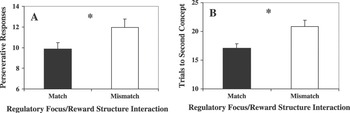
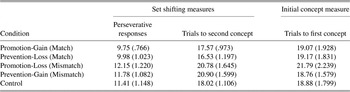
Perseverative responses (Kongs et al., Reference Kongs, Thompson, Iverson and Heaton2000), and the number of trials to learn the first and second concept were examined. Performance means and standard errors for all three measures across the four motivation conditions (and the control condition) are displayed in Table 1. The 2 regulatory focus (promotion vs. prevention) × 2 reward structure (gains vs. losses) ANOVA identified a significant interaction between regulatory focus and task reward structure on perseverative responses (F 1,227 = 4.00, p < .05; η2 = .017), and trials to learn the second concept (F 1,220 = 7.34; p < .01; η2 = .032), but not on the trials to learn the first concept (F < 1.0) (see Figure 2). No main effects emerged for any of the dependent measures (all F’s < 1.0). The significant interactions were characterized by fewer perseverative responses, and faster learning of the second concept for the participants in a regulatory match (promotion-gains or prevention-losses) relative to a regulatory mismatch (promotion-losses or prevention-gains) (perseverative responses: t229 = 2.02; p < .05); second concept: t222 = 2.70; p < .01). These data are plotted in Figure 2. Thus, as predicted, a regulatory match resulted in better cognitive set shifting performance than did a mismatch, but such effects were not observed in initial concept formation.
(A) Perseverative responses, and (B) Trials to learn the second concept for the match and mismatch conditions. Standard errors included. * = p < .05.

Average performance and standard error of the mean (in parentheses) for each condition

“Impairment Classification”
Identifying impairment on neuropsychological tests typically involves comparing an individual’s test score with a criterion score derived from a normative sample. One common approach is to classify an individual as mildly impaired if their score is 1.5 standard deviations or more below the mean of a normative sample (Heaton, Grant, & Matthews, Reference Heaton, Grant and Matthews1991). Put another way, an individual is classified as impaired if their score is in the range observed for the worst 6.7% of individuals in the normative sample (Z-1.5).
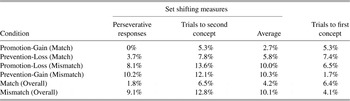
Here we apply the same basic approach in the interest of determining how a regulatory match vs. mismatch affects the proportion of participants who would be classified as “impaired” using participants’ data from the control condition. To be clear, however, our goal is not to identify participants with truly impaired performance on the WCST; rather we use this analysis as a benchmark that provides a method to determine the impact of the manipulations on performance on this variant of the WCST. Table 2 displays the percentage of participants in each condition whose performance was at least 1.5 standard deviations below the mean of the control conditionFootnote 2. The Table includes the two measures of set shifting (perseverative responses and trials to second concept) as well as their average. For completeness, trials to first concept are also included. For the perseveration measure, 1.8% of the participants in the regulatory match conditions revealed performance less than 1.5 standard deviations below the control mean, whereas nearly 5 times as many (9.1%) showed the same poor performance in the mismatch conditions. This difference was significant (two-tailed Fisher exact test, p < .05). For the trials to second concept measure, 6.5% of the participants in the regulatory match conditions performed less than 1.5 standard deviations below the control mean, whereas nearly twice times as many (12.8%) showed the same poor performance in the mismatch conditions. This difference, however, was not significant (two-tailed Fisher exact test, p = .12). The average of these two measures was highly significant (two-tailed Fisher exact test, p = .01). Thus, a significantly larger proportion of regulatory mismatch participants relative to regulatory match participants showed set shifting performance at least 1.5 standard deviations below the mean of the control group.
Percentage of participants whose performance was at least 1.5 standard deviations below the mean of the control condition

DISCUSSION
The WCST provides a useful measure of concept formation and set shifting in neuropsychological assessment. The current study reveals a critical interaction between situational regulatory focus (imposed by the global incentive) and local reward structure of the task on set shifting, but not initial concept learning in a variant of the WCST modified to include regulatory focus and reward structure manipulations. Participants whose situational regulatory focus was incongruent with the reward structure of the task showed slower learning of the second concept and more perseverative errors, both indicators of poor cognitive set shifting. Thus, significant changes in set shifting can be obtained simply by changing one’s global incentive structure (promotion vs. prevention) or the local task reward structure (gains vs. losses).
Our previous work suggests that a regulatory match leads to faster classification learning in a task that involves rule shifting than a regulatory mismatch (e.g., Maddox, Baldwin, & Markman, Reference Maddox, Baldwin and Markman2006). Within the domain of our modified WCST, faster rule shifting should speed disengagement from one strategy and engagement of a new strategy, and thus should directly affect measures of set shifting (e.g., trials to learn the second concept and the number of perseverative errors). However increased rule shifting should not necessarily speed initial concept learning as measured by the trials to learn the first concept. Because a regulatory mismatch should lead to poorer rule/set shifting, this suggests that a mismatch will be advantageous under situations where maintaining set is optimal. Further work should address this possibility.
We now turn to two important implications of the current findings.
Neuropsychological Assessment
As outlined in the introduction, some neuropsychological assessment situations could be influenced by incentive motivation factors. For example, an individual in a neuropsychological assessment setting who is trying to regain their job (a promotion focus) is in a different motivational state from an individual trying to keep from losing their job (a prevention focus). The former might be in a regulatory match, whereas the latter might be in a regulatory mismatch. The results from our study suggest that this could affect measures of set shifting.
It is also known that some neurocognitive disorders have a strong approach or avoidance motivational components to them (e.g., Chamberlain et al., Reference Chamberlain, Fineberg, Blackwell, Robbins and Sahakian2006; Elliott et al., Reference Elliott, Sahakian, Herrod, Robbins and Paykel1997; Murray et al., Reference Murray, Clark, Corlett, Blackwell, Cools and Jones2008). One example is depression that has been linked to a deficit in the approach-motivation system. It is possible that depressed patients approach neuropsychological testing from an avoidance-motivational state and are thus in a regulatory mismatch. Although we certainly do not wish to argue that depression or one’s goal in neuropsychological assessment (to regain or avoid losing one’s job), and the potential regulatory mismatch that this might obtain, would solely account for any performance deficits, the present findings do raise important questions and future research directions. For example, if a losses reward structure were used with depressed patients or with the individuals trying to keep from losing their job, set-shifting performance on the WCST might improve.
Treatment Implications
Although somewhat more speculative, our results might also have implications for neurocognitive treatment or rehabilitation. For example, if a neurocognitive disorder is characterized by a chronic prevention focus, then the home environment could be modified to emphasize loss minimization, or alternatively the person’s global incentive structure could be modified to introduce situational promotion foci. Chronic regulatory foci can be measured (Higgins, Reference Higgins1997), but more importantly can be changed through the introduction of specific situational regulatory focus manipulations such as the monetary incentive provided in the current study. In keeping with the example of depression—if depressed patients are in a chronic prevention focus, a work environment could be modified so that the incentive to work hard is based on minimizing losses, such as losing fewer points for successful completion of a task than unsuccessful completion of that task.
Although we observe the same behavioral pattern in the two regulatory match conditions (and in the two mismatch conditions) it is likely that performance in these two conditions is characterized by different patterns of neural processing. That is, there may be different neural circuits that can regulate cognitive set shifting performance on the same task. Consistent with this notion is the fact that social-motivational factors and the reinforcement environment (e.g., rewards and punishments) are mediated by different neural circuits (e.g., Bechara, Damasio, & Damasio, Reference Bechara, Damasio and Damasio2000; Delgado, Stenger, & Fiez, Reference Delgado, Stenger and Fiez2004; Faure, Reynolds, Richard, & Berridge, Reference Faure, Reynolds, Richard and Berridge2008; Hare, O’Doherty, Camerer, Schultz, & Rangel, Reference Hare, O’Doherty, Camerer, Schultz and Rangel2008; Phillips, Vacca, & Ahn, Reference Phillips, Vacca and Ahn2008). The possibility of two neural systems contributing to regulatory match might also have treatment implications in that it may be possible to develop and implement behavioral or pharmacological interventions to emphasize brain functioning mediated within a normal neural pathway as opposed to one that is damaged or dysfunctional (Rahman et al., Reference Rahman, Robbins, Hodges, Mehta, Nestor and Clark2006; Robbins, Reference Robbins2007).
Limitations and Future Directions
Although our results are compelling in demonstrating the influence of incentive motivation on neuropsychological test performance, there are a few cautionary points that should be raised. First, the observed effect sizes are modest. Even so it is important to point out that these results are reliable, and perhaps more importantly are being observed in a “normal” young population. We might anticipate larger effect sizes in clinical populations under similar experimental manipulations. Second, demographic data were not collected the groups were not matched. Thus it is possible, though unlikely, that there were group differences that random assignment did not fully overcome. Third, it is important to point out that incentive motivation is only one of many potential influences on neuropsychological test performance. Many other factors (e.g., demographics, neurologic, or psychiatric status, etc.) account for a large amount of test performance variability. Our point is that incentive motivation might be another factor to consider. Fourth, although our study might suggest that incentive motivation be considered in the context of neuropsychological assessment, the actual pragmatics of doing so are less than ideal at this time. Measures of chronic focus do exist but they have not been standardized or normed to the level needed in neuropsychological assessment (Higgins, Reference Higgins1997). However, it is certainly possible to take into consideration from an interpretive sense whether someone is trying to gain something by successful test performance as opposed to avoiding losing something from successful test performance.
There are several possible future directions. Whereas a good starting point is to examine the influence of incentive motivation in healthy, young adults using a situational incentive motivation manipulation (as in the current study), future work should examine variations in chronic motivational states or predisposition to depression in the same healthy, young population. Extensions to non patient populations are also in order. Future studies will have to examine this issue in appropriate populations (e.g., depression) where factors such as the nature of feedback (positive vs. negative) could interact with one’s global state (e.g., mood).
CONCLUSIONS
To summarize, the assessment of set shifting can be affected when there is a regulatory mismatch between the global incentive structure and the local task reward structure. This could impact neuropsychological assessment in some clinical populations and suggests that social-motivational and task reward factors might need to be taken into account when assessing set shifting.
ACKNOWLEDGMENTS
This research was supported by NIMH grant MH077708 to W.T.M. and A.B.M., and a VA Merit Award to J.V.F. We thank the MaddoxLab RA’s for data collection. We also thank Deborah Fein and two anonymous reviewers for helpful comments on an earlier version of this manuscript.