Introduction
Entomopathogenic nematodes (EPNs) from the families Heterorhabditidae and Steinernematidae are microbial obligate pathogens that infect a wide range of insects in the laboratory. In the field, they mainly infect the soil-dwelling forms of insects belonging to the orders Lepidoptera, Coleoptera and Diptera and a few other soil arthropods (Mráček et al., Reference Mráček, Bečvář and Kindlmann1999). EPNs from the family Heterorhabditidae are mutualistically associated with bacteria of the genus Photorhabdus and those from the family Steinernematidae with bacteria of the genus Xenorhabdus (Burnell and Stock, Reference Burnell and Stock2000).
The third-stage infective juvenile nematodes (IJs), also known as dauers, are potentially useful as agents for the biological control of numerous insect pests (Hominick et al., Reference Hominick, Reid and Briscoe1995) These IJs are naturally found in the soil, where they are attracted to suitable hosts by the hosts' faeces or CO2. IJs enter the host through the natural openings, and once they invade the haemocoel through the midgut wall, they release their symbiont bacteria that rapidly multiply, killing the host within 24–48 h of septicaemia (Hazir et al., Reference Hazir, Keskin, Stock, Kaya and Özcan2003).
The natural distribution of biological control organisms is influenced by the insect host's age and by habitat, soil type, pesticide use, agricultural practices and location (Fuxa, Reference Fuxa1982; Mietkiewski et al., Reference Mietkiewski, Pell and Clark1997). EPNs are found in broadly diverse soil habitats and exhibit considerable variations in terms of host range, reproduction, infectivity and survival conditions (pH, organic matter, temperature, soil moisture, etc.) (Stock et al., Reference Stock, Pryor and Kaya1999). Colima has a unique geographical location, surrounded by mountains and the Pacific Ocean, with a diversity of habitats that may contribute to the diversification of the distribution of EPNs.
EPNs have unique attributes ideal for their use as biological control agents: they have a broad host range, can be mass-produced, are environmentally safe, can be easily applied or sprayed, are compatible with most chemical pesticides, etc. (García del Pino and Palomo, Reference García del Pino and Palomo1996). Owing to these characteristics, they have been successfully applied to control insect pests in row crops, vegetables and orchards in many countries.
In México, the Universidad de Colima has conducted studies to determine the potential of exotic EPNs to control insect pests, evaluating them in laboratory and field conditions against fall armyworm, Spodoptera frugiperda (J. E. Smith) (Molina-Ochoa et al., Reference Molina-Ochoa, Hamm, Lezama-Gutiérrez, Bojalil-Jaber, Arenas-Vargas and González-Ramírez1996, Reference Molina-Ochoa, Lezama-Gutiérrez, Hamm, Wiseman and López-Edwards1999), Mexican fruit flies, Anastrepha spp. (Lezama-Gutiérrez et al., Reference Lezama-Gutiérrez, Molina-Ochoa, Contreras-Ochoa, González-Ramírez, Trujillo-De la Luz and Rebolledo-Domínguez1996), and agave weevil, Scyphophorus acupunctatus Gyllenhaal (Molina-Ochoa et al., Reference Molina-Ochoa, Hueso-Guerrero, Lezama-Gutiérrez, Farías-Larios, Radillo-Juárez, García-Berber and Fallad-Chávez2004). A native steinernematid strain, Steinernema diaprepesi, was isolated from grassland in Colima, México, and evaluated against engorged cattle ticks and was found to cause significant adult tick mortality (Molina-Ochoa et al., Reference Molina-Ochoa, Nguyen, González-Ramírez, Quintana-Moreno, Lezama-Gutiérrez and Foster2009).
In the State of Colima, several steinernematid and heterorhabditid nematodes have been recovered from agricultural areas (Lezama-Gutiérrez et al., Reference Lezama-Gutiérrez, Hamm, Molina-Ochoa, López-Edwards, Pescador-Rubio, González-Ramírez and Styer2001; Molina-Ochoa et al., Reference Molina-Ochoa, Lezama-Gutierrez, González-Ramírez, López-Edwards, Rodríguez-Vega and Arceo-Palacios2003). However, no survey has been conducted to determine the occurrence of EPNs in cultivated or natural/non-cultivated habitats. Herein, we report the results of a survey conducted to determine the occurrence and recovery frequency of EPNs and the predominant plant species in the cultivated and non-cultivated habitats of the coast of the State of Colima.
Materials and methods
Soil samples were collected from the municipalities of Manzanillo, Armería and Ixtlahuacán, located in the coast of the State of Colima, México, from March to May 2004.
In Manzanillo, three soil samples were collected from non-cultivated habitats with predominant vegetation locally named barcino in Spanish (Cordia elaeagnoides DC.), palma de cayuco or babassu (Orbignya cohune (Martius) Dahlgren ex Standley) and red mangrove (Rhizophora mangle L.). Three soil samples were collected from cultivated habitats planted with bananas (Musa paradisiaca L.), as well as associated forage crops of sorghum/coconut palms (Sorghum bicolor L. (Moench.) × Sorghum halepense Piper (Stapf.)/Cocos nucifera L.) and corn (Zea mays L.).
In Armería, only one soil sample was collected from a non-cultivated habitat where the predominant vegetation was sage (Salvia spp.), and six soil samples were collected from a Mexican lime grove (Citrus aurantifolia (Swingle) Tanaka), a corn field (Z. mays L.), grassland of African star grass (Cynodon nlemfuensis Vanderyst), an associated Mexican lime/coconut palm orchard (C. aurantifolia/C. nucifera), a Jalapeño hot pepper orchard (Capsicum annuum L.) and an associated banana/coconut palm orchard (M. paradisiaca/C. nucifera).
In Ixtlahuacán, three soil cores were collected from non-cultivated habitats where the predominant vegetation was habillo (Hura polyandra Baill.), barcino (C. elaeagnoides), nopal cactus (Opuntia spp.) and columnar cacti (Stenocereus spp.), and three soil samples were collected from areas cultivated with corn (Z. mays L.), muskmelon (Cucumis melo L.) and gamba grass (Andropogon gyanus Kunth.).
Each soil sample, weighing approximately 1 kg, was a composite of five random subsamples collected at least 100 m apart at each site at a depth of 10–20 cm in an area of 20 m2.
Soil samples were placed in polyethylene bags to avoid the loss of moisture and then kept in coolers containing refrigerant gel packs during the transit to the laboratory and stored at 15 °C (Stock et al., Reference Stock, Pryor and Kaya1999) in the Entomopathogenic Nematology Laboratory of the Universidad de Colima at Tecomán, Colima, México.
The stored soil samples were processed within 1 week of collection. To bait the soils for the recovery of EPNs and entomopathogenic fungi (EPF), each sample of 1 kg weight was thoroughly mixed and a subsample of ca. 240 cc was placed in a 250 cc plastic container. Then, five last instar larvae of the greater wax moth (GWM), Galleria mellonella L., were placed in the soil sample and the container was covered with a lid and inverted (Kaya and Stock, Reference Kaya, Stock and Lacey1997). The container was held at room temperature (20 ± 3 °C) for a period of 7–8 days.
GWM larvae were infected and killed by EPNs and EPF during the 15-day baiting period. Cadavers of GWM were recovered from the baited traps, disinfected with a solution of sodium hypochlorite (1%) for 3 min and rinsed with distilled water three times. They were collected at 3-day intervals over 15 days after set-up and transferred to White traps to collect the emerging IJs (Kaya and Stock, Reference Kaya, Stock and Lacey1997).
IJs that emerged were pooled from each sample and used to infect fresh last instars of GWM to verify their pathogenicity and allow the production of progeny for identification at the genus level, considering the characteristic colour of the GWM cadavers (Kaya and Stock, Reference Kaya, Stock and Lacey1997). Using Sabouraud dextrose yeast extract agar, with 500 ppm of chloramphenicol (Lezama-Gutiérrez et al., Reference Lezama-Gutiérrez, Hamm, Molina-Ochoa, López-Edwards, Pescador-Rubio, González-Ramírez and Styer2001), EPF were isolated from the GWM cadavers and identified by microscopic inspection of morphological characteristics (Brady, Reference Brady1979). Soil samples that were negative for EPNs and EPF during the first round were baited again with the last instars of GWM. All the soil samples were maintained at room temperature.
Results and Discussion
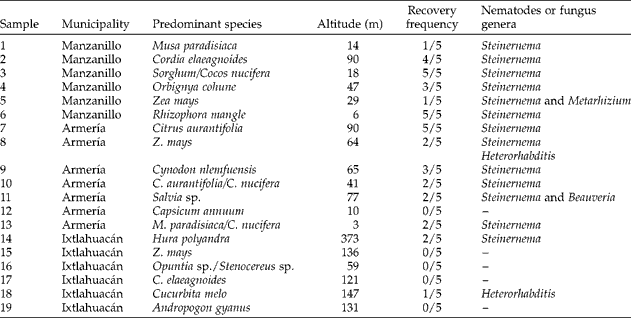
Current research efforts were focused on isolating EPNs and EPF that may be ubiquitous in the cultivated and non-cultivated soils of the State of Colima, México. Nineteen soil samples were collected from three municipalities (Table 1): seven from non-cultivated habitats and 12 from habitats or areas cultivated mostly with fruit and grain crops and grasses. EPNs were recovered from 14 of the 19 soil samples with a total prevalence of 73.7%; EPF were recovered from two of the 19 soil samples with a total prevalence of 10.5%.
Predominant plant species and recovery frequency of the entomopathogenic nematodes and fungi in the coast of the State of Colima, México

From the 14 positive soil samples, 12 steinernematid isolates (85.7%) and two heterorhabditid isolates (14.3%) were recovered from all the three municipalities. Stock et al. (Reference Stock, Pryor and Kaya1999) reported a similar proportion of recovery frequency of steinernematid isolates (80%) in a survey conducted in California, USA; however, the proportion of heterorhabditid isolates reported by them was higher than that reported by us (20%).
EPNs from the genus Steinernema were recovered from the three municipalities. EPNs from the genera Steinernema and Heterorhabditis were recovered from Armería and Ixtlahuacán. Other important entomopathogenic microorganisms isolated were the fungus Metarhizium sp. in a Manzanillo soil sample cultivated with corn and in a non-cultivated area where the predominant vegetation was red mangrove and the fungus Beauveria sp. from an area in Armería with sage as the predominant vegetation. The isolation of EPF and other microorganisms from cultivated soils has also been reported in surveys conducted previously in Mexico (Lezama-Gutiérrez et al., Reference Lezama-Gutiérrez, Hamm, Molina-Ochoa, López-Edwards, Pescador-Rubio, González-Ramírez and Styer2001; Molina-Ochoa et al., Reference Molina-Ochoa, Lezama-Gutierrez, González-Ramírez, López-Edwards, Rodríguez-Vega and Arceo-Palacios2003).
Most (64.3% = 9/14) of the soil samples positive for the recovery of EPNs were from cultivated habitats and only 35.7% (5/14) were from non-cultivated habitats. No nematodes were recovered from soil samples collected from areas cultivated with hot peppers in Armería or from those cultivated with corn and grasslands cultivated with gamba grass in Ixtlahuacán. However, negative results were also obtained for non-cultivated areas where the predominant vegetation was nopal cactus, columnar cacti and barcino (Table 1).
In terms of species diversity, the associations of sorghum, Mexican lime and banana/coconut palms were the richest cultivated habitats, yielding three of the eight Steinernema isolates recovered, but Heterorhabditis isolates were recovered from corn and muskmelon orchards (Table 1). Isolates from the genus Steinernema were recovered in all the positive non-cultivated habitats, but three of the five positive soil samples were obtained from Manzanillo (Table 1). Our results differ from those reported by Stock et al. (Reference Stock, Pryor and Kaya1999), because the majority of their positive samples were recovered from woodlands and coniferous and oak forests, considered as non-cultivated areas; in their study, negative results were obtained for chaparral habitats, redwood forest and desert habitats.
The occurrence of EPN and EPF isolates in cultivated and non-cultivated soils in Colima is demonstrated for the first time in this survey. The EPNs were differentially distributed in cultivated and non-cultivated soils and their isolates were recovered in 73.7% of the soils sampled.
Most of the EPN isolates were recovered from cultivated habitats. Our results suggest that there is a higher prevalence of EPNs in cultivated habitats or cultivated soils. We speculate that the environmental conditions, particularly soil moisture, favoured the recovery of EPNs, because we conducted the survey during the spring and early summer. The rainy season increased the soil moisture in the non-cultivated habitats and also the cultivated habitats were under irrigation. Lezama-Gutiérrez et al. (Reference Lezama-Gutiérrez, Hamm, Molina-Ochoa, López-Edwards, Pescador-Rubio, González-Ramírez and Styer2001) emphasized the role of rainfall in influencing the parasitism of entomopathogenic microorganisms; this point of view supports our speculation.
Conclusion
Steinernematid nematodes were more frequently recovered than heterorhabditid nematodes from both cultivated and non-cultivated habitats. The associations of sorghum, Mexican lime and banana/coconut palms were the richest cultivated habitats, yielding three of the eight Steinernema isolates recovered. Steinernematid nematodes were also recovered without distinction in annual or perennial crops. Heterorhabditid nematodes were isolated only from soils cultivated with corn and muskmelon. The higher frequency of recovery in the Colima soils observed in this survey suggests the adaptability of the steinernematids to a wider range of habitats in comparison with the heterorhabditids, as only a couple of EPF species were recovered: Metarhizium sp. and Beauveria sp.
Acknowledgements
Mention of trade names or commercial products in this article is solely for the purpose of providing specific information and does not imply recommendation or endorsement by the U. S. Department of Agriculture (USDA). USDA is an equal-opportunity provider and employer.