Tense-aspect has been extensively investigated in first language (L1) and second language (L2) acquisition research (Bardovi-Harlig, 1999, 2000; Li & Shirai, 2000; Weist, 2002). It has been observed that there is a strong relationship between inherent lexical aspect of verbs and the acquisition of tense-aspect morphology, a relationship summarized in the aspect hypothesis (Andersen & Shirai, 1994, 1996; Bardovi-Harlig, 1999, 2000; Robison, 1995; Shirai, 1991). The aspect hypothesis predicts that at the early stages of acquisition, learners predominantly use past tense and perfective aspect forms with punctual and telic verbs and progressive aspect forms with activity verbs.
The acquisition of tense-aspect marking can be very informative for understanding the mechanism of form-meaning mapping in language acquisition. Research in this area enables us to see how language learners come to associate the basic grammatical functors, such as tense-aspect morphology, with semantic features of verbs (Shirai, 2004). Also, the ample empirical observations available in this area provide us with a significant database for comparison between L1 and L2 acquisition as well as comparison across various languages, from which we can infer the mechanism behind acquisition of grammatical functors in general. In spite of the existing broad range of investigation, however, we still do not know how such form-meaning mappings are created.
Shirai (2004; see also Salaberry & Shirai, 2002) argued that multiple factors, such as input frequency, learning environment, and L1 influence, contribute to the acquisition patterns predicted by the aspect hypothesis. In particular, Shirai (2002, 2004) emphasized the L1 transfer explanation for the initial form-meaning association, but few studies have systematically investigated the role of L1 in relation to the aspect hypothesis. The main purpose of this study is to help fill this gap by analyzing the acquisition of the Japanese imperfective aspect marker.
INTRODUCTION
The Aspect Hypothesis
First, we briefly describe the categories of inherent aspect of verbs, which is crucial to understanding the literature on the aspect hypothesis. Unlike grammatical aspect, which is marked explicitly by linguistic devices such as auxiliaries or inflectional morphology, inherent aspect is defined in terms of the temporal properties of the situation to which the verb (phrase) refers.
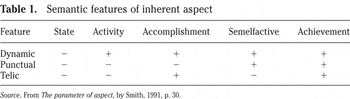
Vendler's (1967) four categories—probably the most broadly accepted and the best known in L2 tense-aspect studies—are state, activity, accomplishment, and achievement. A state verb (e.g., love, know) refers to a situation that is viewed as continuing to exist unless some outside situation makes it change. An activity verb (e.g., run, walk) describes a dynamic and durative situation without an inherent end point. An accomplishment verb (e.g., make a chair, run a mile) describes a situation that is dynamic and durative, but has a necessary end point. An achievement verb (e.g., die, drop) refers to a dynamic and punctual situation. States and activities are atelic, whereas accomplishments and achievements are telic. Vendler's four categories plus semelfactive (to be discussed later in this section) can be defined on the basis of three semantic features: dynamicity, telicity, and punctuality (see Table 1).
Semantic features of inherent aspect

As mentioned earlier, studies on the acquisition of tense-aspect in both L1 and L2 have indicated that inherent aspect will influence the way in which language learners use grammatical tense-aspect markers. A series of generalizations to this effect, together labeled the aspect hypothesis (Andersen & Shirai, 1994, 1996; Bardovi-Harlig, 2000; Bardovi-Harlig & Bergström, 1996; Shirai, 1991), is summarized as follows:
- Learners first use (perfective) past marking on achievement and accomplishment verbs, eventually extending use to activity and state verbs.
- In languages that encode the perfective-imperfective distinction morphologically, imperfective past appears later than perfective past, and imperfective past marking begins with stative and activity (i.e., atelic) verbs, then extends to accomplishment and achievement (i.e., telic) verbs.
- In languages that have progressive aspect, use of progressive marking begins with activity verbs and then extends to accomplishment and achievement verbs.
- Learners do not incorrectly attach progressive marking to stative verbs.
In this article, we focus on the third generalization; that is, we examine whether L2 learners of Japanese show a strong association of progressive marking with activity verbs and extend this use to other verb types. Because the evidence for the acquisition order for the spread of past marking from telics is more robust (Bardovi-Harlig, 2000; Shirai, 2002), it is worth investigating the acquisition of progressive marking.
Although the four-category system of inherent aspect has been dominant in aspect hypothesis research, theoretical and empirical arguments have cast doubt on its sufficiency for fine-grained analysis. As shown in Table 1, Smith (1991) modified Vendler's system and added a fifth category, semelfactive (e.g., cough, knock), which belongs to achievement in Vendler's classification. Semelfactive is similar to achievement in that it is dynamic and punctual, but different in that it does not involve an inherent end point that denotes a change of state. The difference between semelfactive and Vendler's achievement can be observed when they are combined with the progressive aspect marker. In English, for example, when used with a progressive marker, semelfactive can denote an iterative action in progress (e.g., Ken is knocking on the door), whereas achievement indicates another meaning (in English, it often denotes a preliminary stage of an event, as in John is dying). A L1 acquisition study by Shirai and Andersen (1995) empirically supported Smith's modification: Three children (acquiring English as a L1) showed early use of progressive morphology not only with activity verbs but also with semelfactive verbs to denote iterative action in progress (e.g., He's jumping). The current study is another attempt to test the validity of the semelfactive category and examine the difference between semelfactive and other categories when they denote progressive meaning.
The Tense-Aspect System in Japanese
Before we move on to the discussion of previous research on tense-aspect acquisition, let us briefly describe the tense-aspect system of Japanese; this is important for understanding the theoretical importance of the acquisition of Japanese—in particular, to explain the observed generalizations. The Japanese tense-aspect system has much in common with that of English. In both languages, all indicative predicates are marked for tense (past -ta, nonpast -ru in Japanese). Also, similar to the English progressive form be -ing, Japanese has an aspect marker -te i-(ru) that must be used in describing action in progress at the time of reference. However, the semantic scope of the Japanese aspect marker -te i-(ru) is different from that of English.
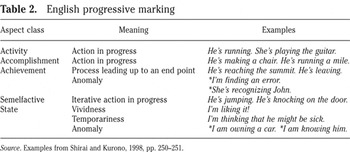
The English progressive marking be -ing normally has the meanings presented in Table 2 when it is attached to verbs of different inherent aspect classes.1
To be more precise, more marked cases of futurate (e.g., we are leaving tonight) and habitual (e.g., I'm going to school by bicycle these days) can be used for any of these verb types.
English progressive marking

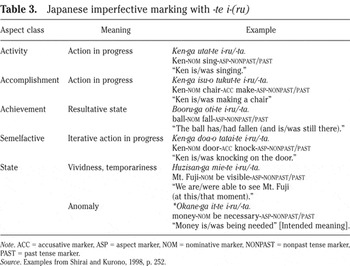
The Japanese aspect marker -te i-(ru) shows a similar interaction with inherent aspect, as illustrated in Table 3. The major difference between the two languages concerns the combination of -te i-(ru) with achievement verbs. Japanese -te i-(ru) cannot denote a process leading up to the end point, but it can refer to a resultative state, used quite frequently by native speakers (NSs) of Japanese (Shirai & Nishi, 2005). As in Booru-ga oti-te i-ru “The ball has fallen (and it is there),” Japanese focuses on the duration of state that obtains as a result of the punctual action.2
The difference between past -ta and resultative -te i-ru can be explained as follows: Whereas oti-ta “The ball fell/has fallen” views the action as a whole and focuses on the fact that the ball fell, oti-te i-ru “The ball has fallen (and it is there)” focuses on the duration of state after the action.
Japanese imperfective marking with -te i-(ru)

Applying the aspect hypothesis to Japanese, a straightforward prediction is that learners will initially associate the past tense marker -ta with achievement verbs and the progressive-imperfective aspect marker -te i-(ru) with activity verbs, even though in the target grammar, -te i-(ru) can be used with achievement verbs to denote a resultative state.
Terminologically, there is no general agreement among linguists about what to call the aspectual form -te i-(ru). Linguists in Japan mostly use the term “keizoku-soo” (continuative aspect or durative aspect), but, following Shirai (1998a, 2000), in this article we use the term imperfective aspect. Imperfective aspect focuses on the internal structure of a situation and, therefore, it takes an internal view (unlike perfective aspect, which takes an external view). More formally, Smith (1991) stated that the defining feature of imperfective aspect is that it does not include the beginning and final end points of a situation in its scope. Because the Japanese -te i-(ru) meets this definition, Shirai (1998a, 2000) treated it as imperfective. However, as is well known, progressive aspect is a subcategory of imperfective aspect, with the added feature of dynamicity (Comrie, 1976); therefore, in this article we will use the term imperfective when it refers to the multiple meanings that -te i-(ru) denotes (e.g., progressive and resultative meanings).
Additionally, we briefly describe the aspectual systems of German and the Slavic languages (i.e., Russian, Bulgarian, and Ukrainian), which are L1s of the participants in this study. As in English and Japanese, German and Slavic distinguish between past and nonpast by means of verbal morphology, auxiliary, or both. However, whereas English and Japanese have an obligatory aspectual marking to denote progressive meaning, German and Slavic do not have such markers and describe action in progress with the simple present form— that is, zero form in German and present imperfective in Slavic languages. The contrast is illustrated in Table 4; the examples in the second column describe actions in progress, whereas those in the third column describe habitual and generic situations in all four languages.
Aspectual marking in English, Japanese, German, and Russian

In other words, NSs of English (and Japanese) automatically add aspectual marking to refer to action in progress, whereas NSs in the nonprogressive group in this study do not have to make this distinction at all, at least morphologically.3
Although German has periphrastic forms to denote progressive meanings, they are optional and are used sparingly; therefore, it is more common to use the simple present form to refer to action in progress. For further details of progressive marking in German, see Ebert (2000). The aspectual system in Russian is discussed in detail in Smith (1991); the aspectual systems in Ukrainian and Bulgarian are very similar to that of Russian, and progressive markings are essentially the same in these two languages as in Russian (see Pugh & Press, 1999, for Ukrainian, and Slabakova, 1997, for Bulgarian).
The Prototype Hypothesis
Numerous studies on various languages, conducted in various contexts, have supported the predictions of the aspect hypothesis at the descriptive level, but the explanation that underlies the observed phenomena remains an open question. One attempt to provide an explanatory account was Andersen and Shirai's (1996) prototype hypothesis (see also Andersen, 2002; Li & Shirai, 2000; Shirai, 1991); this hypothesis proposed that language learners initially acquire the prototypes for each aspectual morpheme and then gradually extend their scope to less prototypical cases.4
The prototype hypothesis differs from the aspect hypothesis in that it involves both lexical aspectual categories and semantic meanings (e.g., action in progress, habitual) that the form denotes (Andersen & Shirai, 1996; Shirai, 1991; Shirai & Andersen, 1995). For example, Andersen & Shirai predicted that habitual use of the progressive marker is more difficult than progressive use. In contrast, the aspect hypothesis is exclusively concerned with lexical aspect. In the context of the present article, however, they essentially make the same predictions.
According to Andersen and Shirai (1996), the prototype of a progressive marker is a process (action in progress), whereas habitual, futurate, and stative progressive meanings are peripheral. More specifically, the action in progress meaning with activity verbs is the best exemplar of the progressive marker, then action in progress with accomplishment and semelfactive (iterative progressive) follow. Andersen and Shirai proposed this sequence based on a review of L1 acquisition studies (Shirai, 1991), but there is not yet sufficient evidence to support this acquisition order in L2.
Furthermore, although the prototype hypothesis nicely explains the developmental sequence from prototype to periphery, it does not provide the ultimate causal explanation; that is, the question of where the prototype comes from still remains (Shirai & Kurono, 1998). Andersen and Shirai (1994, 1996) presented a scenario of prototype formation based on input (the distributional bias hypothesis). They argued that there is a distributional bias in the linguistic input and that language learners create a prototype from the skewed input. In English, for example, the majority of progressive and past markers are used with activity verbs and achievement verbs, respectively, in utterances addressed to children (Shirai & Andersen, 1995). This might indicate that children can obtain prototype information from the input. Similarly, such distributional bias has been observed in adult-to-adult speech in various languages (see Andersen & Shirai, 1996, for a review).
However, the distributional bias hypothesis might not work for the acquisition of -te i-(ru). Shirai (1995; see also Shirai & Kurono, 1998) analyzed the utterances that a Japanese NS addressed to L2 learners and showed that -te i-(ru) was more frequently attached to achievements than activities (59% vs. 37%). Additionally, an analysis of a conversational corpus of Japanese NSs (Shirai & Nishi, 2005)5
The corpus used by Shirai and Nishi (2005) consists of various situations with various participants that a housewife encountered at home and in the community, such as family conversation at mealtime, routine dialogues at shops, and cooking class.
As a reviewer pointed out, across-category analyses are sensitive to the number of tokens (Bardovi-Harlig, 2002b), and it might be the case that within-category analysis shows a different picture. However, it is not possible to compare them, due to the fact that Shirai and Nishi (2005) did not provide information regarding inflected forms other than -te i-(ru).
Given such a distributional bias, one might speculate that the distributional bias in the use of Japanese -te i-(ru) might facilitate the acquisition of resultative state meaning, which is obtained by attaching -te i-(ru) to achievement verbs, as discussed earlier. This appears to be the case at least for some children acquiring Japanese as L1 (Li & Shirai, 2000; Shirai, 1998b, 2006), but not for L2 Japanese. Most studies of L2 Japanese indicate that the progressive meaning is acquired earlier than the resultative state meaning and that learners of Japanese tend to associate achievements with -ta (past form), which is congruent with the prediction of the aspect hypothesis7
Strictly speaking, progressive meaning is also obtained in combination with accomplishment and semelfactive verbs. However, most studies that used elicitation tasks used mostly activity verbs to yield action in progress, and, therefore, when a study found progressive meaning to be easier than resultative meaning, it means that the association between -te i-(ru) and activity verbs is observed. For details of these L2 Japanese studies, see Shirai (2002).
In contrast, a recent study by Ishida (2004) illustrated the potential effect of input. Ishida, who analyzed conversational data from four L2 learners of Japanese (L1 English and Chinese), reported higher accuracy for the resultative use of -te i-(ru) over its progressive use, which goes completely against most previous studies. As Ishida suggested, this can be attributed to instructional factors—more specifically, the order of presentation. Whereas the progressive meaning is usually introduced earlier than resultative state in Japanese language textbooks, Ishida's learners of Japanese were taught the resultative meaning in the second semester, 4 months earlier than the progressive meaning, which was introduced in the third semester. It appears that initial exposure exclusively to the resultative meaning and deprivation of the progressive meaning for 4 months can result in more accurate production of the resultative meaning even long after the progressive meaning is introduced (the participants were tested in their fourth or fifth semester). One might speculate that input frequency can override the universal pattern, but only when it is extremely skewed. For example, Lightbown (1987) observed that the universal order of morpheme acquisition was violated due to intensive teaching of a grammatical item (-ing). However, there should be other dominant factors when input is not extremely skewed.
L1 Influence
Where, then, does the prototype come from for Japanese -te i-(ru)? In the case of English, the prototype for progressive can be argued to come from a skewed input distribution, as noted earlier, but this is not very likely for Japanese because neither activity verbs nor progressive meaning is used more frequently with -te i-(ru) in the input. Shirai (2002) suggested that L1 influence might be the key to the formation of the prototype because most of the studies on tense-aspect in L2 Japanese investigated learners whose L1 has a progressive marking (e.g., English, Chinese, Korean). If the learners map -te i-(ru) on to the progressive marker in their L1, it is not surprising that the progressive meaning is easier to acquire than the resultative state (Li & Shirai, 2000; Shirai & Kurono, 1998). Thus, Shirai argued that if the L1 transfer explanation is valid, learners whose L1 has no progressive marker will not show a preference for progressive meaning over resultative meaning.
There are two studies on L2 Japanese that are relevant to Shirai's proposed test of the L1 transfer explanation for the preponderance of progressive meaning. Sugaya (2003) longitudinally investigated a NS of Russian (L1 nonprogressive) and a NS of Telugu (L1 progressive). The analysis of the interview data revealed that the L1 Telugu learner used progressive meaning earlier than resultative meaning, whereas the L1 Russian learner showed no such preference and used both meanings frequently early in the language learning process.
Another relevant study is by Uozumi (1998), who analyzed longitudinal oral production data from a Russian learner enrolled in a 6-month intensive Japanese program. The data (interview, story-telling, and role-plays) were collected 3 months after the learner completed the program (i.e., in the ninth month of the learner's stay in Japan) and every 3 months after that, for a total of six times. The results were ambiguous. In terms of the emergence of -te i-(ru), progressive meaning emerged earlier (one token at time 1 and five tokens at time 2) than resultative meaning, which only appeared at time 3 (10 tokens). However, across all six times, progressive and resultative meanings showed similar tendencies both in terms of raw frequency (23 vs. 26 tokens; type count not reported8
This only includes correct use, but even if incorrect uses are included, the trend is the same (29 vs. 33 tokens).
Obviously these two small case studies do not provide a definite answer to the L1 transfer question. We need additional controlled investigations to test whether the presence or absence of a progressive form in the learner's L1 influences the acquisition pattern.
There are some relevant studies that address the role of L1 in the acquisition of progressive form beyond L2 Japanese data. Kleinmann (1977) investigated two L1 groups of English as a second language (ESL) learners: L1 Arabic, which has neither progressive nor passive forms, and L1 Spanish and Portuguese, which have both progressive and passive forms. A L1 effect was found for passive but not for progressive. Results from oral tasks showed that with the progressive form, there was no significant difference between the L1 groups, whereas with the passive form, the L1 Spanish and Portuguese learners performed significantly better than the L1 Arabic learners. In a study that investigated the L2 Italian progressive form, which is optional and more marked than alternative forms (simple present or imperfect), Giacalone-Ramat (2002) pointed out that both English (L1 progressive) and German (L1 nonprogressive) speakers showed similar behavior and produced only a few progressive forms. These studies might indicate that the influence of L1 in the acquisition of L2 progressive marking is minimal.
On the other hand, Rohde (1996) found that learners whose L1 lacks the progressive form showed a developmental pattern for English progressive that is inconsistent with the aspect hypothesis. Rohde observed that L1 German children more often attached -ing to achievements than to activities in English. Shirai (2002) suggested that this might be related to the lack of progressive marking in L1 German.9
Bardovi-Harlig (2000) pointed out that a within-category analysis of Rohde's data revealed findings different from the original (across-category) analysis by Rohde; that is, achievements were mostly used with past morphology and activities with progressive.
Although not directly related to the effect of L1 on the acquisition of progressive marking, Collins (2002, see also Collins, 1999) presented an important hypothesis regarding L1 influence in the acquisition of tense-aspect morphology. In contrast to Shirai's (2002) strong version of L1 transfer, Collins proposed a weak version. She argued that L1 influence does not override the effect of lexical aspect. Using cloze tasks and preference tasks, she investigated the use of tense-aspect markers in past time contexts by Francophone ESL learners, replicating the Bardovi-Harlig and Reynolds (1995) study that supported the aspect hypothesis with a mixed L1 group. The French compound past (passé composé) is similar in form to the English present perfect, but its semantic equivalent in English is usually the simple past and, therefore, the English present perfect often figures as a competitor for simple past when French speakers learn English. However, the results were consistent with the aspect hypothesis in that the learners were significantly more successful in using simple past with telic verbs and struggled with atelic verbs. Collins (2002) noted that the effect of the L1 was restricted to the nontarget use of perfect with telic verbs and that the presence of the French compound past in learners' L1 did not change the pattern of acquisition predicted by the aspect hypothesis.
Collins (2004) confirmed this minimum transfer view in another study on English past tense, in which L1 French and L1 Japanese learners were compared. According to Collins, both groups of learners were more successful at marking the simple past with telics than with atelics, and Japanese learners—in spite of the existence of the progressive form in their L1—did not overextend -ing with activity verbs to past tense contexts. However, Collins's observations of L1 effect were focused on the overextension of progressive marking and did not test whether there were facilitative effects of L1 progressive marking in the acquisition of L2 progressive marking. As Collins pointed out, the existence of a L2 equivalent aspectual marker in L1 might facilitate the rate of development.
In summary, the question of whether and to what extent a learner's L1 influences the acquisition of tense-aspect markers is still an open one. The present study directly tests the effect of the L1 in the acquisition of the Japanese aspect marker -te i-ru, using an acceptability judgment test and an oral picture description task on two groups of learners—a L1 progressive group (NSs of English) and a L1 nonprogressive group (NSs of German and Slavic languages). If only the L1 progressive group shows higher accuracy with progressive state than resultative state, this supports the L1 transfer explanation. If there is no difference between the two groups, it can be concluded that the L1 transfer effect is minimal, and we need to look for other factors to explain the form-meaning association predicted by the aspect hypothesis. Additionally, we also test part of Andersen and Shirai's (1996) prototype hypothesis by investigating whether there is a spread from prototype to periphery in the acquisition of the imperfective marker -te i-ru and which alternative forms compete with -te i-ru.
The hypotheses tested in this study are the following:
- The L1 progressive group will show higher accuracy with progressive than resultative state meanings of the Japanese imperfective aspect marker -te i-ru, whereas the L1 nonprogressive group will show no such preference. (This hypothesis is relevant to both the judgment and the oral tasks.)
- For progressive meaning, there will be an interaction between inherent aspect and the use of -te i-ru. The pattern will be consistent with the prototype hypothesis; that is, there will be a spread from activity to accomplishment and semelfactive. (This hypothesis is relevant to the judgment task only.)
- There will be an effect of inherent aspect on the learner's choice of alternative forms: Learners will more strongly associate past form (-ta) with achievements than with other verb types. (This hypothesis is relevant to both the judgment and the oral tasks.)
METHOD
Participants
There were 80 participants living in the Tokyo metropolitan area: 39 English NSs and 41 NSs of languages that do not have obligatory progressive marking (18 German, 18 Russian, 3 Ukrainian,10
The Ukrainian learners were balanced bilinguals of Russian and Ukrainian.
Additionally, 21 NSs of Japanese provided baseline data for the judgment test. They were graduate, undergraduate, and nondegree students of various majors at a women's university in Tokyo (age range = 20–55, mean = 30.2 for 20 Japanese NSs; one person did not report her age).
Materials and Procedure
Procedure.
The data were individually collected in various places, such as the learner's home, office, or classroom. The participants had an OPI, completed the oral picture description task and the acceptability judgment test, and, finally, filled out background questionnaires.
The two tasks were not timed. The oral task took about 10 min to complete, and the judgment test took about 30 min on average. One of the researchers (the first author) was present throughout the administration. During the oral task, the researcher did not provide any vocabulary, even if asked, so as not to bias participant production. For the judgment test, the researcher told the participants to feel free to ask about unfamiliar words in the test items in order to properly elicit their tense-aspect knowledge and avoid misunderstanding of the test sentences. When asked, the researcher explained words by paraphrasing in Japanese or by using drawings and gestures.11
There were several times when the target verbs figured in the unfamiliar vocabulary (about 10 times in total). Because the researcher's use of specific tense-aspect forms could influence the learners' choices, the target verbs were explained by gestures and were never pronounced except in unmarked -ru form.
Acceptability Judgment Test.
The acceptability judgment test was designed to assess learners' knowledge of finite verb forms -ru (nonpast), -ta (past), -te i-ru (nonpast imperfective), and -te i-ta (past imperfective). Each item consisted of a short dialogue with the verb deleted. The learners were instructed to circle all appropriate forms from among the four verb forms, as illustrated in Appendix A. This was to examine if the learners could appropriately judge in which context a verb form can or cannot be used. In other words, the task required learners to judge the acceptability of all four choices. This method, originally used by Kurono (1995), is effective in assessing learners' ability to judge each verb form in a short time because they do not need to read the context sentences four times. To make sure that participants gave judgments for each item carefully, we incorporated eight items that each had two correct target forms, so that the learners would believe that some items had more than one correct answer. Otherwise, participants might have decided that there was only one correct choice for each item.
The judgment test was piloted with 13 NSs of Japanese, none of whom were in the control group of 21 Japanese NSs mentioned earlier. The test items to which more than 20% of the 13 informants did not respond with our expected response were revised. The test was also piloted with three learners of Japanese, and we reworded difficult or unclear expressions that they indicated.
The sentences were given in Japanese orthography with readings printed in kana (phonograms) and kanji (Chinese characters). The motivation for using a kana version instead of romanization is that if an instructed learner living in Japan lacks kana knowledge, it is highly likely that he or she is lacking in even basic Japanese language ability and will not understand the test items on the whole. To make sure that the learners understood the meaning of the sentences, English translations were given for some content words that were determined to possibly be difficult based on reactions of participants in the pilot study.12
Most participants in the L1 nonprogressive group had a good command of English and, therefore, had no difficulty understanding English translations.
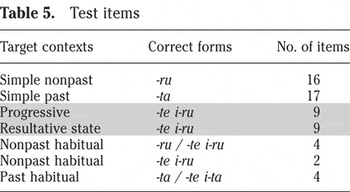
The test consisted of 61 items, of which 9 items targeted progressive meaning and 9 items targeted resultative state meaning; that is, for these 18 items, the correct form was -te i-ru (nonpast imperfective) (see Table 5, in which these forms are highlighted).13
To examine whether the learners could use the imperfective form productively, 33 items for which the target forms were simple nonpast and simple past were included in the test. The results from the analysis of productivity will be reported in a separate article.
Test items

The target verbs for progressive and resultative states are shown in Appendix B.14
To make sure that the test items are easily understandable, the target verbs were chosen from Minna no Nihongo “Japanese for everyone” volumes 1 and 2 (3A Corporation, 1998a, 1998b), popular Japanese textbooks for beginners. For the two verbs that are absent in the textbooks—tiru “to fall” and tataku “to beat”—extra care was taken to present them in easy-to-understand situations such as Sakura-no hana-ga tit-te i-masu “Cherry blossoms are falling,” and Saru-ga taiko-o tatai-te i-masu “A monkey is beating a drum.”
Picture Description Task.
To examine learners' ability to use -te i-ru to denote the progressive and resultative meanings orally, we used two pictures that are very similar to each other but have many differences in their details (see Appendix C). For example, in one picture, a man is smoking, whereas in the other, the same man is talking on the phone. The participants were asked to describe the differences between the two pictures. Based on the pilot test, which was conducted with five Japanese NSs (who also participated in the pilot of the judgment test), the pictures were modified so that they would elicit an equal number of progressive and resultative state meanings (about 15 by type count for each; see Appendix D). The learners' utterances were audio-recorded and transcribed.
The task was administered in Japanese. The researcher pointed out to the participant that there are many differences between the upper and lower pictures and asked the participant to describe the differences. Each person in the picture was assigned a name, and participants were asked to use that name as they described the person. Participants were also asked to mark each item on the picture after they described it. When participants had trouble coming up with the right words to say and were taking too much time, the researcher encouraged them to go on to another item. To elicit the maximum number of utterances, the researcher pointed to the items that participants had forgotten to comment on and prompted them to produce utterances for those items.
ANALYSIS AND RESULTS
Nine learners, evaluated as novices on the basis of the OPI, did not take the acceptability judgment test because it was expected that novice learners would have difficulty understanding the test sentences. The judgment test was administered to 71 intermediate and advanced learners, but the data from 10 learners were not retained for analysis. (Four participants did not complete the task because of insufficient knowledge of Japanese phonograms, and six participants who reported lack of formal L2 instruction were excluded to control for the variable of classroom instruction.) This resulted in a sample of 61 participants: 35 L1 nonprogressive learners (17 German, 13 Russian, 3 Ukrainian, 2 Bulgarian) and 26 L1 progressive learners (English).15
Details of 61 participants' OPI ratings are as follows: In the L1 nonprogressive group, 17 participants were evaluated as intermediate and 18 as advanced. In the L1 progressive group, 13 were rated as intermediate and 13 as advanced. Both L1 groups were distributed from intermediate-low to advanced-high. It was not possible to conduct an OPI for one learner in the L1 nonprogressive group due to scheduling difficulty, but this person was retained because her proficiency was judged to be good enough to perform the tasks.
Test of the Equivalence of the L1 Groups
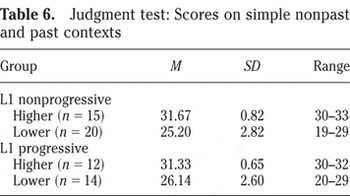
To establish equivalence between the L1 groups, their proficiency in tense-aspect distinctions was carefully tested. Because the OPI is not sufficiently sensitive to learners' knowledge of tense-aspect morphology, it was necessary to use another measure of proficiency to investigate the relationship between learners' level of development and their knowledge of -te i-ru. For this purpose, we assigned a score to each student based on his or her appropriate judgment of simple past and nonpast for 33 items (see Table 5). This is similar to the work of Bardovi-Harlig (1995, 1998) and Collins (2002), who used a suppliance in obligatory context (SOC) score for past tense context to divide learners into different proficiency groups. We did not use the target knowledge (progressive and resultative score) as a grouping variable because it could affect the comparison. The purpose of using the simple past/nonpast score is that it can reflect the learners' knowledge of tense-aspect morphology and indicate that the effect of L1 appears to be minimal, as the learners' L1s (English, German, and Slavic) distinguish between past and nonpast.
Participants from each L1 group were then divided into lower or higher levels, with the median (29) as the cutoff. This procedure resulted in four groups. Table 6 shows the number of participants, the means, the standard deviations, and the range of scores for each of the groups. The higher and lower groups do not show equivalent score ranges because they were not equally distributed. Grouping the participants in this study by equivalent ranges would result in extreme differences in the numbers of learners per group. To allow for meaningful comparisons between L1 groups, we, instead, grouped them into balanced cell sizes, following Collins (2002). For both higher and lower level groups, t-tests did not reveal a significant difference between the L1 groups (higher: p = .459; lower: p = .456). Therefore, the two L1 groups—both at the higher and lower levels—can be considered homogeneous.16
To examine whether the data are normally distributed, we ran Kolmogorov-Smirnov tests. They showed nonsignificance (i.e., the assumption of normality was met).
Judgment test: Scores on simple nonpast and past contexts

Although we treated L1 German and Slavic learners in one group due to the fact that these languages use zero marking to describe action in progress, it could be the case that the difference between their aspect systems affects the results. To test this possibility, we also examined whether there was a difference between L1 German and L1 Slavic learners. Three-way repeated-measures ANOVAs with contexts (progressive vs. resultative) as the within-subject factor and level (higher vs. lower) and L1 (German vs. Slavic) as between-subject factors were performed for the L1 nonprogressive group; these analyses did not show an effect of L1 (German vs. Slavic) on either the judgment test (p = .270) or the oral task (p = .356).
Acceptability Judgment Test
To test each research hypothesis, we analyzed (a) the use of imperfective form in progressive and resultative state contexts, (b) the use of imperfective form in each of the three aspectual categories with progressive meaning, and (c) the alternative forms that the learners supplied in the target contexts in place of the imperfective.
The Effect of L1: Accuracy of Imperfective Form in Progressive and Resultative Contexts.
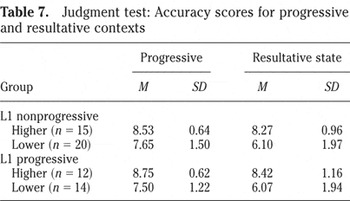
The first analysis compared the distribution of the appropriate use of imperfective form in progressive and resultative state contexts (i.e., where the correct form is -te i-ru and the intended meanings are progressive and resultative, respectively). Table 7 shows the means and standard deviations of the score in each context.
Judgment test: Accuracy scores for progressive and resultative contexts

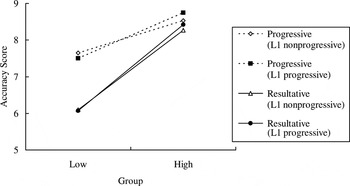
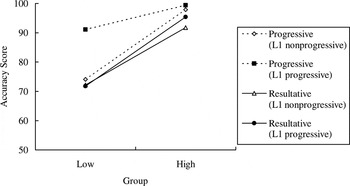
A three-way repeated-measures ANOVA revealed the main effect of level (higher vs. lower), F(1, 57) = 30.183, p < .05, and an interaction between level and context (progressive vs. resultative), F(1, 57) = 8.611, p < .05, but the other interactions and the effect of L1 were not significant17
Kolmogorov-Smirnov tests showed that the assumption of normality was met at the lower level but not at the higher level. Therefore, we additionally ran nonparametric tests for the higher level, although ANOVA is known to be relatively robust against deviations from normality.

Judgment test: Accuracy scores for progressive and resultative contexts.
Although there was no difference between the two meanings in the acceptance scores of the correct response of -te i-ru for the higher level learners, a different analysis revealed a significant difference between progressive and resultative meanings.18
This analysis was done in response to an anonymous SSLA reviewer's comment, for which we are grateful.

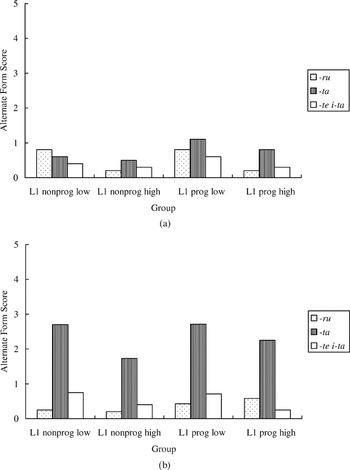
Judgment test: Distribution of alternative responses in (a) progressive context and (b) resultative context.
To summarize, the L1 progressive and nonprogressive groups showed similar results in their scores for the two meanings of -te i-ru. Regardless of L1, the learners responded more appropriately to progressive than to resultative meaning.
The Effect of Verb Types in Progressive Contexts.
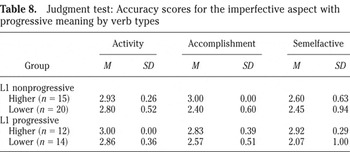
The second analysis examined the effect of inherent aspect of verbs in progressive contexts, comparing the scores of items with three aspectual categories of verbs: activity, accomplishment, and semelfactive. Table 8 shows the means and standard deviations.
Judgment test: Accuracy scores for the imperfective aspect with progressive meaning by verb types

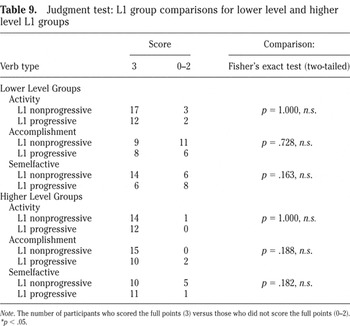
Because a number of participants scored the full number of points (3), we applied nonparametric tests to the analysis. According to the number of appropriate uses of each verb type, participants were divided into two groups: those who scored the full points (3) and those who did not. Fisher's exact test (two-tailed) revealed no significant difference between the two L1 groups for all verb types, either at the lower level or at the higher level (see Table 9).
Judgment test: L1 group comparisons for lower level and higher level L1 groups

To examine the effect of verb type, we combined the scores of the two L1 groups and performed Cochran's Q-test. At the lower level, the ratio of those who scored full points (3) versus those who did not (0–2) is 29:5 for activity verbs, 17:17 for accomplishment verbs, and 20:14 for semelfactive, which revealed a significant difference (p < .05, two-tailed). In contrast, at the higher level there was no significant difference between verb types, with ratios of 26:1 for activity verbs, 25:2 for accomplishment verbs, and 21:6 for semelfactive (p = .072, two-tailed). That is, the lower level learners found it more difficult to attach -te i-ru to accomplishment and semelfactive than activity verbs, but the higher level learners were able to handle them equally well.
In summary, the results show that for the low-level groups, the effect of inherent aspect is clear: It is easier to judge progressive use correctly for activities than for accomplishments or semalfactives, regardless of L1. For the high-level groups, an effect of verb types is not found.
Distribution of Alternatives to Imperfective Form.
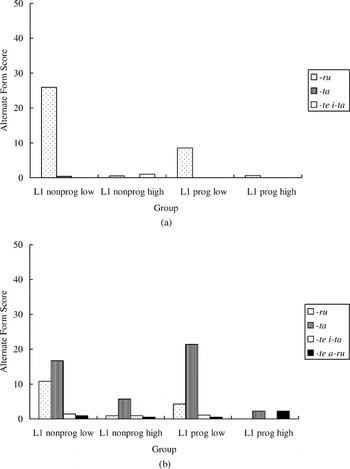
The third analysis looked at the distribution of the alternative responses to the same items, where -te i-ru (nonpast imperfective) was the target, including the three forms -ru (nonpast), -ta (past), and -te i-ta (past imperfective). Figures 2a and 2b show the frequency of choices for each context; responses reveal that the distribution of alternatives was different depending on the context. For progressive context (activity, accomplishment, and semelfactive), infrequent use was observed for the alternative forms, mostly less than one (out of nine; see Figure 2a), whereas for resultative state context (achievement), past form -ta was dominant in all groups (see Figure 2b). The third research hypothesis was supported in that there was an effect of inherent aspect on the learners' choice of alternative forms: Learners more strongly associated past form (-ta), rather than other alternatives, with resultative (achievement).
To summarize, the results from the judgment test support the aspect hypothesis in that the nonpast imperfective -te i-ru used with progressive meaning was strongly associated with activity verbs at the lower level, and the past marker was associated with achievement for both levels. The results also showed that the effect of L1 was almost nonexistent, which suggests that the aspect hypothesis might hold regardless of learners' L1.
Picture Description Task.
The picture description task was completed by 80 learners; however, to enable comparisons with the judgment test performance, we analyzed the data only from the learners who were included in the analysis of the judgment test. Two learners from the L1 nonprogressive group (one German and one Russian learner, both from the lower level group) were excluded because of a failure in recording. This resulted in 33 L1 nonprogressive learners (16 German, 12 Russian, 3 Ukrainian, 2 Bulgarian) and 26 L1 progressive learners (L1 English).19
To test whether the exclusion of the two L1 nonprogressive learners affected the equivalence of the two L1 groups in their proficiency in the domain of tense-aspect, we ran the same comparison on the results of the acceptability judgment test that we did for the previous section by excluding the two participants. The result was the same: t-tests did not reveal a significant difference between L1 groups at each level, thus ensuring the equivalence of the two L1 groups.
We first extracted all finite verb tokens in the matrix clause and coded them for their target contexts (i.e., progressive and resultative state meanings) and their morphological forms (e.g., -ru, -ta, -te i-ru).20
We excluded the following items from the analysis: (a) 469 tokens of state verbs in -ru/ta form, of which 441 tokens were either aru “to exist” (inanimate) or iru “to exist” (animate); (b) 34 tokens of acceptable use of -te a-(ru) construction (e.g., mon ga ake-te a-ru “a gate is open by design”); (c) 13 tokens of -tokoro (e.g., basu ni not-ta tokoro desu “has just gotten on the bus”); (d) six tokens of uninterpretable items. Items listed in (a) and (b) were excluded because they were not obligatory contexts of the -te i-ru form; items in (c) were excluded because the -tokoro construction can be used not only with -te i-ru but also with -ru/ta form to describe the pictures.
Using the linguistic tests for inherent aspectual categorization used by Shirai and Kurono (1998), we categorized all verb tokens used in resultative state and progressive contexts. It turned out that all resultative contexts involved achievement verbs, and that all progressive contexts involved activity, with the only exception being one state verb (two tokens) in a progressive context. This means that we can safely assume that as far as the analysis of the oral task is concerned, the comparison of two meanings (progressive vs. resultative state) can be equated with the comparison of two lexical aspect classes (activity vs. achievement).
The Effect of L1: Accuracy of Imperfective Form in Progressive and Resultative Contexts.
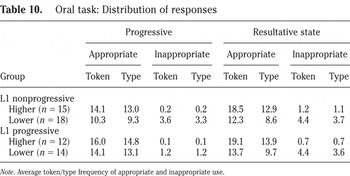
The first analysis compared SOC scores for progressive and resultative state contexts (i.e., where the correct form is -te i-ru and the intended meanings are progressive or resultative). Targetlike use analysis was not used because there was no overuse of the -te i-ru form. Appropriate attempts at nonpast imperfective included both targetlike uses (e.g., megane o kake-te i-ru “is wearing glasses,” resultative) and nontargetlike uses, including inflectional errors (e.g., *sui-te i-ru for sut-te i-ru “is smoking”) and misuse of transitive verbs instead of intransitive verbs (e.g., ake-te i-ru for ai-te i-ru “is open”). There were four types of inappropriate alternative form: nonpast -ru, past -ta, past imperfective -te i-ta, and a resultative state construction -te a-ru that describes a state caused by an intended action and is normally used only with transitive verbs (e.g., *sin-de aru for sin-de i-ru “is dead”). The details of the alternative verbal forms used by the learners are reported in the next subsection.
Table 10 shows average token and type frequency of appropriate and inappropriate use produced by each learner in each context. It is worth noting that there are large differences between token and type counts, especially in the appropriate use of resultative state contexts but not in that of progressive contexts. Taking the low-level group of L1 progressive as an example, the average appropriate use of -te i-ru in progressive contexts is 14.1 by token count and 13.1 by type count, whereas in resultative state, the average appropriate use is 13.7 by token but only 9.7 by type. This means that learners tended to repeatedly use the same verbs for resultative state contexts. For example, one learner from the lower level L1 progressive group used tat-te i-ru “is standing” six times and suwat-te i-ru “is sitting” three times [out of 24 tokens of resultative -te i-ru that he used]. It appears that this learner relied heavily on particular expressions of resultative state, which might skew the comparison of the two meanings of -te i-ru. Therefore, we chose to use type analysis rather than token analysis as a measure of productive control of -te i-ru.
Oral task: Distribution of responses

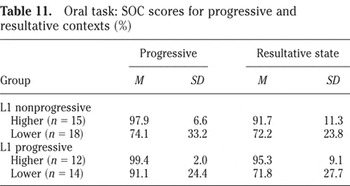
Table 11 shows the means and the standard deviations of the score in each context. Because a three-way repeated-measures ANOVA revealed a triple interaction, F(1, 55) = 4.305, p < .05, a two-way repeated-measures ANOVA was conducted for each level.21
Because Kolmogorov-Smirnov tests showed that the assumption of normality was met at the lower level but not at the higher level, we additionally ran nonparametric tests for the latter.
Oral task: SOC scores for progressive and resultative contexts (%)


Oral task: SOC scores for progressive and resultative contexts.
To summarize, the results of the oral task differed from that of the judgment test in that there was a triple interaction among L1, levels, and contexts. For the lower level groups, L1 nonprogressive learners did not show any preference for either of the two meanings of -te i-ru, whereas L1 progressive learners found progressive contexts easier. In contrast, the higher level learners of both L1 groups had more difficulty with resultative state meaning.
Distribution of Alternatives to Imperfective Form
The last analysis looked at the distribution of the alternative forms that the learners produced for each context in which they did not use the target form -te i-ru (nonpast imperfective). Figure 4a shows that for progressive contexts, the nonpast form -ru was mostly used as an alternative, and this is conspicuous for L1 nonprogressive learners at lower level proficiency (25.9%). Therefore, the significant difference between the two L1 groups found in the preceding analysis seems largely due to the overuse of nonpast form by German and Slavic speakers whose L1s do not have an obligatory progressive form, which suggests a strong effect of L1 influence.

Oral task: Distribution of inappropriate responses in (a) progressive contexts and (b) resultative contexts.
As Figure 4b shows, for resultative state meaning, the predominant alternative was the past form -ta, and this trend is particularly strong for lower level learners. This is consistent with the aspect hypothesis because, as mentioned previously, all resultative contexts are described by achievement verbs, which are predicted to be associated with past tense inflections, especially at early stages.
DISCUSSION
Answers to the Research Hypotheses
The two tasks reported in this article set out to test three hypotheses: (a) The presence or absence of a progressive marker in the learner's L1 will influence the acquisition of the two basic meanings (progressive and resultative states) of -te i-ru, (b) there will be interaction between inherent aspect and use of -te i-ru when it is used for progressive meaning, and (c) there will be an effect of inherent aspect on the learner's choice of alternative forms.
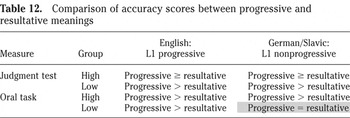
The major results of the two tasks are summarized in Table 12. As the table shows, most learners generally found progressive meaning easier than resultative meaning, consistent with previous studies. However, there is one cell (highlighted in the table) where there is no significant difference: lower level learners in the L1 nonprogressive group in the oral production task. How can we account for this finding?
Comparison of accuracy scores between progressive and resultative meanings

Regarding the first hypothesis—the effect of the L1—it was found that the L1 does have an effect on the acquisition of the two meanings (progressive and resultative states) of -te i-ru. For the lower level groups in the oral task, only the L1 progressive group showed higher accuracy for progressive, whereas the L1 nonprogressive group did not. This clearly shows that there is an effect of L1. However, this does not mean that the present study supports Shirai's strong version of L1 transfer. Shirai (2002, also Shirai & Kurono, 1998) proposed that if L1 transfer is the key to the early acquisition of progressive meaning for the Japanese imperfective marker -te i-(ru), learners without progressive marking in their L1 should not show such a tendency and both progressive and resultative will develop at the same time. This hypothesis was only supported for the lower level learners in the oral task. None of the other comparisons between the two L1 groups showed a significant difference. In particular, Shirai's L1 transfer hypothesis cannot explain the fact that even for the L1 nonprogressive group, progressive was easier (for the lower and higher level groups in the judgment test and the higher level group in the oral task). Therefore, an alternative explanation needs to be sought to account for the relative ease of progressive meaning.
The second hypothesis—whether the acquisition of the progressive meaning of the -te i-ru form is governed by inherent aspect, showing a spread from the prototype to nonprototypes—was clearly answered. In the judgment test, learners had a significantly higher score for activities plus -te i-ru than accomplishments or semelfactives, although in all of these cases, the meaning denoted is progressive. This clearly shows that learners are not only sensitive to the meaning that -te i-ru denotes (i.e., progressive vs. resultative) but also to the inherent aspect of the verbs.
Regarding the third hypothesis—the analysis of the competitors of imperfective -te i-ru—the judgment test revealed that for achievement, the past tense form -ta was dominantly chosen, whereas other verb classes (activity, accomplishment, and semelfactive) showed no such dominant alternate. Also, in the oral task, the most predominant competitor of -te i-ru for achievements was the past tense -ta. This response pattern for -ta in two studies constitutes clear support for the aspect hypothesis.
The results summarized here support the validity of Smith's five-category system. Semelfactive is categorized as achievement in Vendler's four-way classification, but it differs from the rest of the achievement category in that semelfactives do not have end points (i.e., they are atelic), and this difference did affect the learners' choices of aspectual form. This suggests that the five-way classification is more sensitive to learner data than the four-category system that is dominant in current aspect hypothesis research.
Toward an Explanation of the Initial Form-Meaning Mapping
Why Is L1 Transfer Observed Only in the Oral Task?
In the oral picture description task, although the L1 nonprogressive learners at the higher level and the L1 progressive learners predominantly associated the Japanese imperfective aspect marker with activity verbs (denoting progressive), the lower proficiency L1 nonprogressive learners did not show any such preference. That is, the results from the oral task do not support Collins's (2002) finding that L1 influence does not override the effect of lexical aspect. However, it was found that L1 transfer was evident only in the oral production task, not in the judgment task. How can we interpret the discrepancy between the two tasks?
The effect of task variation in the acquisition of tense-aspect was already reported elsewhere (e.g., Bardovi-Harlig, 199822
The results of this study are consistent with previous tense-aspect research, which also found an interaction of modality (oral vs. written) with inherent aspect. Bardovi-Harlig (1998) reported that the rate of appropriate use for the oral narratives was somewhat lower overall than that for the written narratives and, in particular, the ratio of past marking was especially lower in the spoken narrative for activity and accomplishment verbs. It appears that learners have more difficulty using past tense form in a spoken task, which requires procedural knowledge.
This theory of automatized knowledge might explain why the lower proficiency learners of the L1 nonprogressive group performed equally for progressive and resultative meanings in the oral task. They had neither L1 procedural knowledge nor sufficient L2 procedural knowledge, whereas the L1 progressive groups could use their L1 procedural knowledge for progressive meaning. Because the interlanguage knowledge of the higher proficiency learners had become more automatized, the influence of the L1 was not found. This also explains Sugaya's (2003) evidence against the universal pattern (in that the learner did not show early acquisition of progressive meaning) because it came from spontaneous oral production data from a novice Russian learner (L1 nonprogressive). It appears that L1 influence in the domain of tense-aspect is only evident in tasks for which procedural knowledge is required and at early stages of acquisition.
However, due to the fact that the participants in this study were intermediate and advanced learners, we could not capture the beginning stage. It is possible that less advanced learners would show the effect of L1 even on tasks with no time pressure. Alternatively, a number of studies showed that L1 influence is developmentally constrained in that it only occurs when the learner has reached a particular stage (Collins, 2002; Wode, 1978; Zobl, 1980). If this is the case for the acquisition of -te i-(ru), L1 progressive learners and L1 nonprogressive learners might show the same pattern at the beginning stage, when they cannot handle verbal inflection well. Further investigation should include novice learners and examine how L1 works along developmental stages.
Why Is Progressive Meaning Generally Easier?
Given that the claim of an L1 effect is partially valid, we still need to explain why L2 learners of Japanese—even those whose L1 does not have a progressive marker—generally find progressive meaning easier. In other words, we need to ask: Where do the prototypes (achievement for past and activity for progressive) come from? Shirai and Kurono (1998) discussed various possible reasons for the early acquisition of progressive meaning over resultative state in the acquisition of -te i-(ru).
One possible reason they mentioned is the effect of L1 transfer. However, the present results suggest that L1 transfer cannot be the whole story because even the L1 nonprogressive learners found progressive meaning easier in most cases (i.e., the lower level learners in the judgment task and the higher level learners in both tasks), nor can input frequency (the distributional bias hypothesis; Andersen & Shirai, 1994) fully explain the results obtained in this study because Japanese NSs appear to use the resultative state meaning more often than the progressive meaning (Shirai & Nishi, 2005). What other factors, then, contribute to learners' form-meaning mapping in the acquisition of tense-aspect?
The most plausible explanation invokes the functioning of cognitive mechanisms, such as the one-to-one principle (Andersen, 1984), which states that language learners generally prefer to assign one meaning to one form. As Shirai and Kurono (1998; see also Shirai, 1993) suggested, the initial restriction of -te i-(ru) to action in progress meaning might be due to the existence of the alternative forms -ta and -te-a-(ru) in Japanese to refer to result state.23
Although -te a-(ru) was not mentioned in Shirai and Kurono (1998), the results from the oral production task indicate that -te a-(ru) is an important alternative form for the resultative use of -te i-(ru).
Additionally, as the results of the lower level English NSs in the oral task indicate, an obligatory progressive marker in the L1 appears to contribute to ease of progressive use of -te i-(ru). This explanation is also consistent with the observation in the judgment test that the higher level groups performed equally well in judging progressive and resultative meanings, at least in the initial analysis. Because their level of acquisition was quite high, they had probably already passed the stage of one-to-one mapping and moved on to the level where they can handle one-to-many mappings. This was not the case in the oral task, probably because the task required relatively automatized control of the aspectual form and, thus, even the higher level learners found the resultative meaning to be more difficult.
Is the Progressive Advantage Universal?
Having accepted that progressive meaning of -te i-(ru) is generally easier, we should also keep in mind that this advantage of progressive meaning over resultative meaning might not hold universally in all learning situations. Rather, we should treat the progressive advantage that stems from simple form-meaning mapping in the use of -te-i-(ru) as one factor among many—although it is a strong one inherent in the organization of the Japanese aspectual system. This is because such a progressive advantage can be overridden if other factors are dominant. As the oral task shows, the lower level learners without progressive marking in their L1 did not show any progressive advantage. Furthermore, as mentioned earlier, Ishida's (2004) conversational data from L1 progressive learners (English and Chinese) showed higher accuracy for resultative use of -te i-(ru) over its progressive use, which contradicts the findings of most previous studies (e.g., Shirai, 2002; Shirai & Kurono, 1998).
It is noteworthy that all of the counterevidence to the progressive advantage in the Japanese data comes from oral production data (i.e., Ishida, 2004; Sugaya, 2003). This task variation appears to be congruent with findings from L2 English. Shirai's (2004) comprehensive review of tense-aspect acquisition in L2 English pointed out that studies using production data, whether oral or written, did not always follow the prediction of the aspect hypothesis in that for some studies, the effect of inherent lexical aspect was strongest not at the beginning stage but at the intermediate level. Shirai attributed the deviation to the use of rote-learned forms in production data. That is to say, when pushed to perform beyond their capacity, L2 learners at lower proficiency levels might haphazardly produce high-frequency forms before the actual relationship between the morphological form and its meaning is acquired.24
Salaberry (2000) also reported that his classroom L2 Spanish learners' use of past tense marker (preterit) was not limited to telic verbs at early stages. However, his view is that it is used as default past tense marker, which does not necessarily assume the interpretation proposed here (i.e., high-frequency forms produced haphazardly). This issue has to be settled in future research.
The use of rote-learned forms might have affected the current Japanese data as well. In this study, the only group that showed no progressive advantage was the L1 nonprogressive low-level learners on the oral task. This group perhaps produced rote-learned forms they encountered often (e.g., tat-te i-ru “is standing”), resulting in no advantage of progressive meaning, whereas in other cases, their semantic representation was reflected in the higher accuracy scores for progressive meaning. Although the role of rote learning is an important issue in the area of the acquisition of tense-aspect (Bardovi-Harlig, 2002a; Housen, 2002; Shirai, 2004), its effect remains unclear thus far and merits further research.
CONCLUSION
In this study, we attempted to test the effect of inherent aspect and the learner's L1 on the acquisition of the Japanese imperfective aspect marker through two controlled experiments. Our findings suggest that the effect of L1 might contribute to the formation of acquisition patterns predicted by the aspect hypothesis but that this acquisition might be mediated by task type and L2 proficiency. The results of the acceptability judgment test from the L1 progressive and nonprogressive groups support the aspect hypothesis in that the imperfective marker was strongly associated with activity verbs at the earlier stage of acquisition. However, the results from the oral task showed a discrepancy in the prediction. In the oral task, the L1 nonprogressive learners with higher proficiency and all L1 progressive learners (regardless of proficiency) predominantly associated the Japanese imperfective aspect marker with activity verbs, but the lower level L1 nonprogressive learners did not show any such preference. This suggests that the effect of L1 is valid when L2 procedural knowledge is insufficient, but it does not work at later stages or for tasks for which procedural knowledge is not required.
This is a significant contribution toward an explanation of the acquisition pattern posited by the aspect hypothesis. Based on our study, we can safely conclude that there is L1 transfer to some degree but that it is not the key determinant of the observed pattern in form-meaning association in the acquisition of tense-aspect markers.
Apart from the effect of L1, we discussed various possibilities for the observed acquisition patterns. Distributional bias, which Andersen and Shirai (1994) offered as an important explanation, does not appear to work for Japanese. Currently, we assume that the one-to-one mapping that learners prefer to make in grammar acquisition is the key to the explanation for the ease of progressive meaning in the acquisition of -te i-(ru). This will be further mediated by other factors, such as the elicitation procedure (as in the present study) or input distribution (Ishida, 2004). A full understanding of the interaction of various factors waits to be established through future studies.
One final issue that we need to address in order to answer the question of where the prototypes come from is the possible role of a universal predisposition (Slobin, 1985) or an innate mechanism (Bickerton, 1981) in the acquisition of grammatical functors. Slobin and Bickerton both presupposed that learners look for some grammaticizable notions with special privileged status and map grammatical morphemes onto such special notions—in this case, notions such as punctuality, or telicity, or the lack thereof.25
Slobin has since changed his position and is now skeptical of such a universal predisposition (e.g., Slobin, 1997).
Is such a universal predisposition at work in L2 acquisition? If it is, then it nicely explains the observation that regardless of the learner's L1 and regardless of input frequency, L2 learners of Japanese prefer to assign progressive meaning rather than resultative meaning to its imperfective marker. However, it is clearly at odds with Ishida's (2004) study, in which learners had more difficulty with progressive meaning than with resultative meaning. Because this preference can be explained by the learner's tendency to form one-to-one mapping—as argued in this article—for the sake of parsimony, we will not resort to such an explanation.
APPENDIX A: SAMPLE TEST ITEM
(1) Original Kana version given to the participants

(2) Romanized version and gloss

Note. COP = copula, FP = final particle, IMP = imperfective aspect marker, LOC = locative marker, NOM = nominative marker, NONPAST = nonpast tense marker, PAST = past tense marker, Q = question particle. The correct answer is C for this test item. The verb-ending forms used in the test items are -masu and -masita, polite forms for nonpast -ru and past -ta. The learners were more familiar with this form because the polite style is usually introduced earlier in classroom settings.
APPENDIX B: TARGET VERBS FOR PROGRESSIVE AND RESULTATIVE STATE CONTEXTS IN THE JUDGMENT TEST

APPENDIX C: PICTURES FROM THE ORAL TASK

APPENDIX D: VERBS PRODUCED MOST FREQUENTLY BY LEARNERS ON THE ORAL TASK