INTRODUCTION
One of the central issues in the acquisition of language is determining how and when grammatical morphemes are acquired. This is often a challenge given children's variable realization of grammatical morphemes, raising questions about their early syntactic competence. The study of this issue is further complicated by the absence of early longitudinal data, the lack of quantitative analysis and uncertainty as to how to treat phonologically-reduced ‘filler’ syllables (e.g. Peters, Reference Peters1983). Each of these issues has become more tractable as longitudinal data from the early stages of language development become more readily available. It is now possible to address the theoretically more interesting question of whether the variable production of certain grammatical morphemes is due to children's limited processing capacity, to the maturation of syntactic representations, to constraints on the interpretation of grammatical morphemes or to prosodic constraints on children's early outputs. The last is the focus of this study.
There is a large literature indicating that prosodic constraints play a significant role in determining the variable production of grammatical morphemes (e.g. Demuth, Reference Demuth and Meisel1992, Reference Demuth, Lust, Suñer and Whitman1994; Gerken, Reference Gerken1994, Reference Gerken1996; Lleó & Demuth, Reference Lleó, Demuth, Greenhill, Littlefield and Tano1999). The basic claim is that children's first grammatical morphemes appear in prosodically licensed positions, typically as part of a binary foot, and that grammatical morphemes that cannot be prosodified as such are omitted from children's early speech. Prosodic constraints thus provide a framework for making predictions about the contexts in which grammatical function items are most likely to appear in children's early productions.
The present study investigates the role of prosodic constraints on the development of determiners in early French. We will show that children's French determiners appear first with monosyllabic words, and only later with di- and trisyllabic words, suggesting that determiners are prosodically licensed in French. We will also demonstrate that individual variation between the children's determiner production can be understood in terms of their differential access to prosodic structure, with some children initially accessing higher-level prosodic structures than others.
The paper is organized as follows. First, we review the literature on the prosody–morphology interactions and the development of French determiners. Second, we discuss the prosodic structure of French determiners and explain why determiners should be expected to be produced earlier with monosyllabic than with di- and trisyllabic words. Third, we describe the methodology of the study and present its results. Finally, we conclude with a discussion of the implications of these findings for understanding the development of early grammars.
Prosodic constraints on the production of grammatical morphemes
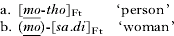
In an attempt to address the limitations of syntactic accounts, Demuth (Reference Demuth and Meisel1992, Reference Demuth, Lust, Suñer and Whitman1994) proposed that some of children's variability in the use of grammatical morphemes could be understood in terms of prosodic constraints on children's early productions. Using longitudinal data from the Bantu language Sesotho, she proposed that noun class prefixes are more consistently produced with monosyllabic noun stems, forming a disyllabic trochaic foot (1a), but tend to be omitted when the nominal stem already has two syllables, where the noun class prefix is left unfooted (1b). That is, the variable production of noun class prefixes is systematic, being prosodically licensed when part of a foot. Recent quantitative analysis has shown that these prosodic constraints last in Sesotho until around the age of 2 ; 3 (Demuth & Ellis, Reference Demuth, Ellis, Guo, Lieven, Ervin-Tripp, Budwig and Nakamurain press).
(1)

Using elicited production tasks, Gerken (Reference Gerken1996) has similarly shown that the variable production of early English determiners (and pronominal subjects) can be partially explained by the different metrical or rhythmic contexts in which these appear. According to Gerken (Reference Gerken1996), English determiners are more likely to be produced when they can be prosodified as part of a strong–weak (Sw) trochaic foot. In contrast, determiners are more likely to be omitted when they appear in weak, unfooted syllables. She claims that this explains why children are better at producing the footed determiner in (2a) than the unfooted determiner in (2b). Similar findings were recently reported by Demuth, McCullough and Adamo (Reference Demuth, McCullough, Adamo, Bamman, Magnitskaia and Zaller2007) in their longitudinal study of five children acquiring English.
(2)
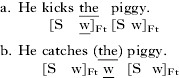
Since the words preceding the determiner in (2b) contain one more syllable than the words preceding the determiner in (2a), one could argue that determiners in sentences like (2b) are omitted more often due to processing limitations (although such an account would not provide a principled explanation for why the determiner, and not another word, is omitted). However, Demuth et al. (Reference Demuth, McCullough, Adamo, Bamman, Magnitskaia and Zaller2007) showed that the contexts in which English determiners were spontaneously produced were actually longer than the contexts in which determiners were omitted. This is in part due to the fact that, in English, footed determiners must prosodify with the preceding word, as in (2a). Furthermore, in Spanish, it has been found that children often produce a determiner at the cost of omitting a syllable from the following lexical item (e.g. la muñeca [aˈmeka] ‘the doll’) (Demuth, Reference Demuth, Weissenborn and Höhle2001a). This suggests that word length per se cannot account for the variable appearance of determiners (otherwise the child would produce the lexical item muñeca and omit the determiner).
Further support for the view that children's earliest grammatical function items are prosodically licensed comes from recent investigations of prosodic constraints on the realization of inflectional morphemes. For example, Song and Demuth (in preparation) showed that one- to three-year-olds exhibit significantly worse production of third person singular -s when the morpheme is preceded by a consonant than when it is preceded by a vowel (e.g. looks /lʊks/ vs. sees /siz/). Furthermore, Bortolini and Leonard (Reference Bortolini and Leonard2000) found that children with Specific Language Impairment (SLI) were more likely to omit unfooted grammatical morphemes (e.g. the car) and grammatical morphemes realized as consonants in word-final position (e.g. climbed,) than did control children. Similarly, Marshall (Reference Marshall2004) found that when syllable complexity increased at the end of the word (i.e. no coda consonant, single coda consonant, complex coda cluster), SLI children had increased difficulty in producing past tense morphemes (e.g. sewed /soʊd/, yelled /jεld/, danced /dænst/). This suggests that phonotactic or syllable structure constraints may also account for some of the variable production of word-final grammatical morphemes. We now turn to a discussion of French, reviewing some of the previous findings on the development of determiners.
The development of French determiners
Veneziano and Sinclair (Reference Veneziano and Sinclair2000) examined the development of a French-speaking child who showed extensive use of ‘filler’ syllables before nouns and verbs between the ages of 1 ; 7 and 1 ; 10. They claim that these are initially premorphological prosodic placeholders that serve the function of lengthening the utterance. These then become protomorphemes, with 60% being morphophonologically well-formed by the age of 2 ; 3. The authors also note that between the ages of 1 ; 8 and 1 ; 10, the majority of fillers occurred before monosyllabic rather than multisyllabic words. Similar findings are reported for the first productions of nouns by French-speaking children with cochlear implants (Hilaire, Régol & Jisa, Reference Hilaire, Régol and Jisa2002). This suggests that fillers and protomorphemes are also prosodically licensed in French. The fact that almost half of French children's target words are monosyllabic (Demuth & Johnson, Reference Demuth and Johnson2003) would then help explain the large number of fillers and protomorphemes, yielding wS iambic feet (cf. Vihman, DePaolis & Davis, Reference Vihman, DePaolis and Davis1998).
Consistent with this hypothesis is Kupisch's (Reference Kupisch2004) study of French–German bilinguals, which found that children acquired French determiners around the age of 2, but German determiners somewhat later. Although the sample was small, these results seem to confirm findings reported elsewhere in the literature that French determiners are learned early and easily, even in language-delayed populations (e.g. Jakubowicz & Nash, Reference Jakubowicz and Nash2001). This is expected if we assume that early French determiners combine with monosyllabic words to form wS iambic feet. We suggest that the later development of German determiners is due to the fact that they must be prosodified as a separate prosodic word (Lleó & Demuth, Reference Lleó, Demuth, Greenhill, Littlefield and Tano1999). This is not to say that the semantics of bare nouns, for example, may have no effect on the acquisition of determiners (e.g. Chierchia, Reference Chierchia and Rothstein1998), but that these semantic effects will be manifested at later stages of development.
Further support for a prosodic explanation comes from Bassano and Maillochon (Reference Bassano and Maillochon2005). These authors conducted a cross-sectional study of French-speaking children's spontaneous production of determiners at 1 ; 6, 2 ; 6 and 3 ; 3 years, examining these for possible interactions with prosodic (word length) and semantic (animacy) factors. Determiners were produced in obligatory contexts with 38%, 75% and 95% accuracy across the three age groups respectively. Critically, prosodic constraints were found with the 1 ; 6 age group, where both determiners and fillers were produced more frequently with monosyllabic words than with multisyllabic words. In contrast, animacy effects were found with the 2 ; 6 age group, with more determiners used with inanimate nouns. The authors concluded that both lexical and prosodic factors play a role in explaining the patterns of determiner development, with prosodic licensing affecting early stages of acquisition, and semantics playing a more important role later.
Tremblay (Reference Tremblay, Deen, Nomura, Schulz and Schwartz2006) also investigated the role of prosodic constraints on the production of determiners in early French. Data were drawn from the longitudinal spontaneous interactions of a normally-developing French Canadian child, Max (1 ; 9–2 ; 3; Plunkett, Reference Plunkett, Pusch and Raible2002). The production of determiners preceding monosyllabic versus disyllabic nouns was compared. The results showed that Max omitted many more determiners with disyllabic nouns than with monosyllabic nouns until the age of 2 ; 2. This is consistent with the findings reported above, suggesting that French determiners must be prosodically licensed before they can be produced.
Taken together, the foregoing results suggest that early French determiners are more likely to appear in prosodically-licensed positions, resulting in phonologically-conditioned variability in the production of French determiners. If this analysis is correct, then the prosodic constraints in French must be somewhat different from those found in English, German, Sesotho and Spanish, which all have S(w) trochaic feet. French is generally considered to have word-final or phrase-final prominence, but there is some controversy as to whether prominence is a domain edge marker (e.g. Jun & Fougeron, Reference Jun, Fougeron and Botinis2000; Mertens, Reference Mertens1993) or the instantiation of a (non-iterative) (w)S iambic foot in the language (e.g. Charette, Reference Charette1991; Scullen, Reference Scullen1997; see Selkirk, Reference Selkirk1978 and Montreuil, 2002 for alternative, trochaic foot accounts). For the purpose of this study, we assume that French has an iambic foot. We now turn to a discussion of the prosodic structure, and show why we expect French determiners to occur earlier with monosyllabic than with di- and trisyllabic words.
THE PROSODIC STRUCTURE OF FRENCH DETERMINERS
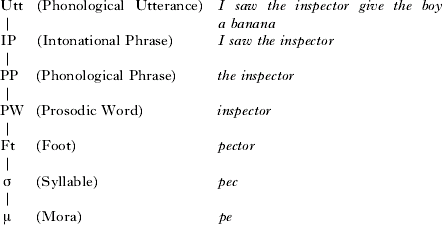
The different levels of prosodic structure can be captured in terms of the Prosodic Hierarchy, shown in (3) (Selkirk, Reference Selkirk1984; Nespor & Vogel, Reference Nespor and Vogel1986).
(3) The prosodic hierarchy
Selkirk (Reference Selkirk, Morgan and Demuth1996) provides a ‘typology’ of prosodic structures that grammatical function items may assume. These are presented graphically in (4), where fnc represents (closed-class) grammatical functional items, and lex (open-class) lexical items.
(4) The prosodic structure of grammatical function items

She shows that the prosodic representation of function items varies from language to language, as well as within a language, depending on the prosodic characteristics of a given grammatical morpheme. For example, in English, stressed auxiliaries and pronouns (e.g. we CAN, HE knows) are themselves Prosodic Words (PWs), and combine with lexical items at the level of the Phonological Phrase (PP) (4a). However, unstressed prepositions, articles, auxiliaries and pronouns typically take the structure in (4b), where the function word is prosodified at the level of the PP (e.g. to Boston, a message, can cook, his picture), except when they cliticize onto a lexical item, in which case they take the affixal structure in (4d) (e.g. need'm). Function words in English generally do not prosodify as internal clitics (4c), though Gerken (Reference Gerken1996) suggests this analysis for the determiners in (2a).
We similarly assume for French that stressed function words (e.g. stressed numerals and strong pronouns such as DEUX chats ‘TWO cats’ and il le veux LUI ‘He wants IT/HE wants it’) form their own PW and combine with lexical items at the level of the PP (4a). In contrast, function words that cliticize onto a lexical item (e.g. subject and object clitics such as Il veut partir ‘He wants to leave’ and Jean le veut ‘Jean wants it’) prosodify as affixal clitics (4d). As for determiners, it has been proposed that these function words prosodify as free clitics at the level of the PP (4b) when they precede a consonant-initial word (e.g. le chat ‘the cat’) (e.g. Goad & Buckley, Reference Goad and Buckley2006), but prosodify as internal clitics (4c) when preceding vowel-initial monosyllabic and disyllabic words (e.g. l'eau ‘the water’; l'orange ‘the orange’). This means that there is some evidence in the adult French input that determiners can be prosodified inside the foot.
Goad and Buckley (Reference Goad and Buckley2006) explore word minimality effects in the study of Clara, a child learning Canadian French (cf. Rose, Reference Rose2000). Unlike English, where vowels are either long (tense, bimoraic) /i, e, ɑ, o, ɔ, u/ or short (lax, monomoraic) /æ, ʊ, ε, ɪ, ʌ/, most vowels in French are short, contributing only one mora of prosodic structure to the syllable. Thus, a word with only a consonant and vowel (CV), of which there are many in French, is typically monomoraic, or subminimal (i.e. less than a binary (bimoraic) foot). Goad and Buckley (Reference Goad and Buckley2006) argue that Clara exhibits compensatory lengthening of monomoraic words (CV>CV:), producing bare lexical items as binary feet rather than as subminimal, monomoraic CV words (e.g. [ne:], nez ‘nose’). They therefore claim that determiners occurring with monosyllabic target words (e.g. le nez ‘the nose’) are always prosodified as free clitics at the level of the PP, as in (4b). As they indicate, analyzing early determiners as free clitics has the advantage of proposing a prosodic structure that is isomorphic to the syntactic structure of these function words, where the determiner is a separate word from the noun in both cases. However, this analysis is problematic: if French determiners are always prosodified as part of the PP, and the child's lexical items always constitute at least a binary foot, then one would predict that determiners would appear concurrently with both monosyllabic and disyllabic words. But Clara's first determiners appear with monosyllabic target words, consistent with previous reports. This calls into question Goad and Buckley's proposal that Clara's early CV words are actually CV: binary feet. Since no acoustic analysis is provided, it is difficult to assess this claim. We therefore suggest that the child may be prosodifying her early determiners as part of the foot, as in (4c). This analysis would be consistent with much of the literature showing earlier use of grammatical function items that constitute part of a binary foot (e.g. Demuth, Reference Demuth and Meisel1992, Reference Demuth, Lust, Suñer and Whitman1994; Gerken, Reference Gerken1996). Such an analysis would also help explain some of the early variability found in the production of French determiners, including their earlier occurrence with monosyllabic words.
The purpose of the present study is therefore to investigate possible prosodic explanations for the early variability reported in the production of determiners in French. Given the distribution of monomorphemic word shapes in French, we expect determiners to appear earlier with monosyllabic than with di- or trisyllabic words, resulting in binary iambic (wS) feet. This presumes that determiners will be prosodified as part of the foot rather than at a higher level of prosodic structure. To our knowledge, no longitudinal study has yet examined the role of prosodic constraints on the development of determiners by children acquiring European French. The present study therefore examines the development of determiners in two children from Lyon, France.
METHOD
Participants
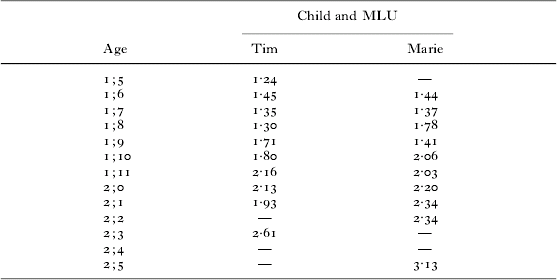
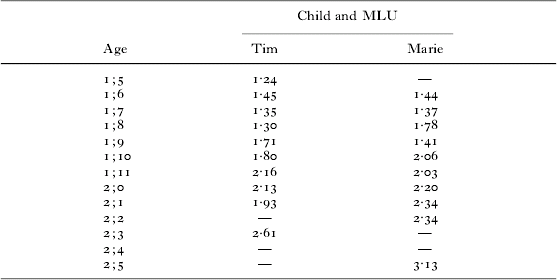
The participants in this study are two normally-developing French-speaking children from the Lyon Corpus (http://childes.psy.cmu.edu/data/Romance): Tim (1 ; 5–2 ; 3) and Marie (1 ; 6–2 ; 5). The children had no clinically-diagnosed neurological, motor control, language or hearing deficits at the time of the recordings, and French was the only language they heard in their environment. Tim was extremely precocious in terms of vocabulary development, performing at the 90th percentile on the French MacArthur CDI (Kern, Reference Kern2003) at 1 ; 5 and every month thereafter. Marie was more average, performing at the 50th percentile at age 1 ; 4 and 1 ; 6. The children's ages and corresponding word-based Mean Lengths of Utterance (MLUs) are provided in Table 1.
Participants' ages and MLUs (Mean Lengths of Utterance)
Data collection and transcription
The data were collected by members of the Dynamique du Langage at the University of Lyon 2 in Lyon, France. The children and their parents (usually the mother) were video-recorded in their homes in Lyon for approximately one hour every two weeks. Missing recording sessions were typically due to August vacations. The research assistant normally left after setting up the recording equipment to ensure that child–parent speech interactions would be as natural as possible. The child and parent were video-recorded with a small Panasonic PV-DV601D-K mini digital video-recorder placed on a tripod. Each wore a wireless Azden WLT/PRO VHF lavalier radio microphone pinned to the collar. The child's radio transmitter was placed in a child-sized bear-shaped pack that the child wore around the waist, and the radio receiver was attached to the top of the video camera. Since the microphones were wireless, the child and parent could move about freely.
The video recordings were then downloaded onto a computer, and both child and parent utterances were orthographically transcribed by trained transcribers of the Dynamique du Langage at Lyon 2 using CHILDES conventions (MacWhinney, Reference MacWhinney2000). The child speech was then also transcribed using broad phonemic transcription. A combination of linguistic context, phonetic match and visual information from the video was used to identify the child's target words (see Vihman & McCune, Reference Vihman and McCune1994, for similar procedures). Only the target words for which the transcriber had at least a 95% confidence level were included in the present analysis. A second transcriber phonetically re-coded at least 10% of each child's utterances for each one-hour session. The average between-coder phoneme-for-phoneme reliability was 91·42% for Tim and 89·3% for Marie.
Coding procedures
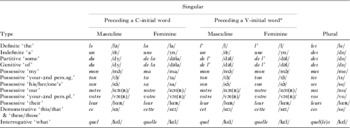
In order to examine the development of determiners, we first identified and extracted from the database all instances of nouns (e.g. le chat ‘the cat’) and nominal adjectives (e.g. le gros ‘the big one’) that should be preceded by a determiner in the adult grammar. The results were then calculated as the number and percentage of determiners used in obligatory contexts. Excluded from the analyses were all nouns and nominal adjectives that did not require a determiner, all noun phrases in which the noun or nominal adjective was unclear and all instances in which it was acoustically not clear if what preceded the noun or nominal adjective was a determiner. Repetitions were counted once for every different phonetic realization. All French determiners were included in the study. A list of their target phonemic forms is provided in Table 2.
French determiners and target phonemic forms (C=consonant; V=vowel)

a Note: Several French determiners lose their vowel in front of vowel-initial singular words.
Determiners were coded as target-like if all of their segments were phonologically accurate, with a few exceptions: the outputs [lø] and [lœ] and the outputs [dø] and [dœ] were accepted as target-like instances of /lə/ le ‘the-masculine singular’ and /də/ de ‘some/of,’ respectively; similarly, the outputs [ ] and [
 ] were accepted as target-like instances of /
 / un ‘a-masculine singular’. These exceptions were made because, in continuous speech, it is difficult to distinguish between [ø], [œ], and [ə], on the one hand, and between [], [], and [], on the other. All prenominal vowels which cliticized onto the noun (i.e. weak vowels not separated from the noun by a pause), including CV determiners whose consonant had been dropped and the nasal consonants [n] and [m], were classified as determiner fillers if the context provided clear evidence that they were instances of determiners (e.g. [əˈpul] for /ynˈpul/ une poule ‘a-feminine singular hen’ (Tim, 1 ; 8); [aˈliv] for /ˈlivʀ/ un livre ‘a-masculine singular book’ (Marie, 2 ; 2)). We assume that prenominal fillers are proto-determiners from their very early occurrences, because several studies have convincingly shown that filler syllables rarely occur in syntactically-illicit positions, therefore being subject to similar syntactic constraints as their phonologically target-like counterparts (Bottari, Cipriani & Chilosi, Reference Bottari, Cipriani and Chilosi1993/Reference Bottari, Cipriani and Chilosi1994; Tremblay, Reference Tremblay, Brugos, Clark-Cotton and Ha2005; though see Veneziano & Sinclair, Reference Veneziano and Sinclair2000, for the view that early filler syllables are prosodic placeholders). The few instances in which it was not clear if the prenominal vowel was a filler or the first syllable of the nominal (e.g. [ə] in [əˈpo] standing for /ləʃaˈpo/ le chapeau ‘the-masculine singular hat’) were excluded from the analyses. This decision was made (in contrast to some of the previous studies, e.g. Veneziano & Sinclair, Reference Veneziano and Sinclair2000) because the children's segmental accuracy might not be sufficiently high for them to be able to accurately produce the vowel in the initial, unstressed syllable of multisyllabic nominals. All other CV(C) determiners with one (or more) inaccurate segment(s) were coded as non-target-like determiners if the context provided clear evidence that they were instances of determiners and if they were not separated from the nominal by a pause (e.g. [lɔˈli] for /ləˈli/ le lit ‘the-masculine singular bed’ (Tim, 1 ; 10); [doˈle] for /dyˈlε/ du lait ‘some-masculine singular milk’ (Marie, 2 ; 2)).
Nouns, nominal adjectives and prenominal adjectives were then coded for their initial segment (C vs. V) and the number of syllables in the target word. In French, the final latent consonant of function words is pronounced when the initial segment of the following content word is a vowel (e.g. les années /lezaˈne/ ‘the-plural years’). This process of liaison sometimes causes segmentation problems with children acquiring French. For example, a few nouns and nominal adjectives in Tim's and Marie's data consistently showed liaison despite the absence of a determiner (e.g. [not] for /otʀ/ autre ‘another one’ (Tim, 1 ; 10; Marie, 1 ; 11)). Because these words appeared to have been lexicalized with the word-initial consonant, instances of liaisons without a determiner were not counted as instances of determiners when the consonant-initial noun or nominal adjective did not alternate with the vowel-initial form. Since similar segmentation problems can potentially occur with vowel-initial nouns and nominal adjectives preceded by a determiner (e.g. l'eau [lo] ‘the-singular water’ (Tim, 1 ; 6); d'autres [dot] ‘some more’ (Marie, 1 ; 9)), we also excluded these from the analyses when they did not alternate with the vowel-initial form of the noun or nominal adjectives, or when they did not alternate with another determiner.
Predictions
Recall that Veneziano and Sinclair (Reference Veneziano and Sinclair2000) found extensive use of filler syllables between the ages of 1 ; 7–1 ; 10. We therefore expect to find a similar developmental pattern. As in Demuth and Johnson (Reference Demuth and Johnson2003) and Goad and Buckley (Reference Goad and Buckley2006), we also expect to find that trisyllabic monomorphemic words are truncated to disyllabic or monosyllabic outputs, showing that early lexical items are prosodically constrained to at most a foot of structure. Finally, as in previous studies, we expect earlier and greater use of determiners and determiner fillers with monosyllabic words. Such findings would provide support for the position that early determiners are most likely to appear in prosodically-licensed contexts.
RESULTS
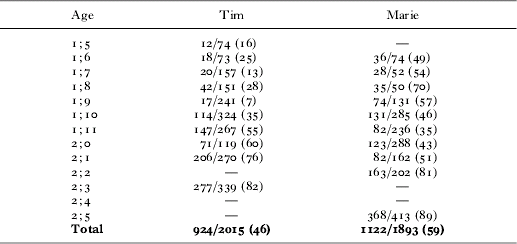
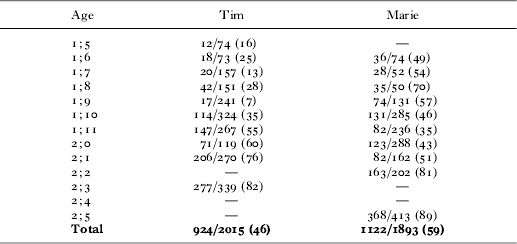
Table 3 presents both children's overall production of determiners (including target-like, non-target-like and filler determiners), showing number and percent use in obligatory contexts. Tim exhibits only 25% determiner use in obligatory contexts at 1 ; 6, gradually increasing to 82% determiner production by 2 ; 3. In contrast, Marie already shows 49% use of determiners in obligatory contents at 1 ; 6, and this rises to 89% by 2 ; 5. However, she also exhibits an interesting U-shaped development of determiners, dropping to a lower percentage of determiner production at 1 ; 11–2 ; 0 before rapidly improving. We examine the children's production of determiners in more detail below.
Total number (percent) of determiners produced in obligatory contexts
Target-like, non-target-like and filler determiners
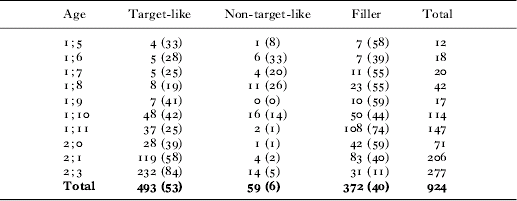
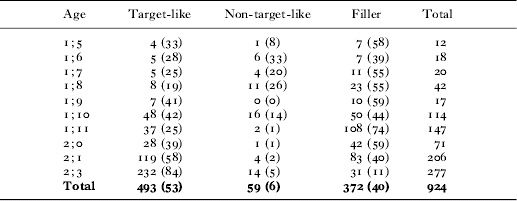
Table 4 provides a breakdown of the number and percent of target-like, non-target-like, and filler determiners in Tim's productions. Before 2 ; 1, Tim's phonological accuracy on determiners is poor, with most of them being realized as fillers. By 2 ; 1 his determiners are consistently more target-like (58%), and this increases to 84% by 2 ; 3. As has been found for other French-acquiring children (e.g. Veneziano & Sinclair, Reference Veneziano and Sinclair2000), the overall proportion of fillers in Tim's data is high (40% of all determiners used).
Tim's number (percent) of determiners produced by type
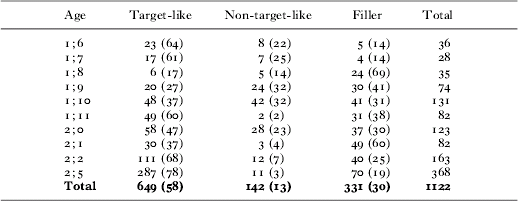
Recall that Marie's production of determiners was initially much higher than Tim's, but that she also showed a U-shaped developmental curve (Table 3). Table 5 shows that, in contrast to Tim, her earliest determiners (1 ; 6–1 ; 7) tended to be target-like. She then began to produce a higher proportion of fillers, with target-like productions increasing again at 2 ; 2.
Marie's number (percent) of determiners produced by type
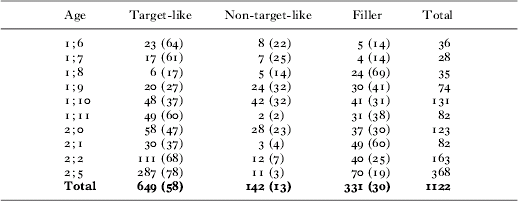
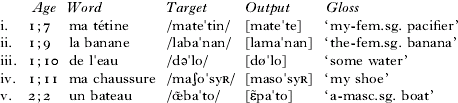
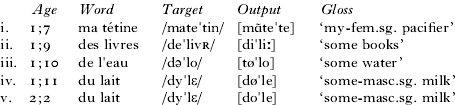
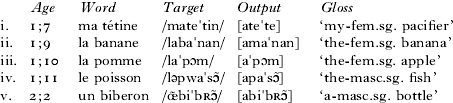
Examples of Tim's and Marie's target-like, non-target-like and filler determiners are provided in Appendix A and Appendix B, respectively.
These results indicate that Tim and Marie approach the production of determiners somewhat differently, despite the two children having similar MLUs. Tim tends to omit more determiners in obligatory contexts, and he exhibits a high overall percentage use of fillers. Marie, on the other hand, initially produces more determiners, a large number of which are segmentally accurate. On the basis of these findings, we hypothesize that Tim may be initially focusing on lower levels of prosodic structure than Marie, resulting in his lower rates of determiner production.
Individual variation in early production has been noted elsewhere in the literature. For example, Peters and Menn (Reference Peters and Menn1993) showed that only one of the two English-speaking children they studied displayed the use of filler syllables. Peters (Reference Peters1983) proposed that these individual differences could be captured in terms of more analytic (fine-grained) versus more gestalt (higher-level) approaches to acquiring language. Demuth (Reference Demuth2001b) argued that such differences could be explained in terms of children's accessing the Prosodic Hierarchy at different levels of structure. Thus, although many children access the hierarchy at the level of the PW, others do so at lower or higher levels. For many children, PWs are restricted to only a foot. Other children access the Prosodic Hierarchy at the level of the Intonation Phrase or Phonological Utterance, where their utterances consist mostly of intonational contours, but few identifiable words or segments.
If Tim were initially accessing lower levels of prosodic structure, as suggested by his lower rates of determiner use, we might also expect him to show higher truncation rates with disyllabic and trisyllabic lexical items but better production of the syllabic structure of these words. To address these issues, we now turn to an examination of the children's production of monomorphemic words.
Truncation of disyllabic and trisyllabic target nouns
Much of the previous literature on the acquisition of PWs had suggested that children's early words would take the form of binary feet. This could be achieved either in the form of two syllables (e.g. kitty), or one heavy (bimoraic) syllable (e.g. cat) (e.g. Allen & Hawkins, Reference Allen, Hawkins, Bell and Hooper1978). Critically, it was proposed that children would not produce subminimal, monomoraic (CV) open-class lexical items, generally considered to be marked structures, despite the fact that they do occur in the lexicon of some languages, for example French (e.g. [ʃa] chat ‘cat’, [lε] lait ‘milk’, [ne] nez ‘nose’, etc.). However, Demuth and Johnson (Reference Demuth and Johnson2003), in their study of French-speaking Suzanne, showed that subminimal words were produced, and that di- and trisyllabic words were also occasionally truncated to subminimal, monomoraic form. Thus, despite the counter-claims of Goad and Buckley (Reference Goad and Buckley2006) for Clara, we expect that the children in this study may also truncate both di- and trisyllabic words to monosyllables, some resulting in CV subminimal words. Lleó and Demuth (Reference Lleó, Demuth, Greenhill, Littlefield and Tano1999) showed that children's ability to produce larger monomorphemic PW structures may provide a larger prosodic window for the earlier incorporation of grammatical function items. This is used to explain why determiners in a language like Spanish appear to be ‘prosodically licensed’ earlier than in languages like English or German. Thus, given their different profiles in producing determiners, we expect that Tim might show higher lexical truncation rates than Marie.
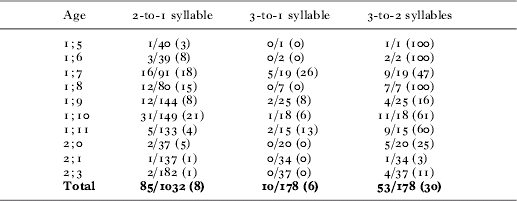
Table 6 shows the number and percentage of Tim's truncated disyllabic and trisyllabic target nouns. Overall, Tim truncates 8% of disyllabic target nouns, especially before 1 ; 10. He also truncates 6% of trisyllabic target nouns to monosyllabic outputs, all before 1 ; 11. Critically, however, over 50% of Tim's trisyllabic target nouns are realized with two syllables before the age of 2 ; 0. This suggests that Tim can produce lexical items composed of a binary foot, but that larger lexical items are problematic until 2 ; 0. Examples of his truncations are provided in Appendix C.
Tim's number (percent) of truncated nouns
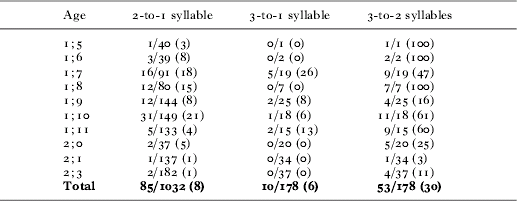
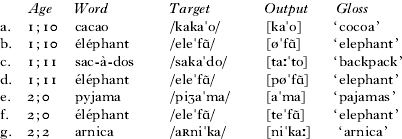
As the examples of monosyllabic outputs show, it is typically the final (stressed) syllable that is preserved (though not in (Ci. m, n)), with the onset of the first or second syllable sometimes being substituted in onset position of the output form (e.g. (Ci. i, k), (Cii, b, d, f, g)). Note also that a few of these truncations result in CV subminimal words (e.g. (Ci. a, c, f), (Cii. c, d, g)), with little evidence of compensatory lengthening (CV:). This would appear to counter Goad and Buckley's (Reference Goad and Buckley2006) claim that French-speaking children's productions exhibit minimal word effects.
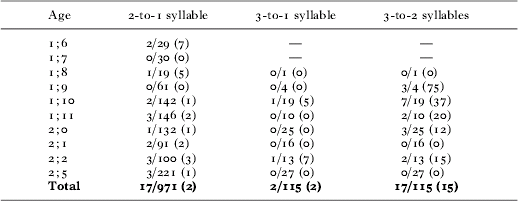
By contrast, Marie truncates less than Tim. This is shown in Table 7. Chi-square analyses reveal that her overall truncation rate is significantly lower than Tim's for 2-to-1-syllable truncations (χ2=43·54, df=1, p<0·001) and 3-to-2-syllable truncations (χ2=8·08, df=1, p<0·002), though not for 3-to-1-syllable truncations (χ2=2·68, df=1, p<0·200). Overall, she truncates only 2% of all disyllabic targets and 2% of all trisyllabic targets to monosyllabic outputs. Like Tim, her truncation of trisyllabic targets to disyllabic forms is also proportionally the highest (15%), but this is half the truncation rate exhibited by Tim. Thus, as predicted, Marie has earlier command of more complex PW structure, where nouns are not limited to only a binary foot. Examples of her truncations are provided in Appendix D.
Marie's number (percent) of truncated nouns
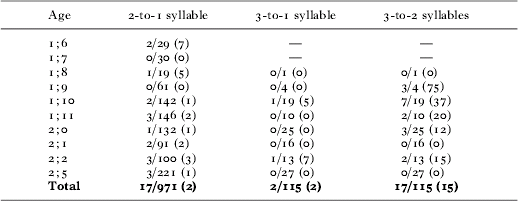
As with Tim, Marie's truncations of di- and trisyllables to monosyllabic outputs usually preserve the final (stressed) syllable of the target noun (though see (Di. c, f, j) and (Dii. b)). Many of her truncations also result in CV subminimal words (e.g. (Di. a, b, c, e, h, i, j, k); though see (Dii. a)), thus providing further counter-evidence to Goad and Buckley's claim that the early words of French-acquiring children are minimally binary.
In sum, Marie truncates lexical items less than Tim, producing a higher percentage of prosodically well-formed disyllabic and trisyllabic PWs. These results corroborate the hypothesis that Marie is approaching language learning from a higher level of prosodic structure than Tim, producing larger PWs and more determiners at an early point in development.
Given the foregoing discussion, we now can make predictions regarding these children's use of determiners with words of different prosodic shapes. If both children prosodify determiners at the level of the Phonological Phrase, as is assumed for adult prosodic representations (see (4b)), we would expect this to have little interaction with the size of the lexical items they produce. If, on the other hand, both children's determiners are prosodically licensed at a lower level of structure, for example the foot (4c), we would expect earlier and greater use of determiners with monosyllabic words than with di- and trisyllabic words. Given Marie's apparent early attention to higher levels of structure, we might then predict that she would initially show no difference in the production of determiners before monosyllabic and disyllabic words. On the other hand, given Tim's early focus on lower levels of prosodic structure, we might expect him to prosodify his early determiners as part of a foot, producing determiners primarily with monosyllabic words. We turn below to the analysis of determiner use as a function of word structure.
Determiners preceding monosyllabic, disyllabic and trisyllabic nominal targets
In this section, we report the percentage of children's syllabic determiners preceding monosyllabic, disyllabic and trisyllabic non-truncated nominal targets. The determiners l' ‘the’ and d' ‘some/of’ were excluded from the analyses, because no word-shape effect is expected to arise with these determiners, as they do not require an additional syllable to be prosodified. Nouns preceded by an adjective were excluded from the analyses, as the adjective requires additional prosodic structure to be realized, in which case it would be difficult to assess the effect of word-shape on the production of determiners. Finally, truncated nouns were excluded from analyses so that we could control for what was being produced.Footnote 1 The data for target-like, non-target-like and filler determiners are collapsed in this section, because they display the same asymmetries between their occurrence with monosyllabic, disyllabic and trisyllabic nominal targets.
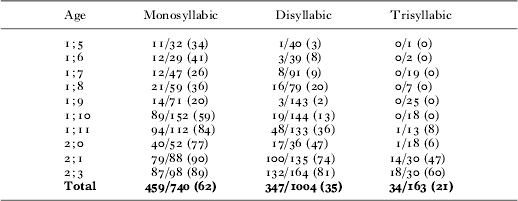
Consider Tim's data, shown in Table 8. There is a clear asymmetry between Tim's production of determiners preceding monosyllabic, disyllabic and trisyllabic nominals: the fewer syllables the noun has, the higher the probability that it will be preceded by a determiner. Chi-square analyses on the total number of determiners preceding monosyllabic, disyllabic and trisyllabic words reveal a significant effect of target word shape (χ2=169·28, df=2, p<0·001). Subsequent pairwise analyses reveal a significant difference between the total number of determiners preceding monosyllabic versus disyllabic words (χ2=129·28, df=1, p<0·001), monosyllabic versus trisyllabic words (χ2=91·33, df=1, p<0·001) and disyllabic versus trisyllabic words (χ2=11·97, df=1, p<0·001).
Tim's number (percent) of determiner use with different non-truncated target word-shapes
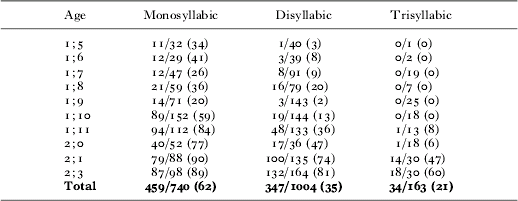
We can see from these results that, although Tim has difficulty producing determiners before all nominals up until 1 ; 10, from the first month of the study, an asymmetry is apparent between determiners preceding monosyllabic versus disyllabic and trisyllabic nominals. Notice that his increased use of determiners preceding monosyllabic words at 1 ; 10 comes immediately before his decrease in the truncation of disyllabic and trisyllabic target nouns to monosyllables (Table 6). Between 1 ; 11 and 2 ; 0, there is a clear asymmetry in determiner use between the three word types, corresponding closely to the decrease in trisyllabic to disyllabic truncations. By 2 ; 3, Tim can consistently produce determiners before monosyllabic and disyllabic nominals, but not before trisyllabic nominals.
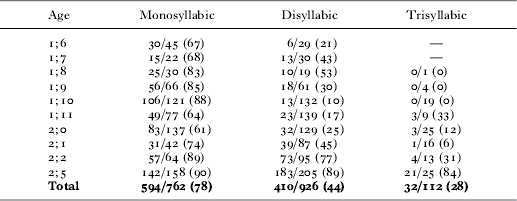
Marie manifests a very similar pattern of determiner production, shown in Table 9. As with Tim, there is a clear asymmetry between her production of determiners before monosyllabic, disyllabic and trisyllabic nominals. Chi-square analyses on the total number of determiners preceding monosyllabic, disyllabic and trisyllabic words also reveal a significant effect of target word shape (χ2=235·13, df=2, p<0·001). Subsequent pairwise analyses reveal a significant difference in determiner use preceding monosyllabic versus disyllabic words (χ2=196·70, df=1, p<0·001), monosyllabic versus trisyllabic words (χ2=117·16, df=1, p<0·001) and disyllabic versus trisyllabic words (χ2=10·08, df=1, p<0·001).
Marie's number (percent) of determiner use with different non-truncated target word-shapes
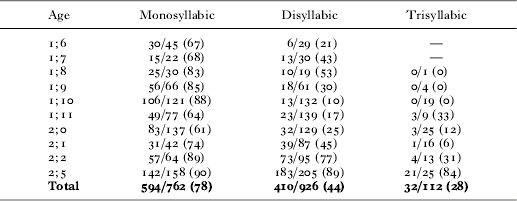
Thus, although Marie exhibits much higher rates of determiner use from her first productions, she also shows significant differences in her use of determiners with different word-shapes. In particular, she is much more likely to use determiners with monosyllabic words than with disyllabic words, and her determiner production is also greater with disyllabic words than with trisyllabic words. The asymmetry in determiner use between monosyllabic and disyllabic nominals disappears after 2 ; 1, but determiner use with trisyllabic nominals remains low, perhaps because Marie's trisyllabic truncation rates are also low: using a determiner with a trisyllabic word would result in a prosodic unit of four syllables. This indicates that at this point, Marie typically does not yet produce prosodic units larger than three syllables. By 2 ; 5, Marie can produce determiners consistently before all three word types.
Although most of the children's determiners are produced with full lexical items, a few are produced with truncated forms (see Demuth, Reference Demuth, Weissenborn and Höhle2001a, for discussion of similar forms in Spanish). This is primarily the case with Tim, since his nominal truncation rate is higher than Marie's. Examples of truncated words accompanied by a determiner (excluded from the above analyses) are presented in (5)–(6).
(5) Tim's determiner+truncated target words

(6) Marie's determiner+truncated target words

The forms in (5)–(6) therefore indicate that Tim and Marie are treating the determiner and following lexical item as separate prosodic units, where the determiner is included at the cost of lexical truncation. However, the fact that there are so few instances of determiner+truncated noun indicates that these children generally prefer to maintain lexical integrity, dropping the determiner instead of the syllable of a lexical item.
The findings presented above clearly support the hypothesis that these children's early determiners are prosodically licensed, where determiner production predictably interacts with the prosodic shape of the following lexical item. Crucially, both children exhibit an interaction between the occurrence of determiners and their lexical truncation rates: determiners come to precede at least 75% of all monosyllabic nominals precisely when most disyllabic and trisyllabic target nouns are no longer truncated to monosyllabic outputs. Similarly, the percentage of determiners occurring before disyllabic words reaches at least 75% exactly when most trisyllabic target nouns are no longer truncated to disyllabic outputs. This shows that the increase in children's ability to produce more complex prosodic structures affects both lexical and functional items, suggesting that both initially prosodify at the same level of prosodic structure.
Where the two children differ is on the prosodic level from which they approach the task of language learning: determiners preceding monosyllabic and even disyllabic nominal targets are prosodically licensed at a much higher rate earlier in Marie's grammar, suggesting earlier access to higher levels of structure. One might then wonder why Marie produces more determiners with monosyllabic words than with disyllabic words if she indeed has access to higher-level prosodic structure. The answer to this question lies partially in her U-shaped development. A closer look at the results indicates that it is her sudden determiner omissions with disyllabic targets that largely result in the U-shaped development, suggesting that determiners are no longer prosodically licensed with disyllables. Recent analysis of Marie's acquisition of syllable structure (Demuth, McCullough & Kehoe, Reference Demuth, McCullough and Kehoe2005) indicates that the decrease in determiner production with disyllables coincides with a sudden increase in coda production between 1 ; 10 and 2 ; 0. This suggests that at 1 ; 10, Marie has shifted her focus from a higher to a lower level of prosodic structure, resulting in greater coda production and higher determiner omission with disyllabic targets. In other words, the asymmetry found between determiners produced with monosyllabic versus disyllabic targets after 1 ; 9 is the result of this prosodic shift. In order to account for the same asymmetry between 1 ; 6 and 1 ; 9, we propose that Marie's representation of determiners at a higher level of structure (i.e. before disyllabic targets) is less stable than her representation of determiners at a lower level of structure (i.e. before monosyllabic targets), resulting in higher omission of the former.
Note that Marie's shift in representation from producing longer to shorter determiner+lexical item sequences provides evidence against the alternative analysis of the data that these effects might be merely ‘length effects’ limiting children's outputs to a certain number of syllables. Instead, we suggest that constraints on prosodic representations, rather than limiting the number of syllables per PW, drive the acquisition patterns found for both children. In the following section, we discuss in more detail the nature of these developing prosodic representations.
DISCUSSION
This study of two French-speaking children has shown that their production of determiners increases gradually between 1 ; 5–2 ; 5. Crucially, their use of determiners is systematic, first appearing in prosodically simple contexts, and only later appearing with prosodically more complex words. This is particularly interesting since both monosyllabic and disyllabic words are common in French, and children produce both from the initial stages of development. If all French determiners were prosodified at the higher level of the PP, and children could produce both monosyllabic and disyllabic words equally well, we would not expect determiners to appear first and predominantly with monosyllabic words. We show below that the level at which determiners prosodify is closely linked to the prosodic development of lexical representations.
Consider the prosodic representations in (7).
(7) Proposed prosodic development of French determiners
Given the data discussed above, we propose that Tim initially produces many lexical items with no determiner, as illustrated in (7a). His first determiners are prosodified at the level of the foot. This would entail a representation like that in (7b). Note that the lexical item here is a syllable, and can take the form of CV, CV: or CVC. In all cases, the lexical item constitutes the head of an iambic foot. Tim then exhibits a second stage of development, where some reanalysis appears to have taken place. At 1 ; 10, his use of determiners with monosyllables doubles, indicating that he is more reliably incorporating determiners into his PWs. At 1 ; 11, he shows an increase in use of determiners with disyllabic words. The latter coincides with his drop in truncation of disyllables, suggesting that determiners are no longer prosodified at the level of the foot, but at a higher level of structure, such as the PW (7c). At 2 ; 1, he shows an increase in the use of determiners with trisyllabic forms, suggesting that he has finally developed a more adult-like representation for both lexical and functional material. This permits lexical items of more than a foot, and function items prosodified at the level of the PP, as shown in (7d).
By contrast, Marie's first determiners are prosodified either at the level of the foot or at the level of the PW, as she alternates between the representations in (7b) and (7c) until 1 ; 9. This coincides with a low truncation rate of di- and trisyllabic nouns to monosyllabic nouns. At 1 ; 10, she appears to abandon the analysis in (7c) as she shifts her focus to the foot (7b), resulting in her increased omission of determiners with disyllabic nouns and greater coda production. By 2 ; 1, she returns to the analysis in (7c) as her production of determiners with disyllabic words increases. At the same time she reduces her truncation of trisyllabic words, and uses her first determiners with words of this shape, beginning to prosodify determiners as free clitics (7d). Finally, by 2 ; 5, Marie has adopted the adult-like representation of French determiners (7d).
We have outlined above a likely scenario for the development of early prosodic representations in French. Critically, this proposal suggests a close connection between the prosodic structure of lexical and functional items, where determiners are initially licensed as part of a foot and only later at the levels of the PW and PP as the lexicon becomes prosodically more complex. The children's initial analysis of determiners as foot-internal clitics is not so strange, given that determiners preceding vowel-initial monosyllabic and disyllabic nominals prosodify at the level of the foot in adult French. This may, in fact, contribute to children's early (non-target-like) prosodic analysis of determiners.
Of course, there may be alternative analyses of these data. First, there may be lexical effects, where high-frequency words are more reliably preceded by determiners than lower-frequency, less familiar words. This has been suggested to explain some of the variable production of plural morphemes in English (e.g. Zapf, Reference Zapf, Brugos, Micciulla and Smith2004). This is obviously an area for further investigation. Second, we have treated all kinds of determiners here as one class. Further investigation of the specific types of determiners, and how these develop over time, will be needed to determine if there are syntactic or semantic factors that can explain the developmental patterns found here. Finally, we have argued that there is a tight connection between the development of lexical and functional structure. It is therefore interesting to note that both children reach an MLU of 2 around 1 ; 11, the point at which they produce their first determiners with trisyllabic words. Thus, there may also be developments in other parts of their grammar, or increasing memory or processing abilities, that help stimulate the ability to produce higher-level prosodic structures. It is clear, however, that the children's outputs are not governed simply by the number of syllables produced: both children produce three-syllable outputs in the form of a determiner+disyllabic noun several months before they produce isolated non-truncated three-syllable lexical items (cf. similar findings in Spanish, e.g. Demuth, Reference Demuth, Weissenborn and Höhle2001a). Marie's U-shaped production of determiners with both monosyllabic and disyllabic nouns further illustrates that prosodic (re)organization, rather than length effects per se, constrains the nature of her output forms. Thus, it appears that the patterns outlined above can best be explained by appealing to the acquisition of prosodic structure rather than simple output limitations on the number of syllables produced. Demuth et al.'s (Reference Demuth, McCullough, Adamo, Bamman, Magnitskaia and Zaller2007) findings regarding the prosodic licensing of early English determiners, a language with very different prosodic structure, provides further evidence against a processing account of the data. One of the residual issues is the syntactic and semantic status of these French-speaking children's early determiners. Perhaps these are merely ‘prosodic placeholders’, with no actual determiner status (e.g. Peters, Reference Peters1983; Veneziano & Sinclair, Reference Veneziano and Sinclair2000). However, given the distribution of determiners and the fact that many are well-formed by 1 ; 10 or 1 ; 11, we suggest that these items do have syntactic and semantic status, even if aspects of the system are still being learned.
CONCLUSION
This study examined the early production of determiners by two French-speaking children. Although there were individual differences, both acquired their first determiners with monosyllabic words, and only later with disyllabic and trisyllabic words. These findings suggest that French-speaking children's early determiners are prosodically licensed as part of a binary foot. Determiner use with larger prosodic words then increases as the prosodic structure of lexical representations becomes more complex, and children begin to prosodify determiners at higher levels of prosodic structure. These findings provide a model for exploring other interactions at the prosody–morphology interface, and a principled explanation for some of the variable production of grammatical mssssorphemes.
APPENDIX A. EXAMPLES OF TIM'S DETERMINERS
a. Target-like determiners
b. Non-target-like determiners
c. Filler determiners
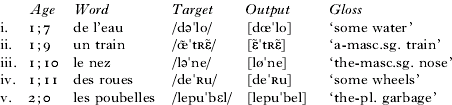
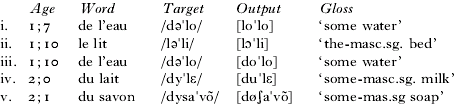
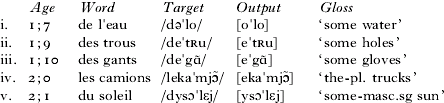
APPENDIX B. EXAMPLES OF MARIE'S DETERMINERS
a. Target-like determiners
b. Non-target-like determiners
c. Filler determiners
APPENDIX C. EXAMPLES OF TIM'S TRUNCATION OF MONOMORPHEMIC LEXICAL ITEMS
Ci. Tim's 2-to-1-syllable truncations
Cii. Tim's 3-to-1-syllable truncations
Ciii. Tim's 3-to-2-syllable truncations

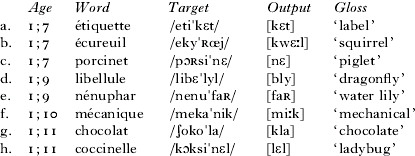

APPENDIX D. EXAMPLES OF MARIE'S TRUNCATION OF MONOMORPHEMIC LEXICAL ITEMS
Di. Marie's 2-to-1-syllable truncations
Dii. Marie's 3-to-1-syllable truncations
Diii. Marie's 3-to-2-syllable truncations