Introduction
Mass gatherings have variable definitions, but commonly have been defined as an event at a specific location or several discrete locations with 1,000 persons or more.Reference De Lorenzo1-Reference Hodgetts and Cooke4 Several factors make advanced preparation for medical management important. These include the potential for delayed response to emergencies due to limited access to patients and the risk of certain types of injuries and illnesses related to the event itself (eg, orthopedic injuries from moshing at a concert and hyperthermia at a marathon).Reference Arbon5 To ensure timely access to appropriate health care resources, preparation for mass gatherings includes risk assessment and planning coupled with system enhancements that ensure sufficient capacity and capability for the provision of medical care to attendees, without adversely affecting baseline medical care in the host community.Reference Molloy, Sherif, Natin and McDonnell6, 7
Mass-gathering medical care aims to provide on-site event medical care, including rapid access to patients, triage, stabilization, and transport. This should be achieved without compromising the abilities of the Emergency Medical Services (EMS) system to provide routine emergency services.Reference Arbon5, Reference Michael and Barbera8, Reference Milsten, Seaman, Liu, Bissell and Maguire9
In predicting utilization of medical resources, some variables have been identified as important factors. These include: weather; duration of the event; whether the event is indoors or outdoors; bounded or unbounded; presence of seated or mobile attendees; type of event; mood of the crowd and availability of alcohol and drugs; crowd density and geography of the venue; and age of the attendees.Reference Arbon5, Reference Calabro, Krohmer, Rivera-Rivera, Balcombe and Reich10, Reference Milsten, Maguire, Bissell and Seaman11 To that end, various organizations (eg, the American College of Emergency Physicians (Irving, Texas USA), and the National Association of EMS Physicians (Lenexa, Kansas USA)) have produced guidelines for the provision of emergency medical care for crowds.Reference Jaslow, Yancy and Milsten2, Reference Calabro, Krohmer, Rivera-Rivera, Balcombe and Reich10
This paper analyzes patient presentations from a single annual motorsport night event over a 4-year period. The aim is to describe the medical presentations and unique challenges influencing medical planning. Patient presenting characteristics, rates of patient presentation, and transportation to hospitals in association with attendance and heat index are evaluated. Previously described factors affecting patient presentation rates (PPRs) are then compared with the number of patients seeking medical attention at this motorsport event. These data will inform medical planning and create more efficient resource allocation for similar events in the future.
Background
Formula One SingTel Singapore Grand Prix has been held in Singapore since 2008. It is the inaugural Formula One night race, and is the first street circuit in Asia taking place in the heart of the city center.12 The boundaries of the circuit park abut the Marina Bay and surrounding buildings, spanning an area of approximately 500,000 m2. The circuit park is segregated into various zones by the race track where access between zones is restricted to overhead pedestrian bridges or narrow walkways.
The race received an average attendance of 82,000 spectators per day from 2009 through 2012. Generally, there is sufficient space for spectators. However, bottlenecks form at the entry points and the access routes within the circuit park during peak hours when spectators enter or exit the circuit park.
The event takes place over a weekend at the end of September. The circuit park opens from 2:00pm to 1:00am, with support races taking place in the afternoon. Evenings are reserved for Formula One race cars. Practice sessions take place on Friday, qualifying sessions on Saturday, and the actual race takes place on Sunday. Accordingly, most spectators enter the circuit park in the late afternoon, with numbers increasing from Friday through Sunday. Alcohol is available throughout the circuit park.
Mass concerts are usually held in an open field at approximately 10:00pm after completion of racetrack activities. A purpose-built stage and enclosed crowd space is erected on the large field. The crowd space has an area of 1,947m2 and is designed to hold 4,967 concertgoers. In addition, up to 25,000 more spectators can enter the field to watch the concerts. These spectators come from other parts of the circuit park and add to the large crowds who are leaving the circuit park after the completion of racing for the day.
Medical support at the Singapore Grand Prix is provided by two teams: the track medical team and the spectator medical team. The Chief Medical Officer supervises both teams. The track medical team primarily manages motorsports-related medical needs, especially trauma. This medical team is based in the track medical center located at the pit lane. It is staffed with emergency physicians, trauma surgeons, psychiatrists, sports physicians, nurses, and a full complement of support staff. Radiology services are available onsite. Medical elements are located at various points along the circuit to provide immediate medical attention in the event of a racing incident.
The spectator medical team is responsible for provision of medical services to the spectators, including triage, treatment, observation, and evacuation to hospitals from 2:00 pm to 1:00 am, daily. This team also responds to medical emergencies related to attendees falling into the water. Due to widespread geography and access difficulties, medical facilities are spread throughout the circuit park. The spectator medical team command center is located in the circuit park and supported by eight “Advance Medical Posts” (AMPs) and 18 “First Aid Posts” (FAPs). Each AMP is staffed by a minimum of two physicians and four nurses. Staff are capable of providing Advanced Cardiac Life Support for up to two patients at one time. Each FAP is staffed by nurses or first aiders and provides first aid and medical advice to attendees. Automated External Defibrillators are available at all AMPs and select FAPs in remote locations. The medical staff faces challenges in locating casualties due to the large crowds and night environs. This is mitigated in part by close cooperation with the Singapore Grand Prix Operations Team. The spectator medical service is supported by ten modified buggies configured to fit a stretcher lengthwise. Twenty-one ambulances are on standby for evacuation of patients to the nearest hospitals. The spectator medical team has the option of transferring ill patients to the track medical center instead of a hospital. The decision to evacuate patients is made by the physician on site in consultation with emergency physicians at the command center.
All medical encounters were recorded, including those managed solely by first aiders and nurses. As the event progressed, medical records became more comprehensive, transitioning from paper records to internet browser based forms with predefined fields.
Medical operations are directed by the spectator medical command center. This center is run by emergency physicians and nurses who provide medical advice and operational direction. Communication within the medical team is managed via trunked radios, cellular phones, and text messages. Text messaging is particularly useful during race hours when the roar of the race cars precludes voice communications. The spectator medical command maintains constant communication with the track medical team, race operations, and the Ministry of Health Operations Center.
Methods
A database of patient presentations was prospectively collated and retrospectively analyzed over a 4-year period from 2009 through 2012. No patient identifiers were collected during the event as this was not a statutory requirement. This study received approval of exemption from the National Healthcare Group Domain Specific Review Board (Singapore). In 2009, medical records were written on paper and transcribed onto a spreadsheet for analysis. In 2010, medical records were collated via an online Google spreadsheet (Google, Mountain View, California USA). From 2011 onwards, more sophisticated data were collected using a Google form with fixed data fields. Medical providers input patient information via Internet-connected smartphones and tablets. These data are immediately visible to the race organizers as well as personnel at the Ministry of Health Operations Center. The database was reviewed throughout each racing day. Inaccurate or missing data were flagged, and the medical provider was asked to rectify these issues within the same day. The data represented 2,140 patients who presented for first aid assistance over a total of 12 event days. After the events, patient presentations were grouped into various medical categories by the same emergency physician from 2009 through 2012. However, no code book was used to ensure consistent interpretation during data extraction. The race organizer provided the average race attendances for each racing weekend. Weather data were obtained from the National Environmental Agency of Singapore. All measures are reported as mean and one standard deviation (SD); regression analysis was performed and statistical significance is accepted at a P value of <.05. Excel 2010 (Microsoft, Inc., Redmond, Washington USA) was utilized to manage and analyze the data. The PPR was calculated based on the number of patients presenting divided by the number of attendees multiplied by 1,000. The transport to hospital rate (TTHR) was calculated by dividing the number of patients transported from the circuit park to the nearest hospitals divided by number of attendees multiplied by 1,000.
Results
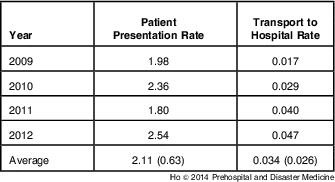
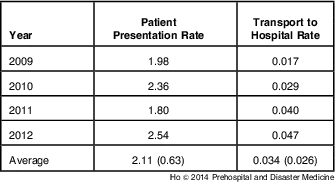
The daily attendance for the race from 2009 through 2012 averaged 81,992 (SD=2,120). The number of patients treated daily ranged from 90 to 254, with a PPR of 2.17 (SD=0.63). An average of 2.8 (SD=2.2) ambulance transfers were made daily, accounting for a TTHR of 0.034 (SD=0.026) (Table 1). Most patients were seen on race day (39.6%), followed by qualifying day (37.2%), and practice session day (23.2%).
Patient Presentation Rate and Transport to Hospital Rate from 2009 to 2012
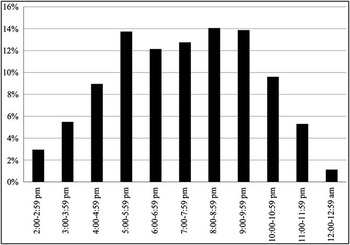
Most patients (66.6%) presented between the hours of 5:00pm and 10:00pm. This coincided with the hours of motor racing (Figure 1).
Time of Patient Presentation

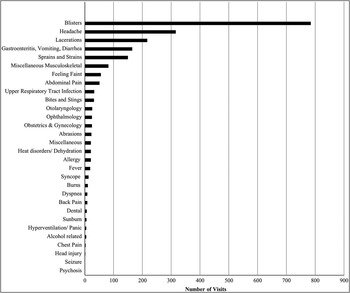
The majority (58.7%) of presentations were for musculoskeletal conditions, including blisters, lacerations, abrasions, sprains, and strains (Figure 2).
Presenting Complaints of Attendees

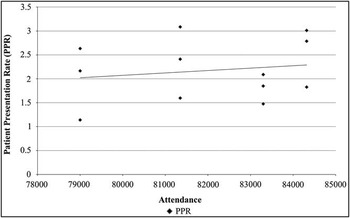
No linear relationship was demonstrated between attendance and PPR (P = .594; 95% CI, 0.00015-0.00026) (Figure 3).
Relationship between Attendance and Patient Presentation Rate Abbreviation: PPR, patient presentation rate.

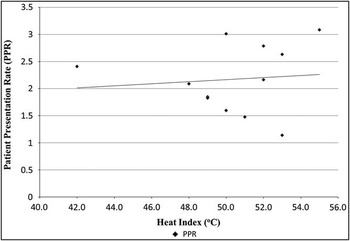
The daily maximum temperature averaged 31.8°C (SD = 0.9°C) [89.2oF (SD = 1.6oF)]. The maximum relative humidity averaged 93.8% (SD = 3.1%). The average heat index was 50.3°C (SD = 3.3°C). Up to 19% of patient presentations could be attributed to heat-related causes. These included dehydration, headache, sunburn, faintness, and syncope. However, no statistically significant correlation was demonstrated between the heat index and PPR (Figure 4).
Relationship between Heat Index (°C) and Patient Presentation Rate Abbreviation: PPR, patient presentation rate.

Discussion
The predominant presenting complaints over a 4-year period at the Formula One SingTel Singapore Grand Prix night race were related to musculoskeletal conditions, a finding in stark contrast to that of other studies where very small proportions of musculoskeletal complaints were identified.Reference Milsten, Seaman, Liu, Bissell and Maguire9, Reference Grant, Nacca, Prince and Scott13 This could be due to a difference in the definitions for patient presentations. In other studies, only patients seen by a physician were included in the final analysis.Reference Grant, Nacca, Prince and Scott13 In addition, the terrain within some parts of the circuit park was uneven due to temporary footpaths and ongoing construction work. Attendees, some of them in unsuitable footwear (slippers, high heels), had to traverse long distances within the circuit park on uneven terrain. This may account for the large proportion of musculoskeletal conditions. Accordingly, knowledge of the high rates of musculoskeletal complaints for past events led to medical responders to be better equipped to manage these problems.
Gastroenteritis accounted for 7.7% of medical presentations over the four years. Half of these cases occurred in 2009 when a small outbreak of diarrhea and vomiting took place among race volunteers. This outbreak was mild, affecting mainly young, healthy volunteers who had consumed food from a staff canteen the night before. This incident exposed the difficulties faced in the identification and management of unexpected outbreaks. A temporary medical facility was set up in a canteen and ad hoc medical supplies were sourced from the nearest pharmacies and hospital. In subsequent years, medical logistic chains were formalized with larger quantities of medical equipment and medications stockpiled. Medical reporting and surveillance was improved with the use of Internet-connected devices by first responders, providing medical command elements with real-time medical information.
Milstein et al found that increased attendance did not strongly correlate with medical presentations.Reference Milsten, Seaman, Liu, Bissell and Maguire9 Similarly, this dataset showed no correlation between attendances and medical presentations.
Certain variables have been shown to better predict medical resource use. These include event type (eg, rock concerts), event duration, crowd mobility, and temperature.Reference Milsten, Seaman, Liu, Bissell and Maguire9 Additional studies have confirmed the positive relationship between temperature, humidity, and PPRs.Reference Arbon, Bridgewater and Smith14-Reference Baird, O'Connor, Williamson, Sojka, Alibertis and Brady17 Heat index, an index that combines air temperature and relative humidity in an attempt to determine the human-perceived equivalent temperature, is frequently used in prediction models for patient presentations. This was not demonstrated in this study, possibly because the heat index did not vary much throughout the 12 event days across the four years. Heat related complaints accounted for only about 19% of the medical presentations, which is likely because most of the patrons are Singaporeans who were already acclimatized to the weather. Peak attendances to the circuit park occur during the evening hours when it was relatively cooler. Accordingly, most medical presentations occurred between 5:00 pm and 10:00 pm (Figure 3). Despite the lack of correlation, it would be prudent to plan specifically for the management of heat-related disorders in light of the high baseline heat index in Singapore.
Various models have been proposed to predict PPRs for mass gatherings.Reference Arbon, Bridgewater and Smith14, Reference Kman, Russell and Bozeman16-Reference Serwylo, Arbon and Rumantir19 The Singapore Grand Prix is an outdoor event that is bounded. Both seated and mobile attendees are present. It is simultaneously a motorsports event and an outdoor concert. The crowd ranges from babies to children and young adults to middle aged and the elderly. Though alcohol is readily available, drugs are not, due to the strict laws in Singapore. The crowd density is fairly high, with relatively narrow pedestrian thoroughfares bounded by the debris fences of the race track and the nearby buildings or bay. The unique characteristics of the Singapore Grand Prix, as well as every other mass gathering, defy easy application of models predicting PPRs. For this event, the PPRs and TTHRs fall within the ranges described in the literature. In planning for the medical coverage of a mass gathering, there is a need to look beyond rates of medical utilization and consider unique characteristics and data from similar events described in the literature.
Limitations
Attendee numbers provided by the race organizers are approximate figures based on the average of total attendances over three days. It would be expected that more spectators attend the event on race days than on the qualifying and practice session days. Using average attendance figures over the race weekend would decrease the PPR during the practice sessions (Fridays) as the average attendance figures are higher than the actual attendance figures. The converse is true on race day (Sundays) where the actual attendance figures are higher than the average figures used for purposes of this study. Despite this, no correlation was demonstrated between attendance numbers and PPR.
Conclusion
Musculoskeletal conditions were the most common presenting complaints at the Singapore Grand Prix from 2009-2012. Attendance and the heat index did not correlate with PPRs. The latter finding is noteworthy because it runs counter to previous findings in the literature. This is likely due to a combination of factors, including the lack of variance in heat index, the event being held at night, and the majority of attendees being local and already acclimatized to the weather. Analysis of these data will be useful in planning mass-gathering medical care for events occurring in tropical climates. Singapore Grand Prix, a night race held from early afternoon until after midnight within the urban confines of downtown Singapore, has unique features that medical planners must consider. Predicting medical resource needs for a mass gathering requires both use of predictive models and analysis of data from similar past events. Further study is required to refine models that can be used in specialized events.
Acknowledgement
This paper was done as part of a thesis for the European Masters in Disaster Medicine. The authors would like to give credit and thanks.