




No CrossRef data available.
Article contents
The development of linguistic constraints: Phonological innovations in St. John's English
Published online by Cambridge University Press: 16 September 2005
Abstract
This article examines two well-known innovations in Canadian English (CE)—(æ) Retraction and Lowering (e.g., mad, pat) and (aw) Fronting (e.g., loud, mouse)— with a view to discovering the routes by which phonological change diffuses. The data are from St. John's, Newfoundland, one of the few remaining Canadian communities where the variety spoken by the founding population remains relatively intact. Because this variety is leveling toward CE (Clarke, 1991), the St. John's context enables us to tap into processes of dialect shift while they are taking place. This glimpse reveals the developmental nature of linguistic constraints during the early stages of change. Moreover, by focusing on preadolescent and adolescent speakers, age groups that are often overlooked in favor of adult samples (Eckert, 1988:183), the analysis situates the locus of change on the adolescent years. Taken together, these results provide an important gauge for tracking the progress of phonological change.Special thanks to Jack Chambers, Sandra Clarke, Hank Rogers, and Sali Tagliamonte for generously sharing their support, insights, and expertise. Appreciation also goes to Erik Thomas for imparting his knowledge of phonetic conditioning effects. Finally, I am grateful to the four anonymous reviewers whose comments strengthened this article enormously. All errors remain, of course, my own. An earlier version of this article was presented at NWAV 31 in October 2002. This work was supported in part by a Dean's Fellowship at Memorial University of Newfoundland, and by SSHRC Doctoral Fellowship #752-2002-2177.
Information
- Type
- Research Article
- Information
- Copyright
- © 2005 Cambridge University Press
Although it is a relatively homogeneous national variety (e.g., Avis, 1973; Chambers, 1991), general Canadian English (CE) is not bereft of regional variation.1
Examples include Lunenburg, a German enclave, and Cape Breton Island, a Scots-Irish enclave, both in Nova Scotia, and Elgin County, an Irish enclave in southwestern Ontario (Chambers, 1991:94–95).
Whereas previous research has had to extrapolate processes of dialect shift by abstracting them from elderly speakers living in linguistic enclaves (e.g., Milroy & Milroy, 1978; Wolfram & Thomas, 2002), the St. John's context enables us to tap into these changes while they are taking place. In focusing on a community where a regional nonstandard variety is giving way to a national standardized prestige variety, the research reported here aims to contribute new insights into the adoption of linguistic change. To this end, the diffusion of two well-known CE innovations—(æ) Retraction and Lowering (e.g., mad, pat) and (aw) Fronting (e.g., loud, mouse)—into St. John's English (SJE) are examined.
In seeking out the routes by which phonological change progresses, the effects of both language-internal and language-external factors on the acquisition of innovative variants are systematically investigated, raising questions about the nature of linguistic constraints. In instances of stable variation, internal conditions on variability are acquired quite early during the preschool years (Roberts, 1994). Even when these are quite complex, as in, for example, the Philadelphia short-a shift, children are able to master most of the linguistic factors governing features involved in long-standing change (Roberts & Labov, 1995). These results suggest that internal constraints develop early within the vernacular. But what of more recent innovations? Are the constraints operative from the initial adoption of linguistic change (Kroch, 1989, 2001), or do they develop as a form increases in frequency?
The data for this analysis come from preadults (i.e., preadolescents and adolescents). Although some research has focused specifically on teenage populations (e.g., Eckert, 1988; Grabe, Post, & Nolan, 2001; Romaine, 1984), these age groups, and preadolescents in particular, tend to be marginalized in variationist endeavors. This means that little is known regarding their roles in the diffusion of change, phonological or otherwise.
Thus, in addition to providing insight into the early stages of phonological diffusion, this research seeks to broaden our understanding of linguistic change by focusing on the speech of people at the younger end of the age spectrum. In so doing, it raises questions about how constraints governing linguistic variability are acquired. The implications address both empirical and descriptive issues in the study of language variation and change.
GENERAL CANADIAN ENGLISH
Labov (1991) has characterized CE as belonging to the third dialect of North American English, a dialect defined by the merger of the low back vowels

(e.g., cot, caught), the stability of low front /æ/, and the absence of any major vocalic chain shift. Contemporary research indicates, however, that of these three diagnostics, only the first, the merger of

, holds true.
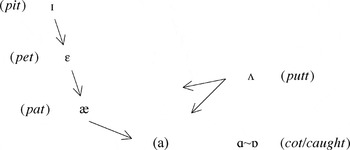
Acoustic analysis indicates that the low front vowel is not at all stable in CE, but rather is retracting and lowering toward central open [a] (Esling, 1991; Esling & Warkentyne, 1993). Moreover, this retraction is part of an ongoing chain shift affecting most of the lax vowel system, outlined in Figure 1 (reproduced from Clarke, Elms, & Youssef, 1995:212).
2Note that [a] is not phonemic in CE (de Wolf, 1992, 1993; Woods, 1979).

, as well as the lowering and/or centralization of the mid back unrounded segment

.
3The Canadian Shift has been likened to ongoing change in California English, which appears to be undergoing a “virtually identical” movement in its vocalic system (Clarke et al., 1995:213); see, for example, Luthin, 1987.

The Canadian lax vowel shift.
Distinct from the lax vowel shift, the back round vowels

are undergoing some degree of fronting (Clarke et al., 1995). The onset of the /aw/ diphthong is also fronting, moving from a back position to one that is more centralized (e.g., Chambers, 1980, 1989).
Thus, a significant portion of CE's vocalic inventory is involved in ongoing change, with most vowels either lowering or fronting their point of articulation. This article examines the diffusion of two of these innovations, (æ) Retraction and Lowering, part of the Canadian lax vowel shift, and (aw) Fronting, in St. John's Youth English (SJYE).
(aw) Fronting
Fronting is a process affecting the /aw/ diphthong in which the onset shifts from the low back region to a central, and sometimes front, position (Chambers, 1980, 1989). Consequently, while traditionally realized as

, the preferred onset in innovative varieties is now [a], though it may even surface as [æ].
This diphthong is already subject to Canadian Raising in CE, a process that raises the onset from

in the environment of a following tautosyllabic voiceless obstruent (e.g.,

‘pout’). Elsewhere (i.e., before voiced consonants and word-finally), the onset remains low (e.g.,

‘proud’;

‘cow’) (Chambers, 1973).
The interaction of Fronting, a lingual phenomenon, and Raising, a closure phenomenon, can result in onsets that are fronted as well as raised. The diphthong may therefore surface with mid open onsets as

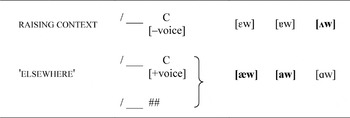
(Chambers & Hardwick, 1986; Hung, Davison, & Chambers, 1993). However, fronted onsets are favored in the “elsewhere” environment of Canadian Raising. Consequently, we expect fronting in words such as proud, town, and cow, but not in words like pout or mouse. These facts are summarized in Figure 2.

Summary of variants of (aw) according to context in CE (favored forms are bolded).
(æ) Retraction & lowering
Since first systematically examined in Clarke et al. (1995), research making use of statistical modeling techniques to investigate the linguistic constraints that condition the retraction and lowering of /æ/ has not been common. The groundbreaking analysis revealed that the only internal factor to significantly affect the probability of (æ) Retraction and Lowering (RL) in CE is the following phonological manner of articulation. A following lateral or fricative was found to favor RL, whereas stops, affricates, and nasals were found to disfavor it. Indeed, not only was a following nasal found to disfavor RL, it tended to trigger tensing and raising of the low front vowel (Clarke et al., 1995:214).4
Preliminary work by Hall (2000) suggested that the inhibiting effect of nasals may not be shared by western varieties of CE (e.g., Vancouver English) in which RL is categorical when the following segment is a nasal stop. Hall (2000) also reported that RL is more frequent in the environment of a following voiceless anterior fricative, whereas it is rare when the vowel is followed by a voiced one. However, because she does not refer to nonanterior fricatives in her data (e.g.,

), we can make no inferences regarding the saliency of anteriority itself. Indeed, in the current materials there is no correlation between anteriority and RL, nor do Clarke et al. (1995) report one.
Other factors conditioning innovative CE variants
Although the following phonological environment is a critical factor conditioning both (aw) Fronting and (æ) RL in CE, the effect of linguistic style on these innovations is negligible. In fact, neither appears to be stylistically stratified (Chambers & Hardwick, 1986; Hung et al., 1993; Woods, 1979). In this sense, (aw) and (æ) pattern together as indicators, with little or no awareness of their use by speakers of CE.
Unlike style, social factors such as age and gender appear to play important roles in the diffusion of (aw) Fronting and (æ) RL. For both changes, the frequency of innovative variants increases as age decreases, providing a trajectory of change in apparent time (e.g., Chambers & Hardwick, 1986; de Wolf, 1993; Esling & Warkentyne, 1993; Hung et al., 1993; Woods, 1979). Both are female-dominated patterns, with women leading in the move toward innovative variants.
ST. JOHN'S ENGLISH
Within the Canadian landscape, the island of Newfoundland is a linguistic relic area. Previously isolated, its English reflects the two historical sources of the variety: southwestern England and southeastern Ireland. The Irish, hailing from the counties of Wexford, Waterford, Kilkenny, and Tipperary, settled primarily on Newfoundland's Avalon Peninsula (Clarke, 1991; Kirwin, 1993). Negligible contact with southeast Ireland since the main influx of immigrants in the 1830s, however, led to the development of an independent strain of Irish English on the island (Kirwin, 1993).
The insularity of the variety was further compounded by Newfoundland's social and geographic isolation, the first of which lasted until the middle of the last century, when first the Second World War and then Confederation with Canada in 1949 brought increased focus on the North American mainland. This broadened social context has had linguistic repercussions in the province, as many of Newfoundland's traditional dialect features are leveling toward CE (Clarke, 1991). This trend is particularly evident in the capital city, St. John's, whose Irish roots are responsible for the distinctiveness of the local vernacular.
In the varieties historically imported to Newfoundland from southwest England and the southeast of Ireland, the onset of (aw) was somewhat raised, though not allophonically conditioned according to the voicing of the following segment (Kirwin, 1993; Seary, Story, & Kirwin, 1968). Due to this history, the traditional SJE variant differs from its CE counterpart, which is raised before a tautosyllabic voiceless obstruent. However, this contrast between the two varieties is well on its way to being lost. As of a decade ago, speakers on the Avalon Peninsula had begun to define allophones of (aw) according to the rule of Canadian Raising (Lanari, 1994).5
In fact, evidence of the diffusion of Canadian Raising onto the Avalon was recorded as early as the mid-1960s (Paddock, 1966); see Chambers (1979:181–182) for a discussion.
However, the traditional CE and SJE realizations of (aw) differ in another way, as well. In CE, the onset is traditionally a back vowel,

, but a fronted onset is found in Newfoundland as a reflex of both of its source varieties (Kirwin, 1993; Seary et al., 1968; Wakelin, 1986).
6In southern varieties of Irish English, the synchronic onset of (aw) is a central vowel (e.g., Bliss, 1984; Wells, 1982).
The low front vowel is also phonetically distinct in these two varieties. Realized as [æ] on the mainland, the traditional local variant is slightly raised, surfacing as

(Clarke, 1991:116).
DATA AND METHOD
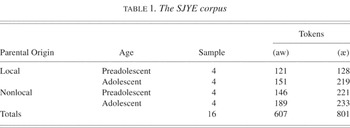
The data on which the following analyses are based come from 16 young women, equally stratified by age and by parental origin (see Table 1), collected during the winter of 2000 using a “friend of a friend” (Milroy, 1980) approach to sampling.
The SJYE corpus

A common theme in the sociolinguistic literature is the role of women as leaders of linguistic change, with women typically responsible for the initial adoption of new variants (e.g., Chambers, 1992; Labov, 1990). This generalization holds in CE, where women are leading the shifts toward innovative variants of (aw) and (æ) (e.g., Chambers & Hardwick, 1986; de Wolf, 1993; Esling & Warkentyne, 1993; Hung et al., 1993; Woods, 1979). The St. John's context provides further support for this trend. Women, and younger women in particular, lead in the use of CE variants, whether they are innovative or traditional features of the national variety (Clarke, 1991). In focusing uniquely on female speakers, therefore, the current research specifically targets a subsection of the community known to use innovative forms.
All members of the sample were born and raised in St. John's or the immediately surrounding area. However, while the parents of half the participants are also native Newfoundlanders, the parents of the other half are not. In all such cases, the mothers, and the majority of the fathers, as well, are from regions of Canada where CE is the linguistic norm.7
Trudgill (1986) noted that in Norwich, the ability to master the

distinction is largely dependent on the mother's accent, suggesting that CE homogeneity is important in the instance of nonlocal mothers, whereas the linguistic origins of nonlocal fathers may be less crucial. Thus, although some of the fathers are British or American, this factor is unlikely to have influenced the results. The key point here is that the mothers of this half of the sample are all from mainland Canada.
The dialect acquisition literature has shown that when parents do not speak the local variety, children demonstrate a strong ability to master (i.e., acquire native-speaker competence of) phonological features of the local dialect, unless these are subject to complex linguistic conditioning (Payne, 1980; Trudgill, 1982, 1986). In St. John's, parental origin has been reported to significantly affect the overall frequency of both local SJE and traditional CE features; local-parent speakers use more local variants, while their nonlocal-parent peers use more CE variants (D'Arcy, 2000). However, whether or not parentage affects the acquisition of the internal constraints that govern variability in the community has to this point remained unknown. The current research addresses this issue by examining the effects of phonological environment on the realization of (aw) and (æ) within the parentage groups.
The participants are further distinguished by age. The preadolescents range from 8 to 11 years old, and the adolescents are 16 and 17 years old. This stratification is an important aspect of the sample. Preadolescents have been included in some sociolinguistic corpora (e.g., Cedergren, 1973; Labov, 1982/1966; Schilling-Estes, 2000; Trudgill, 1974), but the distinction between preadolescent and adolescent speakers is seldom made. More often than not, they are grouped together.8
Notable exceptions to this sampling bias include Macaulay (1977), Mees and Collins (1999), Romaine (1984), and Wolfram (1969).
In St. John's, age has been found to be the most significant social factor contributing to phonological change. At the same time, younger speakers differ from older ones, not so much in casual speech styles, as in formal ones (Clarke, 1991). Consequently, data from free speech, representative of more casual speech styles, and the reading of word-lists, aimed at reflecting the speech of more careful contexts, have been elicited.
To reduce the effect of the interview context, the free speech portions of the interviews were conducted in groups: one local-parent speaker was paired with a local-parent friend (see Labov 1972, 1982/1966 and Milroy 1987 for discussions of this interview technique). The operation of group dynamics and the fact that the participants were companions combine to elicit speech that can be assumed to closely resemble unmonitored vernacular usage.
Coding and analysis
Stressed tokens of (aw) and (æ) were extracted from the interview materials and coded for their phonetic quality, as well as for a series of internal and external constraints. To control the type/token ratio, only five instances were included in cases in which a speaker used a single lexical item repeatedly. In the end, a total of 1408 tokens were retained for analysis, 607 representing (aw) and 801 representing (æ), coded impressionistically from recordings made on a Sony TC-142 cassette tape player. All tokens were listened to at least three times before being transcribed; the transcriptions were later checked by the author for reliability and amended if necessary.
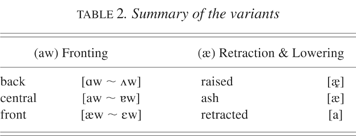
Table 2 provides a summary of the phonetic coding protocol. Following Hung et al. (1993), tokens of (aw) were coded according to the quality of the onset as back (no fronting), central, or front. Given the nearly categorical status of Canadian Raising in these data, onsets were not coded according to whether or not they had also been raised. Rather, it can be assumed that the nucleus is raised in the raising context, whereas in the “elsewhere” environment, it is realized as a low vowel.
Summary of the variants
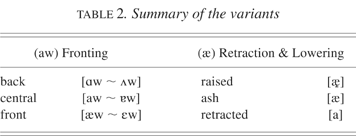
While the variants of (aw) were coded according to backness, the variants of (æ) were coded according to height. Thus, (æ) tokens were coded for raising (the traditional SJE realization), lowering—either with or without retraction—(the innovative CE realization), or neither (the traditional CE realization).9
One reviewer suggested the possibility of rule ordering (Sankoff & Rousseau, 1989) in the realization of these three variants. Following the procedure outlined in Sankoff and Rousseau (1989:4–7), it was determined that

represent three distinct variants.
Next, the data were coded for a range of linguistic factors, all of which focus on the immediate phonological environment. In the case of (aw), the only environment that has been reported to condition Fronting is the following one: Onsets tend to be fronted in the context of a following voiced consonant, as well as word-finally, but generally remain back when preceding a tautosyllabic voiceless consonant (Chambers & Hardwick, 1986; Hung et al., 1993). Consequently, tokens of (aw) were coded according to whether the following segment was voiced (e.g., loud), voiceless (e.g., pout), or Ø (e.g., cow).
Although Clarke et al. (1995) reported that only the following manner of articulation is significant in determining the probability of (æ) RL in CE, the current data were also coded for place of articulation, as well as voicing of the following consonant.10
The effects of the preceding environment on vowels involved in the Canadian shift have never been examined (cf., Clarke et al., 1995). Consequently, tokens of (æ) were also coded for the manner, place, and voicing of the preceding segment. None of these factors proved significant, and accordingly will not be dealt with here unless relevant to a particular discussion.
The data were then coded according to style: careful, reflecting word-list style, and casual, from the peer-group interviews. In CE, (æ) RL and (aw) Fronting exhibit no set profile, being equally frequent across styles. In SJE, on the other hand, these innovations have been reported to represent incipient change, “filtering gradually” into the community via formal speech styles (Clarke, 1991:120).
Age has also been operationalized, making possible a comparison of the roles of preadolescents and adolescents in the diffusion of phonological change. Do these age groups behave comparably in their use of innovative forms?
Finally, to track the effects of the parental dialect in SJYE, the origin of speakers' parents was treated as a factor group. Speakers with nonnative parents were coded as nonlocal, whereas those whose parents were born and raised in Newfoundland were coded as local. This method enables us to model the effects of parentage on the acquisition of language internal factors by addressing two issues. First, do local and nonlocal-parent speakers share the same constraints and constraint hierarchies for phonological variants? Second, what effect(s), if any, does a CE parental dialect have on the acquisition of phonological innovations originating in their own variety? With these issues in mind, I now turn to a discussion of the results.
RESULTS
(aw) Fronting in SJYE
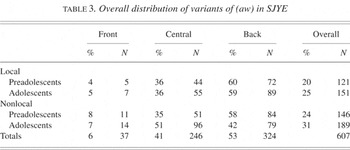
The distributions of the variants of (aw) are displayed in Table 3. A result that immediately stands out is the extremely low incidence of front onsets (6%; N = 607). This is noteworthy because this diphthong was often fronted to [æ] and, if raised, was even realized as

in both source dialects of Newfoundland English (Seary et al., 1968; also Wakelin, 1986). Fronting to

has been reported for the Avalon Peninsula (e.g., Paddock, 1966), yet here we see that among younger speakers in St. John's, this articulation is rare.
11One reviewer pointed out that onsets with

were recorded in St. John's during the 1980s, where they accounted for approximately one quarter of (aw) tokens among local adolescents. Thus, the current results indicate that the traditional realization of this diphthong has decreased considerably among younger speakers.
Overall distribution of variants of (aw) in SJYE

For this reason, it is conspicuous that the most frequent onset in these data occurs with a back vowel. Indeed, the majority status of back variants here, among all but one group, suggests that they may be a synchronic feature of SJYE. The behavior of the nonlocal parent adolescents lends support to this hypothesis. In St. John's, nonlocal-parent speakers, and adolescents in particular, display the lowest overall frequencies of local features (D'Arcy, 2000). If (aw) Fronting is associated with CE, then it is possible that nonfronting is viewed as “local.” If this were true, then we may find evidence for it in the effect of style among the speakers considered here, since mainland features are reported to enter SJE via more formal speech styles (Clarke, 1991).
This raises the question, however, of whether the results in Table 3 reflect patterns of (aw) Fronting, or whether they simply echo the influences of diachronic factors. In other words, the distributional results indicate that fronted onsets form part of these speakers' vernaculars, but do they also have Fronting? Multivariate analysis may help shed some light on this question.
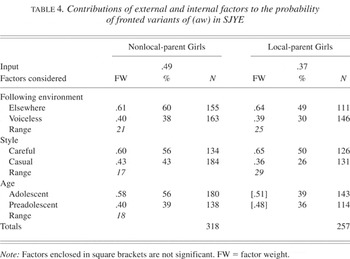
In what follows, the parentage groups have been run separately in order to model the effects of parental origin in SJYE. Table 4 displays the results of these two independent multiple regressions for fronted onsets; because front nuclei are infrequent but display the same distributional patterns across factors as do central ones, front and central realizations have been collapsed in the multivariate runs.12
In the environment of a following lateral, fronting of (aw) occurs extremely frequently (88%; N = 32). Consequently, all such tokens have been excluded from the multivariate analyses. Based on phonetic properties alone, we expect a following lateral to exert the opposite effect and favor back onsets because laterals are velarized in English. However, the unusually high degree of fronting in pre-lateral contexts that we find in these materials may be an artifact of the tokens themselves, all of which consist of two lexical items, scowl and owl. For example, the consonant transition pattern of the preceding [k] in scowl can induce raising of F2 in the diphthong, whereas in the case of owl, the cause may be the preceding word. All tokens come from careful style, which was induced using a word list. The lexeme before owl was write, a form consisting uniquely of coronal consonants and a front gliding diphthong. Consequently, perseveratory coarticulation may be entirely responsible for the fronting in owl (E. Thomas, personal communication).
Contributions of external and internal factors to the probability of fronted variants of (aw) in SJYE

If we first consider constraint hierarchies, we find that the direction of effects within all factor groups is identical for both local and nonlocal-parent girls in St. John's. The parallelism in the hierarchy for the language internal factor of the following phonological environment is particularly important, however, for two reasons. First, it indicates that SJYE shares the phonological conditioning on fronting of the onset reported for CE, with significantly more front and central nuclei occurring in the “elsewhere” environment (i.e., word-finally and before a voiced consonant). By implication, this suggests that the fronting we observe among these speakers constitutes (aw) Fronting rather than any diachronic residue, because allophones of (aw) were not allophonically conditioned in either southwestern England or southeastern Ireland (Kirwin, 1993; Seary et al. 1968). Second, the similarity of the phonological effect across parentage groups reveals that parental origin does not hinder the ability of younger girls in St. John's to master the linguistic constraints that are operative on Fronting.
The multivariate results in Table 4 also demonstrate the clear effect of style on Fronting in SJYE. Fronted onsets are favored in careful speech (.60 among nonlocals; .65 among locals), while significantly disfavored in casual speech (.42 and .36, respectively). This stratification is unique to SJYE; no such result has been reported for (aw) in CE. However, the current finding corroborates the stylistic diffusion reported for other CE features, both in St. John's (e.g., Clarke, 1991) and in rural Newfoundland (e.g., Colbourne, 1982), where supralocal forms have been reported to enter through formal speech styles. This suggests that, despite the traditional realization of this diphthong in Newfoundland, these younger girls associate fronted nuclei with mainland norms, and shift toward it in more formal speech styles.
What must be borne in mind is the nature of the relationship between CE and SJE. CE is the national variety, the standard to which younger speakers in Newfoundland look for their model of prestige speech (Hampson, 1982). Considered in this light, it is perhaps to be expected that CE variants should diffuse into SJE via careful speech. By extension, we might also expect features associated with the local vernacular to be more frequent in informal speech styles, where there is less pressure to conform to the external norms of CE. This is exactly the stylistic context in which we find the highest frequency of back onsets in these data (63%; N = 315).
The relative weight of the stylistic constraint lends further insight to these observations. Within the group of nonlocal-parent speakers, style has the weakest effect on Fronting. Here, the internal constraint is tantamount. But note the distributional evidence. A full 43% of their onsets are fronted during unmonitored free speech. In contrast, fronted variants comprise just 26% of their local-parent peers' (aw) tokens in casual, everyday discourse, a frequency that doubles in the careful context of the word list. This strongly suggests that style takes on the central role in conditioning Fronting in this group, because in order for their speech to more closely resemble mainland norms, they have further to accommodate.
Thus, (aw) Fronting differentiates the parentage groups in terms of the overall frequency of use and the importance of style in constraining fronted variants, with the latter deriving as a consequence from the former. Consequently, it is not the effects of language internal factors that distinguish local from nonlocal-parent girls in St. John's, but rather, it is differences in the ranking of social and linguistic factors that underlie their variable grammars for Fronting.
(æ) Retraction and Lowering in SJYE
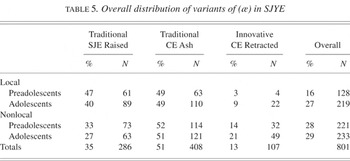
The distributional results for (æ) are displayed in Table 5.13
One speaker, a preadolescent whose pseudonym is Faith, had to be excluded from the examination of (æ) RL; anomalous results set her apart from her local-parent cohort. The traditional SJE raised variant accounts for 75% of her tokens overall, and the remaining 25% all consisted of the traditional CE variant. Faith's results for (aw) Fronting, however, are in line with those of her peers. What distinguishes Faith from the other preadolescents in the sample is that her social and familiar networks are centered in The Goulds, a small town just outside St. John's. Though extremely tentative, Faith's results may hint that (æ) RL is still an urban phenomenon in Newfoundland, whereas (aw) Fronting may have begun to spread into rural areas.
Overall distribution of variants of (æ) in SJYE

The distributions of the local raised variant and the innovative CE retracted variant, on the other hand, seem to indicate that these variants are stratified across the sample. In fact, the results mirror each other. As we progress from local-parent preadolescents to nonlocal-parent adolescents, the overall frequency of the local raised ash,

, steadily decreases, and as we make the same progression among the groups for the innovative retracted and lowered ash, [a], the frequency steadily increases. Thus, age and parental origin appear to interact both in the use of local variants and in the move toward innovative CE variants. The traditional CE realization of (æ) seems to act as an intermediate variant between the phonetic and social extremes of this variable, patterning neutrally among this group of speakers.
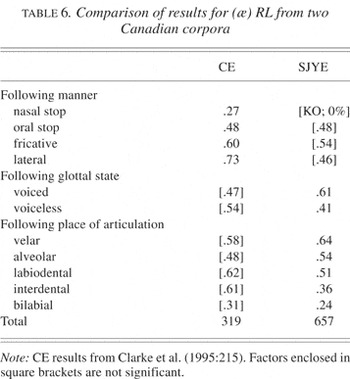
In Clarke et al. (1995), it was reported that the only internal factor to significantly affect the probability of (æ) RL was the following phonological manner. Displayed in Table 6, this result is not replicated in the SJYE data, where this factor was not chosen by the step-wise procedure.14
In Clarke et al. (1995), speaker sex was run simultaneously with the phonological manner, voicing, and place of articulation of the following segment. Because sex is not a factor in the current analysis, the results reported in Table 6 were obtained by running the following phonological environments simultaneously.
Tensing and raising is virtually categorical in SJE when (æ) precedes a nasal consonant (93%; N = 144).
Comparison of results for (æ) RL from two Canadian corpora

The failure of the following manner to have been selected in SJYE may result from interaction with voice within this factor group. For example, CE words like tack and back are realized with [æ], whereas the vowel of tag and bag tends to be raised and fronted.16
Thank you to one reviewer for pointing this out to me.
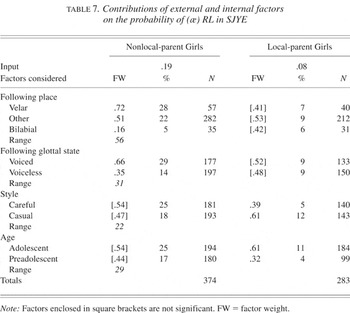
But, do the results in Table 6 reflect the patterns for all the speakers in the SJYE sample, or is RL conditioned differently within each parentage group? Table 7 displays the results of two independent multivariate analyses, one for the nonlocal-parent group, and one for those of local parentage.17
The effect of the following phonological manner was originally included in the multivariate analyses reported in Table 7, but was ultimately removed because not only did it fail to be selected in both parentage groups, but comparison of the log likelihoods revealed that its omission derived a better fit.
Contributions of external and internal factors on the probability of (æ) RL in SJYE

Note the differences in the significance of factors between these two groups. Among the nonlocal-parent girls, the internal constraints of following place and following glottal state are selected as significant. In contrast, it is the external constraints of style and age that are significant among their local-parent peers; the linguistic factors do not appear to constrain RL in any notable way for these speakers.
Furthermore, note that in the nonlocal-parent cohort, it is the following phonological place that exerts the strongest effect on (æ) RL despite the way this factor interacts with voicing. Dorsal articulations strongly favor retraction (.72), bilabial articulations strongly disfavor retraction (.16), and intermediate ones (labiodentals, interdentals, and alveolars) fall on the median (.51). Thus, regardless of whether the following segment is /k/ or /g/, post-vocalic velars are highly favored to induce RL, whereas /p/ and /b/ highly disfavor it. Though not significant in the CE data, Clarke et al. (1995) also reported that RL is more frequent in the context of a following velar, while being least frequent when the following segment is bilabial. Such an effect is actually a very natural one, since (æ) RL is constrained along the articulatory correlates corresponding to peripherality: (æ) remains front with the front-most of articulations, those that are bilabial, and as the point of contact moves back in the oral cavity, so does the realization of the vowel.
However, this same direction of effects is not visible within the local-parent group. In fact, here velars and bilabials seem to pattern identically, disfavoring RL with equal probabilities. The difference in significance, as well as in the direction of effects within this factor group, suggests that parentage influences the acquisition of the place constraint on (æ) RL in SJYE.
The question remains, though, as to why voicing conditions RL opposite to the findings for CE. In isolation, this result is difficult to explain. However, where (æ) has two variants in CE (traditional [æ] and innovative [a]), it has three in SJE (local

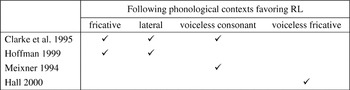
, traditional CE [æ], and innovative CE [a]). Interestingly, the effects of the following manner on the traditional CE realization in SJYE do mirror those constraining innovative forms in CE. Figure 3 summarizes the previous findings for (æ) RL in CE.

Summary of following phonological contexts found to favor (æ).
Taken together, these results point to following laterals, fricatives, and voiceless consonants as the loci of retraction in CE. A separate run (not shown here) revealed that the two most frequent contexts for the traditional CE realization of (æ) in SJYE are before laterals (75%; N = 74) and voiceless fricatives (66%; N = 165). Moreover, these are the only contexts in which this variant is favored (.67 and .55, respectively). In short, the traditional CE realization is most likely to surface when the vowel precedes a lateral and a voiceless fricative, which are more or less the exact environments that favor innovative retracted realizations in CE. Thus, the traditional CE variant patterns in SJYE like the innovative one does in the source variety. The fact that RL does not pattern identically in CE and SJYE, therefore, is most likely attributable to the more complicated situation of the local dialect, where more variants of (æ) are present.
Table 7 also reveals two distinct patterns of stylistic diffusion of the CE retracted variant into SJYE. Within the group of nonlocal-parent speakers, this feature conforms to the pattern outlined in Clarke 1991, favored in careful contexts, though this effect is not significant. In the case of the local-parent speakers, however, the multivariate analysis exposes a different pattern: Their use of the retracted variant not only decreases in careful speech contexts, but this effect is significant. Thus, in contrast to the results for (aw), it appears that parentage is implicated in the diffusion of phonological change, as its route can differ depending on the parental dialect of the speakers. I return to this point later.
The role of parentage in SJYE
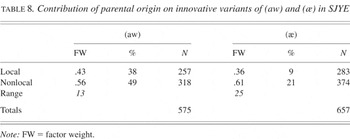
So far, the parentage groups have been examined separately and the independent multivariate analyses have uncovered differences in: (1) the significance of factors (RL), (2) the relative ranking of constraints (RL and Fronting), and (3) constraint hierarchies (RL). This suggests that parental origin itself is an important factor in the diffusion of phonological changes in SJYE. As Table 8 reveals, this is indeed the case. Both (aw) Fronting and (æ) RL are significantly more frequent within the nonlocal-parent group than they are within the local-parent one. With a range of 25, this is especially evident in the instance of (æ) RL.
Contribution of parental origin on innovative variants of (aw) and (æ) in SJYE

The first attestations of both (aw) Fronting and (æ) RL in CE date back to the late 1970s, making these innovations at least 25 years old (see, Chambers, 1980 on (aw) and Woods, 1979 on (æ)). Consequently, the advanced rates of Fronting and RL within the group of nonlocal-parent girls stands to reason, as it is likely that both are present in the speech of their parents. As such, these girls have been exposed to these innovations since birth, an advantage not accorded those of local parentage. This is all the more salient given recent claims in the literature that dialect features are acquired between the ages of three to four years (Roberts, 1994, 1997; Roberts & Labov, 1995), and that the social constraints governing their use are in place by the age of seven years (Labov, 1989; Romaine, 1984).
At the same time, these data have revealed an apparent paradox in the way parental origin affects the acquisition of language internal factors in SJYE. Consider (aw) Fronting. Despite the difference in the overall frequency of use, both local and nonlocal-parent groups share the same hierarchy for the linguistic constraint of the following phonological environment. The examination of (æ) RL, however, reveals a different pattern altogether, in that the multivariate analyses revealed not only distinct constraints but also distinct constraint hierarchies within the parentage groups. How are we to interpret these conflicting results?
Perhaps these differences are not a result of parental origin per se, but rather they may simply be a side effect of parentage. We know that in St. John's, parentage affects quantitative aspects of language change, because nonlocal-parent speakers use more innovative forms than local-parent speakers do. Notice, that in the case of (æ) RL in Table 8, innovative realizations are extremely rare among the local-parent group: The overall frequency is just 9% (N = 283). Compare this to the robust 21% of the nonlocal-parent speakers (N = 374). Given this disparity, it is conceivable that the differences in the operation of language internal factors derive not from differences in parentage, but from the way in which these constraints develop within the vernacular. That is, perhaps linguistic constraints do not appear before a particular threshold of use is attained. After all, recent research indicates that with obsolescing features, constraints cease to operate once the frequency drops below a certain point (Cukor-Avila, 1997). Could the reverse be true in the acquisition of innovative forms? Tagliamonte (2003:543), for example, provided evidence that the most visible indication of the operation of internal factors occurs where a form appears most frequently; it is only where the degree of use is greater that the constraints operate with any strength.
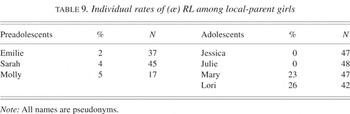
To assess whether the same may be true of the current results, it is necessary to take a closer look at the linguistic behavior of each parentage group. Examination of the results for individual speakers, as in Table 9, reveals that the frequency of retraction varies from 0% to 26% within the local-parent group, though most cluster in the 0% to 5% range. Crucially, the effect of the following place is only visible in the results for Sarah and Mary. These two speakers aside, there is little evidence for the operation of linguistic constraints within this group.
Individual rates of (æ) RL among local-parent girls

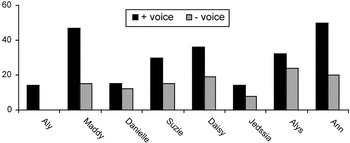
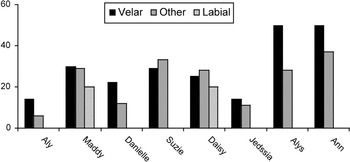
In contrast, consider the results in Figures 4 and 5. These chart the rates of retraction for the nonlocal-parent speakers.

Individual rates of (æ) RL according to the voicing of the following segment among nonlocal-parent girls.

Individual rates of (æ) RL according to following place of articulation among nonlocal-parent girls.
Figure 4 graphically demonstrates that the effect of the following glottal state is in place for every speaker, and in Figure 5, it is clear that the following point of articulation largely conditions RL uniformly across the board. Although the effects of velars and intermediate places seem to be reversed for Suzie and Daisy, the highly disfavoring effect of following labials is nonetheless apparent in their use of retracted variants of (æ).
These striking differences in the operation of the internal constraints in the two parentage groups, in conjunction with the gulf in their frequencies of retraction, would seem to support the hypothesis that the conditions on phonological variability are developmental, becoming defined as the rate of use increases. Alternatively, it is possible that it cannot be determined whether or not constraints are operative until the overall rate of use passes a certain threshold. If this were indeed the case, then we may again be able to find evidence for this in the behavior of individual speakers. With this in mind, consider once more the results for the local-parent group. Two of the adolescents, Mary and Lori, have extremely high rates of retraction. For Mary, who retracts at a rate of 23%, the effect of the place constraint is evident, but the voice constraint operates in the wrong direction (she retracts in voiceless contexts more often than in voiced ones). Lori, who retracts more frequently than any other local-parent girl in her cohort (26%), does not seem to have mastered either constraint. Indeed, she retracts most frequently in the context of a following labial, the place that most disfavors retraction in both CE and within the group of nonlocal-parent speakers. In short, even among the two local-parent girls who display the highest frequencies of innovative variants, there remains little evidence for the operation of language internal factors on (æ) RL.
Given the regularity of the operation of constraints within the nonlocal-parent group, a group that exhibits more than twice the rate of retraction than their local-parent peers, it is plausible that the phonological conditions on (æ) RL may begin to function within the group of local-parent speakers as the use of retracted variants becomes more frequent within the community. The existence of such an effect could explain the paradoxical patterning of RL and Fronting: The first occurs at low rates, whereas the latter occurs quite frequently within both groups of speakers (49% for nonlocals and 38% for locals). Because it has a higher overall distribution, the constraints on Fronting have fully developed, as evidenced in the multivariate results in Table 4. RL, on the other hand, is still too infrequent among local-parent speakers for the constraints to have become fully operative.
Explaining differences in constraint rankings
In addition to the differences in the hierarchies of constraints for (æ) RL, the parentage groups are also set apart by the relative ranking of internal and external factors vis-à-vis each other. As discussed earlier, the multivariate results in Table 4 revealed that the internal constraint prevails among the nonlocal-parent girls for (aw) Fronting, but among their local-parent peers, the effect of style surpasses that of the following phonological environment. Even more prominent, however, is the finding that (æ) RL is conditioned strictly by linguistic factors within the nonlocal-parent group (see Table 7), but among the local-parent group it is the social and stylistic factors that dominate. The phonological factors are not even selected by the stepwise procedure. What do these latter results tell us about change in SJYE?
In light of the proposed developmental nature of linguistic constraints, their lack of significance in conditioning (æ) RL within the local-parent group is not surprising. As already discussed, these girls rarely produce innovative variants of (æ). Because the internal phonological constraints are not yet in place among this group of speakers, only the social and stylistic ones are fully available to operate on RL.
In St. John's, there is strong socioeconomic pressure to conform to CE norms. This pressure is reflected by increased use of mainland forms in the speech of upwardly mobile sections of the population (Clarke, 1991). Although the significant effect of style in these data is in part indicative of the prestige afforded CE variants in the community, its strength among local-parent speakers in particular is suggestive of the developing bidialectalism of this group. Nonlocal-parent speakers already sound more like their mainland peers than do local-parent ones, meaning there is less pressure to conform in contexts requiring increased attention to language. The lesser strength of style within this group may therefore simply reflect this disparity between the parentage groups.
However, recall that local-parent speakers actually decrease their use of innovative variants of (æ) in careful contexts. This profile contrasts starkly with that of the traditional CE variant, for example. This anomalous stylistic behavior may be linked to linguistic insecurity within this group. Such an interpretation is suggested by the lack of internal constraints on (æ) RL in conjunction with the social evaluation of CE in St. John's. Specifically, the local-parent girls decrease their use in formal speech styles because they are not sure how to use it. This is not to suggest that speakers are aware of whether or not they have acquired the constraints on usage, but rather that as a feature becomes more deeply embedded in the system, speakers may become more confident of controlling patterns of variability that originate in a supralocal variety.
The role of age in SJYE
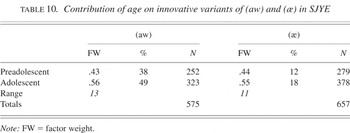
At this point, we may ask ourselves what effect age has on the adoption of innovative forms in SJYE. As the results in Table 10 demonstrate, in St. John's, adolescent girls use significantly more innovative variants than do preadolescent girls.
Contribution of age on innovative variants of (aw) and (æ) in SJYE

A caveat to bear in mind when dealing with younger speakers, of course, is the developing nature of their sociolinguistic personas. For example, while parental social class is arguably the best predictor of vowel quality during preadolescence (Eckert, 1988), it is during this period that children begin to modify their vernaculars in accordance with those of their peer groups (Kerswill, 1996; Labov, 1964; Tagliamonte & D'Arcy, 2004). By the time of adolescence, social identity has become the most reliable predictor of vocalic realizations (Eckert, 1988). Thus, the frequency of certain variables may undergo inter- as well as intra-speaker fluctuations over these formative sociolinguistic years. But, what of the constraints that govern these variable forms?
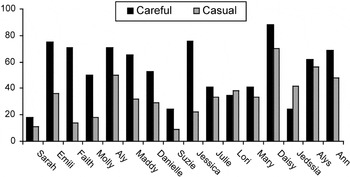
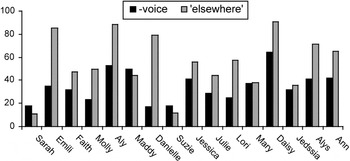
To address this issue, I would like to consider one more time the patterns of individual speakers. Figure 6 displays the rates of (aw) Fronting according to style for each of the 16 speakers in the sample, and Figure 7 displays the individual rates according to the following phonological environment. In these figures, the first eight speakers listed are the preadolescents, and the final eight are the adolescents.

Individual rates of fronted onsets for (aw) according to style.

Individual rates of fronted onsets for (aw) according to following phonological environment.
The results are remarkable. Note the high degree of variation in individual frequencies. This is not symptomatic of the speech of these age groups in particular. It is typical even of adult samples (see, e.g., Clarke et al., 1995:221; Hoffman, 2004; Wolfram & Thomas, 2002:168–175). What I suggest we are viewing here is idiolectal variation. The more important observation is the way in which style and the following phonological environment are distributed across the sample. Both factors display identical patterns across almost all speakers, with fronted onsets being more frequent in careful style (Figure 6) and in the “elsewhere” environment (Figure 7). This same result is evident in Figures 4 and 5, which chart the rates of (æ) RL within the group of nonlocal-parent speakers. This finding is critical because it demonstrates the maintenance of stylistic and language internal constraints across the turbulent sociolinguistic preadult years.
There are, however, individuals who do not appear to conform to group norms. This too is characteristic of adult samples (e.g., Chambers, 2003:84–101; Hoffman, 2004; Wolfram & Thomas, 2002:168, 173). Does their appearance here represent bona fide aberrations from the pattern? Closer investigation suggests they do not. Consider, for example, Maddy in Figure 7. Her anomalous pattern for Fronting results entirely from the contribution of a single lexical item, in this case, mouse. In these materials, this lexeme does not follow the established pattern of variability on (aw). Where we would expect a higher proportion of back onsets, because the following consonant is voiceless, we find that the onset is regularly fronted (75%; N = 16). For the speakers who use it, this form constitutes no more than a single datum. However, Maddy used it three times, and in every instance, the onset is fronted. When excluded, her exceptional pattern disappears; thus, it is simply skewed by the atypical patterning of one word.
The two remaining exceptional distributions in Figure 7 provide further support for the developmental nature of the linguistic constraints that govern features involved in ongoing change. Suzie and Sarah are the most conservative speakers in the sample, both with overall distributions for Fronting of just 15%. As a point of comparison, the next lowest frequency, that of Molly, is 31%. Suzie fronted just 6 of 39 tokens, while Sarah managed a negligible 4 fronted onsets in 26 tokens. With so few instances of Fronting in Suzie and Sarah's data, it is unsurprising that the phonological conditioning factors may not be fully active.
This is most evident for Suzie. Examination of individual phonological contexts suggests that she has yet to master the effects of all segments that form the “elsewhere” environment. Specifically, she categorically fails to front the onset of (aw) before nasals. Because 9 of her 17 “elsewhere” tokens are pre-nasal, this one context distorts the results for the entire environment. In so doing, however, it demonstrates that this particular phonological context is not yet patterning according to the full range of constraints on Fronting in SJYE.
The pre-nasal context is an important one for the speakers under investigation here. Examination of (aw) when it is followed by a nasal reveals a fundamental distinction between sequences of the type /nC/ (e.g., count, ground, bouncing) and those of the type /n#/ (e.g., town, brown, down).18
Interestingly, /aw/ in words such as ground and pound derives from Middle English u, whereas in words like cow, house, and crucially, down, the diphthong comes from Middle English u (for discussion of the isoglosses in the south of England, see Wakelin, 1977:88–90). Thus, this historical split may have synchronic consequences in Newfoundland.
Interestingly, certain /nC/ sequences pattern with tautosyllabic voiceless consonants in conditioning Raising in CE. However, in most such cases, the post-nasal obstruent is a voiceless alveolar stop and forms the onset of a post-tonic syllable (e.g., fountain, mountain) (Chambers, 1973:119). The current results provide evidence of a much broader constraint in SJYE, at least in so far as Raising interacts with Fronting.
Returning to Suzie, nine pre-nasal tokens is not an inconsequential number. Her failure to ever front the onset of /aw/ in this environment suggests that all nasal contexts have been analyzed as barring Fronting. In other words, there is no evidence that the distinction between /n#/ and /nC/ has been mastered, nor is there evidence of the differential effects these two contexts have on Fronting within the “elsewhere” environment.
Thus, Suzie's data demonstrate that even where the frequency of use is low, it is still possible to find evidence that the constraints on phonological variables are not fully operative in the early stages of acquisition.
At the same time, the consistency of effects across individuals for both (aw) Fronting and (æ) RL confirms that once the constraints on variability are acquired, the preadolescents and the adolescents all share the same conditioning factors for phonological change. These results therefore demonstrate that these age groups, despite their ongoing sociolinguistic development, are linguistically cohesive groups, sharing constraint rankings for stylistic as well as language internal factors. This is particularly important because it is argued that the operation of the constraints reveal the underlying grammar (Tagliamonte, 2002:737–740; see also Poplack & Tagliamonte, 1989, 2001). The current findings add further support to this claim. Consequently, the contribution of both these age groups to variationist research is invaluable, as they provide an added dimension to any exploration of change in progress.
Situating the locus of change
Having established that preadolescent and adolescent girls in St. John's follow the same phonological patterns, the question remains as to whether these profiles can tell us anything about ongoing change in the community more generally.
As discussed earlier, age is a critical factor in the diffusion of CE innovative forms in SJYE, in that the adolescents are significantly more advanced than are their preadolescent peers in the use of these variants. This means that the typical pattern of age stratification does not hold, because the younger speakers use fewer, not more, innovative variants than the older ones do. But, the age stratification of the sample is not typical either. The oldest speakers in this corpus are usually the youngest ones in many sociolinguistic corpora (e.g., Bailey, Wilke, Tillery, & Sand, 1992; Clarke, 1991; Ito & Tagliamonte, 2003; Schilling-Estes & Wolfram, 1999; etc.). Given this observation, how are we to interpret the reversal in the trajectory of change?
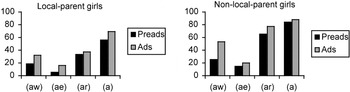
The SJYE apparent time data suggest that, although participating in change by using innovative forms, speakers continue to favor features of the local vernacular through preadolescence, and that it is only during adolescence that they shift toward the new, incoming variants. As Figure 8 demonstrates, this pattern is found not only for innovative CE forms in SJYE, but for traditional CE variants, as well. In short, the locus of adoption of phonological features undergoing change is clearly situated during the adolescent years. This finding was foreshadowed by Eckert's work with adolescents, where she concluded that this age provides “a license and an imperative to begin acting on certain kinds of social knowledge that the age cohort has been developing for years” (Eckert, 2000:8). Thus, not only do the SJYE results add to the growing body of literature profiling the dynamic linguistic behavior of adolescents, but they also corroborate the claim that tapping into phonological changes is linked to the social development of this age group (Eckert, 1988:197). In other words, if phonological change is present in the community, the place where it will be actively engaged is among adolescents.

Overall frequencies of CE variants in SJYE in casual style (data for (ar) and (a) from D'Arcy, 2000).
In Clarke (1991), (aw) Fronting and (æ) RL marked incipient change in SJE. Although present in careful contexts, they failed to form any integral aspect of casual vernacular usage (1991:120). Here, however, the results clearly indicate that both (aw) Fronting and (æ) RL are socially and linguistically conditioned in SJYE. Furthermore, they constitute a nonnegligible component of casual speech styles (see Tables 4 and 7). Thus, although (æ) is clearly lagging behind (aw), the move toward CE innovative variants is no longer incipient in nature, but rather represents bona fide generational change in the community.
A comparison with earlier results from the community adds support for this interpretation. Clarke (1991:116) reported that innovative variants were more frequent in the speech of her youngest participants, aged 15 to 19 years, than in that of older age groups. As, for example, the overall frequency of (æ) RL among the adolescents was then 8% in casual speech, whereas in these more recent materials it is 19% (N = 188), it is possible to extrapolate from the trajectory in real time that the use of these variants is increasing. Consequently, pinpointing the moment of their active adoption to the adolescent years is even more exciting, because it provides a gauge for tracking the diffusion of innovations in this variety.
CONCLUSION
If the patterning of individuals reflects that of the group as a whole, then we may conclude that the parameter defining the group reflects a genuine sociolinguistic construct. Furthermore, if the behavior of this group reflects larger patterns within the community, then we may conclude that the group is representative of the sociolinguistic structure of the community itself. Careful scrutiny of the linguistic behavior of preadolescent and adolescent speakers of SJYE has revealed that these age groups, though still developing sociolinguistically, demonstrate stable internal constraints on variability. Consequently, an important aspect of this research concerns the critical role of pre-adults in the diffusion of phonological change. Although preadolescents participate in change, using the incoming forms, it is adolescents who catalyze these changes within the community, significantly increasing their frequency of use. The identification of the adolescent years as the locus of a dynamic shift toward innovative phonological variants thus provides us with a clear reference point in tracking the progress of linguistic changes. Taken together, these results illustrate that sociolinguistic corpora should include these younger members of any speech community, but that at the same time, they must not be lumped together as a monolithic group, because their roles in the diffusion of change are distinct.
I have also argued that in the acquisition of phonological change, linguistic constraints may be developmental, becoming operative only as a feature rises in frequency and becomes further embedded in the community. This finding corroborates those in Tagliamonte (2003), in which the constraints on possessive have versus have got are most apparent where the degree of use is highest. Here in SJYE this effect is visible in the differential behavior of the language internal conditions in each of the parentage groups. In the case of (aw) Fronting, which is extremely frequent throughout the sample, the effect of the following phonological environment is not only operative, but it is strong across the board (Table 4). In the case of (æ) Retraction and Lowering, on the other hand, the internal constraints have no effect within the group of local-parent speakers. This is also the group in which innovative variants are quite infrequent, accounting for just 9% of tokens overall. Even among the two individuals who retract at vigorous rates (Mary, 23% and Lori, 26%), evidence for the operation of linguistic constraints is lacking. This suggests, however, that it is not individual frequencies that are the determinants of change, but rather that it is the community norm that underlies the coalescence of the conditions on variability.
References
REFERENCES
Avis, Walter.
(1973).
The English language in Canada. In
T. Sebeok (ed.),
Current trends in linguistics 10.
The Hague:
Mouton de Gruyter.
40–74.
Bailey, Guy,
Wilke, Tom,
Tillery, Jan, &
Sand, Lori.
(1992).
The apparent time construct.
Language Variation and Change
3:241–264.Google Scholar
Bailey, Richard.
(1982).
The English language in Canada. In
R. Bailey &
M. Görlach (eds.),
English as a world language.
Ann Arbor:
University of Michigan Press.
134–176.
Bliss, A.
(1984).
English in the south of Ireland. In
P. Trudgill (ed.),
Language in the British Isles.
Cambridge:
Cambridge University Press.
135–151.
Cedergren, Henrietta.
(1973).
The interplay of social and linguistic factors in Panama.
Doctoral dissertation,
Cornell University.
Chambers, J. K.
(1973).
Canadian raising.
The Canadian Journal of Linguistics
18:113–135.Google Scholar
Chambers, J. K.
(1979).
Canadian English. In
J. K. Chambers (ed.),
The languages of Canada.
Montreal:
Didier.
168–204.
Chambers, J. K.
(1980).
Linguistic variation and Chomsky's ‘homogenous speech
community’.
In
M. Kinloch &
A. House (eds.),
Papers from the fourth annual meeting of the Atlantic Provinces
Linguistic Association.
Fredericton:
University of New Brunswick.
1–32.
Chambers, J. K.
(1989).
Canadian raising: Blocking, fronting, etc.
American Speech
64:75–88.Google Scholar
Chambers, J. K.
(1991).
Canada. In
J. Cheshire (ed.),
English around the world: Sociolinguistic perspectives.
Cambridge:
Cambridge University Press.
89–107.
Chambers, J. K.
(1992).
Linguistic correlates of gender and sex.
English World-Wide
13:173–218.Google Scholar
Chambers, J. K.
(2003).
Sociolinguistic theory: Linguistic variation and its social
significance (2nd edition).
Oxford:
Blackwell.
Chambers, J. K., &
Hardwick, Margaret.
(1986).
Comparative sociolinguistics of a sound change in Canadian
English.
English World-Wide
7:23–46.Google Scholar
Clarke, Sandra.
(1991).
Phonological variation and recent language change in St.
John's English.
In
J. Cheshire (ed.),
English around the world: Sociolinguistic perspectives.
Cambridge:
Cambridge University Press.
109–122.
Clarke, Sandra,
Elms, Ford, &
Youssef, Amani.
(1995).
The third dialect of English: Some Canadian evidence.
Language Variation and Change
7:209–228.Google Scholar
Colbourne, Bramwell W.
(1982).
A sociolinguistic study of Long Island, Notre Dame Bay,
Newfoundland.
M.A. thesis,
Memorial University of Newfoundland.
Cukor-Avila, Patricia.
(1997).
Change and stability in the use of verbal -s over time in
AAVE. In
E. Schneider (ed.),
Englishes around the world I.
Amsterdam:
Benjamins.
295–306.
D'Arcy, Alex.
(2000).
Beyond mastery: A study of dialect acquisition.
M.A. thesis,
Memorial University of Newfoundland.
de Decker, Paul.
(2002).
Hangin' and retractin': Adolescent social practice and
phonetic variation.
University of Pennsylvania Working Papers in Linguistics
8:59–73.Google Scholar
de Wolf, Gaelan Dodds.
(1992).
Social and regional factors in Canadian English: A study of
phonological variables and grammatical items in Ottawa and
Vancouver.
Toronto:
Canadian Scholar's Press.
de Wolf, Gaelan Dodds.
(1993).
Local patterns and markers of speech in Vancouver English.
In
S. Clarke (ed.),
Varieties of English around the world: Focus on Canada.
Amsterdam:
Benjamins.
269–293.
Eckert, Penelope.
(1988).
Adolescent social structure and the spread of linguistic
change.
Language in Society
17:183–207.Google Scholar
Eckert, Penelope.
(2000).
Language variation as social practice.
Oxford:
Blackwell.
Esling, John.
(1991).
Sociophonetic variation in Vancouver. In
J. Cheshire (ed.),
English around the world: Sociolinguistic perspectives.
Cambridge:
Cambridge University Press.
123–133.
Esling, John, &
Warkentyne, Henry.
(1993).
Retracting of /æ/ in Vancouver English. In
S. Clarke (ed.),
Varieties of English around the world: Focus on Canada.
Amsterdam:
Benjamins.
229–246.
Grabe, Esther,
Post, Brechtje, &
Nolan, Francis.
(2001).
The IViE Corpus.
Department of Linguistics, University of Cambridge.
http://www.phon.ox.ac.uk/∼esther/ivyweb.
Hall, Erin.
(2000).
Regional variation in Canadian English vowel backing.
Toronto Working Papers in Linguistics
18:21–27.Google Scholar
Hampson, Eloise.
(1982).
Age as a factor in language attitude differences. In
S. Clarke &
R. King (eds.),
Papers from the sixth annual meeting of the Atlantic Provinces
Linguistic Association.
St. John's:
Memorial University of Newfoundland.
51–62.
Hoffman, Michol.
(1999).
Really expansive: The progress of lax vowel lowering in a chain
shift.
Paper presented at NWAVE-28, University of Toronto.
Hoffman, Michol.
(2004).
All for none and none for all: /s/ deletion in the group and
the individual.
Paper presented at NWAVE-33, University of Michigan.
Hung, Henrietta,
Davison, John, &
Chambers, J. K.
(1993).
Comparative sociolinguistics of (aw)-fronting. In
S. Clarke (ed.),
Varieties of English around the world: Focus on Canada.
Amsterdam:
Benjamins.
247–268.
Ito, Rika, &
Tagliamonte, Sali.
(2003).
Well weird, right dodgy, very strange, really cool: Layering and
recycling in English intensifiers.
Language in Society
32:257–279.Google Scholar
Kerswill, Paul.
(1996).
Children, adolescents, and language change.
Language Variation and Change
8:177–202.Google Scholar
Kirwin, William.
(1993).
The planting of Anglo-Irish in Newfoundland. In
S. Clarke (ed.),
Varieties of English around the world: Focus on Canada.
Amsterdam:
Benjamins.
65–84.
Kroch, Anthony.
(1989).
Reflexes of grammar in patterns of language change.
Language Variation and Change
1:199–244.Google Scholar
Kroch, Anthony.
(2001).
Syntactic change. In
M. Baltin &
C. Collins (eds.),
The handbook of contemporary syntactic theory.
Malden:
Blackwell.
699–729.
Labov, William.
(1964).
Stages in the acquisition of standard English. In
R. Shuy (ed.),
Social dialects and language learning.
Champaign, IL:
National Council of Teachers of English.
77–103.
Labov, William.
(1972).
Language in the inner city.
Philadelphia:
University of Pennsylvania Press.
Labov, William.
(1982/1966).
The social stratification of English in New York City.
Washington, DC:
Center for Applied Linguistics.
Labov, William.
(1989).
The child as linguistic historian.
Language Variation and Change
1:85–97.Google Scholar
Labov, William.
(1990).
The intersection of sex and social class in the course of linguistic
change.
Language Variation and Change
2:205–254.Google Scholar
Labov, William.
(1991).
The three dialects of English. In
P. Eckert (ed.),
New ways of analyzing sound change.
San Diego:
Academic.
1–44.
Labov, William.
(1994).
Principles of linguistic change: Internal factors.
Oxford:
Blackwell.
Lanari, Catherine.
(1994).
A sociolinguistic survey of the Burin region of Newfoundland.
M.A. thesis,
Memorial University of Newfoundland.
Luthin, Herbert.
(1987).
The story of California (ow): The coming-of-age of English in
California.
In
K. Denning,
S. Inkelas,
F. McNair-Knox, &
J. Rickford (eds.),
Variation in language: NWAV 15 at Stanford.
Stanford University:
Department of Linguistics.
312–324.
Macaulay, Ronald.
(1977).
Language, social class, and education: A Glasgow study.
Edinburgh:
Edinburgh University Press.
Mees, Inger M., &
Collins, Beverley.
(1999).
Cardiff: A real-time study of glottalisation. In
P. Foulkes &
G. Docherty (eds.),
Urban voices: Accent studies in the British Isles.
London:
Arnold.
185–202.
Meixner, Laura.
(1994).
Variation and change in Toronto English: (ε) and
(æ).
Manuscript.
York University.
Milroy, James, &
Milroy, Lesley.
(1978).
Belfast: Change and variation in an urban vernacular. In
P. Trudgill (ed.),
Sociolinguistic patterns in British English.
London:
Edward Arnold.
19–36.
Milroy, Lesley.
(1980).
Language and social networks.
Oxford:
Blackwell.
Milroy, Lesley.
(1987).
Observing and analysing natural language.
Oxford:
Blackwell.
Paddock, Harold.
(1966).
A dialect survey of Carbonear, Newfoundland.
M.A. thesis,
Memorial University of Newfoundland.
Payne, Arvilla.
(1980).
Factors controlling the acquisition of the Philadelphia dialect by
out-of-state children.
In
W. Labov (ed.),
Locating language in time and space.
New York:
Academic.
143–178.
Poplack, Shana, &
Tagliamonte, Sali.
(1989).
There's no tense like the present: Verbal -s
inflection in Early Black English.
Language Variation and Change
1:47–84.Google Scholar
Poplack, Shana, &
Tagliamonte, Sali.
(2001).
African American English in the diaspora: Tense and aspect.
Malden:
Blackwell.
Roberts, Julie.
(1994).
Acquisition of variable rules: (-t,d) deletion and (ing) production
in preschool children.
Doctoral dissertation,
University of Pennsylvania.
Roberts, Julie.
(1997).
Hitting a moving target: Acquisition of sound change in progress by
Philadelphia children.
Language Variation and Change
9:249–266.Google Scholar
Roberts, Julie, &
Labov, William.
(1995).
Learning to talk Philadelphian: Acquisition of short a by
preschool children.
Language Variation and Change
7:101–112.Google Scholar
Romaine, Suzanne.
(1984).
The language of children and adolescents: The acquisition of
communicative competence.
Oxford:
Blackwell.
Sankoff, David, &
Rousseau, Pascale.
(1989).
Statistical evidence for rule ordering.
Language Variation and Change
1:1–18.Google Scholar
Schilling-Estes, Natalie.
(2000).
Investigating intra-ethnic variation: /ay/ in Lumbee Native
American English.
Language Variation and Change
12:141–174.Google Scholar
Schilling-Estes, Natalie, &
Wolfram, Walt.
(1999).
Alternative models of dialect death: Dissipation vs.
concentration.
Language
75:486–521.Google Scholar
Seary, E.,
Story, George, &
Kirwin, William.
(1968).
The Avalon Peninsula of Newfoundland: An ethno-linguistic
study.
National Museum of Canada, Bulletin 219. Ottawa:
Queen's Printer.
Tagliamonte, Sali.
(2002).
Comparative sociolinguistics. In
J. K. Chambers,
P. Trudgill, &
N. Schilling-Estes (eds.),
The handbook of language variation and change.
Malden:
Blackwell.
729–763.
Tagliamonte, Sali.
(2003).
“Every place has a different toll”: Determinants of
grammatical variation in cross-variety perspective.
In
G. Rhodenburg &
B. Mondorf (eds.),
Determinants of grammatical variation in English.
Berlin:
Mouton de Gruyter.
531–554.
Tagliamonte, Sali, &
D'Arcy, Alex.
(2004).
He's like, she's like: The quotative system in
Canadian youth.
Journal of Sociolinguistics
8:496–514.Google Scholar
Thomas, Erik.
(2001).
An acoustic analysis of vowel variation in New World English.
Publication of the American Dialect Society 85. Durham, NC:
Duke University Press.
Trudgill, Peter.
(1974).
The social differentiation of English in Norwich.
Cambridge:
Cambridge University Press.
Trudgill, Peter.
(1982).
Linguistic accommodation: Sociolinguistic observations on a
sociopsychological theory.
In
T. Fretheim &
L. Hellan (eds.),
Papers from the sixth Scandinavian Conference of Linguistics.
Trondheim:
Tapir.
284–297.
Trudgill, Peter.
(1986).
Dialects in contact.
Oxford:
Blackwell.
Wakelin, Martyn.
(1977).
English dialects: An introduction.
London:
The Athlone Press, University of London.
Wakelin, Martyn.
(1986).
Varieties of English around the world: The southwest of
England.
Amsterdam:
Benjamins.CrossRef
Wells, John.
(1982).
Accents of English.
(3 vols). Cambridge:
Cambridge University Press.
Wolfram, Walt.
(1969).
A sociolinguistic description of Detroit Negro Speech.
Washington, DC:
Center for Applied Linguistics.
Wolfram, Walt, &
Thomas, Erik.
(2002).
The development of African American English.
Malden:
Blackwell.CrossRef
Woods, Howard.
(1979).
The Ottawa survey of Canadian English.
(Published 1999). Strathy Language Unit Occasional Papers, No. 4.
Kingston, Ontario:
Queen's University.
The Canadian lax vowel shift.
Summary of variants of (aw) according to context in CE (favored forms are bolded).
The SJYE corpus
Summary of the variants
Overall distribution of variants of (aw) in SJYE
Contributions of external and internal factors to the probability of fronted variants of (aw) in SJYE
Overall distribution of variants of (æ) in SJYE
Comparison of results for (æ) RL from two Canadian corpora
Contributions of external and internal factors on the probability of (æ) RL in SJYE
Summary of following phonological contexts found to favor (æ).
Contribution of parental origin on innovative variants of (aw) and (æ) in SJYE
Individual rates of (æ) RL among local-parent girls
Individual rates of (æ) RL according to the voicing of the following segment among nonlocal-parent girls.
Individual rates of (æ) RL according to following place of articulation among nonlocal-parent girls.
Contribution of age on innovative variants of (aw) and (æ) in SJYE
Individual rates of fronted onsets for (aw) according to style.
Individual rates of fronted onsets for (aw) according to following phonological environment.
Overall frequencies of CE variants in SJYE in casual style (data for (ar) and (a) from D'Arcy, 2000).
 You have
Access
- 11
- Cited by