Introduction
Amidst the barbarity and darkness which reign in Lapland, there appear strictures of light, which will entertain the eie of the most knowing observer; as the Stars are no less remarkable then is the Sun it self. However the Reader will not fail to meet here with what may gratify his curiosity. Warmer climates having all the comforts and necessaries of life plentifully bestowed upon them, are but a more distant home; where we have little else talk’d of, then what we daily see among our selves: but here it is indeed, where, rather then in America, we have a new World discovered.Footnote 1
The northern region of Sápmi (Lapland)Footnote 2 attracted attention and imagination for centuries. The paragraph quoted above from the preface to the first English edition of Johannes Schefferus’s authoritative History of Lapland (1674) is, in many ways, symptomatic of the ambivalent manner the region was imagined in the early modern period. Sápmi was seen as uncivilized and remote, yet not without sights of wonder; geographically close and at the same time distant; known and unknown. The readers of Schefferus’s work were encouraged to see it as the next frontier and destination for exploration, as a new version of the Americas, which after nearly two centuries of discovery and conquest, had lost their aura of novelty and exoticism. Sápmi was cast here as a new world on the threshold of old Europe, more exciting than the already “known” overseas colonies.
The ambivalent terms in which this northern region was depicted and the curiosity it stirred were neither new nor specific to Schefferus’s work and its translation. In antiquity and the Middle Ages, the far North had been seen as a marvellous and outlandish place, a happy utopia “beyond the North Wind”, or as an abode of Satan, a terrifying end of the world where no human life or culture could thrive.Footnote 3
The projections and construction of Sápmi as a particular place, while continuously adjusted to the agendas and sensitivities of the observers, followed certain schemes and modes of engaging.Footnote 4 Among the narratives of the North, those produced in the early modern period occupy a particular position. Departing from the classical and medieval traditions of representation, which was often based on hearsay and myth, descriptions of Sápmi published in seventeenth and eighteenth centuries were, for the first time, the results of first-hand observation. Early modern Sápmi was witnessed and experienced by a number of Scandinavian and foreign explorers.
Despite varied source material, narratives of travel in Sápmi have received relatively scant attention.Footnote 5 The few studies that do exist typically focus on scientific expeditions in the eighteenth and nineteenth centuries and on Sápmi as a physical landscape in which to experiment with and observe natural phenomena,Footnote 6 as well as on Sápmi as an emerging destination for nineteenth-century travellers searching for authenticity, unspoiled nature, and adventure.Footnote 7 This study takes a different and new approach. It scrutinizes discourses, projections, and images of Sápmi produced in the early phases of exploration and colonial interest in the region, between the end of the sixteenth and mid-eighteenth centuries. Based on a selection of writing from and about the region, it considers the questions of how and why Sápmi was constructed in the early modern period, how writers experienced and imagined the region, and how their descriptions of the landscape and its inhabitants were intertwined with the larger schemes of improvement proposed by the state. The study also considers similarities and differences in the ways various authors experienced and described the region, including the disparate attitudes of domestic and foreign writers.
The article is grounded in the vast body of research on travel writing, especially analytical works inspired by postcolonial approaches.Footnote 8 This scholarship treats travel as an exemplary record of cross-cultural encounters and engagements between colonizers and colonized and is concerned with the analyses of representational discourse—how the traveller/colonizer produced the image of the other and how this representation helped western observers define themselves—and with the examination of ambivalence, contradictions, and inconsistencies of colonial discourse as a site and sign of instability.Footnote 9 These analytical routes are taken in this article.
Sápmi as a Colonial Landscape
Before the Vasas ascended to the Swedish throne in 1523, Sápmi was only loosely connected with the Swedish kingdom. The motives for increased interest and intervention in the region were manifold. They included economic concerns and geopolitical needs to define northern borders and unify the region with the rest of the country. There were also important religious and cultural aspects underlying early-modern policies in Sápmi. The Lutheran theory of government, embraced by the Swedish ruling class, stipulated unity in religion as a prerequisite to a functional social order and therefore it was important to include the Sami in the Lutheran fold and to bring them into the desired state of “civility”.
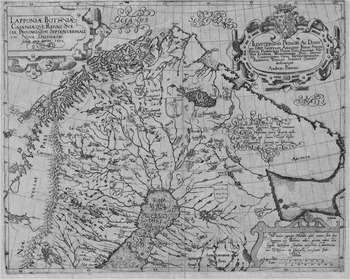
The early decades of the seventeenth century saw the implementation of various policies following these motives.Footnote 10 Cartographers were sent to the far North to measure and map the landscape, and to gather information about precious resources. In this process, the spatial reality of the other was brought under control by naming, renaming, and delineating “blank spaces” for imaginary projections and exploration (fig. 1).Footnote 11 Along with surveyors came assessors, tax collectors, and missionaries. To facilitate their work and oversight and to implement state control, parish churches, regular market places, and permanent towns were established, and strict rules of attendance of market days and religious holidays were implemented. In 1632, the first school for Sami boys was established in Lycksele in Umeå lappmark. Footnote 12 Its goal was to educate a group of Sami-speaking missionaries and, through the introduction of a firm religious and moral curriculum, to instil virtues like order, punctuality, and obedience, which necessary to fulfil the demands of colonial society.Footnote 13 Two years after the school opened its doors, silver ore was discovered in the mountains bordering Norway (then part of Denmark), spurring dreams of riches and success.Footnote 14 The discovery and the enthusiastic reaction to it happened at an important moment of conjuncture. At that time mercantilism was a dominant economic doctrine and precious metals were seen as a chief source of national wealth.Footnote 15 The new sources of silver were hoped to provide a considerable boost to the state economy, which had been exhausted by Sweden’s conflicts with Denmark and its ongoing embroilment in the Thirty Years’ War. Furthermore, the search for ores and the discovery of silver—and indeed the character of Swedes’ engagement in Sápmi overall—coincided with the colonial appetites of Gustavus Adolphus and his chancellor Axel Oxenstierna. In 1623 the king sponsored the idea of establishing a colonial company for the purpose of trade, colonization, and missionary work in Asia, Africa, and the Americas, and an American colony was established in 1638.Footnote 16
Lapponiæ, Bothniæ, Cajaniæqve Regni Sveciæ provinciarvm septentrionalivm nova delineation—map of Sápmi drawn by Andreas Bureus in 1611. Curtesy of the National Library of Sweden.

The silverworks produced meagre results, but this and the discovery of other valuable ores that soon followed, together with tax and trade revenues, encouraged the crown and its representatives to see Sápmi as a source of national wealth. Alongside these mercantilist projects, the state promoted settlement in Sápmi through the so-called Lappmarksplakat, colonization ordinances, the first of which was published in 1673. These encouraged the agricultural settlement and colonization of Sápmi and offered generous terms to peasants willing to establish farms in the northern territory. The expansion of the state apparatus in Sápmi was accompanied by continuous scientific exploration, with the objective of exploring the landscape, mapping its features, as well as proposing utilitarian, income-generating plans for exploitation of the land. Combined, all these practices and institutions constituted micro-rituals of the official presence in Sápmi. The implementation of these practices happened unevenly and the large-scale civilizing and modernizing plans had a stronger effect on the southern Sami than on their northern neighbours. In the following centuries, however, the character of the state intervention turned into full-blown colonial policies with racial overtones.Footnote 17
Early modern attitudes towards Sápmi had a clear colonial hue. They were expressed not only in economic and political initiatives that served the interest of Stockholm, but also in the unbalanced power relations skewed against the Sami. They were likewise evident in the contemporary rhetoric. The discovery of silver, for example, encouraged Privy Councillor Carl Bonde to compare Sápmi to the West Indies and to dream of Sweden becoming as wealthy as Spain. Colonial expansion was presented as the fulfilment of the divine commandment to appropriate and make use of land or as the blatant will of God as expressed in Axel Oxenstierrna’s 1637 address to the Royal Council.Footnote 18
The rhetoric of cultural superiority, desire, and difference mixed with experiences of ambivalence—reactions dominating the engagement with the colonial world, contact zones, and fringes—underlined the perception and image of Sápmi. These experiences and figures of narration were shared by the missionaries, administrators, academics, and adventurers who were sent or travelled to Sápmi in the early modern period.
Travellers to Sápmi
The travellers and writers who engaged with the subject of Sápmi and Sami were an eclectic group. They were all educated men, but their reasons for travel, the duration of their stays, and the degree to which they engaged with the Sami differed. The motifs for narrating their experiences and the intended audience varied, too. They were familiar with existing works on the region,Footnote 19 but their relations exhibit considerable differences of personal experience and opinion. Olaus Petri Niurenius (1580–1645), Olaus Graan (ca 1620–1689), Johannes Tornaeus (?–1681) and Nicolaus Lundius Lappo (1640–1726) were pastors in parishes inhabited by the Sami. Johan Graan (?–1679) and Gabriel Gyllengrip (1687–1753) were county governors. All six were representatives of the Swedish state who spent significant time in various parts of Sápmi. Two of these men—Lundius Lappo and Johan Graan—were Sami with an intimate knowledge of the Sami culture; the rhetoric in their texts, however, followed closely the language used by other educated members of the state apparatus. The relations and letters written by all these men were directed toward the state administration. The pastors responded to an inquiry about the region and customs of the Sami made by a Royal Chancellor Magnus Gabriel de la GardieFootnote 20 and their reports have an ethnographic character. The county governors described the state of affairs in their province and proposals for future improvements as part of their administrative responsibilities.Footnote 21 As a result, they dwelled less on ethnographic details and more on economic and social issues. The content of these reports was probably known to a rather small circle of people with the exception of Niurenius’s and Tornaeus’s accounts, which were used by Shefferus in writing his history.
The travel narratives of Olof Rudbeck the Younger (1660–1740) and his student Carl Linnaeus (1707–1778) had a different character. Both men were scholars and scientists, and undertook their travels as assignments from the king and the Royal Society of Sciences, respectively, to explore and document flora, fauna, and natural resources of the region. Written in the style of a journal, their observations included notes on the culture and lifeways of the Sami. The accounts of their travels were published and translated to English, Linnaeus’s Iter lapponicum (1732)Footnote 22 being more comprehensive and becoming much more popular than Rudbeck’s Nora Samolad (1701), whose notes were published in a fragmentary state (the majority of the manuscript was destroyed in a fire).Footnote 23 Rudbeck also left behind an unedited journal of his travel, which differs slightly from his published journal in scope, language, and detail. The former reports on the progress of his journey in an informal style with considerable detail; the latter is more philosophical and elaborate, perhaps due to its being the introduction to the journal. Both make philological digressions and, inspired by Gothicism, speculate about the ancient history of Sweden and Sápmi.
Another traveller, Arwid Ehremalm (1720–1745), was a clerk at the Swedish Academy of Sciences and a cousin of its founder. His account can be categorized as positioned between the reports of the state agents and scientists in terms of style and goals. It is primarily concerned with evaluating the agricultural potential of the southern regions of Sápmi offering the author’s thought on the culture of Sami. The report was published in 1743, two years after the journey.Footnote 24
Two accounts included in the analysis are histories written by Olaus Magnus (1490–1557) and Johannes Schefferus (1621–1679). The former was a priest, humanist, and cartographer whose account of northern Sweden, Historia de gentibus septentrionalibus (1555), was based on his months-long journey. It is among the earliest efforts to rehabilitate the fantastical and mostly negative image of the North and to introduce a European audience to the history, geography, and culture of the region.Footnote 25 Written a hundred years later, Schefferus’s Lapponia (1673) had similar goals: to present an objective, true picture of the North and to debunk stories about Sami participation and use of sorcery in the Swedish army that circulated in a Europe consumed by the Thirty Years’ War.Footnote 26 Schefferus never visited Sápmi but based his account on earlier histories, travel accounts, and reports sent from the province. Both books were published in several editions and translations.
Early modern Sápmi was also visited by a small group of foreigners including four Frenchmen—Jean-François Regnard (1655–1709), Pierre Louis Maupertuis (1698–1759), Reginald Outhier (1694–1774), and Aubry de la Motraye (1674–1747), whose accounts were published in several editions and translations. Regnard was a playwright, poet, and traveller whose journey to Sápmi in 1681 was inspired by curiosity and a recommendation by the Swedish king, who “informed us that Lapland deserved to be seen by the curious, both on account of its situation and its inhabitants, whose mode of living is quite different from that of all Europe”.Footnote 27 His journal, written with a European readership in mind and published posthumously, was influenced by Schefferus’s history. It effectively exaggerated the differences of Sami and Sápmi and highlighted the wonderful and the despicable. Knowledge and curiosity were also the primary reasons for de la Motraye’s travels.Footnote 28 He was a seasoned globetrotter, and his five-year long stay in Sweden and journey to Sápmi, undertaken in 1718, was only a short episode in his exploration of the world.Footnote 29 His account differs from Ragnard’s in tone, language, and his attempts to participate in Sami life and understand its cultural logic intimately rather than as a disengaged observer. Maupertuis and Outhier were members of the same scientific expedition to the Tornio valley, undertaken in 1736–37, to determine the shape of the Earth. Their journals contain extensive notes on the measurements of the northern meridian but also offer some observations on the landscape, climate, and local lifeways.
The writers’ occupations, their agendas and reasons for travel, and their expected audience all influenced the authors’ writing style and judgements. While some of the improvement programmes and reports written by the state representatives offered more consistent views of the landscape and its native population that served the rhetoric of their proposals, travel journals generally offered more space for hesitation, shifting ideas resulting from the actual confrontations of one’s prejudice and cultural stereotypes with the other. The analysed texts also illustrate differences in the focus of Swedish and foreign authors. Gunnar Broberg distinguished three often overlapping motives for the exploration of Sápmi by domestic travellers: missionary, spurred by an interest in Sami spiritual beliefs and practices and by a quest to plant Lutheranism in the north; economic and political, to document potential resources and to reach the furthest borders of the kingdom; and scientific, motivated by the opportunity to discover new species of flora and fauna, conduct astronomical and physical observations, and do research on the Sami language and ethnography.Footnote 30 The interest in Sápmi and Sami was driven thus not only by a simple curiosity; it also coincided with colonial projects intended to document and gather knowledge about the region and its people and ultimately to alter, adjust, and improve their character.Footnote 31 The majority of the reports analysed here can be read as either foreshadowing or as direct testimonies of these processes.
Foreign travellers were drawn to the North by curiosity, the opportunity to meet a nomadic tribe living in an unusual landscape, and a chance to witness a shaman’s trance and to observe and study natural phenomena. Although some were fascinated by the stories and sights of natural riches, they lacked the intense resource-surveying focus exhibited by Swedish authors.Footnote 32 The experience of exoticism and difference is more difficult to qualify. It is present in all narratives, including those authored by pastors and administrators living in Sápmi. Domestic travellers might have been more familiar with certain aspects of the geography and climate than their foreign counterparts, but oftentimes Swedish and foreign visitors alike experienced a feeling of disorientation and unfamiliarity. Linnaeus’s sensation while hiking the mountains in Luleå lappmark is a case in point: “When I reached this mountain, I seemed entering on a new world; and when I had ascended it, I scarcely knew whether I was in Asia or Africa, the soil, situation, and every one of the plants, being equally strange to me.”Footnote 33
If both Swedish and foreign visitors considered Sápmi different and exotic, they did not share the same interest and ideas about the history of the region. Domestic writers who engaged with the subject portrayed the region and its people as being of ancient ancestry. Tornaeus and Rudbeck thought of Sami as a Scythian tribe who migrated to the North a long time ago, adapted to the climate and geography, and developed a new dialect.Footnote 34 Their reasoning was based on the similarities in the diet, dress, and lifestyle between the Sami and the nomadic peoples of the Asian steppe. Rudbeck even suggested that the Sami were the Scythians of Pliny and provided a rational explanation of their supposed monstrosity: Sami moving quickly on skis were mistaken for one-footed Sciopadæ; Cyclopes were nothing else than misrepresentation of Sami squinting one eye while shooting arrows from their bows; and Sami women wearing tall headdresses could have appeared as headless Blemmyes to an inexperienced eye.Footnote 35 Niurenius and Schefferus argued instead for a common ancestry of the Finns and the Sami, whom they identified them with Tacitus’ “Fenni” and Ptolemy’s northern “Phinnoi.” They thought that the Sami migrated from Finland in several waves over hundreds of years.Footnote 36 The authors acknowledged that the Sami themselves recognised this common ancestry and traced their migration to the leadership of one Mieschogiesche and Thins Kogreh.Footnote 37 Foreign travellers were rarely interested in the Sami past and thought that there was nothing ancient or remarkable in their history. Maupertuis, for example, questioned sarcastically “what can one believe in regard to antiquity from those people, who do not even know their own age, and who for the greater part are ignorant who were their mothers.” He thought of Sami as simple, plain, and backward, too restrained in their cultural development by the rigour of the climate to have any history: “we cannot imagine that they can have ever had any memorable event to transmit to posterity, nor, if ever they had had, that they could ever have invented the means. Nor can it be conceived that this country, with its present aspect, ever possessed more civilized inhabitants.”
Curious and Horrifying: Wonder and Difference in Narratives of Sápmi
To early modern Swedish and foreign travellers Sápmi appeared as distant not only in geographical but also in cultural and temporal terms—a land that was far away, on the edge of the world, a place of extreme nature and climate, called home by people whose humanity was rhetorically doubted. In narrating the landscape and its people these authors made use of certain tropes, including “othering”, difference, and wonder—common figures of speech and ways of relating experiences of travel and colonial encounters.Footnote 38
The experience of travel in Sápmi and meeting with the Sami sometimes brought the shock of cultural difference, which led to the process of “othering”. Judged by the same norms as the observer and his countryman judged themselves, and found short of fulfilling the supposed universal principles, natives were characterized as “other”, lesser or less corrupt, through discourses such as primitivism, purity, nomadism, and lack of history. This picture was superficial and hyperbolic because the travellers limited themselves to noting the indigenous people’s external features such as costume, physique, modes of habitation, diet, and physical artefacts. They rarely made any effort to immerse themselves in the culture and seldom were able to understand the worldview of their hosts.Footnote 39 These ways of constructing otherness were standardized and transmittable, the discourse was shared across wide geographies, and the knowledge of the other was continuously reproduced and circulated among colonial administrators and travellers.Footnote 40 As pointed out by Stephen Greenblatt, this indiscriminate and equivocal stock of generic representations and assumptions, or “mimetic capital”, was accompanied by “engaged representations”, images and descriptions that were “relational, local, and historically contingent”, based on the travellers’ own interactions with a given group of people.Footnote 41
A mixture of “mimetic” and “relational” representations is discernible in the portrayal of the Sami. In the eyes of Regnard, for example, Sami were caricatures of humans, with their short, “laughable figures” dressed in skins from head to toe and living on a breadless diet. “All the Laplanders, male and female, are horribly ugly; and very much resemble monkeys: I do not know a comparison by which they can be more properly designated. Their face is square; their cheeks are much elevated; the rest of their countenance is narrow; and the mouth extends from ear to ear.”Footnote 42 Maupertuis judged them just as sharply. Contrasting them with his own sense of humanity and culture, he viewed them as a degenerate race made crude and short in stature by the rigidity of the climate, living like beasts in the forests, lacking settlement, and “continuously wandering in the deserts”.Footnote 43 Linnaeus, who developed a system of classification of living species, placed Sami in the freak category of Homo Monstrosus, as agile and timid Alpine dwarves.Footnote 44
A sense of difference was also expressed by pastors who lived in the region for extended periods of time. Like the travellers, they commented on the physical and material disparities between themselves and the Sami (barbarians, averse to agriculture, short and timid, but healthy and quick); but they also dwelled on moral otherness, which they framed as a series of dichotomies of Christian-pagan, diligent-lazy, moderate-excessive, and rational-illogical.Footnote 45 Thus Niurenius, Graan, and Tornaeus called the Sami irrational and intemperate on account of their custom of gorging on food and drink only to then suffer starvation. They commented on the Sami living with superstition and lacking proper knowledge, and on their natural laziness and ignorance, which made them free but also subject to perpetual poverty.Footnote 46 In Lundius Lappo’s account, this otherness has yet another dimension. He accentuated the Sami harmonious existence with the natural world and their animist spirituality as the sources of difference and the elements that equipped them with supernatural and liminal qualities feared and mythologised by their Swedish neighbours.Footnote 47
This sense of difference inspired a feeling of wonder, “the decisive emotional and intellectual experience in the presence of radical difference.”Footnote 48 In the scholarship on travel writing, wonder has been singled out as one of the most persistent forms of rhetoric, response and feeling (authentic and staged) when faced with the difference of the observed world.Footnote 49 This trope featured prominently in the early modern descriptions of Sápmi. But the experience of wonder was not unequivocal. It was associated with awe and fright, with delight as well as horror, with surpassing the normal towards beauty and tranquillity or grotesque and revulsion. The nature and culture of the region delivered an abundance of marvellous sights and experiences that caused these adverse reactions: delightful spectacles of aurora borealis in the winter sky, the never setting midnight sun of summer, and the perpetual darkness of winter, magnetic stones, wonderfully useful reindeer, and a wealth of natural and man-made souvenirs destined for cabinets of curiosities.Footnote 50 It also surprised with the frightening and grotesque theatrics of shamanistic rituals, unhuman-like sounds of traditional joik chanting, horrors of travel through torrents and camping in the woods, and a limited, breadless diet that was appalling to metropolitan tastes.Footnote 51 The extremes of the region, the unusual climate, the ragged, striking nature, the nomadic, self-reliant lifestyle of the Sami and their mystifying spiritual practices were as terrifying as they were seductive, and this ‘boreal exoticism’ contributed to the indisputable magnetism of the region.Footnote 52
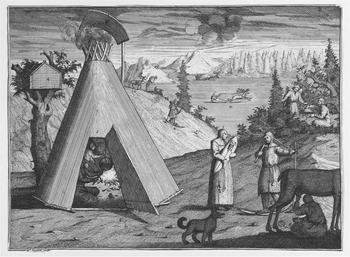
Contacts between Sami and outsiders and the depictions of the Sami were mediated through symbols and took a form of meetings “between representatives bearing representations”.Footnote 53 The Sami were always portrayed with their attributes, typical examples of material culture signifying their particularity. The tableau vivant included Sami clad in long coats skiing or riding ackja, a sledge pulled by reindeer, embroiled in their domestic life around a tent surrounded by reindeer herds or engaged in shamanistic rituals involving the use of drums (fig. 2). For the Sami, too, the travellers signified a certain type, whose appearance gleams between the lines of the travel narratives. With their sketch and notebooks, collectors’ bags, maps, and compasses, asking endless questions about reindeer herds, beliefs, and shamans the travellers, regardless of their motives, were stereotyped and suspected of being tax collectors, prospectors, or missionaries.Footnote 54
Representation of Sami life from Aubry de la Motraye’s Travels, II, pl. 38. Etched and engraved by William Hogarth. Curtesy of the Metropolitan Museum of Art.

The cultural stereotypes and tropes of otherness and wonder likened Sami and Sápmi to other colonies and peoples subjected to the gaze of traveling Europeans, but what made the region distinct was its relative geographical proximity to metropolitan Europe. In most cases, meetings with ‘exotic natives’ took place after extended ocean voyages that served as a means of mental and meditative adjustment that eased people’s separation from the familiar and entry into novel worlds. But it took Linnaeus only three days to leisurely walk from Umeå, where he viewed collection of curiosities and botanical gardens, and exchanged scientific ideas with gentlemen of the town, to the southern stretches of Lycksele lappmark, which he compared to the hellish environment of the Styx.Footnote 55 The town of Tornio, where Maupertuis and Outhier could enjoy the company of burghers who conversed with them in French and Latin, where they slept in proper beds, dined on dishes seasoned with sugar, saffron, ginger, and lemon, and received weekly letters from France, was likewise only three days from the mountains north of the Arctic Circle, cursed by Maupertuis for their remoteness and challenging him to live like Sami.Footnote 56 This sharp juxtaposition of what the travellers considered as civilization and barbarity in such close proximity only strengthened the sense of cultural shock.
Beyond the almost universally perceived exoticism and dissimilarity from the observer and his culture, the various narratives differed in their judgements of the landscape and people. Two major and contradicting understandings of the landscape and its inhabitants can be distinguished—one that had a tendency to highlight Sápmi as a bountiful, paradise-like home for noble, if simple, natives, and one that was skewed towards judging the region as a barren, empty, and forsaken land of ignorant savages.
Sápmi as Wonderland
The fringes of the old world were sometimes imagined and styled as Arcadias brimming with seemingly limitless abundance, inhabited by societies devoid of any artifice, as places inspiring and fulfilling dreams of pastoral utopias. For example, in sixteenth- and seventeenth-century novels and cartographic materials, the far North, especially the North Pole, was imagined as a temperate oasis, as the centre of the world, as a vortex, and a passageway to an alternative world.Footnote 57
To some thinkers and travellers, the northern fringes (and colonies in general) appeared not so much as existing ideal societies but as valid candidates for implementing programmes inspired by utopian fiction. These locations were conceived of as vast tabulae rasae and thus model settings for experimenting with idealistic schemes of reform.Footnote 58 These two tropes of existing and potential Arcadias were well utilized in early modern writing about Sápmi.
One of the earliest travellers to leave a detailed description of the region was the Swedish priest and scholar Olaus Magnus. His Historia de Gentibus Septentrionalibus became a popular account of Sweden translated into several languages and appeared in nearly two dozen editions. His account followed certain existing conventions, not least by catering to the contemporary European fascination with foreign cultures and little known parts of the world, and by including anecdotes about the bizarre and marvellous. However, it also produced a comprehensive, ‘normalizing’, and humanizing picture of the North.Footnote 59
Olaus Magnus envisioned Sápmi as a land of bounty, a plentiful and rich region offering numerous rewords and advantages. This vision can be exemplified by his eulogy of the coastal regions of Bothnia:
In the Trees, Birds of diverse kinds sing harmoniously; there is great variety of Fish, that sport themselves above Water: there is great profit for Fishers every where; there is no hurtful beast in the Sea there, nor any pernicious formidable creeping Creature near the Land. All the Summer there is no darkness, no great heat of the Sun; the Ayr is wholesome and temperate; all things are there pleasant, quiet and peaceable. But which is most wonderfull, in so great pleasantnesse of divers places and times, and liberty, yet is no lascivious act committed amongst them: they live, both Sexes, chastely and modestly; they neither commit Incest, Fornication nor Adultery; nor so much as name them.Footnote 60
Olaus Magnus does not omit the elements that feature abundantly in later reports and travel narratives—the intense cold of the wintertime and summertime plagues of gnats. But unlike many other authors he underscores that the people who live in the region are well adapted to the climate and conditions and are blessed with happy, honest, and almost carefree lives. They are safer in their forests and sweeping wilderness than those that live in the towns under the protection of laws and fear of punishment.Footnote 61 This happy utopia was partly due to an uncorrupted condition of the North located far from civilization and partly to the balancing act of nature and God: if He denied the Sami and other people of the far North plentiful harvests, He provided them with ample fisheries and hunting grounds. Olaus Magnus’s optimism and conviction that Sápmi abounded not only in fish and game but was potentially a wealthy source of minerals was signalled in his Carta Marina. West of Luleå he symbolically indicated deposits of Minera Auri—mineral gold.
While Olaus Magnus saw the North as an actual locus amoenus (pleasant place), for many other commentators it was a location with the potential of being a place where dreams come true. Promise of Sápmi and praise of its resources became a common motif in the relations, histories, and proposals for improvement authored throughout the seventeenth and eighteenth century. In eighteenth-century proposals especially, the beauty of the landscape was not necessarily locked in the aesthetic experiences of a wandering observer but rather in his utilitarian projection, judged from the perspective of future appropriations. Sápmi was seen not only as an exotic place but as the fulfilment of a desire of marvellous transformation of an underappreciated wasteland into a rich promised land. The utopian rhetoric of improvement and reform was closely connected with the exploitative projects launched by the state. In the first half of the seventeenth century, the exploitation of minerals inspired odes to the country’s wealth and spurred utopian plans for development and high profits.Footnote 62 One of the most enthusiastic visionaries and proponents of harnessing nature’s potential and turning Sápmi into prosperous and booming region was Gabriel Gyllengrip, who arrived in Umeå in 1733 and served as Västerbotten’s county governor from 1733 to 1753. To him the province had enormous possibilities. His sweeping utopian visions included full-scale development of mining, reorganization of the timber industry with a focus on the production of tar and planks, the establishment of a leather industry especially among Sami, production of limestone and brick, exploitation of the region’s rich fisheries, pearl fishing, and glass and paper manufacturing.Footnote 63 To achieve these goals, Gyllengrip proposed further colonization of the interior and the establishment of large gentry estates, which had the means to engage in large-scale exploitation of various resources. Populating the North and investing in its industries together with instilling the virtues of diligence and hard work were the key ingredients of the magnificent transformation of the landscape he envisioned. He even put forward a fantastic plan to encourage immigration of Catholics from Salzburg who would promote urban culture and industriousness in the young Bothnian towns.Footnote 64
Gyllengrip was not simply a mercantilist theoretician; he was also practical about his ideas. He traversed the country in search of metal deposits and he tested agricultural possibilities on his model farm in Umeå, where he tried to cultivate all conceivable utilitarian crops, from cereals to fruit trees, while corresponding with Linnaeus about the possibility of growing heartier kinds of grain.Footnote 65 According to Gyllengrip, all these proposed developments, especially a serious commitment to mining, had the potential of elevating Sápmi to one of the wealthiest and most productive provinces in the whole country.Footnote 66 To his disappointment, however, his agricultural experiments did not succeed, the stream of colonists and entrepreneurs failed to materialize, and most of his sweeping visions for development did not happen; his Northern utopia remained an illusion.
The belief in the region’s agricultural possibilities led to exaggerated visions of Sápmi as a vast potential farmland. As early as 1670, Johan Graan, a Sami educated at the Uppsala University, proposed ideas of colonization and agricultural development and argued that a seamless and happy coexistence between pastoralist Sami and agriculturalist Swedish and Finnish peasants was fully possible. Graan insisted that not all the lappmark regions were rocky and swampy wastelands but that there were in fact pockets of land suitable for farming and pasture, the demarcation and utilisation of which would result in crops and taxes beneficial for the kingdom.Footnote 67 These ideas formed the basis of ordinances urging colonization issued in 1673 and 1695, and renewed in 1749. The feasibility, profitability, and indeed the necessity of agriculture were discussed with a new force in the mid-eighteenth century. Enlightenment convictions about the ability to improve the human condition was aided by physiocracy, which underscored agriculture as the main source of national wealth and promoted science as a way to overcome the shortcomings of northern climate and geology. The utilitarian attitudes of local pastors, as well as of thinkers and scientists based in Stockholm and Uppsala who had visited Sápmi themselves or had read about it, were put forward in a multitude of proposals arguing for extensive colonization and farming of Sápmi.Footnote 68 The common denominator of these proposals was close to that of Gyllengrip’s and typical of colonial schemes: Sápmi was a landscape of enormous potential and national interest. It was one’s duty to exploit it and thus contribute to the glory and wellbeing of the nation. It was immoral and against God’s order not to improve and reap profits from nature.Footnote 69
All these proposals for improvement and multiple visions of utopia had one common trope: they transformed the landscape and nature of Sápmi into a commercial product, abstracted away from the existing and dense socioecological web and meaning it had for the Sami. These projections obscured or criticised the logic of local sustenance practices and ways of living as indolent and languid. This rhetoric was consistent with the Enlightenment logic of colonial rationalisation described by Mary Louise Pratt as an “extractive, dissociative understanding which overlaid functional, experiential relations among people, plants and animals”Footnote 70 shaping hegemony based on possession of land and resources, “the textual apartheid that separates landscape from people, accounts of inhabitants from accounts of their habitats. . . . The European improving eye produces subsistence habitats as ‘empty’ landscapes, meaningful only in terms of a capitalist future and of their potential for producing a marketable surplus.”Footnote 71
The commercial bounty of Sápmi was styled as either ready to be consumed directly or capable of being appropriated in the near future with proper (i.e., supplied by the centre) steps, knowledge, and supervision. The appropriation was not presented as a question of choice. It was argued as a necessity and duty, a God-given right and responsibility to take possession of the wastelands and use them in a rational way, and in the process to aid the reforming and civilizing efforts among the Sami. Mary Baine Campbell observed that “Beauty is the attribute that desire projects on what it is pleased to consume.”Footnote 72 The beauty of Sápmi was found precisely in its vast economic capacity, ready to be exploited, and in its furnishing of the utopian dreams of a perfected society busying itself with various useful industries. The utopian projections of the future remained in the sphere of fantasy, for Sápmi never became the site of an actual utopian community the way that, for example, America did. Gyllenholm’s visions of well-ordered society, a machine in which a person is above all a productive cog, has its defined place in a community, lives by the virtues of diligence and commitment, and contributes to the welfare of the state, came the closest to the utopian ideal. However, even if the wholesome transformation envisioned by these proposals never materialised, Sápmi became a site of exploitation, experiments with agriculture, and other efforts of improvement. The ideology and language of the proposals and the pace of their production went hand in hand with the practical programmes launched in the region, even if the scale and the projected outcomes of the former were much grander than what was actually accomplished. The visions put on paper were prompted by eyewitness accounts of Sápmi’s wealth, and the projects that sought to harness this wealth and these visions in turn fuelled further policies and moves to appropriate the land.
Relocating beauty to the sphere of mercantilist desire does not automatically imply that some travellers and authors failed to appreciate the aesthetic qualities of the landscape, or that its beauty was not experienced as a genuine aesthetic pleasure. Following the Platonists, contemporary European aesthetics held that beauty could induce awe and a pleasant astonishment, longing and love, and ravishing pleasure.Footnote 73 Olaus Magnus and other travellers, including Rudbeck, Linnaeus, and some of the foreigners, experienced such delight in their encounters with northern scenery and were mesmerized by the tranquillity, peace, and natural order of their surroundings. They were able to see and value the landscape not (only) as a playground for utilitarian projects but as a collection of stunning and unusual vistas appealing to the senses. The primitive and unspoiled was the site of pleasure, nostalgia, and longing for what was destroyed by progress.Footnote 74 Its wonderful quality was magnified by the sensory difference from the places the travellers came from.
Sápmi as Barren Wasteland
Sápmi as a real or imagined place of beauty and bounty was hardly the only image of the landscape advanced by early modern writers. Among the narratives of Sápmi, there was a stream of testimonies that tended towards negative and pessimistic portrayals exhibiting disillusionment with the ‘dystopias of tragic failure.’Footnote 75 They delved into the social, cultural, and environmental causes of failed improvement schemes and revealed the observers’ bleak visions of culture and environment and their pessimistic convictions about the future of the region.
A pessimistic picture of the landscape and its people is given by Olaus Graan, seventeenth-century pastor of Piteå. According to him, the surroundings of the town were the most peripheral and deserted places one could imagine and thwarted any form of civilized existence. Only those who valued their personal freedom above their ability to live off the land and those who were ready to “forsake all agreeable company” could possibly find the region attractive.Footnote 76 Tornaeus, pastor of Tornio, described the even more northerly locations of Tornio and Kemi lappmark as the end of the world. “Here there are neither forests nor trees with the exception of small birch trees at the foot of the mountains. Everything is so covered in snow, open and wild and unlike any other place that one may think oneself to be in a remote and borderless ocean without any likelihood of finding land soon. Here everything is infertile and almost everywhere covered with dry sand.”Footnote 77 Maupertuis and Outhier, who ventured into the same areas described so potently by Tornaeus, experienced similar dread. The region was seen as an almost uninhabitable wasteland, rugged, difficult to traverse, offering a coarse diet, plagued by surprising heat and swarms of gnats in summer, and unbearable cold in winter.Footnote 78 The landscape was infertile, producing no valuable crops, and this barrenness, according to Maupertuis, has “caused a degeneration of the human race in these climates.”Footnote 79 The scenery was bleak, and even the sight of Mount Niemi, which he described as the “enchanted grounds of fairy tales,” Maupertuis judged as delightful anywhere else but in Sápmi.Footnote 80
Negative pictures of Sápmi were also produced in the eighteenth century by domestic travellers driven by visions of science and improvements in the service of the national economy. One of them was Arwid Ehremalm, who in 1741 journeyed across the southern parts of Sápmi together with his cousin Baron Carl Wilhelm Cederhielm.Footnote 81 Both men were connected to the Swedish Academy of Science and undertook their travels to verify Gabriel Gyllengrip’s promising reports regarding the possibilities of agriculture. Their impressions and observations were disappointing. Sápmi was a mountainous, infertile region, full of bogs, infested with mosquitoes and other nuisances, hard to traverse and overall hardly suitable for establishing any colony. It was “merely a desert, where are beheld only mountains without cultivation, without any trace of human industry,” an empty and hostile place threatening the “trembling soul” of the unaccustomed traveller with “all the horrors of a deluge, all the images of the Styx, with its nine great windings.”Footnote 82 Ehremalm speculated that low taxes and freedom from conscription were probably the only factors that could attract anybody to such an adventure as the colonization of this stony and frosty wilderness.Footnote 83 The dystopian characteristics of Sápmi are well summarized in the following passage:
In these far removed countries from the sun, nature employs ages to produce little. The inhabitants live to a great age, but what a life! without ever feeling the pleasures of the senses or the imagination, which yield to the soul a lively and solid enjoyment; without experiencing that inward and continual action and re-action, which bind men to every thing in nature, by sensation, desire and enterprise; without any taste, which may attach a being to himself and to those around him. Thus the manners of these people, inclosed by frozen seas and mountains of snow, possess not the least of animation, or of vigour. Society there is dull, monotonous, without passion, without incitement. The inhabitants, like the trees, are almost isolated, though placed by the side of each other.Footnote 84
The utilitarian and paternalistic gaze with which he regarded the landscape draws attention to the supposed mismanagement of resources, wasteful actions, lack of “proper” knowledge and supposedly wrong decisions taken by the Sami and local peasants. Worst of all was the fact that the inhabitants of this wasteland seemed irredeemable, just like the nature that surrounded them. Sami were considered stubborn and insincere, stuck in the past, and inseparable from their ‘superstitions’. Their love of freedom and independence surpassed any attempts to better their condition and turn them sociable. They avoided contact with Swedish officials and disregarded efforts to “improve” their diet and lifestyle, and bring them to the state of civility and order.Footnote 85
Ehremalm’s account of insensible and unsociable Sami incidentally provides evidence of their strategies for dealing with a century of colonial policies and infringements. Burning the forests, which Ehremalm judged as gross profligacy, was used by the Sami to deter the colonial encroachment. Their reluctance to discuss the subject of religion and their mistrust of pastors and government officials was an effect of harsh regulations prohibiting the use of ceremonial drums and other indigenous practices.
Ehremalm’s Sápmi was a landscape with dystopian qualities, stuck in the past and subject only to the laws of nature. The negative stance and the hyperbole of the harshness of the landscape and people might have served as a commentary of failed and seriously fraught initiatives and as a warning against new such efforts. Read together with the pastor’s reports pertaining to the difficulty of bringing the Sami to a civilized state, it is a testimony of frustration with the slow or only superficial implementation of the civilizing initiatives, of the protracted character of colonial expansion, and of Sami resistance, slyness, and counter-conduct. It is also a narrative that explicitly links and equates people’s character with the climate and features of the geography serving as an excuse for unsuccessful attempts of improvement and at the same planting a seed of doubt about the correctness of the state’s assumptions and approaches.
The rhetoric of horror and harshness might also have served to magnify one’s own heroic quest and sacrifice in undertaking the journey to the far North. Suffered hardships and dangers were common themes of the survival literature so popular at that time. As Heidi Hansson has observed, the North was associated with elements such as severe cold, distance from civilization, pristine nature, danger, and exposure to natural forces making it a dramatic setting for challenge and adventure.Footnote 86 Combining these motifs with descriptions of scientific observations is a landmark trope of Maupertuis’s relation. The unforgiving weather and surroundings, weariness of travel, and the lifestyle of the Sami, which the traveller-scientist had to mimic—all lifted to hyperbolic proportions—were rendered as demanding if not unendurable. The suffering of the scientist and his companions and the juxtaposition of the primitive, uncultured surroundings with the pursuit of ground-breaking scientific discoveries became a key element of the “men of science” identity. The bigger the adversities and challenges, the sweeter the triumph of the explorer and success of his mission.
This is not to say that travel in Sápmi did not inspire genuine dread and horror. Venturing away from the well-maintained coastal road was a serious challenge especially for inexperienced travellers such as Ehremalm, Outhier, and Maupertuis. The geography, nature, and climate of the region were sombre obstacles and occasionally put the travellers in life-threatening situations. Wonder and thrill of the unknown brought not only pleasure but also unsettling feelings and intimidation.
Sápmi as Ambivalent Landscape
Many other narrators of Sápmi, domestic and foreign, did not offer a decidedly negative or positive picture of the landscape and its people, hesitating instead between praise and condemnation. Their representations were ridden with ambivalence and contradiction, stances that permeated colonial interactions and travel writing.Footnote 87 This ambivalence revealed itself in various moments: in the discovery and uneasy dealing with a rift between stereotypes and authoritarian sources about the other and one’s own witnessed experiences; in the perception of the indigenous peoples as empty, naked in body and culture, unformed and animal-like as well as virtual doubles, fully aware of the European culture and grasping the concepts and language of the explorers; in deploring and desiring the uncultivated state of simplicity.Footnote 88
In his authoritative and self-consciously balanced Lapponia, Johannes Schefferus portrayed the region as clearly “other” and nothing like Sweden proper;Footnote 89 but he approached it in an ambivalent way. It was not a place suitable for farming but it was good for pasture, hunting, and fishing. The omnipresent coldness rendered the landscape barren and affected the inhabitants’ physique and character in a negative way (they were characterised as small, lazy, cowardly, and infertile). But the northern climate was also understood as beneficial, wholesome and protecting from diseases. The Sami were accused of crudeness, pride, and indolence but praised for their high moral standards and industriousness. They were seen as nomadic barbarians, living in savagery with and like beasts, outside of the just order of society—a state that served to explain their supposed superstitious nature and timorousness. Yet that very state equipped them with a quietly admired ability to cope with the challenges and solitude of living in the forest and mountains.Footnote 90 In the same breath they were called adulterous and “strict observers of the conjugal tye”; cunning and deceitful and sincere and frank; fearful of, mistrusting, and mocking the strangers, yet “very Civil to Strangers, very freely offering them what they have of Victuals or any other Thing used among them.” Footnote 91
Schefferus and his informants also witnessed a different, more disruptive kind of ambivalence and mockery—one that aligns more closely with the definitions proposed by Homi Bhabha and Robert YoungFootnote 92 —that left them with a sense of discomfort and betrayal. They felt affronted when Sami “having vanity enough to imagine that they have certain Qualifications belonging to them, beyond what are to be found in other Nation” ridiculed and passed judgements on Swedes they interacted with—an act apparently reserved for learned observers like Schefferus himself.Footnote 93 Even grosser insult was exhibited by Sami graduates of the missionary school, who upon return home abandoned all the teachings and expressions of civility and reverted to the “damaging sin” of Sami life and religion.Footnote 94 Being able to speak the language and use the rhetoric of the Swedish administrators, they tried to demystify and defend Sami practices, for example by “translating” the ever-contested Sami drum as nothing more than a version of a compass.Footnote 95 This example of mimicry-turned-mockery was singled out by Bhabha as an unwanted effect of the civilizing process that demanded that the colonized become compliant mimics of the colonizers by reproducing their assumptions, habits, and values. The process gave birth to ambivalent subjects whose mimicry was never very far from mockery and whose positions questioned the clear-cut authority of colonial power and revealed the arbitrary character of colonial rhetoric.Footnote 96
The Sápmi rendered by Schefferus was thus on many levels an ambiguous place: margins lacking social and cultural polish of the centre, but also a place of harmony and ancient simplicity; compliant and resisting changes introduced by the state; neither paradise nor hell.Footnote 97 A similar ambiguity reverberates in Olof Rudbeck’s reports from his travel undertaken in 1695.Footnote 98 Rudbeck scanned the landscape with the eye of a colonial explorer, described with approval initiatives that had already been undertaken to exploit it, and marvelled at the potential and richness of the still unexplored nature: unknown plant and animal species, and mineral resources. On the one hand, in the edited Nora Samolad, he interrogated the nations of Sápmi as “vast solitudes full of horror and darkness” treated by nature as a step-child.Footnote 99 He praised the region for its wholesome climate, bountiful resources, insignificant dangers, and pleasant surroundings.Footnote 100 On the other hand, in the unedited journal, he admitted that this wonderland had an unnerving side. Rudbeck’s sojourn made him see the landscape as unforgiving and desolate, and impossible to navigate without local guides. Its mountainous character, treacherous bogs, and hard-to-cross rivers made it inaccessible and unattractive.Footnote 101 It was a harsh place with stunning sights, a poor and forsaken wasteland of potentially rich opportunities, full of extremes and moderate at the same time.
A few decades later, Carl Linnaeus, a traveller who shared Rudbeck’s interests, purpose of journey, and perspective, shared his divided opinion of the landscape and its inhabitants. Crossing into and traversing Lycksele lappmark in the early days of his travels, Linnaeus felt uncertain of his bearings and overwhelmed by the demanding terrain of rocks, marshes, woods, and rushing rivers. The scenery made him regret his undertaking, see the Sami as poor wretches, and compare his surroundings to the mythical Underworld: “A divine could never describe a place of future punishment more horrible than this country, nor could the Styx of the poets exceed it. I may therefore boast of having visited the Stygian territories.”Footnote 102 After continuing his journey and climbing the mountains and valleys of the “Lapland Alps,” his perception of the landscape and people changed. Idealizing the mountain Sami and their abode, he was in awe with the tranquillity of the scene: “Blessed be the Lord for the beauty of summer and of spring, and for what is here in greater perfection than almost any where else in the world—the air, the water, the verdure of the herbage, and the song of birds!”Footnote 103 The happy simplicity of the inhabitants was now compared to Ovid’s Golden Age and Virgil’s pastoralism.Footnote 104
As Linnaeus wandered he wondered. He frequently noticed how barren and sterile the surroundings were, how difficult it was to get to places, and how challenging and unpredictable the weather could be. Yet throughout his ramblings, in the true spirit of the Enlightenment botanizer, he never stopped envisioning schemes to utilize and improve the resources of nature. From its less extreme regions of lappmark with their potential for becoming colonists’ islands of agriculture and heartier types of crops, to the potential of its timber and metal industries, Sápmi seemed to be a land of possibilities and undiscovered marvels. Linnaeus occasionally empathized with the Sami whose fishing and land rights were abused by the settlers and who were mistreated by incompetent administrators. But he never reflected explicitly about the causality of the two—the colonial schemes of turning the land of his hosts into farmland and mines, for which he advocated, and the impoverishment, disenfranchisement, and dispossession of the Sami, which he pitied.
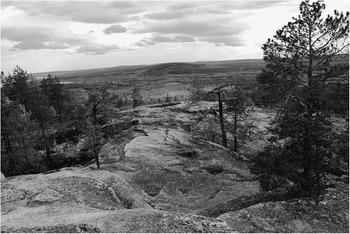
The foreign travellers who visited the region in the course of the seventeenth and eighteenth centuries offered equally ambivalent descriptions of the landscape and its native inhabitants. Many shared the idea expressed so clearly by the English editor of Schefferus’s history, who styled Sápmi as one of the last outposts of unexplored wilderness in Europe, an unfamiliar new world nested within a well-known continent (fig. 3). Jean-François Regnard saw Sápmi as a place at the end of the world, “neglected by nature and disregarded by man” and “sterility in itself.”Footnote 105 This was an extreme and desolate place reflecting and reflected by the character of the Sami, barbarous savages, whose humanity he interrogated.Footnote 106 Complaining about Sápmi’s implacable nature and weather on some occasions, he was nonetheless captivated by the exotic beauty of the place. He marvelled at its natural wonders, the abundance of fauna and rare minerals, and the pleasures of hunting and traveling by sleigh.Footnote 107 A visit at the ironworks at Kengis inspired him to write an ode to the local nature and made him confess that “these frightful solitudes, however, are sometimes agreeable, and please one, at times, as much as the most magnificent abodes.”Footnote 108 Even the Sami were not always regarded as brutes. Regnard praised their ingenuity and masterful adaptation to the environment, as well as their hospitability and vigour. Footnote 109
Some travellers praised the landscape of Sápmi as unspoiled and sublime, while others disdained it as a wasteland. Photo by author.

Aubry de la Motraye, too, hesitated in his judgment of the Sami. At times he insinuated their close proximity to the animal world due to their lack of written laws and nomadic lifestyleFootnote 110 , while at times he portrayed them as noble if simple savages, courteous and honest hosts, living happy lives.Footnote 111 He blamed their ignorance, especially their superficial understanding of Christian dogma and practice, on abusive and incompetent pastors who were more interested in collecting fees and taxes than in mission.Footnote 112 Believing in his own cultural superiority, he tried, nonetheless, to immerse himself and participate in the local culture, occasionally blurring the lines between the self and the other by adopting local customs, striking friendships along the way, and showing genuine admiration for the Sami.Footnote 113 His account illustrates clear ambivalence and it indicates that an encounter with the indigenous societies could shake the grounds of knowledge and identity of the European explorers. While the explorer and narrator de la Motraye thought himself superior to the people he described, his sense of civility and primacy was undermined by a powerful longing for the simpler, more innocent life he ascribed to the Sami, which he took as “a reproach to the sophisticated jadedness of Europe.”Footnote 114 The same was true for Linnaeus, who despite the discomforts and dietary problems he suffered during his sojourn was, nonetheless, smitten by the simple pleasures of life he enjoyed among Sami. He incorporated his fond memories of his travels in his later books and public lectures, and his teaching at Uppsala, in which he nostalgically praised the lifestyle of Sami and juxtaposed its innocence and wholesomeness with the degeneration and corruption of civilization.Footnote 115
Conclusions: Utopias, Dystopias and Ambivalent Ideas of Sápmi
The visions and experience of Sápmi in early modern writing can be generally regarded as framed in two distinctive ways. Some authors chose to highlight the beauty and abundance of the landscape, seeing it as an existing or potential source of wealth and a setting for a utopia. Other, focusing on the bleakness of the place and its inhabitants, thought of it as a wasteland and periphery, a stern tableau completed and complemented by the primitive culture of its natives. The particulars of both portrayals were closely entangled with imagination and experience, dominant conventions of engagement with “the other,” and seventeenth-century intellectual currents of Gothicism and mercantilism, as well as with the rationality and science characteristic of the age of Enlightenment. This rhetoric was also closely connected to the ideology of improvement, and it accompanied the diverse practical schemes to appropriate, reshape, and rationalize the use of landscape. The particular ideas of Sápmi, whether seen as a promising land of plenty or as a mismanaged locale of heathen Sami, foreshadowed and fuelled programmes of reform. These programmes, successful or not, provided the stimulus for further writing seeped in the same rhetoric of praise and necessity of improvement, or offering a warning and a commentary on the failure and physical inability to appropriate the barren wasteland.
The beauty or horror was rarely total in the images of Sápmi. Most texts wavered between the rhetoric and experiences of beauty and dread, bounty and wasteland. They were shaded by the ambivalence and uncertainty that sprang from diverse experiences accumulated during the course of the author’s travels, by the contrast between the carried stereotypes and experienced reality, and by the self-desired simplicity and innocence of the Sami and the civility and “modern” virtues expected of them. Both observers and observed remained in a complicated relationship coloured by experience and imagination and marked by simultaneous want or acceptance of the perpetual otherness of the Sami and Sápmi and relentless proposals and projects intended to erase that difference.
Ambivalence appears in the accounts written by both domestic and foreign writers. However, even if these different travellers shared uncertainty and perceived the Sami and Sápmi as undeniably strange and exotic, the narratives of the Swedish authors were, to some extent, informed by different ideological premises and concerned with issues neglected by foreigners. To those issues belonged questions of Sami history and language deemed by domestic writers as having ancient roots that testified to their connections with other known peoples and cultures, and capable of development, even if progress was slow. Foreigners rarely considered these questions, and when they did they saw Sami as timeless and stagnant, lacking history or cultural accomplishments.
Travellers also differed in the way they regarded the landscape: while not indifferent to its aesthetic qualities, domestic travellers saw it primarily in terms of economic utility, actively searched for resources, lauding their larger benefits and proposing schemes of their exploitation. Foreigners prioritized the sensory experiences of the landscape and commented on the appealing or appalling qualities of the geography and commenting on the climatic and physical similarities to and differences from the regions they came from.
As a concluding note it is worth noting that the practice of ambivalent imagining and projection of desires on the landscape of Sápmi is by no means a closed historical process that ended with the advance of modernity. The recent boom in mining combined with climate change had mobilized contradictory visions of the region anew.Footnote 116 Swedish and Finnish governments and industry advance utopian rhetoric of the North as a region of a bright future, seeing the exploitation of seemingly boundless natural resources and development of heavy industry as a guarantee of social and economic welfare in the region and a boost to their respective national economies.Footnote 117 These visions are coupled with a strong belief in science and technology, which are heralded as a sure way to overcome natural obstacles and warrant safe and sustainable extraction of metals. Critics envision quite a different scenario: a dystopian future of natural disasters and irreversible cultural, social, and ecological changes caused by aggressive exploitation of resources, insufficient sensitivity, and overconfidence in science.Footnote 118 These arguments are distant but clear echoes of Enlightenment proposals for improvement and in their essence reminiscent of the discourses and actions taken in the late nineteenth century, when rapid and intensive industrialization processes promoted (Swedish) Sápmi as “the land of the future” and “Sweden’s America” on the one hand, and was blamed for considerable social problems on the other.Footnote 119 It is telling that today, as then, Sápmi is compared to the Klondike.Footnote 120
These modern images and understandings of Sápmi meet with another utopia, which portrays it as a magical place, timeless and unaffected by modern environmental and social problems. Produced mainly by the tourist industry, this image reduces Sápmi to a fairyland, an Arctic Arcadia of unspoiled nature and simplicity where one can experience life as it used to be. This nostalgic and sentimental image, too, has its nineteenth-century antecedents and early modern parallels. The rapid industrialization created “an increasing desire for nostalgic access to the disappearing past”Footnote 121 and Sápmi was constructed and perceived as a place where a simpler, uncorrupted life of the bygone era, clean air, and healthy lifestyle could be accessed by European urbanites.
The northern region occupies a stable albeit polysemous position in outsiders’ projections. Its remote position, tapestry of rugged nature, underground resources, its vastness and fragility continue to engage the imagination and fuel a sense of otherness and difference. To quote Peter Davidson, there are and “there have always been as many norths as there have been standpoints from which to look northwards.”Footnote 122