INTRODUCTION
Knowledge of the local occurrence of a species, in addition to how it makes use of an area, are fundamental tools for conservation. This is, however, a challenging task with regard to marine mammals due to the variation of habitat resources in space and time and the high mobility of these animals (Goetz et al., Reference Goetz, Rugh, Read and Hobbs2007).
The Bryde's whale (Balaenoptera edeni) is a lesser-known species of large whales, classified by the IUCN as Data Deficient (Reilly et al., Reference Reilly, Bannister, Best, Brown, Brownell, Butterworth, Clapham, Cooke, Donovan, Urbán and Zerbini2008). It can reach 13–15.6 m and weighs from 17 to 20 tons (Lodi & Borobia, Reference Lodi and Borobia2013). Its reproductive cycle includes a gestation period of 11–12 months, 6 months of lactation and an intercalving period of 6 months (Kato & Perrin, Reference Kato, Perrin, Perrin, Würsig and Thewissen2009). Bryde's whales feed primarily on schooling fish and euphausiids (Tershy, Reference Tershy1992).
Bryde's whales are observed in tropical and warm temperate waters of the Pacific, Atlantic and Indian Oceans and are regularly recorded in South-eastern Brazil (Omura, Reference Omura1959; Kato & Perrin, Reference Kato, Perrin, Perrin, Würsig and Thewissen2009). They are different from most Mysticeti due to the fact that they are not known to conduct long migrations between breeding and feeding areas (Zerbini et al., Reference Zerbini, Secchi, Siciliano and Simões-Lopes1997). In Brazilian waters, Bryde's whales are not commonly sighted near the coast. Studies in open oceanic waters are expensive and, in developing countries, such as Brazil, uncommon. However, in some areas of South-eastern Brazil, such as Cabo Frio, Rio de Janeiro state, whales come closer to the coast (Figueiredo et al., Reference Figueiredo, Tardin, Lodi, Maciel, dos Santos Alves and Simão2015), creating study opportunities. The Brazilian National Plan for Large Cetaceans states that an investigation of distribution patterns and subsequent designation of critical conservation areas for this species in Brazilian waters is desirable (Rocha-Campos & Câmara, Reference Rocha-Campos and Câmara2011).
The aim of our study was to understand the occurrence of Bryde's whale in Cabo Frio and their distribution in relation to bathymetry.
MATERIALS AND METHODS
Study area
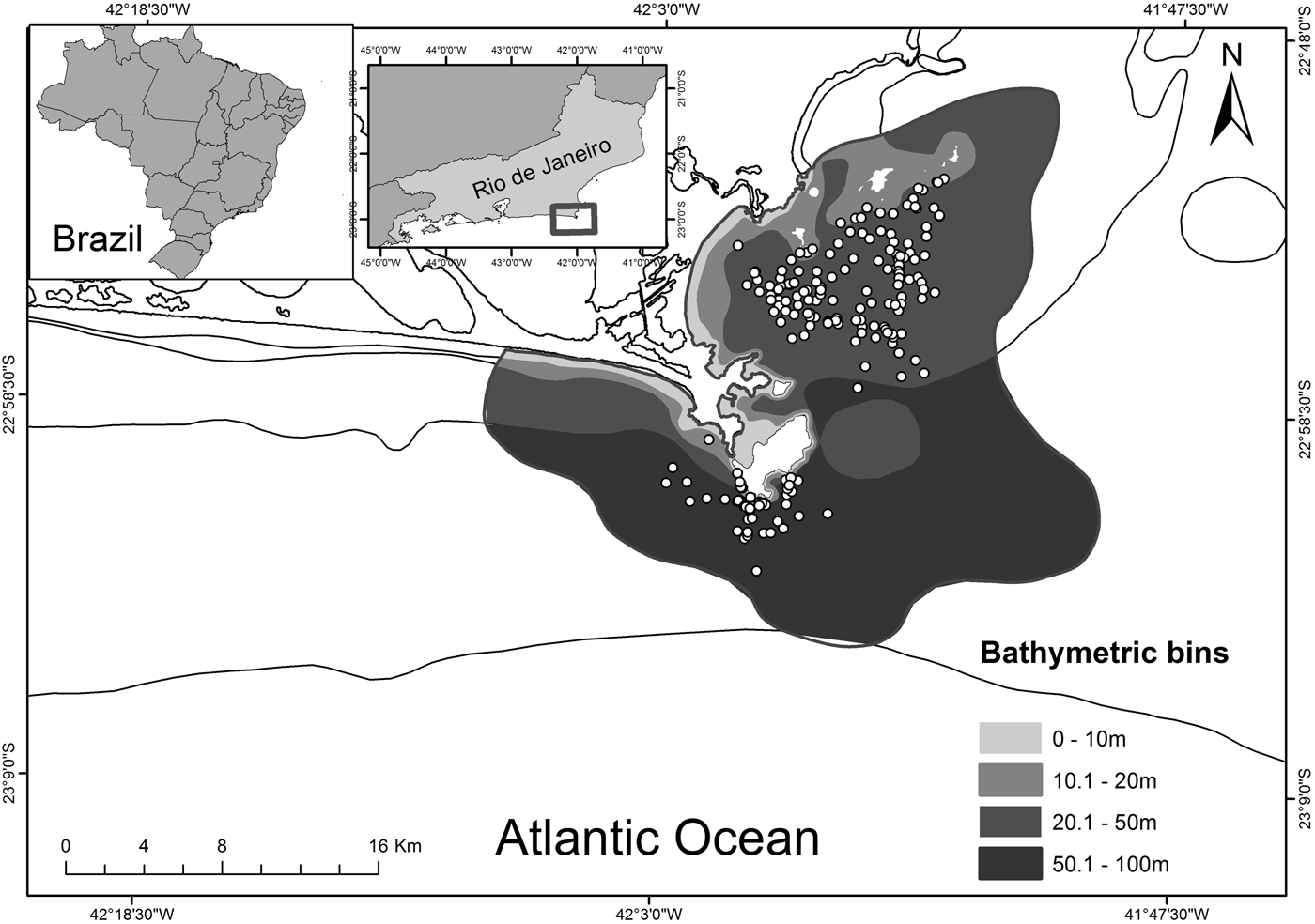
The study area is located in the Cabo Frio region (41°57′40″W 22°58′59″S) comprising an area of 467.5 km2 (Figure 1), including Arraial do Cabo and Cabo Frio municipalities (Figure 1). The region is a prominent eastward cape of South-eastern Brazil, with a substrate varying predominantly from fine sand to mud with few rocks and with a narrow continental shelf (Coutinho, Reference Coutinho1969; Muehe & Carvalho, Reference Muehe and Carvalho1993). Both municipalities comprise a large part of Rio de Janeiro state tourism due to blue water and white sandy beaches. Coastal development is increasing in a disorderly fashion and the local population for the two municipalities reaches more than 150,000 individuals with gross domestic product (GDP) exceeding U$ 3 billion (IBGE, 2015).
Actual study area of Bryde's whale in Cabo Frio region, delimited by navigation routes. The colours in greyscale divide bathymetric bins, with the clearest representing shallower depth and the darkest deeper waters. The white dots are the distribution points where Bryde's whales occur. Each dot is a GPS position taken during the focal follow.

The southern portion of the study area is a Marine Protected Area (MPA) IUCN category V designed to protect local fishermen, and despite its creation in 1997 (Brasil, 1997), no management plan exists as yet (Figure 1). Consequently, intense fishing activities (e.g. trawl, gillnet and seine nets), extensive fishing and tour boat traffic occur in the area. This is an important upwelling area (Moreira da Silva, Reference Moreira da Silva1977; Valentin et al, Reference Valentin, Andre and Jacob1987; Gonzalez-Rodriguez & Valentin, Reference Gonzalez-Rodriguez, Valentin, Andre and Jacob1992), mixing cold, low salinity and nutrient-rich waters with warmer surface waters, resulting in high productivity and large local biodiversity. Therefore, these activities are harmful to the ecosystem itself and for local artisanal fishermen. Since Bryde's whales is one of the lesser-known whale species (Kato & Perrin, Reference Kato, Perrin, Perrin, Würsig and Thewissen2009), these threats are more harmful to knowledge and conservation of these species.
Data collection
From December 2010 to November 2012 a total of 96 boat trips were conducted, 4 days each month during all seasons. Each sampling day lasted about 6 h. We adopted the US Naval Observatory data to define the seasons as summer (21 December 2010 to 20 March 2011 and 22 December 2011 to 20 March 2012), autumn (20 March 2011 to 21 June 2011 and 20 March 2012 to 20 June 2012), winter (21 June 2011 to 23 September 2011 and 20 June 2012 to 22 September 2012) and spring (23 September 2011 to 22 December 2011 and 22 September 2012 to 21 December 2012).
The surveys were conducted with a 6.5 m boat powered by 175 hp four-stroke outboard engine only during periods of no haze, and calm sea conditions of less than 4 Beaufort. Upon sighting, the boat was kept at low speed (~7 knots) and maintained a minimum distance of 50 m. This approach was taken in order to minimize any interference to whale behaviour. A focal follow methodology was used, since the GPS position (GPS Garmin Etrex) was marked every time a whale was sighted and continued to be marked every time the whale moved 500 m (estimated using the scale on GPS) from the last marked point, to subsequently establish the number of points (NPt) the whale passed through each bathymetric bin. Bathymetric ranges were defined using the data available on nautical charts, numbers 150501 and 150801. The size area was calculated using the ArcGIS® 10.1 software package. To count the number of passages (NPs) only the boat's routes inside the actual study area were considered (Figure 1). All the boat's routes outside the actual study area, i.e. on the way to start the sampling, was excluded from this analysis. Video recordings were used (SONY Dcr30 camera) in order to register the behaviour of the whale by the method focal group-follows with continuous sampling (Altmann, Reference Altmann1974).
Nicks, scars and natural markings on both sides of dorsal fins were photographed to identify the number of whales observed during the study, as in earlier reports (Espécie et al., Reference Espécie, Tardin and Simão2010). This technique was used to determine the number of whales followed during each observation day.
Data analyses
To establish Bryde's whale habitat use in relation to bathymetry, all the geographic positions of the whales and the research vessel routes were plotted in ArcGIS® 10.1 software and overlapped with the bathymetric bins. In order to do this, the following bathymetric bins were considered: 0–10, 10.1–20, 20.1–50 and 50.1–100 m. Two indices were created for the habitat use analysis: the Habitat Use Index (HU) and the Effort Index (EI). Although 96 field trips were conducted, only data from 59 were used for the HU calculations, due to problems with the GPS equipment. In order to calculate the HU, the relationship of three measurements for each bathymetric bin was considered: the number of points (NPt), number of passages (NPs) and bathymetric bin size (S). The number of points (NPt) is related to the number of waypoints marked in each bathymetric bin, marking a point every 500 m. The number of passages (NPs) is the number of times the research boat's route crossed any bathymetric bin. The bin size (S) means the size of the area of each bathymetric bin measured in square kilometres. The EI can be expressed as EI = NPs/S and was calculated for each bathymetric bin. The HU was then calculated by dividing the NPt by the EI, expressed as HU = NPt/EI or HU = NPt/NPs × S−1.
All behavioural analyses were individual and punctual, using video recordings, in order to understand the behaviour displayed in each bathymetric bin. Recorded videos were separated by date and subsequently cut every 10 min, resulting in multiple clips (Mann, Reference Mann1999). When the whale remained unobserved for a period greater than 10 min, the respective clip was classified as displaying an unidentified behaviour. The end to the encounter and video recorder was determined when a whale remained unobserved for 20 min. Bryde's whales behaviours states were characterized as foraging (prey-seeking behaviour, staying in the same area and employing long and short dives to catch any prey; Thompson et al., Reference Thompson, O'Callaghan, Dalebout and Baker2002), and travelling (heading in the same direction with short dive intervals and frequent surfacing). To account for differences in observation duration, the number of minutes recorded during a specific day was divided by the time the whales spent engaged in each behaviour during that same day. In most cases the same individual (or pair) was followed continuously along the day, therefore, in these cases, we could track their movement for many hours in each day.
RESULTS
Occurrence
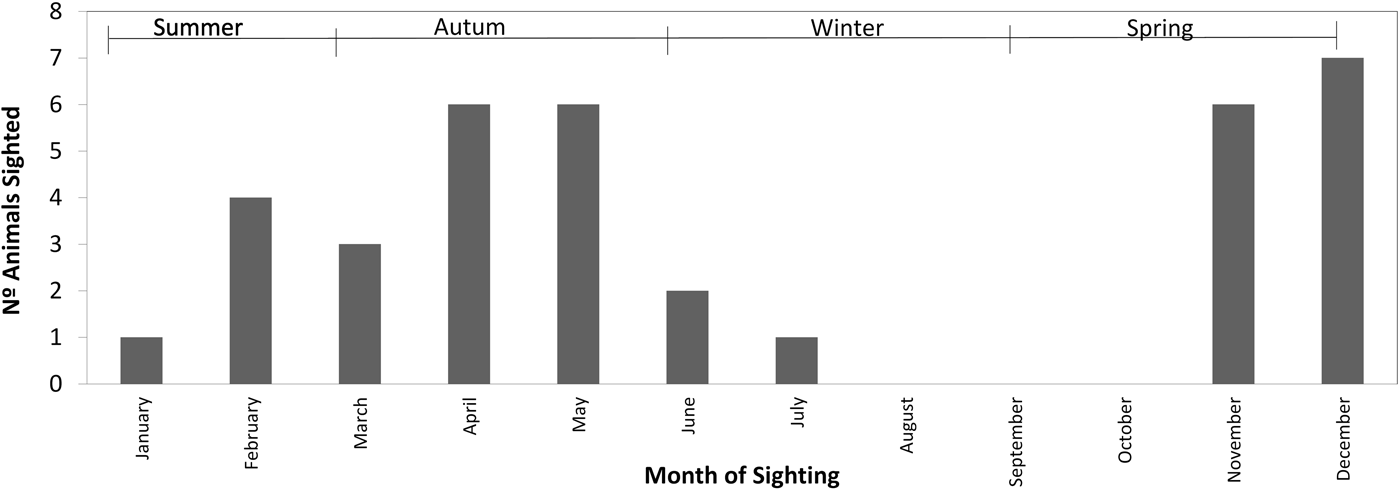
Bryde's whales were sighted 22 times, totalling 36 individuals, with possible false negatives due to poorly marked individuals (55% not identified). The whales were present in the study area during most of the year, except from August to October, and were observed during all seasons (Figure 2), but more abundantly in the autumn (Nindividuals = 16) and spring (Nindividuals = 13), followed by summer (Nindividuals = 5) and winter (Nindividuals = 2).
Occurrence of Bryde's whale in Cabo Frio region from December 2010 to November 2012. The beginning of the seasons were respectively: Summer 2010 (21 December), Autumm 2011 (20 March), Winter 2011 (21 June), Spring 2011 (23 September), Summer 2011 (21 December), Autumn 2012 (20 March), Winter 2012 (20 June), Spring 2012 (22 September), Summer (21 December). The data of the seasons were obtained from the National Institute of Meteorology.

Habitat use
Although 22 days of Bryde's whale sightings were registered, during 4 days the whales were travelling fast and behavioural recordings were not possible. A total of 2240 min of video recordings were analysed. The most frequently recorded behaviour was foraging (900 min – 40.18%). However, during 710 min (33.14%) behavioural recording could not be conducted using the aforementioned methods, due to the fact that the animal was not visible for a period exceeding 10 min. Travelling was the behaviour less observed (630 min – 28.13%).
Despite higher effort in shallow waters (Table 1), Bryde's whales showed higher intensity of use of the 20.1–50 and 50.1–100 m bathymetries, indicated by the HU value. The preference for these bathymetries is indicated by high HU values and is demonstrated in Figure 1.
Use of bathymetric bins by Bryde's whales in Cabo Frio region.

DISCUSSION
Occurrence
In the present study, Bryde's whales showed low occurrence in the area during the winter season, which may be explained by the low occurrence of Brazilian sardines (Sardinella brasiliensis) in the same area during this season (Paiva & Motta, Reference Paiva and Motta2000). Bryde's whales are also known locally as ‘baleia-sardinheira’ (sardine whale), due to frequent observations of this species feeding on Brazilian sardines, and the Cabo Frio region is one of the areas that displays the highest abundance of these fish (Paiva & Motta, Reference Paiva and Motta2000). The distribution and movements of this whale species are thought to be influenced by its prey dynamics (Zerbini et al., Reference Zerbini, Secchi, Siciliano and Simões-Lopes1997; Wiseman et al., Reference Wiseman, Parsons, Stockin and Baker2011; Dywer et al., Reference Dywer, Clement, Pawley and Stoking2016).
Another possible explanation for the observed whale occurrences is the wind regime. Despite not being measured in the present study, during winter the upwelling cycle is interrupted by the S-SW winds resulting from the passage of cold fronts, causing a brief period of partial downwelling near the shore (Gonzalez-Rodriguez & Valentin, Reference Gonzalez-Rodriguez, Valentin, Andre and Jacob1992). However, the low occurrence of the species in summer can stem from an atypicity of the years in question, which were marked by the La Niña phenomenon. This phenomenon directly affects the wind regime, minimizing the upwelling effect and, consequently, altering the occurrence and distribution of cetaceans (Benson et al., Reference Benson, Croll, Marinovic, Chavez and Harvey2002). This effect has also been observed in the Gulf of California, where the La Niña phenomenon shifted shoals of sardines concentrated further south than in the Gulf, influencing the occurrence of Bryde's whales in the region (Salvadeo et al., Reference Salvadeo, Flores-Ramirez, Gómez-Gallardo, MacLeod, Lluch-Belda, Jaume-Schinkel and Urban2011). A similar pattern was also reported in Hauraki Gulf, New Zealand, where there were more sightings in a year of La Niña and fewer sightings in a neutral year (Dywer et al., Reference Dywer, Clement, Pawley and Stoking2016). Despite this apparent dependence on fish in the diet of the Bryde's whale, in New Zealand a high incidence of amphipods and krill was also reported (Jarman et al., Reference Jarman, Wiseman, Baker and Gales2006).
Autumn and spring showed the higher incidence of whales, correlating with the greatest abundance of sardines in the former, and the very high abundance of sardines in the latter, due to spawning of the fish stocks (Paiva & Motta, Reference Paiva and Motta2000).
The occurrence of Bryde's whales in the Cabo Frio region was not similar to those observed in other locations. In the Hauraki Gulf, New Zealand this species occurs throughout the year, but was more abundant in winter between 2003 and 2006 (Wiseman et al., Reference Wiseman, Parsons, Stockin and Baker2011), however, between 2010 and 2012, the interannual variation was much larger than seasonal variation (Dywer et al., Reference Dywer, Clement, Pawley and Stoking2016) in Hauraki Gulf, while in the Gulf of California, USA no seasonal pattern was found (Salvadeo et al., Reference Salvadeo, Flores-Ramirez, Gómez-Gallardo, MacLeod, Lluch-Belda, Jaume-Schinkel and Urban2011). The differences in occurrence patterns might be more strongly related to prey availability than any other variable, but this would need to be tested.
In contrast to other Balaenoptera species, Bryde's whales are not known to undertake long-distance migrations (Kato & Perrin, Reference Kato, Perrin, Perrin, Würsig and Thewissen2009). The abundance of this species is closely related to the upwelling systems that lead to higher rates of primary productivity, as observed in Chile (Gallardo et al., Reference Gallardo, Arcos, Salamanca and Pastene1983), the Galapagos Archipelago (Palacios, Reference Palacios2003), the eastern tropical Pacific (Ballance et al., Reference Ballance, Pitman and Fiedler2006), the Colombian Caribbean (Pardo & Palacios, Reference Pardo and Palacios2006), the Gulf of Mexico (Chavez, Reference Chavez2006), New Zealand (Wiseman et al., Reference Wiseman, Parsons, Stockin and Baker2011), South Africa (Best, Reference Best2001; Penry, Reference Penry2010), and the Southern California Bight (Kerosky et al., Reference Kerosky, Širović, Roche, Baumann-Pickering, Wiggins and Hildebrand2012). Bryde's whales may have been released from migration restrictions, remaining at low latitudes and exploring prey availability throughout the year (Clapham, Reference Clapham, Mann, Connor, Tyack and Whitehead2000). This pattern was confirmed in Cabo Frio, since the occurrence of this whale could be associated with the abundance of sardines.
Habitat use
The most frequently observed behaviour was foraging. Due to the upwelling phenomenon, the study area is very productive and nutrient-rich, with sufficient organic matter to maintain high trophic levels in a web (Gonzalez-Rodriguez & Valentin, Reference Gonzalez-Rodriguez, Valentin, Andre and Jacob1992). Furthermore, the abundance of sardines in the region may explain this preferential behaviour. Therefore, the predominance of foraging behaviour was expected.
Considering that the most frequently observed behaviour was foraging, behaviour wherein the whale seeks to capture prey, the preference for 20.1–50 and 50.1–100 m bathymetries seems to agree with the data from Madeira Island (Portugal), where Bryde's whales showed feeding dives above 40 m (Alves et al., Reference Alves, Dinis, Cascão and Freitas2010). According to Paiva & Motta (Reference Paiva and Motta2000), sardine shoals in the Cabo Frio region occur more frequently at depths up to 80 m with the largest sardine schools occurring between 31 and 60 m. As 98% of whales were found at depths up to 50 m, mainly 20–50 m, there is possibly a relationship between the co-occurrence of predator and prey, as evidenced by a possible spatial overlap.
Although other studies discussing how Bryde's whales use certain areas are available, no papers discuss this related to bathhymetric bins, as conducted in the present report.
Studies throughout the Brazilian coast describe the occurrence of these whales at depths of 15–122 m (Siciliano et al., Reference Siciliano, de Oliveira Santos, Vicente, Alvarenga, Zampirolli, Brito and Pizzorno2004), while at the Gulf of Mexico (199–302 m; Maze-Foley & Mullin, Reference Maze-Foley and Mullin2006) and in South Africa (up to 400 m; Best et al., Reference Best, Butterworth and Rickett1984) greater depths were recorded. The exception occurs in New Zealand, in which this species, although present up to 60 m in depth, is found at more than 30 km off the coast (Wiseman et al., Reference Wiseman, Parsons, Stockin and Baker2011). However, only in New Zealand was the occurrence of Bryde's whales related to prey availability, indicating a close correlation (Wiseman et al., Reference Wiseman, Parsons, Stockin and Baker2011; Dywer et al., Reference Dywer, Clement, Pawley and Stoking2016).
Our study is relevant for the knowledge of the specie and region. We consider further studies to be important, mainly in order to understand the influence of climatic phenomena in Bryde's whale distribution in Cabo Frio. The occurrence of Bryde's whales observed in our study seems to be associated to prey dynamics. However, further studies involving the occurrence of shoals of fish with the occurrence of this whale species should be conducted, in addition to systematic and prolonged studies designed to increase knowledge about this species and to support conservation.
This study demonstrates the importance of the area for the species, since this species is seldom observed throughout the world, and is a important area for feeding. Moreover, the habitat use data can be important to understand how the whale uses the area locally and initiate the creation of protected areas for this cetacean within the Conservation Unit.
ACKNOWLEDGEMENTS
The authors would like to thank Marco Aurelio Crespo and members (Luciana D. Figueiredo and Carine C.G. Galvão) of the Laboratório de Bioacústica e Ecologia de Cetáceos (LBEC/DCA/IF/UFRRJ) for their support in the field and in the laboratory.
FINANCIAL SUPPORT
The authors gratefully acknowledge research grants from Conselho Nacional de Desenvolvimento Científico e Tecnológico – CNPq (Grant# 479348/2010-3) and CAPES for the scholarship of Israel Maciel.