Introduction
Patients with severe mental disorder, including schizophrenia and bipolar affective disorder, have an elevated mortality from heart disease in Denmark (Laursen et al. Reference Laursen, Munk-Olsen, Nordentoft and Mortensen2007), the USA and many European countries (Saha et al. Reference Saha, Chant and McGrath2007). Cardiovascular (CV) disease (CVD) is the most common cause of death in Denmark (Laursen, Reference Laursen2006) and consequently excess mortality from heart disease is responsible for a large share of the total years of life lost in this patient group (Colton & Manderscheid, Reference Colton and Manderscheid2006; Laursen et al. Reference Laursen, Munk-Olsen, Nordentoft and Mortensen2007). A recent study including the total Danish population found that patients previously admitted to a psychiatric hospital with schizophrenia or bipolar disorder had a 12–19 years shorter life expectancy than the general population (Laursen, Reference Laursen2011). Several explanations have been proposed for the excess mortality in these groups. These include side-effects of pharmacological treatment (Allison et al. Reference Allison, Mentore, Heo, Chandler, Cappelleri, Infante and Weiden1999), unhealthy diets (Brown et al. Reference Brown, Birtwistle, Roe and Thompson1999), high prevalence of cigarette smoking, limited physical activity (Kilbourne et al. Reference Kilbourne, Rofey, McCarthy, Post, Welsh and Blow2007; Gorczynski & Faulkner, Reference Gorczynski and Faulkner2010) and the negative social consequences of having a mental disorder (Agerbo et al. Reference Agerbo, Byrne, Mortensen and Eaton2004). Previous Danish register-based studies have demonstrated lower rates of hospitalization and invasive procedures for CVD (Laursen et al. Reference Laursen, Munk-Olsen, Agerbo, Gasse and Mortensen2009), suggesting that part of the excess mortality from heart disease may be caused by insufficient treatment of CVD.
There is a lack of data from population-based studies that have studied primary and secondary prevention of CVD in patients with severe psychiatric illness (Mitchell & Lord, Reference Mitchell and Lord2010; De et al. Reference De, Yu and Detraux2011).
In the present study, we explored the possibility that a lack of CV treatment in primary and secondary prevention may be contributing to the excess mortality in schizophrenia or bipolar disorder. By measuring rates of pharmacological treatment of CV risk factors and diseases among patients with schizophrenia or bipolar disorder compared with the general population, we examined the potential impact of CV drug use on mortality in a population-based cohort.
Method
Study population and follow-up
We identified all individuals born in Denmark, and living in Denmark at some point from 1995 to 2006, from the Danish Civil Registration System (CRS; Pedersen et al. Reference Pedersen, Gotzsche, Moller and Mortensen2006). The CRS was established in 1968, at which time all people alive and living in Denmark were registered and assigned a 10-digit personal identification number used in all registers. The register records information on gender, date of birth, place of birth, and vital status (e.g. date of death and migration out of Denmark). From this database we drew a 25% random sample that formed the analytic cohort. The follow-up of the cohort began on 1 January 1998 or on the cohort member's 10th birthday whichever came last. Patients were followed until the first prescription of a drug within the CV drug classes (in analyses where this was the outcome), death, emigration or end of the study period (31 December 2008), whichever came first. In order to minimize confounding by previous treatment with CV drugs, we excluded people who redeemed a prescription for any of the CV drugs in the period 1995 to 1997. Sensitivity analyses using varying time windows (from 1 to 5 years) based on our data showed that this 3-year exclusion period for the use of CV drugs was sufficient to minimize the mixing of prevalent and incident use of CV drugs, because the incidence of ‘new’ users did not peak in the first months of the study period. A total of 1 061 532 individuals were included in the population-based cohort.
Assessment of psychiatric admission, CV drug use, CVD and somatic co-morbidity, and cause-specific mortality
The Danish Psychiatric Central Register (Mors et al. Reference Mors, Perto and Mortensen2011) includes data on all psychiatric in-patient admissions in Denmark since 1 April 1969, and we identified all people with mental disorders in this register. Our main diagnostic categories were (a) schizophrenia: International Classification of Diseases (ICD)-8 (WHO, 1971) 295 excluding 295.79 and ICD-10 (WHO, 1994) F20 and (b) bipolar disorder: ICD-8 (WHO, 1971) 296.19 or 296.39 and ICD-10 (WHO, 1994) F30 or F31. Furthermore, we examined a comparison group comprising all cohort members who had been admitted to a psychiatric hospital with a psychiatric disorder other than schizophrenia or bipolar disorder.
CV drug use was assessed via the Register of Medicinal Product Statistics, which contains information on all prescriptions for drugs dispensed from Danish pharmacies (Kildemoes et al. Reference Kildemoes, Sorensen and Hallas2011). In Denmark only medical doctors are allowed to prescribe drugs. From 1995 and onwards information on drug use on individual patient level is available. The variables used in the present study are the personal registration number, information of the dispensed drug, Anatomical Therapeutic Chemical (ATC) code, and date of transaction. CV drugs included all drugs with the ATC codes C01 (cardiac therapy, e.g. cardiac glycosides and anti-arrythmics), C02 (‘antihypertensives’, e.g. anti-adrenergic agents and antihypertensives in combination), C03 (diuretics), C07 (beta-blocking agents), C08 (calcium channel blockers), C09 (agents acting on the renin–angiotensin system), C10 (lipid-modifying agents) and B01 (anti-thrombotic agents); see Table 1 (WHO, 2013). It should be noted that the category C02 according to the ATC coding system is labelled ‘antihypertensives’, but contains mainly anti-adrenergic drugs. It excludes many other drugs used in the modern treatment of hypertension such as diuretics, beta-blockers, calcium channel blockers or ACE (angiotensin–converting–enzyme) inhibitors. We therefore refer to this category as ‘other antihypertensives’.
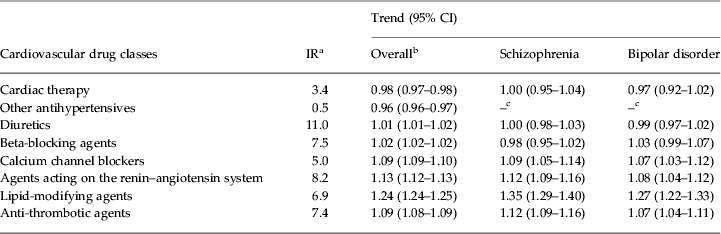
Cardiovascular drug classes and calendar trend between 1998 and 2008 in the general Danish population and among patients with schizophrenia or bipolar disorder
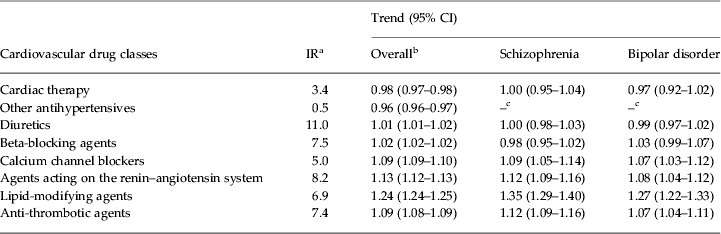
CI, Confidence interval; IR, incidence rate.
a IR of prescriptions (average in the total follow-up period) in the psychiatric disease-free population; i.e. new prescriptions per 1000 person-years under risk.
b Change in prescription rate per one calendar year in the total cohort (from 1998 to 2008), i.e. the entire Danish population, assuming a linear trend over the period. Adjusted for age and gender.
c Not enough cases to estimate trend.
Patients were considered as treated with CV drugs once they had redeemed at least one prescription for a CV drug.
All treatments with CV drugs were categorized as either primary or secondary prevention. All investigated drug classes are used in primary and secondary prevention of CVD. Primary prevention was defined as CV drug treatment in patients with no previous hospital contacts due to myocardial infarction (MI) (ICD-8 410 or ICD-10 I21–23) or cerebrovascular diseases (ICD-8 430–439 or ICD-10 I60–69, G45–46). Secondary prevention was defined as CV drug treatment in patients with previous hospital contacts due to these diseases.
The Danish Cause of Death Register (Juel & Helweg-Larsen, Reference Juel and Helweg-Larsen1999) contains computerized information about all deaths of Danish citizens and residents, including date and causes of death. The validity of the register is high (Juel & Helweg-Larsen, Reference Juel and Helweg-Larsen1999). Over-all mortality (ICD-10 A00–Y98), deaths from diseases and medical conditions (natural causes; ICD-10: A00–R99) and deaths from external causes (unnatural causes; ICD-10: X60.0–Y09.9, Y87.0, Y87.1) were examined. A subcategory of natural causes, cardiac death, was also examined (ICD-10: I00.0–I19.9, I21.0–I25.9, I30.0–I52.9; ICD-8: 390.0–429.9).
Assessment of somatic co-morbidity
We used the Charlson Comorbidity Index (Charlson et al. Reference Charlson, Pompei, Ales and MacKenzie1987) to account for somatic co-morbidity (as a time-dependent variable updated to 2008). The index measures 19 severe, chronic diseases, each on a scale of 1–6. The summed score is a reliable predictor of mortality and has been validated in various settings (Charlson et al. Reference Charlson, Pompei, Ales and MacKenzie1987). Data on hospital contacts with the diseases included in the Charlson Comorbidity Index were drawn from the Danish National Hospital Register (Andersen et al. Reference Andersen, Madsen, Jorgensen, Mellemkjoer and Olsen1999). The score was calculated in a time-dependent manner using in-patient contacts from 1977 onwards, and additionally out-patient contacts from 1995 onwards.
Statistical analyses
In the prospective cohort study, we analysed redemption of CV drug prescriptions using Poisson regression with the genmod procedure in SAS version 9.1 (SAS Institute Inc., USA). We calculated the incidence rate of redemption of CV drug prescriptions in the different drug classes as number of new CV drug users per 1000 years at risk. The main outcome measures were incidence rate ratios (IRRs), measuring the difference of incidence rates in patients with the respective severe psychiatric diseases compared with the population without the disease. In the same way mortality was measured as mortality rate ratios (MRRs). All IRRs and MRRs were adjusted for or stratified by the Charlson Comorbidity Index, gender, calendar time, and age. IRRs and MRRs were calculated by log-likelihood estimation, and Wald's 95% confidence intervals (CIs) were used. IRRs/MRRs can be interpreted as relative risks.
The analyses were stratified by primary and secondary prevention of CV treatment to account for the more definite indication of treatment as secondary prevention in patients with previous MI or cerebrovascular disease and to evaluate the effect of primary prevention on mortality.
The analysis was further stratified by cause of death, into death by natural causes (subdivided into CV deaths) and unnatural causes (suicide, murder or accidental death).
Results
The cohort included 1 061 532 persons which contributed 10 264 025 person years of risk time. Average age at entrance in the follow-up was 36.1 years and age at the end of the follow-up was 44.4 years, with an age range of 10 to 109 years. During the follow-up from 1998 to 2008, 174 774 persons redeemed at least one prescription for a CV drug.
Overall trend in the use of CV drugs
The use of CV drugs in Denmark changed markedly during the study period. Cardiac therapy, including anti-arrhythmic and cardiac glycosides, and antihypertensive drugs in the ‘other’ category declined during the decade, while the use of diuretics and beta-blocking agents remained stable. By contrast, prescriptions for calcium channel blockers, agents acting on the renin–angiotensin system, and anti-thrombotic agents, and particularly lipid-modifying agents [inclusive of 3-hydroxy-3-methylglutaryl-coenzyme A (HMG-CoA) reductase inhibitors (statins)] increased (Table 1). The shift in the pattern of CV drug use was seen in the general population as well as among people with schizophrenia or bipolar disorder. Those with schizophrenia had a proportionally greater increase in the use of lipid-modifying agents than the rest of the population (Table 1).
Analysis of CV drug classes
Patients with schizophrenia had a lower use of all but one (diuretics, which were used more frequently) of the CV drug classes compared with the reference population with no psychiatric contacts (Fig. 1). Anti-thrombotic agents and other antihypertensives were used less frequently among schizophrenic patients although the difference was not statistically significant. The remaining classes, i.e. beta-blockers, calcium channel blockers, lipid-modifying agents, and drugs acting on the renin–angiotensin system, were taken at significantly lower rates. For bipolar disorder all but three classes were used less, again with significantly higher use of diuretics (Fig. 1). Individuals with other psychiatric admissions used all but two CV drug classes more frequently (Fig. 1).
Incidence rate ratios and 95% confidence intervals (CI) for redemptions of different cardiovascular drug classes among patients with schizophrenia, bipolar disorder, or other psychiatric (Psych) disease compared with the population never admitted to a psychiatric hospital. Agents reac. on R-A sys., Agents acting on the renin–angiotensin system.

We also performed separate analyses for men and women and found no differences, except for anti-thrombotic agents (ATC code B01) where women with schizophrenia had an IRR of 1.12 (95% CI 0.97–1.30) and men had an IRR of 0.88 (95% CI 0.78–0.98) (results not shown in the tables).
We additionally investigated CV drug use in secondary prevention, by restricting the analysis to include only those with a previous hospital admission due to MI or cerebrovascular disease. The use of drugs was, as expected, much higher in this subgroup of the cohort (data not shown), but, the IRRs between individuals with schizophrenia or bipolar disorder and the reference population were of a similar magnitude as in the total cohort, with a tendency for the mentally disordered individuals to use fewer CV drugs (Fig. 2). In patients with psychiatric contacts other than schizophrenia or bipolar disorder the IRRs were significantly lower in five CV drug classes (Fig. 2).
Incidence rate ratios and 95% confidence intervals (CI) for redemptions of different cardiovascular drug classes in secondary prevention among patients with schizophrenia, bipolar disorder, or other psychiatric (Psych) disease compared with the population never admitted to a psychiatric hospital. Agents reac. on R-A sys., Agents acting on the renin–angiotensin system.

Adjustment for Charlson Comorbidity Score only had a minor effect on results.
Effectiveness of CV drug use as primary or secondary prevention in reducing mortality
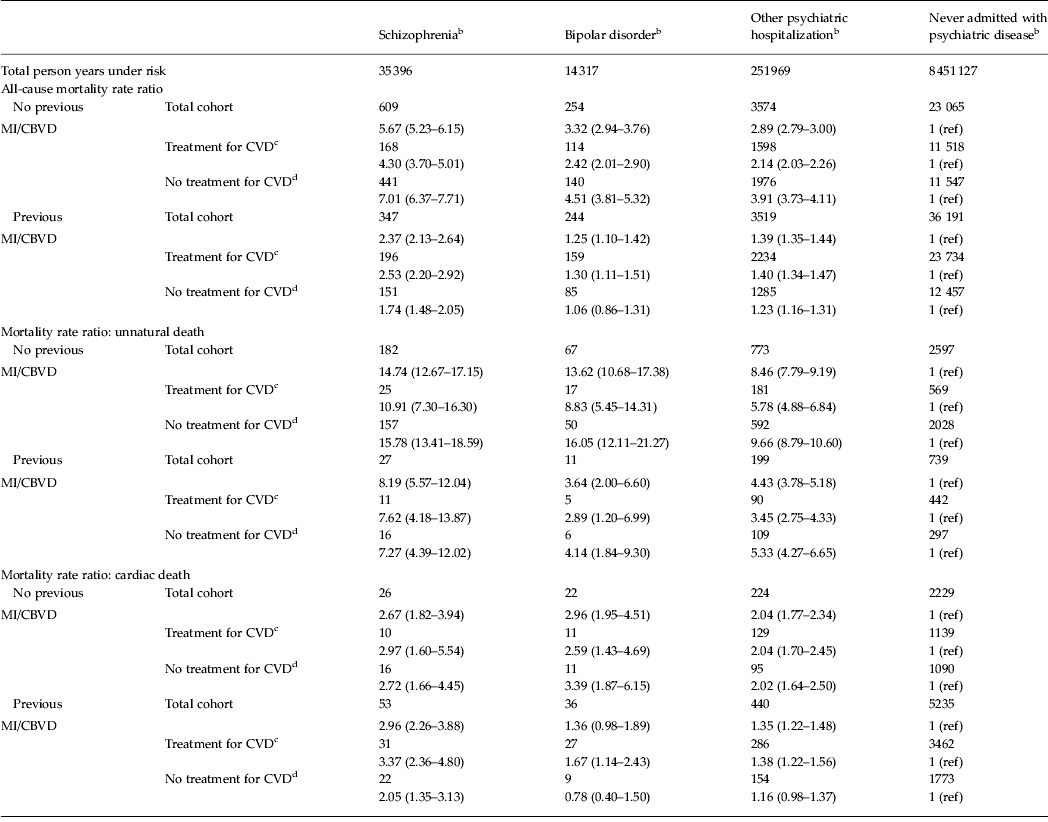
In primary prevention, among patients without any CV drug use, patients with schizophrenia and bipolar disorder had a 7-fold and 4.5-fold increased risk of all-cause mortality, respectively (Table 2). This excess mortality was almost halved to approximately 4.3 and 2.4 times the risk in the patients with the mental disorders schizophrenia or bipolar disorder who used CV drugs. In secondary prevention, the pattern was completely different; overall excess mortality in those with mental disorders was much lower, and, furthermore, the MRRs in the group who used CV drugs were almost identical to the MRRs in the group without CV drug use.
Number of cases and mortality rate ratios (all-cause mortality, death from unnatural causes, and cardiac death) comparing patients with psychiatric disease versus persons who had never been admitted with psychiatric disease a
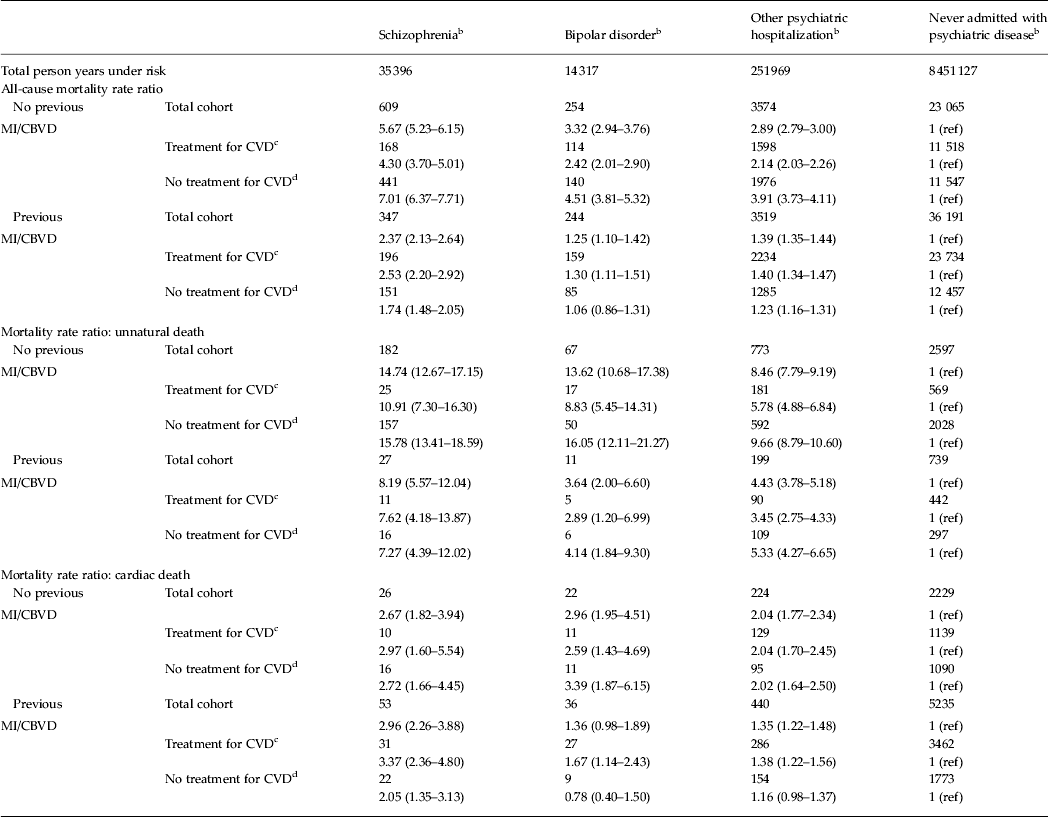
Data are given as number of cases, mortality rate ratio (95% confidence interval).
MI, Myocardial infarction; CBVD, cerebrovascular disease; CVD, cardiovascular disease; ref, reference.
a Stratified by previous hospital contacts due to MI or CBVD and CVD treatment status.
b Mortality rate ratio adjusted for gender, age, calendar time, and Charlson Comorbidity Index.
c Only cohort members who had redeemed at least one cardiovascular drug prescription.
d Only cohort members who had never redeemed a cardiovascular drug prescription.
When unnatural deaths were considered, the MRRs were much higher (Table 2). The MRR due to unnatural causes of death was increased by around 14-fold in patients with schizophrenia and bipolar disorders, while deaths by natural causes showed a smaller excess, and death by CVD the least excess.
CV drug treatment appeared to have a greater impact on reducing the excess mortality from unnatural causes than natural causes, and the least impact on excess mortality from CVD.
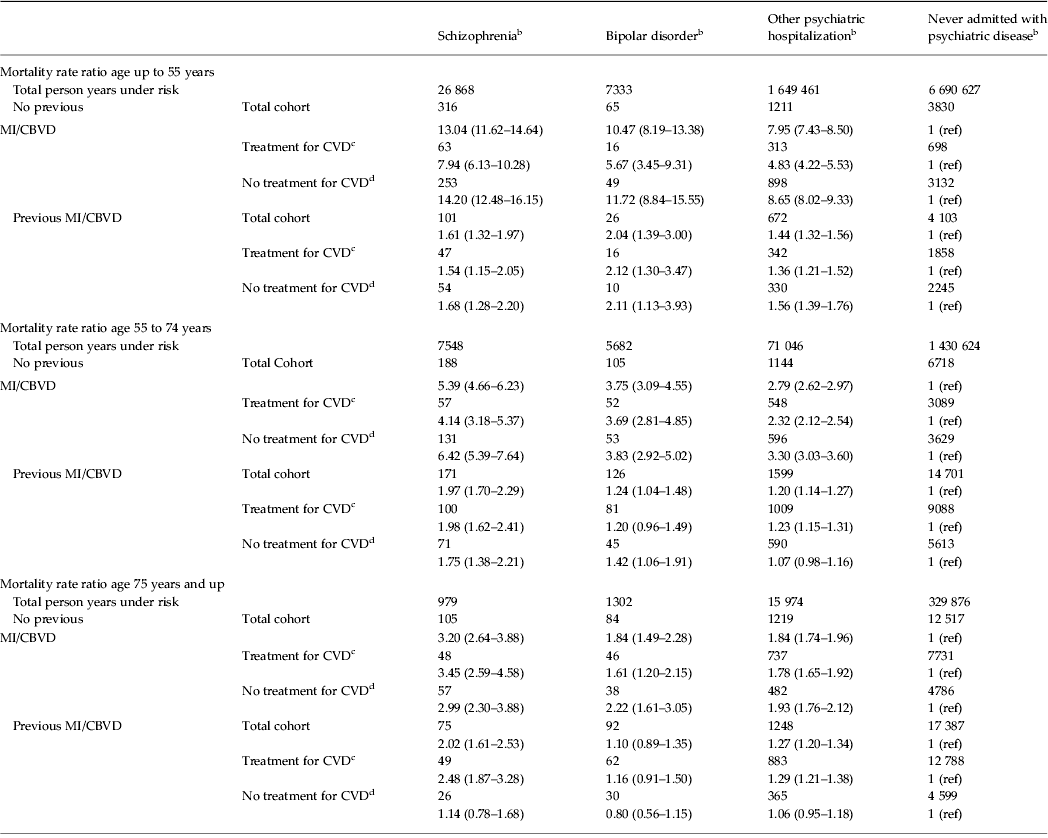
The analysis based on all-cause mortality was stratified according to age (Table 3). We found a strong effect modification by age, such that the risk of death was especially high among psychiatric patients younger than 55 years in primary care (no previous MI or cerebrovascular disease) compared with secondary care (previous MI or cerebrovascular disease).
Number of cases and overall mortality rate ratios comparing patients with psychiatric disease versus persons who had never been admitted with psychiatric disease a
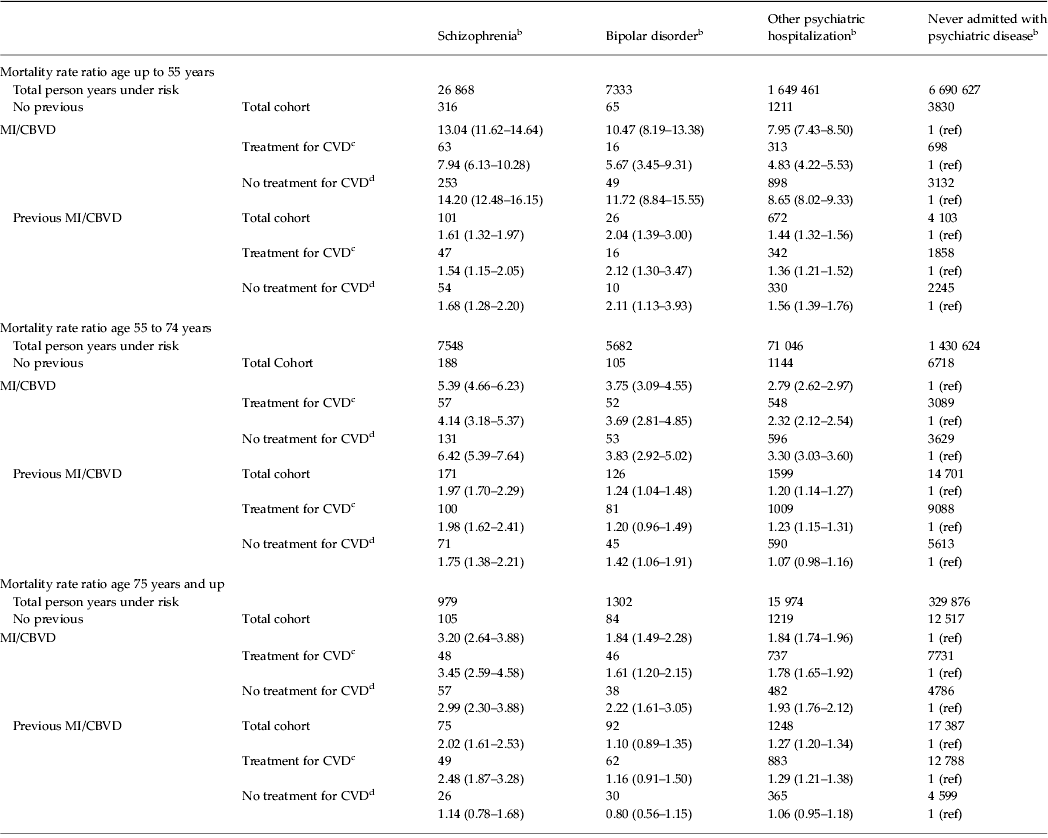
Data are given as number of cases, mortality rate ratio (95% confidence interval).
MI, Myocardial infarction; CBVD, cerebrovascular disease; CVD, cardiovascular disease; ref, reference.
a Stratified by age and previous hospital contacts due to MI or CBVD.
b Mortality rate ratios adjusted for gender, age, calendar time and Charlson Comorbidity Index.
c Only cohort members who had redeemed at least one cardiovascular drug prescription.
d Only cohort members who had never redeemed a cardiovascular drug prescription.
Discussion
Key findings
Individuals with schizophrenia or bipolar disorder had generally lower rates of use of most CV drug classes compared with the population without psychiatric admissions. Excess mortality was particularly increased in psychiatric patients who were not taking CV drugs, but this excess was not driven primarily by mortality from CV causes. Surprisingly, patients taking CV drugs had a much lower excess mortality from unnatural causes, as well as for natural causes other than CVD, than patients not taking CV drugs.
We found much higher excess mortality in patients without previous hospital contacts due to MI or cerebrovascular disease, than in those with a previous history of MI or cerebrovascular disease. In secondary prevention, there were much smaller differences in excess mortality between treated and untreated patients with severe psychiatric disease. These findings could suggest that contacts with the healthcare system, be it through contacts to general practitioners resulting in CV prescriptions or hospital contacts due to MI or cerebrovascular disease, decrease the excess mortality in patients with severe psychiatric disease over that of the general population.
CV drug use in previous studies
In this paper we have focused on CV drug use in patients with and without clinical CVD or cerebrovascular disease and found an overall decreased incidence of CV drug use in patients with severe psychiatric diseases, particularly of lipid-lowering drugs and agents reacting on the renin–angiotensin system. The main focus in most previous papers on this topic has been on CV drug use in secondary prevention. Some of the studies investigated a broader range of severe mental disorder, but all included schizophrenia or bipolar disorder. Most of these studies found a slightly reduced use of CV medication (Druss et al. Reference Druss, Bradford, Rosenheck, Radford and Krumholz2001; Petersen et al. Reference Petersen, Normand, Druss and Rosenheck2003; Weiss et al. Reference Weiss, Henderson, Weilburg, Goff, Meigs, Cagliero and Grant2006; Hippisley-Cox et al. Reference Hippisley-Cox, Parker, Coupland and Vinogradova2007), while others did not find such a reduction (Desai et al. Reference Desai, Rosenheck, Druss and Perlin2002; Plomondon et al. Reference Plomondon, Ho, Wang, Greiner, Shore, Sakai, Fihn and Rumsfeld2007). A recent study from Helsinki, with approximately 200 schizophrenic patients (Lahti et al. Reference Lahti, Tiihonen, Wildgust, Beary, Hodgson, Kajantie, Osmond, Raikkonen and Eriksson2012), found a 0.37-fold use of antihypertensive and 0.47-fold use of lipid-lowering drugs compared with the general population. None of these studies considered the potential effect of under-detection of milder CVD or potential under-treatment of primary risk factors such as hypertension or hyperlipidaemia in patients without previous CVD events, or accounted for the fact that CVD of any severity might not be detected in patients with severe mental disorders due to their decreased contacts with the somatic healthcare system.
What is a low level of CV drug use?
The lower use of antihypertensive drugs could be partly explained if persons with schizophrenia had a lower blood pressure than the general population. Antipsychotics have blood pressure-lowering side effects, which may explain part of the decreased incidence of antihypertensive drug use, i.e. calcium channel blockers, ACE inhibitors and beta-blockers in patients with schizophrenia or other psychiatric disorders treated with antipsychotics (Suvisaari et al. Reference Suvisaari, Saarni, Perala, Suvisaari, Harkanen, Lonnqvist and Reunanen2007). However, in Denmark, a cross-sectional study comparing antipsychotic-treated patients with schizophrenia with the general population found a similar prevalence of hypertension of approximately 55% in both groups (Krane-Gartiser et al. Reference Krane-Gartiser, Breum, Glumrr, Linneberg, Madsen, Koster, Jepsen and Fink-Jensen2011). Moreover, diabetes and hyperlipidaemia are at least as prevalent in patients with schizophrenia as in the general population (Laursen et al. Reference Laursen, Munk-Olsen and Gasse2011; Briskman et al. Reference Briskman, Bar, Boaz and Shargorodsky2012; Crump et al. Reference Crump, Winkleby, Sundquist and Sundquist2013). Statin use increased over the last decade in both patients with severe psychiatric disorders as well as in the general population but remained at a lower level in patients with severe psychiatric disorders.
Cardiac mortality and mortality from all other causes are higher in schizophrenic or bipolar individuals (Harris & Barraclough, Reference Harris and Barraclough1998; Osby et al. Reference Osby, Correia, Brandt, Ekbom and Sparen2000, Reference Osby, Brandt, Correia, Ekbom and Sparen2001; Laursen et al. Reference Laursen, Munk-Olsen, Nordentoft and Mortensen2007). This is important to take into account in the interpretation of the comparison of the consumption of CV drugs with the mentally healthy reference population. In spite of the much higher mortality in people with schizophrenia and bipolar disorder, we found lower CV drug use.
Impact of low levels of CV drug use on mortality
The causative role of CV drug use on the excess mortality cannot be investigated in observational study designs, but can only be established in randomized controlled trials. However, we made an attempt to clarify the treatment impact by examining the MRRs in different subpopulations of the cohort. First, we divided the population into primary and secondary prevention groups. Within each of these groups we examined: (1) the general population; (2) individuals not using CV drugs; and (3) individuals using CV drugs. If we assume that individuals with schizophrenia or bipolar disorder received the same CV/somatic care as the general population we would expect the same MRRs/excess mortality in schizophrenic/bipolar individuals and the general population in all six subpopulations.
This was not the case. MRRs for all-cause overall mortality were particularly higher in those without CV drug prescriptions in primary prevention. This suggests that CV-untreated individuals with schizophrenia/bipolar disorder are not as healthy as untreated individuals without psychiatric disorders. Another explanation could be that patients without primary prevention were more difficult to engage in both psychiatric and somatic treatment probably due to the severity of their psychiatric disorder, and thus have a higher mortality.
Moreover, in the case of treatment, patients with severe psychiatric disease were more frequently treated with diuretics, and less frequently with more potent drugs such as ACE inhibitors or beta-blockers, indicating insufficient treatment intensity. On top of that, no difference in mortality rate was found between treated and untreated patients, indicating insufficient efficacy of the treatment in question.
Implications of under-detection and under-treatment of CVD in patients with schizophrenia or bipolar disorder
The present study found both under-treatment of CV risk factors in all three groups of psychiatric patients (schizophrenia, bipolar disorder and psychiatric hospitalization) and increased mortality rates – all-cause and unnatural – in these three groups. This result confirms that, even in a wealthy, Western European country with a highly developed mental healthcare system such as Denmark, CV risk factors are under-treated. Unfortunately, this finding confirms and strengthens the view of a systematic under-detection and/or under-treatment of somatic illness in general in all groups of psychiatric patients, and even more so in patients with severe mental disorders. The excess mortality is probably caused by a combination of life-style factors and side effects of antipsychotic medicine, but to a great extent also by the lack of somatic treatment. The ultimate goal of primary healthcare is summed up by the WHO's definition, ‘reducing exclusion and social disparities in health’ (WHO, 2011), which, as this study demonstrates, is actually not met in Denmark.
CV drug use appeared to be associated with little or no reduction in deaths from CVD (compared with the general population), but with around a halving of the excess mortality due to unnatural causes. How are we to interpret this? It seems unlikely that CV drugs would have a high impact on death by suicide, accident or other unnatural deaths, although a recent study by Qin et al. (Reference Qin, Webb, Kapur and Sorensen2013) shows that physical illness increases the risk of suicide, and thus taking care of the psychical illness would lower the suicide risk (unnatural death). However, a more plausible explanation could be that those patients who are untreated with CV drugs are the most unwell; in other words, the association between CV drug use and mortality is confounded by disease severity. Thus, those very patients who most need treatment are the very patients who are falling through the gaps in the system. This finding is analogous to the finding of Tiihonen et al. (Reference Tiihonen, Lonnqvist, Wahlbeck, Klaukka, Niskanen, Tanskanen and Haukka2009) whereby patients who received no antipsychotics for schizophrenia had higher mortality than those treated with antipsychotics.
It is clear that patients with schizophrenia and other mental disorders are not accessing adequate treatment for their CVDs. What is less clear is the level at which these patients are being failed by the system – whether somatic disorders are not being recognized, CV drugs are not being prescribed, or patients are not taking the drugs (it should be noted that the presented results are based not on prescriptions but on redemptions). We suspect that all these mechanisms may be at work, but our data are not able to address this question.
Limitations
Associations between psychiatric status and cardiac deaths could not be controlled for behavioural risk factors such as smoking, diet and physical inactivity, and this could affect the result. However, when we, for example, examine persons who have had a cardiac diagnosis we have controlled for these behavioural risk factors by a proxy measure, as we would expect people with such risky behaviour to have a higher risk for having these cardiac diagnoses.
We used clinical psychiatric diagnosis, as opposed to diagnosis made in more structured settings; however, studies have validated the clinical diagnoses of bipolar disorder and schizophrenia in the Danish Psychiatric Central Register against research criteria diagnoses, and found high agreement between the diagnoses (Munk-Jorgensen & Mortensen, Reference Munk-Jorgensen and Mortensen1997; Kessing, Reference Kessing1998; Jakobsen et al. Reference Jakobsen, Frederiksen, Hansen, Jansson, Parnas and Werge2005; Uggerby et al. Reference Uggerby, Ostergaard, Roge, Correll and Nielsen2013). Our outcome measure was defined as a psychiatric disorder treated at an in- or out-patient psychiatric treatment facility. For this reason the study only included persons with the most severe disorders, and rates of psychiatric disorders are likely to be underestimated, mainly with regard to major depression. However we believe that a large percentage of persons with schizophrenia or bipolar disorder are in contact with the psychiatric hospital system, because of the severity of the symptoms.
We have used the first redemption of a CV drug as an indicator of use of the drug; however, we did not assess whether this prescription was repeated afterwards. We do not know whether the patients have actually taken the medicine or just picked it up at the pharmacy as no data on (non-)compliance was available. Furthermore, persons with schizophrenia or bipolar disorder may be even more inclined to pick up their drug prescriptions without taking the drug, and thus we could have a slight differential misclassification. Accordingly, correction for non-compliance and discontinuation is absent in our analyses, and this limitation should be taken into account if picking up drug prescriptions are interpreted as using the medicine.
The definition of primary prevention (as persons who redeemed prescriptions of cardiac drugs but had not had a contact to a hospital with a cardiac disease) is a rather rough definition and could introduce a slight misclassification. Based on the available data it is not possible to show if patients had the indication for primary prevention such as hypertension or hyperlipidaemia, while diabetes is accounted for by the Charlson Comorbidity Index. As pointed out above we assume that risk factors are under-diagnosed in these patients and we would expect a higher proportion of patients receiving primary prevention. This assumption does not indicate that all patients should have received primary prevention.
Conclusion
The present study, in connection with our previous study that demonstrated a lack of sufficient hospitalization and invasive cardiac procedures, shows an apparent deficit in CV care among patients with schizophrenia or bipolar disorder compared with the general population in Denmark. Pharmacological CV treatment, particularly in primary prevention, and contact with the somatic healthcare system though were associated with halved excess mortality in patients with severe mental disease. A causative link between the deficit in CV care and the high mortality in schizophrenic and bipolar patients cannot fully be established, but the growing evidence strongly suggests that the generally provided somatic care is insufficient. The results suggest that the intensive psychiatric care that is provided for this vulnerable population needs to be supplemented with assertive outreaching somatic care – diagnostic as well as therapeutic – for a normalization of CV care and mortality and, in more general, for a normalization of the level of somatic care. Finally, our data suggest that the patients who are at greatest risk of mortality through unnatural causes are those least likely to receive care for CV drugs, suggesting that particular efforts should be directed towards patients with the most severe mental disorder.
Acknowledgements
This study was supported by The Stanley Medical Research Institute. T.M.L. had full access to all of the data in the study and takes responsibility for the integrity of the data and the accuracy of the data analyses. The Lundbeck Foundation provided T.M.L. with financial support.
Declaration of Interest
None.