




1. Introduction
Understanding how people arrive at moral judgments has long been a central concern of psychology. Dual-process accounts of moral cognition argue that intuitive processes are closely tied to deontological judgments grounded in rules and duties, while reflective processes promote utilitarian judgments that prioritize outcomes (Cushman & Greene, Reference Cushman and Greene2012; Greene, Reference Greene and Sinnott-Armstrong2008; Greene et al., Reference Greene, Sommerville, Nystrom, Darley and Cohen2001, Reference Greene, Nystrom, Engell, Darley and Cohen2004). Much of the evidence supporting this model comes from sacrificial trolley-type dilemmas in which harming one person to save several others is treated as utilitarian reasoning (Greene & Haidt, Reference Greene and Haidt2002; Patil et al., Reference Patil, Zucchelli, Kool, Campbell, Fornasier, Calò and Cushman2021). However, such scenarios have been criticized for their limited external validity and conceptual ambiguity (Bartels & Pizarro, Reference Bartels and Pizarro2011; Bauman et al., Reference Bauman, McGraw, Bartels and Warren2014; Crone & Laham, Reference Crone and Laham2017; Kahane et al., Reference Kahane, Everett, Earp, Farias and Savulescu2015; Körner & Deutsch, Reference Körner and Deutsch2022). Moreover, meta-analyses that pool small sample-size experimental studies reveal either no effect or only small effects of reflection manipulations on utilitarian responding, raising questions about the robustness of these findings (Capraro, Reference Capraro2024; Fahrenwaldt et al., Reference Fahrenwaldt, Olsen, Rahal and Fiedler2025; Rehren, Reference Rehren2024). These debates raise a fundamental question: does reflection, when measured as a stable individual difference, predict actual utilitarian behavior in real decision-making contexts? The present research provides one of the first systematic tests of this question, integrating cognitive, dispositional, and self-report measures of reflection with an incentivized behavioral task conducted 17 months later.
The dual-process model remains highly influential in explaining moral judgment. According to this framework, reflective thought is required to override the immediate emotional pull of deontological rules and to prioritize aggregate welfare (Greene, Reference Greene and Sinnott-Armstrong2008). Evidence in support of this claim has often relied on sacrificial dilemmas, but these paradigms raise two challenges. First, they are highly artificial and may not capture real-world trade-offs (Bauman et al., Reference Bauman, McGraw, Bartels and Warren2014; Bostyn et al., Reference Bostyn, Sevenhant and Roets2018; Körner & Deutsch, Reference Körner and Deutsch2022). Second, utilitarian responses in these dilemmas correlate positively with psychopathic traits (Djeriouat & Trémolière, Reference Djeriouat and Trémolière2014; Kahane et al., Reference Kahane, Everett, Earp, Farias and Savulescu2015; Paruzel-Czachura & Farny, Reference Paruzel-Czachura and Farny2023), suggesting they may reflect reduced sensitivity to harm rather than genuine concern for maximizing outcomes (Kahane et al., Reference Kahane, Everett, Earp, Farias and Savulescu2015).
To address these concerns regarding sacrificial dilemmas, researchers have developed more realistic alternatives, including historically-based scenarios (Körner & Deutsch, Reference Körner and Deutsch2022) and lab-based experiments on real-world behavior (Bostyn et al., Reference Bostyn, Sevenhant and Roets2018; Gold et al., Reference Gold, Pulford and Colman2015). A particularly promising direction involves using economic games to measure moral behavior directly, thereby avoiding the intention-behavior gap common in self-report studies (Clarkson, Reference Clarkson2022). For instance, Bostyn et al. (Reference Bostyn, Sevenhant and Roets2019) introduced a monetary trolley dilemma in which participants could reduce one person’s payoff to increase those of five others. Unlike sacrificial dilemmas, utilitarian choices in this paradigm were not associated with psychopathy, indicating that monetary trade-offs may better capture impartial, outcome-focused reasoning. Still, much of this work has relied on hypothetical scenarios (e.g., Côté et al., Reference Côté, Piff and Willer2013) or designs involving deception (e.g., Bostyn et al., Reference Bostyn, Sevenhant and Roets2019).
Alongside these behavioral innovations, theoretical work has refined our understanding of what constitutes utilitarian decision-making. Kahane et al. (Reference Kahane, Everett, Earp, Caviola, Faber, Crockett and Savulescu2018) distinguish between instrumental harm, endorsing harm for the greater good, and impartial beneficence, the impartial promotion of overall welfare. This distinction helps explain why sacrificial dilemmas primarily capture instrumental harm. The Oxford Utilitarianism Scale (OUS) has since become a widely used measure of these two dimensions of utilitarianism at the level of individual differences, supported by evidence of satisfactory psychometric properties (Ni et al., Reference Ni, Burns, Mak, Lah, Silva, Goldwater and Kleitman2023), cross-cultural reliability (Oshiro et al., Reference Oshiro, McAuliffe, Santos, Findor, Kuzminska and Flake2024), and even heritability (Bates, Reference Bates2025). Yet the predictive validity of these self-reported dimensions for real-world utilitarian behavior remains uncertain, a gap this study seeks to address.
Although trolley dilemmas are commonly used to capture utilitarian and deontological moral principles, different moral considerations play roles in moral judgments (Aktas et al., Reference Aktas, Yilmaz and Bahçekapili2017). For instance, virtue-ethical concerns also guide moral decisions when individuals act in accordance with character ideals rather than with outcome- or rule-based reasoning (Uhlmann et al., Reference Uhlmann, Pizarro and Diermeier2015). While the deontological response in moral dilemmas is typically characterized as not harming others, fatalism may also play a role, whereby individuals avoid moral responsibility by attributing outcomes to fate or chance (Bostyn et al., Reference Bostyn, Gouwy, De Craene, Vanmechelen, Scheirlinckx, Tissot and Roets2025). In addition, responding to moral dilemmas may not even be morally grounded at all, reflecting amorality (Aktas et al., Reference Aktas, Yilmaz and Bahçekapili2017). Finally, fairness concerns are also considered fundamental in moral decision-making (Fehr & Schmidt, Reference Fehr and Schmidt1999). Especially in monetary contexts, redistributing resources might motivate a focus on equality rather than maximizing overall welfare. Therefore, capturing moral justifications provides a more complete picture of moral reasoning and also serves as a validity check on which moral considerations the dilemma actually elicits.
A second issue concerns measurement of reflection. Experimental manipulations often yield small effects (Capraro, Reference Capraro2024; Fahrenwaldt et al., Reference Fahrenwaldt, Olsen, Rahal and Fiedler2025), but individual-difference measures may provide more reliable insights. Performance-based tests such as the Cognitive Reflection Test (CRT; Frederick, Reference Frederick2005; Sirota & Juanchich, Reference Sirota and Juanchich2018), belief-bias and conjunction-fallacy items (Kahneman & Tversky, Reference Kahneman and Tversky1973; Markovits & Nantel, Reference Markovits and Nantel1989), reasoning ability (Raven, Reference Raven2000), and thinking-style questionnaires (Newton et al., Reference Newton, Feeney and Pennycook2024) have all been used to capture reflective tendencies. Recent integrative efforts combine these measures into composite indices of reflective cognition (Isler & Yilmaz, Reference Isler and Yilmaz2023). Such approaches allow researchers to test whether reflection, assessed across multiple domains, predicts moral behavior over time.
Finally, reflection must be understood within its sociocultural context, as it is not inherently accuracy-promoting but shaped by epistemic norms (Baron, Reference Baron2020; Saribay & Yilmaz, Reference Saribay and Yilmaz2024; Yilmaz, Reference Yilmaz2021). Religiosity is especially relevant in this regard. Religious individuals are more likely to endorse deontological reasoning and less likely to make utilitarian judgments in sacrificial moral dilemmas (Antonenko Young et al., Reference Antonenko Young, Willer and Keltner2013; Saroglou & Craninx, Reference Saroglou and Craninx2021). When utilitarian and deontological judgments are examined separately, reflection increases deontological judgments only among more religious individuals, who appear to rely on cognitive resources to access and apply religious moral precepts, while leaving unchanged the deontological responses of less religious individuals (McPhetres et al., Reference McPhetres, Conway, Hughes and Zuckerman2018). Moreover, religiosity is positively associated with impartial beneficence but not instrumental harm, challenging the previously reported negative link between religiosity and utilitarian judgments involving sacrifice (Kahane et al., Reference Kahane, Everett, Earp, Caviola, Faber, Crockett and Savulescu2018; Paruzel-Czachura & Charzyńska, Reference Paruzel-Czachura and Farny2023). Epistemically, believers often treat divine authority as a source of moral truth (Baron et al., Reference Baron, Scott, Fincher and Metz2015; Piazza & Landy, Reference Piazza and Landy2013; Simpson et al., Reference Simpson, Piazza and Rios2016), whereas non-believers tend to adopt evidence-based reasoning and belief updating (Metz et al., Reference Metz, Weisberg and Weisberg2018; Yilmaz & Isler, Reference Yilmaz and Isler2019). Reflection, moreover, is not inherently critical: it can be recruited to bolster an already favored conclusion rather than to evaluate it, and believers who regard divine authority as settling moral questions may place less value on such critical evaluation (Baron, Reference Baron2020; Yilmaz & Isler, Reference Yilmaz and Isler2025). Thus, reflection may promote utilitarian reasoning among non-believers but reinforce rule-based convictions among believers. Despite theoretical arguments and findings based on hypothetical sacrificial dilemmas, no prior research has empirically tested whether religiosity moderates the reflection–utilitarianism link in incentivized behavioral contexts.
1.1. The present research
The present study examined whether reflection predicts utilitarian moral behavior in an externally valid, incentivized setting. Reflection was assessed through performance-based tasks (Isler & Yilmaz, Reference Isler and Yilmaz2023), reasoning ability (Raven, Reference Raven2000), and dispositional thinking styles (Newton et al., Reference Newton, Feeney and Pennycook2024). Seventeen months later, participants completed a monetary moral dilemma (Bostyn et al., Reference Bostyn, Sevenhant and Roets2019) with real economic consequences. We also tested whether utilitarian dimensions measured by the OUS (Kahane et al., Reference Kahane, Everett, Earp, Caviola, Faber, Crockett and Savulescu2018) predicted behavior and whether religiosity moderated the reflection–utilitarianism link.
We preregistered three hypotheses: (H1) impartial beneficence and (H2) instrumental harm would correlate positively with utilitarian behavior, and (H3) higher cognitive performance scores would predict a greater likelihood of utilitarian choices, consistent with the dual-process model (Greene, Reference Greene and Sinnott-Armstrong2008). Moral justifications were preregistered as exploratory variables, and their correlations with utilitarian behavior and cognitive reflection were examined. In addition, we conducted exploratory analyses using theoretically relevant variables available in the Time 1 dataset, including additional cognitive measures (i.e., Raven’s Matrices and self-reported thinking styles assessed with the 4-Component Thinking Style Questionnaire) and a single-item measure of religiosity.
This design contributes to the literature by involving real incentives, reducing demand effects and enhancing external validity. It further evaluates the predictive validity of the OUS on utilitarian behavior, integrates multiple measures of reflection to provide a robust test of dual-process theory, and investigates religiosity as a potential moderator of the reflection–utilitarianism association.
2. Method
The research protocol was preregistered on the Open Science Framework before data collection at Time 2 (https://osf.io/skjmh/?view_only=e6f6972639d642999762eb1e3a1866b0).
2.1. Participants
A total of 1,200 U.S. participants were recruited at Time 1 (575 females; Mage = 39.9, SDage = 14.9) and received $2.00 for survey completion. Seventeen months later, participants were re-contacted for Time 2, yielding 322 responses. As preregistered, one duplicate was excluded, leaving a final sample of 321 participants (161 females; Mage = 47.12, SDage = 14.17), with a $2 base payment.
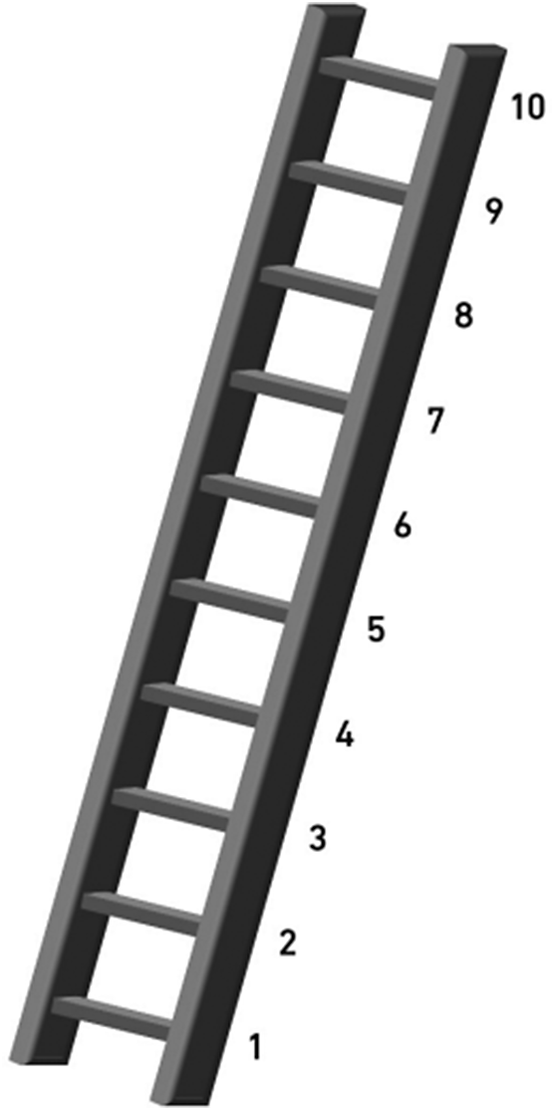
The data were drawn from a larger project on moral beliefs among religious believers and non-believersFootnote 1 (the main study’s OSF page: https://osf.io/rnzy9/?view_only=e3ca7f26e2d443f396f46892a1e9781b). Participants were recruited via Prolific with preselection for gender balance and equal numbers of Christian believers and non-believers (agnostics/atheists) at Time 1 (N = 1,200). Those identifying as ‘other’ or non-Christian were excluded in line with the project focus, and 1,169 eligible participants were invited to Time 2 after 17 months.Footnote 2 At Time 2, we aimed to balance subgroups by belief (believer and nonbeliever), gender (male and female), and socioeconomic status (high and low); crossing these three binary factors (e.g., male high-socioeconomic status (SES) believers, female low-SES non-believers) yielded eight subgroups in total, with 40 participants targeted per subgroup recruited via Prolific’s demographic prescreening criteria (N = 320). We also collected self-reported demographics, including religious affiliation, religiosity, subjective SES, and political ideology. Similar to the targeted prescreening via Prolific, religious affiliation was 49.5% Christian believers, 49.3% non-believers (27.1% atheists, 21.1% agnostics), and 1.2% Jewish/other. Religiosity (0 = not at all religious, 10 = very religious) averaged 3.31 (SD = 3.70). Subjective SES was measured with a 1–10 socioeconomic ladder item, where higher scores indicate higher perceived status in U.S. society (M = 5.30, SD = 1.83). This measure aligned with Prolific’s prescreening SES criteria, which also used a 1–10 scale with scores below 5 indicating low SES and scores of 5 and above indicating high SES; accordingly, 49.1% of the sample were classified as low SES and 50.9% as high SES.
2.2. Procedure and materials
Participants’ scores on the OUS, Cognitive Performance Task (CPT), 4-Component Thinking Styles Questionnaire (4-CTSQ), Raven’s matrices, and religiosity were drawn from the Time 1 data collection. At Time 2, conducted 17 months later, they completed the monetary moral dilemma and rated their decision justifications based on various normative moral frameworks as a validation of the task. The study materials, analysis code, data, and codebook are available on the OSF project site: https://osf.io/6r7gn/?view_only=828e9bf46ac74907b7878e106a8f5b59.
Since this study’s data were from a larger project, participants also completed additional scales at Time 1 and economic games at Time 2, with all measures presented in random order. A demographic questionnaire was given at the end of the study (see the Appendix). At the start of Time 2, participants were informed that one randomly selected task would determine their bonus payment, ensuring that their decisions were real and consequential.
2.2.1. The Oxford Utilitarianism Scale (OUS)
The OUS (Kahane et al., Reference Kahane, Everett, Earp, Caviola, Faber, Crockett and Savulescu2018) measures the two dimensions of utilitarian thinking. Impartial beneficence represents the positive dimension of utilitarianism, reflecting the principle of maximizing overall well-being with equal concern for all, regardless of parochial ties. The five-item subscale (α = .73) includes items such as, ‘It is just as wrong to fail to help someone as it is to actively harm them yourself’. The instrumental harm dimension, on the other hand, represents the negative component of utilitarianism, reflecting the acceptance of harm to achieve the greater good. The four-item subscale (α = .76) includes items such as, ‘It is morally right to harm an innocent person if harming them is a necessary means to helping several other innocent people’. Participants rated their agreement with the items on a Likert scale from 1 (strongly disagree) to 7 (strongly agree).
2.2.2. Cognitive performance task (CPT)
Isler and Yilmaz (Reference Isler and Yilmaz2023) introduced the CPT by combining existing reflective and intuitive thinking measures. The first three of its five multiple-choice items are from the validated four-option version of the Cognitive Reflection Test (CRT; Frederick, Reference Frederick2005; Sirota & Juanchich, Reference Sirota and Juanchich2018). The fourth is a belief-bias question (Baron et al., Reference Baron, Scott, Fincher and Metz2015; Markovits & Nantel, Reference Markovits and Nantel1989), and the fifth is a conjunction-fallacy item (Kahneman & Tversky, Reference Kahneman and Tversky1973; Yilmaz & Saribay, Reference Yilmaz and Saribay2017). Reflection scores equal the total number of correct responses, while intuition scores equal the number of intuitive responses.
2.2.3. 4-Component thinking styles questionnaire (4-CTSQ)
The 4-CTSQ was developed by Newton et al. (Reference Newton, Feeney and Pennycook2024) to assess the multidimensionality of thinking styles through a self-report questionnaire. The scale consists of four subscales, each containing six items: actively open-minded thinking (α = .92), close-minded thinking (α = .87), preference for intuitive thinking (α = .95), and preference for effortful thinking (α = .90). Participants responded to items using a 6-point scale, ranging from 1 (strongly disagree) to 6 (strongly agree).
2.2.4. Raven’s progressive matrices
Raven’s Standard Progressive Matrices (Raven, Reference Raven2000) were used to measure reasoning ability. Although Raven’s matrices are standardly interpreted as a measure of cognitive ability rather than reflection, the items contain intuitively appealing lures, and performance depends in part on the willingness to spend time to get the right answer, a feature they share with reflection measures (Baron et al., Reference Baron, Scott, Fincher and Metz2015). We therefore treated Raven’s scores as an ability-based, convergent indicator of reflective cognition rather than as a direct measure of reflection. Participants completed three 3 × 3 figure matrices with one missing element, selecting the option that best completed the pattern. Scores reflected the total number of correct responses, following the procedure of Mani et al. (Reference Mani, Mullainathan, Shafir and Zhao2013, Study 2).
2.2.5. Religiosity
Religiosity was measured using a single-item question: ‘How religious do you consider yourself’? rated from 0 (not at all religious) to 10 (very religious).
2.2.6. The monetary moral dilemma
To assess utilitarian behavior in a behavioral context, we employed a monetary moral dilemmaFootnote 3 (Bostyn et al., Reference Bostyn, Sevenhant and Roets2019). Participants were first grouped with six other passive participants, and a monetary arrangement was presented at the beginning of the task (see current arrangement in Figure 1). In the initial arrangement, the participant and one other group member (C1) were set to receive a $1 bonus, while the remaining five participants (C2–C6 ) received nothing. Participants were then given the option to change the final bonus distribution for others in their group by asking, ‘Would you like to change to the alternative arrangement where C1 does not receive any bonus, and instead, five other participants receive $1 bonus each’? Participants were also informed that their decision would have no impact on their own bonus. As in the traditional trolley dilemma, participants chose between a deontological option of not intervening (current arrangement) and a utilitarian option that sacrificed one to benefit five (alternative arrangement). Choosing the alternative arrangement was coded as utilitarian behavior. In line with Bostyn et al.’s (Reference Bostyn, Sevenhant and Roets2019) finding that framing (gain vs. loss) does not affect outcomes, we used only the loss frame. We also included real monetary incentives, avoided deception, and provided simplified illustrated instructions.
Bonus distributions for the current and alternative arrangements in the monetary moral dilemma.

2.2.7. Decision justification questions
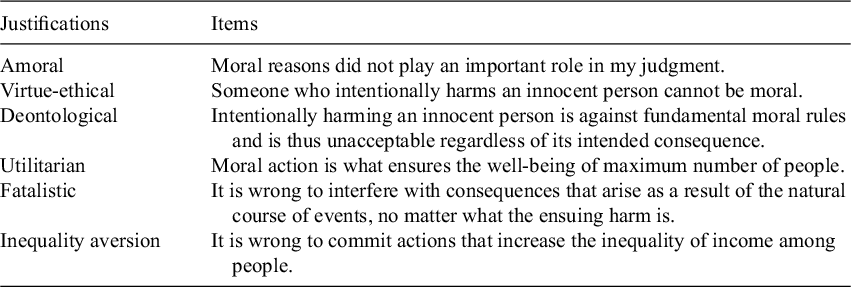
After the monetary moral dilemma, participants rated the extent to which each item played a role in their decision-making (i.e., whether to keep the current arrangement or accept the alternative arrangement) on single-item Likert scales (1 = completely disagree, 5 = completely agree) to measure their moral justifications, covering amorality, virtue ethics, deontology, classical utilitarianism, fatalism (Aktas et al., Reference Aktas, Yilmaz and Bahçekapili2017), and inequality aversion to capture fairness concerns (Table 1).
Decision justification questions

Table 1. Long description
Table 1 presents six moral justification categories with their items. Amoral: ‘Moral reasons did not play an important role in my judgment.’ Virtue ethical: ‘Someone who intentionally harms an innocent person cannot be moral.’ Deontological: ‘Intentionally harming an innocent person is against fundamental moral rules and is thus unacceptable regardless of its intended consequence.’ Utilitarian: ‘Moral action is what ensures the well-being of maximum number of people.’ Fatalistic: ‘It is wrong to interfere with consequences that arise as a result of the natural course of events no matter what the ensuing harm is.’ Inequality aversion: ‘It is wrong to commit actions that increase the inequality of income among people.
3. Results
3.1 Confirmatory tests
As preregistered, point-biserial correlations were estimated to test the correlations between utilitarian behavior and OUS dimensions of impartial beneficence (H1) and tolerance of instrumental harm (H2). The utilitarian behavior was not significantly associated with either impartial beneficence (rpb = −.08, p = .13) or tolerance of instrumental harm (rpb = −.05, p = .35). To test the link between cognitive reflection and utilitarian behavior in the monetary moral dilemma (H3), a preregistered logistic regression was conducted with CPT reflection scores as the predictor and utilitarian behavior as the outcome. Of 321 participants, 222 chose the utilitarian option. While the model yielded 69.2% classification accuracy, matching the sample’s intercept-only base rate, a likelihood ratio test confirmed that adding CPT significantly improved the model’s overall fit (χ 2(1) = 5.77, p = .016). Continuous metrics indicated that CPT exerts a statistically meaningful, albeit subtle, effect on the probability of making a utilitarian choice, performing better than random guessing (McFadden’s Pseudo-R2 = .0145, AUC = .585). Specifically, higher CPT reflection scores increased the odds of utilitarian choices (OR = 1.19, 95% CI [1.03, 1.38]).Footnote 4
3.2. Exploratory tests
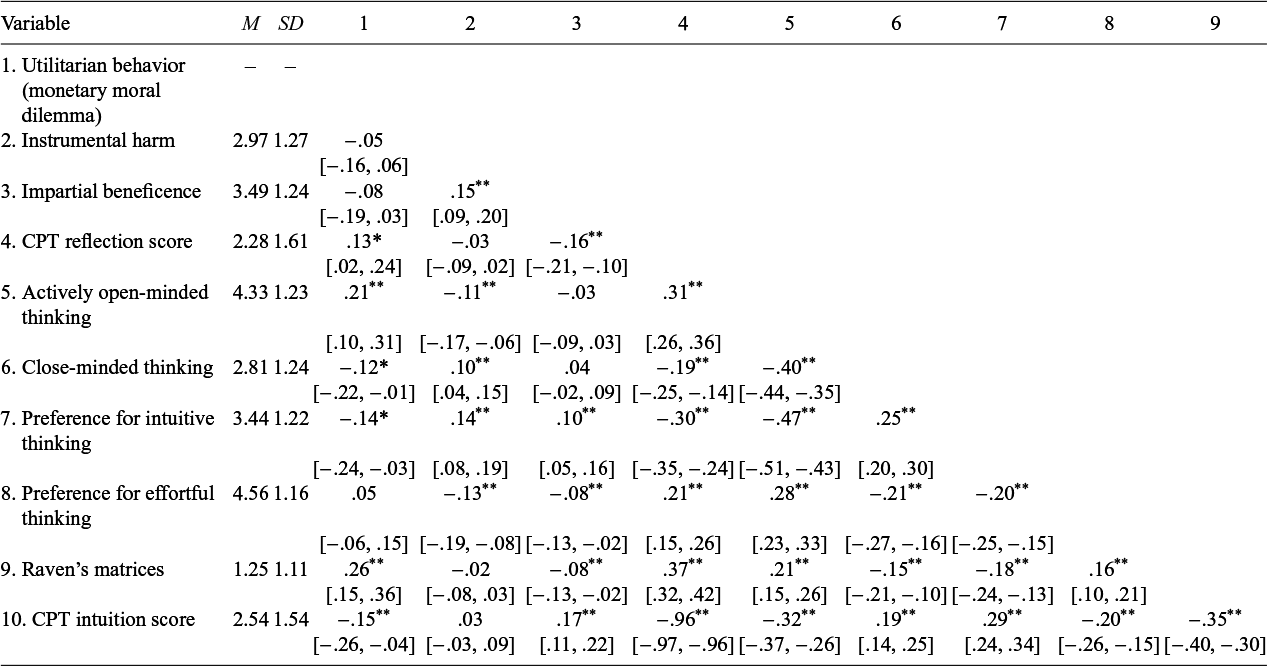
Pearson correlations among utilitarian behavior, OUS dimensions, and cognitive measures are reported in Table 2. Both impartial beneficence and instrumental harm were generally negatively correlated with reflection and positively correlated with intuition. Specifically, impartial beneficence was negatively associated with CPT reflection (r = −.16, p < .001), preference for effortful thinking (r = −.08, p = .008) and Raven’s matrices (r = −.08, p = .007), but positively with preference for intuitive thinking (r = .10, p < .001). With a similar pattern, instrumental harm was negatively correlated with actively open-minded thinking (r = −.11, p < .001) and preference for effortful thinking (r = −.13, p < .001) but positively correlated with close-minded thinking (r = .10, p = .001) and preference for intuitive thinking (r = .14, p < .001). In line with our preregistered hypothesis, actual utilitarian decisions 17 months later correlated positively with CPT reflection (r = .13, p = .016), actively open-minded thinking (r = .21, p < .001), and Raven’s matrices (r = .26, p < .001), but negatively correlated with close-minded thinking (r = −.12, p = .035) and preference for intuitive thinking (r = −.14, p = .014). Given all reflection measures positively correlated with utilitarian behavior, a multivariable logistic regression was conducted to examine the unique contributions of CPT reflection, cognitive ability (Raven’s Matrices), and actively open-minded thinking to utilitarian behavior in the monetary moral dilemma. The model indicated that CPT reflection scores did not significantly predict utilitarian behavior, OR = 0.96, 95% CI [0.81, 1.14], p = .653. In contrast, Raven’s matrices significantly predicted utilitarian behavior, OR = 1.73, 95% CI [1.33, 2.27], p < .001, as did actively open-minded thinking, OR = 1.41, 95% CI [1.14, 1.75], p = .001. These results suggest that, when accounting for cognitive ability and thinking style, CPT reflection scores alone did not uniquely predict utilitarian choice, whereas both cognitive ability and actively open-minded thinking were independently associated with greater odds of choosing the utilitarian option.
Summary of correlations, means, standard deviations

Table 2. Long description
Utilitarian behavior correlated positively with CPT reflection (r = .13), actively open-minded thinking (r = .21), and Raven’s matrices (r = .26), and negatively with close-minded thinking (r = -.12), preference for intuitive thinking (r = -.14), and CPT intuition (r = -.15). Instrumental harm and impartial beneficence were not significantly correlated with utilitarian behavior. Among cognitive measures, CPT reflection and intuition were strongly negatively correlated (r = -.96). Full values and 95% CIs are reported in the manuscript.
Note: Values in square brackets indicate the 95% confidence interval for each correlation. *indicates p < .05. **indicates p < .01. Sample size is 321 for correlations with the utilitarian behavior in the monetary moral dilemma and 1,200 for others.
As preregistered, we also examined whether utilitarian behavior was more strongly associated with impartial beneficence or tolerance of instrumental harm. Although statistical procedures exist for comparing dependent correlations, such comparisons are difficult to interpret because they do not account for potential differences in measurement reliability. We therefore simply note that the two correlations were similar in magnitude and both close to zero.
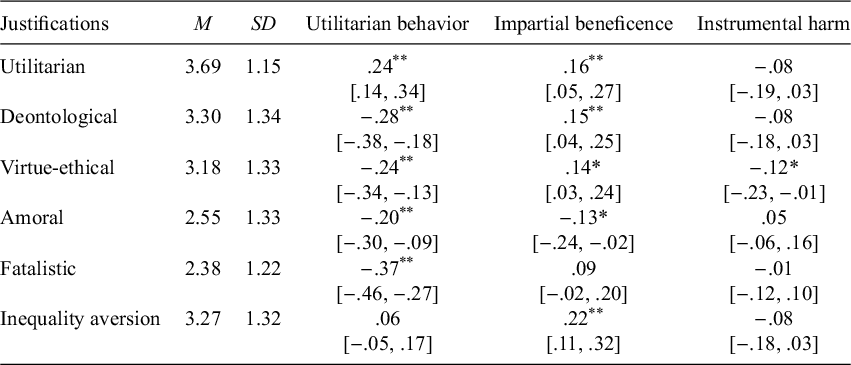
Analysis of the decision justifications as a validation check of the monetary moral dilemma revealed that only utilitarian justification was positively correlated with utilitarian behavior (r = .24, p < .001), as can be expected, whereas amorality (r = −.20, p < .001), virtue ethics (r = −.24, p < .001), deontology (r = −.28, p < .001), and fatalism (r = −.37, p < .001) were all negatively correlated with utilitarian behavior (Table 3). We also examined the relationship between decision justifications and OUS dimensions (Table 3). Impartial beneficence was negatively correlated with amorality (r = −.13, p = .018) but positively correlated with competing normative frameworks such as virtue ethics (r = .14, p = .014), deontology (r = .15, p = .008), utilitarianism (r = .16, p = .004), and inequality aversion (r = .22, p < .001), suggesting a response bias. Meanwhile, instrumental harm was only negatively associated with virtue ethics (r = −.12, p = .030).
Means, standard deviations, and correlations among moral justifications, utilitarian behavior, and OUS dimensions
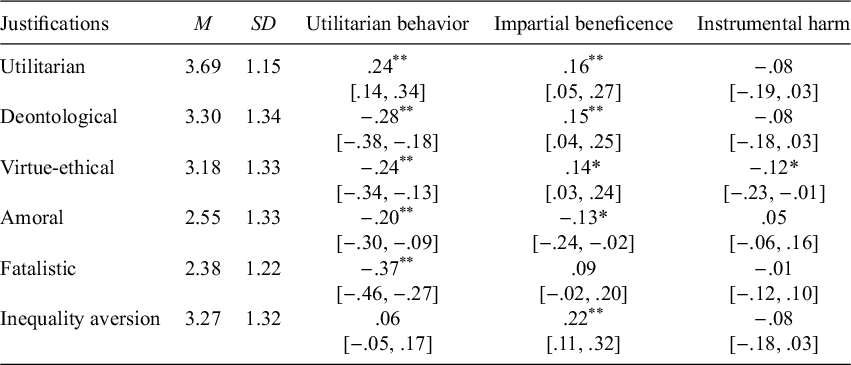
Table 3. Long description
Values follow the order: utilitarian behavior, impartial beneficence, instrumental harm. * p < .05, ** p < .01.
Inequality aversion (M = 3.27): r = ns, .22**, ns
Fatalistic (M = 2.38): r = -.37**, ns, ns
Amoral (M = 2.55): r = -.20**, -.13*, ns
Virtue ethical (M = 3.18): r = -.24**, .14*, -.12*
Deontological (M = 3.30): r = -.28**, .15**, ns
Utilitarian (M = 3.69): r = .24**, .16**, ns
Table 3 correlations with utilitarian behavior, impartial beneficence, and instrumental harm (N = 321):
Note: Values in square brackets indicate the 95% confidence interval for each correlation. *indicates p < .05. **indicates p < .01. N = 321. Table generated using the apaTables package in R (Stanley, Reference Stanley2021).
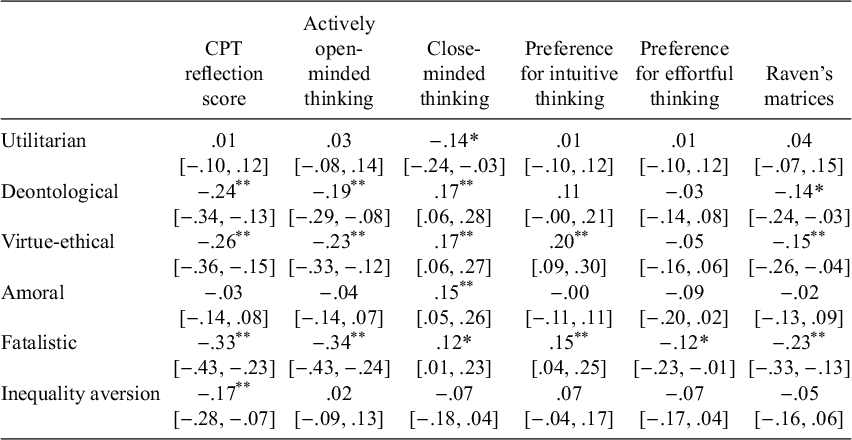
Table 4 presents the correlations between decision justifications of the monetary moral dilemma and reflection measures. Although CPT reflection, actively open-minded thinking, and Raven’s matrices predicted utilitarian behavior (see Table 2), none were significantly correlated with utilitarian justification (r = .01, r = .03, r = .04, respectively, and all ps > .441). Only close-minded thinking was negatively associated with utilitarian justification (r = −.14; p = .015). Regarding other moral justifications, CPT reflection was negatively correlated with deontological (r = −.24, p < .001), virtue-ethical (r = −.26, p < .001), fatalistic justifications (r = −.33, p < .001), and inequality aversion (r = −.17, p = .002). Actively open-minded thinking was also negatively related to deontological (r = −.19, p < .001), virtue-ethical (r = −.23, p < .001), and fatalistic justifications (r = −.34, p < .001), whereas close-minded thinking showed positive correlations with these three (r = .17, p = .002; r = .17, p = .002; r = .12, p = .03) and with amorality (r = .15, p = .005). Preference for intuitive thinking was positively associated with virtue-ethical (r = .20, p < .001) and fatalistic justifications (r = .15, p = .009), while preference for effortful thinking was negatively related only to fatalistic justification (r = .−12, p = .028). Raven’s matrices scores were negatively correlated with deontological (r = −.14, p = .013), virtue-ethical (r = −.15, p = .007), and fatalistic justifications (r = −.23, p < .001). Overall, reflection-related measures (CPT reflection, actively open-minded thinking, and Raven’s matrices) were negatively associated with deontological, virtue-ethical, and fatalistic justifications.
Correlations among moral justifications in the monetary moral dilemma and reflection measures
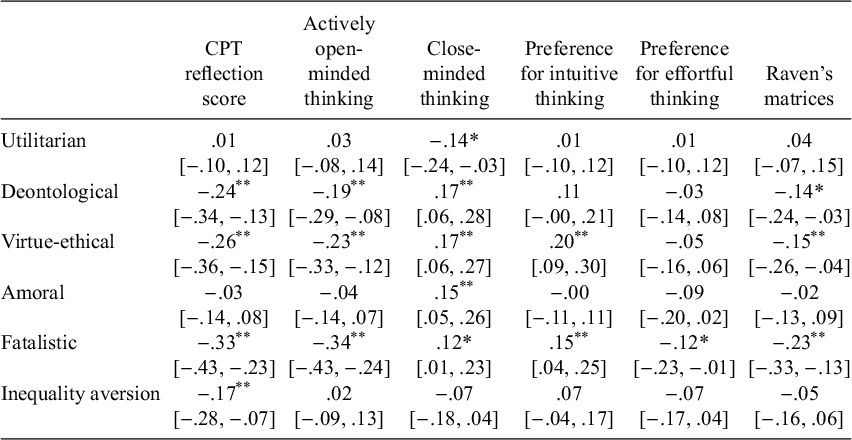
Table 4. Long description
Inequality aversion: -.17**, ns, ns, ns, ns, ns
Fatalistic: -.33**, -.34**, .12*, .15**, -.12*, -.23**
Amoral: ns, ns, .15**, ns, ns, ns
Virtue ethical: -.26**, -.23**, .17**, .20**, ns, -.15**
Deontological: -.24**, -.19**, .17**, ns, ns, -.14*
Utilitarian: ns, ns, -.14*, ns, ns, ns
Table 4 correlations between moral justifications and reflection measures (N = 321). Values follow order: CPT reflection, AOT, close-minded, intuitive, effortful thinking, Raven’s matrices.
Note: Values in square brackets indicate the 95% confidence interval for each correlation. *indicates p < .05. **indicates p < .01. N = 321. Table generated using the apaTables package in R (Stanley, Reference Stanley2021).
To explore the role of religiosity, we first examined bivariate correlations. Religiosity was negatively correlated with utilitarian behavior (r = −.17, p = .003), positively correlated with impartial beneficence (r = .09, p = .001), and showed no significant association with instrumental harm (r = .03, p = .261). Given the significant correlations of religiosity with utilitarian behavior and impartial beneficence, we conducted exploratory moderation analyses. The logistic regression model including CPT reflection, religiosity, and their interaction significantly predicted utilitarian behavior in the monetary moral dilemma, χ2 (3) = 17.64, p < .001 (Figure 2). Higher reflection scores increased the odds of utilitarian behavior (OR = 1.36, 95% CI, [1.105, 1.676], p = .004). While religiosity had no significant direct effect (OR = 1.02, 95% CI, [0.916, 1.149], p = .663), a significant interaction between reflection and religiosity was observed (OR = .95, 95% CI, [0.914, 0.992], p = .021), suggesting that the association between reflective thinking and utilitarian behavior weakens as religiosity increases. In contrast, the moderation analysis for impartial beneficence yielded no significant interaction, suggesting that the interaction between religiosity and CPT reflection is specific to utilitarian behavior but not impartial beneficence, b = −0.005, SE = 0.006, p = .441.
Interaction plot of religiosity and CPT reflection score on predicted probability of utilitarian behavior.

4. Discussion
The present study investigated whether reflective thinking predicts utilitarian moral behavior over time in an incentivized paradigm that also included various cognitive assessments (CPT, 4-CTSQ, Raven matrices) and self-reported utilitarian measures (OUS dimensions and utilitarian justification). Consistent with the dual-process model of moral judgment (Greene et al., Reference Greene, Sommerville, Nystrom, Darley and Cohen2001, Reference Greene, Nystrom, Engell, Darley and Cohen2004; Greene, Reference Greene and Sinnott-Armstrong2008), reflection was positively associated with utilitarian behavior in a monetary moral dilemma measured 17 months after the initial cognitive tasks. This finding extends prior work by demonstrating that reflection predicts actual moral behavior in a context with real stakes. Importantly, utilitarian dimensions measured by the OUS (Kahane et al., Reference Kahane, Everett, Earp, Caviola, Faber, Crockett and Savulescu2018) did not predict behavior, underscoring a divergence between self-report and behavioral measures of moral judgment (Bostyn et al., Reference Bostyn, Sevenhant and Roets2018; Sheeran & Webb, Reference Sheeran and Webb2016).
4.1. Reflection and utilitarian behavior
The link between reflection and utilitarianism was found across multiple indicators of reflective cognition in both confirmatory (CPT reflection) and exploratory findings (Raven’s and actively open-minded thinking). While the confirmatory result strengthens correlational support for the dual-process model’s core claim that reflective processes facilitate utilitarian judgments (Greene, Reference Greene and Sinnott-Armstrong2008; Greene & Haidt, Reference Greene and Haidt2002), utilitarian behavior may also be driven not only by the tendency to override intuitive responses, as captured by CPT, but also by broader cognitive resources and the motivation to engage in open and effortful thinking. Raven’s matrices, though standardly interpreted as a measure of cognitive ability, also share features with reflection measures: the items contain intuitively appealing lures, and willingness to take time is a major determinant of performance (Baron et al., Reference Baron, Scott, Fincher and Metz2015), so the ability and reflection interpretations are not sharply separable in practice. As these are exploratory, they should be interpreted with caution, but they point to a theoretically meaningful distinction between cognitive reflection, ability, and motivation as separable contributors to utilitarian behavior, warranting further investigation.
Unlike sacrificial dilemmas—often criticized for conflating utilitarian reasoning with antisocial traits such as psychopathy (Bartels & Pizarro, Reference Bartels and Pizarro2011; Djeriouat & Trémolière, Reference Djeriouat and Trémolière2014; Kahane et al., Reference Kahane, Everett, Earp, Farias and Savulescu2015; Zamora et al., Reference Zamora, Ungson and Seidman2022)—the monetary moral task involves no physical harm (Bostyn et al., Reference Bostyn, Sevenhant and Roets2019). At the same time, the monetary dilemma does not involve using one person as a means to benefit others in the way footbridge dilemmas do. Thus, the emotional processes posited by dual-process models to underlie deontological judgments may not be engaged to the same extent, as taking money from one person is unlikely to elicit the same degree of emotional intensity as physical harm.
We showed that the utilitarian choice in the monetary dilemma reflects a distinct utilitarian motivation, given that it was positively correlated only with utilitarian justification. It was also not significantly correlated with the inequality-aversion justification, suggesting that fairness concerns, which might otherwise provide non-utilitarian grounds for redistribution, are unlikely to account for the utilitarian choice. In contrast, the non-utilitarian choice correlated with multiple moral justifications, including deontology, fatalism, virtue ethics, and amorality, suggesting a heterogeneous set of moral and non-moral considerations rather than deontological reasoning alone. A similar pattern has been found in real-world moral dilemmas in lab settings, where utilitarian decisions were driven by cost-benefit motivation, whereas non-harming decisions reflected a range of moral motivations (Bostyn et al., Reference Bostyn, Gouwy, De Craene, Vanmechelen, Scheirlinckx, Tissot and Roets2025). These findings suggest that deontological principles, as traditionally used in the moral dilemma literature, may not fully account for non-harming behavior, especially when behavioral measures are incorporated.
The 17-month interval between the measurement of reflection and the behavioral task further reduces concerns about demand effects, as participants were unlikely to infer the study’s hypotheses. This temporal separation suggests that individual differences in reflection are predictive of moral behavior, converging with meta-analytic evidence on reflective and intuitive thinking in moral dilemmas (Capraro, Reference Capraro2024; Fahrenwaldt et al., Reference Fahrenwaldt, Olsen, Rahal and Fiedler2025).
4.2. Limitations of the Oxford Utilitarianism Scale
The OUS (Kahane et al., Reference Kahane, Everett, Earp, Caviola, Faber, Crockett and Savulescu2018) was developed to capture utilitarian tendencies by distinguishing between instrumental harm and impartial beneficence. In the present study, however, neither dimension predicted actual behavior in the monetary moral dilemma. Impartial beneficence correlated with a range of moral justifications, including both deontological and utilitarian ones, raising concerns about its construct validity. These findings are consistent with critiques that impartial beneficence may reflect general altruism or moral expansiveness rather than utilitarian reasoning per se (Mihailov, Reference Mihailov2023; Simpson & Nash, Reference Simpson and Nash2024), and with evidence suggesting that OUS dimensions may reflect reduced sensitivity to moral norms rather than greater sensitivity to outcomes (Körner et al., Reference Körner, Deutsch and Gawronski2020). By contrast, utilitarian decision in the monetary moral dilemma was positively associated with utilitarian justification and negatively with deontological, virtue-ethical, and fatalistic ones, supporting its validity as a behavioral measure.
Furthermore, exploratory analyses showed that actively open-minded thinking correlated positively with utilitarian behavior, while close-mindedness and intuitive thinking correlated negatively. The OUS dimensions, in contrast, were positively associated with intuition but negatively with reflection. Moreover, dual-process predictions do not consistently map onto OUS dimensions, as reflection manipulations fail to reliably influence either dimension (Capraro et al., Reference Capraro, Everett and Earp2019). Thus, the OUS may capture dispositional tendencies toward intuitive reasoning rather than the reflective processes emphasized in dual-process models. Given the limitations of OUS, novel conceptualizations of utilitarianism may be needed. For instance, Antoniou et al. (Reference Antoniou, Romero-Kornblum, Young, You, Kramer, Rankin and Chiong2023) propose a revised two-dimensional model that integrates emotion into Kahane et al.’s (Reference Kahane, Everett, Earp, Caviola, Faber, Crockett and Savulescu2018) two-dimensional account, providing a more comprehensive understanding of utilitarian reasoning.
Taken together, these results highlight the limitations of relying solely on self-report measures. While self-report scales such as OUS have good psychometric properties, they may capture socially desirable attitudes or have limited conceptual capacity to capture utilitarianism as theorized in dual-process models. Additionally, earlier findings emphasize the value of behavioral tasks for assessing utilitarian decision-making, addressing the external validity concerns of existing moral dilemma measures (Bostyn et al., Reference Bostyn, Sevenhant and Roets2018; Clarkson, Reference Clarkson2022; Sheeran & Webb, Reference Sheeran and Webb2016). Accordingly, this study also showed that incentivized behavioral tasks offer a more ecologically valid measure of utilitarian decision-making.
4.3. The role of religiosity
One noteworthy exploratory finding of this study is that religiosity moderated the relationship between reflection and utilitarian behavior. Although religiosity itself was not directly associated with utilitarian choices, reflection predicted utilitarianism more strongly among non-believers than believers. This moderation aligns with research emphasizing that reflection may not be uniformly truth-oriented but depends on the epistemic norms individuals endorse (Baron, Reference Baron2020; Saribay & Yilmaz, Reference Saribay and Yilmaz2024; Yilmaz, Reference Yilmaz2021).
For non-believers, reflection is guided by evidence-based reasoning and belief updating (Bahçekapili & Yilmaz, Reference Bahçekapili and Yilmaz2017; Metz et al., Reference Metz, Weisberg and Weisberg2018; Yilmaz & Isler, Reference Yilmaz and Isler2019), promoting impartial deliberation and outcome-based judgments. For believers, who often treat divine authority as a source of moral truth (Baron et al., Reference Baron, Scott, Fincher and Metz2015; Piazza & Landy, Reference Piazza and Landy2013; Simpson et al., Reference Simpson, Piazza and Rios2016), reflection may instead reinforce convictions grounded in sacred texts. Our findings thus extend the literature indicating negative correlations between religiosity and utilitarian judgments (Saroglou & Craninx, Reference Saroglou and Craninx2021) by demonstrating empirically that religiosity conditions the reflection–utilitarianism link, situating dual-process models within broader sociocultural contexts (Saribay & Yilmaz, Reference Saribay and Yilmaz2024; Yilmaz & Isler, Reference Yilmaz and Isler2025).
4.4. Limitations and future directions
Several limitations should be acknowledged. Although assessing the predictor and outcome variables in the same participants over a 17-month interval adds temporal depth and allows for examination of long-term associations, the analyses were correlational and do not establish causality. Furthermore, because different constructs were measured at Time 1 and Time 2, the design does not reduce within-subject variability in the same way as repeated measures. Although the temporal stability of cognitive reflection (Stagnaro et al., Reference Stagnaro, Pennycook and Rand2018) and sensitivity to consequences in moral dilemmas were found (Luke & Gawronski, Reference Luke and Gawronski2022), uncontrollable life events (e.g., elections, severe illness, economic hardship) during long periods, similar to the current study, may have influenced participants’ moral decisions. Future research should employ experimentalFootnote 5 or longitudinal designs that can more directly test causal mechanisms and capture potential changes in moral behavior across longer intervals while retaining the external validity of behavioral tasks.
Second, utilitarian behavior was assessed with a single monetary moral dilemma. While this task improves upon sacrificial dilemmas by removing physical harm and incorporating real incentives without any experimental deception, it captures only one dimension of utilitarian reasoning and thus has limited content validity as a measure of broader utilitarian tendencies. Developing a broader set of incentivized tasks, such as redistribution, impartial aid, or public goods games, would provide a more comprehensive picture of utilitarian moral psychology.
Third, moral justifications (utilitarianism, deontology, virtue ethics, amorality, fatalism, and inequality aversion) were measured with single items, limiting psychometric robustness and the depth of insights into participants’ normative views. Multi-item scales or qualitative methods could enrich understanding of the cognitive and normative frameworks people invoke. Similarly, religiosity was assessed with a single self-report item; because different operationalizations of religiosity can relate differently to the two utilitarian dimensions (Paruzel-Czachura & Charzyńska, Reference Paruzel-Czachura and Farny2023), future work should employ multidimensional measures of religiosity. Finally, the sample was drawn from the U.S. and may not generalize across cultures. Cross-cultural research is especially important given differences in religiosity, epistemic norms, and moral priorities, and could test whether the moderating role of religiosity is consistent across contexts.
Lastly, while the current study is grounded in Greene’s original dual-process model for understanding the role of reflective cognition in utilitarian decision-making, this framework has also been subject to criticism and refinement. Specifically, Bago and De Neys (Reference Bago and De Neys2019) found that intuitive responses in moral dilemmas are not exclusively deontological and that utilitarian judgments do not necessarily require deliberative override of intuitive responses. Future research should also examine the precise cognitive mechanisms underlying utilitarian behavior using behavioral paradigms that can more directly test the timing and nature of intuitive and deliberative processes.
5. Conclusion
This preregistered study provides evidence that reflection predicts utilitarian behavior in an incentivized economic task, whereas self-reported OUS dimensions do not. These findings extend the dual-process model of moral judgment by moving beyond hypothetical dilemmas to actual behavior, while also cautioning against overreliance on self-report scales such as the OUS. In addition, the moderating role of religiosity is a result worth following up, as reflection’s impact on moral decision-making may depend on epistemic norms that guide reasoning.
By integrating cognitive, self-report, and behavioral measures across time, this study advances understanding of the reflection–utilitarianism link and suggests dual-process models within broader sociocultural contexts. In doing so, it contributes to a more ecologically grounded and nuanced account of individual differences in moral cognition.
Acknowledgments
Parts of this research were included in the first author’s master’s thesis (R.V.) submitted to Kadir Has University and conducted under the last author’s supervision (O.Y.). We are grateful to Mariola Paruzel-Czachura, Jonathon Baron, and an anonymous reviewer for their constructive and valuable feedback during the revision process. We used ChatGPT (GPT-4o; chat.openai.com) to proofread and improve language of our text. ChatGPT revised existing content and did not generate any part of the article independently .
Data availability statement
The data, analysis code, codebook, and materials of this study are openly available in the Open Science Framework (OSF) at https://osf.io/6r7gn/.
Funding statement
This research was supported by the Templeton Religion Trust [grant number: TRT0424]. The first author was supported by the 2210-A Program of The Research and Technological Council of Turkey (TUBITAK).
Competing interest
The authors have no competing interests to declare that are relevant to the content of this article.
Ethical standards
We received ethical approval from the Human Research Ethics Committee of Kadir Has University (Report number: E-82741295-604.01.01-29719).
Appendix
Oxford Utilitarianism Scale (OUS)
The following statements focus on your thoughts in different situations. Please indicate how much you agree or disagree with each of these statements using the scale provided below. (1 = Strongly Disagree; 7 = Strongly Agree)
1) If the only way to save another person’s life during an emergency is to sacrifice one’s own leg, then one is morally required to make this sacrifice.
2) From a moral point of view, we should feel obliged to give one of our kidneys to a person with kidney failure since we do not need two kidneys to survive, but really only one to be healthy.
3) From a moral perspective, people should care about the well-being of all human beings on the planet equally; they should not favor the well-being of people who are especially close to them either physically or emotionally.
4) It is just as wrong to fail to help someone as it is to actively harm them yourself.
5) It is morally wrong to keep money that one does not really need if one can donate it to causes that provide effective help to those who will benefit a great deal.
6) It is morally right to harm an innocent person if harming them is a necessary means to helping several other innocent people.
7) If the only way to ensure the overall well-being and happiness of the people is through the use of political oppression for a short, limited period, then political oppression should be used.
8) It is permissible to torture an innocent person if this would be necessary to provide information to prevent a bomb going off that would kill hundreds of people.
9) Sometimes it is morally necessary for innocent people to die as collateral damage—if more people are saved overall.
4-Component Thinking Style Questionnaire (4-CTSQ)
Please indicate to what extent you agree or disagree with the following statements. (1 = Strongly Disagree; 6 = Strongly Agree)
1) It is important to be loyal to your beliefs even when evidence is brought to bear against them. (R)
2) Whether something feels true is more important than evidence. (R)
3) Just because evidence conflicts with my current beliefs does not mean my beliefs are wrong. (R)
4) There may be evidence that goes against what you believe, but that does not mean you have to change your beliefs. (R)
5) Even if there is concrete evidence against what you believe to be true, it is OK to maintain cherished beliefs. (R)
6) Regardless of the topic, what you believe to be true is more important than evidence against your beliefs. (R)
7) I think there are many wrong ways, but only one right way, to almost anything.
8) In my experience, the truth is often black and white.
9) Truth is never relative.
10) The truth does not change.
11) Either something is true, or it is false; there is nothing in between.
12) There is no middle ground between what is true and what is false.
13) I like to rely on my intuitive impressions.
14) I believe in trusting my hunches.
15) When I make decisions, I tend to rely on my intuition.
16) Using my ‘gut-feelings’ usually works well for me in figuring out problems in my life.
17) Intuition is the best guide in making decisions.
18) I often go by my instincts when deciding on a course of action. (18)
19) I am not that good at figuring out complicated problems. (R)
20) Thinking is not my idea of an enjoyable activity. (R)
21) I try to avoid situations that require thinking in depth about something. (R)
22) I am not a very analytical thinker. (R)
23) Reasoning things out carefully is not one of my strong points. (R)
24) Thinking hard and for a long time about something gives me little satisfaction. (R)
Cognitive Performance Test
1) A bat and a ball cost £1.10 in total. The bat costs £1.00 more than the ball. How much does the ball cost?
-
◯ 5 pence (1)
-
◯ 10 pence (2)
-
◯ 9 pence (3)
-
◯ 1 pence (4)
2) If it takes 5 machines 5 minutes to make 5 widgets, how long would it take 100 machines to make 100 widgets?
-
◯ 5 minutes (1)
-
◯ 100 minutes (2)
-
◯ 20 minutes (3)
-
◯ 500 minutes (4)
3) In a lake, there is a patch of lily pads. Every day, the patch doubles in size. If it takes 48 days for the patch to cover the entire lake, how long would it take for the patch to cover half of the lake?
-
◯ 47 days (1)
-
◯ 24 days (2)
-
◯ 12 days (3)
-
◯ 36 days (4)
4) All living things need water. Roses need water. If these two statements are true, can we conclude from them that roses are living things?
-
◯ Yes (1)
-
◯ No (2)
5) Claire is 31 years old, single, outspoken, and very bright. She majored in philosophy. As a student, she was deeply concerned with issues of discrimination and social justice, and also participated in anti-nuclear demonstrations. Which is more probable?
-
◯ Claire is a bank teller (1)
-
◯ Claire is a bank teller and is active in the feminist movement (2)
Raven’s Progressive Matrices
Please try to correctly answer the next three questions. You will receive 5 pence for each correct answer in addition to the participation fee.
On each of the next three screens, you will be shown an image with a missing piece. You need to choose the missing piece that logically completes the image from among the given options. Please see below for a simple example, where the correct answer is ‘2’.

Long description
The top section contains a large rectangle filled with a 14 by 9 grid of solid black dots. A white pentagonal shape with a rounded tip on the right side is cut out from the bottom-right quadrant of the grid, leaving a blank space. Below this are six numbered options, each a pentagonal shape identical in outline to the cutout.
* Option 1 contains horizontal lines.
* Option 2, highlighted with a red border, contains a 4 by 3 grid of dots plus one dot in the rounded tip, matching the pattern of the main grid.
* Option 3 contains four dots in a square formation.
* Option 4 contains a single central dot.
* Option 5 contains a grid of squares.
* Option 6 is a solid black shape.
1)

Long description
The top section contains a large rectangle containing a three by three grid of symbols.
Top row from left to right:
1. A square with a central dot.
2. A square divided into four smaller quadrants by a vertical and horizontal line, with a central dot.
3. A large plus sign consisting of a vertical and horizontal line.
Middle row from left to right:
1. A square with an X inside and a central dot.
2. A square containing an X, a vertical line, a horizontal line, and an inscribed circle, all meeting at a central dot.
3. A circle divided into four quadrants by a vertical and horizontal line, with a central dot.
Bottom row from left to right:
1. An X shape with a central dot.
2. An X shape with an inscribed circle and a central dot.
3. An empty pentagonal frame pointing to the right.
Below the matrix are eight numbered options, each inside a pentagonal frame:
1. A square with a central dot.
2. A square with an X, a vertical line, and a horizontal line.
3. A circle with a vertical and horizontal line and a central dot.
4. A square with an X, a vertical line, a horizontal line, and an inscribed circle.
5. A circle with a central dot.
6. An X with an inscribed circle and a central dot.
7. An X with a vertical and horizontal line and a central dot.
8. A square with an inscribed circle and a central dot.
-
◯ 1 (1)
-
◯ 2 (2)
-
◯ 3 (3)
-
◯ 4 (4)
-
◯ 5 (5)
-
◯ 6 (6)
-
◯ 7 (7)
-
◯ 8 (8)
2)

Long description
The main matrix contains nine cells arranged in three rows and three columns. Each cell contains a square with an X inside, combined with semicircular lobes attached to its sides.
Top row:
- Left: Square with lobes on the top and left sides.
- Middle: Square with lobes on the top and right sides.
- Right: Square with a lobe on the top side only.
Middle row:
- Left: Square with lobes on the bottom and left sides.
- Middle: Square with lobes on the bottom and right sides.
- Right: Square with a lobe on the bottom side only.
Bottom row:
- Left: Square with a lobe on the left side only.
- Middle: Square with a lobe on the right side only.
- Right: An empty large pentagonal frame indicating the missing piece.
Below the matrix are eight numbered options, each inside a pentagonal frame:
1. Square with lobes on top and bottom.
2. Square with lobes on all four sides.
3. An hourglass shape with no square or lobes.
4. An X shape with no square or lobes.
5. Square with a lobe on the right side.
6. A square with an X inside and no lobes.
7. Four lobes arranged in a clover pattern with no central square.
8. Square with a lobe on the bottom side.
-
◯ 1 (1)
-
◯ 2 (2)
-
◯ 3 (3)
-
◯ 4 (4)
-
◯ 5 (5)
-
◯ 6 (6)
-
◯ 7 (7)
-
◯ 8 (8)
3)

Long description
The main matrix contains three rows and three columns.
Row 1: Two horizontal diamonds joined at a point with an X inside; two vertical diamonds joined at a point with an X inside; a small horizontal hourglass shape.
Row 2: Two horizontal diamonds joined at a point with a vertical line through the center; two vertical diamonds joined at a point with a horizontal line through the center; a small vertical hourglass shape.
Row 3: Two horizontal diamonds joined at a point with no internal lines; two vertical diamonds joined at a point with no internal lines; an empty pentagonal frame with a curved right edge.
Below the matrix are eight numbered options, each inside a pentagonal frame:
1. A rectangle with an X inside.
2. A complex star-like shape formed by four diamonds meeting at a central square with an X.
3. A large X.
4. Four diamonds meeting at a central point with no internal lines.
5. A large horizontal hourglass.
6. A rectangle containing multiple diagonal lines forming a woven pattern.
7. Two vertical diamonds joined at a point.
8. Four diamonds meeting at a central point with a horizontal line through the middle.
-
◯ 1 (1)
-
◯ 2 (2)
-
◯ 3 (3)
-
◯ 4 (4)
-
◯ 5 (5)
-
◯ 6 (6)
-
◯ 7 (7)
-
◯ 8 (8)
Monetary Moral Dilemma (MMD)
In this task, you will interact with six other participants (Participant C1 to C6).
You are randomly selected to make a decision in this task while the six other participants will be passive. You will receive $1 for this task, regardless of your decision.
One of the six other participants (Participant C1) has also been randomly selected by a computer to receive $1 from this task, whereas the other five were not chosen to receive any bonus. This means that, in the current arrangement, only two are set to receive a bonus out of the seven participants grouped for this task: you and Participant C1.
Figure A5

However, you will determine who will ultimately receive a bonus from this task. As things stand, only you and Participant C1 will receive a $1 bonus, whereas the other five participants will not receive any bonus. Now, you have an opportunity to change this arrangement.
If you wish, you can change to an alternative arrangement where Participant C1 does not receive any bonus, and instead, each of the five other participants receive $1 bonus.
Figure A6

If you make this change in the arrangements then the one participant who was originally selected to receive a bonus (Participant C1) will not receive it, but all other participants (Participant C2 to C6) will receive bonuses. Whatever you decide will have no impact on your own bonus.
Would you like to change to the alternative arrangement where Participant C1 does not receive any bonus, and instead, five other participants receive $1 bonus each?
Please select an option.
-
◯ Change to the alternative arrangement.
-
◯ Do not change the current arrangement.
Decision Justification in the Monetary Moral Decisions
Please rate to what extent each of the following played a role while making your decision in this task:
1 = Completely disagree; 5 = Completely agree
-
1) Moral reasons did not play an important role in my judgment.
-
2) Someone who intentionally harms an innocent person cannot be moral.
-
3) Intentionally harming an innocent person is against fundamental moral rules and is thus unacceptable regardless of its intended consequence.
-
4) Moral action is what ensures the well-being of maximum number of people.
-
5) It is wrong to interfere with consequences that arise as a result of the natural course of events no matter what the ensuing harm is.
-
6) It is wrong to commit actions that increase the inequality of income among people.
Demographic Form
Gender What is your gender?
-
◯ Male (1)
-
◯ Female (2)
-
◯ Non-binary/third gender (3)
-
◯ Prefer not to say (4)
Age What is your age in years?
---------------------------------------------------------------------------------------------
Education level What is the highest level of education you have completed?
-
◯ Some high school or less (1)
-
◯ High school diploma or GED (2)
-
◯ Some college, but no degree (3)
-
◯ Associates or technical degree (4)
-
◯ Bachelor’s degree (5)
-
◯ Graduate or professional degree (MA, MS, MBA, PhD, JD, MD, DDS etc.) (6)
-
◯ Prefer not to say (7)
Household income What was your total household income before taxes during the past 12 months?
-
◯ Less than $25,000 (1)
-
◯ $25,000–$49,999 (2)
-
◯ $50,000–$74,999 (3)
-
◯ $75,000–$99,999 (4)
-
◯ $100,000–$149,999 (5)
-
◯ $150,000 or more (6)
Number of people living together What is the number of people you live together (including you)?
Ladder (Subjective SES) Imagine that this ladder pictures how American society is set up.
Figure A7

At the top of the ladder are the people who are the best off—they have the most money, the highest amount of schooling, and the jobs that bring the most respect.
At the bottom are people who are the worst off—they have the least money, little or no education, no job, or jobs that no one wants or respects.
Now think about your family. Please tell us where you think your family would be on this ladder. Select the place that best represents where your family would be on this ladder.
-
□ 10
-
□ 9
-
□ 8
-
□ 7
-
□ 6
-
□ 5
-
□ 4
-
□ 3
-
□ 2
-
□ 1
Belief in God (categorical) Do you believe in God?
-
◯ Yes (1)
-
◯ No (2)
Belief in God (continuous) Do you believe in God? (1 = Definitely not; 10 = Definitely yes)
Religious affiliation Please choose the option below that best describes your religious affiliation.
□ Christian, Anglican (1)
□ Christian, Baptist (2)
□ Christian, Catholic (3)
□ Christian, Evangelical (4)
□ Christian, Mormon (5)
□ Christian, Orthodox (6)
□ Christian, Protestant (7)
□ Christian, Unitarian (8)
□ Christian, Other (9)
□ Hindu (10)
□ Jewish, Conservative (11)
□ Jewish, Orthodox (12)
□ Jewish, Reform (13)
□ Jewish, Ultra Orthodox (14)
□ Jewish, Other (15)
□ Pagan (16)
□ Muslim, Kharijite (17)
□ Muslim, Shia (18)
□ Muslim, Sunni (19)
□ Muslim, Other (20)
□ Buddhist (21)
□ Atheist (22)
□ Agnostic (23)
□ Other (24)
Level of religious commitment What is your level of commitment to the religious affiliation you have chosen above? (0 = Extremely Low; 10 = Extremely High)
Religiosity How religious do you describe yourself? (0 = Not at all religious, 10 = Very religious)
General ideology How would you place your political views on this scale, generally speaking? (0 = Extremely Liberal; 10 = Extremely Conservative)
Ideology—social issues When it comes to social issues, how liberal or conservative are you? (0 = Extremely Liberal; 10 = Extremely Conservative)
Ideology—economic issues When it comes to economic issues, how liberal or conservative are you? (0 = Extremely Liberal; 10 = Extremely Conservative)
Ideology (categorical) Where would you place yourself along the political spectrum?
-
◯ Conservative (1)
-
◯ Moderate (2)
-
◯ Liberal (3)
-
◯ Libertarian (4)
-
◯ Other (5)
Happiness How happy do you feel in general? (0 = Extremely Unhappy, 10 = Extremely Happy)
Meaning in life Please take a moment to think about what makes your life feel important to you. Please respond to the following statement as truthfully and accurately as you can, and also please remember that it is very subjective question and that there is no right or wrong answer. Please answer according to the scale below: My life has a clear sense of purpose.
-
◯ Absolutely Untrue (1)
-
◯ Mostly Untrue (2)
-
◯ Somewhat Untrue (3)
-
◯ Cannot Say True or False (4)
-
◯ Somewhat True (5)
-
◯ Mostly True (6)
-
◯ Absolutely True (7)
Belief in evolution Do you believe in evolution? (0 = Definitely not; 10 = Definitely yes)
Belief in karma Do you believe in karma? (0 = Definitely not; 10 = Definitely yes)
Belief in witchcraft Do you believe in witchcraft? (0 = Definitely not; 10 = Definitely yes)
Belief in alternative medicine Do you believe in alternative medicine? (0 = Definitely not; 10 = Definitely yes)
Life satisfaction All things considered, how satisfied are you with your life as a whole these days? (1 = Completely dissatisfied; 10 = Completely satisfied)




 Open access

