Alignment occurs in conversation, when interlocutors imitate one another's linguistic behavior. Unmediated accounts of alignment propose that alignment is unconscious and automatic, occurring as interlocutors prime one another's linguistic representations during language processing. Priming facilitates access to representations, either through residual activation (Pickering & Branigan, Reference Pickering and Branigan1998) or through an error-driven learning mechanism (Chang, Dell, & Bock, 2006). Certain unmediated accounts, such as the interactive alignment account (cf., e.g., Pickering & Garrod, Reference Pickering and Garrod2004), propose that lower level (e.g., syntactic) alignment leads to higher level (e.g., semantic) alignment, and ultimately to alignment of situational models or mutual understanding of the situation under discussion. Achieving mutual understanding, therefore, need not depend on complex cognitive processes, as previously suggested (Clark & Marshall, 1981). According to Garrod and Pickering (Reference Garrod and Pickering2004), because alignment is automatic and unconscious, it helps to make conversation easy.
Conversation is not easy for many children with an autism spectrum disorder (ASD), however. ASD is a neurodevelopmental disorder characterized by impaired social interaction and communication skills, with a global prevalence of between 0.01% and 1.57% (Zaroff & Uhm, Reference Zaroff and Uhm2012). As many as 30% of individuals with ASD never acquire functional language (Anderson et al., Reference Anderson, Lord, Risi, DiLavore, Shulman and Thurm2007), and those who do may struggle to use it appropriately in social, communicative contexts. Such pragmatic deficits are an aspect of language that is seriously impaired in ASD (Tager-Flusberg, Reference Tager-Flusberg1981, Reference Tager-Flusberg1996), and the impairment may be conspicuous in conversations. ASD children fail to make new, relevant contributions to discussion (Capps, Kehres, & Sigman, Reference Capps, Kehres and Sigman1998; Tager-Flusberg & Anderson, Reference Tager-Flusberg and Anderson1991) and produce unusual content or style (Volden, Reference Volden2002). Pragmatic deficits in ASD are thought to relate to impaired theory of mind (ToM; Happé, Reference Happé1993) or mentalizing ability. ASD individuals with ToM impairment may struggle to appreciate that others have thoughts and feelings that are unique to them, and they may presume that others intuitively know what they are thinking and feeling themselves.
ASD is also associated with imitation deficits, in the domains of body movement, object use, facial expressions, and vocalization (Ingersoll, Reference Ingersoll2008), which may relate to atypical connectivity of the imitation network of the brain (Shih et al., Reference Shih, Shen, Ottl, Keehn, Gaffrey and Muller2010). Vocal imitation deficits are complex in ASD. Nonverbal ASD children show reduced vocal imitation (Hartung, Reference Hartung1970), and verbal children may fail to imitate paralinguistic features of speech when vocal imitation is intact (Diehl & Paul, Reference Diehl and Paul2012). In contrast, some ASD children show excessive vocal imitation in the form of echolalia, when entire tracts of speech may be copied with exact, or nearly exact, repetition of words and intonation. Echolalia, another pragmatic deficit, can also compromise conversation skills in ASD (Grossi, Marcone, Cinquegrana, & Gallucci, Reference Grossi, Marcone, Cinquegrana and Gallucci2013), suggesting that conversation requires a certain amount of alignment, but not too much.
Given ASD can involve under- and overimitation, unmediated accounts of alignment do not allow a simple prediction to be made about alignment in the conversations of ASD individuals. Because imitation leads to alignment, it might be expected that those who underimitate would align less with an interlocutor, while those who overimitate would align more. A further complexity is a growing body of evidence suggesting that the tendency to align is mediated by beliefs about the audience (cf., e.g., Branigan, Pickering, Pearson, McLean, & Brown, Reference Branigan, Pickering, Pearson, McLean and Brown2011). Mediated accounts conceptualize alignment as a more conscious process, whereby imitation in conversation may be strategically deployed to facilitate communicative success, or for social–affective gains. It is again unclear what the implications of this might be for ASD.
Despite these theoretical uncertainties, recent studies suggest that ASD individuals are not atypical in the extent to which they align. Allen, Haywood, Rajendran, and Branigan (Reference Allen, Haywood, Rajendran and Branigan2011) showed that ASD children converge passive syntax with an interlocutor (e.g., passive phrases such as “the queen is being kissed by the sheep”) to the same extent as both chronological and verbal mental age-matched typical controls. Slocombe et al. (Reference Slocombe, Alvarez, Branigan, Jellema, Burnett and Fischer2012) showed that adults with Asperger syndrome, a high-functioning form of autism, are as likely as typical controls to align lexis, syntax, and spatial frame of reference with an interlocutor.
The findings of these studies raise questions about the conversation skills of ASD individuals. If alignment abilities are normal in ASD, then this should support participation in dialogue, but many ASD individuals find conversation difficult. A possible explanation for these contradictory findings is that the alignment observed in previous research is an experimental artifact (i.e., task dependent) rather than a real phenomenon, a possibility that has already been suggested (Healey, Purver, & Howes, Reference Healey, Purver and Howes2012; Howes, Healey, & Purver, Reference Howes, Healey and Purver2010). Allen et al. (Reference Allen, Haywood, Rajendran and Branigan2011) measured alignment using an adapted version of Snap!, a card matching game for children. To play Snap!, a deck of pictorial cards is split evenly between players, who take turns in revealing their cards to each other. If two adjacent cards are matching, players compete to say “Snap!,” in order to win those cards. In the adapted version of the game, players are required to verbally describe the picture on each card, for example,
Experimenter: A cow is squashing a doctor.
Child: A dog is biting a robber.
Experimenter: A crocodile is kicking a knight.
Child: A crocodile is kicking a knight. Snap!
Slocombe et al. (Reference Slocombe, Alvarez, Branigan, Jellema, Burnett and Fischer2012) used two cooperative tasks to measure alignment, both of which involved guided card sorting. These types of tasks, called referential communication tasks, are highly structured. They enforce turn taking (Dickson, Reference Dickson, Brainerd and Pressley1982), and allow experimental control over the nature of participants’ verbal responses (Leinonen & Letts, Reference Leinonen and Letts1997). As a result, they are not necessarily a reliable proxy for natural conversations, a point acknowledged by Slocombe et al. (Reference Slocombe, Alvarez, Branigan, Jellema, Burnett and Fischer2012).
Slocombe et al. (Reference Slocombe, Alvarez, Branigan, Jellema, Burnett and Fischer2012) suggest that future research should examine alignment in the natural conversations of ASD individuals. They propose two reasons why there might be differences in alignment in natural conversation versus referential communication tasks. First, natural conversations are less structured. There is a large discrepancy in the social functioning of ASD individuals between experimental and naturalistic situations. ASD individuals may perform well in social reasoning experiments, but fail to apply social reasoning to everyday social interactions (Klin, Jones, Schultz, & Volkmar, Reference Klin, Jones, Schultz and Volkmar2003). It is notable that ASD children tend to be more communicative in more structured conversations (Tager-Flusberg, Reference Tager-Flusberg and Anderson1991).
Second, the focus of natural conversations may be on social affiliation. It is widely accepted, however, that ASD individuals show reduced interest in social stimuli (Fletcher-Watson, Leekam, Benson, Frank, & Findley, Reference Fletcher-Watson, Leekam, Benson, Frank and Findlay2009; Hanley, McPhillips, McHern, & Riby, Reference Hanley, McPhillips, Mulhern and Riby2012; Klin, Jones, Schultz, Volkmar, & Cohen, Reference Klin, Jones, Schultz, Volkmar and Cohen2002), including speech. ASD individuals show weaker brain responses to speech sounds than do controls (Boddaert et al., Reference Boddaert, Belin, Chabane, Poline, Barthélémy and Mouren-Simeoni2003), and may actively ignore speech sounds unless instructed otherwise (Whitehouse & Bishop, Reference Whitehouse and Bishop2008). Further, reduced motivation to affiliate with a social partner may result in underimitation of behavior by ASD individuals (Hobson & Hobson, Reference Hobson and Hobson2008; Marsh, Pearson, Ropar, & Hamilton, Reference Marsh, Pearson, Ropar and Hamilton2013). This is an important finding, because it suggests that ASD individuals’ alignment in conversation might be especially sensitive to social-psychological factors. It also makes a case for considering alignment in ASD from a mediated as well as an unmediated perspective.
Because there are grounds for expecting a difference in how ASD individuals would align with an interlocutor in naturalistic versus experimental settings, this paper presents two studies that compare syntactic alignment in ASD and typical children, in an experimental and in a naturalistic setting. The first study was an extended replication of Allen et al.'s (Reference Allen, Haywood, Rajendran and Branigan2011) study, measuring dative as well as active–passive alternation using a pictorial card game. In the second study, syntactic alignment was measured across all structures in the conversations of ASD and typical children with a peer. Most children took part in both studies. We predicted that, according Allen et al. (Reference Allen, Haywood, Rajendran and Branigan2011) and Slocombe et al. (Reference Slocombe, Alvarez, Branigan, Jellema, Burnett and Fischer2012), ASD children would align syntax to the same extent as controls in the card game. However, we also predicted that ASD children would not maintain the level of alignment observed in the card game in natural conversation, which is both less structured and less goal oriented.
Finally, given the possibility that alignment is an experimental artifact, the different methods used in our studies are compared in this paper. It was expected that, overall, there would be a discrepancy in syntactic alignment effect sizes between the card game and the natural conversation task, with weaker alignment effects in natural conversation, as per data from Howes et al. (Reference Howes, Healey and Purver2010) and Healey et al. (Reference Healey, Purver and Howes2012). Following the lead of Gries (Reference Gries2005), we discuss the merits of studying alignment in an experimental versus a naturalistic setting.
STUDY 1
Method
Participants
Seventeen ASD children (12 male, 5 female) took part in the card game study, with a mean chronological age of 11.4 years (range = 8.3–13.7 years). The children had been previously diagnosed with ASD by a pediatrician, psychiatrist, or clinical psychologist, and we corroborated diagnoses using the Social Communication Questionnaire (SCQ; Rutter, Bailey, & Lord, Reference Rutter, Bailey and Lord2003). The SCQ is a brief parental screening instrument that assesses communication and social skills in children who may have ASD. The recommended cutoff score for the SCQ is 15 (Wiggins, Bateman, Adamson, & Robins, Reference Wiggins, Bakeman, Adamson and Robins2007), and the ASD children in our sample obtained standardized scores at or above the cutoff (mean = 23.1, range = 15–33). The children were also administered the Kaufman Brief Intelligence Test (KBIT-2; Kaufman & Kaufman, Reference Kaufman and Kaufman2004), a standardized measure of both verbal and nonverbal ability (mean = 77.8, SD = 21.6). The SCQ and the KBIT-2 are the same measures as those used by Allen et al. (Reference Allen, Haywood, Rajendran and Branigan2011).
We also tested language ability using the British Picture Vocabulary Scale (BPVS-3; Dunn, Dunn, & Styles, Reference Dunn, Dunn and Styles2009). Like Allen et al. (Reference Allen, Haywood, Rajendran and Branigan2011), we used raw scores to estimate the verbal mental age of the ASD children (mean BPVS-3 = 9.6 years, range = 6.7–12.8 years) by which we matched them with typical controls (N = 17 [10 male, 7 female], mean BPVS-3 = 9.6 years, range = 6.8–12.1 years). In addition, the Sally-Anne false belief task (Baron-Cohen, Leslie, & Frith, Reference Baron-Cohen, Leslie and Frith1985) was administered to all children. The Sally-Anne task assesses first-order ToM, which requires reasoning about the mental state of others. Because alignment may be mediated by beliefs about one's interlocutor, we wished to verify that any between-group differences in alignment could not be better explained by basic ToM impairment, especially in the ASD group. The pass rate (=94.12%) on the Sally-Anne task did not differ between groups, however.
All participants were recruited from schools in Dorset, United Kingdom. The ASD children were taught within the autism unit of a special needs school. The typical children attended a state primary school. Note that, unlike Allen et al. (Reference Allen, Haywood, Rajendran and Branigan2011), we did not compare our ASD group with a group of chronologically aged-matched controls. This was owing to their finding that alignment is unrelated to chronological age, at least in children who are fluent, native speakers.
Materials
Materials were a set of 30 pairs of picture cards, of which there were 24 experimental pairs of a prime and a target card, and 6 pairs of filler cards, adapted from a game used by Messenger, Branigan, McLean, and Sorace (Reference Messenger, Branigan, McLean and Sorace2012). Our main adaption was to incorporate prepositional object (PO) and double object (DO) forms within the game. We also withdrew object–experiencer verbs, because ASD is associated with difficulties in understanding emotional scenes (cf., e.g., Hobson, Reference Hobson1986), and with producing emotional language (e.g., Pearlman-Avnion & Eviatar, Reference Pearlman-Avnion and Eviatar2002).
All cards depicted a transitive event involving an animal donor and a human recipient (e.g., a bear dragging a witch), or an animal donor, a human recipient, and an object of transfer (e.g., a tiger giving a ball to a nurse). There was no repetition of semantic and lexical content in experimental pairs, to ensure that children imitated abstract language structures, instead of copying prime descriptions verbatim. Filler pairs were similar to experimental pairs, but the prime and target cards were identical. There were two active, two passive, one PO, and one DO filler primes. Two scripts of primed descriptions of the experimenter's cards were prepared, each containing a version of each prime, to control for collostruction strengths (Gries, Reference Gries2005), or the principle that words may be more or less attracted to certain syntactic patterns or constructions. Of the 24 pairs of experimental items, there were six active primes, six passive primes, six PO primes, and six DO primes. Filler items were spaced at even intervals through the scripts, to sustain children's interest in the game. Children were randomly assigned to either one of the scripts.
Design
All children experienced the full range of structural primes. Prime (active form vs. passive form vs. PO form vs. DO form) was a within-participants and within-items factor. Diagnosis (ASD vs. typical) was a between-participants and within-items factor. The dependent variable was the children's production or not of the previously used syntactic form.
Procedure
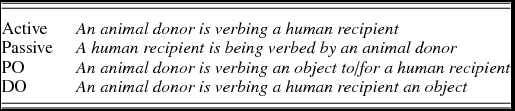
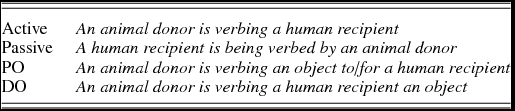
All children were tested individually, and by the same experimenter, who was aware of the study hypotheses. Both the experimenter and the child had a preordered pile of cards, and they took turns revealing and describing their cards to each other. The experimenter always described her card first, using an active, passive, PO, or DO structure (see Table 1), by reading from a hidden script. Hence the experimenter primed the child's description of the subsequent “target” card. Whoever said “Snap!” first on filler rounds won the pair of matching cards, and all cards placed before it. The game took 5–10 min to complete, following a practice round during which the experimenter and the child each described two experimental items and one filler item. The BPVS-3 and KBIT-2 took an additional 20–30 min to administer.
Syntactic forms of prime descriptions in card game
Coding and analysis
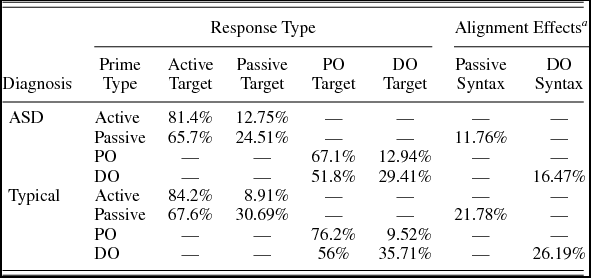
We adopted a similar coding scheme to Allen et al.'s (Reference Allen, Haywood, Rajendran and Branigan2011), extended to cover dative syntactic structures. Target descriptions were coded as containing either a preferred (i.e., active; prepositional) or a dispreferred (passive; double object) syntactic form. This distinction was based on corpus data showing that transitive verbs usually take an active, rather than a passive, form (Biber, Johansson, Leech, Conrad, & Finegan, Reference Biber, Johansson, Leech, Conrad and Finegan1999) and that passive constructions are rare in conversation, with a relative frequency of ~2%–3% in spoken English corpora (Roland, Dick, & Elman, Reference Roland, Dick and Elman2007). Similarly, it has been shown that double object forms are less common than prepositional forms in speech, especially children's speech (Gropen, Pinker, Hollander, Goldberg, & Wilson, Reference Gropen, Pinker, Hollander, Goldberg and Wilson1989). Roland et al. (Reference Roland, Dick and Elman2007) showed that the relative frequency of double object forms in spoken English is ~1%–2%. The coding scheme allowed us to measure the extent of children's syntactic repetition, by calculating alignment effects. In this study, alignment effects quantify the difference in the number of dispreferred target descriptions produced in response to dispreferred versus preferred prime descriptions (Table 2).
Percentage of target responses by prime condition (card game)

aAlignment effects are calculated as percentage of dispreferred targets produced after dispreferred primes, minus the percentage of dispreferred targets produced after preferred primes. For example, in ASD children, the passive syntax alignment effect is 25.51% –12.75% = 11.76%.
Some children described target cards with different syntax, or syntax that could not be expressed in an alternative syntactic form (e.g., a fairy is having a cuddle with a bear). Such descriptions were coded as “other” and were excluded from analysis. As in Allen et al.'s (Reference Allen, Haywood, Rajendran and Branigan2011) study, other responses represented 10.6% of the data set, and they were randomly distributed across prime types and group.
All data evidencing active, passive, PO, or DO structures were submitted to a logit mixed-effects analysis. This was a departure from the methodology of Allen et al. (Reference Allen, Haywood, Rajendran and Branigan2011), who conducted a by-participant and by-item analysis of variance (ANOVA) of their data. This type of analysis, called F1–F2 analysis, is common in psycholinguistic research. However, it has been suggested that ANOVAs are inadequate for dealing with categorical data (Barr, Levy, Scheepers, & Tily, Reference Barr, Levy, Scheepers and Tily2013; Jaeger, Reference Jaeger2008). Further, ANOVAs of categorical data may produce spurious results and are less powerful than mixed-effects models (Dixon, Reference Dixon2008).
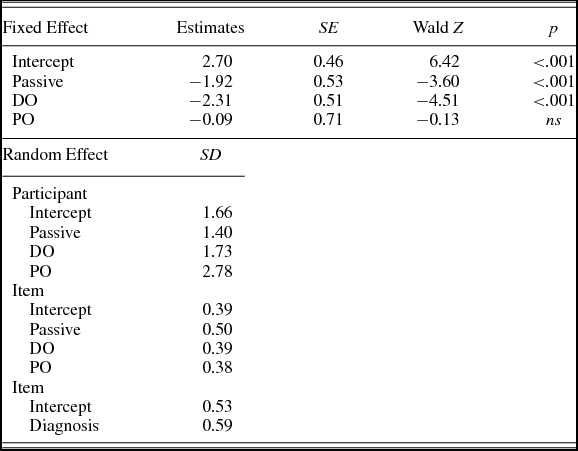
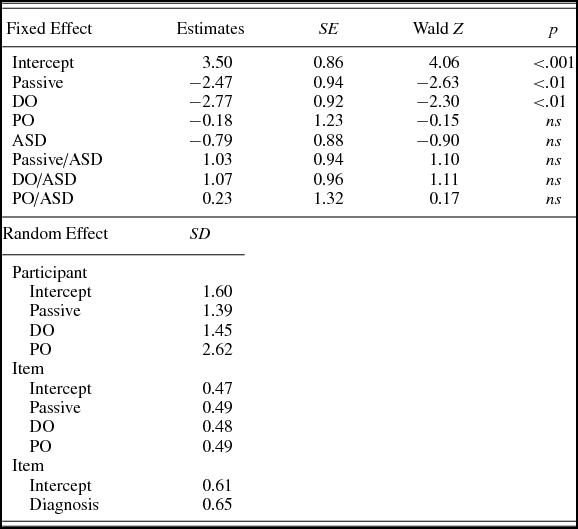
We therefore fitted logit models to our data (Table 2). Because other data points were excluded from analysis, our dependent variable was binary (i.e., 0 = no production of dispreferred syntax, 1 = production of dispreferred syntax). We treated diagnosis (ASD vs. typical) and prime type (active vs. passive vs. PO vs. DO) as fixed effects. Three levels of contrast were defined for the four levels of the prime type variable, with active syntax as a reference category. Participants and items were treated as random effects.
The models reported here were fitted with the statistical package R (version 3.0.2; R Core Team, 2013) and the package lme4 (Bates, Maechler, & Bolker, Reference Bates, Maechler and Bolker2011). We compared three logit models to a baseline model, for which no fixed effects were specified. The first model included only the effect of prime type, to check that our experimental manipulations influenced alignment across all participants. The second model included the effects of prime type and diagnosis, to verify that the experimental manipulations influenced alignment in both groups. The third model included an interaction between prime and diagnosis, allowing us to identify whether the groups aligned to the same extent or not. Chi-squared values were calculated in lme4, assessing which (if any) of the models was a significant improvement in describing our data.
The statistical significance of fixed and random effects in the logit models was assessed using Wald's test (Wald, 1943), for which z scores and corresponding p values are reported here (see Tables 3 and 4).
Summary of fixed and random effects for prime-only model (card game)
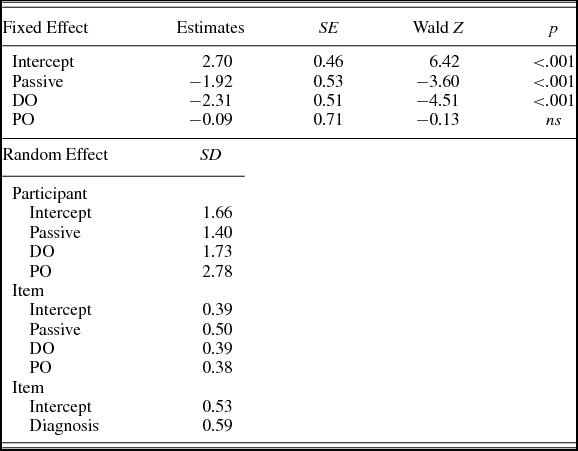
Summary of fixed and random effects for interaction model (card game)
Results
In line with Allen et al.'s (Reference Allen, Haywood, Rajendran and Branigan2011) findings, our analysis showed that our prime-only model significantly improved on the baseline model, χ2 (3) = 22.26, p < .001. This meant that, overall, target responses were affected by the prime type the participants heard. Participants were more likely to produce a dispreferred form of syntax in response to the experimenter's use of a dispreferred rather than a preferred form. Our prime + diagnosis model was not a significant improvement on the baseline model, χ2 (1) = 0.01, p = .93, indicating that participants produced more dispreferred syntax in response to the experimenter's use of dispreferred syntax, regardless of diagnosis. Further, our interaction term model was not a significant improvement on the baseline model, χ2 (3) = 2.31, p = .51. This showed that alignment effects did not differ significantly between the ASD and the typical groups, again as per Allen et al. (Reference Allen, Haywood, Rajendran and Branigan2011).
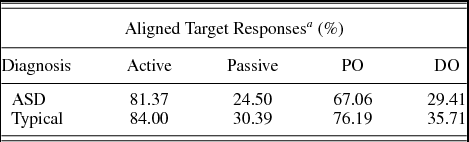
Because of a mean difference in proportions of “other” responses between the groups (ASD M = 13.6%; typical M = 7.5%), we conducted a further logit mixed-effects analysis on our data set, including the data points excluded from the previous analysis. This was necessary because, if other responses were taken into account, the ASD group produced more nonaligned descriptions than the typical group. Thus, we wanted to eliminate the possibility that between-group differences in alignment were being obscured by the exclusion of other responses. In this analysis, we coded whether the target was syntactically aligned with the prime description or not. Other responses were recoded as being not aligned. These data are presented in Table 5.
Percentage of aligned target responses by prime condition (card game)
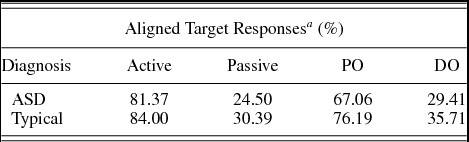
aOther responses are recoded.
As before, we compared three logit models to a baseline model. Model 1 contained only the effect of prime type, Model 2 the effect of prime type and diagnosis, and Model 3 an interaction between prime type and diagnosis. Items and participants were again treated as random effects. The analysis showed that, even after accounting for the group differences in “other” responses, the effect of prime type remained significant, χ2 (3) = 33.88, p < .001. The effect of diagnosis was again nonsignificant, χ2 (1) = 2.82, p = .09, as was the interaction between prime type and diagnosis, χ2 (3) = 0.22, p = .98. Thus, the results of both analyses suggest that ASD children are sensitive, not only to the priming of active–passive alternation, but also to the priming of dative alternation in a referential communication task. Further, the ASD group was able to align syntax to an extent comparable to that of typical children.
Relationships among alignment effects, age, and language ability
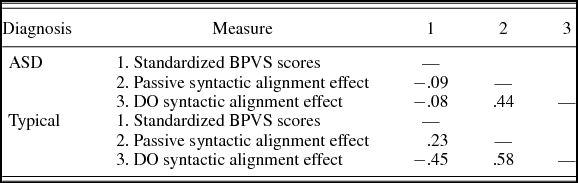
Unlike Allen et al. (Reference Allen, Haywood, Rajendran and Branigan2011), we found no significant correlations between alignment effects and raw BPVS-3 scores for either our ASD or our typical group, when chronological age was taken into account. This was surprising in light of evidence that linguistic ability predicts the magnitude of syntactic priming effects in children. Kidd (Reference Kidd2012) observed that children with better vocabulary and grammatical knowledge were primed more strongly on a referential communication task than were children with weaker skills in these areas. The absence of any significant correlations may reflect the variability of alignment effect scores across raw BPVS-3 scores in our data set (see Table 6).
Correlation matrix of standardized BPVS and alignment scores (card game)
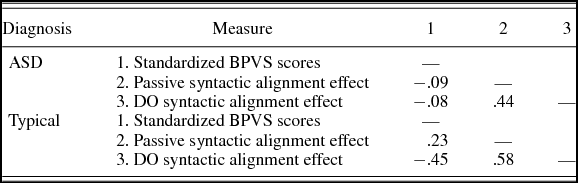
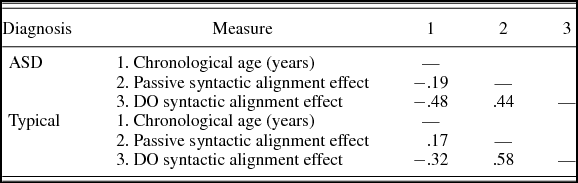
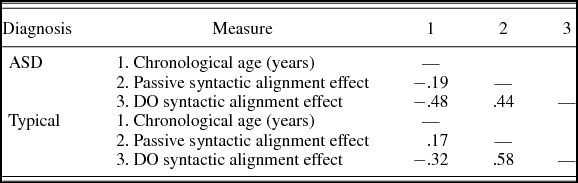
More consistently, we found no significant correlations between alignment effects and chronological age. This supports previous studies (e.g., Garrod & Clark, Reference Garrod and Clark1993) that have found no significant developmental relationships between age and alignment in children carrying out a referential communication task (see Table 7).
Correlation matrix of chronological age and alignment scores (card game)
Interim discussion
In our first study, ASD children took turns with an experimenter to describe pairs of unrelated picture cards. Ours was an extended replication of Allen et al.'s (Reference Allen, Haywood, Rajendran and Branigan2011) study, which showed that ASD children tended to describe using passive syntax when they had just heard an experimenter produce a passive description. We observed a similar pattern in our own data. ASD children produced 11.76% more dispreferred, passive forms to describe a transitive event when they had just heard an experimenter produce a passive description. A novel finding of our study was that this pattern extended to dative alternation. Despite emergent evidence that ASD children may struggle with dative alternation (Stockbridge, Happé, & White, Reference Stockbridge, Happé and White2013), our ASD group produced 16.47% more dispreferred, double object forms than preferred, prepositional forms to describe a transitive event, when they had just heard an experimenter produce a double object description. This finding is consistent with Slocombe et al.'s (Reference Allen, Haywood, Rajendran and Branigan2012) study, which reported a double object priming effect in adults with Asperger syndrome.
Another novel finding was that alignment effects for dative alternation are stronger than for active–passive alternation in both ASD and typical children, such that more DO targets were produced in response to DO primes than were passive targets in response to passive primes. This may be because DO forms are relatively more frequent in spoken language than are passive forms (Roland et al., Reference Roland, Dick and Elman2007), and Hartsuiker and Kolk (Reference Hartsuiker and Kolk1998) suggest that rarer syntactic structures are more sensitive to priming effects than are more common ones. An alternative explanation for the pattern of our data is that it reflects weaker passive competence in the children. Messenger et al. (Reference Messenger, Branigan, McLean and Sorace2012) observe that the strength of priming effects depends on the extent to which children construct abstract representations for a given structure. It is therefore possible that the children in our sample were better able to abstract DO than passive rules, but this is a matter for further investigation.
Overall, our results lend support to the hypothesis that syntactic alignment is intact in ASD children, relative to typical controls. Both our ASD and typical groups imitated abstract syntactic structures used by the experimenter, without being asked to do so. Because ASD children demonstrate intact syntactic alignment, they should be able to engage in conversation without difficulty, if unmediated accounts of alignment are true. The alignment process has a percolating effect, whereby syntactic alignment leads to alignment of situational models, which is the basis for a successful conversation. As noted, however, studies suggest that ASD individuals struggle with conversation. They display pragmatic deficits, which, as Slocombe et al. (Reference Slocombe, Alvarez, Branigan, Jellema, Burnett and Fischer2012) point out, suggest a failure to accommodate the situational model of an interlocutor. Such evidence suggests that the alignment process might not be robust in ASD individuals, at least in more naturalistic settings. We were interested to know, therefore, whether syntactic alignment occurs in the natural conversations of ASD children, and if so, to what extent. These questions are addressed in our second study.
STUDY 2
Method
Participants
Most children (83%) who took part in the first study also took part in the second, with an interval between the studies. Additional children were recruited from the participating schools used in Study 1. There were no significant changes in participant demographics. Seventeen ASD children (12 male, 5 female) completed the natural conversation task, with a mean chronological age of 11.2 years (range = 7.9–13.4 years). ASD diagnoses were again corroborated using the SCQ, and all children scored at or above the cutoff (mean = 22.4, range 15–33). The children's mean K-BIT 2 score was 77.5 (SD = 21.3), and they were well matched for verbal mental age (mean BPVS-3 = 9.5 years, range = 6.7–12.8 years) to typical controls (N = 17 [10 male, 7 female], mean BPVS-3 = 9.9 years, range = 6.8–12.1 years). Again, there was no significant group difference in performance on the Sally-Anne task.
Coding and analysis
In this study, a repeated measures analysis of covariance (ANCOVA) was conducted, with syntactic alignment as the dependent variable. Syntactic alignment was calculated as the mean proportion of syntax used by a peer interlocutor (i.e., nonfocal child), and reused immediately by a focal child, across pairs of conversation turns (or exchanges). Diagnosis was the only between-participants factor (ASD vs. typical). Conversation type was a within-participants factor: we measured syntactic alignment in the real conversations had by the children and in “fake,” control conversations.
The creation of control conversations is a method, designed by Healey et al. (Reference Healey, Purver and Howes2012), of establishing how syntactically similar conversation turns would be by chance, and therefore whether natural conversations actually evidence alignment. This is a different metric than that used to calculate the alignment effects reported in Study 1, and in the wider alignment literature. Our control conversations were created by separating the conversation turns of each focal child from the turns of the paired nonfocal child, and interleaving these with the turns of a nonfocal child from a different conversation. As far as possible, all conversations were matched according to length, with any unmatched turns discarded.
We used lexical alignment as a covariate in our ANCOVA model, to correct for a phenomenon called the “lexical boost effect” (Pickering & Ferreira, Reference Pickering and Ferreira2008). This effect describes an increase in syntactic alignment, as a result of a prime and a target utterance sharing content words. The correction was applied so that, as far as possible, we could isolate alignment effects on grammatical abstractions, as in Study 1. Note that, as recommended by Delaney and Maxwell (Reference Delaney and Maxwell1981), we mean centered the covariate prior to analysis. This was to prevent the ANCOVA from erroneously underestimating the repeated measures effect, as can happen when it is assumed that the covariate partly explains variability between repeated measures variables.
Procedure
Each child was paired with a different peer (N = 37) who had no documented impairments of social interaction and communication skills. The children and their peers were known to each other prior to the study. The experimenter explained to each pair that she wished for them to discuss with one another the topic “What is the best pet?” This topic had been tested in a pilot study, and it was deemed to be accessible and of interest to children. Further, the topic promoted collaborative talk during piloting, in the manner of a referential communication task. We aimed to discourage “one-sided” conversations among the children, especially in the ASD group. During the testing session, the experimenter was present but feigned to ignore the children while they talked to one another. All conversations were video recorded and subsequently transcribed.
Data processing and analysis
We developed a natural language processing application to measure alignment in our conversation transcripts (Magonde & Keller, Reference Magonde and Keller2014), building on similar work in other, naturalistic studies of syntactic alignment (Gries, Reference Gries2005; Healey et al; Reference Hanley, McPhillips, Mulhern and Riby2012; Howes et al. Reference Howes, Healey and Purver2010). Our application uses a word tokenizer to perform parts of speech (POS) tagging on the transcripts. To measure the accuracy of POS tagging by the application, we manually ratified parsing for 10% of both ASD and TD conversations, and we were satisfied with its mean error rate (=6.59%, range = 4.07%–10.84%).
After tagging, the application separates the POS tags into bigrams. While previously, syntactic alignment has been calculated from nonterminal syntactic rules (e.g., Healey et al., Reference Healey, Purver and Howes2012), bigrams offer the smallest unit in which syntactic alignment can be detected. This level of analysis is an advantage when dealing with shorter conversational utterances, and it has already proved fruitful in the study of children's conversations (Dale & Spivey, Reference Dale and Spivey2006).
The main body of our application applies a cosine similarity measure to all tokens in each conversation exchange, in order to calculate a syntactic alignment score. The similarity measure normalizes this score to take into account any differences in the lengths of paired utterances. A mean syntactic alignment score is then generated for all exchanges in a conversation.
Example turn from real conversation:
Reuse of bigrams (as marked by V) by Child B = 0.52 (cosine)
Example turn from “fake” control conversation:
Child A: My favorite two, three are kittens, bunnies, bearded dragons, and budgies.
Child C: Pick your letters up for you?
Reuse of bigrams by Child C = 0 (cosine)
Unlike in certain studies (e.g., Healey et al., Reference Healey, Purver and Howes2012), we only considered adjacent utterances in our data set, and we did not track decay of syntactic priming across conversation turns. This was owing to mixed evidence regarding the time course of priming effects. Some studies have shown that syntactic priming effects persist over time (e.g., Bock & Griffin, Reference Bock and Griffin2000; Hartsuiker & Kolk, Reference Hartsuiker and Kolk1998). Other studies have shown that syntactic priming effects decay rapidly (e.g., Levelt & Kelter, Reference Levelt and Kelter1982; Wheeldon & Smith, Reference Wheeldon and Smith2003).
Note that, in this study, we examined alignment on a full range of syntactic structures, not only on structures that have a semantically equivalent alternative. For comparative purposes, we would have preferred to measure alignment on the same, dispreferred structures used in the card game. However, as in other corpora of children's conversational speech (Gerard, Keller, & Palpanas, Reference Gerard, Keller and Palpanas2010), such structures were scarce in our conversation transcripts (one passive with an expressed donor, and five double objects, in total), and we were compelled to adjust our method accordingly.
A small number of data points were excluded by the application from analysis. These were experimenter interjections, which had been necessary, either to encourage children who were not talking or to direct those who did not keep to topic. Responses by children to experimenter interjections also do not form part of our analysis.
Results
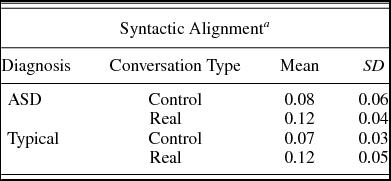
The ANCOVA revealed that, when lexical alignment was controlled for, there was a significant main effect of conversation type on syntactic alignment, in the natural conversation task, F (1, 31) = 14.95, p = .001, partial η2 = 0.33. This indicates that, overall, children repeated syntax at above-chance level in real conversations (see Table 8), and it is evidence of alignment effects. Further, there was no significant main effect of diagnosis on overall syntactic alignment, F (1, 31) = 0.42, partial η2 = 0.01, ns. There was also no significant interaction between diagnosis and syntactic alignment as a repeated measure, F (1, 31) = 0.02, p = .90, partial η2 = 0, demonstrating that alignment effects between the groups were equivalent. Taken together, these findings are consistent with Study 1.
Syntactic alignment scores (cosine) by diagnosis and conversation type (natural conversation task)
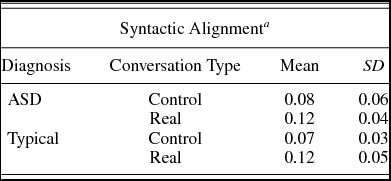
aEstimated marginal means.
Cross-task comparison of alignment effect size
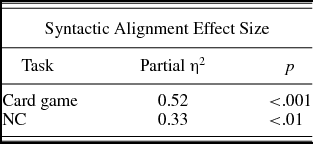
The third objective of this paper was to find out whether syntactic alignment effect sizes differed between the experimental and the naturalistic tasks. To address this question, we compared within-participant alignment effect sizes from the natural conversation task with aggregated effect sizes from the card game (see Table 9). Aggregated effect sizes are calculated as the average of passive and DO syntactic alignment effect sizes.
Syntactic alignment effect size scores by task
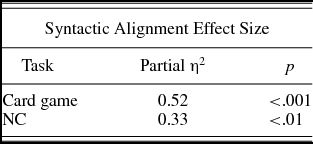
Although effect sizes are large in both tasks, according to Cohen's (Reference Cohen1988) guidelines, there is clearly a stronger syntactic alignment effect in the card game. This finding is in line with our prediction, and it most likely reflects that, in the card game, children's target descriptions were highly constrained. It is also worth noting that, while children aligned syntax across up to seven bigrams in the card game, our analysis of natural conversation task data offered no evidence of syntactic alignment beyond the quadrigram level. This means that, in natural conversation, children did not copy grammar sequences of the length of those used in the card game. This lends further support to our suggestion that alignment is superficially heightened in referential communication tasks.
GENERAL DISCUSSION
Across the studies presented here, we sought to discover whether previous findings about alignment in ASD children could be replicated. We also sought to discover how far these findings could be considered as ecologically valid, and thereby how accurately experimental tasks measure alignment in ASD.
In our first study, based on the findings of Allen et al. (Reference Allen, Haywood, Rajendran and Branigan2011) and Slocombe et al. (Reference Slocombe, Alvarez, Branigan, Jellema, Burnett and Fischer2012), we predicted that ASD children would align syntax to the same extent as verbal mental age-matched typical controls while playing a pictorial card description game. We found evidence in support of this prediction. Like Allen et al. (Reference Allen, Haywood, Rajendran and Branigan2011), we found no significant difference in passive syntactic alignment effects between our ASD and our typical groups. A novel finding was that ASD children also aligned DO syntax to the same extent as controls, despite their putative difficulty with dative alternation. Further, these abilities were not related to chronological age or language ability in our sample. The latter finding is different from Allen et al.'s (Reference Allen, Haywood, Rajendran and Branigan2011) study, but we suspect this minor difference may simply reflect sampling variability, or the adjustments we made to the task.
In our second study, we predicted that the syntactic alignment observed in the card game would not generalize to natural conversation for the ASD group, because conversation is comparatively less structured and goal opaque. Against our prediction, but consistent with the findings of Study 1, ASD children did not differ significantly from controls in the extent to which they aligned syntax with an interlocutor. To our knowledge, this study is unique in demonstrating intact alignment abilities in the natural conversations of ASD children. Furthermore, we believe this study is unique in demonstrating above-chance priming effects in natural conversation, which Healey et al. (Reference Healey, Purver and Howes2012) and Howes et al. (Reference Howes, Healey and Purver2010) did not. We speculate that our use of a bigram model to calculate syntactic alignment, rather than the syntactic rule model used by Healey et al. (Reference Healey, Purver and Howes2012) and Howes et al. (Reference Howes, Healey and Purver2010), might explain this inconsistency. Alternatively, the inconsistency may be attributable to the nature of the data analyzed in our study versus the other studies. Healey et al. (Reference Healey, Purver and Howes2012) and Howes et al. (Reference Howes, Healey and Purver2010) analyzed conversations from a spoken language corpus that is not child oriented, and it has been shown that syntactic priming effects are stronger in children than in adults (Rowland, Chang, Ambridge, Pine, & Lieven, Reference Rowland, Chang, Ambridge, Pine and Lieven2012). Rowland et al. (Reference Rowland, Chang, Ambridge, Pine and Lieven2012) also demonstrated that lexical boost effects are stronger in adults than in children, which may explain why, in Healey et al.'s (Reference Healey, Purver and Howes2012) study, specifying lexical alignment as a covariate in their analysis eradicated syntactic alignment effects. Our results give us reason to believe that alignment is not merely an experimental artifact.
A third prediction of our studies was that, in line with Healey at al. (Reference Healey, Purver and Howes2012) and Howes et al. (Reference Howes, Healey and Purver2010), there would be weaker syntactic alignment effects in natural conversation than in the card game, again owing to the comparative structuredness and goal directedness of the game. This prediction was supported, and we also found that, in natural conversation, there was no alignment on syntactic structures of the length of those used in the card game. This finding highlights that, while experimental approaches to measuring syntactic alignment may reliably capture group differences (or lack thereof) in this behavior, they may also overestimate its prevalence in real-life interactions (cf. also Healey et al., Reference Hanley, McPhillips, Mulhern and Riby2012). At present, there is therefore a trade-off to be made in the study of alignment, between external and ecological validity. While experimental studies of alignment delimit error variance (Gries, Reference Gries2005), naturalistic studies assess the prevalence of alignment more realistically.
Overall, the results of both our studies are consistent with unmediated accounts of alignment, which conceptualize lower level alignment as an unconscious, automatic process facilitated by priming mechanisms. According to such accounts, prior exposure to dispreferred syntactic forms (passive; DO) increased subsequent access to these forms, either through residual activation or through implicit learning. If priming resulted from residual activation, alignment effects can be construed in terms of the short-term activation of lemma nodes representing lexical entries in the mental lexicon. Pickering and Branigan (Reference Pickering and Branigan1998) argue that the comprehension of a sentence with a particular structure activates the syntactic representations associated with that structure, facilitating the subsequent comprehension or production of a sentence containing the same structure. In contrast, if priming resulted from implicit learning, then alignment effects can be construed in terms of an error-driven implicit learning process. Chang et al. (2006) posit a dual-path model of syntactic priming, which predicts the upcoming structure of a sentence, adjusts its internal representations in response to error, and thereby biases the production of subsequent, similar structures. In either case, our study demonstrates that ASD children align syntax with an interlocutor, without any explicit instruction to do so, and in both an experimental and a naturalistic setting.
We cannot fully discount the possibility that alignment in the ASD group was mediated by mentalizing abilities, however. As noted, and despite widely documented ToM impairment in ASD children, our groups performed equally well on the Sally-Anne task, suggesting that all the children had at least a basic ability to adopt another person's perspective. Use of other, more advanced ToM measures may be necessary to avoid such ceiling effects in future research, and they might elucidate a role for audience design in ASD children's alignment. Higher order ToM impairment does not appear to affect alignment abilities in other clinical populations, however (Stewart, Corcoran, & Drake, Reference Stewart, Corcoran and Drake2008).
As well as contributing to the alignment literature, our findings contribute to the literature on imitation in ASD. A review of studies that consider action imitation in ASD concludes that ASD individuals struggle to copy actions that are unfamiliar and that do not have a clear goal (Vivanti & Hamilton, Reference Vivanti, Hamilton, Volkmar, Paul, Rogers and Pelphrey2014). Although motor imitation is a different form of imitation than language alignment, it is nevertheless surprising that the ASD children in our studies showed no deficiencies of imitation in the verbal domain, because conversation can itself be goal opaque. It is also surprising given that language deficits are a diagnostic feature of ASD. Lower level linguistic alignment may therefore represent a form of imitation that is spared in verbal ASD children.
Two questions remain over the syntactic alignment we observed in our studies. First, while ASD and typical children aligned to the same extent, we were not able to establish whether this behavior is underpinned by the same or different mechanisms. It is known, for example, that typical children imitate for social affiliative reasons (Over & Carpenter, Reference Over and Carpenter2009). However, because ASD children have reduced social motivation (Chevallier, Kohls, Troiani, Brodkin, & Schultz, Reference Chevallier, Kohls, Troiani, Brodkin and Schultz2012), it is possible that their alignment is differently driven. Second, we do not know whether syntactic alignment actually supports the alignment of situation models in ASD children, as it is theorized to do. We have already argued that the pragmatic deficits associated with ASD imply nonalignment of situation models. This suggests that the alignment process in ASD is not wholly unmediated, because alignment at one linguistic level seems not to promote alignment at another.
A plausible explanation for both the alignment and the pragmatic findings in ASD is that the syntactic alignment we observed in our sample reflected only superficial but not deep coordination processes. The possibility that alignment involves unmediated and mediated components was first proposed by Garrod and Clark (Reference Garrod and Clark1993), and more recently by Branigan, Pickering, Pearson, and McLean (Reference Branigan, Pickering, Pearson and McLean2010). In a study of alignment in the conversations of typical children, Garrod and Clark (Reference Garrod and Clark1993) sought to explain why, in a group of children aged 7–12 years, the youngest children (7–8 years) showed the least communicative success on a maze task, despite aligning syntax and lexis at a comparable level to the older children. The explanation offered was that the younger children only superficially aligned with an interlocutor, and were less sensitive than older children to the mutual intelligibility of their conversation exchanges. As an illustrative example, Garrod and Clark (Reference Garrod and Clark1993, p. 124) offer this exchange between two children aged 7–8 years:
Child B: Tell me where you are.
Child A: I’m at a switch box and mine's flashing.
Child B: Right where your's . . . where's your switch box . . . where's your cross.
Child A: Well it's just above a switch box.
Child B: And mine's is kind of diagonal where the switch box is.
Child A: Yeh, right.
Although Child A's description of her position in the maze is inadequate, Child B adopts the same description to identify her own position, a choice that subsequently results in communication failure, rather than mutual understanding. The children have difficulties with semantic alignment: while they converge on a lexicon and descriptive scheme, they have no local construal of what their task-relevant language means.
For our purposes, Garrod and Clark's account is appealing in two ways. First, it consolidates alignment and pragmatics findings in ASD, suggesting that lower level alignment may be a necessary but not sufficient condition for establishing common understanding in conversation. This suggestion is supported by studies of ASD individuals with echolalia, whose strongly aligned responses tend to disrupt rather than promote conversation (Grossi et al., Reference Grossi, Marcone, Cinquegrana and Gallucci2013; Ross, Reference Ross2002). Studies of echolalia in ASD offer tentative evidence for a missing link between lower and higher level alignment in this population. Second, the account highlights how critical semantic alignment is to the alignment process, and what the costs are of its impairment. This is important because, as Allen et al. (Reference Allen, Haywood, Rajendran and Branigan2011) have speculated, the communicative difficulties of ASD children may relate to impaired semantic alignment. Allen et al.'s (Reference Allen, Haywood, Rajendran and Branigan2011) proposition is consistent with studies showing that semantic processing is widely compromised in ASD (cf., e.g., Kamio, Robins, Kelley, Swainson, & Fein, Reference Kamio, Robins, Kelley, Swainson and Fein2007; Menyuk & Quill, Reference Menyuk, Quill, Schopler and Mesibov1985; Tager-Flusberg, Reference Tager-Flusberg1981). Figurative language can prove particularly challenging for ASD individuals, who are prone to miscomprehending jokes (Emerich, Creaghead, Grether, Murray, & Grasha, Reference Emerich, Creaghead, Grether, Murray and Grasha2003), irony (Happé, Reference Happé1993), and sarcasm (Persicke, Tarbox, Ranick, & St. Clair, Reference Persicke, Tarbox, Ranick and St. Clair2013). Therefore, ASD children with no fundamental impairment of alignment may still have poor communicative competence.
Despite the compelling pattern of our data, we acknowledge some limitations to our studies, owing in part to the nonexperimental design of Study 2. One limitation was that the interlocutor was not a constant factor across the card game and the natural conversation task. This was a practical decision in Study 1, because it was not feasible to engage children as confederates in the card game. In Study 2, we felt it would have been problematic to have the experimenter hold 34 conversations on the same topic with different children. We do not believe that our results were grossly affected by this methodological inconsistency, especially if alignment is unmediated. Because alignment can be mediated, however, we recognize that children may have aligned less with a peer than they would have done with the experimenter. We assume this on the basis that the children and their classmates already had common ground to draw on. As a result, the need to establish mutually intelligible referents may have been diminished, and syntactic alignment might therefore have been less ubiquitous. The significance of this is that, in our studies, there may have been a smaller difference in alignment across tasks, had the interlocutor remained constant.
Another methodological inconsistency, which we have already highlighted, is that we did not measure alignment in the same way across our studies. The rarity of passive and DO structures in spoken language, which facilitated the calculation of alignment effects in Study 1, was the reason that we had to look more broadly at syntactic alignment in Study 2. While Study 2 has the advantage of not being artificially constrained to two types of syntax, it is the case that the alignment effects that we have presented here are measured differently in Studies 1 and 2. In Study 1, we follow the standard practice of alignment experiments, calculating how often dispreferred syntactic targets follow dispreferred syntactic primes, and adjusting for dispreferred targets following preferred primes. In Study 2, however, where responses are unconstrained, it was not possible to calculate alignment effects in the same way. As an alternative, and consistent with other, naturalistic studies of alignment, we calculated global alignment effects, which indicate how much syntactic alignment there is above chance (i.e., is there really any alignment at all?), after taking any lexical boost effects into account. These are clearly very different measures of alignment effects, but a universal formula for working out alignment effects in both experimental and naturalistic settings has not yet been devised.
Finally, and like many studies of ASD, our studies may suffer from small sample size effects, a fact compounded by the notorious heterogeneity of ASD. In particular, we acknowledge that, in Study 1, there were group differences between typical and ASD children, albeit not at the level of statistical significance. It is possible that a larger, more powerful study would have yielded different results, although we observe that Allen et al.'s (Reference Allen, Haywood, Rajendran and Branigan2011) study showed highly equivalent alignment effects between ASD and typical children. A more powerful approach to measure alignment in ASD children's natural conversations would be to analyze large amounts of corpus data, as other studies have done. To date, however, we are not aware of any corpus of conversations in ASD being publicly available. Further data collection is therefore necessary to ascertain whether our pattern of results generalizes to a larger sample.
Given that ASD children may have impaired semantic alignment abilities, future research should examine this possibility more closely. There was no scope in our study tasks for examining the communicative success of ASD children, or how alignment might relate to this. A different and more difficult experimental task, such as Garrod and Clark's (Reference Garrod and Clark1993) maze game, would help to clarify whether semantic alignment is intact in ASD, and if so, how it supports alignment of situation models. A greater challenge would be to develop a task where these variables could be studied in a real-world setting. Further investigation of the mechanisms of alignment in ASD and typical children is also necessary, to probe how similar alignment behaviors actually are between these groups. Research into both these questions is ongoing.
In summary, we found in our studies that ASD children align syntax to the same extent as typical controls, in natural conversation as well as in an experimental task. This finding lends ecological validity to previous experimental work on alignment in ASD, suggesting that ASD individuals are able to align linguistic representations with an interlocutor outside of a laboratory setting. We have also called into question the experimental tasks used to measure alignment, however. While these have not been presented as proxies for real conversations, they do give a false impression of how much people align in natural settings. We therefore recommend that caution be exercised over the generalizability of experimental findings on alignment, pending further naturalistic research. Further studies must also investigate whether ASD children align at higher linguistic levels, such as semantics, and whether alignment is underpinned by the same mechanisms in ASD and typical children.
APPENDIX A
Experimenter's card game script (1)
A dog is biting a robber.
A nurse is being squashed by a pig.
A lion sends a girl a letter.
A dog cuts a fireman a cake.
A penguin throws a banana to a cowboy. [SNAP!]
An elephant sings a song for a boy.
A lion is hitting a fireman.
A horse is pulling a clown.
A queen is being carried by a cow.
A crocodile is kicking a knight. [SNAP!]
A soldier is being pulled by a tiger.
A sheep sings a song to a queen.
A horse reads a book to a nurse.
A rabbit gives a clown a ball.
A chef is being photographed by a dolphin. [SNAP!]
A robber is being carried by an elephant.
A bear is patting a girl.
A king is being hit by a frog.
A pig pours a drink for a witch.
A pirate is being washed by a seal. [SNAP!]
A frog reads a book to a fairy.
A tiger gives a ball to a doctor.
A cat is patting a witch.
A bear sends a soldier a letter.
A snake is painting a diver a picture. [SNAP!]
A cat pours a robber a drink.
A sheep is squashing a fairy.
A doctor is being bitten by a rabbit.
A cow cuts a king a cake.
A giraffe is hugging a vampire. [SNAP!]
ACKNOWLEDGMENTS
This research was supported by the Engineering and Physical Sciences Research Council Grant EP/K503198/1. We are grateful for the support of the staff and children at participating schools. Thanks to Rod Bond and Ben Cowan for their assistance with the statistics reported in Study 1. Thanks also to Kate Messenger for the loan of materials adapted in Study 1.